Ms-116
German (epub, pdf) | German/English
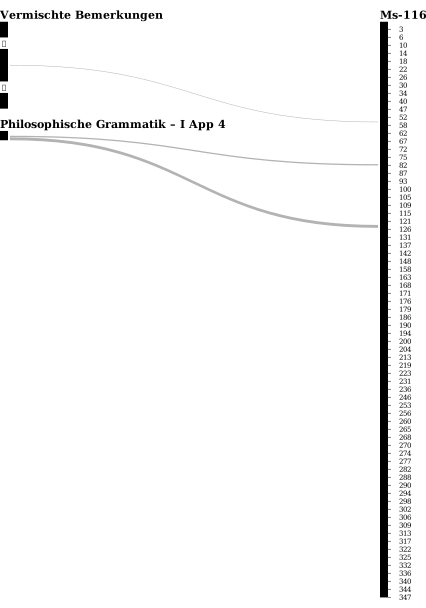
7 published remarks, VB, PG I App IV
Do not quote from or cite this translation!
§
IIr[1]Philosophische Bemerkungen XII
Philosophical Remarks XII
§
1[1]1 Kann man denn etwas Anderes, als einen Satz, verstehen? Oder: Ist es nicht erst ein Satz, wenn man es versteht. Also: Kann man Etwas anders als als Satz verstehen?
1 Can one understand anything other than a sentence? Or: Is it not a sentence until one understands it? Thus: Can one understand anything other than a sentence?
§
1[2]2 Man möchte davon reden: “einen Satz zu erleben”. Läßt sich dieses Erlebnis niederschreiben? –
2 One might like to talk about “experiencing a sentence.” Can this experience be written down? –
§
1[3] &2[1]
3 Denke: daß es in einem gewissen Sinne keinen halben Satz gibt. Das heißt, vom halben Satz gilt, was
vom Wort gilt, daß er nur im Zusammenhang des Satzes Sinn hat. (Der Rösselsprung besteht aus einer graden & einer schiefen Bewegung. Vergleiche nun: “ein halber Rösselsprung ”, &: “eine halbe Semmel”. Eine halbe Semmel ist besser als gar keine. –)
3 Consider: in a certain sense, there is no half-sentence. That is to say, what applies to the half-sentence also applies to the word, namely that it only has sense in the context of the sentence. (A horse-leap consists of a straight and an oblique movement. Now compare: “a half horse-leap,” & “a half bread roll.” A half bread roll is better than no bread roll at all. –)
§
2[2]1 Überlegen: ‘Das Verstehen fängt aber erst mit dem Satz an. (Und darum interessiert es uns nicht.)’
1 Consider: ‘Understanding only begins with the sentence. (And that is why it does not interest us.)’
§
2[3]2 = 3˙2 Eine Versuchung, zu glauben, das Wort “verstehen”, der Ausdruck: “einen Satz verstehen”, seien metalogische Worte.
2 = 3˙2 A temptation to believe that the word “understand,” the expression “to understand a sentence,” are metalogical words.
§
2[4]3 Was soll uns das Verstehen bekümmern? Wir müssen ja das Zeichen verstehen, daß es für uns ein Zeichen ist!
3 Why should understanding concern us? We must understand the sign in that it is a sign for us!
§
2[5]4 ‘Es wäre ja auch seltsam, daß die Wissenschaft, die Mathematik, die Sätze gebraucht, aber von ihrem Verstehen nicht spricht.’
4 ‘It would also be strange if science, mathematics, used sentences, but did not speak of their understanding.’
§
2[6] &3[1]
5 Man sieht in dem Verstehen das Eigentliche, im Zeichen das Nebensächliche. – Übrigens, wozu dann das Zeichen überhaupt? – Nur um sich Andern verständlich zu machen? Aber wie ist das möglich? Ich meine, – wie geschieht dies? Ich meine, – wie geschieht dies? – Hier wird das Zeichen als ein Medikament angesehen, das im Andern den gleichen Zustand hervorrufen soll, den ich habe.
5 One sees the essential thing in understanding, the inessential thing in the sign. – By the way, what is the point of the sign at all? – Only to make oneself understandable to others? But how is that possible? I mean, – how does this happen? I mean, – how does this happen? – Here the sign is regarded as a medicine that should produce the same state in the other person that I have.
§
3[2]1 Auf die Frage “was meinst Du?” antworten wir: “ich meine das & das”, (&) nicht: “ich meine, was ich mit dem Satz ‥‥‥ meine.”
1 In answer to the question “what do you mean?” we reply: “I mean this & that,” (&) not: “I mean what I mean by the sentence ‥‥‥.”
§
3[3]2 = 2˙2 Eine Versuchung, zu glauben, die Bedeutung des Worts “verstehen”, des Ausdrucks “einen Satz verstehen”, sei metalogisch. “Verstehen” & “meinen” sind Worte wie alle anderen.
2 = 2˙2 A temptation to believe that the meaning of the word “understand,” the expression “to understand a sentence,” is metalogical. “Understand” & “mean” are words like all others.
§
3[4]3 Was ein Satz meint, spricht eine Erklärung aus. So fällt am Schluß die Meinung ganz aus der Sprache, also aus der Betrachtung, heraus; & es bleibt die Sprache, das Einzige, was wir betrachten können.
3 What a sentence means is expressed in an explanation. Thus, in the end, opinion falls completely out of the language, and therefore out of consideration; & there remains the language, the only thing we can consider.
§
4[1]1 ‘Die Sprache muß für sich selbst sprechen.’
1 ‘Language must speak for itself.’
§
4[2]2 ‘Alles, was ich in der Sprache tun kann, ist etwas sagen: das eine sagen. (Das eine sagen im Raume dessen, was ich hätte sagen können.)’
2 ‘All I can do in language is say something: say the one. (Say the one within the space of what I could have said.)’
§
4[3]3 ‘Gesprochenes erklärt man durch die Sprache. Darum kann man die Sprache, in diesem Sinn, nicht erklären.’
3 ‘Spoken language is explained by language. Therefore, one cannot explain the language in this sense.’
§
4[4]4 Eine Interpretation ist immer nur eine im Gegensatz zu einer andern. Sie hängt sich an das Zeichen & reiht es in ein (weiteres) System ein.
4 An interpretation is always only one in contrast to another. It attaches itself to the sign & incorporates it into a (further) system.
§
4[5] &5[1]
5 Wenn Frege gegen die formale Auffassung der Arithmetik spricht, so sagt er gleichsam: diese kleinlichen Erklärungen, die Symbole betreffend, sind müßig, wenn wir diese verstehen. Und das Verstehen ist quasi das Sehen eines Bildes – aus dem dann alle Regeln folgen (wodurch sie verständlich werden). Frege sah aber – glaube ich – nicht, daß dieses Bild nur wieder ein Zeichen ist, oder auch ein Kalkül, – der uns den niedergeschriebenen Kalkül erklärt. Und, was wir Verstehen einer Sprache nennen, gleicht überhaupt dem Verstehen eines Kalküls, das daher kommt, daß wir die Gründe seiner Entstehung, oder seine Anwendung kennen lernen. Und auch da lernen wir einen leicht überblickbaren Symbolismus statt des fremden kennen. (Verstehen heißt hier etwas ähnliches wie übersehen können.)
5 When Frege speaks against the formal conception of arithmetic, he says, as it were, that these petty explanations concerning the symbols are superfluous if we understand them. And understanding is, as it were, seeing a picture – from which all the rules then follow (thereby becoming understandable). But Frege, I believe, did not see that this picture is only another sign, or even a calculus, which explains the written calculus to us. And what we call understanding a language is, in general, like understanding a calculus, which comes from the fact that we learn the reasons for its origin or its application. And there too, we learn a readily comprehensible symbolism instead of the foreign one. (Understanding here means something similar to being able to overlook it.)
§
5[2]1 Wenn komplizierte seelische Vorgänge hinter der Front der Symbole beim Verstehen des Wortes “und” (z.B.) vorsichgehen müssen – wie kommt es dann, daß von ihnen in der Logik nie die Rede ist, noch sein braucht?
1 If complicated mental processes must take place behind the facade of the symbols when understanding the word “and” (e.g.) – how is it that they are never mentioned in logic, nor need be?
§
5[3] &6[1]
2 Wenn ich jemandem einen Befehl gebe, so ist es mir ganz genug, ihm Zeichen zu geben. Und ich würde nie sagen: Das sind ja nur Worte, & ich muß hinter die Worte dringen. Ebenso, wenn ich jemand etwas gefragt habe & er gibt mir eine Antwort (also ein Zeichen), bin ich zufrieden – das war es, was ich erwartete – & wende nicht ein: Das ist ja eine bloße Antwort.
2 When I give someone a command, it is quite enough for me to give them a sign. And I would never say: These are just words, & I must look beyond the words. Likewise, when I have asked someone something & they give me an answer (i.e., a sign), I am satisfied—that was my expectation—& do not object: That is merely an answer.
§
6[2]1 Wenn man aber sagt: “wie soll ich wissen, was er meint, ich sehe ja nur seine Zeichen”, so sage ich: “wie soll er wissen, was er meint, er hat ja auch nur seine Zeichen”.
1 But if one says: “how am I supposed to know what he means, I only see his signs,” I say: “how is he supposed to know what he means, he only has his signs too.”
§
6[3]2 “Etwas habe ich aber doch gemeint, als ich das sagte!” – Wohl, aber wie können wir, was es ist, herausbringen? Doch wohl nur, indem er es uns sagt. Wenn wir nicht sein übriges Verhalten als Kriterium nehmen sollen, dann also (das), was er uns erklärt.
2 “But I did mean something when I said that!” – Well, but how can we find out what it is? Only, presumably, by him telling us. If we are not to take his other behaviour as a criterion, then (it) is what he explains to us.
§
6[4] &7[1]
3 Denke Dir, Einer hätte das Schachspiel ursprünglich als ein Schreibspiel kennen gelernt & wüßte nichts von der Deutung dieses Spiels als Brettspiel. Später würde sie ihm gezeigt.
3 Imagine that someone had originally learned chess as a writing game and knew nothing of the interpretation of this game as a board game. Later, it would be shown to him.
§
7[2]1 “Du hast mit der Hand eine Bewegung gemacht; hast Du etwas damit gemeint? – Ich dachte, Du meintest, ich solle zu Dir kommen.” Also er konnte etwas meinen, oder auch nichts meinen. Und wenn das erstere: dann, was er auch ausdrückte, oder etwas Anderes? Hat er mit seinem Ausdruck etwas anderes, als diesen, gemeint, oder hat er nur seinen Ausdruck – gemeint?
1 “You made a movement with your hand; did you mean something by it? – I thought you meant that I should come to you.” So he could mean something, or also mean nothing. And if the former: then, what he also expressed, or something else? Did he mean something other than this with his expression, or did he only mean his expression?
§
7[3]2 Könnte man auch antworten: “Ich habe etwas mit dieser Bewegung gemeint, was ich nur durch diese Bewegung ausdrücken kann”?
2 Could one also answer: “I meant something with this movement, which I can only express through this movement”?
§
7[4] &8[1]
3 ‘Wir unterscheiden doch Sprache von dem, was nicht Sprache ist; Schrift von dem, was keine Schrift ist. Wir sehen Striche, an einer Mauer etwa, & sagen wir verstehen sie; & andere – & sagen, sie bedeuten nichts (oder, uns nichts). Damit ist doch eine sehr allgemeine Erfahrung charakterisiert, die wir nennen könnten: “etwas als Sprache verstehen” – ganz abgesehen von dem, was wir aus den Strichen (etc.) herauslesen.’
3 ‘We distinguish language from what is not language; writing from what is not writing. We see lines, on a wall for example, & say we understand them; & others – & say, they mean nothing (or, to us nothing). This characterizes a very general experience, which we could call: “understanding something as language” – quite apart from what we read out of the lines (etc.).’
§
8[2]1 Ich sehe eine deutsche Aufschrift & eine chinesische: Ist die chinesische etwa ungeeignet, etwas mitzuteilen? ‒ ‒ Ich sage: ich habe Chinesisch nicht gelernt. Aber dies gibt nur die vermutliche Ursache an der gegenwärtigen Erscheinung, die allein uns jetzt interessiert.
1 I see a German inscription & a Chinese one: is the Chinese one perhaps unsuitable for communicating something? ‒ ‒ I say: I have not learned Chinese. But this only indicates the probable cause of the present phenomenon, which alone interests us now.
§
8[3] &9[1]
2 Geben wir denn den Worten, die uns gesagt werden, willkürlich Interpretationen? Kommt nicht das Erlebnis des Verstehens mit dem Erlebnis des Hörens (oder Sehens) der Zeichen, wenn wir die Sprache verstehen? Wenn mir jemand etwas sagt & ich verstehe (es), so geschieht mir dies, so wie, daß ich höre. Und hier ist also Verstehen das Phänomen, – die Phänomene, welche sich einstellen, wenn ich einen deutschen Satz höre, & die dieses Hören unterscheiden von dem eines Satzes einer mir unbekannten Sprache.
2 Do we arbitrarily assign interpretations to the words that are said to us? Does not the experience of understanding come with the experience of hearing (or seeing) the signs, when we understand the language? When someone says something to me & I understand (it), this happens to me in the same way as when I hear. And here understanding is the phenomenon – the phenomena, which occur when I hear a German sentence, & which distinguish this hearing from hearing a sentence in a language unknown to me.
§
9[2]1 Denken wir an eine Chiffre: Ein Satz sei mir in der Chiffre gegeben & auch ihr Schlüssel; dann ist mir natürlich in einer Beziehung alles zum Verständnis des Satzes gegeben. Und doch würde ich auf die Frage “verstehst Du diesen Satz”, antworten: Nein, noch nicht; ich muß ihn erst entziffern. Und erst, wenn ich ihn, z.B., ins Deutsche übertragen hätte, würde ich sagen: “jetzt versteh ich ihn”. Wenn man (sich) hier die Frage stellt: “In welchem Augenblick dieses Übertragens verstehe ich (zuerst) den Satz”, so erhält man einen Einblick in das Wesen dessen, was wir “verstehen” nennen.
1 Let us think of a cipher: a sentence is given to me in the cipher & also its key; then I am, of course, in one respect given everything for understanding the sentence. And yet I would answer the question “Do you understand this sentence?”, No, not yet; I must first decipher it. And only when I have, for example, translated it into German, would I say: “now I understand it.” If one asks oneself here: “At what point in this translation do I (first) understand the sentence?”, one gains an insight into the essence of what we call “understanding.”
§
10[1]1 Ich sage einen Satz: “ich sehe einen schwarzen Kreis”; aber auf diese besondern Wörter kommt es doch nicht an – setzen wir also statt ihrer diese: “a b c d e.” Aber nun kann ich, wenn ich das lese, mit ihm nicht ohne weiteres den oberen Sinn verbinden. – Ich bin nicht gewöhnt – könnte ich sagen – statt “ich” “a” & statt “sehe” “b” & statt “einen” “c” zu sagen, etc.. Aber damit meine ich nicht, ich sei nicht gewöhnt, mit “a” sofort das Wort “ich” zu assoziieren, sondern ich bin nicht gewöhnt, “a” an der Stelle von “ich” zu gebrauchen – in der Bedeutung von “ich”.
1 I say a sentence: “I see a black circle”; but these particular words are not what matters – so let us substitute these with: “a b c d e.” But now, when I read that, I cannot immediately connect it with the sense mentioned above. – I am not used – one might say – to saying “a” instead of “I” & “b” instead of “see” & “c” instead of “a,” etc. But I do not mean that I am not used to associating “a” immediately with the word “I,” but rather I am not used to using “a” in place of “I” – in the sense of “I.”
§
10[2]2 “Ich sage das nicht nur, ich meine auch etwas damit.” – Wenn man sich überlegt, was dabei in uns vorgeht, wenn wir Worte meinen (und nicht nur sagen), so ist es uns, als wäre dann etwas mit diesen Worten gekuppelt, während sie sonst leer liefen. – Als ob sie gleichsam in uns eingriffen.
2 “I don’t just say that, I also mean something by it.” – If one considers what happens within us when we mean words (and not just say them), it seems as if something is then coupled with these words, whereas otherwise they run empty. – As if they, as it were, intervened in us.
§
11[1]1 ‘Ich verstehe einen Befehl als Befehl, d.h., ich sehe in ihm nicht nur diese Struktur von Lauten oder Strichen, sondern sie hat – sozusagen – einen Einfluß auf mich. Ich reagiere auf den Befehl (auch ehe ich ihn befolge) anders, als etwa auf eine Mitteilung, oder Frage. (Ich lese ihn in anderem Tonfall, mit anderer Miene & Geste.)’
1 ‘I understand an order as an order, i.e., I don’t just see in it this structure of sounds or strokes, but it has – in a way – an influence on me. I react to the order (even before I obey it) differently than, for example, to a communication, or a question. (I read it in a different tone, with a different mien & gesture.)’
§
11[2]2 Der Satz, wenn ich ihn verstehe, bekommt für mich Tiefe.
2 The sentence, when I understand it, gains depth for me.
§
11[3]1 In einer Erzählung steht der Satz: “Nachdem er das gesagt hatte, verließ er sie, wie am vorigen Tage.” – Fragt man mich, ob ich diesen Satz verstehe, so ist nicht ganz leicht, drauf zu antworten. Es ist ein deutscher Satz, & insofern verstehe ich ihn. Ich wüßte, wie man diesen Satz etwa gebrauchen könnte; ich könnte selbst einen Zusammenhang für ihn erfinden. Und doch verstehe ich ihn nicht so, wie ich ihn verstünde, wenn ich die Erzählung bis zu diesem Satz gelesen hätte.
1 In a story, the sentence says: “After he had said that, he left her, as on the previous day.” – If one asks me whether I understand this sentence, it is not entirely easy to answer. It is a German sentence, & in that respect I understand it. I would know how one could use this sentence; I could even invent a context for it. And yet I do not understand it in the way that I would understand it if I had read the story up to this sentence.
§
12[1]1 Was heißt es, ein Bild, eine Zeichnung zu verstehen? Auch da gibt es Verstehen & nicht verstehen. Und auch da können diese Ausdrücke verschiedenerlei bedeuten. Das Bild soll eine Anordnung von Gegenständen – etwa ein Stilleben – darstellen; einen Teil des Bildes aber verstehe ich nicht: d.h., ich bin nicht fähig, dort Körper zu sehen, sondern sehe nur Farbenflecke auf der Bildfläche. – Oder ich sehe alles körperlich, aber auf dem Bild sind Gegenstände dargestellt, die ich (noch) nie gesehen habe. Und da gibt es den Fall, wo etwas offenbar (z.B.) ein Vogel ist, aber nicht einer den ich kenne; oder, ich sehe einen Gegenstand, der mir ganz und gar fremd ist. – Vielleicht aber kenne ich alle Gegenstände, verstehe aber – in anderem Sinne – ihre Anordnung nicht.
1 What does it mean to understand a picture, a drawing? There, too, there is understanding & not understanding. And also there, these expressions can mean different things. The picture is supposed to represent an arrangement of objects – for example, a still life; but I do not understand one part of the picture: i.e., I am not able to see bodies there, but only see patches of color on the surface of the picture. – Or I see everything physically, but the picture depicts objects that I have (never) seen before. And then there is the case where something is obviously (e.g.) a bird, but not one that I know; or, I see an object that is completely unfamiliar to me. – Perhaps, however, I know all the objects, but I do not understand – in another sense – their arrangement.
§
12[2] &13[1]
2 Angenommen, das Bild stellte Menschen & Pferde dar & sie wären darauf etwa 1 Fuß hoch. Angenommen nun, ich kennte Menschen & Pferde von dieser Größe, so könnte ich das Bild als ihre lebensgroße Darstellung sehen; & es würde mir nun einen andern Eindruck machen, als, den ich gewöhnt bin; obwohl doch die dreidimensionale Erscheinung der Gestalten (auf dem Bild) die nämliche wäre. Und doch ist der Eindruck des Bildes unabhängig von dem Gesichtseindruck, den ein wirklicher Mensch gemacht hat. Ich meine: in den visuellen Eindruck des Bildes tritt nicht, z.B., die Erinnerung an die Größe wirklicher Menschen ein.
2 Suppose the picture depicted people & horses & they were about 1 foot high. Suppose now that I know people & horses of this size, so I could see the picture as their life-size depiction; & it would now make a different impression on me than the one I am used to; although the three-dimensional appearance of the figures (in the picture) would be the same. And yet the impression of the picture is independent of the visual impression that a real person made. I mean: the visual impression of the picture does not include, for example, the memory of the size of real people.
§
13[2] &14[1]
1 Dieses Sehen der gemalten Gestalten als Menschen & nicht als Zwerge ist, in gewisser Beziehung analog dem Sehen der Figuren als räumlicher Gebilde, statt als ebener. Es ist hier durchaus unpassend, zu sagen, wir fassen, was wir sehen, einmal als das Eine, einmal als das Andere auf, sähen aber immer dasselbe.
1 This seeing of the painted figures as people & not as dwarfs is, in a certain respect, analogous to seeing the figures as spatial forms, rather than as flat. It is entirely inappropriate to say that we sometimes grasp what we see in one way, sometimes in another, but always see the same thing.
§
14[2]1 Und ähnlich, wenn wir einen Satz mit Verständnis & ohne Verständnis lesen. (Erinnere Dich daran, wie es ist, wenn man einen Satz mit falscher Betonung liest, ihn daher nicht versteht, & nun auf einmal darauf kommt, wie er zu lesen ist.)
1 And similarly, when we read a sentence with understanding & without understanding. (Remember what it is like when one reads a sentence with incorrect emphasis, and therefore does not understand it, & then suddenly realizes how it should be read.)
§
14[3]2 Beim Lesen einer schleuderhaften Schrift kann man erkennen, was es heißt, etwas in das gegebene Bild hineinsehen.
2 When looking at a scrawled script, one can recognize what it means to see something in the given picture.
§
14[4]3 Eine Uhr als Uhr, d.h. als Zifferblatt mit Zeigern, sehen ist ähnlich dem: den Orion als schreitenden Mann (zu) sehen.
3 Seeing a clock as a clock, i.e., as a dial with hands, is similar to: seeing the Orion as a walking man.
§
14[5] &15[1]
4 Denke an den Unterschied der Auffassung des Satzes – wenn in ihm dies Wort einmal zu diesem, einmal zu jenem gehörig angesehen wird. Und ich hätte auch sagen können, es werde einmal zu diesem, einmal zu jenem Wort gehörig – verstanden, gesehen, ausgesprochen.
4 Think of the difference in the understanding of the sentence – when, in it, this word is considered to belong to this one, and sometimes to that one. And I could also have said that it is sometimes understood, seen, or spoken as belonging to this word, sometimes to that one.
§
15[2]1 Wir könnten uns den Marsbewohner denken, der auf der Erde erst nach & nach den Gesichtsausdruck der Menschen als solchen verstehen lernte, & z.B. den drohenden erst nach gewissen Erfahrungen als solchen empfinden lernt. Er hatte bis dahin die Gesichtsform angeschaut, wie wir die Form eines Steines.
1 We could imagine a Martian who gradually learns to understand the facial expressions of people on Earth, and, for example, learns to recognize the threatening one after certain experiences. Until then, he looked at the shape of the face, as we look at the shape of a stone.
§
15[3]2 Kann ich nicht sagen: er lernt erst die befehlende Geste in einer gewissen Satzform verstehen?
2 Can I not say: he only learns to understand the commanding gesture in a certain sentential form?
§
15[4]3 Chinesische Gesten verstehen wir so wenig, wie chinesische Sätze.
3 We understand Chinese gestures as little as we understand Chinese sentences.
§
15[5] &16[1]
4 Wissen, was der Satz besagt, kann nur heißen: die Frage beantworten können, “was sagt er?”.
4 Knowing what the sentence says can only mean: being able to answer the question, “What does it say?”.
§
16[2]1 Den Sinn eines Satzes verstehen, kann heißen: die Frage “Was ist sein Sinn?” beantworten können.
1 Understanding the sense of a sentence can mean: being able to answer the question “What is its sense?”.
§
16[3]2 “Verstehen”, damit meine ich dann ein Korrelat der Erklärung. – Es ist das Gegenteil von “Mißverstehen”. Mit “Mißverständnis” meine ich (wesentlich) etwas, was sich durch Erklärung beseitigen läßt. Eine andere Nichtübereinstimmung nenne ich nicht “Mißverständnis”.
2 “Understanding,” by this I mean a correlate of explanation. – It is the opposite of “misunderstanding.” By “misunderstanding” I mean (essentially) something that can be eliminated by explanation. I would not call another kind of disagreement a “misunderstanding.”
§
16[4]3 = 3˙2 Ich war lange versucht, zu glauben, “verstehen” sei ein metalogisches Wort.
3 = 3˙2 For a long time, I was inclined to believe that “understanding” is a metalogical word.
§
16[5] &17[1]
4 “Ich sage das nicht nur, ich meine etwas damit.” – Soll man darauf fragen: “Was?” – dann kommt ein andrer Satz zur Antwort. – Oder war die Frage “was?” unerlaubt, weil der Satz nur sagen sollte: “ich sage das nicht bloß, es geht auch etwas dabei in mir vor”. (Ähnlich der Aussage: “Ich spreche das Gedicht nicht bloß, ich singe es auch.”)
4 “I am not just saying this, I mean something by it.” – Should one ask: “What?” – then another sentence comes as an answer. – Or was the question “what?” inappropriate, because the sentence was only meant to say: “I am not just saying this, something else is also going on in me.” (Similar to the statement: “I am not just reciting the poem, I am also singing it.”)
§
17[2] &18[1]
1 Die Frage ist: Kann er mir diese Bewegung mitteilen; sie beschreiben, anders als durch die Beschreibung: “die Bewegung, die dieser, oder ein andrer, Satz hervorruft”? Kann er sein Meinen mit meinem Meinen anders vergleichen, als durch den Vergleich des Ausdrucks? (Und das heißt: was versteht, man unter dem Vergleich zweier Meinungen?)
1 The question is: Can he communicate this movement to me; describe it, other than through the description: “the movement that this, or another, sentence evokes”? Can he compare his meaning with my meaning in any other way than through the comparison of the expression? (And what does that mean: what does one understand by the comparison of two opinions?)
§
18[2]1 “Ist das Verständnis nicht etwas anderes als der Ausdruck des Verständnisses? Ist es nicht so, daß der Ausdruck des Verständnisses eben (nur) ein unvollkommener Ausdruck ist?” – Das heißt also: ein Ausdruck der etwas ausläßt – was wesentlich unausdrückbar ist. Denn sonst könnte ja ein besserer gefunden werden. Also wäre der Ausdruck ein vollkommener Ausdruck.
1 “Is understanding not something different from the expression of understanding? Is it not the case that the expression of understanding is only an imperfect expression?” – That is, an expression that leaves something out – which is essentially inexpressible. Because otherwise a better one could be found. So the expression would be a perfect expression.
§
18[3] &19[1]
2 Was heißt das: “Meine Tränen, mein Gesicht, meine Worte, können Dir nie mitteilen, wie traurig ich bin”? Was heißt es: ‘das mitteilen’? – “Worte sind eben nur Worte, sie können einen Gedanken nicht mitteilen.” Man kann den Geschmack einer Speise durch Worte mitteilen, aber auch dadurch, daß man den Andern von ihr kosten läßt. Man könnte es nennen: “mitteilen, was ich fühle”, wenn man dem Andern einen Zahn ausschlägt. Ist es nun richtig zu sagen: “Nur so kann ich ihm mitteilen, welchen Schmerz ich fühle, nicht durch Worte”? Was ist das Kriterium dafür, daß es eine gute Mitteilung war?
2 What does it mean: “My tears, my face, my words can never communicate to you how sad I am”? What does it mean: ‘to communicate’? – “Words are just words, they cannot communicate a thought.” One can communicate the taste of a dish through words, but also by letting the other taste it. One could call it: “communicating what I feel,” if one knocked out the other’s tooth. Is it now correct to say: “Only in this way can I communicate to him the pain I feel, not through words”? What is the criterion for it being a good communication?
§
19[2]1 Ich verstehe dieses Bild genau, ich könnte es in Ton darstellen. – Ich verstehe diese Beschreibung genau, ich könnte eine Zeichnung nach ihr machen. Man könnte in vielen Fällen als Kriterium des Verstehens festsetzen, daß man den Sinn des Satzes muß zeichnerisch darstellen können. Ich denke an einen offiziellen Test des Verstehens. Es ist in unseren Schwierigkeiten oft gut an solche offiziell (d.h. im praktischen Leben) festgesetzte Tests zu denken. Wie wird ein Mann geprüft, ob er Kartenlesen kann, ob er die Landkarte versteht?
1 I understand this picture perfectly, I could represent it in sound. – I understand this description perfectly, I could draw a picture based on it. In many cases, one could establish as a criterion for understanding that one must be able to represent the sense of the sentence graphically. I am thinking of an official test of understanding. In our difficulties, it is often good to think of such officially (i.e., in practical life) established tests. How is a person tested to see if he can read maps, if he understands the map?
§
19[3] &20[1]
2 Folgt daraus übrigens, daß “Verstehen” die Tätigkeit ist – das Zeichnen z.B. – wodurch wir unser Verständnis erweisen? Ich dachte einmal so: Aber diese Frage ist natürlich irreleitend! Sie bedeutet nicht: “Ist also das Verstehen diese Tätigkeit – ist es nicht doch eine andere?” – sie fragt nur: “Wird “Verstehen” zur Bezeichnung dieser Tätigkeit gebraucht – wird es nicht anders gebraucht?”
2 Does it follow from this that “understanding” is the activity – drawing, for example – by which we demonstrate our understanding? I once thought so: but this question is, of course, misleading! It does not mean: “Is understanding this activity – is it not, perhaps, a different one?” – it only asks: “Is ‘understanding’ used to designate this activity – is it not used differently?”
§
20[2]1 Es ist sonderbar: Unser Verstehen einer Geste möchten wir durch ihre Übersetzung in Worte erklären, & das Verstehen von Worten durch eine Übersetzung in Gesten. (So werden wir hin & her geworfen, wenn wir suchen wollen wo das Verstehen eigentlich liegt.) Und wirklich werden wir Worte durch eine Geste & eine Geste durch Worte erklären.
1 It is peculiar: we would like to explain our understanding of a gesture by translating it into words, and the understanding of words by translating it into gestures. (Thus, we are tossed back and forth when we want to find out where understanding actually lies.) And indeed, we explain words by means of a gesture, and a gesture by means of words.
§
20[3] &21[1]
2 Muß ich einen Befehl verstehen, damit ich dann nach ihm handeln kann? – Gewiß! sonst wüßtest Du ja nicht, was Du zu tun hast. Aber vom Wissen zum Tun ist ja wieder ein Sprung! –
2 Must I understand an order in order to act on it? – Of course! Otherwise, you wouldn’t know what you have to do. But from knowing to acting is again a leap!
§
21[2]1 Der Satz: “ich muß den Befehl verstehen, ehe ich nach ihm handeln kann” hat natürlich einen guten Sinn, aber wieder keinen metalogischen.
1 The sentence: “I must understand the order before I can act on it” naturally has a good sense, but again no metalogical one.
§
21[3]2 Die Idee die man hier vom Verstehen hat, ist etwa, daß man damit von den Worten näher an die Ausführung heran kommt. – In welchem Sinne ist das richtig?
2 The idea one has here of understanding is, for example, that it brings one closer from the words to the execution. – In what sense is this correct?
§
21[4]3 “Aber ich muß einen Befehl verstehen um nach ihm handeln zu können.” Hier ist das “muß” verdächtig. – Denke auch an die Frage: “Wie lange vor dem Befolgen mußt Du den Befehl verstehen?”
3 “But I must understand an order in order to act on it.” Here, the “must” is suspicious. – Also, think of the question: “How long before obeying must you understand the order?”
§
21[5] &22[1]
4 Wenn gesagt würde, daß der, der den Befehl erhält, eben außer den Worten Vorstellungen erhält, die der Ausführung des Befehls ähnlich sind (während es die Worte nicht sind), so will ich noch weiter gehen & annehmen, daß der Befehl dadurch gegeben wird, daß wir den Andern dazu bringen, die Bewegungen, die er dem Befehl gemäß in 5 Minuten ausführen soll, jetzt durch mechanische Beeinflussung auszuführen, darin bestehe der Befehl; & näher kann ich doch wohl der Ausführung des Befehls in seinem Ausdruck nicht kommen. Dann haben wir die Ähnlichkeit der Vorstellung durch eine viel größere Ähnlichkeit ersetzt. Und der Weg vom Zeichen zur Ausführung scheint hier sehr verkürzt zu sein. Es ist damit auch gezeigt, wie Phantasiebilder, Vorstellungen für den Gedanken unwesentlich sind.
4 If one were to say that the person receiving the order receives, in addition to the words, images that are similar to the execution of the order (whereas the words are not), I would go even further and assume that the order is given by making the other person perform, through mechanical influence, the movements that he is to perform in 5 minutes according to the order; in this lies the order; and I cannot possibly get closer to the execution of the order in its expression. Then we have replaced the similarity of the image with a much greater similarity. And the path from the sign to the execution seems very shortened here. It also shows how images of fantasy, images are inessential to thought.
§
22[2] &23[1]
1 “Zwischen dem Befehl & der Ausführung ist eine Kluft. Sie muß durch das Verstehen geschlossen werden.” “Erst im Verstehen heißt es, daß wir das zu tun haben. Der Befehl (selbst), das sind ja nur Laute, Tintenstriche. –”
1 “There is a gap between the order and the execution. It must be closed by understanding.” “Only in understanding do we have to do that. The order (itself) is just sounds, inkstrokes. –”
§
23[2]1 Also muß ich dem Befehl erst die Deutung geben? – Aber was veranlaßt mich gerade zu dieser Deutung? Ist es der Befehl, dann war er ja schon hinreichend, da er diese Deutung befahl. – Oder hast Du die Deutung willkürlich hinzugefügt, – dann befolgst Du auch nicht den Befehl, sondern das was Du aus ihm gemacht hast.
1 So must I first give the order an interpretation? – But what prompts me to this interpretation in particular? Is it the order, then it was already sufficient, since it commanded this interpretation. – Or did you arbitrarily add the interpretation – then you are not obeying the order, but what you have made of it.
§
23[3]2 Eine ‘Interpretation’ ist doch etwas, was in Zeichen gegeben werden kann. Es ist diese Interpretation im Gegensatz zu einer anderen (die anders lautet). – Wenn man also sagen wollte: “jeder Satz bedarf noch einer Interpretation”, so hieße das: kein Satz kann ohne einen Zusatz verstanden werden.
2 An ‘interpretation’ is something that can be given in signs. It is this interpretation in contrast to another (which sounds different). – If one wanted to say: “every sentence requires further interpretation,” that would mean: no sentence can be understood without an addition.
§
23[4] &24[1]
3 “Ich kann den Befehl nicht ausführen, weil ich nicht verstehe, was Du meinst. – Ja, jetzt versteh' ich Dich”. – Was ging da vor, als ich plötzlich den Andern verstand? Da gab es viele Möglichkeiten. Der Befehl konnte – z.B. – mit falscher Betonung ausgesprochen worden sein, & es fiel mir plötzlich die richtige Betonung ein. Einem Dritten würde ich dann sagen: “jetzt versteh ich ihn, er meint …” & würde den Befehl in richtiger Betonung wiederholen. Und in der richtigen Betonung verstünde ich ihn nun; d.h., ich müßte nun nicht noch einen, geisterhaften, Sinn erfassen, sondern es genügt mir vollkommen der wohlbekannte deutsche Wortlaut – Oder, der Befehl ist mir in verständlichem Deutsch gegeben worden, schien mir aber ungereimt, da ich ihn auf irgend eine Weise mißverstand; dann fällt mir eine Erklärung ein: “ach, er meint …”, & nun kann ich ihn ausführen. Oder es konnten mir ‘mehrere Deutungen vorschweben”, für deren eine ich mich endlich entscheide.
3 “I cannot execute the command because I do not understand what you mean. – Yes, now I understand you.” – What was happening when I suddenly understood the other person? There were many possibilities. The command – for example – could have been spoken with incorrect emphasis, & suddenly the correct emphasis occurred to me. I would then say to a third person: “now I understand him, he means…” & would repeat the command with the correct emphasis. And with the correct emphasis I now understand it; i.e., I no longer have to grasp some other, ghostly sense, but the completely familiar German wording is enough for me – Or, the command was given to me in understandable German, but it seemed nonsensical to me because I misunderstood it in some way; then an explanation occurs to me: “ah, he means…”, & now I can execute it. Or several interpretations could have occurred to me, and I finally decide on one of them.
§
24[2]1 Was heißt es: verstehen, daß etwas ein Befehl ist, wenn man auch den Befehl selber noch nicht versteht? (“Er meint: ich soll etwas tun – aber was er wünscht, weiß ich nicht.”)
1 What does it mean to understand that something is a command, if one does not yet understand the command itself? (“He means: I should do something – but I do not know what he wants.”)
§
25[1]1 Ein Zeichen deuten, ihm eine Deutung geben – ist ein Vorgang, der wohl in manchen, aber durchaus nicht in allen Fällen geschieht, wenn ein Zeichen verstanden wird.
1 To interpret a sign, to give it an interpretation – is a process that probably happens in some, but certainly not in all, cases when a sign is understood.
§
25[2]2 Wenn mich jemand fragt: “Wie viel Uhr ist es?”, geht in mir nun eine Arbeit des Deutens vor? Ich reagierte unmittelbar auf das, was ich sehe & höre.
2 If someone asks me: “What time is it?”, does a process of interpretation now take place in me? I reacted immediately to what I see & hear.
§
25[3]3 Der Zerstreute, der auf den Befehl “Rechtsum!” sich nach links dreht, & nun, an die Stirn greifend, sagt: “ach so – rechts um”, & rechts um macht. – Ist ihm eine Deutung eingefallen?
3 The absent-minded person, who, upon hearing the command “Turn right!”, turns to the left, & now, touching his forehead, says: “ah, so – turn right”, & turns right. – Did an interpretation occur to him?
§
25[4] &26[1]
4 Ich deute die Worte; wohl; aber deute ich auch die Mienen? Deute ich, etwa, einen Gesichtsausdruck als drohend, oder freundlich? – Es kann geschehen. Wenn ich nun sagte: Es ist nicht genug, daß ich das drohende Gesicht wahrnehme, sondern ich muß es erst deuten. – Es zückt jemand das Messer & ich sage: “Ich verstehe das als eine Drohung.”
4 I interpret the words; certainly; but do I also interpret the expressions? Do I, for example, interpret a facial expression as threatening, or friendly? – It can happen. If I were to say: It is not enough that I perceive the threatening face; rather, I must first interpret it. – Someone draws a knife, and I say: “I understand this as a threat.”
§
26[2]1 Kann man jemand befehlen, einen Satz zu verstehen? Warum ist es Unsinn zu sagen: “Versteh das!”? Aber wenn mir Einer sagt: “versteh diesen griechischen Satz!”, so kann ich doch den Befehl befolgen, indem ich Griechisch lerne, & ihn dann verstehe. Sagt man nur darum nicht “versteh dies!” – weil es sich nicht ohne weiteres ausführen läßt? Aber man kann dennoch Einem, der nie Flötenblasen gelernt hat, befehlen “Blas dieses Stück!”. Ist es nicht dies: daß “Verstehen” keine Tätigkeit ist? (“Rufe Dir Schmerzen hervor!” – nicht: “Habe Schmerzen!”)
1 Can one command someone to understand a sentence? Why is it nonsense to say: “Understand this!”? But if someone says to me: “understand this Greek sentence!”, I can still obey the command by learning Greek, & then understand it. Is it only because it cannot be carried out without further ado that one does not say “understand this!”? But one can still command someone who has never learned to play the flute: “Play this piece!”. Is it not this: that “understanding” is not an activity? (“Bring about pain!” – not: “Have pain!”)
§
26[3] &27[1]
2 Es ist merkwürdig, daß wir uns bei dem Gedanken, es dürfte jetzt 3 Uhr sein, die Zeigerstellung meist nicht genau, oder überhaupt nicht vorstellen, – sondern das Bild, gleichsam, in einem Werkzeugkasten der Sprache liegen haben, von wo wir wissen, es jederzeit hervorziehen zu können, wenn wir es brauchen.
2 It is remarkable that when we think that it should now be 3 o’clock, we usually do not imagine the position of the hands exactly, or not at all – but the image, as it were, lies in a toolbox of language, from which we know that we can pull it out at any time if we need it.
§
27[2]1 Es ist, wie wenn ich mir im Werkzeugkasten der Sprache – in der Grammatik etwa – Werkzeuge zum künftigen Gebrauch hergerichtet hätte.
1 It is as if I had prepared tools for future use in the toolbox of language – in the grammar, for example.
§
27[3]2 Was heißt es, zu sagen: “ich sehe zwar hier kein Violett, aber wenn Du mir einen Farbkasten gibst, so kann ich es Dir darin zeigen”? Wie kann man wissen, daß man es zeigen kann, wenn …; daß man es also erkennen kann, wenn man es sieht?
2 What does it mean to say: “I do not see any violet here, but if you give me a box of paints, I can show it to you in it”? How can one know that one can show it, if …; that one can therefore recognize it when one sees it?
§
27[4] &28[1]
3 Wie weiß ich, wie die Farbe wirklich ausschaut, dadurch, daß ich sie mir vorstelle? Wie weiß ich, daß ich etwas werde tun können? D.h., wie weiß ich, daß, was ich jetzt tue, ist: jenes tun zu können?
3 How do I know what the color really looks like by imagining it? How do I know that I will be able to do something? That is, how do I know that what I am doing now is: being able to do that?
§
28[2]1 “Die Vorstellung muß mehr sein, als ein Bild! Denn wie ähnlich ich auch das Bild dem mache, was es darstellen soll, es könnte doch immer noch das Bild von einem andern Gegenstand sein – aber die Vorstellung hat es in sich, daß sie die Vorstellung von dem & (von) nichts anderem ist.” Man könnte so dahin kommen, die Vorstellung als ein Über-Bild anzusehen.
1 “The image must be more than just a picture! Because no matter how similar I make the picture to what it is supposed to represent, it could still be a picture of another object – but the image, in a sense, contains within itself the fact that it is the image of that and of nothing else.” One might come to the conclusion that the image should be seen as a kind of super-image.
§
28[3]2 Wie ist es, wenn ich jemand den Befehl gebe: “stelle Dir einen roten Fleck vor”, & nun sage: den Befehl verstehen, heiße, wissen, wie es ist, wenn er ausgeführt ist; oder gar, sich vorstellen können, wie es ist, wenn …?
2 What does it mean when I give someone the command: “Imagine a red spot,” and then say that understanding the command means knowing what it is like when it is carried out; or even being able to imagine what it is like when…?
§
28[4] &29[1]
3 Vergleich der verschiedenen Arten von Linien auf der Landkarte, mit den Wortarten im Satz. Der Unbelehrte sieht eine Menge von Linien & weiß nicht, daß sie sehr verschiedene Bedeutungen haben; es sind Straßen, Grenzen, Schichtenlinien, Meridiane, Schraffen, u.a.. Denke Dir auf dem Plan wäre ein Weg eingezeichnet & (mit einigen Linien) durchstrichen – um anzudeuten, daß es diesen Weg gegeben habe, aber nicht mehr gebe. –
3 Compare the different types of lines on a map with the parts of speech in a sentence. The uneducated person sees a lot of lines and does not know that they have very different meanings; they are roads, borders, contour lines, meridians, hatchings, etc. Imagine that a path is drawn on the map and crossed out with some lines – to indicate that the path existed, but no longer exists. –
§
29[2]1 Wir sagen: das Wesentliche am Wort ist seine Bedeutung; wir können das Wort durch ein anderes ersetzen, das die gleiche Bedeutung hat. Damit ist gleichsam ein Platz für das Wort fixiert & man kann ein Wort für das andere setzen, wenn man es an den gleichen Platz setzt.
1 We say: the essential thing about a word is its meaning; we can replace the word with another word that has the same meaning. In this way, a place for the word is fixed, as it were, and one can put one word in place of the other, if one puts it in the same place.
§
29[3] &30[1]
2 Angenommen, ich wollte, auf einmal, alle Wörter meiner Sprache durch andere ersetzen, wie könnte ich wissen, an welcher Stelle eines der neuen Wörter steht? Sind es die Vorstellungen, die den Platz der Wörter halten? Oder: Wenn ich mir den Platz merke, was merke ich mir da? Angenommen, ich hätte keine neuen Wörter eingeführt, sondern die Plätze der alten Wörter nur vertauscht. –
2 Suppose I wanted, all at once, to replace all the words in my language with other words; how could I know in which place one of the new words is? Are the images what hold the place of the words? Or: if I remember the place, what is it that I am remembering? Suppose I had not introduced any new words, but had only changed the places of the old words. –
§
30[2]1 Der Ort eines Wortes in der Grammatik ist seine Bedeutung.
1 The place of a word in grammar is its meaning.
§
30[3]2 Wäre es nicht ähnlich, wenn ich mich entschlösse die Formen der Schachfiguren zu ändern; oder die Figur des Pferdchens zum König zu nehmen, etc.? – Wie aber, wenn ich auch das Schachbrett ändern wollte? –
2 Would it not be similar if I decided to change the shapes of the chess pieces; or to take the knight as the king, etc.? – But what if I also wanted to change the chessboard? –
§
30[4]3 Wenn ich sage: “die Farbe dieses Gegenstands heißt ‘violett’”, so muß ich die Farbe mit den Worten “die Farbe dieses Gegenstands” schon benannt haben, sie schon zur Taufe gehalten haben, damit der Akt der Namengebung geschehen kann. Denn ich könnte auch sagen: “der Name dieser Farbe ist von Dir zu bestimmen”, & der den Namen gibt, müßte nun schon wissen, ‘wem er ihn gibt’ (an welchen Platz der Sprache er ihn stellt).
3 When I say: “the color of this object is called ‘violet’,” I must already have named the color with the words “the color of this object,” I must already have christened it, in order for the act of naming to take place. Because I could also say: “the name of this color is to be determined by you,” and the one who gives the name must now already know ‘to whom he is giving it’ (in what place in the language he is placing it).
§
31[1]1 Die Einförmigkeit der Anwendung des Wortes “Bedeutung”, verglichen mit der Einförmigkeit der Anwendung von “zeigen”. Auf das Buch zeigen, auf seine Farbe zeigen, auf seine Form, auf seine Dicke, auf seine Geschmacklosigkeit, etc..
1 The uniformity of the application of the word “meaning,” compared to the uniformity of the application of “to show.” To point to the book, to point to its color, to its shape, to its thickness, to its tastelessness, etc.
§
31[2]2 Ich bin geneigt zu sagen: Ich ‘zeige’ in verschiedenem Sinne auf diesen Körper, seine Gestalt, seine Farbe, etc.. – Was heißt das? –
2 I am inclined to say: I ‘point’ in a different sense to this body, its shape, its color, etc. – What does that mean? –
§
31[3]3 Was heißt es: Ich ‘höre’ in anderem Sinne: das Klavier, seinen Klang, das Musikstück, den, der es spielt, seine Geläufigkeit? Ich ‘heirate’ in anderem Sinne: eine Frau, & ihr Geld.
3 What does it mean: I ‘hear’ in a different sense: the piano, its sound, the piece of music, the one who plays it, his familiarity with it? I ‘marry’ in a different sense: a woman, and her money.
§
31[4] &32[1]
4 Ist die Bedeutung, das Verstehen des Wortes in der Erklärung der Bedeutung niedergelegt; oder nur durch sie bewirkt, wie die Schmerzen durch das Gift? Wie wirkt die Erklärung das Verstehen? – Wie wirkt die Erklärung? D.h.: was bewirkt sie; & wie wendet man sie an?
4 Is the meaning, the understanding of the word, laid down in the explanation of the meaning; or is it only brought about by it, as the pain is brought about by the poison? How does the explanation affect the understanding? – How does the explanation work? That is: what does it bring about; and how does one apply it?
§
32[2]1 Was ist das Verstehen eines Wortes– die Empfindungen, die ich beim Hören des Worts habe – oder die Fähigkeit es anzuwenden? Was ist die Liebe des A für den B: eine Empfindung die A hat, – oder die Bereitschaft für den B einzustehen, ihm zu helfen, etc.? Fragen wir uns statt dessen: Wie wird das Wort “Verstehen” (oder “Liebe”) tatsächlich angewendet?
1 What is the understanding of a word – the sensations that I have when I hear the word – or the ability to apply it? What is the love of A for B: a sensation that A has, – or the willingness to stand up for B, to help him, etc.? Instead, let us ask: How is the word “understanding” (or “love”) actually used?
§
32[3] &33[1]
2 ‘Die Bedeutung des Wortes ist das, was die Erklärung der Bedeutung erklärt.’ D.h.: Willst Du den Gebrauch des Worts “Bedeutung” verstehen, so sieh vor allem, was man “Erklärung der Bedeutung” nennt. Denn dies ist ein Konkretum & führt uns nicht so leicht in die Irre, wie das Wort “Bedeutung” selbst, das geeignet ist uns auf die Jagd nach einem Schatten zu schicken.
2 ‘The meaning of a word is what the explanation of the meaning explains.’ That is: If you want to understand the use of the word “meaning,” then look above all at what one calls “explanation of the meaning.” For this is a concrete thing & does not so easily lead us astray, as the word “meaning” itself, which is suited to send us on a hunt for a shadow.
§
33[2]1 Wie geschieht dies, die Worte “das ist blau” einmal als Aussage über den Gegenstand, auf den man zeigt, einmal als Erklärung des Wortes “blau” meinen? Im letzteren Falle meint man also eigentlich: “das heißt ‘blau’.” – Kann man also das “ist” einmal als “heißt” meinen & das Wort “blau” als “‘blau’”, & ein andermal das “ist” wirklich als “ist”? Aber es ist ein Unterschied zwischen dem Fall, wenn wir jemand eine Mitteilung machen wollen: “das ist blau”, & dem, wenn wir ihm, mit denselben Worten, das Wort “blau” erklären wollen. Worin liegt der Unterschied in solchen Fällen? Es kann auch geschehen, daß jemand aus einer Mitteilung eine Worterklärung zieht.
1 How does this happen, that the words “that is blue” are sometimes meant as a statement about the object one is pointing at, and sometimes as an explanation of the word “blue”? In the latter case, does one really mean: “that is called ‘blue’.” – Can one then mean “is” as “is called” and the word “blue” as “‘blue’,” and at other times mean “is” as “is” in reality? But there is a difference between the case when we want to give someone a communication: “that is blue,” and the case when we want to explain the word “blue” to him, using the same words. What is the difference in such cases? It can also happen that someone draws a word-explanation from a communication.
§
33[3] &34[1]
2 Wie kann Einer nach der Erklärung einer Wortbedeutung fragen? – Z.B. so: “Welche Farbe heißt ‘Chromgelb’?”, oder: “Welches ist das dreigestrichene C?”; aber auch so: “Was heißt das Wort ‘nefas’?”. Auf die erste & vielleicht auf die zweite Frage wird man durch ein Zeigen antworten & die Frage hatte das auch vorausgesehen. Die dritte Frage könnte man durch eine Übersetzung beantworten (oder auch durch Beispiele der Anwendung). – Wie aber, wenn ein mathematisch nicht Gebildeter fragte: “Was bedeutet das Wort ‘Integral’?” Da müßte man wohl antworten: das ist ein mathematischer Ausdruck, den ich Dir erst werde erklären können, wenn Du mehr Mathematik verstehen wirst. Ich habe einmal als Kind jemand nach der Bedeutung des Wortes “etwas” gefragt. Die Antwort war: “das verstehst Du noch nicht.” Wie aber hätte man es erklären sollen? Durch eine Definition? oder hätte man sagen sollen, das Wort sei undefinierbar? Wie ich es später verstehen gelernt habe, weiß ich nicht; aber ich habe wohl Phrasen, worin das Wort vorkommt, anwenden gelernt. Ich hörte & beobachtete, wie die Erwachsenen es anwendeten & machte es ihnen nach.
2 How can one ask for the explanation of a word-meaning? – For example, like this: “What color is called ‘chrome yellow’?” or: “Which is the three-dashed C?”; but also like this: “What does the word ‘nefas’ mean?” The first and perhaps the second question can be answered by pointing, and the question also presupposed this. The third question could be answered by a translation (or also by examples of the application). – But what if someone who is not mathematically educated asked: “What does the word ‘integral’ mean?” One would probably have to answer: That is a mathematical expression, which I can only explain to you if you understand more mathematics. When I was a child, I once asked someone for the meaning of the word “something.” The answer was: “You don’t understand that yet.” But how could one have explained it? By a definition? Or would one have had to say that the word is indefinable? I don’t know how I later learned to understand it; but I probably learned to apply phrases in which the word occurs. I listened and observed how the adults used it, and I imitated them.
§
34[2] &35[1]
1 ‘Die Erklärung der Bedeutung ist doch immer nur eine Andeutung. Am Schluß muß er, kann er doch nur, erraten, was ich meine.
(Ich kann ihm – sozusagen – die Hand führen, aber nicht den Verstand.’ – Aber Du gebrauchst das Wort “Andeutung” unrichtig. “Andeutung” nennt man etwas, was man vervollständigen kann. Und denkst Du Dir denn zu dieser ‘Andeutung’ eine Vervollständigung, & wie schaut sie aus? Und wenn der Andere die Meinung erraten soll, so kann er wohl dies, oder jenes, raten (er kann ja auch einmal unrichtig erraten). Und wie drückt sich das aus: was er errät? Was nimmst Du als Anzeichen dafür? Und kommt es dann in der Verwendung der Sprache nicht nur auf diese Anzeichen an? Welchen Begriff hast Du von seinem Raten & Erraten der Bedeutung? Wie rätst Du selbst eine Bedeutung, was errätst Du da?
1 ‘The explanation of the meaning is always only a hint. In the end, he must, and indeed can only, guess what I mean.
(I can – as it were – guide his hand, but not his mind.’ – But you are using the word “hint” incorrectly. A “hint” is something that one can complete. And do you think of a completion for this ‘hint,’ and what does it look like? And if the other person is to guess the meaning, then he can probably guess this, or that (he can also guess incorrectly sometimes). And how is this expressed: what does he guess? What do you take as a sign for this? And doesn’t the use of language ultimately depend on these signs? What concept do you have of his guessing and understanding the meaning? How do you yourself guess a meaning, what do you guess?
§
35[2] &36[1]
1 Mißverständnis – Unverständnis. Gegen das Mißverständnis hilft Erklärung, gegen das Unverständnis – Abrichtung. – Wenn er sich abrichten läßt. Warum kann man einer Katze nicht das Apportieren beibringen? Versteht sie nicht, was man will? Und worin besteht hier Verstehen & Nichtverstehen? (Ich habe einmal in einem Bauernhof gesehen, wie ein junger Wolfshund mit einem Schwein spielen wollte. Er lief ein kurzes Stück, legte sich hin zum Aufspringen bereit, bellte – (er wollte das Schwein auffordern ihm nachzulaufen). Das Schwein drehte einmal den Kopf nach dem Bellen hin & ging dann seinen Weg fort. Es hatte nichts verstanden.)
1 Misunderstanding – lack of understanding. Explanation helps against misunderstanding; training helps against lack of understanding – if he lets himself be trained. Why can one not teach a cat to fetch? Does it not understand what one wants? And what is the difference between understanding and not understanding here? (I once saw on a farm how a young wolf-dog wanted to play with a pig. It ran a short distance, lay down ready to jump up, barked – (it wanted to ask the pig to run after it). The pig turned its head once at the barking and then went on its way. It had not understood anything.)
§
36[2]1 “Das was 1 cm³ Wasser wiegt, hat man ‘1 Gramm’ genannt.” – “Ja was wiegt er denn?” “Was dieser Satz besagt kann ich auch so ausdrücken: ‥‥‥․” – “Ja was besagt er denn?”
1 “That which weighs 1 cm³ of water has been called ‘1 gram.’” – “Yes, but what does it weigh?” “What this sentence says, I can also express this way: ‥‥‥․” – “Yes, but what does it say?”
§
36[3] &37[1]
2 Man möchte mit dem Gedächtnis & der Assoziation den Mechanismus des Bedeutens erklären. –
Aber wir fühlen, daß es uns auf eine Erklärung eines Mechanismus nicht ankommen kann. Denn die ist wieder eine Beschreibung von Phänomenen in der Sprache. Sie sagt, etwa: wenn wir das Wort “rot” hören, so springt die & die Vorstellung hervor. Nun, wenn das eintritt, – was weiter? Wir wollen eben nicht die Erklärung eines Mechanismus hören, sondern die Erklärung eines Kalküls.
2 One might wish to provide an explanation of the mechanism of meaning through memory and association. –
But we feel that an explanation of a mechanism cannot be what matters to us. For that is again a description of phenomena in language. It says, for example: when we hear the word “red,” then the & the idea springs to mind. Well, when that happens—what next? We do not want to hear an explanation of a mechanism, but rather an explanation of a calculus.
§
37[2]1 Wenn ich sage, das Symbol ist das, was diesen Effekt hervorruft, so fragt es sich eben, wie ich von diesem Effekt reden kann, wenn er nicht gegenwärtig ist. Und wie ich weiß, daß es der ist, den ich gemeint habe, wenn er eintritt. Es ist darum keine Erklärung, die unsre Schwierigkeiten hebt, zu sagen: “sehr einfach, wir vergleichen die Tatsache mit dem Erinnerungsbild”, – weil vergleichen eine bestimmte Vergleichsmethode voraussetzt, & wie ist uns die gegeben?
1 When I say that the symbol is what produces this effect, the question arises: how can I speak of this effect if it is not present? And how do I know that it is the one I meant when it occurs? It is therefore no explanation that resolves our difficulties to say: “very simple, we compare the fact with the memory-image”—because comparison presupposes a certain method of comparison, & how is that given to us?
§
37[3] &38[1]
2 Wie soll er wissen, welche Farbe er zu wählen hat, wenn er “rot” hört? – Sehr einfach: er soll die Farbe nehmen, deren Bild ihm beim Hören des Wortes einfällt. Aber wie soll er wissen, welche Farbe das ist, “deren Bild ihm einfällt”? Braucht es dafür ein weiteres Kriterium? (Es gibt übrigens ein Spiel: die Farbe wählen, welche einem beim Wort … einfällt.) “‘Rot’ bedeutet die Farbe, die mir beim Hören des Wortes ‘rot’ einfällt” ist eine Definition. Es erklärt nicht, was das Wesen des Bedeutens ist. (Bezieht sich auf das, was Frege, & gelegentlich Ramsey, vom Wiedererkennen als der Bedingung des Symbolisierens sagte. Was ist denn das Kriterium dessen, daß ich die Farbe richtig wiedererkannt habe? Etwa, soetwas wie das Erlebnis der Freude beim Wiedererkennen?)
2 How is he to know which color to choose when he hears “red”?—Very simple: he should take the color whose image comes to mind when he hears the word. But how is he to know which color that is, “whose image comes to mind”? Does this require a further criterion? (Incidentally, there is a game: choose the color that comes to mind when hearing the word ….) “‘Red’ means the color that comes to my mind when I hear the word ‘red’” is a definition. It does not provide an explanation of what the essence of meaning is. (This refers to what Frege—and occasionally Ramsey—said about recognition as the condition of symbolization. What, then, is the criterion for knowing that I have correctly recognized the color? Perhaps something like the experience of joy upon recognition?)
§
38[2]1 Die psychologischen – trivialen – Erörterungen über Erwartung, Assoziation, u.s.w., lassen immer das eigentlich Merkwürdige aus, & man merkt ihnen an, daß sie herumreden, ohne den springenden Punkt zu berühren.)
1 The psychological – trivial – discussions about expectation, association, etc., always leave out what is actually remarkable, & one can tell that they are beating around the bush without touching the crucial point.
§
39[1]1 ‘Warum verlangst Du Erklärungen? Wenn diese gegeben sein werden, wirst Du ja doch wieder vor einem Ende stehen. Sie können Dich nicht weiterführen, als Du jetzt bist.’
1 “Why do you ask for explanations? When these are given, you will be at an end again. They cannot take you any further than you are now.”
§
39[2]2 Die Wirkung eines Satzes auf das Gemüt ist nicht sein Sinn. D.h.: nicht so wird das Wort Sinn gebraucht. Die Untersuchung, ob die Bedeutung eines Zeichens seine Wirkung ist, ist eine grammatische Untersuchung. Wenn wir Einem einen Stoß geben, damit er weggehe & er taumelt zurück, so nennen wir das nicht die Bedeutung des Stoßes.
2 The effect of a sentence on the mind is not its sense. That is to say: that is not how the word “sense” is used. The investigation of whether the meaning of a sign is its effect is a grammatical investigation. If we give someone a push so that he goes away & he staggers back, we do not call that the sense of the push.
§
39[3]2 Ist der Sinn der Bitte: “Gib mir einen Apfel”, ihre Wirkung? Sagen wir, wir haben die Bitte anders gemeint, wenn er mir einen Apfel gibt, & anders, wenn er mir keinen gibt? Baten wir ihn jedesmal um etwas anderes; oder war es im einen Fall keine Bitte?
2 Is the sense of the request “Give me an apple” its effect? Do we say that we meant the request differently if he gives me an apple, and differently if he does not give me one? Did we ask him for something different each time; or was it not a request in one case?
§
40[1]1 Wer einen Satz in seiner Muttersprache liest, sieht die einzelnen Wörter, wie sie einander folgen, jedes in anderer Weise. Wir vergessen ganz, daß “nicht” & “mich” & “sieht”, als Laut- oder Schriftbilder, sich nicht wesentlich von einander unterscheiden. In einer uns ganz fremden Sprache sehen wir klar die wesentliche Einförmigkeit der Wörter. – Könnte man ganz Analoges nicht auch von den Figuren eines Spiels sagen? Aber auch z.B. von Werkzeugen etwa den Instrumenten eines Zahnarztes; wer ihren Zweck nicht kennt, sieht (nur) längere & kürzere, spitze & stumpfe dicke & dünne Stäbe. Für den, der sie gebraucht, haben sie vor allem jedes seine Bedeutung.
1 When reading a sentence in one’s native language, one sees the individual words as they follow one another, each in a different way. We completely forget that “not” & “me” & “sees,” as spoken or written forms, do not differ significantly from one another. In a language entirely foreign to us, we clearly see the essential uniformity of the words. – Couldn’t one say something quite analogous about the figures of a game? But also, for example, about tools—such as a dentist’s instruments; whoever does not know their purpose sees (only) longer & shorter, sharp & blunt, thick & thin rods. For the one who uses them, each one has its own specific meaning above all else.
§
40[2] &41[1]
2 Sofern es (nach James) ein Wenn-Gefühl, ein Oder-Gefühl gibt etc., gibt es für den Schachspieler gewiß (auch) ein Königs-, ein Läufer-Gefühl, etc. Aber sind es diese Gefühle, auf die es beim Schachspiel eigentlich ankommt?
2 Insofar as (according to James) there is an if-feeling, an or-feeling, etc., there is certainly (also) a king-feeling, a bishop-feeling, etc. for the chess player. But are these the feelings that actually matter in a game of chess?
§
41[3] &42[1] &
43[1]
2 “Es gilt mit Recht als ein Kriterium des Verstehens des Wortes ‘rot’, daß Einer einen roten Gegenstand auf Befehl aus anders gefärbten herausgreifen kann; dagegen ist das richtige Übersetzen des Wortes ins Englische oder Französische kein Beweis des Verstehens. Darum ist das rote Muster ein primäres Zeichen für rot, dagegen jedes Wort ein sekundäres Zeichen.” Was ist der Beweis des Verstehens: daß man eine Erklärung seiner Bedeutung geben kann, oder, daß man es richtig anwenden kann? (D.h.: was willst Du Beweis des Verständnisses nennen?) Und was ist unser Kriterium dafür, daß Einer das Wort richtig anwenden kann? Vergleiche damit: Von wem sollen wir sagen, er könne multiplizieren – etc.? Ist denn die Hinweisende Erklärung nicht auch noch – anzuwenden? – Kann man ein rotes Muster nur auf eine Art als Muster für eine Farbe verwenden? Ist es nicht denkbar, daß man vergebens versucht durch den Hinweis auf etwas Rotes Jemandem den Gebrauch des Wortes “rot” beizubringen & es erst gelingt, wenn man ihm bei diesem Wort einen Schlag auf die Nase versetzt – “Ja, aber nur dann, wenn der Schlag bei ihm einen subjektiven roten Gesichtseindruck hervorbringt!” – Ich kann das annehmen, – aber warum soll ich darüber irgend eine Annahme machen? Und wenn ein Befehl lautet: “Stell Dir dort einen roten Fleck vor” – mache ich den Übergang vom Wort “rot” zur Vorstellung erst durch ein Farbmuster? Und wenn ich ein solches Muster bei der Hand habe – bin ich sicherer, daß das die richtige Farbe ist, als daß meine Vorstellung, die ich unabhängig vom Muster gebildet habe, die rechte ist? Wenn ich nach Diktat schreibe, oder Geschriebenes lese: mache ich den Übergang vom Laut zum Buchstaben, oder vom Buchstaben zum Laut, durch ein Muster? – “Ja, aber Du kannst doch nicht den Laut vom Buchstaben ablesen, wenn Du nicht schon weißt, daß der & der Laut dem Buchstaben entspricht”. – Überlege: Worin besteht dieses Wissen? “Aber soll das also heißen, daß das Muster – das rote Täfelchen z.B. – ein ebenso willkürliches Zeichen ist, wie das Wort ‘rot?’” – Wenn ich mich mit irgend jemand, dessen Sprache ich nicht verstehe, verständigen wollte &, sagen wir, einen roten Gegenstand zu erhalten wünschte, (so) würde ich zur Verständigung unbedingt auf etwas Rotes zeigen. (Dies Zeichen wäre immer das gleiche, die Wörter für diese Farbe aber nicht.) Und eine geschriebene Vorlage Kopieren ist doch wohl etwas Anderes, als nach Diktat zu schreiben. – Wahr ist es, daß es mancherlei gibt, was wir ‘Zeichen’ nennen, & mancherlei Arten, sie zu verwenden. Unrichtig ist nur die vorschnelle, dumme, Klassifikation, die auf einem Verkennen unserer Aufgabe beruht. (Braithwaite)
2 “It is rightly regarded as a criterion for understanding the word ‘red’ that one can pick out a red object from others on command; on the other hand, correctly translating the word into English or French is not proof of understanding. Therefore, the red sample is a primary sign for red, while every word is a secondary sign.” What is the proof of understanding: that one can give an explanation of its meaning, or that one can apply it correctly? (I.e., what do you want to call proof of understanding?) And what is our criterion for whether someone can apply the word correctly? Compare this with: who should we say can multiply – etc.? Isn't the ostensive explanation also something that can be applied? – Can a red sample only be used in one way as a sample for a color? Isn’t it conceivable that one tries in vain to teach someone the use of the word “red” by pointing to something red, and that it only succeeds when one gives him a blow on the nose when saying this word – “Yes, but only if the blow produces a subjective red visual impression in him!” – I can accept that, – but why should I make any assumption about it? And if a command says: “Imagine a red spot there” – do I make the transition from the word “red” to the image only through a color sample? And if I have such a sample at hand – am I more certain that this is the right color than that my image, which I formed independently of the sample, is the right one? When I write from dictation or read something written: do I make the transition from sound to letter, or from letter to sound, through a sample? – “Yes, but you can’t read the sound from the letter if you don’t already know that this and that sound corresponds to the letter.” – Consider: what does this knowledge consist of? “But is this supposed to mean that the sample – the red square, for example – is just as arbitrary a sign as the word ‘red’?” – If I wanted to communicate with someone whose language I don't understand, and, say, wanted to obtain a red object, I would definitely point to something red in order to achieve mutual understanding. (This sign would always be the same, but the words for this color would not.) And copying a written template is something different than writing from dictation. – It is true that there are various things that we call ‘signs’, and various ways of using them. Only the hasty, silly classification is incorrect, which is based on a misunderstanding of our task. (Braithwaite)
§
43[2] &44[1] &
45[1]
1 Man kann ein rotes Täfelchen als Muster für das Malen eines rötlichen Weiß, oder eines rötlichen Gelb (etc.) verwenden – aber kann man es auch als Muster für das Malen eines Tones von Blaugrün (z.B.) verwenden? – Wie, wenn ich jemand, mit allen äußern Zeichen des genauen Kopierens, einen roten Fleck blaugrün ‘wiedergeben’ sähe? – Ich würde sagen: “Ich weiß nicht, wie er es macht!”, oder auch: “Ich weiß nicht was er macht.” – Aber angenommen, er ‘kopierte’ nun diesen Ton von Rot bei verschiedenen Gelegenheiten in eben diesem Blaugrün, & etwa andere Töne von Rot regelmäßig in andern blaugrünen Tönen – soll ich nun sagen, er kopiere, oder er kopiere nicht? – Nein, wie Du willst. Was heißt es aber, daß ich nicht weiß ‘was er macht’? Sehe ich denn nicht, was er macht? Aber ich sehe nicht in ihn hinein. – Nur dieses Gleichnis nicht! Wenn ich ihn rot in rot kopieren sehe, was weiß ich denn da? Weiß ich, wie ich es mache? Freilich, man sagt: ich male eben die gleiche Farbe. – Aber wie, wenn er sagt: “& ich male die Quint zu dieser Farbe”? Sehe ich einen besonderen Vorgang der Vermittlung, wenn ich die ‘gleiche’ Farbe male? Nimm an, ich kenne diesen Menschen als einen ehrlichen Menschen; er gibt, wie ich es beschrieben habe, ein Rot durch ein Blaugrün wieder – aber nun nicht den gleichen Ton immer durch den gleichen, sondern einmal durch einen, einmal durch einen andern Ton. Soll ich sagen: “ich weiß nicht, was er macht”? – Er macht, was ich sehe – aber ich würde es nie tun; ich weiß nicht, warum er es tut; seine Handlungsweise ‘ist mir unverständlich’.
1 One can use a small red panel as a model for painting a reddish white, or a reddish yellow (etc.)—but can one also use it as a model for painting a shade of blue-green (e.g.)?—What if I saw someone, with all the outward signs of exact copying, ‘reproducing’ a red spot as blue-green?—What if I saw someone, with all the outward signs of exact copying, ‘reproducing’ a red spot as blue-green? – I would say: “I don’t know how he does it!”, or also: “I don’t know what he’s doing.” – But suppose he ‘copied’ this shade of red on various occasions into precisely this blue-green, & other shades of red with regularity into other shades of blue-green – should I now say he is copying, or that he is not copying? – No, as you want. But what does it mean that I don’t know ‘what he’s doing’? Don’t I see what he’s doing? But I can’t see inside him. – Just not this simile! If I see him copying red into red, what do I know then? Do I know how I do it? Of course, one says: I’m just painting the same color. – But what if he says: “& I’m painting the fifth to this color”? Do I see a specific process of mediation when I paint the ‘same’ color? Suppose I know this person as an honest person; he renders, as I’ve described, a red through a blue-green—but now not always the same shade through the same one, but sometimes through one shade, sometimes through another. Should I say, “I don’t know what he’s doing”? – He’s doing what I see – but I would never do it; I don’t know why he does it; his way of acting ‘is incomprehensible to me’.
§
45[2]1 Wenn ich französische Vokabeln durchgehe, um zu sehen, ob ich sie verstehe; ist es mir nicht ein Beweis dafür, daß ich ‘rouge” verstehe, wenn ich es durch “rot” übersetzen kann? – “Ja; aber nur, weil Du das deutsche Wort schon anwenden kannst.” – Aber gilt das nicht auch vom roten Muster, wenn ich, um mein Verständnis zu zeigen, darauf weise?
1 When I go through French vocabulary to see if I understand it; isn’t it proof to me that I understand “rouge” if I can translate it as “rot”? – “Yes; but only because you can already apply the German word.” – But doesn’t that also apply to the red pattern when I point to it to show my understanding?
§
46[1]1 Ist denn das ‘primäre Zeichen’ unmißdeutbar?
1 Is the ‘primary sign’ unambiguous?
§
46[2]2 Wir sagen manchmal: “Ja, wenn das Wort das bedeutet (bedeuten soll), dann ist der Satz wahr.” – Worauf sehen, was meinen, wir hier mit dem Wort “das”?
2 We sometimes say: “Yes, if the word has a meaning (is supposed to have a meaning), then the sentence is true.” – What do we see here as the word “that”?
§
46[3] &47[1]
2 Der Begriff vom ‘sekundären Zeichen’ ist doch dieser: Sekundär ist ein Zeichen dann, wenn, um mich nach ihm zu richten, ich eine Art von Tabelle brauche, die es mit einem andern (primären) Zeichen verbindet, & über dieses kann ich mich erst nach dem sekundären richten. Die Tabelle garantiert die Gleichheit aller Übergänge, die ich mir mache, nicht, denn sie zwingt mich ja nicht, sie immer in gleicher Weise zu gebrauchen. Sie ist da, wie ein Feld, durch das Wege führen, aber ich kann ja auch querfeldein gehen. Welcher Art ist denn meine Aussage über die Tabelle: sie zwinge mich nicht, sie so & so zu gebrauchen? Diese Erklärung führt mir eine Verwendung der Tabelle vor Augen, – an die ich vielleicht nicht gedacht hatte. Ich könnte sagen: “Sieh Deine Theorie doch so an – bist Du jetzt noch immer von ihr befriedigt?”
2 The concept of the ‘secondary sign’ is this: A sign is secondary if, in order to orient myself by it, I need a kind of table that connects it to another (primary) sign, & it is only through this that I can orient myself by the secondary one. The table does not guarantee the uniformity of all the transitions I make, for it does not force me to use it in the same way every time. It is there, like a field through which paths lead, but I can also go cross-country. What, then, is the nature of my statement about the table: that it does not force me to use it this way or that? This explanation brings to mind a use of the table—one I might not have thought of. I could say: “See your theory this way—are you still satisfied with it?”
§
47[2]1 Die Grammatik – könnte man sagen – das sind die Geschäftsbücher der Sprache; aus denen alles zu ersehen sein muß, was die Transaktionen mittels unsrer Sprache betrifft; – & nicht (bloß) irgendwelche Gefühle über die Bedeutung der Worte.
1 Grammar—one might say—is the ledger of language; from which everything must be discernible that concerns the transactions carried out by means of our language;—and not (merely) some feelings about the meaning of words.
§
47[3]2 Wie gebrauchst Du das Wort, was machst Du damit, – das wird mich lehren, wie Du es verstehst. (Gilt besonders für die ‘Deutungen’ mathematischer Theoreme.)
2 How do you use the word, what do you do with it—that will teach me how you understand it. (This applies particularly to the ‘interpretations’ of mathematical theorems.)
§
47[4]3 Eine Interpretation eines Satzes ist seine Umgebung in der Grammatik.
3 An interpretation of a sentence is its context in grammar.
§
48[1]1 Rede mir nicht von Interpretationen, Illustrationen, Anwendungen von Sätzen, deren genaue Stellung zu diesen Sätzen Du nicht erklärst & zu erklären nicht der Mühe wert achtest, weil sie doch nicht eigentlich zur Sache gehörten – obwohl doch eben sie es sind, die Deinen Sätzen Interesse für Dich geben.
1 Do not speak to me of interpretations, illustrations, or applications of sentences whose precise relation to these sentences you do not provide an explanation for—and do not consider the effort of providing an explanation worth it—because they do not actually pertain to the matter at hand—even though it is precisely they that make your sentences of interest to you.
§
48[2]2 Was ist ein Satz? Wodurch ist dieser Begriff bestimmt? – Wie wird dieses Wort, “Satz”, in der nicht-philosophischen Sprache gebraucht? ‘Satz’, im Gegensatz wozu?
2 What is a sentence? What defines this concept? – How is this word, “sentence,” used in non-philosophical language? “Sentence”—in contrast to what?
§
48[3]3 Wenn wir sagen: “Satz ist jedes Zeichen, womit wir etwas meinen”, so ist die Frage: was meinen wir – & wann meinen wir es? Während der Satz ausgesprochen wird? usw., usw..
3 When we say: “A sentence is any sign by which we mean something,” the question is: what do we mean—and when do we mean it? While the sentence is being spoken? etc., etc.
§
48[4] &49[1]
4 Wenn ich frage: “was ist die allgemeine Form des Satzes?” – so kann man dawider fragen: haben wir denn einen allgemeinen Begriff vom Satz? den wir nun noch exakt fassen wollen.
4 When I ask: “What is the general form of the sentence?”—one might counter-ask: Do we even have a general concept of the sentence? One that we now want to define precisely.
§
49[2]1 Was tut der, der eine neue Sprache konstruiert (erfindet)? Nach welchem Prinzip geht er vor? Denn dies Prinzip wird uns zeigen, welches unser Begriff der ‘Sprache’ ist.
1 What does the person who constructs (invents) a new language do? According to what principle does he proceed? For this principle will show us what our concept of ‘language’ is.
§
49[3] &50[1]
2 Diese Frage ist fundamental: Wie, wenn wir eine neue Erfahrung, etwa einen neuen Geschmack, ein neues Gefühl, kennen lernen: woher weiß ich, daß, was diese Erfahrung beschreiben wird, ein Satz ist? Oder: warum soll ich das jetzt einen Satz nennen? – Nun mit demselben Recht, womit ich vom ‘beschreiben’ rede, oder von einer neuen ‘Erfahrung’. – Aber warum habe ich das Wort “Erfahrung” gebraucht, – im Gegensatz wozu? (Habe ich denn, was geschehen wird, schon bis zu einem Grade damit charakterisiert, daß ich sagte, es sei eine Erfahrung?) Und wenn ich sage: aber die Sprache kann sich doch ausdehnen, so ist die Antwort: Gewiß, aber wenn dieses Wort “ausdehnen” hier einen Sinn hat, so muß ich jetzt schon wissen, was ich damit meine, wie ich mir eine Ausdehnung vorstelle. Und was ich jetzt nicht denken kann, das kann ich jetzt auch nicht ausdrücken, & auch nicht andeuten. Ich möchte in solchen Fällen sagen: “Ich kann doch nicht denkend mein (eigenes) Denken transzendieren!” – – Aber was ich in dem Sinne ‘nicht kann’ – wozu soll ich davon reden. (‘Beruhige Dich – könnte ich sagen – das Unmögliche wird ja auch nicht geschehen.’) – Sehen wir also nach, was wir tun, wie wir unsre Worte gebrauchen!
2 This question is fundamental: When we learn a new experience—such as a new taste or a new feeling—how do I know that what will describe this experience is a sentence? Or: why should I now call it a sentence? – Well, by the same right with which I speak of ‘describing’ or of a new ‘experience’. – But why did I use the word “experience”—in contrast to what? (Have I, then, already characterized what is about to happen to such an extent that I said it is an experience?) And if I say: but language can expand, after all, the answer is: Certainly, but if this word “expand” has any sense here, I must already know what I mean by it, how I imagine an expansion. And what I cannot think of now, I cannot express now, nor even hint at. In such cases I would like to say: “I cannot, after all, transcend my (own) thinking while thinking!” – – But what I “cannot” do in that sense—why should I even speak of it? (“Calm down,” I might say, “the impossible isn’t going to happen anyway.”) – So let us examine what we do, how we use our words!
§
50[2]1 Hier haben wir dieses bohrende Problem: wie es denn möglich ist, auch nur auf den Gedanken zu kommen! An die Existenz von Dingen auch nur zu denken, wenn wir immer nur Vorstellungen – ihre Abbilder – sehen.
1 Here we have this nagging problem: how is it even possible to have a thought about such a thing! To even think of the existence of things when we always see only representations—their images.
§
50[3] &51[1]
2 “Wie konnte ich nur auf den Gedanken kommen!” müßte doch heißen: Was kann denn überhaupt (für Substanz) in diesem Gedanken sein? – Aber, das zu sehen, müssen wir sehen, wie wir ihn denn gebrauchen.
2 “How could I have even come up with that thought!” ought to mean: What (substance) could there possibly be in this thought? – But to see that, we must see how we use it.
§
51[2] &52[1]
2 “Wie kann es denn Sinn haben von einer mir ganz neuen Art der Sinneswahrnehmung zu reden, die ich vielleicht einmal haben werde. – Wenn Du nicht vom Sinnesorgan reden willst.” Ich habe solches oft in Diskussionen (mit Ramsey, z.B.) gesagt. Die Antwort war dann von der Art: “Es ist eben doch möglich, so etwas zu denken!” (So, wie man sagt: “die Technik leistet heute eben Dinge, die Du Dir gar nicht vorstellen kannst.”) – – Nun, was ist da zu machen? man muß herausfinden, was Du dabei denkst. (Daß Du versicherst, diese Phrase ließe sich denken – was kann ich damit tun? Darauf kommt es ja (auch) nicht an. Ihr Zweck ist ja nicht (der), Nebel in Deiner Seele aufsteigen zu lassen.) Was Du meinst – wie ist es herauszufinden? Wir müssen geduldig prüfen, wie dieser Satz ausgewählt werden soll. Wie rund um ihn alles aussieht. – Da wird sich sein Sinn zeigen.
2 “How can it make sense to speak of a kind of sensory perception entirely new to me, which I might perhaps have one day—if you do not want to speak of the sensory organ?” I have often said such things in discussions (with Ramsey, for example). The reply was then of the sort: “It is,_ after all_, possible to think of such a thing!” (Just as one says: “The technique today does things you can’t even imagine.”) – – Well, what is to be done? One must find out what you mean by that. (That you assure me this phrase is conceivable—what can I do with that? That’s not (the) point, after all. Its purpose isn’t (to) create fog in your soul.) What do you mean—how is it to be figured out? We must patiently examine how this sentence is to be interpreted. What everything around it looks like. – Then its sense will become clear.
§
52[2]1 “Wie können mich denn meine (eigenen) Gedanken dorthin führen, wo kein Weg für sie geht? Das wäre (ja), als meinte man, eine Lokomotive, wenn sie nur Brennstoff hat, könne beliebig weit fahren, & vergäße, daß sie nicht weiter fahren kann, als die Gleise liegen.”
1 “How can my (own) thoughts lead me to a place where there is no path for them to go? That would be (indeed) like saying that a locomotive, if it only has fuel, can travel as far as it likes, & forgetting that it cannot travel farther than the tracks extend.”
§
52[3]2 “Welchen Begriff habe ich denn von der neuen Sinneserfahrung? Habe ich denn überhaupt einen? Ist nun nicht ‘Sinneserfahrung’ so leer wie ‘Ereignis’? “Da geschah ein Ereignis” – weißt Du jetzt etwas darüber, was geschah?” – Aber wenn ich keinen Begriff habe, dann werde ich ja auch nichts mit diesem Wort anfangen können. Und was ich damit anfangen kann, wird ja zeigen, welcher Begriff da ist. Sage also nicht: “Dein Begriff ist leer”, sondern: “Sehen wir nach, was Dein Begriff ist; denn es ist ihm nicht unmittelbar anzusehen, was an ihm ist.”
2 “What concept do I have of the new sensory experience? Do I have one at all? Isn’t ‘sensory experience’ just as empty as ‘event’? ‘An event occurred’—do you now know anything about what happened?”—But if I have no concept, then I won’t be able to do anything with this word either. And what I can do with it will show what concept is there. So do not say: “Your concept is empty,” but rather: “Let us see what your concept is; for it is not immediately apparent what is in it.”
§
53[1]1 “Ich kann doch nicht in den Gedanken, durch Worte, eine Voraussicht erschleichen, von etwas, was ich nicht kenne.
(Nihil est in intellectu …)
Als könnte ich in den Gedanken gleichsam von hinten kommen, & einen Blick von etwas erhaschen, was ich von vorn nicht ansehen kann.” – Gegen wen richte ich mich denn da? – Wenn ich mich nicht selbst verrenne – dann doch gegen eine falsche, d.i. irreführende, Auffassung, gegen falsche, irreführende, Bilder. (Die irreführende Gegenüberstellung: ‘etwas durch Denken erkennen, durch den Verstand erfassen’ – ‘etwas durch Sinneswahrnehmung erfassen’. Der Verstand, als eine Art Sinn für das Unsinnliche.)
1 “I cannot, after all, in thought, through words, gain a glimpse of something I do not know.
(Nihil est in intellectu …)
As if I could, in thought, come from behind, so to speak, & catch a glimpse of something I cannot see from the front.” – Against whom am I directing myself there? – If I am not mistaken myself – then against a false, i.e., misleading, conception, against false, misleading, images. (The misleading juxtaposition: ‘to recognize something through thinking, to grasp it through the intellect’ – ‘to grasp something through sensory perception.’ The intellect, as a kind of sense for nonsensical things.)
§
53[2] &54[1]
2 Ich könnte sagen: Du hast einen falschen Begriff; – aber aufklären läßt sich die Sache nicht, dadurch daß man gegen Deine Worte wettert; sondern nur dadurch, daß ich versuche, Deine Aufmerksamkeit von gewissen Worten, Illustrationen, Vorstellungen, weg, & auf die Verwendung der Wörter hinzulenken.
2 I could say: You have a wrong conception; – but the matter cannot be clarified by arguing against your words; but only by trying to direct your attention away from certain words, illustrations, images, & towards the use of the words hin.
§
54[2] &55[1]
1 Du redest, als könnte der Gedanke – von dem Du einen nebelhaften Begriff hast – etwas Unerhörtes leisten; & das muß man eben anerkennen – es ist eben der Gedanke. Hardy sagt in dem Aufsatz “Mathematical Proof”: “That ‘the finite cannot understand the infinite’ should surely be a theological & not a mathematical war-cry.” Es ist wahr, dies ist ein ungeschickter Ausdruck. Aber was die die ihn verwenden damit sagen wollen, ist: “Es muß hier doch mit rechten Dingen zugehen! Woher dieser Sprung vom Endlichen zum Unendlichen?” Und so ganz unsinnig ist jene Ausdrucksweise auch nicht – nur ist jenes ‘Endliche’, was das Unendliche nicht soll denken können, – nicht ‘der Mensch’, oder ‘der Verstand’, sondern der Symbolismus, der Kalkül. Und wie dieser das ‘Unendliche’ denkt, dies ist wohl einer Untersuchung wert. Und eine solche Untersuchung ist zu vergleichen der genauen Untersuchung & Klärung der Geschäftsgebarung eines Unternehmens durch einen …. Das Ziel ist eine übersichtliche vergleichende Darstellung aller Anwendungen, Illustrationen, Auffassungen, des Kalküls. Eine allseitige Beleuchtung. (Denn jede einseitige Beleuchtung wirft auch einen Schatten.) Die vollkommene Übersicht über alles, was Unklarheit schaffen kann. Und diese Übersicht muß sich über einen weiten Raum erstrecken, denn die Wurzeln unserer Ideen reichen weit. So eine Untersuchung ist schwer. – “Das Endliche kann nicht das Unendliche verstehen” heißt: So kann es nicht zugehen, wie ihr es, in charakteristischer Oberflächlichkeit, darstellt. Der Gedanke kann, gleichsam, fliegen, er braucht nicht zu gehen. Du verstehst, d.h. übersiehst, Deine Transaktionen nicht, & projizierst, quasi, Dein Unverständnis in die Idee eines Mediums, in dem das Erstaunlichste möglich ist.
1 You speak as if the thought—of which you have a vague notion—could accomplish something unheard of; & one must simply acknowledge that—it is, after all, the thought. Hardy says in the essay “Mathematical Proof”: “That ‘the finite cannot understand the infinite’ should surely be a theological & not a mathematical war-cry.” It is true, this is a clumsy expression. But what those who use it want to say is: “Surely things must be in order here! Where does this leap from the finite to the infinite come from?” And that way of expressing it is not entirely nonsensical—only that “finite,” which the infinite is not supposed to be able to conceive, is not “man” or “the mind,” but symbolism, calculus. And how this “finite” conceives the “infinite”—this is certainly worth investigating. And such an investigation is comparable to the precise examination and clarification of a company’s business conduct by an auditor. The goal is a surveyable representation of all applications, illustrations, and interpretations of calculus. A comprehensive examination. (For any one-sided examination also casts a shadow.) A complete overview of everything that can create ambiguity. And this overview must extend over a wide scope, for the roots of our ideas reach far. Such an investigation is difficult. – “The finite does not have the understanding of the infinite” means: It cannot be as you, in your characteristic superficiality, portray it. Thought can, as it were, fly; it need not walk. You do not have understanding—that is, you do not grasp—your own actions, and you project, as it were, your lack of understanding into the idea of a medium in which the most astonishing things are possible.
§
56[1]1 Man sagt: “Befindet sich ein Körper hier?” – & die Kriterien sind eben die Sinneswahrnehmungen. Aber das ist eine neue Bildung, eine Bildung der Philosophie: “Gibt es hinter diesen Sinneswahrnehmungen – die ja die Kriterien der Existenz des Körpers waren – einen Körper?” –
1 One says: “Is there a body here?” – & the criteria are precisely the sensory perceptions. But this is a new construct, a construct of philosophy: “Is there a body behind these sensory perceptions—which were, after all, the criteria for the body’s existence?” –
§VB
56[2]2 Die seltsame Ähnlichkeit einer philosophischen Untersuchung (vielleicht besonders in der Mathematik) mit einer ästhetischen. (Z.B., was an diesem Kleid schlecht ist, wie es gehörte, etc..)
2 The strange similarity between a philosophical inquiry (perhaps especially in mathematics) and an aesthetic one. (E.g., what is wrong with this dress, how it ought to be, etc.)
§
56[3] &57[1]
3 ‘Über sich selbst führt uns kein Zeichen hinaus; und auch kein Argument.’ – Was soll das heißen; wer glaubt denn, daß es so sei? – Ist es so: Im Allgemeinen brauchen wir beim Weiterentwickeln der Benutzung unserer Wörter & Symbole nicht gar zu vorsichtig zu sein; die Technik ihres Gebrauchs dehnt sich ganz von selbst aus & wir merken nicht, daß etwas Neues geschieht. – Dann aber gibt es Fälle, wo der Weg sich plötzlich verengt, wo die schwersten Mißverständnisse auf allen Seiten liegen & Vorsicht nötig wird. Hier kann man nicht mehr (sorglos) einem Schlendrian des Sprachgebrauchs folgen – sondern muß sich bei jedem Schritt fragen: ist das noch das alte Spiel, hat sich die Umgebung dieses Ausdrucks nun nicht wesentlich verändert? Schau um Dich! Das Zeichen ist der Wagen mit dem Du fährst; aber geht noch ein Weg?
3 ‘Nothing about itself leads us beyond itself; and neither does any argument.’ – What is this supposed to mean; who believes that this is the case? – Is it so: In general, when developing the use of our words & symbols, we don’t need to be too careful; the technique of their use expands entirely on its own, & we don’t notice that something new is happening. – But then there are cases where the path suddenly narrows, where the most serious misunderstandings lie on all sides, & caution is needed. Here one can no longer (carelessly) follow a routine of linguistic usage – but must ask at every step: is this still the old game, has the environment of this expression not essentially changed? Look around! The sign is the cart you are riding in; but is there still a way?
§
57[2] &58[1]
1 Der, welcher darauf aufmerksam macht, daß ein Wort in verschiedenen Bedeutungen gebraucht wurde, oder, daß bei dem Gebrauch dieses Ausdrucks uns dieses Bild vorschwebt, & der überhaupt Regeln feststellt, denen gemäß Worte gebraucht werden, hat gar nicht die Pflicht übernommen eine Erklärung des Wortes “Regel” (oder “Wort”, oder “Sprache” oder “Satz”, etc.) zu geben. – Und Regeln, die vom Wort “Regel” handeln, sind nicht Über-Regeln. D.h., es geht in der Philosophie ganz gemütlich zu; wir führen nicht einen (einzigartigen) Monumentalbau auf, die rechte Sprache, sondern wir wollen nur Mißverständnisse beseitigen.
1 He who points out that a word has been used in different meanings, or that when using this expression, this image is present in our minds, & who generally establishes rules according to which words are used, does not take on the obligation to give an explanation of the word “rule” (or “word”, or “language”, or “sentence”, etc.). – And rules that deal with the word “rule” are not meta-rules. That is, things are quite comfortable in philosophy; we are not building a (unique) monumental structure, the right language, but we only want to eliminate misunderstandings.
§
58[2]1 Wie unterscheidet man Regeln von Spielen z.B. von dem, was keine Regel ist? Man gebraucht manchmal den Satz: “Das ist eine Regel, das nicht”. Will man damit sagen, daß das eine die Eigenschaft hat, die allen Regeln gemeinsam ist, wodurch sie Regeln sind; und daß diese Eigenschaft dem andern fehlt?
1 How does one distinguish rules from games, for example, from what is not a rule? One sometimes uses the sentence: “This is a rule, that is not.” Does one mean to say that the one has the property that all rules have in common, which is what makes them rules; and that this property is lacking in the other?
§
58[3]2 In manchen Ballspielen zieht man einen Strich mitten durchs Spielfeld, um die Parteien zu scheiden; begrenzt das Spiel aber weiter nicht, da es nicht nötig ist.
2 In some ball games, one draws a line in the middle of the playing field to separate the parties, but does not further limit the game, since this is not necessary.
§
59[1]1 Über die Sprache sind nicht mehr Bedenken berechtigt, als ein Schachspieler über das Schachspiel hat, nämlich keine.
1 No more concerns about language are justified than a chess player has about the game of chess, namely none.
§
59[2]2 Es scheint, ich mache es mir in der Philosophie immer leichter & leichter; aber die Schwierigkeit ist, es sich leichter machen, & dabei gewissenhaft sein.
2 It seems that I am making things easier & easier for myself in philosophy; but the difficulty is in making things easier for oneself, while also being conscientious.
§
59[3]3 Was ist ein Satz? – Vor allem gibt es in unsern Sprachen einen Satzklang. (Daher die Unsinngedichte Lewis Carroll's.) Und wenn wir an verschiedenen Stellen sagen: das & das zu sagen, habe keinen Sinn, so ist, was keinen Sinn hat, nie eine beliebige Zusammenstellung von Wörtern oder Silben, sondern etwas, was einen Sinn zu haben scheint, was wie ein Satz oder Teil eines Satzes klingt.
3 What is a sentence? – First of all, there is a sentence sound in our languages. (Hence Lewis Carroll's nonsense poems.) And when we say in different places that saying this & that makes no sense, then what makes no sense is never an arbitrary combination of words or syllables, but something that seems to have sense, something that sounds like a sentence or part of a sentence.
§
59[4] &60[1]
4 Denke Dir eine neue Sprache so konstruiert: die Wörter & die Grammatik sind die der deutschen Sprache, aber die Wörter im Satz stehen in der umgekehrten Reihenfolge. Ein Satz dieser Sprache klingt also wie ein deutscher Satz, wenn man bei seinem letzten Wort anfängt & zum ersten hin liest. Die Ausdrucksmöglichkeiten haben also die selbe Multiplizität, wie im Deutschen. Aber was wir als Satzklang kennen, ist dahin.
4 Imagine a new language constructed in such a way: the words & the grammar are those of the German language, but the words in the sentence are in the reverse order. A sentence of this language therefore sounds like a German sentence if one starts at its last word & reads to the first. The expressive possibilities therefore have the same multiplicity as in German. But what we know as sentence sound is gone.
§
60[2] &61[1]
1 Betrachte die Ausdrucksform: “Ich habe so viele Taschentücher, als ergibt”, oder “Die Zahl meiner Anzüge ist ”. Hat dieser Satz Sinn? Es ist ihm unmittelbar nicht anzukennen. Man sieht an diesem Beispiel, wie etwas auf den ersten Blick ganz wie ein Satz aussehen kann, den wir wohl verstehen, was doch in Wirklichkeit Unsinn ist & nur nach Analogie sinnvoller Sätze gebildet.
1 Consider the form of expression: “I have as many handkerchiefs as ,” or “The number of my suits is .” Does this sentence have sense? It is not immediately apparent. This example shows how something can, at first glance, look just like a sentence that we presumably understand, but which, in reality, is nonsense and is only formed by analogy with meaningful sentences.
§
61[2]1 Dies gibt ein herrliches Beispiel dafür, was es heißt, einen Satz verstehen (meinen).
1 This gives a splendid example of what it means to understand (mean) a sentence.
§
61[3] &62[1]
2 Wie mach ich's denn, um ein Wort immer sinnvoll anzuwenden; schau ich immer in der Grammatik nach? Nein; daß ich etwas meine – was ich meine, hindert mich (daran) Unsinn zu sagen. Ich rede vom ‘Teilen eines Apfels’ aber nicht vom ‘Teilen der Farbe Rot’, weil ich beim ‘Teilen eines Apfels’ (mir) etwas denken, etwas vorstellen, etwas wollen kann; beim Ausdruck ‘Teilen einer Farbe’ nicht. – Richtiger wäre es zu sagen, daß ich bei den Worten “Teilen eines Apfels” etwas denke, mir etwas vorstelle, etwas will, bei den Worten “Teilen der Farbe Rot” nicht. Aber das doch nur, weil diesen Worten in unsrer Sprache kein Sinn gegeben wurde, d.h., weil man sie tatsächlich nicht in einem Sprachspiel anwendet.
2 How do I do it, so that I always use a word in a meaningful way? Do I always look it up in the grammar? No; the fact that I mean something—what I mean—prevents me from saying nonsense. I talk about ‘sharing an apple’ but not about ‘sharing the color red,’ because when I say ‘sharing an apple,’ I can think of something, imagine something, want something; not when I say ‘sharing a color.’ – It would be more accurate to say that when I use the words “sharing an apple,” I think of something, imagine something, want something; with the words “sharing the color red,” not. But this is only because no sense has been given to these words in our language, i.e., because they are not actually used in a language-game.
§
62[2]1 ‘Daß ich etwas mit den Worten meine, hindert mich, Unsinn zu sagen’, heißt wohl: ich stelle mir etwas bei ihnen vor, will etwas mit ihnen, treibe etwas mit ihnen, gebrauche sie zu einem Zweck, & das schließt eben den Unsinn aus.
1 ‘The fact that I mean something with the words prevents me from saying nonsense,’ probably means: I imagine something with them, I want something with them, I do something with them, I use them for a purpose, and that is precisely what excludes nonsense.
§
62[3]2 = 61˙2 + 62˙1 ‘Wie mach ich's denn, um ein Wort immer richtig, d.h., sinnvoll anzuwenden; schau ich immer in der Grammatik nach? Nein; daß ich etwas meine – was ich meine, hindert mich, Unsinn zu sagen.’ – Wie mach ich's denn, etwas mit den Worten meinen? Ich stelle mir etwas vor, will etwas mit ihnen, treibe etwas mit ihnen; gebrauche sie zu einem Zweck.
2 = 61˙2 + 62˙1 ‘How do I do it, so that I always use a word correctly, i.e., in a meaningful way? Do I always look it up in the grammar? No; the fact that I mean something—what I mean—prevents me from saying nonsense.’ – How do I do it, mean something with the words? I imagine something, I want something with them, I do something with them; I use them for a purpose.
§
62[4] &63[1]
3 Wann sagen wir denn, ein Wortausdruck sei Unsinn? Ungefähr ist es so: Wenn in einem Sprachspiel eine gewisse Form des Wortausdrucks verwendet wird & es besteht die Versuchung einen (irgendwie ähnlichen) Satz nach Analogie der Sätze des Sprachspiels zu bilden & der nun zu allerhand Problemen, Zweifeln, falschen Schlüssen, Anlaß gibt, weil seine Berechtigung durch seinen Satzklang (gleichsam, durch seine Uniform) unzweifelhaft erscheint, & das, was ihn von den nützlichen Sätzen unterscheidet, nicht in die Augen fällt; – wenn wir nun diesen Wortausdruck als eine das Denken störende Bildung von (den) anderen trennen, sozusagen abzäunen wollen, so sagen wir, sie sei unsinnig. Wie es aber im Einzelnen wirklich zugeht kann nur diese ganze Untersuchung auf Schritt & Tritt zeigen.
3 When do we say that a word expression is nonsense? Roughly, it is like this: When a certain form of word expression is used in a language-game, and there is a temptation to form a (somehow similar) sentence by analogy with the sentences of the language-game, and this now gives rise to all sorts of problems, doubts, false conclusions, because its warrant seems undeniable (as it were, through its uniform), and what distinguishes it from the useful sentences is not apparent; – if we now want to separate this word expression from the others, as a formation that disturbs thinking, as it were, to fence it off, then we say that it is nonsense. However, how it actually proceeds in detail can only be shown step by step in this entire investigation.
§
63[2] &64[1]
1 = 61˙2 “Der Satz ‘Ich teile rot’ ist unsinnig, rot kann man nicht teilen.” – Dem Satz “ich teile rot” könnte ich doch einen Sinn geben (er möge etwa dasselbe sagen wie “ich teile einen roten Körper”). Wie, wenn ich fragte: welches Wort, welcher Fehler, macht den Satz zum Unsinn? Warum soll es gerade das Wort “rot” sein? Da sieht man, daß wir bei diesem Satz, auch in seiner unsinnigen Gestalt an ein ganz bestimmtes System von Sätzen denken. Daher sagt man auch: “rot kann man nicht teilen”, gibt also eine Antwort; während man auf eine beliebige Wortzusammenstellung nicht antworten würde. “Rot kann man nicht teilen” heißt also: Erinnere Dich daran, daß Du in dem Sprachspiel, zu dem der Satz seiner Erscheinung nach zu gehören scheint, mit ihm nichts anzufangen weißt.
1 = 61˙2 “The sentence ‘I divide red’ is nonsensical; one cannot divide red.” – I could, after all, give the sentence “I divide red” a sense (it might say something like “I divide a red body”). How, if I asked: which word, which error, makes the sentence nonsense? Why should it be precisely the word “red”? Here we see that with this sentence, even in its nonsensical form, we are thinking of a very specific system of sentences. That is why one also says: “You cannot divide red,” thus giving an answer; whereas one would not respond to just any combination of words. “You cannot divide red” therefore means: Remember that in the language-game to which the sentence appears to belong, you do not know what to make of it.
§
64[2]1 Was machen wir nun, wenn wir der Wortgruppe “ich teile Rot” einen Sinn geben? – Ja wir könnten doch ganz verschiedenes aus ihr machen. Einen Satz der Arithmetik, einen Ausruf, einen Erfahrungssatz, usw. usw..
1 What do we do now if we give the word group “I divide red” a sense? – Yes, we could make quite different things out of it. A sentence of arithmetic, an exclamation, an experiential proposition, etc., etc.
§
64[3] &65[1]
2 Welcher Art sind die Regeln, welche sagen, daß die & die Zusammenstellungen von Wörtern keinen Sinn haben? Sind sie analog denjenigen Regeln, welche sagen, daß es keine Spielstellung im Schach ist, wenn zwei Figuren zugleich auf einem Feld stehen; oder wenn eine Figur auf der Grenze zweier Felder steht? Denk' an eine Darstellung einer Reise um die Erde; durch eine Linie, die in den Projektionen der beiden Hemisphären eingezeichnet ist. Ich sage nun: ein

Linienstück, das in so einer Darstellung über den Grenzkreis einer Hemisphäre hinausschaut wie a, hat keinen Sinn. Man könnte auch sagen: nichts ist darüber ausgemacht worden.
2 What kind of rules are those that say that certain combinations of words have no sense? Are they analogous to the rules that say there is no valid chess position if two figures stand on the same square at the same time; or if a figure stands on the boundary between two squares? Think of a representation of a journey around the Earth; by a line drawn in the projections of the two hemispheres. I now say: a
line segment that, in such a representation, extends beyond the boundary circle of a hemisphere, like a, has no sense. One could also say: nothing has been decided about it.
§
65[2] &66[1]
1 Was heißt es denn: “entdecken, daß ein Satz keinen Sinn hat”? Und was heißt das: “wenn ich etwas damit meine, muß es doch Sinn haben”? Das erste heißt doch: sich durch die Erscheinung eines Satzes nicht irren lassen & seine Anwendung im Sprachspiel, untersuchen. Und: “wenn ich etwas damit meine” – heißt das etwas Ähnliches wie: “wenn ich mir etwas dabei vorstelle”? – Nun, wenn das der ganze Zweck des Satzes ist, daß er in Dir eine Vorstellung weckt, so kann man sagen, er hat Sinn. Aber für gewöhnlich ist das nicht Alles, was man vom Satz verlangt. Oft aber führt von der Vorstellung ein Weg zur weiteren Verwendung.
1 What does it mean to “discover that a sentence has no sense”? And what does it mean: “if I mean something with it, it must have sense”? The first means: not to let oneself be misled by the appearance of a sentence & to investigate its use in the language-game. And: “if I mean something with it” – does that mean something similar to: “if I imagine something with it”? – Well, if the whole purpose of the sentence is that it evokes an image in you, then one can say that it has sense. But usually, that is not all that one demands of the sentence. Often, however, the image leads to further use.
§
66[2]1 Wenn man es für selbstverständlich hält, daß der Mensch sich an seiner Phantasie vergnügt, so bedenke man, daß diese Phantasie nicht wie ein gemaltes Bild oder ein plastisches Modell sondern ein komplexes Gebilde ist aus heterogenen Bestandteilen; – Zeichen & Bildern. Man wird dann das Operieren mit Schrift- & Lautzeichen nicht (mehr) in schroffen Gegensatz stellen, zu dem Operieren mit ‘Vorstellungsbildern’ der Ereignisse.
1 If one takes it for granted that human beings delight in their fantasy, one should consider that this fantasy is not like a painted picture or a plastic model, but a complex structure made up of heterogeneous components; signs & images. One will then no longer see the operation with written and spoken signs in stark contrast to the operation with ‘mental images’ of events.
§
66[3] 2 Die Häßlichkeit eines Menschen kann uns im Bild, aber auch in den Worten der Beschreibung abstoßen.
2 The ugliness of a person can repel us in the picture, but also in the words of the description.
§
67[1]1 “Meine Erwartung ist so gemacht, daß, was immer kommt, mit ihr übereinstimmen muß, oder nicht.”
1 “My expectation is made in such a way that whatever comes, it must agree with it, or not.”
§
67[2]2 “Der Satz ist als Richter hingestellt & wir fühlen uns vor ihm verantwortlich.”
2 “The sentence is put in the position of a judge, and we feel responsible for it.”
§
67[3]3 ‘Lege einen Maßstab an einen Körper an; er sagt nicht, daß der Körper so lang ist. Vielmehr ist er an sich – ich möchte sagen – tot & leistet nichts von dem, was der Gedanke leistet.’ Es ist als hätten wir uns eingebildet, das Wesentliche am lebenden Menschen sei die äußere Gestalt, & hätten nun einen Holzblock von dieser Gestalt hergestellt & sähen mit Beschämung den toten Klotz, der auch keine Ähnlichkeit mit dem Leben hat.
3 ‘Place a standard against a body; it does not say that the body is so long. Rather, it is in itself – I would like to say – dead and does not do any of what the thought does.’ It is as if we had imagined that the essential thing about a living person is the external form, and we have now made a wooden block of this form and look with shame at the dead block, which also has no similarity to life.
§
67[4] &68[1]
4 Man könnte sagen: “Die Erwartung ist kein Bild, sie bedient sich nur eines Bildes”. Ich erwarte etwa, daß meine Uhr jetzt auf 7 zeigen wird & drücke dies durch ein Bild der Zeigerstellung aus. Dieses Bild kann ich nun mit der wirklichen Stellung vergleichen; die Erwartung aber nicht.
4 One could say: “The expectation is not a picture; it only makes use of a picture.” I expect, for example, that my clock will now show 7 o'clock and express this through a picture of the position of the hands. I can now compare this picture with the actual position; but not the expectation.
§
68[2]1 Mein Gedanke ist hier: wenn Einer die Erwartung selbst sehen könnte, daß er sehen müßte, was erwartet wird. (So aber daß es nicht noch einer Projektionsmethode, Vergleichsmethode, bedürfte um von dem was er sieht zu der Tatsache zu kommen, die erwartet wird.) (Aber so ist es ja auch: wer den Ausdruck der Erwartung sieht, sieht ‘was erwartet wird’.)
1 My thought here is: if one could see the expectation itself, that he must see what is expected. (So that it would not require a method of projection, a method of comparison, in order to get from what he sees to the fact that is expected.) (But that is also how it is: whoever sees the expression of the expectation sees ‘what is expected’.)
§
68[3] &69[1]
2 Erkläre Einem, daß die Zeigerstellung, die Du aufgezeichnet hast, ausdrücken soll, daß die Zeiger dieser Uhr dort jetzt so stehen! Du gibst ihm weitere Zeichen. — Die Unbeholfenheit, mit der das Zeichen, wie ein Stummer, durch allerlei suggestive Gebärden sich verständlich zu machen sucht — sie verschwindet, wenn wir erkennen, daß es auf's System des Ausdrucks ankommt, dem das Zeichen angehört. Man möchte sagen: nur der Gedanke kann es sagen, das Zeichen nicht.
2 Explain to someone that the position of the hands that you have recorded is meant to express that the hands of this clock are now in this position! You give him further signs. — The awkwardness with which the sign, like a mute person, tries to make itself understood through all sorts of suggestive gestures — it disappears when we recognize that it is the system of expression to which the sign belongs that is important. One would like to say: only the thought can say it, not the sign.
§
69[2]1 Jedes Symbol scheint als solches etwas offen zu lassen.
1 Every symbol seems to leave something open.
§
69[3]2 ‘Der Plan ist als Plan etwas Unbefriedigtes. (Wie der Wunsch, die Erwartung, die Vermutung, u.s.f..)’ Ich möchte manchmal mein Gefühl, dem Plan gegenüber, als eine Innervation bezeichnen. Aber auch die Innervation an sich ist nicht unbefriedigt, ergänzungsbedürftig.
2 “The plan, as a plan, is something unsatisfactory. (As are wish, expectation, conjecture, etc.)” Sometimes I would like to describe my feeling towards the plan as an innervation. But even the innervation itself is not unsatisfactory, not in need of supplementation.
§
69[4] &70[1]
1 In wiefern kann man den Wunsch als solchen, die Erwartung, ‘unbefriedigt’ nennen? Was ist das Urbild der Unbefriedigung? Ist es der leere Hohlraum? Und würde man von einem leeren Raum sagen, er sei unbefriedigt? Wäre das nicht auch eine Metapher? Ist es nicht ein gewisses Gefühl, das wir ‘Unbefriedigung’ nennen? Etwa den Hunger. Aber der Hunger enthält nicht das Bild dessen was ihn befriedigt.
1 In what sense can one call a wish, an expectation, ‘unsatisfactory’? What is the prototype of unsatisfactoriness? Is it the empty void? And would one say that an empty space is unsatisfactory? Wouldn’t that also be a metaphor? Isn’t it a certain feeling that we call ‘unsatisfactoriness’? For example, hunger. But hunger does not contain the picture of what will satisfy it.
§
70[2]1 Vom Hohlzylinder zu sagen er wäre ‘unbefriedigt’, was sollte das heißen! – Aber ich kann mir denken daß man sich statt des Ausdrucks “der leere Hohlzylinder” des Ausdrucks bedient “der unbefriedigte Hohlzylinder”, & daß man den Vollzylinder, der in ihn paßt “seine Befriedigung” nennt.
1 To say of the hollow cylinder that it is ‘unsatisfied’—what is that supposed to mean! – But I can imagine that instead of the expression “the empty hollow cylinder,” one might use the expression “the unsatisfied hollow cylinder,” & that one might call the solid cylinder that fits into it “its satisfaction.”
§
70[3] &71[1]
2 Der Wunsch scheint schon zu wissen, was ihn erfüllen wird, oder würde; der Satz, der Gedanke, was ihn wahr macht, auch wenn er gar nicht da ist! Woher dieses Bestimmen, dessen, was noch nicht da ist? dieses despotische Verfügen?
Und woher diese seltsame Sinnestäuschung? – Wir sagen, der Satz sagt etwas; der Wunsch wünscht, der Befehl befiehlt, etwas. Aber wie benützen wir denn diese Aussagen, wann benützen wir sie, in welchem weiteren Zusammenhang? Was ist es, was ein Satz sagt; was setzen wir statt des “etwas” ein? Dieser Satz sagt: daß … – & nun folgt ein weiterer Satz. “Der Satz sagt etwas”, darauf ist die Ergänzung entweder die Frage “Was?” & ein weiterer Satz – oder, der Ausdruck “sagt etwas” ist gar keine Variable, heißt nicht: sagt dies, oder jenes.
2 A wish seems to already know what will fulfill it, or would; the sentence, the thought, what makes it true, even if it is not yet there! Where does this determination come from, of that which is not yet there? This despotic disposition?
And where does this strange sensory illusion come from? – We say that the sentence says something; the wish wishes, the command commands something. But how do we use these statements, when do we use them, in what broader context? What is it that a sentence says; what do we put in place of “something”? This sentence says: that… – and then follows another sentence. “The sentence says something,” to which the complement is either the question “What?” and another sentence – or the expression “says something” is not a variable, does not mean: says this, or that.
§
71[2]1 ‘Der Befehl befiehlt seine Befolgung’. Ja, also kennt er seine Befolgung schon ehe sie da ist! – Aber der Satz ist ja nur ein grammatischer über die Worte “Befehl” & “Befolgung”. Er sagt: Wenn ein Befehl lautet: “Tue das & das”, dann nennt man “das & das tun” das Befolgen dieses Befehls. (Ähnlich ist der Satz: “Der Hund hat ‘Beine’, der Hase ‘Läufe’.”)
1 ‘The command commands its obedience.’ Yes, so it already knows its obedience before it is there! – But the sentence is just a grammatical one about the words “command” and “obedience.” It says: If a command says: “Do this and that,” then “doing this and that” is called obeying this command. (Similarly, the sentence: “The dog has ‘legs,’ the hare has ‘paws.’”)
§
71[3] &72[1]
2 Wir sagen: “Der Befehl befiehlt dies” & tun es; aber auch: “der Befehl befiehlt dies: ich soll das & das tun.” Wir übersetzen ihn einmal in einen Satz, einmal in eine Demonstration, & einmal in die Tat.
2 We say: “The command commands this” and do it; but also: “the command commands this: I should do this and that.” We translate it once into a sentence, once into a demonstration, and once into a deed.
§
72[2]1 Ja er befiehlt ja schon – möchte ich sagen – daß ich das tun soll! Aber was ist denn das das? Ich werde von der Form: “Er befiehlt das” hypnotisiert.
1 Yes, it already commands – I would like to say – that I should do that! But what is that? I am hypnotized by the form: “It commands this.”
§
72[3] &73[1]
2 Man könnte auch so sagen: Dieser Befehl befiehlt dies (man tut es) – – aber hat er dies nicht schon früher befohlen? (Er hat doch früher nichts anders befohlen!) Also hat er diese Tat befohlen, ehe es sie (noch) gab. Inwiefern hat er aber früher dies befohlen? – ist denn Befehlen eine Tätigkeit die der Befehl auch früher ausübte? Und wie hat er sie ausgeübt? “Der Befehl befiehlt das & das” enthält ja die Zeit gar nicht, sowenig wie “2 + 2 ist 4”. “Ich habe auch früher dies gemeint” enthält wohl die Zeit. – Wie kann man meinen, was noch nicht geschehen ist? Worin bestand aber damals: dies zu meinen? Was nennen wir also jetzt: ‘dies, was jetzt geschieht, gemeint zu haben’. Worin besteht die Identität: dasselbe jetzt tun, was ich früher meinte. Worin besteht es: dieselbe Speise jetzt zubereiten, die ich später esse?
2 One could also say: This command commands this (one does it) – – but hasn’t it already commanded this before? (It didn’t command anything else before, did it!) So it commanded this act before it (yet) existed. But in what sense did it command this earlier? – Is commanding an activity that the command also performed earlier? And how did it perform it? “The command commands this and that” does not contain time at all, any more than “2 + 2 is 4.” “I also meant this earlier” does contain time. – How can one mean what has not yet happened? But what did it consist of back then: to mean this? What, then, do we now call: ‘having meant this, which is now happening’? What does the identity consist of: doing the same thing now that I meant earlier? What does it consist of: preparing the same food now that I will eat later?
§
73[2]1 Ja, ich meine doch jetzt schon das, was ich später ausführe. – Ja, manchmal meine ich jetzt dasselbe; manchmal etwas anderes! In welchen Fällen sagen wir das eine, in welchen Fällen das andere? In welchen Fällen sage ich, daß ich etwas anderes getan habe, als was ich meinte – & in welchen dasselbe. Und wenn der Befehl nicht befolgt wird – wo ist dann der Schatten seiner Befolgung, den Du zu sehen meintest; weil Dir die Form vorschwebte: Er befiehlt das & das.
1 Yes, I already mean now what I will later carry out. – Yes, sometimes I mean the same thing; sometimes something else! In which cases do we say the one, and in which cases the other? In which cases do I say that I have done something different from what I meant – & in which the same thing. And if the command is not followed – where then is the shadow of its following, which you meant to see; because the form was in your mind: It commands this & that.
§
73[3]2 Wie macht man es denn: das & das befehlen?
2 How does one do it: to command this & that?
§
73[4]3 Man sagt: man befiehlt den Befehl, & auch: man befiehlt die Handlung.
3 One says: one commands the command, & also: one commands the action.
§
74[1]1 Wir identifizieren den Satz “daß …” mit der Handlung.
1 We identify the sentence “that …” with the action.
§
74[2]2 “Er hat das getan, was ich ihm befohlen habe” – Warum soll man hier nicht sagen, es sei eine Identität der Handlung & der Worte?! Wozu soll ich einen Schatten zwischen die beiden stellen? Wir haben ja eine Projektionsmethode. – Nur ist es eine andere Identität: ‘Ich habe das getan, was er getan hat’, & anderseits: ‘Ich habe das getan, was er befohlen hat’.
2 “He did that which I commanded him to do” – Why should one not say here, that it is an identity of the action & the words?! Why should I put a shadow between the two? We have a method of projection. – Only it is a different identity: ‘I did what he did’, & on the other hand: ‘I did what he commanded’.
§
74[3]3 Regel: “der Wunsch p möge der Fall sein = der Wunsch, der dadurch befriedigt wird, daß p der Fall ist”.
3 Rule: “the wish that p be the case = the wish that is satisfied by p being the case”.
§
74[4] &75[1]
4 (Und hier meine ich: die Erwartung ist unbefriedigt, weil sie die Erwartung von etwas ist; der Glaube, die Meinung unbefriedigt, weil sie die Meinung ist, daß etwas der Fall ist, etwas Wirkliches, etwas außerhalb dem Vorgang der Meinung.)
4 (And here I mean: the expectation is unsatisfied, because it is the expectation of something; the belief, the opinion unsatisfied, because it is the opinion that something is the case, something real, something outside the process of the opinion.)
§
75[2]1 Einen Satz verstehen heißt, eine Sprache verstehen. Etwas ist ein Satz nur in einer Sprache.
1 To understand a sentence means to understand a language. Something is a sentence only in a language.
§
75[3]2 Was bedeutet es, wenn man sagt: “Ich kann mir das Gegenteil davon nicht vorstellen”, oder: “Wie wäre es denn, wenn's anders wäre?” – z.B., wenn jemand gesagt hat, daß meine Vorstellungen privat seien, oder, daß nur ich selbst wissen kann, ob ich Schmerzen empfinde, & dergleichen.
2 What does it mean when one says: “I cannot imagine the opposite of that”, or: “What would it be like if it were different?” – e.g., if someone has said that my mental images are private, or that only I myself can know whether I feel pain, & the like.
§
75[4] &76[1] &
77[1]
3 “Ich kann mir nicht vorstellen …” heißt hier natürlich nicht: Meine Vorstellungskraft reicht nicht hin. – Wir gebrauchen diese Art eine Aussage ad absurdum zu führen, wenn diese Aussage eine grammatikalische ist, die uns eine Aussage über Faktisches vortäuscht. Aber warum sage ich: “ich kann mir das Gegenteil nicht vorstellen”; warum nicht: “ich kann mir das (was Du sagst) nicht vorstellen”? Ein Beispiel: “Jeder Stab hat eine Länge” – das heißt etwa: wir nennen etwas (oder, dies) ‘die Länge eines Stabes’ (aber nichts ‘die Länge einer Kugel’). Kann ich mir nun vorstellen daß ‘jeder Stab eine Länge hat’? Nun, ich stelle mir eben einen Stab vor – & das ist alles. Nur spielt dieses Bild in Verbindung mit diesem Satz eine ganz andere Rolle, als ein Bild in Verbindung mit dem Satz: “mein Tisch hat die gleiche Länge, wie der Deine”. Denn hier versteh ich, was es heißt, sich ein Bild vom Gegenteil zu machen (& es muß kein Vorstellungsbild sein). Das Bild aber zum grammatikalischen Satz, konnte nur etwa dazu dienen, an ihm zu zeigen, was man “Länge eines Satzes” nennt. Und was sollte davon das entgegengesetzte Bild sein?
3 “I cannot imagine …” here naturally does not mean: My powers of imagination are not sufficient. – We use this kind of statement to lead an assertion to absurdity, when this assertion is a grammatical one, which gives us the appearance of an assertion about something factual. But why do I say: “I cannot imagine the opposite”; why not: “I cannot imagine that (what you say)”? An example: “Every rod has a length” – that is to say: we call something (or, this) ‘the length of a rod’ (but nothing ‘the length of a sphere’). Can I now imagine that ‘every rod has a length’? Well, I just imagine a rod – & that is all. Only this image plays a completely different role in connection with this sentence than an image in connection with the sentence: “my table has the same length as yours”. For here I understand what it means to form an image of the opposite (and it does not have to be a mental image). But the image of the grammatical sentence could only serve to show what is called ‘the length of a sentence’. And what would the opposite image of that be?
§
77[2]1 Es scheint als könnte man sagen: “Die Wortsprache läßt unsinnige Wortzusammenstellungen zu, die Sprache der Vorstellung aber nicht unsinnige Vorstellungen.” – Also die Sprache der Zeichnung auch nicht unsinnige Zeichnungen? Denke es wären Zeichnungen, nach denen Körper modelliert werden sollen. Dann hat z.B. die Zeichnung

Sinn, und die Zeichnung

keinen. Wie, wenn ich mir unsinnige Wortzusammenstellungen vorstelle!
1 It seems as if one could say: “Word-language allows nonsensical word combinations, but the language of mental images does not allow nonsensical images.” – So the language of drawing does not allow nonsensical drawings either? Suppose they are drawings according to which bodies are to be modeled. Then, for example, the drawing
has sense, and the drawing
has no sense. What if I imagine nonsensical word combinations!
§
77[3]2 Wie zeigt man die Unsinnigkeit eines Satzes, z.B. “Dieser Körper hat Ausdehnung”, indem man sagt: “ich kann mir nicht vorstellen, wie es anders wäre”? Wir neigen dazu, jenen Satz als die Feststellung von etwas Selbstverständlichem anzusehen. Wir möchten sagen: “Ja freilich hat er Ausdehnung; aber wie könnte es denn anders sein; also wozu es sagen?”
2 How does one show the nonsensicality of a sentence, e.g. “This body has extension”, by saying: “I cannot imagine how it could be different”? We tend to see that sentence as the statement of something self-evident. We would like to say: “Yes, of course it has extension; but how could it be different; so why say it?”
§
78[1]1 Wir könnten auf den Satz “Dieser Körper hat eine Ausdehnung” antworten: “Unsinn!”, neigen aber dazu, zu antworten: “Freilich!”. Warum?
1 We could respond to the sentence “This body has extension” with: “Nonsense!”, but we tend to respond: “Of course!”. Why?
§
78[2]2 “Ich habe tatsächlich nie gesehen, daß ein schwarzer Fleck nach & nach immer heller wird, bis er weiß ist, & dann das Weiß immer rötlicher bis er rot ist; aber ich weiß daß es möglich ist, weil ich es mir vorstellen kann.” Wie weiß ich, daß es möglich ist, weil ich es mir vorstellen kann? (“Ich weiß, daß es möglich ist dieses Schloß mit dem Sperrhaken aufzusperren, weil ich solche Schlösser schon so aufgesperrt habe.” Vermute ich, in diesem Sinne, daß dieser Farbenübergang möglich sein wird, weil ich ihn mir vorgestellt habe?)
2 “I have actually never seen a black spot gradually become lighter and lighter until it is white, & then the white become more and more reddish until it is red; but I know that it is possible, because I can imagine it.” How do I know that it is possible because I can imagine it? (“I know that it is possible to unlock this lock with the bolt, because I have unlocked such locks in this way before.” Do I assume, in this sense, that this color transition will be possible because I have imagined it?)
§
78[3]3 Wenn gesagt wird, ein Satz sei sinnlos – so ist nicht quasi, sein Sinn sinnlos. Sondern der Satz wird aus der Sprache ausgeschaltet.
3 When it is said that a sentence is nonsensical, it is not as if its sense is nonsensical. Rather, the sentence is excluded from the language.
§
79[1]1 Ich versuche etwas, kann es aber nicht. – Was heißt es aber: “etwas nicht versuchen können”? “Wir können auch nicht einmal versuchen, uns ein rundes Viereck vorzustellen.”
1 I try to do something, but I cannot. – But what does it mean to “not be able to try to do something”? “We cannot even try to imagine a round square.”
§
79[2] &80[1]
2 Wenn man auch den Satz als Bild eines möglichen Sachverhalts auffaßt & sagt, er zeige die Möglichkeit des Sachverhalts, so kann doch der Satz bestenfalls tun, was ein gemaltes, oder plastisches Bild, oder ein Film tut, & er kann also jedenfalls nicht hinstellen, was nicht der Fall ist. Also hängt es ganz von unsrer Grammatik ab, was (logisch) möglich genannt wird, & was nicht, nämlich eben was sie zuläßt. Aber das ist doch willkürlich! – In einem Sinne, ja. Aber nicht mit jeder satzähnlichen Bildung kann ich etwas anfangen, nicht jedes Spiel ist nützlich & wenn ich versucht bin etwas ganz Unnützes als Satz zuzulassen, so geschieht es meistens, weil ich mir seine Anwendung nicht genügend überlegt habe. Wenn ich z.B. von einer ‘unendlich langen Baumreihe’ rede & mich nicht frage, wie es etwa zu verifizieren ist, daß eine Baumreihe unendlich lang ist.
2 Even if one regards the sentence as a picture of a possible state of affairs & says that it shows the possibility of the state of affairs, the sentence can at best do what a painted or sculptural image, or a film, does, & it cannot, in any case, present what is not the case. So it depends entirely on our grammar what is called (logically) possible, and what is not—namely, precisely what it permits. But that is arbitrary! – In a sense, yes. But I cannot make use of every sentence-like construction; not every game is useful, and when I am tempted to accept something completely useless as a sentence, it usually happens because I have not thought through its application sufficiently. For example, when I speak of an ‘infinitely long row of trees’ and do not ask myself how one might verify that a row of trees is infinitely long.
§PG I App IV
80[2] &81[1] &
82[1]
1 Wenn man die Bezeichnung “Elementarsatz” gebrauchen will wie ich es in der Log. Phil. Abh. getan habe, also wie “atomic proposition” bei Russell, so kann man den Satz “hier steht eine rote Rose” Elementarsatz nennen. D.h. er enthält keine Wahrheitsfunktion & ist nicht durch einen Ausdruck definiert, der eine enthält. Soll aber gesagt werden, der Satz sei nur dann ein Elementarsatz, wenn seine logische Analyse keine Wahrheitsfunktion ans Licht bringt,, so setzt das voraus daß man eine Vorstellung von so einer ‘Analyse’ habe. Ich habe selbst in frühern Zeiten von der ‘vollständigen Analyse’ geredet, in dem Gedanken, die Philosophie müßte alle Sätze endgültig zergliedern, um so alle Zusammenhänge klarzustellen & jede Möglichkeit des Mißverständnisses zu beseitigen. Als gäbe es einen Kalkül in dem diese Zergliederung möglich wäre. Mir schwebte dabei etwas vor von der Art der Definition Russells für den bestimmten Artikel. Ähnlich, dachte ich einmal, könnte & sollte man auch etwa den Begriff einer Kugel mit Hilfe von Gesichtsbildern, etc., definieren & so würde ein für allemal der Zusammenhang der Begriffe gezeigt, die Quelle aller Mißverständnisse, etc.. Es lag dem (allen) ein falsch idealisiertes Bild der Sprache & ihrer Verwendung zu Grunde. Freilich kann man in gewissen Fällen durch Definitionen den Zusammenhang der Arten des Gebrauchs von Ausdrücken klarstellen. Und auch im Falle des Zusammenhangs von ‘Gesichtsbild’ & ‘Kugel’ kann eine solche Definition helfen. Aber nicht, indem man den Begriff der physikalischen Kugel definiert, wohl aber indem man ein unserm Sprachspiel verwandtes oder vielmehr eine ganze Reihe ihm verwandter Sprachspiele beschreibt & in diesen mögen solche Definitionen vorkommen. Es werden durch diese Gegenüberstellung grammatische Vorurteile zerstört & es wird uns dadurch ermöglicht die Verwendung eines Worts zu sehen wie sie wirklich ist statt dem Wort eine Verwendung anzudichten.
1 If one wants to use the designation “elementary proposition” as I have done in the Logical-Philosophical Treatise, that is, as “atomic proposition” in Russell’s sense, then one can call the proposition “here stands a red rose” an elementary proposition. That is, it contains no truth-function and is not defined by an expression that contains one. But if one is to say that a proposition is an elementary proposition only if its logical analysis does not bring a truth-function to light, this presupposes that one has a conception of such an ‘analysis’. I myself spoke in earlier times of “complete analysis,” in the thought that philosophy must definitively dissect all propositions in order to clarify all connections and eliminate every possibility of misunderstanding. As if there were a calculus in which such a dissection were possible. I had in mind something along the lines of Russell’s definition of the definite article. Similarly, I once thought, one could and should define the concept of a sphere with the help of visual images, etc., and thus the connection between the concepts—the source of all misunderstandings, etc.—would be demonstrated once and for all. Underlying this (for everyone) was a falsely idealized image of language and its use. Of course, in certain cases one can clarify the connection between the various ways expressions are used through definitions. And even in the case of the connection between ‘visual image’ and ‘sphere,’ such a definition can help. But not by defining the concept of the physical sphere, rather by describing a language-game related to ours—or rather, a whole series of language-games related to it—and such definitions may occur within these. This juxtaposition destroys grammatical prejudices and enables us to see the use of a word as it really is, rather than attributing a use to the word.
§PG I App IV
82[2]1 Es kann unter Umständen einen Kalkül geben der Sätze zerlegt & es ist nicht schwer sich so einen vorzustellen. Es ist dann eine Rechenaufgabe, zu finden, ob ein Satz ein Elementarsatz ist, oder nicht. Die Frage, ob ein logisches Produkt (z.B.) in einem Satz versteckt sei, ist ein mathematisches Problem. – Was hier “versteckt” heißt, wird durch die Methode das Versteckte zu suchen definiert (beziehungsweise durch den Mangel einer Methode).
1 There may, under certain circumstances, be a calculus that decomposes sentences, and it is not difficult to imagine such a thing. It is then a calculation to determine whether a sentence is an elementary sentence or not. The question of whether a logical product (e.g.) is hidden in a sentence is a mathematical problem. – What is meant here by “hidden” is defined by the method of searching for what is hidden (or rather, by the lack of a method).
§
82[3] &83[1]
2 “Wenn ich sage, ich habe heute Nacht nicht geträumt, so muß ich doch wissen, wo nach dem Traum zu suchen wäre (d.h., der Satz ‘ich habe geträumt’ darf, auf die tatsächliche Situation angewendet, falsch, aber nicht unsinnig sein.)” Heißt das also, daß Du doch etwas gespürt hast, sozusagen die Andeutung eines Traums, die Dir die Stelle bewußt macht, an der ein Traum gestanden wäre. Oder, wenn ich sage, “ich habe keine Schmerzen im Arm”, heißt das, daß ich einen Schatten eines Schmerzgefühls habe, der die Stelle andeutet, in die der Schmerz eintreten würde? – In wiefern enthält der gegenwärtige, schmerzlose Zustand die Möglichkeit der Schmerzen. Wenn Einer sagt: “Damit das Wort ‘Schmerzen’ Bedeutung habe, ist es notwendig, daß man Schmerzen als solche erkennt, wenn sie auftreten”, so kann man antworten: “Es ist nicht notwendiger, als daß man das Fehlen der Schmerzen erkennt”.
2 “When I say, ‘I did not dream last night,’ I must nevertheless know where to look for the dream (i.e., the sentence ‘I dreamed’ may, on application to the actual situation, be false but not nonsensical).” Does this mean, then, that you did feel something—so to speak, a hint of a dream—that makes the spot where a dream would have been conscious? Or, if I say, “I have no pain in my arm,” does that mean I have a shadow of a sensation of pain that indicates the spot where the pain would occur? – To what extent does the present, pain-free state contain the possibility of pain? If someone says, “For the word ‘pain’ to have meaning, it is necessary to recognize pain as such when it occurs,” one can reply: “It is no more necessary than recognizing the absence of pain.”
§
83[2] &84[1]
1 “Aber muß ich nicht wissen, wie es wäre, wenn ich Schmerzen hätte.” – Man kommt nicht davon weg, daß die Benützung des Satzes darin besteht, daß man sich bei jedem Wort etwas vorstelle. Die Anwendung des Satzes ist nicht die, die ein solches Vorstellen fordert. Immer wieder möchte man sich den Sinn eines Satzes, also seine Verwendung (seinen Nutzen) in einem seelischen Zustand des Redenden oder Hörenden konzentriert denken. Man denkt nicht, daß man mit den Worten rechnet, operiert, für sie mit der Zeit dies oder jenes Bild substituiert. Sondern ihr Sinn, d.i. aber ihr Zweck, soll in einer Art Bild liegen, das sie im Geist des Sprechers erzeugen. Es ist so als glaube man, daß etwa die schriftliche Anweisung, auf eine Kuh, die mir Einer ausfolgen soll, immer von einer Vorstellung einer Kuh begleitet sein müsse, wenn diese Anweisung nicht ihren Sinn verlieren soll. Damit meine ich natürlich nicht, daß es in manchen Sprachspielen nicht wesentlich sei, daß man an gewissen Punkten den Übergang von den Worten zur Vorstellung mache. – Wenn wir dem Arzt mitteilen wir hätten Schmerzen – in welchen Fällen ist es nützlich, daß er sich einen Schmerz vorstellt? – –Und wie ist es übrigens: sich einen Schmerz vorstellen. Geschieht dies nicht auf sehr mannigfache Weise. (So mannigfach, wie, sich an einen Schmerz erinnern.)
1 “But don’t I have to know what it would be like if I were in pain?” – One cannot escape the fact that using the sentence involves imagining something with every word. The application of the sentence is not the one that requires such an imagination. Time and again, one tends to think of the sense of a sentence—that is, its use (its purpose)—as concentrated in a mental state of the speaker or listener. One does not think that one calculates with the words, operates on them, or substitutes this or that image for them over time. Rather, their sense—that is, their purpose—is supposed to lie in a kind of image that they produce in the speaker’s mind. It is as if one believed that, for example, the written instruction to follow a cow—which someone is supposed to carry out for me—must always be accompanied by a mental image of a cow if this instruction does not lose its sense. By this I do not mean, of course, that in certain language-games it is not essential to make the transition from words to mental images at certain points. – When we communicate to the doctor that we are in pain—in which cases is it useful for him to imagine pain? – –And by the way, what is it like to imagine pain? Does this not happen in a great variety of ways? (As varied as remembering a pain.)
§
85[1]1 Das Gefühl ist, als müßte ‘~ p’, um ‘p’ zu verneinen, es erst in gewissem Sinne wahr machen. Man fragt: “was ist nicht der Fall”. Dieses muß dargestellt werden. – Aber es ist ja durch p dargestellt.
1 The feeling is that, in order to deny ‘p’, one must first, in a certain sense, make it true. One asks: “What is not the case?” This must be represented. – But it is, after all, represented by p.
§
85[2]2 Man kommt nicht davon weg, daß der Sinn des Satzes den Satz begleitet; bei dem Satz steht.
2 One cannot get away from the fact that the meaning of the sentence accompanies the sentence; it is with the sentence.
§
85[3]3 Ist die Verneinung eines Satzes identisch mit der Disjunktion nicht ausgeschlossener Fälle? Sie ist es in manchen Fällen. (Z.B. in diesem: “Die Permutation der Elemente A, B & C, die er anschrieb, war nicht ACB.”)
3 Is the negation of a sentence identical with the disjunction of not-excluded cases? It is in some cases. (E.g., in this: “The permutation of the elements A, B & C, which he wrote down, was not ACB.”)
§
85[4] &86[1]
4 Verneinen: eine ‘geistige Tätigkeit’. Verneine etwas – & beobachte, was Du tust. – Schüttelst Du etwa innerlich den Kopf? Und wenn es so ist – ist dies nun unseres Interesses würdiger, als der etwa, ein ‘~’ vor einem Satz zu schreiben? Kennst Du jetzt das Wesen der Negation?
4 To negate: a ‘mental activity’. Negate something – & observe what you are doing. – Do you perhaps shake your head inwardly? And if so – is this now more worthy of our interest than, say, writing a ‘~’ in front of a sentence? Do you now know the essence of negation?
§
86[2]1 “Wie kann das Wort ‘nicht’ verneinen?!” “Das Zeichen ‘nicht’ deutet an, Du sollst, was drauf folgt, negativ auffassen.” Man möchte sagen: “Das Zeichen der Verneinung ist nur eine Veranlassung, etwas, möglicherweise sehr Kompliziertes, zu tun.” Es ist, als veranlaßte uns das Zeichen der Negation zu etwas; aber wozu? das wird nicht gesagt. Es ist als brauchte es nur angedeutet werden; als wüßten wir es schon. Als wäre eine Erklärung unnötig, da wir die Sache ohnehin schon kennen.
1 “How can the word ‘not’ negate?!” “The sign ‘not’ indicates that you should interpret what follows negatively.” One might say: “The sign of negation is merely an invitation to do something, possibly quite complicated.” It is as if the sign of negation prompts us to do something; but what? That is not said. It is as if it only needs to be hinted at; as if we already know it. As if an explanation were unnecessary, since we already know the matter.
§
86[3] &87[1]
2 Was ist der Unterschied zwischen diesen beiden Vorgängen: wünschen, daß etwas geschehe & wünschen, das dasselbe nicht geschehe? Will man es bildlich darstellen, so wird man mit dem Bild des Ereignisses etwas vornehmen: es durchstreifen, es abzäumen, & dergleichen. Aber das, kommt uns vor, ist eine rohe Methode des Ausdrucks. In der Wortsprache gar verwenden wir das Zeichen “nicht”; dies ist wie ein ungeschickter Behelf. Man meint: im Denken geschieht es schon anders.
2 What is the difference between these two processes: to wish that something happen & to wish that the same thing not happen? If one wants to represent it figuratively, one will use the image of the event to do something: to cross it out, to strike it through, & the like. But that, it seems to us, is a crude method of expression. In the word-language, we even use the word “not”; this is like a clumsy expedient. One feels: in thought, it already happens differently.
§
87[2]1 Die Negation, könnte man sagen, ist eine ausschließende, abweisende, Gebärde. Aber die verwenden wir zu mancherlei.
1 Negation, one might say, is an excluding, rejecting, gesture. But we use it for many things.
§
87[3]2 “Ist es die gleiche Verneinung, wenn man sagt: ‘Eisen schmilzt nicht bei 100˚ C’ &: ‘2 × 2 ist nicht 5’?” Ist das durch Introspektion festzustellen, während man die beiden Sätze sagt?
2 “Is it the same negation when one says: ‘Iron does not melt at 100˚ C’ & ‘2 × 2 is not 5’?” Is this ascertainable through introspection, while saying the two sentences?
§
87[4] &88[1]
3 Das Wort scheint uns manchmal seine Bedeutung, wie etwas, einmal in dies Gefäß hineingelegtes, mit sich herumzutragen. Wir sehen es nun in zwei Sätzen verwendet & fragen naiv: enthält es in diesem dasselbe, wie in jenem?
3 The word sometimes seems to carry its meaning with it, as if it were something placed in this vessel. We now see it used in two sentences & ask naively: does it contain the same thing in this as in that?
§
88[2]1 Ist ‘ein Wort verstehen’ ein seelischer Zustand? – Die Betrübnis, die Aufregung nennen wir seelische Zustände. Wir sagen: “Er war den ganzen Tag sehr betrübt”, “Er war von morgen an in großer Aufregung”, “Er hatte seit gestern ununterbrochen Schmerzen”. Wir sagen auch: “Ich verstehe dieses Wort seit gestern”, wenn es mir etwa gestern erklärt wurde; aber verstand ich es ununterbrochen? Ja man könnte von einer Unterbrechung des Verstehens reden wenn ich es einmal vergessen & dann wieder gelernt hätte; aber kann man fragen: “Um wieviel Uhr hast Du aufgehört es zu verstehen?” wie man fragen kann: “Um wieviel Uhr haben Deine Schmerzen nachgelassen?”?
1 Is ‘understanding a word’ a state of mind? – We call sadness and excitement states of mind. We say: “He was very sad all day,” “He has been in great excitement since yesterday,” “He has had uninterrupted pain since yesterday.” We also say: “I have understood this word since yesterday,” if it was explained to me yesterday; but did I understand it continuously? Yes, one could speak of an interruption in the understanding if I once forgot it & then learned it again; but can one ask: “At what time did you stop understanding it?” as one can ask: “At what time did your pain subside?”?
§
88[3] &89[1]
2 “Ich verstehe das Wort ‘Ventil’ seit gestern.” – hast Du das Verstehen die ganze Zeit gespürt? Du konntest das Wort seit gestern anwenden; wie Du auch tausend andere Wörter anwenden kannst – & schon seit langer Zeit. Wenn man das Verstehen des Wortes einen Zustand der Seele nennen will, dann in dem Sinne wie gewisse Fähigkeiten. Z.B. die Fähigkeit zu rechnen, eine Sprache zu sprechen, Schach zu spielen, ein Gedicht aufzusagen. Von jedem dieser Sätze kann man sagen er beschreibt einen Zustand der Seele: “ich habe seit gestern Schmerzen” “ich habe ihn seit gestern erwartet” “ich wußte seit gestern, daß er kommen wird” “ich kann seit gestern integrieren”
Wie hat sich das in jedem dieser Fälle abgespielt?
2 “I have understood the word ‘valve’ since yesterday.” – Have you felt the understanding all the time? You have been able to use the word since yesterday; just as you have been able to use thousands of other words for a long time. If one wants to call the understanding of the word a state of mind, then in the sense of certain abilities. E.g. the ability to calculate, to speak a language, to play chess, to recite a poem. One can say of each of these sentences that it describes a state of mind: “I have had pain since yesterday,” “I have been expecting him since yesterday,” “I knew since yesterday that he would come,” “I have been able to integrate since yesterday.”
How has this played out in each of these cases?
§
89[2] &90[1]
1 Was sehen wir als ein Kriterium dafür an, daß wir jetzt Schachspielen können; was dafür, daß wir jetzt dieses Gedicht auswendig wissen? – Was aber ist mein Kriterium dafür, daß ich jetzt Schmerzen habe? Schmerzen, Trauer, Wut u. dergl. will ich “Bewußtseinszustände” nennen; im Gegensatz zum Wissen des Einmaleins, zu der Fähigkeit Schach zu spielen, zu integrieren, die chemischen Symbole & die häufigeren Wörter der deutschen Sprache zu gebrauchen: diese will ich “hypothetische Zustände der Seele” nennen. Man könnte sie auch hypothetische Zustände eines Seelenmodells nennen. Und als Seelenmodell kann auch das Gehirn & Nervensystem fungieren.
1 What do we regard as a criterion for the fact that we can now play chess; what for the fact that we now know this poem by heart? – But what is my criterion for the fact that I now have pain? Pain, sorrow, anger, etc. I want to call “states of consciousness”; in contrast to the knowledge of the multiplication table, to the ability to play chess, to integrate, to use the chemical symbols & the more common words of the German language: these I want to call “hypothetical states of the mind.” One could also call them hypothetical states of a model of the mind. And the brain & nervous system can also function as a model of the mind.
§
90[2] &91[1]
1 Vielleicht möchte man die Worte “bewußte” & “unbewußte” Seelenzustände hier anwenden. Von mir aus, aber nichts ist irreführender als das! Ich kann auch von “bewußten” & “unbewußten” Zahnschmerzen reden; der Satz: “ich habe unbewußte Zahnschmerzen” kann z.B. soviel heißen wie jetzt: “ich habe einen schlechten Zahn & keine Schmerzen”. Aber “bewußter Zustand” & “unbewußter Zustand”, das assoziiert sich für uns unweigerlich mit dem Bild: ein Ding, welches wir sehen, & ein gleichartiges, welches wir nicht sehen, weil es etwa hinter uns steht. Dieser Vergleich aber ist durchaus irreführend.
1 Perhaps one might want to apply the words “conscious” & “unconscious” states of the mind here. Be my guest, but nothing is more misleading than that! I can also talk about “conscious” & “unconscious” toothache; the sentence: “I have unconscious toothache” can, for example, mean something like: “I have a bad tooth & no pain.” But “conscious state” & “unconscious state,” this inevitably associates itself with the image: a thing that we see, & a similar thing that we do not see, because it is, for example, behind us. But this comparison is quite misleading.
§
91[2]1 ‘Einen Berg ersteigen können’ kann man einen Zustand meines Körpers nennen. Ich sage: “Ich kann hinauf steigen – ich meine, ich bin stark genug dazu”. Es ist aber ein Zustand andrer Art, wenn ich sage: “Ja, ich kann dorthin gehen – ich meine, ich habe Zeit dazu.” – “Aber wenn Du sie wirklich machen kannst, dann müssen doch alle Bedingungen eintreffen; dann heißt eben ‘Du kannst sie machen’ nicht nur, Du habest Zeit, sondern auch, Du habest die Kraft, u.s.f.”
1 ‘Being able to climb a mountain’ can be called a state of my body. I say: “I can climb up—I mean, I’m strong enough to do it.” But it is a state of a different kind when I say: “Yes, I can go there—I mean, I have time to do it.” – “But if you can really do it, then all the conditions must be met; then ‘you can do it’ means not only that you have the time, but also that you have the strength, and so on.”
§
91[3]2 “Aber was ist es für ein seltsamer Zustand: ‘etwas tun können’! Wie weiß er, daß, was er jetzt tut, ist: das andere, was er jetzt nicht tut, tun können?”
2 “But what a strange state it is: ‘being able to do something’! How does he know that what he is doing now is: being able to do the other thing that he is not doing now?”
§
91[4] &92[1]
3 Jemand behauptet, er könne etwas bestimmtes tun; er versucht es nun, & es gelingt ihm nicht: Stelle Dir Umstände vor, unter welchen es Sinn hat, zu sagen: “Als ich sagte, ich könne es, da konnte ich's wirklich, nur jetzt kann ich's nicht” – und Umstände, unter welchen dies keinen Sinn hat.
3 Someone claims that he can do something specific; he tries it now, & it does not succeed. Imagine circumstances under which it makes sense to say: “When I said I could do it, I really could, but now I can’t” – & circumstances under which this does not make sense.
§
92[2] &93[1]
1 Auf die Frage: “Kannst Du dieses Gewicht heben?”, kann die Antwort lauten: “Ich weiß nicht; es wird sich zeigen”. Ebenso auf die Frage: “Kannst Du noch Schach spielen?”. Wenn mich aber jemand fragt “Verstehst Du das Wort ‘Baum’?” – kann ich sagen “Es wird sich zeigen”? – Die Antwort wäre: “Du mußt doch wissen ob Du's verstehst!” Aber denk', es wäre gefragt worden: “Weißt Du wie ein Bauer im Schach zieht?” & er hätte geantwortet: “Es wird sich zeigen” – da wären wir schon eher geneigt, zu sagen: “Du wirst doch wissen, ob Du's weißt, oder nicht!” – Anderseits: er wäre gefragt worden: “Weißt Du, was ‘rein’ & ‘unrein’ in den jüdischen Speisevorschriften bedeutet?” – wäre es da Unsinn, zu sagen: “Laß sehen – das & das nennt man rein; aber ob auch das rein heißt, weiß ich nicht, etc. etc.” Man sagt dann auch: “Bis zu einem gewissen Grade verstehe ich das Wort.” Oder die Frage wäre: “Verstehst Du das Wort ‘Integral’?” – Aber kannst Du Dir nicht auch Fälle denken, in denen es ganz natürlich wäre, zu sagen: “Ja, bis zu einem gewissen Grade verstehe ich das Wort Baum; aber wie weit, das wird sich zeigen”? Und konnte es nicht auch geschehen daß Du Dir einbildest ein Wort zu verstehen (nicht anders als eine Rechnungsart zu verstehen) & nun draufkommst daß Du es nicht verstanden hast? “Ich habe geglaubt ich weiß was ‘relative’ & ‘absolute Bewegung’ heißt, aber ich sehe, ich weiß es nicht.”
1 In response to the question: “Can you lift this weight?”, the answer might be: “I don’t know; we’ll see.” The same applies to the question: “Can you still play chess?” But if someone asks me, “Do you have understanding of the word ‘tree’?”—can I say, “We’ll see”? – The answer would be: “You must know whether you have the understanding or not!” But suppose the question had been: “Do you know how a pawn moves in chess?” and he had answered: “We’ll see”—then we would be more inclined to say: “You must know whether you know it or not!” – On the other hand: if he had been asked, “Do you know what ‘clean’ and ‘unclean’ mean in the Jewish dietary laws?” – would it be nonsensical to say, “Let’s see – this and that are called clean; but whether that is also called clean, I don’t know, etc., etc.” One would then also say, “To a certain extent, I have some understanding of the word.” Or the question would be: “Do you understand the word ‘integral’?” – But can’t you also think of cases in which it would be quite natural to say: “Yes, to a certain extent I understand the word ‘tree’; but to what extent, that remains to be seen”? And couldn’t it also happen that you imagine you understand a word (no differently than understanding a method of calculation) & then realize that you haven’t understood it? “I thought I knew what ‘relative’ & ‘absolute motion’ meant, but I see that I don’t.”
§
93[2] &94[1]
1 Ich denke mir dieses Spiel gespielt: Eine Liste von Wörtern verschiedener Art wird angelegt; es sind teils ganz einfache Substantiva, wie “Baum”, “Brot”, dann z.B. auch “Ding”, seltenere wie “Dynamometer”, “Kontinuität” u.a. spezielle Farbnamen wie: “sepia”, “ultramarin”, “kobaltblau”; die Wörter “vielleicht”, “etwa”, “das”; auch Wörter fremder Sprachen, mehr, oder weniger ausgefallen; & auch sinnlose Lautreihen. Diese Wörter werden mir vorgelesen, ich soll nach jedem sagen, ob ich es verstehe oder nicht; & nachzusehen, was beim Verstehen oder Nichtverstehen in mir vorging. – Auf das Wort “Baum” werde ich, unbedenklich, mit “ja” antworten – ein Bild mag mir vorschweben oder nicht; auf eine Lautzusammenstellung die ich noch nie gehört habe ebenso unbedenklich mit nein; bei Wörtern, die einen speziellen Farbton bezeichnen, wird häufig ein Vorstellen der Antwort vorhergehen; bei selteneren Wörtern wie “Dynamometer” ein Überlegen; bei Wörtern wie der Artikel “das” etwa ein Achselzucken; Wörter einer fremden Sprache werde ich manchmal ins Deutsche übersetzen; schweben mir Bilder vor so sind es manchmal die der Gegenstände, die das Wort bezeichnet (wieder tausenderlei Fälle), manchmal andere Bilder. Dies Spiel könnte man durch eines ergänzen, in dem die Namen von Tätigkeiten gesagt werden & bei jeder gefragt: “Kannst Du das?” – Das Subjekt soll dann angeben, welche Gründe es hatte die Frage so oder so zu beantworten.
1 I imagine playing this game: A list of words of various kinds is compiled; some are very simple nouns, such as “tree,” “bread,” then, for example, also “thing,” rarer ones like “dynamometer,” “continuity,” and other specific color names such as: “sepia,” “ultramarine,” “cobalt blue”; the words “perhaps,” “about,” “the”; also words from foreign languages, more or less unusual; & also senseless sequences of sounds. These words are read aloud to me, and after each one I am to say whether I understand them or not; & to examine what was going on inside me when I had understanding or did not have it. – To the word “tree,” I will answer “yes” without hesitation—an image may or may not come to mind; to a sequence of sounds I have never heard before, I will answer “no” just as readily; for words with a specific designation of color, the answer is often preceded by a mental visualization; for rarer words like “dynamometer,” a moment of thought; for words like the article “das,” perhaps a shrug; I will sometimes translate words from a foreign language into German; if images come to mind, they are sometimes those of the objects the word designates (again, a thousand different cases), sometimes other images. This game could be supplemented by one in which the names of activities are stated & for each one asked: “Can you do that?” – The subject should then explain the reasons for answering the question one way or the other.
§
95[1]1 Es ist interessant, daß die Bilder, die uns beim Hören & ‘Verstehen’ eines isolierten Wortes vorschweben, wenn etwa unser Verständnis geprüft wird, meist ganz ausbleiben, wenn wir einen Satz der das Wort enthält mit Verständnis lesen. Das Bild, was dieser etwa hervorruft, besteht durchaus nicht aus allen jenen Teilbildern.
1 It is interesting that the images that come to mind when we hear and “have understanding” of an isolated word—for example, when our comprehension is being tested—usually fail to appear at all when we read a sentence containing that word with understanding. The image that this evokes by no means consists of all those partial images.
§
95[2] &96[1]
2 Ich schrieb einmal: “Wenn ich gefragt werde ‘Siehst Du dort eine Kugel?’, ein andermal ‘Siehst Du dort die Halbkugel?’, so kann was ich sehe beidemale das Gleiche sein, & wenn ich antworte ‘Ja, ich sehe sie’, so unterscheide ich doch zwischen den beiden Hypothesen. Wie ich im Schachspiel zwischen einem Bauer & dem König unterscheide, auch wenn der gegenwärtige Zug einer ist, den beide machen könnten & wenn selbst eine Königsfigur als Bauer fungierte.” Man ist in der Philosophie immer in der Gefahr, einen Mythus des Symbolismus zu geben, oder der psychischen Vorgänge. Statt einfach zu sagen, was jeder weiß & zugeben muß.
2 I once wrote: “If I am asked ‘Do you see a sphere there?’, and another time ‘Do you see the hemisphere there?’, what I see may be the same in both cases, & when I answer ‘Yes, I see it’, I nevertheless distinguish between the two hypotheses. Just as in a game of chess I distinguish between a pawn and the king, even if the current move is one that both could make, and even if a king were to function as a pawn.” In philosophy, one is always in danger of creating a myth of symbolism, or of mental processes. Instead of simply saying what everyone knows and must admit.
§
96[2]1 Man sagt: – “In diesem Augenblick verstand ich, welchen Gesichtsausdruck er meinte – ich sah ihn vor mir.” Hier ist also Verstehen ein Bewußtseinszustand, oder Vorgang. Ganz ähnlich: “Als ich dieses Quartett neulich hörte, da verstand ich es.” Nein; man sagt “Ich hörte ihm mit Verständnis zu”, aber nicht “Ich verstand es die ganze Zeit”.
1 One says: – “At that moment I understood what facial expression he meant – I saw it before me.” Here, then, understanding is a state of consciousness, or a process. Quite similarly: “When I heard this quartet the other day, I understood it.” No; one says “I listened to it with understanding,” but not “I understood it the whole time.”
§
96[3]2 “Solange die Temperatur des Stabes nicht unter … sinkt, kann man ihn schmieden”. Es hat also Sinn zu sagen: “ich kann ihn von 5 bis 6 Uhr schmieden”. Oder: “Ich kann von 5 bis 6 Schachspielen”, d.h. z.B. ich habe von 5 bis 6 Zeit. – “Solange mein Puls nicht unter … herabsinkt kann ich diese Multiplikation ausführen.” Diese Multiplikation braucht 1½ Minuten; wie lange braucht es: sie ausführen können? Und wenn Du sie eine Stunde lang rechnen kannst, die ganze Zeit kannst, fängst Du da immer wieder von frischem damit an?
2 “As long as the temperature of the bar does not drop below …, one can forge it.” There is therefore sense in saying: “I can forge it from 5 to 6 o’clock.” Or: “I can play chess from 5 to 6,” i.e., for example, I have time from 5 to 6. – “As long as my pulse doesn’t drop below …, I can do this multiplication.” This multiplication takes 1½ minutes; how long does it take to be able to do it? And if you can do it for an hour, the whole time_,_ do you start over from scratch every time?
§
97[1]1 “Ich verstand sein Mienenspiel.” – – Wie lange? – Nun, während ich es sah! Hier kann man sagen: “ich folgte ihm mit Verständnis”. Worin besteht dies Folgen? Beschreibe solche Fälle; dann wirst Du's sehen.
1 “I understood his facial expressions.” – – For how long? – Well, while I was watching him! Here one can say: “I followed him with understanding.” What does this following consist of? Describe such cases; then you will see.
§
97[2]2 Wann verstehe ich den Satz: “Unser Leben währet siebzig Jahre”? Immer? oder während ich ihn lese? Bei jedem Wort nur dies Wort, oder das Ganze auf einmal am Schluß?
2 When does my understanding of the sentence “Our life lasts seventy years” begin? Always? Or while I am reading it? With each word, only that word, or the whole thing at once at the end?
§
97[3]3 Wie, wenn man fragte: Wann kannst Du Schach spielen? Immer? oder während der Partie? Und während jedes Zuges das ganze Schach? – Und wie seltsam, daß Schachspielen können so kurze Zeit braucht & eine Partie so viel länger?
3 It is like asking: When can you play chess? Always? Or during the game? And during every move, the whole game? – And how strange that knowing how to play chess takes such a short time, while a game takes so much longer?
§
97[4] &98[1] &
99[1]
4 Es ist eine sehr merkwürdige Tatsache, daß ich mich bei dem Gebrauch der Sprache nicht erinnere, wie ich sie gelernt habe. Ich sage: “das Glas steht im Schrank”; ich weiß nicht wie ich die Bedeutung von “Glas” & “Schrank” gelernt habe. Meine Anwendung der Wörter ist ganz losgelöst von Erklärungen die mir einmal gegeben wurden. Es ist so, als hätte ich die Wörter selbst geprägt. Und hier werden wir wieder zu der Frage geführt: Wenn die grammatischen Regeln die von einem Wort handeln seine Bedeutung bestimmen, muß ich diese Regeln alle im Kopf haben, wenn das Wort für mich etwas bedeuten soll? Oder ist es hier wie in einem Mechanismus: das Rad, das stillsteht, das Rad in einer Lage, weiß, gleichsam nicht, welche Bewegung ihm noch erlaubt ist, der Kolben weiß nicht, welches Gesetz seiner Bewegung vorgeschrieben ist; & doch wirkt das Rad & der Kolben nur durch jene Gebundenheit. Soll ich also sagen: Die grammatischen Regeln wirken in der Zeit? (Wie jene Führung.) Also: Das Wort “Glas” wirkt nur in der Art seiner Anwendung. Und es wäre die seltsame Frage denkbar: “Wie kann ich dann gleich wissen, was ich mit “Glas” meine, ich kann doch nicht die ganze Art der Anwendung auf einmal im Kopfe haben?” – Und ist es nicht ähnlich in einem Spiel? Man kann sagen, ich wisse die Regeln des Spiels, ‘habe sie im Kopf’, wenn ich spiele. Aber ist dieses ‘im Kopf haben’ nicht wirklich nur eine Hypothese? Habe ich sie nicht nur insofern im Kopf, als ich sie in jedem besondern Fall anwende? – Gewiß, dies Wissen ist nur das hypothetische Reservoir, woraus das wirklich gesehene Wasser fließt. Das Verständnis der Sprache – quasi des Spiels – scheint wie ein Hintergrund, auf dem der einzelne Satz erst Bedeutung gewinnt.
4 It is a very curious fact that, when using language, I do not remember how I learned it. I say: “the glass is in the cupboard”; I do not know how I learned the meaning of “glass” & “cupboard.” My application of words is completely detached from explanations that were once given to me. It is as if I had coined the words myself. And here we are led back to the question: If the grammatical rules governing a word determine its meaning, must I have all these rules in my head for the word to mean anything to me? Or is it here like in a mechanism: the wheel that stands still, the wheel in a position, knows, as it were, not what movement is still permitted to it, the piston does not know what law governs its movement; & yet the wheel & the piston act only through that constraint. Should I therefore say: The grammatical rules act in time? (Like that guidance.) So: The word “glass” functions only in the manner of its application. And one might conceivably ask the strange question: “How can I then know immediately what I mean by ‘glass,’ since I cannot possibly have the entire range of its applications in my head at once?” – And is it not similar in a game? One might say that I have the knowledge of the rules of the game, ‘have them in my head,’ when I play. But isn’t this “having them in my head” really just a hypothesis? Do I not have them in my head only insofar as I apply them in each particular case? – Certainly, this knowledge is merely the hypothetical reservoir from which the water actually seen flows. The understanding of language—quasi of the game—seems like a backdrop against which the individual sentence first gains meaning.
§
99[2]1 Wie seltsam: es scheint, als ob zwar eine physische (mechanische) Führung versagen, Unvorhergesehenes zulassen könnte, aber eine Regel nicht! Sie wäre sozusagen die einzig verläßliche Führung. Aber worin besteht es, daß eine Führung eine Bewegung nicht zuläßt, & worin, daß eine Regel sie nicht zuläßt? – Wie weiß man das eine, & wie das andere?
1 How strange: it seems as though a physical (mechanical) guide might fail, allowing for the unforeseen, but a rule cannot! It would be, so to speak, the only reliable guide. But in what does it consist that a guide does not allow a movement, & in what that a rule does not allow it? – How does one know one thing, & how the other?
§
100[1]1 Kann ich (nicht) sagen: Ich meine die Verneinung, welche verdoppelt eine Bejahung gibt? Wenn Du von Rot gesprochen hast, hast Du dann das gemeint, wovon man sagen kann, es sei hell, aber nicht, es sei grün, auch wenn Du an diese Regel nicht gedacht, noch von ihr Gebrauch gemacht hast? Hast Du das nicht verwendet, deren drei eine Verneinung geben; auch wenn Du diese Regel nicht verwendet hast? Ist es eine Hypothese, daß es das nicht war? Kann es zweifelhaft sein, ob es dasselbe war, & durch Erfahrung bestätigt werden?
1 Can I (not) say: I mean the negation which, when doubled, yields an affirmation? When you spoke of red, did you mean that which one can say is bright, but not that it is green, even if you did not think of this rule nor use it? Did you not use those three that constitute a negation; even if you did not use this rule? Is it a hypothesis that it was not so? Can it be doubtful whether it was the same thing, & be confirmed by experience?
§
100[2] &101[1]
100 Worin besteht die Absicht, eine Partie Schach zu spielen? Wie unterscheidet sie sich von der Absicht, ein anderes Spiel zu spielen? Schach ist doch durch seine Regeln definiert; wäre eine der Regeln anders, so wäre es ein anderes Spiel. Wie treten also die Regeln des Schach in die Absicht ein Schach zu spielen? Oder wissen wir etwa nicht, welches Spiel zu spielen wir beabsichtigen; zeigt sich uns das erst wenn wir es schon gespielt haben? (Man sagt: “Ich werde doch wissen, was ich spielen wollte!”, “Ich werde doch wissen, was ich mir wünsche!”, “Ich werde doch wissen, warum ich es getan habe!”) Denke an eine Begründung wie: “Ich weiß, daß ich die Absicht hatte, denn ich habe mir gedacht: ‘jetzt komme ich endlich zum Schachspielen’.” Es würde sich mit dieser Absicht auch vollkommen vertragen, wenn ich beim ersten Zug darauf käme, daß ich alle Regeln schon vergessen habe.
100 What constitutes the intention to play a game of chess? How does it differ from the intention to play another game? Chess is, after all, defined by its rules; if any of the rules were different, it would be a different game. So how do the rules of chess enter into the intention to play chess? Or do we perhaps not know which game we want to play; does that only become clear to us once we have already played it? (People say: “Surely I will know what I wanted to play!”, “Surely I will know what I wish for!”, “Surely I will know why I did it!”) Consider a justification such as: “I know that I had the intention, because I thought to myself: ‘Now I’m finally going to play chess.’” It would be entirely consistent with this intention if, on the first move, I realized that I had already forgotten all the rules.
§
101[2]1 Es stört uns gleichsam, daß der Gedanke eines Satzes in keinem Moment ganz vorhanden ist. Wir sehen ihn wie einen Gegenstand an, den wir erzeugen, & nie ganz besitzen, denn kaum entsteht ein Teil, so verschwindet ein andrer.
1 It bothers us, as it were, that the thought of a sentence is never fully present at any given moment. We see it as an object that we create but never fully possess, for as soon as one part arises, another disappears.
§
101[3] &102[1]
2 ‘Intuitives Denken.’ Mozart schreibt in einem Brief, ein Stück stünde in einem Augenblick ganz vor seinem Geist. – Wenn mir nun jemand sagte: “Also ist es eben doch möglich, daß ein ganzer Gedanke auf einmal erfaßt, gedacht, wird” – also ist es doch möglich, etwas ‘intuitives Denken’ zu nennen. Aber erklärt diese Wortverbindung schon, was wir darunter verstehen? Bei Mozarts Worten kann ich mir mancherlei denken: Z.B., daß gewiß nicht gemeint ist, er höre das ganze Stück in einem Augenblick vor seinem inneren Ohr, als würden alle Töne des Stücks zugleich angeschlagen oder als würde das Stück in rasender Geschwindigkeit durchgespielt; ich kann noch dies & jenes vermuten, & weiter komme ich nicht.
2 ‘Intuitive thinking.’ Mozart writes in a letter that a piece stands fully before his mind in an instant. – If someone were to say to me: “So it is indeed possible that an entire thought is grasped and conceived at once”—so it is indeed possible to call something ‘intuitive thinking.’ But does this phrase already provide an explanation of what we mean by it? Mozart’s words give me cause for various thoughts: for example, that he certainly does not mean that he hears the entire piece in an instant in his inner ear, as if all the notes of the piece were struck simultaneously or as if the piece were played through at breakneck speed; I can surmise this and that, and I get no further.
§
102[2] &103[1]
1 Das Verstehen eines Satzes der Sprache ist dem Verstehen eines Themas in der Musik (oder Musikstückes) viel verwandter als man etwa glaubt. Ich meine es aber so: daß das Verstehen des sprachlichen Satzes näher als man denkt dem liegt, was man gewöhnlich Verstehen des Musikstücks nennt. Warum will ich den Wechsel der Stärke & des Tempos gerade auf diesen Rhythmus bringen, warum gerade diese Linie zeichnen? Man möchte sagen: “weil ich weiß, was das alles heißt”. Aber was heißt es? ich wüßte es nicht zu sagen. Zur ‘Erklärung’ könnte ich es nur mit etwas anderem vergleichen, was denselben Rhythmus (ich meine, dieselbe Linie) hat. (Man kann sagen: “Siehst Du nicht: das ist, als würde eine Schlußfolgerung gezogen”, oder: “das ist gleichsam eine Parenthese”, etc.. Wie begründet man solche Vergleiche? Es gibt verschiedenartige Begründungen.)
1 Understanding a sentence in the language is much more akin to understanding a theme in music (or a musical piece) than one might suppose. But what I mean is this: that understanding a linguistic sentence is closer than one thinks to what is usually called understanding a piece of music. Why do I want to bring the change in dynamics and tempo precisely to this rhythm, why draw precisely this line? One might say: “because I know what it all means.” But what does it mean? I wouldn’t know how to say. To ‘give an explanation’ of it, I could only compare it to something else that has the same rhythm (I mean, the same line). (One might say: “Don’t you see: it’s as if a conclusion were being drawn,” or: “it is, as it were, a parenthesis,” etc. How does one justify such comparisons? There are various justifications.)
§
103[2] &104[1]
11 “Denken” nennen wir wohl manchmal den Satz mit einem seelischen Vorgang begleiten, aber “Gedanke” nennen wir nicht jene Begleitung. – Sprich einen Satz & denke ihn; sprich ihn mit Verständnis! – Und nun sprich ihn nicht, & tu nur das, womit Du ihn beim verständnisvollen Sprechen begleitet hast! – (Singe dies Lied mit Ausdruck – & nun singe es nicht, aber wiederhole den Ausdruck! – Und man könnte auch hier etwas wiederholen: Z.B. Schwingungen des Körpers, langsameres & schnelleres Atmen, Vorstellungsbilder. –)
11 We sometimes call “thinking” the mental process that accompanies a sentence, but we do not call that accompaniment a “thought.” – Speak a sentence & think it; speak it with understanding! – And now do not speak it, & do only that with which you accompanied it while speaking with understanding! – (Sing this song with expression – & now do not sing it, but repeat the expression! – And one could also repeat something here: e.g., bodily vibrations, slower & faster breathing, mental images. –)
§
104[2]1 “Er hat diese Worte gesagt, aber dabei nichts gemeint.” – “Doch, – ich habe etwas gemeint!” – “Und zwar was denn?” – “Was ich gesagt habe.”
1 “He said these words, but he didn’t mean anything by them.” – “Yes, – I meant something!” – “And what, precisely?” – “What I said.”
§
104[3]2 “Dieser Satz hat Sinn.” – “Welchen?” Vergleiche damit: “Diese Wortreihe ist ein Satz.” – “Welcher?”
2 “This sentence has sense.” – “Which sense?” Compare this with: “This sequence of words is a sentence.” – “Which sentence?”
§
104[4]3 “Ich habe etwas Bestimmtes gemeint, als ich sagte, …” – Und hast Du bei jedem Wort etwas anderes gemeint, oder während des ganzen Satzes dasselbe?
3 “I had something specific in mind when I said, …” – And did you have something different in mind with each word, or the same thing throughout the entire sentence?
§
104[5]4 Übrigens seltsam, daß eine Wortreihe Unsinn sein kann, wenn man doch bei jedem Wort etwas meint.
4 By the way, it’s strange that a sequence of words can be nonsense, when one does indeed have something in mind with each word.
§
105[1]1 Was heißt es, wenn ich sage, daß im Satz: “die Rose ist rot”, das “ist” eine andere Bedeutung hat als im Satz: “2 mal 2 ist 4”. Wenn ich sagen wollte, es heiße, daß verschiedene Regeln von diesen beiden Wörtern gelten, so wäre die Antwort, daß nur von einem Wort die Rede ist. Ich kann aber sagen: In dem ersten Satz darfst Du “ist” durch “hat die Eigenschaft” (ε) ersetzen, in dem zweiten “ist” durch “ist gleich” ( = ), aber nicht umgekehrt. Und im weitern Verlauf macht man etwas ganz anderes mit “ε” als mit “ = ”.
1 What does it mean when I say that in the sentence “the rose is red,” the “is” has a different meaning than in the sentence “2 times 2 is 4”? If I wanted to say that different rules apply to these two words, the answer would be that we are talking about only one word. But I can say: In the first sentence, you may replace “is” with “has the property” (ε), in the second “is” with “is equal to” ( = ), but not the other way around. And in the further course of the argument, one does something quite different with “ε” than with “ = ”.
§
105[2]2 Kann ich nun das, was die Regeln der Anwendung vom Worte sagen, auch anders beschreiben, nämlich durch die Beschreibung des Vorgangs, der beim Verstehen des Worts stattfindet? Ich meinte früher einmal, die grammatischen Regeln seien die Auseinanderlegung dessen, was ich bei einem Gebrauch des Wortes auf einmal erlebe. Sozusagen Folgen, Äußerungen, der Eigenschaften, die ich beim Verstehen auf einmal erlebe.
2 Can I now describe what the rules of word application say in a different way, namely by describing the process that takes place when understanding the word? I once thought that grammatical rules were the analysis of what I experience all at once when using a word. So to speak, consequences, expressions of the properties that I experience all at once when understanding.
§
106[1]1 Man möchte ja sagen: die Verneinung habe die Eigenschaft, verdoppelt eine Bejahung zu ergeben. “Die doppelte Negation gibt eine Bejahung”, das klingt so wie: “Kohle und Sauerstoff geben Kohlensäure”. Aber in Wirklichkeit gibt die doppelte Negation nichts, sondern ist etwas.
1 One might be tempted to say: negation has the property of yielding an affirmation when doubled. “Double negation yields an affirmation”—that sounds like: “Carbon and oxygen yield carbonic acid.” But in reality, double negation does not yield anything; rather, it is something.
§
106[2]2 Man kann sagen: Dieser Körper hat die Eigenschaft braun zu sein. Braun hat die Eigenschaft die Farbe dieses Körpers zu sein. 3 hat die Eigenschaft die Zahl meiner Schwestern zu sein (Nicht aber: 3 hat die Eigenschaft die Hälfte von 6 zu sein. Dies gehört zur Grammatik des Zeichens “3”.) Die Verneinung hat die Eigenschaft in diesem Satz die Wahrheit zu ergeben.
2 One can say: this body has the property of being brown. Brown has the property of being the color of this body. 3 has the property of being the number of my sisters (but not: 3 has the property of being half of 6. This belongs to the grammar of the sign “3”). Negation has the property of yielding truth in this sentence.
§
106[3] &107[1]
3 “Daß 3 Verneinungen wieder eine Verneinung ergeben, muß doch schon in der einen Verneinung, die ich jetzt gebrauche, liegen.” (Die Versuchung einen Mythus zur Erklärung des Bedeutens zu erfinden.)
3 “That three negations again yield a negation must already lie in the one negation that I now use.” (The temptation to invent a myth to explain the meaning.)
§
107[2]1 Nicht: “Die Würfelform hat die Eigenschaft, lauter gleiche Seiten zu besitzen” – aber ein Holzklotz hat etwa diese Eigenschaft, & ist dadurch ein Würfel.
1 Not: “The cube has the property of possessing all equal sides” – but a wooden block happens to have this property, and is thereby a cube.
§
107[3]2 Heißt es etwas: daß drei solche Verneinungen eine Verneinung ergeben? (Wie: “drei solche Pferde können diesen Wagen fortbewegen”.) Aber im Satz “~~~p = ~p” ist gar nicht von der Verneinung die Rede. (Von der Verneinung handelt etwa der Satz: “es regnet nicht”.) Der Satz der Logik ist eine Regel für den Gebrauch des Zeichens “~”. Man könnte auch sagen: in ihm hat das Zeichen “~” keine Bedeutung, sondern erhält eine.
2 Does it mean something: that three such negations result in a negation? (Like: “three such horses can move this carriage.”) But in the sentence “~~~p = ~p,” there is no mention of negation at all. (The sentence “it is not raining,” for example, deals with negation.) The proposition of logic is a rule for the use of the symbol “~.” One could also say: in it, the symbol “~” has no meaning, but is given one.
§
107[4] &108[1]
3 Es hat den Anschein, als würde aus der Natur der Negation folgen, daß ~~ p p ist. (Und etwas Richtiges ist daran. Was? Unsre Natur hängt mit beiden zusammen.)
3 It appears as though it follows from the nature of negation that ~~ p is p. (And there is some truth to this. What? Our nature is connected to both.)
§
108[2]1 Ich möchte das Bild gebrauchen: daß das Wort “ist”, wenn es einmal “ = ”, einmal “ε” bedeutet, einen verschiedenen Bedeutungskörper hinter sich hat; daß es die gleiche Vorderfläche ist die (jedesmal) einem andern Körper angehört; wie wenn ich ein Dreieck im Vordergrund sehe, das das einemal die Endfläche eines Prismas, das andremal eines Tetraeders ist.
1 I would like to use the following image: that the word “is,” when it means “= ” in one instance and “ε” in another, has a different body of meaning behind it; that it is the same front surface that (each time) belongs to a different body; as when I see a triangle in the foreground that is, in one instance, the end face of a prism, and in another, of a tetrahedron.
§
108[3] &109[1]
2 Oder denken wir uns diesen Fall: Wir hätten vollkommen durchsichtige Glaswürfel, deren eine Seitenfläche rot angestrichen wäre. Wenn wir sie aneinander reihen, so werden wir nur ganz bestimmte Anordnungen roter Quadrate im Raum entstehen können, bedingt durch die Würfelform der Glaskörper. Ich könnte nun die Regel, nach der hier rote Quadrate angeordnet sein können, so geben, daß von den Würfeln in ihr explicite nicht die Rede wäre, aber das Wesen der Würfelform wäre dennoch in dieser Regel enthalten.
2 Or let us imagine this case: we have perfectly transparent glass cubes, one of whose side surfaces is painted red. If we arrange them next to each other, only certain arrangements of red squares will be possible in space, due to the cube shape of the glass bodies. I could now give the rule according to which red squares can be arranged in such a way that the cubes are not explicitly mentioned in it, but the essence of the cube shape would nevertheless be contained in this rule.
§
109[2]1 Wenn wir nun aber einen Würfel sehen sind uns damit wirklich schon alle Gesetze der möglichen Zusammenstellung gegeben? – Also seine ganze Geometrie? Kann ich die Geometrie des Würfels von einem Würfel ablesen?
1 But when we see a cube, are we thereby truly given all the laws of its possible composition?—That is, its entire geometry? Can I deduce the geometry of the cube from a cube?
§
109[3] &110[1]
2 Der Würfel ist dann eine Notation der Regel. – Und hätten wir so eine Regel gefunden, so könnten wir sie wirklich nicht besser notieren, als durch die Zeichnung eines Würfels (& daß es hier eine Zeichnung tut, ist sehr bedeutsam). Aber der Würfel oder die Zeichnung des Würfels, sind doch nur Zeichen, wirken doch nur als Zeichen, insofern, als ich sie nun benütze, in einem System von Verbindungen mit andern Zeichen. Wenn ich denke, der Würfel enthält schon die ganze Geometrie des Würfels – welcher Würfel? Der Gesichtswürfel, oder ein Eisenwürfel? Oder gibt es einen idealen geometrischen Würfel? – Offenbar schwebt uns der Vorgang vor, wenn wir aus einer Zeichnung, einem Modell, der Vorstellung, Sätze der Geometrie ableiten. Aber welche Rolle spielt dabei das Modell? Doch die des Zeichens, mit bestimmter Verwendungsart. Es ist allerdings (interessant &) merkwürdig, wie wir eine Figur (das Bild des Würfels z.B.) wieder & wieder verwenden, mit immer anderen Zutaten. Und es ist dieses Zeichen (mit der Identität eines Zeichens), welches wir für jenen Würfel nehmen, in dem die geometrischen Gesetze bereits liegen.
2 The cube is then a notation of the rule. – And if we had found such a rule, we really could not note it better than by drawing a cube (& the fact that a drawing suffices here is very significant). But the cube or the drawing of the cube are, after all, only signs; they function only as signs insofar as I now use them in a system of connections with other signs. When I think that the cube already contains the entire geometry of the cube—which cube? The cube with faces, or an iron cube? Or is there an ideal geometric cube?—obviously, the process comes to mind when we derive geometric theorems from a drawing, a model, or an idea. But what role does the model play in this? That of a sign, with a specific mode of use. It is, however, (interesting &) curious how we use a figure (the image of the cube, for example) again & again, with ever-changing elements. And it is this sign (with the identity of a sign) that we take for that cube in which the geometric laws already lie.
§
110[2]1 Der Satz “Es regnet” sagt doch etwas übers Wetter aus aber nicht über das was ich sage. Wie kann aber dann “Es regnet” dasselbe sagen wie: “Der Satz ‘es regnet’ ist wahr”, da der doch etwas über die Worte aussagt? Kann es dasselbe sagen, wenn ich einmal auf die Frage nach dem Wetter antworte: “Es regnet”, ein andermal: “Ich sage Dir wahrheitsgemäß: ‘es regnet’.”
1 The sentence “It is raining” says something about the weather, but not about what I am saying. How then can “It is raining” say the same thing as: “The sentence ‘it is raining’ is true,” since that says something about the words? Can it say the same thing, if one time I answer the question about the weather: “It is raining,” and another time: “I am truthfully telling you: ‘it is raining’.”
§
111[1]1 Die Erklärung von Zeichen führt uns von diesen Zeichen zu andern. Wenn Du denkst, die Sprache, ihr Wesen, müsse sich notwendig erklären lassen, so denke, daß die Erklärung in einer Sprache gegeben wird.
1 The explanation of signs leads us from these signs to others. If you think that language, its essence, must necessarily be explainable, then think that the explanation is given in a language.
§
111[2]2 Denke Dir einen Satz der Wortsprache etwa den: “Ich bin kleiner als Du” durch Zeichen der Gebärdensprache ersetzt. Fühlen wir hier noch immer dasselbe Bedürfnis nach Erklärung, – wie bei den Worten?
2 Imagine a sentence of word-language, such as: “I am smaller than you,” replaced by signs of sign language. Do we still feel the same need for explanation here, as with the words?
§
111[3]3 Die Gebärdensprache ist uns nicht geflissentlich gelehrt worden; & gewiß nicht durch Zeichenerklärungen.
3 Sign language was not taught to us deliberately; and certainly not through explanations of signs.
§
111[4] &112[1]
4 Ist es so, daß eine Erklärung, eine Tabelle z.B., zuerst so gebraucht werden kann, daß man sie ‘nachschlägt’, daß man sie dann gleichsam im Kopf nachschlägt (sie sich vors innere Auge ruft, oder dergl.); & daß man endlich ohne diese Tabelle arbeitet, also so, als wäre sie nie dagewesen? In diesem letzteren Falle spielt man (also) offenbar ein anderes Spiel; die Tabelle ist aus dem Spiel ausgeschieden. Ich mag einmal auf sie zurückgreifen, aber dann tue ich, was der Erblindete tut, der etwa auf den Tastsinn zurückgreift. Eine Erklärung, eine Tabelle, wird zur Geschichte wenn wir sie nicht mehr benützen.
4 Is it the case that an explanation, a table for example, can first be used in such a way that one ‘looks it up,’ that one then, as it were, looks it up in one’s head (calls it to mind, or the like); and that finally one works without this table, i.e., as if it had never existed? In this latter case, one is (therefore) obviously playing a different game; the table has been eliminated from the game. I may sometimes refer to it, but then I do what the blind person does, who perhaps refers to the sense of touch. An explanation, a table, becomes history when we no longer use it.
§
112[2] &113[1]
1 Ich muß unterscheiden zwischen den Fällen: wenn ich mich einmal nach einer Tabelle richte, & ein andermal in Übereinstimmung mit der Tabelle (der Regel) handele, ohne die Tabelle zu benutzen. – Die Regel deren Erlernung mich veranlaßte, jetzt so & so zu handeln, ist als Ursache meiner Handlungsweise Geschichte. – Sofern sie aber eine allgemeine Beschreibung unserer Handlungsweise ist, ist sie eine Hypothese. (Die Hypothese z.B., daß diese zwei Leute, die am Schachbrett sitzen, den & den Gesetzen gemäß handeln werden.) Die Spieler können aber die Regel auch im Spiel benützen, indem sie sie vor jedem Zug nachschlagen (dies kann zum Spiel gehören). Hier ist die Benützung der Regel eine Spielhandlung. “Hier liegt aber eine Schwierigkeit; der Spieler welcher ohne Benützung der Regeln spielt, ja der nie ein Verzeichnis der Regeln gesehen hätte, könnte dennoch, wenn es verlangt würde, eines anlegen; & zwar meine ich nicht – behaviouristisch – indem er durch wiederholte Beobachtung feststellt, wie er in diesen Fällen handelt, sondern, indem er, vor einem Zuge stehend, sagt: ‘in diesem Fall zieht man so’.” – Aber wenn dies so ist, – so zeigt es doch nur, daß er unter gewissen Umständen Regeln aussprechen wird; nicht, daß er von ihnen beim Ziehen Gebrauch gemacht hat.
1 I must distinguish between the cases: when I once follow a table, and another time act in accordance with the table (the rule), without using the table. – The rule whose learning led me to act in this way now is, as a cause of my way of acting, history. – However, insofar as it is a general description of our way of acting, it is a hypothesis. (The hypothesis, for example, that these two people sitting at the chessboard will act according to the given laws.) But the players can also use the rule in the game by looking it up before each move (this can be part of the game). Here, the use of the rule is a move in the game. “Here, however, there is a difficulty; the player who plays without using the rules, yes, who has never seen a list of the rules, could nevertheless, if asked, draw one up; and I do not mean – behavioristically – by repeatedly observing how he acts in these cases, but by, standing before a move, saying: ‘in this case one moves so’.” – But if this is the case, then it only shows that he will state rules under certain circumstances; not that he made use of them when making his move.
§
113[2] &114[1]
1 Es ist möglich, daß Einer die Bedeutung des Wortes “blau” vergißt. Was hat er da vergessen? “Ich weiß nicht mehr, was ‘blau’ heißt.” – Ist das ein bestimmter Geisteszustand? – Aber es gibt unter verschiedenen Umständen verschiedene Geisteszustände, denen dieser Satz entsprechen mag. Überlege: “Der, welcher die Bedeutung des Wortes ‘blau’ vergessen hat & aufgefordert wurde, einen blauen Gegenstand aus anderen auszuwählen, fühlt beim Ansehen dieser Gegenstände, daß die Verbindung zwischen dem Wort ‘blau’ & jenen Farben nicht mehr besteht (unterbrochen ist); und die Verbindung wird wieder hergestellt, wenn wir ihm die Erklärung des Wortes wiederholen.”
1 It is possible that someone forgets the meaning of the word “blue.” What has he forgotten? “I no longer know what ‘blue’ means.” – Is this a specific state of mind? – But there are different states of mind under different circumstances to which this sentence may correspond. Consider: “The one who has forgotten the meaning of the word ‘blue’ and was asked to select a blue object from others, feels when looking at these objects that the connection between the word ‘blue’ and those colors no longer exists (is broken); and the connection is restored when we repeat the explanation of the word to him.”
§
114[2]1 Wie kann man sich zur Probe, ob man das Wort “blau” versteht, ein blaues Vorstellungsbild vor die Seele rufen; denn wie kann mir das Wort “blau” zeigen, welche Farbe aus dem Farbenkasten meiner Vorstellung ich zu wählen habe, & wie kann mir die Farbe, die kommt, zeigen, daß sie die richtige ist? Wähle ich denn also eine Vorstellung, die zum Worte “blau” paßt? – Und kann nicht die unrechte Vorstellung kommen? Und wie zeigt sich das?
1 How can one, to test one’s understanding of the word “blue,” conjure up a mental image of blue? For how can the word “blue” show me which color from the palette of my imagination I am to choose, and how can the color that comes to mind show me that it is the right one? Do I therefore choose an image that fits the word “blue”?—And might not the wrong image arise? And how does that become apparent?
§
115[1]1 Was ist das Kriterium dafür, daß ich das Wort “blau” verstehe: daß mir dabei diese Farbe vorschwebt (daß ich instinktiv meinen Blick auf sie richte u. dergl.); oder, daß die andern Menschen mit meiner Benützung des Wortes einverstanden sind? Angenommen, beim Worte “mn” fiele mir regelmäßig irgend eine Farbe ein (nach dem normalen Gebrauch der Wörter: ‘nicht immer dieselbe’); könnte ich nicht sagen: “‘mn’ nenne ich die Farbe, die mir bei dem Worte einfällt”?
Aber warum rede ich von Vorstellungen?! Auf den Befehl, etwas Blaues zu zeigen, zeige ich auf einen Gegenstand von bestimmter Färbung, & wenn die nun – nach irgendwelchen andern Kriterien beurteilt – beim Wort “blau” immer die gleiche ist, so ist es eben dafür keine Erklärung, zu sagen, es schwebe mir beim Hören des Wortes ein Bild vor & nach ihm richte ich mich.
1 What is the criterion for my understanding of the word “blue”: that this color comes to mind (that I instinctively direct my gaze toward it, and the like); or that other people agree with my use of the word? Suppose that whenever I hear the word “blue,” a certain color has a degree of regularity in that it regularly comes to mind (according to the normal use of words: “not always the same”); could I not say: “I call ‘blue’ the color that comes to mind when I hear the word”?
But why am I talking about mental images?! When asked to point to something blue, I point to an object of a certain color, & if this—judged by some other criteria—is always the same when the word “blue” is used, then saying that an image comes to mind when I hear the word & that I orient myself by it is no explanation for this.
§
115[2] &116[1]
1 Angenommen, ich nenne morgen “blau”, was ich immer so genannt habe – d.h. so sage ich; aber alle Andern die ich treffe sagen: “das ist ja rot!” – wer hat dann Recht? Wenn ich mich vergewissere, daß ich ein Wort verstehe, indem ich mir ein Bild in die Vorstellung rufe, oder auf einen Gegenstand zeige, so ist dies doch nur insofern ein Kriterium des richtigen Verständnisses, als es mir nur die Verständigung mit Andern ermöglicht.
1 Suppose tomorrow I call “blue” what I have always called that—that is, that is what I say; but everyone else I meet says: “That’s red!”—who is right then? If I verify that I understand a word by calling an image to mind or pointing to an object, this is a criterion of correct understanding only insofar as it enables me to communicate with others.
§
116[2] &117[1] &
118[1]
1 Aber könnte man hier nicht zwischen subjektivem Verstehen des Wortes & objektivem Verstehen unterscheiden? Ich lese etwa von einem blauen Topf & es springt in mir sogleich mit Bestimmtheit ein Bild in der Vorstellung hervor. (Als wäre auf einen Knopf gedrückt worden & ein Täfelchen mit dem Bild darauf in Verbindung mit dem Knopf.) Beim Wort “Puhu” springt so ein Bild nicht hervor. Dies ist ein Unterschied. Ob ich aber die Worte “blauer Topf” richtig verstanden habe, in Übereinstimmung mit dem allgemeinen Gebrauch, ist damit noch nicht gesagt. Das Wort subjektiv verstehen hieße also – beiläufig gesprochen: es ist in Verbindung mit einem Bild. Es im objektiven Sinne verstehen hieße: es ist in Verbindung mit dem rechten Bild. – Man könnte also auch sagen: Die Sprache soweit Einer sie nur subjektiv versteht ist zwar kein Mittel der Verständigung mit Andern, aber ein Werkzeug zum privaten Gebrauch des Einzelnen. Die Frage aber ist: ob wir dieses Aussprechen von Lautverbindungen, Schreiben von Linienzügen u. dergl., nun auch ‘Sprache’, & ob wir es noch ein ‘Werkzeug’ nennen würden. Denn er müßte nun mit sich selbst Sprachspiele spielen – & das kann er wohl: denke Dir nun einen Robinson Crusoe, der für seinen privaten Gebrauch eine Sprache (Zeichen) verwendet; denke Du sähest ihm dabei (ohne daß er es wüßte) zu; Du sähest also, wie er bei mannigfachen Gelegenheiten Striche in Hölzer ritzt, Laute ausstößt: würdest Du dies unter allen Umständen ‘Benützen von Zeichen’ nennen? Doch nur wenn Du dabei eine bestimmte Regelmäßigkeit beobachten würdest. Wir beobachten einen Menschen der bei verschiedener Gelegenheit – ohne Gesetzmäßigkeit – irgendwelche Laute ausstößt – nun sagen wir: “Das mag eine rein-private Sprache sein; er wird sich wohl jedesmal beim gleichen Laut dasselbe vorstellen.” –
1 But couldn’t one distinguish here between subjective understanding of the word and objective understanding? For instance, I read about a blue pot, and an image immediately springs to mind with certainty. (As if a button had been pressed and a small panel with the image on it were connected to the button.) With the word “Puhu,” such an image does not spring to mind. This is a difference. But whether I have correctly understood the words “blue pot” in accordance with general use is not yet settled. To have a subjectivist understanding of the word would thus mean—to put it simply: it is associated with an image. To have an objective sense of the word would mean: it is associated with the correct image. – One could therefore also say: Language, insofar as one understands it only subjectively, is indeed not a means of communication with others, but a tool for the individual’s private use. The question, however, is: whether we would still call this utterance of sound combinations, writing of lines, and the like, ‘language,’ and whether we would still call it a ‘tool.’ For he would now have to play language-games with himself—and he can certainly do that: imagine a Robinson Crusoe who uses a language (signs) for his private use; imagine you were seeing him do so (without his knowing it); You would thus see how, on numerous occasions, he carves lines into wood and utters sounds: would you under any circumstances call this ‘the use of signs’? Yet only if you were to observe a certain regularity in the process. We observe a person who, on various occasions—without any regularity—emits certain sounds—now we say: “This may be a purely private language; he probably imagines the same thing every time he makes the same sound.” –
§
118[2]1 “Wenn Du einmal weißt, was das Wort bezeichnet, verstehst Du es, kennst seine ganze Anwendung.”
1 “Once you know what the word denotes, you have understanding of it, you know its full application.”
§
118[3]2 Denke Dir, ein Mensch gebrauchte “gelb” zur Bezeichnung jedes gelben Gegenstandes (also etwa wie wir “etwas Gelbes”). Er würde dann die hinweisende Erklärung immer richtig geben & sein Gebrauch des Wortes wäre doch nicht der unsere.
2 Imagine that a person used “yellow” to perform the designation of every yellow object (much like we use “something yellow”). He would then always give the correct ostensive explanation, yet his use of the word would not be ours.
§
118[4]3 Die Bedeutung eines Wortes vergessen – sich wieder an sie erinnern. Was für Abarten gibt es da? An was erinnert man sich, was fällt einem da ein, wenn man sich wieder daran erinnert, was das englische Wort “perhaps” bedeutet? – Wie geht so etwas vor sich: ich sage, “jetzt weiß ich zum erstenmal was die Worte bedeuten: ‘der blaue Äther’”?
3 Forgetting the meaning of a word—remembering it again. What variations are there? What does one recall, what comes to mind when one remembers again what the English word “perhaps” means?—How does something like this happen: I say, “Now, for the first time, I know what the words mean: ‘the blue ether’”?
§
119[1]1 Ist es richtig zu sagen: “Das Wort ‘rot’ ist allein kein Zeichen, sondern braucht ein Supplement im Farbengedächtnis”?
1 Is it correct to say: “The word ‘red’ is not a sign in itself, but requires a supplement in the memory of colors”?
§
119[2]2 Wenn der Kranke läutet, so komme ich zu ihm. Befolge ich den Befehl des Läutens, indem ich mir zuerst ein Bild von der Bewegung mache, die er von mir verlangt. Ich kann aber wohl sagen: “Tu jetzt was Du Deiner Erinnerung nach gestern bei dieser Gelegenheit getan hast” – & wenn er sich daran erinnert, kann er den Befehl befolgen. Wenn nicht, so ist es, als hätte ich befohlen: “Tu was auf diesem Zettel aufgeschrieben steht!” – & der Zettel ist leer. Oder es steht auf ihm: “Kaufe n Pflaumen & ”.
2 If the patient rings the bell, I come to him. Do I obey the command of the ringing by first forming a mental image of the action he is asking me to perform? But I could probably say: “Now do what you did yesterday on this occasion, according to your memory” – and if he remembers, he can obey the command. If not, it is as if I had commanded: “Do what is written on this piece of paper!” – and the piece of paper is blank. Or it says: “Buy n plums & ”.
§
119[3] &120[1]
3 Ist mein Gedächtnis unbedingt verläßlicher, als eine Aufzeichnung, mein Farbengedächtnis z.B., als ein Farbmuster? Bei verschiedenen Gelegenheiten werde ich das eine durch das andere kontrollieren; u. u.. Das Gedächtnis ist nicht immer die letzte Instanz. Könnte ich nicht, unter Umständen, sagen: “Mein Gedächtnis dunkelt immer etwas nach”?
3 Is my memory necessarily more reliable than a record, my memory of colors, for example, than a color sample? On different occasions, I will check one by the other; and so on. Memory is not always the final authority. Could I not, under certain circumstances, say: “My memory always fades a bit”?
§
120[2]1 Wie kann ich es rechtfertigen, daß ich mir auf diese Worte hin diese Vorstellung mache? Hat mir jemand die Vorstellung der blauen Farbe gezeigt & gesagt, daß sie es sei? Was heißt denn hier: “diese Vorstellung”? kann ich denn auf sie zeigen? Kann ich etwa in mir auf sie zeigen, wenn sie meine Vorstellung ist? Wenn ich mir einen blauen Kreis & einen Pfeil vorstelle, der auf ihn zeigt – zeigt der Pfeil auf meine Vorstellung? Könnte ich mir so private hinweisende Definitionen geben? (Denke immer an den Gebrauch der Zeichen!) (Dies alles hängt mit dem Problem zusammen: ob, & wie, ich denn wissen kann, ob, & was, der Andre fühlt, sieht, etc..)
1 How can I justify forming this mental image based on these words? Did someone show me the image of the color blue and tell me that this is it? What does “this mental image” mean here? Can I point to it? Can I point to it within myself, if it is my mental image? If I imagine a blue circle and an arrow pointing at it—does the arrow point to my image? Could I give myself such private, ostensive definitions? (Always think of the use of signs!) (All this is connected to the problem: whether, and how, I can know whether, and what, the other person feels, sees, etc.)
§
121[1]1 Ich sehe jemand & erinnere mich an ihn. Schwebt mir da immer (oder auch nur oft) ein ‘Erinnerungsbild’ des Menschen vor?
1 I see someone & remember him. Does a ‘memory-image’ of the person always (or even just often) come to mind?
§
121[2]2 Ist also die Gebärdensprache keiner Erklärung fähig? – Gewiß; z.B. durch Worte.
2 Is sign language therefore incapable of explanation? – Certainly; for example, through words.
§
121[3]3 Denke an das laute Lesen des Geschriebenen, oder an das Niederschreiben des Gesprochenen. Wir könnten uns eine Art Tabelle (hier einen Mechanismus) denken, nach der man sich bei der Übertragung richten könnte. Aber wir richten uns nach keiner. Kein Akt des Gedächtnisses, nichts, vermittelt zwischen dem geschriebenen Zeichen & dem Laut.
3 Think of reading the written word aloud, or of writing down what is spoken. We could imagine a kind of table (here a mechanism) that one could use as a guide for the translation. But we do not use any such guide. No act of memory, nothing, mediates between the written sign and the sound.
§
121[4] &122[1]
4 Es ist ein Spiel, mittels eines Farbmuster Gegenstände aus andern auswählen, ein anderes, dies mittels eines Erinnerungsbildes einer Farbe tun, & ein anderes, unmittelbar nach einem Wort handeln. “Aber die Farbe kann mich bei der Wahl führen, & das Wort nicht!” – Aber würdest Du nicht sagen, Du wirst beim Lesen vom Geschriebenen geführt; beim Schreiben vom Diktat? Ja, ich will nicht sagen, dieser Fall sei von gleicher Art wie der vorige; aber es besteht eine Analogie, & eine Unähnlichkeit. Auch ein Muster führt mich, wie ich mich von ihm führen lasse. – Stelle Dir verschiedene Grenzfälle vor, in denen es schwer zu sagen ist, ob man dies “von den Zeichen geführt werden” nennen soll, oder nicht.
4 It is one thing to select objects from among others using a color sample, another to do so using a memory-image of a color, and yet another to act immediately upon a word. “But the color can guide me in my choice, and the word cannot!”—But would you not say that you are guided by the written text when reading, and by the dictation when writing? Yes, I do not want to say that this case is of the same kind as the previous one; but there is an analogy, and a dissimilarity. A pattern also guides me, insofar as I allow myself to be guided by it. – Imagine various borderline cases in which it is difficult to say whether one should call this “being guided by the signs” or not.
§
122[2]1 Wie alles Metaphysische, ist die ‘Harmonie zwischen Denken & Wirklichkeit’ in der Grammatik der Sprache aufzufinden.
1 As with all metaphysics, the ‘harmony between thought and reality’ is to be found in the grammar of language.
§PG I App IV
122[3] &123[1]
2 Was kann uns glauben machen, es bestehe eine Art Übereinstimmung zwischen Gedanken & Wirklichkeit? – Statt “Übereinstimmung” könnte man (hier) ruhig setzen: “Bildhaftigkeit”. Ist aber die Bildhaftigkeit eine Übereinstimmung? in der Log. Phil. Abh. habe ich so etwas gesagt, wie: sie sei eine Übereinstimmung der Form. Das aber ist ein Irrtum. Alles kann ein Bild von allem sein – wenn wir den Begriff des Bilds entsprechend ausdehnen. Was ich sagte, kommt nun darauf hinaus: jede Projektion, nach welcher Methode immer, müsse etwas mit dem Projizierten gemein haben. Das heißt, ich dehne den Begriff des ‘gemeinsam habens’ aus & mache ihn dem allgemeinen Begriff des Projizierens äquivalent. Es drängt sich mir also eine bestimmte Art der Verallgemeinerung auf, eine Form der Darstellung, ein bestimmter Aspekt.
2 What can lead us to believe that there is a kind of correspondence between thought and reality? – Instead of “correspondence,” one could easily say (here): “pictoriality.” But is pictoriality a correspondence? In the Logical-Philosophical Treatise, I said something like: it is a correspondence of form. But that is a mistake. Everything can be an image of everything—if we correspond the concept of the image accordingly. What I said now amounts to this: every projection, by whatever method, must have something in common with the projected. That is, I expand the concept of “having in common” and make it equivalent to the general concept of projection. A certain kind of generalization thus imposes itself on me, a form of representation, a certain aspect.
§PG I App IV
123[2]1 Vor allem ist “Bild” hier zweideutig (gebraucht). Man will sagen: ein Befehl sei ein Bild der Handlung die nach ihm ausgeführt wurde; aber auch, ein Bild der Handlung, die nach ihm ausgeführt werden soll.
1 Above all, “image” is used ambiguously here. One wants to say: a command is an image of the action that was carried out according to it; but also, an image of the action that is to be carried out according to it.
§PG I App IV
124[1] &125[1]
1 Man kann sagen: eine Werkzeichnung dient als Bild des Gegenstandes, den der Arbeiter nach ihr anfertigen soll. Und man könnte hier “Projektionsmethode” die Art & Weise nennen, wie der Arbeiter so eine Zeichnung in die Arbeit umzusetzen hat. Man könnte sich nun so ausdrücken: die Projektionsmethode vermittle zwischen der Zeichnung & dem Objekt, sie reiche von der Zeichnung zum Werkstück. Man vergleicht damit die Projektionsmethode mit Projektionslinien, die von einer Figur zu einer anderen reichen. – Wenn aber die Projektionsmethode eine Brücke ist, dann ist sie eine, die nicht geschlagen ist, ehe die Anwendung nicht gemacht ist. – Der Vergleich aber führt zur Idee, daß das Bild mitsamt den Projektionsstrahlen nun nicht noch verschiedene Arten der Anwendung zuläßt, sondern daß dadurch das Abgebildete, auch wenn es tatsächlich nicht vorhanden, ätherisch bestimmt ist, so bestimmt nämlich, als wäre es vorhanden. (Es ist ‘auf ja & nein bestimmt’.) “Bild” kann man dann die Werkzeichnung mit der Methode ihrer Anwendung nennen. Und unter dieser Methode stellt man sich nun etwas vor, was sich an die Werkzeichnung anschließt, auch wenn sie nicht verwendet wird. (Man kann eine Anwendung ‘beschreiben’, auch wenn es sie nicht gibt.)
1 One might say: a working drawing serves as an image of the object that the worker is to produce according to it. And one could call the “projection method” here the manner in which the worker must translate such a drawing into the work. One could now make the following expression: the projection method mediates between the drawing and the object; it extends from the drawing to the workpiece. One thus makes a comparison between the projection method and projection lines that extend from one figure to another. – But if the projection method is a bridge, then it is one that is not built until the application is made. – The comparison, however, leads to the idea that the image, together with the projection rays, does not merely permit various types of application, but that through this the depicted object, even if it does not actually exist, is ethically determined—namely, determined as if it were present. (It is “determined to be both yes and no.”) One can then call the working drawing_, with_ the method of its application, an “image.” And under this method, one now imagines something that follows the working drawing, even if it is not used. (One can ‘describe’ an application, even if it does not exist.)
§PG I App IV
125[2] &126[1]
1 Ich frage nun: “Wie könnte denn die Werkzeichnung als Darstellung verwendet werden, wenn nicht schon eine Übereinstimmung, mit dem, was gemacht werden soll, da ist?” – Aber was heißt das? Nun, etwa dies: Wie könnte ich nach Noten Klavier spielen, wenn sie nicht schon irgend eine Beziehung zu Handbewegungen gewisser Art hätten? Und diese Beziehung besteht freilich manchmal in einer gewissen Übereinstimmung (Ähnlichkeit), manchmal aber nicht in einer Übereinstimmung, sondern nur darin, daß wir die Zeichen so & so anwenden gelernt haben. Um aber diese Fälle alle gleich zu machen – denn dazu reizt es uns – dient die Verwechslung zwischen Projektionsstrahlen, die das Bild mit dem Gegenstand verbinden, & der Projektionsmethode. Man kann sagen: die Projektionsstrahlen rechne ich noch zum Bild – aber nicht die Projektionsmethode. Man könnte freilich auch sagen: Eine Beschreibung der Projektionsmethode rechne ich noch zum Bild. Ich stelle mir also vor, die Verschiedenheit zwischen Satz & Wirklichkeit werde durch die Projektionsstrahlen ausgeglichen, die zum Bild, zum Gedanken, gehören, & die keinen Raum mehr für eine Methode der Anwendung lassen. Es gibt (vielmehr) nur noch Übereinstimmung & Nichtübereinstimmung.
1 I now ask: “How could the working drawing be used as a representation if there were not already a correspondence with what is to be made?”—But what does that mean? Well, something like this: How could I play the piano from sheet music if it did not already have some kind of relationship to hand movements of a certain sort? And this relationship consists, of course, sometimes in a certain correspondence (similarity), but sometimes not in a correspondence, but only in the fact that we have learned to apply the signs in such and such a way. But to make all these cases the same—for that is what tempts us—serves the confusion between the projection rays that connect the image with the object, and the projection method. One might say: I still count the projection rays as part of the image—but not the projection method. One could, of course, also say: I still count a description of the projection method as part of the image. I therefore imagine that the difference between proposition and reality is balanced out by the projection rays, which belong to the image, to the thought, and which leave no room for a method of application. There is (rather) only agreement and disagreement.
§
126[2]1 “Die Möglichkeit der Übereinstimmung bedingt schon eine Übereinstimmung.” – Denke, jemand sagte: “Schachspielen können ist eine Art Schach-spielen”.
1 “The possibility of agreement already presupposes an agreement.” – I think someone said: “Being able to play chess is a kind of playing chess.”
§
126[3] &127[1]
2 “Ein falscher Satz stellt die Wirklichkeit nur falsch dar, aber doch die Wirklichkeit.” Eine falsche Beschreibung meines Zimmers beschreibt immerhin etwas mit meinem Zimmer Vergleichbares. Das kommt darauf hinaus: Zwei verschiedene Längen haben immerhin mit einander gemein, daß sie Längen sind; zwei Formen, daß sie Formen sind; etc.. – Wenn das nicht völliger Unsinn sein soll, so wäre es etwa eine grammatische Feststellung über die Ähnlichkeit der Anwendung der Ausdrücke gewisser Klassen.
2 “A false sentence only represents reality incorrectly, but it does represent reality.” A false description of my room still describes something comparable to my room. This comes down to this: two different lengths at least have in common that they are lengths; two shapes, that they are shapes; etc. – If this is not to be utter nonsense, then it would be something like a grammatical statement about the similarity in the application of expressions of certain classes.
§
127[2]1 “Das gemalte Bildnis stimmt, abgesehen von der Ähnlichkeit, mit dem Menschen dadurch überein, daß es Farben aufweist.” Dies kann man eine Übereinstimmung nennen & diese fehlt zwischen einem Menschen & einer Kohlenzeichnung.
1 “The painted likeness, apart from the similarity, agrees with the person in that it exhibits colors.” One could call this an agreement, and this is lacking between a person and a charcoal drawing.
§
127[3]2 “Rot & Grün stimmen darin überein, daß sie Farben sind.” – Hier kann man sagen: “Wie wäre es wenn sie nicht übereinstimmten?”
2 “Red and green agree in that they are colors.” – Here one can say: “What if they did not agree?”
§
127[4] &128[1]
3 Diese Bemerkung ist wichtig, weil wir das Seltsame am Denken, die Folge grammatischer Mißverständnisse, immer durch seinen seelischen, ungreifbaren, Charakter erklären möchten.
3 This remark is important, because we always want to explain the oddity of thinking, the consequence of grammatical misunderstandings, through its psychological, elusive, character.
§
128[2]1 Man möchte Gründe & Gründe & Gründe angeben. In dem Gefühl: wo ein Grund ist, ist alles in Ordnung. Ist kein Grund vorhanden, so ist die Sache irrational, & daher für uns nicht interessant. (Der Gebrauch von “irrational” ähnlich dem des Wortes “fallen” im Satz: “Wenn die Erde nicht irgendwie gehalten wäre, müßte sie fallen”.) Wir möchten nicht einfach beschreiben, was geschieht, sondern wir möchten immer (nur) erklären.
1 One wants to give reasons, and reasons, and reasons. With the feeling: where there is a reason, everything is in order. If no reason is present, then the matter is irrational, and therefore not interesting to us. (The use of “irrational” is similar to that of the word “fall” in the sentence: “If the earth were not held in some way, it would have to fall.”) We do not simply want to describe what happens, but we always want to (only) explain.
§
128[3]2 “Das Ideale wäre es, wenn die Kette der Gründe ins Unendliche reichte.” – Ja, was ist denn die Funktion, der Zweck, eines Grundes?
2 “Ideally, the chain of reasons would extend into infinity.” – Yes, what is the function, the purpose, of a reason?
§
128[4] &129[1]
3 Wie, wenn wir jemanden fragen: “wie weißt Du, daß Deine Beschreibung wiedergibt was Du siehst?” & er antwortet: “ich meine das mit diesen Worten”. – Es handelt sich etwa um eine Landschaft. Was ist dieses ‘das’? Was macht eine Reihe von Worten zur Beschreibung dessen, was ich vor mir sehe? Daß ich mit ihnen meine, was ich vor mir sehe? Wie macht man das? – Angenommen, ich sagte: “a b c d”, & meinte damit: das Wetter ist schön– ich hatte nämlich beim Aussprechen jener Zeichen, das Erlebnis, welches ich sonst nur hätte, wenn ich, “a” jahraus, jahrein in der Bedeutung von “das”, “b” in der Bedeutung von “Wetter”, u.s.w., gebraucht hätte – sagt dann “a b c d”: das Wetter ist schön?
3 What if we ask someone: “How do you know that your description reproduces what you see?” and he answers: “I mean that with these words.” – It is about a landscape. What is this ‘that’? What makes a series of words a description of what I see in front of me? That I mean what I see in front of me with them? How does one do that? – Suppose I say: “a b c d,” and mean by it: the weather is nice – namely, when uttering those signs, I have the experience which I would otherwise only have if I used “a” year in, year out in the sense of “that,” “b” in the sense of “weather,” etc. – does “a b c d” then mean: the weather is nice?
§
129[2] &130[1]
1 Kann ich denn nicht mit Worten meinen was ich will? – Schau auf die Tür Deines Zimmers, sage dabei eine Reihe beliebiger Lautverbindungen, & meine damit eine Beschreibung dieser Tür! –
1 Can I not mean what I want with words? – Look at the door of your room, say a series of arbitrary sound combinations, and mean by them a description of this door! –
§
130[2]1 Denke, ich sagte: “a b c d” & meine damit: das Wetter ist schön – nämlich, ich habe beim Aussprechen jener Zeichen das gleiche Erlebnis, welches man sonst nur hätte, wenn man “a” jahraus, jahrein in der Bedeutung von “das” gebraucht hätte, “b” in der Bedeutung von “Wetter”, u.s.w.. – Heißt nun “a b c d”: das Wetter ist schön?
1 Suppose I say: “a b c d” and mean by it: the weather is nice – namely, I have when uttering those signs the same experience which one would otherwise only have if one used “a” year in, year out in the sense of “that,” “b” in the sense of “weather,” etc. – Does “a b c d” then mean: the weather is nice?
§
130[3] &131[1]
2 Und doch gibt es Unterschiede im Erleben eines Satzes. Mache diesen Versuch: Im Gespräch mit jemandem, der, sagen wir, Deutsch, aber, wie Du weißt, nicht Englisch versteht, – sagst Du ihm auf einmal einen englischen Satz. Ihr redet etwa von einer Tour, die ihr machen wollt, & nun sagst Du ihm den Satz, Du wollest nicht gehen, wenn es regnet, in der fremden Sprache, die Du beherrschst, er aber nicht. – Da würdest Du merken, daß der englische Satz gleichsam in Dir leerläuft, daß Du ihn in diesem Gespräch nicht ‘meinen’ kannst; wie Du es tätest, wenn Du ihn in einem englischen Gespräch gebrauchtest.
2 And yet there are differences in the experience of a sentence. Try this: in a conversation with someone who, let us say, speaks German, but, as you know, does not understand English, – you suddenly say to him an English sentence. You are talking about a trip you want to take, and now you say to him the sentence, that you do not want to go if it rains, in the foreign language that you master, but he does not. – You would notice that the English sentence, as it were, runs empty within you, that you cannot ‘mean’ it in this conversation; as you would if you used it in an English conversation.
§
131[2] &132[1]
1 Denke, jemand zeigte mit der Gebärde des Zahnschmerzes auf seine Wange & sagte dabei: “abrakadabra! ” – Wir fragen: “Was meinst Du?”& er antwortet: “Ich meinte damit: ‘Zahnschmerzen’.” – Du denkst Dir sofort: wie kann man denn das – was heißt es denn, mit diesem Wort ‘Zahnschmerzen meinen’? Und doch hättest Du, in anderem Zusammenhang, behauptet, daß die Tätigkeit, das & das zu meinen, gerade das Wichtigste beim Gebrauch der Sprache sei. Aber wie, – kann ich denn nicht sagen: “Mit ‘abrakadabra’ meine ich Zahnschmerzen”? Freilich; aber das ist eine Definition, nicht eine Beschreibung dessen, was in mir beim Aussprechen des Wortes vorgeht. Und man kann auch sagen: “Als ich ‘der Führer’ sagte, meinte ich Adolf Hitler” & ich nehme an, als ich jene Worte sagte, hatte mir tatsächlich ein Bild des Menschen vorgeschwebt; & dennoch sagt der Satz: “als ich sagte … meinte ich …” nicht: dies oder jenes ging in mir beim Aussprechen der Worte vor. “Mit dem Worte … meinte ich …” heißt nicht dasselbe wie: bei jenem Wort dachte ich an … Man kann wohl beim Aussprechen des Wortes “abracadabra” an Schmerzen denken; aber das drückt man nicht mit den Worten aus: “ich habe mit dem Wort … gemeint”. Diese Aussage ist vielmehr immer ein Ausdruck einer Regel.
1 Imagine someone pointing to his cheek with the gesture for toothache and saying, “abracadabra!” – We ask, “What do you mean?” and he answers, “I meant ‘toothache’.” – You immediately think to yourself: how can one—what does it even mean to “mean ‘toothache’” with that word? And yet, in a different context, you would have asserted that the act of meaning this or that is precisely the most important thing in the use of language. But how—can’t I say: “By ‘abracadabra’ I mean toothache”? Of course; but that is a definition, not a description of what is going on inside me when I utter the word. And one can also say: “When I said ‘the Führer,’ I meant Adolf Hitler”—and I suppose that when I said those words, an image of the man had indeed come to mind;—and yet the sentence: “When I said … I meant …” does not say: this or that was going on inside me when I spoke the words. “By the word … I meant …” does not mean the same thing as: when I said that word, I thought of … One can certainly think of pain when uttering the word “abracadabra”; but one does not express that with the words: “I meant … by the word …”. Rather, this statement is always an expression of a rule.
§
132[2]1 Man könnte im Gebrauch eines Worts eine ‘Oberflächengrammatik’ von einer ‘eingehenden Grammatik’ unterscheiden. Das, was sich uns am Gebrauch eines Worts unmittelbar einprägt, ist seine Verwendungsweise im Satzbau, der Teil seines Gebrauches – könnte man sagen – den man mit dem Ohr erfassen kann. – Und nun vergleiche die Tatsachen der eingehenden Grammatik des Wortes “meinen” (etwa), mit dem, was seine Oberflächengrammatik uns sollte erwarten lassen. Kein Wunder, wenn man es schwer findet sich auszukennen.
1 One could distinguish between a ‘surface grammar’ and a ‘deep grammar’ in the use of a word. What immediately strikes us about the use of a word is its function in sentence structure—the part of its use, one might say, that can be grasped by the ear. – And now perform a comparison of the facts of the deep grammar of the word “mean” (for example) with what its surface grammar would lead us to expect. No wonder it is difficult to make sense of it.
§
133[1]1 Die Grammatik sagt nicht, wie die Sprache gebaut sein muß, um ihren Zweck zu erfüllen, um so & und so auf Menschen zu wirken. Sie beschreibt nur, aber erklärt in keiner Weise, den Gebrauch der Zeichen.
1 Grammar does not say how language must be constructed in order to fulfil its purpose, to have such and such an effect on people. It merely describes, but in no way provides an explanation for the use of signs.
§
133[2]2 Der Begriff des Lebewesens hat die gleiche Unbestimmtheit, wie der der Sprache.
2 The concept of a living being has the same indeterminacy as that of language.
§
133[3]3 “Der Zweck der Sprache ist, Gedanken auszudrücken.” – So ist es wohl der Zweck jedes Satzes, einen Gedanken auszudrücken; – welchen Gedanken drückt also z.B. der Satz: “Es regnet” aus? – – Nicht: “Ohne Sprache könnten wir uns nicht mit einander verständigen”. Wohl aber: ohne Sprache können wir Menschen nicht so & so beeinflussen, können wir nicht Straßen & Maschinen bauen; etc.. Und auch: Ohne den Gebrauch der Rede & der Schrift könnten sich Menschen nicht verständigen.
3 “The purpose of language is to express thoughts.” – So it is probably the purpose of every sentence to express a thought; – what thought, then, does the sentence “It is raining” express, for example? – – Not: “Without language, we could not communicate with one another.” But rather: without language, we humans cannot influence things in such and such a way; we cannot build roads and machines; etc. And also: Without the use of speech and writing, people could not communicate with one another.
§
134[1]1 Vergleiche: Ein Spiel erfinden – eine Sprache erfinden – eine Maschine erfinden.
1 Comparison: Inventing a game – inventing a language – inventing a machine.
§
134[2]2 Sind die Regeln eines Spiels willkürlich? – Ich könnte sie “willkürlich” nennen zum Unterschied, etwa, von den Regeln etwa des Fingersatzes, wenn hervorgehoben werden soll, daß das so oder so der Spielhandlungen nicht unmittelbar zweckdienlich oder zweckwidrig ist. Obwohl eine Regel ein Spiel interessant, langweilig oder lustig machen kann.
2 Are the rules of a game arbitrary? – I could call them “arbitrary” to distinguish them, for example, from the rules of fingering, if the point is to be made that this or that is not immediately conducive or detrimental to the game’s actions. Although a rule can make a game interesting, boring, or fun.
§
134[3] &135[1]
3 Man kann die Regeln der Grammatik “willkürlich” nennen, wenn damit gesagt sein soll, der Zweck der Grammatik sei nur der der Sprache. Und es sei Unsinn etwa zu sagen: die Sprache müsse Substantiva, Eigenschaftswörter, Verben & Zahlwörter enthalten, weil es Dinge, Eigenschaften Tätigkeiten & Zahlen gebe, u. dergl.. Als sei der Fall vergleichbar dem: Die Astronomie muß von 4 Jupitermonden sprechen weil es 4 Jupitermonde gibt.
3 One can call the rules of grammar “arbitrary” if the intention is to say that the purpose of grammar is solely that of language. And it would be nonsensical to say, for example: language must contain nouns, adjectives, verbs, and numerals because there are things, properties, activities, and numbers, and the like. As if the case were comparable to this: Astronomy must speak of 4 moons of Jupiter because there are 4 moons of Jupiter.
§
135[2] &136[1]
4 Denken wir uns ein Tagebuch mit Hilfe einer Zahl, von einander unabhängiger, Satzzeichen geführt. Jede Seite trägt ein Datum & ist, gleichsam wie ein Stundenplan, in 24 Abschnitte eingeteilt; & nun heißt “A” in unserer Sprache: ich gehe schlafen; “B”: ich stehe auf; “C”: ich esse; etc.. Wie weiß er, daß es immer dasselbe ist, was er mit “A” notiert? Er befragt sein Gedächtnis. Aber das führt uns nicht weiter. Die Aussage des Gedächtnisses gesellt sich dann eben zu dem Zeichen. (Denke, statt des Gedächtnisses diente ihm ein Würfel, & er würfle (nun), was er zu schreiben hat.) Wozu kann so ein Tagebuch ihm dienen? Etwa als Erinnerungsvergnügen. Er liest es später durch & begleitet das Lesen mit Vorstellungen; & manchmal erinnert er sich, daß es wirklich so war. Da fragt es sich doch: Mit welchem Recht, habe ich oben gesagt: “A” heiße in unsrer Sprache: ich gehe schlafen, etc. etc.? Nur das machte es ja möglich diese Zeichen “Tagebucheintragungen” zu nennen! Also frage Dich: woraus könnte ich schließen, daß diese Zeichen das & das heißen? Angenommen, diese Zeichen wären seine ganze Sprache & unsre Deutung beruhe darauf, daß er ein Zeichen regelmäßig bei gewissen Gelegenheiten einträgt. – Wozu kann ihm nun das Tagebuch dienen? – Wir vermuten etwa, dazu, um sich, wenn er es wieder liest, in der Erinnerung zu ergeben. – Soll ich also sagen, eine Tagebuchseite teile ihm dann etwas mit? Und worin besteht es, daß sie ihm etwas mitteilt? In dem Erinnerungserlebnis, welches er beim Lesen hat. – Aber wenn er dieses gleiche Erlebnis beim Betrachten einer Reihe von Bäumen hätte, – würden wir sagen, sie teilten ihm etwas mit?
4 Let us imagine a diary kept with the aid of a number, an independent system of punctuation. Each page bears a date & is, as it were, divided into 24 sections like a timetable; & now “A” in our language means: I go to sleep; “B”: I get up; “C”: I eat; etc. How does he know that what he notes with “A” is always the same? He consults his memory. But that does not get us anywhere. The statement of memory is then simply added to the sign. (Imagine that instead of memory, a die served him, & he rolled (now) what he was to write.) What use could such a diary be to him? Perhaps as a source of pleasurable memories. He reads it later & accompanies the reading with images; & sometimes he remembers that it really was so. But doesn't that raise the question: On what grounds did I say above: “A” means in our language: I go to sleep, etc. etc.? Only that made it possible to call these signs “diary entries”! So ask yourself: from what could I conclude that these signs mean this & that? Suppose these signs were his whole language & our interpretation was based on the fact that he regularly records a sign on certain occasions. – What use could the diary be to him now? – We suppose, for example, that it is to allow him, when he reads it again, to indulge in memories. – Should I then say that a diary page tells him something? & in what does it consist that it tells him something? In the experience of remembering that he has when reading. – But if he had the same experience when looking at a series of trees, – would we say that they tell him something?
§
136[2] &137[1]
1 Bei ‘Erinnerungserlebnis’ denkt man (natürlich) vor allem an so etwas wie – Erinnerungsbild. Nun gibt es freilich Erinnerungsbilder, – ich kann mir leicht welche vor die Seele rufen. Aber wie rufe ich es mir vor die Seele, in welcher Umgebung von Gedanken? Und wenn ich es nun isoliert betrachte, festhalte, ist es selbst die Erinnerung? Ich sage etwa: “Ich sehe mich mit einem Freunde da & da spazierengehen.” Aber – wie weiß ich, daß ich's bin & mein Freund? Sind die Portraits so gut getroffen? Natürlich nicht. Aber ich sage, daß ich's bin mit meinem Freund; ich mache diesen Übergang vom Bild (von der Vorstellung) zu Worten, oder von diesem Bild zu gewissen andern Bildern; etc..
1 When one thinks of “experience of remembering”, one thinks (naturally) primarily of something like – a memory-image. Of course, there are memory-images – I can easily conjure some up in my mind. But how do I conjure it up in my mind, in what environment of thoughts? And if I now consider it in isolation, fix it, is it itself the memory? I say, for example: “I see myself walking with a friend there & there.” But – how do I know that I am the one & that it is my friend? Are the portraits so accurately depicted? Of course not. But I say that it is me with my friend; I make this transition from the image (from the imagination) to words, or from this image to certain other images; etc.
§
137[2] &138[1]
1 Und, wenn ich sage: “Ich sehe ein Erinnerungsbild vor mir” – wie weißt Du, was ich erlebe? Du kannst ja – wie man sagt – nicht in mich hineinschauen (das kann nur ich). Also mache ich mir wohl hauptsächlich, nur selbst eine Mitteilung, oder soll ich sagen: ich mache nur mir selbst eine eigentliche Mitteilung, nicht dem Andern. Aber wie teilt es mir etwas mit, bei, oder nach, einem Erlebnis Laute auszustoßen (etwa den Satz: “ich habe ein Erinnerungserlebnis”)?
1 And if I say: “I see a memory-image before me” – how do you know what I am experiencing? You can’t – as they say – look inside me (only I can). So I am mainly making a communication to myself, or should I say: I am only making a real communication to myself, not to another. But how does it communicate something to me, by uttering sounds during or after an experience (for example, the sentence: “I have an experience of remembering”)?
§
138[2]1 Oder hätte ich gar zu mir selber, statt “Ich habe ein Erinnerungserlebnis” sagen sollen: “Ich habe das”? (Oder gar nur: “Das.”)
1 Or should I have said to myself, instead of “I have an experience of remembering”: “I have that”? (Or even just: “That.”)
§
138[3]2 Was nennt man denn gewöhnlich eine “Mitteilung”? Da mußt Du an Mitteilungsspiele denken.
2 What does one usually call a “communication”? You have to think of communication games.
§
138[4]3 Teile ich mir etwas mit, wenn ich, auf dieses Papier sehend, sage: “Dieses Papier ist weiß”? Und was heißt es eigentlich: “etwas zu sich selbst sagen”? Sagt man alles zu sich selbst, was man ausspricht, wenn niemand sonst zugegen ist?
3 Do I communicate something to myself when, looking at this paper, I say: “This paper is white”? & what does it actually mean: “to say something to oneself”? Does one say everything to oneself that one utters when no one else is present?
§
138[5] &139[1]
Aber kann man sich nicht ermahnen, sich selbst befehlen, ja sich selbst fragen & antworten? Oh ja – man kann auch gegen sich selbst Schach spielen, ja vielleicht sogar sich selbst Geld abgewinnen – wenn man nämlich etwas so nennt. Denn das “kann man” in diesen Sätzen heißt doch: “Tut man nicht das & das & nennt man es nicht so & so?” Und wenn ich in ein Zimmer komme, wo ich erwartet hatte Andere zu treffen & es ist niemand da, – sage ich da nicht vielleicht zu mir selbst: “Ich bin ganz allein.” – Warum sollte ich das nicht eine “Mitteilung” nennen? Und wenn es mir seltsam vorkommt dies eine Mitteilung zu nennen – ist es nicht, weil ich es nicht als Mitteilung verwende? Ich komme in ein Haus, denke, es werden Leute drin sein, aber es ist leer; ich schaue mich darin um, & sehe, es ist unbewohnt; ich sage zu mir: “Es ist leer. Ich kann hier machen, was ich will” – & nun gehe ich daran, das & das zu tun. Dies ist schon eher eine Mitteilung.
But can one not remind oneself, give oneself commands, yes, even ask and answer oneself? Oh yes – one can also play chess against oneself, yes, perhaps even win money from oneself – if one calls it that. Because “one can” in these sentences means: “Doesn’t one do this & that, & doesn’t one call it this & that?” And if I enter a room where I expected to find others, & there is no one there, – don’t I perhaps say to myself: “I am all alone.” – Why shouldn’t I call that a “communication”? And if it seems strange to me to call this a communication – isn’t it because I don’t use it as a communication? I come into a house, think there will be people inside, but it is empty; I look around in it, & see that it is uninhabited; I say to myself: “It is empty. I can do what I want here” – & now I proceed to do this & that. This is already more of a communication.
§
139[2] &140[1]
1 “Ich nehme an, es schwebe ihm ein Bild vor.” – – Könnte ich auch annehmen, es schwebe diesem Ofen ein Bild vor? Und warum scheint dies unmöglich? Ist denn also die menschliche Gestalt dazu nötig? –
1 “I assume that he has an image before him.” – – Could I also assume that this stove has an image before it? And why does this seem impossible? Is the human shape necessary for this? –
§
140[2]1 Was ist diese Annahme? – Worte, & ein Bild. Aber was mache ich mit diesen Worten & diesem Bild? (Und das Bild ist sehr roh: ich denke dabei nämlich an den menschlichen Kopf, & an das Bild in nebelhafter Weise in ihm.)
1 What is this assumption? – Words, & an image. But what do I do with these words & this image? (And the image is very rough: I am thinking of the human head, & of the image in it in a nebulous way.)
§
140[3]2 “Aber diese Annahme hat doch gewiß einen guten Sinn!” – Ja; diese Worte & dies Bild haben unter normalen Umständen eine uns geläufige Anwendung. – Nehmen wir aber einen Fall an, in welchem diese Anwendung wegfällt, so werden wir uns nun gleichsam zum ersten Male der Nacktheit der Worte & des Bildes bewußt.
2 “But this assumption certainly has a good sense!” – Yes; these words & this image have a familiar application in normal circumstances. – But if we assume a case in which this application disappears, then we will, as it were, become conscious for the first time of the nakedness of the words & the image.
§
140[4]3 Seine Anwendung – könnte man sagen – ist eine zeitliche Einhüllung des Zeichens.
3 Its application – one could say – is a temporal embedding of the sign.
§
141[1] &142[1]
1 “Aber wenn ich annehme, er habe, etwa, Schmerzen, so nehme ich einfach an, er habe dasselbe, was ich so oft gehabt habe!” – Das führt uns nicht weiter. Die Frage ist ja eben: wie appliziere ich diese meine Erfahrung auf den Fall des Andern? Es ist, als sagtest Du: “Du weißt doch, was es heißt: es ist hier 5 Uhr – dann weißt Du auch, was es heißt, es sei auf der Sonne 5 Uhr; es heißt eben, es sei dort eben so viel Uhr wie hier, wenn es hier 5 Uhr ist.” Die Erklärung mittels der Gleichheit funktioniert hier nicht, weil ich zwar weiß, daß man 5 Uhr hier “die gleiche Zeit” nennen kann, wie 5 Uhr dort, aber eben nicht weiß, in welchem Falle man von Zeitgleichheit hier & dort spricht. Eben so ist es keine Erklärung zu sagen: die Annahme, er habe Schmerzen sei eben die Annahme er habe das Gleiche wie ich. Denn dieser Teil der Grammatik ist mir wohl klar, daß man nämlich sagen werde, der Ofen habe das gleiche Erlebnis wie ich, wenn man sagt, er habe Schmerzen & ich habe Schmerzen.
1 “But if I assume that he has, for example, pain, then I simply assume that he has the same thing that I have had so often!” – This doesn’t get us anywhere. The question is precisely: how do I apply this experience of mine to the case of the other? It is as if you say: “You know what it means: it is 5 o’clock here – then you also know what it means that it is 5 o’clock on the sun; it simply means that it is just as much o’clock there as it is here when it is 5 o’clock here.” The explanation by means of sameness does not work here, because I know that one can call 5 o’clock here “the same time” as 5 o’clock there, but I do not know in which case one speaks of time being simultaneous here & there. It is just like saying that the assumption that he has pain is simply the assumption that he has the same thing as I do. Because this part of the grammar is clear to me, namely that one would say that the stove has the same experience as I do, if one says that he has pain & I have pain.
§
142[2]1 Was uns hier irreleitet ist der Gebrauch des Wortes “haben”, & die scheinbare Analogie unseres Falles mit dem: “Er hat einen Fleck auf der Nase” – “Ich habe einen Fleck auf der Nase”. Hier ist nämlich die Applikation auf den Andern viel simpler & keine Gefahr des Irregehens.
1 What misleads us here is the use of the word “to have”, & the apparent analogy of our case with this: “He has a spot on his nose” – “I have a spot on my nose”. Here, the application to the other is much simpler & there is no danger of being misled.
§
142[3] &143[1]
2 Wir möchten doch immer sagen: “Erinnerungsbild ist Erinnerungsbild! ob er es hat, oder ich es habe; & wie immer ich erfahre, ob er eines hat, oder nicht.” – Damit könnte ich mich einverstanden erklären. – Und wenn Du mich fragst: “Weißt Du denn nicht, was ich meine, wenn ich sage, er habe ein Erinnerungsbild?” – so kann ich antworten: “Ich kann mir bei diesen Worten etwas vorstellen; – aber weiter geht der Nutzen dieser Worte in diesem speziellen Fall nicht.” Und ich kann mir auch etwas bei den Worten vorstellen: “es war gerade 5 Uhr Nachmittag auf der Sonne” – nämlich etwa eine Pendeluhr die 5 Uhr zeigt. – Noch besser wäre vielleicht das Beispiel der Anwendung von “oben” & “unten” auf die Erdkugel. Hier haben wir alle eine ganz deutliche Vorstellung, was “oben” & “unten” bedeutet. Ich sehe doch, daß ich oben bin, die Erde ist doch unter mir! (Lächle ja nicht über dieses Beispiel. Es wird uns zwar schon in der Volksschule beigebracht, daß es dumm sei, so etwas zu sagen. Aber es ist eben viel leichter, ein Problem zuzuschütten. als (es) zu lösen.) Und erst eine Überlegung zeigt uns, daß wir das gewöhnliche Spiel mit “oben” & “unten” hier nicht spielen können, daß wir es hier umändern müssen, wenn wir diese Worte anwenden wollen. (Daß wir also z.B. von den Antipoden als den Menschen “unter” unserem Erdteil reden können, es aber nun auch für richtig anerkennen, wenn sie auf uns den gleichen Ausdruck anwenden.)
2 We always want to say: “A memory-image is a memory-image! Whether he has it, or I have it; and however I come to know whether he has one or not.” – I could agree with that. – And if you ask me: “Don’t you know what I mean when I say he has a memory-image?” – then I can answer: “I can picture something when I hear those words; – but in this specific case, the usefulness of those words doesn’t go any further.” And I can also picture something when I hear the words: “It was exactly 5 o’clock in the afternoon on the sun” – namely, a pendulum clock showing 5 o’clock. – Perhaps an even better example would be the application of “up” & “down” in relation to the globe. Here we all have a very clear idea of the meaning of “up” and “down”. I see that I’m up, the Earth is below me! (Don’t laugh at this example. We’re taught in elementary school that it’s silly to say such things. But it’s just much easier to gloss over a problem than to solve it.) And only upon reflection do we realize that we cannot play the usual game with “up” and “down” here, that we must adapt it if we want to use these words. (So that, for example, we can speak of the antipodes as the people “below” our continent, but we must also acknowledge as correct when they make the same expression applicable to us.)
§
144[1]1 Du sagst: “Es hat doch Sinn – ich weiß doch was es bedeutet!” – & hängst Dich an die gewohnten Worte & an ein Bild.
1 You say: “It makes sense – I know what it means!” – & you cling to the familiar words & to an image.
§
144[2]2 Es ist als täten wir dem Andern (ein) Unrecht, wenn wir ihm nicht die Möglichkeit des gleichen Erlebnisses zubilligten, wie wir es gehabt haben. Aber wir können es ihm ja ruhig zubilligen, ja das primitivste Bild für ihn gelten lassen – wenn wir nur dann nicht draufkommen, daß wir die Funktion unsrer Sprache mißverstanden habe.
2 It is as if we were doing the other person an injustice if we did not grant him the possibility of the same experience that we had. But we can easily grant it to him, yes, let the most primitive image apply to him – if we only don’t realize that we have misunderstood the function of our language.
§
144[3] &145[1]
3 Es scheint hier so klar: daß, ‘das Wort verstehen’ Eins ist, & ‘es anwenden können’, ein Anderes. Und dies kommt wieder daher, daß wir gewohnt sind die hinweisende Erklärung als endgültige Antwort der Frage “Verstehst Du das Wort …?” anzunehmen. Denn es scheint, als könnten wir uns auf die Frage: “Verstehst Du was ‘Erinnerungsbild’ (oder ‘Schmerz’ etc.) bedeutet”, sogleich selbst die hinweisende Erklärung geben, indem wir uns (so) ein Bild vor die Seele rufen.
3 It seems so clear here: that ‘understanding the word’ is one thing, & ‘being able to apply it’, another. And this comes again from the fact that we are used to accepting the ostensive explanation as the final answer to the question “Do you understand the word…?” Because it seems as if we can immediately give ourselves the ostensive explanation to the question: “Do you understand what ‘memory-image’ (or ‘pain’ etc.) means,” by conjuring up an image in our mind.
§
145[2]1 Denke an die verschiedene Anwendung dieser beiden ‘hinweisenden Erklärungen’: a) Jemand fragt: “Wer von diesen Leuten ist L.W.?” – Darauf zeigt Einer auf sich & sagt: “ich bin L.W.”.
b) Jemand fragt mich: “Was heißt ‘ich’?” Ich zeige auf mich & sage: “Das ist ich.”
1 Think of the different application of these two ‘ostensive explanations’: a) Someone asks: “Who of these people is L.W.?” – One of them points to himself & says: “I am L.W.”.
b) Someone asks me: “What does ‘ich’ mean?” I point to myself & say: “This is ich.”
§
145[3] &146[1]
3 Es scheint also, ich könne mir eine Art hinweisender Erklärung des Wortes ‘Schmerz’ (z.B.) geben, wie ich mir eine solche Erklärung des Wortes ‘Ziegenbock’ geben könnte. Nur sind die Fälle doch nicht ganz parallel. Ich kann sagen: “Oh ja, ich weiß was ‘Ziegenbock’ bedeutet” & mir dabei das Bild eines Ziegenbocks vors innere Auge rufen, aber ich kann auch auf einen wirklichen Gegenstand zeigen; & wenn ich dabei etwa auf eine Kuh zeige, wird man mir sagen, ich wisse nicht, was das Wort bedeutet.
3 It seems, then, as if I can give a kind of ostensive explanation of the word ‘pain’ (for example), just as I could give such an explanation of the word ‘goat’. Only the cases are not quite parallel. I can say: “Oh yes, I know what ‘goat’ means” & conjure up the image of a goat in my mind, but I can also point to a real object; & if I point to a cow, I will be told that I do not know what the word means.
§
146[2] &147[1]
1 “Ich versteh' genau, was es heißt, er stelle sich jetzt einen roten Kreis vor, ob ich auch nie drauf kommen mag, ob es sich so verhält.” – Ist es ein Bewußtseinszustand, wenn Du das genau verstehst? Du meinst gewiß: Du stellst Dir etwas bei diesen Worten vor. Du siehst den Menschen, stellst Dir einen roten Kreis vor, etwas vor, & etwas über ihm schwebend – & wenn nicht das, dann etwas ähnliches. Wir wissen ja, daß es spezifische Bilder solcher Zustände oder Vorgänge in der Seele des Andern gibt. Im Gemälde sieht man den Träumenden schlafend liegen & in einer Art Gewölk über ihm das ‘Traumbild’ schweben. Im alten stummen Film wurde eine Erinnerung durch ein bläuliches – gleichsam nächtiges – Bild dargestellt, das meist klein war & rund & von Dunkelheit umgeben. – Man frage sich, ob so wirklich eine Erinnerung aussieht – – und dennoch verstand Jeder, was dies Bild bedeutete (sonst wäre es auch niemandem eingefallen diese Darstellung zu verwenden). Wir haben eben – entsprechend den Ausdrucksformen unsrer Sprache – primitive Bilder von den Vorgängen in der Seele des Andern.
1 “I understand perfectly what it means when he imagines a red circle now, even if I might not be able to figure out whether it is actually the case.” – Is it a state of consciousness when you understand that perfectly? You probably mean: you have an image in your mind when you hear these words. You see the person, imagine a red circle, something, and something floating above him – and if not that, then something similar. We know that there are specific images of such states or processes in the mind of the other person. In a painting, one sees the dreamer lying asleep and, in a way, the ‘dream image’ floating above him. In old silent films, a memory was depicted by a bluish – almost nocturnal – image, which was usually small and round and surrounded by darkness. – One might ask whether a memory really looks like that – and yet everyone understood what this image meant (otherwise, no one would have thought of using this depiction). We simply have – in accordance with the forms of expression of our language – primitive images of the processes in the mind of the other person.
§
147[2] &148[1]
1 Nun ist verstehen sehr häufig: sich ein Bild machen können. Und die Worte: “ich kann mir davon ein deutliches Bild machen” – gelten ja als gleichbedeutend mit: “ich verstehe”. Dort nämlich, wo die richtige Übertragung der Worte in das Bild die übrige richtige Verwendung der Worte verbürgt. Man möchte hier von einem Akt des Verstehens, Erfassens, reden & dieser wäre dann das Übersetzen der Worte in ein Bild. Vergleichst Du aber einen solchen Fall mit dem: “Ich verstehe, was es heißt, er stelle sich einen roten Kreis vor”, – so mag es zwar richtig sein, daß Du Dir dabei ein Bild von dem machst was er sich vorstellt: also – z.B. – von einem roten Kreise, – aber das Bild des “Vorschwebens” der Vorstellung ist für das Verständnis, d.h. für den weiteren Gebrauch der Worte, ganz ohne Belang. Hier – könnte man sagen – stammelt Dein Bild.
1 Now, understanding very often means: being able to form an image. And the words: “I can form a clear image of it” – are considered synonymous with: “I understand.” For in the cases where the correct transfer of the words into an image guarantees the correct use of the words in other respects. One might speak here of an act of understanding, grasping, and this would then be the translation of the words into an image. However, if you compare such a case with the statement: “I understand what it means when he imagines a red circle,” then it may indeed be true that you form an image of what he imagines, i.e., – for example – a red circle, but the image of the “having in mind” of the image is entirely irrelevant for the understanding, i.e., for the further use of the words. Here – one might say – your image stammers.
§
148[2]1 Wenn Du also sagst, Du verstehst genau, was jene Aussage heißt, so kann man antworten: Du verstündest sie, wie jeder, der Deutsch versteht, sie unter normalen Umständen versteht. Daß Dir aber bei jener Aussage ein Bild vorschwebt, welcher Art immer (ein Bild davon, wie dem Andern ein Bild vorschwebt), das garantiert Dein Verstehen der Worte durchaus nicht.
1 So, if you say that you understand perfectly what that statement means, one can answer: You understand it as everyone who understands German understands it under normal circumstances. However, the fact that you have an image in mind when you hear that statement, whatever its nature (an image of how the other person has an image in mind), does not guarantee your understanding of the words.
§
148[3] &149[1] &
150[1] &
151[1]
2 Hier nun kommt es vor, daß unser Denken uns einen merkwürdigen Streich spielt. Wir wollen nämlich das Gesetz des ausgeschlossenen Dritten zitieren & sagen: “Entweder es hat ihm ein solches Bild vorgeschwebt, oder nicht – ein Drittes gibt es nicht!” – Dieses seltsame Argument gebraucht auch Weyl in der Diskussion über das Vorkommen einer gewissen Ziffer in der unendlichen Entwicklung einer Irrationalzahl. – ‘In der unendlichen Entwicklung von π kommen einmal fünf 7 nacheinander, oder nicht’. D.h.: Gott sieht es; aber wir wissen es nicht. Was bedeutet denn das? – Wir gebrauchen ein Bild; das Bild einer sichtbaren Reihe, die der Eine übersieht, der Andre nicht. Der Satz vom ausgeschlossenen Dritten sagt hier: Es muß entweder so ausschauen, oder so. Er sagt also eigentlich – & das ist ja selbstverständlich – gar nichts, sondern gibt uns ein Bild – & das Problem soll nun sein, ob die Wirklichkeit mit dem Bild übereinstimme, oder nicht. Und dies Bild scheint nun, was wir zu tun, wie & wonach wir zu suchen haben zu bestimmen, – tut es aber nicht, weil wir eben nicht wissen, wie es appliziert werden soll. Wenn wir hier sagen “es gibt kein Drittes”, oder “es gibt doch kein Drittes”, so drückt sich darin aus, daß wir den Blick von diesem Bild nicht wenden können das ausschaut, als müßte in ihm schon das Problem & seine Lösung liegen, während wir doch fühlen, daß es nicht der Fall ist. Ebenso, wenn man sagt: “Entweder hat er diese Empfindung, oder er hat sie nicht” – so schwebt uns dabei vor allem ein Bild vor, das schon den Sinn der Aussagen unmißverständlich zu bestimmen scheint. “Du weißt jetzt, worum es sich handelt” – möchte man sagen. Und gerade das weiß er damit noch nicht. (Überhaupt wäre der ‘Satz vom ausgeschlossenen Dritten’ am ehesten so zu verwenden: Wir geben z.B. jemandem eine Zeichnung & sagen: “Geh dort hin & schau nach ob es so ausschaut, oder nicht.” Der Zusatz “ein Drittes gibt es nicht”, könnte dann heißen: ich wünsche nur einen dieser beiden Berichte & keinen dritten.)
2 Here now, it happens that our thinking plays a curious trick on us. We want to cite the law of the excluded middle & say: “Either such a picture occurred to him, or it didn’t – there is no third possibility!” – Weyl also used this curious argument in the discussion about the occurrence of a certain digit in the infinite development of an irrational number. – ‘In the infinite development of π, there are either five 7s in a row, or there aren’t.’ That is, God knows; but we do not know it. What does that mean? – We use a picture; the picture of a visible series, which one person overlooks, and the other does not. The law of the excluded middle says here: It must either look like this, or like that. So it actually says – & this is obvious – nothing at all, but gives us a picture – & the problem is now whether reality corresponds to the picture, or not. And this picture now seems to determine what we have to do, how & what we have to look for – but it does not, because we do not know how it should be applied. If we say here “there is no third,” or “there really isn’t a third,” then this expresses that we cannot turn away from this picture that looks as if the problem & its solution must already lie in it, while we feel that this is not the case. Similarly, if one says: “Either he has this sensation, or he does not have it” – then above all a picture appears to us, which already seems to determine the sense of the statements unambiguously. “You know now what it is about” – one would like to say. And precisely because of that, he does not know it yet. (In general, the ‘law of the excluded middle’ would most likely be used as follows: We give someone a drawing, for example, & say: “Go there & see if it looks like this, or not.” The addition “there is no third,” could then mean: I only want one of these two reports & no third.)
§
151[2] &152[1]
1 Denk' Dir diesen Vorgang: Eine Kette von Menschen ist aufgestellt, darunter ich, jeder hält die Nachbarn bei der Hand, & ich will annehmen, wir stünden mit ausgestreckten Armen. Nun wird, sagen wir ein heißer Luftstrahl auf uns geblasen vom Ersten angefangen über Brust & Arm zum zweiten, u.s.w. bis zum Letzten. So kann man nun sagen, ein Schmerz wandre durch alle diese Leute hindurch. Aber ich könnte auch sagen: Es gibt hier zweierlei Phänomene: erstens, der Luftstrahl & das Benehmen der Leute – hier geht gleichsam eine Welle durch die ganze Kette; zweitens aber ist da eine Schmerzempfindung die anfängt wenn der Strahl zu mir kommt, durch mich hindurch wandert & aufhört, wenn der Strahl zum Nächsten übergeht. – “Aber dieses Phänomen hört doch nicht auf; es geht nur zum Nächsten über!” – “Das Phänomen, wovon ich rede, hört auf!” – Wer hat hier recht? – Der welcher sagt, die Gerade schneide den Kreis noch immer, aber in zwei imaginären Punkten, oder der, der sagt sie höre auf, ihn zu schneiden? – Du kannst es so & so ausdrücken. Und eine gewisse Einstellung Deines Blicks wird Dich zu der, eine andere Einstellung zu einer anderen Ausdrucksweise geneigt machen; ja, Dir die eine oder andere Ausdrucksform' unwiderstehlich aufzudrängen.
1 Imagine this process: A chain of people is set up, including me, each holding the neighbor by the hand, & I want to assume that they are standing with their arms outstretched. Now, let's say a hot air jet is blown on them, starting with the first, over the chest & arm to the second, and so on, to the last. One can now say that a pain travels through all these people. But I could also say: There are two phenomena here: first, the air jet & the behaviour of the people – a wave, as it were, passes through the entire chain; secondly, there is a sensation of pain that begins when the jet reaches me, passes through me & stops when the jet passes to the next person. – “But this phenomenon does not stop; it just passes to the next person!” – “The phenomenon that I am talking about stops!” – Who is right here? – The one who says that the line still intersects the circle, but at two imaginary points, or the one who says it stops intersecting it? – You can express it this way & that way. And a certain attitude of your gaze will make you inclined to this, and another attitude to another form of expression; yes, it will make one or the other form of expression irresistible to you.
§
152[2] &153[1]
1 Ich erlebe, daß ein Schmerz von einem Ort zum andern (nämlich in meinem Körper) wandert; & ich könnte mir auch vorstellen daß er auf gleiche Weise weiter wanderte, in den Körper des Andern: indem nämlich die Region ‘meiner’ Schmerzempfindsamkeit sich ausdehnte, oder, das, was man sonst zu meines Nachbarn Körper rechnet, nun, in dieser Beziehung, zu meinem gehörte (oder: auch zu meinem gehörte). Aber erlebe ich nun nicht nur Schmerz, erlebe ich auch, daß ich ihn habe? – Aber was heißt diese Frage?? Ich teile doch eben einem Andern mein Erlebnis mit mit den Worten “ich habe Schmerzen”. Was ist es also, was sich gegen diese Ausdrucksweise in mir auflehnt & sagt, daß hier von einem Subjekt, das hat, nicht die Rede ist?
1 I experience that a pain travels from one place to another (namely in my body); & I could also imagine that it travels in the same way to the body of another: in that the region of ‘my’ sensation of pain expands, or that what one otherwise counts as belonging to my neighbor’s body now, in this respect, belongs to mine (or: also belongs to mine). But do I not only experience pain, do I also experience that I have it? – But what does this question mean?? I am sharing my experience with another person with the words “I have pain”. So what is it that resists this way of expressing myself & says that we are not talking about a subject that has it?
§
153[2] &154[1]
1 Nun, es bietet sich mir eine Ausdrucksweise an, in der “Schmerz” nur dort steht, wo ich normalerweise “mein Schmerz” sage. Und wenn ich eine solche Ausdrucksweise adoptiere, so hat es ja wirklich keinen Sinn von “meinem Schmerz” zu reden. Merkwürdig ist es, daß man hier nun geneigt ist, zu sagen: “Eigentlich müßte es ja heißen: ‘ …’”. – Der Eine sagt also: “Eigentlich schneidet ja die Gerade den Kreis noch immer, …”, der Andere: “Eigentlich schneidet sie ihn natürlich nicht mehr.” – Ebenso: “Eigentlich denkt man auch im Schlaf, – nur unbewußt’ – “Eigentlich ist das ja kein Denken, sondern …”.
1 Well, a way of expressing myself suggests itself to me in which “pain” appears only where I would normally say “my pain.” And if I adopt such a way of expressing myself, then it really has no sense to speak of “my pain.” It is strange that one is now inclined to say: “Actually, it should read: ‘ …’”. – So one person says: “Actually, the line still intersects the circle, …”, while another says: “Actually, of course, it no longer intersects it.” – Similarly: “Actually, one thinks even in sleep—only unconsciously”—“Actually, that’s not really thinking, but …”.
§
154[2]1 Und das zeigt Dir wieder, wie man das Wort “Schmerz” (z.B.) durch den gleichen Hinweis erklären, aber dann in verschiedener Weise gebrauchen kann.
1 And this shows you once again how the word “pain” (for example) can be explained by the same reference, but then used in different ways.
§
154[3]2 Ich fragte: “Was ist es, was sich gegen diese Ausdrucksweise auflehnt?” – Aber vor allem: Für gewöhnlich lehnt sich ja in mir (gar) nichts gegen diese Ausdrucksweise auf! Also nur unter ganz besondern Umständen – wenn mein Blick in ganz besonderer Weise gerichtet ist. Wenn ich nämlich philosophiere & mich in eine Art der Anschauung verbohre.
2 I asked: “What is it that rebels against this mode of expression?” – But above all: Usually, nothing in me rebels against this mode of expression at all! Only under very special circumstances—when my gaze is directed in a very special way. Namely, when I am philosophizing and have withdrawn into a kind of contemplation.
§
154[4] &155[1]
3 Wenn ich nun das Wort “Schmerz” ganz für das in Anspruch nähme, was ich bis dahin “meinen Schmerz” genannt habe, & was Andere “den Schmerz des L.W.” genannt haben, so geschähe den Andern damit kein Unrecht, solange nur eine Notation vorgesehen wäre, in der der Ausfall des Wortes “Schmerz” in anderen Verbindungen irgendwie ersetzt wird. Die Andern werden dann dennoch bedauert, vom Arzt behandelt, etc.. Es wäre natürlich auch kein Einwand gegen diese Ausdrucksweise, zu sagen: “Aber die Andern haben ja genau dasselbe, was Du hast!”. Aber was hätte ich dann von dieser neuen Ausdrucksart? Nichts. Aber der Solipsist will ja auch keine praktischen Vorteile, wenn er seine Anschauung vertritt!
3 If I were now to reserve the word “pain” entirely for what I have hitherto called “my pain,” & what others have called “the pain of L.W.,” this would not do the others any injustice, provided only that a notation were provided whereby the omission of the word “pain” in other contexts is somehow replaced. The others would still be pitied, treated by a doctor, etc. Of course, there would be no objection to this way of speaking if one were to say: “But the others have exactly the same thing that you have!” But what would I gain from this new way of speaking? Nothing. But the solipsist does not want any practical advantages when he defends his view!
§
155[2] &156[1] &
157[1]
1 Ich möchte sagen: “Wenn ich sage, ‘ich habe Schmerzen’, weise ich nicht auf eine Person, die die Schmerzen hat, da ich in gewissem Sinne gar nicht weiß, wer sie hat.” Und das läßt sich rechtfertigen. Denn vor allem: ich sagte ja nicht, die & die Person hat Schmerzen, sondern: “Ich habe …”. Nun damit nenne ich ja keine Person. So wenig, wie, wenn ich vor Schmerzen stöhne. Obwohl der Andre aus dem Stöhnen ersieht, wer Schmerz fühlt. Was heißt es denn: wissen wer Schmerzen fühlt? Es heißt, z.B., wissen, welcher Mensch in diesem Zimmer Schmerzen fühlt: also, der dort sitzt, oder, der in dieser Ecke steht, der Lange mit den blonden Haaren dort, oder der Dicke, etc. etc. – Worauf will ich hinaus? Darauf, daß es sehr verschiedene Kriterien der ‘Identität’ der Person gibt. Nun, welches ist es, das mich bestimmt, zu sagen, ‘ich’ habe Schmerzen? Gar keins. Denn wenn ich mich selbst nicht sehe (etc.) – mit geschlossenen Augen etwa – (so) kann ich mir ja vorstellen, daß ich Gestalt & Ort geändert habe. Wenn ich also die Augen wieder aufschlage, daß ich um mich her alles verändert finde; daß dort ein Mensch sitzt, der so ausschaut wie ich früher, wenn ich mich im Spiegel sah, daß mein Körper so aussieht, wie der des N.N. & daß ich dort stehe, wo ich ihn vor wenigen Sekunden stehen sah. Bin ich nun noch L.W.? D.h., wenn ich Schmerzen habe & nun statt, “Ich habe …”, sagen wollte “ L.W. hat …”, & wenn man nun nicht mir zu Hilfe käme sondern jenen Andern dort, – hätten die Andern Unrecht so zu handeln, gehen sie nicht nach den Regeln des Sprachspiels vor?
1 I would like to say: “When I say, ‘I am in pain,’ I am not pointing to a person who is in pain, since in a certain sense I do not even know who is in pain.” And that can be justified. For above all: I did not say that such-and-such a person is in pain, but rather: “I am in pain …”. Now, by that I am not naming any person. Just as little as when I groan in pain. Although the other person can tell from the groaning who is feeling the pain. What does it mean to know who is feeling pain? It means, for example, to know which person in this room is feeling pain: that is, the one sitting there, or the one standing in that corner, the tall one with blond hair over there, or the fat one, etc., etc. – What do I want to say? That there are very different criteria for a person’s ‘identity.’ Now, which one is it that determines me to say, ‘I’ am in pain? None at all. For if I do not see myself (etc.)—with my eyes closed, for instance—(then) I can imagine that I have changed form and location. So when I open my eyes again and find that everything around me has changed; that there is a person sitting there who looks like I used to when I saw myself in the mirror, that my body looks like that of N.N., and that I am standing where I saw him standing just a few seconds ago. Am I still L.W.? That is, if I am in pain and instead of saying, “I have …,” I wanted to say “L.W. has …,” and if someone were to come to the aid of that other person there instead of me—would the others be wrong to act that way? Are they not following the rules of the language-game?
§
157[2]1 Aber wie weiß ich, daß ich's bin?! – Daß ich was bin? Daß ich ich bin, heißt doch nichts. Daß ich der Mensch bin, der diese Geschichte hat, – nun das sage ich – daran erinnere ich mich. Wenn aber nun die Andern das nicht annehmen, so kann ja der Fall ganz so liegen, wie wenn ich mir jetzt plötzlich ‘einbildete’, ein Andrer gewesen zu sein, d.h. ganz anders ausgesehen zu haben & eine andere Geschichte zu haben, als die welche ich nach der Aussage aller Andern habe.
1 But how do I know that I am it?!—That I am something? That I am me means nothing. That I am the person who has this story—well, that is what I say—that is what I remember. But if the others do not accept that, then the situation could well be just as if I were now suddenly ‘imagining’ that I had been someone else, i.e., that I had looked completely different & had a different story than the one I have according to everyone else’s statement.
§
157[3] &158[1]
2 “Aber Du willst doch jedenfalls, wenn Du sagst: “Ich habe …”, die Aufmerksamkeit der Andern auf eine bestimmte Person lenken.” – Die Antwort könnte sein: Nein; ich will sie nur auf mich lenken. –
2 “But surely, when you say, ‘I have…,’ you want to draw the attention of others to a specific person.” – The answer could be: No; I only want to draw their attention to myself. –
§
158[2]1 “Aber Du willst doch durch die Worte ‘Ich habe …’ jedenfalls zwischen Dir & dem Andern unterscheiden.” D.h. also: ich will nicht sagen, der Andre habe Schmerzen, sondern ich. ‒ ‒ Ich will die Worte sagen, die ich sage, & nicht andere. Aber das Wort “ich”, obgleich es an derselben Stelle im Satz steht, wie “er”, funktioniert anders. Weiß ich denn, wer redet, wenn ich weiß, daß ich rede? – – –
1 “But surely, with the words ‘I have…,’ you want to distinguish between you & the other.” That is to say: I do not want to say that the other person has pain, but I do. – – I want to say the words that I say, & not other words. But the word “I,” although it stands in the same place in the sentence as “he,” functions differently. Do I know who is speaking when I know that I am speaking? – – –
§
158[3] &159[1] &
160[1]
2 “Wenn ich Schmerzen haben kann, kann sie der Andre auch haben. Sowie ich sie haben kann, kann sie der Andre haben.” – Aber dieses ‘Argument’ ist einfach eine Bewegung, ein Rundgang, in unsrer Wortsprache. Man könnte auch sagen: das Argument bewegt sich in den Bildern, die uns nur allzu geläufig & wohlvertraut sind & berührt das Problem nicht, da dieses in der Anwendung jener Bilder liegt. Während wir nämlich in einer Klasse von Fällen uns bemühen, ein Bild zu finden, & ist dieses gefunden, die Anwendung sich gleichsam von selbst macht, so haben wir hier bereits ein Bild, das sich uns auf Schritt & Tritt aufdrängt uns aber nicht aus der Schwierigkeit hilft, die nun erst anfängt. Frage ich z.B.: “wie soll ich es mir vorstellen, daß dieser Mechanismus in dieses Gehäuse geht?”, so kann als Antwort, etwa, eine Zeichnung im verkleinerten Maßstab dienen. Man kann mir dann sagen: “Siehst Du, so geht er hinein”; oder vielleicht auch: “Warum wundert es Dich? So wie Du es hier siehst, so geht es auch dort.” Das letztere erklärt freilich nichts mehr, sondert fordert Dich nur auf, nun die Anwendung von dem Bild, das ich Dir gegeben habe, zu machen.
2 “If I can have pain, the other person can have it too. Just as I can have it, the other person can have it.” – But this ‘argument’ is simply a movement, a walk around, in our language. One could also say: the argument moves in the pictures that are all too familiar & well-known to us & does not touch the problem, since the problem lies in the application of those pictures. Whereas in one class of cases we strive to find a picture, & once this is found, the application almost takes care of itself, here we already have a picture that forces itself upon us at every turn, but does not help us with the difficulty, which only now begins. For example, if I ask: “How should I imagine that this mechanism goes into that housing?” then, as an answer, a drawing on a smaller scale can serve. One can then say to me: “See, that’s how it goes in”; or perhaps also: “Why are you surprised? Just as you see it here, so it goes there too.” The latter, of course, explains nothing more, but only asks you to make the application of the picture that I have given you.
§
160[2]1 Aber unser Problem ist nicht: “Wie soll ich es mir vorstellen, daß der Andre die & die Vorstellung hat?” – – Eher noch: Wie kann ich es mir noch auf andere als die gewöhnliche Weise vorstellen; welches andere Bild kann ich noch dafür verwenden? – um mich nämlich davor zu schützen, die Anwendung des gewöhnlichen Bildes mißzuverstehen. – Oder auch: Wie kann ich das gewöhnliche Bild noch auf andere als die gewöhnliche Weise anwenden? – damit nämlich sichtbar werde, daß es da noch verschiedene Anwendungen geben könnte.
1 But our problem is not: “How am I to imagine that the other person has this or that idea?” – – Rather: How can I imagine it in ways other than the usual way; what other image can I use for this? – namely, to protect myself from misunderstanding the application of the usual image. – Or also: How can I apply the usual image in ways other than the usual way? – so that it becomes clear that there could be other applications as well.
§
160[3] &161[1]
2 Darum ist es wichtig, sich, z.B., den Fall vorzustellen, ich könnte nicht nur in meinem, sondern auch im Körper des Andern Schmerz empfinden. Und würde mir nun erklärt: “der Andre hat Schmerzen” heiße: er habe jetzt, was ich früher hatte, so könnte ich dies so auffassen: Mein Schmerz habe nun seinen Ort verändert, er sei aus diesem Körper in den andern gegangen. Wenn man mir also sagte: “Du weißt, wie es ist, wenn Du Schmerz fühlst – gehe nun von Dir zum Andern über!”, so könnte ich verschiedenerlei Übergänge machen, & das zeigt, daß man nicht sagen kann: “Das bezeichnet man mit “Schmerz” & Du weißt, was “ich habe”, “du hast”, bedeutet, etc. – so weißt Du, was es heißt: “er hat Schmerzen””. (Zwei irreführende Bilder.)
2 That is why it is important to imagine, for example, the case that I could not only feel pain in my own body, but also in the body of the other. And if I were then told: “the other person has pain” means: he now has what I had before, then I could understand this in such a way: My pain has now changed its location, it has gone from this body into the other. If one were to say to me, then: “You know what it is like when you feel pain – now go from yourself to the other!” then I could make various transitions, & this shows that one cannot say: “This is what is meant by ‘pain,’ & you know what ‘I have,’ ‘you have’ means, etc. – so you know what it means: ‘he has pain.’” (Two misleading pictures.)
§
161[2]1 Ich sehe einen roten Fleck & sage: “Das bin doch ich, der dies sieht. –” – Aber, vor allem, was bedeutet hier “dies”? (Und es bedeutet nicht: ‘was ich damit meine.’) Lasse ich aber die Bedeutung des “dies” in der Schwebe, wo ist dann der Sinn des Satzes?
1 I see a red spot & say: “It is I, after all, who sees this. –” – But, above all, what does “this” mean here? (And it does not mean: ‘what I mean by it.’) But if I leave the meaning of “this” open, where then is the sense of the sentence?
§
162[1]1 Man muß lernen, den Ausdruck “ich habe Schmerzen” als einen ebenso übertragenen ansehen, wie: “die Gerade schneidet den Kreis in zwei imaginären Punkten”.
1 One must learn to regard the expression “I have pain” as being as metaphorical as: “the line intersects the circle at two imaginary points.”
§
162[2]2 Alle Schwierigkeiten kommen hier daher, daß wir uns Bilder machen, die uns eine andere Verwendung der Worte als die tatsächliche erwarten lassen. Hier ist ein fortwährender Widerstreit.
2 All the difficulties here arise from the fact that we create images that lead us to expect a different use of the words than the actual one. Here is a continuous conflict.
§
162[3] &163[1]
3 Ein Bild wird heraufbeschworen, das eindeutig den Sinn zu bestimmen scheint. Die wirkliche Verwendung scheint etwas Verunreinigtes der gegenüber, die das Bild uns zeigt. Es geht hier wieder, wie in der Mengenlehre: die Ausdrucksform scheint für einen Gott zugeschnitten zu sein, der weiß, was wir nicht wissen können, er sieht die ganzen unendlichen Reihen & sieht in das Bewußtsein des Menschen hinein. Für uns freilich sind diese Ausdrucksformen quasi ein Ornat, das wir wohl anlegen, mit dem wir aber nicht viel anfangen können, da uns die reale Macht fehlt, die dieser Kleidung Sinn & Zweck geben würde. In der wirklichen Verwendung der Ausdrücke machen wir gleichsam Umwege, gehen durch Nebengassen; während wir wohl die gerade breite Straße vor uns sehen, sie aber nie benützen können, weil sie permanent gesperrt ist.
3 An image is conjured up that seems to unambiguously determine the sense. The reality of the usage seems somewhat tainted in comparison to what the image shows us. It is the same here as in set theory: the form of expression seems tailored for a God who knows what we cannot know; he sees the entire infinite series and looks into the consciousness of human beings. For us, however, these forms of expression are, so to speak, a set of regalia that we may well don, but with which we cannot do much, since we lack the real power that would give this attire sense and purpose. In the reality of their use, we take detours, so to speak, and walk through side streets; while we may well see the straight, wide road ahead of us, we can never use it because it is permanently blocked.
§
163[2]1 Läuft es nicht alles drauf hinaus, daß die Worte: “ich habe Schmerzen” einem Stöhnen oder Schrei entsprechen? Daß, wenn ich aus Mitleid stöhne, man daraus nicht entnimmt, wer der Leidende ist, sondern dafür ein Zeichen (oder dergl.) nötig ist, während der Schrei des Leidenden uns zu ihm führt.
1 Doesn't it all come down to the fact that the words “I have pain” correspond to a groan or a cry? That if I groan out of sympathy, one does not infer from it who is suffering, but a sign (or the like) is needed for that, while the cry of the sufferer leads us to him.
§
163[3]2 Ich könnte über Schmerzen klagen, & nicht wissen, wer sie hat.
2 I could complain about pains, and not know who has them.
§
163[4] &164[1]
3 “Aber Du weißt doch jedenfalls, daß Du sie hast & nicht der Andre.” – Ich weiß durchaus nicht, ob nicht der Andre sie hat. Und wenn ich sage “ich habe Schmerzen”, so klage ich einfach; & den der klagt nennt man “den, der die Schmerzen hat”. Der Klagende ist es, von dem man sagt: er habe die Schmerzen; daher kann man von der Klage nicht sagen, sie sage aus, welche Person die Schmerzen habe.
3 “But you certainly know that you have them and not the other.” – I certainly don't know whether the other has them. And when I say “I have pain,” I simply complain; and the one who complains is what one calls “the one who has the pain.” The complainer is the one of whom one says: he has the pain; therefore, one cannot say that the complaint expresses which person has the pain.
§
164[2] &165[1]
1 “Aber Du gebrauchst doch ‘ich habe’ im Gegensatz zu ‘er hat’.” – Nun, ich sage in diesem Fall “ich”, & sage nicht “er”. Und “ich” steht allerdings an der gleichen Stelle im Gefüge des Satzes, an der in andern Fällen “er” steht. Aber es ist nicht, als zeigte der Zeiger jetzt auf mich (d.h. hier: auf meinen Körper), der sonst auf einen Andern zeigt. (Denn nicht darin besteht es, daß ich Schmerzen habe, daß sie jetzt in meinem Körper sind.) Denn ich bin ja eben versucht zu sagen: vom Andern wisse ich, daß er Schmerzen habe, weil ich sein Benehmen beobachte, von mir – weil ich sie fühle. Aber das ist eben sinnlos, da “ich fühle Schmerzen” das gleiche heißt, wie: “ich habe sie”. Es scheint hier so, als hülfe mir in einem Fall der eine Sinn, im andern Fall der andre den Besitzer des Schmerzes finden; wie ich etwa einen Gegenstand mit den Augen suchen kann, aber auch mit den Ohren. Und man kann wohl sagen, daß mich in einem Fall der Gesichtssinn an den Ort der Schmerzen leitet im andern Fall der Sinn des Schmerzgefühls; aber mein Schmerzgefühl leitet mich nicht zum Besitzer des Schmerzes. Wenn jeder dieser Leute ‘weiß’, daß er Schmerzen hat, – weiß denn jeder etwas anderes? Weiß nicht jeder dasselbe, nämlich: “ich habe Schmerzen”? – Anders verhält es sich mit dem Satz: “er hat Schmerzen” – denn “er” bezieht sich auf einen Namen, eine Beschreibung, oder (eine) hinweisende Gebärde; ohne eine solche Beziehung ist der Ausdruck ohne Sinn. “Ich” & “er” dienen in unserer Sprache nicht gleichartigen Zwecken.
1 “But you do use ‘I have’ as opposed to ‘he has’.” – Well, in this case I say “I,” and do not say “he.” And “I” does indeed occupy the same position in the sentence structure as “he” does in other cases. But it is not as if the pointer now points to me (i.e., here: to my body), whereas it otherwise points to someone else. (For it is not the case that I have pain because it is now in my body.) For I am, after all, tempted to say: of the other person I know that he has pain because I observe his behaviour; of myself—because I feel it. But that is precisely senseless, since “I feel pain” means the same as “I have it.” It seems here as if, in one case, one sense helps me find the owner of the pain, and in the other case, the other sense does; just as I can search for an object with my eyes, but also with my ears. And one might well say that in one case the sense of sight leads me to the location of the pain, in the other case the sense of pain; but my sense of pain does not lead me to the owner of the pain. If each of these people “knows” that they are in pain—does each have knowledge of something different? Doesn’t everyone know the same thing, namely: “I am in pain”? – The situation is different with the sentence: “He is in pain” – for “he” refers to a name, a description, or (a) pointing gesture; without such a reference, the expression has no sense. “I” & “he” do not serve the same purposes in our language.
§
165[2]1 Man könnte sich denken, daß jemand stöhnte: “Irgendjemand hat Schmerzen – ich weiß nicht wer!” – worauf man ihm, dem Stöhnenden zu Hilfe eilte.
1 One might imagine that someone groaned: “Someone has pain – I don't know who!” – whereupon one hurried to help him, the one groaning.
§
165[3] &166[1]
2 Oder denke Dir: Einer stieße (plötzlich) Klagelaute aus & sagt, indem er auf einen Andern zeigt: “Er hat Schmerzen, er hat Schmerzen!” Dieser aber gibt keinerlei Schmerzenszeichen. Angenommen nun, man fände, daß kalte Umschläge, diesem aufgelegt, den Klagenden beruhigen, so läge es nahe, zu sagen, er hatte Schmerzen im Körper des Andern gehabt. Man könnte den Klagenden in diesem Falle lehren, statt “er hat Schmerzen”, “ich habe in ihm Schmerzen” zu rufen.
2 Or imagine: One suddenly lets out cries of complaint and says, pointing to another: “He has pain, he has pain!” But this other gives no signs of pain. Suppose one found that applying cold compresses to him soothed the one complaining, then it would be natural to say that he had pain in the other person's body. In this case, one could teach the complainer to say “I have pain in him” instead of “he has pain.”
§
166[2]1 Wenn Mehrere Einem zurufen: “Komm zu mir!” – wollen sie Verschiedenes, oder will jeder dasselbe?
1 If several people call out to one person: “Come to me!” – do they want different things, or does each of them want the same thing?
§
166[3]2 “Aber Du sagst doch jedenfalls, daß Du Schmerzen hast!” – Ich wollte nicht behaupten, daß ich etwas habe; ich wollte nur klagen, & man hat mich die Klage gelehrt: “ich habe Schmerzen”. Denn wenn ich behaupte “ich habe …”, so behaupte ich eine Beziehung eines Gegenstandes zu meinem Körper. Hier aber klagt mein Körper zwar, aber die Klage sagt nichts über ihn, es sei denn, daß sie sagt, der Schmerz sei in ihm.
2 “But you do say, at any rate, that you are in pain!” – I did not mean to assert that I have something; I only wanted to complain, and I was taught to complain: “I am in pain.” For when I assert “I have …,” I am asserting a relationship between an object and my body. Here, however, my body does indeed complain, but the complaint says nothing about it, unless it says that the pain is within it.
§
167[1]1 Die Klage sagt nicht, wer klagt.
1 The complaint does not say who is complaining.
§
167[2]2 Wie, wenn man lernte, als Klage die Worte zu gebrauchen: “Ich klage!”. Klagt man dann nicht bloß, sondern sagt auch, wer klagt?
2 What if one learned to use the words as a complaint: “I complain!” Does one then not only complain, but also say who is complaining?
§
167[3]3 Denke, es werde jemand gelehrt auf Personen zu zeigen & zu sagen: “Da ist der N”, “Da ist der M”, etc. & auch: “Da bin ich”. Wird ihn dies letztere nun in der gleichen Weise gelehrt? Freilich, auch hier zeigt er auf einen Menschen, aber was man ihn lehrte war, bei diesen Worten den Arm zu beugen.
3 Suppose someone is taught to point at people and say: “There is N,” “There is M,” etc., and also: “There I am.” Is the latter taught to him in the same way? Of course, here too he points at a person, but what he was taught was to bend his arm when saying these words.
§
167[4] &168[1]
4 “Ich fühle nicht, daß ich etwas habe, ich fühle nur Schmerzen.” “Ich will nicht sagen, daß jetzt etwas bei mir ist; daß ein Etwas jetzt in besonderer Beziehung zu meinem Körper steht.” “Ich will nicht sagen, daß ein Etwas, das ich ‘Schmerz’ nenne, seinen Aufenthaltsort (jetzt) bei mir genommen hat.” – Aber schließlich könnte man doch statt der Klage “ich habe Schmerzen”, die gebrauchen: “ein Etwas … hat seinen Aufenthalt …”. – Also heißt: “ich will das nicht sagen”: ich verwende diese Worte nicht so, sondern so. Ich mache also auf einen grammatischen Unterschied aufmerksam. Ich könnte auch sagen: “Laß Dich nicht von der bildlichen Redeweise ‘ich habe Schmerzen’ irreführen.”
4 “I do not feel that I have something; I only feel pain.” “I do not want to say that something is now with me; that a something now stands in a special relationship to my body.” “I do not want to say that a something, which I call ‘pain,’ has (now) taken up residence within me.” – But after all, instead of the complaint “I have pain,” one could use: “something … has taken up residence …”. – So “I don’t want to say that” means: I don’t use these words that way, but this way. I am thus drawing attention to a grammatical distinction. I could also say: “Don’t let yourself be misled by the figurative expression ‘I have pain.’”
§
168[2]1 “Ich weiß, daß ich Schmerzen habe, weil ich sie fühle.” kommt uns vor wie: “Ich weiß daß ich den Plumpsack habe, weil ich ihn fühle (nicht weil ich ihn sehe)”.
1 “I know that I have pain because I feel it.” seems to be like: “I know that I have the googly-box because I feel it (not because I see it).”
§
168[3] &169[1]
2 “Du weißt doch insofern, wer den Schmerz hat, als Du weißt, daß Du ihn hast” – scheint etwa zu sagen: “Du weißt doch jedenfalls, daß der Schmerz jetzt bei Dir ist”– so wie man sagt: “Ich weiß jetzt, wo der Plumpsack ist, – weil nämlich ich ihn habe.” – Das heißt aber doch: “jetzt bin ich nicht mehr im Zweifel darüber, wer ihn, hat – weil ich ihn nämlich habe”. Aber kann man auch sagen: “Jetzt bin ich nicht mehr im Zweifel darüber, wer Schmerzen hat, weil ich sie habe”? Bin ich über die Andern jetzt weniger im Zweifel, & war ich über mich früher im Zweifel?
2 “You know, insofar as you know that you have the pain, who has the pain” – seems to be saying something like: “You know, in any case, that the pain is with you now” – just as one says: “I now know where the sack is – because I have it.” – But that means: “Now I am no longer in doubt about who has it—because I have it.” But can one also say: “Now I am no longer in doubt about who is in pain, because I am in pain”? Am I now less in doubt about others, & was I in doubt about myself before?
§
169[2]1 “Du zweifelst doch nicht, ob Du sie oder der Andere sie hat!” – Der Satz “Ich weiß nicht ob ich, oder der Andre Schmerzen hat” wäre ein logisches Produkt dessen ein Faktor wäre: “ich weiß nicht, ob ich Schmerzen habe, oder nicht”; & dies ist kein sinnvoller deutscher Satz.
1 “You don’t doubt whether you have it or the other person has it!” – The sentence “I don’t know whether I, or the other person, is in pain” would be a logical product of which one factor would be: “I don’t know whether I am in pain or not”; & this is not a meaningful German sentence.
§
169[3] &170[1]
2 Denke Dir: Mehrere Leute stehen in einem Kreis, darunter auch ich. Irgend einer von uns, einmal der, einmal jener, wird mit den Polen einer Elektrisiermaschine in Berührung gebracht, ohne daß wir es sehen können. Ich trachte zu erkennen, welcher von uns jetzt (gerade) elektrisiert wird. Einmal sage ich: “Jetzt weiß ich, wer mit der Induktionsspule in Verbindung steht; ich bin's nämlich.” In diesem Sinne könnte ich auch sagen: “Jetzt weiß ich, wer die Schläge spürt; ich nämlich.” Dies wäre eine etwas seltsame Ausdrucksweise. Wenn ich die Schläge aber auch an einem Ort außerhalb meines Körpers fühlen kann, so daß mit der Äußerung, daß ich sie fühle, auch nicht gesagt ist, welchen Körper der Kontakt berührt, dann scheint die Ausdrucksweise “Jetzt weiß ich, wer …” gänzlich inadäquat.
2 Imagine this: Several people are standing in a circle, including me. One of us, sometimes this one, sometimes that one, is brought into contact with the poles of an electrifying machine without us being able to see it. I try to figure out which one of us is being electrified right now. Once I say: “Now I know who is connected to the induction coil; it’s me, after all.” In this sense, I could also say: “Now I know who feels the shocks; it’s me, after all.” This would be a somewhat strange way of expressing it. But if I can also feel the shocks at a location outside my body, so that saying I feel them does not specify which body the contact is touching, then the expression “Now I know who…” seems entirely inadequate.
§
170[2]1 Zu “Ich weiß, …” gibt es ein “Siehst Du, es ist so”.
1 To “I know…” there is a “See, it is so”.
§
170[3]2 Eine Äußerung der Empfindung kann man vergleichen dem Blatt, das ein Kartenspieler erhält. Es ist eine Ausgangsstellung des Spiels, aber noch kein Ergebnis desselben.
2 An utterance of sensation can be compared to the card that a card player receives. It is the starting position of the game, but not yet the result of it.
§
170[4]3 Wenn Du sagst: “ich weiß, daß ich Schmerzen habe”, so könnte Einer Dir antworten: “Zeig sie, wenn Du sie hast. Kannst Du nichts zeigen, dann weißt Du auch nichts.”
3 If you say, “I know that I am in pain,” then someone might reply to you: “Show it, if you are in pain. If you cannot show anything, then you do not know anything either.”
§
170[5] &171[1]
4 Denke man sagte vor jedem Satz die Worte “Ich sage:”; & ihr Zweck wäre, die Aufmerksamkeit des Andern auf sich zu ziehen. Oder man räuspert sich vor jedem Satz, zu demselben Zweck, & der Andre hat sich nach dem Geräusch hin zu drehen. Ist dann jeder Satz eine Aussage über den Redenden?
4 Imagine that before each sentence one said the words “I say”; and its purpose would be to draw the other person’s attention to oneself. Or one clears one’s throat before each sentence, for the same purpose, and the other person has to turn to face the sound. Is then every sentence a statement about the speaker?
§
171[2]1 Wenn man das Fühlen des Schmerzes vergleicht mit einem Beobachten, so ist der Schmerz das Beobachtete & man beobachtet nun nicht außerdem noch, wer ihn fühlt, d.h., wer ihn beobachtet.
1 If one compares feeling pain with observing, then the pain is the observed thing, and one is not observing, in addition, who is feeling it, i.e., who is observing it.
§
171[3]2 “Manchmal beobachte ich Schmerzen, wenn Andre sie haben, manchmal fühle ich Schmerzen.” – Aber nicht: “manchmal fühle ich Schmerzen in mir” – es sei denn im Gegensatz zu Fällen, in denen ich Schmerzen in den Körpern Anderer fühle.
2 “Sometimes I observe pain when others have it, sometimes I feel pain.” – But not: “sometimes I feel pain in myself” – unless in contrast to cases in which I feel pain in the bodies of others.
§
171[4] &172[1]
3 Wenn ich als Einleitung sage: “Ich sage:”, sage ich ihm erst, wer redet? – Wenn ich aber sage: “Ich rede undeutlich”, so teile ich ihm mit, wer dies tut. Der Satz ist eine Behauptung, ein Ausdruck der Meinung, oder des Wissens. Die Einleitung “Ich rede:” ist es nicht.
3 If I say as an introduction: “I say:”, am I first telling him who is speaking? – But if I say: “I speak unclearly,” then I am telling him who is doing this. The sentence is an assertion, an expression of opinion, or of knowledge. The introduction “I speak:” is not that.
§
172[2]1 Der Gruß: “Ich grüße Dich!” – die Reaktion auf ihn ist nicht die, auf eine Behauptung. Daher können die Worte “Ich grüße Dich” & “grüß Dich Gott” auf das Gleiche hinauskommen.
1 The greeting: “I greet you!” – the reaction to it is not a reaction to an assertion. Therefore, the words “I greet you” and “God bless you” can amount to the same thing.
§
172[3] &173[1]
2 Der Gruß sagt nichts von einer Person aus. Nun sagt er aber doch: “ich grüße Dich”, also sagt er etwas von einer Person aus, soweit der Wortlaut dies bestimmt. Man kann aber sagen: diese Worte werden hier nicht als eine solche Aussage, oder Behauptung behandelt; sondern als Gruß. Sie werden z.B. nicht als Behauptung geprüft oder bestätigt. Ebenso der Ausdruck des Dankes: “Ich danke Dir!” So wird der Gruß “How do you do?” nicht als Frage behandelt. Die Worte: “Ich hasse Dich” können einfach die Äußerung des Hasses sein; aber, unter Umständen, auch eine Behauptung, über deren Richtigkeit gestritten werden kann.
2 The greeting says nothing about a person. But it does say: “I greet you,” so it does say something about a person, in so far as the wording determines this. However, one can say: these words are not treated here as such a statement or assertion; but as a greeting. For example, they are not tested or confirmed as an assertion. Likewise, the expression of thanks: “I thank you!” Thus, the greeting “How do you do?” is not treated as a question. The words: “I hate you” can simply be the utterance of hatred; but, under circumstances, also an assertion, about the truth of which one can argue.
§
173[2]1 Ich zeige, & sage: “Dort rötet sich der Himmel!” – kann man fragen: “Bist Du sicher, daß er sich dort rötet”? Man könnte sagen, der Satz: “Mir erscheint dort eine Flamme” – ist keine Aussage über einen Ort. Sondern die Äußerung eines Gesichtseindrucks. Ebenso: “Ich sehe dort dieses Bild” (welches ich nun durch eine Zeichnung wiedergebe).
1 I point and say: “The sky is reddening over there!” – can one ask: “Are you sure that it is reddening there?” One could say that the sentence: “A flame appears to me over there” – is not a statement about a place. Rather, it is the utterance of a visual impression. Likewise: “I see this picture over there” (which I now reproduce through a drawing).
§
173[3] &174[1]
2 “Ich weiß jetzt, wer die Schläge fühlt; der dort.” “Ich weiß jetzt, wer die Schläge fühlt; ich.” – Man könnte erwidern: “Soll ich das als Äußerung der Empfindung nehmen, oder hast Du etwas an Dir beobachtet?” Ist das das Empfindungssignal (entsprechend etwa einem Zucken des Gesichts) – dann weiß ich, was ich damit anzufangen habe; & ich kümmere mich um den Wortlaut nicht, der eine andere Verwendung nahe zu legen scheint.
2 “I now know who feels the blows; the one over there.” “I now know who feels the blows; I.” – One might reply: “Should I take that as an expression of sensation, or have you observed something in yourself?” If that is the signal of sensation (corresponding, for example, to a twitch of the face)—then I know what to make of it; & I do not concern myself with the wording, which seems to suggest a different use.
§
174[2]1 Denke, einer schaut im Kreis herum & sagt ein & das andre Mal: “Jetzt weiß ich, wer die Schläge fühlt: der dort.” Und nun zuckt er einmal selbst zusammen. – War sein Zucken eine Aussage, wie jene andern? D.h. hat er dieses Zeichen auf Grund desselben Vor-Spiels gegeben, wie jene; wenn er sagt, er fühle die Schläge, sucht er noch nach einer Bestätigung seiner Aussage? Fragt ihn der Andre, wie er weiß, daß …?
1 Imagine that one looks around in a circle and says, now and then: “Now I know who is feeling the blows: he there.” And now he twitches himself. – Was his twitch an assertion, like those other ones? That is, did he give this sign on the basis of the same preliminary play as those; when he says that he feels the blows, is he still looking for confirmation of his assertion? Does the other person ask him how he knows that…?
§
174[3] &175[1]
2 Das “ich habe” in “ich habe Schmerzen” ist das Charakteristikum des Empfindungssignals. Das heißt eben: es bedeutet hier etwas anderes, als in den Behauptungen “ich habe …”: Wo die Beziehung von etwas zu meinem Körper ausgesagt wird. – Das Empfindungssignal ist eine Äußerung meines Körpers; aber es nennt mich, d.h. ihn, nicht, insofern es auch nichts von ihm aussagt.
2 The “I have” in “I have pain” is the characteristic of the sensation signal. That is, it means something different here than in the assertions “I have…”: where the relationship of something to my body is stated. – The sensation signal is an utterance of my body; but it does not name me, i.e., him, in that it also says nothing about him.
§
175[2]1 Die Klage nennt den Klagenden nicht. Obschon sie die Aufmerksamkeit auf ihn lenkt.
1 The complaint does not name the complainant. Although it draws attention to him.
§
175[3]2 Die Klage “Ich habe Schmerzen” ist eine Aussage über mich im übertragenen Sinne. Sie wird aber nicht als Aussage über mich, d.h. über meinen Körper, angewendet.
2 The statement “I have pain” is a statement about me in a figurative sense. But it is not used as a statement about me, i.e., about my body.
§
175[4] &176[1]
2 Ich möchte sagen: Der Hinweis auf mich in der Äußerung der Empfindung läuft, gleichsam, leer. – Aber er läuft in sofern nicht leer, als die Worte “ich habe” in dem Satz eine Funktion haben; sie unterscheiden den Fall von dem, in welchem (statt ihrer ) “er hat” steht. – Ich fühle, der Hinweis läuft leer, wenn die Schmerzäußerung auszusagen scheint: “ich äußere Schmerz”. – Wie kann denn die Klage sagen, daß ich klage?! Nun, sie kann es – – & sie kann es insofern nicht, als man die Mitteilung, daß man klagt, nicht machen kann, als bis die Klage ausgestoßen ist, & daß man die Mitteilung, man habe geklagt, nicht “Klage” nennt.
2 I would like to say: The reference to me in the statement of the sensation is, so to speak, empty. – But it is not empty insofar as the words “I have” have a function in the sentence; they distinguish this case from the one in which (instead of them) “he has” appears. – I feel that the reference is empty when the statement of pain seems to say: “I express pain”. – How, then, can the complaint say that I am complaining?! Well, it can – – & it cannot insofar as one cannot communicate the fact that one is complaining until the complaint has been uttered, & that one does not call the communication that one has complained “complaint.”
§
176[2]1 Die Äußerung der Empfindung eine Behauptung zu nennen ist dadurch irreführend, daß mit dem Wort “Behauptung” die ‘Prüfung der Behauptung’, die ‘Bestätigung der Behauptung’, die ‘Entkräftung der Behauptung’ im Sprachspiel verbunden ist.
1 To call the utterance of a sensation an assertion is misleading in that the word “assertion” is associated in the language-game with the ‘verification of the assertion,’ the ‘confirmation of the assertion,’ and the ‘refutation of the assertion.’
§
176[3]2 “Ich weiß doch, daß ich Schmerzen habe!” – Du sagst jedenfalls, daß Du es weißt, – & das genügt mir; aber die Frage ist: Wie bist Du zu dieser Aussage gekommen, was geschieht mit ihr, wozu dient sie?
2 “I know very well that I am in pain!”—You say, at any rate, that you know it—and that is enough for me; but the question is: How did you arrive at this statement, what happens to it, what is its purpose?
§
177[1]1 Wozu dient etwa die Aussage: “Ich habe doch etwas, wenn ich Schmerzen habe”?
1 What, for example, does the statement serve: “I have something when I have pain”?
§
177[2]2 Wir verwechseln immer wieder Aussagen der Art: “Ich bin geneigt dies so – nicht so zu nennen” – mit der Mitteilung, daß etwas sich hier so, & nicht so verhält. Alle metaphysischen (unzeitlichen) Aussagen könnte man in der Form machen: “Ich bin geneigt, …”. “Ich bin geneigt eine Aussage über das, was geschehen wird, nicht ‘Satz’ zu nennen”, “ich bin geneigt Farbe & Größe & Lage ‘Gegenstände’ zu nennen”, “ich bin geneigt die Zahl 3 einen objektiven, nicht wirklichen Gegenstand zu nennen”.
2 We repeatedly confuse statements of the kind: “I am inclined to call this this—not that”—with the communication that something behaves this way, and not that way. All metaphysical (timeless) statements could be made in the form: “I_ am inclined_ to …”. “I am inclined not to call a statement about what will happen a ‘sentence’,” “I am inclined to call color, size, and location ‘objects’,” “I am inclined to call the number 3 an objective, not a real object.”
§
177[3] &178[1]
3 Wie könnte man entscheiden: ob Du ein Etwas hast, wenn Du Schmerz fühlst? Gut, Du möchtest das sagen – aber ist dies das Kriterium dafür, daß es so ist? Du kannst ein Zahnrad auch als Briefbeschwerer gebrauchen. Dann würden wir etwa sagen: es funktioniert hier nicht als Zahnrad.
3 How could one decide: whether you have something when you feel pain? Well, you want to say that – but is this the criterion for it being so? You can also use a cogwheel as a paperweight. Then we would say something like: it is not functioning as a cogwheel here.
§
178[2]1 Man kann sagen: Du ‘weißt’ nur, worüber Du Dich vergewissern kannst. Du kannst Dich z.B. vergewissern, ob diese Deine Empfindung “Bremseln” heißt. “Das heißt doch ‘bremseln’?”, kann man sagen, indem man dem Gefragten einen elektrischen Schlag gibt.
1 One can say: You ‘know’ only what you can verify. You can verify, for example, whether your sensation is called “braking”. “That is called ‘braking’?”, one can say by giving the person asked an electric shock.
§
178[3]3 Man könnte dem, der seine Empfindung in den Worten äußert: “Ich weiß Einen, der …, nämlich ich” – sagen: Du verwendest da die Worte “ich weiß” in seltsamer Weise. Diesen Ausdruck hast Du (sonst) in einer ganz andern Sprachtechnik gebrauchen gelernt. Es gab in diesem Spiel ein ‘Sich-überzeugen’ ‘Bezweifeln’, ‘größere & geringere Sicherheit’, ‘Bestätigung’.
3 One could say to the one who expresses his sensation in the words: “I know one who…, namely myself” – You are using the words “I know” in a strange way. You have learned to use this expression in a completely different language-technique (otherwise). There was in this game ‘self-conviction’, ‘doubting’, ‘greater & lesser certainty’, ‘confirmation’.
§
178[4] &179[1]
3 Statt: “man kann nicht”, sage: “es gibt in diesem Spiel nicht”: Statt “man kann im Damespiel nicht rochieren” – “es gibt im Damespiel kein Rochieren”; statt “ich kann meine Empfindung nicht vorzeigen” – “es gibt in der Verwendung von ‘ich habe die Empfindung …’ kein Vorzeigen dessen, was ‘man hat’”; statt “man kann nicht alle Kardinalzahlen aufzählen” – “es gibt hier kein Aufzählen aller Glieder, wenn auch ein Aufzählen von Gliedern”.
3 Instead of: “one cannot”, say: “there is no such thing in this game”: Instead of “one cannot rochade in checkers” – “there is no rochade in checkers”; instead of “I cannot show my sensation” – “there is no showing of what ‘one has’ in the use of ‘I have the sensation…’”; instead of “one cannot enumerate all cardinal numbers” – “there is no enumeration of all the members here, even if there is an enumeration of members.”
§
179[2]1 Der Satz “Empfindungen sind privat” ist von der Art: Patience spielt man allein.
1 The sentence “Sensations are private” is of the kind: One plays patience alone.
§
179[3]2 “Jetzt habe ich die Schmerzen” – So weißt Du also, daß Du jetzt das hast, was früher er hatte – aber wie weißt Du daß es dasselbe ist? Frage: Was ist hier die Methode der Vergleichung? Anschließend daran: In welchem Sinne sagt man hier, man habe etwas.
2 “Now I have the pain”—So you know that you now have what he used to have—but how do you know that it is the same thing? Question: What is the comparison method here? Following on from that: In what sense does one say here that one has something?
§
179[4] &180[1]
3 “Ich wähle den Mund nicht, der die Äußerung macht.” – Die Person von der gesagt wird: sie habe die Erinnerung, den Schmerz, den Gesichtseindruck, ist die, deren Mund die Äußerung tut. – Ich entscheide mich nicht so: “Ich merke einen Schmerz; ich merke, daß ich ihn habe; so muß ich ihn auch äußern.”
3 “I do not choose the mouth that makes the utterance.” – The person of whom it is said that they have the memory, the pain, the visual impression, is the one whose mouth makes the utterance. – I do not decide in this way: “I feel a pain; I notice that I have it; so I must also express it.”
§
180[2]1 Der Gebrauch der Äußerung wird Dich nicht gelehrt, indem ein Phänomen Dir vor die Sinne geführt, & mit diesen Worten dargestellt wird. Wie lernt man den Gebrauch der Worte: “ich stelle mir … vor”?
1 The use of the utterance is not taught to you by having a phenomenon presented to your senses & represented with these words. How does one learn the use of the words: “I imagine …”?
§
180[3] &181[1]
2 Kann ich zweifeln ob ich es war, der, wie ich mich erinnere, gestern im Lesezimmer der Bibliothek gesessen ist, oder ob es ein Andrer war? – Gewiß: indem ich zweifle, ob ich gestern dort gesessen bin &, ob ein Andrer dort gesessen ist. – Aber kannst Du denn zweifeln, ob die Erinnerung, die Du hast Dich, oder einen Andern darstellt (wie Du zweifelst, ob diese Gestalt auf der Photographie Du bist, oder ein Andrer)? Nun, es kann ein Bild in meiner Erinnerung auftauchen, ich sehe uns beide am Tisch sitzen, weiß aber nicht mehr, bin ich an diesem Platz gesessen & Du am andern, oder war es umgekehrt. Oder aber: Ich sehe mich in der Erinnerung an diesem Tisch sitzen. Aber das Bild, was vor mir auftaucht ist nicht das eines Menschen – etwa im Profil – an einem Tisch sitzend, sondern das Bild, was der sieht, der selbst an dem Tisch sitzt. Gebe ich dann diesem Bild, gleichsam, den Titel: “ich, an diesem Tisch sitzend”, so nicht darum, weil ich eine Gestalt auf dem Bild für mich halte. Aber so geht es ja normalerweise überhaupt nicht vor sich, daß meine Erinnerung mir ein Bild zeigt, & ich nach der Porträtähnlichkeit beurteile, wen es darstellt. Sondern mit dem Bild, oder auch ohne ein solches, kommen mir die Worte: “ich erinnere mich, dort & dort gewesen zu sein.” Meine Worte sind eine Äußerung der Erinnerung, sie sind selbst das Erinnerungsphänomen & nicht bloß die Beschreibung eines Erinnerungsbildes. Zweifeln, ob ich es bin, den meine Erinnerung mir zeigt, heißt in diesem Fall zweifeln, ob das wirklich die Äußerung meiner Erinnerung ist. Man sagt auch: “Erinnerst Du Dich wirklich daran, daß …, oder nur daran, daß …?” Wie, aber wenn Einer fragte: “Bist Du sicher, daß Du Dich daran erinnerst, daß es gestern schön war, & nicht, daß es geregnet hat?” –
2 Can I doubt whether it was I who, as I recall, sat in the library’s reading room yesterday, or whether it was someone else? – Certainly: by doubting whether I sat there yesterday and whether someone else sat there. – But can you doubt whether the memory you have depicts you or someone else (just as you doubt whether the figure in the photograph is you or someone else)? Well, an image may appear in my memory; I see both of us sitting at the table, but I no longer know whether I was sitting in this seat and you in the other, or whether it was the other way around. Or else: I see myself sitting at this table in my memory. But the image that appears before me is not that of a person—say, in profile—sitting at a table, but rather the image seen by the one who is sitting at the table himself. If I then give this image, as it were, the title: “I, sitting at this table,” it is not because I take a figure in the image to be myself. But that is not how it normally happens at all, that my memory shows me an image, & I judge by the likeness of the portrait whom it depicts. Rather, with the image, or even without one, the words come to me: “I remember having been there & there.” My words are an expression of memory; they are themselves the phenomenon of memory & not merely the description of a memory-image. To doubt whether it is me that my memory shows me means, in this case, to doubt whether this is truly the expression of my memory. One also says: “Do you really remember that …, or only that …?” But what if someone asked: “Are you sure that you remember that it was nice yesterday, and not that it rained?” –
§
182[1]1 “‘Ich’ in meinem Munde bezeichnet mich.” – Bezeichnet denn dieses Wort in meinem Munde etwas Besonderes? Ich wollte wohl sagen: “‘Ich’ bezeichnet immer den Menschen, der es ausspricht”. Aber was heißt das, es bezeichne ihn? Gibt es denn da nur eine Möglichkeit?
1 “‘I’ in my mouth refers to me.” – Does this word in my mouth designate something special? I probably meant: “‘I’ always refers to the person who utters it.” But what does that mean, that it refers to him? Is there only one possibility?
§
182[2] &183[1]
2 Es ist möglich, nicht zu wissen, ob dieser Fuß, den ich hier vor mir sehe meiner oder der eines Andern ist. Man könnte dann sagen: “Drücke ihn, wenn ich es fühle, so ist es mein Fuß.” Ich könnte erklären: “Zu meinem Körper gehört jeder Teil, in dem ich Empfindungen haben kann.” Eine andere Definition wäre: “Mein Fuß ist der, welcher mit meinem Körper zusammenhängt”. Dementsprechend könnte ich sagen: “Nimm die Decke von unsern Beinen, dann werde ich sehen, ob das mein Fuß ist.” (Ich nehme etwa an, der Fuß wäre gelähmt.) “Welcher ist denn aber ‘Dein Körper’?” – “Das nenne ich meinen Körper”, dabei mache ich eine reflexive zeigende Gebärde. Das ist der Fuß der zu diesen Schmerzäußerungen gehört. Ich meine damit nicht: ‘das’, was so & so aussieht; so daß ich also ein andermal nicht-reflexiv zeigen könnte & sagen: “Mein Körper ist jetzt dort, nicht mehr hier, wie früher.” Ich hätte auch sagen können: “Hier ist mein Körper”, & das hätte nicht geheißen: “mein Körper ist jetzt hier”, sondern: “der Körper, der hier ist, heißt ‘mein Körper’”. Man könnte sagen: “mein …” kann possessiv, oder reflexiv definiert sein. “Das ist mein Fuß” kann heißen: das ist der Fuß, der zu meinem Mund gehört; ‘mein Mund’ aber ist der Mund, der diese Worte ausspricht. Das heißt: so werden die Worte “mein Mund” im Sprachspiel verwendet. Daß man nämlich nicht sagt: “Laß sehen, welches ist Dein Mund, ist es dieser, oder der?”
2 It is possible not to know whether this foot, which I see here in front of me, is mine or someone else’s. One could then say: “Touch it, if I feel it, then it is my foot.” I could explain: “Every part of my body belongs to me, in which I can have sensations.” Another definition would be: “My foot is the one that is connected to my body.” Accordingly, I could say: “Take the blanket off our legs, then I will see if that is my foot.” (I assume, for example, that the foot is paralyzed.) “But which one is ‘your body’?” – “This is what I call my body,” while making a reflexive pointing gesture. That is the foot that belongs to these pain sensations. I do not mean: ‘that’, which looks so and so; so that I could show non-reflexively at some other time & say: “My body is now there, not here anymore, as before.” I could also have said: “Here is my body,” & that would not have meant: “my body is now here,” but: “the body that is here is called ‘my body’.” One could say: “my…” can be defined as possessive or reflexive. “That is my foot” can mean: that is the foot that belongs to my mouth; ‘my mouth’ is the mouth that utters these words. That is: thus the words “my mouth” are used in the language-game. The fact is that one does not say: “Let me see which is your mouth, is it this one, or that one?”
§
183[2] &184[1]
1 Überlege: Wie können diese Fragen angewendet, & wie entschieden werden: 1) “Sind diese Bücher meine Bücher?” 2) “Ist dieser Fuß mein Fuß?” 3) “Ist dieser Körper mein Körper?” 4) “Ist dieser Mund mein Mund?” 5) “Ist diese Empfindung meine Empfindung?”
Zu 3): Dabei könnte man auf ein Bild im Spiegel weisen. Aber die Frage könnte auch angewendet werden, wie № 2. Unter gewissen Umständen aber könnte man einen Körper betasten, & die Frage stellen unter anderen Umständen bedeutet sie das gleiche wie: “Sieht so mein Körper aus?”
Zu 5) Welche ist denn diese Empfindung; d.h.: wie verwendet man denn hier das hinweisende Fürwort? Doch anders als z.B. im ersten Beispiel! Verirrungen entstehen hier wieder dadurch, daß man sich einbildet, auf eine Empfindung zu zeigen, indem man seine Aufmerksamkeit auf sie richtet.
1 Consider: How can these questions be applied, & how can they be decided: 1) “Are these books my books?” 2) “Is this foot my foot?” 3) “Is this body my body?” 4) “Is this mouth my mouth?” 5) “Is this sensation my sensation?”
For 3): One could point to a picture in the mirror. But the question could also be applied as in № 2. Under certain circumstances, however, one could feel a body, & the question means, under other circumstances, the same as: “Does it look like my body?”
For 5) Which is this sensation; i.e.: how does one use the demonstrative pronoun here? But differently than, for example, in the first example! Confusions arise here again because one imagines pointing to a sensation by directing one’s attention to it.
§
184[2] &185[1]
1 “Das ist mein Körper.” – Wohl, & wer bist denn Du? – “Das bin ich.” In beiden Erklärungen macht er dieselbe hinweisende Gebärde. – Aber soll das heißen, daß “ich” das gleiche heißt, wie “mein Körper”? Kann ich sagen: mein Körper liebe, denke nach, stelle sich etwas vor, etc.? – Nun warum nicht? Diese Redeweise ist ja noch nicht ‘besetzt’. – Aber wäre es denn wahr, das zu sagen? – Es wäre wahr, wenn der entsprechende Satz in der jetzt gebräuchlichen Redeweise wahr wäre. Aber es ist doch nicht mein Körper, der liebt, oder sich freut! – D.h.: Er ‘freut sich’ nicht in demselben Sinne, wie er ‘zuckt’ oder ‘wächst’; aber ich ‘freue mich’ auch nicht in demselben Sinne, wie ich ‘zucke’ oder ‘wachse’. Und es ist allerdings wahr, daß durch die Ausdrucksform: “mein Körper freut sich” – eine Äußerung der Erscheinung nach noch (viel) ähnlicher würde der Behauptung auf Grund einer Beobachtung (wie: “ich habe einen Ausschlag”).
1 “This is my body.” – Well, & who are you? – “This is me.” In both explanations, he makes the same pointing gesture. – But does that mean that “I” means the same as “my body”? Can I say: my body loves, thinks, imagines something, etc.? – Now why not? This way of speaking has not yet been ‘taken’. – But would it be true to say that? – It would be true if the corresponding sentence were true in the currently used way of speaking. But it is not my body that loves, or is happy! – I.e.: It does not ‘feel happy’ in the same sense as it ‘twitches’ or ‘grows’; but I do not ‘feel happy’ in the same sense as I ‘twitch’ or ‘grow’. And it is indeed true that through the form of expression: “my body is happy” – an utterance in appearance would still be (much) more similar to the assertion based on an observation (like: “I have a rash”).
§
185[2]1 ‘Mein’ ist das, was ich habe; & das (mit einer reflexiven Geste) bin ich. Willst Du also wissen, ob etwas mein ist, so sieh' nach, wer es besitzt. Willst Du, z.B., wissen, ob dies Haus mein Haus ist, so sieh nach, wer es gekauft hat, wer darin wohnt, etc. Wie aber, wenn ich sage: “Sieh nach, ob dieses Gesicht mein Gesicht ist”?
1 ‘Mine’ is what I have; & this (with a reflexive gesture) is me. So if you want to know whether something is mine, look to see who possesses it. If you want to know, for example, whether this house is my house, see who bought it, who lives in it, etc. But how if I say: “See if this face is my face?”
§
185[3]2 Aber ist “Das bin ich” (mit der reflexiven Geste) überhaupt eine Erklärung? – Wenn es einen Andern den Gebrauch von “ich” lehren kann, dann ist es eine Erklärung.
2 But is “This is me” (with the reflexive gesture) an explanation at all? – If it can teach another person the use of “I”, then it is an explanation.
§
185[4] &186[1]
Man kann auf eine philosophische Frage immer antworten: “Wie sie nun gestellt ist, ist sie unlösbar. – Wir müssen sehen, wie sie zu stellen wäre, um eine Antwort zuzulassen. Wird sie so gestellt sein, so wird ihre Beantwortung keine Schwierigkeit machen.”
One can always answer a philosophical question by saying: “As it is now formulated, it is unsolvable. – We must see how it could be formulated in such a way as to allow for an answer. If it is formulated in that way, its answer will present no difficulty.”
§
186[2]1 Es gibt nicht eine Methode der Philosophie, wohl aber gibt es Methoden, gleichsam verschiedene Therapien.
1 There is not one method of philosophy, but there are methods, much like different therapies.
§
186[3]“Ich habe Schmerzen” verhält sich zu “Er hat Schmerzen” ähnlich, wie ein Stöhnen zu der Aussage, daß einer stöhnt.
“I am in pain” relates to “He is in pain” in a similar way as a groan relates to the statement that someone is groaning.
§
186[4] &187[1]
3 “Ich denke an meine Schmerzen.” – Wie macht man das? Ich denke etwa: “es wird bald vergehen”. Aber geht hier nicht doch ein inneres Zeigen vor sich, wodurch ich “es” mit dem Schmerz verbinde? – “Du wirst doch nicht leugnen, ich meine etwas mit diesem Wort in meinem Innern!” – Ich will gar nichts leugnen; z.B. das nicht, daß Du bei dem Wort “es” eine gewisse Bewegung machst, Deine Aufmerksamkeit von gewissen Dingen abziehst u.s.w.; aber in wiefern hilft das dem Gedanken? Welche Verbindung besteht zwischen der Funktion des Gedankenausdrucks & dem Konzentrieren der Aufmerksamkeit auf den Schmerz beim Aussprechen des Wortes “es”?
3 “I am thinking about my pain.” – How does one do that? I think, for example: “it will soon be over.” But isn’t there still some kind of inner pointing going on here, by which I connect “it” with the pain? – “You certainly can’t deny that I mean something with this word in my inner self!” – I don’t want to deny anything; for example, not that when you say “it,” you make a certain movement, you direct your attention away from certain things, etc.; but in what way does this help the thought? What connection exists between the function of the expression of the thought & the focusing of attention on the pain when uttering the word “it”?
§
187[2]1 Denke, Du habest Schmerzen & hörst zugleich, wie jemand nebenan Klavier spielt. Du sagst: “es wird bald aufhören”. Es ist doch wohl ein Unterschied, ob Du den Schmerz meinst, oder das Klavierspiel! – Freilich; aber worin besteht dieser Unterschied? Ich gebe zu: es wird in vielen Fällen der Meinung eine Richtung der Aufmerksamkeit entsprechen, so wie auch oft ein Blick, eine Geste, oder ein Schließen der Augen, das man ein ‘Nach-innen-blicken’ nennen könnte.
1 Suppose you have pain & at the same time hear someone playing the piano next door. You say: “it will soon stop.” Surely, there is a difference whether you mean the pain or the piano playing! – Of course; but in what does this difference consist? I admit: in many cases, the opinion will correspond to a direction of attention, just as often a glance, a gesture, or a closing of the eyes, which one might call ‘looking inward,’ does.
§
187[3] &188[1]
2 “Ich habe die ganze Zeit nur an meinen Schmerz gedacht”, sagt man allerdings, wenn man seine Aufmerksamkeit auf nichts anderes gerichtet hatte.
2 One says, “I have only been thinking about my pain all the time,” when one has directed one’s attention to nothing else.
§
188[2]1 Denke es simuliert Einer Schmerzen & sagt nun: “es wird bald aufhören” – kann man nicht von ihm sagen, er meine den Schmerz, & doch konzentriert er seine Aufmerksamkeit auf keinen Schmerz. – Und wie, wenn ich endlich sage: “er hat schon aufgehört”?
1 Suppose someone simulates pain & now says: “it will soon stop” – can one not say of him that he means the pain, & yet he is not concentrating his attention on any pain? – And what if I finally say: “it has already stopped”?
§
188[3] &189[1]
2 (Aber kann man nicht auch lügen, indem man sagt: “es wird bald aufhören” & den Schmerz meint & auf die Frage “was hast Du gemeint?” antwortet: “den Lärm im Nebenzimmer”? In Fällen solcher Art sagt man etwa: “Ich wollte antworten: …, habe mir's aber überlegt & geantwortet: …”.
2 (But can one also lie by saying: “it will soon stop” & meaning the pain & answering the question “what did you mean?” with: “the noise in the next room”? In cases of this kind, one says something like: “I wanted to say: …, but I changed my mind & said: …”.
§
189[2]1 Man kann von einem Gegenstand sprechen, indem man beim Sprechen auf ihn zeigt. Das Zeigen ist hier ein Teil des Sprachspiels. Nun glaubt man, man spreche dadurch von einer Empfindung, daß man seine Aufmerksamkeit beim Sprechen auf sie richtet. Aber wo ist die Analogie? Sie liegt offenbar darin, daß Schauen & Horchen als ein Zeigen dienen kann. Aber auch auf den Gegenstand zeigen, von dem man spricht, kann ja für das Sprachspiel, für den Gedanken, unter Umständen ganz unwesentlich sein.
1 One can speak of an object by pointing to it while speaking. The pointing is here part of the language-game. Now one believes that one is thereby speaking of a sensation by directing one’s attention to it while speaking. But where is the analogy? It clearly lies in the fact that looking & listening can serve as a kind of pointing. But pointing to the object that one speaks of can also be quite immaterial for the language-game, for the thought.
§
189[3] &190[1]
2 Und auf was zeige ich denn durch die innere Tätigkeit des Horchens? Auf den Laut der mir zu Ohren kommt & auf die Stille, wenn ich nichts höre? Das Horchen sucht gleichsam einen Gehörseindruck & kann daher auf ihn nicht zeigen, sondern nur auf den Ort, wo es ihn sucht.
2 And what, then, do I point to through the inner activity of listening? To the sound that reaches my ears & to the silence when I hear nothing? Listening seeks, as it were, an auditory impression & can therefore not point to it, but only to the place where it seeks it.
§
190[2]1 Wenn die rezeptive Einstellung ein ‘Hinweisen’ (auf etwas) genannt wird, – dann nicht auf das, was wir durch diese Einstellung gewinnen.
1 If the receptive attitude is called ‘pointing’ (to something), then not to what we gain through this attitude.
§
190[3] &191[1]
2 Denke, ich horchte aufmerksam auf ein Geräusch, das immer leiser wird. Ich sage endlich: “es wird bald ganz aufhören”. Worin bestand es, daß ich mit “es” das Geräusch meinte? Und wie müßte ich es anstellen, in dieser Situation etwas anderes zu meinen? – Was geht mich denn dieses ‘Meinen’ an? Denke doch an die praktische Verwendung des Gedankens, der Sprache! Von welcher Bedeutung könnte die Frage sein, ob ich mit diesem Wort bereits das & das gemeint habe, oder nicht?? Ich sage: “es wird bald aufhören” – nun, wozu mache ich diesen Lärm überhaupt? Was nützt er? Worin liegt sein Interesse? Hätte denn diese Lautreihe irgend ein Interesse für uns, wenn sie, ohne (das) Glied einer Sprache zu sein, in diesem einen Fall, mit welcher psychischen Begleitung immer, ausgestoßen worden wäre?
2 Suppose I listened attentively to a sound that is growing ever fainter. I finally say: “it will soon stop altogether.” In what sense did I mean the sound by “it”? And how would I have to go about it to mean something else in this situation? – What business is this ‘meaning’ of mine? Just think of the practical use of thought, of language! What meaning could the question have as to whether I already meant this or that with this word, or not?? I say: “It will soon stop”—well, why am I making this noise at all? What good does it do? What is its significance? Would this sequence of sounds have any significance for us if, without being a part of a language, it had been uttered in this one instance, whatever the psychological context might be?
§
191[2]1 Wenn ich in der Beschreibung eines Experiments sage: das & das habe eine halbe Stunde lang zu geschehen, so muß bekannt sein, wonach das Verfließen einer halben Stunde zu beurteilen ist. Und wenn ich sage, es gehöre zu einem Gedanken, daß diese geistige Einstellung das Wort … begleite, so muß bekannt sein, wie das zu beurteilen ist. Die geistige Einstellung ‘begleitet’ das Wort nicht in demselben Sinne, wie eine Gebärde es begleitet. (Ähnlich, wie Einer allein reisen kann & doch von meinen Wünschen begleitet, & wie ein Raum leer sein kann & doch von Licht durchflossen.)
1 When I say in the description of an experiment: this and that must take place for half an hour, it must be known by what standard the passage of half an hour is to be judged. And when I say that it belongs to a thought that this mental attitude accompanies the word …, it must be known how that is to be judged. The mental attitude does not ‘accompany’ the word in the same sense that a gesture accompanies it. (Similarly, just as one can travel alone & yet be accompanied by my wishes, & just as a room can be empty & yet be filled with light.)
§
192[1]1 Denke, Du telephoniertest jemandem & sagst ihm: “dieser Tisch ist zu hoch”, wobei Du mit dem Finger auf den Tisch zeigst – welche Rolle spielt hier dies Zeigen? Kann ich sagen: ich meine den betreffenden Tisch, indem ich auf ihn zeige? Wozu dieses Zeigen, & wozu diese Worte & was sonst sie begleiten mag?!
1 Suppose you telephone someone and say to him: “this table is too high,” pointing with your finger at the table – what role does this pointing play here? Can I say: I mean the table in question by pointing at it? What is the point of this pointing, and what is the point of these words and whatever else may accompany them?
§
192[2]“Meinen”, könnte man sagen, ist kein Tätigkeitswort.
“Meaning,” one might say, is not a verb.
§
192[3] &193[1]
Das innere Hinblicken auf die Empfindung, welche Verbindung soll es denn zwischen Wort & Empfindung herstellen; wozu soll denn diese Verbindung dienen? Wurde ich denn das gelehrt, als ich diesen Satz gebrauchen, diesen Gedanken denken lernte? (Der Gedanke ist ja etwas, was ich lernte – eine Spielhandlung.) Wir lernen allerdings auch dies, unsre Aufmerksamkeit auf Dinge, oder auf Empfindungen, richten: Wir lernen beobachten & die Beobachtung beschreiben. Aber wie wird in diesem Falle meine ‘innere Tätigkeit’ kontrolliert? Wonach wird beurteilt, ob ich wirklich achtgegeben habe?
What kind of connection should there be between word and sensation, if one considers the inner focusing on the sensation; what is the purpose of this connection? Was I taught that when I learned to use this sentence, to think this thought? (For the thought is something that I learned – a move in a game.) We also learn, of course, to direct our attention to things or to sensations: we learn to observe and to describe the observation. But how is my ‘inner activity’ controlled in this case? According to what is it judged whether I have really paid attention?
§
193[2]1 Sagt man z.B.: “Ich habe jetzt eigentlich nicht meinen Schmerz gemeint, ich habe nicht genügend auf ihn achtgegeben”? Frage ich mich: “Was habe ich denn jetzt mit diesem Wort gemeint? Meine Aufmerksamkeit war zwischen meinem Schmerz & dem Lärm geteilt – –.”
1 Does one say, for example: “I didn’t really mean my pain now, I didn’t pay enough attention to it”? Do I ask myself: “What did I mean with this word now? My attention was divided between my pain and the noise – –.”
§
193[3]2 Das Richten der Aufmerksamkeit greift in den Mechanismus der Gedanken nicht so ein, wie man versucht ist, anzunehmen.
2 The directing of attention does not intervene in the mechanism of thoughts in the way one is tempted to assume.
§
193[4] &194[1]
3 Wenn ich frage: “Was meinst Du mit …?”, so frage ich nach einer bestimmten Verbindung. Aber nicht jede Verbindung interessiert mich, & z.B. im allgemeinen nicht die, die darin besteht, daß der Sprecher sich das & das beim Aussprechen des Wortes vorgestellt hat.
3 When I ask: “What do you mean by…?”, I am asking for a specific connection. But not every connection interests me, and, for example, generally not the one that consists in the speaker imagining this and that while uttering the word.
§
194[2]1 Warum sollte man diesen Wortausdruck begleitet von diesem seelischen Akt den Gedanken nennen? Haben wir denn gelernt, das diesen Gedanken nennen? Haben wir denn gelernt, die Aussage “ich meine …” so zu gebrauchen? Deuten wir nicht vielmehr nur nachträglich das Verbum als Bezeichnung für diesen Akt?!
1 Why should one call this word-expression accompanied by this mental act the thought? Have we learned to call this the thought? Have we learned to use the statement “I mean…” in this way? Or do we rather only subsequently interpret the verb as a designation for this act?
§
194[3]2 Mit der Antwort: “Ich habe … … gemeint” schlägt (er) eine Verbindung, & berichtet nicht auf Grund einer Introspektion, daß die & die Verbindung besteht.
2 With the answer: “I meant… …,” (he) establishes a connection, and does not report, on the basis of introspection, that this and that connection exists.
§
194[4] &195[1]
3 Ich habe meinen Schmerz gemeint = Ich habe es mit Hinblick auf meinen Schmerz gesagt. Und doch benützen wir “meinen” nicht zur Bezeichnung eines solchen seelischen Aktes. Die Bedeutung des Wortes “meinen” geht quasi an diesem Akt vorbei. Wenn man das & das meint, tut man Gewisses. Aber das Verbum “meinen” bedeutet nicht: dies tun.
3 I meant my pain = I said it with regard to my pain. And yet we do not use “mean” to perform a designation of such a mental act. The meaning of the word “mean” virtually bypasses this act. When one means this and that, one does certain things. But the verb “mean” does not mean: to do this.
§
195[2]1 Vergleiche mit “meinen” die französische Ausdrucksweise: “vouloir dire”. Diese könnte uns verleiten, darüber nachzudenken, wie man denn eines sagen wolle, während man etwas anderes sagt.
1 Compare “to mean” with the French expression “vouloir dire.” This might lead us to think about how one might want to say one thing while saying something else.
§
195[3] &196[1]
2 “Es wird bald aufhören”. – Du wirst mir doch nicht sagen, daß, wer das sagt, dabei nicht schon meint, was er meint! – Kann Einer, der nicht Deutsch kann, durch sie begleitende seelische Vorgänge, diese Lautreihe so meinen? Oder denke, daß sie gar nicht der Satz einer Sprache wäre! –
2 “It will stop soon.” – You’re not going to tell me that whoever says that doesn’t already mean what they mean! – Can someone who doesn’t know German, through the accompanying mental processes, mean this sequence of sounds in that way? Or think that it isn’t even a sentence in a language! –
§
196[2] &197[1]
1 Ich horche auf ein Geräusch & sage: “Welche wunderbare Melodie!” Der Andere: “Ich höre keine Melodie.” – Ich: “Ich meine nicht, was wir da hören, sondern das Lied …” (von dem wir etwa früher geredet hatten). Das zeigt nur, kann man sagen, daß meinen nicht horchen ist, – sondern ein anderer spezifischer Vorgang. – Also teilt, wer sagt: “ich habe das Lied … gemeint” dem Andern mit, daß der besondere Vorgang, den man “meinen” nennt (& der allerdings niemandem so ganz bekannt zu sein scheint) in ihm (dem Sprecher) in bezug auf dieses Lied stattgefunden hat. Aber warum teilt er ihm das mit? Ist es für den Andern von Interesse? – Ich würde so nicht fragen, wenn sie dabei gewesen wären ein psychologisches Experiment zu machen. – Sie sprechen auch nicht weiter von dem Vorgang des Meinens sondern von jener Melodie. Wenn meine Worte “ich habe … gemeint” eine Mitteilung über diesen, recht unklaren, seelischen Vorgang waren, so scheint sie jedenfalls für das Gespräch ziemlich irrelevant gewesen zu sein. So irrelevant etwa wie in einer Schachpartie die Mitteilung, daß ich jetzt gerade die eigentümliche Empfindung des Bedrohens des fremden Königs gehabt habe.
1 I listen to a sound & say: “What a wonderful melody!” The other person: “I don’t hear a melody.” – I: “I don’t mean what we’re hearing here, but the song …” (which we had talked about earlier, for example). This only shows, one might say, that “to mean” is not the same as listening—but rather a different, specific process. – So whoever says: “I meant the song…” is telling the other person that the particular process called “meaning” (& which, admittedly, no one seems to know all that well) took place in him (the speaker) with regard to this song. But why is he telling him this? Is it of interest to the other person? – I wouldn’t ask that if they had been conducting a psychological experiment. – You also don’t go on to talk about the process of “meaning” but rather about that melody. If my words “I meant …” were a communication about this rather unclear mental process, it seems in any case to have been quite irrelevant to the conversation. As irrelevant, for example, as the statement in a chess game that I just had the peculiar sensation of threatening the opponent’s king.
§
197[2] &198[1]
1 Die Wahrheit ist: Wenn mir Einer mit den Worten, “ich habe das Lied … gemeint”, eine Mitteilung über ein besonderes Erlebnis machen will, so werde ich ihm antworten müssen: “Ich weiß noch nicht, was Du meinst. Beschreib' Dein Erlebnis genauer: Ich kann mir jetzt noch alles Mögliche vorstellen.” Das ist offenbar nicht der Gebrauch, den wir für gewöhnlich von dem Worte “meinen” machen.
1 The truth is: if someone wants to give me a communication about a particular experience with the words “I meant the song…,” I will have to answer him: “I don’t yet know what you mean. Describe your experience more precisely: I can still imagine all sorts of things.” This is clearly not the use we usually make of the word “mean.”
§
198[2]1 Introspektion könnte uns doch wenigstens dahin führen, daß wir sehen, es gebe jedenfalls mehrere Abarten seelischer Vorgänge, die man ‘Vorgänge des Meinens’ nennen könnte. – Und dann könnte es uns doch wundern, daß die Frage: “Sag mir, wie hast Du das Lied gemeint – so …, oder so … ?” uns unverständlich erscheinen würde. (Ist dieser Fall vergleichbar dem: Es mag interessant sein zu wissen, was ich dem N.N. geschrieben habe; aber wer würde mich z.B. fragen “Wie hast Du das ‘L’ am Anfang dieses Briefs geschrieben?”!)
1 Introspection could at least lead us to see that there are, in any case, several varieties of mental processes that one could call ‘processes of meaning.’ – And then we might well be surprised that the question: “Tell me, how did you mean the song—this way… or that way…?” would seem incomprehensible to us. (Is this case comparable to the following: It may be interesting to have knowledge of what I wrote to so-and-so; but who would ask me, for example, “How did you write the ‘L’ at the beginning of this letter?”!)
§
198[3]2 “Der Ausdruck, “den Schmerz meinen”, heißt nicht nur nicht dasselbe wie der, “auf den Schmerz achten”, sondern der Gebrauch des einen ist dem Gebrauch des andern ganz unähnlich.
2 The expression “meaning the pain” does not only mean the same thing as “paying attention to the pain,” but the use of the one is quite different from the use of the other.
§
198[4] &199[1]
1 “Es wird bald aufhören.” – – “Hast Du den Schmerz gemeint?” – “Ja.” – “Dann werde ich Dir kein schmerzstillendes Pulver mehr geben.” Was interessiert den, der fragt: “Hast Du … gemeint?”? Doch nicht, was im Andern während des Aussprechens der Worte “Es wird …” vorgeht. – Unter andern Umständen hätte er auch fragen können: “Sag mir, was ist in Dir vorgegangen, als Du das Wort … aussprachst?” Aber die Antwort darauf wäre nie: “ich habe … gemeint”! Sondern sie wäre viel weniger einfach & viel weniger klar.
1 “It will soon be over.” – – “Did you mean the pain?” – “Yes.” – “Then I will not give you any more pain-relieving powder.” What interests the person who asks: “Did you mean…?”? Not what is going on in the other person while uttering the words “It will…” – Under other circumstances, he could also have asked: “Tell me, what was going on in you when you spoke the word…?” But the answer to that would never be: “I meant…”! Rather, it would be much less simple & much less clear.
§
199[2] &200[1]
1 Denke, zwei Leute machen ein Experiment; der eine hat eine Quecksilbersäule zu beobachten; er sagt zum Andern: “es steigt”, oder “es steigt noch immer”, oder “jetzt fällt es”; er meint dabei das Quecksilber. Wie geht das vor sich? Er beobachtet & spricht. – Gesetzt, er sagt dabei wieder einmal “es steigt”, & er meint nun etwas anderes – etwa, sein Selbstbewußtsein. Wie kann er das anfangen? D.h.: was würden wir unter solchen Umständen “sein Selbstbewußtsein meinen” nennen? – Etwa dies: Er sagte zu sich selbst: “Mein Selbstbewußtsein war bedenklich gesunken, aber jetzt steigt es” & die letzten Worte sprach er laut aus.
1 Suppose two people are conducting an experiment; one has to observe a column of mercury; he says to the other: “it is rising,” or “it is still rising,” or “now it is falling”; he means the mercury by this. How does this work? He observes & speaks. – Suppose he says “it is rising” again, & this time he means something else – for example, his consciousness. How can he begin to do this? That is, what would we call “meaning his consciousness” under such circumstances? – Something like this: He said to himself: “My consciousness had decreased considerably, but now it is rising,” & he uttered the last words aloud.
§
200[2]1 “Hat er nun die Quecksilbersäule dadurch gemeint, daß er sie beobachtete?” Daß er sie gemeint hat, lag in dem ganzen Spiel, das gespielt wurde.
1 “Did he mean the column of mercury by observing it?” That he meant it was contained in the whole game that was played.
§
200[3]2 Das Konzentrieren der Aufmerksamkeit auf meine Empfindung entspricht, im Sprachspiel, einem Beobachten, nicht einem Zeigen.
2 Concentrating attention on my sensation corresponds, in the language-game, to observing, not to pointing.
§
200[4]3 Man könnte auch fragen: Hat also der Satz, “Das Geräusch wird immer leiser”, einen sich fortwährend ändernden Sinn, weil das Geräusch sich ändert? – Und das zeigt, daß es nicht ohne weiters klar ist, worauf ich ‘innerlich bei diesen Worten zeige’.
3 One could also ask: Does the sentence, “The noise is getting quieter,” have a continuously changing sense because the noise is changing? – And this shows that it is not immediately clear what I am ‘internally pointing to’ with these words.
§
200[5] &201[1]
4 “Was ging da vor, als Du mit diesem Wort … meintest?” “Was ging da vor, als in dieser Rechnung ‘z’ tang α bedeutete?“
4 “What was going on when you meant that word…?” “What was going on when ‘z’ meant the tangent of α in this calculation?”
§
201[2]1 Anderseits: “Als Du vorhin fluchtest, hast Du es wirklich gemeint?” heißt etwa soviel wie: “Warst Du dabei wirklich ärgerlich?” Und die Antwort kann auf Grund einer Introspektion gegeben werden & ist oft von der Art: “Ich habe es nicht sehr ernst gemeint”, “Ich habe es halb im Scherz gemeint”, etc.; hier gibt es Gradunterschiede. Und man sagt allerdings auch: “Ich habe bei diesem Wort halb & halb an ihn gedacht”.
1 On the other hand: “When you cursed just now, did you really mean it?” means something like: “Were you really angry at the time?” And the answer can be given on the basis of introspection & is often of the kind: “I didn’t mean it very seriously,” “I meant it half in jest,” etc.; there are degrees here. And one also says: “I was half thinking of him when I said that word.”
§
201[3]2 “Ich meine mit diesem Wort …” möchte man vergleichen mit “Mir schwebt bei diesem Wort … vor”. Aber man gibt dem Wort “meinen” damit eine falsche grammatische Deutung.
2 “I mean this word…” one would like to compare with “This word brings something to my mind.” But this gives the word “mean” a false grammatical interpretation.
§
201[4] &202[1]
3 Untersuche diesen Fall: “Als Du vorhin sagtest: ‘es wird bald aufhören’ – hast Du Deinen Schmerz gemeint, oder den Lärm?” – “Ich weiß nicht mehr, was ich gemeint habe.”
3 Examine this case: “When you said just now, ‘it will soon be over’ – did you mean your pain, or the noise?” – “I don’t remember what I meant.”
§
202[2]1 Lernt er den Gebrauch von “ich habe …”, indem man ihm sagt: wenn diese Person Schmerzen hat, dann mußt Du sagen “ich habe …”? – Warum nicht? Es kommt nur darauf an, wie die Worte “diese Person” zu gebrauchen sind, wonach ihre Identität zu bestimmen ist.
1 Does he learn the use of “I have…” by being told: if this person has pain, then you must say “I have…”? – Why not? It only depends on how the words “this person” are to be used, according to which its identity is to be determined.
§
202[3]2 Jeder solche Grund [Ersetzen einer Ausdrucksweise durch eine andere] ist zweideutig.
2 Each such basis [replacing one expression with another] is ambiguous.
§
202[4] &203[1]
3 Es kann Einer doch sagen: “Das sehe ich jetzt rot, aber gestern hab ich es grün gesehen”, & unter Umständen, z.B. wenn wir eine physiologische Erklärung dafür haben, werden wir diese Aussage gelten lassen. – Wenn aber Einer immer wieder solche Aussagen machte, er erinnere sich das gestern anders gesehen zu haben, ohne daß sonst etwas für solche Aussagen spräche, da würden wir endlich von dem Ausdruck “er erinnert sich …” übergehen zum Ausdruck: “er sagt, er erinnert sich …”. Und wir würden etwa hinzusetzen: “aber was das eigentlich heißt, weiß ich nicht”.
Wenn nun jemand erwiderte: “Nun, er hat eben die Erlebnisse, die wir ‘Erinnerungserlebnisse’ nennen” – so wären wir hier plötzlich geneigt, das als eine irrelevante Bemerkung beiseite zu schieben; wir wüßten mit der Idee des innern Erlebnisses nun nichts anzufangen, & sind geneigt, sie fallen zu lassen. Es wird hier plötzlich müßig von ‘einem bestimmten Erlebnis’ zu sprechen.
3 Someone can say: “That looks red to me now, but yesterday I saw it green,” & under certain circumstances, e.g. if we have a physiological explanation for it, we will accept this statement. – But if someone repeatedly made such statements, remembering that he saw it differently yesterday, without anything else speaking for such statements, we would eventually stop using the expression “he remembers…” & use the expression: “he says he remembers…”. And we would perhaps add: “but I don’t know what that actually means.”
If someone then replied: “Well, he just has the experiences that we call ‘memory experiences,’” then we would suddenly be inclined to dismiss this as an irrelevant remark; we would no longer know what to do with the idea of an inner experience, & we would be inclined to let it drop. It suddenly becomes pointless to speak of ‘a particular experience’.
§
203[2] &204[1]
1 Nimm einmal ein Erlebnis, was Du “Erinnerungserlebnis” nennen würdest – – Um Dir vor die Seele zu rufen, was Du so nennst, erinnerst Du Dich etwa eines Geschehnisses vom vergangenen Tag. Ja, nun weißt Du also, was “Erinnerungserlebnis” heißt. Aber weißt Du es denn gewiß – ist es nicht möglich, daß Dir morgen ein ganz anderes inneres Erlebnis einfällt, wenn Du versuchst, Dir vor die Seele zu rufen, was mit diesem Wort benannt wird? Du wirst Dir dieses Erlebnis also besehen, & beschreiben, worin es besteht. Da wirst Du sehen, daß es verschiedenerlei ‘Erinnerungserlebnisse’ gibt & ihre Beschreibung wird etwa darin bestehen, daß Du die Worte angibst, die man in diesem Fall zu sagen geneigt ist, die Gebärde, Miene, die man macht, das Bild, was uns vorschwebt. – Nimm nun irgend ein solches Erlebnis & frage Dich, ob Du es unter allen Umständen “Erinnerungserlebnis” nennen würdest. Ich erinnere mich, N. in seinem Zimmer gesehen zu haben, ich sehe ihn vor mir, an seinem Schreibtisch sitzen: Ist dies Erinnerungsbild von andrer Art, als irgend ein Bild meiner Phantasie? Könnten die Lautreihen: “ich erinnere mich …” in einer andern Sprache nicht etwas ganz Anderes bedeuten?
1 Let us take an experience that you would call a “memory experience” – in order to bring to mind what you call “memory,” you might recall an event from the previous day. Yes, now you know what “memory experience” means. But do you know it for certain – is it not possible that tomorrow, when you try to bring to mind what is meant by this word, a completely different inner experience might occur to you? You will then consider this experience and describe what it consists of. You will see that there are various ‘memory experiences’ and that their description will consist of giving the words that one is inclined to say in this case, the gestures, facial expressions that one makes, the picture that comes to mind. – Now take any such experience and ask yourself whether you would call it a “memory experience” under all circumstances. I remember seeing N. in his room; I see him before me, sitting at his desk: is this memory-image of a different kind than any image of my imagination? Could the sequences of sounds: “I remember…” mean something completely different in another language?
§
204[2] &205[1]
1 Würden wir es Sprachspiel nennen, wenn jener Mensch beim Betrachten der Zeichen seines Tagebuchs beliebige Zeichnungen entwürfe? – Aber würde das kein seelisches Erlebnis bedeuten? Und warum soll das nicht Sprache sein, wohl aber, was mit einer andern Art von Erlebnissen verknüpft ist? Wenn jenes Zeichnen nun erinnerungsbetont wäre (was immer das heißen mag) wie wird es dadurch für uns wichtiger?
1 Would we call it a language-game if that person, when looking at the signs in his diary, drew any drawings he pleased? – But would that not constitute a mental experience? And why should that not be language, but what is associated with another kind of experience should be? If that drawing were now memory-related (whatever that may mean), how would it become more important to us?
§
205[2]1 Der Zahnarzt fragt: “Haben Sie hier Schmerzen?” Der Patient: “Ich habe gar nichts – Au weh!”
1 The dentist asks: “Do you have pain here?” The patient: “I don’t have anything – Ouch, it hurts!”
§
205[3] &206[1] &
207[1]
2 “Es gibt doch eine subjektive Regelmäßigkeit, eine Regelmäßigkeit, die nur für mich existiert.” – D.h.: wir verwenden das Wort “Regelmäßigkeit” manchmal so: jemand stelle sich eine Regelmäßigkeit vor; er sehe etwas regelmäßig; etwas scheine ihm regelmäßig usf.. Aber das heißt nun nicht: er hat ein Objekt vor sich, – das keiner von uns kennt & er “Regelmäßigkeit” nennt. Spielt er außer dem Spiel, was ich sehe noch eins mit sich selbst, wovon ich nichts weiß, so weiß ich auch nicht, ob es ein ‘Spiel’ zu nennen ist. Spricht er außer der öffentlichen Sprache mit sich selbst noch eine private, von der ich nichts weiß, warum sage ich, es sei eine Sprache? D.h.: Wir gebrauchen das Bild vom ‘privaten Objekt’, welches nur er & kein Andrer sehen kann. Es ist ein Bild – werde Dir klar darüber! Und nun liegt es im Wesen dieses Bildes, daß wir noch weitere Annahmen über dies Objekt, & was er damit tut, machen; es genügt uns nicht zu sagen: Er hat ein privates Etwas & tut etwas damit. Er beschreibt uns z.B. einen Traum & wir sagen: er sieht ein Bild vor sich & beschreibt es uns. Aber dann meinen wir doch mit dem ‘Bild’, was wir gewöhnlich so nennen, wenn auch Mehrere das Bild sehen können. Aber vielleicht sagst Du: “Nein, ich meine kein materielles Bild, sondern nur den Gesichtseindruck eines solchen Bildes.” – Aber dann hätte es ja wieder keinen Sinn statt dieses Ausdrucks den Ausdruck “Bild, welches nur er sehen kann” zu gebrauchen. Das Vorstellungsbild ist das Bild, das beschrieben wird, wenn man die Vorstellung beschreibt. Nein, wir gebrauchen hier das Gleichnis (Bild) eines ‘materiellen’ Bildes, etwas desjenigen, welches wir nach seiner Beschreibung herstellen könnten.
2 “There is a subjective regularity, a regularity that exists only for me.” – That is, we sometimes use the word “regularity” in such a way: someone imagines a regularity; he sees something regularly; something seems regular to him, etc. But that does not mean that he has an object in front of him – which none of us know – and calls it “regularity.” If, besides the game that I see, he is playing another game with himself, of which I know nothing, then I also do not know whether it is a ‘game’ to call it so. If he speaks a private language with himself, of which I know nothing, besides the public language, why do I say it is a language? That is, we use the image of a ‘private object,’ which only he and no other can see. It is an image – be clear about that! And now it is in the nature of this image that we make further assumptions about this object, and what he does with it; it is not enough for us to say: he has a private something and does something with it. He describes a dream to us, for example, and we say: he sees a picture before him and describes it to us. But then we mean by the ‘picture’ what we usually mean when several people can see the picture. But perhaps you say: “No, I do not mean a material picture, but only the visual impression of such a picture.” – But then it would again be pointless to use the expression “picture, which only he can see” instead of this expression. The mental image is the picture that is described when one describes the imagination. No, we use the simile (image) of a ‘material’ picture, something that we could reproduce according to its description.
§
207[2]1 Freilich, wenn das Wasser im Topf kocht, so steigt der Dampf aus dem Topf & auch das Bild des Dampfes aus dem Bild des Topfes. Aber wie, wenn man sagen wollte, im Bild des Topfes müsse auch etwas kochen?
1 Of course, if the water in the pot boils, then the steam rises from the pot, and the image of the steam also rises from the image of the pot. But how if one wanted to say that something must also be boiling in the image of the pot?
§
207[3] &208[1]
2 Sagen wir nun aber: “wir wissen natürlich nicht eigentlich, wie sein Bild aussieht”, so machen wir dadurch unsre Annahme wieder zu nichte & man kann fragen: Wenn Du also gar nicht weißt, was er vor sich hat, mit welchem Rechte nennst Du es “Bild”? Wenn es z.B. eine Fläche mit (ganz) beliebigen Farbflecken wäre, hättest Du dann noch ein Recht, zu sagen: er beschriebe uns diesen Komplex mit seinen Worten? Wenn Du sagst, er sähe ein privates Bild vor sich, so mußt Du nun von außen hinein arbeiten. (D.h.,) Du mußt innen etwas annehmen: zur Erklärung – richtiger, zur Darstellung – des Äußern; tust Du das nicht, so verliert Deine Annahme jeden Sinn. Freilich, Du siehst sie nicht als Annahme, es kommt uns vor, die Sprache sagt es. “Er hat ein privates Objekt. Weiter wissen wir aber nichts darüber.” – Aber was wissen wir denn, wenn wir das wissen? –
2 Now, if we say: “of course, we don’t actually know what his image looks like,” then we thereby nullify our assumption, and one can ask: if you don’t know what he has before him, on what grounds do you call it an “image”? If, for example, it were a surface with (completely) arbitrary patches of color, would you still be justified in saying that he describes this complex with his words? If you say that he has a private image before him, then you must now work from the outside in. (That is,) you must assume something inside for the explanation – more accurately, for the representation – of the outside; if you do not do this, then your assumption loses all sense. Of course, you don’t see it as an assumption; it seems to us that language says it. “He has a private object. Furthermore, we know nothing about it.” – But what do we know if we know that? –
§
208[2] &209[1]
1 Die Ausdrucksweise unserer Sprache legt das Bild nahe, oder macht Gebrauch von dem Bild, des Objekts, welches nur mir allein zugehört. – Bedenke, daß man den gleichen Übergang von einem Bild der Sprache zum andern zu verschiedenen Zwecken machen kann. (Man will z.B. mit ihm von einer Hypothese zu einer andern übergehn; oder man will die gleiche Hypothese anders ausdrücken.)
1 The way our language expresses itself suggests the image, or makes use of the image, of an object that belongs to me alone. – Consider that one can make the same transition from one image of language to another for different purposes. (For example, one wants to move from one hypothesis to another; or one wants to express the same hypothesis differently.)
§
209[2]1 Was wäre dagegen zu sagen, daß das “u” ein doppeltes i ist (‘die Punkte läßt man aus’), & daß eben so ein Doppel-i anders ausgesprochen wird, als das einfache? Sagt man nun eigentlich etwas vom “u” aus, wenn man sagt, es sei ein Doppel-i, ohne (damit) etwas über die Geschichte des Buchstaben “u”, oder seine Aussprache behaupten zu wollen?
1 What would one say against the idea that the “u” is a double i (‘the dots are omitted’), and that this double i is pronounced differently from the simple one? Does one actually say something about the “u” when one says that it is a double i, without (thereby) wanting to make any claims about the history of the letter “u,” or its pronunciation?
§
209[3] &210[1]
2 Wenn Du sagst, er sähe ein privates Bild vor sich, das er beschreibe, so hast Du immerhin eine Annahme gemacht über das, was er vor sich hat. Und das heißt, daß Du es näher beschreiben kannst, oder beschreibst. Gibst Du zu, daß Du gar keine Ahnung hast, von welcher Art, was er vor sich hat, sein könnte, – was verführt Dich dann dennoch, zu sagen, er habe etwas vor sich? Ist das nicht, als sagtest Du von Einem: Er hat etwas – aber ob es Geld, oder eine Schuld, oder eine leere Kasse ist, weiß ich nicht.
2 If you say that he has a private image before him that he describes, then you have at least made an assumption about what he has before him. And that means that you can describe it more precisely, or are describing it. If you admit that you have no idea what kind of thing he might have before him, what then still leads you to say that he has something before him? Isn’t that the same as saying of someone: He has something – but whether it is money, or a debt, or an empty cash box, I do not know.
§
210[2]1 Ist es nicht so, daß Du Dir zuerst von dem, was er vor sich hat eine bestimmte Vorstellung machst, – sie dann für grundlos erklärst, – aber nun dennoch (daran) festhältst, er habe etwas vor sich?
1 Isn’t it the case that you first form a specific image of what he has before him, then declare it to be unfounded, but nevertheless (persist in the idea) that he has something before him?
§
210[3] &211[1] &
212[1] &
213[1]
2 Woher die Idee, daß Einer ein privates Bild vor sich hat? – “Nun, daher, daß ich eines habe!” – Aber hast Du denn ein Bild vor Dir? Das sagst Du ja nur! Und es ist so wenig & so viel Grund, diese Wendung in Deinem Fall zu gebrauchen, wie in dem des Andern. “Aber ich stelle mir doch z.B. etwas lebhaft vor, sehe es also vor mir & der Andre, der neben mir steht, sieht es nicht, also gehört es mir allein zu.” – Aber es ist ja (nur) eine Metapher, zu sagen, Du sähest etwas “vor Dir”, oder “in Dir”, das Gleichnis vom ‘innern Auge’. Und wenn sich der Andre dasselbe vorstellt, warum sollst Du nicht sagen, er habe dasselbe vor sich? – “Er kann doch nicht die identischen Schmerzen haben, die ich habe!” – Warum nicht? Was ist das Kriterium der Identität? Und wie ist es: Kann er sie nur nicht mit Dir zugleich haben, wohl aber, wenn Du sie abgelegt hast; oder kann er das überhaupt nie haben? (Seltsam, was man sich doch für Vorstellungen macht!)
“Aber wenn ich mir etwas vorstelle, oder auch wirkliche Gegenstände sähe, so habe ich doch etwas, was mein Nachbar nicht hat.” – Ich verstehe Dich. Du willst um Dich schauen & sagen: “Nur ich habe doch dieses.” – Aber wozu diese Worte? sie taugen zu nichts. – Ja, kannst Du nicht auch sagen: “Es ist hier von einem ‘Sehen’ (& daher auch von einem ‘Haben’) & von einem Subjekt, also auch vom Ich, nicht die Rede”? Könnte ich Dir nicht sagen: Das, wovon Du redest & sagst, nur Du habest es – inwiefern hast Du es denn? Besitzt Du es? Du siehst es nicht einmal. Ja müßtest Du nicht davon sagen: niemand habe es? Es ist ja auch klar: wenn Du logisch ausschließt, daß ein Andrer etwas hat, so verliert es auch seinen Sinn zu sagen, Du habest es. Aber was ist dann das, wovon Du redest? Ich sagte ja: ich wisse in meinem Innern, wovon Du redest. Aber das hieß (nun) nicht, ich könne den Gegenstand zeigen, von dem Du gesprochen hast; aber ich weiß, wie Du diesen Gegenstand aufzufassen, zu sehen, wie Du ihn sozusagen durch Blick und Gesten zu bezeichnen meintest. Ich weiß, in welcher Weise man in diesem Fall vor sich & um sich schaut, & anderes. – Ich glaube, man kann sagen: Du redest (wenn Du z.B. im Zimmer sitzt) von dem ‘visuellen Zimmer’. Das, was keinen Besitzer hat, ist das ‘visuelle Zimmer’. Ich kann es sowenig besitzen, als ich darin herumgehen, oder es anschauen, oder darauf zeigen kann. Es gehört in sofern nicht mir an, als es niemand anderm angehören kann; oder: es gehört insofern nicht mir an, als ich (ja) darauf die gleiche Ausdrucksform verwenden will, wie (z.B.) auf das materielle Zimmer selbst, in dem ich sitze. Dieses kann doch beschrieben werden, ohne daß dabei von einem Besitzen des Zimmers die Rede wäre. Und es ist doch auch ganz gut möglich, daß das Zimmer keinen Besitzer hat. Dann aber kann das visuelle Zimmer keinen Besitzer haben. “Denn es hat keinen Herrn außer sich & keinen in sich” – könnte man sagen. Denk' Dir doch ein Landschaftsbild, eine Phantasielandschaft, & in ihr ein Haus – & jemand fragte: “wem gehört das Haus?” (Es könnte übrigens die Antwort sein: “Dem Bauer, der auf der Bank vor dem Haustor sitzt”. – Aber dieser Bauer kann sein Haus dann, z.B., nicht betreten.)
2 Where does the idea come from that someone has a private image before them? – “Well, because I have one!” – But do you have an image before you? You’re just saying that! And there is as little & as much reason to use this phrase in your case as in that of the other person. “But I do, for example, vividly imagine something, so I see it before me, and the other person standing next to me does not see it, so it belongs to me alone.” – But it is (only) a metaphor to say that you see something “in front of you” or “within you”—the simile of the ‘inner eye.’ And if the other person imagines the same thing, why shouldn’t you say that he has the same thing in front of him? – “But he can’t possibly have the exact same pain that I have!” – Why not? What is the criterion of identity? And how is it: Can he not have it at the same time as you, but can have it once you have put it aside; or can he never have it at all? (Strange, the ideas we come up with!)
“But when I imagine something, or even see real objects, I still have something my neighbor does not have.” – I have understanding for you. You want to look around and say: “Only I have this.” – But what’s the point of these words? They’re useless. – Yes, couldn’t you also say: “We’re not talking here about ‘seeing’ (and therefore also about ‘having’) and about a subject, that is, about the ‘I’”? Couldn’t I say to you: What you’re talking about and saying only you have—in what sense do you have it? Do you possess it? You don’t even see it. Yes, shouldn’t you say of it: no one has it? It’s clear, after all: if you logically rule out that another has something, then it also loses its sense to say that you have it. But what, then, is this thing you’re talking about? I did say: I know within myself what you’re talking about. But that didn’t mean I could point to the object you were speaking of; yet I know how to grasp this object, to see how you intended to designate it, so to speak, through your gaze and gestures. I know in what way one looks in front of and around oneself in this case, and other things. – I believe one can say: You speak (when you are sitting in the room, for example) of the ‘visual room’. That which has no owner is the ‘visual room’. I can no more possess it than I can walk around in it, or look at it, or point to it. It does not belong to me insofar as it cannot belong to anyone else; or: it does not belong to me insofar as I (indeed) want to use the same form of expression for it as (e.g.) for the material room itself in which I am sitting. This can, after all, be described without there being any question of owning the room. And it is quite possible, after all, that the room has no owner. But then the visual room cannot have an owner either. “For it has no master except itself & none within itself”—one might say. Just imagine a landscape, an imaginary landscape, and within it a house—and someone asked: “Who owns the house?” (The answer, by the way, could be: “The farmer sitting on the bench in front of the front door.”—But this farmer cannot, for example, enter his house.)
§
213[2] &214[1]
1 – “Ich sage zwar: ‘ich habe jetzt die & die Vorstellung’, aber die Worte ‘ich habe’ sind nur ein Zeichen für den Andern; die Vorstellungswelt ist ganz in der Beschreibung der Vorstellung dargestellt.” – Du meinst, “Ich habe” ist mehr wie: “Jetzt Achtung!”. Du bist geneigt, zu sagen, es sollte eigentlich anders ausgedrückt werden. Etwa einfach, indem man mit der Hand ein Zeichen gibt & dann beschreibt. – Wenn man, wie hier, mit den Ausdrücken unsrer gewöhnlichen Sprache (die doch ihre Schuldigkeit tun) nicht einverstanden ist, so sitzt uns ein Bild im Kopf, das mit dem der gewöhnlichen Ausdrucksweise streitet. Während wir versucht sind, zu sagen, unsre Ausdrucksweise beschreibe die Tatsachen nicht so, wie sie wirklich sind. – Als ob (z.B.) der Satz “er hat Schmerzen” noch auf andre Weise falsch sein könnte, als dadurch, daß dieser Mensch nicht Schmerzen hat. Man will also etwa sagen: “er hat eigentlich nicht Schmerzen” – ohne damit sagen zu wollen, daß er nicht Schmerzen habe. Als sage die Ausdrucksform etwas Falsches, obwohl der Satz, zur Not, etwas Richtiges behauptet. Denn so sehen ja die Streitigkeiten zwischen Idealisten, Solipsisten & Realisten aus. Die einen greifen die normale Sprache an, als griffen sie eine Behauptung an; die andern verteidigen sie, als konstatierten sie offenbare Fakten, die jeder vernünftige Mensch anerkennt.
1 – “I do say: ‘I now have this and that idea,’ but the words ‘I have’ are merely a sign for the other; the world of the imagination is entirely represented in the description of the idea.” – You mean, “I have” is more like: “Now pay attention!” You are inclined to say that it should actually be expressed differently. Perhaps simply by making a gesture with the hand and then describing it. – When, as here, one disagrees with the expressions of our ordinary language (which do, after all, serve their purpose), an image sits in our mind that conflicts with that of the ordinary mode of expression. While we are tempted to say that our way of expressing things does not describe the facts as they really are. – As if (for example) the sentence “he is in pain” could be wrong in any other way than by the fact that this person is not in pain. So one wants to say, for instance: “he is not actually in pain”—without thereby meaning to say that he is not in pain. As if the form of expression were saying something false, even though the sentence, if necessary, asserts something true. For this is indeed how the disputes between idealists, solipsists, and realists appear. The former attack ordinary language as if they were attacking an assertion; the latter defend it as if they were stating obvious facts that every reasonable person acknowledges.
§
215[1]Es ist richtig, wenn auch paradox zu sagen: “‘Ich’ bezeichnet keine Person”.
It is correct, although paradoxical, to say: “‘I’ does not refer to a person.”
§
215[2]1 Wenn ich den Gebrauch des Wortes “Ich” beschreiben will –, genügt es, wenn ich beschreibe, wie die Personen A, B, C, usw. das Wort verwenden – oder muß ich auch sagen, wie ich es verwende? Wird also in der Beschreibung des Sprachspiels das Wort “ich” auch in dieser Weise vorkommen? – “Ja, willst Du denn sagen, daß Du, L.W., eine besondere Verwendung für dieses Wort hast?” – Nein; aber ich wollte auch nicht sagen: “ich, L.W.”, sondern bloß “ich”. ‒ ‒ Diesen Streich kann uns dieses Wort spielen.
1 If I want to describe the use of the word “I”—is it sufficient for me to describe how persons A, B, C, etc., use the word—or must I also say how I use it? So will the word “I” also appear in this way in the description of the language-game? – “Yes, are you saying that you, L.W., have a special use for this word?” – No; but I didn’t want to say “I, L.W.” either, just “I.” ‒ ‒ This is the trick this word can play on us.
§
215[3] &216[1]
2 “Wenn ich Schmerzen habe, so sind doch da einfach Schmerzen, & von einer Person ist überhaupt nicht die Rede.” – Du möchtest also einfach sagen: “Schmerzen!” – dies beschreibt – würdest Du sagen – das ganze Faktum. Aber, erstens, ist das eine Beschreibung? & zweitens, wozu ist sie nütze? Du vergleichst offenbar die Situation der, in welcher Du eine Beschreibung zu geben hast. Die Vorstellung ist eine Welt, die beschrieben werden soll; wie (etwa) die Erde in einem Geographiebuch beschrieben wird. Die Beschreibung könnte auch von einem Grammophon gesprochen werden. – Inwiefern ist der Ausdruck des Schmerzes aber eine Beschreibung einer Welt; & wozu ist diese Beschreibung nütze?
2 “When I am in pain, there is simply pain, & there is no mention of a person at all.” – So you simply want to say: “Pain!” – this describes – you would say – the whole fact. But, first of all, is that a description? & secondly, what is it good for? You are evidently conducting a comparison of the situation with one in which you have to give a description. The idea is a world that is to be described; like (for example) the Earth as described in a geography book. The description could also be spoken of in terms of a gramophone. – But in what sense is the expression of pain a description of a world; & what use is this description?
§
216[2] &217[1]
1 Denke Dir zwei Beschreibungen. In einer heißt es: an dem & dem Ort der Erde steht ein Haus, das so & so aussieht, so eingerichtet ist, etc. In der andern: “Es war einmal ein reicher Mann, der lebte in einem Haus …” (nun folgt die Beschreibung). Oder ich sage: “Denken wir uns ein Haus, welches …”. Die Verwendung jeder dieser Beschreibungen ist eine andere. (Wie, wenn Einer sagte: die Beschreibung des Hauses ist eigentlich alles worauf es ankommt; das Übrige sei ein Wink für den, der sie hört?) Es ist eine falsche Vergleichung, die uns irreführt.
1 Imagine two descriptions. In one, it says: at such-and-such a place on Earth stands a house that looks like this and that, is furnished like this, etc. In the other: “Once upon a time there was a rich man who lived in a house …” (now the description follows). Or I say: “Let’s imagine a house that …”. The purpose of each of these descriptions is different. (What if someone were to say: the description of the house is actually all that matters; the rest is merely a hint for the listener?) It is a false comparison that misleads us.
§
217[2]1 Oder eigentlich, hundert irreführende Vergleichungen scheinen sich hier zu treffen: Man nimmt für eine hinweisende Erklärung, was keine ist; & für Beschreibung, was keine Beschreibung ist; & für einen Eigennamen, was keiner ist; & für ein Wissen, was kein Wissen ist.
1 Or rather, a hundred misleading comparisons seem to converge here: one takes for an ostensive explanation what is not one; & for a description what is not a description; & for a proper name what is not one; & for knowledge what is not knowledge.
§
217[3]2 Vorsichtig, wie auf brüchigem Eis muß man vorwärts gehen; überall nach der Verwendung fragen, nirgends dem Schein des Ausdrucks trauen. Denn jeder der geläufigen Ausdrücke legt eine andere als die tatsächliche Verwendung nahe.
2 One must proceed cautiously, as if on thin ice; one must ask about usage everywhere, and trust the appearance of the expression nowhere. For each of the common expressions suggests a usage other than the fact.
§
217[4] &218[1]
3 Hundert irreleitende Bilder kommen hier zusammen, & das macht die Schwierigkeit der philosophischen Situation aus. Wohin wir treten, wankt wieder der Boden. Die ‘großen’, schwierigen Probleme der Philosophie sind es nicht etwa dadurch, daß hier ein unerhört subtiler & geheimnisvoller Sachverhalt ist, den wir erforschen sollen, sondern dadurch, daß sich an dieser Stelle eine große Menge von irreführenden Ausdrucksformen kreuzen.
3 A hundred misleading images converge here, and that is what constitutes the difficulty of the philosophical situation. Wherever we step, the ground gives way again. The ‘great,’ difficult problems of philosophy do not arise because there is some incredibly subtle and mysterious state of affairs here that we are to investigate, but because a great multitude of misleading forms of expression intersect at this point.
§
218[2]1 Warum sagte ich: das “ich habe” sei nur für den Andern? – Das heißt doch: nicht für mich, der die eigene Vorstellung beschreibt. Und das soll doch heißen: ich brauche diesen Hinweis nicht – also wohl: ich wisse, daß es meine Vorstellung ist. – – Ich sehe es für allzu selbstverständlich an, daß diese ‘Beschreibung’ (irgend) etwas für mich bedeutet. Inwiefern ist sie nicht bloß ein Lärm, der eine Vorstellung begleitet? D.h.: was kann denn ich mit ihr machen?
1 Why did I say that the “I have” is only for the other? – That means: not for me, who describes the image. And that is supposed to mean: I don’t need this hint – so presumably: I know that it is my image. – – I take it for granted that this ‘description’ (in some way) means something to me. In what way is it not merely a noise accompanying an image? That is: what can I do with it?
§
218[3] &219[1]
2 “Was kann er mehr wissen, als, wie es sich verhält? Und das erfährt er durch die Beschreibung der Vorstellung.” Hier wird diese Beschreibung aufgefaßt, als die Beschreibung eines Universums, einer Welt. Tatsächlich, erhält er eine Beschreibung, so kann er mit ihr noch sehr verschiedenerlei anfangen. Das “ich habe” läßt sich (etwa) (mit) einem Orientierungspfeil auf einer Landkarte vergleichen. Und der gehört doch auch zur Landkarte. (Obschon man sagen könnte: nicht zur Karte, als Bild.)
2 “What more can he know than how things are? And he learns this through the description of the image.” Here, this description is understood as the description of a universe, a world. In fact, if he receives a description, he can still do very different things with it. The “I have” can (for example) be compared with an orientation arrow on a map. And that also belongs to the map. (Although one could say: not to the map, as image.)
§
219[2] &220[1]
1 Es ist wohl wahr, daß er mit der Beschreibung meines Gesichtsbilds eine vollständige Beschreibung erhält, – denn das “ich habe” fügt ja der Beschreibung nichts hinzu. Aber wir wollen sagen: “Was kann er mehr haben, als eine vollständige Beschreibung!” – & wir vergessen, daß, was wir “Beschreibung” nennen, verschiedene Stellen im Sprachspiel einnehmen kann. Wir verwundern uns nicht darüber, daß die Beschreibung einer Landschaft andere Anwendungsmöglichkeiten erhält, wenn wir ihr einen Hinweis beifügen: diese Landschaft liege dort & dort; so & so gelange man dorthin. – Die Beschreibung des Gesichtsbildes aber ist in einem andern Fall, denn sie beschreibt – möchten wir sagen – eine Welt; & zwar, weil das Gesichtsbild an nichts grenzt.
1 It is probably true that he receives a complete description with the description of my visual image – because the “I have” does not add anything to the description. But we want to say: “What more can he have than a complete description!” – & we forget that what we call “description” can occupy different places in the language-game. We are not surprised that the description of a landscape has different application possibilities if we add a hint to it: this landscape is located here & there; one can get there in this way. – But the description of the visual image is in a different case, because it describes – we would like to say – a world; & that is because the visual image is not limited to anything.
§
220[2]2 Wir können zu keiner Lösung der philosophischen Schwierigkeit kommen, ehe wir nicht das Blut, sozusagen, von den Sätzen, die uns gefangen halten, abziehen; indem wir unsre Aufmerksamkeit darauf richten, woher wir denn diese Darstellungsart genommen haben; also auf das, was uns zum Modell für sie gedient hatte.
2 We cannot arrive at a solution to the philosophical difficulty until we remove, as it were, the blood from the sentences that hold us captive; by directing our attention to where we got this form of representation from; that is, to what served as a model for it.
§
220[3]2 Auf eine neue Möglichkeit kommen, wie etwas hat geschehen können, ist auch eine Entdeckung. Und darum meint man oft, man habe den wirklichen Sachverhalt entdeckt, wenn man nur eine neue Möglichkeit gefunden hat, wie es sich hätte verhalten können. (Darwins Theorie.)
2 Coming up with a new possibility of how something could have happened is also a discovery. And that is why one often thinks that one has discovered the actual state of affairs when one has only found a new possibility of how it could have been. (Darwin’s theory.)
§
221[1]1 Du denkst, Du mußt doch wohl ein Kleid weben: weil Du vor einem (wenngleich leeren) Webstuhl sitzt & die Bewegungen des Webens machst.
1 You think that you must weave a dress: because you are sitting in front of (albeit an empty) loom & making the movements of weaving.
§
221[2]2 Man könnte auch sagen: der Besitzer des visuellen Zimmers müßte doch wesensgleich mit ihm sein; aber er befindet sich nicht in ihm, noch gibt es ein Außen.
2 One could also say that the owner of the visual room must be essentially the same as it; but he is not in it, nor is there an outside.
§
221[3]3 “Das visuelle Zimmer hat keinen Besitzer” heißt soviel als: es hat keinen Nachbar.
3 “The visual room has no owner” means as much as: it has no neighbor.
§
221[4]4 Was der, der gleichsam das ‘visuelle Zimmer’ entdeckt zu haben schien, – was der gefunden hatte, war eine neue Ausdrucksform, ein neuer Vergleich; & man könnte auch sagen, eine neue Empfindung.
4 What the one who seemed to have discovered the ‘visual room’—what he had found—was a new form of expression, a new comparison; & one could also say, a new sensation.
§
222[1]1 Denke Dir, jemand, der auf die Sonne schaut, hätte plötzlich die Empfindung, daß nicht sie sich bewegt, – daß wir an ihr vorüberziehen. Nun will er sagen, er habe einen neuen Bewegungszustand gesehen, in dem wir uns befinden; & denke, er macht nun Gebärden, welche zeigen sollen welche Bewegung er meint, & daß es nicht die der Sonne ist. – Wir hätten es hier mit zwei verschiedenen Anwendungen des Wortes “Bewegung” zu tun.
1 Imagine someone who, while looking at the sun, suddenly has the sensation that it is not moving – that we are passing by it. Now he wants to say that he has seen a new state of motion in which we are; & he thinks that he is now making gestures to show which movement he means, & that it is not that of the sun. – Here we would have to do with two different applications of the word “movement”.
§
222[2] &223[1]
2 Du deutest die neue Auffassung als (das) Sehen eines neuen Gegenstandes. Du deutest eine grammatische Bewegung, die Du machst – als quasi-physikalische Erscheinung, die Du entdeckst . (Denke z.B. an die Frage: “Sind Sinnesdaten der Baustoff des Universums?”) Aber es ist nicht einwandfrei sich so auszudrücken: Du habest eine ‘grammatische’ Bewegung gemacht. Du hast vor allem eine neue Auffassung gefunden. So, als hättest Du eine neue Malweise erfunden; oder auch, ein neues Metrum, oder eine neue Art der Gesänge. –
2 You interpret the new conception as seeing a new object. You interpret a grammatical move that you make as a quasi-physical phenomenon that you discover. (Think, for example, of the question: “Are sense-data the building blocks of the universe?”) But it is not entirely correct to express oneself in this way: you have made a ‘grammatical’ move. You have primarily discovered a new conception. It is as if you had invented a new style of painting; or also, a new meter, or a new type of song. –
§
223[2]1 Man kann doch einen Spiegel besitzen; besitzt man dann auch das Spiegelbild, was sich in ihm zeigt?
1 One can possess a mirror; does that mean one also possesses the reflection that appears in it?
§
223[3]2 “Man sollte eigentlich sagen: …” – Warum soll man eigentlich einen andern Ausdruck gebrauchen; wenn dieser es auch tut? Doch darum, weil uns das Bild, das in unserm gewöhnlichen Ausdruck enthalten ist (jetzt) nicht paßt; weil wir, aus irgendwelchen Gründen, eine andre Auffassung anstreben; aber nicht darum, weil der andre Ausdruck nun das Faktum (richtiger,) zutreffender, beschreibt.
2 “One should actually say: …” – Why should one actually use a different expression if this one also does the job? Because the image contained in our usual expression does not (now) fit us; because, for whatever reason, we are striving for a different conception; but not because the other expression now describes the fact (more correctly) or more accurately.
§
223[4] &224[1]
3 “Sätze dienen ja dazu, zu beschreiben, wie sich alles verhält”, denken wir. Der Satz als Bild. Und das ist recht schön, aber es gibt doch Stilleben, Portraits, Landschaftsbilder, mythologische Darstellungen, Ornamente, Landkarten, Diagramme, etc., etc..
3 “Sentences are there to describe how everything is related,” we think. The sentence as a picture. And that is quite nice, but there are also still lifes, portraits, landscape paintings, mythological depictions, ornaments, maps, diagrams, etc., etc.
§
224[2]1 Eine Schachpartie im Kopf spielen. – Ein Tennismatch im Kopf spielen. – Sich selbst zum Geburtstag etwas schenken. – Sich selbst ein Haus abkaufen.
1 To play a game of chess in one’s head. – To play a game of tennis in one’s head. – To give oneself a present for one’s birthday. – To buy a house from oneself.
§
224[3] &225[1] &
226[1]
2 Wie machen wir es denn, das ‘visuelle Zimmer’ zu sehen; ich meine das, was eine Welt ist & keinem Subjekt gehört? Denn eben darum denken wir ja, wir entdeckten es, weil wir uns seiner nicht immer bewußt sind. – Einerseits sehe ich da natürlich alles ganz wie gewöhnlich; ich schaue umher, auch auf meinen Körper, denke: “ich kann meine Augen nicht sehen” – – Aber es gibt ja wohl alle möglichen solcher Arten meine Umgebung zu sehen. Ich kann mir z.B. ‘vorstellen’, alle Gegenstände, die ich sehe, seien aus bemaltem Papier & körperlich nur auf der Seite, die mir jetzt zugewendet ist. Und worin besteht es denn: die Dinge so & so & so sehen? – Manchmal teils darin, daß man den Blick ruhen oder wandern läßt & darin, wie er wandert; oder darin, daß man ganz Auge ist, & in dem, was wir dabei sagen, & nicht sagen; in Gesten, die wir machen; & vielem andern. Manchen Eindruck erhalten wir nur, wenn man auf einen Fleck starrt; manchen nur, wenn alle Gegenstände um uns in Ruhe sind, nicht, wenn sich etwas bewegt; manchen wohl nur im Zimmer, wenn alle Entfernungen klein sind; & wenn die Menschen immer im Freien philosophierten, würden sie auf manche Gedanken nicht kommen. Man kann sagen: wenn wir philosophieren, feiert nicht nur unsre Sprache, sondern auch unser Blick. Denn während ich den Ofen heize, sehe ich ihn anders, als wenn ich beim Philosophieren auf ihn starre – denke ich nicht an den ‘visuellen Ofen’, das Sinnesdatum, etc. Ein Philosoph, der beim Philosophieren immer ein Auge zudrückte, könnte von andern Anschauungen eher gefangen werden, als der, welcher immer mit beiden schaut.
2 How do we go about seeing the ‘visual room’; I mean that which is a world & belongs to no subject? For that is precisely why we think we have discovered it, because we are not always conscious of it. – On the one hand, of course, I see everything there just as usual; I look around, including at my body, and think: “I cannot see my eyes”— – But there are surely all sorts of ways to see my surroundings like this. I can, for example, ‘imagine’ that all the objects I see are made of painted paper & physically exist only on the side that is now facing me. And what does it consist of, to see things this way and that way? – Sometimes partly in letting the gaze rest or wander, and in how it wanders; or in being entirely an eye, and in what we say—and do not say—in the process; in the gestures we make; and in many other things. We receive some impressions only when we stare at a spot; some only when all objects around us are at rest, not when something is moving; some probably only indoors, when all distances are small; & if people always philosophized outdoors, they would not come up with certain thoughts. One might say: when we philosophize, not only our language celebrates, but also our gaze. For while I am stoking the stove, I see it differently than when I stare at it while philosophizing—I do not think of the ‘visual stove,’ the sense-datum, etc. A philosopher who always closes one eye while philosophizing might be more easily captivated by other perspectives than one who always looks with both.
§
226[2]1 Wer sagt, man könne nicht zweimal in den gleichen Fluß steigen, kann nur unter sehr besonderen Umständen so empfinden; d.h., nur unter diesen Umständen versucht sein, es zu sagen.
1 Whoever says that one cannot step twice into the same river can only feel so under very special circumstances; that is, only under these circumstances does he try to say it.
§
226[3] &227[1]
2 Die verschiedenen Stellen, die ein Bild in einer Theorie einnehmen kann (oder in einem Sprachspiel überhaupt) – – die verschiedenen Stellen, an denen ein algebraisches Bild (sagen wir ) in einem mathematischen Ausdruck stehen kann. Ich glaube, daß man das erste durch das zweite veranschaulichen kann. Wer wohl weiß, daß diese Wurzel in diesem Ausdruck eine Rolle spielt, aber nicht, ob sie in ihm (der) Potenz-Exponent ist, oder zu einer Potenz erhoben wird, ob sie über oder unter dem Bruchstrich steht, der weiß eigentlich noch garnichts.
2 The different roles that a picture can assume in a theory (or in a language-game in general) – the different positions in which an algebraic picture (let’s say ) can appear in a mathematical expression. I believe that one can illustrate the former by means of the latter. Whoever probably knows that this root plays a role in this expression, but not whether it is the base or the exponent, whether it is above or below the fraction line, actually doesn’t know very much yet.
§
227[2] &228[1] &
229[1]
1 Die Diskussion über den Tagebuchschreiber. Das Seltsame, daß es nicht ganz klar zu sein scheint, was damit gemeint ist, wenn man sagt, er sehe, habe, Vorstellungsbilder, wenn er sein Tagebuch wieder liest. Woher dies? Es scheint, als mache ich einen Fehler, wenn ich so ohne weiteres davon spreche, er habe (oder habe vielleicht) Vorstellungsbilder. – Mir kommt als erstes in den Sinn, daß ich ja auch von einem Tisch nicht ohne weiteres annehmen kann er habe Vorstellungen. Und wenn Einer sagte: “Ja, weil Du vom Tisch nicht annimmst, er hat eine Seele”, so frage ich: warum kann ich das nicht annehmen? Was hindert mich daran? Es muß doch wohl Gestalt & Benehmen sein. D.h.: die Handlungen sind wohl das Kriterium dafür, ob etwas ‘Seele hat’. – Sagte ich: “Stelle Dir vor, daß dieser Tisch jetzt ein Bild vor sich sieht” – so wüßtest Du nicht recht, wie Du ein ‘Bild’ auf den Tisch applizieren sollest. Warum geht es denn aber, wenn Du statt dessen einen Menschen vor Dir hast? – Da siehst Du z.B. vor allem nicht auf seine Füße, oder seinen Bauch, wenn Du Dir vorstellen willst, er sehe ein Bild vor sich; sondern auf seinen Kopf. Sage, was Du willst – Du meinst, die Idee sei in seinem Kopf. Und man erkennt, daß sie da ist, aus seinem Gesichtsausdruck – auch Haltung, etc.. Das ist das Bild, das Du gebrauchst; aber was ist seine Anwendung? Es ist also richtig: ich kann mir nicht vorstellen, wie ein Tisch ein Bild vor sich sieht (man könnte sehr wohl auch sagen: “mit welchem Teil”) – wohl aber, wie ein Mensch dies tut. – Und man wird auch gegen jeden Einwand sagen: “Ich kann mir doch denken, daß dieser Mensch ein Bild vor sich sieht!”. D.h. vor allem: Du kannst es sagen, & es ist ein alt eingesessener deutscher Satz, mit dem Du – für gewöhnlich – wohl umgehen kannst. Aber wir empfinden für gewöhnlich auch keine Schwierigkeit darin, zu sagen: “ich nehme an, er stellt sich dabei … vor”. Wir kommen nämlich dann gar nicht dahin, uns zu fragen, wie denn ein Zustand des Geistes, wie eine Vorstellung an dem Menschen, gleichsam, haftet, sondern wir arbeiten mit unserm Ausdruck. (Wir nehmen Geld ein, geben es wieder aus – aber wir starren nicht auf eine Banknote & trachten den Wert, der ja an ihr irgendwie haftet, zu sehen.) Und das nicht, weil wir dann gedankenlos sind – sondern weil wir denken – aber keinen gedanklichen Krampf haben.
1 The discussion about the diary writer. The odd thing is that it doesn’t seem entirely clear what is meant when one says that he sees, has, mental images when he rereads his diary. Where does this come from? It seems as if I am making a mistake when I speak so readily about him having (or perhaps having) mental images. The first thing that occurs to me is that I cannot simply assume that a table has mental images. And if someone said: “Yes, because you don’t assume that the table has a mind,” I ask: why can I not assume that? What prevents me from doing so? It must be shape & behaviour. That is to say: the actions are probably the criterion for whether something ‘has a mind’. If I said: “Imagine that this table is now looking at a picture,” you wouldn’t really know how to apply a ‘picture’ to the table. But why does it work when you have a person in front of you instead? For example, you don’t primarily look at his feet or his stomach when you want to imagine him looking at a picture; rather, you look at his head. Say what you want – you mean that the idea is in his head. And one can see that it is there from his facial expression – also posture, etc.. This is the picture that you use; but what is its application? It is indeed true: I cannot imagine how a table looks at a picture (one could also say: ‘with which part’) – but I can imagine how a person does this. And one will also say against any objection: “I can think that this person is looking at a picture!” That is to say, above all: You can say it, & it is a well-established German sentence with which you – usually – probably know how to deal. But we also usually don’t feel any difficulty in saying: “I assume that he is imagining …”. Because we don’t even get to the point of asking ourselves how a state of mind, how an image, is somehow attached to the person, but rather we work with our expression. (We take in money, spend it again – but we don’t stare at a banknote & try to see the value that is somehow attached to it.) And not because we are then unthinking – but because we think – but without having a mental cramp.
§
229[2] &230[1]
1 Wenn ich also fühle: ich wisse nicht so recht, was ich damit meine: jener Mann sehe Bilder vor sich – obwohl ich doch anderseits sagen möchte, daß ich sehr wohl verstehe, was das heißt – so ist es, weil ich meine Aussage nicht recht anzuwenden weiß. Und daher das Gefühl, als wüßte ich nicht, wie die Vorstellungen an diesem Mann haften. Sie haften nämlich an dem, was Einer sagt & tut (an seinen Handlungen).
1 So if I feel that I don’t quite know what I mean: that man sees pictures in front of him – although I would like to say that I very well understand what that means – it is because I don’t quite know how to apply my statement. And therefore the feeling, as if I didn’t know how the images are attached to this man. They are, in fact, attached to what someone says & does (to his actions).
§
230[2]1 Die Ursache ist oft der Blitzableiter, der den Tatsachen ihre Kraft nimmt. Man sagt: “das kommt daher, daß …”, & hat die Kraft von der Tatsache abgeleitet. (Man könnte oft sagen, man habe die Tatsache geerdet.)
1 The cause is often the lightning rod that robs facts of their power. One says: “This is because …,” & has derived the power from the fact. (One could often say that one has grounded the fact.)
§
230[3] &231[1]
2 “Die Zeit ist überall im ganzen Raum.” Um zu zeigen, daß es so ist, stelle ich mich irgendwo hin & mache eine Geste, die das Verfließen andeutet. Und sage zum Andern: “Du siehst, die Zeit verfließt. –” Und ist es nicht, als sähe, oder fühlte, ich es wirklich? Ist das nicht merkwürdig! Was nehme ich denn wahr? Etwa eine Handbewegung & was sonst gerade vorgeht, & doch möchte ich sagen, ich sei mir jetzt des Verlaufs der Zeit bewußt. Ich bin mir eines Bildes bewußt, das die Worte “Verfließen der Zeit” herauf bringt.
2 “Time exists everywhere in all of space.” To demonstrate that this is so, I stand somewhere and make a gesture that indicates the passage of time. And I say to the other: “You see, time passes. –” And isn’t it as if I really see, or feel, it? Isn’t that remarkable! What do I perceive? Perhaps a hand movement and whatever else is currently happening, and yet I would like to say that I am now conscious of the passage of time. I am conscious of an image that brings to mind the words “the passage of time.”
§
231[2] &232[1]
1 Wenn er eine gewisse Erscheinung am Himmel sieht, macht er ein Kreuz in's Tagebuch. – Das ist die Beschreibung eines Sprachspiels. Hier stellen wir uns bestimmte Umstände vor; einen Menschen, dessen Zuverlässigkeit in der normalen Weise erprobt worden ist. Nun sehe ich von diesen gewohnten Umständen ab & betrachte nur mehr das subjektive Sprachspiel. Er macht jetzt ein Kreuz ins Tagebuch, wenn er jene Erscheinungen ‘zu sehen glaubt’. Und dies nehme ich an; denn ich habe weiter kein Anzeichen dafür, daß er die Erscheinung zu sehen glaubt. Dann aber nehme ich an, daß dort etwas vorgeht, wo niemand hinsieht.
1 When he sees a certain phenomenon in the sky, he makes a cross in his diary. – This is the description of a language-game. Here we imagine certain circumstances; a person whose reliability has been tested in the usual way. Now I disregard these familiar circumstances & consider only the subjective language-game. He now makes a cross in the diary when he ‘thinks he sees’ those phenomena. And I accept this; for I have no further indication that he thinks he sees the phenomenon. But then I assume that something is happening there where no one is looking.
§
232[2]1 “Blind ist der, der nicht sieht; wie immer man dies feststellen mag & ob es jemand weiß, oder nicht.” Aber so wird das Wort “blind” nicht verwendet! Freilich ist blind, der nicht sieht – d.h., die Ausdrücke bedeuten dasselbe, sie werden auf die gleiche Weise verwendet. Mit der Erklärung: “‘blind’ ist der, der nicht sieht” gibt man nun gleichsam ein Bild der Blindheit; etwa dieses:

im Gegensatz zu diesem:

Aber damit ist man nicht die Kriterien für das Blindsein losgeworden. Diese bestimmen nach wie vor die Verwendung des Wortes “blind”.
1 “Blind is the one who does not see; however one may determine this & whether anyone knows it or not.” But that is not how the word “blind” is used! Of course, blind is the one who does not see—i.e., the expressions mean the same thing; they are used in the same way. With the explanation: “‘blind’ is the one who does not see,” one now, as it were, provides a picture of blindness; something like this:
as opposed to this:
But that doesn’t mean we’ve gotten rid of the criteria for being blind. These criteria still determine the use of the word “blind.”
§
233[1]1 “Ich weiß doch, wie es ist: Schmerzen zu fühlen.” Nun, wie ist es? Kannst Du fortfahren: “Es ist so” indem Du mich versicherst, Du habest bei dem letzten Wort das Gefühl gehabt? Das heißt so wenig, wie zu sagen: “Ich weiß doch, welche Farbe ‘Kobaltblau’ heißt: diese.” – wenn Du bei dem hinweisenden Fürwort auf nichts zeigst. “Aber heißt es auch für den nichts, der es sagt?” – Was fängt er damit an? –
1 “I know what it is to feel pain.” Well, what is it? Can you continue: “It is like this” by assuring me that you felt something at the last word? This means as little as saying: “I know what the color ‘cobalt blue’ is: this,” if you do not point to anything when using the demonstrative pronoun. “But does it mean nothing to the one who says it?” – What does he do with that? –
§
233[2]2 Und warum soll man nicht sagen: “Man kann nie wissen, daß einer nicht sieht, unsere Beobachtungen können es nur höchst wahrscheinlich machen”? Warum soll man nicht auch diese Ausdrucksform gebrauchen, so sehr verwickelt & irreführend sie ist?
2 And why should one not say: “One can never know that someone does not see; our observations can only make it highly probable”? Why should one not also use this form of expression, however complicated and misleading it may be?
§
233[3]3 Wie geht die Annahme eines Sachverhalts in die Annahme einer Ausdrucksform über. Das Bild vom Differentialgetriebe.
3 How does the assumption of a state of affairs turn into the assumption of a form of expression? The image of the differential.
§
234[1]1 Wenn man nun sagt: “ich kann doch annehmen, daß dieser Mensch die & die Vorstellung hat” – so ist die Antwort: Du kannst jedenfalls sagen: “ich nehme an …”, & Du kannst Dir auch dabei etwas vorstellen (denken) & das ist ja wohl alles, was zum Annehmen gehört; aber ist dadurch auch die Rolle, die dieser Annahme zufällt, festgelegt? Es kann ja immer noch (um mich so auszudrücken) eine tote Annahme sein.
1 If one now says: “I can assume that this person has this and that image” – then the answer is: You can in any case say: “I assume…,” and you can also imagine something (think) while doing so, and that is probably all that is involved in making an assumption; but does this also determine the role that this assumption plays? It can still (to put it that way) be a dead assumption.
§
234[2] &235[1]
2 “Die Annahme, daß dieser Mensch – der sich ganz normal benimmt – blind ist, hat doch Sinn!” – D.h.: ‘es ist doch eine Annahme’, ‘ich kann doch so etwas wirklich annehmen’. Und das heißt (doch): ich mache mir doch wirklich ein Bild von dem, was ich annehme. Wohl; aber geht es weiter? Wenn ich die Annahme, daß einer blind ist unter andern Umständen mache, bestätige ich mir doch nie, daß diese Annahme wirklich Sinn hat. Und daß ich mir dabei wirklich etwas denke, ein Bild habe, spielt dann gar keine Rolle. Dieses Bild wird erst hier wichtig, wo es sozusagen der einzige Anhaltspunkt dafür ist, daß ich wirklich eine Annahme gemacht habe. Ja es ist alles, was von einer Annahme hier noch übrig ist.
2 “The assumption that this person – who behaves quite normally – is blind, makes sense!” – That is: ‘it is an assumption,’ ‘I can really make such an assumption.’ And this means (doesn’t it): I really form a picture of what I am assuming. Yes; but does it go any further? If I make the assumption that someone is blind under other circumstances, I never confirm that this assumption really makes sense. And that I really think something, have an image, then plays no role at all. This image only becomes important here, where it is, as it were, the only indication that I have really made an assumption. Yes, it is all that is left of an assumption here.
§
235[2]1 Wenn ich an einer Annahme festhalte, so ist eben die Frage, woran ich mit dieser Annahme festhalte.
1 If I hold on to an assumption, the question is precisely what I am holding on to with this assumption.
§
235[3]2 “Aber Du sagst doch: ‘ich habe Schmerzen’, weil Du Schmerzen hast.” – D.h.: Dein “ich habe …” ist doch durch dieses Phänomen gerechtfertigt. – Ja; denke nur, wie der hinweisende Ausdruck “dieses Phänomen” in diesem Falle verwendet wird.
2 “But you say: ‘I have pain,’ because you have pain.” – I.e.: Your “I have…” is justified by this phenomenon. – Yes; just think how the expressive term “this phenomenon” is used in this case.
§
235[4] &236[1]
3 “Nichts im Gesichtsfeld deutet darauf hin etc.” (Log. Phil. Abh.) Das heißt sozusagen: Du wirst vergebens im Gesichtsraum nach dem Sehen ausschauen. Er ist nirgends im Gesichtsraum zu finden. – Aber die Wahrheit ist: Du tust nur, als suchtest Du nach einem Etwas, nach einer Person im Gesichtsraum, die nicht da ist.
3 “Nothing in the visual field points to this, etc.” (Log. Phil. Abh.) This means, so to speak: You will search in vain within the visual field for the act of seeing. It is nowhere to be found within the visual field. – But the truth is: You are only pretending to search for something, for a person within the visual field who is not there.
§
236[2] &237[1] &
238[1] &
239[1] &
240[1]
1 “Im visuellen Raum gehen keine Lichtstrahlen von einem Objekt zu einem Auge.” – Wenn ich das sage, so habe ich doch förmlich ein Bild von dieser Tatsache! Und ich habe ein Bild vom visuellen Raum, ein anderes vom physikalischen Raum. Die Bilder aber sind die, zweier verschiedener Räumlichkeiten. Im einen ist der leere Raum gleichsam von Konstruktionslinien (aller Art) durchzogen; im andern ist er im strengen Sinne leer – gleichsam dunkel. (Und diese Worte selbst beschreiben nicht sowohl die beiden Bilder, sondern gehören selbst zu diesen Bildern.) Erinnere Dich nun daran, daß wir in unserm Satz etwas über die ‘Natur’ des visuellen Raumes ausgesagt haben; aber daß wir damit von dem Ausdruck “der visuelle Raum” noch keinen praktischen Gebrauch gemacht haben. Wie wollen wir den Ausdruck nun anwenden? Wohl bei der Mitteilung des subjektiven Gesichtseindrucks: z.B. in einem psychologischen Experiment. Wir sagen etwa: “in meinem visuellen Raum stehen Gegenstände in folgender Anordnung: …”. Und statt “in meinem visuellen Raum” kann man einfach “im visuellen Raum” sagen(,) & das Possessivpronomen durch die besondere Praxis der Anwendung des Ausdrucks ausscheiden. Es ist leicht, sich die Regeln einer solchen Anwendung auszudenken. – Und wem sich diese Art der Darstellung (aus irgendwelchen Gründen) aufdrängt, der wird geneigt sein, zu sagen: Es gibt nicht ‘meinen’ & ‘seinen’ Gesichtsraum; es gibt nur den Gesichtsraum. Denken wir an die Beschreibung eines Bildes. Es sei ein Landschaftsbild; zwei Formen der Beschreibung sind möglich. In der einen heißt es: Die Abendsonne beleuchtet die Gipfel der Berge … die Bäume werfen lange Schatten … im See spiegeln sich die Wolken etc.. In der andern: Die Sonne ist knapp über dem Horizont … die Gipfel der Berge sind hell … die Bäume haben lange Schlagschatten … im See sieht man Blau & weiße Wolken etc.. (Vielleicht wird man sagen, die erste Art der Beschreibung sei nur dort anzuwenden, wo die Lichter & Schatten, etc. wirklich im Bild motiviert seien. Dem ist aber nicht so. Wäre z.B. an einer Stelle des Bildes eine ganz unmotivierte Helligkeit, so können wir einfach sagen: “von einer unsichtbaren Quelle fällt grelles Licht auf …”.) Wenn nun Einer sagte: “In dem Raum eines Bildes fällt kein Licht von einem Gegenstand auf einen andern” – was könnte er mit dieser Aussage wollen? Ist es nicht eine (besondere) Betrachtungsweise, die er damit heraushebt? Der Satz ist zeitlos; ich will nicht sagen: “im Bildraum fällt nie Licht …”; nicht: die Erfahrung lehrt …; sondern: es ist im Wesen des Bildraumes. Man könnte den Satz aber auch so verwenden: “Es nützt nichts, daß Du die Sonne auf diesem Bild noch heller malst, die Berge werden dadurch nicht heller.” Die Betrachtungsweise, die uns vorgehalten wurde ist etwa die: Auch im Bild gibt es ein Rechts & Links, ein Vorn & Hinten, & räumliche Gegenstände; sie sind hier hell, hier dunkel; aber es gibt nicht die (uns wohlbekannten) kausalen Zusammenhänge zwischen diesen Helligkeiten & Dunkelheiten. – Eine Analogie wird also hervorgehoben, eine andere unterdrückt. Der Ausdruck “im Bildraum fällt kein Licht etc.” zieht uns aber in anderer Richtung, (setzt uns auf ein anderes Denkgeleise). Wir stellen uns eine physikalische Räumlichkeit vor, in der die Gegenstände eine (sozusagen) magische Helligkeit besitzen, aber nicht in gewöhnlicher Weise auf einander durch ihre Helligkeit wirken. Wenn nun Einer sagt: “Im Gesichtsraum gehen keine Lichtstrahlen …” – so weiß ich zunächst noch nicht sicher, wie er diese Aussage verwenden will. Er könnte ja z.B. fortfahren: “ich will damit sagen, daß nicht in allen Fällen, in denen gesehen wird, mit dem Auge gesehen wird.” Aber ich kann den Satz wohl am besten so erklären: –Wenn ich sage: “im Gesichtsraum gehen Strahlen von da dorthin”, so heißt das, es gehen leuchtende Linien durch den Raum; wo solche nicht zu sehen sind, wo (wie man auch sagen kann) solche im Gesichtsraum nicht vorhanden sind, spreche man nicht von ‘Strahlen im Gesichtsraum’. Ich will zeigen, wie leicht es ist, durch natürliche Übergänge von einer Darstellungsweise zur andern zu einem Satz zu gelangen, der ganz den Charakter einer Aussage über eine fremdartige Welt trägt; & der uns doch nur ein fremdartiges Bild vorhält zur Darstellung wohlvertrauter Dinge.
1 “In the visual space, no light rays emanate from an object to an eye.” – When I say this, I practically have a picture of this fact! And I have one picture of the visual space, another of the physical space. But the pictures are those of two different spaces. In one, the empty space is as if permeated by lines of construction (of all kinds); in the other, it is empty in the strict sense – as if dark. (And these words themselves do not so much describe the two pictures, but belong to these pictures themselves.) Now, remember that in our sentence we said something about the ‘nature’ of the visual space; but that with it we have not yet made any practical use of the expression “the visual space”. How do we want to apply the expression now? Presumably in the communication of subjective visual impression: e.g., in a psychological experiment. We say, for example: “in my visual space, objects are in the following arrangement: …”. And instead of “in my visual space”, one can simply say “in the visual space”, and the possessive pronoun is eliminated by the special practice of the application of the expression. It is easy to think of the rules of such an application. – And whoever finds this kind of representation (for whatever reasons) appealing will be inclined to say: There is no ‘my’ & ‘his’ visual space; there is only the visual space. Let us think of the description of a picture. Let it be a landscape; two forms of description are possible. In one, it says: The evening sun illuminates the peaks of the mountains … the trees cast long shadows … the clouds are reflected in the lake, etc. In the other: The sun is just above the horizon … the peaks of the mountains are bright … the trees have long shadows … in the lake one sees blue & white clouds, etc. (Perhaps one will say that the first type of description is only applicable where the lights & shadows, etc. are actually motivated in the picture. But this is not the case. If, for example, there were a completely unmotivated brightness in one place in the picture, we can simply say: “from an invisible source, bright light falls on …”. ) Now, if someone said: “In the space of a picture, no light falls from one object on another” – what could he want with this statement? Is it not a (special) way of looking at things that he highlights with it? The sentence is timeless; I do not want to say: “in the picture space, light never falls …”; not: experience teaches …; but: it is in the nature of the picture space. But one could also use the sentence like this: “It is useless that you paint the sun in this picture even brighter, the mountains will not become brighter because of it.” The way of looking at things that has been presented to us is approximately this: Even in the picture there are a right & left, a front & back, & spatial objects; they are bright here, dark here; but there are no (well-known) causal connections between these brightnesses & darknesses. – One analogy is thus highlighted, another suppressed. The expression “in the picture space, no light falls, etc.” draws us in another direction, (puts us on a different line of thought). We imagine a physical space in which the objects have a (so to speak) magical brightness, but do not act on each other in the usual way through their brightness. Now, if someone says: “In the visual space, no light rays go …” – I do not yet know for sure how he wants to use this statement. He could, for example, continue: “I want to say that not in all cases in which something is seen, it is seen with the eye.” But I can best explain the sentence like this: –If I say: “in the visual space, rays go from there to there”, this means that luminous lines pass through the space; where these cannot be seen, where (as one can also say) these are not present in the visual space, one does not speak of ‘rays in the visual space’. I want to show how easily one can, through natural transitions from one form of representation to another, arrive at a sentence that has the character of a statement about a foreign world; & which, however, only presents a foreign picture to us for the representation of well-known things.
§
240[2] &241[1] &
242[1]
1 Wo sehe ich das Haus: hier in meinem Auge, oder dort, wo es steht? (In der Philosophie vergißt man immer wieder, daß man zwei Augen hat.) Aber angenommen, ich entscheide mich für eine der beiden Antworten, welche Konsequenz hätte die Entscheidung? – Aufgabe: Man sagt: “Ich sehe dort ein Haus”; wie wird dieser Satz angewendet? Und wie könnte man den anwenden: “ich sehe das Haus hier” (wobei man auf ein Auge, oder auf beide Augen zeigt)? – Vergleiche damit: “Wenn ich mit einem Stock diesen Gegenstand abtaste, habe ich die Tastempfindung in der Spitze des Stockes, nicht in der Hand die ihn hält.” Wenn Einer sagt: “ich empfinde diesen Druck nicht hier in der Hand, sondern im Handgelenk” – so ist die Konsequenz, daß der Arzt das Handgelenk untersucht. Welchen Unterschied macht es aber, ob ich sage, ich fühle die Härte des Gegenstandes in der Stockspitze; oder in der Hand? Heißt, was ich sage: “es ist, als hätte ich Nervenenden in der Stockspitze”? Inwiefern ist es so? – Nun, ich bin jedenfalls geneigt, zu sagen: “ich fühle die Härte etc. in der Stockspitze”; & damit geht zusammen, daß ich beim Abtasten nicht auf meine Hand, sondern auf die Stockspitze sehe, daß ich, was ich empfinde, mit den Worten beschreibe: “ich fühle dort etwas Hartes, Rundes” – nicht, indem ich sage: “ich fühle einen Druck gegen die Fingerspitzen des Daumens, Mittelfingers & Zeigefingers. “Wenn mich etwa jemand fragte: “was fühlst Du jetzt in den Fingern, die die Sonde halten?” – (so) könnte ich ihm antworten: “ich weiß nicht – – ich fühle dort etwas Hartes, Raues.”
1 Where do I see the house: here in my eye, or there, where it stands? (In philosophy, one keeps forgetting that one has two eyes.) But suppose I decide on one of the two answers; what consequence would that decision have? – Task: One says: “I see a house there”; how is this sentence applied? And how could one apply: “I see the house here” (while pointing to one eye, or to both eyes)? – Compare this with: “When I feel this object with a stick, I have the sensation of touch at the tip of the stick, not in the hand holding it.” When someone says: “I do not feel this pressure here in my hand, but in my wrist”—the consequence is that the doctor examines the wrist. But what difference does it make whether I say I feel the hardness of the object at the tip of the stick, or in my hand? Does what I say mean: “It is as if I had nerve endings at the tip of the stick”? In what sense is that so?—Well, in any case, I am inclined to say: “I feel the hardness, etc., at the tip of the stick”; and this goes hand in hand with the fact that when palpating, I see not my hand but the tip of the stick, that I describe what I feel with the words: “I feel something hard and round there”—not by saying: “I feel pressure against the fingertips of my thumb, middle finger, and index finger.” If, for example, someone asked me: “What do you feel now in the fingers holding the probe?” – (then) I could answer him: “I don’t know – – I feel something hard and rough there.”
§
242[2]1 Wenn ich mir im Innern das ABC vorsage, was ist das Kriterium dafür, daß ich das Gleiche tue wie ein Andrer, der es sich im Stillen vorsagt? Es könnte gefunden werden, daß in meinem Kehlkopf & seinem das Gleiche dabei vorgeht. (Und ebenso, wenn wir beide an das Gleiche denken, das Gleiche wünschen etc..) Aber lernen wir denn die Verwendung der Worte “sich im Stillen das & das vorsagen” indem auf einen Vorgang im Kehlkopf oder im Gehirn hingewiesen wird? Ist es nicht auch ganz gut möglich, daß meiner Vorstellung vom Laut a & seiner verschiedene physiologische Vorgänge entsprechen? Die Frage ist: Wie vergleicht man Vorstellungen?
1 When I recite the ABC in my mind, what is the criterion for knowing that I am doing the same thing as someone else who is reciting it silently? It might be found that the same process is taking place in my larynx and his. (And likewise, when we both think the same thing, wish the same thing, etc.) But do we learn the usage of the words “recite this and that silently” by referring to a process in the larynx or in the brain? Is it not also quite possible that different physiological processes correspond to my conception of the sound a and his? The question is: How does one perform a comparison of conceptions?
§
242[3] &243[1]
2 ‘Ich kann nie wissen, daß er sich das im Geiste vorsagt.’ – Aber weiß er's selbst? Wie, wenn wir sagten: Er kann es auch nicht wissen, er kann's nur sagen? Er kann – könnte man sagen – so wenig wie ich kontrollieren, daß, was er sich vorstellt, wirklich das ist, was wir den Laut a nennen. – ‘So weiß er nicht, ob er sich den Laut a vorstellt?!’ – Nein, das zu sagen, wäre falsch. Es würde heißen, er sei unsicher, sei im Zweifel darüber. Richtiger ist es, zu sagen, es sei hier weder von Wissen, noch von einem Zweifel die Rede. – Das Sprachspiel fängt damit an, daß er sagt, er habe die Vorstellung ‥‥.
2 ‘I can never know that he is reciting it to himself in his mind.’ – But does he know it himself? What if we said: He cannot know it either; he can only say it? He can—one might say—just as little as I can verify that what he imagines is really what we call the sound a. – ‘So he doesn’t know whether he is imagining the sound a?!’ – No, to say that would be wrong. It would imply that he is uncertain, that he is in doubt about it. It is more correct to say that neither knowledge nor doubt is at issue here. – The language-game begins with him saying that he has the idea …
§
243[2]1 Das Sprachspiel fängt also quasi mit einer Beschreibung an, der nicht ein Beschriebenes entspricht. (Diese, grammatische, Bemerkung könnte auch gänzlich irreführen.)
1 The language-game thus begins, so to speak, with a description that does not correspond to anything described. (This grammatical remark could also be entirely misleading.)
§
243[3] &244[1]
2 Die große Schwierigkeit ist hier, die Sache nicht so darzustellen, als könnte man etwas nicht: nämlich, als wäre da wohl ein Gegenstand, von dem ich die Beschreibung abziehe, aber ich wäre nicht im Stande, ihn jemandem zu zeigen. – Und das Beste, was ich vorschlagen kann, ist wohl, daß wir der Versuchung, dies Bild zu gebrauchen, nachgeben: aber nun untersuchen, wie es sich weiter anwenden läßt.
2 The great difficulty here is not to present the matter as if one were incapable of doing something: namely, as if there were indeed an object from which I derive the description, but I were unable to show it to anyone. – And the best I can suggest is probably that we give in to the temptation to use this image: but now examine how it can be applied further.
§
244[2]1 Die Auffassung der Erinnerung als innerer Vorgang macht es uns möglich, eine Annahme über den Vorgang zu machen, scheinbar ohne uns darum zu bekümmern, wie & ob sich der innere Vorgang ausdrückt. Nur ist die Annahme leer, solange sie mit keiner Annahme über die äußern Vorgänge gekuppelt ist.
1 The conception of memory as an internal process makes it possible for us to make an assumption about the process, seemingly without concerning ourselves with how and whether the internal process expresses itself. However, the assumption is empty as long as it is not coupled with an assumption about the external processes.
§
244[3] &245[1]
2 Oh wie schwer ist es hier, aus der Metaphysik in die Grammatik zu treten. – D.h. über aller Bildlichkeit der Ausdrücke, die sich uns aufdrängen, nicht ihre Anwendung zu vergessen.
2 Oh, how difficult it is here to step from metaphysics into grammar. – That is, despite all the imagery of the expressions that impose themselves on us, not to forget their application.
§
245[2]1 Denn das ist ja der Witz, daß alles Ätherische aus der Erklärung hinaus muß.
1 For that is the point: everything ethereal must be left out of the explanation.
§
245[3] &246[1]
2 Es ist, als hätten wir eine Sprachform überkommen, die die Dinge darstellt als Erzeugnisse des Gießens eines Materials in eine Form & in der z.B. vom Tisch nicht anders die Rede ist, als indem gesagt wird, daß das Material des Tisches in die Form eines Tisches eingegangen sei, so daß man am Ende glaubt, man dürfe nicht einfach von einem Tisch reden, sondern es sei da einmal das Material, & dann die Form, in die es tritt. Das Resultat der Philosophie wäre hier: daß man rundweg vom Tisch spricht & dies als eine in sich vollständige Ausdrucksform ansieht.
2 It is as if we had inherited a linguistic form that represents things as the products of pouring a material into a form & in which, for example, one speaks of a table in no other way than by saying that the material of the table has taken on the form of a table, so that in the end one believes one must not simply speak of a table, but rather that there is first the material, & then the form into which it enters. The result of philosophy here would be: that one speaks of the table outright & regards this as a form of expression complete in itself.
§
246[2]1 Warum soll ich denn leugnen, daß ein geistiger Vorgang da ist?! Nur heißt, “es hat jetzt in mir der geistige Vorgang der Erinnerung an … stattgefunden” – eben: “ich habe mich jetzt an … erinnert”. Den geistigen Vorgang leugnen hieße, die Erinnerung leugnen; leugnen daß irgend jemand sich an irgendetwas erinnert.
1 Why should I deny that a mental process exists?! Just say, “the mental process of remembering … has now taken place within me”—that is: “I have now remembered …”. To deny the mental process would be to deny the memory; to deny that anyone remembers anything.
§
246[3] &247[1]
2 Wenn ich nun sage: “das Sprachspiel fängt mit der Äußerung an”, ist dies eine grammatische Selbstverständlichkeit? – Vergleichen wir damit: “Das Sprachspiel fängt mit der Traumerzählung an”. Das sagt doch nicht, daß wir dem nicht glauben, der sagt, er habe geträumt, … – “Das Sprachspiel fängt mit der Äußerung an” – nun, dies ist der Unterschied: zwischen einer Beschreibung eines ‘innern’ Erlebnisses & der einer physikalischen Tatsache.
2 If I now say: “the language-game begins with the utterance,” is this a grammatical truism? – Let us conduct a comparison between this and: “The language-game begins with the dream narrative.” That does not mean, however, that we do not believe someone who says they have dreamed, … – “The language-game begins with the utterance” – well, this is the difference: between a description of an ‘inner’ experience and that of a physical fact.
§
247[2]1 Da wir in diesen Untersuchungen immer fragen: “was müßte man sagen, wenn …”, so genügt uns die Varietät der uns in der Wirklichkeit bekannten Fälle nicht, sondern wir müssen eine Mannigfaltigkeit von Sachverhalten in die Erwägung ziehen, gleichgültig, ob sie wirklich oder erdichtete sind. Daher berührt es komisch, wenn wir einen Philosophen mit der Miene eines Naturforschers nach einzelnen entlegenen Fakten (seltsamen Geisteskrankheiten z.B.) fischen sehen. Als wäre das faktische dieser Dinge für uns von Wichtigkeit.
1 Since in these investigations we always ask: “what would one have to say if …,” the variety of cases known to us in reality is not sufficient for us; rather, we must take into consideration a multitude of states of affairs, regardless of whether they are real or fictional. That is why it strikes us as odd when we see a philosopher, with the air of a natural scientist, fishing for individual remote facts (strange mental illnesses, for example). As if the factual nature of these things were of importance to us.
§
247[3] &248[1]
2 “Ich sage doch, daß ich Schmerzen habe, weil es wirklich so ist.” – Das soll den Gebrauch des Ausdrucks “ich habe Schmerzen” erklären? Wie kann es das, – es setzt ihn ja voraus! Es kann wohl sagen: – ich gebrauche diesmal den Ausdruck ‘ich habe Schmerzen’, weil es wirklich so ist & nicht weil …, z.B., weil es in der Rolle steht, die ich auswendig lerne. Was man eigentlich sagen möchte, ist: “Ich sage doch, ich habe Schmerzen, weil dies hier der Fall ist”. – Und sagt man dies & gibt dabei eine Demonstration, die das Wort “dies hier” ja doch erfordert, – so wird dieser Erklärung niemand widersprechen wollen.
2 “I’m saying that I’m in pain because that’s really the case.” – Is that supposed to provide an explanation for the use of the expression “I’m in pain”? How can it—it presupposes it! One might say: – I am using the expression ‘I am in pain’ this time because the reality is that it is actually the case & not because …, e.g., because it is in the script I am learning. What one actually wants to say is: “I am saying that I am in pain because this is the case.” – And if one says this and provides a demonstration that the word “this” does indeed require, – then no one will want to contradict this explanation.
§
248[2] &249[1] &
250[1]
1 “Woher aber dann die Einbildung, daß die Worte die Beschreibung eines Gefühls sind?” – Dies ist ja keine Einbildung. Eine Einbildung ist es, daß der Satz “Schmerzen sind dieses Gefühl” eine Erklärung des Wortes “Schmerzen” ist, auch wenn er von keiner Demonstration begleitet wird. (Damit hängt zusammen: das Schauen kann zwar eine Art des Zeigens genannt werden, aber nicht das Sehen.) Man müßte hier von einer Erklärung reden, die sich nur im Gedächtnis niederlegen läßt. Denken wir uns eine Tabelle die nur in unsrer Vorstellung existiert. Etwa ein Wörterbuch. Mittels eines Wörterbuchs kann man die Übersetzung eines Wortes X durch ein Wort Y rechtfertigen. Sollen wir es aber auch eine Rechtfertigung nennen, wenn diese Tabelle nur in der Vorstellung nachgeschlagen wird? – “Nun, es ist dann eben eine subjektive Rechtfertigung.” – Aber die Rechtfertigung bestand doch darin, daß man an eine unabhängige Stelle appelliert. – “Aber ich kann doch auch von meiner Erinnerung einer Sache an das Erinnerungsbild einer andern appellieren. Ich weiß – z.B. – nicht, ob ich mir die Abfahrzeit des Zuges richtig gemerkt habe, & rufe mir zur Kontrolle das Bild der Tabelle des Fahrplans ins Gedächtnis. Haben wir hier nicht den gleichen Fall?” – Nein; denn es ist wesentlich, daß dieser Vorgang erfahrungsgemäß hilft, die richtige Erinnerung hervorzurufen. Wäre das Vorstellungsbild des Fahrplans nicht selbst auf seine Richtigkeit zu prüfen, so könnte es keine Bestätigung der Richtigkeit der ersten Erinnerung abgeben. (Wie es keinen Sinn hätte mehrere Exemplare der heutigen Morgenzeitung zu kaufen, um sich zu versichern, ob sie die Wahrheit schreibt.) In der Vorstellung eine Tabelle nachschlagen, ist so wenig ein Nachschlagen einer Tabelle, wie die Vorstellung eines Resultats eines vorgestellten Experiments das Resultat eines Experiments ist.
1 “But where, then, does the notion come from that words are the description of a feeling?” – This is not a notion. It is a delusion that the sentence “Pain is this feeling” is an explanation of the word “pain,” even if it is not accompanied by any demonstration. (Related to this: looking can indeed be called a kind of pointing, but not seeing.) One would have to speak here of an explanation that can only be laid down in memory. Let us imagine a table that exists only in our imagination. A dictionary, for example. By means of a dictionary, one can justify the translation of a word X into a word Y. But should we also call it a justification if this table is consulted only in the imagination? – “Well, then it is simply a subjective justification.” – But the justification consisted in appealing to an independent source. – “But I can also appeal from my memory of one thing to the memory-image of another. I don’t know—for example—whether I’ve correctly memorized the train’s departure time, so I call up the image of the timetable in my memory to check. Isn’t this the same case here?” – No; for it is essential that this process, based on experience, helps to evoke the correct memory. If the mental image of the timetable could not itself be checked for accuracy, it could not confirm the accuracy of the first memory. (Just as it would make no sense to buy several copies of today’s morning paper to make sure it reports the truth.) Looking up a table in one’s mind is no more an act of looking up a table than the mental image of the result of an imagined experiment is the result of an experiment.
§
250[2]1 Ähnlich wäre es fast, wenn man beim Würfeln wieviel ein Wurf gilt durch einen weitern Wurf bestimmte.
1 It would be almost the same as if, when rolling a die, one determined the value of a roll by rolling it again.
§
250[3] &251[1]
2 Angenommen etwa, man wollte die Konstruktion einer Brücke, die in der Phantasie gebaut wird, dadurch rechtfertigen, daß man zuerst in der Vorstellung Zerreißproben mit den Materialien der Brücke macht. Dies wäre natürlich die Vorstellung von dem, was man die Rechtfertigung der Dimensionierung der Brücke nennt; aber würden wir es auch eine Rechtfertigung der Vorstellung einer Dimensionierung nennen?
2 Suppose, for example, one wanted to justify the construction of a bridge built in the imagination by first conducting tensile tests in the mind on the bridge’s materials. This would, of course, be the idea of what is called the justification of the bridge’s dimensions; but would we also call it a justification of the idea of a set of dimensions?
§
251[2]1 “Ich kann mir (im Innern) doch vornehmen, in Zukunft das ‘Schmerz’ zu nennen.” – Aber hast Du es Dir auch gewiß vorgenommen? Bist Du sicher, daß es dazu genug war, die Aufmerksamkeit auf Dein Gefühl zu konzentrieren? – Seltsame Frage. –
1 “I can, after all, resolve (inwardly) to call this ‘pain’ in the future.” – But have you certainly resolved to do so? Are you sure that it was enough to focus your attention on your feeling? – Strange question. –
§
251[3] &252[1]
2 [Witz des Begriffes geht verloren.] Warum kann meine rechte Hand nicht meiner linken ein Geschenk geben? – Nun, es läßt sich tun; meine rechte Hand kann es in meine linke geben. Ja, meine rechte Hand könnte eine Schenkungsurkunde schreiben & meine linke eine Quittung u. dergl. – Aber die weiteren praktischen Folgen wären nicht die einer Schenkung. Wenn die linke Hand das Geld von der rechten genommen hat, die Quittung geschrieben ist, etc. – wird man fragen: “Nun, & was dann?” Und das Gleiche kann man fragen, wenn Einer sich eine private Worterklärung gegeben hat.
2 [The joke of the concept is lost.] Why can’t my right hand give a gift to my left? – Well, it can be done; my right hand can put it into my left. Yes, my right hand could write a deed of gift & my left a receipt, etc. – But the further practical consequences would not be those of a gift. Once the left hand has taken the money from the right, the receipt is written, etc. – one will ask: “Well, & then what?” And the same can be asked when one has given oneself a private explanation of a word.
§
252[2]1 “Aber Du kannst doch nicht leugnen, daß beim Erinnern ein innerer Vorgang stattfindet.” – Warum macht es denn den Eindruck, als wollten wir etwas leugnen? Wenn man sagt: “es findet doch dabei ein innerer Vorgang statt”, so will man fortsetzen: “Du siehst es doch.” Und es ist doch dieser innere Vorgang, den man mit dem Wort “sich erinnern” meint. – Es macht den Eindruck, daß wir etwas leugnen wollen, weil wir uns gegen das Bild vom ‘innern Vorgang’ wenden. Was ich leugne ist, daß das Bild vom ‘innern Vorgang’ uns die richtige Idee von der Verwendung des Worts “erinnern” gibt. Ja wir sagen, daß dieses Bild mit seinen Verästungen uns verhindert, die Verwendung des Wortes zu sehen, wie sie ist.
1 “But you can’t deny that an inner process takes place when remembering.” – Why does it give the impression that we want to deny something? When one says, “an inner process does take place,” one wants to continue: “You can see it, after all.” And it is this inner process that is meant by the word “remember.” – It gives the impression that we want to deny something because we are turning against the image of the ‘inner process.’ What I deny is that the image of the ‘inner process’ gives us the correct idea of the use of the word “remember.” Yes, we say that this image, with its ramifications, prevents us from seeing the use of the word as it is.
§
253[1]1 Wenn Einer mir sagt: “Du weißt doch, daß Du etwas innerlich erlebst, wenn Du Dich einer Sache erinnerst”, bin ich geneigt zu sagen: “Ja.” – Aber was weiter? Was geschieht nun damit?
1 When someone says to me, “You know, after all, that you experience something internally when you remember something,” I am inclined to say, “Yes.” – But what next? What happens with that now?
§
253[2]2 Wenn wir unter Umständen geneigt sind uns leerlaufende Sätze vorzusagen, warum soll es nicht auch leerlaufende Zwiegespräche geben?
2 If we are sometimes inclined to utter meaningless sentences, why shouldn’t there also be meaningless dialogues?
§
253[3]3 “Du willst doch nicht sagen, daß dabei nichts in Dir vorgegangen ist!” – Nun, ich sagte ja: ich habe mich an … erinnert. Soll denn noch etwas anderes vorgegangen sein? Und einen Vorgang im Sinne von ‘Essen’, ‘Nähen’, hast du ja nicht gemeint.
3 “You don’t want to say that nothing happened inside you!” – Well, I did say: I remembered … . Is there supposed to have been something else going on? And you didn’t mean an action in the sense of ‘eating’ or ‘sewing’.
§
253[4] &254[1]
4 “Aber es ging doch, als ich mich erinnerte, etwas in mir vor!” – Warum sagst Du: “es ging doch …”? Ist das eine Mitteilung, daß etwas in Dir vorging, – wozu die Emphase? Ich wollte es ja nicht leugnen.
4 “But surely something was going on inside me when I remembered!” – Why do you say: “surely …”? Is that a communication that something was going on inside you—why the emphasis? I didn’t want to deny it.
§
254[2]1 “Was zu A paßt, ist doch in einem Sinne A gleich!” – Nun, ich kann verstehen, daß man geneigt ist, das zu sagen. Diese Aussage setzt voraus, daß man den Gebrauch der Worte “passen” & “gleich sein” kenne. Sie unterstreicht eine Analogie, die zwischen dem Gebrauch des einen Wortes & des andern besteht. Man könnte sie (auch) einen Versuch der Überredung nennen. Sie ist nicht zu verwechseln mit einer Behauptung der Art: “Damit dieser Zylinder in den Hohlzylinder passe müssen sie mit der Schublehre gemessen den gleichen Durchmesser zeigen.” (Dies ist ein ‘Erfahrungssatz’.)
1 “What fits A is, in a sense, the same as A!” – Well, I can understand that one is inclined to say that. This statement presupposes that one is familiar with the use of the words “fit” and “be the same.” It underscores an analogy that exists between the use of one word and the other. One could (also) call it an attempt at persuasion. It is not to be confused with an assertion of the kind: “For this cylinder to fit into the hollow cylinder, they must have the same diameter when measured with a caliper.” (This is an ‘empirical statement’.)
§
254[3] &255[1]
2 Man ändert die Grammatik des Wortes “die Zahl 3” dadurch nicht, daß man sie ‘einen Gegenstand’ nennt. Wir willigen damit ein, statt “die Drei” zu sagen: “der Gegenstand Drei”. Man verwechselt immer wieder Sätze, die ein neues Bild, einen neuen Namen, in Vorschlag bringen, mit Sätzen über die Natur eines Gegenstandes. Bringe ich eine neue bildliche Ausdrucksweise heran, so muß ich nun die Grammatik des alten Ausdrucks auf den neuen übertragen.
2 One does not change the grammar of the phrase “the number 3” by calling it ‘an object.’ We thereby agree to say “the object Three” instead of “the number three.” People repeatedly confuse sentences that propose a new image, a new name, with sentences about the nature of an object. If I introduce a new figurative mode of expression, I must now transfer the grammar of the old expression to the new one.
§
255[2]2 “Du meinst doch einen inneren Vorgang.” – Freilich meine ich einen innern Vorgang. Wie ich auch mit “3” eine Zahl meine.
2 “You mean an inner process, don’t you?” – Of course I mean an inner process. Just as I mean a number when I say “3.”
§
255[3]2 Eine Hauptursache philosophischer Krankheiten – einseitige Diät: man nährt sein Denken mit nur einer Art von Beispielen.
2 A major cause of philosophical ailments—a one-sided diet: one feeds one’s thinking with only one kind of example.
§
255[4]2 Nennst Du den Gedanken ein ‘Erlebnis’, so ist er das Erlebnis des Gedankenausdrucks.
2 If you call the thought an ‘experience,’ then it is the experience of the expression of the thought.
§
256[1]1 Frage Dich: in wiefern gehört das Achten, Konzentrieren der Aufmerksamkeit, auf die Empfindung, oder ein ähnlicher Vorgang, zum Sprachspiel – zum Gedanken? Welche Funktion hat es im Sprachspiel? (Hat es die des Zeigens?)
1 Ask yourself: to what extent does paying attention, focusing one’s attention on the sensation, or a similar process, belong to the language-game—to thought? What function does it have in the language-game? (Does it have that of pointing?)
§
256[2]2 Die größte Gefahr im Philosophieren droht dem Geist von der metaphysischen Tendenz, die ihn in Besitz nimmt, & die grammatische verdrängt.
2 The greatest danger in philosophy threatens the mind from the metaphysical tendency that takes hold of it and supplants the grammatical.
§
256[3]3 Man rät Einem: “Um … zu tun, stell Dir … vor.” – Was ist das Kriterium dafür, daß er den Rat befolgt hat?
3 One is advised: “To do …, imagine ….” – What is the criterion for determining that he has followed the advice?
§
256[4]1 Wie kann man ‘innere Spielhandlungen’ lehren, wie kontrollieren?
1 How can one teach ‘inner play actions,’ and how can one monitor them?
§
257[1]1 Wenn es äußere & innere Spiele gibt, – so ist das Fußballspiel kein inneres, sondern ein äußeres Spiel.
1 If there are external and internal games, then soccer is not an internal game, but an external one.
§
257[2]2) Die ‘innere Spielhandlung’ ist so wenig ‘Spielhandlung’, wie das Bild eines meiner Geschwister eines meiner Geschwister ist.
2) The ‘inner game action’ is just as little a ‘game action’ as the picture of one of my siblings is one of my siblings.
§
257[3]3) Ein bekannter Mathematiker erzählte einmal, nicht ohne eine gewisse Befriedigung, daß sein Sohn die Figuren zu einem seiner Bücher habe zeichnen müssen, da er selbst nicht gewußt habe, wie eine Ellipse aussieht. – Der nächste Schritt wäre offenbar, daß der Mathematiker auch nicht wüßte, wie die Gleichung einer Ellipse aussieht, oder überhaupt, wie ein mathematischer Satz aussieht.
3) A well-known mathematician once recounted, not without a certain satisfaction, that his son had to draw the figures for one of his books because he himself did not know what an ellipse looked like. – The next step would apparently be that the mathematician also did not know what the equation of an ellipse looked like, or indeed what a mathematical theorem looked like.
§
258[1]1 Ein Ballspiel, bei dem mir Einer den Ball zuwirft, & ich ihn in der Vorstellung zurückwerfe.
1 A ball game in which someone throws the ball to me, and I throw it back in my imagination.
§
258[2]2 Denken wir uns eine Variante des Tennisspiels: es wird in die Regeln dieses Spiels die aufgenommen, der Spieler habe sich in gewissen Momenten des Spiels, etwa beim Servieren, das & das vorzustellen. (Der Zweck dieser Regel wäre, das Spiel zu erschweren.) – Der erste Einwand könnte sein: man könne in diesem Spiel zu leicht schwindeln; aber dem wird mit der Annahme begegnet, das Spiel werde nur von durchaus ehrlichen & zuverlässigen Menschen gespielt. Hier haben wir also ein Spiel mit innern Spielhandlungen. –
2 Let us imagine a variation of the game of tennis: a rule is added to this game stating that the player must imagine this and that at certain moments of the game, such as when serving. (The purpose of this rule would be to make the game more difficult.) – The first objection might be: it would be too easy to cheat in this game; but this is countered by the assumption that the game is played only by thoroughly honest & reliable people. So here we have a game with internal game actions. –
§
258[3] &259[1]
3 Welcher Art ist nun die innere Spielhandlung, worin besteht sie? Nun, darin, daß er – der Spielregel gemäß – sich … vorstellt. – Könnte man aber nicht auch sagen: Wir wissen nicht, welcher Art die innere Spielhandlung ist, die er der Regel gemäß ausführt; wir kennen nur ihre Äußerungen? Die innere Spielhandlung sei ein X, dessen Natur wir nicht kennen. Oder: Es gebe auch hier nur äußere Spielhandlungen: die Mitteilung der Spielregel & das, was man die ‘Äußerung des innern Vorgangs’ nennt. – Nun, kann man das Spiel nicht auf alle drei Arten beschreiben? Auch das mit dem ‘unbekannten’ X ist eine ganz mögliche Beschreibungsart. Der Eine sagt, die sogenannte ‘innere’ Spielhandlung sei mit einer Spielhandlung, im andern Sinne, nicht vergleichbar – der Andre sagt, sie sei mit einer solchen vergleichbar – der Dritte: sie sei vergleichbar nur mit einer Handlung, die im Geheimen geschieht & die niemand kennt, als der Handelnde. Wichtig ist für uns, daß wir die Gefahren des Ausdrucks “innere Spielhandlung” sehen. Er ist gefährlich, weil er Verwirrung hervorruft.
3 What kind of inner game action is this, and what does it consist of? Well, in the fact that he—in accordance with the rule of a game—imagines … – But couldn’t one also say: We do not know what kind of inner game action it is that he performs in accordance with the rule; we know only its manifestations? Let the inner game action be an X whose nature we do not know. Or: Perhaps there are only external game actions here as well: the communication of the rule of a game & what is called the ‘manifestation of the internal process.’ – Well, can’t the game be described in all three ways? Even the one involving the ‘unknown’ X is a perfectly possible way of describing it. One says that the so-called ‘internal’ play action is not comparable to a play action in the other sense—another says it is comparable to such an action—a third: it is comparable only to an action that takes place in secret & that no one knows except the actor. What is important for us is that we see the dangers of the expression “inner plot.” It is dangerous because it causes confusion.
§
259[2] &260[1]
1 Die Grammatik – kann man sagen – das sind die Geschäftsbücher der Sprache; aus denen sich alles ersehen lassen muß, was die tatsächlichen Transaktionen vermittels unsrer Worte betrifft – & nicht bloß vage Gefühle über ihre Bedeutung.
1 Grammar—one might say—is the ledger of language; from it everything must be discernible that concerns the actual transactions mediated by our words—and not merely vague feelings about their meaning.
§
260[2] &261[1]
1 Denk' Dir eine Reise um die Erde dargestellt durch eine Linie, die in den Projektionen der Erdhemisphären eingezeichnet ist. Ich sage nun …
1 Imagine a journey around the Earth represented by a line drawn in the projections of the Earth’s hemispheres. I now say …
§
261[2]1 Es würde Einer vorschlagen: “Meine einmal mit der Lautreihe ‘zer’ die Negation, statt mit dem Wort ‘nicht’.” – Wie sollte ich das machen? Soll ich versuchen ein gewisses Gefühl in mir hervorzurufen, wenn ich das Wort “zer” ausspreche? (Man könnte sagen: bedenke, daß das Wort je nach der Wortart in einem andern Sinne ‘bedeutet’.)
1 Someone might suggest: “Use the sound sequence ‘zer’ for negation instead of the word ‘not’.” – How should I do that? Should I try to evoke a certain feeling within myself when I pronounce the word “zer”? (One might say: consider that the word has a different meaning depending on its part of speech.)
§
261[3] &262[1]
1 Ist das Gähnen nur ein Anzeichen der Langenweile, nicht auch ein Zeichen? Kann man das Gähnen nicht auch meinen? Wenn ich die Achsel zucke; könnte man sagen: ich meine etwas damit? Gewiß; es könnte mich doch jemand fragen: “Hast Du nur zufällig mit der Achsel gezuckt, oder hast Du es als Achselzucken gemeint?” Worin liegt der Unterschied? Worin besteht es die Bewegung als Achselzucken zu meinen? Wenn ich antworte: “Ich hab' es gemeint” – heißt das: die Bewegung war von den & den Gefühlen begleitet –? Was macht das Achselzucken zum Zeichen? Daß wir dem Andern dadurch etwas mitteilen wollen? Und ist diese Absicht nun eine Erfahrung; die das Achselzucken begleitet? – Aber begleiten denn nicht charakteristische Empfindungen das Achselzucken als Ausdruck? Oh ja – so wie charakteristische Mienen es begleiten.
1 Is yawning merely a sign of boredom, or is it also a sign? Can’t yawning also be meant? When I shrug my shoulders, could one say: I mean something by it? Certainly; someone might ask me: “Did you just happen to shrug your shoulders, or did you mean it as a shrug?” What is the difference? What does it mean to intend the movement as a shrug? If I answer, “I meant it”—does that mean the movement was accompanied by certain feelings? What makes the shrug a sign? That we want to communicate something to the other person through it? And is this intention an experience that accompanies the shrug?—But don’t characteristic feelings accompany the shrug as an expression? Oh yes—just as characteristic facial expressions accompany it.
§
262[2]1 Das Achselzucken, Kopfschütteln, Nicken, usf. nennen wir Zeichen vor allem darum, weil sie in dem Gebrauch unsrer Wortsprache eingebettet sind.
1 We call shrugging, shaking one’s head, nodding, and so on “signs” primarily because they are embedded in the use of our word-language.
§
262[3] &263[1]
2 Man sagt: “der Hahn ruft die Hühner durch sein Krähen herbei” – aber liegt dem nicht schon der Vergleich mit unsrer Sprache zu Grunde? – Wird der Aspekt nicht ganz verändert, wenn wir uns vorstellen, durch irgend eine physikalische Einwirkung setze das Krähen die Hühner in Bewegung. Wenn aber gezeigt würde, in welcher Weise die Worte “Komm zu mir!” auf den Angesprochenen einwirken, sodaß (am Schluß) unter gewissen Bedingungen gewisse seiner Muskeln innerviert werden etc. – würde jener Satz damit für uns den Charakter des Satzes verlieren?
2 One says: “The rooster calls the hens by crowing”—but isn’t this already based on a comparison with our language?—Wouldn’t the whole aspect change if we imagined that the crowing set the hens in motion through some physical effect? But if it were shown in what way the words “Come to me!” affect the person addressed, so that (in the end) under certain conditions certain of his muscles are innervated, etc.—would that sentence thereby lose its character as a sentence for us?
§
263[2]1 Ich will sagen: Der Apparat unserer Sprache, unserer Wortsprache, ist vor allem das, was wir Sprache nennen, & dann anderes nach seiner Analogie oder Vergleichbarkeit mit ihr.
1 I mean to say: The apparatus of our language, our word-language, is above all that which we call language, & then other things by analogy or comparability with it.
§
263[3]2 “Der Hund meint etwas mit seinem Wedeln.” – Wie kann man das begründen? – Sagt man auch: “Die Pflanze wenn sie ihre Blätter hängen läßt, meint damit, daß sie Wasser braucht”? –
2 “The dog means something by wagging its tail.” – How can one justify that? – Does one also say: “When the plant lets its leaves droop, it means that it needs water”? –
§
264[1]Bd. XI. S. 39/3
Vol. XI, p. 39/3
§
265[1]1 Stelle Dir ein Sprachspiel vor mit dem Befehl: “Schau das an!” – Wie aber sähe ein Sprachspiel aus mit dem Befehl “Sieh das”? Da gibt es verschiedene Möglichkeiten. Z.B. “Stelle Dir … vor!” oder “Sieh diese Zeichnung als …!”
1 Imagine a language-game with the command: “Look at that!” – But what would a language-game look like with the command “See that”? There are various possibilities. E.g., “Imagine …!” or “See this drawing as …!”
§
265[2]2 ‘Du sagtest “Es wird bald aufhören” – hast Du an den Lärm gedacht oder an Deine Schmerzen?’ Wenn er nun antwortet “Ich habe an den Klavierstimmer gedacht”, konstatiert er es habe diese Verbindung bestanden, oder schlägt er sie mit diesen Worten? – Kann ich nicht beides sagen? Wenn, was er sagte, wahr war, bestand da nicht jene Verbindung? Und schlägt er nicht dennoch eine die nicht bestand?
2 ‘You said “It will stop soon”—were you thinking of the noise or of your pain?’ If he now replies “I was thinking of the piano tuner,” is he stating that this connection existed, or is he suggesting it with these words? – Can I not say both? If what he said was true, wasn’t that connection there? And isn’t he nevertheless suggesting one that didn’t exist?
§
265[3]3 Es ist daher oft ganz gleichgültig, ob man sagt “ich habe gemeint”, oder “ich meine”. Es heißt ungefähr: Der Satz gehört in diesen Zusammenhang. Und es kann sein daß er erst durch die Worte “Ich meine …” in den Zusammenhang eingereiht wird.
3 It is therefore often quite irrelevant whether one says “I meant” or “I mean.” It means roughly: The sentence belongs in this context. And it may be that it is only placed in the context through the words “I mean ….”
§
266[1]1 Es gibt einen Befehl: “Schau das an!”. Gibt es auch den Befehl: “Sieh das!”? Man kann aber sagen: “Stell Dir das vor!” & auch “Sieh diese Figur als Würfel!”.
1 There is a command: “Look at that!” Is there also the command: “See that!”? But one can say: “Imagine that!” & also “See this figure as a cube!”
§
266[2]2 Ich zeige mit der Hand & sage “Komm her!”. A fragt “Hast Du mich gemeint?”. Ich sage “Nein; den B.” Was ging da vor als ich den B meinte (da doch mein Zeigen es zweifelhaft ließ, welchen ich meinte)? – Ich sagte diese Worte, machte diese Handbewegung; mußte noch mehr vorgehen, daß das Sprachspiel vorsichgehen konnte? Aber wußte ich nicht schon während des Zeigens, wen ich meinte? Wußte? Ich hätte z.B. auf B gezeigt auch wenn A nicht in einer Nähe gestanden wäre. [Das Meinen entwickelt sich.]
2 I point with my hand & say “Come here!”. A asks “Did you mean me?”. I say “No; B.” What was going on when I meant B (since my pointing left it in doubt whom I meant)? – I said these words, made this hand gesture; did anything else have to happen for the language-game to proceed? But didn’t I already know whom I meant while pointing? Did I know? I would have pointed at B, for example, even if A hadn’t been standing nearby. [The meaning develops.]
§
266[3] &267[1]
Aber könnte ich nicht doch auch aus den Umständen rekonstruieren, wen ich meinte? Ich hatte nur auf B geschaut; ich brauchte ihn zu einem bestimmten Zweck; etc.
But could I not also reconstruct from the circumstances whom I meant? I had only looked at B; I needed him for a certain purpose; etc.
§
267[2]“Freilich habe ich B gemeint; – ich habe gar nicht an A gedacht!” “Ich wollte B sollte zu mir kommen, damit …” Alles dies deutet auf einen größeren Zusammenhang.
“Of course I meant B; – I didn’t even think of A!” “I wanted B to come to me so that…” All of this points to a larger context.
§
267[3]Ich möchte also zweierlei sagen: Daß ich B meine, liege in den Umständen & meinen Gedanken – & anderseits: es liege in dem, was ich später sage & tue.
So I would like to say two things: That I mean B lies in the circumstances & my thoughts – & on the other hand: it lies in what I say & do later.
§
267[4]Man könnte also fragen: Wenn ich später erklärte “Ich habe B gemeint” konnte das nicht meinen früheren Gedanken, u.s.w., widersprechen?
One could therefore ask: If I explained later “I meant B,” could that not contradict my earlier thoughts, etc.?
§
267[5]Die Umstände & meine Gedanken führten etwa auf den B hin.
The circumstances and my thoughts led, for example, to B.
§
267[6] &268[1]
Aber ist die Fragestellung nicht ganz irreführend “Was geschieht da, wenn ich den A meine?”? Handelt sich's nicht darum: Was will ich mitteilen, wenn ich sage “Ich habe den B gemeint”? Oder auch: Wozu dient dieser Satz?
But isn’t the question itself somewhat misleading: “What happens there when I mean A?” Isn’t the point rather: What do I want to communicate when I say “I meant B”? Or also: What is the purpose of this sentence?
§
268[2]Will ich z.B. dem, dem ich dies sage, die Umstände mitteilen die mich zu meinem Satz geführt haben?
Do I, for example, want to communicate to the person to whom I am saying this, the circumstances that led me to my sentence?
§
268[3]Ist “Ich meinte Dich” ähnlich wie “Ich machte alles zur Reise bereit”, nämlich eine allgemeine Art der Beschreibung, die man sich im einzelnen ausgeführt denken kann?
Is “I meant you” similar to “I made everything ready for the journey,” namely a general kind of description that one can think of in detail?
§
268[4]“Ich hoffte den ganzen Tag er werde kommen” ist eine allgemeine Beschreibung.
“I hoped all day that he would come” is a general description.
§
268[5]“Ich denke täglich an Dich” ist auch von dieser Art.
“I think of you every day” is also of this kind.
§
268[6]“Mit diesen Worten habe ich ihn gemeint”. – Was soll der Andre daraus schließen? Etwa, daß er in meinen Gedanken war.
“With these words I meant him”. – What is the other person supposed to conclude from this? Perhaps that he was in my thoughts.
§
268[7] &269[1]
“Wir haben damals von Dir geredet”. Hier könnte man fortfahren: “Ich sagte …”.
“We were talking about you back then.” Here one could continue: “I said …”.
§
269[2]“Ich habe damals an ihn gedacht”. Auch das ließe sich weiter ausführe.
“I thought of him back then.” This, too, could be elaborated further.
§
269[3]“Mit dieser Bemerkung meinte ich ihn”. Das ist anders. Nimm an, jemand antwortete mir: “Ich habe Dich ganz gut verstanden.” Als er meine Bemerkung las, fiel ihm gleich ein, auf wen sie sich bezog. Das wollte ich auch erreichen; nicht, daß er sonst noch etwas über meine Seelenvorgänge daraus erriete.
“With this remark, I meant him.” That is different. Suppose someone replied to me: “I had a good understanding of you.” When he read my remark, it immediately occurred to him whom it referred to. That is what I wanted to achieve; not that he might otherwise deduce anything else about my inner workings from it.
§
269[4]Wenn ich mit einer zeigenden Bewegung sage “Dieser Sessel ist gebrochen”, so meine ich einen bestimmten Sessel. Aber der Satz dient (doch) nicht dazu, dem Andern einen Seelenzustand des Meinens zu beschreiben.
If, with a pointing gesture, I say “This armchair is broken,” then I mean a specific armchair. But the sentence does not (after all) serve to describe to the other person a state of mind of intending.
§
269[5]Wenn ich aber sage “Ich dachte, als ich das sagte, an seinen Tod”, da will ich dem Andern mitteilen, was ‘in mir vorging’.
If, however, I say “I thought of his death when I said that,” then I want to communicate to the other person what was ‘going on inside me’.
§
270[1]Ist es nicht genau so mit dem Verbum “verstehen”? Es erklärt mir jemand die Route, die ich dort & dort hin zu nehmen habe. Er fragt “Hast Du mich verstanden?” Ich antworte “Ich hab's verstanden.” – Will ich ihm mitteilen, was in mir während seiner Erklärung vorging? – Und doch ließe sich auch das mitteilen.
Isn't it exactly the same with the verb “to understand”? Someone explains the route that I have to take here and there. He asks, “Have you understood me?” I answer, “I have understood it.” – Do I want to communicate to him what was going on inside me during his explanation? – And yet, that could also be communicated.
§
270[2]Denk Dir ein Sprachspiel: Ich mache Anspielungen auf verschiedene Personen; der Andre soll erraten, wen ich meine.
Imagine a language-game: I make allusions to different people; the other person is supposed to guess whom I mean.
§
270[3]Wenn ich eine Anspielung mache, mag mein Blick, mein Gesichtsausdruck, zeigen, daß es eine Anspielung ist. Wer mich sieht mag sagen: “ Er denkt jetzt an einen bestimmten Menschen.” Oder: “Er meint jetzt einen bestimmten Menschen, obwohl ich nicht weiß, wen.” Ich sage: “Du hast's erraten; ich dachte wirklich an eine bestimmte Person.” Also erriet er doch, was in mir vorging.
If I make an allusion, my glance, my facial expression, may show that it is an allusion. Someone who sees me may say: “He is thinking of a certain person right now.” Or: “He means a certain person right now, although I don’t know who.” I say: “You guessed it; I was really thinking of a certain person.” So he did guess what was going on inside me.
§
271[1]Er könnte auch sagen: “Kannst Du erraten, an wen ich dabei gedacht habe?” Und sage ich nun “Ich glaube Du dachtest an N..”, so kann man das natürlich das Erraten eines innern Vorgangs nennen; aber anderseits wieder liegt der Akzent auf etwas ganz anderem.
He could also say: “Can you guess who I was thinking of?” And if I then say, “I think you were thinking of N…,” then one can of course call that guessing an inner process; but on the other hand, the emphasis is on something quite different.
§
271[2]Ich könnte doch zwei Fragen stellen:
-
“Könnte man, was Du gesagt hast, nicht auf den N anwenden?”
-
“Hast Du dabei nicht an den N gedacht?”
I could ask two questions:
-
“Could what you said not be applied to N?”
-
“Were you not thinking of N?”
§
271[3]Wenn ich Einem sage “Ich meine …”, teile ich ihm nicht mit, daß ich meine? Ich sage ihm: “Ich meine ….”
When I say to someone, “I mean…,” am I not telling them that I mean it? I am saying to them: “I mean….”
§
271[4] &272[1]
Aber ist es nicht sonderbar, daß der Fall, daß ich A meinte sich psychologisch von dem unterschied, in dem ich B meinte, & daß ich dennoch mit den Worten “Ich meinte A, nicht B” nicht eben diesen Unterschied beschreiben sollte? Ich will sagen: Wenn das so ist, dann muß es Erfahrungstatsache sein, daß sich die Fälle psychologisch unterscheiden & es müßte möglich sein, daß sie sich nicht so unterschieden.
But isn’t it strange that the case in which I meant A differs psychologically from the one in which I meant B, & that I should nevertheless not be describing precisely this difference with the words “I meant A, not B”? I mean to say: If that is the case, then it must be an empirical fact that the cases differ psychologically, & it would have to be possible that they did not differ in this way.
§
272[2]Ich sage “Komm her!” & zeige in der Richtung des A. B, der neben ihm steht macht einen Schritt auf mich zu. Ich sage: “Nein; A soll kommen.” Wird man das nun als eine Mitteilung über meine inneren Erlebnisse auffassen? Gewiß nicht. – Und könnte man nicht doch daraus Schlüsse auf Vorgänge ziehen, die in mir beim Aussprechen des Befehls “Komm her!” stattgefunden haben?
I say, “Come here!” and point in the direction of A. B, who is standing next to him, takes a step toward me. I say, “No; A should come.” Would one now regard that as a communication about my inner experiences? Certainly not. – And could one not still draw conclusions from it about processes that took place in me while uttering the command, “Come here!”?
§
272[3] &273[1]
Aber auf was für Vorgänge? Könnte man nicht mutmaßen, ich habe bei meinem Befehl auf A geschaut; mein Gedankengang habe mich zu ihm geleitet? Aber vielleicht kenne ich den B überhaupt nicht, stehe nur mit A in Verbindung. Dann hätte also, wer meine seelischen Vorgänge mutmaßte ganz irre gehen können & hätte dennoch verstanden, daß ich den A & nicht den B gemeint habe.
But what kind of processes? Could one not assume that, in my command, I looked at A; that my train of thought led me to him? But perhaps I don’t know B at all; I am only connected to A. Then, whoever was conjecturing about my mental processes could have been completely wrong, and yet would still have understood that I meant A and not B.
§
273[2]Ein Sprachspiel: Einer erfindet Namen, die uns bekannte Personen in irgend einer Weise charakterisieren. Die Andern sollen erraten, wer mit dem Namen gemeint ist. Das Spiel könnte aber auch so gespielt werden, daß der, der die Namen erfindet auf einen Zettel den erfundenen Namen zum Eigennamen der Person schreibt. Damit keinem Zweifel unterliegt wen er gemeint hat.
A language-game: One invents names that characterize familiar people in some way. The others are supposed to guess who is meant by the name. The game could also be played in such a way that the person who invents the names writes the invented name on a piece of paper as the proper name of the person. So that there is no doubt whom he meant.
§
273[3]Wenn ich das Gesicht des N nach dem Gedächtnis für mich hier zeichne, so kann man doch sagen, ich meine ihn mit meiner Zeichnung. Aber von welchem Vorgang, der während des Zeichnens stattfindet könnte ich sagen, er wäre das Meinen?
Denn man möchte natürlich sagen: als er ihn meinte habe er auf ihn gezielt. Wie aber macht er das, wenn er sich sein Gesicht in die Erinnerung ruft?
If I draw N’s face from memory here, then one can say that I mean him with my drawing. But what process that takes place during the drawing could one say is the meaning?
For one would naturally say: when he meant him, he was directing his gaze at him. But how does he do that when he recalls his face?
§
274[1]Ich meine wie ruft er sich ihn in's Gedächtnis? Wie ruft er ihn?
I mean, how does he recall him? How does he recall him?
§
274[2]Und wie weiß er, daß der Andere kommt? Überlege Dir das!
And how does he know that the other person is coming? Think about that!
§
274[3]“Ich harre peinlich” – das ist doch die Beschreibung eines Seelenzustandes.
“I am anxiously awaiting” – that is, after all, the description of a state of mind.
§
274[4]Wie ist es aber nun mit den Sprachspielen; zu welchen gehört ein bestimmter Ausdruck? Wenn ich z.B. sage “Ich erwarte jeden Augenblick eine Explosion” – ist das die Mitteilung über einen Zustand des Erwartens, oder bloß die Mitteilung, daß ich glaube, eine Explosion werde bald eintreten?
But what about language-games; to which does a particular expression belong? If, for example, I say, “I expect an explosion any moment now,” is that the communication of a state of expectation, or merely the communication that I believe an explosion will soon occur?
§
274[5]Man könnte doch verschiedene Redeweisen haben. “Ich erwarte p” soll etwa heißen: ich glaube das & das wird geschehen. D.h. es ist meine Meinung, die mich aber nicht weiter beschäftigt. “Ich bin in der Erwartung …” soll heißen: Mein Geist beschäftigt sich mit diesem Ereignis ist von der Erwartung erfüllt.
One could have different ways of speaking. For example, “I expect p” could mean: I believe that this and that will happen. That is to say, it is my opinion, but it does not further occupy me. “I am in the expectation…” should mean: My mind is occupied with this event and is filled with expectation.
§
275[1]Ich sage “Bitte komm her!” & winke ihm. Ich meinte A & nicht B. Ich meinte ihn, es liegt kein Zweifel vor. Schaute ich auch halb auf B, so meinte ich doch nur A. Und doch scheint es klar, wenn ich nicht etwas erdichten will, als habe keine andere Verbindung zwischen mir (oder meiner Rede) & ihm bestanden, als etwa mein Blick, & ähnliches. Dieses ‘ihn meinen’ als Verbindung aufgefaßt ist wie ein Mythus. Und ein sehr starker Mythus. Was immer ich mir nämlich für eine Verbindung denke, keine tut, was ich wünsche. Keine Verbindung, die ich mir vorstelle, genügt, & in Folge dessen scheint es, als wäre eben das Meinen eine spezifische Verbindung ganz unvergleichlich allen den anderen Verbindungen. (So glaube ich, fand Moore daß der Begriff ‘gut’ undefinierbar sei.)
I say “Please come here!” and wave to him. I meant A and not B. I meant him; there is no doubt about it. Even if I glanced at B, I only meant A. And yet it seems clear, if I don’t want to invent something, that there was no other connection between me (or my words) and him than, for example, my gaze, and so on. This ‘meaning him’ conceived of as a connection is like a myth. And a very strong myth. For whatever connection I think of, none does what I want. No connection that I imagine is sufficient, and as a result, it seems as if the very act of meaning is a specific connection, quite uncomparable to all the other connections. (I believe that Moore thought the concept of ‘good’ was indefinable.)
§
275[2] &276[1]
Denke Dir wieder den Fall ‘komm her!”, aber in Kontinuität & Diskontinuität. Ich stehe unter einer Menge Menschen; plötzlich ohne irgend einen Grund zeige ich auf einen & sage “komm her!”. Es scheint als könnte ich nicht völlig diskontinuierlich wollen, er solle zu mir kommen. Ich muß doch eine bestimmte Verbindung mit ihm machen. Z.B. es gefällt mir sein Gesicht. Oder: ich zeige & blicke unzweideutig auf ihn.
Think again of the case “come here!”, but in terms of continuity and discontinuity. I am standing among a lot of people; suddenly, without any reason, I point at one and say “come here!” It seems as if I cannot completely discontinuously want him to come to me. I must establish a certain connection with him. For example, I like his face. Or: I point and look unambiguously at him.
§
276[2]Wenn ich mich erinnere, ich habe den & den gemeint, muß ich mich da nicht irgendwelcher Umstände erinnern, which bear this out.
When I remember, I meant so and so, must I not remember certain circumstances that bear this out?
§
276[3]“Hast Du gewiß den A gemeint?” – “Freilich, ich sprach ja mit A.” Oder: “Freilich; A hat mir bei solchen Gelegenheiten immer geholfen.” Oder: “Ja ich habe A gemeint. Ich hatte bisher nie mit ihm gesprochen & wollte ihn einmal heranziehen.” Oder: “Er lächelte mir zu, & auf einen Impuls hin winkte ich ihm.” Oder: “Ich war im Zweifel, sollte ich den A oder den B rufen; endlich wendete ich mich an den A.”
“Are you sure you meant A?” – “Of course, I was speaking to A.” Or: “Of course; A has always helped me on such occasions.” Or: “Yes, I meant A. I had never spoken to him before and wanted to get him involved.” Or: “He smiled at me, and on impulse, I waved to him.” Or: “I was in doubt whether to call A or B; finally, I turned to A.”
§
276[4] &277[1]
Ich bin mit jemandem im Gespräch. Wir reden davon daß ich ihm etwas demonstrieren will. Plötzlich sage ich, ohne auf ihn zu schauen: “Komm her”. Ich habe ihn gemeint, & er hat es verstanden. Dagegen aber: ich bin mit einer Menge Menschen in einem Zimmer. Ich schaue auf den Boden vor mich hin & sage “komm her” – dabei meine ich den N der irgendwo im Zimmer steht. Wie mache ich das? – Wenn ich jemandem erzählte ich hätte das getan, wird er es nicht recht verstehen & fragen, ob ich etwa glaubte ich könnte den N durch diese Worte & indem ich an ihn dachte gleichsam anziehen, zu mir bannen. Ich könnte auch einen Fluch vor mich hin sprechen & dabei einen bestimmten Menschen meinen. Und das konnte so geschehen, daß ich in irgend einer Weise an ihn dachte. Aber soll ich nun sagen: an ihn denken war hier ihn meinen?
I am talking to someone. We are talking about the fact that I want to demonstrate something to him. Suddenly, without looking at him, I say, “Come here.” I meant him, and he understood. On the other hand: I am in a room with a lot of people. I look at the floor in front of me and say “come here” – and in doing so, I mean N who is somewhere in the room. How do I do that? – If I told someone that I had done that, he would not quite understand it and would ask whether I thought I could, by saying those words and by thinking of N, somehow attract him, conjure him to me. I could also say a curse under my breath and mean a certain person by it. And this could have happened in some way by thinking of him. But should I now say: thinking of him was the same as meaning him?
§
277[2] &278[1]
In manchen spiritistischen Gebräuchen ist es wesentlich daß man an eine Person denke. Und wir haben hier den Eindruck als wäre an ihn denken gleichsam ihn mit meinen Gedanken aufspießen. Oder es ist als stäche ich immer wieder mit den Gedanken nach ihm hin. Denn sie schweifen etwa immer wieder ein wenig von ihm ab.
In some spiritualist practices, it is essential that one thinks of a person. And we have here the impression that thinking of him is like spearing him with my thoughts. Or it is as if I were constantly probing him with my thoughts. Because they always stray away from him a little.
§
278[2]Wenn Du mir sagst Du habest geflucht & dabei den N gemeint, so wird es mir ganz gleichgültig sein, ob Du dabei sein Bild ansahst, ob Du Dir ihn vorstelltest, seinen Namen aussprachst, etc. Die Schlüsse aus dem Faktum, die mich interessieren, haben damit nichts zu tun. Anderseits aber könnte es sein, daß jemand mir erklärt, sein Fluch sei nur dann wirksam, wenn er sich den Menschen klar vorstellt, oder seinen Namen laut ausspricht. Und hier könnte man vielleicht sagen “Es kommt darauf an wie der Fluchende sein Opfer meint.” Aber das ist nicht die gewöhnliche Verwendung von “meinen”. Für gewöhnlich hat die Frage “Wie hast Du ihn gemeint?” keinen Sinn.
If you tell me that you cursed and meant N, it will be completely irrelevant to me whether you looked at his picture, whether you imagined him, said his name, etc. The inferences from the fact that interest me have nothing to do with that. On the other hand, it could be that someone explains to me that his curse is only effective if he clearly imagines the person, or says his name out loud. And here one could perhaps say “It depends on how the curser means his victim.” But that is not the usual use of “to mean.” Usually, the question “How did you mean him?” does not make sense.
§
278[3] &279[1]
Wenn mir jemand sagt “Ich habe N damals verflucht” so frage ich nicht: “Wie hast Du ihn verflucht?” & jedenfalls hieße das nicht “Wie hast Du Dich auf ihn beim Fluchen bezogen?”
If someone tells me “I cursed N back then,” I don’t ask “How did you curse him?” and in any case, it would not mean “How did you refer to him while cursing?”
§
279[2]Man fragt natürlich auch nicht: “Bist Du sicher, daß Du ihn verflucht hast, daß die Verbindung mit ihm hergestellt war?”
One does not, of course, ask: “Are you sure that you cursed him, that the connection with him was established?”
§
279[3]So ist also wohl diese Verbindung sehr leicht herzustellen, daß man ihrer so sicher sein kann?! wissen kann daß sie nicht daneben geht. – Nun, kann es mir passieren, daß ich an den Einen schreiben will & tatsächlich an den Andern schreibe? & wie geschieht das?
So, is this connection therefore very easy to establish, so that one can be so sure of it?! Can one know that it won't go wrong? – Well, can it happen that I want to write to one person & actually write to the other? & how does that happen?
§
279[4] &280[1]
Wenn ich zwei Freunde habe, die beide Fritz heißen, & ich schreibe einem von ihnen einen Brief; worin liegt es, daß ich ihn nicht dem Andern schreibe? Am Inhalt? Aber der könnte für beide passen. Die Adresse habe ich noch nicht geschrieben. Nun die Verbindung kann in der Vorgeschichte liegen. Aber wenn mich nun jemand fragt “An wen schreibst Du?” & ich antworte “An Fritz N in …” – schloß ich dies aus der Vorgeschichte? Gebe ich die Antwort nicht beinahe so, wie ich sage “Ich habe Zahnschmerzen”? – Könnte ich im Zweifel darüber sein welchem von beiden ich schreibe? – Das wäre natürlich möglich, daß ich einen Brief schreibe & mich erst später entscheide welchem von beiden ich ihn schicken werde. Und in diesem Falle könnte ich auf die Frage “Wem schreibst Du?” antworten “Ich weiß es noch nicht”. Aber ich könnte auch antworten: “Vorläufig niemandem, – ich werde den Brief an …, oder an … schicken.”
If I have two friends, both named Fritz, and I write a letter to one of them; what is it that prevents me from writing it to the other? The content? But that could fit both. I haven’t written the address yet. Well, the connection might lie in the background. But if someone asks me, “Who are you writing to?” and I answer, “To Fritz N in …”—did I deduce this from the background? Don’t I give the answer almost the same way I say, “I have a toothache”?—Could I be in doubt about which of the two I’m writing to? – It would, of course, be possible that I’m writing a letter and will only decide later which of the two I’ll send it to. And in that case, I could answer the question “Who are you writing to?” with “I don’t know yet.” But I could also answer: “No one for now—I’ll send the letter to …, or to ….”
§
280[2] &281[1]
Wäre aber nicht auch dieser Fall denkbar: Ich schreibe einen Brief ohne Anrede; jemand fragt mich “Wem schreibst Du?”. Ich antworte: “Ich weiß es nicht – ich hab's noch soeben gewußt, aber jetzt ist es mir entfallen.” Später sage ich: “Jetzt weiß ich's, ich schrieb dem N!” – Das wäre so, wie man manchmal sagt: “Was wollte ich nur in dieser Lade suchen? – Ach ja das …!” Und wenn uns dies einfällt, erinnern wir uns wieder an den Zusammenhang unsrer Handlung mit früheren. Es könnte aber auch den Fall geben: ich öffne eine Lade & krame in ihr, auf einmal komme ich gleichsam zu mir & frage mich “Warum suche ich in dieser Lade herum?”; und dann kommt die Antwort: “Ich will die Photographie des … sehen”. “Ich will”; nicht “ich wollte”. Das Öffnen der Lade etc. geschah sozusagen automatisch & erhielt später eine Interpretation.
But wouldn't this case also be conceivable: I write a letter without an address; someone asks me “Who are you writing to?”. I answer: “I don't know – I just knew it, but now I've forgotten.” Later I say: “Now I know it, I wrote to N!” – This would be like when one sometimes says: “What did I want to look for in this drawer? – Oh yes, that…!” And when this occurs to us, we remember the connection of our action with the past. But it could also be the case: I open a drawer & rummage through it, suddenly I seem to come to my senses & ask myself “Why am I rummaging in this drawer?”; and then the answer comes: “I want to see the photograph of…”. “I want”, not “I wanted”. The opening of the drawer etc. happened, as it were, automatically & received later an interpretation.
§
281[2]Und wäre es nicht möglich, daß ich mich in meiner Antwort – “Ich schreibe dem N” – täuschte? Nicht, als täuschte mich die Erinnerung – etwa an den Briefanfang. Wenn ich aber die Anrede ansehe sage ich etwa: “ Nein! Ich schreibe an M; aber es kam mir seltsamerweise in diesem Augenblick vor, als schriebe ich dem N.”
And wouldn't it be possible that I am mistaken in my answer – “I am writing to N”? Not as if my memory is deceiving me – about the beginning of the letter. But if I look at the address, I might say: “No! I am writing to M; but it strangely seemed to me at this moment as if I were writing to N.”
§
281[3] &282[1]
“Du wolltest vorhin jemand zu Dir winken; wen hast Du gemeint?” – Die Wortreaktion darauf ist “Ich meinte den N”. Nun kannst Du Dich aber ‘näher’ an den Vorgang erinnern. Du sagst dann etwa: “Ich wollte ihm sagen …, weil …”. Oder: “Ich dachte daran, daß … & wollte ihm sagen, daß …”.
“You wanted to wave to someone just now; who did you mean?” – The verbal reaction to this is “I meant N”. Now you can remember the process ‘more’ clearly. You then say something like: “I wanted to tell him…, because…”. Or: “I was thinking that… & I wanted to tell him that…”.
§
282[2]Nun möchte man fragen: “Hätte Einer, der in Dein Inneres zu sehen im Stande wäre, dort sehen können, daß Du das sagen wolltest?” Angenommen ich hätte mir meinen Vorsatz auf einen Zettel notiert, so hätte ein Andrer meinen Vorsatz dort lesen können; & kann ich mir denken, daß er meinen Vorsatz auf irgend einem Wege hätte sicherer erfahren können, als auf diese Weise? Gewiß nicht.
Now one would like to ask: “Could someone who was able to see into your inner self see there that you wanted to say that?”. Suppose I had written down my intention on a piece of paper, then another person could have read my intention there; & can I imagine that he could have found out my intention in some other way, more reliably than in this way? Certainly not.
§
282[3]“Ich habe damals ihn gemeint.” Wann & für wie lange hast Du ihn gemeint?
“I meant him at that time.” When & for how long did you mean him?
§
282[4]Ich erinnere mich, ihn gemeint zu haben. Erinnere ich mich eines Vorgangs oder Zustands? Wann fing er an, wie verlief er, etc.?
I remember meaning him. Do I remember a process or a state? When did it begin, how did it proceed, etc.?
§
282[5] &283[1]
Woran glaube ich wenn ich an eine Seele im Menschen glaube? Woran glaube ich wenn ich glaube diese Substanz enthalte zwei Ringe von C-Atomen? In beiden Fällen ist ein Bild im Vordergrund, der Sinn aber (weit) im Hintergrund; d.h., die Anwendung des Bildes nicht leicht zu übersehen.
What do I believe when I believe in a soul in a person? What do I believe when I believe that this substance contains two rings of C-atoms? In both cases, an image is in the foreground, but the sense is (far) in the background; i.e., the application of the image is not easily overlooked.
§
283[2] &284[1]
Wir hören, primitive Volksstämme glauben, sie stammen von einem Tier (z.B. einer Schlange) ab. Wir fragen uns: Wie können sie das glauben? – Wir sollten fragen: “Wie glauben sie es?” Sie sagen, etwa, Worte, die wir in den deutschen Satz “Wir stammen von … ab” übersetzen. – “Aber das ist doch nicht alles!” sagt man nun; sie haben ja die mannigfachsten Gebräuche & Gesetze; die alle sich auf diesen Glauben stützen (& also beweisen, daß wir ihre Worte richtig ins Deutsche übertragen haben)! Aber warum sollten wir nicht sagen: diese Gebräuche & Gesetze stützen sich nicht auf jenen Glauben, sondern sie zeigen inwiefern, in welchem Sinn, ein solcher Glaube besteht. Man könnte sich z.B. fragen: Glauben jene Leute jemals bei anderen Gelegenheiten daß eine Schlange einen Menschen statt einer Schlange hervorbringt. Je nachdem diese Frage zu beantworten ist, erhält ihr Glaube an ihren Ursprung ein anderes Feld.
We hear that primitive tribes believe they are descended from an animal (e.g., a snake). We ask ourselves: How can they believe that? – We should ask: “How do they believe it?” They say, for example, words that we translate into the English sentence “We are descended from …”. – “But that’s not all!” one might say; after all, they have the most diverse customs and laws, all of which are based on this belief (and thus provide a proof that we have correctly translated their words into German)! But why shouldn’t we say: these customs and laws are not based on that belief, but rather they show to what extent, in what sense, such a belief exists. One might ask, for example: Do those people ever believe on other occasions that a snake gives birth to a human instead of a snake? Depending on how this question is answered, their belief in their origin takes on a different dimension.
§
284[2] &285[1]
Denken wir uns, ein Stamm nennt sich “die Kinder Israel”. Ursprünglich, nehme ich an, heiße das nicht die Nachkommen eines Mannes mit Namen Israel. Sondern “Nachkommen” oder “Kinder” heiße so viel wie “der Stamm”, betrachtet als eine Erscheinung in der Zeit. Dies wäre als nennte man die Entwickelung von π “die Kinder π”. Nun denke ‘durch ein Mißverstehen’ fasse man jenen Ausdruck auf als “die Kinder (Nachkommen) des Israel” & rede also von einem Mann Israel als dem Stammvater: die Frage ist: in was für Fällen hat man ein Recht von einem Mißverstehen zu reden; in was für Fällen aber nur von einer bildlichen Ausdrucksweise. Prima facie ist anzunehmen, daß es hier in Wirklichkeit allerlei Grade geben wird. Und daß in gewissen Religionen, was ursprünglich bildliche Ausdrucksweise war, zu einer ausgewachsenen Verfälschung weiterentwickelt wird. (Mit der Hilfe etwa von Philosophen.)
Let us imagine a tribe calling itself “the Children of Israel.” Originally, I assume, this did not refer to the descendants of a man named Israel. Rather, “descendants” or “children” meant something like “the tribe,” viewed as a phenomenon in time. This would be like calling the development of π “the children of π.” Now suppose, “through a misunderstanding,” one interprets that expression as “the children (descendants) of Israel” and thus speaks of a man named Israel as the progenitor: the question is: in what cases does one have the right to speak of a misunderstanding; and in what cases only of a figurative mode of expression. Prima facie, it must be assumed that there are in reality all sorts of degrees here. And that in certain religions, what was originally figurative language develops into a full-blown distortion. (With the help, for example, of philosophers.)
§
285[2] &286[1]
Ein Sprachspiel: Gedanken erraten. Spielkarten liegen auf einem Tisch. Ich will, daß der Andre eine von ihnen berühren soll. Ich schließe die Augen & denke an eine dieser Karten; der Andre soll erraten, welche ich meine. Er läßt sich darauf etwa eine Karte einfallen, wobei er wünscht meine Meinung zu treffen, & berührt die Karte. Ich sage: Ja, die war's, oder die war's nicht. Eine Variante dieses Spiels wäre, daß ich auf eine bestimmte Karte schaue, so aber, daß der Andre die Richtung meines Blicks nicht sehen kann & daß er nun jene Karte erraten muß. Daß dies eine Variante des ersten Spiels ist, ist wichtig.
Man könnte mich im ersten Spiel auch fragen: Wie denkst Du an eine Karte? (Und dies könnte wichtig sein weil es sich zeigen könnte, daß je nach der Art & Weise das Erraten bald mehr, bald weniger zuverlässig wäre.)
A language-game: guessing thoughts. Playing cards lie on a table. I want the other person to touch one of them. I close my eyes & think of one of these cards; the other person is to guess which one I mean. He then thinks of a card, wishing to guess my opinion, & touches the card. I say: Yes, that was it, or that wasn’t it. A variation of this game would be that I look at a specific card, but in such a way that the other person cannot see the direction of my gaze & must now guess that card. It is important that this is a variation of the first game.
In the first game, one could also ask me: What card are you thinking of? (And this could be important because it might turn out that, depending on the manner, the guessing would sometimes be more reliable and sometimes less.)
§
286[2]“Ich wollte, daß N zu mir komme” – hier gibt es eine Frage: “Warum wolltest Du das?” D.h.: “Wie kamst Du auf diesen Gedanken?” Ich will hier die Umgebung des Wunsches kennen lernen. Aber das ist hier ein schlechter Ausdruck. Nicht die Umgebung des Wunsches sondern höchstens die Umgebung des Wunschausdrucks wollte ich kennen lernen; &, man könnte sagen, den Verlauf des Wunsches.
“I wanted N to come to me”—here there is a question: “Why did you want that?” That is: “How did you come up with that thought?” I want to learn about the context of the wish here. But that is a poor way of putting it. I didn’t want to learn about the context of the wish, but at most the context of the expression of the wish; and, one could say, the course of the wish.
§
286[3]Mußte aber der Wunsch solchen Verlauf haben? Konnte ich nicht plötzlich & ohne jeden Grund wünschen, N möge zu mir kommen? Und das geschah doch zu irgend einer Zeit! Hatte einen Anfang, ein Ende, etc. So mußte also doch ein Vorgang stattfinden, ähnlich dem des Aussprechens des Wunsches.
But did the wish have to take such a course? Couldn’t I suddenly and for no reason wish that N might come to me? And yet that did happen at some point! It had a beginning, an end, etc. So a process must have taken place after all, similar to that of uttering the wish.
§
286[4] &287[1]
Wenn ich sage “Ich habe in diesem Zimmer einen Sessel gesehen”, so kann ich mich meistens nur sehr beiläufig an das besondere Gesichtsbild erinnern, & es hat in den meisten Fällen auch gar keine Bedeutung. Der Gebrauch, der von dem Satz gemacht wird, geht an dieser Besonderheit vorbei. Ist es nun so auch, wenn ich sage “Ich habe ihn gemeint”: Geht dieser Satz in der gleichen Weise an den Besonderheiten des Vorgangs vorbei? So daß man also sagen könnte: “Ich meinte N; aber (genau) wie das vorging weiß ich nicht mehr”. – Woran kann ich mich hier nicht erinnern?
When I say “I saw an armchair in this room,” I can usually recall the specific visual image only very casually, & in most cases it has no meaning at all. The way the sentence is used ignores this particular detail. Is this also the case when I say “I meant him”: Does this sentence similarly ignore the particulars of the event? So that one could say: “I meant N; but I no longer know (exactly) how it happened.” – What is it that I cannot remember here?
§
287[2] &288[1]
In einer nur um weniges verschiedenen Situation hätte er, statt stumm mit dem Finger zu winken, jemandem gesagt “Sag dem N, er soll zu mir kommen”. Man kann nun sagen, die Worte “Ich wollte, N solle zu mir kommen” beschreiben den damaligen Zustand meines Geistes, & man kann es auch wieder nicht sagen.
In a situation only slightly different, instead of silently waving with his finger, he could have said to someone, “Tell N to come to me.” Now one might say that the words “I wanted N to come to me” describe the state of my mind at the time, and one might also say that they do not.
§
288[2]Welches Kriterium gibt es dafür, daß Du das wirklich damals wolltest, oder meintest? – Wohl, ein Anderer konnte es aus Deinem Benehmen & den Umständen erkennen; aber Du erkennst es daraus nicht.
What criterion is there for the fact that you really wanted it, or meant it, at the time? Well, another person could recognize it from your behavior and the circumstances; but you do not recognize it from that.
§
288[3]Wenn ich sage “Ich meinte ihn”, da mag mir wohl ein Bild vorschweben, etwa davon, wie ich ihn ansah, etc., aber das Bild ist nur, wie die Illustration in einer Geschichte. Aus ihr allein wäre meistens gar nichts zu erschließen; erst wenn man die Geschichte kennt, weiß man, was es mit dem Bild soll.
When I say “I meant him,” I may well have an image in mind, for example of how I looked at him, etc., but the image is merely like the illustration in a story. From it alone, one could usually deduce nothing at all; only when one knows the story does one know what the image is meant to convey.
§
288[4]“Aber, wer sagt ‘Ich meinte ihn’, erinnert sich doch an etwas! Etwas Vergangenes kommt wieder in sein Gedächtnis!”
“But whoever says ‘I meant him’ is surely remembering something! Something from the past comes back to their mind!”
§
288[5] &289[1]
Erkennt man denn aber ein Erlebnis als Gedächtniserlebnis? Ich meine: Haben wir ein Erlebnis, sehen wir ein Bild vor uns, oder dergleichen, & erkennen dies Bild nun nach gewissen Merkmalen als das eines vergangenen Ereignisses? Wie man etwa eine Photographie sieht, die vergilbt ist & daraus schließt, sie sei vor längerer Zeit aufgenommen worden? Aber hier brauchen wir Erfahrung, uns zu lehren, daß die Farbe des Papiers auf Alter deutet.
But do we recognize an experience as a memory? I mean: When we have an experience, do we see an image before us, or something similar, and do we then recognize this image by certain features as that of a past event? Like when one sees a photograph that has yellowed and concludes from this that it was taken a long time ago? But here we need experience to teach us that the color of the paper indicates age.
§
289[2]Jemand macht Anstalten zu sprechen. Ich lasse ihn nicht zu Wort kommen. Dann frage ich “Was wolltest Du sagen?” – Nun sagt er irgend etwas. – Was kümmert es mich, was damals in ihm vorging? Was kümmert es mich wie er das Wollen in die Rede übersetzt? – Wie aber ist es mit ihm selbst?
Someone makes a move to speak. I don’t let him get a word in. Then I ask, “What did you want to say?”—Now he says something. —What does it matter to me what was going on inside him back then? What does it matter to me how he translates that desire into speech? —But what about him himself?
§
289[3]Haben diese beiden Fragen ähnliche Grammatik: “Was wolltest Du sagen?” & “Was hast Du gesagt?” – Man könnte das auch so sagen: Heißt, sich an die Absicht zu erinnern, sich an einen Vorgang erinnern, der zwar natürlich nicht die beabsichtigte Handlung ist, aber etwas anderes ähnlicher Art?
Do these two questions have a similar grammar: “What did you want to say?” and “What did you say?”—One could also put it this way: Does remembering an intention mean remembering a process that is certainly not the intended action, but something else of a similar kind?
§
290[1]Denke, ich sähe eine Situation in einem Buch, wüßte aber nicht, ob sie eine Situation der Haupterzählung, oder eine Erinnerung des Helden, oder den Traum, oder den Wunsch, oder eine Befürchtung einer der handelnden Personen darstellt.
Imagine I see a situation in a book, but I don’t know whether it is a situation from the main story, or a memory of the hero, or a dream, or a wish, or a fear of one of the characters.
§
290[2]“Ich erinnre mich, ich wollte damals länger bei ihm bleiben.” – Welches Bild dieses Wunsches tritt mir vor die Seele? Gar keins. Was ich in der Erinnerung vor mir sehe, läßt keinen Schluß auf meine Gefühle zu. Und doch erinnere ich mich ganz deutlich daran, daß sie vorhanden waren.
“I remember that I wanted to stay with him longer at the time.” What image of this wish comes before my mind? None at all. What I see in my memory does not allow any conclusion about my feelings. And yet I remember quite clearly that they were present.
§
290[3]Unser Fehler ist, dort nach einer Erklärung zu suchen, wo wir die Tatsachen als ‘Urphänomene’ sehen sollten. D.h., wo wir sagen sollten: dieses Sprachspiel wird gespielt.
Our mistake is to look for an explanation where we should see the facts as ‘proto-phenomena.’ That is, where we should say: this language-game is being played.
§
290[4]Nicht um die Erklärung des Sprachspiels durch Gefühle handelt sich's, sondern um die Feststellung des Sprachspiels.
It is not about the explanation of the language-game through feelings, but about the ascertainment of the language-game.
§
290[5] &291[1]
Wozu sage ich jemandem, ich hätte früher den & den Wunsch gehabt? Sieh auf das Sprachspiel als das Primäre! Und auf die Gefühle etc. als auf eine Betrachtungsweise des Sprachspiels! Man könnte fragen: Wie ist der Mensch je dazu gekommen, einen vergangenen Wunsch zu äußern?
Why would I tell someone that I once had such-and-such a wish? See the language-game as the primary thing! And see feelings, etc., as a way of viewing the language-game! One might ask: How did humans ever come to express a past wish?
§
291[2]Denken wir uns diese Äußerung nehme immer die Form an: “Ich sagte mir: ‘wenn ich nur länger bleiben könnte!’” Der Zweck einer solchen Mitteilung könnte sein, den Andern meine Reaktionen kennen zu lehren. (“Vouloir dire”.)
Let us imagine that this utterance always takes the form: “I said to myself: ‘If only I could stay longer!’” The purpose of such communication could be to let the other person know my reactions. (“Vouloir dire.”)
§
291[3](Meine Methoden haben Ähnlichkeit mit gewissen sehr allgemeinen Methoden in der Mathematik.)
(My methods have similarities with certain very general methods in mathematics.)
§
291[4]Oder man könnte sich auch so ausdrücken: “Ich sagte mir gleichsam: ‘N soll zu mir kommen’.”
Or one could also use the following expression: “I said to myself, as it were: ‘N should come to me.’”
§
291[5] &292[1]
Wenn jemand mich fragt “Von wem hast Du jetzt mit dem N gesprochen?”, & ich antworte “Wir haben von A geredet”, so ist es klar: ich stelle mit dieser Antwort nur eine Verbindung unseres Gespräches mit dem A fest, eine Verbindung die sich zur Zeit hat nachweisen lassen.
If someone asks me, “Who did you just talk to about N?” and I answer, “We talked about A,” then it is clear: with this answer, I only establish a connection between our conversation and A, a connection that can be demonstrated at the time.
§
292[2]Wenn Max sagt “Der Fürst trägt Vatersorge für die Truppen”, so meint er Wallenstein.
If Max says, “The Prince has guardianship over the troops,” he means Wallenstein.
§
292[3]Angenommen, jemand sagte: Wir wissen nicht ob Max Wallenstein meint; er könne in diesem Satz, for all we know, auch einen andern Fürsten meinen.
Suppose someone said: We do not know whether Max means Wallenstein; in this sentence, he may also mean another prince.
§
292[4] &293[1]
Wenn ich nun mit A von einem Menschen namens ‘B’ rede, aber es gibt zwei Leute, die so heißen, worin besteht dann die Verbindung unseres Gesprächs mit dem einen von ihnen? – “Nun ihr denkt an diesen Menschen.” – Aber was für eine Art von Verbindung stellt das her? – Nun, man kann sich natürlich leicht allerlei Verbindungen des Gesprächs mit einem der beiden vorstellen. Ist es aber nicht klar, daß eine entscheidende Verbindung von unserm Denken nicht gemacht werden kann, wenn sie nicht auch von dem Gespräch selbst gemacht werden kann? (Der innere Vorgang kann nichts tun, was der äußere nicht auch kann.)
If I am now talking with A about a person named ‘B’, but there are two people with that name, what then is the connection between our conversation and one of them? – “Well, you are thinking of this person.” – But what kind of connection does that establish? – Well, one can of course easily imagine all sorts of connections between the conversation and one of the two. But isn’t it clear that a decisive connection cannot be made by our thinking if it cannot also be made by the conversation itself? (The internal process cannot do anything that the external process cannot also do.)
§
293[2] &294[1]
Worin besteht es, daß ich zu einem bestimmten Menschen rede? Wir beide sind allein in meinem Zimmer. Wir sprechen über einen bestimmten Gegenstand der uns beide beschäftigt hat. Ich stehe vor ihm, schaue ihn an & rede. – Aber das kann ich doch auch tun ohne zu ihm zu reden. Und ich kann auch zu ihm reden ohne vor ihm zu stehen, ohne ihn anzuschauen. Ja auch wenn Andere mit uns im Zimmer wären. Ja selbst, wenn ich dabei einen Andern ansähe! – Jemand fragt “Zu wem hast Du gesprochen?” – Ich sage: “Zu N.” Ich wollte, daß er meine Worte auf sich bezieht, obwohl ich ihn nicht ansah. Aber als ich vor ihm stand & ihn ansah, wollte ich doch auch, daß er meine Worte auf sich bezöge!
What does it consist of, my speaking to a certain person? We are both alone in my room. We are talking about a certain object that concerns us both. I stand before him, look at him, and speak. – But I can also do that without speaking to him. And I can also speak to him without standing before him, without looking at him. Yes, even if others were in the room with us. Yes, even if I were looking at someone else! – Someone asks, “Who did you just speak to?” – I say, “I spoke to N.” I wanted him to relate my words to himself, even though I wasn't looking at him. But when I stood before him and looked at him, I also wanted him to relate my words to himself!
§
294[2]Mach diesen Versuch: Sag “Hol' ihn der Teufel!”, & meine verschiedene Personen. Auch solche, die Du kaum kennst, den Kommis in einem Geschäft, z.B..– Du wirst Dir ihn dabei vorstellen. Und dann sagst Du etwa ich meinte jetzt N. Aber Du sagtest Dir den Namen nicht, während Du fluchtest. Wie weißt Du also, daß es N war, dessen Bild Du sahst? Du gingst von der Vorstellung zum Namen “N” über. Zu sagen, Du wußtest schon früher, wen Du meintest, ist ähnlich dem: zu sagen, Du weißt, wie diese Melodie weiter geht.
Try this experiment: Say “May the devil take him!” and have different people in mind. Even those you barely know, like the clerk in a store. – You will be imagining him while you say it. And then you say that you meant N. But you didn't say the name to yourself while you were cursing. So how do you know it was N whose image you saw? You went from the image to the name “N.” Saying that you knew earlier who you meant is similar to saying that you know how this melody continues.
§
294[3]“Ich meinte N” scheint von einem Zusammenhang zu berichten & auch einen zu machen.
“I meant N” seems to report on a connection & also to create one.
§
294[4] &295[1]
Ich zeichne einen Kopf. Du fragst mich “Wen soll das vorstellen?” – Ich sage “Das soll N sein.” – Du: “Es sieht ihm aber nicht ähnlich. Eher noch dem M.” – Als ich sagte, es stelle den N vor, – machte ich einen Zusammenhang, oder berichtete ich (von) einem? Welcher Zusammenhang hatte denn bestanden?
I draw a head. You ask me, “Who is this supposed to be?” – I say, “It’s supposed to be N.” – You: “It doesn’t look like him. It looks more like M.” – When I said that it was supposed to be N, was I making a connection, or was I reporting (on) one? What connection had existed?
§
295[2]Es ist, als könnte ich sagen: “Ich besiegle einen bestimmten Zusammenhang.” Und meine ich dann nicht, daß eine plausible Linie bis zu ihrem natürlichen Ende fortgeführt wird?
It is as if I could say: “I seal a certain connection.” And don't I mean that a plausible line is carried on to its natural end?
§
295[3]Was ist dafür zu sagen, daß meine Worte einen Zusammenhang, der bestanden hat, beschreiben? Nun sie beziehen sich auf Verschiedenes, was nicht erst mit ihnen in die Erscheinung trat. Sie sagen, z.B., daß ich damals eine bestimmte Antwort gegeben hätte, wenn ich gefragt worden wäre. Und wenn dies auch nur konditional ist, so sagt es doch etwas über die Vergangenheit.
What is there to say for the claim that my words describe a connection that existed? Well, they refer to various things that did not only come into being with them. They say, for example, that I would have given a certain answer if I had been asked at the time. And even if this is only conditional, it still says something about the past.
§
295[4]Wen, oder was ich meinte, kann z.B. meine Gesinnung zeigen.
Who or what I meant can, for example, reveal my attitude.
§
296[1]“Ich habe nicht auf den neuen Überzug des Sessels gezeigt, sondern auf das alte Holz, & davon gesprochen.” – Meine Gesinnung war die. “Hättest Du mich damals darum gebeten, ich hätte es Dir mit Freuden gegeben!” – So war ich damals. – Ist nun diese Aussage von derselben Art wie die: “Hättest Du mir damals befohlen dieses Gewicht zu heben, ich wäre zu schwach dazu gewesen.”?
“I did not point to the new upholstery of the armchair, but to the old wood, & spoke of it.” – That was my attitude. “If you had asked me for it back then, I would have gladly given it to you!” – That’s how I was back then. – Is this statement of the same kind as: “If you had ordered me to lift this weight back then, I would have been too weak to do so.”?
§
296[2] &297[1]
“Ich sah ihn an & winkte mit dem Finger. Ich wollte, für einen Augenblick, er möchte zu mir kommen.” Kann man sagen: Diese Worte “Ich wollte …” sind eine Beschreibung eines menschlichen Zustandes? D.h. was da vorging war so nur zu beschreiben als ein Fall eines typisch menschlichen Verhaltens. Wenn wir die Skitzen eines Zeichners sehen, so erkennen wir das Glied eines Fingers, das allein dasteht als solches; aber darum nur, weil wir wissen, daß dieser Mensch Teile des menschlichen Körpers zeichnet. Wir werden die Skitze richtig als die einer Fingerspitze beschreiben.
“I saw him & waved my finger. I wanted, for a moment, for him to come to me.” Can one say: These words “I wanted …” are a description of a human condition? That is, what was happening there could only be described as a case of typical human behavior. When we see a sketch by an artist, we recognize the tip of a finger standing alone as such; but only because we know that this person is drawing parts of the human body. We would correctly describe the sketch as that of a fingertip.
§
297[2]In einer Diskussion: Ich wollte für einen Augenblick das & das sagen. Ich teile dies einem Andern mit. Was entnimmt er daraus?
D.h. wohl: Wie kann er … verwenden?
In a discussion: I wanted to say this and that for a moment. I communicate this to another. What does he gather from it?
That is, probably: How can he use it?
§
297[3] &298[1]
Erinnere ich mich daran, daß ich das & das für einen Augenblick habe sagen wollen, so erinnere ich mich meistens an gewisse ‘Einzelheiten’. Diese Einzelheiten sind nicht irrelevant in dem Sinne in welchem andere Umstände an die ich mich auch erinnern kann es sind. Aber wem ich sage “Ich wollte für einen Augenblick sagen …” erfährt dadurch diese Einzelheiten nicht & muß sie auch nicht erraten. Er muß z.B. nicht wissen, daß ich schon den Mund zum sprechen geöffnet hatte & das Bild einer bestimmten Buchseite vor meinem Geiste hatte. Er kann sich aber den Vorgang so ‘ausmalen’.
When I recall that I wanted to say this and that for a moment, I usually recall certain ‘details’. These details are not irrelevant in the sense that other circumstances I can also recall are. But the person to whom I say “I wanted to say for a moment…” does not learn these details from this & does not have to guess them. He does not have to know, for example, that I had already opened my mouth to speak & had the image of a certain page of a book in my mind. But he can ‘picture’ the process in this way.
§
298[2]Sammle ich nun zusammen, woran ich mich erinnere, so scheint das alles als Evidenz dafür, daß ich das & das wollte, ungenügend. Nun ist die Frage. Wenn ich mich selbst daran erinnern könnte, gesagt zu haben “Ich will …”, wäre mir das Evidenz genug? Nun, jedenfalls könnte ich ein Gesetz aufstellen & sagen: Wenn ich sagte: “Ich will das & das”, dann wollte ich das & das.
If I now gather together what I remember, all of this seems insufficient as evidence that I wanted this and that. Now the question is: If I could remember having said “I want…,” would that be enough evidence for me? Well, in any case, I could establish a law and say: If I said, “I want this and that,” then I wanted this and that.
§
298[3]Natürlich ist hier ein tiefer Irrtum, wenn ich sage, die Evidenz sei ungenügend. Denn ich könnte nicht sagen wofür sie nicht genügt. Wohl aber kann man sagen, daß ich den Satz “Ich wollte sagen: …” aus den Vorgängen, an die ich mich erinnere nicht ableiten kann.
Of course, there is a profound error here when I say that the evidence is insufficient. For I could not say for what it is insufficient. However, one can certainly say that I cannot derive the sentence “I wanted to say: …” from the events I remember.
§
299[1]Der Satz “Ich wollte sagen: …” scheint mehr zu sagen, als das Erinnern verbürgt. – Und auch das wäre falsch, zu sagen: Das woran Du Dich erinnerst ist eben ein Spezialfall dessen, was man “das & das sagen wollen” nennt. Als wäre der Fall ähnlich dem: ‘Anstalten zur Abreise treffen’ – welches darin bestehen kann daß man Koffer packt, von Leuten Abschied nimmt, etc. etc. – aber auch darin, daß man den Hut aufsetzt & zum Bahnhof geht. Wenn ich ihn zur Bahn gehen sehe, – weiß ich daß er abreisen will? Ja ich weiß es auch dann nicht, wenn ich ihn eine Fahrkarte lösen sehe. Und doch wird man das Anstalten zur Abreise nennen: Unter gewissen Umständen nämlich.
The sentence “I wanted to say…” seems to say more than what the remembering warrants. And it would also be wrong to say: What you remember is just a special case of what is called “wanting to say this and that.” As if the case were similar to this: ‘making preparations to depart’—which can consist of packing suitcases, saying goodbye to people, etc., etc.—but also in putting on a hat and walking to the train station. If I see him walking to the station, do I know that he wants to depart? Yes, I don’t know it even then, if I see him buying a ticket. And yet, one will correctly call that making preparations to depart: under certain circumstances.
§
299[2]Wenn ich damals das & das sagen wollte, so konnte es sein, daß ich dies damals aufschrieb. Schrieb ich es auf, so ist mir das später ein Zeugnis, daß ich dies wollte. Wenn ich es nicht aufschrieb, so mußte der Fall doch dem der ersten ähnlich sein.
If I wanted to say this or that back then, it could be that I wrote it down at the time. If I wrote it down, it is a testimony to me later that I wanted this. If I did not write it down, the case must still have been similar to the first one.
§
300[1]Es ist offenbar richtig, daß ich sagen kann: unter den & den Umständen hätte ich damals das gesagt. – Und was kann mich dazu berechtigen dies zu behaupten? Ich behaupte doch gleichsam eine Gesinnung. Aber nicht bloß wie ich etwa sage ich hätte gestern von 1 bis 100 zählen können; sondern die Gesinnung war gleichsam akut vorhanden. Und der Fall daher vielleicht ähnlich dem: Ich hätte gestern auf Deine Erklärung hin die Reihe fortsetzen können, wenn nichts dazwischen gekommen wäre. Gibt es dafür eine Verifikation? Unter welchen Umständen werde ich ihm glauben, daß er es konnte? Z.B., wenn ich wußte, daß er eine bestimmte Technik beherrschte.
It is evidently correct that I can say: under those & those circumstances, I would have said that back then. – And what can entitle me to make this assertion? I am, as it were, asserting a state of mind. But not merely as if I were saying, for example, that I could have counted from 1 to 100 yesterday; rather, the state of mind was, as it were, acutely present. And the case is therefore perhaps similar to this: I could have continued the sequence yesterday following your explanation, if nothing had come between us. Is there any verification for this? Under what circumstances would I believe him that he could have done it? For example, if I knew that he had mastered a certain technique.
§
300[2] &301[1]
Ich fragte einmal: “Könnte ich immer sagen: ‘es kommt mir vor, als hätte ich das gestern sagen wollen’ statt ‘ich wollte das gestern sagen’?” – Aber ich kann auch sagen: “Ich weiß, ich wollte das gestern sagen.” – Nun ich sage das & sage es mit Überzeugung. Es ist der Ausdruck einer Art von Erinnerung. Nun, hat sie denn keinen Gebrauch?! Wird man der Aussage immer glauben? Nicht unter allen Umständen. Man wird manchmal z.B. antworten: “Das bildest Du Dir nur ein”. Manchmal aber: “Ich weiß, daß Du es sagen wolltest; ich hab es Dir angesehen.” Darin scheint nun die Schwierigkeit zu bestehen, daß jener Erinnerungssatz gleichsam halb verifizierbar ist. Einerseits kann etwas dafür, oder dagegen sprechen, daß er wahr ist; anderseits stützt er sich nicht auf die Umstände die für, oder gegen ihn sprechen.
I once asked: “Could I always say, ‘It seems to me as if I wanted to say that yesterday’ instead of ‘I wanted to say that yesterday’?” – But I can also say: “I know I wanted to say that yesterday.” – Well, I say that—and say it with conviction. It is the expression of a kind of memory. Well, does it have no use?! Will people always believe the statement? Not under all circumstances. Sometimes, for example, they will reply: “You’re just imagining that.” Sometimes, however: “I know you wanted to say it; I could tell by looking at you.” The difficulty here seems to lie in the fact that this statement of memory is, so to speak, only half verifiable. On the one hand, there may be evidence for or against its truth; on the other hand, it does not rely on the circumstances that speak for or against it.
§
301[2]Nun, wie der Satz gebraucht wird, so wird er gebraucht.
Well, the sentence is used as it is used.
§
301[3] &302[1]
Die Grammatik des Ausdrucks “etwas sagen wollen” ist verwandt der von “etwas sagen können”. Im einen Fall die Erinnerung an eine Absicht, im andern, an ein Verstehen. (Ein potentielles Verhalten zu einem Satz.)
The grammar of the expression “wanting to say something” is related to that of “being able to say something.” In one case, the memory of an intention; in the other, of an understanding. (A potential behavior towards a sentence.)
§
302[2]Lernt man denn, was “etwas sagen wollen” heißt, indem Einem gezeigt wird, welcher Vorgang, oder Zustand so genannt wird; wie man lernt, was ein Menschenauflauf, oder ein Gemurmel genannt wird?!
Does one learn what “wanting to say something” means by being shown which process or state is so called; as one learns what a crowd of people or a murmur is called?!
§
302[3]Was ist die philosophische Wichtigkeit der Frage “Wie lernt man die Bedeutung des Wortes …?”?
What is the philosophical importance of the question “How does one learn the meaning of the word …?”?
§
302[4]Man kann doch nur etwas sagen, wenn man sprechen gelernt hat: wer also etwas sagen will muß dazu auch sprechen gelernt haben; & doch ist es klar, daß er beim Sprechen-Wollen nicht sprechen mußte. Wie er auch beim Tanzen-Wollen nicht tanzt. Und wenn man darüber nachdenkt, so greift der Geist nach der Vorstellung des Tanzens, Redens, etc..
One can only say something if one has learned to speak: so whoever wants to say something must also have learned to speak; & yet it is clear that in wanting to speak, one did not have to speak. Just as in wanting to dance, one does not dance. And when one thinks about it, the mind reaches for the idea of dancing, speaking, etc.
§
302[5] &303[1]
Als wäre nämlich das Tanzen-Wollen: einen Plan für den Tanz machen. Aber man kann doch auch einen Plan machen wollen.
As if wanting to dance were the same as making a plan for the dance. But one can also want to make a plan.
§
303[2]Oder man möchte sagen: “Etwas tun wollen, ist etwas Ähnliches wie, für das Tun einen Plan entwerfen.” Und ein Plan ist natürlich nicht privat. Einen Plan machen kann man nur innerhalb einer Technik. Und daß ein Plan gemacht wurde, können Andere so gut wissen, wie ich.
Or one might say: “Wanting to do something is similar to devising a plan for doing it.” And a plan is, of course, not private. One can only make a plan within a technique. And others can know just as well as I do that a plan has been made.
§
303[3]Ich sagte, ich habe alles zur Reise vorbereitet: meine Vorbereitungen bestanden darin daß ich … – Kann man nun auch sagen: “Ich wollte damals sagen … – Meine Absicht dies zu sagen bestand darin, daß ich …”? Und daraus könnte man folgern: eine Absicht haben sei ein spezifischer Zustand der Seele.
I said that I had prepared everything for the journey: my preparations consisted of the fact that I … – Can one also say: “I wanted to say at that time … – My intention to say this consisted of the fact that I …”? And from this one could infer: having an intention is a specific state of mind.
§
303[4]Es handelt sich also um die Anwendbarkeit von “… es besteht darin, daß …”.
It is therefore a question of the applicability of “… it consists of the fact that …”.
§
303[5] &304[1]
“Ich bereitete alles zur Abreise vor.” – “Laß hören, was Du wirklich getan hast, worin Deine Vorbereitungen bestanden haben?” – – Kann man auch sagen: “Laß hören, worin Deine Absicht, das zu sagen, bestanden hat”? Im ersten Falle können wir aus den Einzelheiten z.B. schließen, ob er wirklich alles zur Reise vorbereitet hatte. Können wir auch erfahren, ob er das wirklich sagen wollte, es sozusagen gründlich wollte, wenn er uns sagt welches Bild ihm etwa vorschwebte etc.?
“I prepared everything for the departure.” – “Tell me, what did you actually do? What did your preparations consist of?” – – Could one also say: “Tell me, what did your intention in saying that consist of?” In the first case, we can infer from the details, for example, whether he had really prepared everything for the trip. Can we also learn whether he really wanted to say that—whether he wanted it thoroughly, so to speak—if he tells us what image he had in mind, etc.?
§
304[2]Und wüßte ich nun die Einzelheiten, könnte ich das sagen: “Wenn Dir nur dieses Bild vorgeschwebt hat …, so kann man das kaum die Absicht das zu sagen nennen”?
And if I now knew the details, could I say: “If you only had this image in mind, then one can hardly call that the intention to say it”?
§
304[3] &305[1]
Denk Dir diesen Fall: Ich sage Einem ich sei einen gewissen Weg gegangen einem Plan gemäß, den ich zuvor angefertigt habe. Ich zeige ihm darauf diesen ‘Plan’ & er besteht aus Strichen auf einem Papier; aber ich kann nicht erklären inwiefern diese Striche der Plan meiner Wanderung sind, dem Andern keine Regel sagen wonach zu lesen ist. Wohl aber bin ich der Zeichnung mit allen charakteristischen Anzeichen des Kartenlesens nachgegangen. Ich könnte so eine Zeichnung einen ‘privaten’ Plan nennen; oder die Erscheinung die ich soeben beschrieben habe: “einem privaten Plan folgen”. (Aber dieser Ausdruck wäre natürlich sehr mißverständlich.)
Imagine this case: I tell someone that I followed a certain path according to a plan that I had prepared beforehand. I show him this ‘plan’ and it consists of lines on a piece of paper; but I cannot explain in what way these lines are the plan of my walk, and I cannot tell the other person any rule according to which to read it. However, I did follow the drawing with all the characteristic signs of map reading. I could call such a drawing a ‘private’ plan; or the phenomenon I have just described: “following a private plan”. (But this expression would of course be very misleading.)
§
305[2]Könnte ich nun sagen: “Daß ich damals tanzen wollte, lese ich gleichsam wie von einem Plan ab, obwohl kein Plan da ist”? Aber das heißt doch nichts anderes als: Ich bin jetzt geneigt zu sagen: ich lese die Absicht zu tanzen in gewissen Seelenzuständen, an die ich mich erinnere.
Could I now say: “That I wanted to dance back then, I read, as it were, from a plan, even though there is no plan”? But that means nothing other than: I am now inclined to say: I read the intention to dance into certain states of mind that I remember.
§
305[3] &306[1]
“Ich wollte sagen …” – Du erinnerst Dich an verschiedene Einzelheiten. Aber sie alle zeigen nicht diese Absicht. Es ist als wäre ein Bild einer Handlung aufgenommen worden aber es sind von ihm nur einige verstreute Einzelheiten zu sehen, hier eine Hand dort ein Stück eines Gesichts, oder ein Hut, das übrige ist dunkel. Und nun ist es, als wüßte ich doch ganz gewiß, was das ganze Bild darstellt. Als könnte ich das Dunkel lesen.
“I wanted to say …” – You remember various details. But they all do not show this intention. It is as if a picture of an action had been taken, but only some scattered details can be seen, here a hand, there a piece of a face, or a hat, the rest is dark. And now it is as if I knew for sure what the whole picture represents. As if I could read the darkness.
§
306[2]Wenn Du Dich erinnerst daß Du das & das sagen wolltest, so erinnerst Du Dich weder es gesagt zu haben noch irgend eines Vorgangs aus welchem man nach irgend einer Regel, was Du sagen wolltest, ableiten kann. Deine Erinnerungsreaktion sind die Worte “Ich wollte sagen …”.
If you remember that you wanted to say this or that, you remember neither having said it nor any event from which one could deduce, according to any rule, what you wanted to say. Your memory reaction is the words “I wanted to say …”.
§
306[3]“Ich wollte sagen” (“I was going to say”) – Also sagte ich doch nichts; & ich machte auch keine anderen Zeichen. Was man ‘sagen wollte’ hatte man also in keiner Form gesagt.
“I wanted to say” (“I was going to say”) – So I didn’t say anything after all; & I didn’t make any other signs either. What one ‘wanted to say’ had thus not been said in any form.
§
306[4]Es ist als führte ich eine Skitze nach der Intuition des Meisters aus.
It is as if I were executing a sketch according to the intuition of the master.
§
306[5] &307[1]
Sage ich “Ich wollte damals sagen …” & beruht diese Aussage auf den Gedanken, Vorstellungen, etc. an die ich mich erinnere, so muß ein Anderer dem ich nun diese Gedanken, Vorstellungen etc. mitteile daraus mit ebensolcher Sicherheit schließen können, ich hätte damals sagen wollen …. Er könnte das aber nicht. Ja, schlösse ich nun aus dieser Evidenz ich hätte das & das sagen wollen, so würde der Andre mit Recht sagen, dieser Schluß sei sehr unsicher.
If I say “I wanted to say…” & this statement is based on the thoughts, images, etc. to which I remember, then another person to whom I now communicate these thoughts, images, etc. must be able to infer with equal certainty that I wanted to say… back then. But he could not. Yes, if I now infer from this evidence that I wanted to say this & that, then the other person would rightly say that this inference is very uncertain.
§
307[2]Es würde seltsam klingen, wenn ich sagte, daß der, der sicher ist er habe das & das sagen wollen, eines Bildes sicher ist.
It would sound odd if I said that the one who is certain that he wanted to say this & that is certain of a picture.
§
307[3]Kann man sagen: Wer sagt, er habe das & das tun (oder sagen) wollen, der gibt ein Bild von sich selber.
Can one say: Whoever says that he wanted to do (or say) this & that, he is giving a picture of himself.
§
307[4]Ich bin von einem Bilde überzeugt. Aber wie ist das möglich?
I am convinced of a picture. But how is that possible?
§
307[5] &308[1]
Aber wenn ich nun wirklich damals das sagen wollte – muß es nicht genug sein dem Andern mitzuteilen was ich damals tatsächlich getan habe? Denk Dir ich erwarte jemand am Bahnhofe ich sehe ihn von ferne kommen & eile ihm mit freudigem Gesicht entgegen. Und denk Dir diesen Vorgang würde nach dem ersten Schritt durch ein Elementarereignis abgebrochen. Dann würde ich doch sagen ich hätte ihm entgegeneilen wollen.
But if I really wanted to say that back then—isn’t it enough to communicate to the other person what I actually did back then? Imagine I’m waiting for someone at the train station; I see him coming from a distance and rush toward him with a joyful face. And imagine this process was interrupted by a sudden event after the first step. Then I would still say that I wanted to rush toward him.
§
308[2]Du hast getan, gedacht, gefühlt, was Du getan, gedacht, gefühlt hast. – Aber ist das nicht genug; muß ich noch etwas hinzudichten? Aber dichte ich denn etwas hinzu, wenn ich sage, Du hättest ihm entgegen gehen wollen? Willst Du nicht sagen, Du hättest dies getan, wenn nichts dazwischengekommen wäre?
You have done, thought, felt what you have done, thought, felt. – But is that not enough; must I still add something? But do I add something when I say that you wanted to go towards him? Don’t you want to say that you would have done this if nothing had intervened?
§
308[3]Also willst Du doch mehr als bloß berichten was Du getan, gedacht & gefühlt hast? Und warum?
So, you do want to say more than just report what you have done, thought & felt? And why?
§
309[1]Setze ich das Samenkorn ein & lasse es wachsen?
Do I plant the seed & let it grow?
§
309[2]Ich will doch sagen: Ich weiß nicht nur was ich damals tat, sondern auch in was sich das entfaltet hätte. Ja ich weiß dies so sicher wie das erste. Denn das ist ja die Meinung die ich hatte.
I want to say: I don’t just know what I did back then, but also what it would have unfolded into. Yes, I know this as certainly as the first. Because that is the opinion that I had.
§
309[3]Das ist doch so, wie wenn ich sagte: ich weiß mit Sicherheit, wie ich die Melodie fortgesetzt hätte wenn ich nicht unterbrochen worden wäre. Oder ist es nicht so?
It is like when I say: I know for sure how I would have continued the melody if I had not been interrupted. Or is it not so?
§
309[4] &310[1]
Warum will ich ihm außer dem, was ich tat, auch noch eine Intention mitteilen? – Nicht weil die Intention auch etwas war was damals stattfand. Sondern weil ich etwas über mich mitteilen will, das über das hinausgeht, was damals geschah. Ich erschließe ihm mein Inneres, wenn ich sage was ich tun wollte. – Nicht aber auf Grund von Selbstbeobachtung, sondern durch eine Reaktion (man könnte es auch eine Intuition nennen).
Why do I want to communicate to him not only what I did, but also an intention? – Not because the intention was also something that happened back then. But because I want to communicate something about myself, which goes beyond what happened back then. I reveal my inner being to him when I say what I wanted to do. – But not on the basis of self-observation, but through a reaction (one could also call it an intuition).
§
310[2]Hätte ich Visionen mein Seelenleben in der Vergangenheit betreffend, so könnten diese von großer Wichtigkeit sein.
If I had visions concerning my mental life in the past, then these could be of great importance.
§
310[3]Kann ich mit dem Wort “bububu” meinen: “Wenn es nicht regnet, werde ich spazieren gehen”? – Nur in einer Sprache kann ich etwas mit etwas meinen. (Das zeigt klar, daß die Grammatik von “meinen” nicht ähnlich der ist von “sich etwas vorstellen” & dergl..)
Can I use the word “bububu” to mean: “If it doesn’t rain, I will go for a walk”? – Only in a language can I mean something by something. (This clearly shows that the grammar of “meaning” is not similar to that of “imagining something” & the like.)
§
310[4] &311[1]
“Ich denke an N.” “Ich rede von N”. Wie rede ich von N? Ich sage etwa “Ich muß heute N besuchen.” – Aber das ist doch nicht genug! Mit N könnte ich doch verschiedene Personen meinen, die diesen Namen haben. “Also muß noch eine andere Verbindung meiner Rede mit dem N bestehen, denn sonst hatte ich doch nicht ihn gemeint.” Gewiß eine solche Verbindung besteht, nur nicht, wie Du sie Dir vorstellst: nämlich durch einen geistigen (ätherischen) Mechanismus. (Man vergleicht eben “ihn meinen” mit “ihn erschießen”.)
“I am thinking of N.” “I am talking about N.” How do I talk about N? I say something like “I have to visit N today.” – But that is not enough! With N, I could mean different people who have that name. “So there must be another connection between my speech and that N, because otherwise I didn’t really mean him.” Certainly, such a connection exists, only not as you imagine it: namely through a mental (ethereal) mechanism. (One compares “meaning him” with “shooting him”.)
§
311[2] &312[1]
Wenn ich mit einer Bemerkung auf N. anspiele, so mag sich dies – wenn bestimmte Umstände gegeben sind – aus meinem Blick, Gesichtsausdruck, etc. ersehen lassen. Und teile ich jemand dazu noch meine Gefühle, Vorstellungen, etc. während meiner Anspielung mit, so mögen diese das typische Bild des Anspielens (oder ein solches Bild) vervollständigen. Aber daraus folgt nicht, daß der Ausdruck “auf N. anspielen” bedeutet: sich so benehmen, dies fühlen, sich dies vorstellen, etc. Und hier wird mancher sagen: “Freilich nicht! Das haben wir immer schon gesehen. Und es muß sich eben ein roter Faden durch alle diese Erscheinungen ziehen, die diesen Faden gleichsam umspinnen & schwer auffindbar machen.” Und das ist auch nicht wahr.
Aber es wäre auch falsch zu sagen, “Anspielen” bezeichne eine Familie von geistigen und anderen Vorgängen. Denn man frägt nicht: “Wie hast Du auf ihn angespielt? War es mit einer Miene, Geste, mit Gedanken?” – Wie man wohl fragen kann: “Wie hast Du auf ihn gezeigt? Mit der Hand, mit einer Kopfbewegung?”
If I allude to N. with a remark, this may—under certain circumstances—be discernible from my gaze, facial expression, etc. And if I also share my feelings, ideas, etc., with someone during my allusion, these may complete the typical picture of the allusion (or such a picture). But it does not follow that the expression “to allude to N.” has the meaning: behaviour in this way, feeling this, imagining this, etc. And here some will say: “Of course not! We have always seen that. And there must simply be a common thread running through all these phenomena, which, as it were, wrap around this thread & make it hard to find.” And that is not true either.
But it would also be wrong to say that “allude” is used as a designation for a family of mental and other processes. For one does not ask: “How did you allude to him? Was it with a facial expression, a gesture, a thought?”—as one might well ask: “How did you point to him? With your hand, with a nod of the head?”
§
312[2] &313[1]
“Ich habe in meiner Rede auf ihn angespielt.” – “Mit welchen Worten?” – “Ich habe auf ihn angespielt, als ich von einem Menschen redete, der …”. Ich habe auf ihn angespielt heißt ungefähr: Ich wollte, daß jemand bei diesen Worten an ihn denken sollte. Aber “Ich wollte” ist nicht die Beschreibung eines Seelenzustandes & “verstehen, daß N gemeint war” ist es auch nicht.
“I alluded to him in my speech.” – “With which words?” – “I alluded to him when I spoke of a person who…” I alluded to him means approximately: I wanted someone to think of him when hearing these words. But “I wanted” is not the description of a state of mind, and “understanding that N was meant” is not either.
§
313[2]Wenn ich meinen Arm ‘willkürlich’ hebe, so treffe ich nicht Vorkehrungen zu diesem Zweck. Auch der Wunsch, die Absicht ist keine solche Vorkehrung.
If I raise my arm ‘arbitrarily’, then I do not take precautions for this purpose. Nor is the wish, the intention, such a precaution.
§
313[3]Ich wünsche nicht daß sich mein Arm heben möge, damit er sich hebe. (Grammatische Bemerkung.)
I do not wish that my arm might rise so that it may rise. (Grammatical remark.)
§
313[4]Wenn ich meinen Arm willkürlich bewege, so bediene ich mich nicht (irgend) eines Mittels die Bewegung herbeizuführen.
If I move my arm arbitrarily, then I do not use (any) means to bring about the movement.
§
313[5] &314[1]
“Warum hast Du Deinen Arm gehoben?” – “Weil ich es wollte.” – Was ist das für eine Begründung? Gebe ich eine Ursache an? Einen Grund?
“Why did you raise your arm?” – “Because I wanted to.” – What kind of justification is that? Do I give a cause? A reason?
§
314[2]Worin besteht es: den Entschluß fassen ein bestimmtes Zeichen zu geben?
What does it consist of: to make the decision to give a certain sign?
§
314[3]Denke diese Beschreibung einer willkürlichen Handlung: “Ich fasse den Entschluß um 5 Uhr die Glocke zu ziehen; & wenn es 5 schlägt macht mein Arm einfach diese Bewegung.” – Ist das die richtige Beschreibung, & nicht die: “wenn es 5 schlägt hebe ich meinen Arm”? – Die erste Beschreibung möchte man ergänzen: “& siehe da, mein Arm hebt sich, wenn es 5 schlägt.” Und dies “siehe da” ist gerade was hier wegfällt. Wir sagen nicht: “Wahrhaftig, mein Arm hebt sich!”
Consider this description of an arbitrary action: “I make the decision to pull the bell at 5 o’clock; and when it is 5 o’clock, my arm simply makes this movement.” – Is this the right description, and not the one: “when it is 5 o’clock, I raise my arm”? – The first description one would like to add: “and behold, my arm rises when it is 5 o’clock.” And this “behold” is precisely what is missing here. We do not say: “Truly, my arm rises!”
§
314[4]Man könnte also sagen: die willkürliche Bewegung sei durch die Abwesenheit des Staunens charakterisiert. Und nun will ich nicht, daß man frägt “Aber warum erstaunt man hier nicht?”
One could therefore say that the arbitrary movement is characterized by the absence of amazement. And now I do not want people to ask “But why does one not marvel here?”
§
315[1]Die Sprache ist ein Instrument. Die Begriffe sind Instrumente. Man hat nun eine Idee, daß es keinen großen Unterschied macht, welche Begriffe ich verwende. Wie man schließlich mit Fuß & Zoll Physik treiben kann wie mit m und cm; der Unterschied ist doch nur einer der Bequemlichkeit. Aber auch das ist nicht wahr, wenn, z.B., Rechnungen in einem Maßsystem mehr Zeit & Mühe erfordern, als wir aufwenden können.
Language is an instrument. The concepts are instruments. Now one has the idea that it does not make a great difference which concepts I use. Just as one can do physics with feet and inches as with m and cm; the difference is only one of convenience. But that is not true either, if, for example, calculations in one system of measurement require more time and effort than we can expend.
§
315[2]Begriffe leiten uns zu Untersuchungen. Sind der Ausdruck unseres Interesses & bestimmen unser Interesse.
Concepts guide us to investigations. Are the expression of our interest and determine our interest.
§
316[1]00.05.1945
Denk' Dir Leute die alle Sätze (Behauptungen, Fragen, etc.) wenn sie sie meinen, sich nicht nur in ihrem Aussprechen üben, oder dergl., singen. Vom gesungenen Satz sagen sie, “er lebt”, vom nicht gesungenen, er sei tot. Wenn diese Menschen über den Begriff ‘meinen’ philosophieren, werden sie versucht sein zu sagen: meinen heiße singen.
05.05.1945
Imagine people who, when they mean all sentences (assertions, questions, etc.), not only practice their pronunciation, or the like, sing them. They say that the sung sentence “is alive”, the unsung one is dead. If these people philosophize about the concept of ‘meaning’, they will be tempted to say: meaning means singing.
§
316[2]Nicht umhin kommen – wenn wir uns philosophischen Gedanken hingeben – das & das zu sagen, unwiderstehlich dazu neigen dies zu sagen, heißt nicht, zu einer Annahme gezwungen sein, oder, etwas unmittelbar einsehen, oder wissen.
Being unable to avoid saying this and that when engaging in philosophical thought, being irresistibly inclined to say this, does not mean being forced to make an assumption, or to immediately grasp something, or to know something.
§
316[3]“Ich verlasse das Zimmer, weil du es befiehlst.” “Ich verlasse das Zimmer nicht weil Du es befiehlst”. Beschreibt dieser Satz einen Zusammenhang meiner Handlung mit seinem Befehl?
“I leave the room because you command it.” “I do not leave the room because you command it.” Does this sentence describe a connection between my action and his command?
§
317[1]Unter was für Umständen sagt man “Diese Vorrichtung ist eine Bremse, funktioniert aber jetzt nicht”? Das heißt doch: sie erfüllt ihren Zweck nicht. Worin liegt es daß sie diesen Zweck hat? Man könnte auch sagen: “Es war die Absicht, daß dies als Bremse wirken sollte”. Wessen Absicht? Hier entschwindet uns die Absicht als Zustand der Seele gänzlich. Könnte man sich nicht auch das denken, daß 5 Leute eine Absicht haben, ausführen, ohne daß einer von ihnen sie hat? So kann eine Regierung eine Absicht haben, die kein Mensch hat.
Under what circumstances does one say, “This device is a brake, but it isn’t working right now”? That means, after all, that it is not fulfilling its purpose. In what does its purpose consist? One could also say: “The intention was that this should act as a brake.” Whose intention? Here, intention as a state of mind vanishes entirely. Could one not also imagine that five people have an intention and carry it out without any one of them having it? Thus, a government can have an intention that no individual has.
§
317[2] &318[1]
Wer mein Erwarten wahrnähme, müßte unmittelbar wahrnehmen, was erwartet wird. D.h.: Nicht aus dem wahrgenommenen Vorgang darauf schließen! – Aber zu sagen, Einer nehme die Erwartung wahr, hat keinen Sinn. Es sei denn etwa den: er nehme den ‘Ausdruck der Erwartung’ wahr. Vom Erwartenden zu sagen er nähme die Erwartung wahr, statt, er erwarte, wäre blödsinnige Verdrehung des Ausdrucks.
Anyone who perceives my expectation would have to perceive immediately what is expected. That is to say: not to infer it from the perceived event! – But to say that someone perceives the expectation makes no sense. Unless, perhaps, he perceives the ‘expression of the expectation.’ To say of the expectant person that he perceives the expectation, instead of saying that he expects, would be a nonsensical distortion of the expression.
§
318[2]Folgt, daß dort ein Sessel steht, aus den Sinneseindrücken die ich empfange? – Wie kann denn ein Satz aus Sinneseindrücken folgen? Nun – folgt er aus den Sätzen die die Sinneseindrücke beschreiben? Nein. – Aber schließe ich denn nicht aus den Eindrücken, daß ein Sessel dort steht? – Ich ziehe doch keinen Schluß! – Aber manchmal doch! Ich sehe z.B. eine Photographie & sage “Es muß also dort ein Sessel gestanden haben”, oder auch “Aus dem, was man da sieht, schließe ich daß ein Sessel dort gestanden ist.” Nun das ist ein Schluß; aber keiner der Logik. Ein Schluß ist der Übergang zu einer Behauptung; also auch zu dem der Behauptung entsprechenden Benehmen. ‘Ich ziehe die Konsequenzen’ nicht nur in Worten, sondern auch in Handlungen.
Does it follow from the sense impressions I receive that there is an armchair there? – How can a sentence follow from sense impressions? Well – does it follow from the sentences that describe the sense impressions? No. – But don’t I infer from the impressions that there is an armchair there? – I’m not drawing any conclusion! – But sometimes I am! For example, I see a photograph and say, “So there must have been an armchair there,” or even, “From what one sees there, I infer that an armchair stood there.” Well, that is a conclusion; but not one of logic. A conclusion is the transition to an assertion; and thus also to the behaviour that corresponds to that assertion. ‘I draw the consequences’ not only in words, but also in actions.
§
318[3] &319[1]
War ich aber dazu berechtigt, diese Konsequenzen zu ziehen?
Was nennt man hier eine Berechtigung? – Wie wird das Wort “Berechtigung” gebraucht? Beschreibe Sprachspiele! Aus ihnen wird sich auch die Wichtigkeit der Berechtigung entnehmen lassen.
But was I justified in drawing these consequences?
What is meant by “justification” here? – How is the word “justification” used? Describe language-games! From them, the importance of justification can also be deduced.
§
319[2] &320[1]
Nicht was Vorstellungen sind, oder was da geschieht, wenn man sich etwas vorstellt, muß man fragen, sondern: wie das Wort “Vorstellung” gebraucht wird. Das heißt aber nicht daß ich nur von Worten reden will. Denn soweit in meiner Frage vom Wort “Vorstellung” die Rede ist, ist sie's auch in der Frage nach dem Wesen der Vorstellung. Und ich sage nur, daß diese Frage nicht durch ein Zeigen – weder für den Vorstellenden, noch für den Andern – zu erklären ist; noch durch die Beschreibung irgend eines Vorgangs. Nach einer Worterklärung frägt auch die erste Frage; aber sie führt irre in Bezug auf die Art der Antwort, die zu erwarten ist.
One must not ask what representations are, or what happens when one represents something, but rather: how the word “representation” is used. But that does not mean that I want to speak only of words. For insofar as my question concerns the word “representation,” it also concerns the question of the nature of representation. And I am merely saying that this question cannot be explained by pointing—neither for the person imagining nor for the other—nor by the description of any process. The first question also asks for an explanation of a word; but it leads one astray regarding the kind of answer that is to be expected.
§
320[2]Moore's Widerspruch: “Ich glaube, es regnet, aber es regnet nicht.” Denken wir uns eine Sprache in der man statt “Ich glaube, es regnet” sagt: “Es regnet”, aber in anderem Tonfall, als die apodiktische Behauptung “Es regnet”. Man könnte ja Moores Paradox auch so erzeugen: Die Aussage “Vielleicht regnet es” & die Aussage “Es regnet nicht” widerspreche einander nicht; aber die Aussage “Vielleicht regnet es, & es regnet nicht” ist Unsinn.
Moore’s contradiction: “I believe it is raining, but it isn’t raining.” Let us imagine a language in which one says “It is raining” instead of “I believe it is raining,” but in a different tone of voice than the apodictic assertion “It is raining.” One could also create Moore’s paradox in this way: the statement “Perhaps it is raining” and the statement “It is not raining” do not contradict each other; but the statement “Perhaps it is raining, and it is not raining” is nonsense.
§
320[3] &321[1]
Man könnte aber doch sagen: Aus dem Satz “Ich glaube es regnet, aber es regnet nicht” sollst Du ersehen, erstens, daß es regnet; zweitens (was ja damit nicht in Widerspruch steht) daß ich, L.W., es nicht glaube; – und wenn es nun wirklich regnet, & ich wirklich nicht glaube daß es regnet, dann war jener Satz wahr. – “Aber, wie konntest Du ihn dann aussprechen?” – Ein Gott hat aus mir gesprochen.
But one could also say: From the sentence “I believe it is raining, but it isn’t raining,” you should see, firstly, that it is raining; secondly (which does not contradict the first part) that I, L.W., do not believe it; – and if it is really raining, and I really do not believe that it is raining, then that sentence was true. – “But how could you have uttered it?” – A god spoke through me.
§
321[2]Es ist offenbar: ich kann einen Behauptungssatz (z.B. “Es regnet”) aussprechen, ohne eine Behauptung zu machen. Z.B.: wenn ich ihn in einer Geschichte lese; wenn ich ihn als Sprachübung ausspreche; wenn ich ihn einem Andern nachspreche, etwa indem ich mir überlege was ich da machen werde; etc.. Er ist eine Behauptung, wenn ich ihn unter bestimmten Umständen (räumlich & zeitliche Umgebung) ausspreche.
It is obvious: I can utter an assertion sentence (e.g., “It is raining”) without making an assertion. For example: if I read it in a story; if I utter it as a language exercise; if I repeat it to someone else, perhaps by considering what I will do; etc. It is an assertion if I utter it under certain circumstances (spatial and temporal environment).
§
321[3]Man könnte das Fregesche Behauptungszeichen so verwenden: Wenn ich schreibe “Er sagte: ‘Es regnet’” weiß ich damit noch nicht, ob er dies behaupten wollte. Darum werde ich in diesem Falle schreiben “Er sagte: ‘⊢ Es regnet’”, was soviel heißt als “Er behauptete: ‘Es regnet’”.
One could use the Fregean assertion symbol as follows: When I write “He said: ‘It is raining’,” I do not yet know whether he wanted to assert this. Therefore, in this case, I will write “He said: ‘⊢ It is raining’,” which means “He asserted: ‘It is raining’.”
§
321[4] &322[1]
Es gehört hierher, daß man, wie ich schon früher gesagt habe, eine Kontradiktion als Satz der Logik aussprechen könnte; also etwa um zu sagen, wovor man sich hüten müsse.
It is relevant here that, as I said earlier, one could express a contradiction as a sentence of logic; for example, in order to say what one should be wary of.
§
322[2]Denk an eine ironische Äußerung z.B. den Ausruf “Er hat keine Zeit!” – Was man so ergänzen konnte: “welcher Unsinn!” – Und nun kann man auch sagen: “Er hat keine Zeit! – Er hat reichlich Zeit!” & das ist kein Widerspruch.
Think of an ironic utterance, e.g., the exclamation “He has no time!” – What one could add is: “what nonsense!” – And now one can also say: “He has no time! – He has plenty of time!” & that is not a contradiction.
§
322[3]Denk Dir, daß Leute logische Tautologien in anderm Tone aussprächen, als nicht-tautologische Sätze, & daß sie Kontradiktionen in ironischem Ton sprächen.
Imagine that people utter logical tautologies in a different tone than non-tautological sentences, and that they utter contradictions in an ironic tone.
§
322[4] &323[1]
“Der Wille ist frei” (oder “unfrei”) ist eine Behauptung von ähnlicher Art wie die, die Zukunft sei vorausbestimmt (oder, sie sei es nicht). Nicht daß die beiden das Gleiche sagen! Aber 1) sie hängen beide mit unserm Begriff von der Kausalität zusammen; 2) sie drücken beide eine Stellungnahme des Menschen zu Geschehnissen aus.
“The will is free” (or “unfree”) is an assertion of a similar kind to the one that the future is predetermined (or that it is not). Not that the two say the same thing! But 1) they are both connected with our concept of causality; 2) they both express a position of the human being towards events.
§
323[2]Ich sage oft: “Ich konnte nicht, oder wollte nicht (nenn es, wie Du willst!)” – “Ich konnte nicht” klingt wie eine Rechtfertigung oder Entschuldigung; “Ich wollte nicht” wie Eigenwilligkeit.
I often say: “I could not, or I did not want to (call it what you like!)” – “I could not” sounds like a justification or excuse; “I did not want to” sounds like obstinacy.
§
323[3]“Ich sehe mich einen Strom hinunter treiben. Ist ein überhängender Ast da, an dem ich mich halten konnte so war's nicht mein Werk. Ergriff ich ihn nicht, so war's auch nicht mein Werk.” Das drückt eine Attitude aus. Und eine andere, wenn ich sage: “Hätte ich nur meine Augen offen gehalten, so hätte ich den Ast ergriffen & mich gerettet!”
“I see myself drifting down a stream. If there is an overhanging branch that I could have held on to, then it was not my doing. If I did not grasp it, then it was not my doing either.” This expresses an attitude. And a different one, when I say: “If only I had kept my eyes open, I would have grasped the branch and saved myself!”
§
323[4]Der Philosoph behandelt eine Frage; wie eine Krankheit.
The philosopher treats a question; like an illness.
§
323[5] &324[1]
Was bedeutet die Bemerkung “Es ist Schicksal. –”? Was teilt man Einem damit mit? Gar nichts. Und doch ist es nicht leeres Gerede, noch zu vergleichen einem Schrei des Schmerzes. Ähnlich könnte man vielleicht ein Bild gebrauchen. Oder einen Ausdruck wie: “Es kommt mir vor, als …”. Und nun folgt ein Gleichnis, oder die Beschreibung eines Bildes. Fragt man “Was bedeutet dieses Bild? Bedeutet es nicht nur, daß Du …?” – so ist die Antwort: “Es bedeutet nicht nur dies: D.h. ich hätte nicht ebensowohl statt meines Gleichnisses die Deutung gesetzt. Ich wollte ein Bild, & zwar dies Bild, verwenden.” – Warum aber? – Aus gar keinem Grund.
What does the remark “It is fate” mean? What does one communicate to someone with it? Nothing. And yet it is not empty talk, nor is it to be compared with a cry of pain. One might perhaps use a picture. Or an expression like: “It seems to me as if…” And then follows a simile, or the description of a picture. If one asks “What does this picture mean? Does it not only mean that you…?” – then the answer is: “It does not only mean this: i.e. I could just as well have used the interpretation instead of my simile. I wanted to use a picture, and this picture.” – But why? – For no reason at all.
§
324[2]Gewiß, in Dir geschehen alle diese Dinge. – Und nun laß mich nur noch den Ausdruck verstehen, den wir gebrauchen. – Das Bild ist da. Und seine Gültigkeit im besondern Falle bestreite ich nicht. – Nur laß mich jetzt noch die Anwendung des Bildes verstehen!
Certainly, all these things happen in you. – And now let me just understand the expression that we use. – The picture is there. And I do not deny its validity in the particular case. – Only let me now understand the application of the picture!
§
324[3] &325[1]
Denk wir drückten die Absicht eines Menschen (immer) so aus, indem wir sagen: “Er sagte gleichsam zu sich selbst: Ich will …”. Das ist das Bild. Und nun will ich wissen: wie verwendet man den Ausdruck “etwas gleichsam zu sich selbst sagen”. Denn es heißt nicht: etwas zu sich selbst sagen.
Imagine we always express the intention of a human being by saying: “He said, as it were, to himself: I want to…” That is the picture. And now I want to know: how is the expression “saying something as it were to oneself” used? Because it does not mean: saying something to oneself.
§
325[2]Das Bild ist da; & ich bestreite seine Richtigkeit nicht. Aber was ist seine Anwendung? Denke an das Bild vom Blinden:

The picture is there; & I do not deny its correctness. But what is its application? Think of the picture of the blind man:
§
325[3]Der Mensch: ein denkendes schwaches Rohr. Hätte man ihn ein redendes Rohr genannt, so hätte es albern geklungen. Aber “denkend” sollte in diesem Fall heißen: bewußt; Bewußtsein habend. D.h., der Ton liegt hier auf dem Paradox, daß ein Stück Materie Bewußtsein haben kann. Und doch ist hier gar kein Paradox. Oder: paradox ist häufig das menschliche Denken.
Man: a thinking, frail pipe. If one had called him a speaking pipe, it would have sounded absurd. But in this case, “thinking” should mean: conscious; having consciousness. That is, the emphasis here is on the paradox that a piece of matter can have consciousness. And yet there is no paradox here. Or: paradoxical is often human thought.
§
325[4] &326[1] &
327[1] &
328[1]
“Die Endung “a” klingt anders, wenn sie die Endung eines männlichen Namens, als wenn sie die eines weiblichen ist. Das “a” in “agricola” klingt anders als das in “puella”. Das erste klingt aggressiv, das zweite weich.” Ich möchte auch sagen, ich könne das Schluß-a einmal weiblich, einmal männlich ‘deuten’. Und doch klingt natürlich das “a” in den beiden Fällen nicht verschieden. – Wie aber kann ich in das “a” Männlichkeit & Weiblichkeit hineinlesen? Nun, die Tatsache ist, daß ich geneigt bin diese Dinge zu sagen, obwohl das männliche & das weibliche “a” nicht verschieden klingen. Wenn ich sage “Das ‘a’ in ‘puella’ klingt weiblich” – gibt es dafür eine Verifikation? Oder: wie zeigt es sich sonst noch, außer dadurch, daß ich's sage, daß dies “a” weiblich klingt? Man sagt z.B. nicht: “Hör genau hin wenn ich's ausspreche. Du wirst hören, daß es weich klingt.” Man lehrt auch Einen nicht das “a” weiblich & männlich auszusprechen. Es geht etwa so zu: Wir lernen daß das “a” die Endung des weiblichen Geschlechts ist; & das ist uns natürlich, weil es auch bei uns unzählige weibliche Namen endigt. Dann lernen wir männliche Wörter auf “a” & das kommt uns zuerst seltsam vor; aber bald wird es uns ganz natürlich. Wir überlegen uns nicht mehr, daß dies zwar weiblich klingt, aber doch als männliches Hauptwort gibt. Wir finden es ganz natürlich es mit einem Adjektiv auf “us” zu verbinden. Wir behandeln es jetzt als männlich, & es ist uns natürlich. Wenn wir nun an den doppelten Gebrauch der Endung für Männliches & Weibliches denken, assoziieren wir auch mit ihr Gesten, Vorstellungen, Arten der Aussprache, die wir aber beim gewöhnlichen Gebrauch der Wörter auf “a” nicht verwenden. Wohl aber vielleicht in gewissen Fällen: Wenn wir etwa ein Wort für den Namen einer Frau gehalten haben & es sich nun herausstellt, daß es ein männlicher Name ist. In diesem Falle sagen wir oft: “Jetzt klingt das “a” plötzlich anders”. Denn man macht nun wirklich, indem man sich von der früheren Vorstellung frei macht, eine besondere ‘männliche’ Gebärde und dergleichen.
“The ending ‘a’ sounds different when it is the ending of a male name than when it is that of a female one. The ‘a’ in ‘agricola’ sounds different from that in ‘puella.’ The first sounds aggressive, the second soft.” I would also like to say that I can ‘interpret’ the final ‘a’ as feminine in one instance and masculine in another. And yet, of course, the ‘a’ does not sound different in the two cases. – But how can I read masculinity and femininity into the ‘a’? Well, the fact is that I am inclined to say these things, even though the masculine and feminine ‘a’ do not sound different. When I say “The ‘a’ in ‘puella’ sounds feminine”—is there any way to verify that? Or: how else does it show itself, other than by my saying that this “a” sounds feminine? For example, one doesn’t say: “Listen closely when I pronounce it. You’ll hear that it sounds soft.” Nor is one taught to pronounce the “a” as feminine or masculine. It goes something like this: We learn that the “a” is the ending for the feminine gender; and that comes naturally to us, because countless female names end in “a” in our language as well. Then we learn masculine words ending in “a,” and at first that seems strange to us; but soon it becomes completely natural. We no longer think about the fact that although it sounds feminine, it is still a masculine noun. We find it quite natural to combine it with an adjective ending in “us.” We now treat it as masculine, and it feels natural to us. When we think about the dual use of the ending for masculine and feminine, we also associate with it gestures, mental images, and ways of pronunciation that we do not use in the ordinary use of words ending in “a.” Perhaps, however, in certain cases: for example, when we have taken a word to be a woman’s name and it now turns out to be a male name. In this case, we often say: “Now the ‘a’ suddenly sounds different.” For by freeing oneself from the earlier conception, one does indeed make a special ‘masculine’ gesture and the like.
§
328[2]Das Interesse dieses Falles liegt darin daß er zeigt wie wir zuzeiten geneigt sind eine Verschiedenheit des Gebrauchs als Verschiedenheit des Gefühls zu deuten.
The interest of this case lies in the fact that it shows how we are sometimes inclined to interpret a difference in use as a difference in feeling.
§
328[3] &329[1]
Das Gefühl der ‘Bekanntheit’ & der ‘Natürlichkeit’. – Leichter ist es ein Gefühl der Unbekanntheit & der Unnatürlichkeit aufzufinden. Oder: Gefühle. Denn nicht alles was uns unbekannt ist macht uns einen Eindruck der Unbekanntheit. Und hier muß man sich überlegen, was wir “unbekannt” nennen. Einen Feldstein, den wir am Weg sehen, erkennen wir als solchen, aber vielleicht nicht als den, den wir immer da gesehen haben. Einen Menschen etwa als Menschen, aber nicht als Bekannten. Es gibt Gefühle der Wohlvertrautheit, ihre Äußerung ist manchmal ein Blick, oder die Worte “Das alte Zimmer!” (worin ich vor vielen Jahren gewohnt habe & das ich nun unverändert wiederfinde). Ebenso gibt es Gefühle der Fremdheit: Ich stutze; sehe den Gegenstand, oder Menschen, prüfend & mißtrauisch an; sage “Es ist mir alles fremd”. – Aber weil es nun dies Gefühl der Fremdheit gibt, kann man nicht sagen, jeder Gegenstand den wir gut kennen & der uns nicht fremd vorkommt, gebe uns ein Gefühl der Vertrautheit. Wir meinen quasi den Platz den einmal das Gefühl der Fremdheit einnimmt, müsse doch irgendwie besetzt sein. Es ist der Platz für diese Atmosphäre vorhanden, & nimmt ihn nicht die eine ein, dann eine andere.
The feeling of ‘familiarity’ & ‘naturalness’. – It is easier to find a feeling of unfamiliarity & unnaturalness. Or: feelings. For not everything that is unknown to us gives us an impression of unfamiliarity. And here one must consider what we call “unknown.” A fieldstone we see by the path, we recognize as such, but perhaps not as the one we have always seen there. A person, for example, as a person, but not as an acquaintance. There are feelings of familiarity; their expression is sometimes a glance, or the words “The old room!” (in which I lived many years ago & which I now see unchanged). Likewise, there are feelings of strangeness: I pause; see the object, or person, scrutinizingly & suspiciously; say “It is all strange to me.” – But because this feeling of strangeness exists, one cannot say that every object we know well & that does not seem strange to us gives us a feeling of familiarity. We feel, as it were, that the space once occupied by the feeling of strangeness must somehow be filled. The space for this atmosphere exists, & if one does not occupy it, then another does.
§
329[2] &330[1]
Wie der Deutsche, der gut Englisch spricht Germanismen gebraucht, obgleich er nie erst einen deutschen Ausdruck bildet & ihn dann in's Englische übersetzt; wie er also Englisch spricht als übersetze er, ‘unbewußt’, aus dem Deutschen, so denken wir oft, als läge unserm Denken eine Überlegung zugrunde; als übersetzten wir aus einer sehr primitiven Muttersprache in die unsre.
Just as the German who speaks English well uses Germanisms, even though he never first forms a German expression and then translates it into English; just as he thus speaks English as if he were translating, ‘unconsciously,’ from German, so we often think as if our thinking were based on a process of reflection; as if we were translating from a very primitive mother tongue into our own.
§
330[2]Wenn man in gewissen Gedanken lebt, so scheinen sie uns wichtig. Und man vergißt, daß sie Andern mit demselben Recht gänzlich gleichgültig sein können, mit dem die Gedanken früherer Menschen uns selbst obsolet geworden sind.
When we live within certain thoughts, they seem important to us. And we forget that they may be of no interest whatsoever to others, just as the thoughts of earlier generations have become obsolete to us.
§
330[3] &331[1]
Wenn wir philosophieren, setzen wir Gefühle, dort, wo es keine gibt. Sie dienen uns zur Erklärung unserer Gedanken. ‘Hier verlangt die Erklärung unseres Denkens ein Gefühl!’ Es ist als ob unsre Überzeugung auf dieses Verlangen hin handelte.
When we philosophize, we impose feelings where there are none. They serve to explain our thoughts. ‘Here the explanation of our thinking demands a feeling!’ It is as if our conviction were acting in response to this demand.
§
331[2]Überlege wohl, wie wir das Wort “erkennen” benützen! Ich erkenne die Möbel in meinem Zimmer, meinen Freund, den ich täglich sehe. Aber kein ‘Wiedererkennen spielt sich ab’.
Consider carefully how we use the word “recognize”! I recognize the furniture in my room, my friend whom I see daily. But no ‘re-recognition takes place’.
§
331[3] &332[1]
Wie das philosophische Problem der Zustände & Tätigkeiten der Seele entsteht. Zuerst wird der scheinbar unschuldige Schritt gemacht, von etwas Geistigem zu reden, dessen genauere Bestimmung vorläufig offen gelassen wird. Eben dadurch scheint dieser Schritt ganz sicher zu sein. Die wichtigste Bestimmung hat man aber eben dadurch schon gemacht. Und nun muß man diesen Schritt widerrufen & scheint dadurch zu sagen, es gäbe diese Zustände der Seele gar nicht. (Also kein Vorstellen, kein Denken, kein Gefühl, etc.)
This is how the philosophical problem of the states & activities of the mind arises. First, the seemingly innocuous step is taken of speaking of something mental, whose more precise determination is provisionally left open. Precisely thereby, this step seems to be quite safe. However, the most important determination has already been made. And now one must revoke this step and seems thereby to say that these states of the mind do not exist at all. (So, no imagining, no thinking, no feeling, etc.)
§
332[2]Der erste Schritt ist die unschuldige pneumatische Auffassung, wobei man (aber) die ‘Art’ der Vorgänge oder Zustände offen läßt. Das nächste aber ist, daß man sieht: welcher Art immer dieses Etwas ist, wovon man reden will, – es erkläre nichts & ist eine unnütze Fiktion. Gibt man nun aber diese Fiktion auf, so scheint man alles Geistige zu leugnen & dadurch zu sagen, es gebe nur Körperliches.
The first step is the innocent, intuitive conception, whereby one (however) leaves the ‘nature’ of the processes or states open. The next step, however, is to see: whatever the nature of this ‘something’ one wants to speak of may be—it gives no explanation and is a useless fiction. But if one now abandons this fiction, one seems to deny everything spiritual and thereby to say that there is only the physical.
§
332[3] &333[1]
“Ich” benennt keine Person, “hier” keinen Ort & “dieses” ist kein Name. Aber sie stehen mit Namen in Zusammenhang. Namen werden mittels ihrer erklärt. Es ist auch wahr, daß die Physik diese Wörter nicht verwendet.
“I” does not name a person, “here” does not name a place, and “this” is not a name. But they are connected with names. Names are explained by means of them. It is also true that physics does not use these words.
§
333[2]Sehen, Hören Denken, Fühlen, Wollen, sind nicht im gleichen Sinne die Gegenstände der Psychologie, wie die Bewegungen der Körper, die elektrischen Erscheinungen, etc., Gegenstände der Physik. Das siehst Du daraus, daß der Physiker diese Erscheinungen sieht, hört, über sie nachdenkt, sie uns mitteilt & der Psychologe die Äußerungen (das Benehmen) seines Subjekts beobachtet. (Daß man in anderm Sinne eine Frau & ihr Geld heiratet, siehst Du daraus, daß ihr Geld heiraten heißt sie ihres Geldes wegen heiraten.)
Seeing, hearing, thinking, feeling, and wanting are not, in the same sense, the objects of psychology as the movements of bodies, electrical phenomena, etc., are the objects of physics. You can see this from the fact that the physicist sees, hears, and thinks about these phenomena and communicates them to us, whereas the psychologist observes the expressions (the behaviour) of his subject. (That one marries a woman and her money in a different sense, you can see from the fact that to marry her money means to marry her for the sake of her money.)
§
333[3] &334[1]
Wir reden vom Verstehen eines Satzes in dem Sinne, in welchem er durch einen andern ersetzt werden kann, der das Gleiche sagt; aber auch in dem Sinne, in welchem er durch keinen andern ersetzt werden kann. (Sowenig wie ein musikalisches Thema.) Im einen Fall ist der Gedanke des Satzes, was verschiedenen Sätzen gemeinsam ist; im andern etwas, was nur diese Worte, in diesen Stellungen, ausdrücken. Verstehen eines Gedichts.
We speak of understanding a sentence in the sense in which it can be replaced by another that says the same thing; but also in the sense in which it cannot be replaced by any other. (Just as little as a musical theme.) In one case, the thought of the sentence is what is common to different sentences; in the other, something that only these words, in these positions, express. Understanding a poem.
§
334[2]So hat also “verstehen” hier zwei verschiedene Bedeutungen? – Ich möchte sagen, diese Gebrauchsarten von “verstehen” bilden seine Bedeutung, meinen Begriff des Verstehens. Denn ich will “verstehen” auf alles das anwenden.
So does “understanding” have two different meanings here? – I would say that these ways of using “understanding” constitute its meaning, my concept of understanding. For I want to apply “understanding” to all of that.
§
334[3]Wie kann man aber in dem zweiten Falle den ‘Sinn’ erklären? Frage Dich: Wie führt man jemand zum Verständnis eines Gedichts, oder eines Themas? Die Antwort darauf sagt, wie man hier den Sinn erklärt.
But how can one provide an explanation of the ‘sense’ in the second case? Ask yourself: How does one lead someone to an understanding of a poem, or a topic? The answer to that question explains how one provides an explanation of the sense here.
§
334[4]Ein Philosoph sagt: er verstehe den Satz “Ich bin hier”, meine etwas mit ihm, denke etwas, – auch wenn er sich gar nicht daran erinnert, wie, bei welchen Gelegenheiten, dieser Satz verwendet wird. Und wenn ich sage “Die Rose ist auch im Finstern rot”, so siehst Du diese Röte im Finstern förmlich vor Dir.
A philosopher says: he understands the sentence “I am here,” he means something by it, he thinks something, – even if he does not remember how, on what occasions, this sentence is used. And when I say “The rose is red even in the dark,” you actually see this redness in the dark before you.
§
335[1]Wie kommt es nur zum philosophischen Problem der seelischen Vorgänge & Zustände & des Behaviourism? – Der erste Schritt ist der ganz unauffällige. Wir reden von Vorgängen & Zuständen, & lassen ihre Natur offen! Wir werden vielleicht einmal mehr über sie wissen – wird vorausgesetzt. Aber eben dadurch hat man sich auf eine bestimmte Grammatik festgelegt. Denn wir haben einen bestimmten Begriff davon, was es heißt, einen Vorgang näher kennen zu lernen. (Der entscheidende Schritt im Taschenspielerstück ist getan, & wir haben gerade auf ihn nicht aufgemerkt.) – Und nun zerfällt das Gleichnis, das uns unsere Gedanken hätte begreiflich machen sollen. Wir müssen also den noch unverstandenen Prozeß im noch unerforschten Medium leugnen. Und so scheinen wir also die geistigen Vorgänge geleugnet zu haben. Und wollen sie doch natürlich nicht leugnen!
How does the philosophical problem of mental processes & states and of behaviourism arise? The first step is quite unobtrusive. We speak of processes & states and leave their nature open! We will perhaps know more about them at some point – this is assumed. But precisely thereby, one has committed oneself to a certain grammar. Because we have a certain concept of what it means to know a process more closely. (The decisive step in the card trick has been taken, and we have hardly noticed it.) And now the simile that was supposed to make our thoughts comprehensible collapses. We must therefore deny the still misunderstood process in the still unexplored medium. And so we seem to have denied the mental processes. And yet we naturally do not want to deny them!
§
336[1]Jedes Zeichen scheint allein tot. Was gibt ihm Leben? – Im Gebrauch lebt es. Hat es da den lebenden Atem in sich? Oder ist der Gebrauch sein Atem?
Every sign seems dead on its own. What gives it life? – It lives in use. Does it have the breath of life within it? Or is use its breath?
§
336[2]Es ist merkwürdig, wie viel in das politische Denken des Menschen Wunsch & Furcht hineinspielen, & wie wenig: Wissen.
It is remarkable how much wish & fear play a role in human political thinking, & how little: knowledge.
§
336[3]Sind wir vielleicht voreilig in der Annahme, daß das Lächeln eines Säuglings nicht Verstellung ist? – Und auf welcher Erfahrung beruht unsre Annahme?
Are we perhaps hasty in the assumption that a baby's smile is not pretending? – And on what experience is our assumption based?
§
336[4]Wir kopieren die Ziffern von 1 bis 100, etwa, & schließen, denken, auf diese Weise. [Höchst undeutlich.]
We copy the numbers from 1 to 100, for example, & conclude, think, in this way. [Highly unclear.]
§
336[5] &337[1]
Ich könnte es so sagen: Wenn ich die Ziffern von 1 bis 100 kopiere, wie weiß ich daß ich eine Ziffernreihe erhalten werde die beim Zählen stimmt? Und was ist hier eine Kontrolle wofür? Oder wie soll ich hier die wichtige Erfahrungstatsache beschreiben: Soll ich sagen, die Erfahrung lehrt, daß ich immer gleich zähle? oder daß beim Kopieren keine Ziffer verlorengeht? oder daß die Ziffern auf dem Papier stehen bleiben, wie sie sind, auch wenn ich nicht hinschaue? Oder alle diese Tatsachen? Oder soll ich sagen, daß wir einfach nicht in Schwierigkeiten kommen? oder daß uns für gewöhnlich alles in Ordnung scheint? So denken wir. So handeln wir. So reden wir darüber.
I could put it this way: when I copy the numbers from 1 to 100, how do I know that I will obtain a sequence of numbers that is correct when counting? And what is a control here for? Or how should I describe this important empirical fact: should I say that experience teaches that I always count the same way? or that no number is lost when copying? or that the numbers remain on the paper as they are, even if I don't look? Or all these facts? Or should I say that we simply don't get into difficulties? or that everything usually seems to be in order? That's how we think. That's how we act. That's how we talk about it.
§
337[2]In der Philosophie werden nicht Schlüsse gezogen. “Es muß sich doch so verhalten” ist kein Satz der Philosophie. Sie stellt nur fest, was Jeder ihr zugibt.
In philosophy, no inferences are drawn. “It must be the case” is not a proposition of philosophy. It merely states what everyone concedes to it.
§
337[3] &338[1]
Ich kann ‘auf die Uhr schauen’, um zu sehen wieviel Uhr es ist. Aber ich kann auch ein Zifferblatt anschauen, um zu raten, wie viel Uhr es ist; oder zu diesem Zweck die Zeiger einer nicht gehenden Uhr verstellen bis mir ihre Stellung richtig vorkommt. So hilft das Bild der Uhr in (ganz) verschiedenen Weisen, die Zeit bestimmen.
So könnte Zeichnen einem Menschen helfen, sich richtig an eine Begebenheit zu erinnern. Oder das Bild einer Kirche dazu, sich an Einzelheiten einer andern Kirche zu erinnern, indem es uns dazu hilft, zu sehen, wie sie von unserm Bild abwich.
I can ‘look at the clock’ to see what time it is. But I can also look at a clock face in order to guess what time it is; or for this purpose, adjust the hands of a clock that is not working until their position seems right to me. Thus, the image of the clock helps in (quite) different ways to determine the time.
So, drawing could help a person to remember an event correctly. Or the picture of a church could help to remember details of another church by helping us to see how it differed from our picture.
§
338[2]Man könnte sagen: Wer sich eine private Worterklärung gegeben hat, der muß sich nun im Innern vornehmen: das Wort so & so zu gebrauchen. Und wie tut er das? Soll ich annehmen, daß er die Technik dieser Anwendung erfindet, oder daß sie schon existiert?
One could say: Whoever has given himself a private explanation of a word must now intend internally: to use the word in such and such a way. And how does he do that? Should I assume that he invents the technique of this application, or that it already exists?
§
338[3] &339[1]
Eine Psychologie gibt es nur für die Wesen, deren Benehmen dem des Menschen ähnlich ist.
There is a psychology only for beings whose behaviour is similar to that of humans.
§
339[2]Das englische Substantiv “feel” (“it has a certain feel about it”) im Gegensatz zu “feeling”. Es heißt z.B.: das Wort “fühlt sich so & so an”. Z.B., der Gebrauch des Imperfekts & des Perfekts im Deutschen; das eine spitzer, exakter, das andre breiter, gemütlicher. Und doch wäre es falsch zu sagen: zwei verschiedene Gefühle begleiteten diese (beiden) Formen.
The English noun “feel” (“it has a certain feel about it”) in contrast to “feeling”. For example, the word “feels like this and so”. For example, the use of the imperfect & the perfect in German; one sharper, more precise, the other broader, more comfortable. And yet it would be wrong to say: two different feelings accompanied these (two) forms.
§
339[3]Denke Dir Einen, der sagte: “Ich weiß doch wie hoch ich bin!” & dabei die Hand zum Zeichen auf seinen Scheitel legt! [“Ich bin hier”.] Oder auch: “Jeder Mensch weiß, wie hoch er ist.” [Hängt damit zusammen: “Ich” bezeichnet keine Person; aber auch damit daß etwas aussieht wie eine Definition & keine ist (‘private hinweisende Erklärung’) & mit dem Beispiel von der Straßenwalze].
Think of someone who says: “I know how tall I am!” and at the same time points with his hand to his head! [“I am here.”] Or also: “Every person knows how tall he is.” [Connected with: “I” does not refer to a person; but also with the fact that something looks like a definition & is not (‘private ostensive explanation’) & with the example of the roller].
§
339[4]“Meinen” heißt, sozusagen: sicher sein, daß man eine Verwendung des Satzes beherrscht. (Man kann jederzeit Abstecher in die Umgebung des Satzes machen.)
“To mean” means, so to speak: to be certain that one masters a use of the sentence. (One can always make detours into the surroundings of the sentence.)
§
340[1]Man könnte von einem vibrierenden Leben in den Zeichen reden.
One could speak of a vibrant life in the signs.
§
340[2]Das Augenspiel des Zeichens.
The play of the sign.
§
340[3]“Während ich zu ihm sprach, wußte ich nicht, was hinter seiner Stirn vorging.” Dabei denkt man nicht an Gehirnvorgänge, sondern an Denkvorgänge. Es ist ein ernstzunehmendes Bild. Wir möchten wirklich hinter diese Stirne sehen. Und doch meinen wir nur das, was wir auch sonst damit meinen: “wir möchten wissen, was er denkt”. Ich will sagen: wir haben da das lebhafte Bild; & denjenigen Gebrauch der mit ihm das Psychische ausdrückt.
“While I was talking to him, I didn't know what was going on behind his forehead.” In this case, one does not think of brain processes, but of thought processes. It is a serious image. We would really like to see behind that forehead. And yet we only mean what we usually mean by it: “we would like to know what he is thinking”. I mean: we have the vivid picture there; & the use which, together with it, expresses the mental.
§
340[4]Das Wesen ist in der Grammatik ausgesprochen.
The essence is expressed in the grammar.
§
340[5] &341[1]
Welche Art von Gegenstand etwas ist, sagt die Grammatik. (Theologie als Grammatik.)
The grammar says what kind of object something is. (Theology as grammar.)
§
341[2]“Eigenschaft ist eine Eigenschaft” heißt eigentlich, daß das Wort “Eigenschaft” als Eigenschaftswort gebraucht wird. “Rot ist eine Eigenschaft” heißt: “‘Rot’ ist ein Eigenschaftswort”; oder, in einer musterlosen Sprache:
R ist ein Eigenschaftswort: wobei R → . R → ist eine hinweisende Definition.
“A property is a property” actually means that the word “property” is used as a word denoting a property. “Red is a property” means: “‘Red’ is a word denoting a property”; or, in a language without patterns:
R is a word denoting a property: where R → . R → is an ostensive definition.
§
341[3]Teilen wir nun die Eigenschaften in solche ein, die sich selbst besitzen, & solche, die sich nicht selbst besitzen, so teilen damit wir die Eigenschaftswörter in zwei Klassen. Ist “ f ” ein Eigenschaftswort & geben wir ihm den Namen “φ”, erklären wir also
φ → “f” φ →
If we now divide the properties into those that possess themselves, & those that do not possess themselves, then we divide the words denoting properties into two classes. If “f” is a word denoting a property & we give it the name “φ”, then we explain:
φ → “f” φ →
§
341[4] &342[1]
Ich will nun sagen, daß f sich nicht selbst besitzt. – Während also “Eigenschaft” eine der Eigenschaften bezeichnet, bezeichnet “f” nicht eines der f. Oder
(x) : f(x) ⊃ { x ≠ φ, wobei → }
(x) : f(x) ⊃ x ≠ φ, wobei →
I now want to say that f does not possess itself. – Thus, while “property” denotes one of the properties, “f” does not have the designation of one of the fs. Or
(x) : f(x) ⊃ { x ≠ φ, where → }
(x) : f(x) ⊃ x ≠ φ, where →
§
342[2]Und die Eigenschaft ε', welches die Eigenschaft einer Eigenschaft sein soll, sich nicht selbst zu besitzen, kann also so definiert werden:
ε'(f) = (∃a):.(x):f(x) ⊃ x ≠ a wobei →
Und ε'(ε') = (∃a) :. (φ) : ε'(φ) ⊃ φ ≠ a wobei → =
= (∃a):∙:(φ)∷(∃b) :. (y): φy ⊃ y ≠ b wobei b →
f(f) = (∃x): [ f(x) wobei → ]
~ ∙ f(f) = (x): (f(x) →
And the property ε', which is supposed to be the property of a property not to possess itself, can thus be defined as follows:
ε'(f) = (∃a):.(x):f(x) ⊃ x ≠ a where →
And ε'(ε') = (∃a) :. (φ) : ε'(φ) ⊃ φ ≠ a where → =
= (∃a):∙:(φ)∷(∃b) :. (y): φy ⊃ y ≠ b where b →
f(f) = (∃x): [ f(x) where → ]
~ ∙ f(f) = (x): (f(x) →
§
342[3] &343[1] &
344[1]
Denk Dir, Einer sagte: “Die Freude ist ein Funkeln der Seele”. – Das klingt viel richtiger, als – wie etwa James – zu sagen, sie sei eine Summe von Empfindungen, den Wahrnehmungen des Freude-Benehmens unsres Körpers. Das eine ist ein Bild, eine Illustration, die die Verwendung des Begriffs ‘Freude’ noch gar nicht präjudiziert. Das zweite führt uns auf einen falschen Weg. Aber warum? Der Begriff ‘Freude’ ist nicht ähnlich dem einer Empfindung. – Wenn ich höre daß Einer erfreut ist interessieren mich irgendwelche Gefühle in seiner Brust um die Mundwinkel, Augen, in seinen Muskeln nicht. Ja auch wenn ich sage ich habe ein freudiges Gefühl in der Brust so interessiert den Andern nicht eigentlich das Gefühl in meiner Brust. – Aber interessieren sie denn mich nicht? – Sie sind jedenfalls nicht das, was ich mitteilen möchte. – “Ich freue mich” ist vor allem ein Ausdruck der Freude. Er ist zu vergleichen, dem Händeklatschen, Jauchzen, Lachen, etc., er ist aber nicht eine Beschreibung dieses Benehmens; noch eine Beschreibung der Empfindungen, die etwa dieses Benehmen hervorrufen. [ ‘Wie ein Wort verwendet wird, kann man nicht erraten”.]
Imagine someone said: “Joy is a sparkle of the soul.” – That sounds much more correct than—as James does, for example—to say that it is a sum of sensations, the perceptions of our body’s joyful behaviour. The former is an image, an illustration, which does not yet prejudge the use of the term ‘joy.’ The second leads us down the wrong path. But why? The concept of ‘joy’ is not similar to that of a sensation. – When I hear that someone is joyful, I am not interested in any feelings in their chest, around the corners of their mouth, in their eyes, or in their muscles. Yes, even if I say I have a joyful feeling in my chest, the other person is not actually interested in the feeling in my chest. – But don’t they interest me? – In any case, they are not what I wish to communicate. – “I am happy” is above all an expression of joy. It can be compared to clapping, cheering, laughing, etc., but it is not a description of this behaviour; nor is it a description of the sensations that might cause this behaviour. [“One cannot guess how a word is used.”]
§
344[2]“Alles, was geschieht, muß geschehen.” – Denn es kann nicht mehr als geschehen. Und darum kann es nicht weniger, als geschehen müssen.
“Everything that happens must happen.” – For it cannot happen any more than it does. And therefore it cannot be any less than it must happen.
§
344[3]Uns interessiert das Daß, nicht das Warum. Aber wir verlieren von der Welt doch nichts.
We are interested in the that, not the why. But we do not lose anything from the world.
§
344[4]“Also kann ich auf meine Vorstellung nicht zeigen?” – Freilich kann ich auf sie zeigen. Aber was tue ich da?
“So can I not point to my image?” – Of course, I can point to it. But what am I doing then?
§
344[5]Vergleiche: Eine Schachpartie im Kopf spielen – ein Fußballmatch im Kopf spielen. Eine Rechnung im Kopf machen – ein chemisches Experiment im Kopf machen.
Compare: Playing a chess game in one’s head – playing a soccer match in one’s head. Doing a calculation in one’s head – doing a chemical experiment in one’s head.
§
344[6]Denk Dir nun ein Brettspiel (“Brettfußball”). Jeder Spieler hat die Figuren die die Spieler eines der beiden Teams darstellen. Es ist da auch ein Ball mit dem gezogen wird.
Now imagine a board game (“board soccer”). Each player has the figures that represent the players of one of the two teams. There is also a ball that is used.
§
345[1]Wenn Einer sagt, er glaubt an Gott, so ist das eine ganz undeutliche Mitteilung. “Aber ‘glauben’ heißt doch einfach: ‘für wahr halten’!” – Ja, es heißt für wahr halten, & mit dieser Definition ist auch nichts erklärt, was uns interessiert. Ich glaube, daß das Wetter schön bleiben wird, daß die Erde sich um die Sonne bewegt, daß ich mich damals schlecht benommen habe.
When someone communicates that they believe in God, that is a very vague communication. “But ‘believe’ simply means ‘to hold to be true’!” – Yes, it means to hold to be true, & this definition does not provide any explanation that interests us. I believe that the weather will stay nice, that the Earth revolves around the Sun, that my behaviour back then was bad.
§
345[2]“So ist also die Mitteilung ‘Ich glaube …’ an sich uninteressant?” – Nicht, wenn wir den Zusammenhang kennen.
“So is the communication ‘I believe…’ in itself uninteresting?” – Not if we know the context.
§
345[3]Die erste & die dritte Person der psychologischen Verben.
The first & third person of psychological verbs.
§
345[4] &346[1]
Das Fregesche Behauptungszeichen bezeichnet den Satzanfang. Es hat also eine ähnliche Funktion, wie der Schlußpunkt. Es unterscheidet die ganze Periode vom Satz innerhalb der Periode.
Wenn ich Einen sagen höre “es regnet”, aber nicht weiß, ob ich den Anfang & den Schluß der Periode gehört habe, so ist dieser Satz für mich noch kein Mittel der Verständigung.
The Fregean assertion sign indicates the beginning of the sentence. It thus has a similar function to the period. It distinguishes the entire period from the sentence within the period.
If I hear someone say “it is raining,” but I don’t know whether I have heard the beginning & the end of the period, then this sentence is not yet a means of communication for me.
§
346[2]Die erste & die dritte Person der psychologischen Verben. In gewissen Gedankengängen scheint es uns als ob sie dann zwei verschiedene Bedeutungen hätten. Aber man kann auch sagen: Das macht ihre Eigentümlichkeit aus, daß diese zwei Aspekte mit einander zu einer Einheit verschmolzen sind.
The first & third person of psychological verbs. In certain trains of thought, it seems to us as if they then have two different meanings. But one can also say: What makes their peculiarity is that these two aspects are fused together into one unit.
§
346[3] &347[1]
Wie weiß ich daß dieser Gedankengang mich zu dieser Handlung geführt hat? Nun, es ist ein bestimmtes Bild: z.B., in einer experimentellen Untersuchung durch eine Rechnung zu einem Experiment geführt werden. Es sieht so aus: … & nun könnte ich ein Beispiel beschreiben.
How do I know that this train of thought led me to this action? Well, it is a certain picture: e.g., in an experimental investigation, being led to an experiment through a calculation. It looks like this: … & now I could describe an example.
§
347[2]Trinity College
Cambridge
02.08.1945
Dear Kari,
I have to write to you in English because my Norwegian is so bad that I am afraid you might not be able to understand it. Thanks ever so much for writing to me. I longed to hear from you & all my friends in Skjolden. I wish you had written a little more about how everybody is. You didn't mention Arne Draegni & Arne Bolstad, or Froeken Rebni. Please …
Trinity College
Cambridge
02.08.1945
Dear Kari,
I have to write to you in English because my Norwegian is so bad that I am afraid you might not be able to understand it. Thanks ever so much for writing to me. I longed to hear from you & all my friends in Skjolden. I wish you had written a little more about how everybody is. You didn't mention Arne Draegni & Arne Bolstad, or Froeken Rebni. Please …