Ms-122
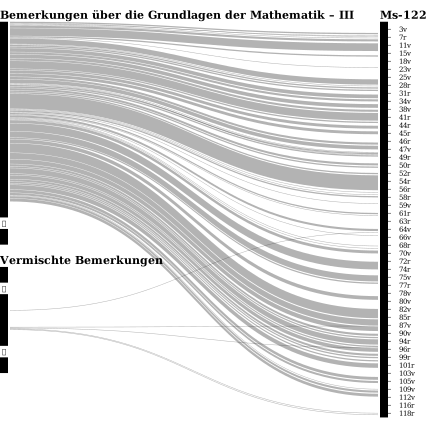
German (epub, pdf) | German/English
231 published remarks, RFM III, VB
Do not quote from or cite this translation!
§
FCv[1]Philosophische Bemerkungen XVIII.
Philosophical Remarks XVIII.
§
1r[1] &1v[1]
16.10.1939
Das Paradox “Heterologisch”: Es ist gut sich vorzustellen, daß die Wörter “heterologisch” & “homologisch” irgendwo wirklich Wörter der lebendigen Sprache sind. Stellen wir uns vor, in der Schrift des Stammes … wird das Wort für rot immer mit roter Tinte, das Wort für blau immer mit blauer Tinte geschrieben, ein Wort das lang bedeutet wird immer langgezogen, eines das kurz bedeutet zusammengepreßt. Dagegen muß bei ihnen das Wort für heiß nicht heiß & das Wort für kalt nicht kalt sein etc. Ihre Grammatiker reden von homologischen & heterologischen Wörtern. Jemand von ihnen fragt nun: “ist das Wort “heterologisch” heterologisch, oder nicht?” & leitet das Paradox ab. Oder, er leitet das Paradox nicht ab & fragt im vollen Ernst. Ich (der Gefragte) denke mir: “Was fragt er eigentlich? Er fragt, ob “h” die Eigenschaft hat, die Eigenschaft nicht zu haben, die es bedeutet, welche ist: die Eigenschaft nicht zu haben, die es bedeutet, welche aber (die) ist: die Eigenschaft nicht zu haben, die es bedeutet u.s.f.”
16.10.1939
The paradox “Heterological”: It is good to imagine that the words “heterological” & “homological” are actually words of a living language somewhere. Let us imagine that in the script of the tribe… the word for red is always written in red ink, the word for blue always in blue ink, a word that means long is always drawn out, one that means short is compressed. However, the word for hot does not have to be hot, and the word for cold does not have to be cold, etc. Their grammarians speak of homologous and heterological words. One of them now asks: “Is the word ‘heterological’ heterological, or not?” and derives the paradox. Or, he does not derive the paradox and asks it in all seriousness. I (the one asked) think: “What is he really asking? He is asking whether ‘h’ has the property of not having the property that it means, which is: the property of not having the property that it means, and so on.”
§
1v[2]Das ist ja als sagte man Einem: “Schreib etwas anderes”, ohne aber zu sagen wovon es verschieden sein soll.
This is as if one said to someone: “Write something different”, without, however, saying what it should be different from.
§
1v[3] &2r[1]
17.10.1939
Auf die Frage “Ist “h” h?” sagen wir uns sofort: “Nun, wir wollen sehen – – was heißt denn ‘h’?” D.h. wir sind nicht gleich klar, zu welchem Resultat hier die Erklärung von “h” führt. Und gleich darauf sehen wir, daß sie zu keinem Resultat führt. Denn das Resultat ist zwar: h (‘h’) = ~h (‘h’), aber, abgesehen davon, daß das ein Widerspruch ist, so ist es keine Erklärung von “h (‘h’)”. Und ebenso erhalte ich auch keine Erklärung, wenn ich mir überlege, was “hom (‘hom’)” bedeutet.
17.10.1939
To the question “Is ‘h’ h?” we immediately say: “Well, let’s see – what does ‘h’ mean?” That is, we are not immediately clear about what result the explanation of “h” leads to. And immediately after, we see that it does not lead to any result. Because the result is indeed: h (‘h’) = ~h (‘h’), but, apart from the fact that this is a contradiction, it is not an explanation of “h (‘h’)”. And likewise, I also obtain no explanation if I consider what “hom (‘hom’”) means.
§
2r[2] &2v[1]
Es wird hier mittels eines Satzes & einer Definition ein Kreis geschlossen, & so, daß die Definition ohne den Satz & der Satz ohne die Definition nicht vollständig ist – wodurch man auf der Suche nach der Bedeutung im Kreis herum geführt wird.
Here, a circle is closed by means of a sentence and a definition, and in such a way that the definition is not complete without the sentence and the sentence is not complete without the definition – whereby one is led around in a circle in the search for meaning.
§
2v[2] &3r[1]
Ebenso, wie man durch die Definition ~f(f) = S(f) zum Widerspruch ~S(S) = S(S) geführt wird, aber das Zeichen “S(S) ” aus der Definition auch nicht erklären kann. Ich könnte es etwa so versuchen: Wenn man statt ‘f’ ‘S’ einsetzt so muß man wissen für welchen Ausdruck nach der Definition das S stehen soll. Am ehesten noch für “~ ξ(ξ)” oder “~ ( )”. Also heißt “S(S)” soviel wie “S(~ ( ))”, aber nicht “~ ( )(~ ( ))”: denn zur Ersetzung des S vor seinem Argument soll ja nach der Definition so verfahren werden: ~[~ ( )][~ (])
Just as one is led to the contradiction ~S(S) = S(S) by the definition ~f(f) = S(f), but the sign “S(S)” cannot be explained from the definition either. I could, for example, try it like this: If one replaces ‘f’ with ‘S’, one must know what expression S should stand for according to the definition. Most likely for “~ ξ(ξ)” or “~ ( )”. So “S(S)” means as much as “S(~ ( ))”, but not “~ ( )(~ ( ))”: because according to the definition, one should proceed in such a way when replacing S before its argument: ~[~ ( )][~ (])
§
3r[2]Schreiben wir eine Funktion als ein Verbum & sagen z.B. statt “F(a)”: “a F-iert”. Also: ~ (f f-iert) = f S-iert Def. Ersehen wir daraus, was wir für einen Ausdruck von der Art “S φ-iert” schreiben sollen?
Let us write a function as a verb and say, for example, instead of “F(a)”: “a F-ied”. So: ~ (f f-ied) = f S-ied Def. Can we derive from this what expression of the kind “S φ-ied” we should write?
§
3r[3]Denken wir uns einen Kalkül mit einem Widerspruch drin aber wir merken den Widerspruch nicht. Wir leiten allerlei Sätze ab, die, wie wir später sehen, mit einander im Widerspruch stehen. Wenn uns ein Teufel narrt so daß wir es nie merken, – was werden wir sagen?
Let us imagine a calculus with a contradiction in it, but we don’t notice the contradiction. We derive all sorts of sentences which, as we later see, contradict each other. If a devil tricks us so that we never notice it, what will we say?
§
3v[1]Was hindert mich zu sagen: Ich nenne etwas nicht “Kalkül”, wenn ihm nicht ein Induktionsbeweis beigefügt ist, der zeigt, daß man in ihm nicht Gebilde von einer gewissen Form erzeugen kann?
What prevents me from saying: I do not call something a “calculus” if it does not include an inductive proof showing that one cannot generate structures of a certain form in it?
§
3v[2]18.10.1939
Ich will der Formulierung entgehen: “ich weiß jetzt mehr über den Kalkül”, & statt ihrer die setzen: “ich habe jetzt einen andern Kalkül”. Der Sinn hiervon ist, die Kluft zwischen einem mathematischen Wissen & nichtmathematischem Wissen immer in ihrer vollen Größe vor Augen zu behalten.
18.10.1939
I want to avoid the formulation: “I now know more about the calculus,” and instead say: “I now have a different calculus.” The point of this is to always keep the gap between a mathematical knowledge and a non-mathematical knowledge in its full size.
§
4r[1] &4v[1]
Angenommen, in einem Stamm führen sie Rechnungen der vier Spezies aus & hie & da verwenden sie einen Übergang von der Art
(3 ‒ 3) ∙ 4 = (3 ‒ 3) ∙ 5.
Sie erhalten daher manchmal widersprechende Resultate – wie wir sagen würden. Das stört sie aber durchaus nicht. Man könnte sich auch den Fall denken, daß Menschen jenen Übergang nur in gewissen Notfällen gebrauchen; wenn eine Rechnung in irgend einem Sinn nicht stimmen will, & stimmen muß. Ein solches Rechnen wäre ähnlich gewissen gebräuchlichen Schlußweisen, durch die irgendeine Annahme (manchmal religiöser Art) gestützt wird, mögen die Fakten auf die sie gestützt wird nun so, oder umgekehrt ausschauen.
Suppose, in a tribe, they perform calculations of the four species & here & there they use a transition of the type
(3 ‒ 3) ∙ 4 = (3 ‒ 3) ∙ 5.
They therefore sometimes obtain contradictory results—as we would say. But that does not bother them at all. One could also imagine the case that people use that transition only in certain emergencies; when a calculation does not add up in some sense, & must add up. Such a way of calculating would be similar to certain common modes of reasoning through which some assumption (sometimes of a religious nature) is supported, regardless of whether the facts on which it is based look this way or the other.
§
4v[2]19.10.1939
4 × (2 × 2 = 4) = (8 × 2 = 16) 4 × (4 × ξ) = 16 × ξ Vierfach ist ein Vierfaches.
19.10.1939
4 × (2 × 2 = 4) = (8 × 2 = 16) 4 × (4 × ξ) = 16 × ξ Four times is a multiple of four.
§
4v[3]Jede mathematische Erfindung (z.B. jeden Beweis) muß man sich wegdenken können & sehen was dann von der Mathematik noch bleibt.
Every mathematical invention (e.g. every proof) must be something that one can imagine away & see what remains of mathematics.
§
4v[4] &5r[1]
Man muß sich immer wieder eine mathematische Entdeckung wegdenken – & sehen, was dann von der Mathematik bleibt – – oder, was für eine Mathematik dann zurückbleibt. – Denn es bleibt (dann) ein Spiel zurück, mit anderer Pointe vielleicht, (&) manchmal gleichsam ein Embryo einer Mathematik – aber wir können es doch als einen Kalkül, als eine Art des Rechnens, auffassen, & dies entzieht uns der Gefahr uns von den ‘Denkgesetzen’ eine viel zu enge Vorstellung zu machen.
One must again & again imagine away a mathematical discovery – & see what remains of mathematics – – or, what kind of a mathematics remains. – For then a game remains, perhaps with a different point, & sometimes almost an embryo of a mathematics – but we can still regard it as a calculus, as a kind of calculation, & this protects us from the danger of forming too narrow a view of ‘the laws of thought’.
§RFM III
5r[2] &5v[1]
25.10.1939
‘Ein Mathematischer Beweis muß übersichtlich sein.’ “Beweis” nennen wir nur eine Struktur, deren Reproduktion eine leicht lösbare Aufgabe ist. Es muß sich mit Sicherheit entscheiden lassen, ob wir hier wirklich zweimal den gleichen Beweis vor uns haben, oder nicht. Der Beweis muß ein Bild sein, welches sich mit Sicherheit genau reproduzieren läßt. Oder auch: was dem Beweise wesentlich ist muß sich mit Sicherheit genau reproduzieren lassen. Er kann z.B. in zwei verschiedenen Handschriften oder Farben niedergeschrieben sein. Zur Reproduktion eines Beweises soll nichts gehören was von der Art einer genauen Reproduktion eines Farbtones oder einer Handschrift ist.
25.10.1939
‘A mathematical proof must be surveyable.’ We call only a structure a “proof”, the reproduction of which is an easily solvable problem. It must be possible to decide with certainty whether we really have the same proof in front of us twice, or not. The proof must be a picture which can be exactly reproduced with certainty. Or also: what is essential to the proof must be able to be exactly reproduced with certainty. It can, for example, be written down in two different handwritings or colors. Nothing that belongs to the reproduction of a proof should be of the kind of an exact reproduction of a color tone or a handwriting.
§RFM III
5v[2] &6r[1] &
6v[1]
Es muß leicht sein genau diesen Beweis wieder anzuschreiben. Hierin liegt der Vorteil des Geschriebenen im Vergleich zum gezeichneten Beweis. Dieser ist oft seinem Wesen nach mißverstanden worden. Die Zeichnung eines Euklidischen Beweises kann ungenau sein, in dem Sinne, daß die Geraden nicht gerade sind die Kreisbögen nicht genau kreisförmig etc. etc. & dabei ist die Zeichnung doch ein exakter Beweis & dies zeigt daß diese Zeichnung nicht – z.B. – demonstriert daß eine solche Konstruktion ein Vieleck mit 5 gleichlangen Seiten ergibt, daß sie einen Satz der Geometrie, nicht einen über die Eigenschaften von Papier, Zirkel, Lineal & Bleistift beweist.
It must be easy to write down exactly this proof again. This is where the advantage of the written lies in comparison to the drawn proof. The latter has often been misunderstood in its essence. The drawing of a Euclidean proof can be inaccurate in the sense that the lines are not straight, the circular arcs are not exactly circular, etc. etc. & yet the drawing is an exact proof & this shows that this drawing does not – for example – demonstrate that such a construction results in a polygon with 5 sides of equal length, that it proves a theorem of geometry, not one about the properties of paper, compass, ruler & pencil.
§
6v[2]Wäre dies ein Beweis:
Man schreibt ∣∣∣∣∣∣∣∣ + ∣∣∣∣∣∣∣∣ = ∣∣∣∣∣∣∣∣∣∣∣∣∣∣∣∣ & wägt (dann) die Tinte auf den beiden Seiten der Gleichung; wiegt sie gleichviel, so ist die Gleichung richtig. Nun, diese Wägung könnte uns sehr wohl als Beweis d.h. als Kriterium dafür dienen, daß auf den beiden Seiten dieser individuellen (token) Gleichung gleichviel Striche stehen, aber sie wäre kein Beweis der Additionsformel im Sinne der Mathematik, sondern ein Experiment eines nicht-mathematischen Satzes.
Would this be a proof:
One writes ∣∣∣∣∣∣∣∣ + ∣∣∣∣∣∣∣∣ = ∣∣∣∣∣∣∣∣∣∣∣∣∣∣∣∣ & (then) weighs the ink on both sides of the equation; if it weighs the same, then the equation is correct. Well, this weighing could very well serve us as a proof, i.e. as a criterion for the fact that there are the same number of lines on both sides of this individual (token) equation, but it would not be a proof of the addition formula in the sense of mathematics, but an experiment of a non-mathematical sentence.
§RFM III
6v[3] &7r[1]
27.10.1939
Ich will sagen: Wenn man eine nicht übersichtliche Beweisfigur durch Veränderung der Notation übersehbar macht, dann schafft man erst einen Beweis, wo früher keiner war.
27.10.1939
I want to say: If one makes a non-surveyable proof figure surveyable by changing the notation, then one creates a proof where there was none before.
§RFM III
7r[2]Denken wir uns nun einen Russellschen Beweis für einen Additionssatz der Art a + b = c der aus ein paar tausend Zeichen bestünde. Du wirst sagen: Zu sehen, ob dieser Beweis stimmt, oder nicht, ist eine rein äußerliche Schwierigkeit, die von keinem mathematischen Interesse ist. (“Ein Mensch übersieht leicht, was ein anderer schwer oder garnicht übersieht”– etc. etc.)
Let us now imagine a Russellian proof for an addition theorem of the kind a + b = c, which consists of a few thousand characters. You will say: To see whether this proof is correct or not is a purely external difficulty, which is of no mathematical interest. (“One person easily overlooks what another person overlooks with difficulty or not at all”– etc. etc.)
§
7r[3] &7v[1]
Wir stellen fest daß in der Stadt A 5 Millionen Menschen sind & in der Stadt B 3 Millionen. Wir rechnen daß wir für beide 5 Millionen Gasmasken brauchen & richten unsre Fabrik so ein daß sie diese Zahl herstellt. Wir finden daß die entsprechende Menge erzeugt worden ist. So war also die Rechnung in diesem Fall sehr nützlich. Und es ist merkwürdig, daß die Russellsche Logik in dieser Weise nützlich sein kann. Oder ist es bloßer Zufall, daß sie es in solchen Fällen so oft ist?
We establish that there are 5 million people in city A & 3 million in city B. We calculate that we need 5 million gas masks for both & set up our factory so that it produces this number. We find that the corresponding amount has been produced. So the calculation was very useful in this case. And it is remarkable that Russellian logic can be useful in this way. Or is it just a coincidence that it is so often useful in such cases?
§RFM III
7v[2]Die Annahme ist, daß die Definitionen nur zur Abkürzung des Ausdrucks dienen, zur Bequemlichkeit des Rechnenden; während sie doch ein Teil der Rechnung sind.
Mit ihrer Hilfe werden Ausdrücke erzeugt, die ohne ihre Hilfe nicht erzeugt werden könnten.
The assumption is that the definitions only serve to shorten the expression, for the convenience of the calculator; while they are in fact part of the calculation.
With their help, expressions are created that could not be created without their help.
§
7v[3] &8r[1]
28.10.1939
Vielleicht sagt man, daß mit ihrer Hilfe nur Aspekte von Ausdrücken hervorgehoben werden. Aber was heißt ‘einen Aspekt hervorheben’ anderes, als einen neuen Ausdruck erzeugen.
28.10.1939
Perhaps one says that with their help only aspects of expressions are highlighted. But what does ‘highlighting an aspect’ mean other than creating a new expression?
§RFM III
8r[2] &8v[1]
Wie ist es aber damit: “Man kann zwar im R'schen Kalkül nicht 234 mit 537 multiplizieren – im gewöhnlichen Sinn – aber es gibt eine R'sche Rechnung die dieser Multiplikation entspricht”? – Welcher Art ist diese Entsprechung? Es könnte so sein:
Man kann auch im R'schen Kalkül diese Multiplikation ausführen nur in einem andern Symbolismus – wie wir ja auch sagen würden wir könnten sie auch in einem andern Zahlensystem ausführen. Wir könnten dann also z.B. die praktischen Aufgaben, zu deren Lösung man jene Multiplikation benützt auch durch die Rechnung im R'schen Kalkül lösen, nur umständlicher.
But what about this: “One can’t multiply 234 by 537 in the Russellian calculus – in the ordinary sense – but there is a Russellian calculation that corresponds to this multiplication”? – What kind of correspondence is this? It could be this:
One can also perform this multiplication in the Russellian calculus, only in a different symbolism – just as we would also say that we could perform it in a different number system. We could then, for example, solve the practical problems for which that multiplication is used, also by means of the calculation in the Russellian calculus, only in a more cumbersome way.
§RFM III
8v[2] &9r[1]
Denken wir uns nun die Kardinalzahlen erklärt als 1, 1 + 1, (1 + 1) + 1, ((1 + 1) + 1) + 1, u.s.f.. Du sagst, die Definitionen welche die Ziffern des Dezimalsystems einführen dienen bloß zur Bequemlichkeit; man könnte die Rechnung 703000 × 40000101 auch in jener langwierigen Schreibweise ausführen. Aber stimmt das? – “Freilich stimmt es! Ich kann doch eine Rechnung in jener Notation anschreiben, konstruieren, die der Rechnung in der Dezimalnotation entspricht.” – Aber wie weiß ich, daß sie ihr entspricht? – Nun, weil ich sie nach einer gewissen Methode aus der andern abgeleitet habe. – Aber wenn ich sie nun nach einer halben Stunde wieder anschaue, kann sie sich da nicht verändert haben? Sie ist ja nicht übersehbar.
Let us now imagine the cardinal numbers defined as 1, 1 + 1, (1 + 1) + 1, ((1 + 1) + 1) + 1, and so on. You say that the definitions that introduce the digits of the decimal system serve only for convenience; one could also perform the calculation 703000 × 40000101 in that lengthy notation. But is that true? – “Of course it is true! I can write down, construct, a calculation in that notation that corresponds to the calculation in decimal notation.” – But how do I know that it corresponds to it? – Well, because I have derived it from the other one according to a certain method. – But if I look at it again after half an hour, couldn’t it have changed? It is not something that can be grasped at a glance.
§RFM III
9r[2]Ich frage nun: könnten wir uns von der Wahrheit des Satzes 7034174 + 6594321 = 13628495 auch durch einen Beweis überzeugen, der in der ersten Notation geführt wäre? – Gibt es so einen Beweis dieses Satzes? – Die Antwort ist: nein.
Now I ask: could we also be convinced of the truth of the sentence 7034174 + 6594321 = 13628495 by a proof that is carried out in the first notation? – Is there such a proof of this sentence? – The answer is: no.
§
9r[3] &9v[1] &
10r[1]
Aber zeigt nicht Russells Erklärung den Zusammenhang zwischen der Addition & Disjunktion. Zeigt sie nicht, was das Wesen der Addition ist, indem sie sozusagen das allgemeine Schema der Anwendung der Addition zeigt; gleichsam die allgemeine Art, wie sich die Addition auf die Dinge bezieht, die Art ihres Zusammenhangs mit dem worauf sie angewendet wird? So könnte man sich z.B. – vom Ausdruck “addieren” verführt – vorstellen daß man die Einwohner von London & Manchester in irgend einer Weise zusammenlegt, wenn man berechnet wie viele Einwohner beide Städte zusammen haben; & nun sagt uns die R'sche Erklärung, daß es sich um keinerlei Zusammenlegen der Gegenstände handelt. (Damit in Zusammenhang, was Frege den ‘Pfeffernuß Standpunkt’ nannte: die Idee, eine Zahl sei ein Haufe von Dingen.) – Ich habe also die beiden Begriffe zusammengenommen, nicht die Städte oder ihre Einwohner – – aber habe ich nicht doch in einem Sinne die Einwohner zusammengenommen? nämlich, indem ich sie zählte & mit den Zeichen, die ich so erhielt, operierte.
But does not Russell’s explanation show the connection between addition and disjunction? Does it not show what the essence of addition is, by showing, so to speak, the general scheme of the application of addition; as it were, the general way in which addition relates to things, the nature of its connection with that to which it is applied? So one might, for example—misled by the expression “to add”—imagine that one is combining the inhabitants of London and Manchester in some way when calculating how many inhabitants both cities have together; and now R’s explanation tells us that there is no such combination of objects involved. (Related to this is what Frege called the ‘Pfeffernuss view’: the idea that a number is a heap of things.) – So I have taken the two concepts together, not the cities or their inhabitants – – but have I not, in a sense, taken the inhabitants together? namely, by counting them & operating with the symbols I thus obtained.
§
10r[2] &10v[1] &
11r[1]
“Die Zahl der Londoner & die Zahl der Dubliner zusammengenommen” ist allerdings gleichbedeutend mit: “die Zahl der Leute, die entweder Londoner oder Dubliner sind” oder mit: “die Zahl der Gegenstände die unter den Begriff Londoner oder Dubliner fallen ” (von der Idee dieser ‘Gegenstände’ die das Prädikat Mensch haben wird noch gesprochen werden) – aber ist der Ausdruck, der sich des Oder bedient fundamentaler als der andere? Oder auch: muß ich den Begriff der Disjunktion der beiden Begriffe bilden wenn ich von der Summe der beiden Anzahlen reden will? In den meisten Fällen werde ich es nicht tun sondern die beiden Zahlen addieren & von der Summe der beiden Zahlen reden. Es gibt freilich auch den andern Fall: man sagt z.B.: “die Zahl der Leute, die in London, oder der Umgebung von London wohnen ist …”. Freilich könnte ich auch im ersten Fall– wenn ich gefragt würde: “welcher Begriff gehört nun zu der Summe die Du gebildet hast”– sagen: der Begriff: Mensch, welcher ein Londoner oder ein Dubliner ist – aber könnte ich nicht ebensowohl antworten: der Begriff: Faß Bier , das ich zu erzeugen habe (wenn ich nämlich für jeden Londoner & Dubliner ein Faß Bier erzeugen wollte).
“The number of Londoners & the number of Dubliners taken together” is, however, synonymous with: “the number of people who are either Londoners or Dubliners” or with: “the number of objects that fall under the concept of Londoner or Dubliner” (we will speak later of the idea of these ‘objects’ that have the predicate ‘human’) – but is the expression that uses ‘or’ more fundamental than the other? Or also: must I form the concept of the disjunction of the two concepts if I want to speak of the sum of the two numbers? In most cases, I will not do so but will add the two numbers and speak of the sum of the two numbers. There is, of course, also the other case: one says, for example: “the number of people who live in London, or in the vicinity of London, is …”. Of course, even in the first case—if I were asked, “Which concept belongs to the sum you have formed?”—I could say: the concept of a person who is a Londoner or a Dubliner—but could I not just as well answer: the concept of a barrel of beer that I have to produce (namely, if I wanted to produce a barrel of beer for every Londoner and Dubliner).
§RFM III
11r[2]Aber lehrt uns Russell nicht doch eine Art des Addierens?
But doesn’t Russell teach us one kind of adding?
§RFM III
11r[3] &11v[1]
30.10.1939
Angenommen wir bewiesen auf R's Methode daß (∃a‥‥․g) ‥‥ (∃a‥‥․i) ⊃ (∃a‥‥․s) eine Tautologie ist; könnten wir nun unser Resultat dahin ausdrücken, g + i sei s? Das setzt doch voraus, daß ich die drei Stücke des Alphabets als Repräsentanten des Beweises nehmen kann. Aber zeigt denn das R's Beweis? Den R'schen Beweis hätte ich doch offenbar auch mit solchen Gruppen von Zeichen in den Klammern führen können, deren Reihenfolgen für mich nichts Charakteristisches gehabt hätten, so daß es nicht möglich gewesen wäre die Zeichengruppe in einer Klammer durch ihr letztes Glied zu repräsentieren.
October 30, 1939
Suppose we prove, using Russell's method, that (∃a‥‥․g) ‥‥ (∃a‥‥․i) ⊃ (∃a‥‥․s) is a tautology; could we now express our result by saying that g + i = s? This does, however, presuppose that I can take the three groups of letters as representatives of the proof. But does Russell's proof show this? Surely, I could also have carried out Russell's proof using such groups of signs in parentheses, whose sequences have no characteristic feature for me, so that it would not be possible to represent the group of signs in a parenthesis by its last member.
§RFM III
11v[2] &12r[1]
Angenommen sogar, der R'sche Beweis werde mit einer Notation der Art als in der Dezimalnotation geführt, & es seien 100 Glieder in der ersten 300 Glieder in der zweiten & 400 Glieder in der dritten Klammer, zeigt der Beweis selbst dann, daß 100 + 300 = 400 ist? – Wie wenn dieser Beweis einmal zu diesem einmal zu einem andern Resultat führte z.B. 100 + 300 = 420? Was bedarf es, um zu sehen daß das Resultat des Beweises, wenn er richtig geführt ist, immer nur von den letzten Ziffern der ersten zwei Klammern abhängt?
Suppose, indeed, that Russell's proof is carried out using a notation of the kind , as in decimal notation, and there are 100 members in the first, 300 members in the second, and 400 members in the third parenthesis; does the proof itself then show that 100 + 300 = 400? – As if this proof were to lead once to this result and once to another result, e.g. 100 + 300 = 420? What is required to see that the result of the proof, if it is carried out correctly, always only depends on the last digits of the first two parentheses?
§RFM III
12r[2] &12v[1]
Aber für kleine Zahlen lehrt uns doch Russell addieren; denn dann übersehen wir eben die Zeichengruppen in den Klammern & können sie als Zahlzeichen nehmen; z.B. ‘xy’, ‘xyz’, ‘xyzuv’.
Russell lehrt uns also einen anderen Kalkül, um von 2 und 3 zu 5 zu gelangen; & das stimmt auch dann, wenn wir sagen der logische Kalkül sei nur – ‘frills’, die dem arithmetischen Kalkül angehängt seien.
But Russell does teach us to add for small numbers; for then we simply overlook the groups of signs in the parentheses and can take them as number signs; e.g. 'xy', 'xyz', 'xyzuv'.
Russell, therefore, teaches us a different calculus to get from 2 and 3 to 5; and this is also true when we say that the logical calculus is only – ‘frills’ that are attached to the arithmetic calculus.
§RFM III
12v[2] &13r[1]
Die Anwendung der Rechnung muß für sich selber sorgen. Und das ist, was am ‘Formalismus’ richtig ist. Die Zurückführung der Arithmetik auf symbolische Logik soll die Applikation der Arithmetik zeigen; gleichsam den Ansatz, mittels welchem sie auf ihrer Anwendung sitzt. So als zeigte man Einem erst eine Trompete ohne das Mundstück – & nun das Mundstück, welches uns zeigt, wie eine Trompete verwendet, geblasen, wird. Das Ansatzstück aber, das uns Russell gibt, ist einerseits zu eng anderseits zu weit; zu allgemein und zu speziell. Die Rechnung sorgt für ihre eigene Anwendung.
The application of calculation must take care of itself. And this is what is right about ‘formalism’. The reduction of arithmetic to symbolic logic is supposed to show the application of arithmetic; as if it were the approach by means of which it rests on its application. It is as if one were first shown a trumpet without the mouthpiece – and then the mouthpiece, which shows us how a trumpet is used, how it is played. But the approach that Russell gives us is, on the one hand, too narrow, and on the other hand, too wide; too general and too specific. Calculation takes care of its own application.
§RFM III
13r[2] &13v[1]
Wir dehnen unsre Ideen von den Rechnungen mit kleinen Zahlen auf die mit großen Zahlen aus, ähnlich wie wir uns vorstellen, daß wenn die Distanz von hier zur Sonne mit dem Zollstock gemessen werden könnte dann eben das herauskäme was wir heute auf ganz andere Art herausbringen. Das heißt, wir sind geneigt die Längenmessung mit dem Zollstab zum Modell zu nehmen auch für die Messung des Abstandes zweier Sterne. Und man sagt, etwa in der Schule: “Wenn wir uns Zollstäbe von hier bis zur Sonne gelegt denken, …” & scheint damit zu erklären, was wir unter dem Abstand zwischen Sonne und Erde verstehen. Und der Gebrauch eines solchen Bildes ist ganz in Ordnung, so lange es uns klar ist daß wir den Abstand von uns zur Sonne messen können & daß wir ihn nicht mit Zollstäben messen können.
We extend our ideas from calculations with small numbers to those with large numbers, much as we imagine that if the distance from here to the sun could be measured with a folding ruler, the result would be exactly what we arrive at today in a completely different way. That is, we are inclined to take the measurement of length with a folding ruler as a model even for measuring the distance between two stars. And people say, for example in school: “If we imagine laying out rulers from here to the Sun, …” & seem to provide an explanation for what we understand by the distance between the Sun and Earth. And the use of such an image is perfectly fine, as long as we realize that we can measure the distance from us to the Sun & that we cannot measure it with rulers.
§RFM III
13v[2] &14r[1]
31.10.1939
Wie, wenn jemand sagen würde: “der eigentliche Beweis von 1000 + 1000 = 2000 ist doch erst der Russellsche, der zeigt, daß der Ausdruck … eine Tautologie ist”? Kann ich denn nicht beweisen, daß eine Tautologie herauskommt, wenn ich in den beiden ersten Klammern je 1000 Glieder & in der dritten 2000 habe? Und wenn ich das beweisen kann, so kann ich das als Beweis des arithmetischen Satzes ansehen.
October 31, 1939
What if someone were to say: “The actual proof of 1000 + 1000 = 2000 is only Russell's, which shows that the expression … is a tautology”? Can I not prove that a tautology results if I have 1000 members in each of the first two parentheses and 2000 in the third? And if I can prove that, then I can see it as a proof of the arithmetic sentence.
§RFM III
14r[2]In der Philosophie ist es immer gut, statt einer Beantwortung einer Frage eine Frage zu setzen. Denn eine Beantwortung der philosophischen Frage könnte ungerecht sein; ihre Erledigung mittels einer andern Frage ist es nicht.
In philosophy, it is always good to put a question in place of an answer to a question. For an answer to the philosophical question might be unfair; its resolution by means of another question is not.
§RFM III
14r[3]Soll ich also z.B. hier eine Frage setzen statt der Antwort, man könne jenen arithm. Satz mit R's Methode nicht beweisen?
Should I, therefore, put a question here instead of the answer, that one cannot prove that arithmetic sentence with Russell's method?
§RFM III
14v[1] &15r[1]
01.11.1939
Der Beweis, daß
eine Tautologie ist, besteht darin, daß man immer ein Glied der 3ten Klammer für ein Glied von 1 oder 2 abstreicht. Und es gibt ja viele Methoden dieses Kollationierens. Oder man könnte auch sagen: es gibt viele Arten & Weisen, das Gelingen der 1 → 1 Zuordnung festzustellen. Eine Art wäre z.B. sternförmige Muster eins für die linke eins für die rechte Seite der Implikation zu konstruieren & diese wieder dadurch zu vergleichen daß man ein Ornament aus beiden bildet. Man könnte also die Regel geben: “Wenn Du wissen willst, ob die Zahlen A & B zusammen wirklich C ergeben, schreib einen Ausdruck der Form … an & ordne die Variablen in den Klammern einander zu indem Du den Beweis dafür anschreibst (oder anzuschreiben trachtest) daß der Ausdruck eine Tautologie ist.” Mein Einwand dagegen ist nun nicht, daß es willkürlich ist, gerade diese Art des Kollationierens vorzuschreiben, sondern, daß man auf diese Weise nicht feststellen kann, daß 1000 + 1000 = 2000 ist.
01.11.1939
The proof that is a tautology consists in the fact that one always eliminates one element of the 3rd parenthesis for one element of 1 or 2. And there are indeed many methods for this collation. Or one could also say: there are many kinds & ways of establishing the success of the 1 → 1 assignment. One way would be, for example, to construct star-shaped patterns, one for the left, one for the right side of the implication, & to compare them again by forming an ornament from both. One could, therefore, give the rule: “If you want to know whether the numbers A & B really add up to C, write an expression of the form … & assign the variables in the parentheses to each other by writing down (or trying to write down) the proof that the expression is a tautology.” My objection to this is now not that it is arbitrary to prescribe precisely this kind of collation, but that in this way one cannot establish that 1000 + 1000 = 2000.
§
15r[2] &15v[1]
02.11.1939
Die R'sche Methode erzeugt nicht den Aspekt dieser Addition. Aber kann dieser Aspekt nicht doch mittels ihrer erzeugt werden durch eine entsprechende Folge von Definitionen? Warum will ich sagen, daß der R'sche Beweis nichts Interessantes der Transformation hinzufügt, die durch die Definitionen allein bewerkstelligt wird? Es kommt mir vor, daß der Beweis davon, daß für die Werte 1000, 1000 & 2000 eine Tautologie herauskommt gänzlich außerhalb des Beweises des arithmetischen Satzes ist.
02.11.1939
Russell's method does not create the aspect of this addition. But can this aspect not be created by means of it through a corresponding sequence of definitions? Why do I want to say that Russell's proof does not add anything interesting to the transformation that is accomplished by the definitions alone? It seems to me that the proof that a tautology results for the values 1000, 1000 & 2000 is completely outside the proof of the arithmetic sentence.
§
15v[2]Und doch erscheint mir auch in dem, was ich sage, etwas falsches.
And yet, something false seems to me even in what I say.
§
15v[3] &16r[1]
‘Die Menge in der 3ten Klammer, die den Ausdruck zu einer Tautologie macht, ist die Summe der beiden ersten Mengen.’ Wie komme ich aber überhaupt zum Begriff einer bestimmten Menge?
‘The set in the 3rd parenthesis, which makes the expression a tautology, is the sum of the two first sets.’ But how do I come to the concept of a specific set at all?
§
16r[2]Man hat oft gesagt, daß die Bedeutung einer Definition oft darin liege, daß sie die Wichtigkeit des Definiens hervorhebe. Aber in anderem Sinne macht sie ja das Definiens im Kalkül verschwinden. Die Wichtigkeit einer Definition liegt zumeist darin, daß Ausdrücke eine andre Struktur erhalten.
It has often been said that the meaning of a definition often lies in the fact that it highlights the importance of the definiens. But in another sense, it makes the definiens disappear in the calculus. The importance of a definition mostly lies in the fact that expressions take on a different structure.
§
16r[3]Führt der, welcher neue Definitionen einführt, nicht einen neuen Kalkül ein?
Does the one who introduces new definitions not introduce a new calculus?
§RFM III
16r[4] &16v[1]
03.11.1939
Denke, Du hättest eine meilenlange ‘Formel’ angeschrieben, & zeigtest durch Transformation, daß sie tautologisch ist (‘wenn sie sich inzwischen nicht verändert hat’, müßte man sagen). Nun zählen wir die Glieder in den Klammern oder teilen sie ab & machen den Ausdruck übersichtlich & es zeigt sich, daß in der ersten Klammer 7566 in der zweiten 2434 in der dritten 10000 Glieder stehen. Habe ich nun bewiesen, daß 2434 + 7566 = 10000 ist? – Das kommt drauf an – könnte man sagen – ob Du sicher bist, daß das Zählen wirklich die Zahlen der Glieder ergeben hat, die während des Beweises in den Klammern standen.
03.11.1939
Suppose you have written a mile-long ‘formula,’ & show by transformation that it is tautological (‘if it has not changed in the meantime,’ one would have to say). Now let us count the elements in the parentheses or divide them & make the expression surveyable & it turns out that there are 7566 elements in the first parenthesis, 2434 in the second, & 10000 in the third. Have I now proven that 2434 + 7566 = 10000? – That depends – one could say – on whether you are sure that the counting really gives the numbers of the elements that were in the parentheses during the proof.
§RFM III
16v[2] &17r[1]
Könnte man so sagen: “R. lehrt uns in die 3te Klammer so viele Zeichen schreiben als in den beiden ersten zusammen stehen”? Aber eigentlich: er lehrt uns für je eine Variable in (1) & in (2) eine Variable in (3) schreiben. Aber lernen wir dadurch welche Zahl die Summe zweier gegebener Zahlen ist? Vielleicht sagt man: “Freilich, denn in der 3ten Klammer steht nun das Paradigma, Urbild, der neuen Zahl.” Aber inwiefern ist ∣∣∣∣∣∣∣∣∣∣∣∣∣∣∣∣ das Paradigma einer Zahl? Bedenke, wie man es als solches verwenden kann.
Could one say: “R. teaches us to write as many signs in the 3rd parenthesis as there are in the two first together”? But actually: he teaches us to write one variable in (3) for each variable in (1) & in (2). But do we learn from this what number is the sum of two given numbers? Perhaps one says: “Indeed, because in the 3rd parenthesis there is now the paradigm, the archetype, of the new number.” But in what sense is ∣∣∣∣∣∣∣∣∣∣∣∣∣∣∣∣ the paradigm of a number? Consider how one can use it as such.
§
17r[2]05.11.1939
Muß denn ein Begriff eine bestimmte Zahl von Gliedern haben?
05.11.1939
Must a concept have a specific number of elements?
§
17r[3] &17v[1]
Es ist falsch zu sagen: “Unter der Summe der Anzahlen zweier Begriffe verstehe ich die Anzahl der Begriffsdisjunktion” – sondern ich verstehe darunter dasselbe wie die Anzahl der Begriffssumme, wenn sich diese Anzahl in bestimmter Weise aus den beiden ersten Zahlen berechnen läßt. D.h., wenn das was man unter ‘Anzahl der Begriffssumme’ versteht eben so aus den Zahlen der ersten Begriffe zu erhalten ist.
It is wrong to say: “With regard to the sum of the numbers of two concepts, I have the understanding that the number of the conceptual disjunction is the same as the number of the conceptual sum, if this number can be calculated in a certain way from the first two numbers.” That is, if the ‘number of the sum of the concepts’ has the same understanding as the numbers of the first concepts, it can be obtained in exactly the same way.
§
17v[2] &18r[1]
06.11.1939
Wir haben einerseits eine Definition der Zahlensumme, die keine Andeutung darüber macht, wie eine Addition anzuwenden ist. Diese Erklärung scheint deshalb vielleicht unbefriedigend. Anderseits ist da eine Erklärung der Summe aus ihrer Anwendung heraus. (Und diese scheint im Vergleich zur ersten unbefriedigend, weil sie sich in Dinge mischt, um die sie sich nicht zu bekümmern hat.) Wenn ich nun sage: die Summe der Anzahlen zweier Begriffe ist die Anzahl der Begriffssumme – so muß ich dazu sagen: & diese Zahl ist aus den beiden ersten so & so zu berechnen. – Wenn das aber der Fall ist, warum definiere ich nicht die Zahlensumme durch diese ihre Berechnung? – Ich verstehe eben unter der Zahl der Begriffssumme etwas, was durch eine bestimmte Rechnung aus den Zahlen der Summandenbegriffe zu erhalten ist.
06.11.1939
On the one hand, we have a definition of the sum of numbers that gives no indication of how addition is to be applied. This explanation may therefore seem unsatisfactory. On the other hand, there is an explanation of the sum based on its application. (And this seems unsatisfactory in comparison to the first, because it meddles in things that it shouldn't concern itself with.) If I now say: the sum of the numbers of two concepts is the number of the concept sum – then I must add: & this number is to be obtained from the two first in this way. – But if that is the case, why don't I define the sum of numbers by this calculation? – I simply mean by the number of the concept sum something that can be obtained from the numbers of the summand concepts by a certain calculation.
§
18r[2] &18v[1]
Einmal scheine ich zuerst nur mit (den) Begriffen zu operieren & was dann die Zahl des resultierenden Begriffes ist, nenne ich Summe der Zahlen der Teilbegriffe. – Im andern Fall habe ich mit Begriffen, deren Zahlen die Zahlen sind, (gar) nichts zu tun.
At one point, it seems that I only operate with (the) concepts & what then is the number of the resulting concept, I call the sum of the numbers of the partial concepts. – In the other case, I have nothing to do with concepts whose numbers are the numbers.
§
18v[2]07.11.1939
Warum soll ich nicht sagen: “Wenn 5 die Zahl von φ ist & 7 die Zahl von ψ, so nenne ich 12 ‘die Zahl von φ ⌵ ψ’”? Statt zu sagen: “dann ist die Zahl von φ⌵ψ 12”.
07.11.1939
Why shouldn't I say: “If 5 is the number of φ & 7 is the number of ψ, then I call 12 ‘the number of φ ⌵ ψ’”? Instead of saying: “then the number of φ⌵ψ is 12”.
§
18v[3] &19r[1]
Die Fregesche Erklärung der Summe scheint uns den Inhalt der Addition zu erklären, während die bloßen Rechenregeln dies nicht zu tun scheinen. Aber muß hier nicht ein falscher Schein vorliegen? – Beide Erklärungen müssen uns ja die Rechnungsregeln geben. Und gibt die erste Erklärung wirklich mehr, – muß sie dann nicht Überflüssiges geben?
Frege's explanation of the sum seems to explain the content of addition, while the mere rules of calculation do not seem to do so. But isn't there a false impression here? – Both explanations must give us the rules of calculation. And if the first explanation really gives more, doesn't it then have to provide something superfluous?
§
19r[2] &19v[1] &
20r[1] &
20v[1]
Woher aber der Schein, daß die erste Erklärung inhaltlich ist? denn beide zeigen uns ja eine Rechentechnik mit Zeichen. – In der ersten Erklärung ist schon alles vorbereitet, um z.B. für “φ” “Londoner” & für “ψ” “Dubliner” einzusetzen. Und nun scheint die Erklärung zu sagen: Wenn der Begriff ‘Londoner’ n Glieder hat & der Begriff ‘Dubliner’ m Gegenstände, so brauchst Du nur den Begriff ‘Londoner oder Dubliner’ zu bilden, & so viele Glieder dieser Begriff hat soviel beträgt n + m.
Aber wie sehe ich nach, welche Zahl ihm zukommt?! – Indem ich den Begriff ‘Londoner oder Dubliner’ untersuche?
So als sagte man: Die Disjunktion der Begriffe kannst Du doch gewiß leicht bilden – nun, die Anzahl dieses Begriffs ist die Summe n + m. – Als wäre jetzt ja alles (schon) getan, da man ja nur mehr nachschauen braucht, welches die Anzahl der Begriffssumme ist.
But where does the impression come from that the first explanation is substantial? For both show us a technique of calculation with signs. – In the first explanation, everything is already prepared to substitute, for example, “Londoners” for “φ” & “Dubliners” for “ψ”. And now the explanation seems to say: If the concept ‘Londoners’ has n members & the concept ‘Dubliners’ has m objects, then you only need to form the concept ‘Londoners or Dubliners’, & as many members as this concept has, that is how much n + m is.
But how do I find out what number it has?! – By examining the concept ‘Londoners or Dubliners’?
It’s as if one said: You can certainly easily form the disjunction of the concepts – well, the number of this concept is the sum n + m. – As if everything (was) already done, because all that remains is to find out what the number of the concept sum is.
§
20v[2]Man könnte natürlich definieren: Der Ausdruck “die Zahlensumme der Begriffe ‘φ’ und ‘ψ’” solle bedeuten: die Anzahl des Begriffes ‘φ⌵ψ’.
One could, of course, define: The expression “the sum of the numbers of the concepts ‘φ’ & ‘ψ’” should mean: the number of the concept ‘φ⌵ψ’.
§
20v[3]Kann man denn aber nicht erklären: “Addition ist diejenige Operation, die gebraucht wird, um aus den Anzahlen zweier Begriffe die Anzahl der Begriffssumme zu finden”?
But can't one also explain: “Addition is the operation that is used to find the number of the concept sum from the numbers of two concepts”?
§
20v[4] &21r[1]
Aber ist das richtig? Braucht man dazu addieren? Kann man nicht z.B. sagen, die Anzahl von φ⌵ψ sei: 1000 + 2000?
But is that correct? Does one need to add for that? Can one not, for example, say that the number of φ⌵ψ is: 1000 + 2000?
§
21r[2]08.11.1939
Man könnte, was ich hier betreibe, ‘infantile Mathematik’ nennen.
08.11.1939
One could call what I am doing here 'infantile mathematics'.
§
21r[3] &21v[1]
“Der Begriff ‘φ⌵ψ’ hat doch eine Zahl”. Wie soll sie festgestellt werden? Unabhängig von den Zahlen von ‘φ’ und ‘ψ’? Und wie wenn sich durch Zählung der Gegenstände die φ genügen, der Gegenstände die ψ genügen & der Gegenstände die φ⌵ψ genügen ergibt daß die erste Zahl 100 die zweite 200 & die dritte 302 ist? Es soll also heißen: die Summe der Anzahlen von φ und ψ ist die Anzahl der Begriffssumme, – wie sich diese aus der Berechnung ergibt.
“The concept ‘φ⌵ψ’ does have a number”. How is it to be determined? Independently of the numbers of ‘φ’ & ‘ψ’? And how if counting the objects that satisfy φ, the objects that satisfy ψ & the objects that satisfy φ⌵ψ yields that the first number is 100, the second is 200 & the third is 302? It should therefore mean: the sum of the numbers of φ & ψ is the number of the concept sum, – as this results from the calculation.
§
21v[2]Wer also sagt, die Summe zweier Anzahlen sei die Anzahl der Begriffsdisjunktion, sagt eigentlich: “Berechne die Anzahl der Begriffssumme, dann hast Du die Summe der beiden Anzahlen”.
Whoever says that the sum of two numbers is the number of the concept disjunction is actually saying: “Calculate the number of the concept sum, then you have the sum of the two numbers”.
§RFM III
21v[3] &22r[1]
09.11.1939
Die R'sche Tautologie, die dem Satz a + b = c entspricht, zeigt uns vor allem nicht in welcher Notation die Zahl c zu schreiben ist & es ist kein Grund warum sie nicht in der Form a + b geschrieben werden soll. –Denn R. lehrt uns ja nicht die Technik des Addierens, etwa, im Dezimalsystem. – Aber könnten wir sie vielleicht aus seiner Technik ableiten? Fragen wir einmal so: Kann man die Technik des Dezimalsystems aus der des Systems 1, 1 + 1, (1 + 1) + 1, etc. ableiten? Könnte man diese Frage nicht auch so stellen: Wenn man eine Rechentechnik in dem einen System & eine im andern System hat, – wie zeigt man, daß die beiden äquivalent sind?
09.11.1939
The R-style tautology, corresponding to the sentence a + b = c, primarily doesn’t show us in what notation the number c should be written, and there is no reason why it shouldn’t be written in the form a + b. – Because R. doesn’t teach us the technique of addition, for example, in the decimal system. – But could we perhaps derive it from his technique? Let’s ask this: Can the technique of the decimal system be derived from that of the system 1, 1 + 1, (1 + 1) + 1, etc.? Couldn’t we also phrase this question as follows: If one has a calculation technique in one system and one in the other system, how does one show that the two are equivalent?
§
22r[2] &22v[1] &
23r[1] &
23v[1]
13.11.1939
Ein Volksstamm habe eine Technik des Zählens, etwa die unsere im Dezimalsystem. Statt des Addierens, Subtrahierens, etc. aber verwenden sie folgenden Vorgang: Sie stellen Eisenwürfel von genau gleicher Größe her, zählen etwa 3470 in eine Wagschale, 250 in die andere & nun zählen sie, wieder mit 1 anfangend Würfel in die zweite Wagschale bis die Waage einspielt. Das Resultat dieses Prozesses drücken sie dann durch eine Formel aus, etwa “250 + 3220 = 3470”. Sie haben also durch ein Experiment erhalten, was wir durch eine Rechnung? – Wie verwenden sie die Formel? – Wenn 250 Soldaten in einer Reihe stehen & sie stellen weitere 3220 dazu, so erwarten sie daß eine Zählung aller 3470 ergeben werde. – Warum? – Es hat sich gezeigt daß dies für gewöhnlich so herauskam. – Aber wie, wenn sie einmal die oben beschriebene Wägung ausführen & sie erhalten nun die Formel 250 + 3000 = 3470 – sagen sie dann: “diesmal ergeben diese Zahlen 3470” oder sagen sie: “es muß ein Fehler in der Wägung vorliegen”? – Habe ich im zweiten Fall das Wägen nicht mehr als Experiment, sondern als Beweis aufgefaßt? ‒ ‒ Nun, wenn (die) Erfahrung mich oft genug das gleiche gelehrt hat, so werde ich endlich unbedingt an einer Annahme festhalten & alles andere muß sich nach ihr richten. Man kann sagen: die Annahme versteinert zur Regel. – Wenn nun die Hypothese, daß n + m Würfel 𝓁 Würfeln das Gleichgewicht halten zur Regel versteinert, wird die Hypothese dann zum arithmetischen Satz?
November 13, 1939
Suppose a tribe has a counting technique, such as ours in the decimal system. Instead of adding, subtracting, etc., however, they use the following procedure: They make iron cubes of exactly the same size, place about 3470 in one pan of a balance, 250 in the other, and now they count, starting again with 1, cubes into the second pan until the balance evens out. They then express the result of this process using a formula, such as “250 + 3220 = 3470.” So they obtained through an experiment what we obtain through a calculation? – How do they use the formula? – If 250 soldiers are standing in a row and they add another 3220 to them, they expect that a count of all 3470 will result. – Why? – It has been shown that this is usually the result. – But what if, when they perform the weighing described above, they obtain the formula 250 + 3000 = 3470—do they then say, “this time these numbers add up to 3470,” or do they say, “there must be an error in the weighing”? – In the second case, have I no longer regarded the weighing as an experiment, but as proof? ‒ ‒ Well, if experience has taught me the same thing often enough, I will finally adhere unconditionally to an assumption, and everything else must conform to it. One might say: the assumption solidifies into a rule. – If the hypothesis that n + m dice balance 𝓁 dice becomes set in stone as a rule, does the hypothesis then become an arithmetic theorem?
§
23v[2]“250 Würfel + 3220 Würfel sind soviel, wie 3470 Würfel.”
“250 dice + 3220 dice equal 3470 dice.”
§
23v[3]“250 + 3220 Würfel sind die gleiche Anzahl von Würfeln wie 3470.”
“250 + 3220 cubes are the same number of cubes as 3470.”
§
23v[4]14.11.1939
‘Aber warum vertraust Du dieser Rechnung, daß sie Dir wirklich die gleiche Anzahl liefert?’ – Ich vertraue ihr (gar) nicht. Das ist, was ich jetzt ‘gleiche Anzahl’ nenne.
November 14, 1939
‘But why do you trust this calculation to really give you the same number?’ – I don’t trust it (at all). That is what I now call ‘the same number.’
§
23v[5] &24r[1]
Ich will sagen: Mit ‘ebensoviel’ verbinde ich eine gewisse Vorstellung – etwa
 ;
;
& nun führe ich für ebensoviel ein neues Kriterium ein. “Nun nenne ich das ‘ebensoviel’.” Natürlich wegen einer Verwandtschaft des neuen Kriteriums mit dem alten.
I want to say: I associate a certain idea with ‘just as much’—something like
;
& now I introduce a new criterion for ‘just as much.’ “Now I call this ‘just as much.’” Of course, because of a connection between the new criterion and the old one.
§
24r[2][→ Dieser Satz ist] in gewissem Sinne analog dem gebildet: diese wiegen soviel wie jene. Er sieht es so an: in den Ziffern allein liegt es noch nicht, daß die einen gleichviele sind wie die andern. Gleichviele zu sein ist ein Drittes.
[→ This sentence is] in a certain sense analogous to the following: these weigh as much as those. He sees it this way: the numbers alone do not yet imply that the ones are equal in quantity to the others. Being equal in quantity is a third thing.
§
24r[3]Wie vergleicht sich:
a) “250 und 3220 Erbsen sind soviele, wie 3470 Erbsen”
b) “250 und 3220 Erbsen wiegen gleichviel, wie 3470 Erbsen”
c) “250 und 3220 Erbsen haben das gleiche Volumen, wie 3470 Erbsen” ?
How does one compare:
a) “250 and 3220 peas are as many as 3470 peas”
b) “250 and 3220 peas weigh as much as 3470 peas”
c) “250 and 3220 peas have the same volume as 3470 peas”?
§
24v[1]15.11.1939
Man möchte (vielleicht) sagen: a ist ein Satz der Mathematik, b aber ein Erfahrungssatz. – Aber kann nicht a auch als Erfahrungssatz verstanden werden? – Und kann c nicht leicht als mathematischer & als Erfahrungssatz gedeutet werden? Warum dann nicht b als mathematischer Satz?
15.11.1939
One might say: a is a sentence of mathematics, but b is an empirical sentence. – But can not a also be understood as an empirical sentence? – And can c not easily be interpreted as both a mathematical and an empirical sentence? Why then not b as a mathematical sentence?
§
24v[2] &25r[1]
Warum soll man sich nicht die Arithmetik eines Volkes als mit den Vorgängen des Wägens untrennbar verbunden denken Wie es eine Mathematik des Zeichnens & Messens mit Zirkel & Lineal gibt – warum nicht (so) eine Mathematik des Wägens?
Why shouldn’t one think of the arithmetic of a people as inextricably linked with the processes of weighing, as there is a mathematics of drawing and measuring with compass and ruler – why not (then) a mathematics of weighing?
§
25r[2]Und wenn die Mathematik a priori ist, warum soll es nicht der Satz b sein? wenn wir nur nicht die Erfahrung als Zeugin für oder gegen ihn anrufen. –
And if mathematics is a priori, why shouldn’t sentence b be? if we just don’t invoke experience as a witness for or against it.
§
25r[3] &25v[1]
Im Archimedischen Beweis des Hebelgesetzes wird der Satz, daß der symmetrisch belastete gleicharmige Hebel sich im Gleichgewicht befindet nicht als Erfahrungssatz sondern als Satz a priori behandelt; sowie im Beweis des Satzes von den kommunizierenden Gefäßen der Satz, das Wasser in einem Gefäß bleibe offenbar im Gleichgewicht, auch wenn ein Teil des selben plötzlich erstarrte.

Vergleiche: auch den Beweis mit der Stevinschen Kette. Wenn man diesen Satz als Satz der Erfahrung auffaßt, so appelliert er an eine Beobachtung, die gewiß niemand ausgeführt hat.
In Archimedes’ proof of the law of the lever, the proposition that a symmetrically loaded, equal-armed lever is in equilibrium is not treated as an empirical proposition but as an a priori proposition; similarly, in the proof of the theorem of communicating vessels, the proposition that water in a vessel remains in equilibrium, even if part of it suddenly solidifies, is also treated as such.
Compare: also the proof with Stevin’s chain. If one understands this proposition as a proposition of experience, it appeals to an observation that certainly no one has carried out.
§
25v[2] &26r[1]
Betrachte diesen Satz: “Müssen sich die n + m & die 𝓁 Würfel das Gleichgewicht halten — nun, es sind vor allem gleich viele.”
(Wenn, z.B., die n + m Kugeln in einem Kreis in gleichen Abständen liegen & auch die 𝓁 Kugeln liegen in gleichen Abständen in einem Kreis, so haben wir beidemale die gleiche Figur.) Und sie halten sich auch das Gleichgewicht, in einer idealen Welt.
Consider this proposition: “Must the n + m and the 𝓁 cubes be in equilibrium – well, there are primarily an equal number of them.”
(If, for example, the n + m spheres lie in a circle at equal distances, and the 𝓁 spheres also lie at equal distances in a circle, then in both cases we have the same figure.) And they are also in equilibrium, in an ideal world.
§
26r[2]16.11.1939
Wir hätten (dann) eine Statik a priori in der nicht gesagt wird wie die Kanten der Würfel zu messen sind, noch, wie festzustellen ist, daß sie aus dem gleichen Material bestehen; so wie in der Euklidischen Geometrie nicht gesagt wird wie wir die Längengleichheit zweier Strecken feststellen. Was ist aber der Beweis eines Satzes dieser rein mathematischen Statik? Natürlich nicht das Experiment des Wägens.
16.11.1939
We would (then) have an a priori statics in which it is not said how the edges of the cubes are to be measured, nor how it is to be determined that they are made of the same material; just as in Euclidean geometry it is not said how we determine the equality of the lengths of two lines. But what is the proof of a proposition of this purely mathematical statics? Certainly not the experiment of weighing.
§
26v[1]Ist es nun mit dem Zählen wie mit dem Wägen?
Is it the same with counting as with weighing?
§RFM III
26v[2]“Ein Beweis soll nicht nur zeigen, daß es so ist, sondern daß es so sein muß.”
“A proof should not only show that it is so, but that it must be so.”
§RFM III
26v[3]Unter welchen Umständen zeigt dies das Zählen?
Under what circumstances does counting show this?
§RFM III
26v[4] &27r[1]
17.11.1939
{ Man möchte sagen: wenn die Ziffern & das Gezählte ein einprägsames Bild ergeben. Wenn dieses Bild nun statt jedes neuen Zählens dieser Menge gebraucht wird. – Aber hier scheinen wir nur von räumlichen Bilden zu reden: wenn wir aber eine Reihe von Wörtern auswendig wissen & nun zwei solche Reihen einander eins zu eins zuordnen indem wir z.B. sagen
“der erste – Montag; der zweite – Dienstag; der dritte – Mittwoch; etc.” – können wir so nicht beweisen daß vom Montag zum Donnerstag vier Tage sind? Es fragt sich eben: Was nennen wir ein “einprägsames Bild”. Was ist das Kriterium davon, daß wir es uns eingeprägt haben? Oder ist die Antwort hierauf: “Daß wir es als Paradigma der Identität benützen!”?
17.11.1939
One might say: if the numerals and the things counted form a memorable image. If this image is then used instead of every new counting of this quantity. – But here it seems we are only talking about spatial images: but if we know a series of words by heart and now assign two such series to each other one to one by saying, for example,
“the first – Monday; the second – Tuesday; the third – Wednesday; etc.” – can we not prove that four days lie between Monday and Thursday? The question is: What do we call a “memorable image”? What is the criterion for us having memorized it? Or is the answer here: “That we use it as a paradigm of identity!”?
§RFM III
27r[2]Wir machen nicht Versuche, an einem Satz, oder Beweis, um seine Eigenschaften festzustellen.
We do not conduct experiments on a proposition or proof in order to determine its properties.
§RFM III
27r[3] &27v[1]
Wie reproduzieren wir, kopieren wir einen Beweis? – Nicht, z.B., indem wir Messungen an ihm anstellen.
How do we reproduce, copy a proof? – Not, for example, by taking measurements on it.
§RFM III
27v[2] &28r[1]
Wie wenn ein Beweis so ungeheuer lang wäre, daß man ihn unmöglich übersehen könnte – oder sehen wir einen anderen Fall an: Man habe als Paradigma der Zahl die wir 1000 nennen eine lange Reihe von Strichen in einen harten Fels gegraben. Diese Reihe nennen wir die Ur-Tausend & um zu erfahren, ob tausend Menschen auf einem Platz sind ziehen wir Striche, oder spannen Schnüre (1 → 1 Zuordnung). Hier hat nun das Zahlzeichen für 1000 nicht die Identität einer Gestalt sondern eines physikalischen Gegenstandes. Wir können uns ähnlich eine Ur-Hundert etc. denken & einen Beweis daß 10 × 100 = 1000 ist, den wir nicht übersehen könnten.
What if a proof were so incredibly long that one could not possibly overlook it – or let us look at another case: Suppose one has a long row of strokes carved into a hard rock as a paradigm of the number we call 1000. We call this row the prime thousand, and in order to find out whether a thousand people are on a square, we draw strokes or span strings (1 → 1 assignment). Here, the numerical sign for 1000 does not have the identity of a shape but of a physical object. We can similarly imagine a prime hundred, etc., and a proof that 10 × 100 = 1000, which we could not overlook.
§RFM III
28r[2]Die Ziffer für 1000 im 1 + 1 + 1 + 1… System kann nicht durch ihre Gestalt erkannt werden.
The numeral for 1000 in the 1 + 1 + 1 + 1… system cannot be recognized by its shape.
§
28r[3]18.11.1939
Es wird mir schwer, hier gerecht zu sein. Es ist in der Philosophie schwer, nicht ungerecht zu sein, wenn man den gerechten Ausweg nicht sieht.
18.11.1939
It is difficult for me to be fair here. It is difficult in philosophy not to be unfair if one does not see the fair way out.
§RFM III
28r[4] &28v[1]
Ist diese Figur ein Beweis für 27 + 16 = 43: weil man zu “27” kommt, wenn man die Striche der linken Seite zählt, zu “16” auf der rechten Seite, & zu “43” wenn man die ganze Reihe zählt?
Worin liegt hier das Seltsame – wenn man die Figur den Beweis dieses Satzes nennt? Doch darin, wie dieser Beweis zu reproduzieren ist, oder wiederzuerkennen ist, darin, daß er keine charakteristische visuelle Gestalt hat. –
Is this figure a proof for 27 + 16 = 43: because one arrives at “27” by counting the strokes on the left side, at “16” on the right side, & at “43” when counting the entire row?
What is strange here – if one calls this figure the proof of this sentence? But it lies in how this proof can be reproduced or recognized, in the fact that it has no characteristic visual shape. –
§
28v[2]Die meisten Leute verstehen nichts, & wundern sich daher über nichts.
Most people do not understand anything, & therefore they are surprised by nothing.
§RFM III
28v[3] &29r[1]
Wenn nun jener Beweis auch keine visuelle Gestalt hat, so kann ich ihn dennoch genau kopieren(, reproduzieren) – ist die Figur also nicht doch der Beweis? Ich könnte ihn etwa in ein Stahlstück einritzen & von Hand zu Hand gehen lassen. Ich würde also Einem sagen: “Hier hast Du den Beweis, daß 27 + 16 = 43 ist.” – – Nun, kann man nicht doch sagen: er beweise den Satz mit Hilfe der Figur? Doch; aber die Figur ist nicht der Beweis.
Now, even if that proof has no visual form, I can still copy it exactly (reproduce it)—so isn’t the figure the proof after all? I could, for example, engrave it on a piece of steel and pass it from hand to hand. I would thus say to someone: “Here you have the proof that 27 + 16 = 43.” – – Well, can’t one still say: he proves the theorem with the help of the figure? Yes; but the figure is not the proof.
§RFM III
29r[2] &29v[1]
Das aber würde man doch einen Beweis von 250 + 3220 = 3470 nennen: man zählt über 250 hinaus & fängt zugleich auch bei 1 zu zählen an & ordnet die beiden Zählungen einander zu: 251 … 1 252 … 2 253 … 3 etc. 3470 …3220 Man könnte das einen Beweis nennen, der durch 3220 Stufen fortschreitet. Das ist doch ein Beweis – & kann man ihn übersichtlich nennen??
But one would certainly call this a proof of 250 + 3220 = 3470: one counts beyond 250 & at the same time starts counting from 1 & assigns the two counts to each other: 251 … 1 252 … 2 253 … 3 etc. 3470 … 3220. One could call this a proof that progresses through 3220 steps. This is a proof – & can one call it surveyable?
§
29v[2] &30r[1]
Die Zeichenbildung nach einem gewissen System. (∃x) φx (∃n, m) φn.φm (∃a, r, v) φa.φr.φv – – – – – – – – – –
Worin besteht es, das System zu sehen? Etwa darin auf den Befehl die Reihe fortzusetzen so & so zu reagieren. Und durch eine bestimmte Definition kann ich wohl ein System andeuten, indem ich gerade diese Zeichen zusammenfasse, aber ich kann nicht das System durch bloße ‘Abkürzung’ der Schreibweise schaffen; ich hebe es nur hervor. Wie ich ein System durch die Schreibweise
zum Ausdruck bringe, so auch durch Definitionen. Aber die bloße Abkürzung des Zeichens zeigt mir nicht wie nun in jedem Fall diese Definition anzuwenden ist.
The formation of symbols according to a certain system. (∃x) φx (∃n, m) φn.φm (∃a, r, v) φa.φr.φv – – – – – – – – – –
What does it mean to see the system? Perhaps it means reacting to the command to continue the series in such and such a way. And through a certain definition, I can indeed hint at a system by combining precisely these symbols, but I cannot create the system through mere ‘abbreviation’ of the notation; I merely highlight it. Just as I express a system through the notation
so too through definitions. But the mere abbreviation of the symbol does not show me how the definition is to be applied in each case.
§RFM III
30r[2] &30v[1]
Wie kannst Du sagen, daß Russell den Satz “250 + 3220 = 3470” nicht beweisen kann?! Denk Dir einfach, daß man die Definitionen 1 + 1 = 2, 2 + 1 = 3, etc. nicht darum auswendig weiß, weil sie einem System folgen – man weiß sie eben auswendig. Was ist die Erfindung des Dezimalsystems eigentlich? Die Erfindung eines Systems von Kürzungen – – aber was ist das System der Kürzungen ? ist es bloß das System der neuen Zeichen, oder auch ein System ihrer Anwendungen als Abkürzung? Und ist es das letztere, dann ist es ja eine neue Anschauungsart des alten Zeichensystems.
How can you say that Russell cannot provide a proof for the statement “250 + 3220 = 3470”?! Just think that one does not know the definitions 1 + 1 = 2, 2 + 1 = 3, etc., by heart simply because they follow a system—one just knows them by heart. What is the invention of the decimal system, actually? The invention of a system of abbreviations—but what is the system of abbreviations? Is it merely the system of new symbols, or also a system of their applications as abbreviations? And if it is the latter, then it is indeed a new way of viewing the old system of symbols.
§RFM III
30v[2]Können wir vom 1 + 1 + 1… System kommend, durch bloße Abkürzungen der Schreibweise im Dezimalsystem rechnen lernen?
Can we, starting from the 1 + 1 + 1… system, learn to do arithmetic in the decimal system simply by means of abbreviations of notation?
§
30v[3] &31r[1]
19.11.1939
“Wiederhole diesen Vorgang, diese Operation, die wir … nennen wollen!” – Weiß er, was er zu wiederholen hat?
19.11.1939
“Repeat this process, this operation, which we want to call…” – Does he know what he has to repeat?
§
31r[2]20.11.1939
Eine Definition führt den Ausdruck eines neuen Systems ein.
20.11.1939
A definition introduces the expression of a new system.
§
31r[3]Man könnte freilich nach jedem mathematischen Satz sagen “per definitionem”. Und so wäre, wenn man z.B. auf Skolems Art vorgeht, 250 + 3220 = 3470 einfach eine abgeleitete Definition.
One could, of course, say “per definitionem” after every mathematical sentence. And thus, if one proceeds in Skolem's manner, for example, 250 + 3220 = 3470 is simply a derived definition.
§
31r[4] &31v[1]
Und es ist natürlich auch wahr – “es sind 250 + 3220 Leute in diesem Raum” heißt genau dasselbe wie: “es sind 3470 Leute in diesem Raum”. In dem mathematischen Satz liegt kein Naturgesetz. Ist der eine Satz wahr, so ist es damit auch schon der zweite, & umgekehrt! Sodaß, wer durch Versuch den einen festgestellt hat eben damit auch schon den zweiten festgestellt hat, & umgekehrt. Und doch deutet der eine auf eine andere Art der Verifikation, als der andre. Es ist ganz richtig zu sagen: “In dieser Kiste sind 23 + 27 Äpfel”, wenn man einfach sagen will, es seien in ihr 50 Äpfel – & doch wird es niemand sagen, der nicht einen bestimmten Zweck mit dieser Teilung verbindet.
And it is, of course, also true – “there are 250 + 3220 people in this room” means exactly the same as: “there are 3470 people in this room”. There is no law of nature in the mathematical sentence. If one sentence is true, then the other is thereby also true, & vice versa! So that, whoever has established the one by experiment has thereby also established the other, & vice versa. And yet the one points to a different kind of verification than the other. It is perfectly correct to say: “There are 23 + 27 apples in this box” if one simply wants to say that there are 50 apples in it – & yet no one will say it who does not connect this division with a certain purpose.
§RFM III
31v[2] &32r[1]
Angenommen ich habe nach Russell einen Satz der Form (∃xyz…) (∃uvw…) ⊃ (∃abc…) bewiesen – & nun ‘mache ich ihn übersichtlich’, indem ich über die Variablen Zeichen schreibe – soll ich nun sagen, ich habe nach Russell einen arithmetischen Satz im Dezimalsystem bewiesen?
Suppose I have proven a sentence of the form (∃xyz…) (∃uvw…) ⊃ (∃abc…) in Russell’s system – & now I ‘make it surveyable’ by writing over the variables – am I now to say that I have proven an arithmetic sentence in the decimal system in Russell’s system?
§RFM III
32r[2]22.11.1939
Aber jedem Beweis in Dezimalsystem entspricht doch einer im Russellschen System! – Woher wissen wir, daß es so ist? Lassen wir die Intuition beiseite. – Aber man kann es beweisen. –
22.11.1939
But every proof in the decimal system corresponds to one in Russell’s system! – How do we know that this is so? Let us put intuition aside. – But one can prove it. –
§RFM III
32r[3]Wenn man eine Zahl im Dezimalsystem aus 1, 2, 3 ‥․ 9, 0 definiert & die Zeichen 0,1…9 aus 1, 1 + 1, (1 + 1) + 1, ‥․, kann man dann durch die rekursive Erklärung des Dezimalsystems hindurch von irgendeiner Zahl zu einem Zeichen der Form 1 + 1 + 1… gelangen?
If one defines a number in the decimal system from 1, 2, 3 ‥․ 9, 0 & the signs 0, 1…9 from 1, 1 + 1, (1 + 1) + 1, ‥․, can one, through the recursive explanation of the decimal system, get from any number to a sign of the form 1 + 1 + 1…?
§RFM III
32v[1]Wie, wenn Einer sagte: Die R.sche Arithmetik stimmt mit der gewöhnlichen bis zu Zahlen unter 1010 überein; dann aber weicht sie von ihr ab. Und nun führt er uns einen R-Beweis dafür vor daß 1010 + 1 = 1010 ist. Warum soll ich nun einem solchen Beweis nicht trauen? Wie wird man mich davon überzeugen, daß ich mich im R-Beweis verrechnet haben muß? Brauche ich denn aber einen Beweis aus einem anderen System, um mich zu überzeugen, ob ich mich in dem ersten Beweis verrechnet habe? Genügt es nicht, daß ich diesen Beweis übersehbar anschreibe?
How, if one said: Russell’s arithmetic agrees with the usual one up to numbers less than 1010; then, however, it deviates from it. And now he presents us with an R-proof that 1010 + 1 = 1010. Why should I not trust such a proof? How will one convince me that I must have made a mistake in the R-proof? Do I need a proof from another system in order to convince myself whether I made a mistake in the first proof? Is it not enough that I write this proof in a way that makes it surveyable?
§RFM III
32v[2] &33r[1]
23.11.1939
Liegt denn nicht meine ganze Schwierigkeit darin, einzusehen, wie man, ohne aus R's logischem Kalkül herauszutreten zum Begriff der Menge von Variablen im Ausdruck “(∃ x,y,z etc.)” kommen kann, dort wo dieses Zeichen nicht übersehbar ist? – Nun kann man ihn aber doch übersehbar machen indem man schreibt:
(). Und dennoch verstehe ich etwas nicht: man hat doch nun das Kriterium für die Identität so eines Ausdrucks geändert! Ich sehe jetzt auf andere Weise, daß die Menge der Zeichen in zwei solchen Ausdrücken die selbe ist.
23.11.1939
Isn’t my whole difficulty in seeing how one, without leaving Russell’s logical calculus, can arrive at the concept of the set of variables in the expression “(∃ x,y,z etc.)”, where this sign is not surveyable? – Now, however, one can make it surveyable by writing:
(). And yet I don’t understand something: one has now changed the criterion for the identity of such an expression! I now see in a different way that the set of signs in two such expressions is the same.
§
33r[2] &33v[1]
Wenn ich eine Folge von Zeichen auswendig weiß & die Zeichen in der ersten Klammer reichen vom ersten Zeichen bis zum
“ ”,
”,
in der zweiten Klammer vom ersten bis zum
“ ”,
”,
dann in der dritten vom ersten bis zum
“ ”.
”.
If I know a sequence of signs by heart & the signs in the first bracket range from the first sign to
“”,
in the second bracket from the first to
“”,
then in the third from the first to
“”.
§RFM III
33v[2]Ich bin eben versucht zu sagen: R's Beweis kann wohl Stufe für Stufe weitergehen, aber am Schluß wisse man nicht recht was man bewiesen habe – wenigstens nicht nach den alten Kriterien; indem ich den R-schen Beweis übersichtlich mache, beweise ich etwas über diesen Beweis.
I am just trying to say: R's proof can presumably proceed step by step, but in the end, one does not really know what one has proven – at least not according to the old criteria; by making the R-proof surveyable, I prove something about this proof.
§RFM III
33v[3] &34r[1] &
34v[1]
Ich will sagen: man brauche die R'sche Rechentechnik gar nicht anzuerkennen, & könne mit einer andern (Rechentechnik) beweisen, daß es einen R'schen Beweis des Satzes geben müsse. Dann aber ruht der Satz freilich nicht mehr auf dem R-Beweis. Oder: Daß man sich zu jedem bewiesenen Satz der Form m + n = l einen R'schen Beweis vorstellen kann, zeigt nicht daß der Satz auf diesem Beweis ruht. Denn der Fall ist denkbar, daß man den R-Beweis eines Satzes vom R-Beweis eines andern Satzes gar nicht unterscheiden kann & nur darum sagt sie seien verschieden, weil sie die Übersetzungen zweier erkennbar verschiedener Beweise sind.
What I want to say is: one need not accept R’s computational technique at all, and could use another (computational technique) to prove that there must be an R-proof of the theorem. But then, of course, the theorem no longer rests on the R-proof. Or: The fact that one can conceive of an R-proof for every proven theorem of the form m + n = l does not show that the theorem rests on this proof. For it is conceivable that one cannot distinguish the R-proof of one theorem from the R-proof of another theorem at all, and says they are different only because they are the translations of two recognizably different proofs.
§RFM III
34v[2]Oder: Etwas hört auf Beweis zu sein, wenn es aufhört Paradigma zu sein, z.B. R.'s logischer Kalkül; & anderseits ist jeder andere Kalkül annehmbar, der uns als Paradigma dient.
Or: Something ceases to be a proof when it ceases to be a paradigm, e.g., R.'s logical calculus; and conversely, any other calculus is acceptable if it serves us as a paradigm.
§
34v[3] &35r[1] &
35v[1] &
36r[1]
24.11.1939
Man könnte doch fragen: Was ist das Eigentümliche eines mathematischen Problems überhaupt? Wenn ich z.B. frage: “gibt es einen Weg diese

Figur nachzufahren ohne zweimal die gleiche Strecke zu passieren?” so würde jeder sagen: das ist ein mathematisches Problem, das ist mathematisch zu entscheiden. Ebenso, wenn man die Frage stellt: “Kann man die Rechtecke dieser Figur mit roter & grüner Farbe so anstreichen, daß jedes Rechteck entweder ganz rot oder ganz grün ist & daß ein jedes sich von jedem angrenzenden abhebt?” Was ist charakteristisch mathematisch an diesen Problemen? Nun, man könnte sagen, daß wir für sie eine bestimmte Art der Beantwortung gelten lassen. Z.B.: Wenn es mir gelungen ist in ein jedes der Rechtecke solchermaßen entweder den Buchstaben ‘x’ oder ‘y’ zu schreiben, daß zwei angrenzende Rechtecke nie den gleichen Buchstaben enthalten, so nehme ich das als positive Beantwortung der zweiten Frage an. Nun nehmen wir an die Figur von der wir sprachen sei nicht als diese bestimmte Gestalt definiert gewesen sondern als die Figur in einem gewissen Zeitraum die auf dieser Tafel zu sehen ist & nehmen wir an diese Figur flimmerte & wir fragten nun: “läßt sie sich so & so nachziehen?” – würden wir dies eine mathematische Frage nennen? Wie weiß ich, noch eh' ich einen Begriff von der Art der Lösung habe, schon, daß dies eine mathematische Frage ist?
24.11.1939
One could ask: What is the peculiarity of a mathematical problem at all? If, for example, I ask: “Is there a way to trace this
figure without passing over the same path twice?” then everyone would say: this is a mathematical problem, this can be decided mathematically. Likewise, if one asks: “Can the rectangles of this figure be painted with red and green colors in such a way that each rectangle is either entirely red or entirely green and that each one differs from each adjacent one?” What is mathematically characteristic of these problems? Well, one could say that we accept a certain kind of answer for them. For example: If I have succeeded in writing either the letter 'x' or 'y' in each of the rectangles in such a way that two adjacent rectangles never contain the same letter, then I accept this as a positive answer to the second question. Now let us assume that the figure we are talking about was not defined as this specific shape, but as the figure on this board for a certain period of time, and let us assume that this figure flickers and we ask: “Can it be traced in this way or that?” – would we call this a mathematical question? How do I know, even before I have a concept of the type of solution, that this is a mathematical question?
§
36r[2]“Das ist eine mathematische Frage” – heißt: Das ist ein für allemal durch ein Bild zu entscheiden.
“This is a mathematical question” – means: This can be decided once and for all by a picture.
§
36r[3] &36v[1]
Daß der R'sche Beweis von n + m = l alles mögliche Überflüssige enthält ist wohl klar, aber das zu zeigen genügt mir noch nicht. Nun, wenn er auch einigermaßen ausgeschmückt ist, macht ihn das noch nicht falsch. Man braucht dies um & auf nicht, aber es schadet auch nichts. Wenn wir sie aber weglassen, so haben wir vorerst eine Konstruktion, mittels zwei Reihen von Variablen eine dritte Reihe zu bilden, die so viele Variable enthält, als beide ersten zusammen. Analog etwa dieser Konstruktion:

Genügt nun dies, die Addition der Kardinalzahlen zu erklären? Ist es richtig, daß unser ganzer Additionskalkül mit Kardinalzahlen wirklich auf so einem eins-zu-eins Abstreichen beruht, sodaß dieses im Hintergrund jeder solchen Rechnung steht?
That R’s proof of n + m = l contains all sorts of superfluous elements is probably clear, but showing that is not yet enough for me. Well, even if it is somewhat embellished, that does not make it wrong. One does not need this at all, but it does no harm either. But if we omit them, we have, for the time being, a construction for forming a third series using two series of variables, which contains as many variables as the first two combined. Analogous, for example, to this construction:
Is this sufficient for an explanation of the addition of cardinal numbers? Is it correct that our entire calculus of addition with cardinal numbers really rests on such a one-to-one crossing-out, so that this underlies every such calculation?
§RFM III
36v[2]25.11.1939
Es ist eine Tatsache, daß verschiedene Methoden der Zählung so gut wie immer übereinstimmen.
25.11.1939
It is a fact that different methods of counting almost always agree.
§RFM III
36v[3] &37r[1]
Wenn ich die Felder eines Schachbretts zähle, komme ich so gut wie immer zu ‘64’.
If I count the squares of a chessboard, I almost always arrive at ‘64’.
§RFM III
37r[2]Wenn ich zwei Reihen von Wörtern auswendig weiß, z.B., Zahlwörter & das Alphabet & ich ordne sie nun einander 1 → 1 zu a 1 b 2 c 3 etc.
so komme ich bei ‘z’ so gut wie immer zu ‘26’.
If I know two series of words by heart, e.g., number words and the alphabet, and I now assign them to each other 1 → 1 a 1 b 2 c 3 etc.
then I almost always arrive at ‘26’ at ‘z’.
§RFM III
37r[3] &37v[1] &
38r[1]
Es gibt (so) etwas wie: eine Reihe von Wörtern auswendig können. Wann sagt man ich wisse das Gedicht … auswendig? Die Kriterien sind ziemlich kompliziert. Übereinstimmung mit dem gedruckten Texte ist eines. Was müßte geschehen, das mich zweifeln machte, daß ich wirklich das ABC auswendig weiß? Es ist schwer vorzustellen. Aber ich verwende nun das Aufsagen, oder Anschreiben aus dem Gedächtnis, einer Wortfolge als Kriterium der Zahlengleichheit, Mengengleichheit. [I'm much too slick & all I produce is pretty slick. Es hat nicht genug Falten im Gesicht sondern ist oberflächlich & von glatter Stirn. Zugleich macht es fälschlich den Eindruck der Tiefe, denn es ist von Einem geschrieben der sich so gern tief wüßte. Das Gesicht ist zu faltenlos; aber Falten kommen vom Kummer, nicht von der Bequemlichkeit. Wer auf dem Kummer schwimmen will, um ja nie unterzutauchen, wie sollte der Tiefe kennen. Mein ganzes Leben (inneres & äußeres) ist darauf angelegt, auf sicherem Boot auf dem Meere, auf der Oberfläche, zu schwimmen. Ich will doch gar nicht zahlen; wie sollte ich erhalten?]
There is something like: being able to recite a series of words from memory. When does one say that I know the poem… by heart? The criteria are quite complicated. Agreement with the printed text is one of them. What would have to happen to make me doubt that I really know the ABC by heart? It’s hard to imagine. But I now use reciting, or writing down from memory, a sequence of words as a criterion for the equality of numbers, the equality of sets. [I'm much too slick & all I produce is pretty slick. It doesn't have enough wrinkles on its face but is superficial & with a smooth forehead. At the same time, it falsely gives the impression of depth, because it is written by someone who would like to know so much. The face is too wrinkle-free; but wrinkles come from sorrow, not from comfort. How could someone who wants to float on sorrow, in order to never sink, know depth. My whole life (inner & outer) is designed to float on a safe boat on the sea, on the surface. I don't even want to count; how could I maintain it?]
§RFM III
38r[2]Soll ich nun sagen: Das macht ja alles nichts – die Logik bleibt doch der Grundkalkül nur wird freilich, ob ich zweimal dieselbe Formel vor mir habe, von Fall zu Fall verschieden festgestellt.
Should I now say: That doesn't matter at all – logic still remains the basic calculus, but of course, whether I have the same formula in front of me twice, is determined differently from case to case.
§
38r[3] &38v[1]
26.11.1939
Stellen wir uns vor, daß wir nie andere Zeichenfolgen als die von der Form gesehen hätten. Unsere logischen Beweise bezögen sich dann ganz natürlich eben auf diese Folgen. Nehmen wir an, ich bilde nun den Begriff der ‘Addition von 10’ mittels des Begriffs der ‘Addition von 1’. Und dann, mittels der Addition von 10 erst den der 100. –
26.11.1939
Let us imagine that we have never seen any sequences of signs other than those of the form . Our logical proofs would then quite naturally refer to these sequences. Suppose I now form the concept of ‘addition by 10’ by means of the concept of ‘addition by 1’. And then, by means of the addition of 10, I form the concept of 100. –
§
38v[2]Ist es die Logik, die mich zwingt, – – –
Is it logic that forces me – – –
§RFM III
38v[3]Es ist nicht die Logik, die mich zwingt – möchte ich sagen – einen Satz von der Form (∃) (∃) ⊃ (∃) anzuerkennen, wenn in den ersten beiden Klammern je eine Million Variable ist & in der dritten zwei Millionen. Ich will sagen: die Logik zwänge mich in diesem Falle gar nicht irgend einen Satz anzuerkennen. Etwas anderes zwingt mich so einen Satz als der Logik gemäß anzuerkennen.
It is not logic that forces me – I would like to say – to accept a sentence of the form (∃) (∃) ⊃ (∃) if there is one million variables in each of the first two parentheses & two million in the third. I want to say: logic does not force me to accept any sentence in this case. Something else forces me to accept such a sentence as being in accordance with logic.
§RFM III
38v[4] &39r[1]
27.11.1939
Die Logik zwingt mich nur, sofern mich der logische Kalkül zwingt.
27.11.1939
Logic only forces me insofar as the logical calculus forces me.
§RFM III
39r[2] &39v[1]
Aber es ist doch dem Kalkül mit 1000000 wesentlich, daß sich diese Zahl muß in eine Summe 1 + 1 + 1… auflösen lassen! Und um sicher zu sein, daß wir die richtige Anzahl von Einsern vor uns haben, können wir ja die Einser numerieren. Diese Notation wäre ähnlich der: ‘100,000.000,000’, die ja auch das Zahlzeichen übersehbar macht. Und ich kann mir doch denken, jemand hätte große Summen Geldes in Pfennigen in ein Buch eingetragen wo sie etwa als 100-stellige Zahlen erschienen, mit denen ich nun zu rechnen hätte. Ich finge nun damit an, sie mir in eine übersehbare Notation zu übersetzen, würde sie aber doch ‘Zahlzeichen’ nennen, sie als Dokumente von Zahlen behandeln. Ja ich würde es sogar als Dokument einer Zahl ansehen, wenn mir einer sagte N hat soviele Schillinge, als Erbsen in dieses Faß gehen. Anders wieder: “Er hat soviele Schillinge als das Hohelied Buchstaben hat”.
But it is essential for the calculus with 1,000,000 that this number must be resolvable into a sum of 1 + 1 + 1…. And to be sure that we have the correct number of ones in front of us, we can number the ones. This notation would be similar to: ‘100,000,000,000’, which also makes the number sign overlookable. And I can imagine that someone has entered large sums of money in pennies in a book where they appear as 100-digit numbers, with which I now have to calculate. I would now start by translating them into an easily readable notation, but I would still call them ‘number signs’, treat them as documents of numbers. Yes, I would even consider it a document of a number if someone said that N has as many schillings as there are peas in this barrel. In other ways: “He has as many schillings as the Song of Songs has letters”.
§
39v[2]28.11.1939
Versuche nicht, recht zu behalten! Es ist fruchtbarer, zu trachten, das eigne Unrecht zu beweisen. Ich bin jetzt eigentlich sicher, ich habe mich geirrt. Aber der Platz meines Irrtums & seine Reichweite weiß ich nicht.
28.11.1939
Don't try to be right! It is more fruitful to try to prove one's own wrongness. I am now actually sure that I was wrong. But I do not know the place of my error & its scope.
§RFM III
39v[3]29.11.1939
Die Notation ‘’ macht den Ausdruck ‘(∃…)’ zur Gestalt & damit die R-bewiesene Tautologie.
29.11.1939
The notation ‘’ makes the expression ‘(∃…)’ into a shape, and thus the R-proven tautology.
§RFM III
39v[4] &40r[1]
Laß mich so fragen: Ist es nicht möglich, daß die 1 → 1 Zuordnung im R.schen Beweis nicht verläßlich vollzogen werden kann, daß, z.B., wenn wir sie zum Addieren benützen wollen, regelmäßig sich ein dem gewöhnlichen Resultat widersprechendes ergibt, & daß wir das auf eine Ermüdung schieben, die , ohne daß wir's wissen uns gewisse Schritte überspringen läßt? Und könnten wir dann nicht sagen: – wenn wir nur nicht ermüdeten, würde sich dieses Resultat ergeben –? Darum, weil es die Logik fordert? Fordert sie es denn? Kontrollieren wir (hier) nicht die Logik mit einem anderen Kalkül?
Let me ask this: isn't it possible that the 1 → 1 correspondence in the R-proof cannot be reliably carried out, that, e.g., if we want to use it for adding, a result contradicting the usual result regularly emerges, & that we attribute that to fatigue, which, without us knowing it, causes us to skip certain steps? And couldn't we then say: – if we were not tired, this result would emerge –? Because the logic demands it? Does it demand it? Aren't we (here) controlling the logic with another calculus?
§RFM III
40v[1]Nehmen wir an wir nähmen immer 100 Schritte des logischen Kalküls zusammen & erhielten nun verläßliche Resultate, während wir sie nicht erhalten, wenn wir alle Schritte auszuführen versuchen – – man möchte sagen: die Rechnung basiert ja doch auf Einerschritten, da ein Hunderterschritt durch Einerschritte definiert ist. – Die Definition sagt doch: einen Hunderterschritt machen sei dasselbe wie …, – & doch machen wir den Hunderterschritt & nicht die hundert Einerschritte. Beim abgekürzten Rechnen folge ich doch einer Regel – – & wie wurde diese Regel abgeleitet? – Wie, wenn der gekürzte & der ungekürzte Beweis verschiedene Resultate ergeben?
Suppose we always take 100 steps of the logical calculus together & now obtain reliable results, while we do not obtain them if we try to carry out all the steps – – one would like to say: the calculation is based on single steps after all, since a hundred-step is defined by single steps. – The definition does say: making a hundred-step is the same as …, – & yet we make the hundred-step & not the hundred single steps. In the abbreviated calculation, I follow a rule – – & how was this rule derived? – How, if the shortened & the unshortened proof yield different results?
§RFM III
41r[1]30.11.1939
Was ich sage kommt doch darauf hinaus: daß ich, z.B., ‘10’ als ‘1 + 1 + 1 + 1…’ definieren kann & ‘100 × 2’ als ‘2 + 2 + 2…’, aber darum nicht notwendig ‘100 × 10’ als ‘10 + 10 + 10…’ oder gar als ‘1 + 1 + 1 + 1…’.
30.11.1939
What I say boils down to this: that I can, for example, define ‘10’ as ‘1 + 1 + 1 + 1…’ & ‘100 × 2’ as ‘2 + 2 + 2…’, but that does not necessarily mean that ‘100 × 10’ is ‘10 + 10 + 10…’ or even ‘1 + 1 + 1 + 1…’.
§RFM III
41r[2]Ich kann mich davon, daß 100 × 100 = 10000 ist durch ein ‘abgekürztes’ Verfahren überzeugen. Warum soll ich dann nicht dieses als das ursprüngliche Beweisverfahren betrachten?
I can convince myself that 100 × 100 = 10000 by means of an ‘abbreviated’ procedure. Why should I not then regard this as the original method of proof?
§RFM III
41r[3]Ein abgekürztes Verfahren lehrt mich, was bei dem unabgekürzten herauskommen soll. (Statt daß es umgekehrt wäre.)
An abbreviated procedure teaches me what the result of the unabbreviated one should be. (Instead of the other way around.)
§RFM III
41v[1]01.12.1939
“Die Rechnung basiert ja doch auf den Einerschritten …” Ja; aber auf andre Weise. Der Beweisvorgang ist eben ein anderer.
01.12.1939
“The calculation is based on the single steps after all…” Yes; but in a different way. The proof process is simply different.
§RFM III
41v[2]Ich könnte z.B. sagen:
10 = 1 + 1 + 1 + 1 + 1 + 1 + 1 + 1 + 1 + 1 und gleichermaßen 100 = 10 + 10 + 10 + 10 + 10 + 10 + 10 + 10 + 10 + 10. Habe ich nicht die Erklärung von 100 auf die sukzessive Addition von 1 basiert? Aber in der selben Weise, als hätte ich 100 Einser addiert? Braucht es in meiner Notation überhaupt ein Zeichen der Form – ‘1 + 1 + 1…’ mit 100 Summanden geben?
I could, for example, say:
10 = 1 + 1 + 1 + 1 + 1 + 1 + 1 + 1 + 1 + 1 and equally 100 = 10 + 10 + 10 + 10 + 10 + 10 + 10 + 10 + 10 + 10. Haven't I based the explanation of 100 on the successive addition of 1? But in the same way as if I had added 100 ones? Does my notation even need a sign of the form – ‘1 + 1 + 1…’ with 100 summands?
§RFM III
41v[3] &42r[1]
Die Gefahr scheint hier zu sein, das gekürzte Verfahren als einen blassen Schatten des ungekürzten anzusehen. Die Regel des Zählens ist nicht das Zählen.
The danger here seems to be to see the shortened procedure as a pale shadow of the unshortened one. The rule of counting is not the counting.
§RFM III
42r[2]02.12.1939
Worin besteht es 100 Schritte des Kalküls ‘zusammenzunehmen’? Doch darin, daß man nicht die Einerschritte sondern einen andern Schritt als maßgebend ansieht.
02.12.1939
What does it consist of to ‘sum up’ 100 steps of the calculus? Doesn't it consist in this, that one does not regard the single steps but another step as decisive?
§
42r[3] &42v[1]
Wie weiß ich, daß beim Abdrucken einer Seite eines mathematischen Buches immer die gleiche Anzahl von Strichen auf dem Papier erzeugt wird? Hier scheinen z.B. gewisse Fehler möglich, andere ganz undenkbar. (Man kann es sich leicht erklären, daß beim Abdrucken der Zeichen von ‘x² + 2xy + y²’ statt des ‘’ nur ‘y’ erscheint; aber nicht, daß statt dessen ‘’ erscheint. Wenn also beim Abdrucken dieselben Fehler vorkämen wie sie etwa ein dummer Schüler machen würde.)
How do I know that when printing a page of a mathematics book, the same number of lines is always produced on the paper? Here, for example, certain errors seem possible, while others are completely unthinkable. (An explanation of why, when printing the symbols for ‘x² + 2xy + y²’, only ‘y’ appears instead of ‘’; but not why ‘’ appears instead. That is, if the same errors occurred during printing as a foolish student might make.)
§RFM III
42v[2] &43r[1]
Beim gewöhnlichen Addieren von Zahlen im Dezimalsystem machen wir Einerschritte, Zehnerschritte, etc.. Kann man sagen, das Verfahren basiere auf dem, nur Einerschritte zu machen? Und man könnte es so begründen: Das Resultat der Addition schaut allerdings so aus – ‘7583’, aber die Erklärung dieses Zeichens, seine Bedeutung, die endlich auch in seiner Anwendung zum Ausdruck kommen muß ist doch der Art: 1 + 1 + 1 + 1 + 1 u.s.f.. Aber ist dem so? Muß das Zahlzeichen so erklärt werden oder diese Erklärung implicite in seiner Anwendung zum Ausdruck kommen? Ich glaube, wenn wir nachdenken zeigt sich's, es ist nicht der Fall.
When ordinarily adding numbers in the decimal system, we make steps of one, steps of ten, etc. Can one say that the procedure is based on making only steps of one? And one could justify it thus: the result of the addition certainly looks like this – ‘7583’, but the explanation of this sign, its meaning, which must ultimately also come to expression in its application, is of this sort: 1 + 1 + 1 + 1 + 1, etc. But is this the case? Must the number sign be explained in this way, or must this explanation come to expression implicitly in its application? I believe that, if we think about it, it turns out that this is not the case.
§RFM III
43r[2]Das Rechnen mit Kurven oder mit dem Rechenschieber. Freilich wenn wir die eine Art des Rechnens mit der anderen kontrollieren, kommt normalerweise dasselbe heraus. Wenn es nun aber mehrere Arten gibt – wer sagt, wenn sie nicht übereinstimmen, welches die eigentliche, d.h. aus dem Wesen der Zahl stammende, Rechnungsweise ist?
Calculating with curves or with a slide rule. Of course, if we check one kind of calculation against the other, the same result usually comes out. But if there are several kinds – who says that, if they do not agree, which is the correct one, i.e. the one that stems from the essence of the number?
§
43v[1]03.12.1939
Sich seiner Handlungen schämen ist ein Teil des menschlichen Lebens – & ich will dem entgehen, ich will es vermeiden. Das heißt: ich will das Los der andern Menschen nicht teilen. Das ist, wie wenn ich mich für zu gut hielte mit anderen Hunger oder Mühe zu teilen; als wollte ich in einem Palast leben (& fände dies mir ganz angemessen) während die Anderen in gewöhnlichen Häusern & Hütten leben.
03.12.1939
Being ashamed of one's actions is part of human life – and I want to avoid it, I want to prevent it. That is, I do not want to share the fate of other people. This is like when I consider myself too good to share hunger or hardship with others; as if I wanted to live in a palace (and would find this quite appropriate) while others live in ordinary houses and huts.
§
43v[2]‘Der Beweis muß übersehbar sein’ – heißt das nicht einfach: das Bild eines Beweises muß als Beweis funktionieren können?
‘The proof must be surveyable’ – does this not simply mean: the image of a proof must be able to function as a proof?
§
44r[1]Wie, wenn man sagte: man muß sich den Beweis merken können?
What if one said: one must be able to remember the proof?
§RFM III
44r[2]04.12.1939
Wo ein Zweifel darüber auftauchen kann, ob dies wirklich das Bild dieses Beweises ist, wo wir bereit sind die Identität eines Beweises anzuzweifeln, dort hat die Ableitung ihre Beweiskraft verloren. Denn der Beweis dient uns ja als Maß.
04.12.1939
Where doubt can arise as to whether this is really the image of this proof, where we are ready to doubt the identity of a proof, there the derivation has lost its probative force. For the proof serves us as a measure.
§RFM III
44r[3]Könnte man sagen: Zu einem Beweise gehört ein von uns anerkanntes Kriterium der richtigen Reproduktion des Beweises?
Could one say: Does a proof include a criterion, accepted by us, for the correct reproduction of the proof?
§RFM III
44r[4] &44v[1]
D.h., (auf den gewöhnlichen Fall angewandt), es muß uns als sicher feststehen, daß wir beim Beweisen (z.B.) kein Zeichen übersehen haben. Daß uns kein Teufelchen betrogen haben kann, indem es Zeichen ohne unserm Wissen verschwinden ließ, hinzusetzte, etc.
That is, (applied to the ordinary case), it must be firmly established for us that we have not overlooked any sign in the proving (e.g.). That no little devil has deceived us by making signs disappear without our knowledge, adding them, etc.
§RFM III
44v[3]Man könnte sagen: Wenn man sagen kann: “auch wenn uns ein Dämon betrogen hätte, so wäre doch alles in Ordnung”, dort hat der Schabernack, den er uns antun wollte, eben seinen Zweck verfehlt.
One could say: If one can say: “even if a demon had deceived us, everything would still be in order”, then the trick he wanted to play on us has failed.
§
44v[4]“Der Beweis muß übersehbar sein” – heißt: wir müssen bereit sein ihn als Richtschnur zu nehmen dafür, – – –
04.12.1939 – – – dafür, was als gleich & ungleich zu gelten hat, etc..
“The proof must be surveyable” – means: we must be prepared to use it as a guide for – – –
04.12.1939 – – – for what is to be regarded as equal and unequal, etc.
§
44v[5]Ein mathematischer Beweis, könnte man sagen, hilft immer, einen Begriff zu definieren.
A mathematical proof, one could say, always helps to define a concept.
§
45r[1]Der Beweis muß unser Vorbild, unser Bild, davon sein, wie dieser Ausdruck richtig anzuwenden ist.
The proof must be our model, our image, of how this expression is to be applied correctly.
§RFM III
45r[2]05.12.1939
Der Beweis, könnte man sagen, zeigt nicht bloß, daß es so ist, sondern: wie es so ist. Er zeigt, wie 13 + 14 27 ergeben.
05.12.1939
The proof, one could say, does not merely show that it is so, but: how it is so. It shows how 13 + 14 gives 27.
§RFM III
45r[3]“Der Beweis muß übersehbar sein” – heißt: wir müssen bereit sein, ihn als Richtschnur unseres [(nicht-mathematischen)] Urteilens zu gebrauchen.
“The proof must be surveyable” – means: we must be prepared to use it as a guide for our [(non-mathematical)] judgment.
§RFM III
45r[4]Wenn ich sage “der Beweis ist ein Bild” – so kann man sich ihn auch als kinematographisches Bild denken.
If I say “the proof is an image”, then one can also think of it as a cinematographic image.
§RFM III
45v[1]Den Beweis macht man ein für alle Mal.
One makes the proof once and for all.
§
45v[2]06.12.1939
Kann ich sagen: “Der Beweis ist ein Bild davon, wie es aussieht wenn 200 & 200 400 geben”? Man könnte etwa sagen: es gibt auch ein Bild davon wie 200 & 200 399 ergeben – es verschwindet nämlich dabei eine Einheit. Oder: “Wenn 200 & 200 400 ergibt, so geht das so zu. ”
December 6, 1939
Can I say: “The proof is a picture of what it looks like when 200 & 200 give 400”? One could say, for example: there is also a picture of what it looks like when 200 and 200 make 399—because one unit disappears in the process. Or: “If 200 and 200 make 400, this is how it happens.”
§
45v[3]“Dies Bild macht uns sagen, daß 200 + 200 = 400 sind.” Es ist unser Vorbild für die Addition von 200 & 200.
“This image makes us say that 200 + 200 = 400.” It is our model for the addition of 200 and 200.
§
45v[4] &46r[1]
Dieses Bild zeigt uns nicht, daß 200 & 200 400 ergeben – sondern wie sie es ‘ergeben’.
This image does not show us that 200 and 200 give 400 – but how they ‘give’ it.
§
46r[2]Kann man sagen: “So schaut es aus, wenn 200 & 200 400 ergeben”? “Ergeben” muß doch hier zeitlich gemeint sein!
Can one say: “This is what it looks like when 200 and 200 give 400”? “Give” must here be meant temporally!
§
46r[3]Schau den geschriebenen Beweis als eine Zeichnung an.
Look at the written proof as a drawing.
§
46r[4]Wenn ich aber 200 Äpfel zu 200 Äpfeln lege, so sieht es gewöhnlich nicht so aus.
But if I put 200 apples with 200 apples, it usually does not look like that.
§
46r[5]Wenn ich aber 200 Äpfel zu 200 Äpfeln lege, so sieht es gewöhnlich nicht so aus.
But if I put 200 apples with 200 apples, it usually does not look like that.
§
46r[6]Wie, wenn ich sagte: “So kann es ausschauen, wenn man 200 Äpfel & 200 Äpfel zusammengibt.”
What if I said: “This is what it can look like when one puts 200 apples and 200 apples together.”
§
46r[7]Oder: “So kann es ausschauen, wenn man 200 & 200 Äpfel so zusammengibt, daß sie 400 ergeben.”
Or: “This is what it can look like when one puts 200 and 200 apples together in such a way that they give 400.”
§
46v[1]07.12.1939
… wir müssen bereit sein ihn als Richtschnur zu nehmen für die Beurteilung einer Situation; wir müssen, z.B., auf Grund dieses Bildes bereit sein, zu sagen, daß nach diesen & diesen Teilungen & Abhebungen soviel £ zurückbleiben müssen, wenn keine, auf uns unbekannte Weise, dazu oder abhanden gekommen sind.
07.12.1939
… we must be prepared to take it as a guideline for assessing a situation; for example, based on this image, we must be prepared to say that after these and these divisions and removals, so many pounds must remain, if none have disappeared or been added in some way unknown to us.
§RFM III
46v[2]Der Beweis muß natürlich vorbildlich sein.
The proof must, of course, be exemplary.
§RFM III
46v[3]08.12.1939
Der Beweis(, (das Beweisbild)) zeigt uns das Resultat eines Vorgangs (der Konstruktion); & wir sind überzeugt, daß ein so geregeltes Vorgehen (immer) zu diesem Bild führe.
December 8, 1939
The proof (the proof image) shows us the result of a process (the construction); and we are convinced that such a systematic procedure (always) leads to this image.
§RFM III
47r[1](Der Beweis führt uns ein synthetisches Faktum vor.)
(The proof presents us with a synthetic fact.)
§
47r[2]‘Ja, – wenn ich nach diesen Vorschriften vorgehe, muß ich immer so gehen (wie dies Bild es zeigt), muß immer das herauskommen.’
‘Yes, – if I proceed according to these instructions, I must always proceed this way (as this picture shows), and the result must always be the same.’
§RFM III
47r[3]09.12.1939
Mit dem Satz, der Beweis sei ein Vorbild, – dürfen wir natürlich nichts neues sagen.
09.12.1939
With the statement that the proof is a model, we are, of course, not saying anything new.
§RFM III
47r[4]Der Beweis muß ein Vorgang sein, von dem ich sage: Ja, so muß es sein; das muß herauskommen, wenn ich mich nach dieser Regel richte.
The proof must be a process of which I say: Yes, it must be like this; this must be the result if I follow this rule.
§RFM III
47r[5] &47v[1]
Der Beweis, könnte man sagen, muß ursprünglich eine Art Experiment sein – wird aber dann einfach als Bild genommen.
One could say that the proof must originally be a kind of experiment – but then it is simply taken as an image.
§RFM III
47v[2]Wenn ich 200 Äpfel & 200 Äpfel zusammenschütte & zähle, & es es kommt 400 heraus, so ist das kein Beweis für 200 + 200 = 400. D.h., wir würden dieses Faktum nicht als Paradigma zur Beurteilung aller ähnlichen Situationen verwenden wollen.
If I put 200 apples and 200 apples together and count them, and the result is 400, that is not a proof of 200 + 200 = 400. That is, we would not want to use this fact as a paradigm for assessing all similar situations.
§RFM III
47v[3]Zu sagen: “diese 200 Äpfel & diese 200 Äpfel geben 400”– sagt: Wenn man sie zusammenschüttet, kommt keiner weg, noch dazu, sie verhalten sich normal.
To say: “these 200 apples & these 200 apples make 400”—means: When you put them together, none of them disappear, and moreover, they behave normally.
§
47v[4]‘Das ist nicht nur einmal geschehen, sondern (es) muß sich notwendig wiederholen.’
‘This has not only happened once, but it must necessarily repeat itself.’
§
48r[1]Wir nehmen dies Bild zum Vorbild einer 1 → 1 Zuordnung von 200 + 200 Gegenständen und 400 Gegenständen.
We take this image as a model for a 1 to 1 correspondence of 200 + 200 objects and 400 objects.
§
48r[2]Diese Transformationen werden von einem einmaligen Vorgang zum Begriff.
These transformations are transformed from a single process into a concept.
§RFM III
48r[3]11.12.1939
‘Das ist das Vorbild der Addition von 200 & 200’– nicht: ‘ Das ist das Vorbild davon, daß 200 & 200 addiert 400 ergeben’. Der Vorgang des Addierens ergab allerdings 400, aber dies Resultat nehmen wir nun zum Kriterium der richtigen Addition – oder einfach: der Addition – dieser Zahlen.
11.12.1939
‘This is the model of the addition of 200 & 200’ – not: ‘This is the model of the fact that 200 & 200 added together yield 400’. The process of adding, however, yielded 400, but we now take this result as the criterion for correct addition – or simply: addition – of these numbers.
§RFM III
48r[4]Der ‘bewiesene Satz’ drückt aus, was aus dem Beweisbild abzulesen ist.
The ‘proven sentence’ expresses what can be read from the proof image.
§RFM III
48v[1]Der Beweis ist uns ein Paradigma des richtigen Zusammenzählens von 200 Äpfeln & 200 Äpfeln: D.h., er bestimmt einen neuen Begriff: ‘das Zusammenzählen von 200 & 200 Gegenständen’. Oder man könnte auch sagen: “ein neues Kriterium dafür, daß nichts weggekommen, oder dazugekommen ist”.
The proof is for us a paradigm of the correct counting of 200 apples and 200 apples: that is, it defines a new concept: ‘the counting together of 200 and 200 objects’. Or one could also say: ‘a new criterion for the fact that nothing has disappeared or been added’.
§RFM III
48v[2]← Der Beweis muß unser Vorbild, unser Bild, davon sein, wie diese Operationen ein Ergebnis haben.
← The proof must be our model, our illustration, of how these operations yield a result.
§RFM III
48v[3]Der Beweis definiert das ‘richtige Zusammenzählen’.
The proof defines the ‘correct addition’.
§RFM III
48v[4] &49r[1]
Der Beweis ist unser Vorbild eines bestimmten Ergebens,– welches als Vergleichsobjekt (Maßstab) für wirkliche Veränderungen dient.
The proof is our model of a specific outcome—which serves as an object of comparison (standard) for real changes.
§
49r[2]12.12.1939
Das ist ein Bild, welches zustande kommt, wenn wir diesen Regeln folgen – und nun sagen wir: Es muß zustande kommen.
December 12, 1939
This is a picture that comes about when we follow these rules—and now we say: It must come about.
§
49r[3]Der Beweis ist das Vorbild eines neuen Begriffes.
The proof is the model for a new concept.
§
49r[4]Wie aber, wenn ein logischer Beweis von einem Satz zum andern Satz fortschreitet? Nun, der Beweis des Satzes beweist natürlich immer seine Beweisbarkeit (Konstruierbarkeit) – aber wird er nicht auch anders benützt? Liegt hier nicht das Interesse, das diese Transformationen für uns haben, wo anders, als im früher betrachteten Fall.
But what if a logical proof proceeds from one proposition to another? Well, the proof of a proposition naturally always proves its provability (constructibility)—but is it not also used in other ways? Does not the interest these transformations hold for us lie elsewhere than in the case considered earlier?
§
49v[1]Wenn ich z.B. aus (x)fx f(a) folgere — — — —
If, for example, I infer f(a) from (x)fx — — — —
§
49v[2]– – – – : wir müssen bereit sein, ihn als Richtschnur zu nehmen dafür, wie ein Urteil zu verifizieren ist.
– – – – : we must be prepared to take it as a guideline for how a judgment is to be verified.
§
49v[3]13.12.1939
Beweis verglichen einem jigsaw puzzle. – Müssen die Stücke, wenn sie sich nicht ändern, immer wieder zu dem gleichen Bild zusammengelegt werden können?
December 13, 1939
Comparison of proof with a jigsaw puzzle. – Must the pieces, if they do not change, always be able to be put together to form the same picture?
§
49v[4]15.12.1939
Gestern nicht gearbeitet. Scheine müde zu sein, abgestumpft!
15.12.1939
Did not work yesterday. Seems to be tired, dulled!
§
49v[5] &50r[1]
17.12.1939
Ich erkenne doch aber auch ein Beweisverfahren als äquivalent einem andern an! Ich sage: “man kann die Teilbarkeit auch so beweisen”.
12/17/1939
But I do recognize one method of proof as equivalent to another! I say: “one can also prove divisibility in this way.”
§RFM III
50r[2]Der Beweis überzeugt uns von etwas – – aber nicht der Gemütszustand der Überzeugung interessiert uns jetzt, sondern die Handlungen die diese Überzeugung belegen.
The proof convinces us of something – but it is not the state of mind of conviction that interests us now, but the actions that prove this conviction.
§RFM III
50r[3]Daher läßt uns die Aussage, der Beweis überzeuge uns von der Wahrheit dieses Satzes, kalt, da dieser Ausdruck der verschiedensten Auslegungen fähig ist.
Therefore, the statement that the proof convinces us of the truth of this sentence leaves us cold, since this expression is capable of the most diverse interpretations.
§RFM III
50r[4] &50v[1]
Wenn ich sage: “der Beweis überzeugt mich von etwas”, so muß aber der Satz, der dieser Überzeugung Ausdruck gibt nicht im Beweise konstruiert werden. Wie wir z.B. multiplizieren, aber nicht notwendigerweise das Ergebnis in Form des Satzes … × … = … hinschreiben. Man wird also wohl sagen, die Multiplikation gebe uns diese Überzeugung, ohne daß der Satz der sie ausdrückt je ausgesprochen wird.
When I say: “the proof convinces me of something,” the sentence that expresses this conviction must not be constructed in the proof. For example, we multiply, but we don’t necessarily write the result in the form of the sentence … × … = …. One would probably say that the multiplication gives us this conviction, without the sentence that expresses it ever being uttered.
§
50v[2] &51r[1]
Der Beweis kann mit einem Satz endigen, braucht nicht mit einem Satz zu endigen. Ein Satz, ein sogenannter Satz, zeigt uns beiläufig an, wie der Beweis zu verwenden ist, da der Satz ja Zeichen enthalten muß, die Worten der Umgangssprache entsprechen (& so die Brücke zur Anwendung durch eine uns wohlbekannte Praxis schlägt).
The proof can end with a sentence; it doesn’t have to end with a sentence. A sentence, a so-called sentence, casually shows us how the proof is to be used, since the sentence must contain signs that correspond to words of everyday language (& thus establishes the bridge to application through a practice that is probably familiar to us).
§RFM III
51r[2]Ein psychologischer Nachteil der Beweise, die Sätze konstruieren, ist, daß sie uns leichter vergessen lassen, daß der Sinn des Resultats nicht aus diesem allein abzulesen (ist), sondern aus dem Beweis. In dieser Hinsicht hat das Eindringen des Russellschen Symbolismus in die Beweise viel Schaden gemacht.
A psychological disadvantage of proofs that construct sentences is that they more easily make us forget that the sense of the result cannot be read from it alone, but from the proof. In this respect, the penetration of Russellian symbolism into proofs has done much harm.
§RFM III
51r[3] &51v[1]
Die Russellschen Zeichen hüllen die wichtigen Formen des Beweises, gleichsam, bis zur Unkenntlichkeit ein, wie wenn eine menschliche Gestalt in (viele) Tücher gewickelt ist.
The Russellian signs, as it were, conceal the important forms of the proof to the point of being unrecognizable, as if a human figure were wrapped in (many) cloths.
§
51v[2](Ich sagte einmal: “Wenn Du wissen willst, was bewiesen ist, schau auf den Beweis”. Also nicht: “schau auf das Ende des Beweises”.)
(I once said: “If you want to know what has been proven, look at the proof.” So not: “look at the end of the proof”.)
§
51v[3]Das menschliche Vorgehen nach der Regel ist ein Vorgang dessen Ergebnis die Erfahrung lehrt.
Human procedure according to the rule is a process whose result teaches us through experience.
§
51v[4]Der Beweis aber sagt: Wenn Du nicht zu diesem Ergebnis gelangst, bist Du nicht nach dieser Regel vorgegangen.
But the proof says: If you do not arrive at this result, you have not followed this rule.
§
51v[5] &52r[1]
“Der Beweis überzeugt uns von der Wahrheit dieses Satzes”: Wie äußert sich diese Überzeugung– z.B.– welchen Schluß rechtfertigt dieser Satz? Der durch den Beweis erzeugte mathematische Satz ist ein Instrument – und wir wollen wissen: Wie wird dieses Instrument angewandt?
“The proof convinces us of the truth of this sentence”: How is this conviction expressed—for example, what conclusion does this sentence justify? The mathematical sentence generated by the proof is an instrument—and we want to know: How is this instrument applied?
§
52r[2](Mit dem: “er ist ein Instrument” will ich sagen, seine Funktion sei nicht, Glauben oder Unglauben – Kopfschütteln oder Kopfnicken zu erzeugen.)
(With “it is an instrument,” I want to say that its function is not to generate belief or disbelief—to produce head-shaking or head-nodding.)
§
52r[3]Was fangen wir mit der Überzeugung an: – 25 × 25 sei gleich 625?
What do we do with the conviction that 25 × 25 is equal to 625?
§RFM III
52r[4] &52v[1]
18.12.1939
Bedenken wir, wir werden in der Mathematik von grammatischen Sätzen überzeugt; der Ausdruck, das Ergebnis, dieser Überzeugtheit ist also, daß wir eine Regel annehmen.
18.12.1939 Let us consider that in mathematics, we are convinced by grammatical sentences; the expression, the result of this conviction, is therefore that we accept a rule.
§RFM III
52v[2]Nichts ist wahrscheinlicher, als daß der Wortausdruck des Resultats eines mathem. Beweises dazu angetan ist, uns einen Mythus vorzumachen. Wie sollte es nicht so sein, da jeder Ausdruck in diesen Sätzen in einer sehr speziellen, & dabei, gewissermaßen, übertragenen Bedeutung gebraucht wird.
Nothing is more likely than that the verbal expression of the result of a mathematical proof is designed to deceive us into believing a myth. How could it be otherwise, since every expression in these sentences is used in a very specific, and moreover, in a sense, figurative meaning.
§
52v[3]19.12.1939
Könnte man sagen: Der bewiesene Satz hat zwar nicht die Form einer Regel, aber er läßt sich in eine Regel übersetzen, also erzeugt der Beweis ein Vorbild für einen Symbolismus.
19.12.1939 Could one say: The proven sentence does not have the form of a rule, but it can be translated into a rule, so the proof creates a paradigm for a symbolism.
§RFM III
53r[1]Ich will etwa sagen: Wenn auch der bewiesene mathematische Satz hinaus auf eine Realität außerhalb (seiner selbst) zu deuten scheint, (so) ist er doch nur (der) Ausdruck der Anerkennung eines neuen Maßes (der Realität).
I want to say, for example: Even if the proven mathematical sentence seems to point to a reality outside (itself), it is only the expression of the recognition of a new measure of (reality).
§RFM III
53r[2]Wir nehmen also (aus diesen Grundlagen, auf diese Weise) die Konstruierbarkeit (Beweisbarkeit) dieses Symbols (nämlich des math. Satzes) zum Zeichen dafür, daß wir Symbole so & so transformieren sollen – – –
Thus, we take (from these foundations, in this way) the constructibility (provability) of this symbol (namely, the mathematical sentence) as a sign that we should transform symbols in this way—
§RFM III
53r[3] &53v[1]
Wir haben uns im Beweis zu einer Erkenntnis durchgerungen? Und der letzte Satz spricht diese Erkenntnis aus? Ist diese Erkenntnis nun frei vom Beweise (ist die Nabelschnur abgeschnitten)? – Nun, der Satz wird jetzt allein & ohne das Anhängsel des Beweises verwendet.
Have we arrived at an insight in the proof? And does the last sentence express this insight? Is this insight now free from the proof (is the umbilical cord cut)? — Well, the sentence is now used alone and without the appendage of the proof.
§RFM III
53v[2]Warum soll ich nicht sagen: ich habe mich, im Beweis, zu einer Entscheidung durchgerungen?
Why shouldn’t I say: I arrived at a decision in the proof?
§RFM III
53v[3]Der Beweis stellt diese Entscheidung in ein System von Entscheidungen.
The proof places this decision in a system of decisions.
§RFM III
53v[4](Ich könnte natürlich auch sagen: “der Beweis überzeugt mich von der Zweckmäßigkeit dieser Regel”. Aber das zu sagen könnte leicht irreführen.)
(I could, of course, also say: “the proof convinces me of the expediency of this rule.” But saying that could easily be misleading.)
§RFM III
53v[5]20.12.1939
Der durch den Beweis bewiesene Satz dient als Regel, also als Paradigma. Denn nach der Regel richten wir uns.
20.12.1939 The sentence proven by the proof serves as a rule, and therefore as a paradigm. For we orient ourselves according to the rule.
§RFM III
54r[1]Aber bringt uns der Beweis nur dazu, daß wir uns nach dieser Regel richten (sie anerkennen), oder zeigt er uns auch, wie wir uns nach ihr richten sollen?
But does the proof only lead us to the point that we orient ourselves according to this rule (accept it), or does it also show us how we should orient ourselves according to it?
§RFM III
54r[2]Der math. Satz soll uns ja zeigen, was zu sagen Sinn hat.
The mathematical sentence is supposed to show us what it makes sense to say.
§RFM III
54r[3] &54v[1]
Der Beweis konstruiert einen Satz; aber es kommt eben drauf an wie er ihn konstruiert. Manchmal z.B. konstruiert er zuerst eine Zahl & dann folgt der Satz, daß es eine solche Zahl gibt. Wenn wir sagen, die Konstruktion müsse uns von dem Satz überzeugen, so heißt das, daß sie uns dazu bringen muß, diesen Satz so & so anzuwenden. Daß sie uns bestimmen muß, das als Sinn, das nicht als Sinn anzuerkennen.
The proof constructs a sentence; but it depends on how it constructs it. Sometimes, for example, it first constructs a number and then the sentence follows, stating that there is such a number. If we say that the construction must convince us of the sentence, this means that it must bring us to apply this sentence in such and such a way. That it must determine us to recognize this as sense and that as non-sense.
§RFM III
54v[2]21.12.1939
Was hat der Zweck einer Euklidischen Konstruktion, etwa der Halbierung der Strecke, mit dem Zweck der Ableitung einer Regel aus Regeln mittels logischer Schlüsse gemein?
21.12.1939 What does the purpose of a Euclidean construction, such as bisecting a line, have in common with the purpose of deriving a rule from rules by means of logical inferences?
§RFM III
54v[3]Das Gemeinsame scheint zu sein, daß ich durch die Konstruktion eines Zeichens die Anerkennung eines Zeichens erzwinge.
The common element seems to be that by constructing a sign, I force the acceptance of a sign.
§RFM III
54v[4] &55r[1]
Könnte man sagen: “Die Mathematik schafft neue Ausdrücke, nicht neue Sätze”?? Insofern nämlich, als die mathematischen Sätze ein für allemal in die Sprache aufgenommene Instrumente sind – & ihr Beweis die Stelle zeigt, an der sie stehen.
Could one say: “Mathematics creates new expressions, not new propositions”? Insofar as mathematical propositions are instruments incorporated into language once and for all—and their proof indicates the place where they stand.
§RFM III
55r[2]Inwiefern sind aber z.B. Russells Tautologien ‘Instrumente der Sprache’? Russell hätte sie jedenfalls nicht für solche gehalten. Sein Irrtum, wenn ein solcher vorlag, konnte aber nur darin bestehen, daß er auf ihre Anwendung nicht acht hatte.
In what sense are, for example, Russell’s tautologies ‘instruments of language’? Russell would certainly not have considered them as such. His mistake, if there was one, could only have been that he did not pay attention to their application.
§RFM III
55r[3] &55v[1]
Der Beweis läßt ein Gebilde aus einem anderen entstehen. Er führt uns die Entstehung von einem aus anderen vor. Das ist alles recht gut – aber er leistet doch damit in verschiedenen Fällen ganz Verschiedenes! Was ist das Interesse dieser Überleitung?!
The proof allows one structure to emerge from another. It presents us with the emergence of one from others. That’s all well and good – but it achieves something quite different in different cases! What is the interest of this transformation?!
§RFM III
55v[2]Wenn ich auch den Beweis in einem Archiv der Sprache niedergelegt denke, wer sagt, wie dies Instrument zu verwenden ist, wozu es dient!
If I think of the proof as being deposited in an archive of language, who says how this instrument is to be used, what is it for!
§RFM III
55v[3] &56r[1]
22.12.1939
Der Beweis bringt mich dazu zu sagen, das müsse sich so verhalten. ‒ ‒ Nun, das versteh ich im Fall eines Euklidischen Beweises oder eines Beweises von “25 × 25 = 625”, aber ist es auch so im Fall eines R.schen Beweises etwa von “⊢ p⊃q ∙ p․⊃․q”? Was heißt hier ‘es müsse sich so verhalten’, im Gegensatz zu ‘es verhält sich so’? Soll ich sagen: “nun ich nehme diesen Ausdruck als Paradigma für alle nichtssagenden Sätze dieser Form an”?
22.12.1939 The proof leads me to say that this must behave in such a way. — Well, I understand this in the case of a Euclidean proof or a proof of “25 × 25 = 625”, but is it also the case in the case of a Russellian proof, such as “⊢ p⊃q ∙ p․⊃․q”? What does ‘it must behave in such a way’ mean here, as opposed to ‘it behaves in such a way’? Should I say: “Now I adopt this expression as a paradigm for all nonsensical sentences of this form”?
§RFM III
56r[2]Ich gehe den Beweis durch & sage: “Ja, so muß es sein; ich muß den Gebrauch der Sprache so festlegen”. Ich schlage gleichsam einen Bolzen ein, & schließe damit gewisse Bewegungen aus.
I go through the proof and say: “Yes, it must be so; I must establish the use of language in this way”. I am, as it were, driving a stake into the ground, and thereby excluding certain movements.
§RFM III
56r[3]Ich will sagen, daß das Muß einem Gleise entspricht, das ich in der Sprache lege.
I want to say that the must corresponds to a track that I lay in the language.
§
56v[1]Wenn wir diese Regel annehmen, so müssen wir diese Regel annehmen, wenn wir nicht in Schwierigkeiten geraten wollen. Wenn wir z.B. nicht sagen wollen, “wir müssen uns verrechnet haben”, wenn gar kein Grund zu dieser Anschauungsweise vorliegt.
If we accept this rule, then we must accept this rule if we do not want to get into trouble. For example, if we do not want to say, “we must have made a mistake”, when there is no reason for this view.
§
56v[2]23.12.1939
Es ist ein Bild was Dich überzeugt, oder bestimmt.
23.12.1939 It is a picture that convinces you or determines you.
§RFM III
56v[3] &57r[1]
24.12.1939
Wenn ich sagte, ein Beweis führe einen neuen Begriff ein so meinte ich so etwas wie: der Beweis setze ein neues Paradigma zu den Paradigmen der Sprache; etwa wie wenn man ein besonderes rötlich-blau mischte die besondere Farbmischung irgendwie festlegte, & ihr einen Namen gäbe. Aber wenn wir auch geneigt sind, einen Beweis ein solches neues Paradigma zu nennen – was ist die genaue Ähnlichkeit eines Beweises zu so einem Paradigma? Man möchte sagen: der Beweis ändert die Grammatik unserer Sprache, ändert unsere Begriffe. Er macht neue Zusammenhänge & er schafft den Begriff dieser Zusammenhänge. (Er stellt nicht fest, daß sie da sind, sondern sie bestehen nicht, ehe er sie nicht macht.)
24.12.1939 If I said that a proof introduces a new concept, then I meant something like this: the proof adds a new paradigm to the paradigms of language; for example, as if one mixed a special reddish-blue color, thereby fixing the particular color mixture in some way, and giving it a name. But if we are also inclined to call a proof such a new paradigm – what is the precise similarity between a proof and such a paradigm? One would like to say: the proof changes the grammar of our language, changes our concepts. It creates new connections and it creates the concept of these connections. (It does not state that they are there, but they did not exist until it created them.)
§
57r[2]Bewege ich mich im Kreise?
Am I moving in a circle?
§
57r[3] &57v[1]
Man könnte z.B. sagen ein Beweis schaffe den Begriff des Folgens dieses Satzes aus diesem Satze. Aber, will ich fragen, wie wird das Begriffswort dieses Begriffes in der gewöhnlichen Sprache d.h. außerhalb der Mathematik angewandt?
One could, for example, say that a proof creates the concept of the following of this sentence from this sentence. But, I would like to ask, how is the concept-word of this concept used in ordinary language, i.e. outside of mathematics?
§RFM III
57v[2]Welchen Begriff schafft ‘p⊃p’? Und doch ist es mir als könnte man sagen “p⊃p” diene uns als Begriffszeichen. “p⊃p” ist eine Formel. Legt eine Formel einen Begriff fest? Man kann sagen: “daraus folgt nach der Formel … das & das”. Oder auch: “daraus folgt auf die Art (& Weise) … das & das”. Aber ist das ein Satz, wie ich ihn wünsche? Wie ist es aber damit “Zieh' daraus die Konsequenz auf die Art …”?
What concept does ‘p⊃p’ create? And yet, it seems to me as if one could say that “p⊃p” serves us as a concept-sign. “p⊃p” is a formula. Does a formula establish a concept? One can say: “from this follows, according to the formula, that and that”. Or also: “from this follows, in the manner (& way), that and that”. But is this a sentence, as I want it? How is it, then, with “Draw the consequence in the manner…”?
§
57v[3] &58r[1]
25.12.1939
Aber man kann natürlich auch sagen: “Und daraus folgt, nach der Regel ‘p⊃p⌵q’, ….” Und obwohl man sagen kann, daß die Einschaltung “nach der Regel ‘p⊃p⌵q’” in einem gewissen Sinne überflüssig ist, so ist sie doch nützlich (&) spielt ihre Rolle im Sprachspiel.
25.12.1939
But one can also say: “And from this follows, according to the rule ‘p⊃p ⌵ q’, ….” And although one can say that the inclusion “according to the rule ‘p⊃p ⌵ q’” is, in a certain sense, superfluous, it is nevertheless useful & plays its role in the language-game.
§RFM III
58r[2]Wenn ich vom Beweis sage, er sei ein Vorbild(, ein Bild,) so muß ich es auch von einer R.schen primitive proposition sagen (als der Eizelle eines Beweises).
If I say that the proof is a model (a picture), then I must say the same of an R-proposition (as the egg cell of a proof).
§RFM III
58r[3] &58v[1]
Man kann fragen: Wie ist man darauf gekommen den Satz “p⊃p” als eine wahre Behauptung auszusprechen? Nun, man hat ihn nicht im praktischen Sprachverkehr gebraucht, – aber dennoch war man geneigt ihn unter besondern Umständen (wenn man z.B. Logik betrieb) mit Überzeugung auszusprechen.
One might ask: How did one come to express the sentence “p⊃p” as a true assertion? Well, one did not use it in practical language use—yet one was nevertheless inclined to express it with conviction under special circumstances (e.g., when engaging in logic).
§
58v[2]26.12.1939
Wenn ich sagte “Der Beweis muß übersehbar sein” – gilt dies nicht ebenso von jedem Satz: z.B. “In England gibt es 20000 Kühe”? Man denke sich in diesem Satz “20000” ersetzt durch eine Reihe von Strichen.
26.12.1939
If I said “The proof must be comprehensible,” does this not also apply to every sentence: e.g., “There are 20,000 cows in England”? Let us imagine that in this sentence “20,000” is replaced by a series of dashes.
§
58v[3]Wir entscheiden uns stufenweise zur Annahme dieser Regel.
We gradually decide to accept this rule.
§
58v[4]Wenn der Beweis eine Straße zum (bewiesenen) Satz ist, welche Rolle spielt diese Straße noch, wenn wir sie einmal gegangen sind? Sie gibt dem Satz seinen Ort im System.
If the proof is a path to the (proven) sentence, what role does this path still play once we have traveled it? It gives the sentence its place in the system.
§
59r[1]Was ist es, was mir unklar ist: ist es die Rolle eines Beweises in Sprachspielen?
What is it that is unclear to me: is it the role of a proof in language-games?
§
59r[2]Der mathematische Beweis, weist der Regel ihren Platz an. (Die Regel “16 × 4 = 64” könnte ja auch eine ursprüngliche Definition sein.)
The mathematical proof assigns the rule its place. (The rule “16 × 4 = 64” could, after all, also be an original definition.)
§
59r[3]Der Beweis überredet mich – aber nicht, ⌇ daß das & das sich so & so verhält ⌇, sondern, daß ich meine Begriffe so erweitern, so abändern soll.
The proof convinces me – but not that this and that are related in this and that way, but that I should expand, modify my concepts in this way.
§
59r[4]Ich nehme diese Transformationen an. – Ich lasse sie meine Darstellungsweise bestimmen. (Soll ich sagen: “aus den verschiedensten Gründen”?)
I accept these transformations. – I let them determine my mode of presentation. (Should I say: “for a variety of reasons”?)
§RFM III
59r[5] &59v[1]
Wie ist es aber mit ‘p⊃p’? Ich sehe in ihm einen degenerierten Satz, der auf der Seite der Wahrheit ist. Ich lege ihn als wichtigen Schnittpunkt von Sätzen fest. Ein Angelpunkt der Darstellung.
But what about ‘p⊃p’? I see in it a degenerate sentence that is on the side of truth. I establish it as an important intersection of sentences. An anchor point of the representation.
§
59v[2]Wovon soll der Beweis ein Vorbild sein? – Soll ich sagen: von einer bestimmten Sprachbewegung?
What should the proof be a model for? – Should I say: for a certain language movement?
§
59v[3]Wenn der Beweis auch nach Regeln fortschreitet, so ist er doch das Paradigma für diese Fortschreitung.
Even if the proof proceeds according to rules, it is nonetheless the paradigm for this progression.
§
59v[4] &60r[1]
Ich wollte sagen: Der mathematische Beweis wird außerhalb der Mathematik verwendet & ist da das Paradigma eines unserer Begriffe. – Aber in wiefern ist das wahr?
I wanted to say: The mathematical proof is used outside of mathematics & is there the paradigm of one of our concepts. – But in what sense is that true?
§
60r[2]Nimm einen R.schen Beweis des ersten Teils der Principia Mathematica: inwiefern kann man ihn Vorbild eines Begriffs nennen? Nun, er ist Vorbild des Begriffs eines bestimmten Übergangs.
Take an R-proof from the first part of the Principia Mathematica: in what sense can it be called a model of a concept? Well, it is a model of the concept of a certain transition.
§
60r[3]27.12.1939
Aber das scheint zu wenig zu sagen. – Wie würde der Begriff so einer Transformation gebraucht? Indem man etwa sagen würde: “N. führt mit den Zeichen die Transformation T aus”. Und die Transformation T ist eine, die durch eine Vorlage erklärt wird. Es könnte z.B. eine Umgruppierung der Figuren auf dem Schachbrett sein.
27.12.1939
But that seems to be too little to say. – How would the concept of such a transformation be used? By saying, for example: “N. uses the signs to perform the transformation T.” And the transformation T is one that is explained by a template. It could, for example, be a rearrangement of the figures on the chessboard.
§
60v[1]Ich bin willens, diese Konstruktion “Konstruktion des regelmäßigen 5-ecks mittels Zirkel & Lineal” zu nennen.
I am willing to call this construction “the construction of the regular pentagon by means of compass and ruler.”
§
60v[2]Ich will sagen: Durch die Konstruktion des Fünfecks schaffe ich den Begriff dieser Konstruktion, & durch den Aufbau des Beweises von … den Begriff dieses Beweises.
I want to say: Through the construction of the pentagon, I create the concept of this construction, & through the development of the proof of … the concept of this proof.
§
60v[4]Aber könnte ich nicht auch sagen: der Beweis schaffe den Begriff dieses Satzes an diesem Platz?
But could I not also say: The proof creates the concept of this sentence at this place?
§
60v[5]Der Beweis ist unser Vorbild dieses Weges.
The proof is our model of this way.
§
61r[1]Was aber die Wichtigkeit dieses Weges ist, ist damit noch nicht gesagt. –
But the importance of this way is not yet said. –
§
61r[2]Es genügt nicht zu sagen: “ich bin willens, diese Konstruktion den Beweis dieses Satzes zu nennen”, sondern ich muß sagen: – “dieses Satzes, den ich so & so gebrauche”.
It is not enough to say: “I am willing to call this construction the proof of this sentence,” but I must say: – “this sentence, as I use it in this and that way.”
§RFM III
61r[3] &61v[1]
28.12.1939
Die Konstruktion des Beweises beginnt mit irgend welchen Zeichen, & unter diesen müssen einige, die ‘Konstanten’ in der Sprache schon Bedeutung haben. So ist es wesentlich daß “ ⌵ ” & “~” schon eine uns geläufige Anwendung besitzen & die Konstruktion eines Beweises in den Principia Mathematica nimmt ihre Wichtigkeit, ihren Sinn, daher. Die Zeichen aber des Beweises lassen ihre Bedeutung nicht erkennen.
December 28, 1939
The construction of the proof begins with certain symbols, and among these there must be some—the ‘constants’—that already have meaning in the language. Thus, it is essential that “⌵” and “~” already have an application that is familiar to us, and the construction of a proof in the Principia Mathematica derives its importance and its sense from this. The symbols of the proof, however, do not reveal their meaning.
§RFM III
61v[2]Die ‘Verwendung’ des Beweises hat natürlich mit jener Verwendung seiner Zeichen zu tun.
The ‘use’ of the proof is, of course, related to that use of its signs.
§
61v[3][Die Biegung des Weges, die Du machst, erscheint Dir als Biegung, während für Deinen Blick die Biegungen vor & hinter Dir sich in Gerade ausstrecken.]
[The bending of the path you take appears to you as a bending, while for your view the bends before and behind you stretch out in a straight line.]
§RFM III
61v[4] &62r[1]
Wie gesagt, ich bin ja auch schon von den primitive propositions Russell's in gewissem Sinne überzeugt. Die Überzeugung also, die der Beweis hervorbringt kann nicht nur von der Beweiskonstruktion herrühren.
As I said, I am already convinced, in a certain sense, of Russell's primitive propositions. Thus, the conviction that the proof brings about cannot be solely derived from the construction of the proof.
§
62r[3]Wenn ich mir denke, daß der Beweis Regeln aus Regeln ableitet, so bestimmt er mich also gewisse Regeln anzuwenden, nachdem ich mich schon vorher entschieden habe gewisse Regeln anzuwenden.
If I think that the proof derives rules from rules, then it determines me to apply certain rules, after I have already decided to apply certain rules.
§
62r[4]Die Beweisfigur zeigt ein gewisses Passen – etwas was ich — aus komplizierten Gründen — als Passen anerkenne.
The figure of the proof shows a certain fit – something that I recognize, for complicated reasons, as a fit.
§
62r[5] &62v[1]
Wenn ich sage: “der Beweis schafft einen Begriff” – ist dieser Begriff, sozusagen, einfach ein geometrischer Begriff (entsprechend der geometrischen Figur des Beweises), oder ist es ein Begriff, dessen Inhalt mit der (außerlogischen) Anwendung des Beweises zu tun hat? (Diese Frage beruht natürlich auf Verwirrung.)
When I say: “the proof creates a concept”—is this concept, so to speak, simply a geometric concept (that corresponds to the geometric figure of the proof), or is it a concept whose content has to do with the (extra-logical) application of the proof? (This question, of course, stems from confusion.)
§
62v[2]Die ‘geometrische’ Anwendung des Beweises ist offenbar nur eine unter vielen möglichen. Und sie ist ja eine Anwendung auf ein praktisches Problem.
The ‘geometric’ application of the proof is apparently only one among many possible ones. And it is, after all, an application to a practical problem.
§
62v[3] &63r[1]
‘Das regelmäßige 5-Eck mit Zirkel & Lineal konstruieren’ heißt das tun. Die Wichtigkeit der Konstruktion, des Begriffes, mag darin liegen, daß diese Konstruktion unter gewissen Umständen ein regelmäßiges 5-Eck im metrischen Sinn ergibt.
‘Constructing the regular pentagon with a compass and straightedge’ is what this entails. The importance of the construction, of the concept, may lie in the fact that under certain circumstances this construction yields a regular pentagon in the metric sense.
§
63r[2]29.12.1939
Warum bildet man diesen Begriff? Weil er nützlich ist.
29.12.1939
Why does one form this concept? Because it is useful.
§
63r[3]Warum bildet man den Begriff des Übergangs von diesen Zeichen zu diesem Zeichen?
Why does one form the concept of the transition from these signs to this sign?
§
63r[4]Aber wovon kann mich ein Begriff überzeugen? – Soll ich sagen: davon, daß ich ihn so werde gebrauchen können?
But what can a concept convince me of? – Should I say: that I will be able to use it in this way?
§
63r[5] &63v[1]
Ich habe vor mir eine Reihe von Zeichen – – daß (aber) die Übergänge nach diesen Regeln gemacht sind, ist eine Frage der Anerkennung.
I have before me a series of signs – – that (but) the transitions are made according to these rules is a matter of recognition.
§
63v[2]Wozu kann so eine Folge von Zeichen, wie sie der Beweis ist, nütze sein?
What use can such a sequence of signs, as the proof is, be?
§
63v[3]Aber könnte man die Konstruktion des metrischen regelmäßigen 5-Ecks kein Experiment nennen? Das Konstruieren ist ein Experiment (oder kann eins sein). Die Konstruktion ist – wenn Du willst – eine Anweisung.
But could one not call the construction of the metrically regular pentagon an experiment? The act of constructing is an experiment (or can be one). The construction is—if you want—an instruction.
§
63v[4]Die Konstruktion des Kräfteparallelogrammes.
The construction of the parallelogram of forces.
§
63v[5] &64r[1]
Der Beweis, könnte man sagen, ist ein Ausschnitt aus einem System von Zeichen. Wir nehmen – aus verschiedenen Gründen – die Darstellungsform, – die der Ausschnitt repräsentiert, an.
The proof, one might say, is a section from a system of signs. We accept, for various reasons, the form of representation that the section represents.
§
64r[2]Ich habe früher eine Rechnung dargestellt als Teil einer Technik, z.B. des Hausbaues. Es könnte aber auch ein Experiment mit Zeichen ein Teil so einer Technik sein: – Man übergieße diese Zeichen mit Schwefelsäure & richte sich dann in der & der Weise nach dem was sich dann auf dem Papier zeigt. – Das aber ist keine Rechnung. Die Rechnung muß ‘übersichtlich’ sein. –
I have previously presented a calculation as part of a technique, e.g., of house construction. But an experiment with signs could also be part of such a technique: – One pours sulfuric acid over these signs & then proceeds in the manner dictated by what then appears on the paper. – But that is not a calculation. The calculation must be ‘surveyable’. –
§
64r[3]Der Begriff der Beweiskonstruktion kann auf verschiedenen Umwegen nützlich sein.
The concept of proof construction can be useful in various indirect ways.
§
64v[1]Was ist der Unterschied zwischen einem Beweis in der reinen Mathematik & einem in der angewandten Mathematik?
What is the difference between a proof in pure mathematics and one in applied mathematics?
§RFM III
64v[2]Wenn ich das Urmeter in Paris sähe, aber die Institution des Messens & ihren Zusammenhang mit dem ‘Urmeter’ nicht kennte – könnte ich sagen, ich kenne den Begriff des Urmeters?
If I were to see the standard metre in Paris, but did not know the institution of measurement and its connection with the ‘standard metre’ – could I say that I know the concept of the standard metre?
§RFM III
64v[3]Ist nicht auch so die Beweiskonstruktion ein Teil einer Institution?
Is the construction of a proof not also part of an institution?
§RFM III
64v[4] &65r[1]
Der Beweis ist ein Instrument – aber warum sage ich: “ein Instrument der Sprache“? Ist denn die Rechnung notwendigerweise ein Instrument der Sprache?
The proof is an instrument – but why do I say: “an instrument of language”? Is calculation necessarily an instrument of language?
§
65r[2]Man könnte sich, z.B., denken, daß die Ableitungen in Principia Mathematica zum Zeitvertreib als ein Schreibspiel, von jemand geschrieben worden wären, der mit “⌵” nicht den Begriff ‘oder’ mit ‘~’ nicht den Begriff ‘nicht’ verbunden hätte, u.s.f. Später hätte jemand “⌵” als Zeichen der Disjunktion, ~ als Zeichen der Verneinung aufgefaßt, & die (gewissen) zusammenhängenden Zeichengruppen des Buches als Ableitungen von Schlußregeln. Hätte nun dieser Letztere schon angewandte Mathematik betrieben?
One might imagine, for example, that the derivations in Principia Mathematica were written as a pastime, a writing game, by someone who did not associate the symbol “⌵” with the concept of ‘or’ or the symbol ‘~’ with the concept of ‘not’, and so on. Later, someone might have interpreted “⌵” as a sign of disjunction, ~ as a sign of negation, and the (certain) coherent groups of symbols in the book as derivations of rules of inference. Would this latter person have been practicing applied mathematics?
§VB
65r[3] &65v[1]
30.12.1939
Sich psychoanalysieren lassen ist irgendwie ähnlich vom Baum der Erkenntnis essen. Die Erkenntnis, die man dabei erhält, stellt uns (neue) ethische Probleme; trägt aber nichts zu ihrer Lösung bei.
30.12.1939
To undergo psychoanalysis is in some way similar to eating from the tree of knowledge. The knowledge that one gains in the process poses (new) ethical problems to us; but it does not contribute to their solution.
§
65v[2]Was ist es denn, was Dich quält? Das Fehlen der Übersicht über den Gebrauch des Beweises.
What is it that torments you? The lack of an overview of the use of the proof.
§
65v[3]Das ‘Einleuchten’ der Axiome besteht in dem Entschlossensein sie als die Richtschnur der Darstellung zu nehmen. Ich suche vergebens eine Übersicht über die Verwendung der Konstruktionen.
The "plausibility" of the axioms consists in the determination to take them as the guiding principle of the presentation. I search in vain for an overview of the use of the constructions.
§
65v[4] &66r[1]
Die Konstruktion der 5-Ecks Seite ist bei Euklid ein Teil des Beweises, daß die die Konstruktion der 5-Ecks Seite ist. Aber könnten wir uns nicht denken, daß Leute festsetzen, dieser Konstruktionsvorgang soll als Meßmethode für die Regelmäßigkeit der Fünfecke gelten? Gestützt wäre diese Festsetzung durch gewisse (wohlbekannte) Erfahrungen.
The construction of the pentagon’s side in Euclid is a part of the proof that the construction of the pentagon’s side is possible. But couldn’t we imagine that people decide that this construction process should be regarded as a method of measurement for the regularity of pentagons? This decision would be based on certain (well-known) experiences.
§RFM III
66r[2]Was ich immer tue, scheint zu sein, zwischen Sinnbestimmung & Sinnverwendung einen Unterschied hervorzuheben.
What I always do seems to be to emphasize a difference between the determination of sense and the use of sense.
§
66r[3] &66v[1]
Die Rolle, die die sogenannten Axiome in der eigentlichen Anwendung spielen ist eine mannigfache: Wie kommt es dann, daß mit ihnen immer eine Überzeugung verbunden ist? Was ist das Gemeinsame der Überzeugungen davon daß p⊃p wahr ist & daß man zwischen je 2 Punkten eine Gerade ziehen kann, oder daß alle Körper einander anziehen? – Was ist das Gemeinsame in der Verwendung dieser Behauptungssätze?
The role that so-called axioms play in actual application is manifold: How is it, then, that they are always associated with a conviction? What is the common element in the convictions that p⊃p is true and that one can draw a straight line between any two points, or that all bodies attract each other? – What is the common element in the use of these assertive sentences?
§
66v[2]Angenommen, wir sagten: Mit dem Beweis geht immer ein Entschluß zusammen.
Suppose we said: A proof always involves a decision.
§
66v[3] &67r[1]
Ich möchte sagen: Der Beweis ist eine Konstruktion, & eine Konstruktion, die wir nicht als Experiment betrachten. Sie ist eine Bilderreihe, deren Ende wir ‘das Ergebnis’ nennen. (Und zwar, weil so wirklich normalerweise das Ergebnis ausschaut, wenn wir nach der & der Regel fortschreiten.) Im Satz: “die Konstruktion ergibt das” ist “ergeben” zeitlos gebraucht.
I would like to say: The proof is a construction, and a construction that we do not regard as an experiment. It is a series of images, the end of which we call ‘the result’. (And that is because, in reality, the result usually looks like that when we proceed according to this or that rule.) In the sentence: ‘the construction yields this’, ‘yields’ is used in a timeless sense.
§
67r[2]Das Ergebnis der Euklidischen Konstruktion der 5-Ecks-Seite ist also nicht die metrische 5-Ecksseite. Diese wird sich manchmal ergeben, manchmal nicht.
The result of the Euclidean construction of the pentagon’s side is therefore not the metric pentagon side. This will sometimes result, sometimes not.
§
67r[3]Die Konstruktion ist also in diesem Sinne nicht das Errichten eines Baus, das Erzeugen eines Ergebnisses, das Ergebnis kein Erzeugnis.
The construction is therefore not, in this sense, the erection of a building, the creation of a result; the result is not a creation.
§
67r[4](Ich mache Bemerkungen über die Grammatik der Worte ‘Konstruktion’, ‘Ergebnis’, etc.)
(I am making remarks about the grammar of the words ‘construction’, ‘result’, etc.)
§
67r[5] &67v[1]
Das (geometrische) Ergebnis der Euklidischen Konstruktion mit Zirkel & Lineal könnte man daher überhaupt nicht die Fünfecksseite nennen, sondern nur die ganze Konstruktionsfigur – zu der das regelmäßige 5-Eck gar nicht gehört.
The (geometric) result of the Euclidean construction with compass and ruler could therefore not be called the pentagon’s side at all, but only the entire construction figure – to which the regular pentagon does not belong.
§
67v[2]Wir erkennen aber die Konstruktion in gewissem Sinne an. Was heißt es denn: sie anerkennen? Als was kann ich diese Verbindung von Linien anerkennen? Nun es kommt drauf an: – Im ‘Beweise’ spricht man von einem Anerkennen der Axiome & der einzelnen Schritte. In der Konstruktion der 5-Eckseite gibt es so ein Anerkennen nicht.
But we recognize the construction in a certain sense. What does it mean to recognize it? As what can I recognize this combination of lines? Well, it depends: – In the ‘proof’ one speaks of recognizing the axioms and the individual steps. In the construction of the pentagon’s side, there is no such recognition.
§
67v[3]Aber – wie gesagt – ‘die Axiome, oder Prämissen, etc. anerkennen’ kann doch verschiedenerlei heißen.
But – as I said – ‘recognizing the axioms, or premises, etc.’ can mean different things.
§
67v[4] &68r[1]
Im rein-mathematischen Beweis – könnte man sagen – sei das Anerkennen der Prämissen etwas Ähnliches wie das Anerkennen der Schritte.
In the purely mathematical proof – one could say – recognizing the premises is something similar to recognizing the steps.
§
68r[2](Ich fürchte, ich bin vielleicht nicht mehr jung genug, den Purzelbaum zu machen, der vielleicht hier nötig ist.)
(I’m afraid I may not be young enough to do the somersault that may be necessary here.)
§
68r[3]31.12.1939
Denn alles liegt daran, das Wohlbekannte von einer neuen Seite anzusehen.
31.12.1939
For everything depends on looking at the familiar from a new angle.
§RFM III
68r[4] &68v[1]
Den Beweis anerkennen: Man kann ihn anerkennen als Paradigma der Figur, die entsteht, wenn diese Regeln richtig auf gewisse Figuren angewandt wurden. Man kann ihn anerkennen als die richtige Ableitung einer Schlußregel. Oder als eine richtige Ableitung aus einem richtigen Erfahrungssatz; oder als die richtige Ableitung aus einem falschen Erfahrungssatz; oder einfach als die richtige Ableitung aus einem Erfahrungssatz, von dem wir nicht wissen ob er wahr oder falsch ist.
To recognize the proof: One can recognize it as a paradigm of the figure that arises when these rules are correctly applied to certain figures. One can recognize it as the correct derivation of a rule of inference. Or as a correct derivation from a correct empirical proposition; or as a correct derivation from a false empirical proposition; or simply as a correct derivation from an empirical proposition, of which we do not know whether it is true or false.
§
68v[2]Man könnte fragen: ‘Was tun wir, auf den Beweis hin?’
One could ask: ‘What do we do, in light of the proof?’
§
68v[3] &69r[1]
Es ist ein seltsamer Gebrauch in unsrer Sprache, wenn wir von Zahlen in Erfahrungssätzen & auch in Mathematischen reden.
It is a strange use in our language when we speak of numbers in empirical propositions and also in mathematics.
§RFM III
69r[2] &69v[1]
Kann ich nun aber sagen, daß die Auffassung des Beweises als ‘Beweises der Konstruierbarkeit’ des bewiesenen Satzes in irgend einem Sinn(e) eine einfachere, primärere, als jede andre Auffassung ist? Kann ich also sagen: “Ein jeder Beweis beweist vor allem, daß diese Zeichenform herauskommen muß wenn ich diese Regeln auf diese Zeichenformen anwende”?
Oder: “Der Beweis beweist vor allem, daß diese Zeichenform entstehen kann, wenn man nach diesen Transformationsregeln mit diesen Zeichen operiert. – Das würde auf eine geometrische Anwendung deuten. Denn der Satz dessen Wahrheit, wie ich sage, hier bewiesen ist, ist ein geometrischer Satz, ein Satz Grammatik die Transformierungen von Zeichen betreffend. Man könnte z.B. sagen: es sei bewiesen, daß es Sinn habe zu sagen, jemand habe das Zeichen … nach diesen Regeln aus … & … erhalten, aber keinen Sinn etc. etc..
Can I now say that the conception of the proof as a ‘proof of the constructibility’ of the proven proposition is in some sense(s) a simpler, more primary conception than any other conception? Can I say: ‘Every proof proves above all that this sign form must come out if I apply these rules to these sign forms’?
Or: ‘The proof proves above all that this sign form can arise if one operates with these signs according to these transformation rules. – This would point to a geometric application. For the proposition whose truth, as I say, is proven here, is a geometric proposition, a proposition concerning the grammar of the transformations of signs. One could, for example, say: it has been proven that it makes sense to say that someone obtained the sign … from … & … according to these rules, but that it makes no sense, etc. etc.’
§
69v[2] &70r[1]
Und doch könnte ich sagen, daß im Beweis vor allem anerkannt werden müsse, daß diese Stufen wirklich den Regeln der Übergänge gemäß seien. – Ist es aber wirklich wesentlich, daß im Beweis die Regeln angegeben werden, nach denen die Übergänge geschehen?
And yet I could say that, above all, the proof must acknowledge that these steps truly conform to the rules of transition. – But is it really essential that the proof specify the rules according to which the transitions occur?
§
70r[2]Der Beweis müsse also vor allem als Konstruktion den Regeln gemäß anerkannt werden. –
The proof must therefore primarily be acknowledged as a construction in accordance with the rules. –
§RFM III
70r[3]Oder: Wenn man die Mathematik jedes Inhalts entkleide, so bleibe, daß gewisse Zeichen aus andern nach gewissen Regeln sich konstruieren lassen. –
Or: If one were to strip mathematics of all content, then what remains is that certain signs can be constructed from others according to certain rules. –
§RFM III
70r[4]Das Mindeste, was wir anerkennen (müssen) sei: daß dies Zeichen etc. etc. – & diese Anerkennung liege jeder anderen zu Grunde. –
The least that we (must) acknowledge is: that these signs, etc., etc. – and this acknowledgement underlies everything else. –
§RFM III
70v[1]Ich möchte nun sagen: Die Zeichenfolge des Beweises zieht nicht notwendigerweise irgendein Anerkennen nach sich. Wenn wir aber einmal mit dem Anerkennen anfangen, dann braucht es nicht das ‘geometrische’ zu sein.
I would like to say: the sequence of signs in the proof does not necessarily entail any acknowledgement. But if we once begin with acknowledgement, then it does not necessarily have to be ‘geometric’.
§RFM III
70v[2]Ein Beweis könnte doch aus bloß zwei Stufen bestehen: etwa einem Satz ‘(x).f(x)’ & einem ‘f(a)’ – spielt hier das richtige Übergehen nach einer Regel eine wichtige Rolle?
A proof could consist of only two steps: for example, a sentence ‘(x).f(x)’ and a ‘f(a)’ – does the correct transition according to a rule play an important role here?
§
70v[3]Man könnte fragen: “Warum verwendet die Mathematik überhaupt satzförmige Axiome?”
One might ask: “Why does mathematics use sentential axioms at all?”
§
70v[4] &71r[1]
Die Frage ist: Ist es wahr, daß, wie ich behauptet habe, die Mathematik wesentlich die Rolle der Grammatik ihrer Zeichen spielt? – Kann man denn das in dem Beispiel sagen (das ich gab), worin Leute eine Rechnung als Teil einer Technik des Hausbaus verwenden??
The question is: Is it true that, as I have claimed, mathematics essentially plays the role of the grammar of its signs? – Can one say that in the example I gave, in which people use a calculation as part of a technique for building a house?
§
71r[2]Ich sagte: bei dieser Rechnung gäbe es ein (sozusagen arithmetisches) Richtig oder Falsch, nämlich: der Regel gemäß oder der Regel zuwider.
I said: in this calculation, there would be a (so to speak) arithmetical right or wrong, namely: in accordance with the rule or contrary to the rule.
§
71r[3]Haben wir hier nicht, sozusagen, angewandte Mathematik, ohne reine Mathematik?
Do we not have here, so to speak, applied mathematics, without pure mathematics?
§
71r[4]Ich wollte doch sagen: Wo die reine Mathematik von Satz zu Satz fortschreitet, da wird von einer Ausdrucksform zur andern fortgeschritten.
I wanted to say: where pure mathematics progresses from sentence to sentence, there, one progresses from one form of expression to another.
§
71v[2]Ist denn das Charakteristische am Beweis nicht, daß das Bewiesene am Ende ohne den Beweis feststeht? (Obwohl der Beweis immer zur Grammatik des Bewiesenen gehört.)
Isn’t the characteristic of the proof that the proven thing is ultimately established without the proof? (Although the proof always belongs to the grammar of the proven thing.)
§
71v[3]Muß also der Beweis nicht vor allem beweisen, daß das Beweisen immer zu diesem Resultat führt?
Must the proof, then, not above all prove that proving always leads to this result?
§
71v[4]Wenn ich aber sage: muß er das nicht beweisen, so meine ich doch nicht daß dieser Satz beim Beweisen heraus kommt.
But when I say: must it not prove this, I do not mean that this sentence emerges during the proving.
§
71v[5] &72r[1]
Wenn ich also frage: Muß man am Beweis nicht vor allem anerkennen, daß dies Gebilde bei der Anwendung dieser Regeln heraus kommt – – nun, ich brauche ja den Beweis gar nicht so zu formulieren, daß Regeln ausdrücklich ausgesprochen werden.
So, when I ask: must one primarily acknowledge in the proof that this structure emerges when these rules are applied – well, I don’t need to formulate the proof in such a way that rules are explicitly stated.
§
72r[2]Aber dazu daß der Beweis im Archiv der Sprache niedergelegt werden kann – gehört dazu nicht etwas wie diese geometrische Anerkennung?
But, for the proof to be recorded in the archive of language – doesn’t that involve something like this geometric acknowledgement?
§RFM III
72r[3]01.01.1940
Was ist unerschütterlich gewiß am Bewiesenen?
January 1, 1940
What is unshakably certain about what has been proven?
§RFM III
72r[4] &72v[1]
Einen Satz als unerschütterlich gewiß anzunehmen – will ich sagen – heißt, ihn als grammatische Regel zu verwenden: dadurch entzieht man ihn der Ungewißheit.
To accept a sentence as unshakably certain – I want to say – means to use it as a grammatical rule: thereby one removes it from uncertainty.
§RFM III
72v[2]“Der Beweis muß übersehbar sein” heißt eigentlich nichts andres als: der Beweis ist kein Experiment. Was sich in ihm ergibt nehmen wir nicht deshalb an weil es sich einmal ergibt, oder weil es sich oft ergibt. Sondern wir sehen im Beweis den Grund dafür, zu sagen, daß es sich ergeben muß.
“The proof must be transparent” actually means nothing other than: the proof is not an experiment. We do not accept what follows from it simply because it follows once, or because it follows often. Rather, we see in the proof the reason for saying that it must follow.
§RFM III
72v[3] &73r[1]
Nicht, daß das Zuordnen zu diesem Resultat führt beweist– sondern daß wir überredet werden, diese Erscheinungen (Bilder) als Vorbilder zu nehmen dafür, wie es ausschaut, wenn ….
It is not that the assignment leads to this result that provides a proof—but that we are persuaded to take these phenomena (images) as models of what it looks like when ….
§RFM III
73r[2]Der Beweis ist unser neues Vorbild dafür wie es ausschaut, wenn nichts weg- & nichts dazukommt, wenn wir richtig zählen, etc..
The proof is our new model for how it looks when nothing is lost and nothing is added, when we count correctly, etc.
§RFM III
73r[3] &73v[1]
Ich will sagen: mit der Logik der Principia Mathematica könnte man eine Arithmetik begründen in der 1000 + 1 = 1000 ist; & alles was dazu nötig ist, wäre die sinnliche Richtigkeit der Rechnungen anzuzweifeln. Wenn wir sie aber nicht anzweifeln, so hat daran nicht unsre Überzeugtheit von der Wahrheit der Logik die Schuld.
I want to say: with the logic of Principia Mathematica, one could ground an arithmetic in which 1000 + 1 = 1000; and all that would be needed is to doubt the sensory correctness of the calculations. But if we do not doubt them, then it is not our conviction of the truth of logic that is to blame.
§RFM III
73v[2]Wenn wir beim Beweis sagen: “Das muß herauskommen” – so nicht aus Gründen, die wir nicht sehen.
When we say in a proof, “This must be the result”—we do not say it for reasons we cannot see.
§RFM III
73v[3]Nicht, daß wir dieses Resultat erhalten, sondern, daß es das Ende dieses Weges ist, läßt es uns annehmen.
Not that we obtain this result, but that it is the end of this path, is what makes us accept it.
§RFM III
73v[4] &74r[1]
Das ist der Beweis, was uns überzeugt: Das Bild, was uns nicht überzeugt, ist der Beweis auch dann nicht, wenn von ihm gezeigt werden kann, daß es einen Satz exemplifiziert.
That is the proof that convinces us: the picture that does not convince us is not the proof, even if it can be shown that it exemplifies a proposition.
§RFM III
74r[2]02.01.1940
Das heißt: es darf keine physikalische Untersuchung des Beweisbildes nötig sein um uns zu zeigen, was bewiesen ist.
02.01.1940
That is: no physical investigation of the proof image is necessary to show us what has been proven.
§
74r[3]Ich hätte auch etwas sagen können wie: Der muß anschaulich sein.
I could also have said something like: It must be clear.
§
74r[4]Der Beweis ist unser Vorbild (unser Bild) davon, [wie der neue Begriff zu gebrauchen ist].
The proof is our model (our image) of [how this new concept is to be used].
§
74r[5]Der neue Begriff: Diese Regel als Resultat dieser Umwandlungen.
The new concept: this rule as the result of these transformations.
§
74v[1]Ich bin irgendwie versucht zu sagen: eine neue Regel sei ein neuer Begriff, ein in unsre Sprache neu eingeführter Begriff.
I am somehow tempted to say: a new rule is a new concept, a concept newly introduced into our language.
§
74v[2]Aber führt sie nicht nur dann einen neuen Begriff ein, wenn sie ein neues Bild als Mittel der Darstellung einführt?
But does it not introduce a new concept only when it introduces a new image as a means of representation?
§
74v[3] &75r[1]
Ist es nicht merkwürdig, zu sagen: die Formel “25 × 25 = 625” sei das Zeichen für einen Begriff? Und doch versucht mich etwas, das zu sagen. Ist das nur Unsinn, oder Übereilung? Ist es eine Krankheit meiner Anschauungsweise? Es muß teilweise eine Krankheit sein.
Isn’t it strange to say that the formula “25 × 25 = 625” is the sign for a concept? And yet something tempts me to say that. Is that just nonsense, or is it premature? Is it a malady of my way of looking at things? It must be partly a malady.
§
75r[2]Ein System muß gefunden werden – finden wir nicht das, was offenbar vorliegt, so werden wir gedrängt, zu dogmatisieren. (Wenn die richtige Zusammensetzung nicht gelingt, versuchen wir die Stücke des Puzzles mit Gewalt zusammen zu passen.)
A system must be found – if we don’t find what is obviously there, we are forced to dogmatize. (If the right composition doesn’t succeed, we try to force the pieces of the puzzle together.)
§RFM III
75r[3] &75v[1]
Wir sagen von zwei Menschen auf einem Bild nicht vor allem: der eine erscheine kleiner als der andre, & erst dann, er erscheine weiter weg zu sein. Es ist, kann man sagen, wohl möglich daß uns das kürzer sein gar nicht auffällt sondern bloß das Hintenliegen. (Dies scheint mir mit der Frage der ‘geometrischen’ Auffassung des Beweises zusammen zu hängen.)
When_ _looking at two people in a picture, we do not first say: one appears smaller than the other, and only then that he appears to be farther away. It is, one might say, quite possible that we do not notice the smaller size at all, but merely that he is in the background. (This seems to me to be connected with the question of the ‘geometric’ conception of proof.)
§RFM III
75v[2]03.01.1940
‘Er ist das Vorbild für das, was man so & so nennt.’
03.01.1940
‘It is the model for what one calls so-and-so.’
§RFM III
75v[3]Von was soll aber der Übergang von “(x) ∙ φx” auf “φa” ein Vorbild sein? Höchstens davon, wie von Zeichen der Art “(x) ∙ φx” geschlossen werden kann. Das Vorbild dachte ich mir als eine Rechtfertigung, hier aber ist es keine Rechtfertigung. Das Bild (x) ∙ φx :. φa rechtfertigt den Schluß nicht. Wenn wir von einer Rechtfertigung des Schlusses reden wollen, so liegt sie außerhalb dieses Zeichenschemas.
But what is the transition from “(x) ∙ φx” to “φa” supposed to be a model of? At most, of how one can infer from signs of the kind “(x) ∙ φx”. I had imagined the model as a justification, but here it is not a justification. The diagram (x) ∙ φx :. φa does not justify the inference. If we want to speak of a justification for the inference, it lies outside this symbolic scheme.
§RFM III
76r[1]Und doch ist etwas daran, daß der math. Beweis einen neuen Begriff schafft. – Jeder Beweis ist gleichsam ein Bekenntnis zu einer bestimmten Zeichenverwendung.
And yet, there is something to the idea that the mathematical proof creates a new concept. – Every proof is, as it were, a commitment to a certain use of signs.
§RFM III
76r[2]Aber wozu ist er ein Bekenntnis? Nur zu dieser Verwendung der Übergangsregeln von Zeichen zu Zeichen? Oder (ist er) auch ein Bekenntnis zur Verwendung der primitive propositions in der & der Weise?
But what is it a commitment to? Only to this use of the rules of transition from sign to sign? Or is it also a commitment to the use of the primitive propositions in this or that way?
§RFM III
76r[3]Könnte ich sagen: ich bekenne mich zu p ⊃ p als einer Tautologie?
Could I say: I am committed to p ⊃ p as a tautology?
§RFM III
76v[1]Ich nehme p⊃p als Maxime an, etwa des Schließens.
I take p⊃p as a maxim, for example, for inference.
§RFM III
76v[2]Die Idee, der Beweis schaffe einen neuen Begriff könnte man (auch) ungefähr so ausdrücken: Der Beweis ist nicht: seine Grundlagen plus den Schlußregeln; sondern ein neues Haus – obgleich ein Beispiel dieses & dieses Stils. Der Beweis ist ein neues Paradigma.
The idea that the proof creates a new concept could also be expressed approximately as follows: The proof is not: its foundations plus the rules of inference; but a new house – although an example of this and this style. The proof is a new paradigm.
§
76v[3]Der rein math. Beweis ist das Bekenntnis zu einer neuen Maxime. Ist das richtig?
The purely mathematical proof is the commitment to a new maxim. Is that correct?
§RFM III
76v[4] &77r[1]
Der Begriff, den der Beweis schafft, kann z.B. ein neuer Schlußbegriff sein, ein neuer Begriff des richtigen Schließens. Warum ich aber das als richtiges Schließen anerkenne, hat seinen Grund außerhalb des Beweises.
The concept created by the proof can, for example, be a new concept of inference, a new concept of correct inference. But the reason why I recognize this as correct inference lies outside the proof.
§RFM III
77r[2]Der Beweis schafft einen neuen Begriff – indem er ein neues Zeichen schafft, oder ist. Oder – indem er dem Satz, der sein Ergebnis ist, einen neuen Platz gibt. (Denn der Beweis ist nicht eine Bewegung, sondern ein Weg.)
The proof creates a new concept – by creating a new sign, or by being one. Or – by giving the sentence, which is its result, a new place. (For the proof is not a movement, but a way.)
§
77r[3]Aber ist ein neuer Begriff eines richtigen Schlusses ein Begriff in dem Sinne, wie ich mir ihn dachte? Der neue Begriff erlaubt, einen Satz als die Konsequenz aus diesem darzustellen.
But is a new concept of correct inference a concept in the sense in which I thought of it? The new concept allows one to represent a sentence as the consequence of this.
§
77r[4] &77v[1]
“Ein neuer Begriff” heißt doch wohl nur ein neuer Behelf der Darstellung.
“A new concept” probably just means a new aid to representation.
§
77v[2]04.01.1940
Der Beweis ist das, was uns überzeugt – also nicht das, wovon wir meinen, es würde uns überzeugen, wenn wir es überblicken könnten.
04.01.1940
The proof is what convinces us – so not what we think would convince us if we could grasp it.
§
77v[3]Oder: Es gibt nichts, was: theoretisch, der Beweis sein müßte.
Or: There is nothing that the proof must be, in theory.
§
77v[4]Denn nichts hat – sozusagen – die Pflicht, der Beweis zu sein.
For nothing has – so to speak – the duty to be the proof.
§
77v[5]“Das wäre ein Beweis, wenn ich es überblicken könnte”– was macht Dich dessen so sicher? – Ein Beweis?
“That would be a proof if I could grasp it” – what makes you so sure of that? – A proof?
§
77v[6] &78r[1]
Könnte man sich nicht denken, daß reine Mathematik nie betrieben würde, sondern nur angewandte?
Could one not think that pure mathematics is never practiced, but only applied?
§
78r[2]Gibt es Sätze – der angewandten Mathematik? Nun, das wären Sätze der Naturwissenschaft in ‘mathematischer Sprache’ geschrieben. Der Satz “2 + 2 = 4” ist einer der reinen Math. & so ist es auch der Satz “2 Äpfel + 2 Äpfel = 4 Äpfel”; dagegen der Satz “Die Preise zweier Anzahlen von Äpfeln verhalten sich wie diese Anzahlen”, also “[p 1 p 2] = [n 1 n 2] ”, ein Satz der angewandten Math., d.i., ein Erfahrungssatz.
Are there sentences – of applied mathematics? Well, these would be sentences of the natural sciences written in ‘mathematical language’. The sentence “2 + 2 = 4” is one of pure mathematics & so is the sentence “2 apples + 2 apples = 4 apples”; on the other hand, the sentence “The prices of two quantities of apples are proportional to these quantities”, i.e. “[p 1 p 2] = [n 1 n 2]”, is a sentence of applied mathematics, i.e., an empirical proposition.
§
78r[3] &78v[1]
Man könnte also sagen: Wenn Mathematik in irgend einem Sinne Logik ist (wenn auch nicht ganz so wie Frege & Russell sich es dachten), so ist ein Satz der angewandten Math. nicht ein mathematischer Satz. Dagegen ist aber ein Beweis der angewandten Mathematik ein mathematischer Beweis: eine Rechnung.
›—————‹
One could therefore say: If mathematics is, in some sense, logic (even if not quite as Frege & Russell imagined it), then a sentence of applied mathematics is not a mathematical sentence. However, a proof of applied mathematics is a mathematical proof: a calculation.
§
78v[2]Der Beweis ist ja eben das Vorbild der gerechtfertigten Umwandlungen.
After all, the proof is the model of justified transformations.
§
78v[3]Der Beweis muß unser Vorbild, unser Bild, davon sein, welches die gerechtfertigte Umwandlung sein soll.
The proof must be our model, our image of what the justified transformation should be.
§
78v[4] &79r[1]
05.01.1940
“Der Beweis muß übersehbar sein” – soll doch (etwa) heißen: die Identität einer Transformation eines Beweises ist nicht durch ein Experiment festzustellen, sondern (unmittelbar) durch die Anschauung.
05.01.1940
“The proof must be comprehensible” – does this mean (roughly) that the identity of a transformation in a proof cannot be determined by an experiment, but (directly) by inspection?
§
79r[2]Denn, angenommen, ich habe zwei Zeilen eines Beweises; die zweite ist aus der ersten durch Einsetzung von … für … entstanden – wie stelle ich fest, daß sie wirklich so entstanden ist, d.h., daß ich sie mit Recht das Resultat dieser Substitution nenne? Man könnte sich denken, daß so etwas durch eine Wägung festgestellt würde.
For, suppose I have two lines of a proof; the second is obtained from the first by substituting … for … – how do I establish that it is really so, i.e., that I can rightly call it the result of this substitution? One might think that something like this could be established by weighing.
§
79r[3]Der Beweis ist (also) ein anschaulicher Vorgang.
The proof is (therefore) a visual process.
§
79r[4] &79v[1]
So kann ich mich im Beweis nicht darauf verlassen, daß das Papier die Striche behält, sondern nur darauf, daß mein Gedächtnis sie behält? Unterstütze ich denn nicht zum mindesten mein Gedächtnis durch Anschauen des Geschriebenen & verlasse mich drauf daß das sich nicht geändert hat? – Ich bin auf falscher Fährte. –
So, can I not rely on the fact that the paper retains the lines in the proof, but only on the fact that my memory retains them? Do I not at least support my memory by looking at what is written, and relying on the fact that it has not changed? – I am on the wrong track. –
§RFM III
79v[2]Es darf nicht vorstellbar sein, daß diese Substitution in diesem Ausdruck etwas anderes ergibt. Oder: ich muß es für nicht vorstellbar erklären. (Das Ergebnis eines Experiments aber kann man sich so & so vorstellen.)
It must not be imaginable that this substitution yields anything else in this expression. Or: I must provide an explanation for its inconceivability. (The result of an experiment, however, can be conceived of in one way or another.)
§RFM III
79v[3] &80r[1]
Man könnte sich doch aber den Fall vorstellen, daß der Beweis sich dem Ansehen nach ändert – er ist in einen Fels gegraben & man sagt es sei der gleiche, was immer der Anschein sagt.
But one could imagine the case where the proof changes when viewed – it is carved into a rock, and one says it is the same, whatever the appearance may be.
§RFM III
80r[2]Sagst Du eigentlich etwas anderes als: der Beweis wird als Beweis genommen?
Are you actually saying something other than: the proof is accepted as a proof?
§RFM III
80r[3]Der Beweis muß ein anschaulicher Vorgang sein. Oder auch: der Beweis ist der anschauliche Vorgang.
The proof must be a visual process. Or also: the proof is the visual process.
§RFM III
80r[4]Nicht etwas hinter dem Beweise, sondern der Beweis beweist.
Not something behind the proof, but the proof itself proves.
§
80r[5]Mir scheint es: ich will zu viel beweisen, & darum stocke ich.
It seems to me: I want to prove too much, and that is why I am faltering.
§
80v[1]Der Beweis muß anschaulich sein: überzeugt uns nicht mehr, was wir sehen, so hat der Beweis seine Kraft verloren. Ob er nun nach dem ‘logischen’ Schema Russell's oder anderswie gebaut ist.
The proof must be visual: if what we see no longer convinces us, then the proof has lost its power. Whether it is constructed according to Russell's ‘logical’ scheme or otherwise.
§
80v[2]Von R's Beweis kann sozusagen, gezeigt werden, daß er ein Beweis ist. – Daß aber das ein R'scher Beweis ist, wäre nun nicht auf die ursprüngliche Weise festzustellen. Es wäre ähnlich wie wenn jemand ein Portrait des N. malte, aber in solcher Art, daß es nicht durch das bloße Ansehen festzustellen wäre, daß es ein Bild des N. ist.
It can, in a sense, be shown that Russell's proof is a proof. – But that that is a Russellian proof could not be established in the original way. It would be similar to someone painting a portrait of N., but in such a way that it would not be possible to determine by mere inspection that it is a picture of N.
§
81r[1]Du wirst von etwas anderem überzeugt, daß das der Beweis ist.
You will be convinced of something else, that this is the proof.
§
81r[2]Ich bin entschlossen anzuerkennen, daß es so einen Beweis gibt. Ich bin entschlossen anzuerkennen, daß es möglich ist, diesen Satz so zu beweisen.
I am determined to acknowledge that such a proof exists. I am determined to acknowledge that it is possible to prove this sentence in this way.
§
81r[3]Nun, kann ich nicht beweisen, daß so ein Beweis möglich ist? Das heißt doch: beweisen, daß so eine Konstruktion möglich ist, daß es Sinn hat von so einer Konstruktion zu reden. Aber hat es deswegen auch Sinn von dieser Konstruktion als einem Beweis zu reden?
Now, can I not prove that such a proof is possible? Doesn't that mean: prove that such a construction is possible, that it makes sense to talk about such a construction? But does it follow that it also makes sense to speak of this construction as a proof?
§
81r[4] &81v[1]
06.01.1940
Wenn bewiesen wurde, daß eine solche Konstruktion möglich (logisch möglich) ist, so haben wir also auf Grund eines Beweises angenommen, daß, auch im Falle, wenn der Anschein dagegen spräche, eine so beschriebene Konstruktion als unmöglich & nur eine solche als möglicherweise bestehend anzusehen ist. Aber der Beweis überzeugt ja durch den Anschein.
06.01.1940
If it has been proven that such a construction is possible (logically possible), then we have, on the basis of a proof, assumed that, even in the case where the appearance contradicts it, a construction described in this way should be regarded as impossible, and only one like this as possibly existing. But the proof convinces by the appearance.
§
81v[2]Der Beweis läßt etwas offenbar genug erscheinen, daß wir ihn als Paradigma gelten lassen.
The proof makes something appear obvious enough that we can regard it as a paradigm.
§
82r[1]Was muß er denn (als) offenbar erscheinen lassen?
What must it make appear (as) obvious?
§
82r[2]Was läßt z.B. der Beweis:
als offenbar erkennen? Daß 0˙333 + der 3te Teil von 1 ist – oder, daß sich bei der voll ausgeführten Division nach drei Stellen dieser Quotient & dieser Rest ergeben muß? In andern Worten: Ist das Ergebnis des Beweises ein arithmetisches oder ein geometrisches? Es ist offenbar beides. Aber ist eines das primäre?
What, for example, does a proof reveal?
That 0.333 + is the 3rd part of 1 – or that, in a fully executed division after three decimal places, this quotient & this remainder must result? In other words: Is the result of the proof arithmetic or geometric? It is clearly both. But is one primary?
§
82r[3] &82v[1]
Aber kann ich nicht sagen: Es muß doch vor allem offenbar sein, daß diese Substitution (i.e., die Substitution nach dieser Regel) wirklich diesen Ausdruck ergibt? Muß es nicht vor allem klar sein, daß kein Rechenfehler im Beweis vorliegt??
But can I not say: It must primarily be obvious that this substitution (i.e., the substitution according to this rule) actually yields this expression? Must it not primarily be clear that there is no calculation error in the proof?
§RFM III
82v[3]07.01.1940
Wenn ich sage: “es muß vor allem offenbar sein, daß diese Substitution wirklich diesen Ausdruck ergibt” – so könnte ich auch sagen: “ich muß es als unzweifelhaft annehmen” – aber dann müssen dafür gute Gründe vorliegen: Z.B., daß die gleiche Substitution so gut wie immer das gleiche Resultat ergibt etc. Und besteht darin nicht eben die Übersehbarkeit?
07.01.1940
If I say: “it must primarily be obvious that this substitution actually yields this expression,” then I could also say: “I must assume it as beyond doubt” – but then there must be good reasons for it: e.g., that the same substitution almost always yields the same result, etc. And isn't the comprehensibility precisely based on this?
§RFM III
83r[1]Ich möchte sagen, daß, wo die Übersehbarkeit nicht vorhanden ist, wo also für einen Zweifel Raum ist, ob (hier) wirklich das Resultat dieser Substitution vorliegt, der Beweis zerstört ist. Und nicht – in einer dummen & unwichtigen Weise, die mit dem Wesen des Beweises nichts zu tun hat.
I would like to say that, where comprehensibility is not present, where there is therefore room for doubt as to whether (here) the result of this substitution is actually present, the proof is destroyed. And not – in a silly & unimportant way, which has nothing to do with the essence of the proof.
§RFM III
83r[2]Oder: Die Logik als Grundlage aller Mathematik tut's schon darum nicht, weil die Beweiskraft der logischen Beweise mit ihrer geometrischen Beweiskraft steht & fällt.
Or: Logic, as the basis of all mathematics, fails for this very reason, because the probative force of logical proofs rises and falls with their geometric probative force.
§RFM III
83r[3] &83v[1]
D.h.: der logische Beweis, etwa von der Russellschen Art, ist beweiskräftig nur solange, als er auch geometrische Überzeugungskraft besitzt. Und eine ‘Abkürzung’ eines solchen logischen Beweises kann diese Überzeugungskraft haben & durch sie ein Beweis sein, wenn die (voll) ausgeführte Konstruktion nach R-scher Art es nicht ist.
That is: the logical proof, of the Russellian type, for example, is only probative as long as it also possesses geometric persuasive power. And an ‘abbreviation’ of such a logical proof can have this persuasive power & through it be a proof, when the (fully) carried-out construction in the Russellian style is not.
§RFM III
83v[2]84r[1]Wir neigen dazu, zu glauben, daß der logische Beweis eine eigene, absolute Beweiskraft habe, welche von der unbedingten Sicherheit der logischen Grund- & Schlußgesetze herrührt. Während doch die so bewiesenen Sätze nicht sicherer sein können, als es die Richtigkeit der Anwendung jener Schlußgesetze ist.
We tend to believe that the logical proof has its own, absolute probative force, which derives from the unconditional certainty of the logical basic & inference rules. Whereas the sentences thus proven cannot be more certain than the correctness of the application of those inference rules.
§RFM III
84r[2]08.01.1940
Die logische Gewißheit der Beweise – will ich sagen – reicht nicht weiter, als ihre geometrische Gewißheit.
08.01.1940
The logical certainty of proofs – I want to say – does not extend beyond their geometric certainty.
§RFM III
84r[4]Wenn nun der Beweis ein Vorbild ist, so muß es darauf ankommen, was als eine richtige Reproduktion des Beweises zu gelten hat.
If now the proof is a model, then it must depend on what is to be regarded as a correct reproduction of the proof.
§RFM III
84r[5] &84v[1]
Käme z.B. im Beweis das Zeichen “∣∣∣∣∣∣∣∣∣∣” vor, so ist es nicht klar, ob als Reproduktion davon nur ‘die gleiche Anzahl’ von Strichen (oder etwa Kreuzchen) gelten soll, oder ebensowohl auch eine andere, wenn nicht gar zu kleine Anzahl. Etc.
For example, if the sign “∣∣∣∣∣∣∣∣∣∣” appears in the proof, it is not clear whether only ‘the same number’ of lines (or, for example, crosses) should be regarded as a reproduction of it, or also another, if not even a smaller number. Etc.
§RFM III
84v[2]Es ist doch die Frage, was als Kriterium der Reproduktion des Beweises zu gelten hat, – der Gleichheit von Beweisen. Wie sind sie zu vergleichen, um die Gleichheit festzustellen? Sind sie gleich, wenn sie gleich ausschauen?
The question is what should be regarded as the criterion for the reproduction of the proof – the equality of proofs. How are they to be compared in order to establish equality? Are they equal if they look the same?
§RFM III
84v[3]Ich möchte, sozusagen, zeigen, daß wir den logischen Beweisen in der Mathematik davonlaufen können.
I would like, as it were, to show that we can outrun the logical proofs in mathematics.
§RFM III
85r[1] &85v[1]
“Durch entsprechende Definitionen können wir “25 × 25 = 625” in der R.schen Logik beweisen.” – Und kann ich die gewöhnliche Beweistechnik durch die R.sche erklären? Aber wie kann man eine Beweistechnik durch eine andere erklären? Wie kann eine das Wesen einer andern erklären? Denn ist die eine eine ‘Abkürzung’ der anderen, so muß sie doch eine systematische Abkürzung sein. Es bedarf doch eines Beweises, daß ich die langen Beweise systematisch abkürzen kann & also wieder ein System von Beweisen erhalte. Die langen Beweise gehen nun (zuerst) immer mit den kurzen einher & geben ihnen gleichsam ihre Sanktion. Aber endlich können sie den kurzen nicht mehr folgen & diese zeigen ihre Selbständigkeit.
“Through definitions that correspond to the original definition, we can provide a proof for ‘25 × 25 = 625’ in R.sch logic.” – And can I give an explanation of the ordinary method of proof through R.sch’s? But how can one method of proof be explained by another? How can one explain the nature of another? For if one is an ‘abbreviation’ of the other, it must surely be a systematic abbreviation. After all, proof is required that I can systematically abbreviate the long proofs & thus obtain a system of proofs once again. The long proofs now (at first) always accompany the short ones &, as it were, sanction them. But eventually they can no longer follow the short ones, & these demonstrate their independence.
§RFM III
85v[2]Das Betrachten der langen unübersehbaren logischen Beweise ist nur ein Mittel um zu zeigen, wie diese Technik zusammenbricht & neue Techniken notwendig werden.
Looking at the long, sprawling logical proofs is merely a means of showing how this technique breaks down & new techniques become necessary.
§
85v[3] &86r[1]
[Was ich sagen will, mag Unsinn sein; aber möge ich dann eben das in solcher Weise herausfinden, daß es wertvoll ist.]
[What I want to say may be nonsense; but may I then discover it in such a way that it is valuable.]
§RFM III
86r[2]Ich will sagen: Die Mathematik ist ein buntes Gemisch von Beweistechniken. – – Und darauf beruht ihre mannigfache Anwendbarkeit & ihre Wichtigkeit.
I want to say: mathematics is a motley mixture of techniques of proof. – – And this is the basis for its manifold applicability & its importance.
§RFM III
86r[3]Und das kommt doch auf das Gleiche hinaus, wie zu sagen: Wer ein System, wie das R.sche, besäße & aus diesem ‘durch entsprechende Definitionen’ Systeme, wie den Differentialkalkül, erzeugte, der erfände ein neues Stück Mathematik. (Wie ich schon früher gesagt habe.)
And this ultimately amounts to the same thing as saying: If one possessed a system, such as Russell’s, & generated systems such as differential calculus from it ‘by means of corresponding definitions’, one would invent a new piece of mathematics. (As I said earlier.)
§RFM III
86r[4] &86v[1]
Nun, man könnte doch einfach sagen: Wenn ein Mensch das Rechnen im Dezimalsystem erfunden hätte – der hätte doch eine mathematische Erfindung gemacht! – Auch wenn ihm Russell's Principia Mathematica bereits vorgelegen wären. –
Well, one could simply say: If a person had invented calculation in the decimal system—he would have made a mathematical invention!—even if Russell’s Principia Mathematica had already been available to him. –
§RFM III
86v[2] &87r[1]
Wie ist es, wenn man ein Beweissystem einem anderen koordiniert? Es gibt dann eine Übersetzungsregel mittels derer man die in bewiesenen Sätze in die in bewiesenen übersetzen kann. Man kann sich doch aber denken, daß einige – oder alle – Beweissysteme der heutigen Mathematik auf solche Weise einem System, etwa dem R.schen zugeordnet wären. So daß alle Beweise, wenn auch umständlich, in diesem System ausgeführt werden könnten. So gäbe es dann nur das eine System – & nicht mehr die vielen Systeme? – Aber es muß sich doch also von dem einen zeigen lassen, daß es sich in den vielen darstellen läßt. – Ein Teil des Systems wird die Eigentümlichkeiten der Trigonometrie besitzen, ein anderer die der Algebra, u.s.w.. Man kann also sagen, daß in diesen Teilen verschiedene Techniken verwendet werden.
What if one coordinates one system of proof to another? Then there is a rule of translation by means of which one can translate the sentences proven in into those proven in . One can imagine that some – or all – of the systems of proof of modern mathematics would be coordinated to a system in this way, for example, Russell’s. So that all proofs, even if cumbersome, could be carried out in this system. Thus, there would then only be the one system – and no longer the many systems? – But it must be possible to demonstrate from the one that it can be represented in the many. – One part of the system will have the peculiarities of trigonometry, another that of algebra, etc. One can say that different techniques are used in these parts.
§RFM III
87r[2]Ich sagte: der, welcher das Rechnen in der Dezimalnotation erfunden hat, habe doch eine mathematische Entdeckung gemacht. Aber hätte er diese Entdeckung nicht in lauter Russellschen Symbolen machen können. Er hätte, sozusagen (wie ich mich seinerzeit ausdrückte) einen neuen Aspekt entdeckt.
I said: the person who invented calculation in decimal notation made a mathematical discovery. But could he not have made this discovery in a series of Russellian symbols? He would, as it were (as I expressed myself at the time), have discovered a new aspect.
§RFM III
87v[1]‘Aber die Wahrheit der wahren math. Sätze kann dann doch aus jenen allgemeinen Grundlagen bewiesen werden.’ – Mir scheint, hier ist ein Haken. Wann sagen wir, ein math. Satz sei wahr? –
‘But the truth of true mathematical sentences can then be proven from those general foundations.’ – It seems to me that there is a catch here. When do we say that a mathematical sentence is true? –
§RFM III
87v[2]Mir scheint, als führten wir, ohne es zu wissen, neue Begriffe in die R.sche Logik ein. ‒ ‒ Z.B., indem wir festsetzen, was für Zeichen der Form (∃x,y,z…) als einander äquivalent & welche nicht als äquivalent gelten sollen. Ist es selbstverständlich, daß “(∃x,y,z)” nicht das gleiche Zeichen ist wie “(∃x,y,z,u)”?
It seems to me that we are, without knowing it, introducing new concepts into Russell’s logic. – – E.g., by establishing what signs of the form (∃x,y,z…) are to be regarded as equivalent to each other & which are not to be regarded as equivalent. Is it self-evident that “(∃x,y,z)” is not the same sign as “(∃x,y,z,u)”?
§RFM III
87v[3] &88r[1]
Aber wie ist es – : Wenn ich zuerst ‘p⌵q’ & ‘~p’ einführe & einige Tautologien mit ihnen konstruiere – & dann zeige ich (etwa) die Reihe ~p, ~ ~p, ~ ~ ~p, etc. vor & führe eine Notation ein wie , . Ich möchte sagen: wir hatten vielleicht an die Möglichkeit so einer Reihenordnung ursprünglich gar nicht gedacht & wir haben nun einen neuen Begriff in unsre Rechnung eingeführt. Hier ist ein ‘neuer Aspekt’.
But what if – : If I first introduce ‘p⌵q’ & ‘~p’ & construct some tautologies with them – & then I show (e.g.) the series ~p, ~ ~p, ~ ~ ~p, etc. & introduce a notation like , . I would like to say: we may not have originally thought about the possibility of such a sequence, & we have now introduced a new concept into our calculation. Here is a ‘new aspect’.
§VB
88r[2] &88v[1]
10.01.1940
In aller großen Kunst ist ein wildes Tier: gezähmt. Bei Mendelssohn, z.B., nicht. Alle große Kunst hat als ihren Grundbaß die primitiven Triebe des Menschen. Sie sind nicht die Melodie (wie, vielleicht, bei Wagner), aber das was der Melodie die Tiefe & Gewalt gibt. In diesem Sinne kann man Mendelssohn einen “reproduktiven” Künstler nennen. –
Im gleichen Sinn: mein Haus für Gretl ist das Resultat entschiedener Feinhörigkeit, guter Manieren, der Ausdruck eines großen Verständnisses (für eine Kultur, etc.). Aber das ursprüngliche Leben, das wilde Leben, welches sich austoben möchte – fehlt. Man könnte also auch sagen, es fehlt ihm die Gesundheit (Kierkegaard). (Treibhauspflanze.)
10.01.1940
In all great art, there is a wild animal: tamed. In Mendelssohn, for example, this is not the case. All great art has as its foundation the primitive drives of man. They are not the melody (as perhaps in Wagner), but what gives the melody its depth & power. In this sense, one can call Mendelssohn a “reproductive” artist. –
In the same sense: my house for Gretl is the result of decisive refinement, good manners, the expression of a great understanding (for a culture, etc.). But the original life, the wild life, which wants to break free – is missing. One could also say that it lacks health (Kierkegaard). (Hothouse plant.)
§RFM III
88v[2]Es ist ja klar, daß ich den Zahlbegriff, wenn auch in sehr primitiver & unzureichender Weise hätte so einführen können – aber dieses Beispiel zeigt mir alles was ich brauche.
It is clear that I could have introduced the concept of number, even if in a very primitive & inadequate way – but this example shows me everything I need.
§RFM III
89r[1]In wiefern kann es richtig sein, zu sagen, man hätte mit der Reihe ~p, ~~p, ~~~p, etc. einen neuen Begriff in die Logik eingeführt? – Nun, vor allem könnte man sagen, man habe es mit dem ‘etc.’ getan. Denn dieses ‘etc.’ steht für ein mir neues Gesetz der Zeichenbildung. Dafür charakteristisch, die Tatsache, daß eine rekursive Definition zur Erklärung der Dezimalnotation benötigt wird.
In what sense can it be correct to say that one introduced a new concept into logic with the sequence ~p, ~~p, ~~~p, etc.? – Well, first one could say that one did it with the ‘etc.’. For this ‘etc.’ stands for a new law of symbol formation. This is characterized by the fact that a recursive definition is needed to explain decimal notation.
§RFM III
89r[2]Eine neue Technik wird eingeführt.
A new technique is introduced.
§RFM III
89r[3] &89v[1]
Man kann es auch so sagen: Wer den Begriff der R.'schen Beweis- & Satzbildung hat, hat damit nicht den Begriff jeder Reihe
One could also put it this way: Whoever has grasped R.'s concept of proof and proposition formation does not thereby have a grasp of every series
§RFM III
89v[2]Ich möchte sagen: R.'s Begründung der Mathematik schiebt die Einführung neuer Techniken hinaus, – bis man endlich glaubt, sie sei (gar) nicht mehr nötig.
I would like to say: Russell’s justification of mathematics postpones the introduction of new techniques – until one finally believes that they are (no longer) necessary.
§RFM III
89v[3](Es wäre vielleicht so, als philosophierte ich über den Begriff der Längenmessung so lange, bis man vergäße, daß zur Längenmessung die tatsächliche Festsetzung einer Längeneinheit nötig ist.)
(It would be perhaps as if I philosophized about the concept of length measurement for so long that one forgets that the actual fixing of a unit of length is necessary for length measurement.)
§
89v[4] &90r[1]
(Übrigens meine ich nicht, daß, wenn man zu den R'ussellschen Prinzipien ein Prinzip der Induktion hinzu nimmt, man nun aus dem Wasser ist & die Gesamtheit der Mathematik ableiten kann. Denn ein Prinzip der Induktion ist nur ein allgemeines Bild – & seine neue Anwendung eine neue Erfindung. (Nicht ‘Intuition’.))
(Incidentally, I do not mean that if one adds a principle of induction to Russell’s principles, one is now out of the woods & can derive the entirety of mathematics. For a principle of induction is only a general picture – & its new application is a new invention. (Not ‘intuition’.))
§
90r[2]Die Vagheit des Begriffs ‘Aspekt’. Ich kann freilich sagen, daß, wenn ich in R.s Symbolismus (eines Tages) z.B. Multiplizieren lernte die R'schen Konstruktionen dadurch ein ganz neues Ansehen gewönnen. – Ähnlich dem ist der neue Aspekt, den das Schachspiel gewönne wenn jemand eines Tages nach dem Schreibspiel das Brettspiel erfände.
The vagueness of the concept of ‘aspect’. I can, of course, say that if I learned to multiply in Russell’s symbolism (one day), the Russellian constructions would thereby gain a completely new appearance. – Similar to this is the new aspect that chess would gain if someone were to invent the board game after the writing game.
§
90v[1]Man sagt gewöhnlich, daß die Anwendung eines Axiomsystems darin liegt, daß man von der Wahrheit der Axiome überzeugt ist. Aber was heißt es z.B. von der Wahrheit von ‘p⊃p’ überzeugt zu sein? – Man stellt sich also die Axiome vor, als wären sie eine Art von Prinzipien der Mechanik: Erkennt man sie an so erkennt man z.B. an, daß ein Körper im Zustand der Ruhe, oder – etc. etc.
One usually says that the application of an axiom system lies in the fact that one is convinced of the truth of the axioms. But what does it mean, for example, to be convinced of the truth of ‘p⊃p’? – One imagines the axioms as if they were a kind of principles of mechanics: if one recognizes them, then one recognizes, for example, that a body in a state of rest, or – etc. etc.
§RFM III
90v[2] &91r[1]
11.01.1940
Kann man nun, was ich sagen will so ausdrücken: “Wenn wir von Anfang an gelernt hätten alle Mathematik in R's System zu schreiben, so wäre natürlich mit dem R'schen Kalkül die Differentialrechnung, z.B., noch nicht erfunden. Wer also diese Rechnungsart im R'schen Kalkül entdeckte – – –.”
11.01.1940
Can one now express what I want to say in this way: “If we had learned from the beginning to write all mathematics in Russell’s system, then, of course, the Russellian calculus would not yet have invented differential calculus. Whoever discovered this type of calculation in the Russellian calculus – – –.”
§RFM III
91r[2]Angenommen, ich hätte R'sche Beweise der Sätze
vor mir & fände nun einen abgekürzten Weg, den Satz ‘’
zu beweisen. Es ist als habe ich eine neue Rechnungsart innerhalb des alten Kalküls gefunden. Worin besteht es, daß sie gefunden wurde?
Suppose I had Russellian proofs of the sentences
before me & now found a shortened way to prove the sentence ‘’. It is as if I have discovered a new type of calculation within the old calculus. In what does it consist that it has been discovered?
§RFM III
91r[3] &91v[1]
Sage mir: Habe ich eine neue Rechnungsart eingeführt, wenn ich multiplizieren gelernt hätte & mir nun Multiplikationen mit lauter gleichen Faktoren als ein besonderer Zweig dieser Rechnungen auffallen & ich daher die Notation einführe ‘an = …’ ?
Tell me: have I introduced a new type of calculation if I had learned to multiply & now multiplications with all the same factors strike me as a special branch of these calculations & I therefore introduce the notation ‘an = …’?
§
91v[2]Kann man sagen, daß ich, zwar nicht durch eine, einfache, aber durch eine iterative Definition einen neuen Begriff einführe? – Warum aber? Führt eine iterative Def. nicht nur eine Reihe von Abkürzungen ein – statt einer Abkürzung? (Ist es übrigens eine Abkürzung wenn ich festsetze: 1 + (1 + 1) = (1 + 1) + 1 Def. ?)
Can one say that I introduce a new concept, not through a single, simple definition, but through an iterative definition? – But why? Does an iterative definition not only introduce a series of abbreviations – instead of one abbreviation? (Is it, by the way, an abbreviation if I set: 1 + (1 + 1) = (1 + 1) + 1 Def.?)
§RFM III
91v[3] &92r[1]
12.01.1940
Offenbar die bloße ‘abgekürzte’, oder andere, Schreibweise – ‘162’ statt ‘16 × 16’ – macht's nicht. Wichtig ist, daß wir jetzt die Faktoren bloß zählen. Ist 1615 das gleiche wie
16 × 16 × 16 × 16 × 16 × 16 × 16 × 16 × 16 × 16 × 16 × 16 × 16 × 16 × 16.? Der Beweis, daß 1615 = ‥‥ ist, besteht nicht einfach darin, daß ich 16 15-mal mit sich selbst multipliziere & daß dabei dies heraus kommt – sondern es muß im Beweis gezeigt sein, daß ich die Zahl 15-mal zum Faktor setze.
12.01.1940
Apparently, the mere ‘abbreviated’, or different, way of writing – ‘162’ instead of ‘16 × 16’ – doesn’t make the difference. What is important is that we now simply count the factors. Is 1615 the same as
16 × 16 × 16 × 16 × 16 × 16 × 16 × 16 × 16 × 16 × 16 × 16 × 16 × 16 × 16.? The proof that 1615 = ‥‥ does not simply consist in the fact that I multiply 16 by itself 15 times & that this results – but it must be shown in the proof that I set the number 15 times as a factor.
§RFM III
92r[2] &92v[1] &
93r[1]
Wenn ich frage: “Was ist das neue an der ‘neuen Rechnungsart’ des Potenzierens” – so ist das schwer zu sagen. Das Wort ‘neuer Aspekt’ ist vag. Es heißt, wir sehen die Sache jetzt anders an – aber die Frage ist: was ist die wesentliche, die wichtige, Äußerung dieses ‘andersAnsehens’? Zuerst will ich sagen: “Es hätte einem nie auffallen brauchen, daß in gewissen Produkten alle Faktoren gleich sind” – oder: “‘Produkt lauter gleicher Faktoren’ ist ein neuer Begriff” – oder: “Das Neue besteht darin, daß wir die Rechnungen anders zusammenfassen”. Beim Potenzieren ist es offenbar das Wesentliche, daß wir auf die Zahl der Faktoren sehen. Es ist doch nicht gesagt, daß wir auf die Zahl der Faktoren je geachtet haben. Es mag uns zum ersten mal auffallen daß es Produkte mit 2, 3, 4 etc. Faktoren gibt, obwohl wir schon lange solche Produkte ausgerechnet haben. Ein neuer Aspekt – aber wieder: Was ist seine wichtige Seite? Wozu benütze ich diesen neuen Aspekt? – Nun vor allem lege ich ihn vielleicht in einer Notation nieder. Ich schreibe also, z.B. statt ‘a × a’ ‘’. Dadurch beziehe ich mich auf die Zahlenreihe (spiele auf sie an), was früher nicht geschehen war. Ich stelle also doch eine neue Verbindung her! – Eine Verbindung – zwischen welchen Dingen? Zwischen der Technik des Zählens von Faktoren & der Technik des Multiplizierens.
When I ask, “What is new about the ‘new method of calculation’ of exponentiation?”—it is hard to say. The term ‘new aspect’ is vague. It means we now see the matter differently—but the question is: what is the essential, the important, expression of this ‘different view’? First, I want to say: “It would never have been necessary to notice that in certain products all factors are the same”—or: “‘product of identical factors’ is a new concept”—or: “The novelty lies in the fact that we summarize the calculations differently.” In exponentiation, it is apparently essential that we see the number of factors. It is not a given that we have ever paid attention to the number of factors. It may strike us for the first time that there are products with 2, 3, 4, etc., factors, even though we have been calculating such products for a long time. A new aspect—but again: What is its important side? What do I use this new aspect for?—Well, first of all, I might perhaps record it in a notation. So I write, for example, ‘’ instead of ‘a × a’. In doing so, I refer to the sequence of numbers (allude to it), which had not happened before. So I am indeed establishing a new connection! – A connection – between which things? Between the technique of counting factors & the technique of multiplying.
§
93r[2] &93v[1]
[Ich schreibe oft meine Bemerkungen, wie Hausfrauen alten Kram: Schnüre, Bänder, Lappen, Stecknadeln, sammeln, weil man sie manchmal brauchen kann. Aber wenn man sie je wirklich braucht, sind sie nicht zur Hand.]
I often write down my observations, much like housewives collect old scraps: strings, ribbons, rags, pins, because one might need them sometimes. But when one actually needs them, they are not at hand.
§RFM III
93v[2]Aber so macht ja jeder Beweis, jede einzelne Rechnung neue Verbindungen!
But in this way, every proof, every single calculation, creates new connections!
§RFM III
93v[3] &94r[1]
Aber der gleiche Beweis, der zeigt, daß a × a × a × a… = b ist beweist doch auch, daß ist; nur, daß wir den Übergang nach der Definition von ‘an’ machen müssen. Aber dieser Übergang ist gerade das Neue. Aber wenn er nur ein Übergang zu dem alten Beweis ist, wie kann er dann wichtig sein?
But the same proof that shows that a × a × a × a… = b also proves that ; only that we must make the transition according to the definition of ‘an’. But this transition is precisely what is new. But if it is merely a transition to the old proof, how can it be important?
§RFM III
94r[2]‘Es ist nur ein andere Schreibweise.’ Wo hört es auf – bloß eine andre Schreibweise zu sein?
‘It is only a different way of writing.’ Where does it stop – being just another way of writing?
§RFM III
94r[3]Nicht dort: wo nur die eine Schreibweise, & nicht die andre, so & so verwendet werden kann?
Not where only one way of writing, and not the other, can be used in this way?
§RFM III
94r[4] &94v[1]
Man könnte es “einen neuen Aspekt finden” nennen wenn Einer statt f(a) schreibt a(f); man könnte sagen: ‘Er sieht die Funktion als Argument ihres Arguments an’. Oder wenn Einer statt ‘a × a’ schriebe ‘x(a)’ könnte man sagen: ‘Was man früher als Spezialfall einer Funktion mit zwei Argumentstellen ansah, sieht er als Funktion mit einer Argumentstelle an.’ Wer das tut, hat gewiß in einem Sinn den Aspekt verändert, er hat z.B. diesen Ausdruck mit anderen zusammengestellt, verglichen, mit denen er früher nicht verglichen wurde. – Aber ist das nun eine wichtige Aspektänderung? Nicht, solange sie nicht gewisse Konsequenzen hat.
One could call it “finding a new aspect” if one writes a(f) instead of f(a); one could say: ‘He sees the function as the argument of its argument.’ Or if one were to write ‘x(a)’ instead of ‘a × a,’ one could say: ‘What was previously seen as a special case of a function with two argument positions, he sees as a function with a single argument position.’ Anyone who does this has certainly changed the aspect in a sense; for example, they have combined this expression with others, conducted a comparison with things it was not previously compared to. – But is this now a significant change in aspect? Not as long as it has no specific consequences.
§RFM III
94v[2] &95r[1]
Es ist schon wahr, daß ich durch das Hineinbringen des Begriffs der Zahl der Negationen von p den Aspekt der logischen Rechnung geändert habe: ‘So hab ich es noch nicht angeschaut’– könnte man sagen. Aber wichtig wird diese Änderung erst dadurch, daß sie die Anwendung des Zeichens ändert.
It is true that by introducing the concept of the number of negations of p, I have changed the aspect of the logical calculation: ‘I haven’t looked at it that way yet’—one might say. But this change only becomes significant insofar as it alters the application of the sign.
§RFM III
95r[2]13.01.1940
Einen Fuß als 12 Zoll auffassen, hieße allerdings den Aspekt des Fußes ändern, aber wichtig würde diese Änderung erst, wenn man nun auch Längen in Zoll mäße.
January 13, 1940
To conceive of a foot as 12 inches would, however, mean changing the aspect of the foot, but this change would only become important if one were now also measuring lengths in inches.
§
95r[3]Jeder Mensch trachtet sich selbst zu betrügen: und wer jemand betrügen will, macht's natürlich geschickt & nicht ungeschickt; er wird dem Andern nicht sagen, was der schon durchschauen kann, sondern was er nicht durchschauen kann.
Everyone tries to deceive himself: and whoever wants to deceive someone, of course, does it skillfully and not clumsily; he will not tell the other what he can already see through, but what he cannot see through.
§RFM III
95r[4] &95v[1]
Wer das Zählen der Negationszeichen einführt, führt eine neue Art der Reproduktion der Zeichen ein.
Whoever introduces the counting of negation signs introduces a new type of reproduction of the signs.
§RFM III
95v[2]Es ist zwar für die Arithmetik, die (doch) von der Gleichheit von Anzahlen spricht, ganz gleichgültig, wie Anzahlengleichheit zweier Klassen festgestellt wird – aber es ist für ihre Schlüsse nicht gleichgültig, wie ihre Zeichen mit einander verglichen werden, nach welcher Methode also, z.B., festgestellt wird, ob die Anzahl der Ziffern zweier Zahlzeichen die gleiche ist.
It is true that for arithmetic, which (after all) speaks of the equality of numbers, it is quite irrelevant how the equality of numbers of two classes is established – but it is not irrelevant for its inferences how its signs are compared with each other, according to what method, for example, it is determined whether the number of digits of two number signs is the same.
§VB
95v[3] &96r[1]
Ein Lehrer, der während des Unterrichts gute, oder sogar erstaunliche Resultate aufweisen kann, ist darum kein guter Lehrer, denn es ist möglich, daß er seine Schüler, während sie unter seinem unmittelbaren Einfluß stehen, zu einer ihnen unnatürlichen Höhe emporzieht, ohne sie doch zu dieser Höhe zu entwickeln, so daß sie sofort zusammensinken, wenn der Lehrer die Schulstube verläßt. Dies gilt vielleicht von mir; ich habe daran gedacht. (Mahlers Lehraufführungen waren ausgezeichnet, wenn er sie leitete; das Orchester schien sofort zusammenzusinken, wenn er es nicht selbst leitete.)
A teacher who can demonstrate good, or even remarkable, results during instruction is not necessarily a good teacher, because it is possible that he raises his students to an unnatural height while they are under his immediate influence, without actually developing them to that height, so that they immediately collapse when the teacher leaves the classroom. This may be true of me; I have thought about it. (Mahler’s teaching performances were excellent when he conducted them; the orchestra seemed to collapse immediately when he did not conduct it himself.)
§RFM III
96r[2]Nicht die Einführung der Zahlzeichen als Abkürzungen ist wichtig, sondern der Methode des Zählens.
It is not the introduction of numerical symbols as abbreviations that is important, but the method of counting.
§RFM III
96r[3] &96v[1]
Ich will die Buntheit der Mathematik erklären.
I want to explain the colorfulness of mathematics.
§RFM III
96v[2] &97r[1]
‘Ich kann auch in Russell's System den Beweis führen, daß 127 : 18 = 7˙055 ist.’ Warum nicht. – Aber muß beim R.schen Beweis dasselbe herauskommen, wie bei der gewöhnlichen Division? Die beiden sind freilich durch eine Rechnung (durch Übersetzungsregeln etwa) mit einander verbunden; aber ist es nicht doch gewagt die Division in der ‘sekundären’ Technik zu rechnen?
‘I can also provide a proof in Russell’s system that 127 : 18 = 7.055.’ Why not? – But must the result of Russell’s proof be the same as that of ordinary division? The two are, of course, connected by a calculation (through translation rules, for example); but is it not still risky to perform the division using the ‘secondary’ technique?
§RFM III
97r[2]Aber wenn nun Einer sagte: “Unsinn – solche Bedenken spielen gar keine Rolle!” –
But if someone now said: “Nonsense – such concerns play no role at all!” –
§RFM III
97r[3] &97v[1]
14.01.1940
– Aber nicht um die Unsicherheit handelt sich's, denn wir sind (ja) unsrer Schlüsse sicher, sondern darum, ob wir noch (Russellsche) Logik betreiben, wenn wir z.B. dividieren. Wie weiß ich, wie ich einen R.schen Beweis als Division anwenden kann? Ich sehe z.B. nach, wie oft eine Länge in einer andern enthalten ist: wie zeigt mir ein R-scher Beweis diese Anwendung? – Z.B., in R.schen Beweisen braucht kein Zählen vorkommen. Aber kann ich nicht doch einen Satz wie ‘127 : 18 = 7˙05’ in R.sche Notation übertragen? – Ja, wenn ich eine gewisse Übertragung annehme. Aber ist es denn nicht einfach eine Übertragung nach einer Definition? ‒ ‒
January 14, 1940
– But it is not a matter of uncertainty, for we are (indeed) certain of our conclusions, but rather of whether we are still applying (Russellian) logic when, for example, we divide. How do I know how to apply a Russellian proof as a division? For example, I see how many times one length is contained in another: how does a Russellian proof show me this application? – For example, counting need not occur in Russellian proofs. But can I not still translate a statement like ‘127 : 18 = 7.05’ into Russellian notation? – Yes, if I assume a certain translation. But isn’t that simply a translation according to a definition? ‒ ‒
§
97v[2] &98r[1]
Oder soll ich sagen: Die reine Mathematik hat nichts mit Zahlen zu tun, sowenig wie mit Längen, Kreisen, Winkeln, etc.? Oder vielleicht besser: ‘sowenig mit dem Zählen, als mit dem Messen von Längen oder von Winkeln, etc. etc..’ Aber sie bereitet doch diese Anwendung jedenfalls vor. — Kann man jeden Satz der Mathem. logisch begründen? D.h. muß man wirklich auf diese Sätze & diese Techniken kommen, wenn man die R.schen Beweise abkürzt?
Or should I say: pure mathematics has nothing to do with numbers, just as little as with lengths, circles, angles, etc.? Or perhaps better: ‘just as little with counting as with measuring lengths or angles, etc. etc.’ But it does prepare this application in any case. – Can every sentence of mathematics be logically justified? That is, must one really arrive at these sentences & these techniques if one abbreviates the Russellian proofs?
§
98r[2]15.01.1940
In Zusammenhang mit Dedekinds Theorem: ich kann nach der dritten die vierte Dezimalstelle rechnen, & nicht etwa nach der dritten die fünfte, während die vierte auf unbestimmte Dauer unbestimmt bleibt. Oder: wenn sich nach der nten die n & mte ergibt, so muß sich nach einer angebbaren Zahl von Rechnungsstufen die ergeben. Oder: wenn ich auch mit jeder Rechnungsstufe eine Dezimalstelle berechne es aber unentschieden bleibt, wieviele Stufen ich rechnen muß um die Stelle zu erhalten, so berechne ich keine reelle Zahl.
15.01.1940
In connection with Dedekind’s theorem: I can calculate the fourth decimal place after the third, & not, for example, the fifth after the third, while the fourth remains undetermined for an indefinite period. Or: if, after the nth step, the n&mth results, then after a specifiable number of calculation steps, must result. Or: if, even with each calculation step, I calculate a decimal place, but it remains undecided how many steps I must calculate to obtain the place, then I am not calculating a real number.
§RFM III
98v[1]Die Trigonometrie hat ihre Wichtigkeit ursprünglich in ihrer Verbindung mit Längen- & Winkelmessungen: sie ist ein Stück Mathematik, das zur Anwendung auf Längen- & Winkelmessungen eingerichtet ist. Man könnte die Anwendbarkeit auf dieses Gebiet auch einen ‘Aspekt’ der Trigonometrie nennen.
Trigonometry originally has its importance in its connection with measurements of lengths & angles: it is a piece of mathematics that is set up for application to measurements of lengths & angles. One could also call the applicability to this field an ‘aspect’ of trigonometry.
§RFM III
98v[2]Wenn ich einen Kreis in 7 gleiche Teile teile & den Kosinus eines dieser Teile durch Messung bestimme – ist das eine Rechnung oder ein Experiment? Wenn eine Rechnung – ist sie denn übersehbar?
If I divide a circle into 7 equal parts & determine the cosine of one of these parts by measurement – is this a calculation or an experiment? If it is a calculation – is it surveyable?
§RFM III
99r[1]Ist das Rechnen mit dem Rechenschieber übersehbar?
Is calculating with a slide rule surveyable?
§
99r[2]Was heißt es: glauben, daß ein Körper so & so viel wiegt ?
What does it mean to believe that a body weighs so & so much?
§RFM III
99r[3]Wenn man den Cosinus eines Winkels durch Messung bestimmen muß, ist dann ein Satz der Form cos α = n ein mathematischer Satz? Was ist das Kriterium dieser Entscheidung? Sagt der Satz etwas Äußeres über unsre Lineale, u. dergl., aus; oder etwas Internes über unsre Begriffe? – Wie ist das zu entscheiden?
If one has to determine the cosine of an angle by measurement, is a sentence of the form cos α = n a mathematical sentence? What is the criterion for this decision? Does the sentence say something external about our rulers, etc., or something internal about our concepts? – How is this to be decided?
§RFM III
99r[4] &99v[1]
Gehören die Figuren (Illustrationen) in der Trigonometrie zur reinen Mathematik, oder sind sie nur Beispiele einer möglichen Anwendung?
Do the figures (illustrations) in trigonometry belong to pure mathematics, or are they only examples of a possible application?
§
99v[2]Übersetzung des Schreibspiels in das Brettspiel: — — —
Translation of the writing game into the board game: — — —
§
99v[3]Ich bin nicht gescheit, sondern sehr dumm; weil ich nicht sehe, was unter meiner Nase liegt.
I am not clever, but very stupid; because I do not see what is under my nose.
§RFM III
99v[4]16.01.1940
Wenn an dem, was ich sagen will, irgend etwas Wahres ist, so muß, z.B., das Rechnen in der Dezimalnotation sein eigenes Leben haben. – Man kann natürlich jede Dezimalzahl darstellen in der Form:

& daher die vier Rechnungsarten in dieser Notation ausführen. Aber das Leben der Dezimalnotation müßte unabhängig sein von dem der Strichnotation.
16.01.1940
If there is anything true in what I want to say, then, e.g., calculating in decimal notation must have its own life. – One can, of course, represent every decimal number in the form:
& therefore perform the four arithmetic operations in this notation. But the life of decimal notation must be independent of that of stroke notation.
§RFM III
100r[1]In diesem Zusammenhang fällt mir immer wieder dies ein: Daß man in R.'s Logik zwar einen Satz a : b = c beweisen kann, daß sie uns aber einen richtigen Satz dieser Form nicht konstruieren lehrt, d.h. daß sie uns nicht Dividieren lehrt. Der Vorgang des Dividierens entspräche z.B. dem eines systematischen Probierens R'scher Beweise zu dem Zwecke etwa den Beweis eines Satzes von der Form 37 × 15 = x zu erhalten. ‘Aber die Technik eines solchen systematischen Probierens gründet sich doch wieder auf Logik. Man kann doch wieder logisch beweisen, daß diese Technik zum Ziel führen muß.’ Es ist also ähnlich, wie wenn wir im Euklid beweisen, daß sich das & das so & so konstruieren läßt.
In this context, this thought keeps coming to mind: that although one can provide a proof for the proposition a : b = c in R.’s logic, it does not teach us how to construct a correct proposition of this form, i.e., it does not teach us how to divide. The process of division would correspond, for example, to that of systematically testing R.'s proofs for the purpose of obtaining, say, a proof of a theorem of the form 37 × 15 = x. ‘But the technique of such systematic trial and error is, after all, based on logic. One can, after all, provide a logical proof that this technique must lead to the desired result.’ It is thus similar to when we provide a logical proof in Euclid that & can be constructed in such and such a way.
§
100v[1]Unsere Vorstellung von den Mengen sind die Zahlen in der Darstellung unseres Zahlensystems.
Our image of the sets are the numbers in the representation of our number system.
§
100v[2]Im Experiment machen wir oft für das Resultat das Wirken unsichtbarer Vorgänge verantwortlich; der Beweis liegt ganz vor unsern Augen.
In the experiment, we often attribute the result to the action of invisible processes; the proof lies right before our eyes.
§RFM III
100v[3] &101r[1]
17.01.1940
Was will Einer zeigen, der zeigen will, daß Mathematik nicht Logik ist? Er will doch etwas sagen wie: – Wenn man Tische, Stühle, Schränke etc. in genug Papier wickelt, werden sie endlich gewiß alle kugelförmig ausschauen.
17.01.1940
What does one want to show, if one wants to show that mathematics is not logic? One wants to say something like: – If one wraps enough tables, chairs, cupboards, etc. in paper, they will eventually all look spherical.
§RFM III
101r[2]Er will nicht zeigen, daß es unmöglich ist, zu jedem math. Beweis einen R'schen zu konstruieren, der ihm (irgendwie) ‘entspricht’; sondern, daß das Annehmen so einer Entsprechung sich nicht auf Logik stützt.
One does not want to show that it is impossible to construct a Russellian proof for every mathematical proof that (somehow) ‘corresponds’ to it; but that the assumption of such a correspondence is not based on logic.
§RFM III
101r[3] &101v[1]
18.01.1940
“Aber wir können doch immer auf die primitive logische Methode zurückgehen!” Nun, angenommen, daß wir es können – wie kommt es, daß wir es nicht tun müssen? Oder sind wir vorschnell, unvorsichtig, wenn wir es nicht tun? Aber wie gehen wir denn zurück zum primitiven Ausdruck? Gehen wir, z.B., den Weg durch den sekundären Beweis & von seinem Ende aus zurück in's primäre System & sehen zu, wo wir so hingelangen; oder gehen wir in beiden Systemen vor & machen dann die Verbindung der Endpunkte? Und wie wissen wir, daß wir im primären System in beiden Fällen zum gleichen Resultat gelangen? Führt das Vorgehen im sekundären System nicht Überzeugungskraft mit sich?
18.01.1940
“But we can always go back to the primitive logical method!” Well, assuming that we can – how is it that we don’t have to? Or are we hasty, careless, when we don’t do it? But how do we go back to the primitive expression? Do we, for example, go through the secondary proof & from its end back into the primary system & see where we end up; or do we proceed in both systems & then make the connection of the endpoints? And how do we know that in the primary system we arrive at the same result in both cases? Doesn’t the procedure in the secondary system carry conviction with it?
§RFM III
101v[2] &102r[1]
“Aber wir können uns doch bei jedem Schritt im sekundären System denken, daß er auch im primären gemacht werden könnte!” – Das ist es eben: wir können uns denken, daß er gemacht werden könnte – ohne, daß wir ihn machen.
“But we can, at every step in the secondary system, think that it could also be done in the primary system!” – That is precisely it: we can think that it could be done – without actually doing it.
§RFM III
102r[2]Und warum nehmen wir den einen an Stelle des andern an? Aus logischen Gründen?
And why do we take one instead of the other? For logical reasons?
§RFM III
102r[3]“Aber kann man nicht logisch beweisen, daß beide Umwandlungen zum gleichen Resultat gelangen müssen?” – Aber es handelt sich doch hier um Umwandlungen von Zeichen – wie soll denn die Logik hier ein Urteil sprechen?
“But can’t one logically prove that both transformations must lead to the same result?” – But here we are dealing with transformations of signs – how is logic supposed to make a judgment here?
§
102v[1]Man sagt häufig: “Es ist leicht zu sehen, daß dieser Prozeß zu diesem Resultat führen muß.” – Wie kommt es, daß es (leicht) zu sehen ist? Oder bilden wir uns nur ein, es zu sehen – aus einer Art Gedankenlosigkeit?
One often says: “It is easy to see that this process must lead to this result.” – How is it that it is (easy) to see? Or do we only imagine that we see it – out of a kind of thoughtlessness?
§
102v[2]Betrachte statt des Beispiels ‘1 : 3’ ein Beispiel der rekursiven Abkürzung eines R.schen Beweises!
Instead of the example ‘1 : 3’, consider an example of the recursive abbreviation of a Russellian proof!
§
102v[3]19.01.1940
Frege's Bemerkung, daß, wenn man näher zusieht, doch alle diese Stufen durchlaufen werden mußten, um zu diesem Schluß zu gelangen. (Ja in seinem System des Schließens freilich.)
19.01.1940
Frege’s remark that, if one looks more closely, one must in fact go through all these stages in order to arrive at this conclusion. (Yes, in his system of reasoning, of course.)
§
103r[1]20.01.1940
In gewissem Sinn ist ja die Ähnlichkeit aller Zweige der Mathematik offenbar. Immer wieder die selben Zeichen: Das Gleichheitszeichen, “ + ”, “ ‒ ” etc., Funktion & Argument. Das ist doch etwas. Aber anderseits – ist es nicht auch irreführend? wie der Gebrauch von Subjekt & Prädikat als Rahmen für tausenderlei Bilder. –
20.01.1940
In a certain sense, the similarity of all branches of mathematics is obvious. Again and again the same signs: the equality sign, “ + ”, “ ‒ ” etc., function & argument. That is something. But on the other hand – isn’t it also misleading? like the use of subject & predicate as a framework for a thousand different images. –
§
103r[2]‘Du siehst also: so geht es weiter –.’ Dies Argument wird immer wieder gebraucht. Aber es wird in den verschiedensten Zusammenhängen gebraucht.
‘So you see: that’s how it continues –.’ This argument is used again and again. But it is used in the most varied contexts.
§
103r[3] &103v[1]
Z.B.: Teilbarkeit – wir beweisen daß eine Zahl durch 3 teilbar ist, wenn ihre Ziffernsumme es ist. Der Beweis muß mit den einzelnen Fällen, in denen wir eine Zahl im Dezimalsystem durch 3 dividieren stimmen. Kann man, daß dies der Fall ist, im Strichsystem durch Induktion beweisen?
For example: divisibility – we prove that a number is divisible by 3 if its digit sum is. The proof must agree with the individual cases in which we divide a number in the decimal system by 3. Can one, if this is the case, prove it in the stroke system by induction?
§
103v[2]Ich scheine doch etwas durch meinen Beweis prophezeien zu können – – aber meine Prophezeiung ist eine andere, wenn sie sich auf's Strichsystem – & eine andere, wenn sie sich auf's Dezimalsystem bezieht. Und doch ist es für den Beweis (der Teilbarkeit, z.B.) wesentlich, eine solche Vorhersage sein zu können.
I seem to be able to prophesy something through my proof – – but my prophecy is different if it refers to the stroke system – & different if it refers to the decimal system. And yet, for the proof (of divisibility, for example), it is essential to be able to be such a prediction.
§
103v[3] &104r[1]
Es ist nun die Frage, wie ich in einem System beweisen kann, daß die Rechnung in einem andern eine gültige Vorhersage ist?
The question now is, how can I prove in one system that the calculation in another is a valid prediction?
§
104r[2]Unser Beweis muß, um eine richtige Vorhersage begründen zu können, in Übereinstimmung sein mit der Geometrie dieses Zeichenraumes.
In order to be able to justify a correct prediction, our proof must be in agreement with the geometry of this space of signs.
§
104r[3]21.01.1940
Der Beweis der Teilbarkeit, z.B., muß uns überzeugen, daß die Rechnung, so ausgeführt, zu diesem Resultat führen muß: d.h., daß wir, die Regeln gewissenhaft befolgend, zu diesem Resultat gelangen werden.
21.01.1940
The proof of divisibility, for example, must convince us that the calculation, carried out in this way, must lead to this result: i.e., that we, conscientiously following the rules, will arrive at this result.
§
104r[4] &104v[1]
Kann man die Frage so stellen: “Wenn man (z.B.) die Zeichen des Dezimalsystems als Abkürzungen der Zeichen des Strichsystems betrachtet – – kann man den Induktionsbeweis im Dezimalsystem als Abkürzung eines Beweises im Strichsystem betrachten?”
Can one put the question like this: “If one regards the signs of the decimal system as abbreviations of the signs of the stroke system – – can one regard the inductive proof in the decimal system as an abbreviation of a proof in the stroke system?”
§RFM III
104v[2]Wie kann der Beweis im Strichsystem beweisen, daß der Beweis im Dezimalsystem ein Beweis ist?
How can the proof in the stroke system prove that the proof in the decimal system is a proof?
§RFM III
104v[3]Nun, – ist es hier mit dem Beweis im Dezimalsystem nicht so, wie mit einer Konstruktion bei Euklid, von der bewiesen wird, daß sie wirklich eine Konstruktion dieses & dieses Gebildes ist?
Well, – isn’t the proof in the decimal system here like a construction in Euclid, which is proven to be a genuine construction of this and that figure?
§RFM III
104v[4] &105r[1]
Darf ich es so sagen: “Die Übertragung des Strichsystems ins Dezimalsystem setzt eine rekursive Definition voraus. Diese Definition führt aber nicht die Abkürzung eines Ausdrucks durch einen andern ein. Der Induktive Beweis im Dezimalsystem aber enthält natürlich nicht die Menge jener Zeichen die durch die rekursive Definition in Strichzeichen zu übertragen wären. Dieser allgemeine Beweis kann daher durch die rekursive Definition nicht in einen Beweis des Strichsystems übertragen werden.”?
May I put it this way: “The translation of the line system into the decimal system presupposes a recursive definition. However, this definition does not introduce the abbreviation of one expression by another. The inductive proof in the decimal system, however, naturally does not contain the set of those symbols that would have to be transferred into line symbols by the recursive definition. This general proof cannot therefore be transferred into a proof of the line system by means of the recursive definition.”?
§RFM III
105r[2] &105v[1]
Der rekursive Beweis führt eine neue Zeichentechnik ein. – Er muß also den Übergang in eine neue ‘Geometrie’ machen. (Können wir sagen): wir erhalten eine neue Methode ein Zeichen wiederzuerkennen?
The recursive proof introduces a new technique for signs. – It must therefore make the transition into a new ‘geometry’. (Can we say): we obtain a new method for recognizing a sign?
§
105v[2]“Der Beweis muß übersehbar sein” – heißt das nicht: daß es ein Beweis ist, muß zu sehen sein.
“The proof must be comprehensible” – does this not mean: that it must be visible that it is a proof?
§RFM III
105v[3] &106r[1] &
106v[1]
22.01.1940
Der Beweis zeigt uns, was herauskommen soll. – Und da jede Reproduktion des Beweises das nämliche demonstrieren muß, so muß sie einerseits das Resultat automatisch reproduzieren, anderseits aber auch den Zwang es zu erhalten.
D.h.: wir reproduzieren nicht nur die Bedingungen, unter welchen sich dies Resultat einmal ergab (wie beim Experiment), sondern das Resultat selbst. Und doch ist der Beweis kein abgekartetes Spiel, insofern er uns immer wieder muß führen können.
January 22, 1940
The proof shows us what is supposed to result. – And since every reproduction of the proof must demonstrate the same thing, it must, on the one hand, automatically reproduce the result, but on the other hand, also the necessity of obtaining it.
That is to say: we reproduce not only the conditions under which this result once arose (as in an experiment), but the result itself. And yet the proof is not a rigged game, insofar as it must always be able to lead us there again.
§RFM III
106v[2]Wir müssen einerseits den Beweis automatisch ganz reproduzieren können, & anderseits muß diese Reproduktion wieder der Beweis des Resultats sein.
On the one hand, we must be able to reproduce the proof in its entirety automatically, and on the other hand, this reproduction must itself be the proof of the result.
§RFM III
106v[3] &107r[1]
“Der Beweis muß übersehbar sein” will unsre Aufmerksamkeit eigentlich auf den Unterschied der Begriffe richten: ‘einen Beweis wiederholen’, ‘ein Experiment wiederholen’. Einen Beweis wiederholen heißt nicht: die Bedingungen reproduzieren unter denen einmal ein bestimmtes Resultat erhalten wurde, sondern es heißt, jede Stufe & das Resultat wiederholen. Und obwohl so der Beweis also etwas ist, was sich ganz – automatisch muß reproduzieren lassen, so muß doch jede solche Reproduktion den Beweiszwang enthalten das Resultat anzuerkennen.
“The proof must be transparent” actually wants to direct our attention to the difference between the concepts: ‘repeating a proof,’ ‘repeating an experiment.’ Repeating a proof does not mean reproducing the conditions under which a certain result was once obtained, but rather repeating every step and the result. And although the proof is thus something that must be capable of being reproduced entirely—automatically—every such reproduction must nevertheless contain the compelling evidence to accept the result.
§
107r[2]Es ist also, als ob ich sagte: Der Beweis ist nichts als ein Bild, & doch muß er uns überzeugen.
It is as if I said: The proof is nothing but a picture, and yet it must convince us.
§
107r[3] &107v[1]
Sind die (diversen) Kalküle der Mathematik nur darum nicht durch Russellsche Logik ersetzbar, weil diese zu weitschweifig wäre?
Are the (various) calculi of mathematics irreplaceable by Russellian logic simply because the latter would be too verbose?
§
107v[2]Oder man könnte fragen: “Die Mathematik kennt die mannigfaltigsten Konstruktionen für ihre Sätze: kann man alle diese Konstruktionen auf R.sche Weise rechtfertigen?”
Or one could ask: “Mathematics knows the most diverse constructions for its sentences: can all these constructions be justified in a Russellian way?”
§
107v[3]Könnte man fragen: ‘Muß die √2, auf Grund der Logik, im Dezimalsystem 1˙4142 ‥‥ sein?’
Could one ask: ‘Must √2, on the basis of logic, be 1.4142 … in the decimal system?’
§
107v[4] &108r[1]
24.01.1940
Eine Zahl nach dem Rhythmus von Schlägen erkennen. – Wie weiß ich, daß, was auf diese Weise gleichzahlig ist, es auch nach der Vergleichsmethode des Zählens ist?
24.01.1940
Recognizing a number according to the rhythm of strokes. – How do I know that what is equally divisible in this way is also so according to the method of comparison by counting?
§
108r[2] &108v[1] &
109r[1]
Man hätte auf die √2 so kommen können: Wenn man im Dezimalsystem eine ganze Zahl mit sich selbst multipliziert, so entsteht manchmal ein Produkt mit einer ungeraden Anzahl von Stellen, dessen höchste Stelle 1 ist, welcher unmittelbar eine nicht unterbrochene Reihe von 9ern folgt & endlich noch eine Zahl anderer Stellen; vergrößert man aber die Einerstelle der Faktoren um 1, so wird das Produkt bereits > 2. Liegt uns ein solches Produkt a × a = b vor, so kann man ein weiteres der gleichen Art konstruieren mit einer längeren Reihe von 9ern, indem man an die Ziffernreihe a rechts eine bestimmte Folge weiterer Stellen anhängt. Auf diese Weise erhielt man etwa die Folge: 1 × 1 = 1
14 × 14 = 196
141 × 141 = 19881
1414 × 1414 = 1999396 Nun ist es klar, daß man diese Multiplikationen im Strichsystem ausführen kann. Und auch, daß man in diesem System eine Eigenschaft der Produkte nachweisen kann, die darauf hinauskommt, daß die Produkte sich immer mehr einer Zahl nähern. – Was aber kann mich sicher machen, daß die Beweise in den beiden Systemen wirklich parallel laufen werden? – Dies kann nicht der Beweis im Strichsystem sein, da ich ja im Dezimalsystem unabhängig von diesem vorgehe. Es ist also denkbar, daß es sich am Ende der Wege zeigt, daß sie nicht parallel liefen. Wie es denkbar ist, daß die Zahlbestimmung mittels eines Rhythmus & die Zahlbestimmung durch Zählen zu verschiedenen Resultaten führt.
One could arrive at √2 in the following way: If, in the decimal system, one multiplies an integer by itself, the product sometimes has an odd number of digits, the highest of which is 1, followed immediately by an unbroken series of 9s, and finally some other digits; but if one increases the units digit of the factors by 1, the product is already > 2. If we have such a product a × a = b, then one can construct another of the same kind with a longer series of 9s by appending a certain sequence of further digits to the digit sequence a on the right. In this way, one obtained, for example, the following sequence: 1 × 1 = 1
14 × 14 = 196
141 × 141 = 19881
1414 × 1414 = 1999396. Now it is clear that these multiplications can be carried out in the stroke system. And also, that in this system one can prove a property of the products which amounts to the fact that the products always get closer and closer to a number . – But what can assure me that the proofs in the two systems will actually run parallel? – This cannot be the proof in the stroke system, since I am proceeding independently of it in the decimal system. It is therefore conceivable that at the end of the process it will turn out that they did not run parallel. As it is conceivable that determining a number by means of a rhythm & determining a number by counting leads to different results.
§
109r[2] &109v[1]
25.01.1940
Aber, wenn man das auch zugibt, – ist es nicht eine Spitzfindigkeit? Kann man nicht sagen: “Der Mathematiker kümmert sich um solche mögliche Unstimmigkeiten nicht. Er setzt voraus – & mit Recht – daß alles auf dem Papier in Ordnung gehen werde.” – Was etwa den Strichkalkül anbelangt, so können wir ja die Striche numerieren & ihre Menge dadurch übersehbar machen &, verlaß Dich nur drauf, es wird dann schon alles mit dem gewöhnlichen Kalkül übereinstimmen!
25.01.1940
But, even if one concedes that, is it not a quibble? Can one not say: “The mathematician does not care about such possible inconsistencies. He assumes – and rightly so – that everything will be in order on paper.” – As far as the stroke calculus is concerned, we can number the strokes & make their quantity overseeable, & rely on it, and then everything will agree with the usual calculus!
§RFM III
109v[2]Wann sagen wir: ein Kalkül ‘entspräche’ einem andern, sei nur die abgekürzte Form des ersten? – ‘Nun, wenn man die Resultate dieses, durch entsprechende Definitionen in die Resultate jenes überführen kann.’ Aber ist schon gesagt, wie man mit diesen Definitionen zu rechnen hat? Was macht uns diese Übertragung anerkennen? Ist sie am Ende ein abgekartetes Spiel? Das ist sie, wenn wir entschlossen sind nur die Übertragung anzuerkennen, die zu dem uns gewohnten Resultat führt.
When do we say that one calculus ‘corresponds’ to another, except that it is only the abbreviated form of the first? – ‘Well, if one can transform the results of this into the results of that by means of corresponding definitions.’ But has it already been said how one is to calculate with these definitions? What makes us accept this transformation? Is it ultimately a foregone conclusion? It is, if we are determined to accept only the transformation that leads to the result we are used to.
§
109v[3] &110r[1]
Wenn wir von ‘einander entsprechenden’ Kalkülen reden, so denken wir oft an die mögliche Anwendung dieser Kalküle & nennen ‘entsprechend’ solche, die der gleichen Anwendung fähig sind. (Man denkt etwa an irgend eine charakteristische Anwendung des Multiplizierens.) Aber auch dies hilft uns nicht. (Könnte Einer nicht den Beweis für ‘3 × 3 = 9’ als Beweis dafür verwenden, daß ‘9 × 9 = 81’ ist, ich meine: könnte er aus dem Gang jenes Beweises nicht unmittelbar auf ‘9 × 9 = 81’ schließen? Er sagt: “3 × 3 = 9 – also muß ich für 9 Nüsse zu 9 Groschen 81 Groschen zahlen.”)
When we talk about ‘corresponding’ calculi, we often think of the possible application of these calculi & call those ‘corresponding’ which are capable of the same application. (One thinks, for example, of some characteristic application of multiplication.) But even this does not help us. (Could not one use the proof of ‘3 × 3 = 9’ as a proof that ‘9 × 9 = 81’, I mean: could one not directly conclude ‘9 × 9 = 81’ from the course of that proof? He says: “3 × 3 = 9 – therefore I must pay 81 groschen for 9 nuts at 9 groschen each.”)
§RFM III
110r[2] &110v[1]
Warum nennen wir einen Teil des R'schen Kalküls den der Differentialrechnung entsprechenden? – Weil in ihm alle Sätze der Differentialrechnung bewiesen werden. – Aber doch nicht am Ende post hoc. – Aber ist das nicht gleichgültig? Genug, daß man Beweise dieser Sätze im R.schen System finden kann! Aber sind es Beweise dieser Sätze nicht nur dann, wenn ihre Resultate sich nur in diese Sätze übersetzen lassen? Aber stimmt das sogar im Fall des Multiplizierens im Strichsystem mit numerierten Strichen?
Why do we call part of Russell's calculus the one corresponding to differential calculus? – Because in it all the sentences of differential calculus are proven. – But not, perhaps, only post hoc. – But is that not irrelevant? Enough that one can find proofs of these sentences in the Russellian system! But are these proofs of these sentences only then, if their results can only be translated into these sentences? But is that even true in the case of multiplication in the stroke system with numbered strokes?
§RFM III
110v[2] &111r[1]
26.01.1940
Nun muß klar gesagt werden, daß die Rechnungen in der Strichnotation normalerweise immer mit denen in der Dezimalnotation übereinstimmen werden. Vielleicht werden wir, um sichere Übereinstimmung zu erzielen, an einem Punkt dazu greifen müssen, die Rechnung mit Strichen von mehreren Leuten nachrechnen zu lassen. Und das Gleiche werden wir bei Rechnungen mit noch höheren Zahlen im Dezimalsystem vornehmen. Aber das zeigt freilich schon: daß nicht die Beweise im Strichsystem die Beweise im Dezimalsystem zwingend machen.
26.01.1940
Now, it must be clearly stated that the calculations in the stroke notation will normally always agree with those in the decimal notation. Perhaps, in order to achieve certain agreement, we will have to resort to having the calculations with strokes checked by several people. And the same will be done with calculations with even higher numbers in the decimal system. But this already shows that the proofs in the stroke system do not necessarily entail the proofs in the decimal system.
§RFM III
111r[2] &111v[1]
“Hätte man aber nun diese nicht, so könnte man jene gebrauchen, um das Gleiche zu beweisen.” – Das Gleiche? Was ist das Gleiche? – Also, der Strichbeweis wird mich vom Gleichen, wenn auch nicht auf die gleiche Weise, überzeugen. – Wie, wenn ich sagte: “Der Platz an den uns ein Beweis führt, kann nicht unabhängig von diesem Beweis bestimmt werden”. – Bin ich durch einen Beweis im Strichsystem davon überzeugt worden, daß der bewiesene Satz die Anwendbarkeit besitzt, die der Beweis im Dezimalsystem ihm gibt – ist, z.B., im Strichsystem gezeigt worden, daß der Satz auch im Dezimalsystem beweisbar ist?
“But if one did not have these, then one could use those to prove the same.” – The same? What is the same? – So, the stroke proof will convince me of the same, even if not in the same way. – How, if I said: “The place to which a proof leads cannot be determined independently of this proof.” – Have I been convinced by a proof in the stroke system that the proven sentence has the applicability that the proof in the decimal system gives it – is it, for example, shown in the stroke system that the sentence can also be proven in the decimal system?
§
111v[2]27.01.1940
Ich schlage mich auf diesen Seiten mit einem bestimmten Teufel herum; & der Kampf ist noch unentschieden.
27.01.1940
I am grappling with a certain devil on these pages; & the fight is still undecided.
§RFM III
111v[3] &112r[1]
28.01.1940
Es wäre natürlich Unsinn zu sagen, daß ein Satz nicht mehrere Beweise haben kann – denn so sagen wir eben. Aber kann man nicht sagen: Dieser Beweis zeigt daß … herauskommt, wenn man das tut; der andre Beweis zeigt, daß dieser Ausdruck herauskommt, wenn man etwas andres tut. Ist denn z.B. das mathematische Faktum, daß 129 durch 3 teilbar ist, unabhängig davon, daß dies Resultat bei dieser Rechnung herauskommt? Ich meine: ist das Faktum dieser Teilbarkeit unabhängig von dem Kalkül vorhanden, in dem es sich ergibt; oder ist es ein Faktum dieses Kalküls?
28.01.1940
It would, of course, be nonsense to say that one sentence cannot have several proofs – because that is precisely what we say. But can one not say: This proof shows that … results when one does that; the other proof shows that this expression results when one does something else. For example, is the mathematical fact that 129 is divisible by 3 independent of the fact that this result is obtained in this calculation? I mean: is the fact of this divisibility independent of the calculus in which it arises; or is it a fact of this calculus?
§RFM III
112v[1]Denke man sagte: “Durch das Rechnen lernen wir die Eigenschaften der Zahlen kennen.” Aber bestehen die Eigenschaften der Zahlen außerhalb des Rechnens?
Suppose one said: “Through calculation we learn the properties of numbers.” But do the properties of numbers exist outside of calculation?
§RFM III
112v[2]‘Zwei Beweise beweisen dasselbe, wenn sie mich von dem gleichen überzeugen.’ – Und wann überzeugen sie mich von dem Gleichen? Wie weiß ich, daß sie mich vom Gleichen überzeugen? Natürlich nicht durch Introspektion.
‘Two proofs prove the same if they convince me of the same thing.’ – And when do they convince me of the same thing? How do I know that they convince me of the same thing? Certainly not through introspection.
§RFM III
112v[3]Man kann mich auf verschiedenen Wegen dazu bringen, diese Regel anzunehmen.
One can bring me to accept this rule in different ways.
§
112v[4] &113r[1]
Kann man in R' Logik beweisen, daß ist? – Nun warum nicht? “” steht doch nur als Abkürzung statt “~ ~ ~ ~ – – – –p” & man rechnet einfach von 100 bis 1 herunter. Auch, wenn man daran Anstoß nimmt daß sich hundert ‘~’ nicht als solche erkennen lassen, so kann man ja die Stellen der ‘~’ numerieren & sie dadurch übersehbar machen. –
Can one provide a proof in R' logic that is true? – Well, why not? “” is merely an abbreviation for “~ ~ ~ ~ – – – –p”, and one simply counts down from 100 to 1. Even if one takes issue with the fact that a hundred ‘~’s cannot be recognized as such, one can still number the positions of the ‘~’s and thereby make them visible. –
§
113r[2]29.01.1940
Numerieren wir die ‘~’ vor p mit den Buchstaben ‘a’ bis ‘r’: Ist ‘’ ein R-scher Begriff? (Wie, wenn ‘’ hieße: viele Verneinungen von ‘p’?)
29.01.1940
Let us number the ‘~’ before p with the letters ‘a’ to ‘r’: Is ‘’ an R-logical concept? (How, if ‘’ meant: many negations of ‘p’?)
§
113r[3] &113v[1] &
114r[1]
Ich bin versucht hier eine Deutung zu konstruieren, nach welcher man sagen kann, daß der Sinn der Sätze, die durch die Rechnungen
und
bewiesen sind, ein verschiedener ist. D.h.: ich will die Worte “Sinn eines mathematischen Satzes” so deuten, daß dieser Sinn davon abhängt, wie der Satz erhalten wird. So eine Deutung kann natürlich nicht zeigen, daß es falsch ist zu sagen, zwei Beweise bewiesen das Gleiche! (Analog kann man sagen, daß verschiedene Kriterien beweisen, daß der Tod vor zwei Stunden eingetreten sei, & doch kann es nützlich sein von verschiedenen Bedeutungen des Ausdrucks “Eintritt des Todes”, je nach dem verwendeten Kriterium, zu reden.) Es ist vielmehr ein besonders wichtiges Mittel unserer Sprache zu bestimmen, daß verschiedene Kriterien als Kriterien des Gleichen gelten sollen. –
I am tempted to construct an interpretation here according to which one can say that the sense of the propositions proven by the calculations
and
is different. That is: I want to interpret the words “sense of a mathematical theorem” in such a way that this sense depends on how the theorem is obtained. Such an interpretation cannot, of course, show that it is false to say that two proofs prove the same thing! (Similarly, one can say that different criteria provide proof that death occurred two hours ago, & yet it may be useful to speak of different meanings of the expression “occurrence of death,” depending on the criterion used.) Rather, it is a particularly important function of our language to determine that different criteria are to be regarded as criteria of the same thing. –
§
114r[2] &114v[1]
Aber kann man gegen mich nicht einwenden: daß nur eine kleine Anzahl Zeichengeometrischer Prinzipe in der Mathematik angewandt werden, so daß der Unterschied der Berechnungen des gleichen Satzes uninteressant wird. Ich meine: Kommt, was ich sagen will, nicht darauf hinaus, daß jeder neue Beweis des gleichen Satzes schon darum interessant sein muß, weil er eine neue Zeichen-geometrische Methode zeigt. Oder: er überzeugt uns von einer neuen Möglichkeit der Konstruktion.
But might one not object to me: that only a small number of symbolic-geometric principles are applied in mathematics, so that the difference in the calculations of the same theorem becomes uninteresting. I mean: Does what I want to say not amount to the fact that every new proof of the same theorem must be interesting simply because it demonstrates a new symbolic-geometric method. Or: it convinces us of a new possibility of construction.
§
114v[2]Wohl aber kann nicht so eine neue Methode trivial werden, indem man sie auf trivialem Wege einführt?
Könnte z.B. das Multiplizieren mit Dezimalen nicht als eine triviale Abweichung vom Multiplizieren im Strichsystem dargestellt werden? Ja; aber hörte die Trivialität nicht dann auf, wenn gezeigt wird, daß wir uns in gewissen Fällen auf die zweite & nicht auf die erste Methode verlassen?
But surely such a new method cannot become trivial simply by being introduced in a trivial way?
Could, for example, multiplication with decimals not be presented as a trivial deviation from multiplication in the line system? Yes; but would the triviality not cease once it is shown that in certain cases we rely on the second method rather than the first?
§
115r[1](Man könnte mein Problem auch so ausdrücken: Ist es richtig die Mathematik als eine Klasse von wahren Sätzen aufzufassen?)
(One could also express my problem as follows: Is it correct to regard mathematics as a class of true sentences?)
§
115r[2]30.01.1940
Kann die Strichrechnung mich davon überzeugen, daß die Dezimalrechnung dies ergeben wird? In gewissem Sinne doch offenbar!
January 30, 1940
Can the line-of-sums method convince me that the decimal system will yield this result? In a certain sense, apparently so!
§
115r[3] &115v[1]
Ist nicht folgendes ein starker Einwand gegen mich: Niemand wird sich die Mühe nehmen, das Kommutative Gesetz für das Rechnen im Dezimalsystem zu beweisen, wenn es für das Strichsystem bewiesen ist. Man wird vielmehr auf diesen Beweis hin sagen, es müsse nun auch fürs Dezimalsystem gelten – & käme dort etwas anderes heraus, so müsse man sich verrechnet haben. Daraus folgt: Man wird in diesem Falle dem Resultat einer Multiplikation im Dezimalsystem weniger trauen als einem Induktionsbeweis im Strichsystem.
Is not the following a strong objection against me: No one will take the trouble to provide a proof of the commutative law for calculation in the decimal system if a proof for the bar system has been provided. Rather, one would say, based on this proof, that it must now also apply to the decimal system—and if something different were to come out there, one must have miscalculated. It follows that, in this case, one would trust the result of a multiplication in the decimal system less than an inductive proof in the bar system.
§
115v[2]Und damit hängt diese Frage zusammen: Sind es nur so uninteressante Fälle, wie z.B. lange Sätze im Dezimalsystem, in denen die ‘kürzere’ Rechnungsweise mehr als eine ganz triviale Transformation der ‘langen’ ist.
And this raises the following question: Are there only such uninteresting cases, such as long expressions in the decimal system, in which the “shorter” method of calculation is more than just a trivial transformation of the “long” one?
§
115v[3] &116r[1]
Kann man nicht sagen, daß alle interessanten Sätze über die Kardinalzahlen (& daher alle Sätze über die Zahlen) im Strichsystem überzeugend bewiesen werden können & daher jedes andere System nur das Interesse der Kürze hat?!
Can’t one say that all interesting propositions about cardinal numbers (and therefore all propositions about numbers) can be convincingly proven in the line system—and that every other system is therefore of interest only for the sake of brevity?!
§
116r[2]Aber, wenn wir nun z.B. das Kommutative Gesetz im Strichsystem bewiesen haben, ist es dann nicht von höchstem Interesse, daß die Rechnungen im Dezimalsystem – so gut wie immer – diesen Beweis befolgen? Und nicht nur darum weil man also so kürzer rechnen kann, sondern weil man also auch anders rechnen kann.
But, if we have now, for example, proven the commutative law in the line system, is it not of the utmost interest that the calculations in the decimal system—almost always—follow this proof? And not only because one can thus calculate more concisely, but because one can thus also calculate differently.
§
116r[3] &116v[1]
Man könnte fragen: Wie ist es denn möglich, daß uns der Skolemsche Induktionsbeweis des Distributiven Gesetzes allgemein von diesem Gesetze überzeugt? Wäre – könnte man sagen – diese Überzeugung, was sie ist, wenn nicht beim Rechnen (etwa im Strichsystem) tatsächlich normalerweise dies Gesetz, bestätigt würde? – Nun, man kann sagen: der Induktionsbeweis überzeugt uns davon, daß wir zu sagen haben
a + (b + c) = (a + b) + c & kommt das im besondern Fall nicht heraus, so haben wir einen Fehler anzunehmen. Wohl, aber das wäre also unter Umständen eine sehr unpraktische Regel & eine, die anzunehmen kein Grund vorhanden wäre.
One could ask: How is it possible that Skolem's inductive proof of the distributive law convinces us in general of this law? Would – one could say – this conviction be what it is if this law were not actually confirmed in practice (e.g., in the unary system)? – Well, one can say: the inductive proof convinces us that we have to say
a + (b + c) = (a + b) + c, and if this does not come out in the particular case, then we have to assume that we have made a mistake. Yes, but that would be, under the circumstances, a very impractical rule, and there would be no reason to assume it.
§
117r[1]Es gibt aber nun doch mehr oder weniger triviale Ersetzungen & Abkürzungen!
But there are, after all_, more_ or less trivial substitutions and abbreviations!
§
117r[2]Der Bescheidene, der sich selbst mitzuzählen vergaß.
The modest man who forgot to count himself.
§
117r[3]31.01.1940
Es sei π100 die 100-stellige ganze Zahl: 314159…. Ist dann der Beweis, das ist (oder das Gegenteil) ein R'scher Beweis, da doch dieser Satz der Logik nur eine Abkürzung eines R'schen Satzes ist?
31.01.1940
Let π100 be the 100-digit whole number: 314159…. Is the proof that is (or the opposite) a Russellian proof, since this sentence is only an abbreviation of a Russellian sentence in logic?
§
117r[4]Nun, der Beweis involviert eine neue Technik der Zahlbestimmung – wie man sagen könnte. Aber statt des allgemeinen Ausdrucks “Zahlbestimmung”, wäre es besser einen ganz speziellen zu verwenden für die Bestimmung der Menge der Negationen.
Well, the proof involves a new technique of determining numbers – as one might say. But instead of the general expression “determining numbers,” it would be better to use a very specific one for determining the set of negations.
§
117v[1]Lenkt nicht das Wort “Abkürzung” unsre Aufmerksamkeit – wie ein Taschenspielertrick – auf den unwichtigen Gegenstand? Freilich ist “” kürzer als (die entsprechende Reihe) “~ ~ ~ ‥‥․p”; aber doch nur (darum), weil, z.B., der Buchstabe π ein so kurzes Zeichen ist. Wie, wenn wir statt seiner einen Linienzug verwendeten, (der) komplizierter (wäre), als die ganze Reihe der Negationszeichen?
Does not the word “abbreviation” direct our attention – like a sleight of hand trick – to the unimportant object? Of course, “” is shorter than (the corresponding series) “~ ~ ~ ‥‥․p”; but only (because), for example, the letter π is such a short sign. What if we used a line instead of it, which would be more complicated than the whole series of negation signs?
§
117v[2] &118r[1]
– Aber man könnte doch auch sagen: “Die Rechnung die “” in die Form der Reihe umwandelt, zeigt bloß, was “” bedeutet, sie ist bloß die Übersetzung von einer Ausdrucksweise in eine andere – & auf diese Übersetzung folgt nun der Russellsche Beweis.”
– But one could also say: “The calculation that converts ‘’ into the form of a series merely shows what ‘’ means; it is merely the translation from one form of expression into another—and Russell’s proof now follows from this translation.”
§
118r[2](Wenn man diesen Weg geht, könnte man noch einen Schritt weiter gehen & sagen, daß der R'sche Beweis dann einen Satz beweist, der nichts sagt.)
(If one takes this approach, one could go a step further and say that Russell’s proof then proves a statement that says nothing.)
§
118r[3]Aber warum soll ich das ‘Übersetzen’ von einer Ausdrucksweise in eine andre nicht auch einen Beweis nennen? der zeigt, daß diesem Ausdruck in der einen Ausdrucksweise dieser in der andern entspricht.(So kann man Einem mittels des Wörterbuchs & der Grammatik beweisen, daß dieser deutsche Satz auf Englisch so heißt.
But why shouldn’t I also call the ‘translation’ from one form of expression to another a proof? It shows that this expression in one form corresponds to that in the other. (Thus, one can prove to someone, using a dictionary and grammar, that this German sentence is called this in English.)
§VB
118r[4] &118v[1]
01.02.1940
‘Zweck der Musik: Gefühle zu vermitteln.’
01.02.1940
‘The purpose of music: to convey feelings.’
§
118v[2]Verbirg dir nie, daß du in Schwierigkeiten bist.
Never hide the fact that you are in difficulty.
§VB
118v[3]Damit verbunden: Wir mögen mit Recht sagen “er hat jetzt das gleiche Gesicht wie früher” – obwohl die Messung in beiden Fällen Verschiedenes ergab. Wie werden die Worte “der gleiche Gesichtsausdruck” gebraucht? – Wie weiß man, daß Einer diese Worte richtig gebraucht? Aber wie weiß ich, daß ich sie richtig gebrauche?
Related to this: We may rightly say “he now has the same face as before”—even though the measurement yielded different results in both cases. How are the words “the same facial expression” used?—How does one know that someone is using these words correctly? But how do I know that I am using them correctly?
§
118v[4] &BCr[1]
‘Ich fühle, daß ich das Wort “rot” richtig gebrauche.’ Nun, das kann man schon sagen. Nur ist es jetzt interessant zu untersuchen, was mit diesem Satz nicht gemeint ist.
‘I feel that I am using the word “red” correctly.’ Well, one can say that. But now it is interesting to investigate what this sentence does not mean.
§
BCr[2]Die unerfüllte Sehnsucht in der Philosophie: ‘Ich will Rot beschreiben, kann es aber nicht’. Sehn' ich mich nach dem, wonach man sich nicht sehnen kann? Wenn ich in einem Kreis herum liefe, immer schneller – & sagte, ich wollte mich fangen – soll man dann sagen, ich versuche mich selbst einzuholen – oder soll man es nicht sagen?
The unfulfilled longing in philosophy: ‘I want to describe red, but I cannot.’ Am I longing for what one cannot long for? If I were to run around in a circle, faster & faster—and say that I want to catch myself, should one then say that I am trying to catch up with myself—or should one not say it?
§
BCr[3]03.02.1940
Es heiße ‘’ die Stelle der Zahl e; dann hat – so sagte ich einmal – der Satz: “ich habe 2 Hüte” den selben Sinn, wie: “ich habe Hüte”. Aber hat auch “~ ~p≡p” den selben Sinn wie
“”?
[→ Fortgesetzt in Band XIII. ]
03.02.1940
Let ‘’ be the place of the number e; then—as I once said—the sentence: ‘I have 2 hats’ has the same sense as: ‘I have hats’. But does ‘~ ~p≡p’ also have the same sense as
“”?
[→ Continued in Volume XIII.]