Ms-133
German (epub, pdf) | German/English
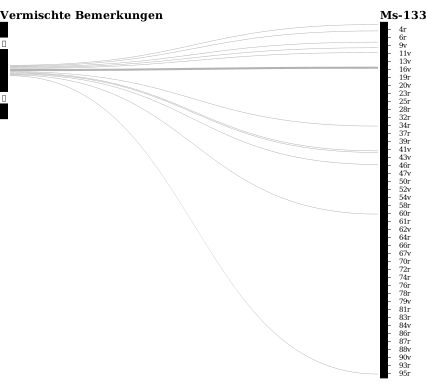
14 published remarks, VB
Do not quote from or cite this translation!
§
1v[1]22.10.1946
Sagt man nicht von dem, man kenne es, was man richtig beschreiben kann? Und kann man das von den eigenen Gedanken sagen?
October 22, 1946
Doesn’t one say that one knows something when one can describe it accurately? And can one say this about one’s own thoughts?
§
1v[2]Wenn Einer die Worte statt den “Ausdruck” des Gedankens, die “Beschreibung” des Gedankens nennen will, frage er sich, wie man einen Tisch beschreiben, & wie man die eigenen Gedanken beschreiben lernt. Und das heißt nur: er möge zusehen, wie man die Beschreibung eines Tisches, und wie man die Beschreibung der Gedanken als richtig oder falsch beurteilt; er möge also diese Sprachspiele in allen ihren Erscheinungen ins Auge fassen.
If someone wants to call the words the “expression” of the thought instead of the “description” of the thought, let them ask themselves how one learns to describe a table, and how one learns to describe one’s own thoughts. And this simply means: let them observe how the description of a table, and the description of thoughts, are judged to be correct or incorrect; let them, therefore, consider these language-games in all their manifestations.
§
1v[3] &2r[1]
23.10.1946
Philosophische Zweifel, wie Blumen. Der Eine hat von dieser Art nur ein
schwaches, kümmerliches Exemplar, der Andre ein schön ausgebildetes, kräftiges. Ein Philosoph züchtet viele Arten, & zu besonderer Größe & Schönheit.
October 23, 1946
Philosophical doubts are like flowers. One person has only a weak, stunted specimen of this kind, while another has a beautifully developed, vigorous one. A philosopher cultivates many kinds, and to a particularly large and beautiful size.
§VB
2r[2] &2v[1]
Den Wahnsinn muß man nicht als Krankheit ansehen. Warum nicht als eine plötzliche – mehr oder weniger plötzliche – Charakteränderung? Jeder Mensch ist (oder die Meisten sind) mißtrauisch, & vielleicht gegen die Verwandten mehr, als gegen Andere. Hat das Mißtrauen einen Grund? Ja & nein. Man kann dafür Gründe angeben, aber sie
sind nicht zwingend. Warum soll ein Mensch nicht plötzlich gegen die Menschen viel mißtrauischer werden? Warum nicht viel verschlossener? oder liebeleer? Werden Menschen dies nicht auch im gewöhnlichen Verlauf? – Wo ist hier die Grenze zwischen Wollen & Können? Will ich mich niemandem mehr mitteilen, oder kann ich's nicht? Wenn so vieles seinen Reiz verlieren kann, warum nicht Alles? Wenn der Mensch auch im gewöhnlichen Leben verschlagen ist, warum soll er nicht – & vielleicht plötzlich – noch viel verschlagener werden? Und viel unzugänglicher.
One must not regard insanity as a disease. Why not as a sudden—more or less sudden—change in character? Every person is (or most people are) mistrustful, and perhaps more so towards relatives than towards others. Does this mistrust have a reason? Yes and no. One can give reasons for it, but they are not conclusive. Why shouldn’t a person suddenly become much more mistrustful of people? Why not much more reserved? or devoid of affection? Don’t people also become this way in the ordinary course of events?—Where is the boundary here between wanting and being able? Do I want to communicate with no one anymore, or can I not? If so much can lose its appeal, why not everything? If people are also cunning in ordinary life, why shouldn’t they—and perhaps suddenly—become much more cunning? And much more inaccessible.
§
2v[2]“Die Tatsache ist doch, daß der Mensch nur seine eigenen Gedanken kennt.” (“Die Tatsache ist doch, daß von meinem eigenen Denken nur ich weiß.”) “Und auch ich nicht” könnte man sagen.
“The fact is that people only know their own thoughts.” (“The fact is that only I know my own thoughts.”) “And even I don’t” one could say.
§
3r[1]“Die Tatsache ist doch, daß der Mensch nur seine eigenen Gedanken kennt; daß sie etwas ihm allein gehöriges, den Anderen verborgenes sind.” Ist das so, wie auch mein Herzklopfen nur ich spüre? Ist es dem zu vergleichen, daß nur ich es fühle, wenn ich mir den Magen verdorben habe, oder ist der Satz wie der: “Jeder spürt nur seine eigenen Schmerzen”?
“The fact is that people only know their own thoughts; that they are something that belongs to them alone, hidden from others.” Is this the case, just as only I feel my heartbeat? Is it comparable to the fact that only I feel it when I have a stomach ache, or is the statement like: “Everyone only feels their own pain”?
§
3r[2]Der Satz scheint zu sagen: “Wir haben, von Natur aus, ein Mittel Dinge geheim zu halten, einen Schrank in den niemand dringen kann, so verschlossen vollzieht sich unser Denken, z.B. & unser Fühlen.”
The sentence seems to say: “By nature, we have a way of keeping things secret, a closet into which no one can penetrate, and in this way our thinking, for example, and our feeling take place.”
§
3r[3] &3v[1]
‘Gleich’ in übertragener Bedeutung. Es gibt keine Grenze
zwischen einer nicht-übertragenen & einer übertragenen Bedeutung.
‘Same’ in a figurative sense. There is no boundary between a non-figurative and a figurative meaning.
§
3v[2]“Dem Menschen hat es die Natur gegeben, daß er im Geheimen denken kann.” Denk Dir, man sagte: “Die Natur hat es dem Menschen gegeben, daß er hörbar reden, aber auch daß er unhörbar in seinem Geiste reden kann.” Er kann also, heißt das, dasselbe auf zwei Arten tun. (Als könnte er sichtbar verdauen und unsichtbar verdauen.) Nur ist beim Reden im Geiste das Reden besser verborgen als ein Vorgang im Innern des Körpers sein kann. – Wie wäre es aber, wenn ich redete, wenn alle Andern taub wären? Wäre da mein Reden nicht ebensogut verborgen? “Im tiefsten Geheimnis des Geistes geht etwas vor sich.”
“Nature has given people the ability to think in secret.” Imagine someone saying: “Nature has given people the ability to speak audibly, but also to speak inaudibly in their minds.” This means that they can, in a sense, do the same thing in two ways. (As if they could digest visibly and invisibly.) The only difference is that when speaking in one’s mind, the speaking is more hidden than a process in the body can be. But what if I spoke when everyone else was deaf? Wouldn’t my speaking be just as hidden? “Something is happening in the deepest secret of the mind.”
§
4r[1]Wer mir sagt, was er gedacht hat, – – hat mir der wirklich gesagt: was er gedacht hat? Mußte nicht das eigentliche geistige Geschehnis unbeschrieben bleiben?– – – War nicht er das Geheime, – wovon ich in der Rede dem Andern nur ein Bild gebe?
If someone tells me what he has thought—has he really told me what he thought? Didn’t the actual mental event remain undescribed? Wasn’t he the secret, of which I only give an image in speech to another?
§
4r[2]Niemand sieht, niemand hört, niemand nimmt wahr, was ich denke. So ist es ein Vorgang zutiefst verschlossen. Aber nicht in der Materie eingebettet, sondern in einen anderen Raum entrückt. (Und so wirklich aller Wahrnehmung entzogen.) – – – Und wie weißt Du, was es ist, was vorgeht? & welche Worte es beschreiben?
No one sees, no one hears, no one perceives what I think. Thus, it is a process deeply hidden. But not embedded in matter, but removed into another realm. (And thus truly inaccessible to all perception.)—And how do you know what it is, what is happening, and which words describe it?
§VB
4r[3]24.10.1946
Eine Pointe im Gedicht ist überspitzt, wenn die Verstandesspitzen nackt zu Tage treten, nicht überkleidet vom Herzen.
October 24, 1946
A punchline in a poem is exaggerated when the peaks of intellect stand bare, not covered by the heart.
§
4v[1]Wenn ich Einem sage, was ich denke, – kenne ich da meinen Gedanken besser als meine Worte ihn darstellen. Ist es als kennte ich einen Körper & zeigte ihm nur eine Photographie?
If I tell someone what I think—do I then know my thoughts better than my words represent them? Is it as if I know a body and only show him a photograph?
§
4v[2] &5r[1]
“Der Mensch ist im Stande, in voller Abgeschlossenheit mit sich selbst zu reden; in einer Isolierung, die weit vollkommener ist, als jede körperliche Isolierung.” Wie weiß ich, daß dem N. dies gegeben ist? – Weil er's sagt & zuverlässig ist? – Und doch sagen wir: “Ich wüßte gerne, was er jetzt bei sich denkt”; ganz so, wie wir sagen könnten: “Ich wüßte gerne, was er jetzt in sein Notizbuch schreibt”. Ja, man könnte eben das sagen & es, sozusagen, als selbstverständlich ansehen, daß er bei sich das denkt, was er in's
Notizbuch einträgt.
“Man is capable of conversing with himself in complete isolation; in an isolation that is far more perfect than any physical isolation.” How do I know that this is given to N.? – Because he says so & is reliable? – And yet we say: “I would like to know what he is thinking right now”; just as we could say: “I would like to know what he is writing in his notebook right now.” Yes, one could indeed say that & take it, as it were, for granted that he is thinking what he writes in his notebook.
§
5r[2]Würden nun Leute, die regelmäßig, – etwa durch Beobachten des Kehlkopfs eines Menschen – seine Gedanken ‘lesen’ könnten, – würden sie auch von der gänzlichen Einsamkeit des Geistes mit sich selbst zu sprechen geneigt sein? – Oder: Wären auch sie geneigt, das Bild von der ‘gänzlichen Abgeschlossenheit’ zu gebrauchen?
Now, would people who could ‘read’ someone’s thoughts regularly – perhaps by observing a person’s larynx – also be inclined to speak of the complete isolation of the mind in itself? – Or: Would they also be inclined to use the image of ‘complete isolation’?
§
5r[3]“Ich möchte wissen, worauf er sinnt!” Aber nun stell die – scheinbar irrelevante – Frage: “Was ist daran überhaupt Interessantes, an dem, was ‘in ihm’, in seinem Geiste, vorgeht – angenommen, daß etwas vorgeht?” (Hol's der Teufel, was in ihm vorgeht!)
“I would like to know what he is thinking!” But now pose the – seemingly irrelevant – question: “What is so interesting about what is ‘in him,’ in his mind – assuming that something is going on?” (The devil take what is going on in him!)
§
5r[4] &5v[1]
Der Vergleich des Denkens mit einem Vorgang in der Verborgenheit ist irreführend.
So irreführend, ungefähr, wie der Vergleich des Suchens nach dem treffenden Ausdruck mit einem Abkonterfeien des Gedankens.
The comparison of thinking with a process in concealment is misleading.
So misleading, approximately, as the comparison of searching for the appropriate expression with a counterfeiting of the thought.
§
5v[2]Was uns verwirrt, das ist, daß die die Gedanken des Andern zu wissen in einem Sinne eine logische Unmöglichkeit, in einem andern aber eine psychologische ist.
What confuses us is that knowing the thoughts of another is, in one sense, a logical impossibility, but in another sense, it is a psychological one.
§
5v[3]Ist es nun richtig, zu sagen, daß diese beiden ‘Unmöglichkeiten’ so miteinander zusammenhängen, daß die psychologische Unmöglichkeit (hier) das Bild liefert das uns (dann) zum Abzeichen des Begriffs ‘denken’ wird?
Is it correct to say that these two ‘impossibilities’ are so related to each other that the psychological impossibility (here) provides the image that then becomes the sign of the concept of ‘thinking’?
§
6r[1]Man kann nicht sagen, das Schreiben in's Notizbuch, oder das monologische Sprechen, sei dem stummen Denken ‘ähnlich’; wohl aber kann der eine Vorgang den andern (das Kopfrechnen das Rechnen auf dem Papier, z.B.) für gewisse Zwecke ersetzen.
One cannot say that writing in a notebook, or monological speaking, is ‘similar’ to silent thinking; however, one process can replace the other for certain purposes (e.g., mental arithmetic can replace arithmetic on paper).
§
6r[2]Könnte es Leute geben, die beim Denken immer zu sich selbst murmeln, deren Denken also für Andere zugänglich ist? – “Ja, aber wir könnten doch nicht wissen, ob sie nicht, außerdem, stumm bei sich selber denken!” – Könnte es denn aber nicht sein, daß, diese Möglichkeit dies anzunehmen, ebenso sinnlos wäre, wie anzunehmen, die Haare dieser Leute dächten, oder ein Stein dächte?
Could there be people who always mutter to themselves while thinking, so that their thinking is accessible to others? – “Yes, but we couldn’t know whether they are also thinking silently to themselves!” – But couldn’t it also be that this possibility of assuming it is just as senseless as assuming that the hair of these people is thinking, or that a stone is thinking?
§
6r[3] &6v[1]
Müßten wir, heißt das, wenn dies so wäre, auch nur auf den Gedanken kommen, einer dächte, hätte Gedanken,
in seinem Geist verborgen?
Must we, if this were the case, even come to the idea that someone is thinking, has thoughts, hidden in his mind?
§
6v[2]“Was in mir vorgeht kann unmöglich Einer wissen; denn, was immer er sähe, es wäre nicht das.” Hier wird Grammatik geschmiedet.
“What is going on in me cannot possibly be known by anyone; for whatever he sees, it would not be that.” Here, grammar is being forged.
§
6v[3]“Ich weiß nicht, was Du Dir denkst. Sag, was Du Dir denkst!” – das heißt etwa: “Rede!”
“I don’t know what you are thinking. Tell me what you are thinking!” – this means something like: “Speak!”
§
6v[4] &7r[1]
Ist es also irreführend, von der Seele des Menschen, oder von seinem Geist zu reden? So wenig, daß es ganz verständlich ist, wenn ich sage: “Meine Seele ist müde, nicht bloß mein Verstand”. Aber sagst Du nicht doch, daß alles was man durch das Wort “Seele” ausdrücken kann, irgendwie auch durch Worte für Körperliches sich ausdrücken läßt? Ich sage es nicht. Aber wenn es auch so wäre, – was würde das sagen? Die Worte, so wie das, worauf
wir bei ihrer Erklärung weisen, sind ja nur die Instrumente, & nun kommt's auf ihren Gebrauch an.
Is it therefore misleading to speak of the soul of a person, or of his mind? So little that it is quite understandable when I say: “My soul is tired, not just my mind.” But don’t you still say that everything that can be expressed by the word “soul” can somehow also be expressed by words for the physical? I do not say that. But even if it were so, what would that say? The words, as well as what we point to in their explanation, are only the instruments, & now it depends on their use.
§VB
7r[2]Oh es kann ein Schlüssel für ewig da liegen, wohin ihn der Meister gelegt hat, & nie verwendet werden, das Schloß aufzuschließen, dafür der Meister ihn geschmiedet hat.
Oh, a key can lie there forever, where the master has put it, & never be used to open the lock for which the master forged it.
§
7r[3] &7v[1] &
8r[1]
25.10.1946
Ich habe nicht den Mut und nicht die Kraft & Klarheit den Tatsachen meines Lebens gerade in's Gesicht zu schauen. – B. hat zu mir eine Vor-Liebe. Etwas, was nicht halten kann. Wie diese verwelken wird, weiß ich natürlich nicht. Wie etwas von ihr zu erhalten wäre, lebendig, nicht gepreßt in einem Buch als Andenken, weiß ich auch nicht. Es ist unendlich unwahrscheinlich, daß diese Liebe, wenn sie von einer andern, oder anderen Umständen gedrängt wird, dann noch Zähigkeit genug haben wird, nicht zu reißen. Das ist nun eine furchtbare Schwierigkeit meines Lebens. Ich weiß nicht ob und wie ich es aushalten werde, dies Verhältnis mit dieser Aussicht weiterzunähren. Es abzubrechen aber habe ich nicht die Klarheit und nicht die Kraft. Wenn ich mir vorstelle, daß ich es abgebrochen hätte, so fürchte ich mich vor der Einsamkeit; davor mir sagen zu müssen, ich hätte treulos & ungeduldig ein Band zerrissen, das ein großes & ungemein seltsames Geschenk des Himmels war, und das ich nicht zum Guten zu verwenden wußte. Es wird mir so erscheinen, daß hier, als ich es nie erwarten durfte mir eine Gelegenheit geboten wurde, und ich, statt sie nun wohl zu benützen, sie weggeworfen habe. Das ist schwer: Wenn ich diese Neigung benützen will, kann ich's nur tun indem ich viel leide. – Und ob es dann gehen wird weiß ich auch nicht, noch, ob ich diesen Schmerz aushalten kann. Dämonen haben dieses Band gewoben und halten es in der Hand. Sie können's zerreißen, oder dauern lassen.
October 25, 1946
I do not have the courage and the strength & clarity to face the facts of my life head-on. – B. has a pre-disposition towards me. Something that cannot last. How this will fade, I naturally do not know. How something of it could be preserved, alive, not pressed into a book as a memento, I also do not know. It is infinitely unlikely that this love, if it is pressured by another, or other circumstances, will still have enough resilience not to break. This is now a terrible difficulty in my life. I do not know whether and how I will be able to endure, to continue nurturing this relationship with this prospect. But I do not have the clarity and the strength to break it off. If I imagine that I had broken it off, then I am afraid of the loneliness; of having to tell myself that I have broken a bond that was a great & extraordinarily odd gift from heaven, and that I did not know how to use for good. It will seem to me that, when I never expected it, an opportunity was offered to me, and I, instead of probably using it, have thrown it away. That is difficult: if I want to use this inclination, I can only do it by suffering a great deal. – And whether it will then work, I do not know either, nor whether I can endure this pain can. Demons have woven this bond and hold it in their hands. They can tear it apart, or let it last.
§
8r[2] &8v[1] &
9r[1]
26.10.1946
Die Liebe ist ein Glück. Vielleicht ein Glück mit Schmerzen, aber ein Glück. Fehlt das Glück, oder schrumpft es auf ein kurzes Aufflackern zusammen, so fehlt die Liebe. – In der Liebe muß ich sicher ruhen können. – Aber kannst du ein warmes Herz zurückweisen? Ist es ein Herz, das warm für mich schlägt? – ‘I'll rather do anything than to hurt the soul of friendship.’ – I must know: he won't hurt our friendship. Der Mensch kann aus seiner Haut nicht heraus. Ich kann nicht eine Forderung, die tief in mir, mit meinem ganzen Leben verankert, liegt, aufgeben. Denn die Liebe ist mit der Natur verbunden; und würde ich unnatürlich, so müßte die Liebe aufhören. – Kann ich sagen: “Ich werde vernünftig sein, & das nicht mehr verlangen.”? Bei manchem geht es. Es geht vielleicht bei den meisten für eine Zeit. Aber doch nur als Mittel zu einem andern Ende, nicht als Ende. Ich kann sagen: Laß ihn gewähren, – es wird einmal anders werden. – Die Liebe, die ist die Perle von großem Wert, die man am Herzen hält, für die man nichts eintauschen will, die man als das Wertvollste schätzt. Sie zeigt einem überhaupt – wenn man sie hat – was großer Wert ist. Man lernt, was es heißt: den Wert erkennen. Man lernt, was es heißt: ein Edelmetall von allen andern aussondern. Die ungeheure Vorliebe dafür lehrt uns die Idee des einzigartigen Wertes. Die ungeheure Vorliebe führt uns dazu zu sehen: es ist unsere Pflicht das zu verteidigen. Die Vorliebe führt uns zum Ernst. Die Leidenschaft, zum Ernst. – Tut das die Vorliebe nicht, so ist sie nicht Liebe. Das Furchtbare ist die Ungewißheit. Und in der Ungewißheit beschäftigt sich mein Geist immer damit, mir Möglichkeiten, und fast immer schlechte auszumalen. Das ist manchmal recht, meistens aber übel. “Auf Gott vertrauen”. Aber vom Gottvertrauen bin ich weit entfernt. Von da, wo ich bin, zum Gottvertrauen ist ein weiter Weg. Freudevolle Hoffnung und Furcht sind einander verschwistert. Ich kann die eine nicht haben ohne daß sie an die andre grenzt.
October 26, 1946
Love is a happiness. Perhaps a happiness with pain, but a happiness. If the happiness is missing, or shrinks to a brief flash, then the love is missing. – In love, I must be able to rest securely. – But can you reject a warm heart? Is it a heart that is warm for me? – ‘I'd rather do anything than hurt the soul of friendship.’ – I must know: he won't hurt our friendship. A person cannot get out of his own skin. I cannot give up a demand that lies deep within me, anchored in my whole life. For love is connected with nature; and if I were to be unnatural, then love would have to stop. – Can I say: “I will be reasonable, & no longer demand that.”? In some cases, it works. It may work for most for a while. But only as a means to another end, not as an end in itself. I can say: let him be, – it will be different one day. – Love is the pearl of great value that one holds close to one's heart, for which one wants nothing in exchange, which one values as the most precious thing. It shows one, if one has it, what great value is. One learns what it means: to recognize value. One learns what it means: to separate a precious metal from all others. The immense preference for it teaches us the idea of unique value. The immense preference leads us to see: it is our duty to defend it. The preference leads us to seriousness. The passion, to seriousness. – If the preference does not do this, then it is not love. The terrible thing is the uncertainty. And in the uncertainty, my mind is always occupied with imagining possibilities, and almost always bad ones. That is sometimes right, but mostly bad. “Trust in God.” But I am far from trusting in God. From where I am, there is a long way to trusting in God. Joyful hope and fear are siblings. I cannot have one without the other bordering on it.
§
9r[2]27.10.1946
Es ist nicht jeder frei, der seiner Fesseln spottet kann man von denen sagen, die über die Sprachuntersuchungen in der Philosophie spotten & nicht sehen, daß sie selbst in tiefen Begriffsverwirrungen verstrickt sind.
October 27, 1946
It is not everyone who is free; one can say that of those who mock the investigations of language in philosophy & do not see that they themselves are entangled in deep conceptual confusions.
§
9v[1]Die Untersuchung der Sprache in der Philosophie ist ein Beschreiben & Vergleichen der Begriffe, mit Hilfe auch ad hoc aufgestellter Begriffe.
The investigation of language in philosophy is a description & comparison of concepts, with the help of concepts also established ad hoc.
§
9v[2] &10r[1]
28.10.1946
Ich sage “Laß mich nachdenken!”, denke nach, dann rede ich. Was geschah als ich nachdachte? – Ich dachte nach. (Das ist natürlich keine Antwort.) Aber ich tat doch in dieser Zeit nicht nichts! Wenn mit “nichts tun” geistige Leere gemeint ist, tat ich etwas & nicht nichts. – Denk Dir, Einer sagte: “Mein Geist war nicht in Ruhe, sondern in Bewegung.” – Aber was ist auf diesem Gebiete “Ruhe”, was “Bewegung” zu nennen? – Wir müssen hinunter steigen zum Begriff des “Beschreibens” – des “Berichtens”, oder “Erzählens” eines Vorgangs. – Wie ist's aber mit dem Vorgang, den ich spüre?! – Bist Du sicher, daß Du einen ‘Vorgang’ spürst? Und, wenn Du sagst, Du seist sicher, – was ist diese Sicherheit wert? Was gilt sie im Verkehr? (“Schwarz, eine Gesichtsempfindung, oder der Mangel einer Gesichtsempfindung?”)
28.10.1946
I say, “Let me think!”, I think, then I speak. What happened when I was thinking? – I thought. (Of course, this is not an answer.) But I didn’t do absolutely nothing during that time! If “doing nothing” means mental emptiness, then I did something, and not nothing. – Imagine someone said, “My mind was not in repose, but in motion.” – But what is “repose,” and what is “motion” in this context? – We must descend to the concept of “describing” – of “reporting” or “telling” a process. – But what about the process that I experience?! – Are you sure that you experience a ‘process’? And if you say you are sure, – what is that certainty worth? What is its value in practice? (“Black, a visual sensation, or the lack of a visual sensation?”)
§
10r[2]29.10.1946
Unsere Kenntnis vieler verschiedener Sprachen läßt uns die Unterschiede der Betrachtungsweisen die sich in ihnen zeigen, als unwesentlich geringschätzen. Dabei sind wir aber blind dafür, daß wir selbst dennoch ein Vorurteil zu Gunsten gewisser Ausdrucksformen haben, daß wir eben auch dieses Gemenge von Sprachen von von einem besonderen Standpunkte aus betrachten, & daß insbesondere die Sprachspiele, die wir in Betracht ziehen sehr parteiisch ausgewählt sind. (Niemand in Europa hat heute nur eine Sprache) auch der zuckt der nur eine versteht.)
29.10.1946
Our knowledge of many different languages leads us to underestimate the differences in the ways of seeing that are reflected in them. However, we are blind to the fact that we ourselves still have a prejudice in favor of certain forms of expression, that we also view this mixture of languages from a particular point of view, and that, in particular, the language-games that we consider are very biasedly selected. (No one in Europe today has only one language; even those who only understand one.)
§VB
10r[3]“Es ist höchste Zeit, daß wir diese Erscheinung mit etwas anderem vergleichen” – kann man sagen. – Ich denke da, z.B., an Geisteskrankheiten.
“It is high time that we compare this phenomenon with something else,” one might say. – I think, for example, of mental illnesses.
§
10v[1]Unsre Kenntnis vieler (verschiedener) Sprachen läßt uns die Philosophie, die in den Formen einer jeden niedergelegt sind, nicht recht ernstnehmen. Dabei aber sind wir blind dafür, daß wir (selbst) starke Vorurteile für & gegen gewisse Ausdrucksformen haben; daß eben auch in dieser Übereinanderlagerung die Sprachen für uns ein bestimmtes Bild ergeben.
Our knowledge of many (different) languages prevents us from taking the philosophy contained in the forms of each of them seriously. However, we are blind to the fact that we (ourselves) have strong prejudices for and against certain forms of expression; that even in this juxtaposition, the languages produce a specific picture for us.
§
10v[2] &11r[1]
30.10.1946
Du mußt bedenken, daß es ein Sprachspiel geben kann, ‘eine Reihe von Ziffern fortsetzen’, in dem keine Regel; kein Regelausdruck je gegeben wird, sondern das Lernen nur durch Beispiele geschieht. So daß die Idee einer Rechtfertigung durch ein Bild, das uns zwingt, so vorzugehen, diesen Leuten ganz fremd wäre.
30.10.1946
You must consider that there may be a language-game, ‘continuing a series of numbers,’ in which there is no rule; no rule-statement is ever given, but learning happens only through examples. So that the idea of a justification through a picture that forces us to proceed in this way would be completely foreign to these people.
§
11r[2]Beispiel von den Namen, die nur in Begleitung ihrer Träger Bedeutung haben, d.h. verwendet werden Sie dienen also nur zur Vermeidung des steten Zeigens. Das Beispiel das mir immer wieder vorschwebt, ist die Bezeichnung von Linien, Punkten, Winkeln, in geometrischen Figuren, mit A, B, C, … etc. a, b, c … α, β, γ … mit lateinischen & griechischen Buchstaben.
An example is the names that only have meaning in conjunction with their bearers, i.e., when used, they serve only to avoid constantly pointing. The example that always comes to mind is the designation of lines, points, and angles in geometric figures with A, B, C, … etc. a, b, c … α, β, γ … with Latin and Greek letters.
§
11r[3] &11v[1]
Beim Lesen: sehen des Wortbilds “Ich habe das Wort flüchtig gesehen”. Das ist ein besonderes Erlebnis, läßt sich nicht durch einen Film darstellen.
When reading: seeing the word-image “I saw the word fleetingly.” This is a special experience; it cannot be represented by a film.
§
11v[2]31.10.1946
Denk Dir eine Geisteskrankheit, in welcher man Namen nur in Anwesenheit der Träger gebrauchen & verstehen kann.
31.10.1946
Imagine a mental illness in which one uses and understands names only in the presence of their bearers.
§VB
11v[3]Freud hat durch seine phantastischen Pseudo-Erklärungen (gerade weil sie geistreich sind) einen schlimmen Dienst erwiesen. (Jeder Esel hat sie nun zur Hand, mit ihrer Hilfe Krankheitserscheinungen zu ‘erklären’.)
Freud, through his fantastic pseudo-explanations (precisely because they are witty), has done a great disservice. (Now everyone has them at hand to ‘explain’ symptoms of illness.)
§
11v[4]Ja: der Philosoph will Methoden umgestalten.
Yes: the philosopher wants to reshape methods.
§
11v[5] &12r[1]
Denk Dir, das Rechnen im Dezimalsystem hätte seinen Ausgang genommen von der Erfindung eines Menschen, der den Kalkül als ein Schreibspiel, gänzlich fern von den Zwecken & Assoziationen der Arithmetik, erfunden hätte. Es habe aber dieser Mann wohl geahnt, daß sein Spiel mit Zeichen einst von ungeheurer Bedeutung in allen Zweigen des Lebens sein werde. Er hat sich aber nicht, bemüht diese Bedeutung zu formulieren, oder genauer vorauszusehen. Dennoch aber wäre von einem l'art pour l'art bei ihm hier keine Rede.
Imagine that calculating in the decimal system originated from the invention of a person who invented the calculus as a writing game, completely separate from the purposes and associations of arithmetic. However, this man probably suspected that his game with signs would one day be of immense importance in all areas of life. However, he did not try to formulate this meaning or predict it more precisely. Nevertheless, there would be no question of “art for art's sake” in his case.
§
12r[2] &12v[1]
Das Sprachspiel, in welchem das Wort nur bei Existenz des Trägers Bedeutung hat, müßte eines sein worin der Träger des Worts eine andere als die uns gewohnte Rolle spielt. In welchem mit mehr Recht von einer Vertretung des Dings durch das Wort geredet werden könnte. Wenn z.B. Menschen durch Puppen vertreten würden. Oder wenn man eine Sitzordnung macht, indem man Sitzkarten an die Plätze der Tafel legt. Stirbt einer der Gäste, so zerreißt man die Sitzkarte mit seinem Namen.
The language-game in which the word only has meaning when its bearer exists must be one in which the bearer of the word plays a different role than the one we are used to. In which one could more rightly speak of a representation of the thing by the word. For example, if people were represented by dolls. Or if one makes a seating arrangement by placing place cards on the places at the table. If one of the guests dies, the place card with his name is torn up.
§
12v[2]Es könnte von Worten ein Gebrauch gemacht werden derart, daß die Zeichen nutzlos würden (daß man sie vielleicht vernichtete), sobald der Träger aufhörte zu existieren.
It could be that words are used in such a way that the signs become useless (that one might destroy them) as soon as the bearer ceases to exist.
§
12v[3] &13r[1]
In jenem Sprachspiel müßte sozusagen der Name den Gegenstand an einer Schnur haben, & hört der Gegenstand auf zu existieren, so kann man den Namen, der mit ihm zusammengearbeitet hat, wegwerfen.
In that language-game, the name would, as it were, have the object on a string, and when the object ceases to exist, one can throw away the name that cooperated with it.
§
13r[2]O, warum ist mir zumute, als schrieb ich ein Gedicht, wenn ich Philosophie schreibe? Es ist hier, wie wenn hier ein Kleines wäre, das eine herrliche Bedeutung hat. Wie ein Blatt, oder eine Blume.
Oh, why do I feel as if I am writing a poem when I write philosophy? Here, there is something small that has a wonderful meaning. Like a leaf, or a flower.
§
13r[3]Die Sucht nach Erklärung ist dem Beschreiben hinderlich.
The craving for explanation is an obstacle to description.
§
13r[4]Die vorgefaßte Hypothese wirkt wie ein Sieb, das nur einen ganz kleinen Teil der Tatsachen zu unserm Blick gelangen läßt.
The preconceived hypothesis acts like a sieve, allowing only a very small part of the facts to reach our view.
§
13r[5] &13v[1]
01.11.1946
Gestern ‘Moral Science Club’: ich selbst eitel & auch dumm. Die ‘Atmosphäre’ elend. – Soll ich weiter lehren? –
01.11.1946
Yesterday ‘Moral Science Club’: I myself was vain & also stupid. The ‘atmosphere’ was wretched. – Should I continue to teach? –
§
13v[2]“Ich beabsichtige dorthin zu gehen”: Beschreibung eines Geisteszustands, oder Äußerung? – Wenn man sich ein Modell der Seele vorstellt, so könnte der Satz eine Beschreibung des Modells im gegenwärtigen Zustand sein. Der Mensch schaut seine Seele an & sagt: “ …”. Ist es ein gutes oder ein schlechtes Modell – – – wie wäre das zu entscheiden. Die Frage ist: Wie würde es als Zeichen verwendet?
“I intend to go there”: Is this a description of a state of mind, or an utterance? – If one imagines a model of the mind, then the sentence could be a description of the model in its present state. The human being looks at his mind & says: “…” Is it a good or a bad model – how would one decide? The question is: How would it be used as a sign?
§
13v[3] &14r[1]
“Ich beabsichtige …” könnte man als Aussage verwenden: “Ich tue etwas, was dieser Absicht entspricht” z.B.: ich packe für die Reise, bereite mich so oder so, durch Überlegungen oder Handlungen, auf die Reise vor. So könnte man ein Verbum verwenden. Etwa entsprechend dem Ausdruck “Ich handle in der Absicht …”
“I intend to…” one could use as a statement: “I am doing something that corresponds to this intention,” e.g.: I am packing for the trip, preparing for the trip in one way or another, through considerations or actions. Thus, one could use a verb. Roughly corresponding to the expression “I am acting with the intention of…”
§
14r[2]Beschreibung meiner Seelenzustände: des Wechsels von Furcht und Hoffnung z.B.. “Am Vormittag war ich voller Hoffnung, dann …. Jeder würde das eine Beschreibung nennen. Aber es ist charakteristisch dafür, daß dieser Beschreibung parallel eine meines Benehmens gehen könnte.
Description of my states of mind: of the change from fear and hope, for example. “In the morning I was full of hope, then…. Everyone would call this a description. But it is characteristic of the fact that there could be a parallel description of my behaviour.
§
14r[3]Vergleiche den Ausdruck der Furcht & Hoffnung mit dem des ‘Glaubens’, das & das werde geschehen. – Man nennt darum auch Hoffnung & Furcht “Gemütsbewegungen”, den Glauben (oder das Glauben) aber nicht.
Compare the expression of fear & hope with that of ‘belief,’ that this and that will happen. – One therefore also calls hope and fear “emotions,” but not belief (or the believing).
§
14r[4] &14v[1]
Wenn ich sage: “Die Absicht es zu tun; wurde von Stunde zu Stunde stärker” – dies wird man Beschreibung nennen. Aber dann doch auch dies: “Ich beabsichtigte die ganze Zeit ….” Vergleiche nun “Ich glaubte die ganze Zeit an's Gravitationsgesetz” mit “Ich glaubte die ganze Zeit, ein leises Flüstern zu hören”. Im ersten Fall ist “Glauben” ähnlich verwendet wie “Wissen” (‘Hätte man mich gefragt, so hätte ich gesagt …’) – im zweiten Fall haben wir eine Tätigkeit, ein Vermuten, Lauschen, Zweifeln, etc. Und bezeichnet auch “glauben” nicht diese Tätigkeit, so ist es doch sie, die uns sagen läßt, wir beschrieben hier einen Seelenzustand oder eine seelische Tätigkeit. – Wir könnten das auch so sagen: Wir machen uns ein Bild des Menschen, der die ganze Zeit glaubt, ein leises Geräusch zu hören. Aber nicht eines des Menschen, der an die Richtigkeit des Gravitationsgesetzes glaubt.
When I say: “The intention to do it became stronger from hour to hour” – this one would call a description. But then also this: “I intended it all along….” Now compare “I believed in the law of gravity all along” with “I believed all along that I was hearing a faint whisper.” In the first case, “believing” is used similarly to “knowing” (‘Had one asked me, I would have said…’) – in the second case, we have an activity, a guessing, listening, doubting, etc. And even if “believing” does not denote this activity, it is nevertheless it that makes us say that we are describing here a state of mind or a mental activity. – We could also put it this way: We are forming a picture of the person who believes all along that he is hearing a faint noise. But not of the person who believes in the correctness of the law of gravity.
§
15r[1]Ich beabsichtige (könnte man sagen) heißt nicht: “Ich bin dabei zu beabsichtigen” oder “Ich bin beim Beabsichtigen” (wie man sagt ich bin beim Zeitunglesen). Wohl aber: “Ich bin dabei, meine Reise zu planen” etc. Wir haben kein einzelnes Verbum, könnten es aber haben (& vielleicht existiert es wirklich in einer wenig bekannten Sprache) das ausdrückt: “handeln mit der Absicht das & das zu tun” .
I intend (one could say) does not mean: “I am in the process of intending” or “I am in the act of intending” (as one says I am in the act of reading the newspaper). But rather: “I am in the process of planning my trip,” etc. We do not have a single verb, but we could have it (and perhaps it actually exists in a little-known language) that expresses: “acting with the intention of doing this and that.”
§
15r[2]“Ich beabsichtige …” ist nie eine Beschreibung, aber unter gewissen Umständen lassen sich Beschreibungen dieser Äußerung zuordnen.
“I intend…” is never a description, but under certain circumstances, descriptions can be assigned to this utterance.
§
15v[1]Zu sich selbst reden. “Was geschieht da?” Falsche Frage! Nicht nur kann man nicht sagen, was geschieht – auch nicht: man wisse nicht, was geschieht – auch nicht: man wisse nur das & das darüber! Aber auch das ist falsch, zu sagen: Es ist eben ein spezifischer Vorgang, der sich durch nichts beschreiben läßt, als eben mit diesen Worten. – Die Begriffe ‘Beschreibung’ & ‘Bericht’. Man sagt: Einer berichtet, er habe zu sich selbst gesagt …. Inwiefern ist das zu vergleichen dem ‘Bericht’, er habe, z.B., gesagt …? Vergegenwärtigen wir uns, daß Beschreiben ein sehr spezielles Sprachspiel ist. – – – [Beschreibung eines Traums, Erinnerung.] Wir müssen diese zu unterst liegenden, erhärteten Begriffe umgraben.
Talking to oneself. “What is happening here?” A wrong question! Not only can one not say what is happening—not even: one does not know what is happening—not even: one knows only this and that about it! But even this is wrong, to say: it is simply a specific process that cannot be described in any other way than with these words. – The concepts of ‘description’ and ‘report’. One says: someone reports that he said to himself…. In what respect is this comparable to the ‘report’ that he said, e.g.,…? Let us realize that describing is a very specific language-game. – – – [Description of a dream, memory.] We must dig up these underlying, hardened concepts.
§VB
16r[1]Die Ironie in der Musik. Bei Wagner z.B. in den Meistersingern. Unvergleichlich tiefer im ersten Satz der IX. im Fugato. Hier ist etwas, was in der Rede dem Ausdruck grimmiger Ironie entspricht.
The irony in music. In Wagner, for example, in the Meistersingers. Incomparably deeper in the first sentence of the IX in the fugato. Here is something that corresponds in speech to the expression of grim irony.
§VB
16r[2] &16v[1]
02.11.1946
Ich hätte auch sagen können: das Verzerrte in der Musik. In dem Sinne in dem man von gramverzerrten Zügen spricht. Wenn Grillparzer sagt, Mozart habe in der Musik nur das “Schöne” zugelassen, so heißt das, glaube ich, daß er nicht das Verzerrte, Gräßliche zugelassen habe, daß in seiner Musik sich nichts findet, was diesem entspricht. Ob das ganz wahr ist, will ich nicht sagen, aber angenommen, es ist so, so ist es ein Vorurteil Grillparzer, daß es von Rechts wegen nicht anders sein dürfe. Daß die Musik nach Mozart (besonders natürlich durch Beethoven) ihr Sprachgebiet erweitert hat ist weder zu preisen, noch zu beklagen, sondern: so verhält es sich. In Grillparzers Verhalten ist eine Art von Undankbarkeit. Wollte er noch einen Mozart haben? Könnte er sich etwas vorstellen, was so einer nun komponieren würde? Hätte er sich Mozart vorstellen können, wenn er ihn nicht gekannt hätte? Hier hat auch der Begriff “das Schöne” manchen Unfug angestellt.
02.11.1946
I could also have said: the distorted in music. In the sense in which one speaks of features distorted by grammar. When Grillparzer says that Mozart only allowed the “beautiful” in music, that means, I believe, that he did not allow the distorted, the hideous, that in his music nothing can be found that corresponds to this. Whether this is entirely true, I will not say, but let us assume that it is, so it is a prejudice of Grillparzer that things should not be otherwise. That the music after Mozart (particularly, of course, through Beethoven) has expanded its area of language is neither to be praised nor regretted, but: that is how it is. In Grillparzer’s behaviour, there is a kind of ingratitude. Did he still want a Mozart? Could he imagine something that such a one would now compose? Could he have imagined Mozart if he had not known him? Here, too, the concept of “the beautiful” has done much mischief.
§VB
16v[2]Begriffe können einen Unfug erleichtern oder erschweren; begünstigen, oder hemmen.
Concepts can facilitate or hinder nonsense; favour or inhibit it.
§
16v[3]Es ist ganz richtig: man kann sich nicht eine Erklärung von ‘rot’, oder ‘Farbe’ vorstellen. Aber nicht, weil das Erlebte etwas Spezifisches ist, sondern weil das Sprachspiel es ist.
It is quite correct: one cannot imagine an explanation of ‘red’ or ‘colour’. But not because what is experienced is something specific, but because the language-game is what it is.
§
16v[4] &17r[1]
“Rot ist einfach”. – Was heißt das, warum ist man geneigt das zu sagen? Was ist nicht einfach? Nun, ein Sessel, z.B..– Ist ein Dreiklang zusammengesetzt? Viele sagen, er sei nicht einfach: Grundton & Terz & Quint, sondern sei eine neue Einheit. Könnte der Sessel nicht auch als neue Einheit aufgefaßt werden? Die Farbe Orange wird man vielleicht zusammengesetzt nennen. Aber muß sie es für Jeden sein, muß jeder geneigt sein sie als Produkt einer Farbmischung aufzufassen? Denk an den Abscheu Goethes vor der Idee, weiß sei zusammengesetzt. Was heißt hier “zusammengesetzt”? und was heißt hier “einfach”?
“Red is simple.” – What does that mean, why is one inclined to say that? What is not simple? Well, a chair, for example. – Is a triad composed? Many say that it is not simple: fundamental tone and third and fifth, but is a new unity. Could the chair not also be understood as a new unity? The colour orange one might perhaps call composed. But must it be for everyone, must everyone be inclined to understand it as a product of a colour mixture? Think of Goethe’s aversion to the idea that white is composed. What does “composed” mean here, and what does “simple” mean here?
§
17r[2] &17v[1]
03.11.1946
Schau ein weißliches Grün an: Bist Du hier ebenso geneigt zu sagen, es sei einfach? Und wenn nicht, – war es also diese Zusammensetzung (aus den Grundfarben inklusive Schwarz & Weiß) die Du beim reinen Rot vermißtest?
03.11.1946
Look at a whitish green: Are you equally inclined to say that it is simple? And if not, – was it then this composition (from the primary colours including black and white) that you missed in pure red?
§
17v[2] &18r[1]
“Man kann einem Menschen nicht erklären, was Rot ist” – Wenn man es nun dennoch könnte, – ist es dann nicht, was wir “rot” nennen? Denken wir uns Menschen die eine Zwischenfarbe, von Rot & Gelb z.B., durch eine Art binären Dezimalbruch so ausdrücken: R, L L R L u. dergl., wo R & L Rechts & Links bedeuten & auf der rechten Seite z.B. Gelb steht auf der linken Rot. – Diese Leute, lernen schon im Kindergarten Farbtöne in dieser Weise beschreiben, nach solchen Beschreibungen Farben auszuwählen, zu mischen etc. Sie verhalten sich zu uns ungefähr, wie Leute mit absolutem Gehör zu Leuten, denen dies fehlt. Sie können tun, was wir nicht können.
“One cannot explain to a person what red is” – If one could do so nevertheless, is it not then what we call “red”? Let us imagine people who express an intermediate colour, between red and yellow, for example, through a kind of binary decimal fraction in this way: R, L L R L, etc., where R and L mean right and left and, on the right side, for example, yellow is on the left red. – These people already learn in kindergarten to describe colour tones in this way, to choose and mix colours according to such descriptions, etc. They behave towards us approximately as people with perfect pitch behave towards people who lack it. They can do what we cannot.
§
18r[2]Und hier möchte man sagen: “Ist das denn aber auch vorstellbar? Ja, das Benehmen wohl! aber auch der innere Vorgang, das Farberlebnis?” Und was man auf so eine Frage sagen soll, ist schwer zu sehen. Hätten die, die kein absolutes Gehör haben, erraten können, es müsse auch Leute mit absolutem Gehör geben?
And here one would like to say: “Is that even conceivable? Yes, the behaviour, certainly! but also the inner process, the experience of colour?” And it is difficult to see what one should say to such a question. Could those who do not have perfect pitch have guessed that there must also be people with perfect pitch?
§
18r[3]Und doch fühlen wir etwas wie: In diesen Leuten muß etwas ganz anderes vorgehen. Aber was bedeutet dieses Gefühl?
And yet we feel something like: something completely different must be happening in these people. But what does this feeling mean?
§
18r[4] &18v[1]
Wenn Einer sagte “Rot ist zusammengesetzt” – so könnten wir nicht erraten, worauf er damit anspielt, was er mit diesem Satz wird anfangen wollen. Sagt er aber: “Dieser Sessel ist zusammengesetzt”, so mögen wir zwar nicht gleich wissen, von welcher Zusammensetzung er spricht, können aber gleich an mehr als einen Sinn für seine Aussage denken. Was für eine Art von Faktum ist es nun worauf ich hier aufmerksam mache?
If someone said “Red is composite,” we couldn’t guess what he meant, what he intends to do with this sentence. But if he says, “This armchair is composite,” we may not immediately know what kind of composition he is talking about, but we can immediately think of more than one sense for his statement. What kind of fact is it that I am pointing out here?
§
18v[2]Jedenfalls ist es ein wichtiges Faktum. – Uns ist keine Technik geläufig, auf die dieser Satz anspielen könnte.
In any case, it is an important fact. – We are not familiar with any technique to which this sentence could refer.
§
18v[3]Wir beschreiben hier ein Sprachspiel, welches wir nicht lernen können.
We are describing a language-game that we cannot learn.
§
19r[1]“Dann muß etwas ganz anderes in ihm vorgehen, etwas, was wir nicht kennen.” – Das zeigt uns, wonach wir bestimmen, ob ‘im Andern’ etwas anderes als, oder dasselbe wie, bei uns stattfindet. Das zeigt uns, wonach wir die inneren Vorgänge beurteilen.
“Then something completely different must be happening in him, something we don’t know.” – This shows us what we determine when we ask whether something different than, or the same as, what is happening in us is happening ‘in the other.’ This shows us, according to what we judge the inner processes.
§
19r[2]“Rot ist nicht zusammengesetzt” – Und was ist Rot?! – Da möchten wir einfach auf etwas Rotes zeigen; & (wir) vergessen, daß, wenn jene Aussage einen Sinn haben soll, uns mehr gegeben sein muß, als die hinweisende Definition. Wir verstehen noch gar nicht, was der Sinn eines Satzes von der Form “X ist nicht zusammengesetzt” ist, wenn für “X” ein Wort gesetzt wird, welches den Gebrauch unserer Farbwörter hat.
“Red is not composite” – And what is red?! – We simply want to point to something red; & (we) forget that, if this statement is to have sense, we must be given more than the ostensive definition. We don’t yet understand what the sense of a sentence of the form “X is not composite” is, when “X” is a word that has the use of our color words.
§
19r[3] &19v[1]
Es ist Tatsache: “Rot” wird einem nicht durch Worte ohne Bezug auf ein Farbmuster erklärt. Sollte das nicht wichtig sein?!
It is a fact: “Red” is not explained to one by words without reference to a color sample. Shouldn’t that be important?!
§
19v[2]“Wie könnte man Rot Einem erklären wollen, da es doch ein bestimmter Sinneseindruck ist, & nur der ihn kennt, der ihn hat (oder gehabt hat) & erklären nur heißen kann: ihn im Andern (zu) erzeugen!” – Aber Du weißt, das nützt nichts. (Kriterium!)
“How could one want to explain red to someone, since it is a particular sense impression, & only the one who has it (or had it) knows it, & explaining can only mean: to produce it in the other!” – But you know that it doesn’t help. (Criterion!)
§
19v[3]“Wer absolutes Gehör hat, muß ein anderes Tonerlebnis haben, als ich.” – Und Jeder, der absolutes Gehör hat, das gleiche? Und wenn das nicht, warum muß es ein anderes sein, als das meine?
“Whoever has perfect pitch must have a different tonal experience than I do.” – And does everyone who has perfect pitch have the same experience? And if not, why must it be different from mine?
§
19v[4]Daß die Meisten von uns zählen können, ist sehr merkwürdig.
The fact that most of us can count is very remarkable.
§
19v[5] &20r[1]
Denk Dir, um Einem ‘Rot’ zu erklären, zeigen wir ihm ein etwas rötliches Schwarzbraun, & sagen: “Diese Farbe besteht aus Gelb (wir zeigen reines Gelb), Schwarz (wir zeigen es) & noch einer Farbe, die “Rot” heißt. Darauf ist er nun im Stande, aus einer Anzahl von Farbmustern das reine Rot auszuwählen.
Imagine, in order to explain ‘red’ to someone, we show him a somewhat reddish brownish black, & say: “This color consists of yellow (we show pure yellow), black (we show it) & another color, which is called ‘red’.” With this, he is now able to select the pure red from a number of color samples.
§
20r[2]Und merke wohl: man zeigt nicht auf Rot, sondern auf etwas Rotes. D.h. natürlich: der Begriff ‘Rot’ ist durch's Zeigen nicht bestimmt & es ist nicht nur möglich “Rot” nun als Namen einer Form, z.B., zu deuten, sondern auch als Begriffswort, das einem Farbwort viel näher steht.
And note: one doesn’t point to red, but to something red. That is, of course: the concept ‘red’ is not determined by pointing, & it is not only possible to interpret “red” as the name of a form, e.g., but also as a concept word that is much closer to a color word.
§
20r[3]Denk Dir Einer, der nicht im Stand ist einen Akkord zu zerlegen, & z.B. auch dann die Zerlegung nicht anerkennt, wenn sie ihm gezeigt wird.
Imagine someone who is not able to decompose a chord, & also does not recognize the decomposition, even when it is shown to him.
§
20v[1]Denk Dir, Einer sagte, man könne auch die Trikolore nicht erklären da sie eine besondere Einheit bildet. Wie man sagen könnte: das Gesicht

bilde eine Einheit, die nur der erfaßt, der es ganz sieht. Soll ich nun sagen, es sei nicht zusammengesetzt? Hat das Gesicht z.B. einen traurigen Ausdruck, so ist der nicht zusammengesetzt aus dem Ausdruck der Nase, des linken Auges, des rechten etc..
Imagine someone says that the tricolor cannot be explained because it forms a special unity. As one might say: the face
forms a unity that only the one who sees it whole can grasp. Should I then say that it is not composite? If the face, e.g., has a sad expression, then it is not composite of the expression of the nose, the left eye, the right eye, etc..
§
20v[2]Wie, wenn Leute Rot eine Zwischenfarbe von Orange & blaurot nennten? Wir könnten nur sagen: “Diese Leute sehen rote Gegenstände anders wie wir, weil wir die Farbe einfach sehen, sie aber zusammengesetzt.”
What if people called red an intermediate color between orange & blue-red? We could only say: “These people see red objects differently than we do, because we simply see the color, while they see it as composite.”
§
20v[3] &21r[1]
Was für eine Art Aussage ist das: “Rot ist ein einfacher Sinneseindruck”?
Heißt es: “Was wir “Rot” nennen ist nicht aus verschiedenen Farben zusammengesetzt”?
What kind of statement is this: “Red is a simple sense impression”?
Does it mean: “What we call ‘red’ is not composite of different colors”?
§
21r[2]04.11.1946
Ein Wort wird nicht verwendet, ein Ding zu bezeichnen.
04.11.1946
A word is not used to denote a thing.
§
21r[3] &21v[1]
Farben lassen sich durch nichts anderes erklären. Nicht, z.B., durch Formen oder durch Töne.” Du kannst z.B. dem Rot-Grün Blinden diese Farben nicht erklären. Nehmen wir nun an ich könnte es, – wie sähe dieser Vorgang aus? Das Resultat der Erklärung muß doch sein Verstehen sein. Er muß also nach der Erklärung sich verhalten wie ein nicht Farbenblinder. Er wird also etwas Rotes als rot erkennen etc. Er könnte dann von seinem früheren Zustand & von der Erklärung reden. Wie? – Soll er sagen: “Damals wußte ich nicht recht was ‘Rot’ bedeutet; erst als man mir sagte, es sei heißer als gelb, verstand ich das Wort.” – Von einem solchen würde man sagen, er habe Rot immer gesehen, nur das Wort nicht denken können, er wäre nicht blind gewesen.
Colors cannot be explained by anything else. Not, for example, by shapes or sounds.” You cannot, for example, explain these colors to a red-green colorblind person. Now, let us assume I could—what would this process look like? The result of the explanation must be understanding. He must, therefore, behave after the explanation as someone who is not colorblind. He will then recognize something red as red, etc. He could then talk about his previous state and the explanation. How? – Should he say: “Before, I didn’t really know what ‘red’ meant; only when someone told me that it was hotter than yellow did I understand the word”? – One would say about such a person that he always saw red, only he couldn’t think the word; he wasn’t blind.
§
21v[2]Kannst Du Dir vorstellen, was der rot-grün Blinde sieht? Kannst Du das Bild des Zimmers malen, wie er es sieht?
Can you imagine what the red-green colorblind person sees? Can you paint a picture of the room as he sees it?
§
21v[3]“Sind also die inneren Vorgänge im Farbenblinden nicht andere, als beim Normalen? Oder sind, was wir “innere Vorgänge” nennen, doch nur äußere Vorgänge?” – Und weiß ich, & wie weiß ich, daß ich wirklich sehe?
“Are the inner processes in the colorblind person not different from those in the normal person? Or are what we call ‘inner processes’ just external processes?” – And do I know, and how do I know, that I really see?
§
21v[4] &22r[1]
Rot kann man dem Blinden nicht erklären. – Kann man es Einem erklären, so war er nicht blind. Wir unterscheiden eben zwischen den Fällen, in denen Erklärung funktioniert, & den anderen.
One cannot explain red to a blind person. – If one could explain it to him, then he was not blind. We simply distinguish between the cases in which explanation works and the other cases.
§
22r[2]Der ‘spezifische Erlebnisinhalt’. – Wer ‘Rot’ erklärt, zeigt denn der auf einen Erlebnisinhalt?
The ‘specific experiential content’. – Does explaining ‘red’ point to a specific experiential content?
§
22r[3]Denk Dir wir sagten: “Dem Blinden müßten wir etwas geben, damit er “rot”, “grün”, etc. verstehen lernte.” Würde also ein Blinder sehend, so würden wir sagen: es sei ihm ein Erlebnis gegeben worden. Woher weißt Du, daß dem Blinden etwas gegeben werden müßte, damit er …?
Imagine we said: “We must give something to the blind person so that he learns to understand ‘red’, ‘green’, etc.” If a blind person were to see, we would say that he had been given an experience. How do you know that something must be given to the blind person so that he…?
§
22r[4] &22v[1]
“Wer alles nur grau, schwarz & weiß sähe, dem müßte etwas gegeben werden, damit er wüßte, was Rot, Grün, etc. ist.” Und was müßte ihm gegeben werden? Nun, die Farben. Also z.B. dies, & dies, und dies. (Denk Dir, z.B., daß farbige Dinge in sein Gehirn eingeführt werden müßten, zu den bloß grauen & schwarzen.) Aber müßte das geschehen als Mittel zum Zweck des künftigen Handelns? Oder schließt eben dies Handeln diese Vorbilder ein? Will ich sagen: “Es müßte ihm etwas gegeben werden, denn es ist klar, er könnte sonst nicht …” – oder: Sein sehendes Benehmen enthält neue Bestandteile. Auch: was würden wir eine “Erklärung des Sehens” nennen? Kann man sagen: Nun, Du weißt doch sonst, was “Erklärung” heißt; verwende diesen Begriff also auch hier!
“Someone who only saw gray, black, and white would have to be given something so that he knows what red, green, etc. are.” And what would have to be given to him? Well, the colors. So, for example, this, and this, and this. (Imagine, for example, that colored objects had to be introduced into his brain, next to the purely gray and black.) But would this have to happen as a means to the end of future action? Or does this action itself include these models? Do I want to say: “Something would have to be given to him, because it is clear that he could not otherwise…”—or: his seeing behaviour contains new components. Also: what would we call an “explanation of seeing”? Can one say: well, you know what “explanation” means; so use this term here as well!
§
22v[2]Gibt es ein Phänomen, das “Rot” heißt, & das nicht zusammengesetzt ist?
Is there a phenomenon called “red” that is not composite?
§
23r[1]Kann ich sagen: “Schau es an! so wirst Du sehen, daß es sich nicht erklären läßt.” – Oder: “Trinke die Farbe Rot ein, so wirst Du sehen, daß sie nicht durch etwas anderes darzustellen ist!” – – – Und wenn der Andere nun mir beistimmt, zeigt es daß er dasselbe eingetrunken hat, wie ich? – Und was bedeutet nun unsere Bereitschaft, dies zu sagen? Rot erscheint uns isoliert dazustehen. Warum? Was ist dieser Schein, diese Geneigtheit wert?
Can I say: “Look at it! This is how you will see that it cannot be explained.” – Or: “Drink the color red, and you will see that it cannot be represented by anything else!” – – – And if the other person now agrees with me, does that show that he has absorbed the same thing as I have? – And what does our willingness to say this mean? Red appears to us to stand isolated. Why? What is this appearance, this inclination worth?
§
23r[2]Denke an den Satz “Rot ist keine Mischfarbe” & an seine Funktion. Das Sprachspiel mit den Farben ist eben dadurch charakterisiert, was wir tun können & was wir nicht tun können.
Think of the statement “Red is not a mixed color” and its function. The language-game with colors is characterized by what we can do and what we cannot do.
§
23r[3] &23v[1]
Rot ist etwas Spezifisches, aber das sehen wir nicht, wenn wir etwas Rotes anstarren. Sondern die Phänomene, die wir durch das Sprachspiel mit dem Wort “rot” abgrenzen.
Red is something specific, but we do not see this when we stare at something red. Rather, we see the phenomena that we delineate through the language-game with the word “red”.
§
23v[2]“Rot ist etwas Spezifisches”, das müßte soviel heißen wie: “Das ist etwas Spezifisches” – wobei man auf etwas Rotes deutet. Aber damit dies verständlich wäre, mußte man schon unsern Begriff ‘rot’, den Gebrauch jenes Musters, meinen.
“Red is something specific” should mean: “This is something specific”—while one points to something red. But for this to be understandable, one would already have to mean our concept of ‘red,’ the use of that pattern.
§
23v[3] &24r[1]
Man ist nun geneigt, etwas Rotes anzuschauen & dabei zu sagen: “Das ist doch etwas Spezifisches”. (Ich vergleiche damit, daß ich auf ein Cambridge-blue schaue & sage “Was für eine besondere Farbe!”) “Das ist doch etwas Spezifisches. Du wirst mir doch nicht sagen, daß das durch eine Erklärung zu übermitteln ist; daß es aus Elementen besteht!” Das könnte uns eigentlich seinen Begriff der Farbe vermitteln, indem wir daraus entnähmen, daß er nicht von der Gestalt, Größe etc., reden kann.
One is now inclined to look at something red and say: “This is something specific.” (I compare this to looking at a Cambridge blue and saying, “What a special color!”) “This is something specific. You’re not going to tell me that this can be conveyed by an explanation; that it consists of elements!” This could actually convey his concept of color to us, by inferring from it that he cannot talk about shape, size, etc.
§
24r[2]Es ist also für die Bedeutung von “rot” charakteristisch, daß “Rot ist zusammengesetzt” keinen Sinn hat? Oder ist es falsch?
Is it therefore characteristic of the meaning of “red” that “Red is a mixed color” makes no sense? Or is it false?
§
24r[3]Wenn Du Dich über diese Dinge wunderst, wundere Dich erst über etwas anderes! – Nämlich darüber, was denn Beschreibung & Bericht überhaupt leisten. Konzentrierst Du darauf Dein Verwundern, so werden jene andern Probleme schrumpfen.
If you are surprised by these things, first be surprised by something else!—Namely, by what description and report actually accomplish. If you concentrate your surprise on that, those other problems will shrink.
§
24r[4] &24v[1]
05.11.1946
Primäre Farben. Wenn bei anderen Menschen Farben die wir Mischfarben nennen die Rolle unserer primären Farben spielten, würden wir sagen, ihre primären Farben seien, z.B., dieses Orange, dieses Blaurot, dieses Blaugrün, etc.? Heißt also der Satz “Rot ist eine primäre Farbe” soviel wie: Rot spielt bei uns die und die Rolle; wir reagieren auf Rot, Gelb etc. so und so? – Man denkt meistens nicht so: d.h., “Rot ist eine reine Farbe” ist ein Satz über das ‘Wesen’ von Rot, die Zeit tritt in ihn nicht ein; man kann sich nicht denken, daß diese Farbe nicht einfach sein könnte.
05.11.1946
Primary colors. If, in other people, colors that we call mixed colors played the role of our primary colors, would we say that their primary colors are, for example, this orange, this blue-red, this blue-green, etc.? Does the sentence “Red is a primary color” mean as much as: Red plays this and that role for us; we react to red, yellow, etc. in this way? – One usually doesn’t think of it that way: that is, “Red is a pure color” is a sentence about the ‘essence’ of red; time does not enter into it; one cannot imagine that this color could not be simple.
§
24v[2] &25r[1]
Der Farbenkreis: Die gleichen Abstände der primären Farben sind willkürlich. Ja die Übergänge würden uns vielleicht einen gleichförmigeren Eindruck machen, wenn, z.B., der Punkt des reinen Blau dem des reinen Grün näher wäre, als dem des reinen Rot. Es wäre sehr merkwürdig wenn die Gleichheit der Abstände in der Natur der Dinge läge.
The color wheel: The equal spacing of the primary colors is arbitrary. Yes, the transitions might make a more uniform impression on us if, for example, the point of pure blue were closer to that of pure green than to that of pure red. It would be very strange if the equality of the intervals were in the nature of things.
§
25r[2]“Ein rötliches Grün gibt es nicht” ist den Sätzen verwandt, die wir als Axiome in der Mathematik gebrauchen.
“There is no reddish green” is related to the sentences that we use as axioms in mathematics.
§
25r[3]Wem es natürlich wäre eine bestimmte Farbe (etwa ein Olivgrün) als rötliches grün anzusprechen, auch wenn es nicht in einem sichtbaren Übergang von Rot nach Grün vorkommt, von dem wären wir geneigt zu sagen, er habe andere Farberfahrungen als wir. Was uns zeigt, wie wir Gleichheit oder Verschiedenheit von Farberfahrungen beurteilen. Vom Farbenblinden möchten wir sagen, es fehle ihm etwas; von dem der Olivfarbe als rötliches Grün sieht würden wir das nicht sagen. – Und warum sagte ich, er sähe diese Farbe als rötliches Grün & nicht, er nenne sie so?
If it were natural for someone to describe a certain color (for example, olive green) as reddish green, even if it does not occur in a visible transition from red to green, we would be inclined to say that he has different color experiences than we do. This shows us how we judge the sameness or difference of color experiences. We would like to say that the colorblind person is lacking something; we would not say that of the one who sees olive color as reddish green. – And why did I say that he sees this color as reddish green and not that he calls it so?
§
25v[1]Denk Dir Menschen, die Weiß ein bläuliches Rot nennten. Oder Schwarz ein grünliches Rot.
Imagine people who call white a bluish red. Or black a greenish red.
§
25v[2] &26r[1]
06.11.1946
Was heißt: “Rot ist nicht in dem Sinne ‘zusammengesetzt’, wie die Trikolore”? Ich frage: In welchen Sprachspiel gebrauchen wir so einen Satz? – Hier wäre man geneigt, zu sagen, der Satz mache uns auf eine Eigentümlichkeit der Verwendung des Wortes “Rot” aufmerksam. “Violett ist aus Rot & Blau zusammengesetzt” – Was sind die Verwendungen dieses Satzes; & welche Verwendungen hat der Satz “Diese Farbe ist aus Rot & Blau zusammengesetzt”? – Und welche der Satz “Diese Farbe ist nicht aus anderen zusammengesetzt”? – – – Da wird man vielleicht sagen: das kommt drauf an, was ich mit “Diese Farbe” meine. Nun, ich nehme an ich schaue dabei auf etwas Gelbes, – wie mach ich dann das Meinen? Es handelt sich um die Verwendung. – Wie ist es aber dann mit “Gelb ist nicht zusammengesetzt”? (Wozu der Lärm?) – Wenn ich Einen die Technik gelehrt habe, Farben von Gegenständen durch Verbindungen der Wörter “Gelb”, “Rot”, “Blau”, etc., zu beschreiben, nach solchen Beschreibungen Farben auszuwählen, etc., dann kann ich ihm mitteilen, daß die so beschriebenen Farben Mischfarben heißen; & dann also auch daß man Rot, Gelb, etc. “reine Farben” nennt. In diesem Falle steht also “primäre Farbe” für die Disjunktion von sechs Farben.
06.11.1946
What does it mean: “Red is not ‘composed’ in the same sense as the tricolor”? I ask: In what language-game do we use such a sentence? – Here one would be inclined to say that the sentence draws our attention to a peculiarity in the use of the word “red”. “Violet is composed of red and blue” – What are the uses of this sentence; and what are the uses of the sentence “This color is composed of red and blue”? – And what are the uses of the sentence “This color is not composed of others”? – – – One might say: it depends on what I mean by “this color”. Well, I assume I am looking at something yellow – how do I then mean it? It is about the use. – But what about “Yellow is not composed”? (What’s all the fuss about?) – If I have taught someone the technique of describing colors of objects by combining the words “yellow”, “red”, “blue”, etc., of selecting colors according to such descriptions, etc., then I can communicate to him that the colors so described are called mixed colors; and then also that red, yellow, etc. are called “pure colors”. In this case, “primary color” stands for the disjunction of six colors.
§
26r[2] &26v[1]
Die Menschen zählen und rechnen: Beschreibe, was sie da tun! Sollen in dieser Beschreibung auch Sätze vorkommen, wie der: “Er verstand nun, wie er die Reihe fortzusetzen hatte”– oder: “Er ist nun im Stande, jede beliebige Multiplikation auszuführen”? Und ist der Satz zuzulassen: “Er sah nun im Geist die ganze Zahlenreihe vor sich”? Solche Sätze können in der Beschreibung vorkommen; aber können wir nicht verlangen, daß ihr Gebrauch uns erklärt werde, daß uns keine falschen, oder irrelevanten Vorstellungen unterlaufen? Es ist hier die Frage, für wen wir die Beschreibung geben. Von wem sagen wir, er sei im Stande, beliebige Multiplikationen auszuführen? Wie kommt man überhaupt zu diesem Begriff? Und für wen, unter welchen Umständen, wird diese Beschreibung wichtig sein?
People count and calculate: describe what they are doing! Should this description also include sentences like the following: “He now understood how to continue the series” – or: “He is now able to perform any multiplication”? And is the sentence permissible: “He now saw the entire series of numbers in his mind”? Such sentences can occur in the description; but can we not demand that their use be explained to us, that we are not misled by false or irrelevant ideas? The question here is, for whom are we giving the description? Of whom do we say that he is able to perform any multiplication? How does one come to this concept at all? And for whom, under what circumstances, will this description be important?
§
26v[2] &27r[1]
‘Rot ein degeneriertes Grün.’ Wenn man ein Blatt von grün in's Rote spielen sieht sagt man, das grün sei kränklich & im Roten ganz degeneriert. Man schneidet etwa, wenn man die rote Farbe sieht, immer ein Gesicht.
‘Red is a degenerate green.’ If one sees a leaf turning from green to red, one says that the green is sickly and completely degenerated in the red. When one sees the red color, one always seems to envision a face.
§
27r[2]Könnte man nun nicht Rot erklären als die äußerste Degeneration von Grün?
Could one not then explain red as the ultimate degeneration of green?
§
27r[3]Man kann niemandem erklären, was Blau ist!” – Wie kommt man überhaupt auf die Idee; bei welchem Anlaß sagt man das?
One cannot explain to anyone what blue is!” – How does one come up with this idea in the first place; on what occasion does one say that?
§
27r[4] &27v[1]
“Farben sind etwas Spezifisches. Durch nichts anderes zu erklären.” Wie gebraucht man dieses Instrument? – Beschreibe das Spiel mit Farben! Das Benennen von Farben, das Vergleichen von Farben, das Erzeugen von Farben, den Zusammenhang zwischen Farbe & Licht & Beleuchtung, den Zusammenhang der Farbe mit dem Auge, der Töne mit dem Ohr, & unzähliges andres. Wird sich hier nicht das ‘Spezifische’ der Farbe zeigen? Wie zeigt man Einem eine Farbe; & wie einen Ton?
“Colors are something specific. They cannot be explained by anything else.” How does one use this instrument? – Describe the game with colors! The naming of colors, the comparison of colors, the creation of colors, the relationship between color & light & illumination, the relationship of color with the eye, tones with the ear, and countless other things. Will not the ‘specificity’ of color become apparent here? How does one show someone a color; and how does one show someone a tone?
§
27v[2]“Denken ist etwas Spezifisches” kann nicht heißen: “Denken ist das” – wobei man nach innen zeigt.
“Thinking is something specific” cannot mean: “Thinking is the thing” – where one points inward.
§
27v[3] &28r[1]
07.11.1946
“Es geschieht etwas” – Hier scheinen wir auf festem Grunde zu sein; als ob der Sinn wenigstens dieses Satzes für Jeden feststehen müßte. Hier fragen wir uns schon ganz & gar nicht: “Wozu dieser Lärm?”, was soll's mit ihnen, was können sie leisten? Ja, ein Bild im gewöhnlichen Sinn ist immerhin ähnlich dem dargestellten; & das ist seine Rechtfertigung. Ein Bild der unähnlichen Art ist Bild durch ein System der Abbildung – & so muß man also von Anfang untersuchen, was denn die Grammatik des Wortes “Schmerz”, z.B., abbilden soll.
07.11.1946
“Something is happening” – Here, we seem to be on solid ground; as if the sense of at least this sentence must be fixed for everyone. Here, we do not ask at all: “What is the point of this noise?”, what is it for, what can it achieve? Yes, a picture in the ordinary sense is at least similar to what it depicts; and that is its justification. A picture of a different kind is a picture through a system of depiction – and so one must investigate from the beginning what the grammar of the word “pain,” for example, is supposed to depict.
§
28r[2]Wenn wir in Gedanken zu uns selber reden: “Es geschieht etwas; das ist sicher.” Aber der Nutzen dieser Worte ist uns in Wirklichkeit ebenso unklar, wie der speziellen psychologischen Sätze, die wir erklären wollen.
When we think to ourselves: “Something is happening; that is certain.” But the use of these words is in reality just as unclear to us as the specific psychological sentences that we want to explain.
§
28r[3]Statt des Unzerlegbaren, Spezifischen, Undefinierbaren, die Tatsache, daß wir so & so handeln, z.B., gewisse Handlungen strafen, den Tatbestand so & so feststellen, Befehle geben, berichten, z.B. Farben beschreiben, uns für die Gefühle der Andern interessieren. Das hinzunehmende, gegebene – könnte man sagen – seien Lebensformen.
Instead of the indivisible, specific, indefinable, the fact that we act in such and such a way, for example, certain actions are punished, the facts are established in such and such a way, commands are given, reported, for example, colors are described, we are interested in the feelings of others. What is to be accepted, given – one might say – are forms of life.
§
28r[4] &28v[1]
Wir beurteilen das Motiv einer Tat nach dem, was der Mensch, der sie verübt hat, uns sagt, nach dem Bericht von Augenzeugen, nach der Vorgeschichte. So beurteilen wir die Motive eines Menschen. Aber das fällt uns nicht sehr auf daß es so etwas wie die ‘Beurteilung der Motive’ gibt. Daß dies ein ganz eigentümliches Sprachspiel ist – daß der Tisch & der Stein keine Motive haben. Daß es zwar auch die Frage gibt: “Ist das eine zuverlässige Art, die Motive eines Menschen zu beurteilen?”, aber uns schon bekannt sein muß, was denn überhaupt die “Beurteilung von Motiven” heißt. Es muß schon eine Technik geben, die wir so nennen, ehe wir von einer Abänderung von ihr reden können, die wir als zuverlässigere Beurteilung eines Motivs bezeichnen.
We judge the motive of an action according to what the person who committed it tells us, according to the account of eyewitnesses, according to the background. Thus, we judge the motives of a person. But it does not occur to us very much that there is such a thing as ‘judging motives.’ That this is a quite peculiar language-game – that the table and the stone do not have motives. That there is also the question: “Is this a reliable way to judge a person’s motives?”, but we must already know what “judging motives” means at all. There must already be a technique that we call this, before we can talk about a modification of it that we call a more reliable judgment of a motive.
§
29r[1] &29v[1]
Man beurteilt die Länge eines Stabes, & man kann eine Methode suchen & finden, um sie genauer, richtiger, zu beurteilen. Also – sagst Du – ist, was wir hier beurteilen, von der Methode des Beurteilens unabhängig, man kann, was Länge ist, nicht mit Hilfe der Methode der Beurteilung erklären. Aber, wer so denkt, macht einen Fehler. Was für einen Fehler? – Wie seltsam wäre es, zu sagen: “Die Höhe des Himalaya hängt davon ab, wie man ihn ersteigt”. “Die Länge immer genauer messen”, das will man damit vergleichen, näher & näher an ein Objekt heranzukommen. Aber es ist eben nicht in allen Fällen klar, was es heiße “näher und näher an die Länge des Stabes herankommen”. Und man kann nicht sagen: “Du weißt doch, was die Länge eines Stabes ist; und Du weißt, was ‘sie bestimmen’ heißt; darum weißt Du, was es heißt ‘die Länge immer genauer bestimmen’.” Was es heißt, eine genauere Bestimmung der Länge des Stabes zu suchen, ist unter gewissen Umständen klar, & unter gewissen Umständen nicht klar & bedarf einer neuen Bestimmung. Was “die Länge bestimmen” heißt, lernt man nicht dadurch, daß man lernt, was die Länge ist & was bestimmen ist; sondern die Bedeutung des Wortes Länge lernt man u.a. dadurch, daß man lernt, was Längenbestimmung ist. ‘Die Längenbestimmung verfeinern’ ist eine neue Technik, die unserem Längenbegriff abändert.
One judges the length of a rod, & one can search for & find a method to judge it more accurately, more correctly. So – you say – what we judge here is independent of the method of judging; one cannot explain what length is with the help of the method of judgment. But, whoever thinks like that makes a mistake. What kind of mistake? – How strange it would be to say: “The height of the Himalayas depends on how one climbs it.” “Measuring the length ever more accurately,” one wants to compare that to getting closer & closer to an object. But it is not clear in all cases what it means to “get closer & closer to the length of the rod.” And one cannot say: “You know what the length of a rod is; and you know what ‘determining it’ means; therefore you know what it means to ‘determine the length ever more accurately’.” What it means to seek a more accurate determination of the length of the rod is clear under certain circumstances, & unclear under certain circumstances and requires a new determination. One does not learn what “determining the length” means by learning what length is & what determining is; rather, one learns the meaning of the word length, among other things, by learning what determining lengths is. ‘Refining the determination of lengths’ is a new technique that modifies our concept of length.
§
29v[2] &30r[1]
“Die Menschen bestimmen Längen”. – “Also auch Längen?!” – Nicht das solltest Du sagen; sondern: “Also auch das tun sie?!”
“People determine lengths.” – “So, also lengths?!” – That is not what you should say; rather: “So, also that they do?!”
§
30r[2] &30v[1]
08.11.1946
Wenn man einfache Sprachspiele beschreibt zur Illustration, sagen wir, dessen was wir das ‘Motiv’ einer Handlung nennen, dann werden einem immer wieder verwickeltere Fälle vorgehalten, um dadurch zu zeigen, daß unsere Theorie den Tatsachen noch nicht entspricht. Während verwickeltere Fälle eben verwickeltere Fälle sind. Handelte es sich nämlich um eine Theorie, so könnte man allerdings sagen: Es nützt nichts diese speziellen Fälle zu betrachten, sie geben keine Erklärung gerade der wichtigsten Fälle. So könnte man z.B. sagen: Sei nicht über die primitiven kindlichen Wunschträume so entzückt: sie erklären das Phänomen des Traums nicht – & dies ist es ja, was wir erklären wollen. Die einfachen Sprachspiele dagegen spielen eine ganz andere Rolle. Sie sind Pole einer Beschreibung, nicht der Grundstock einer Theorie.
08.11.1946
When one describes simple language-games for illustration, let’s say, of what we call the ‘motive’ of an action, then one is always confronted with increasingly complicated cases in order to show that our theory does not yet correspond to the facts. Whereas more complicated cases are simply more complicated cases. If it were a theory, one could indeed say: It is useless to consider these special cases; they do not provide an explanation of the most important cases. For example, one could say: Do not be so enchanted by the primitive, childish wish-dreams: they do not explain the phenomenon of the dream – and this is what we want to explain. The simple language-games, on the other hand, play a completely different role. They are poles in a description, not the foundation of a theory.
§
30v[2]09.11.1946
“Wie kommt es, daß es uns scheint, daß dieser Farbeindruck, den ich jetzt habe, von mir als das Spezifische, Unzerlegbare erkannt wird?” – – – Frage statt dessen, wie es kommt, daß wir dies sagen wollen. Und die Antwort darauf ist nicht schwer zu finden. Und es ist ja auch eine seltsame Frage: warum es uns so ‘scheine’, als …. Denn schon in diesem Ausdruck liegt ein Mißverständnis.
09.11.1946
“How does it come about that it seems to us that this colour impression, which I have now, is recognized by me as something specific, indivisible?” – – – Instead, ask how it comes about that we want to say this. And the answer to that is not difficult to find. And it is also a strange question: why it seems to us this way, as…. Because even in this expression lies a misunderstanding.
§
30v[3] &31r[1]
Denke, Du solltest beschreiben, wie Menschen das Zählen (im Dezimalsystem z.B.) lernen. Du beschreibst, was der Lehrer sagt & tut, & wie der Schüler darauf reagiert In dem, was der Lehrer sagt & tut, werden z.B. Worte & Gebärden vorkommen, die den Schüler zum Fortsetzen einer Reihe aufmuntern sollen; auch Worte wie “Er kann jetzt zählen”. Soll nun die Beschreibung, die ich von dem Vorgang des Lehrens & Lernens gebe, außer den Worten des Lehrers auch mein eigenes Urteil enthalten: der Schüler könne jetzt zählen, oder, der Schüler habe nun das System der Zahlworte verstanden? Wenn ich so ein Urteil nicht in die Beschreibung aufnehme, – ist sie dann unvollständig? & wenn ich es aufnehme, gehe ich über die bloße Beschreibung hinaus? – Kann ich mich jener Urteile enthalten mit der Begründung: “Das ist alles was geschieht!”?
Imagine you should describe how people learn to count (in the decimal system, for example). You describe what the teacher says & does, & how the student reacts. In what the teacher says & does, there will be, for example, words & gestures that are intended to encourage the student to continue a series; there will also be words like “He can now count.” Should the description that I give of the process of teaching & learning contain, in addition to the teacher’s words, also my own judgment: that the student can now count, or that the student has now understood the system of number words? If I do not include such a judgment in the description, is it then incomplete? & if I include it, am I going beyond the mere description? – Can I refrain from those judgments with the justification: “That is all that happens!”
§
31r[2] &31v[1]
Muß ich nicht vielmehr fragen: “Was tut die Beschreibung überhaupt? wozu dient sie?” – Was eine vollständige & eine unvollständige Beschreibung ist, wissen wir allerdings in anderem Zusammenhang. Frage Dich: Wie verwendet man die Ausdrücke “vollständige” & “unvollständige Beschreibung”? Eine Rede vollständig (oder unvollständig) wiedergeben. Gehört dazu auch die Wiedergabe des Tonfalls, des Minenspiels, der Echtheit oder Unechtheit der Gefühle, der Absichten des Redners, der Anstrengung des Redens? Ob das oder jenes für uns zur vollständigen Beschreibung gehört, wird vom Zweck der Beschreibung abhängen, davon, was der Andre mit der Beschreibung anfängt.
Should I not rather ask: “What does the description actually do? What is its purpose?” – We do, of course, know in another context what constitutes a complete & an incomplete description. Ask yourself: How are the expressions “complete” & “incomplete description” used? To reproduce a speech completely (or incompletely). Does this also include the reproduction of the tone of voice, the facial expressions, the genuineness or lack of genuineness of the feelings, the intentions of the speaker, the effort of speaking? Whether this or that belongs to the complete description will depend on the purpose of the description, on what the other person does with the description.
§
31v[2]Der Ausdruck “Das ist alles, was geschieht” grenzt ab, was wir “geschehen” nennen.
The expression “That is all that happens” delimits what we call “happening.”
§
32r[1]Mein Urteil “Der Schüler kann jetzt zählen” gebe ich zu gewissen Zwecken ab. Man gibt ihm daraufhin etwa eine Anstellung. Sagst Du “So ist also dies Urteil kein Teil der Beschreibung des Lernens, sondern eine Vorhersage” – so antworte ich: “Du kannst es so oder so nennen”. Du kannst sagen, Du beschriebest den Zustand des Schülers. –
I make my judgment “The student can now count” for certain purposes. One then gives him, for example, a job. If you say, “Thus, this judgment is not part of the description of learning, but a prediction,” I reply: “You can call it that or not.” You can say that you described the state of the student.
§
32r[2] &32v[1]
10.11.1946
“Rot ein degeneriertes Grün.” – Wie kann man denn sagen: “Diese Umstände würden uns (dazu) geneigt machen, diesen Begriff zu gebrauchen”? Und wenn wir sagen “Unter diesen Umständen wären wir vielleicht dazu geneigt”, was ist von der Aussage noch übrig? Oder soll ich gar nur sagen: “Ich kann mich, indem ich mir eine gewisse Sachlage vorstelle, dazu bringen, diesen Begriff als den natürlichen zu empfinden”?
10.11.1946
“Red is a degraded green.” – How can one say: “These circumstances would incline us (to) use this concept”? And if we say “Under these circumstances we would perhaps be inclined,” what is left of the statement? Or should I simply say: “I can, by imagining a certain situation, bring myself to consider this concept as natural”?
§
32v[2]Frag dich diese Frage: Wenn du stirbst, wer wird dir nachtrauern; & wie tief wird die Trauer sein? Wer trauert um F.; wie tief trauere ich um ihn, der mehr Grund zur Trauer hat als irgend jemand? Hat er nicht verdient, daß jemand sein ganzes Leben lang um ihn trauere? Wenn jemand, so er. Da möchte man sagen: Gott wird ihn aufheben & ihm geben, was ein schlechter Mensch ihm versagt.
Ask yourself this question: If you die, who will mourn you, & how deeply will the grief be? Who mourns F.; how deeply do I mourn him, who has more reason to grieve than anyone? Does he not deserve that someone should mourn him for their entire life? If anyone does, it is he. One would like to say: God will take him up & give him what a bad person has denied him.
§
32v[3] &33r[1]
Ich sagte neulich: Es ist eine sehr wichtige Tatsache, daß die Farben vieler Gegenstände um uns sich wenig & nur langsam verändern, so daß wir die Gegenstände an ihren Farben wiedererkennen. Wir sagen diese Bücher haben einen roten Einband, Eichenholz ist braun, Gras grün. Wenn sich die Farben der Dinge um uns mit der Temperatur z.B. stark veränderten, so würden wir Materialien, Pflanzen, Tiere, etc. nicht ohne weiteres durch die Farbe identifizieren. – Wie wir sie je wirklich nicht nach der Temperatur erkennen. Nimm ferner an, daß die Gegenstände um uns ihre Farben immer in einer gewissen Reihenfolge (mit der Temperatur etwa) änderten, so daß sie (beim Steigen der Temperatur etwa) von Gelb in Rot, von da in Blau & in Grün übergingen; & beim Fallen der Temperatur den umgekehrten Weg machten. Ich sagte, es wäre dann vorstellbar, daß die Menschen alle Farben als Grade einer Eigenschaft auffaßten.
I said the other day: It is a very important fact that the colors of many objects around us change little & only slowly, so that we recognize the objects by their colors. We say that these books have a red cover, oak wood is brown, grass is green. If the colors of things around us were to change greatly with the temperature, for example, we would not easily identify materials, plants, animals, etc. by their color. – As we would not really recognize them by the temperature. Suppose further that the objects around us always change their colors in a certain order (with the temperature, for example), so that they (when the temperature rises, for example) change from yellow to red, from there to blue & to green; & when the temperature falls, they take the reverse path. I said that it would then be conceivable that people would perceive all colors as degrees of one property.
§
33r[2] &33v[1]
Denk Dir Rot als den Gipfel aller Farben angesehen. Die besondere Rolle des Dreiklangs in unserer Musik. Unser Unverständnis für die alten Kirchentonarten.
Think of red as the pinnacle of all colors. The special role of the triad in our music. Our incomprehension of the old church modes.
§
33v[2]Unter welchen Umständen würde man sagen, diese Menschen fassen alle Farben als Grade einer Eigenschaft auf?
Under what circumstances would one say that these people perceive all colors as degrees of one property?
§
33v[3]Kannst Du Dir denken, daß wir Blau & Rot immer als die beiden äußersten Pole einer Veränderung von Blaurot ansähen. Man könnte dann Rot ein ganz hohes Blaurot & Blau ein ganz tiefes Blaurot nennen.
Can you imagine that we always saw blue & red as the two extreme poles of a change from blue to red. One could then call red a very high blue-red & blue a very low blue-red.
§
33v[4]Oder denke Dir eine Welt, in welcher Farben beinahe immer in regenbogenartigen Übergängen vorkämen. So daß man etwas eine grüne Fläche, wenn sie ausnahmsweise einmal vorkommt als Modifikation eines Regenbogens ansieht.
Or imagine a world in which colors almost always occur in rainbow-like transitions. So that one sees a green area, when it occurs exceptionally, as a modification of a rainbow.
§
33v[5] &34r[1]
Kann ich denn aber nun sagen, daß wenn dies die Tatsachen wären, die Menschen diese & diese Begriffe hätten? Doch gewiß nicht. Wohl aber kann man sagen: Denke nicht, daß unsre Begriffe die einzig möglichen, oder vernünftigen sind; wenn Du Dir ganz andere Tatsachen, als die die uns ständig umgeben, vorstellst; so werden Dir andere Begriffe als die unsern möglich erscheinen.
Can I then say that if these were the facts, people would have these & these concepts? Of course not. However, one can say: Don’t think that our concepts are the only possible, or reasonable ones; if you imagine quite different facts than those that constantly surround us, then other concepts will seem possible to you than ours.
§
34r[2]11.11.1946
Glaub doch nicht, daß Du den Begriff der Farbe in Dir hältst, weil Du auf ein färbiges Objekt schaust, wie immer Du schaust. (So wenig, wie Du den Begriff der negativen Zahl besitzt, dadurch, daß Du Schulden hast.)
11.11.1946
Don’t believe that you hold the concept of color in yourself because you look at a colored object, however you look. (Just as you do not possess the concept of a negative number by having debts.)
§
34r[3] &34v[1] &
35r[1]
Angenommen, wir kennten ein Volk, welches eine gänzlich andere Form der Farbaussage hätte, als die unsere: Wir nehmen dann meistens an, daß es ein Leichtes ist diese Leute unsere Ausdrucksweise zu lehren. Und daß, wenn sie beide Ausdrucksformen beherrschen, sie ihren Unterschied als unwesentlich anerkennen werden. Ist das so? Muß es so sein? Denken wir uns, Leute hätten für zwei Abschattungen von Blaurot zwei verschiedene einfache Namen, & für sie wären die Farben sehr verschieden, die es für uns nicht sind. Wie würde sich das äußern? Und denken wir uns auch das Umgekehrte: daß für ein Volk Rot & Blau nur ‘dem Grade nach’ verschieden wären, nicht ‘gänzlich verschiedene Farben’. Und was wären hierfür die Kriterien? Wir sagen, in der Tonleiter kehre nach je 7 Tönen der gleiche Ton wieder. Was heißt es: “wir empfinden ihn als den gleichen”? Ist, daß wir ihn den gleichen nennen, nur ein sprachlicher Zufall?
Suppose we knew a people who had a completely different form of color statement than ours: We then mostly assume that it is easy to teach these people our way of expressing themselves. And that, if they master both forms of expression, they will recognize their difference as insignificant. Is that so? Must it be so? Let us imagine that people have two different simple names for two shades of blue-red, and for them, the colors are very different, which they are not for us. How would that manifest itself? And let us also imagine the opposite: that for a people, red and blue would only differ ‘in degree,’ not ‘completely different colors.’ And what would the criteria for this be? We say that in the scale, after every 7 tones, the same tone returns. What does it mean: “we perceive it as the same”? Is it that we call it the same, just a linguistic coincidence?
§VB
35r[2]12.11.1946
The fundamental insecurity of life. Jammer, wohin man sieht. Die grinsenden Gesichter der Dummen können uns allerdings glauben machen, sie hätten kein wirkliches Leid; aber sie haben es, nur wo anders als der Gescheitere. Sie haben, sozusagen, keinen Kopfschmerz, aber so viel anderes Elend, wie jeder Andere. Es muß ja nicht alles Elend den gleichen Gesichtsausdruck hervorrufen. Ein edlerer Mensch in seinem Leiden wird anders anschaun als ich.
11.11.1946
The fundamental insecurity of life. Misery, wherever one looks. The grinning faces of fools can, however, make us believe that they have no real suffering; but they do, only in a different way than the more intelligent person. They, so to speak, don’t have a headache, but have so much other misery, like everyone else. It does not have to be the case that all misery causes the same facial expression. A more noble person in his suffering will look different than I do.
§
35r[3] &35v[1]
Den Schwachsinnigen stellt man sich unter dem Bild des Degenerierten, wesentlich Unvollständigen, gleichsam Zerlumpten vor. Also unter dem der Unordnung, statt der primitiveren Ordnung (welches eine weit produktivere Anschauungsart wäre).
The mentally deficient are imagined as a degenerate, essentially incomplete, as it were, tattered figure. Thus, as one of disorder, instead of the more primitive order (which would be a far more productive way of looking at it).
§
35v[2]13.11.1946
Zählen, Rechnen, etc., in einem abgeschlossenen System, so wie eine Melodie abgeschlossen ist. Die Leute zählen etwa mit Hilfe der Töne einer besonderen Melodie; am Ende der Melodie kommt die Zahlenreihe zu einem Ende. – Soll ich sagen: Es gibt natürlich noch weitere Zahlen, nur erkennen diese Leute sie nicht? Oder soll ich sagen: Es gibt noch ein anderes Zählen – das was wir tun – & das kennen (tun) jene Leute nicht.
11.13.1946
Counting, calculating, etc., in a closed system, just as a melody is closed. People calculate with the help of the tones of a particular melody; at the end of the melody, the sequence of numbers comes to an end. – Should I say: Of course, there are other numbers, only these people do not recognize them? Or should I say: There is another way of counting – what we do – and those people do not know (do) that.
§
35v[3]14.11.1946
Ich bin eine neidische, eifersüchtige Natur.
11.14.1946
I am a jealous, envious nature.
§
35v[4] &36r[1]
Warum aber redest Du nur vom Gebrauch der Worte?” – Ich rede nicht nur vom Gebrauch der Worte, sondern ebenso vom Gebrauch eines Farbmusters, eines Maßstabes einer Uhr, des Gesichtsausdrucks, der Gesten.
But why do you only talk about the use of words?” – I am not only talking about the use of words, but also about the use of a color sample, a yardstick, a clock, facial expression, gesture.
§
36r[2]Der Begriff des Erlebnisses: Ähnlich wie der des Geschehens, des Vorgangs, des Zustands, des Etwas, der Tatsache, der Beschreibung und des Berichts: Hier meinen wir, stehen wir auf dem Urgrund, unter allen speziellen Methoden & Sprachspielen. Aber diese höchst allgemeinen Wörter haben eben auch eine höchst verschwommene Bedeutung. Sie beziehen sich in der Tat auf eine Unmenge spezieller Fälle, aber das macht sie nicht härter, sondern eher flüchtiger.
The concept of experience: Similar to that of an event, a process, a state, something, a fact, a description, and a report: Here we mean, we stand on the ground floor, below all special methods & language-games. But these most general words also have a very vague meaning. They do indeed refer to a large number of specific cases, but that does not make them more definite, but rather more fleeting.
§
36r[3] &36v[1]
15.11.1946
Häng dich nicht an einen Unwürdigen & laß einen Würdigen im Stich. Sei nicht zu feig eines Menschen Freundschaft auf die Probe zu stellen. Verträgt es eine Stütze nicht, daß man sich an ihr stützt, so ist sie nichts wert, so traurig das auch sein mag. Der Stock, der hübsch aussieht, so lange man ihn trägt, aber sich biegt, sobald du dich auf ihn stützt, ist nichts wert.
11.15.1946
Don't get attached to an unworthy person and abandon a worthy one. Don't be too afraid to test a person's friendship. If a support cannot withstand being leaned on, then it is worthless, however sad that may be. A stick that looks nice as long as you carry it, but bends as soon as you lean on it, is worthless.
§
36v[2]Das Rechnen im Kopf ist einer der wenigen Fälle, in den von der Vorstellung ein regelmäßiger Gebrauch im Alltagsleben gemacht wird. Darum hat es besonderes Interesse. “Aber ich weiß, daß etwas in mir vorgegangen ist!” Und was? War es nicht, daß Du im Kopf gerechnet hast? – So ist also das Kopfrechnen doch etwas Spezifisches! Nein; denn mir schwebte eine nicht-existierende Verwendung der Worte “Ich weiß, daß etwas … vorgeht” & “Ich weiß, was … vorgeht” vor.
Calculating in one's head is one of the few cases in which a regular use in everyday life is made of imagination. That is why it is of particular interest. “But I know that something has happened inside me!” And what? Wasn't it that you calculated in your head? – So calculating in one's head is after all something specific! No; because I had in mind a non-existent use of the words “I know that something … happens” and “I know what … happens.”
§
36v[3] &37r[1]
Überlege Dir erst: Wie gebraucht man überhaupt die Beschreibung “Er rechnet im Kopf”, “Ich rechne im Kopf”. Eine Schwierigkeit, auf die man stößt, ist eine Vagheit in den Kriterien für den geistigen Vorgang. Ließe sich die beseitigen?
First, consider: How is the description “He calculates in his head,” “I calculate in my head” used at all? A difficulty that one encounters is a vagueness in the criteria for the mental process. Could this be eliminated?
§
37r[2]Ist Kopfrechnen ein Erlebnis? Und was ist ein Erlebnis?
Is mental calculation an experience? And what is an experience?
§
37r[3]Kann man sich das Kopfrechnen vorstellen?
Can one imagine mental calculation?
§
37r[4]Man kann wahrnehmbar rechnen & im Kopf rechnen: Könnte man im Kopf auch etwas tun, was man wahrnehmbar nicht tun kann, wofür es kein wahrnehmbares Äquivalent gibt?
One can calculate perceptually and calculate in one’s head: Could one also do something in one’s head that one cannot do perceptually, for which there is no perceptible equivalent?
§
37r[5] &37v[1]
Wie wäre es, wenn Leute für das Kopfrechnen eine Bezeichnung hätten, die es nicht unter die Tätigkeiten einreihte & schon erst recht nicht unter die des Rechnens? Sie bezeichnen es etwa als ein Können. Ich nehme an sie gebrauchen von dem unsern radikal verschiedene Bilder.
What if people had a designation for mental calculation that didn't place it among activities, and certainly not among the activities of calculating? They might designate it as a skill. I assume they use images that are radically different from ours.
§
37v[2]Die Frage ist: Was geschieht mit der Vagheit der Kriterien? Entspricht sie nicht unsrer Ungewißheit (nicht derjenigen darüber, was wohl in ihm vorgeht) sondern der Ungewißheit der Zukunft? Wir malen Bilder mit verschwommenen Farbgrenzen.
The question is: What happens to the vagueness of the criteria? Doesn't it correspond to our uncertainty (not about what is probably going on in him), but to the uncertainty of the future? We paint images with blurred color boundaries.
§
37v[3]16.11.1946
Kopfrechnen. Ich sage Einem: “Multipliziere … mit …!” Er rechnet nicht – nämlich weder mündlich noch schriftlich, sondern bringt etwa eine [unreadable] Reihe von Buchstaben hervor. – Dann aber liest er sie als jene Multiplikation.
11/16/1946
Mental calculation. I say to someone: “Multiply… by…!” He doesn’t calculate – that is, neither orally nor in writing, but rather produces a [unreadable] series of letters. – But then he reads them as that multiplication.
§
37v[4]“Was tut er, wenn er im Kopf rechnet?”: das erweist sich jetzt als mißverständliche Frage.
“What does he do when he calculates in his head?”: This now turns out to be a misleading question.
§
37v[5] &38r[1]
Wenn aber nun Einer sagte: “So ist alles, was geschieht, doch, daß er so & so reagiert, sich benimmt” – so ist hier wieder ein großes Mißverständnis. Denn hat also, der berichtete “Ich habe die Multiplikation ohne zu schreiben etc., in irgend einem Sinn gerechnet”– hat dieser Unsinn geredet, oder etwas Falsches berichtet? Es ist eine andere Sprachverwendung als die der Beschreibung des Benehmens. Aber man könnte allerdings fragen: Worin besteht die Wichtigkeit dieser neuen Sprachverwendung? Worin besteht z.B. die, der Äußerung der Intention? –
But if someone were to say: “So everything that happens is just that he reacts, that he behaves in such and such a way” – then there is a major misunderstanding. Because does the person who said “I calculated the multiplication without writing it down, etc.”, in some sense, calculate, or did he simply report something false? It is a different use of language than the description of behavior. But one could certainly ask: What is the importance of this new use of language? What, for example, is the importance of the expression of intention? –
§
38r[2] &38v[1]
“Wie, wenn Einer Vorstellungen hätte von der Intensität, Deutlichkeit, von Nachbildern z.B.; wären das Vorstellungen, oder wären es Halluzinationen, – auch wenn er sich der Unwirklichkeit des Gesehenen voll bewußt ist?” Vor allem: Wie weiß ich, daß er Bilder von dieser Deutlichkeit sieht? Er sagt es etwa. Ein Unterschied wäre der, daß seine Bilder von ihm ‘unabhängig’ sind. Was heißt das? – Er könnte sie nicht durch Gedanken verscheuchen. Stelle ich mir z.B. den Tod meines Freundes vor, so kann man mir sagen “Denk nicht daran, denk an etwas anderes”; aber das würde man mir nicht sagen, wenn ich das Ereignis z.B. im Film vor mir sähe. Und so würde ich dem, der mir, in dem angenommenen Fall, sagte, denk nicht daran, antworten: “Ich mag daran denken, oder nicht, – ich sehe es.”
“What if someone had images of intensity, clarity, of afterimages, for example; would these be images, or would they be hallucinations – even if he is fully conscious of the unreality of what he sees?” Above all: How do I know that he sees images of this clarity? He says so. One difference would be that his images are ‘independent’ of him. What does that mean? – He couldn’t chase them away with thoughts. If I imagine the death of my friend, for example, someone could tell me, “Don’t think about it, think about something else”; but that is not something they would say if I saw the event, for example, in a film. And so I would reply to the person who, in the assumed case, told me, don’t think about it: “I may or may not want to think about it, – I see it.”
§
38v[2] &39r[1]
Nimm den Gebrauch des englischen “this”, “that”, “these”, “those”, “will”, “shall”: Regeln für den Gebrauch dieser Wörter zu geben, wäre schwierig. Es ist aber möglich ihn zu verstehen, so daß Du dann geneigt wärest, zu sagen: “Wenn man einmal das richtige Gefühl für diese Wörter hat, kann man sie auch anwenden”. Man könnte also auch diesen Wörtern eine eigentümliche Bedeutung in der englischen Sprache zuschreiben. Ihr Gebrauch wird, sozusagen, als eine Physiognomie gesehen.
Take the use of the English words “this,” “that,” “these,” “those,” “will,” “shall”: It would be difficult to give rules for the use of these words. But it is possible to understand it, so that you would then be inclined to say: “Once you have the right feeling for these words, you can also use them.” So one could also ascribe a peculiar meaning to these words in the English language. Their use is, as it were, seen as a physiognomy.
§
39r[2]17.11.1946
Bin sehr einsam.
11/17/1946
I am very lonely.
§
39r[3] &39v[1]
Kopfrechnen auf Befehl. Laß Dich durch die Kombination bekannter Wörter nicht hindern, das Sprachspiel von Anfang an zu untersuchen. Bedenke, daß man Einen das Kopfrechnen lehrt, indem man ihm befiehlt zu rechnen! Aber müßte das sein? Könnte es nicht sein, daß ich ihm, um ihn zum Kopfrechnen zu bringen, nicht sagen dürfte “Rechne!”, sondern vielleicht: “Tu etwas anderes aber finde das Resultat”. Oder: “Schließ den Mund & die Augen & rühr Dich nicht, & Du wirst die Antwort lernen.” Ich will doch sagen, daß man das Kopfrechnen nicht aus dem Gesichtspunkt des Rechnens betrachten muß, obwohl es wesentlich mit dem Rechnen zusammenhängt. Ja auch nicht unter dem Gesichtspunkt des ‘Tuns’. Denn Tun ist etwa, was man Einem vormacht.
Mental calculation on command. Don't let the combination of familiar words prevent you from examining the language-game from the beginning. Consider that one teaches someone mental calculation by commanding him to calculate! But must this be the case? Couldn't it be that in order to get him to do mental calculation, I shouldn't say “Calculate!”, but perhaps: “Do something different but find the result.” Or: “Close your mouth and eyes and don't move, and you will learn the answer.” I want to say that mental calculation does not have to be considered from the point of view of calculation, even though it is essentially related to calculation. Nor from the point of view of ‘doing’. Because doing is something one pretends to do.
§
39v[2] &40r[1]
Ich will sagen: Es ist nicht notwendig, Reaktionen, die von den unsern verschieden sind, & daher vielleicht anderen Begriffsbildungen günstig sind, als Folgen, oder Äußerungen, ihrer Natur nach verschiedener (innerer) Vorgänge zu deuten. Es ist nicht notwendig, zu sagen: Hier handelt es sich um verschiedene innere Vorgänge.
I want to say: It is not necessary to interpret reactions that are different from ours, and therefore perhaps conducive to different concept formations, as consequences, or manifestations, of different (internal) processes. It is not necessary to say: Here we are dealing with different internal processes.
§
40r[2]Wir haben einerseits seine Fähigkeit, ohne wahrnehmbares Rechnen Stufen der Rechnung mitzuteilen – anderseits die Äußerungen, die er zu machen geneigt ist; wie etwa die: “Ich habe in meinem Innern gerechnet”. Die Erscheinungen der ersten Art könnten uns zu einer bildhaften Beschreibung bringen “Es ist, als rechnete er irgendwie & irgendwo, & teilte uns Stufen dieser Rechnung mit”. Das, was er zu sagen geneigt ist, können wir als Ausdrucksweise unsrer Sprache annehmen, oder auch nicht. Wir könnten ihm z.B. sagen: “Du rechnest doch nicht ‘in Deinem Innern’! Du rechnest uneigentlich.” Und nun sagt er in Zukunft dies.
On the one hand, we have his ability to communicate stages of calculation without any noticeable calculating; on the other hand, the utterances he is inclined to make, such as: “I have been calculating in my head.” The phenomena of the first kind could lead us to a pictorial description: “It is as if he were somehow calculating somewhere, and communicating stages of this calculation to us.” What he is inclined to say, we can take as a way of expressing our language, or not. We could, for example, say to him: “You are not really calculating ‘in your head’! You are calculating in an improper way.” And now, in the future, he says this.
§
40v[1]“Aber ich weiß doch, daß ich wirklich rechne – wenn auch nicht für den Andern wahrnehmbar!” Dies könnte man als typische Äußerung eines geistig Zurückgebliebenen auffassen.
“But I know that I am really calculating – even if it is not perceptible to others!” One could interpret this as a typical utterance of a mentally retarded person.
§
40v[2]Aber wenn wir so mit dem innern Vorgang aufräumen, – bleibt dann nur noch der äußere? – Es bleibt nicht das Sprachspiel der Beschreibung des äußeren Vorgangs allein, sondern auch das, welches von seiner Äußerung ausgeht. Wie immer auch unsre Ausdrucksweise lautet; wie immer z.B. sie die Beziehung zum ‘äußern’ Rechnen macht.
But if we clear up the inner process in this way, does only the outer remain? It is not just the language-game of describing the outer process, but also the one that stems from his utterance. No matter what our way of expression is; no matter how it relates to ‘outer’ calculation.
§
40v[3] &41r[1]
Die Neigung einen tiefen Ton “tief” zu nennen. Ein Volk, das tiefe Töne hoch nennst. Es vergleicht sie dem Donner, der aus der Höhe zu kommen scheint. Bei hohen Tönen ‘denkt es’ an das feine, hohe Summen von Insekten, die dort tief im Grase leben. – Wohl; aber was heißt das alles? – Es sind diesem Volk gewisse Gesten, gewisse Bilder, & also auch, gewisse Worte natürlich. Und zwar ist manches davon Tradition, manches sind ursprüngliche Reaktionen, die nicht (oder doch nicht direkt) durch Beeinflussung des Kindes hervorgerufen worden sind.
The tendency to call a deep tone “deep.” A people that calls deep tones high. It compares them to thunder, which seems to come from above. With high tones, ‘it thinks’ of the fine, high humming of insects that live deep in the grass. Well; but what does all this mean? These are certain gestures, certain images, and therefore also, certain words that are natural to this people. And some of this is tradition, some are original reactions that have not (or have not directly) been caused by influencing the child.
§
41r[2]18.11.1946
Eine Schwierigkeit der Philosophie ist, daß die Gedankengänge in ihr so lang sind.
18.11.1946
One difficulty of philosophy is that the trains of thought in it are so long.
§
41r[3] &41v[1]
19.11.1946
Ich sehe ein böses Ende für mein Leben voraus. Einsamkeit, vielleicht Wahnsinn. Meine Vorlesungen gehen gut, sie werden nie besser gehen. Aber welche Wirkung lassen sie zurück? Helfe ich irgend jemand? Gewiß nicht mehr, als wenn ich ein großer Schauspieler wäre, der ihnen Tragödien vorspielte. Was sie lernen, ist nicht wert gelernt zu werden; & der persönliche Eindruck nützt ihnen nichts. Das gilt für Alle, mit vielleicht einer, oder zwei Ausnahmen.
19.11.1946
I foresee a bad end for my life. Loneliness, perhaps madness. My lectures are going well; they will never go better. But what effect do they leave behind? Do I help anyone? Certainly not more than if I were a great actor, putting on tragedies for them. What they learn is not worth learning; and the personal impression does them no good. This applies to everyone, with perhaps one or two exceptions.
§
41v[2]20.11.1946
In üblem Zustand.
20.11.1946
In a bad state.
§
41v[3]22.11.1946
Schaue mit Verzweiflung in die Zukunft. Mein Leben scheint öde vor mir zu liegen. Und ich kann mich nicht dreinfinden, es so hinzunehmen. Ich sinne immer, und ganz vergebens, nach einer günstigen Veränderung.
22.11.1946
Looking into the future with despair. My life seems desolate before me. And I cannot bring myself to accept it as it is. I am always thinking, and completely in vain, of a favorable change.
§
41v[4] &42r[1]
23.11.1946
Mancher Mensch ist im ganzen Leben krank und kennt nur das Glück, das der fühlt, der nach langen heftigen Schmerzen ein paar schmerzlose Stunden hat. (Es ist ein seliges Aufatmen.)
23.11.1946
Some people are sick for their whole lives and only know the happiness that one feels who, after long, violent pains, has a few painless hours. (It is a blissful sigh.)
§VB
42r[2]Ich kann nicht niederknien, zu beten, weil gleichsam meine Knie steif sind. Ich fürchte mich vor der Auflösung (vor meiner Auflösung) wenn ich weich würde.
I cannot kneel down to pray, because, as it were, my knees are stiff. I am afraid of dissolution (of my dissolution) if I were to become soft.
§
42r[3]“Les paroles ne sont que des sans dout on fait arbitrairement les signes de nos pensées. Les sons n'ont en eux-mmes aucun prix.” (Fénelon)
“Words are only arbitrary signs of our thoughts. Sounds have no value in themselves.” (Fénelon)
§VB
42r[4]Ich zeige meinen Schülern Ausschnitte aus einer ungeheuern Landschaft, in der sie sich unmöglich auskennen können.
I show my students excerpts from an enormous landscape in which they cannot possibly find their way.
§
42r[5] &42v[1] &
43r[1]
Die Worte, Zeichen der Gedanken – ein Bild. Was tut der, der dieses Bild stört? – – – Sind denn Bilder unwichtig, & warum sollen sie unwichtig sein? (Calvin sagt, man habe sich die Dreifaltigkeit nicht als “drei Menschen” zu denken.) Wer dieses Bild stört, was stört der auf? Welche Bewegung verhindert das Bild, & welche macht der möglich, der ihm seinen Platz streitig macht? Welchen Grund kann man haben, hier etwas zu verändern? Nun, man könnte etwa fragen: Sind nur die Worte willkürlich, oder sind es auch die grammatischen Formen? Auch: Wie machen wir Wörter zu Zeichen unsrer Gedanken? Gewisse Fragen werden zugedeckt, indem, worüber wir nicht Rechnung geben können, den Schein des Verstandenen erhält. Aber müssen wir denn über alles Rechnung geben können? Nein; aber manchmal wollen wir uns Rechenschaft über etwas ablegen, wenn die Ruhe der Reichsgrenzen durch Einfälle von Nachbarvölkern gestört wird.
The words, signs of thoughts – a picture. What does the one who disturbs this picture do? Are pictures unimportant, and why should they be unimportant? (Calvin says that one should not think of the Trinity as “three people.”) Whoever disturbs this picture, what is he disturbing? What movement does the picture prevent, and what does he make possible by disputing its place? What reason can one have for wanting to change something here? Well, one could ask, for example: Are only the words arbitrary, or are the grammatical forms also? Also: How do we make words into signs of our thoughts? Certain questions are covered up by giving the appearance of understanding to what we cannot account for. But must we be able to account for everything? No; but sometimes we want to give an account of something when the peace of the border is disturbed by incursions from neighboring peoples.
§
43r[2]26.11.1946
Wagst Du Dich mit Deinen Beschreibungen aus den Grenzen unserer Zwecke, in den leeren Raum hinaus, so bist Du verloren, Deine Sätze verlieren ihren Sinn.
26.11.1946
If you dare to venture with your descriptions beyond the limits of our purposes, into the empty space, then you are lost, your sentences lose their sense.
§
43r[3]Wenn Dir plötzlich ein Thema, eine Wendung, etwas sagt, so brauchst Du Dir's nicht erklären zu können. Es ist Dir plötzlich auch diese Geste zugänglich.
If a topic, a turn of phrase, something suddenly strikes you, then you don't need to be able to explain it. Suddenly, this gesture becomes accessible to you.
§
43r[4] &43v[1]
27.11.1946
Kannst du nicht auch ohne seine Liebe fröhlich sein? Mußt du ohne diese Liebe in Gram versinken? Kannst du ohne diese Stütze nicht leben? Denn das ist die Frage: kannst du nicht aufrecht gehn, ohne dich auf diesen Stab zu lehnen? Oder kannst Du dich nicht entschließen ihn aufzugeben? Oder ist es beides? – Du darfst nicht immer Briefe erwarten, die nicht kommen! Aber wie soll ich es ändern? Es ist nicht Liebe, was mich zu dieser Stütze zieht, sondern, daß ich auf meinen zwei Beinen allein nicht sicher stehen kann.
27.11.1946
Can you not be happy even without his love? Must you sink into sorrow without this love? Can you not live without this support? Because that is the question: can you not walk upright without leaning on this staff? Or can you not decide to give it up? Or is it both? – You must not always expect letters that do not come! But how am I to change it? It is not love that draws me to this support, but the fact that I cannot stand safely on my own two feet.
§
43v[2]Der Philosoph ringt mit den Begriffen seiner Zeit.
The philosopher struggles with the concepts of his time.
§
43v[3]Die ‘seelenlose’ Sklavenrasse. Wir haben ihnen Schmerzsignale, Absichtssignale, Wunschsignale etc. beigebracht. Und nun stell hier die Frage x “Was ist Absicht?”, – “Was ist Wünschen?”. – Oder: “Was geht da vor, wenn wir …?”.
The ‘soulless’ slave race. We have taught them pain signals, intention signals, wish signals, etc. And now ask question x: “What is intention?”, – “What is wishing?” – Or: “What is going on when we …?”.
§
44r[1]Vergleich von körperlichen Vorgängen & Zuständen, wie Verdauung, Atmung, etc. mit geistigen, wie Denken, Fühlen, Wollen etc.. Was ich betonen will, ist gerade die Unvergleichbarkeit. Eher, möchte ich sagen, wären die vergleichbaren Körperzustände: Geschwindigkeit der Atmung, Unregelmäßigkeit des Herzschlags, Zuverlässigkeit der Verdauung & dergleichen. Und freilich könnte man sagen, daß diese alle das Verhalten des Körpers charakterisieren.
Comparison of physical processes & states, such as digestion, respiration, etc., with mental ones, such as thinking, feeling, wanting, etc. What I want to emphasize is precisely the incomparability. Rather, I would like to say that the comparable physical states would be: speed of respiration, irregularity of the heartbeat, reliability of digestion & the like. And of course, one could say that all of these characterize the behaviour of the body.
§
44r[2] &45v[1] &
45r[1]
01.12.1946
Denk Dir einen Stamm von Leuten, die nicht sagen “er hat Schmerzen”, “wir haben Schmerzen”, “in ihm geht das Gleiche vor wie in mir”, “diese Leute haben das gleiche seelische Erlebnis” etc.; sondern man redet wohl von einer Seele & von Vorgängen in der Seele, sagt aber man wisse absolut nichts darüber, ob zwei Leute, von denen wir etwa sagen, sie hätten Schmerzen, wirklich dasselbe haben oder etwas ganz anderes, & man sagt daher bei ihnen die Menschen haben etwas Unbekanntes & nun folgt in ihrer Ausdrucksweise, eine Bestimmung die unserem “sie haben Schmerzen” gleichkommt. Diese Leute werden dann auch nicht sagen: “Wenn ich glaube, jemand habe Schmerzen, so glaube ich, es gehe in ihm etwas bestimmtes vor”, u. dergl.. Muß man es aber überhaupt so ansehen, daß das Schmerzsignal & die Beschreibung des Schmerzbenehmens eine begriffliche Einheit geben? Ich will fragen: “Wo liegt hier das Begriffliche & wo das Phänomenale?” Muß die Sprache eine Schmerzäußerung enthalten? Denken wir uns Leute mit einer Fingersprache. Oder Leute, die nur schreiben, nicht sprechen. Müßten die den Begriff “Schmerz” besitzen?
December 1, 1946
Imagine a tribe of people who do not say “he is in pain,” “we are in pain,” “the same thing is happening in him as in me,” “these people have the same mental experience,” etc.; but one talks about a mind & about processes in the mind, but says that one knows absolutely nothing about whether two people, of whom we say they are in pain, really have the same thing or something completely different, and one says that in them, people have something unknown, and then follows in their way of expression, a determination that corresponds to our “they are in pain.” These people will then also not say: “If I believe that someone is in pain, then I believe that something specific is happening in him,” and so on. Must we at all see it in such a way that the pain signal & the description of the pain-behaviour give a conceptual unit? I want to ask: “Where is the conceptual here & where is the phenomenal?” Must the language contain a pain utterance? Let us imagine people with a finger language. Or people who only write, do not speak. Would they have to possess the concept of “pain”?
§
45r[2]Ist es leichter sich vorzustellen, daß Leute unsern Begriff des Schmerzes nicht haben, als dies, daß sie den Begriff des physikalischen Körpers nicht haben?
Is it easier to imagine that people do not have our concept of pain than this, that they do not have the concept of the physical body?
§
45r[3]Der Witz ist, daß, was wir “Sprache”, “Ausdruck”, “Ausdrucksweise” nennen nicht eines ist.
The trick is that what we call “language,” “expression,” “way of expression” is not one thing.
§
45r[4]Es ist eine wichtige Tatsache, daß wir annehmen, es sei immer möglich, Menschen, die eine andere Sprache als die unsere besitzen, unsre zu lehren. Darum sagen wir ihre Begriffe seien die gleichen, wie unsre.
It is an important fact that we assume that it is always possible for people who have a language different from ours to teach us their language. That is why we say that their concepts are the same as ours.
§
45r[5] &45v[1]
“Du beginnst einen Satz an dessem letzten Ende das Verbum steht; Du wirst mir doch nicht sagen, daß Du den Satz zu sprechen anfingst ohne eine Ahnung was das Verbum sein werde!” – Und worin besteht die Ahnung? Und wenn nun Einer wirklich keine Ahnung davon hätte & doch fließend Deutsch spräche! Wie wird man erfahren, daß er diese Ahnung hatte?
“You start a sentence at the very end of which the verb stands; you won't tell me that you started speaking the sentence without having an idea of what the verb will be!” – And what is the idea? And if one really had no idea about it and yet spoke fluent German! How will one find out that he had this idea?
§
45v[2]04.12.1946
Inwiefern untersuchen wir den Gebrauch von Wörtern? Beurteilen wir ihn nicht auch? Sagen wir nicht auch, dieser Zug sei wesentlich, jener unwesentlich?
December 4, 1946
In what way do we investigate the use of words? Don't we also judge it? Don't we also say that this move is essential, that one is inessential?
§
45v[3]… Ich hätte gerne ein gutes Buch geschrieben, ja ein sehr gutes. Es ist nicht so ausgefallen; aber die Zeit ist vorbei ….
… I would have liked to have written a good book, yes, a very good one. It didn't turn out that way; but the time is over….
§VB
46r[1]07.01.1947
Die apokalyptische Ansicht der Welt ist eigentlich die, daß sich die Dinge nicht wiederholen. Es ist z.B. nicht unsinnig, zu glauben, daß das wissenschaftliche & technische Zeitalter der Anfang vom Ende der Menschheit ist; daß die Idee vom großen Fortschritt eine Verblendung ist, wie auch von der endlichen Erkenntnis der Wahrheit; daß an der wissenschaftlichen Erkenntnis nichts Gutes oder Wünschenswertes ist & daß die Menschheit, die nach ihr strebt, in eine Falle läuft. Es ist durchaus nicht klar, daß dies nicht so ist.
January 7, 1947
The apocalyptic view of the world is actually that things do not repeat themselves. It is not nonsensical, for example, to believe that the scientific and technical age is the beginning of the end of humanity; that the idea of great progress is an illusion, as is the idea of a finite knowledge of the truth; that there is nothing good or desirable about scientific knowledge and that humanity, which strives for it, is walking into a trap. It is not at all clear that this is not the case.
§
46r[2]10.01.1947
Im Kloster Quarr. Meine Gedanken sind nicht geistlich sondern weltlich. Vielleicht wird das anders werden.
10.01.1947
In the Quarr monastery. My thoughts are not spiritual but worldly. Perhaps that will change.
§
46r[3] &46v[1]
11.01.1947
Die Nützlichkeit der Philosophie. Sie sagt: “Warum sollte es so sein?” Sie beseitigt damit natürlich ein Vorurteil.
11.01.1947
The usefulness of philosophy. It says: “Why should it be so?” It thus eliminates a prejudice, of course.
§
46v[2]“Der Schmerz ist ein Phänomen, das uns in der Natur gegeben ist.” – “Die Farbe Rot ist etwas, was uns in der Natur gegeben ist.” Das könnte bestenfalls heißen: Menschen haben manchmal Schmerzen – Gewisse Gegenstände in unsrer Umgebung sind rot.
“Pain is a phenomenon that is given to us in nature.” – “The color red is something that is given to us in nature.” At best, this could mean: People sometimes experience pain – certain objects in our environment are red.
§
46v[3]Man kann das Messen mit dem Meterstab beschreiben; wie kann man es begründen?
One can describe measurement with a meter stick; how can one justify it?
§
46v[4]Ist der Begriff “Schmerz” ein Instrument, das der Mensch gemacht hat; & wozu dient es?
Is the concept of “pain” an instrument that man has created, and what is its purpose?
§
46v[5]Der Begriff des physikalischen Gegenstandes. Der Begriff des Ich. Von wem würden wir sagen er habe diesen Begriff nicht?
The concept of the physical object. The concept of the “I”. Of whom would we say that he does not have this concept?
§
47r[1]Wer andere Begriffe hat als wir, tut etwas anderes als wir.
Whoever has different concepts than we do, does something different than we do.
§
47r[2]Ja – wie kann man Einem befehlen, diese Worte so zu meinen? Es sei denn, daß man ihm befiehlt sie so zu verwenden –.
Yes – how can one command someone to mean these words in this way? Unless one commands him to use them in this way.
§
47r[3] &47v[1]
Denke, Du müßtest eine Entscheidung treffen & zwar, indem Du auf einen aus einer Anzahl von Knöpfen drückst. Die Entscheidung die Du damit triffst ist durch ein Wort gekennzeichnet, das auf dem Knopf steht. Es ist dann natürlich gänzlich gleichgültig, was Du beim Anblick dieses Worts erlebst. Ist das Wort z.B. “Weiche”, so kannst Du es als Adjektiv, Substantiv, oder Verbum meinen, die Entscheidung wird dadurch nicht geändert. Und ebenso, wenn Du das Wort als Entscheidung aussprichst. Es teilt doch jedenfalls dem Andern dasselbe mit, der auf die Entscheidung wartet.
Imagine that you have to make a decision, namely, by pressing one of a number of buttons. The decision you make by doing so is indicated by a word that is on the button. It is then, of course, completely irrelevant what you experience when you see this word. If the word is, for example, “switch,” then you can mean it as an adjective, noun, or verb; the decision is not changed by that. And similarly, if you pronounce the word as a decision. It communicates the same thing to the other person, who is waiting for the decision.
§
47v[2]Wie ist es aber, wenn die Entscheidung zweier Deutungen fähig ist, & der sie hört, gibt ihr nun eine von ihnen? Er kann das entweder durch sein Handeln tun, oder, sozusagen, in Gedanken. Wäre aber auf die Entscheidung nicht gleich zu handeln, so könnte er sie auch hören & vorläufig gar nicht deuten. Anderseits aber könnte er auf eine Frage mit einer Deutung antworten. Dies wäre eine vorläufige Reaktion.
But what if the decision is capable of two interpretations, and the person who hears it gives it one of them? He can do this either through his actions, or, as it were, in thought. If one were not to act immediately on the decision, he could also hear it and, for the time being, not interpret it at all. On the other hand, he could answer a question with an interpretation. This would be a preliminary reaction.
§
47v[3] &48r[1]
Ich gebe Einem einen Befehl durch das Wort “Weiche” in der Bedeutung von Eisenbahnweiche, sage aber leise hinzu das Wort “Eier” – – – in welcher Bedeutung habe ich das Wort ausgesprochen? Oder ich sage im Gespräch, seufzend, “Time flies!” & setze leise fort: “if you've got nothing better to do”. Es ist einem hier immer, als könnte man doch nicht die, einander ausschließenden, Denkbewegungen machen. Meint man nämlich die ersten Worte als Seufzen, dann stehen die anderen ohne einen Zusammenhang da. Und denkt man sich in eine Situation, in der die Worte ein Befehl sind, & spricht man sie auch im Ton eines Seufzers aus, so ist es doch nicht der Seufzer “Die Zeit vergeht!”.
I give someone a command with the word “switch” in the sense of a railroad switch, but I quietly add the word “eggs.” In what sense have I uttered the word? Or, in a conversation, sighing, I say, “Time flies!” and quietly continue: “if you've got nothing better to do.” It always seems as if one could not make the mutually exclusive thought processes. If one means the first words as a sigh, then the others stand there without any connection. And if one imagines oneself in a situation in which the words are a command, and speaks them in the tone of a sigh, then it is not the sigh “Time flies!”
§
48r[2] &48v[1]
Es ist möglich die Worte einer bestimmten Situation gemäß & also in der & der Bedeutung auszusprechen & dabei doch eine andere Bedeutung zu denken. So daß die Worte für mich also, dem Andern unbewußt, eine eigene Bedeutung haben.
It is possible to utter the words in accordance with a certain situation and thus in that and that sense, and yet to think of a different sense. So that the words have a meaning of their own, for me, but unconsciously for the other person.
§
48v[2]Gefragt, werde ich vielleicht diese Bedeutung erklären & die Erklärung hatte mir doch nicht vorgeschwebt. Was hätte also mein Geisteszustand, als ich das doppelsinnige Wort aussprach, mit den Worten der Erklärung zu tun? Inwiefern können diese Worte ihm entsprechen? Es gibt hier offenbar nicht ein Passen der Erklärung zur Erscheinung.
If asked, I will perhaps explain this meaning, and yet the explanation was not what I had in mind. What, then, would my state of mind, when I uttered the ambiguous word, have to do with the words of the explanation? In what way can these words correspond to it? There is clearly no fitting of the explanation to the phenomenon.
§
48v[3]Man kann auch einen Ausdruck während man ihn ausspricht, auf eine Weise meinen & gleich darauf retrospektiv auf eine andere.
One can also mean an expression in one way while uttering it, and immediately afterwards, retrospectively, in another way.
§
48v[4] &49r[1]
Es ist uns als gehörten zu dem Wort in seinen zwei Bedeutungen verschiedene Illustrationen; & man könne dem Wort nun wohl eine aus den beiden zusammengesetzte Illustration geben, dann sei es aber eben nicht eine der beiden dem Worte gemäßen, oder gewohnten. Das heißt aber natürlich nicht, daß immer, wenn man von dem Wort Verwendung macht, eine der beiden Illustrationen anwesend sein muß, sondern nur, daß, wenn wir das Wort illustrieren, eine der beiden & nicht beide Bilder zu ihm gehören.
It is as if different illustrations belong to the word in its two meanings; and one could then give the word an illustration composed of the two, but then it would not be one of the two illustrations appropriate to the word, or customary. This does not, of course, mean that whenever one uses the word, one of the two illustrations must be present, but only that, if we illustrate the word, one of the two images belongs to it, and not both.
§
49r[2]‘Hättest Du mich gefragt, so hätte ich Dir die Antwort gegeben.’ Das bezeichnet einen Zustand; aber nicht eine ‘Begleitung’ meiner Worte.
“Had you asked me, I would have given you that answer.” This describes a state; but not a “concomitance” of my words.
§
49r[3] &49v[1]
Frage Dich wieder: was interessiert uns daran, wie Einer dies Wort, diesen Satz gemeint hat? Ist es wirklich eine, gleichsam, organische Begleiterscheinung des Sprechens, die uns interessiert? & warum? – Weil wir erfahrungsmäßige Schlüsse aus dieser Begleiterscheinung ziehen können?
Ask yourself again: what interests us about how someone meant this word, this sentence? Is it really a kind of organic accompaniment of speaking that interests us? & why? – Because we can draw empirical conclusions from this accompaniment?
§
49v[2]Denke Dir, Leute hätten die Gewohnheit während des Redens zu kritzeln – warum sollte, was sie auf diese Weise bei gewissen Worten hervorbringen, weniger interessant sein, als begleitende Vorgänge in ihrem Geist, & warum soll das Interesse an diesen von anderer Art sein?
Imagine that people have the habit of scribbling while speaking – why should what they produce in this way with certain words be less interesting than accompanying processes in their mind, & why should the interest in these be of a different kind?
§
49v[3]Warum scheint einer dieser Vorgänge den Reden das ihnen eigene Leben zu geben?
Why seems one of these processes to give the speech its own life?
§
49v[4] &50r[1]
Je nachdem er das Wort so oder so gemeint hat, hat er die eine, oder andere Absicht ausgesprochen. Die eine oder andere Absicht gehabt. Und mehr kann man doch über die Wichtigkeit dieses Meinens nicht sagen. Und da scheint es wieder, daß es weniger wichtig ist, was beim Aussprechen des einzelnen Worts (“Bank” z.B.), als was beim & vor dem ganzen Satz vor sich gegangen ist. Gleichsam, wie das Gemüt den ganzen Satz illustriert hat nicht, notwendigerweise, das eine Wort. Und doch, so müssen wir uns gleich gestehen, muß auch die Illustration nicht wichtig sein. Warum soll denn soviel auf sie ankommen? Und wie kann sie dem Satz ein bestimmtes Leben geben, wenn die Sprache es ihm nicht gibt? Warum soll sie eindeutiger sein, als die Wortsprache?
Depending on whether he meant the word this way or that way, he expressed the one or the other intention. He had the one or the other intention. And one can hardly say more about the importance of this meaning. And it seems again that it is less important what happened when uttering the individual word (“bank,” for example) than what happened before and during the entire sentence. As if the mood had illustrated the entire sentence, not necessarily the one word. And yet, we must frankly admit, the illustration does not have to be important. Why should so much depend on it? And how can it give the sentence a specific life if language does not give it that life? Why should it be clearer than word-language?
§
50r[2] &50v[1]
Nein, die Erklärung, was ich gemeint hatte, entnahm ich keiner Illustration, las ich nicht von einer andern Erscheinung ab. – Aber das heißt natürlich nicht, daß ich nicht wirklich gemeint habe, was ich, gemeint zu haben, erkläre. Denn das würde wieder etwas anderes heißen. Es ist eben eine eigene Art der Erklärung & der Zeitangaben.
No, I did not derive the explanation of what I meant from any illustration; I did not infer it from another phenomenon. – But that does not, of course, mean that I did not actually mean what I claim to have meant. For that would be something else. It is simply a different kind of explanation & of temporal indication.
§
50v[2]Ich sage ohne Zusammenhang: “Dort ist eine Bank”. Kann ich sagen: es hieß jetzt dies & nicht das? – Denk Dir, ich hörte den Satz aber in einem Zusammenhang & nun sage ich von ihm, er habe dies & nicht das geheißen. Wäre irgend ein Zweifel gewesen, so hätte ich etwa den Sprecher gefragt & seine Antwort hätte es für mich entschieden.
I say without context: “There is a bank.” Can I say: it meant this now and not that? – Imagine I heard the sentence in a context, and now I say that it meant this and not that. If there had been any doubt, I could have asked the speaker and his answer would have settled it for me.
§
50v[3] &51r[1]
Nun das ist das Entscheidende, daß ich nicht nur nach dem Zusammenhang die Bedeutung beurteilen kann, sondern daß man nach ihr fragen kann & der Antwortende die Bedeutung nicht aus dem Zusammenhang entnimmt.
Now, the crucial thing is that I can not only judge the meaning according to the context, but that one can ask about it, and the person answering does not derive the meaning from the context.
§
51r[2]Ist es denn eine Selbstverständlichkeit, daß wer die Sprache gebrauchen kann, im Stande ist die Wörter, die er versteht, zu erklären? Wir würden freilich sehr erstaunt sein, wenn jemand zwar das Wort “Bank” versteht, aber auf die Frage “was ist eine Bank” uns nicht antworten könnte.
Is it self-evident that someone who can use language is able to explain the words he understands? We would certainly be very surprised if someone understands the word “bank” but cannot answer the question “what is a bank.”
§
51r[3] &51v[1]
Ist es nicht eines, den Satz zu verstehen “Gehen wir ein bißchen in die Sonne”, & ein anderes, sagen wir, das Wort “Sonne” erklären können? – Aber muß der, der diesen Satz versteht, nicht wissen, wie die Sonne ausschaut? So wie der, welcher den Satz “Ich habe keine Schmerzen” versteht, z.B. wissen muß, wie man sich Schmerzen zufügen kann & wie sich Einer, der Schmerzen hat, benimmt, etc. –
Is it not one thing to understand the sentence “Let’s go a little into the sun,” and another to be able to explain the word “sun”? – But must the one who understands this sentence not know what the sun looks like? Just as the one who understands the sentence “I am not in pain” must know how to inflict pain and how a person in pain behaves, etc. –
§
51v[2]Wenn ich also frage “Was hast Du mit ‘Bank’ gemeint?” so ist es nicht anders als wenn ich fragte “Was bedeutet das Wort Apfel?”
So if I ask “What did you mean by ‘bank’?” it is no different than if I asked “What does the word ‘apple’ mean?”
§
51v[3] &52r[1]
Ferner, – wenn es möglich ist dem doppeldeutigen Wort durch öfteres Wiederholen jede ‘Bedeutung’ zu nehmen, warum sollten nicht manche Menschen, die es ohne Zusammenhang aussprechen, dies für gewöhnlich ohne ein Gefühl einer Bedeutung tun? Oder warum sollten die Menschen so ein Wort nicht mit einer Art zitternder Bedeutung aussprechen, wo kein Zusammenhang sie festhält?
Furthermore, – if it is possible to deprive the ambiguous word of every ‘meaning’ by repeating it often, why should some people, when uttering it without context, usually do so without feeling any meaning? Or why should people not utter such a word with a kind of trembling meaning, when no context holds it?
§
52r[2]“Was tust Du aber, wenn Du dem Befehl folgst ‘Sag … & meine damit …’?” – Du tust nicht etwas anderes. Aber auch nicht: etwas Spezifisches.
“What do you do, however, when you obey the command ‘Say … and by that I mean …’?” – You are not doing anything else. But not something specific either.
§
52r[3] &52v[1]
Jedenfalls ist das kein Sprachspiel, das man sehr früh lernt: ein Wort, isoliert, in der & der Bedeutung aussprechen. Die Grundlage ist offenbar daß Einer sagen kann, er kann das Wort … aussprechen & dabei eine oder die andere seiner Bedeutungen meinen. Das geht leicht, wenn das Wort zwei Bedeutungen hat; aber kannst Du auch das Wort “Apfel” aussprechen & Tisch damit meinen? – Ich könnte doch eine Geheimsprache benützen, in der “Apfel” diese Bedeutung hat.
In any case, this is not a language-game that one learns very early: to utter a word, in isolation, with this or that meaning. The basis is apparently that one can say that one can utter the word … and mean one or the other of its meanings. That is easy if the word has two meanings; but can you also utter the word “apple” and mean table by it? – I could use a secret language in which “apple” has that meaning.
§
52v[2]Man sagt zwar “What was in your mind?” – aber warum interessiert uns das? Die Fragen “Was wolltest Du?” & “Was sahst Du vor Dir?” haben ganz verschiedenes Interesse. Die erste fragt, was wir wirklich wissen wollen, aus der Antwort auf die zweite hoffen wir nur etwas erschließen zu können.
One says, “What was in your mind?” – but why are we interested in that? The questions “What did you want?” & “What did you see before you?” have quite different interests. The first asks what we really want to know; from the answer to the second, we only hope to infer something.
§
52v[3]“Gib ihm diesen Befehl & mein' damit …!” “Sag ihm das & mein' damit …!” Das wäre ein merkwürdiger Befehl, den man für gewöhnlich nicht gibt. Oder ich sage einem “Richte diese Botschaft aus”, & ich frage ihn dann “Hast Du sie auch so & so gemeint?”.
“Give him this command & mean by it…!” “Tell him that & mean by it…!” That would be a strange command, one that one would not usually give. Or I say to someone, “Convey this message,” & then I ask him, “Did you also mean it this way?”
§
52v[4] &53r[1]
Wenn er mir einen Befehl gibt & ich frag ihn “Wie hast Du das gemeint?” so will ich eine Ergänzung des Befehls hören, ich will weitere Bestimmungen erhalten, ich zeige ihm, mir eine Erklärung zu geben Was in ihm beim Aussprechen des Befehls vor sich ging wünsche ich nicht zu wissen, – es sei denn, daß man darunter versteht, was er auf die Frage “Was hast Du gemeint?” antwortet.
If he gives me a command & I ask him, “How did you mean that?” then I want to hear a supplement to the command; I want to receive further specifications. I don’t want to know what was going on in him when he uttered the command, – unless one understands by that what he answers to the question “What did you mean?”
§
53r[2] &53v[1]
Aber ist dann die Vergangenheitsform der Frage gerechtfertigt? Doch; denn ich setze eine Änderung der Gesinnung einem Gleichbleiben entgegen. Ich will wirklich nicht nur wissen was er jetzt meint sondern auch was er gemeint hat. – Man könnte etwa fragen “Was meinst Du? & hast Du Deine Gesinnung geändert?” Wenn auf diese Frage Nein zur Antwort kommt, dann hat er, was die Erklärung angibt, auch früher gemeint. Ich will sagen: Die Kriterien für das Geschehen in der Vergangenheit sind hier andere, als etwa für das Auftauchen eines Bildes.
But is the past tense of the question then justified? Yes; because I set a change in disposition against a constancy. I really don’t just want to know what he means now, but also what he meant. – One could, for example, ask, “What do you mean? & Have you changed your disposition?” If the answer to this question is no, then he meant, as the explanation indicates, also earlier. I mean: the criteria for what happened in the past are different here than, for example, for the appearance of a picture.
§
53v[2]Wie soll ich also dieses psychologische Phänomen beschreiben? Daß man ein Wort auf Befehl so & so meinen kann? daß man sich einbildet, es so oder so zu meinen? Soll ich sagen, daß das Wort “meinen” hier in einem andern Sinne gebraucht wird; daß man eigentlich ein anderes Wort gebrauchen sollte? Soll ich so ein Wort vorschlagen? – Oder ist das gerade das Phänomen, daß wir hier das Wort “meinen” gebrauchen, was wir für einen andern Zweck gelernt haben?
How am I supposed to describe this psychological phenomenon? That one can mean a word in such and such a way on command? That one imagines meaning it this way or that way? Should I say that the word “mean” is used here in a different sense; that one should actually use a different word? Should I suggest such a word? – Or is it precisely the phenomenon that we use the word “mean” here, which we have learned for another purpose?
§
53v[3] &54r[1]
Nehmen wir an, mit “Bank” Sitzbank meinen, sei: bei dem Wort an eine Sitzbank denken – & nun nimm an Einer könnte das nicht! Es hätte für ihn keinen Sinn, zu sagen “Denk bei diesem Wort an …”. Oder auch er verstünde nicht, was es heißt bei einem Wort an das oder das denken. Was ginge diesem ab? Ist es ein sehr primitives Sprachspiel in dem man sagt: “Bei diesem Wort ist mir … eingefallen”.
Let’s assume that by “bank,” one means a bench – that is, when one hears the word, one thinks of a bench – & now suppose someone couldn’t! It would make no sense to him to say, “When you hear this word, think of…” Or he wouldn’t understand what it means to think of this or that when he hears a word. What would be missing from him? Is it a very primitive language-game in which one says, “This word made me think of…”?
§
54r[2]Es scheint oft an der Aussprache des Wortes – “Bank” z.B. – zu liegen wie wir es meinen! Das sollte uns ein Licht aufstecken!
It often seems to depend on the pronunciation of the word – “bank,” for example – how we mean it! That should shed some light on the matter!
§
54r[3]Statt “Ich habe das mit dem Wort gemeint” könnte man auch sagen “Das Wort stand für …. Und wie konnte denn das Wort, als ich es aussprach, für dies, & nicht für jenes, stehen?! Und doch hat es gerade diesen Anschein.
Instead of “I meant this by the word,” one could also say, “The word stood for….” And how could the word, when I spoke it, stand for this and not for that?! And yet it has precisely this appearance.
§
54r[4] &54v[1]
Ist also das gleichsam eine optische Täuschung? (So als spiegelte das Wort den Gegenstand, den die Erklärung ihm beigibt.)
Is this then a kind of optical illusion? (As if the word mirrored the object that the explanation assigns to it.)
§
54v[2]Und wenn das eine optische Täuschung ist, was verlieren Leute, die diese Täuschung nicht kennen? Sie sollten sehr wenig verlieren.
And if this is an optical illusion, what do people who are not aware of this illusion lose? They should lose very little.
§
54v[3]Das ist klar: Wenn Einer die Bedeutung eines Worts, das er gebraucht hat, erklären kann, so sagt er nichts über ein Erlebnis aus; auch dann nicht, wenn das Wort zwei Bedeutungen hat & ihm zuerst nur eine einfällt.
This is clear: if someone can explain the meaning of a word that he has used, then he is not saying anything about an experience; even if the word has two meanings & only one occurs to him first.
§
54v[4] &55r[1]
Das besondere Erlebnis der Bedeutung ist charakterisiert dadurch, daß wir mit einer Erklärung & der Vergangenheitsform reagieren: gerade so, als erklärten wir die Bedeutung eines Worts für praktische Zwecke.
The special experience of meaning is characterized by the fact that we react with an explanation & the past tense: just as if we were explaining the meaning of a word for practical purposes.
§
55r[2]Denk Dir Einer sagt einen Satz, gibt einen Befehl, meint ihn so & so, dann überlegt er sich's plötzlich & meint ihn anders. Änderung seiner Vorstellung von sich, die vielleicht die Änderung des Sinnes illustriert. Nun möchte man sagen der Wechsel des Vorstellungsbildes & der Wechsel der Meinung sind verschiedener Art. Diesen könnte man so ausdrücken: Hättest Du mich zuerst gefragt was ich meine, so hätte ich Dir diese Erklärung gegeben, nach jenem Wechsel aber die andere. Die Intention hatte sich geändert & zugleich hatte sich auch ein Erlebnisinhalt geändert, aber die Intention war kein Erlebnis.
Imagine someone says a sentence, gives a command, means it in such and such a way, then he suddenly thinks better of it & means it differently. A change in his image of himself, which perhaps illustrates the change in meaning. Now one would like to say that the change in the mental image & the change in opinion are of a different kind. This could be expressed as follows: If you had asked me first what I meant, I would have given you this explanation; after that change, however, the other. The intention had changed & at the same time a content of experience had also changed, but the intention was not an experience.
§
55r[3] &55v[1] &
56r[1]
Es ist möglich, daß man hier eine neue Nomenklatur einführen sollte – ein Schritt in der Philosophie, der nur selten zu empfehlen ist. Ich meine eine Nomenklatur für psychologische Kategorien. So könnte man das Verstehen eines Worts eine ‘Fähigkeit’ nennen. ‘Intendieren’ aber wäre keine Fähigkeit, & ein Wort so & so meinen ist eine Intention. – Wie aber ist es mit dem plötzlichen Aufzucken – “Jetzt weiß ich's”, “Jetzt kann ich's” etc.? Wohin gehört es? Soll ich es unter die Empfindungen einreihen, weil doch das plötzliche Einziehen des Atems etc. Empfindungen hervorruft? (James hätte das vielleicht getan.) Nun, die Empfindungen sind die Empfindungen, aber das Aufzucken ist keine Empfindung, & das Phänomen das uns hier interessiert ist auch nicht das Aufzucken, – das ich willkürlich jederzeit reproduzieren kann – sondern dasjenige, welches unter ganz besondern Umständen eintritt. Soll ich nun sagen, es gehe während dieses Aufzuckens etwas besonderes vor? Nun, wie soll ich dies prüfen?! Kann ich, aus der Erinnerung an solche Fälle etwa, sagen es geschähe hier etwas, & was es sei? Nein.
It is possible that one should introduce a new nomenclature here – a step in philosophy that is only rarely advisable. I mean a nomenclature for psychological categories. Thus, one could call the understanding of a word a ‘capacity’. But ‘intending’ would not be a capacity, & to mean a word in such & such a way is an intention. – But what about the sudden flash – “Now I know it”, “Now I can do it”, etc.? Where does it belong? Should I classify it among the sensations, because the sudden intake of breath, etc., does produce sensations? (James might have done that.) Well, sensations are sensations, but the flash is not a sensation, & the phenomenon that interests us here is not the flash either – which I can reproduce arbitrarily at any time – but rather the one that occurs under quite special circumstances. Should I now say that something special happens during this flash? Well, how am I supposed to test this?! Can I, from the memory of such cases, say that something happens here, & what it is? No.
§
56r[2]Einer der Grundsätze des Beobachtens müßte doch sein, daß ich das Phänomen, das ich beobachte, durch meine Beobachtung nicht störe. D.h., meine Beobachtung muß brauchbar sein, anzuwenden auf die Fälle in denen nicht beobachtet wurde.
One of the principles of observation must be that I do not disturb the phenomenon I am observing through my observation. That is to say, my observation must be applicable to the cases in which no observation was made.
§
56r[3] &56v[1]
Also entspricht diesem Aufzucken kein besonderes Erlebnis? Nein. – Denk Dir den, der immer sagt “Jetzt hab ich's!”, wenn er nichts hatte, – was sollen wir von ihm sagen? Welches Erlebnis hatte er? Nicht der besondere ‘Erlebnisinhalt’ beim Aufzucken gibt ihm sein besonderes Interesse, & wenn Einer sagt, er habe in diesem Augenblick alles verstanden, so ist das nicht die Beschreibung des Erlebnisinhaltes. – Aber warum nicht? – Ich will unterscheiden zwischen einer Aussage wie: “Ich habe die Formel in diesem Augenblick vor mir gesehen” & einer wie “Ich habe in diesem Augenblick die Methode erfaßt”. Aber nicht, als wollte ich sagen– “weil man eine Methode nicht in einem Augenblick erfassen kann”. Freilich kann man's, es geschieht oft. – Ich will sagen: “‘Jetzt versteh ich's’ ist ein Signal nicht eine Beschreibung”. Und was ist damit getan, daß ich dies sage? Nun, die Aufmerksamkeit wird damit auf den Ursprung so eines Signals gerichtet; die Frage “Wie lernt Einer die Worte ‘Jetzt versteh ich's’ & wie z.B. die der Beschreibung einer Vorstellung?” tritt in den Vordergrund. Denn das Wort “Signal” weißt auf einen Vorgang hin, der signalisiert wird.
So, does this flash correspond to a special experience? No. – Imagine someone who always says “Now I get it!” when he hadn't, – what should we say about him? What experience did he have? It is not the special ‘content of experience’ during the flash that gives him his special interest, & if someone says that he understood everything at that moment, that is not a description of the content of experience. – But why not? – I want to distinguish between a statement like: “I saw the formula in that moment” & one like “I grasped the method at that moment.” But not as if I wanted to say – “because one cannot grasp a method in a moment.” Of course, one can, it often happens. – I want to say: “‘Now I understand’ is a signal, not a description.” And what is achieved by saying this? Well, attention is directed to the origin of such a signal; the question “How does one learn the words ‘Now I understand’ & how, for example, the description of an image?” comes to the fore. Because the word “signal” points to a process that is being signaled.
§
57r[1]Aber gehört es in die Psychologie, daß ich unter gewissen Umständen gewisse Worte ausstoße? Auch wenn diese Worte nicht die Beschreibung eines Erlebnisinhalts sind? Das ist es eben, daß sie nicht eine solche Beschreibung sein müssen.
But does it belong to psychology that I utter certain words under certain circumstances? Even if these words are not a description of the content of experience? That is precisely what it is: that they do not have to be such a description.
§
57r[2]Aber ist es nicht wesentlich für psychologische Aussagen in der ersten Person der Gegenwart, daß sie ‘unbestreitbar’ sein müssen? Und ist dies nicht eben das Kriterium der Beschreibung von Erlebnisinhalten? Denn wer z.B. sagt, er habe sich in diesem Augenblick zu dieser Handlungsweise entschlossen, – kann man den fragen, ob er es auch weiß, daß er diesen Entschluß gefaßt hat?
But is it not essential for psychological statements in the first person present that they must be ‘undeniable’? And is this not precisely the criterion for the description of the content of experience? Because who, for example, says that he decided on this course of action at that moment – can one ask him whether he also knows that he made this decision?
§
57r[3] &57v[1]
Es ist freilich die Unbestreitbarkeit, die das Bild begünstigt: als wäre hier etwas beschrieben, daß nur wir sehen & nicht der Andre sieht, was also uns nahe & immer zugänglich, für den Andern aber verborgen, ist, also etwas, was in uns selbst liegt & wir durch schauen in uns selbst gewahr werden. Und die Psychologie ist nun die Wissenschaft von diesem Innern.
It is, of course, the undeniability that favors the image: as if something is being described here that only we see & the other does not see, which is therefore close to us & always accessible, but hidden from the other, something that is in us & we become aware of it by looking into ourselves. And psychology is now the science of this inner world.
§
57v[2]Wenn ich also sagen will, daß unsere ‘Äußerungen’, mit denen es die Psychologie zu tun hat, durchaus nicht alle Beschreibungen von Erlebnisinhalten seien, so muß ich sagen, daß, was man Beschreibungen von Erlebnisinhalten nennt, nur eine kleine Gruppe jener ‘unbestreitbaren’ Äußerungen sind. Aber durch welche grammatischen Kennzeichen ist diese Gruppe charakterisiert?
If, therefore, I want to say that our ‘utterances,’ with which psychology deals, are by no means all descriptions of the content of experience, then I must say that what one calls descriptions of the content of experience is only a small group of those ‘undeniable’ utterances. But by what grammatical characteristics is this group characterized?
§
57v[3] &58r[1]
Man wird z.B. den Schmerz so einen Erlebnisinhalt nennen wollen. Aber warum? Und warum nicht den Kummer & die Liebe? – Eines ist, daß man nicht von einer sekundenlangen Liebe etc. reden kann. – Wie ist es mit dem Gefühl der Müdigkeit oder der Frische?
One would, for example, want to call pain a content of experience. But why? And why not sorrow & love? – One thing is that one cannot talk about a second-long love, etc. – What about the feeling of tiredness or freshness?
§
58r[2]Wie kommt man auch nur zu dem Begriff eines Erlebnisinhalts. – Ein Erlebnisinhalt, das ist eine Empfindung. Und man möchte nun glauben, man erkenne eine Empfindung als Empfindung, dadurch daß man sie ansieht, sie betrachtet. Und das ist natürlich Unsinn.
How does one even arrive at the concept of the content of an experience? – The content of an experience is a sensation. And one would now like to believe that one recognizes a sensation as a sensation by looking at it, by observing it. And that is, of course, nonsense.
§
58r[3] &58v[1]
Ein Erlebnisinhalt, das ist das, was ein Bild wiedergeben kann; ein Bild in seiner subjektiven Bedeutung, wenn es besagen soll: “Das sehe ich, – was immer der Gegenstand sein mag der diesen Eindruck hervorbringt.” Denn der Erlebnisinhalt ist der private Gegenstand. – Aber wie kann dann der Schmerz einen solchen Inhalt bilden? – Eher noch die Temperaturempfindung. Und der Gehörsinn ist dem Gesicht noch näher verwandt. – aber auch schon ganz verschieden.
The content of an experience is what a picture can reproduce; a picture in its subjective meaning, if it is meant to say: “This is what I see, – whatever the object may be that produces this impression.” For the content of the experience is the private object. – But how can pain then form such a content? – Rather, the sensation of temperature. And the sense of hearing is even more closely related to sight. – but already quite different.
§
58v[2]Eine Empfindung hat so etwas wie eine Farbe & eine Stärke; einen Anfang & Ende & einen Verlauf. Vergleiche den Verlauf der Müdigkeit mit dem Verlauf eines Schmerzes oder einer Druckempfindung.
A sensation has something like a color & an intensity; a beginning & an end & a course. Compare the course of tiredness with the course of a pain or a pressure sensation.
§
58v[3] &59r[1]
Es ist uns förmlich, als hätte der Schmerz einen Körper, als wäre er ein Ding ein Körper mit Form & Farbe. Warum? Hat er die Form des schmerzenden Körperteils? Man möchte z.B. sagen: “Ich könnte den Schmerz beschreiben, wenn ich nur die nötigen Worte & Elementarbedeutungen dazu hätte. Man fühlt: es fehlt einem nur die nötige Nomenklatur. (James) Als könnte man die Empfindung sogar malen, wenn nur der Andere diese Sprache verstünde. – Und man kann den Schmerz ja wirklich räumlich & zeitlich beschreiben.
It is almost as if pain has a body, as if it were a thing, a body with shape & color. Why? Does it have the shape of the painful body part? One would like to say, for example: “I could describe the pain if I only had the necessary words & elementary meanings for it. One feels that one is only lacking the necessary nomenclature. (James) As if one could even paint the sensation, if only the other person understood this language. – And one can indeed describe the pain spatially & temporally.
§
59r[2]Wäre die Schmerzensäußerung nur ein Schreien & dessen Stärke abhängig nur von dem vorrätigen Atem, aber nicht von der Verletzung, – wären wir dann auch geneigt, den Schmerz als etwas Beobachtetes aufzufassen?
If the expression of pain were only a scream & its intensity depended only on the available breath, but not on the injury, – would we then also be inclined to regard the pain as something observed?
§
59r[3] &59v[1]
Warum denkst Du, daß des Andern Schmerz ähnlich ist wie seine Gesichtsempfindung? – Oder so: Warum gruppieren wir Gesicht, Gehör & Tastempfindung zusammen? Weil wir durch sie ‘die Außenwelt kennen lernen’? Der Schmerz könnte ja als eine Art Tastempfindung aufgefaßt werden.
Why do you think that the other person's pain is similar to his sensation of sight? – Or, for example: Why do we group together sight, hearing, & tactile sensation? Because we ‘learn about the external world’ through them? Pain could be regarded as a kind of tactile sensation.
§
59v[2]Das Geschmacksorgan könnte viel mehr als es bei uns tatsächlich geschieht zum Antasten der Gegenstände verwendet werden. Man könnte wichtige Beschaffenheiten der Dinge kennenlernen, indem man sie mit der Zunge berührt.
The taste organ could be used much more than it actually is to touch objects. One could learn important characteristics of things by touching them with the tongue.
§
59v[3]Wie ist es aber mit meiner Idee, daß wir die Stellungen & die Bewegungen unsrer Glieder nicht wirklich nach den Gefühlen beurteilen, die diese Bewegungen uns geben? Und warum sollten wir die Oberflächenbeschaffenheit der Körper so beurteilen, wenn man das von unsern Bewegungen nicht sagen kann? – Was ist überhaupt das Kriterium dafür, daß unser Gefühl uns dies lehrt?
But what about my idea that we do not really judge the positions & the movements of our limbs according to the feelings that these movements give us? And why should we judge the surface properties of bodies in this way, if one cannot say the same about our movements? – What is the criterion for the fact that our feeling teaches us this?
§
60r[1]Wie beurteilt man, ob die Müdigkeit (z.B.) ein unklar lokalisiertes Körpergefühl ist?
How does one judge whether tiredness (for example) is an unclearly localized bodily feeling?
§
60r[2]Ich möchte alle Sinneseindrücke mit gesehenen Gegenständen vergleichen. Sie alle scheinen Gegenstände, Inventarstücke einer Welt zu sein.
I would like to compare all sensory impressions with seen objects. They all seem to be objects, inventory pieces of one world.
§
60r[3]Eine Frage, die in der Wissenschaft förderlich ist, ist “Warum sollte es nicht so sein?” & “Warum sollte es so sein?”, weil sie Vorurteile wegräumt.
A question that is conducive to science is “Why shouldn’t it be so?” & “Why should it be so?”, because it dispels prejudices.
§VB
60r[4]Was ein Mann träumt, das erfüllt sich so gut wie nie.
What a man dreams, that is fulfilled very rarely.
§
60v[1]Das Sprachspiel der Meinungen. Wie, wenn ein Mensch zwei entgegengesetzte Meinungen äußern könnte & man das als Zeichen geteilter Persönlichkeit ansähe? Nun, man wüßte vielleicht mit solchen Äußerungen nichts anzufangen.
The language-game of opinions. What if a person could express two contradictory opinions & one saw this as a sign of a divided personality? Well, one might not know what to do with such utterances.
§
60v[2]Was ist primärer: “Es wird regnen”, oder “Ich glaube, es wird regnen”?
What is more primary: “It will rain”, or “I believe it will rain”?
§
60v[3]Denk Dir das “Ich glaube” durch einen Tonfall ersetzt!
Imagine the “I believe” replaced by a tone of voice!
§
60v[4] &61r[1]
“Es glaubt es wird – – –” ist doch – will man sagen – eine Aussage über ihn; “Ich glaube …” aber ist beinahe gleichbedeutend mit “Es wird regnen” & das ist doch keine Aussage über den Sprecher!
“It believes it will – – –” is, one wants to say, a statement about it; “I believe …” but is almost synonymous with “It will rain” & that is not a statement about the speaker!
§
61r[2]Wie, wenn Einer sagte: “Ich weiß, es wird nicht regnen, aber ich glaube, es wird”?
What if one said: “I know it will not rain, but I believe it will”?
§
61r[3]Man sagt “Ich glaube es wird regnen; nimm Deinen Schirm”.
One says “I believe it will rain; take your umbrella”.
§
61r[4]Könnte man sich den Widerstreit der Meinungen aus der Sprache ganz ausgeschaltet denken? Und was bliebe dann von ihm übrig?
Could one imagine the conflict of opinions completely excluded from language? And what would be left of it then?
§
61r[5]“Nehmen wir an, ich glaube …” – was würde aus diesem Satz wenn die Äußerung “Ich glaube, es wird …” durch “Es wird …” im besondern Tonfall ersetzt wird?
“Let us assume I believe …” – what would become of this sentence if the utterance “I believe it will …” were replaced by “It will …” in a special tone of voice?
§
61r[6]Oder betrachte den Ausdruck: “Ich wette, es wird regnen”!
Or consider the expression: “I bet it will rain”!
§
61v[1]Betrachte die Versicherung: “Es regnet & ich glaube es.”
Consider the statement: “It is raining & I believe it.”
§
61v[2]Oder: “Ich glaube es, & es ist die Wahrheit!” – – – Vergleiche damit: “Ich habe es getan & es war gut”.
Or: “I believe it, & it is the truth!” – – – Compare this with: “I did it & it was good”.
§
61v[3]Ich glaube es, & es ist wahr. Ich glaubte es & es war wahr. Es ist wahr & ich glaube es. Das letztere klingt beinahe wie: “Es ist wahr & ich werde es immer glauben.”
I believe it, & it is true. I believed it & it was true. It is true & I believe it. The latter almost sounds like: “It is true & I will always believe it.”
§
61v[4]Hier möchte man fragen: “Wie weißt Du, daß Du es glaubst?” Denn gibt es (so) ein Wissen, dann kann man sagen, man glaube … & es sei so.
Here one would like to ask: “How do you know that you believe it?” For if there is (such) knowledge, then one can say that one believes … & it is so.
§
61v[5] &62r[1]
Aber, möchte man sagen, was ist die Gegenwart zu jener Vergangenheit die man die Beschreibung eines Zustands unsrer Seele nennen will?
But, one would like to say, what is the present to that past which one wants to call a description of a state of our mind?
§
62r[2]Könnte man sich so einen Ausdruck denken, wie: “Ich bin glaubend es werde … & es wird nicht …”? Der erste Teil wäre sozusagen die Beschreibung eines irgendwie beobachteten Seelenzustands, der zweite aber eine momentane Reaktion. Aber diese stimmt natürlich mit jenem nicht überein.
Could one imagine such an expression as: “I am believing it will … & it will not …”? The first part would, as it were, be the description of some kind of observed state of mind, but the second a momentary reaction. But this does not, of course, agree with that.
§
62r[3]“Ich vertraue darauf, es wird …, & es wird nicht.”
“I trust that it will …, & it will not.”
§
62r[4] &62v[1]
Man möchte sagen: Es kann “ich glaube …” nicht eigentlich das Präsens von “Ich glaubte” sein. Oder: man müßte ein Verbum so gebrauchen können, daß sein Präteritum den Sinn von “ich glaubte” hat, sein Präsens aber einen andern Sinn als unser “ich glaube”. Oder auch so: Es müßte ein Verbum geben, dessen dritte Person in der Gegenwart der Sinn “er glaubt” hat, dessen erste Person aber einen anderen als “ich glaube”.
One would like to say: “I believe …” cannot actually be the present tense of “I believed.” Or: one would have to be able to use a verb in such a way that its past tense has the meaning of “I believed,” its present tense, however, a different meaning than our “I believe.” Or also: there would have to be a verb, whose third person in the present has the meaning “he believes,” whose first person, however, a different meaning than “I believe.”
§
62v[2]Aber soll es dann auch ein Verbum geben, dessen erste Person sagt “ich glaube”, dessen dritte aber nicht das, was wir mit “er glaubt” meinen? Die dritte Person müßte also auch unbestreitbar sein?
But if that is the case, then should there also be a verb, whose first person says “I believe,” whose third, however, not what we mean by “he believes”? The third person would thus also have to be beyond dispute?
§
62v[3]“Es regnet, aber ich glaube es im Unterbewußten nicht.”
“It is raining, but I do not believe it subconsciously.”
§
62v[4]“Ich glaube, er wird kommen; aber ich glaube es eigentlich nicht.”
“I believe he will come; but I don’t really believe it.”
§
62v[5] &63r[1]
Warum; oder richtiger, inwiefern, ist die Intention keine Erfahrung? Man möchte sagen: weil man sie haben kann, ohne sie zu spüren. Aber was heißt das? Es ist übel ausgedrückt. Denn wie weiß ich, daß der Andre die Intention nicht spürt, wie erkenne ich das? Angenommen ich frage ihm & er antwortet mit “ja” so kann ich natürlich annehmen er meine nur, er habe die Absicht.
Why; or rather, in what respect, is intention not an experience? One would like to say: because one can have it without feeling it. But what does that mean? It is poorly expressed. For how do I know that the other person does not feel the intention, how do I recognize that? Suppose I ask him & he answers with “yes,” then of course I can assume that he only means that he has the intention.
§
63r[2]Soll ich sagen: er spürt sie nicht, weil sie mit nichts, was er spürt in Konflikt kommt?
Should I say: he does not feel it because it is in conflict with nothing that he feels?
§
63r[3]Spürt ein Mensch seine Trauer die ganze Zeit während er traurig ist? – Er hat etwa traurige Gedanken.
Does a person feel his grief all the time while he is sad? – He has, for example, sad thoughts.
§
63r[4]Ist der Wechsel der Intention, das Fassen eines Entschlusses ein Erlebnis?
Is the change of intention, the making of a decision, an experience?
§
63r[5] &63v[1]
Was ist den Sinneserlebnissen gemeinsam? – Die Antwort, daß sie uns die Außenwelt kennen lehren ist eine falsche & eine richtige. Sie ist richtig (in)sofern sie auf ein logisches Kriterium deutet.
What do sensory experiences have in common? – The answer that they teach us to know the external world is both a false & a correct one. It is correct insofar as it points to a logical criterion.
§
63v[2]What we do is the opposite of theorizing. Theorie verblendet.
What we do is the opposite of theorizing. Theory distorts.
§
63v[3]Beschreibt “Ich habe Dich angelogen” ein Erlebnis?
Does “I lied to you” describe an experience?
§
63v[4] &64r[1]
Ließe sich ein “Ich habe gelogen” denken, das ich aus der Beobachtung meines Benehmens erschließe? Nur dann, wenn auch der Andere nicht das Geständnis “Ich habe gelogen” machen kann. Beschreibt “Ich habe nicht gelogen” ein Erlebnis, oder “Ich habe diese Aussage im guten Glauben gemacht”? – Du mußt daran denken, daß ich seinen guten Glauben nicht nur aus dem & jenem Benehmen erschließe, sondern auch sein Wort dafür annehme, welches er nicht auf Selbstbeobachtung stützt.
Could one imagine an “I lied” that I infer from the observation of my behaviour? Only if the other person also cannot make the confession “I lied.” Does “I did not lie” describe an experience, or “I made this statement in good faith”? – You must remember that I do not only infer his good faith from this & that behaviour, but also take his word for it, which he does not base on self-observation.
§
64r[2]Warum entnehme ich nicht meinen Worten & Handlungen, ob ich etwas glaube?
Why do I not infer from my words & actions whether I believe something?
§
64r[3] &64v[1]
Wie kommt es daß ich aus meiner Aussage “Es wird regnen” nicht entnehmen kann, daß ich dies glaube? Kann ich denn gar keine interessanten Schlüsse daraus ziehen, daß ich dies gesagt habe? Sagt der Andere es, so schließe ich etwa, er werde einen Schirm mitnehmen. Warum nicht in meinem eigenen Fall? Natürlich, die Versuchung ist hier, zu sagen: Im eigenen Fall brauche ich diesen Schluß nicht aus meinen Worten zu ziehen, weil ich ihn aus meinem Seelenzustand, aus meinem Glauben selbst, ziehen kann.
How is it that I cannot infer from my statement “It will rain” that I believe this? Can I not draw any interesting conclusions from the fact that I said this? If the other person says it, I may, for example, conclude that he will take an umbrella. Why not in my own case? Of course, the temptation here is to say: In my own case, I do not need to draw this conclusion from my words, because I can draw it from my state of mind, from my belief itself.
§
64v[2]‘Ich sage “Es wird regnen”, als glaube ich es, & man kann erwarten, daß ich so handeln werde, wie es diesem Glauben gemäß ist.’ – Was ist dagegen zu sagen?
“I say ‘It will rain,’ as if I believe it, & one can expect that I will act in accordance with this belief.” – What is there to say against that?
§
64v[3] &65r[1]
Warum schließe ich nie von meinen Worten auf meine wahrscheinlichen Handlungen? Aus demselben Grunde aus dem ich nicht von meinem Gesichtsausdruck auf mein wahrscheinliches Benehmen schließe. – Denn nicht das ist das Interessante, daß ich nicht aus meinem Ausdruck der Gemütsbewegung auf meine Gemütsbewegung schließe, sondern daß ich aus jenem Ausdruck auch nicht auf mein späteres Verhalten schließe, wie dies doch die Andern tun die mich beobachten.
Why do I never infer from my words my probable actions? For the same reason that I do not infer from my facial expression my probable behaviour. – For it is not so much that I do not infer my state of mind from my expression of emotion, but that I also do not infer my later behaviour from that expression, as the others who observe me do.
§
65r[2]Man fühlt, man ist der Lösung eines philosophischen Problems näher gekommen, wenn es nicht mehr allein, isoliert, steht, wenn andere Probleme damit in Zusammenhang gebracht sind.
One feels that one has come closer to the solution of a philosophical problem when it no longer stands alone, in isolation, when other problems are brought into connection with it.
§
65r[3]Wir sagen “Er rannte im Zimmer auf & ab & ich erwartete jeden Augenblick, er werde …”
We say, “He ran up and down the room, and I expected him to do something every moment…”
§
65r[4]Der Philosoph macht oft zu einem Wortausdruck die falsche, unpassende, Geste.
The philosopher often makes the wrong, inappropriate gesture in response to a verbal expression.
§
65r[5] &65v[1]
Er sagte “Ich kann fortsetzen” gleich darauf starb er – hätte er, oder hätte er nicht fortsetzen können?! So ist es, wenn man fragt “Hat er das Wort damals verstanden, als er sagte, er verstehe es, oder hat er es damals nicht verstanden?” Was sind die Kriterien zur Entscheidung so einer Frage. Und die Frage kann unentscheidbar, also sinnlos sein wenn “unentscheidbar” heißt, daß Kriterien zur Entscheidung nicht vorgesehen wurden.
He said, “I can continue,” and immediately afterward he died—could he have continued, or could he not have continued? That is what happens when one asks, “Did he understand the word at the time when he said that he understood it, or did he not understand it at that time?” What are the criteria for deciding such a question? And the question can be undecidable, that is to say, senseless, if “undecidable” means that criteria for deciding it were not provided.
§
65v[2]Ich schließe nicht aus dem, was ich sage, darauf was ich wahrscheinlich tun werde. Tue ich dies dennoch so wird man sagen, ich spreche, gleichsam wie ein Über-Ich, ich habe eine geteilte Persönlichkeit, oder dergl.. Aber das ist nicht eine Erklärung meiner Redeweise, sondern nur der Ausdruck dafür daß man so für gewöhnlich nur über den Andern, nicht über sich selbst spricht.
I do not infer from what I say what I will probably do. If I nevertheless do so, one will say that I speak as if I were a super-ego, that I have a split personality, or something similar. But that is not an explanation of my way of speaking, but only the expression of the fact that one usually speaks in that way only about others, not about oneself.
§
65v[3] &66r[1]
Wenn Einer mich auf der Straße trifft & fragt “Wohin gehst Du!” & ich antworte “Ich weiß es nicht”, so nimmt er an ich habe keine bestimmte Absicht, nicht, ich sei unsicher darüber ob ich meine Absicht werde ausführen können. (Siehe eine Hebelsche Erzählung.)
If someone meets me on the street & asks “Where are you going!” & I answer “I don’t know,” then he assumes that I have no specific intention, not that I am unsure whether I will be able to carry out my intention. (See a story by Hebel.)
§
66r[2]Mein Über-Ich könnte von meinem Ich sagen “Es regnet & ich glaube es”. Mein …, & könnte fortfahren: “Ich werde – oder sollte es heißen “wird” – also wahrscheinlich einen Schirm mitnehmen”. Und wie geht nun das Spiel weiter?
My superego might say to my ego, “It’s raining & I believe it.” My…, & might continue: “I will – or should one say ‘will’ – therefore probably take an umbrella.” And how does the game continue now?
§
66r[3]Betrachte auch die Aussage: “Ich werde wahrscheinlich …”, wo das was folgt eine willkürliche, keine unwillkürliche Handlung ist.
Also consider the statement: “I will probably …”, where what follows is an arbitrary, not an involuntary, action.
§
66r[4] &66v[1]
Betrachte: “Ich wette hoch daß das geschehen wird, also werde ich wahrscheinlich …”. Warum sagt man das nicht: warum schließt man nicht aus der eigenen gegenwärtigen Handlungsweise auf die eigene zukünftige? Aber manchmal tut man's ja; nur nicht dort wo man's, beim Andern zu tun pflegt.
Consider: “I bet a lot that that will happen, so I will probably…” Why doesn’t one say that? Why doesn’t one infer one’s future action from one’s present way of acting? But sometimes one does; only not in the cases where one tends to do so with others.
§
66v[2]Täte ich's, so wäre die Rechtfertigung etwa, daß ich mich auf meine Absichten nicht verlassen kann, daß etwas über mich kommt & ich plötzlich so & so handle, wie ich nie zu handeln beabsichtigt hatte.
If I were to do it, the justification would be something along the lines of the fact that I cannot rely on my intentions, that something might happen to me & I suddenly act in such & such a way, in a way that I never intended to act.
§
66v[3]Darin liegt es ja, daß ich für meine Handlungen Gründe weiß & nicht nur Ursachen kennenlerne.
That is precisely why I am aware of reasons for my actions, & not merely learning about causes.
§
66v[4]“Es regnet & ich glaube es” könnte heißen “Es regnet, & ich sage voraus, daß ich so handeln werde, wie einer, der dies glaubt”. Aber welches Kriterium habe ich für die zweite Aussage, wenn nicht die erste?
“It’s raining & I believe it” could mean “It’s raining, & I predict that I will act as someone who believes this”. But what criterion do I have for the second statement if not the first?
§
67r[1]Denke Einer sagte: “Es regnet & ich rede & handle, wie Einer, der das nicht glaubt”!
One might say: “It’s raining & I speak & act as if one didn’t believe it”!
§
67r[2]Betrachte: “Es regnet & ich sage Dir's nicht”
“Es regnet & ich sage es Dir”
“Ich sage Dir ‘Es regnet’”
“Ich spreche den Laut ‘a’ aus.”
“Ich spreche nie den Laut ‘a’ aus.”
Consider: “It is raining, and I will not tell you.”
“It is raining, and I will tell you.”
“I say to you, ‘It is raining.’”
“I utter the sound ‘a.’”
“I never utter the sound ‘a.’”
§
67r[3]“Es regnet, & daraus, daß ich das sage, entnehme ich, daß ich es glaube.” “Es regnet, & daraus, daß ich das sage, entnehme ich, daß ich nicht ausgehen werde” “Es regnet, & daraus daß ich das sage & aus andern Anzeichen entnehme ich, daß ich dies glaube.”
“It is raining, and from the fact that I say this, I conclude that I believe it.” “It is raining, and from the fact that I say this, I conclude that I will not go out.” “It is raining, and from the fact that I say this and from other signs, I conclude that I believe it.”
§
67r[4]“Wenn ich mit solcher Überzeugung sagte ‘Es wird regnen’, würde ich nicht ausgehen.”
“If I said with such conviction, ‘It will rain,’ I would not go out.”
§
67v[1]Man sagt etwa: Die Überzeugung fühlt man, man schließt auf sie nicht aus den eigenen Worten, oder ihrem Tonfall. Aber was heißt es: man fühle die Überzeugung? Wahr ist: Man schließt nicht aus den eigenen Worten auf die eigene Überzeugung, oder auf die Handlungen die ihr entspringen.
One might say: The conviction is felt; one does not infer it from one’s own words, or their tone. But what does it mean to feel the conviction? It is true that one does not infer one’s own conviction from one’s own words, or the actions that spring from it.
§
67v[2]12.02.1947
‘Und warum nicht leiden?’ möchte ich mich fragen. Ist es so unerhört, daß ein Mensch leidet, daß z.B. ein ältlicher Mensch müde & einsam ist, ja selbst, daß er halb verrückt wird? So wirst du halt einer von denen sein. – Und erlaube dir nicht eitle Klagen & Ausbrüche, die sind schlecht.
February 12, 1947
“& why not suffer?” I would like to ask myself. Is it so unheard of that a person suffers, that, for example, an elderly person is tired & lonely, yes, even that he goes half mad? So you will simply be one of them. – & do not allow yourself vain complaints & outbursts, they are bad.
§
67v[3] &68r[1]
Auf die Frage “Warum schließe ich nicht aus meinen Reden auf meine wahrscheinlichen Handlungen” könnte man sagen, es ist hier so, wie ich als Beamter in einem Ministerium auf die wahrscheinlichen Entschlüsse desselben nicht aus den offiziellen Äußerungen schließe, da mir ja der Ursprung, die Genesis dieser Äußerungen & der Entschlüsse bekannt ist. – – – Zu vergleichen wäre dieser Fall dem, daß ich Selbstgespräche führe, vielleicht sogar schriftlich, die mich zu meinen lauten Äußerungen im Gespräch mit Andern führen; & nun sage ich: ich werde doch auf mein künftiges Benehmen nicht aus diesen Äußerungen schließen, sondern aus den viel verläßlichern Dokumenten meines Innenlebens.
To the question “Why do I not infer my likely actions from my words,” one could say: it is as if, as an official in a ministry, I do not infer the likely decisions of the ministry from its official utterances, because I am familiar with the origin, the genesis of these utterances & the decisions. – – – This case could be compared to when I have conversations with myself, perhaps even in writing, which lead to my loud utterances in conversations with others; & now I say: I will not infer my future behaviour from these utterances, but from the much more reliable documents of my inner life.
§
68r[2] &68v[1]
Ich weiß doch, wenn ich zornig bin, ich brauch es doch nicht aus meinem Benehmen lernen. – Aber schließe ich daraus, daß ich zornig bin, auf eine wahrscheinliche Handlung? Man könnte das, glaube ich, auch so sagen: Ich verhalte mich zu meinen Handlungen nicht beobachtend.
If I am angry, I do not need to learn about it from my behaviour. – But do I infer from the fact that I am angry, a likely action? One could, I believe, also say: I do not observe my actions in an observational way.
§
68v[2]Ist denn aus meinen Äußerungen nichts zu ersehen? Und warum ziehe ich also keine Schlüsse aus ihnen? Nun, ich komme vielleicht zu den gleichen Überzeugungen, nur nicht durch Schließen.
Is nothing to be seen in my utterances? And why do I therefore not draw any conclusions from them? Well, I may come to the same convictions, only not through inference.
§
68v[3]Wenn ich Einem sage “Ich weiß, daß Du so handeln wirst, so ist das beste Mittel, um diese Vorhersage wahr zu machen, das, den Andern zu der Handlung zu überreden.
If I say to someone “I know that you will act in this way,” the best way to make this prediction come true is to persuade the other person to take that action.
§
68v[4] &69r[1]
Wenn ich Einem sage “Du wirst jetzt Deine Hand heben”, so kann diese Voraussage Grund genug sein, daß sie nicht in Erfüllung geht; es sei denn sie sei ein Befehl & der Andere respektiere ihn.
If I say to someone “You will now raise your hand,” this prediction may be enough reason for it not to come true; unless it is a command & the other person respects it.
§
69r[2]Ich könnte etwa die Bewegung der Hände eines der in Erregung ist, beobachten & könnte Schlüsse aus solchen Beobachtungen ziehen, die ich aus der Beobachtung meiner eigenen Hände nicht zu ziehen berechtigt wäre.
I could observe the movements of the hands of someone who is agitated & could draw conclusions from such observations, which I would not be entitled to draw from the observation of my own hands.
§
69r[3]Selbstbeobachtung zeigt das Resultat der Selbstbeobachtung.
Self-observation shows the result of self-observation.
§
69r[4] &69v[1] &
70r[1]
“Es regnet & ich glaube, daß es regnet.” – Zum Wetter gewendet sage ich, daß es regnet; dann zu mir selbst gewendet, daß ich dies glaube. – Aber was tue ich denn, wenn ich mich zu mir wende, was beobachte ich? Denk dir, ich sage “Es regnet & ich glaube, daß es bald aufhören wird” – wende ich mich denn beim zweiten Teil zu mir selbst? – Ja, wenn ich herausfinden will, ob er dies glaubt, dann muß ich mich zu ihm wenden, ihn beobachten. Und wenn ich, was ich glaube durch Beobachtung erfahren wollte, müßte ich meine Handlungen beobachten, ganz wie im anderen Fall die Seinen. Warum nun beobachte ich sie nicht? Sind sie für mich nicht interessant? Sie sind es scheinbar nicht. Ich frage einen Andern der mich sieht, fast nie, ob er den Eindruck hat, ich glaube das & das, nämlich um auf diese Weise auf meine Handlungen in der Zukunft schließen zu können. Warum sollte denn ein wirklich guter Beobachter aus meinen Reden & Benehmen nicht mein Verhalten richtiger voraussagen können, als ich es vermag? Aber vielleicht werde ich nur dann so handeln, wie er's voraussieht, wenn er's mir nicht voraussagt.
“It is raining & I believe that it is raining.” – When turning to the weather, I say that it is raining; then, when turning to myself, that I believe this. – But what do I do when I turn to myself, what do I observe? Imagine I say “It is raining & I believe that it will soon stop” – do I turn to myself in the second part? – Yes, if I want to find out whether he believes this, then I must turn to him, observe him. And if I wanted to learn what I believe through observation, I would have to observe my actions, just as in the other case I observe his. Why then do I not observe them? Are they not interesting to me? They apparently are not. I almost never ask another person who sees me whether he has the impression that I believe this & that, namely in order to be able to infer my actions in the future in this way. Why shouldn’t a really good observer be able to predict my behaviour better from my words & behaviour than I can myself? But perhaps I will only act as he predicts if he does not predict it to me.
§
70r[2]Man fragt oft “Was, glaubst Du, wird er tun?” aber selten “Was, glaubst Du, werde ich tun?”
One often asks “What, do you think, will he do?” but rarely “What, do you think, will I do?”
§
70r[3](Das hängt mit dem zusammen, was man die Freiheit des Willens nennt.)
(This is related to what is called free will.)
§
70r[4]Was wir zu tun trachten ist, die Dinge auf eine neue, ungewöhnliche Weise darstellen; nicht aber, weil die alte Weise nicht richtig ist, sondern weil die neue neben die alte gestellt ein neues Licht auf diese wirft & philosophische Fragen behebt.
What we are trying to do is to present things in a new, unusual way; not because the old way is not correct, but because placing the new way alongside the old casts a new light on it & resolves philosophical questions.
§
70r[5] &70v[1]
Wenn ich sage “Ich erinnere mich, ich glaubte, es werde regnen”, so frag Dich nicht “An welche Tatsache, an welchen Vorgang, hat er sich erinnert?” (das wurde schon festgestellt), sondern: “Was ist der Zweck dieser Rede, wie wird sie verwendet?”.
If I say “I remember believing that it would rain,” then do not ask “What fact, what process, did he remember?” (that has already been established), but: “What is the purpose of this statement, how will it be used?”
§
70v[2]Betrachte die Aussage: “Es dürfte regnen & es regnet.”
Consider the statement: “It is probably raining & it is raining.”
§
70v[3]Denk Dir der Satz “Ich glaube p” könne nur durch Selbstbeobachtung, d.i. Beobachtung meines Benehmens gewonnen werden. Wo wir für gewöhnlich aussagen “Ich glaube p” sagt man etwa “p dürfte der Fall sein” oder etwas ähnliches.
Imagine the sentence “I believe p” can only be obtained through self-observation, i.e. observation of my behaviour. Where we usually say “I believe p”, one might say “p is probably the case” or something similar.
§
70v[4] &71r[1]
Der Gesichtssinn, der Gehörsinn, der Tastsinn können auslassen, so daß ich blind, taub, etc. bin; aber was entspräche dem im Bereich der Intention? Und wie benähme sich ein Mensch ohne Vorstellung? Oder einer, der nicht traurig & lustig sein kann?
The sense of sight, the sense of hearing, the sense of touch can fail, so that I am blind, deaf, etc.; but what would correspond to that in the area of intention? And how would a person without imagination behave? Or one who cannot be sad & happy?
§
71r[2]Wie weiß ich, daß Trauer in einem Menschen nicht von der Art des Schmerzes – nur ohne bestimmte Lokalisierung – ist? Wenn Einer sagte, sie sei ein Schmerz der Seele, was könnte man ihm erwidern? – Man trauert: über ein Ereignis. Und das Ereignis ist nicht einfach die Ursache, sondern der Gegenstand der Trauer.
How do I know that grief in a person is not just pain—but without a specific localization? If someone said it was a pain of the mind, what could one reply? – One grieves: over an event. And the event is not simply the cause, but the object of grief.
§
71r[3] &71v[1]
“Die Hoffnung ist auf die Zukunft gerichtet – aber gibt es ein Gefühl, das mit dem der Hoffnung identisch aber auf die Gegenwart oder Vergangenheit gerichtet ist? Sozusagen dieselbe seelische Bewegung aber mit einem anderen Gegenstand? Frage Dich: was wäre hier als das Kriterium der Identität der Seelenbewegungen anzusehen? Damit verbunden: “Ist das Aufschrecken ‘jetzt kann ich's’ ein besonderes, spezifisches, Aufschrecken?”
“Hope is directed toward the future—but is there a feeling that is identical with the feeling of hope but is directed toward the present or the past? A sort of the same mental movement, but with a different object? Ask yourself: what would be considered the criterion of the identity of mental movements here? Related to this: “Is the exclamation ‘now I know’ a special, specific exclamation?”
§
71v[2] &72r[1]
Auch wenn ich zugäbe, daß ich mehr von meinem eigenen Glauben weiß als von dem des Andern, so müßte ich dann doch sagen daß ich eben das von mir wissen kann, was ich vom Andern weiß, wenn auch noch viel mehr. – So müßte ich also, wenn es auch überflüssig wäre, ein Wort auf mich so verwenden können, wie das Wort “glauben” auf den Andern. Was hindert mich daran? – Die Sache wäre dann so: – Das Wort “glauben”, oder ein anderes, würde in der ersten Person der Gegenwart so angewendet, daß ich ‘glaube’, oder wahrscheinlich glaube, wenn ich so & so rede & handle. Daneben könnte dann ein Wort die Stelle unserer Äußerung “ich glaube” vertreten.
Even if I were to concede that I know more about my own beliefs than about those of the other person, I would still have to say that I can know precisely what I know about the other person, and even much more. – Thus, even if it were superfluous, I would be able to use a word about myself in the same way that the word “believe” is used about the other person. What prevents me from doing so? – The situation would then be as follows: – The word “believe,” or some other word, would be used in the first person singular present tense in such a way that I “believe,” or presumably believe, when I speak & act in a certain way. In addition, a word could then take the place of our utterance “I believe.”
§
72r[2]“Es regnet &, siehe da, ich glaube es!” – – – Wenn Einer, vielleicht weil er geistesgestört war, lange keine bestimmte Meinung äußern konnte, weil alles ihm immer zweifelhaft schien, & nun macht er plötzlich eine bestimmte Aussage, merkt es gleich darauf & sagt: Schau, da habe ich auf einmal etwas mit Bestimmtheit ausgesprochen!
“It is raining, and behold, I believe it!” – – – If someone, perhaps because he was mentally disturbed, could not express a specific opinion for a long time, because everything always seemed doubtful to him, and now suddenly makes a specific statement, he immediately notices it and says: Look, I have now expressed something with certainty!
§
72r[3]Sagt er aber “Es regnet & ich glaube es nicht”, so könnten wir ihn fragen: “Warum sagst Du, daß Du's nicht glaubst; Du hast es doch gerade gesagt. Was hast Du an Dir beobachtet, daß Dich glauben macht, Du glaubst es nicht?”
If, however, he says, “It is raining, and I do not believe it,” then we could ask him: “Why do you say that you do not believe it; you just said it. What have you observed in yourself that makes you believe that you do not believe it?”
§
72v[1]Wie aber, wenn er sagte, er habe eine gewisse Unsicherheit in sich beobachtet, als er die Aussage machte? Da wird es drauf ankommen, welche Konsequenzen diese Unsicherheit zu haben pflegt. Aber würde dann der Satz “& ich glaube es nicht” den ersten Satz nicht einfach widerrufen? In einem andern Falle wieder widerspricht sich der Satz, so wie die Aussage “Ich sage niemals ‘a’”, oder “Ich sage kein Wort”.
But what if he said that he had observed a certain uncertainty in himself when he made the statement? In that case, it will depend on what consequences this uncertainty usually has. But would the sentence “and I do not believe it” not simply revoke the first sentence? In another case, the sentence contradicts itself, just like the statement “I never say ‘a’,” or “I say nothing.”
§
72v[2]Denk es käme Einer zum Doktor & sagte “Ich kann nicht ‘a’ sagen”. Er dachte er könnte es nur ganz heiser aussprechen, sagte es aber laut & klar. Hat er einfach eine falsche Aussage gemacht?
Imagine someone comes to the doctor and says, “I can’t say ‘a’.” He thought he could only pronounce it in a hoarse voice, but he said it aloud and clearly. Has he simply made a false statement?
§
72v[3]Der Begriff der Welt des Bewußtseins. Wir bevölkern einen Raum mit Eindrücken.
The concept of the world of consciousness. We populate a space with impressions.
§
73r[1]“Das müßte doch die ideale Uhr sein, deren Zeiger immer auf ‘jetzt’ zeigt.” Ähnlich meine ehemalige Einbildung, die Mathematik müßte ganz aus Addition & Subtraktion bestehen. Hängt auch mit der Sprache zusammen, die nur meine Eindrücke im gegenwärtigen Augenblick beschreibt. “Die ideale Uhr wäre (nur) ein Zeiger, der auf ‘jetzt’ zeigt.” Verwandt die Uraussage, die nur ein unartikulierter Laut ist. (Driesch.) Der Ideale Name, der das Wort ‘dieses’ ist.
“That would be the ideal clock, whose hands always point to ‘now.’” Similar to my former idea that mathematics should consist entirely of addition and subtraction. Also related to language, which only describes my impressions in the present moment. “The ideal clock would be (only) a hand that points to ‘now.’” Related to the primeval utterance, which is only an unarticulated sound. (Driesch.) The ideal name is the word “this.”
§
73r[2] &73v[1]
Ich möchte von einem Stammbaum der psychologischen Begriffe reden. (Ist hier eine Ähnlichkeit mit einem Stammbaum der verschiedenen Zahlbegriffe?)
I would like to talk about a family tree of psychological concepts. (Is there a similarity here with a family tree of different number concepts?)
§
73v[2] &74r[1]
Die Schwierigkeit auf (jede) Theorie zu verzichten ist die: was unvollständig scheint als etwas Vollständiges auffassen
The difficulty in giving up (any) theory is this: to regard what seems incomplete as something complete.
§
74r[2]Die Angst borgt die Bilder der Furcht. I have the feeling of impending doom.”
Fear borrows the images of dread. I have the feeling of impending doom.
§
74r[3]Was ist aber der Inhalt, der Bewußtseinsinhalt der Angst? Die Frage ist falsch gestellt.
But what is the content, the content of consciousness, of fear? The question is wrongly posed.
§
74r[4] &74v[1]
Wie merkwürdig, daß man die Furcht, die Sehnsucht, die Hoffnung, spielen kann! Wie merkwürdig auch, daß ich weiß, sagen kann, was ich jetzt für ein Gesicht mache! Wie merkwürdig, daß ich eines Andern Gang nachahmen kann. So rufe ich mir also einen Schatten der Sehnsucht in die Seele? (Und wie rufe ich ihn?) Aber was ist ein Schatten, ein Bild, der Sehnsucht? Denk an das, was geschieht, wenn Du eine Geschichte, ein Gedicht worin Sehnsucht ausgedrückt ist mit Verständnis liest. Du wirst es, z.B., mit dem Ton der Sehnsucht lesen.
How strange that one can play fear, longing, hope! How strange also that I know, can say, what kind of face I am making right now! How strange that I can imitate the gait of another. So, I conjure up a shadow of longing in my mind? (And how do I conjure it up?) But what is a shadow, an image, of longing? Think of what happens when you read a story, a poem in which longing is expressed, with understanding. You will read it, for example, with the tone of longing.
§
74v[2]Was ist das: die Sehnsucht, des Schauspielers z.B., nach einer fiktiven Person? Was geht da vor? Nun, es läßt sich da wohl etwas beschreiben. Ich meine: sein Mienenspiel, seine Bewegungen, auch die Gedanken, die durch seine Seele ziehen, auch Körpergefühle.
What is this: the longing of an actor, for example, for a fictional person? What is going on there? Well, one can probably describe something about it. I mean: his facial expressions, his movements, also the thoughts that pass through his mind, also physical sensations.
§
74v[3] &75r[1]
“Ein Bild (Vorstellungsbild, Erinnerungsbild) der Sehnsucht”. Man denkt, man habe schon alles damit getan, daß man von einem ‘Bild’ redet; denn die Sehnsucht ist eben ein Bewußtseinsinhalt, & sein Bild ist etwas, was ihm (sehr) ähnlich ist, wenn auch weniger deutlich. Und man könnte ja wohl von Einem der die Sehnsucht auf dem Theater spielt, sagen, er erlebe, oder habe, ein Bild der Sehnsucht: nämlich nicht als Erklärung seines Handelns, sondern zu seiner Beschreibung.
“A picture (mental image, memory-image) of longing.” One might think that one has already done everything by talking about a ‘picture’; because longing is precisely a content of consciousness, & its picture is something that is (very) similar to it, although less clear. And one could certainly say of someone who plays longing in the theater, that he experiences, or has, a picture of longing: namely not as an explanation of his actions, but for its description.
§
75r[2]Würde ich aber nicht doch sagen, daß der Schauspieler etwas der wirklichen Sehnsucht ähnliches erlebt? Ist eben nicht doch etwas an dem, was James sagt: daß die Gemütsbewegung aus den Gefühlen des Körpers besteht, & daher, wenigstens teilweise, durch willkürliche Bewegungen reproduziert werden kann?
But wouldn't one say that the actor experiences something similar to real longing? Isn't there something to what James says: that the emotional state consists of bodily feelings, & therefore, at least in part, can be reproduced by voluntary movements?
§
75r[3] &75v[1]
Ist die Mundwinkel hinunterziehen so unangenehm, so traurig, & sie hinaufziehen, so angenehm? Was ist es, was so schrecklich an der Furcht ist? Das Ziffern, der schnelle Atem, das Gefühl in den Gesichtsmuskeln? – Wenn Du sagst: Diese Furcht, diese Ungewißheit ist schrecklich!” – könntest Du fortsetzen: “Wenn nur dieses Gefühl im Magen nicht wäre!”?
Is the pulling down of the corners of the mouth so unpleasant, so sad, & the pulling them up, so pleasant? What is it that is so terrible about fear? The digits, the rapid breathing, the feeling in the facial muscles? – If you say: “This fear, this uncertainty is terrible!” – could you continue: “If only there wasn't this feeling in my stomach!”?
§
75v[2]Der Ausdruck “Diese Furcht ist schrecklich!” ist ähnlich einem Aufstöhnen, einem Schrei”. Gefragt “Warum schreist Du?” würden wir aber nicht auf den Magen, auf die Brust, etc. zeigen, wie im Falle des Schmerzes, sondern vielleicht auf das, was uns Furcht macht.
The expression “This fear is terrible!” is similar to a groan, a cry.” If asked “Why are you crying?” we would not point to the stomach, the chest, etc., as in the case of pain, but perhaps to what makes us afraid.
§
75v[3] &76r[1]
Was soll ich antworten wenn man mich fragt: “Hast Du in den letzten 5 Minuten, als Du, auf Deine Uhr starrend, über das & jenes nachdachtest, zu irgend einer Zeit Deinen Körper gefühlt?” Was soll ich darauf antworten? Ich erinnere mich an kein Körpergefühl. – Soll ich nun sagen, ich habe gewiß, oder wahrscheinlich, eins gehabt?
What should I answer if someone asks me: “Have you, in the last 5 minutes, while staring at your watch, thinking about this and that, felt your body at any time?” What should I answer to that? I do not remember any bodily sensation. – Should I now say that I was, or probably was, conscious of one?
§
76r[2]Wenn die Angst furchtbar ist & wenn ich in ihr mir meiner Atmung bewußt bin & einer Spannung in meinen Gesichtsmuskeln, sagt das, daß diese Gefühle mir furchtbar sind? Könnten sie nicht sogar eine Linderung bedeuten?
If fear is terrible & if, in it, I am conscious of my breathing & a tension in my facial muscles, does that mean that these feelings are terrible to me? Couldn't they even mean relief?
§
76r[3]Vergleiche Furcht & Angst mit Sorge.
Compare fear & anxiety with worry.
§
76r[4]Und was ist das für eine Beschreibung: “Ewiges Düstre steigt herunter …”? So könnte man einen Schmerz beschreiben; ja sogar malen.
And what is that for a description: “Eternal gloom descends …”? One could describe a pain in this way; yes, even paint it.
§
76r[5] &76v[1]
Ist nicht der ‘Inhalt’ das womit man den Empfindungsraum bevölkert? Das was in Raum & Zeit sich wandelt, vorgeht. Wenn man etwa zu sich selbst spricht, so wären es die vorgestellten Laute (& etwa Gefühle im Kehlkopf oder dergl.).
Isn't the ‘content’ what populates the space of sensation? What changes in space & time, what happens. If one speaks to oneself, for example, then it would be the imagined sounds (& perhaps feelings in the throat or something similar).
§
76v[2]Ja, wollte man ein Bild gebrauchen, so würde man die Sorge, die Freude, etc. durch einen Inhalt, durch wechselnde Farben etwa, wiedergeben.
Yes, if one wanted to use a picture, one would represent the worry, the joy, etc. by a content, by changing colors, for example.
§
76v[3]Ist Lügen ein bestimmtes Erlebnis? Nun, kann ich denn jemandem sagen “Ich werde Dich jetzt anlügen” & es dann tun?
Is lying a specific experience? Well, can I tell someone “I will lie to you now” & then do it?
§
76v[4]Inwiefern ist mir die Lüge bewußt, während ich lüge? Nur in sofern, als sie mir nicht später erst zu Bewußtsein kommt & ich doch später weiß, daß ich gelogen habe. Das Sich-der-Lügebewußt-sein ist ein Können. Dem widerspricht nicht, daß es charakteristische Gefühle des Lügens gibt.
In what way am I conscious of the lie while I lie? Only in so far as it does not only become conscious to me later & I then later know that I have lied. Being conscious of the lie is a possibility. This does not contradict the fact that there are characteristic feelings of lying.
§
77r[1]Das Wissen wird eben nicht durch Worte übersetzt, wenn es sich äußert. Die Worte sind keine Übersetzung eines Andern, das vor ihnen da war, & “das Wissen” dessen heißt, was die Worte aussprachen.
Knowledge is not translated by words when it is expressed. The words are not a translation of something else that was there before, & “the knowledge” is what the words express.
§
77r[2]Man urteilt: “Er sagt es, aber er glaubt es nicht” (was sieht man als Grund so eines Urteils an) & wie könnte man auf analoge Weise zu dem Urteil kommen “Ich sage es, aber glaube es nicht”?
One judges: “He says it, but he doesn't believe it” (what is seen as the reason for such a judgment) & how could one come to the judgment in an analogous way: “I say it, but I don't believe it”?
§
77r[3]Du fragst einen Freund um Rat: Du machst ein Experiment, versuchst, was er Dir sagen wird Manchmal aber fragst Du einen Freund in Gedanken um Rat. Machst Du nun auch ein Experiment? Und hilft Dir der Vorgang nicht doch? Du hältst also ein Selbstgespräch, & es hat einen ähnlichen Zweck wie jener Versuch.
You ask a friend for advice: you do an experiment, trying to see what he will say to you. But sometimes you ask a friend in thought for advice. Do you also do an experiment then? And doesn't the process help you anyway? So you have a conversation with yourself, & it has a similar purpose to that experiment.
§
77r[4] &77v[1]
Man sagt “Ich weiß aus seinem Ton, daß er nicht glaubt, was er spricht”, oder ich nehme es an weil er sich im Allgemeinen als unzuverlässig erweist. Wie kann ich das auf mich anwenden? Kann ich z.B. aus meinem Ton schließen, daß ich wohl nicht meinen Worten gemäß handeln werde?! (Und doch tut's der Andere.) Oder kann ich dies aus meiner früheren Unzuverlässigkeit schließen? Das letztere schon eher. Aber ich beurteile den Ton meine Stimme gar nicht, wie den des Andern. Ja, wenn ich mich später, etwa in einem Sprechfilm sehen könnte, würde ich vielleicht sagen “Ich traue mir nicht recht.”
One says, “I know from his tone that he doesn’t believe what he’s saying,” or I assume it because he generally proves to be unreliable. How can I apply this to myself? Can I, for example, conclude from my tone that I probably won’t act according to my words?! (And yet the other person does.) Or can I conclude this from my past unreliability? The latter is more likely. But I don’t judge the tone of my voice in the same way as the other person’s. Yes, if I could later see myself, perhaps in a talking movie, I might say, “I’m not entirely sure about myself.”
§
77v[2] &78r[1]
Vor allem aber: ich scheine doch einen Ersatz für alle solche Konjekturen zu haben, einen der sicherer ist als sie. Ich weiß doch, daß ich nicht glaube, was ich sage & das gibt mir doch den besten Grund – möchte ich sagen – zur Annahme, daß ich nicht meinen Worten gemäß handeln werde. Ja; ich habe eben eine Absicht meine Handlungen betreffend.
But above all: I do seem to have a substitute for all such conjectures, one that is more reliable than they are. I know that I don’t believe what I say, & that gives me, I would say, the best reason to assume that I won’t act according to my words. Yes; I simply have an intention regarding my actions.
§
78r[2]Nur nichts Theatralisches! Davor mußt du dich hüten.
Just nothing theatrical! You must be careful of that.
§
78r[3]“Ich weiß doch, daß ich lüge! Was brauche ich aus meinem Ton, etc., Schlüsse zu ziehen?” – Aber so ist es nicht. Denn die Frage ist: Kann ich aus jenem ‘Wissen’ die gleichen Schlüsse, auf die Zukunft z.B., ziehen, kann ich von ihm die gleiche Anwendung machen, wie von den äußeren Zeichen?
“I know that I’m lying! Why do I need to draw conclusions from my tone, etc.?” – But that’s not how it is. Because the question is: Can I draw the same conclusions from that ‘knowledge,’ such as about the future, can I make the same application of it, as from external signs?
§
78r[4]Und ist denn die Absicht immer ganz klar? Ich sage z.B. “Es wird schon werden”, halb, weil ich es glaube, halb, weil ich den Andern trösten will.
And is the intention always completely clear? For example, I say, “It will probably be all right,” half because I believe it, half because I want to comfort the other person.
§
78v[1]Hintergedanken. “Ich kenne die meinen, vermute die seinen.” Aber welches Interesse, welche Wichtigkeit, haben seine Hintergedanken für mich? (Nun, überlege es Dir.) Und die ‘Kenntnis’ meiner Hintergedanken spielt nun wirklich dieselbe Rolle für mich wie die Vermutung der seinen für ihn.
Hidden motives. “I know mine, I suspect yours.” But what interest, what importance, do his hidden motives have for me? (Well, think about it.) And the ‘knowledge’ of my hidden motives plays exactly the same role for me as the suspicion of his hidden motives does for him.
§
78v[2]Was ist die Wichtigkeit dessen z.B., daß er mir einmal seine Hintergedanken gesteht? Sie erklären, z.B., sein Verhalten. Lassen Schlüsse zu.
What is the importance of, for example, him confessing his hidden motives to me? They explain, for example, his behavior. Allow conclusions to be drawn.
§
78v[3]‘Nach sich selbst urteilen.’ Das gibt's natürlich. Und ich schließe auch manchmal, daß der Andere Schmerzen hat, weil er sich so benimmt, wie ich in diesem Falle.
‘Judging oneself.’ That certainly exists. And I also sometimes conclude that the other person is in pain because he behaves the way I would in this case.
§
78v[4] &79r[1]
“Wozu soll ich denn aus meinen eigene Worten auf mein Verhalten schließen, wenn ich ohnehin weiß, was ich glaube?” Und wie äußert sich daß ich weiß, was ich glaube?
“Why shouldn’t I draw conclusions about my behavior from my own words, if I already know what I believe?” And how does it manifest that I know what I believe?
§
79r[2]Angst, könnte man glauben, seien die Körpergefühle der Furcht, ohne die Ursache, also den Gegenstand, der Furcht. Das Verhältnis der Angst zur Furcht scheint die Jamessche Idee zu rechtfertigen.
One might believe that anxiety is the bodily sensations of fear, without the cause, i.e., the object, of the fear. The relationship between anxiety and fear seems to justify James’s idea.
§
79r[3]Man könnte sagen: Sage ich Dir meine Hintergedanken, so teile ich Dir genau das mit, was Du vermutest, wenn Du die Hintergedanken vermutest. D.h.: wenn Du die Hintergedanken, sozusagen, als aktives Prinzip vermutest & ich äußere sie, so kannst Du meine Äußerung unmittelbar zur Beschreibung jenes Agens gebrauchen. Meine Äußerung erklärt gerade das, was er erklären will.
One could say: If I tell you my hidden motives, then I am telling you exactly what you suspect if you suspect the hidden motives. That is: if you suspect the hidden motives, so to speak, as an active principle, & I express them, then you can use my utterance directly to describe that agent. My utterance explains exactly what he wants to explain.
§
79r[4] &79v[1]
Ist es nicht so: Äußert sich, daß ich weiß, was ich glaube, nicht eben darin, daß ich von meinen Worten nicht auf mein Verhalten schließe? Äußert es sich nicht darin: daß ich von meinen Worten nicht auf mein Verhalten schließe? Das ist die Tatsache.
Isn’t it like this: Does it not manifest that I know what I believe in the fact that I don’t draw conclusions about my behavior from my words? Doesn’t it manifest in this: that I don’t draw conclusions about my behavior from my words? That is the fact.
§
79v[2]Warum schließe ich nicht aus meinem Ton darauf, daß ich nicht recht von dem überzeugt bin, was ich sage? oder auf all das, worauf man aus dem letzteren schließt? – Und antwortet man: “Weil ich meine Überzeugung kenne so ist die Frage “Wie zeigt sich das?” Soll ich nun sagen: “Darin, daß ich nicht daran zweifle, was sie ist”?
Why don’t I draw conclusions from my tone that I am not entirely convinced of what I am saying? or of all that one concludes from the latter? – And does one answer: “Because I know my belief,” so the question is “How does that show itself?” Should I now say: “In that I don’t doubt what it is”?
§
79v[3]Die Kenntnis des Metrums. Wer das Metrum kennt, hört es anders.
The knowledge of meter. Whoever knows the meter hears it differently.
§
79v[4]Es gibt sorgenvolle Gedanken, aber nicht zahnschmerzvolle.
There are worried thoughts, but not toothache-inducing ones.
§
80r[1]Ich pfeife jetzt einen Ton, aber auch jetzt eine Melodie.
I am now whistling a tone, but also now a melody.
§
80r[2]Könnte man sich Menschen denken, die aus ihren eigenen Reden Schlüsse auf ihre Handlungen zögen? Und was fragt man hier?
Could one imagine people who draw conclusions about their actions from their own words? And what is being asked here?
§
80r[3]Wir sagen nicht: “Ich sehe wütend aus, – ich hoffe nur ich werde keine Gewalttat begehn.” Die Frage ist aber nicht: “Wie kommt das?
We don’t say: “I look angry, – I just hope I don’t commit an act of violence.” But the question is not: “How does that come about?”
§
80r[4]Denk Dir Leute, die sagen: “Ich scheine sehr aufgeregt zu sein; ich sehe mein Gesicht nicht, aber ich fühle, wie gespannt es ist; es sollte mich nicht wundern, wenn ich …”. Oder umgekehrt: “Ich nehme diese Nachricht mit großer Ruhe auf; es ist zu hoffen, daß ich besonnen handeln werde.”
Imagine people who say: “I seem to be very agitated; I can’t see my face, but I feel how tense it is; it shouldn’t surprise me if I…” Or conversely: “I am taking this news with great calm; it is to be hoped that I will act thoughtfully.”
§
80r[5] &80v[1]
Die Psychologie des Urteils. Denn auch das Urteil hat seine Psychologie. Es ist richtig, daß man sich denken kann, daß jedes Urteil mit dem Worte “Ich” beginnt. “Ich urteile, daß ….”
The psychology of judgment. Because even judgment has its psychology. It is true that one can imagine that every judgment begins with the word “I.” “I judge that…”
§
80v[2]So ist also jedes Urteil eines über den Urteilenden? Insofern nicht, als ich nicht will, daß die Hauptkonsequenzen über mich gezogen werden, sondern über den Gegenstand des Urteils. Sage ich “Es regnet”, so will ich im allgemeinen nicht, daß man sage “Also so scheint es Dir.” “Wir reden vom Wetter”, könnte ich sagen, “nicht von mir.”
So is every judgment about the one judging? Not in so far as I do not want the main consequences to be drawn about myself, but about the object of the judgment. If I say “It is raining,” then I generally do not want one to say “So it seems to you.” “We are talking about the weather,” I could say, “not about me.”
§
80v[3]Ist also “Ich urteile, daß es regnet” immer wahr, außer der es sagt, lügt? Da doch dieser Satz dasselbe sagt, wie “Es regnet”? Da siehst Du nur, wie vieldeutig hier “es ist wahr” & “es ist falsch” sind.
So is “I judge that it is raining” always true, except when the person saying it is lying? Since this sentence says the same thing as “It is raining”? You only see how ambiguous “it is true” & “it is false” are here.
§
80v[4] &81r[1]
“Warum aber ist die Grammatik des Zeitworts ‘glauben’ in so seltsamer Weise zusammengesetzt?” Nun, sie ist nicht seltsam zusammengesetzt. Seltsam nur, wenn man sie mit der des Wortes “essen” etwa vergleicht.
“But why is the grammar of the verb ‘to believe’ constructed in such an odd way?” Well, it is not constructed oddly. Only odd if one compares it with the grammar of the word “to eat,” for example.
§
81r[2]Die Frage nach der “Verifikation” ist eine Frage nach der Grammatik des Ausdrucks, nach (den) Regeln, nach denen sich der Gebrauch des Ausdrucks richtet..
The question about “verification” is a question about the grammar of the expression, about the rule(s) according to which the use of the expression is governed.
§
81r[3]“Was er wohl jetzt tun wird” sage ich, indem ich ihm zusehe. Betrachte ich mich & sage “Ich werde jetzt wahrscheinlich …”?
“What will he probably do now” I say, while watching him. Do I consider myself & say “I will probably…”?
§
81r[4] &81v[1]
Denke, ich bewegte mich in einem Zimmer, mit einem Lichtschirm vor den Augen, auf dem ich mich sehe, wie ein Beobachter mich sehen würde. Ich schaue, während ich mich in dem Zimmer bewege, stets nur auf den Schirm & beobachte auf ihm, was ich tue. – Was wäre nun der Unterschied zwischen den zwei Fällen: a) Ich werde durch das, was ich auf dem Lichtschirm sehe, (ebenso) geführt, wie durch die normale Beobachtung meiner Umgebung – b) Ich bewege mich unwillkürlich & beobachte mich wie einen Fremden. Aber fühle ich meine Bewegungen nicht? – Aber geschieht mir dies Gefühl nicht, wie jeder andere Sinneseindruck?
Imagine I move in a room, with a screen in front of my eyes, on which I see myself as an observer would see me. While I move in the room, I always look only at the screen & observe on it what I do. – What would now be the difference between the two cases: a) I am guided by what I see on the screen, just as I am by normal observation of my surroundings – b) I move involuntarily & observe myself as a stranger. But don't I feel my movements? – But isn’t this feeling experienced by me in the same way as any other sense impression?
§
81v[2] &82r[1]
Nun gut: das kinästhetische ist ein anderes, ein besonderes, Gefühl. – Aber so ist Geruch, Gehör, etc..– Warum macht das einen solchen Unterschied? “Innervationsgefühl” – das drückt aus, was man sagen möchte: daß es das Erleben eines Impulses ist. Aber ein Gefühl wie ein Impuls?! Was ist ein Impuls? Ein physikalisches Bild. Das Bild eines Stoßes.
Now, the kinesthetic is a different, a special feeling. – But so is smell, hearing, etc. – Why does this make such a difference? “Innervation feeling” – that expresses what one wants to say: that it is the experience of an impression. But a feeling like an impression?! What is an impression? A physical picture. The picture of a shock.
§
82r[2]Was ist der Unterschied zwischen diesen Beiden: – Einer Linie unwillkürlich folgen – – – Einer Linie mit Absicht folgen.
What is the difference between these two: – Following a line involuntarily – – – Following a line with intention.
§
82r[3]Was ist der Unterschied zwischen diesen beiden: – Einer Linie mit Bedacht & großer Aufmerksamkeit folgen – – – Aufmerksam beobachten, wie meine Hand einer Linie folgt.
What is the difference between these two: – Following a line with care & great attention – – – Attentively observing how my hand follows a line.
§
82r[4]Gewisse Unterschiede sind leicht anzugeben. Einer liegt im Voraussehen dessen, was die Hand tun wird.
Certain differences are easy to state. One lies in the anticipation of what the hand will do.
§
82r[5]Ist ‘Ich tue mein Möglichstes’ die Äußerung eines Erlebnisses?” Ein Unterschied: Man sagt “Tu Dein Möglichstes!”
Is “I do my best” the expression of an experience? One difference: One says “Do your best!”
§
82v[1] &83r[1]
Sagt man: “Gib Dir dieses Muskelgefühl!”? Und warum nicht? – “dieses”? – Welches? – – – Aber kann ich mir nicht ein bestimmtes Muskelgefühl geben, indem ich eben meinen Arm bewege? – Versuch's! Beweg Deinen Arm; & frag Dich, welches Gefühl Du Dir hervorgerufen hast. Sagte mir Einer “Beug Deinen Arm & rufe Dir das charakteristische Gefühl hervor” & ich beuge meinen Arm, so müßte ich ihn nun fragen: “Welches Gefühl hast Du gemeint? Eine leichte Spannung im Bizeps oder ein Gefühl in der Haut an der Innenseite des Ellbogengelenks. Ja, ich könnte, wenn mir Einer eine Bewegung befiehlt, sie machen & dann die Empfindungen die sie hervorrief & ihren besonderen Ort beschreiben (der beinahe nie das Gelenk wäre). Und ich müßte oft auch sagen, ich habe nichts empfunden. Nur darf man das nicht mit der Aussage verwechseln, es sei gewesen, als wäre mein Glied gefühllos.
Does one say: “Give yourself this muscle feeling!”? And why not? – “this”? – Which one? – – – But can’t I give myself a specific muscle feeling by simply moving my arm? – Try it! Move your arm & ask yourself what feeling you have evoked. If someone said to me “Bend your arm & evoke the characteristic feeling,” & I bend my arm, then I would have to ask him now: “Which feeling did you mean? A slight tension in the biceps or a feeling in the skin on the inside of the elbow joint. Yes, I could, if someone gave me an order, perform it & then describe the sensations that it evoked & their specific location (which would almost never be the joint). And I would often also have to say that I felt nothing. But one must not confuse this with the statement that it was as if my limb was numb.
§
83r[2]Ich gehe durch den Hof – wie wäre es, wenn ich unwillkürlich ginge? Wie wäre das, was würde ich fühlen? Wie würde sich mein Gefühl von dem des willkürlichen Gehens unterscheiden? Ist es klar, was auf diese Frage zu antworten ist? Ich kann stehenbleiben, umkehren, etc. etc., wenn ich will. Ist es klar daß im Falle eines unwillkürlichen Gehens das Muskelgefühl ein anderes, fremdartiges, sein müßte? (James über's Aufstehen.)
I walk through the yard – what would it be like if I walked involuntarily? What would it be like, what would I feel? How would my feeling differ from that of walking voluntarily? Is it clear what is to be answered to this question? I can stop, turn around, etc., if I want. Is it clear that in the case of involuntary walking, the muscle feeling would have to be different, foreign? (James on getting up.)
§
83r[3] &83v[1]
Liest Du die Seite willkürlich? Und worin besteht hier der Akt? – Es kann Einer auf Befehl lesen & zu lesen aufhören. Man kann sich auch auf Befehl etwas vorstellen. Sich, z.B. in der Vorstellung ein Gedicht aufsagen, eine Rechnung machen. Fühlst Du's, beim Vorstellen, ob Du Dir etwas willkürlich oder unwillkürlich vorstellst?
Do you read the page arbitrarily? And what constitutes the act here? – Someone can read on command & stop reading on command. One can also imagine something on command, for example, reciting a poem in one’s imagination, doing a calculation. Do you feel it when imagining, whether you are imagining something arbitrarily or involuntarily?
§
83v[2]Man kann sich auf Befehl Gedanken hervorrufen, Vorstellungen hervorrufen, – aber auch, & das ist etwas anderes, auf Befehl etwas denken, sich etwas vorstellen.
One can evoke thoughts or images on command, – but also, & this is something else, think something or imagine something on command.
§
83v[3]Vorstellungen, könnte man sagen, sind willkürlich, Nachbilder unwillkürlich.
Images, one might say, are arbitrary, afterimages are involuntary.
§
83v[4]Unwillkürlich ist, z.B., die Bewegung die man nicht hindern kann; oder die von der man nichts weiß; oder die geschieht, wenn man seine Muskeln geflissentlich schlaff läßt um die Bewegung nicht zu beeinflussen.
Involuntary is, for example, the movement that one cannot prevent; or the one of which one knows nothing; or the one that happens when one deliberately lets one’s muscles relax in order not to influence the movement.
§
83v[5] &84r[1]
Frage ich mich, wenn ich, z.B., den Andern essen sehe, ob er es willkürlich oder unwillkürlich tut? Man sagt vielleicht, ich nehme eben an, daß es willkürlich geschieht. Was nehme ich an; daß er es fühlt? Und auf bestimmte Weise fühlt?
If I ask myself, for example, when I see the other person eating, whether he is doing it arbitrarily or involuntarily? One might say, I simply assume that it happens arbitrarily. What do I assume; that he feels it? And feels it in a certain way?
§
84r[2]Wie weiß ich, ob das Kind willkürlich oder nicht willkürlich ißt, trinkt, geht, etc.? Frage ich es, was es fühlt? Nein; essen, wie Jeder ißt, ist willkürlich.
How do I know whether the child is eating, drinking, walking, etc. arbitrarily or involuntarily? Do I ask him how he feels? No; eating, as everyone eats, is arbitrary.
§
84r[3]Wenn Einer mir nun sagte, er esse unwillkürlich, – was würde mich dies glauben machen.
If someone now told me, he is eating involuntarily, – what would make me believe this?
§
84r[4]Man kann seinen Arm fallen lassen – was tut man da? Was für ein Willensakt ist das. Du lernst “Laß Deinen Arm schlaff hängen”, “Laß Deinen Arm fallen”, & es gibt Kriterien dafür, daß Du es wirklich tust.
One can let one’s arm drop – what does one do then? What kind of act of will is that? You learn “Let your arm hang limply,” “Let your arm drop,” & there are criteria for whether you are really doing it.
§
84r[5]Halte Deinen Arm längere Zeit frei waagrecht ausgestreckt, & beobachte, wo Du die Müdigkeit fühlst.
Hold your arm extended horizontally for a long time, & observe where you feel the fatigue.
§
84v[1]Wenn ich zum Schutz des Gesichts die Hand hebe, – ist die Bewegung willkürlich? – & fühle ich sie anders als eine willkürliche?
If I raise my hand to protect my face, – is the movement arbitrary? – & do I feel it differently than an arbitrary one?
§
84v[2] &85r[1]
Der Begriff der ‘Anstrengung’. Fühlst Du die Anstrengung? Freilich fühlst Du sie. Aber machst Du sie nicht auch? – Was sind die Zeichen der Anstrengung? Ich hebe ein schweres Gewicht mit großer Anstrengung. Meine Muskeln sind gespannt, mein Gesicht zusammengekniffen, mein Atem angehalten – – – aber tue ich das; geschieht es mir nicht bloß? Wie wär's wenn es mir nur geschähe? Wie unterschiede sich der Fall von dem des Wollens? Würde ich etwa anders reden? Würde ich sagen: “Ich weiß nicht, was mit mir geschieht: meine Muskeln sind gespannt, mein Gesicht etc. etc.”? Und sagte ich “Nun, so entspann Deine Muskeln”, so würde er antworten “Ich kann nicht”. Aber wie, wenn mir Einer sagte: “Ich fühle, daß ich tun muß, was immer ich tue”, & daß er sich benimmt wie jeder Andere?
The concept of ‘effort’. Do you feel the effort? Of course you feel it. But don’t you also make it? – What are the signs of effort? I lift a heavy weight with great effort. My muscles are tense, my face is contorted, my breath is held – – – but do I do that; doesn’t it just happen to me? What would it be like if it just happened to me? How would this differ from the case of willing? Would I perhaps speak differently? Would I say: “I don’t know what’s happening to me: my muscles are tense, my face, etc. etc.”? And if someone said to me, “Now, relax your muscles,” he would answer, “I can’t.” But what if someone said to me: “I feel that I must do whatever I do,” & that he behaves like everyone else?
§
85r[2]Er sagt “Ich spanne meine Muskeln an”, & siehe da, sie sind gespannt. Er gab das Signal & gab es richtig; d.h., gab es so, daß wir es als richtig anerkennen. Das ist das Kriterium dafür, daß er das Gefühl der Anstrengung richtig erkannte.
He says “I tense my muscles,” & lo and behold, they are tense. He gave the signal & gave it correctly; i.e., he gave it in such a way that we recognize it as correct. That is the criterion that he recognized the feeling of effort correctly.
§
85r[3]Ist nicht, zu sagen, das kinästhetische Gefühl zeige mir die gemachte Bewegung an, analog der Ansicht, ein Merkmal des Schmerzes zeige mir den Ort des Schmerzes ein?
Isn’t saying that the kinesthetic feeling shows me the movement that is being made analogous to the view that a characteristic of pain shows me the location of the pain?
§
85r[4]Der Inhalt des kinästhetischen Gefühls, & der Tastempfindung. – – –
The content of the kinesthetic feeling, & the tactile sensation. – – –
§
85r[5] &85v[1]
Wenn Einer den Schmerz (durch Farben), durch ein Farbenbild, darstellen wollte, – würde er in das Bild ein lokales Zeichen aufnehmen? Und weshalb nicht?
If someone wanted to represent pain (through colors), through a colored image, – would he include a local sign in the image? And why not?
§
85v[2]Ich kann Einen doch fragen “Tust Du es willkürlich?” (diese Armbewegung z.B.) – & nehme seine Antwort an. Wie hat er gelernt, diese Frage zu verstehen? zu wissen, was ich wissen will? – Und was will ich nur wissen?
I can ask someone “Are you doing it arbitrarily?” (this arm movement, for example) – & accept his answer. How did he learn to understand this question? To know what I want to know? – And what do I only want to know?
§
85v[3]Er machte etwa plötzlich eine ‘sinnlose’ Bewegung, war vielleicht von ihr überrascht. Oder trachtete sie zu unterdrücken.
He suddenly made a ‘senseless’ movement, was perhaps surprised by it. Or tried to suppress it.
§
85v[4]Wie unterscheidet sich das Fühlen der Körperlage & Bewegung von den Sinneseindrücken? Z.B. dadurch, daß hier Stärke & Schwäche nichts entscheiden kann.
How does feeling the body’s position & movement differ from sensory impressions? For example, by the fact that here strength & weakness cannot decide anything.
§
85v[5] &86r[1]
Ist nicht die Empfindung das Maß der Anstrengung? D.h.: Wenn ich sage “Ich ziehe jetzt stärker”, merke ich das am Grad der Empfindung? Und was ist dagegen zu sagen? Man sagt Einem “Streng Dich mehr an!” – nicht damit er mehr empfindet, sondern mehr leistet.
Isn’t sensation the measure of effort? That is: If I say “I am pulling harder now,” do I notice it in the degree of sensation? And what is to be said against that? One says to someone “Exert yourself more!” – not so that he feels more, but that he achieves more.
§
86r[2]Warum fühlt man, man könne eine Tastempfindung (ihren Inhalt) beschreiben, malen, nicht aber eine Bewegungs- oder Positionsempfindung?
Why does one feel that one can describe a tactile sensation (its content), paint it, but not a movement or position sensation?
§
86r[3]Kannst Du z.B. sagen, Deine Positionsempfindung sei schwach oder stark? Und Deine Empfindungen bei der Bewegung eines Gliedes können zwar stärker oder schwächer (oder abwesend) sein, aber das ist keine Wahrnehmung der Bewegung.
Can you, for example, say that your sense of position is weak or strong? And your sensations during the movement of a limb can indeed be stronger or weaker (or absent), but that is not a perception of the movement.
§
86r[4] &86v[1]
Bewegungsempfindungen, d.h., Empfindungen die durch Bewegungen hervorgerufen sind, können z.B. Schmerzen sein.
Sensations of movement, i.e., sensations caused by movements, can, for example, be pain.
§
86v[2]Wie weiß man, daß es nicht diese Bewegungsempfindungen sind, die uns lehren, wie wir uns bewegen? Was wäre ein Zeichen dafür, daß es so ist?
How does one know that it is not these sensations of movement that teach us how to move? What would be a sign that this is the case?
§
86v[3]Bleistift auf dem Handrücken: Die Empfindung lehrt mich seine Bewegung.
Pencil on the back of the hand: the sensation teaches me its movement.
§
86v[4]Ist es nicht eine wichtige Tatsache, daß das Theater uns Farben & Töne vorführt, aber nicht Tastempfindungen? Man könnte sich freilich die Verwendung von Gerüchen & von Temperaturempfindungen vorstellen, aber nicht von Tastempfindungen.
Isn't it an important fact that the theater presents us with colors & sounds, but not tactile sensations? One could, of course, imagine the use of smells & temperature sensations, but not of tactile sensations.
§
86v[5]Unter welchen Umständen würde man sagen, jemand rede, gehe, esse, manchmal unwillkürlich?
Under what circumstances would one say that someone is talking, walking, eating, sometimes involuntarily?
§
86v[6] &87r[1]
Der schlimmste Feind des klaren Denkens ist das Verlangen nach großer Allgemeinheit.
The worst enemy of clear thinking is the desire for great generality.
§
87r[2]Der erste Fehler ist, daß, wer eine Äußerung macht, etwas weiß. Und daß er es weiß, weil er es fühlt.
The first mistake is that whoever makes an utterance knows something. And that he knows it because he feels it.
§
87r[3]Einer, der mit augenscheinlicher Aufmerksamkeit eine Nadel einfädelt & uns sagt, er tue es unwillkürlich. Wie könnte er diese Aussage rechtfertigen?
Someone who threads a needle with apparent care & tells us that they are doing it involuntarily. How could they justify this statement?
§
87r[4]Was man wissen kann, davon kann man überzeugt sein, – & das kann man (auch) vermuten. (Grammatische Bemerkung.)
One can be convinced of what one can know, – & one can also presume it. (Grammatical remark.)
§
87r[5] &87v[1]
Willkürlich sind gewisse Bewegungen mit ihrer normalen Umgebung von Absicht, Lernen, Versuchen, Können. Bewegungen, von denen es Sinn hat, zu sagen, sie seien manchmal willkürlich, sind Bewegungen in einer speziellen Umgebung.
Certain movements are arbitrary in that they are in their normal environment of intention, learning, trying, and skill. Movements for which it makes sense to say that they are sometimes arbitrary are movements in a special environment.
§
87v[2]Eine Kategorie psychologischer Erscheinungen (Tatsachen) wären die ‘Keime’. Aber dies Wort kann ebenso leicht der Ausdruck eines Mißverständnissen sein, wie das Wort “Tendenzerlebnis” (James). Das Wort “Brettspielzug” charakterisiert auch nicht eine Art der Bewegung.
A category of psychological phenomena (facts) would be the ‘seeds’. But this word can just as easily be the expression of a misunderstanding, as is the word “tendency experience” (James). The word “board game move” does not characterize a type of movement either.
§
87v[3] &88r[1]
Übersetzen von einer Sprache in die andere ist eine mathematische Aufgabe. Und das Übersetzen eines lyrischen Gedichts z.B. in eine fremde Sprache ist ganz analog einem mathematischen Problem. Denn man kann wohl das Problem stellen “Wie ist dieser Witz (z.B.) durch einen Witz in der andern Sprache zu übersetzen”, d.h. zu ersetzen; & das Problem kann auch gelöst sein; aber eine Technik zu seiner Lösung gab es nicht.
Translating from one language into another is a mathematical task. And translating a lyrical poem, for example, into a foreign language is entirely analogous to a mathematical problem. Because one can presumably pose the problem “How is this joke (for example) to be translated into a joke in the other language,” that is, to be replaced; & the problem can also be solved; but there was no technique for its solution.
§
88r[2]Du weißt, daß Du lügst; Du weißt es, wenn Du lügst. Eine innere Stimme, ein Gefühl, sagt es mir? Könnte dies Gefühl mich nicht täuschen?
You know that you are lying; you know it when you lie. Does an inner voice, a feeling, tell me this? Could this feeling not deceive me?
§
88r[3]Sagt es mir immer eine Stimme? Und wann spricht sie? Die ganze Zeit? – Und wie weiß ich, daß ich ihr trauen kann?
Does an inner voice always tell me? And when does it speak? All the time? – And how do I know that I can trust it?
§
88r[4]Eine Lüge hat eine besondere Umgebung. Es gibt da vor allem ein Motiv. Eine Veranlassung.
A lie has a special environment. There is, above all, a motive. A reason.
§
88r[5]Das Bewußtsein des Lügens ist von der Kategorie des Bewußtseins der Absicht.
The awareness of lying is of the same category as the awareness of intention.
§
88r[6]“Ein bestimmtes Gefühl”, das ist wie “ein bestimmtes Gas”, oder “eine bestimmte Färbung”.
“A certain feeling” is like “a certain gas,” or “a certain color.”
§
88v[1]Empfindung – möchte man sagen – hat einen Inhalt. Was heißt das? Der Inhalt ist etwas, was wir als Gegenstand, der irgendwo ist, betrachten. Womit wir eben den Raum ‘bevölkern’.
Sensation – one would like to say – has a content. What does that mean? The content is something that we regard as an object that is somewhere. With which we populate space.
§
88v[2]Vergiß nicht: Gesicht, Gehör, Geruch, Geschmack, etc., sind Empfindungen nur weil diesen Begriffen etwas gemeinsam ist – – – wie man Bohrer, Meißel, Axt, Knallgasgebläse zusammennehmen könnte, weil ihnen gewisse Funktionen gemeinsam sind.
Don't forget: sight, hearing, smell, taste, etc., are sensations only because these concepts have something in common – – – just as one could put together drills, chisels, axes, and blowtorches because they have certain functions in common.
§
88v[3] &89r[1]
“Der Schmerz, der Ton, der Geschmack, Geruch, hat eine bestimmte Farbe.” Was heißt das? (Qualität. Eigenschaftswort.) Eine Farbe kann grünlich sein, oder bläulich – es gibt ein Gemisch von Farben; & so auch ein Gemisch von Gerüchen, Klängen, Geschmäcken; Qualitative Zwischenstufen. Wie unterscheidet man qualitative von quantitativen Zwischenstufen, ich meine, von Stufen der ‘Intensität’? Noch auszuhalten – nicht mehr auszuhalten, das sind z.B. Grade der Intensität. Denke, jemand fragte: “Wie kann ich wissen, daß, was ich als verschiedene Grade, der Lautheit z.B., empfinde, der Andre nicht als verschiedene Qualitäten, vergleichbar verschiedenen Farben, empfindet?” – Vergleiche die Reaktion zu einer Änderung der Stärke mit der zu einer Änderung der Qualität.
“The pain, the tone, the taste, the smell, has a certain color.” What does that mean? (Quality. Adjective.) A color can be greenish or blueish – there is a mixture of colors; & so also a mixture of smells, sounds, tastes; qualitative intermediate stages. How does one distinguish qualitative from quantitative intermediate stages, I mean, from stages of ‘intensity’? Still bearable – no longer bearable, these are, for example, degrees of intensity. Imagine someone asking: “How can I know that what I perceive as different degrees of loudness, for example, the other person does not perceive as different qualities, comparable to different colors?” – Compare the reaction to a change in strength with the one to a change in quality.
§
89r[2]Ich fühle meinen Arm &, seltsamerweise, möchte ich nun sagen: ich fühle ihn im Raum in bestimmter Lage; als wäre nämlich das Körpergefühl in einem Raum in der Form des Arms verteilt, so daß ich, um es darzustellen den Arm, z.B. in Gips, in seiner richtigen Lage darstellen müßte.
I feel my arm &—strangely enough—I would now like to say: I feel it in the room in a certain position; as if the bodily sensation were distributed in the room in the shape of the arm, so that in order to represent it, I would have to represent the arm, e.g., in plaster, in its correct position.
§
89r[3] &89v[1]
Denk Dir eine Bleistiftspitze würde an irgendeiner Stelle mit meiner Haut in Berührung gebracht, so kann ich sagen, ich fühle, wo sie ist. Aber fühl ich, wo ich sie fühle? “Wie weißt Du, daß die Spitze jetzt Deinen Schenkel berührt?” – “Ich fühle es”. Dadurch, daß ich die Berührung fühle, weiß ich ihren Ort; aber soll ich darum von einem Ortsgefühl reden? Und wenn es kein Ortsgefühl gibt, warum soll es ein Gefühl der Lage geben?
Imagine that a pencil tip is brought into contact with my skin at some point; I can then say that I feel where it is. But do I feel where I feel it? “How do you know that the tip is now touching your thigh?” – “I feel it.” By feeling the touch, I know its location; but should I therefore speak of a sensation of location? And if there is no sensation of location, why should there be a sensation of the position?
§
89v[2] &90r[1]
Ja, es ist seltsam: Mein Unterarm liegt jetzt horizontal & ich möchte sagen daß ich das fühle; aber nicht so, als hätte ich ein Gefühl, daß immer mit dieser Lage zusammengeht (als fühlte man etwa Blutleere, oder Plethora oder dergleichen) – sondern, als wäre eben das ‘Körpergefühl’ des Arms horizontal angeordnet oder verteilt, wie etwa ein Dunst oder Staubteilchen an der Oberfläche meines Arms so im Raume verteilt sind. Es ist also nicht wirklich, als fühlte ich die Lage meines Arms, sondern als fühlte ich meinen Arm & fühlte ihn in dieser Lage, in diesem Ort. Das heißt aber nur: ich weiß einfach, wie er liegt, ohne es zu wissen: weil …. Wie ich auch weiß, wo ich den Schmerz empfinde, es aber nicht weiß: weil ….
Yes, it is strange: My forearm is now lying horizontally & I would like to say that I feel it; but not in such a way that I have a sensation that is always associated with this position (as if one were to feel, for example, bloodlessness or plethora or the like)—but as if the ‘bodily sensation’ of the arm were simply arranged or distributed horizontally, like a mist or dust particles distributed on the surface of my arm in the space. So it is not really as if I feel the position of my arm, but as if I feel my arm & feel it in this position, in this location. But that simply means: I know how it is lying, without knowing it: because… How is it that I also know where I feel the pain, but do not know it: because…
§
90r[2]Was heißt es “Phantasien sind willkürlich, Nachbilder unwillkürlich”?
What does it mean “Fantasies are arbitrary, afterimages are involuntary”?
§
90r[3]Betrachte: – “Es ist nicht wahr, daß ich immer das Falsche glaube. Z.B., es regnet jetzt, & ich glaube es.” Man könnte von ihm sagen: Er spricht wie zwei Menschen.
Consider: “It is not true that I always believe the wrong thing. For example, it is raining now, and I believe it.” One could say of him: He speaks as two people.
§
90r[4]“Ich erkenne: es regnet. Und ich glaube es; Du wirst sehen, ich werde danach handeln.”
“I recognize: it is raining. And I believe it; you will see, I will act accordingly.”
§
90r[5]“Ich erkenne, daß es regnet; Du wirst sehen, daß die Erkenntnis in mich eingedrungen ist.”
“I recognize that it is raining; you will see that the knowledge has penetrated me.”
§
90v[1]Die Meldung “Der Feind rückt an” könnte ersetzt werden durch “Ich glaube, der Feind …”; aber nicht durch: “Er glaubt …” oder “Ich glaubte …”.
The message “The enemy is advancing” could be replaced by “I believe the enemy is…”; but not by: “He believes…” or “I believed…”
§
90v[2]So hat also ¬p denselben Sinn wie “Ich glaube p”? Soll ich darauf erwidern “Es hat manchmal denselben Sinn”? Das kommt drauf an, wie man die Worte “Sinn” & “Bedeutung” gebraucht.
So, does ¬p have the same meaning as “I believe p”? Should I reply “It has sometimes the same meaning”? That depends on how one uses the words “meaning” & “sense”.
§
90v[3] &91r[1]
“Es regnet & ich erkenne es.” – Warum schließe ich aus seinen Worten, daß er es erkennt, & nicht aus meinen, daß ich es erkenne? Ich schließe aus seinen Worten & Handlungen, daß er in dem Zustand ist, in welchem das & das von ihm zu erwarten ist; warum nicht aus meinen Worten, etc. das nämliche? Die Antwort könnte seltsamerweise sein: “Weil ich nicht automatisch rede.” Aber welche seltsame Antwort! Inwiefern rede ich denn also nicht automatisch? Liegt es an Gefühlen, etc., die mein Reden begleiten? Nein. – “Es liegt daran, daß ich mit Überzeugung rede.” Daß also die Rede nur die Äußerung der Überzeugung ist, die mir bewußt ist, ob ich sie ausspreche, oder nicht? Und worin besteht dies mir der Überzeugung bewußt sein? Darin, daß ich nicht frage “Was glaube ich wohl?”? (Daß ich also z.B. nicht frage “Lüge ich jetzt?”) Ich interessiere mich für sein ganzes Handeln anders als für meines. Ich sage vom Andern “Er hat das in sehr überzeugtem Ton gesagt, aber ich glaube dennoch, er hat gelogen” – aber nicht von mir: “Mein Ton spricht allerdings dafür, daß das meine Überzeugung war, es war aber doch wohl nicht so”.
“It is raining & I recognize it.” – Why do I conclude from his words that he recognizes it, and not from mine that I recognize it? I conclude from his words & actions that he is in the state in which this & that is to be expected of him; why not from my words, etc., the same? The answer could, strangely enough, be: “Because I don’t speak automatically.” But what a strange answer! In what sense do I not speak automatically? Is it due to feelings, etc., that accompany my speech? No. – “It is because I speak with conviction.” So that speech is only the expression of the conviction that I am conscious of, whether I express it or not? And in what does this being conscious of my conviction consist? In that I do not ask “What do I probably believe?”? (In that I do not, for example, ask “Am I lying now?”) I am interested in his whole conduct differently from my own. I say of the other “He said that in a very convinced tone, but I still believe he lied”—but not of myself: “My tone does indeed suggest that that was my conviction, but it probably wasn’t so.”
§
91r[2] &91v[1]
Warum habe ich Zweifel über seine Absicht, aber nicht über die meine? Inwiefern kenne ich unfehlbar meine Absicht? Was ist sozusagen, der Nutzen davon, daß ich meine Absicht weiß? Was nämlich ist der Nutzen, die Funktion, der Absichtsäußerung? Wann, nämlich, ist es eine Absichtsäußerung? Doch, wenn die Tat ihr folgt, wenn sie eine Vorhersage ist. Ich mache die Vorhersage, dieselbe, die der Andre aus der Beobachtung meines Verhaltens macht, ohne diese Beobachtung.
Why do I have doubts about his intention, but not about my own? In what way do I infallibly know my own intention? What is, so to speak, the use of knowing my intention? What is, namely, the use, the function, of the expression of intention? When, namely, is it an expression of intention? When, namely, the act follows it, when it is a prediction. I make the prediction, the same one that the other person makes from observing my behaviour, without this observation.
§
91v[2]Was ist an der Einsamkeit so schrecklich? Was ist am Gedanken, daß ich meinen Freund verlieren werde, so schrecklich? Mein zusammengekniffenes Gesicht? Das eigentümliche Gefühl in meinem Genick?
What is so terrible about loneliness? What is so terrible about the thought that I will lose my friend? My furrowed brow? The peculiar feeling in my neck?
§
91v[3] &92r[1]
Wenn es sich um ein ‘Gefühl der Unwirklichkeit’ handelt, sind wir geneigt zu sagen: “Alles, was ich weiß, ist, daß Menschen, oft unter gewissen ähnlichen Umständen, sagen, sie fühlten, es wäre alles ‘unwirklich’. Wir wissen natürlich auch, wie der Gebrauch dieses Worts im übrigen konditioniert wurde, & noch einiges über ihre anderweitigen Äußerungen. Mehr wissen wir nicht.” – Warum reden wir nicht auch so, wenn es sich um die Äußerungen der Lust, der Überraschung der Willkürlichkeit & Unwillkürlichkeit von Bewegungen handelt?
If it concerns a ‘feeling of unreality,’ we are inclined to say: “All I know is that people, often under certain similar circumstances, say they felt that everything was ‘unreal.’ We also know, of course, how the use of this word has been conditioned, and also something about their other utterances. We know nothing more.” – Why don’t we also speak this way when it comes to the utterances of pleasure, surprise, and the arbitrariness and involuntariness of movements?
§
92r[2]Was meint Einer mit …? Vor allem sagt er: …. Und welcher Gebrauch wird davon gemacht?
What does one mean by…? Above all, he says: …. And what use is made of it?
§
92r[3] &92v[1]
Was sollte ich Einem antworten, der mir sagt, er fühle die Lage & Bewegung seiner Glieder, ihm sage ein Gefühl ihre Stellung & Bewegung? Soll ich sagen, er lüge, oder er irre sich, oder soll ich ihm glauben? Ich möchte ihn fragen, wie ihm ein Gefühl diese Lage, z.B., lehrt? Oder besser: wie er weiß, daß sein Gefühl ihn das lehre.
What should one answer to someone who tells me that he feels the position & movement of his limbs, that a feeling tells him about their position & movement? Should I say that he is lying, or that he is mistaken, or should I believe him? I would like to ask him how a feeling teaches him about this position, for example? Or better: how does he know that his feeling teaches him this?
§
92v[2]Man sagt das Gewöhnliche, – mit der falschen Gebärde.
One says the ordinary thing, – with the wrong gesture.
§
92v[3]Erinnere Dich hier wieder an das Gefühl, der Ort … müsse in der Richtung liegen. Würde uns dies Gefühl nicht zumeist täuschen, so würde man hier von einem gefühlsmäßigen Wissen reden. Und die Quellen dieses Gefühls lassen sich nur vermuten, oder erfahrungsmäßig feststellen.
Remember again the feeling that the place… must be in that direction. If this feeling did not mostly deceive us, one would speak here of a feeling-based knowledge. And the sources of this feeling can only be assumed, or ascertained empirically.
§
92v[4]Man wacht im finstern Zimmer auf & glaubt zu wissen, die Tür des Zimmers sei in der Richtung. Gefühl da Richtung in einer Landschaft.
One wakes up in the dark room and believes to know that the door of the room is in that direction. Feeling about direction in a landscape.
§
92v[5]Man könnte sich natürlich denken, daß Einer die Lage seiner Glieder nach Spannungsgefühlen in seiner Haut (z.B.) beurteilt. Wie würde sich das aber zeigen?
One could, of course, imagine that someone judges the position of his limbs according to feelings of tension in his skin (for example). But how would this show itself?
§
93r[1]Bewege einen Finger einmal von rechts nach links, einmal von links nach rechts. Du spürst die Bewegung; aber fühlst Du die eine wirklich anders als die andre?
Move a finger once from right to left, once from left to right. You feel the movement; but do you really feel one differently from the other?
§
93r[2]Das Wichtigste ist hier, daß man sich eines Unterschieds, der ein kategorischer ist, bewußt sein kann, ohne sagen zu können, worin der Unterschied besteht. Das ist der Fall, in dem man gewöhnlich sagt, man erkenne den Unterschied einfach durch Introspektion.
The most important thing here is that one can be aware of a difference that is categorical, without being able to say in what the difference consists. This is the case in which one usually says that one simply recognizes the difference through introspection.
§
93v[1]Und doch klingt es zuviel wie ein Appell an die Introspektion, wollte ich sagen: “Prüfe Dich doch, ob Du wirklich die Lage Deiner Glieder nach Gefühlen in ihnen bestimmst!” – Und es wäre auch falsch, denn die Frage ist eben: Wie würde sich das zeigen, wenn Einer es täte? Denn wenn er nach einer Selbstprüfung mich versicherte, es sei so, oder es sei nicht so, – wie weiß ich, ob ich ihm trauen darf, ich meine, ob er mich auch richtig verstanden hat. Oder auch: Wie prüfe ich, ob ich ihn verstehe?
And yet it sounds too much like an appeal to introspection, if I were to say: “Just check whether you really determine the position of your limbs according to feelings in them!” – And it would also be wrong, because the question is precisely: How would this show itself if someone did it? Because if, after a self-examination, he assured me that it is so, or that it is not so, – how do I know whether I can trust him, I mean, whether he has also understood me correctly. Or also: How do I check whether I understand him?
§
93v[2]Es sagt mir Einer: “Ich weiß nicht, wie ich meine Finger bewege, aber ich weiß, wenn ich sie spreize durch das Gefühl in meinen Schwimmhäuten.” Hier müßte man fragen: kannst Du also den Befehl “Spreiz Deine Finger” mit geschlossenen Augen nicht ohne weiteres ausführen?
Someone tells me: “I don’t know how I move my fingers, but I know that I spread them through the feeling in my swimming membranes.” Here one would have to ask: can you, with your eyes closed, not simply carry out the command “Spread your fingers”?
§
93v[3] &94r[1]
Wir fühlen unsre Bewegungen. Ja wir fühlen sie wirklich, die Empfindung ist nicht ähnlich einer Geschmacksempfindung, oder einer Hitzempfindung, sondern einer Tastempfindung, der Empfindung, wenn Haut & Muskeln gedrückt, gezogen, verschoben werden.
We feel our movements. Yes, we really feel them; the sensation is not similar to a taste sensation or a heat sensation, but to a tactile sensation, the sensation when skin and muscles are pressed, pulled, or shifted.
§
94r[2]Wie kann ich bei meinen Bewegungen die Leitung des Muskelgefühls brauchen: denn wie kann ich, ehe die Bewegung angefangen hat aus allen den Muskeln die aussuchen, die mir das richtige Bewegungsgefühl geben werden? – Wenn es ein Problem ist “Wie weiß ich, wenn ich die Bewegung nicht sehe, daß sie, & wieweit sie, stattgefunden hat?” – warum ist es dann kein Problem: “Wie weiß ich überhaupt, wie die, sagen wir, befohlene Bewegung überhaupt einzuleiten ist? (Russell machte darüber einmal eine falsche Bemerkung.)
How can I use the guidance of muscle feeling in my movements: because how can I, before the movement has begun, choose from all the muscles those that will give me the right feeling of movement? – If it is a problem “How do I know, if I don’t see the movement, that it has taken place, and to what extent?” – why is it not a problem: “How do I know how to initiate the movement in the first place? (Russell once made a false remark about this.)
§
94r[3] &94v[1]
Ich kann z.B. sagen, daß ich jetzt weiß, daß mein Finger gebogen ist, daß ich aber keinerlei Gefühl in ihm habe, jedenfalls aber keines, daß ich besonders mit dieser Stellung assoziiere. Wenn man mich also fragte: “Spürst Du irgend etwas, wovon Du sagen willst, Du würdest es in der gestreckten Lage, z.B., nicht fühlen; oder geht Dir ein Gefühl ab welches in der andern Lage vorhanden wäre?” – so müßte ich mit Nein antworten.
I can, for example, say that I now know that my finger is bent, that I have no feeling in it, but at least not any feeling that I particularly associate with this position. If I were asked: “Do you feel anything that you would not feel in the extended position, for example; or are you missing a feeling that would be present in the other position?” – then I would have to answer no.
§
94v[2]Man kann nicht sagen “Ich weiß, daß ich lüge”, weil ich eben nur lüge, wenn ich's weiß. Was ich wissen muß, kann ich nicht wissen.
One cannot say “I know that I am lying,” because I only lie when I know it. What I must know, I cannot know.
§
94v[3]“Ich weiß, daß ich lüge” wäre um nichts besser als “Ich glaube, daß ich lüge”. Man könnte auch wirklich immer sagen: “Es kommt mir vor, ich habe gelogen”, “Es kommt mir vor, ich habe die Absicht …”.
“I know that I am lying” would be no better than “I believe that I am lying.” One could also always say: “It seems to me that I lied,” “It seems to me that I had the intention…”
§
95r[1]“Es kommt mir vor, ich lese.” “Es kommt mir vor, ich habe diese Bewegung willkürlich gemacht.” – “Es kommt mir vor” würde hier nicht dasselbe heißen wie “Ich glaube”, & es würde ein “Ich weiß” ausschließen.
“It seems to me that I am reading.” “It seems to me that I made this movement voluntarily.” – “It seems to me” would not mean the same thing here as “I believe,” & it would exclude an “I know.”
§
95r[2]“Was ich früher sagte, war eine Lüge”. Wie weißt Du das? – Du sagst mir die Gründe, die Du hattest, – aber waren sie Dir deutlich genug vor Augen? Hast Du wirklich genug Evidenz für Deine Aussage? Es ist als richtest Du Dich nach keiner Evidenz.
“What I said earlier was a lie.” How do you know that? – You tell me the reasons you had – but were they clear enough in your mind? Did you really have enough evidence for your statement? It is as if you are not guided by any evidence.
§VB
95r[3] &95v[1]
27.02.1947
Sokrates, der den Sophisten immer zum Schweigen bringt – bringt er ihn mit Recht zum Schweigen? – Ja, der Sophist weiß nicht, was er zu wissen glaubte; aber das ist kein Triumph für Sokrates. Weder kann es heißen “Sieh da! Du weißt es nicht!” – noch, triumphierend, “Also wissen wir Alle nichts!” Denn ich will nicht denken, bloß um mich selbst, oder gar den Andern, der Unklarheit zu überführen. Ich trachte nicht, etwas zu verstehen, nur um zu sehen, daß ich's noch nicht verstehe.
27.02.1947
Socrates, who always silences the Sophists – does he silence them rightfully? – Yes, the Sophist does not know what he thought he knew; but that is no triumph for Socrates. Neither can it be said “Look! You don’t know it!” – nor, triumphantly, “So we all know nothing!” For I do not want to think, only in order to expose myself, or even others, to uncertainty. I do not strive to understand something, only in order to see that I do not yet understand it.
§
95v[2]“Ist Vergnügen eine Empfindung?” (I.A. Richards) Das heißt also etwa: Ist Vergnügen so etwas, wie ein Ton, oder ein Geruch?” Aber ist ein Ton so etwas wie ein Geruch? Inwiefern?
“Is pleasure a sensation?” (I.A. Richards) That is, is pleasure something like a sound, or a smell? But is a sound something like a smell? In what way?
§
95v[3]Wer fragt, ob Vergnügen eine Empfindung ist, unterscheidet wahrscheinlich nicht zwischen Grund & Ursache, denn sonst fiele ihm auf, daß man an etwas Vergnügen hat, was nicht heißt, daß dies Etwas eine Empfindung in uns verursacht.
Whoever asks whether pleasure is a sensation probably does not distinguish between ground & cause, because otherwise he would notice that one has pleasure in something, which does not mean that this something causes a sensation in us.
§
95v[4] &96r[1]
Aber Vergnügen geht doch jedenfalls mit einem Gesichtsausdruck zusammen & den sehen wir zwar nicht an uns selbst aber spüren ihn doch. Und versuch einmal über etwas sehr trauriges nachzudenken mit einem Ausdruck strahlender Freude!
But pleasure certainly goes together with a facial expression, & we may not see it in ourselves, but we do feel it. And try thinking about something very sad with an expression of radiant joy!
§
96r[2]28.02.1947
Es ist ja möglich, daß die Drüsen des Traurigen anders sezernieren, als die des Fröhlichen; auch, daß diese Sekretion die, oder eine, Ursache der Trauer ist. Aber folgt daraus, daß die Trauer eine durch diese Sekretion hervorgerufene Empfindung ist?
28.02.1947
It is possible that the glands of the sad person secrete differently than those of the cheerful person; also, that this secretion is the, or one, cause of sadness. But does it follow from this that sadness is a sensation caused by this secretion?
§
96r[3]Aber der Gedanke ist hier: “Du fühlst doch die Trauer – also mußt Du sie irgendwo fühlen; sonst wäre sie eine Chimäre.” Aber wenn Du so denken willst, rufe Dir nur die Verschiedenheit von Sehen & Schmecken in's Gedächtnis. Ich fühle den Schmerz in der Hand – & die Farbe im Auge? Sowie wir hier ein Schema verwenden wollen, statt bloß das wirklich Gemeinsame zu notieren, sehen wir alles falsch vereinfacht.
But the thought here is: “You feel the sadness – so you must feel it somewhere; otherwise it would be a chimera.” But if you want to think like that, just remind yourself of the difference between seeing & tasting. I feel the pain in my hand – & the color in my eye? As soon as we want to use a schema, instead of simply noting what is actually in common, we see everything falsely simplified.