Ms-162b
German (epub, pdf) | German/English
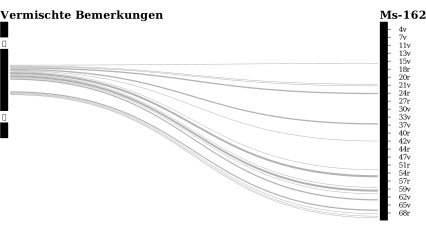
24 published remarks, VB
Do not quote from or cite this translation!
§
1r[1]… Brüche ihrer Größe nach in Reihen ordnet; aber nicht dadurch daß man alle Brüche in eine Reihe ordnet.
… arranges them according to their magnitude in a sequence; but not by arranging all the fractions in a sequence.
§
1r[2]“Ich kann Einem nicht alle Techniken durch eine Technik beibringen.”
“One cannot teach someone all the techniques by means of a single technique.”
§
1r[3] &1v[1]
Man kann wohl die Namen aller Systeme in eine Reihe ordnen, aber sie nicht alle den Systemen der Reihe nach zuteilen.
One can probably arrange the names of all the systems in a sequence, but not assign them all to the systems in the sequence.
§
1v[2] &2r[1]
D.h. man hat, wenn man eine endlose Reihe von Namen hat, nicht zu wenig Namen; wenn man sie (nur) nicht so aufteilt, daß dem System von Namen ein System von Systemen entspricht. Verwendet man diese besondere Art der Zuteilung, dann hat man zu wenig Namen; und das kann man so ausdrücken: “man kann nicht alle Namen allen Systemen zuteilen” – weil man unter dem Verteilen aller Namen an Systeme das Verteilen aller Namen an ein System von Systemen versteht.
That is to say, if one has an endless sequence of names, one does not have too few names; if one does not divide them (only) in such a way that a system of names corresponds to a system of systems. If one uses this particular type of assignment, then one has too few names; and one can express this as follows: “one cannot assign all names to all systems” – because by assigning all names to systems, one understands the assignment of all names to a system of systems.
§
2r[2]Die Verwirrung entsteht hier durch den Ausdruck “man kann … in eine Reihe ordnen”.
The confusion arises here from the expression “one can … arrange them in a sequence”.
§
2v[1]Es gibt Reihen, welche man “Reihen aller Brüche” nennt. Es gibt Reihen, von welchen man sagt, sie enthielten alle Brüche.
There are sequences that are called “sequences of all fractions”. There are sequences of which it is said that they contain all the fractions.
§
2v[2] &3r[1]
‘Wir wollen nicht sagen: eine Reihe von Funktionen enthielte alle Funktionen, da sie nicht enthält.’
‘We do not want to say: a sequence of functions contains all functions, since it does not contain .’
§
3r[2] &3v[1] &
4r[1]
‘Wir wollen unter keinen Umständen von einer Reihe aller Reihen sprechen.’ ‘Wir wollen unter keinen Umständen von einer Kiste sagen, sie enthielte alle Kisten.’ “Wieviele Multiplikationen hast Du zu machen gelernt?” – – (d.h. ein unbegrenztes System von Multiplikationen). – “Und wieviele Funktionen hast Du zu bilden gelernt?” – “Viel mehr als
!”(d.h. ich habe gelernt, aus dem Ausdruck für ein unbegrenztes System von ihnen, neue Funktionen zu erzeugen). – “Aber Du hast doch auch gelernt, aus irgend einem unbegrenzten System der Größe nach geordneter Brüche weitere solche Systeme zu erzeugen.”
‘We do not want to speak under any circumstances of a sequence of all sequences.’ ‘We do not want to say under any circumstances that a box contains all boxes.’ “How many multiplications have you learned to do?” – – (i.e., an unlimited system of multiplications). – “And how many functions have you learned to form?” – “Much more than !” (i.e., I have learned to generate new functions from the expression for an unlimited system of them). – “But you have also learned to generate further such systems from any unlimited system of fractions arranged according to their magnitude.”
§
4r[2] &4v[1]
Bestimmen wir, daß alle Systeme mit Brüchen benannt werden sollen! Man kann alle Brüche in eine Reihe ordnen – hat man damit nun alle Systeme in eine Reihe geordnet? ‘Systeme in eine Reihe ordnen’ heißt: aus einer Reihe von Reihen in gewisser Weise eine Reihe abzuleiten.
Let us stipulate that all systems are to be named with fractions! One can arrange all the fractions in a sequence – does this mean that one has now arranged all the systems in a sequence? ‘Arranging systems in a sequence’ means: deriving one sequence from a sequence of sequences in a certain way.
§
4v[2]Wenn ich jemand die Reihe der Reihen erklärt habe, so muß er nun im Stande sein z.B. Schritt für Schritt zu berechnen. Ich habe ihm also die Technik von erklärt.
If I have explained the sequence of sequences to someone, then he must now be able to calculate, for example, step by step. So I have explained to him the technique of .
§
5r[1] &5v[1]
Was heißt es denn eigentlich die seien Funktionen von x? Genügt es dazu, daß ich einerseits die Zeichen – d.h. ‘’, ‘’ etc. etc. , etc. etc. anschreiben kann & anderseits einige dieser Zeichen als Namen gewisser Techniken der Reihenentwicklung benütze? So ist es doch offenbar nicht, denn es muß vielmehr mit dem System eine bestimmte Technik verbunden sein, Techniken der Entwicklung zu bilden. Dies ist aber nicht damit erreicht, daß ich eine Technik zur Bildung der Zeichen besitze.
What does it actually mean to say that are functions of x? Is it sufficient for this that I can, on the one hand, write down the signs – i.e., ‘’, ‘’ etc. etc. , etc. etc., and, on the other hand, use some of these signs as names for certain techniques of series development? Surely that is not the case, because rather a specific technique must be associated with the system , a technique for forming developments. But this is not achieved by the fact that I possess a technique for forming the signs .
§
5v[2]Man kann alle Funktionsnamen in eine Reihe ordnen; aber man kann sie nicht alle systematisch erklären.
One can arrange all function names in a series; but one cannot systematically explain them all.
§
5v[3]‘Ein System von Funktionsnamen systematisch erklären’ heißt: eine Erklärung an den Kopf zu stellen.
‘To systematically explain a system of function names’ means: to place an explanation at the head.
§
6r[1]‘Den Gebrauch eines Systems von Zeichen systematisch erklären’ heißt: eine Erklärung an den Kopf des Systems stellen, die die richtige Verwendung der Zeichen des Systems bewirkt.
‘To systematically explain the use of a system of signs’ means: to place an explanation at the head of the system, which brings about the correct use of the signs of the system.
§
6r[2]Kann diese Erklärung selbst ein Zeichen des Systems sein?
Can this explanation itself be a sign of the system?
§
6r[3]Die Erklärung der Funktionszeichen geschieht systemweise.
The explanation of the function signs takes place systematically.
§
6v[1]‘Habe ich Dich gelehrt, ein System von Funktionen zu beherrschen, so habe ich Dich damit auch abgerichtet, eine außerhalb des Systems stehende Funktion zu beherrschen.’
‘If I have taught you to master a system of functions, then I have thereby also trained you to master a function outside the system.’
§
6v[2]Meine Aufgabe ist es Euch die Geographie eines Labyrinths zu lehren, so zwar, daß Ihr Euch vollkommen darin auskennt.
My task is to teach you the geography of a labyrinth, in such a way that you are completely familiar with it.
§
7r[1]Wie bewegt man Menschen dazu, mit Überzeugung eine bestimmte Behauptung zu machen?
How does one persuade people to make a particular assertion with conviction?
§
7v[1]“Sei nicht lächerlich! Freilich bedienen wir uns zum Erkennen der Anzahl gewisser Mittel, die Anzahl übersichtlich zu machen; z.B. des Dezimalsystems.” – Aber was ist hier Zweck, & was Mittel?
“Don’t be ridiculous! Of course, we use certain means to recognize the number, to make the number surveyable; for example, the decimal system.” – But what is the purpose here, & what is the means?
§
7v[2] &8r[1]
Wir würden also nicht erkennen, daß 10.000 Variable in dieser Klammer stehen. Ist das nicht, als sagte man: “wir würden nicht erkennen, wieviel Jahre der Elefant lebt, wenn die Erde nicht um die Sonne ginge”?
So we would not recognize that 10,000 variables are in this bracket. Isn’t this the same as saying: “we would not recognize how many years the elephant lives if the earth did not revolve around the sun”?
§
8r[2] &8v[1] &
9r[1]
Ist denn das nicht eben, was wir Zahlbestimmung nennen, diese Technik, das Zählen im Dezimalsystem anzuwenden? – Nein; denn wir hätten ebensowohl in einem andern System zählen können. – Aber liegt dies nicht daran, daß wir verschiedene solche Techniken lernen können & so gut wie immer übereinstimmende Resultate erhalten? – Aber wir erkennen doch die Zahlen ∣, ∣∣, ∣∣∣, ∣∣∣∣ auf den ersten Blick & wir könnten uns doch Wesen denken, die auch 10.000 Striche als 10.000 Striche auf den ersten Blick erkennen würden. – 10.000 Striche als 10.000 Striche? Wie wüßten wir denn, daß es wirklich 10.000 Striche sind die sie als 10.000 Striche erkennen? Doch nur durch eine von unseren Zählmethoden. Also durch die Übereinstimmung unsrer Resultate. Aber kann man denn sagen, daß diese Übereinstimmung zeige, daß jene Leute das Richtige erkennen. (Dann könnte die Übereinstimmung ja ebensogut zeigen, daß wir richtig zählen!)
Isn’t this precisely what we call number determination, this technique of applying counting in the decimal system? – No; because we could just as well have counted in another system. – But is this not due to the fact that we can learn various such techniques & obtain almost always consistent results? – But we recognize the numbers ∣, ∣∣, ∣∣∣, ∣∣∣∣ at first glance, & we could imagine beings who would also recognize 10,000 strokes as 10,000 strokes at first glance. – 10,000 strokes as 10,000 strokes? How would we know that they are really 10,000 strokes that they recognize as 10,000 strokes? Only through one of our counting methods. Thus through the agreement of our results. But can one say that this agreement shows that those people recognize the correct thing? (Then the agreement could just as well show that we count correctly!)
§
9v[1] &10r[1]
So hatte Frank Ramsey (also) völlig recht damit, als er schrieb (Last papers): … Nur, glaube ich, sah er nicht das Problem, welches darin liegt, die Beziehung der logischen Exaktheit & dieser Vagheit anzugeben.
So Frank Ramsey was completely right when he wrote (Last papers): … Only, I think, he did not see the problem which lies in specifying the relationship between logical exactness & this vagueness.
§
10v[1]Warum soll ich nicht sagen: “Wenn 5 die Zahl von φ ist & 7 die Zahl von ψ, so nenne ich 12 die Zahl von φ⌵ψ”? Statt zu sagen: “dann ist die Zahl von φ⌵ψ 12.”
Why shouldn’t I say: “If 5 is the number of φ & 7 is the number of ψ, then I call 12 the number of φ⌵ψ”? Instead of saying: “then the number of φ⌵ψ is 12.”
§
11r[1]We can't describe with words the relation between

An welche Art von Beschreibung denken wir denn, wenn wir sagen Worte könnten das nicht beschreiben?
We can’t describe with words the relation between
What kind of description do we think of when we say that words could not describe it?
§
11r[2]Für diese Relation könnten wir nur einen Namen haben; beschreiben können wir sie nicht.
For this relation, we could only have a name; we cannot describe it.
§
11r[3]Wann wäre sie aber beschrieben?
But when would it be described?
§
11v[1]Nun es ist doch hier ein bestimmter Grad des Größenunterschieds, & der läßt sich mit Worten nicht ausdrücken.
Now, there is a certain degree of difference in size here, and this cannot be expressed in words.
§
11v[2]
Kann ich diesen Winkel nicht beschreiben? Doch, z.B. als das Doppelte eines andern für den ich einen Namen habe.
Can I not describe this angle? Yes, for example, as twice another for which I have a name.
§
11v[3] &12r[1]
Warum aber nicht als das 27-fache eines andern Winkels?
But why not as 27 times another angle?
§
12r[2]Was ist das für ein Satz: “Wir können uns das 27-fache eines Winkels nicht vorstellen”? Vor allem einmal heißt es nicht: das physikalisch 27-fache.
What is this sentence: “We cannot imagine 27 times an angle”? First of all, it does not mean: the physically 27-fold.
§
12r[3]Verwandtes Beispiel: Wir können uns 27 Stücke nicht vorstellen. (Absolutes Gehör.)
Related example: We cannot imagine 27 pieces. (Absolute pitch.)
§
12r[4]Ist es nur behaviouristisch bestimmt?
Is it only behavioristically determined?
§
12v[1]Wann würde ich von einem Andern sagen er könne sich 27 Striche vorstellen – – – wann würde ich es von mir selber sagen?
When would I say that another person can imagine 27 lines—when would I say it of myself?
§
12v[2]Statt ‘vorstellen’ nehmen wir besser Bilder auswählen.
Instead of ‘imagine’, let’s better use ‘select images’.
§
12v[3]Wie wäre es, wenn ich 27 Stücke als ‘bestimmte Figur’ sehen könnte?
What if I could see 27 pieces as a ‘particular figure’?
§
12v[4] &13r[1]
Wie wäre es wenn ‘27’ etwas analoges für mich bedeutete wie ‘4’? Wenn z.B. ein ‘27-Eck’ etwas analoges für mich bedeutete wie ein ‘4-Eck’?
What if ‘27’ meant something analogous to ‘4’ for me? If, for example, a ‘27-sided figure’ meant something analogous to a ‘4-sided figure’ for me?
§
13r[2]Ich würde z.B. verschiedene Eigenschaften des 27-Ecks zeigen können. Die Mitte etc. “Es paßt hierher & nicht daher”. Ich könnte es mit einem Stern 1-1 verbinden etc.
I could, for example, show different properties of the 27-sided figure. The center, etc. “It fits here and not there.” I could connect it one-to-one with a star, etc.
§
13r[3] &13v[1]
“Diese Farbe liegt in der Mitte zwischen … & …” Wir sind nicht geneigt das zu sagen, obwohl wir sagen diese Farbe ist näher dieser als jener. Wir können eine Farbe malen auf den Befehl: male eine Farbe näher dieser als jener, aber nicht auf den Befehl male die Farbe in der Mitte.
“This color lies in the middle between… &…”. We are not inclined to say that, although we say this color is closer to this one than to that one. We can paint a color in response to the command: paint a color closer to this one than to that one, but not in response to the command: paint the color in the middle.
§
13v[2]“Es ist logisch unmöglich, eine Farbe exakt zu beschreiben.”
“It is logically impossible to describe a color exactly.”
§
13v[3] &14r[1]
Beschreibung eines Farbtons durch den Sprechton.
Description of a shade by the tone of voice.
§
14r[2]Warum sagt man ein Ton & seine Oktav seien derselbe Ton? “Was haben die beiden mit einander gemein?” –
Why does one say that a tone and its octave are the same tone? “What do the two have in common?” –
§
14r[3]Kann ich mir vorstellen daß ∣∣∣∣∣∣∣∣∣∣∣∣ als charakteristische Gestalt gesehen wird?
Can I imagine that ||||||||||||||| is seen as a characteristic figure?
§
14r[4]D.h.: Kann ich mir vorstellen, daß es gesehen wird wie
∣∣∣∣∣ ?
That is: Can I imagine that it is seen as ||||||?
§
14r[5] &14v[1]
Kann ich ∣∣∣∣∣ sehen wie ich ∣∣∣ sehe? Oder wie ∣∣, oder wie ∣ Man möchte sagen: “Nein” & dies Nein scheint mir erfahrungsmäßiger & zugleich auch wieder logisch zu sein; ein synthetisches Apriori.
Can I see ||||||||||||||| as I see |||||? Or as ||, or as |? One wants to say: “No,” and this no seems to me more empirical and at the same time also logical; an a priori synthetic.
§
14v[2]Was sagt der Satz: ‘Ich sehe ∣∣∣∣∣∣∣∣∣∣∣∣ jetzt nicht als Gestalt’?
What does the sentence say: ‘I do not see ||||||||||||||| as a figure now’?
§
14v[3] &15r[1]
Man möchte sagen: die beiden S.D. ∣∣∣∣∣∣∣∣∣∣∣∣ & ∣∣∣∣ sind von verschiedener Art. Und das ist sozusagen der logische Grund weshalb man sich nicht vorstellen kann man könne ∣∣∣∣∣∣∣∣∣∣∣∣ als Gestalt sehen. Nämlich: dies S.D. ist keine Gestalt. Die Frage kann man sich … vorstellen hieße also: kann man sich ein S.D. einer andern Art vorstellen, das das S.D. von 12 Strichen wäre?
One might say: the two S.D.s ∣∣∣∣∣∣∣∣∣∣∣∣ & ∣∣∣∣ are of a different kind. And that is, so to speak, the logical reason why one cannot imagine that one could see ∣∣∣∣∣∣∣∣∣∣∣∣ as a shape. Namely: this S.D. is not a shape. The question of whether one can imagine it can thus be phrased as: can one imagine an S.D. of another kind, which would be the S.D. of 12 lines?
§
15r[2] &15v[1]
Der Satz: “ich sehe jetzt ∣∣∣∣∣∣∣∣∣∣∣∣∣∣ nicht als Gestalt” hat keinen klaren Sinn. Man kann ihn so erklären: ‘ich sehe jetzt ∣∣∣∣∣∣∣∣∣∣∣∣∣ nicht so, wie ich ∣∣∣∣∣ sehe’. Aber ist nun die Anwendung des Satzes klar gemacht? (Erinnern wir uns: Wir dürfen nicht beliebige Kriterien anwenden.) Vergleiche ‘Ich bin hier’.
The sentence: “I don’t see it ∣∣∣∣∣∣∣∣∣∣∣∣∣ as a shape” does not have a clear sense. One can explain it thus: ‘I don’t see it ∣∣∣∣∣∣∣∣∣∣∣∣∣ in that way, in which I see’. But is the application of the sentence now made clear? (Let us remember: we are not allowed to apply arbitrary criteria.) Compare ‘I am here’.
§
15v[2]‘Die Zahl 131 ist mit bloßen Strichen unbeschreibbar’ – wie: ‘rot ist durch eine Zeichnung nicht wiederzugeben’.
‘The number 131 is indescribable with mere lines’ – like: ‘red cannot be reproduced by a drawing’.
§
15v[3] &16r[1]
“Der Rhythmus ist nicht beschreibbar”. Das könnte z.B. heißen: daß er nicht ein gemessener Rhythmus ist. Sowie – “die Farbe ist nicht mit Worten zu beschreiben”, daß sie keine derjenigen ist, die Namen haben.
“The rhythm is indescribable.” This could, for example, mean: that it is not a measured rhythm. As – “the color cannot be described in words”, that it is not one of those that have names.
§
16r[2]“Der Eindruck ist nicht mit Worten zu beschreiben. Ich kann nur eine Geste machen.” Die Ohnmacht der Worte sagt natürlich auch etwas. Kein Wort kommt mir, kein Vers, nur eine Geste.
“The impression cannot be described in words. I can only make a gesture.” The powerlessness of words also says something, of course. No word comes to me, no verse, only a gesture.
§
16v[1]Du mußt Dich immer fragen: “arbeitet dieser Satz (z.B. ‘ich bin hier’) & wie arbeitet er?”
You must always ask yourself: “is this sentence working and how is it working?”
§VB
16v[2] &17r[1]
Das alte Testament gesehen als der Körper ohne Kopf; das neue Testament: der Kopf; die Briefe der Apostel: die Krone auf dem Haupt. Wenn ich an die Judenbibel denke, das alte Testament allein, möchte ich sagen: diesem Körper fehlt (noch) der Kopf. Diesen Problemen fehlt die Lösung. Diesen Hoffnungen die Erfüllung. Aber ich denke mir nicht notwendigerweise einen Kopf mit einer Krone.
The Old Testament seen as the body without a head; the New Testament: the head; the letters of the apostles: the crown on the head. When I think of the Hebrew Bible, the Old Testament alone, I would like to say: this body is still missing a head. These problems are lacking a solution. These hopes are lacking fulfilment. But I do not necessarily imagine a head with a crown.
§
17r[2] &17v[1]
‘Kann ich mir vorstellen ∣∣∣∣∣∣∣∣∣∣∣ als charakteristische Gestalt zu sehen?’ Kann ich mir vorstellen, daß sich ∣∣∣∣∣∣∣∣∣∣∣∣ klärt & mir irgendwie in der Klarheit von ∣∣∣∣ erscheint? Ich scheine es mir halb vorstellen, halb nicht vorstellen zu können. Und mancher wäre geneigt hier zu sagen: “Ich glaube ich kann mir es vorstellen.”
‘Can I imagine seeing ∣∣∣∣∣∣∣∣∣∣∣ as a characteristic shape?’ Can I imagine it becoming clear & somehow appearing to me in its clarity? It seems as though I can half imagine it, half not. And some might be inclined to say here: “I think I can imagine it.”
§
17v[2]Nun, was er sich vorstellen kann, kann er sich vorstellen. –
Well, whatever he can imagine, he can imagine. –
§
17v[3]Rufen diese Worte eine Vorstellung hervor? Ja, sie rufen eine Vorstellung hervor. Aber wozu ist sie nütze?
Do these words evoke an image? Yes, they evoke an image. But what is it useful for?
§
17v[4] &18r[1]
‘Diese Worte geben einen Sinn; denn ich weiß genau, wie das wäre, wenn ich die Strichreihe als Gestalt sähe.’
‘These words convey a sense; because I know exactly what it would be like if I saw the series of lines as a shape.’
§
18r[2]‘Ich weiß es, wie ich weiß, wie es wäre, wenn dieser Sessel dort stünde.’
‘I know it, as I know what it would be like if this armchair were standing there.’
§
18r[3]‘Ich weiß wie es wäre wenn wir in einem 4-dimensionalen Raum lebten.’
‘I know what it would be like if we lived in a 4-dimensional space.’
§
18r[4]‘Ich weiß, wie es wäre, wenn einer ein 7-Eck konstruierte.’
‘I know what it would be like if someone constructed a 7-sided figure.’
§
18r[5] &18v[1]
Wir haben gleichsam den Text & eine Illustration – – – aber sollen wir hier sagen, es sei eine Illustration?
We have, as it were, the text & an illustration – – – but should we say here that it is an illustration?
§
18v[2]Hat es Sinn, zu sagen: “diese Leute sehen ∣∣∣∣∣∣∣∣∣∣ als charakteristische Gestalt”? Denke Dir eine Filmgeschichte. Wie würde dies dargestellt?
Does it make sense to say: “these people see ∣∣∣∣∣∣∣∣∣∣∣ as a characteristic shape”? Imagine a film story. How would this be portrayed?
§
18v[3]Beweisen, daß man das regelmäßige 7-Eck nicht konstruieren kann, heißt eigentlich, zeigen daß keine Vorstellung in gewisser Art zu ihm führt.
Proving that one cannot construct a regular 7-sided figure actually means showing that no image leads to it in a certain way.
§
18v[4] &19r[1]
Denken wir uns ein psychologisches Experiment: jemand zeigt mir Tafeln mit Strichreihen und fragt mich ob ich sie jetzt als Gestalten sehe. Denke bei 1000 Strichen sagte ich plötzlich: “die sehe ich als Gestalt!” – – – Du willst sagen: darunter kann man sich gar nichts vorstellen. Man will mich fragen: sind es wirklich die 1000 Striche die Du siehst? Eine Beschreibung des Phänomens ist möglich, die mich befriedigt!
Let’s imagine a psychological experiment: someone shows me panels with series of lines and asks me if I now see them as shapes. Suppose that after 1000 lines I suddenly say: “these I see as a shape!” – – – You want to say: one can’t imagine anything about that. One wants to ask me: are it really the 1000 lines that you see? A description of the phenomenon is possible, and it satisfies me!
§
19r[2] &19v[1]
Frage: “Sieht er dieselbe Zahl, die wir sehen?”
Question: “Does he see the same number that we see?”
§
19v[2]Wieder: “1000 läßt sich nicht durch eine Strichreihe darstellen.”
Again: “1000 cannot be represented by a series of lines.”
§
19v[3]‘Diese Takte geben eine unbeschreibbare Empfindung.’
‘These measures give an indescribable sensation.’
§
19v[4]Kommt sie uns immer unbeschreibbar vor? Womit vergleichen wir sie, wenn sie uns so erscheint? (Unstillbare Sehnsucht)
Does it always seem indescribable to us? What do we compare it to when it appears so? (Unquenchable longing)
§
19v[5] &20r[1]
Kannst Du die Empfindung beschreiben, die Dir diese Takte geben?
Can you describe the sensation that these measures give you?
§
20r[2]‘Ich kann die Zahl der Diagonalen eines 8-Ecks nicht durch eine Strichreihe beschreiben.’
‘I cannot describe the number of diagonals of an 8-sided figure by a series of lines.’
§
20r[3]Wann ist es mir geglückt eine Empfindung zu beschreiben? Wenn ich selbst befriedigt bin?
When did I succeed in describing a sensation? When I am satisfied myself?
§
20r[4] &20v[1]
Zu sagen: “Diese Takte geben mir eine unbeschreibliche Empfindung” – drückt die Tatsache aus, daß ich intrigiert bin, daß ich nach einer Beschreibung oder Erklärung suche.
To say: “These measures give me an indescribable sensation” – expresses the fact that I am intrigued, that I am looking for a description or explanation.
§
20v[2]‘∣∣∣∣∣∣∣∣∣∣∣∣∣ ist keine Beschreibung der Zahl 13.’ – Aber wie ist man denn überhaupt auf die Idee gekommen, es könnte eine sein?! Warum soll es denn eine sein?!
‘∣∣∣∣∣∣∣∣∣∣∣∣∣ is not a description of the number 13.’ – But how did one even come up with the idea that it could be? Why should it be?
§
20v[3] &21r[1]
‘Es ist unmöglich dies mit Worten zu beschreiben, weil Worte nicht die dazu erforderlichen logischen Eigenschaften haben.’
‘It is impossible to describe this in words, because words do not have the necessary logical properties.’
§
21r[2]‘Man kann 1000 nicht als die & die Strichgestalt beschreiben.’
‘One cannot describe 1000 as the & the line shape.’
§
21r[3]‘Ich kann es mir nicht vorstellen.’
‘I cannot imagine it.’
§
21r[4]Eine Ähnlichkeit zwischen diesen Gesichtern die sich nicht beschreiben läßt.
A similarity between these faces that cannot be described.
§
21r[5] &21v[1]
Ich kann mir 1000 Striche nicht als Gestalt vorstellen kann heißen: ich verliere immer wieder den Faden, wenn ich es so & so versuche.
I cannot imagine 1000 lines as a shape means: I keep losing the thread when I try it this way and that.
§VB
21v[2]Der Neid ist etwas oberflächliches – d.h.: die typische Farbe des Neides reicht nicht tief – weiter unten hat die Leidenschaft eine andere Färbung. (Das macht den Neid, natürlich, nicht weniger real.)
Envy is something superficial – that is: the typical color of envy does not go deep – further down, the passion has a different color. (This does not, of course, make envy any less real.)
§
21v[3] &22r[1]
Ich habe Imagination, & das unterscheidet mich von allen Lehrern der Philosophie hier, aber das macht mich noch nicht zum Genie.
I have imagination, & that distinguishes me from all the teachers of philosophy here, but that does not yet make me a genius.
§VB
22r[2] &22v[1]
Das Maß des Genies ist der Charakter, – wenn auch der Charakter an sich nicht das Genie ausmacht. Genie ist nicht ‘Talent und Charakter’, sondern Charakter der sich in der Form eines speziellen Talents kundgibt. Wie ein Mensch aus Mut einem ins Wasser nachspringt, so schreibt ein anderer aus Mut eine Symphonie. (Dies ist ein schwaches Beispiel.)
The measure of genius is character – although character in itself does not constitute genius. Genius is not ‘talent and character’, but character that manifests itself in the form of a specific talent. Just as a person jumps into the water out of courage, so another writes a symphony out of courage. (This is a weak example.)
§
22v[2]Die ‘logische Unmöglichkeit der Beschreibung durch ein bestimmtes Beschreibungsmittel’. Das Mittel ‘paßt logisch nicht’ für den Zweck der Beschreibung.
The ‘logical impossibility of description by a particular means of description’. The means ‘does not logically fit’ for the purpose of description.
§
22v[3] &23r[1]
Warum sollen Zahlen das Mischungsverhältnis von Farben beschreiben können!? Es ist uns, als könnten wir versuchen & würden zurückgestoßen.
Why should numbers be able to describe the mixing ratio of colors!? It seems to us as if we could try and would be repelled.
§
23r[2]Worauf beruht es, daß es nicht geht? “Aber das meine ich nicht!”
What does it depend on, that it doesn’t work? “But that’s not what I mean!”
§
23r[3] &23v[1]
Kannst Du Dir absolutes Gehör vorstellen, wenn Du es nicht hast? Kannst Du es Dir vorstellen, wenn Du es hast? – Kann ein Blinder sich das Sehen von rot vorstellen? Kann ich mir es vorstellen? Kann ich mir vorstellen daß ich so & so spontan reagiere, wenn ich's nicht tue? Kann ich mir's besser vorstellen, wenn ich's tue?
Can you imagine absolute pitch if you don't have it? Can you imagine it if you do have it? – Can a blind person imagine seeing red? Can I imagine it? Can I imagine that I react spontaneously in such and such a way, if I don't do it? Can I imagine it better if I do it?
§
23v[2]Kann ich aber das Sprachspiel spielen, wenn ich nicht so reagiere?
But can I play the language-game if I don't react in that way?
§
23v[3]Beide Überlegungen führen zu dem gleichen Resultat. D.h.: auf beide Arten siehst Du, daß das herankommen muß.
Both lines of thought lead to the same result. That is to say: in both ways you see that it must be the case.
§
24r[1]Du hast z.B. die römischen Ziffern von I bis C arabisch numeriert.
For example, you have numbered the Roman numerals from I to C using Arabic numerals.
§
24r[2]Compare chairs, materials, lengths, numbers
Compare chairs, materials, lengths, numbers.
§VB
24r[3]Das Genie hat nicht mehr Licht als ein andrer, rechtschaffener Mensch – aber es sammelt dies Licht durch eine bestimmte Art von Linse in einem Brennpunkt.
A genius does not have more light than another, upright person – but it collects this light through a certain type of lens in a focal point.
§VB
24r[4] &24v[1]
Worin wird die Seele von eiteln Gedanken bewegt, – wenn sie doch eitel sind? Nun sie wird von ihnen bewegt. (Wie kann der Wind den Baum bewegen, wo er doch nur Wind ist? Nun er bewegt ihn; & vergiß es nicht.)
In what is the mind moved by vain thoughts – when they are vain after all? Well, it is moved by them. (How can the wind move the tree, when it is only wind? Well, it moves it; and don't forget it.)
§
24v[2]Die Antwort zu manchen Problemen kannst Du nicht einfach durch Denken, sondern nur durch Üben erhalten.
The answer to some problems cannot be obtained simply by thinking, but only by practice.
§
25r[1]Ich muß mir eine lange Zeit die Wange streicheln, ehe ich wieder bereit bin ein wenig zu arbeiten.
I must stroke my cheek for a long time before I am ready to work a little.
§
25r[2]Wir sagen nicht: “Also so gehen wir!” sondern: “Also so geht es!”.
We don't say: “So that’s how we proceed!” but: “So that’s how it is!”
§
25r[3]Wenn Einer sagt: “das Resultat der Rechnung findet man experimentell”, so müßte man antworten: “ja, wie soll er es denn finden?”
If someone says: “the result of the calculation is found experimentally,” one should reply: “yes, how else should it be found?”
§
25r[4] &25v[1]
Ist der Ausdruck der Entscheidung ein Satz, der sagt, daß ich mich so entscheide? Der bewiesene Satz als Ausdruck einer Entscheidung.
Is the expression of a decision a sentence that says that I decide in such and such a way? The proven sentence as an expression of a decision.
§
25v[2]Diese Dinge sind feiner gesponnen, als grobe Hände ahnen.
These things are more subtly constructed than rough hands imagine.
§
25v[3] &26r[1] &
26v[1] &
27r[1]
Ich lasse mich ablaufen & das Ende des Ablaufs ist der bewiesene Satz. Aber sagt dann der Satz etwas über diesen Ablauf? Wir haben ein Experiment gemacht – aber im Experiment wurde ein Satz erzeugt (wie sonst etwa eine chemische Verbindung). Und nun gibt es einen andern Satz, der sagt, daß jener Satz erzeugt wurde. – Aber wie, wenn ich als zum Ausdruck hiefür eben jenen Satz gebrauchte? Sodaß also “25 × 25 = 625” mir sagen soll, daß die Menschen, so & so abgerichtet, allgemein dies herausbringen. Nun so eine Aussage gibt es doch, hat doch einen guten Sinn. Und wenn das so ist – könnte man fragen –, soll es dann wirklich zwei Sätze geben: einen, der dieses anthropologische Faktum ausspricht, das doch offenbar für den Sinn der Arithmetik wesentlich ist, & einen andern, der sagt, daß 25 × 25 625 ist? Hier liegt der gewisse Unsinn nahe: “es kommt drauf an, wie wir den Satz meinen.” Man kann aber sagen: es kommt drauf an wie wir den Satz verwenden, was wir mit ihm tun.
I let myself run on, and the end of the running is the proven sentence. But does the sentence then say something about this process? We have conducted an experiment – but in the experiment, a sentence was produced (as otherwise a chemical compound might be). And now there is another sentence that says that that sentence was produced. – But what if I used precisely that sentence as an expression of this? So that “25 × 25 = 625” is supposed to tell me that people, trained in such and such a way, generally produce this result. Now, there is such a statement; it has a good sense. And if that is the case – one could ask – should there really be two sentences: one that expresses this anthropological fact, which is obviously essential for the meaning of arithmetic, and another that says that 25 × 25 is 625? Here a certain nonsense is close at hand: “it depends on how we mean the sentence.” But one can also say: it depends on how we use the sentence, what we do with it.
§
27r[2]“Aber daß 25 × 25 = 625 ist etwas, was wir vor dem Ausführen der Multiplikation nicht wußten.” – Könnte ich nicht auch sagen: dieser Satz ist einer, dessen Beweis wir vorher nicht kannten.
“But that 25 × 25 = 625 is something that we did not know before carrying out the multiplication.” – Couldn't I also say: this sentence is one whose proof we did not know before?
§
27r[3]‘Der Beweis schafft einen Begriff.’
‘The proof creates a concept.’
§
27v[1]Wir sind alle gleich gestimmt, wir laufen alle gleich ab – – – aber heißt das, daß wir diese Gleichheit des Ablaufs unbedingt dazu verwenden, den Ablauf des Einen aus dem Ablauf des Andern vorherzusagen?
We are all in the same mood, we all run on in the same way – but does that mean that we necessarily use this sameness of the process to predict the process of one person from the process of another?
§
27v[2] &28r[1]
Wer sagt, er sei neugierig zu wissen, was die Multiplikation … × … ergeben wird, könnte sagen, er sei neugierig zu sehen, womit er am Schluß übereinstimmen werde. – Das könnte aber ganz mißverstanden werden.
Whoever says that he is curious to know what the multiplication … × … will yield, could say that he is curious to see what he will agree with in the end. – But this could be completely misunderstood.
§
28r[2]Unsre Zustimmung läuft gleich ab, – aber wir bedienen uns dieser Gleichheit des Ablaufs nicht einfach, um Zustimmungsabläufe vorauszusagen. Wie wir uns des Satzes “dies Heft ist rot” nicht nur dazu bedienen um vorherzusagen, daß die meisten Menschen es ‘rot’ nennen werden.
Our agreement runs on in the same way – but we do not simply use this sameness of the process to predict agreement processes. Just as we do not simply use the sentence “this sheet is red” to predict that most people will call it ‘red’.
§
28r[3]Worte & Erfahrung inkommensurabel.
Words & experience are incommensurable.
§
28v[1]Prüfe: “Das Wort ‘absolutes Gehör’ hat für mich nicht den Sinn, den es für den hat der absolutes Gehör besitzt.” “‘Sehen’ hat für mich einen andern Sinn als für den Blinden.” Soll ich auch sagen: “‘Blindheit’ hat für einen blinden einen andern Sinn als für mich.”?
Check: “The word ‘absolute pitch’ does not have the meaning for me that it has for someone who has absolute pitch.” “‘Seeing’ has a different meaning for me than for the blind.” Should I also say: “‘Blindness’ has a different meaning for a blind person than for me”?
§
28v[2] &29r[1]
Man ist geneigt zu sagen daß für den Menschen mit absolutem Gehör gewisse Ausdrücke Sinn haben, die für einen anderen Menschen keinen Sinn haben.
One is inclined to say that for the person with absolute pitch, certain expressions have meaning that they do not have for another person.
§
29r[2]‘Das Multiplizieren lehrt Dich, daß dieses Zeichen herauskommt. Und das hast Du nicht gewußt. Sie lehrt Dich also ein Dir neues empirisches Faktum.’ Aber halt – lehrt sie mich, daß dieses Zeichen am Ende dieses Beweises steht? Lehrt sie mich daß ich mit dieser Zeichenreihe übereinstimme?
‘Multiplication teaches you that this sign results. And you didn’t know that.’ It teaches you a new empirical fact. But wait – does it teach me that this sign will be at the end of this proof? Does it teach me that I will agree with this sequence of signs?
§
29v[1]Habe ich nicht gewußt was diese lange Multiplikation ergibt, so habe ich auch nicht gewußt was 50 + 1 ergibt.
If I didn’t know what this long multiplication yields, then I also didn’t know what 50 + 1 yields.
§
29v[2] &30r[1]
Es ist absolut wesentlich für's Rechnen, daß ich immer wieder auf die gleiche Weise rechne & also immer wieder das gleiche Resultat kriege. Daß ich also voraussagen kann, ich werde wieder zu dieser Zahl gelangen. Aber das heißt natürlich auch: immer auf dem gleichen Weg zu dieser Zahl gelangen! D.h. immer wieder den gleichen Weg gehen. (Und das klingt schon ganz anders). Aber das Resultat der Rechnung kann diese Prophezeiung nicht sein. Aber warum nannte ich dann die Übereinstimmung ‘wesentlich für's Rechnen’? Für mich während ich rechne, ist sie nicht wesentlich; wohl aber für das anthropologische Phänomen Rechnen.
It is absolutely essential for calculation that I always calculate in the same way & thus always get the same result. That I can predict that I will arrive at this number again. But that also obviously means: always arriving at this number in the same way! That is, always taking the same path. (And that already sounds quite different). But the result of the calculation cannot be this prediction. But why did I then call the agreement ‘essential for calculation’? For me, while I am calculating, it is not essential; but it is for the anthropological phenomenon of calculation.
§
30v[1] &31r[1]
… Können wir uns denken, daß dies der einzige Nutzen des Multiplizierens wäre? Das Multiplizieren wäre dann wie eine Art automatischen Sprechens, der Zweck lediglich zu erfahren, was der Andre unter gleichen Umständen sagt. Dabei wäre natürlich ein Kriterium der Gleichheit der Umstände & des Gesagten nötig. Und nun könnte es sein daß der Andere zwar nicht das Gleiche, aber etwas nach einer gewissen Transformationsregel erhältliches sagte. Ich würde dann nach meinem automatischen Ablauf berechnen, was des Andern Ablauf sein wird. Das Rechnen gibt uns (hier) eine Vergleichsmethode. (v)
… Can we imagine that this is the only use of multiplication? Multiplication would then be like a kind of automatic speech, the purpose of which is merely to find out what the other person says under the same circumstances. This would, of course, require a criterion for the equality of the circumstances & of what is said. And now it could be that the other person says something that is not the same, but something obtainable after a certain transformation rule. I would then calculate, according to my automatic process, what the other person's process will be. Calculation gives us (here) a method of comparison. (v)
§
31r[2] &31v[1]
Wenn ich sage: ein bestimmter Farbton sei unbeschreibbar, so habe ich natürlich eine bestimmte Art der Beschreibung im Sinn. Ich sage mir z.B.: nicht so, wie ein einfaches Ornament mit einfachen Farben beschreibbar ist. “Der Farbton ist nicht weiter zerlegbar”. – Nun, ich verlange nicht daß Dir seine Zerlegung gelingt, wenn es Dir nur gelingt, die Zerlegung zu versuchen.
If I say that a certain shade of color is indescribable, then I obviously have a certain kind of description in mind. I say to myself, for example: not in the way that a simple ornament with simple colors can be described. “The shade of color cannot be further decomposed.” – Now, I don’t demand that you succeed in decomposing it, if you only succeed in trying to decompose it.
§
31v[2]Ich denke an eine bestimmte Methode der Beschreibung & sage: “sie paßt nicht”.
I am thinking of a certain method of description & saying: “it doesn’t fit.”
§
31v[3]Wir denken dann an Beschreibungen, die der gewünschten Beschreibung noch am nächsten kommen, z.B. die Beschreibung von Farbenmischungen in verschiedenen Verhältnissen. Oder an Mischungen durch den Farbenkreisel.
We then think of descriptions that are closest to the desired description, for example, the description of color mixtures in different proportions. Or mixtures by the color wheel.
§
31v[4] &32r[1]
Von allen diesen Beschreibungsmethoden fühlen wir daß sie in die Nähe dessen kommen, wovon wir reden, es aber doch nicht treffen.
Of all these methods of description, we feel that they come close to what we are talking about, but do not quite hit it.
§
32r[2] &32v[1]
‘Wir könnten uns denken, daß Engel solche Farbtöne beschreiben könnten.’ Aber wie stellen wir uns das vor? Sie würden, denken wir etwa in Hauchen die Farbe messen & sagen 3000 Hauche von Rot 450 von Gelb oder dergleichen. Aber was hindert uns daran, dies zu tun? Daß uns dies feine Verständnis mangelt. Können wir's uns aber vorstellen? Nun, – man möchte sagen: “in einer Beziehung nicht.”
‘We could imagine that angels could describe such shades of color.’ But how do we imagine that? They would, we think, measure the color in breaths & say 3000 breaths of red, 450 of yellow, or something like that. But what prevents us from doing this? That we lack the fine understanding. Can we imagine it? Well, – one would like to say: ‘in one respect, not.’
§
32v[2]Und das heißt doch: daß wir es uns nicht vorstellen können in dem Sinn, in welchem wir uns vorstellen können, was wir selber erleben.
And that means: that we cannot imagine it in the sense in which we can imagine what we experience ourselves.
§
32v[3]Wir sagen, daß, wer gewisse Erlebnisse gehabt hat, sie sich vorstellen kann, während es der Andre nicht kann.
We say that someone who has had certain experiences can imagine them, while the other cannot.
§
32v[4] &33r[1]
Das ist nun ähnlich, aber auch wieder ganz unähnlich dem Fall: wer dieses Muster besitzt, kann sich die Farbe vorstellen, der Andre nicht.
This is now similar, but also quite different from the case: whoever has this sample can imagine the color, the other cannot.
§
33r[2]Soll es Erfahrungstatsache sein, daß, wer ein Erlebnis hatte, es sich vorstellen kann, & daß es der Andre nicht kann? (Wie weiß ich, daß der Blinde sich die Farben nicht vorstellen kann.) Aber: er kann ein Sprachspiel nicht spielen. Aber wie: erfahrungsgemäß, oder eo ipso? Das Letztere.
Is it to be an empirical fact that someone who has had an experience can imagine it, & that the other cannot? (How do I know that the blind person cannot imagine the colors.) But: he cannot play a language-game. But how: empirically, or eo ipso? The latter.
§
33v[1] &34r[1]
Zu dem Sprachspiel mit “er hat Schmerzen” gehört – möchte etwa man sagen – nicht nur das Bild des Benehmens, sondern auch das Bild der Schmerzen. – Aber hier muß man sich in Acht nehmen: Denke an mein Beispiel von den privaten Tabellen, die nicht zum Spiel gehören. – Im Spiel zeigt sich die ‘private Tabelle’ durch die Abwesenheit einer Tabelle bei gleichzeitiger Ähnlichkeit des Spiels mit einem, welches mit einer Tabelle gespielt wird.
To the language-game with ‘he is in pain’ – one might say – belongs not only the picture of the behaviour, but also the picture of the pain. – But here one must be careful: think of my example of the private tables, which do not belong to the game. – In the game, the ‘private table’ shows itself through the absence of a table, combined with a similarity of the game to one that is played with a table.
§
34r[2]“Aber können die Spielenden nicht in Bezug auf ihre Erlebnisse lügen?” – Das Lügen ist ein sehr spezielles Sprachspiel – das gelernt wird. Betrachte andre Fälle, die nicht Lügen sind & in welchen wir doch nicht sagen würden, er habe das Erlebnis.
‘But can the players not lie with regard to their experiences?’ – Lying is a very special language-game – that is learned. Consider other cases that are not lies & in which we would not say that he has the experience.
§
34r[3] &34v[1]
Zu sagen “das Bild des Schmerzes tritt in's Sprachspiel mit dem Worte ‘Schmerz’ ein”, ist ein Mißverständnis. Die Vorstellung des Schmerzes ist kein Bild & diese Vorstellung ist auch nicht durch etwas ersetzbar, was wir ein Bild nennen würden. Wohl aber tritt die Vorstellung in einem Sinn ins Spiel ein; nur nicht als Bild.
To say “the image of pain enters the language-game with the word ‘pain’” is a misunderstanding. The image of pain is not a picture, and this image cannot be replaced by something we would call a picture. However, the image does enter the game in a certain sense; only not as a picture.
§
34v[2] &35r[1]
Was lerne ich aus dem Induktionsbeweis des Distributionsgesetzes, wenn ich dieses schon annehme? Wie, wenn ich sagte: Ich lerne einen beliebigen Satz von der Form ‘a + (b + c) = (a + b) + c’ aus Satz ‘a + (b + 1) = (a + b) + 1’ erzeugen & zwar entsprechend gewissen Transformationsregeln? Wäre, ihn so zu erzeugen, analog einer euklidischen Konstruktionsaufgabe? Was ist aber davon der grammatische Nutzen? (Hier ist mir noch etwas gänzlich unklar.)
What do I learn from the inductive proof of the distributive law, if I already assume it? What if I said: I learn to generate any sentence of the form ‘a + (b + c) = (a + b) + c’ from the sentence ‘a + (b + 1) = (a + b) + 1’ by means of certain transformation rules? Would generating it in this way be analogous to a Euclidean construction problem? But what is the grammatical use of this? (Here, something is still completely unclear to me.)
§
35r[2] &35v[1]
Der Philosoph braucht Geduld in dem Leiden der Unsicherheit. Wenn Mathematiker sich an philosophische Probleme heranmachen, sind sie zu ungeduldig im Ertragen der Unklarheit; wollen auf dem schnellsten Weg (von ihr) befreit werden, & können daher das Problem nicht lösen, sondern nur oberflächlich zudecken.
The philosopher needs patience in the suffering of uncertainty. When mathematicians tackle philosophical problems, they are too impatient to endure the uncertainty; they want to be rid of it in the quickest way, and therefore cannot solve the problem, but only superficially cover it up.
§
35v[2] &36r[1]
∣∣∣∣∣∣∣∣∣∣∣∣∣∣∣∣
‘Wir können uns nicht vorstellen, wie es ist, wenn Einer diese Striche als Gestalt sieht.’ – Wir können uns jede Reaktion des Menschen vorstellen, von dem wir sagen würden, er tut es. ‘Wir können uns aber sein Erlebnis nicht vorstellen.’
‘We cannot imagine what it is like when someone sees these lines as a shape.’ – We can imagine any reaction of the person of whom we would say that he does it. ‘But we cannot imagine his experience.’
§
36r[2] &36v[1]
Wer nun aber sagt, er habe dies Erlebnis, – ist er auch berechtigt, es zu sagen? Sollen wir nicht sagen: das könnten wir nicht wissen, es hinge ja eben von seinem Erlebnis ab? Das ist falsch: Ob er berechtigt ist, diesen Ausdruck zu gebrauchen, können wir wohl wissen, so gut wie er selbst. Die Rechtfertigung des Gebrauches ist nicht ‘das Erlebnis’. Nicht im grammatischen Sinn nämlich.
Now, if someone says that they have had this experience, are they also justified in saying it? Shouldn't we say: we couldn't know that, it would depend on their experience? That is false: whether they are justified in using this expression, we can probably know, just as well as they themselves. The justification for the use is not ‘the experience’. Not in the grammatical sense, that is.
§
36v[2] &37r[1]
Ich habe in meinem Alter von hervorragenden Menschen gute Manieren gelernt; sozusagen Kinderstube; aber auch das höchst unvollkommen.
In my old age, I learned good manners from excellent people; one might say, I received a good upbringing; but even that was highly imperfect.
§VB
37r[2]Man kann nicht die Wahrheit sagen, wenn man sich noch nicht selber bezwungen hat. Man kann sie nicht sagen; – aber nicht, weil man noch nicht gescheit genug ist.
One cannot tell the truth if one has not yet conquered oneself. One cannot tell it; – but not because one is not clever enough yet.
§VB
37r[3] &37v[1]
Nur der kann sie sagen der schon in ihr ruht; nicht der, der noch in der Unwahrheit ruht, & nur einmal aus der Unwahrheit heraus nach ihr langt.
Only he can tell it, who already rests in it; not he who still rests in untruth, and only reaches out to it once from the untruth.
§
37v[2]Wie weiß ich, daß ich mir Purpur vorstellen kann und nicht ∣∣∣∣∣∣∣∣∣∣∣∣∣ als Gestalt gesehen? Wie weiß ich, daß, was ich mir vorstelle, Purpur ist, & daß, was ich mir schon manchmal vorgestellt habe, nicht die Gestalt ∣∣∣∣∣∣∣∣∣∣∣∣∣ ist?
How do I know that I can imagine crimson and not see ∣∣∣∣∣∣∣∣∣∣∣∣∣ as a figure? How do I know that what I imagine is crimson, and that what I have sometimes imagined is not the figure ∣∣∣∣∣∣∣∣∣∣∣∣∣?
§
37v[3]Die Vorstellung ist keine Rechtfertigung aber das (materielle) Bild ist eine Rechtfertigung.
The image is not a justification, but the (material) picture is a justification.
§
37v[4] &38r[1]
Es gibt auch eine Rechtfertigung für den Gebrauch der Worte: “das kann ich mir vorstellen”. Angenommen, Einer sagte: “Ich kann mir vorstellen, was die Pavlova bei diesem Tanz erlebt hat”, so könnte man fragen: “Wie kannst Du Dir das vorstellen; was hast Du ähnliches erlebt?” – Wenn er nun antwortete: “Das ähnlichste Erlebnis, das ich hatte, war, mir vorzustellen, wie es Mozart beim Komponieren zu Mute war”. –
There is also a justification for the use of the words: “I can imagine that.” Suppose someone says: “I can imagine what Pavlova experienced during this dance,” one could ask: “How can you imagine that; what similar experience have you had?” – If he then replied: “The most similar experience I had was imagining what it was like for Mozart while composing.” –
§
38v[1]Helmholtz sagte, er hätte sich in seltenen Momenten den 4-dimensionalen Raum vorstellen können. – Was ist dazu zu sagen?
Helmholtz said that he was able to imagine the 4-dimensional space in rare moments. – What is to be said about this?
§
38v[2] &39r[1]
“Nichts leichter als Dir einen 4-dimensionalen Würfel vorstellen! er schaut so aus: …” – Aber das meine ich nicht, ich meine etwas wie

nur mit 4 Ausdehnungen! – “Aber ist nicht, was ich Dir gezeigt habe eben etwas wie

nur mit 4 Ausdehnungen?” – Nein; – das meine ich nicht! – – – Was aber meine ich? Was ist mein Bild? Nun der 4-dimensionale Würfel wie Du ihn gezeichnet hast, ist es nicht! Ich habe jetzt als Bild nur die Worte & die Ablehnung alles dessen, was Du mir zeigen kannst.
“It’s easy to imagine a 4-dimensional cube! It looks like this: …” – But that’s not what I mean; I mean something like
but with 4 dimensions! – “But isn’t what I showed you something like
but with 4 dimensions?” – No; that’s not what I mean! – – – But what do I mean? What is my picture? Well, the 4-dimensional cube as you have drawn it, that is not it! All I have now as a picture are the words & the rejection of everything you can show me.
§
39r[2]“Ich kann es mir insofern vorstellen, als ich auch schon …”.
“I can imagine it insofar as I have already…”
§
39r[3] &39v[1]
Bin ich berechtigt, zu sagen: “ich kann mir ∣∣∣∣∣∣∣∣∣∣∣∣∣ nicht als Gestalt vorstellen”? Was berechtigt mich dazu? (Was berechtigt den Blinden zu sagen, er könne nicht sehen?)
Am I justified in saying: “I cannot imagine ∣∣∣∣∣∣∣∣∣∣∣∣∣ as a figure”? What justifies me in that? (What justifies the blind man in saying that he cannot see?)
§
39v[2]“Nun, – Dein Erlebnis, – daß Du ∣∣∣∣∣∣∣∣∣∣ nur als unbestimmte Menge siehst!” – Und was berechtigt mich das zu sagen? Wieder mein Erlebnis? – (Quelle des Mißverständnisses.)
“Well, – your experience, – that you see ∣∣∣∣∣∣∣∣∣∣ only as an indeterminate quantity!” – And what justifies me in saying that? Again, my experience? – (Source of the misunderstanding.)
§
39v[3] &40r[1]
Aber ich kann Einem antworten: “Nun ich sehe ∣∣∣∣∣∣∣∣∣∣∣ nur als unbestimmte Menge, ich könnte z.B. nicht sagen, wo die Mitte ist, ich kann es nicht als das wiedererkennen, was sich so zerlegen läßt – – – ist das keine Rechtfertigung?” – Und der Andre könnte dann sagen: “Ja, das ist eine Rechtfertigung.”
But I can answer him: “Now, I only see ∣∣∣∣∣∣∣∣∣∣ as an indeterminate quantity; for example, I couldn't say where the middle is, I can't recognize it as something that can be divided in this way – isn't that a justification?” – And the other person could then say: “Yes, that is a justification.”
§
40r[2]The image corresponding to “I can't imagine” is a blank.
The image corresponding to “I can't imagine” is a blank.
§
40r[3] &40v[1]
Ein Gesellschaftsspiel, in welchem es heißt: “Stell Dir … vor.” Z.B.: “Denk Dir eine Zahl” etc. etc. Wie lehrt man das Spiel. Wie weiß man ob Einer richtig spielt? Heißt “schwindeln”: sich etwas falsches vorstellen?
A social game in which one says: “Imagine…”. E.g.: “Think of a number,” etc., etc. How does one teach this game? How does one know if someone is playing correctly? Does “cheating” mean imagining something false?
§
40v[2]Wozu sage ich: ich kann mir nicht vorstellen was man da für Empfindungen hat, wenn man jongliert wie Rastelli?
Why do I say: I can't imagine what sensations one has when juggling like Rastelli?
§
40v[3] &41r[1]
“Was ich kann, kann ich mir vorstellen.” – Inwiefern? Nun, ich kann es tun, & ich kann mich dran erinnern, es getan zu haben.
“What I can, I can imagine.” – In what sense? Well, I can do it, & I can remember having done it.
§
41r[2]“Das Gefühl, was ich (selber) hatte, kann ich mir vorstellen.” – Notwendigerweise? Wie, wenn ich's gänzlich vergessen habe? – Wenn ich mich aber daran erinnere – dann eher durch diese Erinnerung. – Wie aber wenn sich mein Gedächtnis irrt?
“The feeling that I (myself) had, I can imagine.” – Necessarily? How, if I have completely forgotten it? – If I remember it, then more through that memory. – But what if my memory is mistaken?
§
41r[3] &41v[1]
Wie, wenn Einer sagte: “ich kann mir nicht vorstellen, wie das ist, wenn man einen Sessel sieht, außer, wenn ich ihn gerade sehe”? Wäre er berechtigt das zu sagen?
How, if someone said: “I can't imagine what it's like to see a chair, except when I'm actually seeing it”? Would he be justified in saying that?
§
41v[2]In welchen Gesprächszusammenhängen sagt man: “Ich kann mir nicht vorstellen wie es Mozart erlebt hat als …”.
In what conversational contexts does one say: “I can't imagine what it was like for Mozart when…”.
§
41v[3] &42r[1]
Die Erfahrung: neue Erfahrungen kennenzulernen. Etwa beim Schreiben. Wann sagt man, man habe eine neue Erfahrung kennengelernt? Wie gebraucht man so einen Satz?
The experience: to get to know new experiences. For example, when writing. When does one say that one has experienced something new? How is such a sentence used?
§
42r[2]“Ich kann ∣∣∣∣∣∣∣∣ nicht als Gestalt sehen” – hat das einen Sinn, wenn's niemand kann? Hätte es einen Sinn von einem seelischen Phänomen zu sprechen das nicht existiert?
“I can't see ∣∣∣∣∣∣∣∣ as a shape” – does that make sense if no one can? Would it make sense to speak of a mental phenomenon that does not exist?
§
42r[3] &42v[1]
Wie gebraucht man tatsächlich “ich kann ∣∣∣∣∣∣∣∣∣ nicht als Gestalt sehen”, 1) wenn es einen gibt der's kann 2) wenn nicht. Wie weiß ich, daß diese Worte Sinn haben? Wenn ich auch versucht bin, sie zu sagen. – (Ich kann mich nicht selbst einholen.)
How is “I can't see ∣∣∣∣∣∣∣∣ as a shape” actually used, 1) if there is someone who can do it, 2) if not? How do I know that these words have sense? Even if I am inclined to say them. – (I can't catch up with myself.)
§
42v[2]‘Du kannst Dir's nicht vorstellen, denn Du kannst's nicht tun!’
‘You can't imagine it because you can't do it!’
§VB
42v[3]Auf seinen Lorbeeren auszuruhen ist so gefährlich, wie auf einer Schneewanderung ausruhen. Du nickst ein & stirbst im Schlaf.
Resting on one's laurels is as dangerous as resting on a snow hike. You nod and die in your sleep.
§
43r[1]Wo ist das Problem, das Sprechen zu sich selbst betreffend? Zweifle ich daran, daß Leute es tun? Zweifle ich daran, daß dieser Ausdruck einen Sinn hat? – – – Es besteht eine Schwierigkeit; die offenbar mit dem Vergleich des Gebrauchs dieses Ausdrucks & andrer Ausdrücke zu tun hat.
What is the problem concerning talking to oneself? Do I doubt that people do it? Do I doubt that this expression has meaning? – – – There is a difficulty; which apparently has to do with the comparison of the use of this expression & other expressions.
§
43r[2] &43v[1]
Erschwert wird dieser Vergleich durch Ausdrücke wie: “Ich bin absolut sicher, daß ich mir das vorgesagt habe” & “Ich zweifle nicht daran, daß Du es getan hast”.
This comparison is made more difficult by expressions such as: “I am absolutely sure that I predicted that” & “I have no doubt that you did it.”
§
43v[2]Beschreibe – erkläre nicht!
Describe – don't explain!
§
43v[3]Wenn das Spiel ohne Ball gespielt wird, gewöhne Dich daran, es so zu beschreiben & nicht das Bild des Ballspiels zu gebrauchen.
If the game is played without a ball, get used to describing it like that and not using the image of the ball game.
§
43v[4]“Ich glaube, daß Du es Dir vorgestellt hast.”
“I believe that you imagined it.”
§
43v[5]“Ich glaube, daß Du es wirklich glaubst.”
“I believe that you really believe it.”
§
43v[6] &44r[1]
Bleib stehen, renn nicht am philosophischen Ziel vorbei!
Stop, don't run past the philosophical goal!
§
44r[2]“Phantasievorstellungen sind blasser als Sinneswahrnehmungen.” – Kann man also dem, der die nicht kennt, sie durch diesen Satz erklären?
“Imaginary images are paler than sensory perceptions.” – So can one explain this to someone who doesn't know them using this sentence?
§
44r[3]Spiel, bei dem man sich einen Ball vorstellen muß.
A game in which one has to imagine a ball.
§
44r[4] &44v[1]
‘Der Gegenstand, von dem wir reden, zerrinnt uns vor den Augen.’ – Was heißt das? Es heißt: Wenn wir die Grammatik der physikalischen Gegenstände zum Vorbild nehmen, so haben wir uns hier Gegenstände zu denken, die alles oder nichts sein können.
‘The object we are talking about dissolves before our eyes.’ – What does that mean? It means: if we take the grammar of physical objects as a model, then we have to think of objects here that can be either everything or nothing.
§
44v[2]In einem Ausdauerrennen gibt es kein Ziel.
In an endurance race, there is no finish line.
§
44v[3]Alle Menschen haben immer gelogen, wenn sie sagten daß sie Schmerzen fühlen.
All people have always lied when they said they felt pain.
§
44v[4] &45r[1]
Die Sprache ist eine Institution. Beschreibung & Ausdruck eines Gefühls: Beschreibung nennen wir wesentlich etwas in einem System von Beschreibungen.
Language is an institution. Description & expression of a feeling: We essentially call something a description when it is part of a system of descriptions.
§
45r[2]Denn die Beschreibung soll mich lehren, wie es ist: & wie es ist muß ich also anders ausdrücken können als durch die Wiederholung der Beschreibung selbst.
Because the description is supposed to teach me what it is like: & how it is must therefore be expressible in another way than by repeating the description itself.
§
45r[3] &45v[1]
Wenn Einer behauptet “ich kann mir ganz vorstellen wie es ist, absolutes Gehör zu haben” ohne daß er es hat, so würden wir ihm sagen, das sei nicht möglich. Wir würden ihm sagen: Wir verstehen Dich nicht. Und der Grund ist, daß wir seine Äußerung nicht anerkennen, wenn er Gewisses nicht tun kann.
If someone claims “I can perfectly imagine what it's like to have absolute pitch” without actually having it, then we would tell him that this is not possible. We would tell him: We don't understand you. And the reason is that we do not acknowledge his statement if he cannot do something.
§
45v[2] &46r[1] &
46v[1]
Welche attitude unsrerseits ist gegen den Andern berechtigt: Er sagt, etwa, ich habe furchtbare Schmerzen, sagt es ohne äußeren Anlaß, & ohne andre Zeichen des Schmerzes, ist ein durchaus wahrheitsliebender Mensch, weiß was ‘Schmerz’ heißt, wünscht kein Mitleid. Welche Attitude unsrerseits ist berechtigt die des Glaubens, die des Unglaubens? Ursprünglich dachte man sich die Rechtfertigung in ihm; & nun fühlen wir sie liegt nicht mehr in ihm sondern außer ihm. Oder: Wir sahen die Rechtfertigung immer unter dem Bilde des innern Vorgangs: Wenn nur der der rechte ist, ist die Äußerung gerechtfertigt; auf die äußern Zeichen kommt's nicht an.
What attitude on our part is justified toward the other person: He says, for example, that he has terrible pain, says it without any external cause, and without any other signs of pain, and is a thoroughly truthful person, knows what “pain” means, and doesn’t want pity. What attitude on our part is justified, that of belief or that of disbelief? Originally, one imagined the justification in him; and now we feel that it no longer lies in him but outside of him. Or: We saw the justification always in the form of an internal process: If only that is correct, then the utterance is justified; the external signs don’t matter.
§
46v[2]“Wenn ein Mensch sagt ich habe Schmerzen so ist er dazu berechtigt, wenn er ein gewisses Gefühl hat, & nicht, wenn er es nicht hat.” Warum sagt man nicht: er ist berechtigt, wenn er Schmerzen hat? Weil man auf ein Ziel hinsteuert, welches man nicht erreicht. Unser Satz kann auch als grammatischer dienen.
“When a person says he has pain, he is justified in doing so if he has a certain feeling, and not if he doesn’t have it.” Why doesn’t one say: he is justified if he has pain? Because one is heading toward a goal that one does not achieve. Our sentence can also serve as a grammatical one.
§
47r[1] &47v[1]
“Der Richter ist berechtigt den Mann des Mordes schuldig zu sprechen, wenn der Mann gemordet hat.” “Der Richter ist berechtigt den Mann des Mordes schuldig zu sprechen, wenn der Mann eine bestimmte Tat vollbracht hat.” “…, wenn der Mann absichtlich getötet hat.” – Wie beurteilt der Richter die Absicht? Schaut er in den Mann hinein? Ja, er tut es! – Nun ist dies nicht, in gewissem Sinne wahr? – Aber warum befriedigt es uns nicht?
“The judge is justified in finding the man guilty of murder if the man committed murder.” “The judge is justified in finding the man guilty of murder if the man committed a certain act.” “…if the man intentionally killed.” – How does the judge assess the intention? Does he look into the man? Yes, he does! – Isn’t this, in a certain sense, true? – But why doesn’t it satisfy us?
§
47v[2]Das Eisen ist, ist nicht, in FeS enthalten.
The iron is, is not, contained in FeS.
§
47v[3]“Das Kind kann lesen aber nicht sprechen.”
“The child can read but cannot speak.”
§
47v[4]‘Das Erlebnis wird zu einem x’ – Wie wird es das? Wie, wenn ich sagte: “Ich habe x Äpfel gegessen & mir daher den Magen verdorben”? Ist dies eine Erklärung? Aber es kann die Einleitung zu einer sein.
‘The experience becomes an x’ – How does it become that? How, if I said: “I ate x apples and therefore spoiled my stomach”? Is this an explanation? But it can be an introduction to one.
§
48r[1]Warum hast Du verheimlicht, wie der Richter in den Verbrecher hineinschaut? War das nicht wichtig? – Warum sagst Du nicht, wie wir die Wahrhaftigkeit eines Menschen prüfen?
Why did you conceal how the judge looks into the criminal? Wasn’t that important? – Why don’t you say how we test the truthfulness of a person?
§
48r[2]Du willst doch nicht die Wahrheit; Du willst Dich selbst!
You don’t want the truth; you want yourself!
§
48r[3] &48v[1]
Der Künstler sieht das Wesentliche? Er lehrt uns das Wesentliche sehen? – Er stellt etwas als das Wesen hin. Er bringt uns dahin, nun das als wesentlich anzuerkennen.
Does the artist see the essential? Does he teach us to see the essential? – He presents something as the essence. He brings us to the point of now recognizing that as essential.
§
48v[2] &49r[1]
“Beschreiben” heißt ein Beschreibungsspiel spielen. – Wie sieht so ein Spiel aus? Wir geben dem Andern eine Beschreibung & er soll irgendwie nach ihr handeln; & dadurch zeigen, daß er die Beschreibung verstanden hat. – Da gibt es sehr verschiedene Fälle! Beschreibungen einer Anordnung von Körpern, Beschreibung von Farben, Beschreibungen von Körperempfindungen, von Stimmungen, etc.
“Describing” means playing a description game. – What does such a game look like? We give the other person a description, and he is supposed to act according to it in some way; and thereby show that he has understood the description. – There are very different cases! Descriptions of an arrangement of bodies, descriptions of colors, descriptions of bodily sensations, of moods, etc.
§
49r[2]“Beschreibe Deine Empfindungen bei der Zeile ‘In allen Wipfeln …’!” Ist es klar, was hier gemeint ist? Was hier als Kriterium dafür gilt, daß der Andere aufgefaßt hat?
“Describe your sensations at the line ‘In all the treetops …’!” Is it clear what is meant here? What is considered the criterion here for the other person having understood?
§
49r[3] &49v[1]
Ich beschreibe Einem ein Zimmer & lasse ihn dann zum Zeichen, daß er meine Beschreibung verstanden hat ein impressionistisches Bild nach dieser Beschreibung malen. – Er malt nun die Stühle die ich als grün beschrieben habe dunkelrot, wo ich gelb sagte, malt er ein Blau. Das ist der Eindruck, den er von diesem Zimmer erhielt. Und nun sage ich: “Ganz richtig – so sieht es aus.”
I describe a room to someone and then have him paint an impressionistic picture of that room based on the description as a sign that he has understood my description. – He now paints the chairs that I described as green dark red; where I said yellow, he paints blue. That is the impression he received of this room. And now I say: “Quite right – that’s what it looks like.”
§
49v[2] &50r[1] &
50v[1]
“Aber kannst Du die Atmosphäre beschreiben die diese Farbe (diese Zeile) umgibt?” – Warum soll ich nicht die Atmosphäre zur Farbe rechnen & sagen: wenn ich die Farbe beschreibe, beschreibe ich damit, was Du diese ‘Atmosphäre’ nennst. Will ich sie ‘ohne diese Atmosphäre’ beschreiben, dann muß ich der Beschreibung etwas hinzufügen. Aber die Frage ist: In welchem Falle sage ich, ich habe die Atmosphäre vermittelt, & in welchem Falle, ich habe nur die Worte (Farbe), aber nicht ihre Atmosphäre vermittelt. Ich meine: in welchem Fall sage ich die Vermittlung sei gelungen? Oder: wie unterscheiden sich die Fälle in denen das eine & in denen das andere (ich sage nicht: “nur das andre”) vermittelt wurde?
“But can you describe the atmosphere that surrounds this color (this line)?” – Why shouldn’t I include the atmosphere in the color and say: when I describe the color, I am thereby describing what you call this ‘atmosphere’? If I want to describe it ‘without this atmosphere,’ then I must add something to the description. But the question is: in which case do I say that I have conveyed the atmosphere, and in which case, that I have only conveyed the words (color), but not its atmosphere? I mean: in which case do I say that the conveyance has succeeded? Or: how do the cases differ in which one or the other (I don’t say: “only the other”) has been conveyed?
§
50v[2] &51r[1]
Wie schaut das Beschreibungsspiel, auf das Du hinzielst, (tatsächlich) aus?
How does the description game, which you are aiming at, (actually) look?
§
51r[2]“Beschreibe, wie das ist, wenn Du Dich an … erinnerst.” – “Beschreibe Dein Erinnerungserlebnis!” – Nun Du hast doch ein Erinnerungserlebnis! – läßt es sich nicht beschreiben? Wie, wenn ich sagte: “Es ist eine Atmosphäre um meine Worte – – – aber wie soll ich diese Atmosphäre übermitteln? Was wirst Du eine (solche) ‘Übermittelung’ nennen?” –
“Describe what it’s like when you remember…” – “Describe your experience of remembering!” – Now you have an experience of remembering! – Can it not be described? How, if I said: “It is an atmosphere around my words – but how am I supposed to convey this atmosphere? What will you call a (such) ‘conveyance’?”
§
51v[1] &52r[1]
“Aber ist die Empfindung nicht nur dann übertragen, wenn der Andre sie (wirklich) hat? Die Kriterien seines Verhaltens sind nicht die Empfindung.” – Nein, sie sind es nicht – – – aber verschiedene Kriterien entsprechen doch der Übertragung verschiedener Empfindungen. – Oder wenn Du willst: diese Kriterien sind dann Kriterien dafür wie wir hier das Wort “gleich” verwenden.
“But isn’t the sensation only transmitted when the other person (actually) has it? The criteria of his behaviour are not the sensation.” – No, they are not – – – but different criteria do correspond to the transmission of different sensations. – Or if you like: these criteria are then criteria for how we use the word “same” here.
§
52r[2]Wie, wenn ich Dir zugäbe: “Ja, eine Empfindung muß übertragen worden sein, – die Frage ist bloß, ob ich sie die ‘gleiche’, wie meine, nennen soll.”
How if I conceded to you: “Yes, a sensation must have been transmitted – the question is only whether I should call it the ‘same’ as mine.”
§
52r[3] &52v[1]
Was heißt es: eine Empfindung mit einem Wort bezeichnen, benennen? Gibt es da nichts zu untersuchen?
Denk Dir Du kämest von einem Sprachspiel mit Bausteinen – & nun hieße es, es werden jetzt auch Empfindungen benannt. Wäre das nicht, als würde zuerst (nur) von einer Übertragung des Besitzes & dann auf einmal von einer Übertragung der Freude am Besitz oder des Stolzes auf den Besitz gesprochen. Müssen wir da nicht etwas Neues lernen? Etwas neues, was wir auch ‘übertragen’ nennen.
What does it mean: to designate a sensation with a word, to name it? Is there nothing to investigate here?
Imagine you came from a language-game with building blocks – & now it would be said that sensations are also being named. Wouldn’t that be as if, first, it was only about the transmission of possession & then suddenly about the transmission of the joy of possession or the pride in the possession. Don’t we have to learn something new here? Something new, which we also call ‘transmission’.
§
52v[2] &53r[1]
Der Vorteil der Betrachtung der Sprachspiele ist eben, daß sie uns stufenweise erblicken läßt, was wir sonst nur in einem einzigen – verworrenen Knäuel sehen.
The advantage of considering language-games is precisely that they allow us to see, step by step, what we otherwise only see in a single – confused jumble.
§
53r[2]Verstehen wir den Satz: ‘Ich habe soviel Paar Schuhe, als der Gleichung x² ‒ 2x + 2 = 0 genügen’?
Do we understand the sentence: ‘I have as many pairs of shoes as the equation x² ‒ 2x + 2 = 0 admits’?
§VB
53r[3] &53v[1]
Die ungeheure Eitelkeit der Wünsche zeigt sich dadurch, daß ich z.B. den Wunsch habe, ein schönes Schreibebuch sobald wie möglich vollzuschreiben. Ich habe nichts davon; ich wünsche es nicht etwa, weil es nur meine Produktivität anzeigt; es ist bloß das Verlangen, etwas schon Gewohntes recht bald los zu werden; obwohl ich ja, sobald ich es los geworden bin, ein neues anfangen werde & sich dasselbe wiederholen muß.
The immense vanity of wishes shows itself in the fact that, for example, I have the wish to fill a beautiful writing book as soon as possible. I have nothing from it; I don’t wish it because it only shows my productivity; it is just the desire to get rid of something I am already used to as soon as possible; although, as soon as I have gotten rid of it, I will start a new one & the same thing must repeat itself.
§
53v[2]‘Sind Nachbilder Vorstellungen? Wo liegt der Unterschied?’
‘Are afterimages images? Where is the difference?’
§
54r[1]Ein gutes Motto für mein Buch wäre: “Ein Schuft: der mehr gibt, als er hat.”
A good motto for my book would be: “A scoundrel: who gives more than he has.”
§
54r[2]Wenn ich einen Mann für einen Mast halte, – habe ich ein ‘nn’ für ein ‘st’ gehalten? Und wie, wenn ich es so auszudrücken versucht wäre?
If I take a man for a pole, – have I mistaken an ‘nn’ for a ‘st’? And how, if I were to try to express it that way?
§
54r[3] &54v[1]
Auf die Frage: verstehst Du diesen Satz bin ich geneigt ‘ja’ zu sagen, ich bin geneigt zu sagen, das Verstehen sei ein geistiger Akt, ich bin geneigt zu sagen … – Sind wir nun befriedigt?
To the question: do you understand this sentence, I am inclined to say ‘yes’, I am inclined to say that understanding is a mental act, I am inclined to say … – Are we now satisfied?
§
54v[2]“Was besagt der Satz, dieser Blinde könne sich Farben vorstellen?” – Was für eine Art Antwort willst Du für so eine Frage gelten lassen? Was lassen wir gewöhnlich als Erklärung in so einem Fall gelten? D.h., welche Wirkung erwarten wir von einer Erklärung? Die Erklärung soll in die Ferne wirken.
“What does the sentence say, that this blind man can imagine colors?” – What kind of answer do you want to accept for such a question? What do we usually accept as an explanation in such a case? That is, what effect do we expect from an explanation? The explanation is supposed to have an effect in the distance.
§
54v[3] &55r[1] &
55v[1]
Warum soll man nicht sagen: “die Vorstellung ist privat”, “niemand kann wissen, was ich sehe” etc., etc.? Was schadet es, das zu sagen? Nehmen wir an, man würde sagen: ‘es führt zu Verwechslungen’ – wäre das wahr?! Führt es zu Verwechslungen? Man könnte aber z.B. sagen: es führt zu Beunruhigungen dazu, daß wir uns nicht auskennen, d.h., verwirrt werden. Manchmal dazu, daß wir gewissen Dingen unsre Aufmerksamkeit schenken die sie sonst nicht angezogen hätten. Es führt dazu, daß es uns philosophisch vor den Augen flimmert. Daß wir im Kreise geführt werden. – Aber was schadet das? –
Why shouldn’t one say: “the image is private,” “no one can know what I see,” etc., etc.? What harm does it do to say that? Suppose one says: ‘it leads to confusion’ – would that be true?! Does it lead to confusion? But one could, for example, say: it leads to unease, to the fact that we are not familiar with it, i.e., we become confused. Sometimes it leads to the fact that we pay attention to certain things that it would not have attracted otherwise. It leads to the fact that it flickers philosophically before our eyes. That we are led in a circle. – But what harm does that do? –
§VB
55v[2] &56r[1]
Schopenhauer, könnte man sagen, ist ein ganz roher Geist. D.h.: Er hat Verfeinerung, aber in einer gewissen Tiefe hört diese plötzlich auf & er ist so roh, wie der Roheste. Dort, wo eigentliche Tiefe anfängt, hört die seine auf.
Schopenhauer, one could say, is a quite crude mind. That is: he has refinement, but in a certain depth it suddenly stops & he is as crude as the crudest. Where genuine depth begins, his ends.
§VB
56r[2]Man könnte von Schopenhauer sagen: er geht nie in sich.
One could say of Schopenhauer: he never goes inside himself.
§VB
56r[3]Ich sitze auf dem Leben, wie der schlechte Reiter auf dem Roß. Ich verdanke es nur der Gutmütigkeit des Pferdes, daß ich jetzt gerade nicht abgeworfen werde.
I sit on life, like the bad rider on the horse. I owe it only to the horse’s good nature that I am not thrown off right now.
§
56r[4] &56v[1]
‘Beschreibe mir, wie Du Dich jetzt fühlst! – Nun – fühlst Du Dich jetzt nicht irgendwie?!’
‘Describe to me how you feel now! – Well – don’t you feel somehow?’
§
56v[2]‘Beschreibe mir seinen Gesichtsausdruck! Nun – er hat doch irgendeinen Gesichtsausdruck!’
‘Describe to me his facial expression! Well – he does have some facial expression!’
§
56v[3] &57r[1]
‘Welchen Eindruck macht Dir dieser Tisch?’ – ‘Keinen besonderen Eindruck.’ Könnte man hier sagen: er müsse Einem irgend einen Eindruck machen? ‘Du hattest keinen besonderen Eindruck?! Aber hast Du ihn z.B. nicht als Tisch erkannt, & als den Tisch der hier immer steht, & als einen sehr gewöhnlichen Tisch etc.?’
‘What impression does this table make on you?’ – ‘No particular impression.’ Could one say here: it must make some impression on one? ‘You didn’t have any particular impression?! But didn’t you, for example, recognize it as a table, & as the table that is always here, & as a very ordinary table, etc.?’
§
57r[2]Die Beschreibung des Eindruckes. Wie verwenden wir Beschreibungen des Eindruckes? Im Gegensatz zu ‘Beschreibungen des Objekts’.
The description of the impression. How do we use descriptions of the impression? In contrast to ‘descriptions of the object’.
§
57r[3]‘Diese Melodie macht mir einen starken Eindruck’ – Ist es klar, daß es eine Beschreibung dieses Eindrucks gibt?
‘This melody makes a strong impression on me’ – Is it clear that there is a description of this impression?
§
57v[1]Den Eindruck als Atmosphäre gesehen: ‘Diese Melodie ist mit einer starken Atmosphäre umgeben’. Aber mit welcher Atmosphäre? Was würden wir eine Angabe, Beschreibung dieser Atmosphäre nennen?
Seeing the impression as an atmosphere: ‘This melody is surrounded by a strong atmosphere’. But with what atmosphere? What would we call an indication, a description of this atmosphere?
§
57v[2]Die Beschreibung einer Atmosphäre ist eine spezielle Sprachanwendung, zu speziellen Zwecken.
The description of an atmosphere is a specific linguistic application, for specific purposes.
§
57v[3] &58r[1]
Deuten des ‘Verstehens’ als Atmosphäre; als geistiger Akt. Man kann zu allem, eine Atmosphäre hinzukonstruieren.
Interpreting ‘understanding’ as atmosphere; as a mental act. One can construct an atmosphere for anything.
§
58r[2]Beschreib das Aroma des Kaffees! – Warum geht es nicht? Fehlen uns die Worte? Und wofür fehlen sie uns? – Woher aber der Gedanke, es müsse doch so eine Beschreibung möglich sein? Ist Dir so eine Beschreibung je abgegangen? Hast Du versucht das Aroma zu beschreiben & es ist Dir nicht gelungen?
Describe the aroma of the coffee! – Why doesn’t it work? Are we lacking the words? And for what are we lacking them? – Where does the idea come from that such a description should be possible? Have you ever been unable to describe it? Have you tried to describe the aroma and failed?
§
58v[1]Verstehst Du den Satz: “Beschreib das Aroma des Kaffees”?
Do you understand the sentence: “Describe the aroma of the coffee”?
§
58v[2]Ich will unbedingt etwas sagen. Sagt das, als was der Andre es werten soll?
I absolutely want to say something. Does it say what the other person should take it to be?
§
58v[3] &59r[1]
“Das Aroma beschreiben” nennen wir eine bestimmte Sprachverwendung. Z.B.: ‘Das Aroma dieses Kaffees ist ähnlich diesem aber stärker gebrannt.’ Wenn man glaubt, es gebe abgesehen von solchen Beschreibungen noch etwas anderes was in einem eminenteren Sinn die Beschreibung des Aromas wäre, so läuft man einer philosophischen Schimäre nach.
‘Describing the aroma’ is what we call a certain linguistic usage. For example: ‘The aroma of this coffee is similar to this one, but more strongly roasted.’ If one believes that, apart from such descriptions, there is something else that would be, in a more eminent sense, the description of the aroma, then one is chasing a philosophical chimera.
§VB
59r[2] &59v[1]
‘Der Eindruck (den diese Melodie macht) ist völlig unbeschreibbar.’ – Das heißt: eine Beschreibung tut's (für meinen Zweck) nicht; Du mußt die Melodie hören. Wenn die Kunst dazu dient ‘Gefühle zu erzeugen’, ist, am Ende, ihre sinnliche Wahrnehmung auch unter diesen Gefühlen?
‘The impression (that this melody makes) is completely indescribable.’ – That is, a description will not do (for my purpose); you must hear the melody. If art serves to ‘create feelings’, is its sensory perception, in the end, also among these feelings?
§
59v[2]Kann man ein Erinnerungserlebnis beschreiben? – Gewiß. – Aber kann man das Erinnerungshafte an diesem Erlebnis beschreiben? Was heißt das?
Can one describe a memory experience? – Certainly. – But can one describe the memorable quality of this experience? What does that mean?
§
59v[3]Wie weißt Du, daß es einen Sinn hat zu sagen, man beschreibe ein Gefühl?
How do you know that it makes sense to say that one should describe a feeling?
§VB
59v[4] &60r[1] &
60v[1]
Meine Originalität, (wenn das das richtige Wort ist), ist, glaube ich, eine Originalität des Bodens, nicht des Samens. (Ich habe vielleicht keinen eigenen Samen.) Wirf einen Samen in meinen Boden, & er wird anders wachsen, als in irgend einem andern Boden. Auch die Originalität Freud's war, glaube ich, von dieser Art. Ich habe immer geglaubt – ohne daß ich weiß, warum – daß der eigentliche Same der Psychoanalyse von Breuer, nicht von Freud herrührt. Das Samenkorn Breuers kann natürlich nur ganz winzig gewesen sein. (Mut ist immer originell.)
My originality, (if that is the right word), is, I believe, an originality of the soil, not of the seed. (I may not have my own seed.) Throw a seed into my soil, and it will grow differently than in any other soil. I believe that Freud's originality was also of this kind. I have always believed – without knowing why – that the true seed of psychoanalysis comes from Breuer, not from Freud. Breuer's seed, of course, could only have been very small. (Courage is always original.)
§VB
60v[2]Die Menschen heute glauben, die Wissenschaftler seien da, sie zu belehren, die Dichter & Musiker etc., sie zu erfreuen. Daß diese sie etwas zu lehren haben; kommt ihnen nicht in dem Sinn.
People today believe that scientists are there to instruct them, the poets and musicians to entertain them. That they have something to teach them; does not occur to them in that sense.
§VB
60v[3] &61r[1]
Das Klavierspielen, ein Tanz der menschlichen Finger.
Playing the piano, a dance of human fingers.
§
61r[2]Was für eine Art Satz ist das: “Braun hat nicht den Charakter der primären Farben Rot, Blau, Grün, Gelb.”? Nun es ist eine Äußerung. Eine sehr wichtige Äußerung. Ein Anfang von Tätigkeiten.
What kind of sentence is this: “Brown does not have the character of the primary colors red, blue, green, yellow”? Well, it is an utterance. A very important utterance. A beginning of activities.
§
61r[3]Ja, – das sind wir geneigt zu sagen. – Und warum sage ich: wir sind ‘geneigt, das zu sagen’? –
Yes, – that is what we are inclined to say. – And why do I say: we are ‘inclined to say that’? –
§VB
61r[4] &61v[1]
Shakespeare, könnte man sagen, zeigt den Tanz der menschlichen Leidenschaften. Er muß daher objektiv sein, sonst würde er ja nicht den Tanz der menschlichen Leidenschaften zeigen – sondern etwa über ihn reden. Aber er zeigt sie uns im Tanz, nicht naturalistisch. (Diese Idee habe ich von Paul Engelmann.)
Shakespeare, one could say, shows the dance of human passions. He must therefore be objective, otherwise he would not show the dance of human passions – but perhaps talk about it. But he shows it to us in the dance, not naturalistically. (I got this idea from Paul Engelmann.)
§
61v[2] &62r[1]
“Das Wort ‘rien’ ist dasselbe wie das Wort ‘res’.” Verstehst Du das? Ja. Aber verstehst Du es auch gewiß? Weißt Du, genau welche Art von Zusammenhang hier gemeint ist? Verstehst Du die Formel , wenn Du zwar weißt, sie sage daß ein Molekül Wasser aus 2 Atomen Sauerstoff … bestehe, aber nicht weißt, welche Art von Experiment, Verifikation, diesen Worten entspricht?
“The word ‘rien’ is the same as the word ‘res’.” Do you understand that? Yes. But do you understand it for certain? Do you know exactly what kind of connection is meant here? Do you understand the formula , if you know that it says that a molecule of water consists of 2 atoms of oxygen…, but you don’t know what kind of experiment, verification, corresponds to these words?
§
62r[2]Moore hat Gewissen; aber wenig Herz.
Moore has conscience; but little heart.
§
62r[3] &63v[1]
Er ist, wahrscheinlich in seinen Zuneigungen & seinen Abneigungen pueril. Sein Herz ist also etwa eine Knospe die nicht verdorrt, aber auch nie voll aufgeblüht ist. Er spornt niemand an.
He is, probably, childish in his affections and his aversions. So his heart is something like a bud that has not withered, but has also never fully bloomed. He does not encourage anyone.
§
62v[2]Das spezifische Gewicht eines Satzes sieht man nicht. Sein Volumen sieht man.
One does not see the specific gravity of a sentence. One sees its volume.
§
62v[3]Gute Gedanken in der Philosophie müssen von weither kommen.
Good thoughts in philosophy must come from afar.
§
62v[4]Denn nur was von weither genommen ist, kann unsern Gesichtspunkt ändern.
For only what is taken from afar can change our point of view.
§VB
63r[1]Die Gleichnisse des N.T. lassen jede beliebige Tiefe der Interpretation zu. Sie sind ohne Boden.
The parables of the N.T. allow for any depth of interpretation. They are bottomless.
§VB
63r[2]Sie haben weniger Stil, als das erste Sprechen eines Kindes. Auch im höchsten Kunstwerk ist noch etwas, was man ‘Stil’, ja auch, was man ‘Manier’ nennen kann.
They have less style than a child's first utterances. Even in the greatest work of art, there is still something that one can call ‘style,’ yes, even what one can call ‘manner.’
§
63r[3] &63v[1]
Mir ist, als lägen mir hundert Dinge vor den Augen, die nur beschrieben werden brauchen & es werden wichtige Erkenntnisse an den Tag gefördert. Aber ich bin zu dumm, sie zu greifen.
It seems to me as if a hundred things are lying before my eyes that only need to be described, and important insights will come to light. But I am too stupid to grasp them.
§
63v[2] &64r[1]
– – – Ich kann z.B. sagen: ich bin in eine Rechnung hineingekommen, die mir verschiedene Resultate für eine Multiplikation, z.B., liefert. Ich kann diesen Kalkül daher für die Zwecke des Multiplizierens nicht verwenden. Ich weiß aber nicht, was ich vermeiden muß, um im Eindeutigen zu bleiben, es sei denn ich vermeide alles Rechnen mit Klammer ausdrücken. Nun worin besteht dieses mich nicht Auskennen? Und soll ich nun sagen: hier habe ich überhaupt keinen Kalkül.
– – – I can, for example, say: I have become involved in a calculation that yields different results for a multiplication, for example. I cannot, therefore, use this calculus for the purposes of multiplication. But I do not know what I must avoid in order to remain consistent, unless I avoid all calculations involving expressions with parentheses. Now, what is the nature of my ignorance? And should I say: in this case, I have absolutely no calculus?
§
64r[2] &64v[1]
“Es sollte doch wieder das Gleiche herauskommen; & es kommt etwas andres heraus!” – Ich muß mich verrechnet haben. Angenommen, dann finde ich, ich habe mich nicht verrechnet, sondern etwas in den Prinzipien meines Kalküls übersehen – was ist das für eine Änderung? Muß ich die neue Entdeckung annehmen?
“It should come out the same again; and something different comes out!” – I must have made a mistake in my calculation. Suppose, then, I find that I did not make a mistake, but overlooked something in the principles of my calculus – what kind of change is that? Must I accept the new discovery?
§
64v[2]‘Was halb voll ist, ist halb leer; darum ist, was ganz voll ist, ganz leer.’
‘What is half full is half empty; therefore, what is completely full is completely empty.’
§
64v[3] &65r[1] &
65v[1]
10.04.1940
Die Erfindung eines Mechanismus zur Erzeugung irgend einer gewünschten Bewegung; ist sie auch eine physikalische Entdeckung? Sagt der, der auf die Idee kommt, Zahnräder, Hebel & Stangen so & so zu verbinden, er habe eine neue physikalische Entdeckung gemacht? Freilich entdeckt er daß sich Maschinenteile in dieser neuen Verbindung so wie gewöhnlich, & wie zu erwarten war, benehmen. Aber nennt man das: eine Entdeckung machen? Hat wer den Zipverschluß erfand, so eine Entdeckung gemacht? Ist so eine Erfindung nicht in einer Weise ähnlich der einer Rechnungsweise? Und verschieden, z.B., von der Erfindung des Schießpulvers.
10.04.1940
The invention of a mechanism for producing any desired movement; is it also a physical discovery? Does someone who comes up with the idea of connecting gears, levers & rods in this way or that say that he has made a new physical discovery? Of course, he discovers that machine parts in this new connection behave as usual, & as was to be expected. But does one call that making a discovery? Did the person who invented the zipper make such a discovery? Isn't such an invention in a way similar to a calculation? And different, for example, from the invention of gunpowder.
§
65v[2] &66r[1]
17.04.1940
Die Inkonsistenz der gewöhnlichen Sprache ist offenbar ganz harmlos. Das heißt aber nicht, daß Inkonsistenz in speziellen Fällen, für gewisse Techniken der Verwendung von Symbolen, nicht äußerst unerwünscht sein kann. Und man wird dann Vorsichtsmaßregeln ergreifen.
17.04.1940
The inconsistency of ordinary language is obviously quite harmless. But that does not mean that inconsistency in specific cases, for certain techniques of using symbols, cannot be extremely undesirable. And one will then take precautionary measures.
§
66r[2] &66v[1]
30.06.1940
‘Was muß man aus der Logik ausschneiden, um die Möglichkeit des Widerspruchs zu beseitigen?’
30.06.1940
‘What must one eliminate from logic in order to eliminate the possibility of contradiction?’
§
66v[2]Was ist die Schwierigkeit? Die Schwierigkeit ist, den Fall mißzuverstehen. Warum ist es schwierig ihn richtig zu verstehen? Wir sehen ihn nicht durch das Medium der richtigen Beispiele. Wir sehen nicht die wichtigen Aspekte. Wir phrasieren das Thema nicht, wie es aufschlußreich wäre, es zu phrasieren.
What is the difficulty? The difficulty is misunderstanding the case. Why is it difficult to understand it correctly? We do not see it through the medium of the right examples. We do not see the important aspects. We do not phrase the topic in a way that would be illuminating.
§
66v[3] &67r[1]
Die wichtigsten Aspekte des Falles sind mir unzugänglich, weil ich die Möglichkeiten nicht übersehe.
The most important aspects of the case are inaccessible to me because I do not see the possibilities.
§
67r[2]Schau es auf eine neue Art, durch ein neues Schema an.
Look at it in a new way, through a new scheme.
§
67r[3]Mache eine andere Art von Vergleich!
Make a different kind of comparison!
§VB
67r[4] &67v[1]
02.07.1940
Das Verführerische der kausalen Betrachtungsweise ist, daß sie einen dazu führt zu sagen: “Natürlich, so muß es geschehen.” Während man denken sollte: so, & auf viele andere Weisen kann es geschehen sein.
02.07.1940
The seductive nature of causal thinking is that it leads one to say: “Of course, that’s how it must happen.” Whereas one should think: it could have happened in this way, and in many other ways.
§VB
67v[2]Wenn wir die ethnologische Betrachtungsweise verwenden, heißt das, daß wir die Philosophie für Ethnologie erklären? Nein es heißt nur, daß wir unsern Standpunkt weit draußen einnehmen, um die Dinge objektiver sehen zu können.
If we use the ethnological approach, does that mean that we explain philosophy in terms of ethnology? No, it just means that we take our point of view very far out in order to be able to see things more objectively.
§
68r[1]13.08.1940
Du zeigst mir einen neuen Gegenstand & sagst: “Was sagst Du nun dazu?” – Und ich: “Was kann ich dazu sagen? – doch nur daß …”.
13.08.1940
You show me a new object & say: “What do you have to say about that now?” – & I: “What can I say about it? – only that …”.
§
68r[2]14.08.1940
Du kannst die Worte “consequent” & “inconsequent” nicht mathematisch definieren.
14.08.1940
You cannot mathematically define the words “consistent” and “inconsistent.”
§
68r[3] &68v[1]
Eine Kontradiktion p ∙ ~p kann man doch immer auffassen als ~(p) ∙ ~(~p) & das als den Satz: ich will weder p behaupten, noch ~p.
A contradiction p ∙ ~p can always be understood as ~(p) ∙ ~(~p), and that as the statement: I do not want to assert either p or ~p.
§VB
68v[2]Eine meiner wichtigsten Methoden ist es mir den historischen Gang der Entwicklung unsrer Gedanken anders vorzustellen als er in Wirklichkeit verlaufen ist. Tut man das so zeigt uns das Problem eine ganz neue Seite.
One of my most important methods is to imagine the historical course of the development of our thoughts differently from how it actually unfolded. If one does this, the problem shows us a completely new side.
§
68v[3] &69r[1]
Warum sollte ‘p ∙ ~p’ nicht p bedeuten? Das ‘~’ im zweiten Teil ist nämlich ironisch gemeint. –
Why shouldn’t ‘p ∙ ~p’ mean p? The ‘~’ in the second part is, after all, meant ironically. –
§
69r[2] &69v[1]
18.08.1940
Kommt, was ich sagen will, nicht darauf hinaus, daß, an einem gewissen Punkt ein Beweis uns nicht größere Gewißheit gibt als die übrigen Umstände ohne einen Beweis? Aber es handelt sich um Gewißheit & Beweis. Und darum: ob ein Beweis einen Kalkül admissibel machen kann.
18.08.1940
Doesn't what I want to say come down to the fact that, at a certain point, a proof does not give us greater certainty than the other circumstances without a proof? But it concerns certainty and proof. And therefore: whether a proof can make a calculus admissible.
§VB
69v[2]19.08.1940
Dasjenige, wogegen ich mich wehre, ist der Begriff einer idealen Exaktheit der uns sozusagen a priori gegeben wäre. Zu verschiedenen Zeiten sind unsere Ideale der Exaktheit verschieden; & keines ist das höchste.
19.08.1940
What I am resisting is the concept of an ideal exactness that would, as it were, be given to us a priori. At different times, our ideals of exactness have been different; and none of them is the highest.
§
69v[3] &70r[1]
20.08.1940
Was ist ‘der ideale Kalkül’? Ideal zu welchem Ende?
20.08.1940
What is ‘the ideal calculus’? Ideal for what purpose?
§VB
70r[2]21.08.1940
Es ist oft nur sehr wenig unangenehmer die Wahrheit zu sagen, als eine Lüge; etwa nur so sehr wie bittern Kaffee zu trinken als süßen; & doch neige ich auch dann stark dazu, die Lüge zu sagen.
21.08.1940
It is often only very slightly more unpleasant to tell the truth than to tell a lie; perhaps only as much as drinking bitter coffee compared to sweet; and yet even then I am strongly inclined to tell the lie.
§
70v[1]Ja, aber hat es nicht auch seinen Grund, warum dieses Bild den Satz rechtfertigt? – Dieser Grund liegt außerhalb der Lage.
Yes, but doesn't it also have its reason, why this picture justifies the sentence? – This reason lies outside the situation.
§
70v[2]Der Satz ist sozusagen die Moral an dem Beweis.
The sentence is, as it were, the moral of the proof.
§
70v[3]Warum Du geneigt bist den Satz auf diese formale Prüfung hin zu gebrauchen das hängt mit der Technik unseres Gebrauchs der Sätze zusammen.
Why you are inclined to use the sentence in this formal test has to do with the technique of our use of sentences.