Ms-174
German (epub, pdf) | German/English
196 published remarks, LW II MS 174, VB, OC
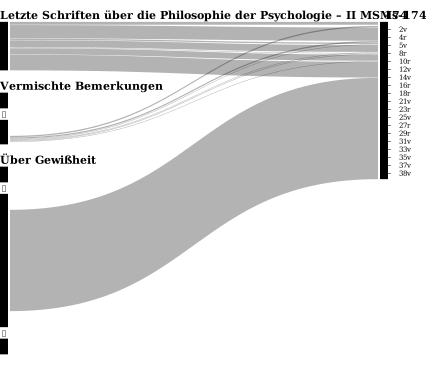
Do not quote from or cite this translation!
§LW II MS 174
1r[1]Die Schmerzäußerung ist nicht gleichermaßen mit dem Schmerz & mit der Verstellung verbunden.
The utterance of pain is not equally connected with pain & with pretending.
§LW II MS 174
1r[2]Sich verstellen ist nicht ein so einfacher Begriff wie Schmerzen haben.
Pretending is not such a simple concept as having pain.
§LW II MS 174
1r[3] Nicht das scheint uns bemerkenswert, daß die Evidenz das Erlebnis des Andern ‘nur wahrscheinlich macht’, sondern, daß dies schwer beschreibbare uns eine wichtige Evidenz ist.
It doesn't seem remarkable to us that evidence only makes the experience of another ‘probable,’ but rather that this difficult-to-describe thing is an important piece of evidence for us.
§LW II MS 174
1r[4]Bedenke, daß Du das Kind den Begriff lehren mußt. Also mußt Du es das Spiel der Evidenz lehren.
Consider that you must teach the child the concept. So you must teach it the game of evidence.
§
1v[1]Wenn Faust sagt “Wer darf ihn nennen, wer ihn bekennen, etc.”, so könnte man ihn fragen: Gebrauchst Du hier nur ein poetisches Gleichnis, oder drängt sich Dir dieser Begriff auf, & lebst Du mit ihm?
When Faust says “Who may name it, who may know it, etc.,” one could ask him: Are you only using a poetic simile here, or is this concept pressing upon you, & are you living with it?
§VB
1v[2] &2r[1]
Ein Gottesbeweis sollte eigentlich etwas sein, wodurch man sich von der Existenz Gottes überzeugen kann. Aber ich denke mir, daß die Gläubigen die solche Beweise lieferten, ihren ‘Glauben’ mit ihrem Verstand analysieren & begründen wollten, obgleich sie selbst durch solche Beweise nie zum Glauben gekommen wären. Einen von der ‘Existenz Gottes überzeugen’ könnte man vielleicht durch eine Art Erziehung, dadurch daß man sein Leben so & so gestaltet. Das Leben kann zum ‘Glauben an Gott’ erziehen. Und es sind auch Erfahrungen, die dies tun; aber nicht Visionen, oder sonstige Sinneserfahrungen, die uns die ‘Existenz dieses Wesens’ zeigen, sondern z.B. Leiden verschiedener Art. Und sie zeigen uns Gott nicht wie ein Sinneseindruck einen Gegenstand, noch lassen sie ihn vermuten. Erfahrungen, Gedanken, – das Leben kann uns diesen Begriff aufzwingen.
A proof of God should actually be something through which one can be convinced of the existence of God. But I think that the believers who provided such proofs wanted to analyze & justify their ‘belief’ with their intellect, although they themselves would never have come to believe through such proofs. Perhaps one could convince someone of the ‘existence of God’ through a kind of education, by shaping one's life in a certain way. Life can educate one to ‘believe in God.’ And there are also experiences that do this; but not visions, or other sense experiences that show us the ‘existence of this being,’ but, for example, various kinds of suffering. And they do not show us God like a sense impression shows an object, nor do they let us suspect him. Experiences, thoughts—life can impose this concept on us.
§VB
2r[2]Er ist dann etwa ähnlich dem Begriff “Gegenstand”.
It is then somewhat similar to the concept of “object.”
§LW II MS 174
2r[3]24.04.1950
Daß unsre Evidenz das Erlebnis des Andern nur wahrscheinlich macht, das führt uns nicht weit; wohl aber, daß dies schwer beschreibbare Muster der Erfahrung für uns eine wichtige Evidenz ist.
April 24, 1950
The fact that our evidence only makes the experience of another probable does not lead us very far; but the fact that this difficult-to-describe pattern of experience is an important piece of evidence for us does.
§LW II MS 174
2r[4] &2v[1]
Daß dies Schwankende ein wichtiger Teil unsres Lebens ist. Wie aber kann man dann überhaupt sagen, es sei etwas Schwankendes? Woran messe ich sein Schwanken? Nun, es gibt unzählige Gestalten des Lächelns, z.B.. Und Lächeln, welches ein Lächeln ist, & Lächeln, welches keins ist.
The fact that this fluctuating thing is an important part of our lives. But how can one even say that something is fluctuating? What do I measure its fluctuation against? Well, there are countless forms of smiling, for example. And smiling, which is a smile, & smiling, which is not a smile.
§LW II MS 174
2v[2]Wovon nehmen wir im Leben Notiz? – “‥‥Da lächelte er.” – das kann unendlich wichtig sein. Aber muß denn eine kleine Verziehung des Gesichts wichtig sein? Und muß sie's uns durch die wahrscheinlichen praktischen Folgen sein?
What do we take note of in life? – “...He smiled.” – that can be infinitely important. But must a slight contortion of the face be important? And must it be so because of the probable practical consequences?
§LW II MS 174
2v[3]“Was in mir vorgeht, kann er nicht wissen.” Er kann's aber doch vermuten. – Also kann er's nur nicht wissen. Also machen wir nur eine Unterscheidung im Gebrauch des Wortes “wissen”.
“What is going on in him, he cannot know.” But he can still suspect it. – So he can only not know it. So we are only making a distinction in the use of the word “know.”
§LW II MS 174
3r[1]Sagt aber der Astronom, der eine Mondesfinsternis berechnet: man könne die Zukunft natürlich nicht wissen? Wir sagen's, wenn wir uns über die Zukunft unsicher fühlen. Der Landmann sagt es in betreff des Wetters; aber der Tischler (sagt) nicht, man könne nicht wissen, ob seine Sessel nicht zusammenbrechen werden.
But does the astronomer, who calculates a lunar eclipse, say that one cannot naturally know the future? We say it when we feel uncertain about the future. The farmer says it with regard to the weather; but the carpenter does not say that one cannot know whether his chairs will break.
§LW II MS 174
3r[2] &3v[1]
“Ich weiß, daß er sich gefreut hat, mich zu sehen”. Was weiß ich? Welche Konsequenzen hat die Tatsache? Ich fühle mich sicher in meinem Verhältnis zu ihm. Aber ist das ein Wissen? Was ist aber der Unterschied zwischen Vermuten & Wissen, daß er sich gefreut hat? Wenn ich's weiß, so werde ich's ohne Zeichen des Zweifels behaupten; & Andre werden diese Aussage verstehen. Nun ja, sie hat ja gewisse praktische Folgen, es läßt sich zur Not etwas aus ihr folgern, aber das scheint nur ihr Schatten zu sein. Was ist das Interesse seines inneren Zustandes der Freude?
“I know that he was pleased to see me.” What do I know? What are the consequences of this fact? I feel secure in my relationship with him. But is that knowledge? What is the difference between suspecting & knowing that he was pleased? If I know it, I will assert it without any signs of doubt; & others will understand this statement. Well, it does have certain practical consequences; something can be inferred from it, but that seems to be only its shadow. What is the interest of his inner state of joy?
§LW II MS 174
3v[2]Wenn ich glaube, er habe sich gefreut, & lerne später, daß es nicht so war, welche Folgen hat das?
If I believe that he was pleased, & later learn that this was not the case, what are the consequences of that?
§LW II MS 174
3v[3]Welchen Unterschied macht es, wenn ich erst glaube, er habe sich gefreut & dann einsehe, daß es nicht wahr war?
What difference does it make if I first believe that he was pleased & then realize that it was not true?
§LW II MS 174
3v[4]Wir möchten alles in sein Inneres projizieren. Dies sei, um was es sich handle. Denn so entgehen wir der Schwierigkeit das Feld des Satzes zu beschreiben.
We would like to project everything into his inner being. This is what it is all about. For in this way we avoid the difficulty of describing the field of the sentence.
§LW II MS 174
3v[5]Es ist genau so, wie wenn man sagt:
“Das Benzol hat die Struktur
 ”
”
heiße: die Atome seien so angeordnet.
It is exactly like saying:
“Benzene has the structure
”
means: the atoms are arranged so.
§LW II MS 174
4r[1]Warum sage ich aber, ich ‘projiziere’ alles in's Innere? Liegt es nicht im Innern? Nein. Es liegt nicht im Innern, es ist das Innere. Und das ist nur eine oberflächliche logische Einordnung & nicht die Beschreibung, deren wir bedürfen.
But why do I say that I ‘project’ everything into the inner being? Is it not already in the inner being? No. It does not lie in the inner being; it is the inner being. And this is only a superficial logical classification & not the description that we need.
§LW II MS 174
4r[2]Wir ‘projizieren’ nichts in sein Inneres; wir geben nur eine Erklärung, die uns nicht weiterführt.
We do not “project” anything into his inner world; we simply offer an explanation that does not take us any further.
§LW II MS 174
4r[3]Denk Dir, die Seele ward ein Gesicht, & wenn Einer sich freut, so lächelt dieses verborgene Gesicht. Laß es so sein, – aber nun wollen wir doch wissen, welche Wichtigkeit dies Lächeln (oder welcher Gesichtsausdruck immer) hat.
Imagine, the mind became a face, and when someone is happy, this hidden face smiles. Let it be so – but now we want to know what significance this smile (or whatever facial expression) has.
§LW II MS 174
4r[4] &4v[1]
Ja, dies könnte sogar unser gewöhnlicher Ausdruck sein: “Sein inneres Gesicht hat gelächelt, wie er mich gesehen hat” etc.
Yes, this could even be our usual expression: “His inner face smiled when he saw me,” etc.
§LW II MS 174
4v[2]Erste Frage: Wie weiß man, wie beurteilt man, ob sein inneres Gesicht lächelt? Zweite Frage: Welche Wichtigkeit hat es? – Aber die beiden hängen zusammen. Und man könnte eine andere, wenngleich verwandte, Frage so stellen: Welche Wichtigkeit hat sein – äußeres – Lächeln? Denn, ist das innere von Wichtigkeit, so muß es – in einer (etwas) andern Art– auch das äußere sein.
First question: how does one know, how does one judge whether one’s inner face is smiling? Second question: what importance does it have? – But the two are connected. And one could pose a different, albeit related, question in this way: what importance does one’s – outer – smile have? For if the inner is of importance, then the outer must also be of importance – in a (somewhat) different way.
§LW II MS 174
4v[3](Einzusehen, daß meine Manipulationen gerechtfertigt sind, ist nicht leicht.)
(It is not easy to see that my manipulations are justified.)
§LW II MS 174
4v[4]Wenn aber nun Ich weiß, daß er sich gefreut hat” gewiß nicht heißt: Ich weiß, daß er gelächelt hat, so ist es etwas anderes, was ich weiß & worauf es hier ankommt.
But if “I know that he was pleased” does certainly not mean: I know that he smiled, then it is something else that I know & that is what matters here.
§VB
5r[1]Ich kann Shakespeare darum nicht verstehen, weil ich in der gänzlichen Asymmetrie die Symmetrie finden will.
I cannot understand Shakespeare because I want to find symmetry in the complete asymmetry.
§VB
5r[2]Mir kommt vor, seine Stücke seien, gleichsam, enorme Skizzen, nicht Gemälde; sie seien hingeworfen, von einem, der sich sozusagen alles erlauben kann. Und ich verstehe, wie man das bewundern & es die höchste Kunst nennen kann, aber ich mag es nicht. – Wer daher vor diesen Stücken sprachlos steht, den kann ich verstehen; wer sie aber bewundert, so wie man Beethoven etwa bewundert, der scheint mir Shakespeare mißzuverstehen.
It seems to me that his works are, as it were, enormous sketches, not paintings; they are dashed off, by someone who can, in a way, allow himself everything. And I understand how one can admire that & call it the highest art, but I don't like it. – I can understand someone who is rendered speechless by these works; but someone who admires them, as one might admire Beethoven, seems to me to misunderstand Shakespeare.
§LW II MS 174
5r[3]Denn das innere Lächeln könnte man sogar zur Not durch ein äußeres ersetzen, & es bliebe (noch immer) die Frage nach der Bedeutung bestehen.
For indeed, if necessary, one could even replace the inner smile with an outer one, & the question of its meaning would still remain.
§LW II MS 174
5v[1]“Ich bin sicher, daß er sich gefreut hat mich zu sehen”, das könnte in einem Gerichtssaal ausgesagt werden. Hier sind die möglichen ‘praktischen’ Folgen klar. Und ebenso auch, wenn die Aussage wäre “Ich bin sicher, er hat sich nicht gefreut, sich aber verstellt.” Anderes ist von dem zu erwarten, der sich freut & von dem, der Freude heuchelt.
“I am sure that he was pleased to see me,” this could be said in a courtroom. The possible ‘practical’ consequences are clear here. And so too if the statement were, “I am sure he was not pleased, but pretended to be.” Different things are to be expected from someone who is pleased and from someone who feigns pleasure.
§VB
5v[2]Eine Zeit mißversteht die andere; & eine kleine Zeit mißversteht alle andern in ihrer eigenen häßlichen Weise.
One era misunderstands another, & a brief period misunderstands all others in its own ugly way.
§LW II MS 174
5v[3] &6r[1]
Liegt mir aber deshalb daran, daß der Andre sich wirklich freut mich zu sehen, weil es andere Folgen hat? Ich fühle mich wohl, weil dieser Mensch (mit dieser Vergangenheit etc.) sich so benimmt. Und das ‘so’ ist freilich ein sehr kompliziertes Muster.
But is it really important to me that the other person is happy to see me, because it has other consequences? I feel good because this person (with this past, etc.) behaves in this way. And that ‘in this way’ is, of course, a very complicated pattern.
§LW II MS 174
6r[2]Wenn man philosophische Probleme nicht lösen will, – warum gibt man es nicht auf, sich mit ihnen zu beschäftigen. Denn sie lösen heißt seinen Standpunkt, die alte Denkweise ändern. Und willst Du das nicht, so solltest Du die Probleme unlösbare nennen.
If one does not want to solve philosophical problems, why not give up trying to deal with them? For to solve them means to change one’s point of view, the old way of thinking. And if you do not want to do that, then you should call the problems unsolvable.
§LW II MS 174
6r[3] &6v[1]
Es wird immer vorausgesetzt, daß der Lächelnde ein Mensch ist, nicht nur daß, was lächelt, ein menschlicher Körper ist. Es werden auch bestimmte Umstände vorausgesetzt & Zusammenhänge des Lächelns mit andern Formen des Benehmens. Aber wenn alles das vorausgesetzt ist, ist mir das Lächeln des Andern angenehm. Wenn ich jemand auf der Straße nach dem Weg frage, so ist mir eine freundliche Antwort lieber als eine unfreundliche. Ich reagiere unmittelbar auf das Benehmen des Andern. Das Innere setze ich voraus, insofern ich einen Menschen voraussetze.
It is always assumed that the one who is smiling is a human being, not just that what is smiling is a human body. Certain circumstances & connections of the smile with other forms of behaviour are also assumed. But if all of that is assumed, then the smile of the other person is pleasing to me. If I ask someone on the street for directions, I prefer a friendly answer to an unfriendly one. I react immediately to the behaviour of the other person. I assume the inner aspect insofar as I assume a human being.
§LW II MS 174
6v[2]Das ‘Innere’ ist eine Täuschung. D.h.: der ganze Ideenkomplex auf den damit angespielt ist, ist wie ein gemalter Vorhang vor die wirkliche Anwendung der Worte gezogen.
The ‘inner’ is an illusion. That is to say: the whole complex of ideas that this suggests is like a painted curtain drawn in front of the actual application of the words.
§LW II MS 174
6v[3] &7r[1]
Mir scheint: wenn man nicht eigentlich wissen kann, ob sich jemand ärgert (z.B.), dann kann man es auch nicht eigentlich glauben, oder vermuten.
It seems to me: if one cannot actually know whether someone is annoyed (for example), then one cannot actually believe or suspect it either.
§LW II MS 174
7r[2]Ist es nicht wahr, daß, wessen ich ‘sicher sein’ kann, das kann ich auch ‘wissen’?
Isn't it true that what I can ‘be sure’ of, I can also ‘know’?
§LW II MS 174
7r[3]Wäre es nicht lächerlich, wenn ein Anwalt im Gerichtssaal sagte, der Junge könne nicht wissen, der & der sei zornig gewesen, weil Zorn etwas Inneres sei? – Dann kann man auch nicht wissen, ob Hängen eine Strafe ist.
Wouldn’t it be ridiculous if a lawyer in the courtroom said that the boy couldn’t know that so-and-so was angry, because anger is something inner? – Then one also couldn’t know whether hanging is a punishment.
§LW II MS 174
7r[4]Wer sagt “das kann man nicht wissen”, macht eine Unterscheidung zwischen Sprachspielen. Er sagt: In solchen Sprachspielen gibt es ein Wissen, in solchen nicht. Und damit schränkt er den Begriff des ‘Wissens’ ein.
Whoever says “that one cannot know” makes a distinction between language-games. He says: In such language-games there is knowledge, in such ones there is not. And with that he limits the concept of ‘knowledge’.
§LW II MS 174
7v[1]Diese Einschränkung könnte nützlich sein, wenn sie einen wichtigen Unterschied betont, den unser gewöhnlicher Sprachgebrauch übergeht. Aber ich glaube, so ist es nicht.
This restriction could be useful if it emphasized an important difference that our ordinary linguistic usage overlooks. But I don’t think that’s the case.
§VB
7v[2] &8r[1]
Wie Gott den Menschen beurteilt, das kann man sich gar nicht vorstellen: Wenn er dabei wirklich die Stärke der Versuchung & die Schwäche der Natur in Anschlag bringt, wen kann er dann verurteilen? Wenn aber nicht, so ergibt eben die Resultierende dieser beiden Kräfte das Ziel, zu dem er prädestiniert wurde. Er wurde also geschaffen, um entweder durch das Zusammenspiel der Kräfte zu siegen, oder unterzugehen. Und das ist überhaupt kein religiöser Gedanke, sondern eher eine wissenschaftliche Hypothese. Wenn Du also im Religiösen bleiben willst, mußt Du kämpfen.
One can hardly imagine how God judges people: If He really takes into account the strength of the temptation & the weakness of human nature, who can He then condemn? But if not, then the result of these two forces determines the goal for which he was predestined. So he was created either to succeed or to fail through the interplay of these forces. And this is not a religious thought at all, but rather a scientific hypothesis. So if you want to stay within the realm of the religious, you must struggle.
§LW II MS 174
8r[2]Aber ist denn die mathematische Sicherheit nicht größer als jede physikalische & schon erst recht als die Sicherheit darüber, was der Andre fühlt?
But isn't mathematical certainty greater than any physical certainty, and all the more so than the certainty about what the other person is feeling?
§VB
8r[3]Sieh Dir die Menschen an: Der eine ist Gift für den andern. Die Mutter für den Sohn, und umgekehrt, etc. etc. Aber die Mutter ist blind & der Sohn ist es auch. Vielleicht haben sie schlechtes Gewissen, aber was hilft ihnen das? Das Kind ist böse, aber niemand lehrt es anders sein, & die Eltern verderben es nur durch ihre dumme Zuneigung; & wie sollen sie es verstehen, & wie soll das Kind es verstehen? Sie sind sozusagen alle böse & alle unschuldig.
Look at people: one is poison to the other. The mother is to the son, and vice versa, etc. etc. But the mother is blind, and the son is blind too. Perhaps they have a bad conscience, but what good does that do them? The child is evil, but no one teaches him to be otherwise, and the parents only spoil him through their stupid affection; and how are they supposed to understand him, and how is the child supposed to understand him? They are, as it were, all evil & all innocent.
§LW II MS 174
8v[1]Und kann man nicht die größere Gewißheit der Mathematik eben so ausdrücken: In der Mathematik gäbe es ein Wissen?
And can’t one express the greater certainty of mathematics in the same way: that there is knowledge in mathematics?
§LW II MS 174
8v[2]In der Math. läßt eine bestimmte klar angebbare Evidenz keinen Zweifel offen. So ist es nicht, wenn wir wissen, jemand habe sich gefreut. Ob eine Rechnung das, oder jenes ergiebt, darüber kann es im Gerichtssaal nicht lange zum Streite kommen; wohl aber darüber, ob Einer ärgerlich war oder nicht. Aber folgt daraus, daß man das eine wissen, das andre nicht wissen kann? Eher noch, daß man im einen Fall die Entscheidung so gut wie immer weiß, im andern sie oft nicht weiß.
In mathematics, a certain, clearly identifiable evidence leaves no room for doubt. This is not the case when we know that someone was pleased. Whether a calculation yields this or that can quickly lead to a dispute in the courtroom; but whether someone was angry or not. But does it follow that one can know one thing, but not the other? Rather, it is that in one case one knows the outcome almost always, in the other case one often does not know it.
§LW II MS 174
8v[3] &9r[1]
Wenn man sagt, man weiß nie, ob der Andre wirklich so & so gefühlt hat, dann nicht, weil er vielleicht in Wirklichkeit doch anders gefühlt hat, sondern weil sozusagen auch Gott nicht wissen kann daß er so gefühlt hat.
If one says that one never knows whether the other person actually felt that way, then not because he may in reality have felt differently, but because, as it were, even God cannot know that he felt that way.
§LW II MS 174
9r[2] &9v[1]
Ich bin z.B. überzeugt, daß mein Freund sich gefreut hat mich zu sehen. Nun aber sage ich mir, indem ich philosophiere, es könnte ja doch anders sein; vielleicht stellte er sich nur so. Aber sogleich sage ich mir, daß, auch wenn er dies selbst zugäbe, ich durchaus nicht sicher wäre, daß er sich nicht irrt, daß er sich selbst kennt. Es ist also im ganzen Spiel eine Unbestimmtheit. Man könnte sagen: In einem Spiel, in dem die Regeln unbestimmt sind, kann man nicht wissen, wer gewonnen & wer verloren hat.
For example, I am convinced that my friend was pleased to see me. But now, while philosophizing, I tell myself that it might be different; perhaps he was only pretending. But immediately I tell myself that, even if he admitted this himself, I would not necessarily be sure that he is not mistaken, that he knows himself. So in the whole game there is an uncertainty. One could say: in a game in which the rules are uncertain, one cannot know who has won and who has lost.
§LW II MS 174
9v[2]Es gibt ein ‘warum’, worauf die Antwort keine Vorhersagen zuläßt. So ist es z.B. mit animistischen Erklärungen. Viele von Freuds Erklärungen, oder Göthes in der Farbenlehre sind von dieser Art. Die Erklärung gibt uns eine Analogie. Und nun ist die Erscheinung nicht mehr isoliert, sondern mit andern verknüpft.
There is a ‘why’ for which the answer does not allow predictions. This is the case, for example, with animistic explanations. Many of Freud’s explanations, or Goethe’s in the Theory of Colors, are of this kind. The explanation gives us an analogy. And now the phenomenon is no longer isolated, but connected with others.
§LW II MS 174
9v[3] &10r[1]
Wenn Einer ‘Freundschaft heuchelt & endlich seine wahren Gefühle zeigt, oder gesteht’, denken wir für gewöhnlich nicht daran nun dies Geständnis in Zweifel zu ziehen & auch hier zu sagen, wir könnten nicht wissen, was wirklich in ihm vorgeht. Vielmehr scheint jetzt Sicherheit erreicht.
When someone ‘pretends to be friendly and finally shows or confesses his true feelings’, we usually don’t think about doubting this confession and saying that we can’t know what is really going on in him. Rather, certainty now seems to have been achieved.
§LW II MS 174
10r[2]Wichtig ist dies: Ich mag aus gewissen Anzeichen & der Kenntnis einer Person, wissen, daß er sich freut, etc.. Aber einem Dritten kann ich nicht meine Beobachtungen beschreiben &, wenn er diesen traut, ihn dadurch von der Echtheit jener Freude etc. überzeugen.
This is important: I may know, from certain signs and my knowledge of a person, that he is pleased, etc. But I cannot describe my observations to a third person, and if he trusts him, convince him of the authenticity of that joy, etc.
§LW II MS 174
10r[3]Man sagt von einer Gefühlsäußerung “Sie sieht echt aus”. Und welchen Sinn hätte das, wenn es nicht überzeugende Kriterien der Echtheit gäbe? Man kann nicht sagen “Das scheint echt”, wenn man nicht auch sagen kann “Das ist echt.”
One says of an emotional expression, “It looks genuine.” And what would be the point of that if there were not convincing criteria for authenticity? One cannot say, “It seems genuine,” if one cannot also say, “It is genuine.”
§VB
10r[4] &10v[1]
Die Philosophie hat keinen Fortschritt gemacht? – Wenn Einer kratzt wo es ihn juckt, muß ein Fortschritt zu sehen sein? ist es sonst kein echtes Kratzen, oder kein echtes Jucken? Und kann nicht diese Reaktion auf die Reizung lange Zeit so weitergehen, ehe ein Mittel gegen das Jucken gefunden wird?
Has philosophy made no progress? – If someone scratches where it itches, should there not be progress to be seen? Is it otherwise not a real scratch, or not a real itch? And can this reaction to the irritation not continue for a long time before a means is found to relieve the itch?
§LW II MS 174
10v[2]“Dieses Weinen macht einen echten Eindruck” – so gibt es also ein echtes Weinen. So gibt es also ein Kriterium dafür. “Aber kein sicheres!”
“This crying makes a real impression” – so there is a real crying. So there is a criterion for it. “But not a certain one!”
§LW II MS 174
10v[3]Wie unterscheidet sich Einer, der ein sicheres Kriterium anerkennt von einem, der's nicht tut?
How does one who acknowledges a certain criterion differ from one who does not?
§LW II MS 174
10v[4] &11r[1]
Aber heißt denn, kein sicheres Kriterium anerkennen: nie sicher sein, daß der Andre so & fühlt? Kann ich nicht ganz sicher sein, & doch kein sicheres Kriterium anerkennen? Ich bin (benehme mich) sicher & weiß etwa nicht warum ich es bin.
But does not acknowledging no certain criterion mean: never being certain that the other feels so & so? Can I not be quite certain, & yet not acknowledge a certain criterion? I am (behave) certain & perhaps do not know why I am.
§LW II MS 174
11r[2]Wie würde es aussehen, wenn Alle Menschen immer über die Gefühle des Andern unsicher wären? Sie würden scheinbar immer etwas zweifelhaft sein, immer etwa eine zweifelhafte Miene oder Gebärde machen, während sie den Andern bemitleiden etc.. – Aber wenn wir nun diese ständige Gebärde weglassen, weil sie ständig ist, welches Benehmen bleibt dann? Etwa ein kühles, oder gleichgültiges nur oberflächliches interessiertes? Aber dann brauchen wir ihr Benehmen wieder nicht als Ausdruck des Zweifelns deuten. – Also heißt es nichts, daß Alle immer ‥‥
What would it look like if all people were always uncertain about the feelings of others? They would apparently always be somewhat doubtful, always making some doubtful facial expression or gesture while pitying others, etc. – But if we now leave out this constant gesture, because it is constant, what behaviour remains? Perhaps just a cool, or indifferent, superficially interested one? But then we don't need to interpret their behaviour again as an expression of doubt. – So it means nothing that all are always‥‥
§LW II MS 174
11r[3]Es gibt Unsicherheit & es gibt Sicherheit; aber daraus folgt nicht, daß es sichere Kriterien gibt.
There is uncertainty & there is certainty; but it does not follow that there are certain criteria.
§LW II MS 174
11v[1]Wie, wenn Einer nun sagte: “Ich weiß, daß er sich freut” heiße nichts anderes als, ich sei seiner Freude sicher, also wieder: ich reagiere auf ihn so & so, & zwar ohne Unsicherheit. Es wäre dann ungefähr so, wie “Ich weiß, daß alles zum Guten ist” – der Ausdruck meiner eigenen Stellungnahme zu was immer kommt. Und hier wäre Grund zu sagen, dies sei eigentlich kein Wissen. Die letztere Aussage würde aber auch im Gerichtssaal niemand davon überzeugen, daß alles zum Guten ist.
How if someone now says: “I know that he is happy” means nothing other than: I am certain of his happiness, so again: I react to him in this way & that, without uncertainty. It would then be approximately the same as: “I know that everything is for the best” – the expression of my own statement about whatever it is. And here there would be reason to say that this is not really knowledge. But even in the courtroom, no one would be convinced by the latter statement that everything is for the best.
§LW II MS 174
11v[2] &12r[1]
Und hier liegt nun etwas Wichtiges: Die Aussage “Ich weiß, daß er sich freut” würde doch auch im Gerichtssaal nicht als mehr gelten als: “Ich habe den sichern Eindruck, daß er sich freut”. Der Fall wäre nicht der gleiche, wie wenn ein Physiker aussagte, er habe dies Experiment gemacht & es habe dies ergeben; oder wie wenn ein Mathematiker über eine Berechnung aussagte. – Wenn ich den Andern lange gekannt habe, wird der Gerichtshof wohl auch meine Aussage gelten lassen, ihr Gewicht beilegen. Aber meine absolute Sicherheit wird ihm nicht ein Wissen bedeuten. Denn aus einem Wissen müßte er ganz bestimmte Schlüsse ziehen können.
And here lies something important: the statement “I know that he is happy” would not be regarded as more than: “I have the certain impression that he is happy” even in the courtroom. The case would not be the same as when a physicist testifies that he made this experiment & it gave this result; or as when a mathematician makes a statement about a calculation. – If I have known the other person for a long time, the court will probably also accept my statement, give it weight. But my absolute certainty will not mean knowledge to him. Because he must be able to draw quite specific conclusions from knowledge.
§LW II MS 174
12r[2]Und man kann nicht entgegnen: “Ich ziehe bestimmte Schlüsse aus meinem Wissen, auch wenn's niemand andrer kann” – denn Schlüsse müssen für Alle gelten.
And one cannot object: “I draw certain conclusions from my knowledge, even if no one else can” – because conclusions must apply to everyone.
§LW II MS 174
12r[3] &12v[1]
Die Verbindung der Evidenz mit dem, wofür sie Evidenz ist, ist hier nicht zwangsläufig. Und ich meine nicht: “die Verbindung des Äußern mit dem Innern”.
The connection between the evidence & that for which it is evidence is not necessarily the case here. & I mean not: “the connection of the external with the internal”.
§LW II MS 174
12v[2]Man könnte sogar sagen: Die Unsicherheit über das Innere ist eine Unsicherheit über etwas Äußeres.
One could even say: the uncertainty about the inner is an uncertainty about something external.
§LW II MS 174
12v[3]Wenn “Ich weiß …” heißt: Ich kann den Andern überzeugen, wenn er mir die Evidenz glaubt, dann kann man sagen: Ich mag zwar über seine Stimmung so sicher sein, wie über die Wahrheit eines math. Satzes, aber es ist dennoch falsch zu sagen, ich wisse seine Stimmung. (Es ist aber dennoch falsch zu sagen: Wissen sei ein anderer SeelenZustand als Sicher-Sein. (Ich ist ein andrer Mensch als L.W.))
If “I know…” means: I can convince the other person if he believes the evidence, then one can say: I may be as certain about his mood as about the truth of a mathematical proposition, but it is still wrong to say that I know his mood. (But it is still wrong to say: knowledge is a different state of mind than being certain. (I am a different person than L.W.))
§LW II MS 174
12v[4] &13r[1]
D.h.: ‘wissen’ ist ein psychologischer Begriff andrer Art als ‘sicher sein’, ‘überzeugt sein’, ‘glauben’, ‘vermuten’, etc.. Die Evidenz für das Wissen ist andrer Art.
That is: ‘knowing’ is a psychological concept of a different kind than ‘being certain’, ‘being convinced’, ‘believing’, ‘guessing’, etc.. The evidence for knowledge is of a different kind.
§LW II MS 174
13r[2]Russell's Beispiel: “Ich weiß, daß der gegenwärtige Ministerpräsident eine Glatze hat”; der es sagt ist sicher & zwar weil er fälschlich glaubt, X sei Ministerpräsident; aber auch der gegenwärtige hat eine Glatze & so ist seine Behauptung wahr & doch weiß er nicht, daß sie's ist.
Russell's example: “I know that the current Prime Minister is bald”; the one who says it is certain, because he wrongly believes that X is Prime Minister; but also the current one is bald & so his statement is true & yet he does not know that it is.
§LW II MS 174
13r[3]“Ich weiß, daß es so ist” ist zwar ein Ausdruck meiner vollkommenen Sicherheit, aber es folgt aus ihm noch andres als meine Sicherheit.
“I know that it is so” is indeed an expression of my complete certainty, but it still follows that something else follows from it than my certainty.
§LW II MS 174
13r[4]Erstens heißt natürlich “Seine Gefühle kann ich nicht wissen” nicht: …im Gegensatz zu meinen. Zweitens heißt es nicht: ich kann seiner Gefühle nie ganz sicher sein.
Firstly, “I cannot know his feelings” naturally does not mean: …in contrast to my feelings. Secondly, it does not mean: I can never be completely certain about his feelings.
§LW II MS 174
13v[1]Aussage: “Ich weiß, daß die Flasche dort gestanden ist.” – “Wie weißt Du das?” – “Ich habe sie dort gesehen.” – Wenn nun die Aussage ist: “Ich weiß, daß er sich gefreut hat”, & gefragt wird “Wie weißt Du das?” – Was ist die Antwort? Sie ist nicht einfach die Beschreibung eines physikalischen Tatbestandes. Es gehört z.B. dazu, daß ich den betreffenden kenne. Wenn im Gerichtssaal ein Film vorgeführt werden könnte, in dem die ganze Szene wiedergegeben wäre, sein Mienenspiel, seine Gebärden, seine Stimme, könnte das manchmal ganz überzeugend wirken. Zum mindesten wenn er kein Schauspieler ist. Aber es wirkt z.B. nur, wenn die, welche die Szene beurteilen der gleichen Kultur angehören. Ich wüßte z.B. nicht, wie bei Chinesen die echte Freude aussieht.
Statement: “I know that the bottle stood there.” – “How do you know that?” – “I saw it there.” – Now, if the statement is: “I know that he was happy,” & one asks “How do you know that?” – What is the answer? It is not simply the description of a physical fact. For example, it includes the fact that I know the person in question. If a film could be shown in the courtroom in which the entire scene was reproduced, his facial expressions, his gestures, his voice, it could sometimes be very convincing. At least if he is not an actor. But it only works, for example, if those who judge the scene belong to the same culture. For example, I would not know what genuine joy looks like in Chinese people.
§LW II MS 174
14r[1]Nicht darauf richten wir unser Augenmerk, daß einer nicht wissen kann, was ein anderer erlebt, daß ein Erlebnis in irgend einem Sinne das Geheimnis dessen ist, der es hat, sondern auf die Regeln der Evidenz überhaupt, die sich auf Erlebnisse beziehen.
We are not focusing on the fact that one cannot know what another experiences, that an experience is in some sense the secret of the one who has it, but on the rules of evidence in general, which relate to experiences.
§LW II MS 174
14r[2]Wichtig ist z.B. daß man einen Menschen ‘kennen’ muß, um beurteilen zu können, welche Bedeutung einer Gefühlsäußerung von ihm beizumessen ist, & daß man doch nicht beschreiben kann, was man an ihm kennt. Ebenso wichtig ist, daß man nicht sagen kann, worin die wesentlichen beobachtbaren Folgen eines innern Zustandes bestehen. Wenn er sich z.B. wirklich gefreut hat, was ist dann von ihm zu erwarten, & was nicht? Es gibt natürlich solche charakteristische Folgen aber sie sind nicht so zu beschreiben, wie die Reaktionen welche einen Zustand eines physikalischen Gegenstands kennzeichnen.
It is important, for example, that one must ‘know’ a person in order to be able to judge what meaning should be assigned to an expression of feeling from him, & that one cannot describe what one knows about him. Equally important is that one cannot say in what the essential observable consequences of an inner state consist. If he was really happy, for example, what is to be expected of him, & what is not? There are, of course, such characteristic consequences, but they cannot be described in the same way as the reactions that characterize the state of a physical object.
§LW II MS 174
14v[1]Man muß auch dies bedenken: Echtheit & Unechtheit sind nicht die einzigen wesentlichen Merkmale eines Gefühlsausdrucks.
Es ist z.B. nicht zu sagen, ob eine Katze, die schnurrt & gleich darauf kratzt, sich verstellt habe. Es könnte sein daß ein Mensch die Zeichen der Freude von sich gäbe & sich dann in ganz unerwarteter Weise benimmt, & daß wir doch nicht sagen können, der erste Ausdruck sei nicht echt gewesen.
One must also consider this: Authenticity & inauthenticity are not the only essential characteristics of an expression of feeling.
For example, one cannot say whether a cat that purrs & then scratches is being insincere. It could be that a person gives signs of joy & then behaves in a completely unexpected way, & that we still cannot say that the first expression was not genuine.
§LW II MS 174
14v[2]Es scheint mir so wenig festzustehen, daß es nur echten oder verstellten Gefühlsausdruck geben kann, wie daß es nur Dur oder Moll Tonarten geben kann.
It seems to me that it is as uncertain that there can only be genuine or feigned expressions of feeling, as it is that there can only be major or minor keys.
§OC
14v[3] &15r[1]
Ich mache Behauptungen die Wirklichkeit betreffend mit verschiedenen Graden der Sicherheit. Wie zeigt sich der Grad der Sicherheit? Welche Konsequenzen hat er? Es kann sich z.B. um Sicherheit des Gedächtnisses, oder der Wahrnehmung handeln. Ich mag meiner Sache sicher sein, aber wissen, welche Prüfung mich eines Irrtums überweisen könnte. Ich bin z.B. der Jahreszahl einer Schlacht ganz sicher, sollte ich aber in einem bekannten Geschichtswerk eine andere Jahreszahl finden, so würde ich meine Ansicht ändern & würde dadurch nicht an allem Urteilen irre werden.
I make assertions about reality with varying degrees of certainty. How does the degree of certainty manifest itself? What consequences does it have? It can, for example, be about certainty of memory or perception. I may be sure of my case, but I know what test could prove me wrong. For example, I am quite sure of the date of a battle, but if I were to find a different date in a well-known historical work, I would change my view & would not thereby judge everything I said to be wrong.
§OC
15r[2] &15v[1]
Könnten wir uns einen Menschen vorstellen, der sich dort immer wieder irrt, wo wir einen Irrtum für ausgeschlossen halten & ihm auch nicht begegnen? Er sagt z.B. mit der selben Sicherheit (& allen ihren Zeichen) wie ich, er wohne dort & dort, sei so & so alt, komme von der & der Stadt, etc., irrt sich aber. Wie aber verhält er sich dann zu diesem Irrtum? Was soll ich annehmen?
Could we imagine a person who is always mistaken where we consider an error to be impossible & who does not even encounter it? He says, for example, with the same certainty (& all its signs) as I do, that he lives there & there, is so & so old, comes from the & the city, etc., but he is wrong. But how does he then relate to this error? What should I assume?
§OC
15v[2]Die Frage ist: Was soll der Logiker hier sagen?
The question is: What should the logician say here?
§OC
15v[3]Ich möchte sagen: “Wenn ich mich darin irre, so habe ich keine Gewähr, daß irgend etwas, was ich sage, wahr ist.” Aber ein Andrer wird das darum nicht von mir sagen, noch ich von einem Andern.
I would like to say: “If I am mistaken in this, then I have no guarantee that anything I say is true.” But another person will not say that about me, nor will I say it about another.
§OC
15v[4]Ich habe seit Monaten an der Adresse A gewohnt, den Straßennamen & die Hausnummer unzählige Male gelesen unzählige Briefe hier erhalten & unzähligen Leuten die Adresse gegeben. Irre ich mich darin, so ist dieser Irrtum kaum geringer, als wenn ich (fälschlich) glaubte, ich schriebe Chinesisch & nicht Deutsch.
I have lived at address A for months, read the street name & house number countless times, received countless letters here, & given the address to countless people. If I am mistaken in this, then this error is hardly less than if I (falsely) believed that I was writing Chinese & not German.
§OC
15v[5] &16r[1]
Wenn mein Freund sich eines Tages einbildete, seit langem da & da gelebt zu haben, etc. etc., so würde ich das keinen Irrtum nennen, sondern eine, vielleicht vorübergehende, Geistesstörung.
If my friend one day imagined that he had lived there & there for a long time, etc., etc., I would not call that an error, but a, perhaps temporary, mental disturbance.
§OC
16r[2]Nicht jeder fälschliche Glaube dieser Art ist ein Irrtum.
Not every false belief of this kind is an error.
§OC
16r[3]Was aber ist der Unterschied zwischen Irrtum & Geistesstörung? Oder wie unterscheidet es sich, wenn ich etwas als Irrtum, & als Geistesstörung behandle?
But what is the difference between error & mental disturbance? Or how does it differ when I treat something as an error, & as a mental disturbance?
§OC
16r[4]Kann man sagen: Ein Irrtum hat nicht nur eine Ursache, sondern auch einen Grund. D.h. ungefähr: er läßt sich in das richtige Wissen des Irrenden einordnen.
Can one say: An error does not only have one cause, but also a reason? That is to say, approximately: it can be integrated into the correct knowledge of the person in error.
§OC
16r[5] &16v[1]
Wäre dies richtig? Wenn ich bloß fälschlich glaubte, daß hier vor mir ein Tisch steht, so könnte das noch ein Irrtum sein; wenn ich aber fälschlich glaube, daß ich diesen oder einen solchen Tisch seit mehreren Monaten täglich gesehen & ständig benützt habe, so ist das kein Irrtum.
Would this be correct? If I merely falsely believe that there is a table in front of me, that could still be an error; but if I falsely believe that I have seen this or such a table every day for several months and constantly used it, then that is not an error.
§OC
16v[2]Mein Ziel muß es natürlich sein, anzugeben, welche Aussagen man hier machen möchte, aber nicht sinnvoll machen kann.
My goal must, of course, be to indicate which statements one would like to make here, but which one cannot make sense of.
§OC
16v[3]Ich werde eine Multiplikation zur Sicherheit vielleicht zweimal rechnen, vielleicht sie von einem Andern nachrechnen lassen. Aber werde ich sie zwanzigmal nachrechnen, oder sie von zwanzig Leuten nachrechnen lassen? Und ist das eine gewisse Fahrlässigkeit? Wäre die Sicherheit bei zwanzigfacher Nachprüfung wirklich größer?!
I might calculate a multiplication twice, just to be sure, or have someone else check it. But would I check it twenty times, or have twenty people check it? And is that a certain kind of carelessness? Would the certainty really be greater with twentyfold verification?!
§OC
16v[3].2Und kann ich dafür einen Grund angeben, daß sie's nicht ist?
And can I give a reason for why it isn’t?
§OC
17r[1]Daß ich ein Mann & keine Frau bin, kann verifiziert werden, aber wenn ich sagte, ich sei eine Frau, & den Irrtum damit erklären wollte, daß ich die Aussage nicht geprüft habe, würde man die Erklärung nicht gelten lassen.
The fact that I am a man and not a woman can be verified, but if I said that I was a woman, and wanted to explain the error with the fact that I did not check the statement, then the explanation would not be accepted.
§OC
17r[2]Man prüft an der Wahrheit meiner Aussagen mein Verstehen dieser Aussagen.
One checks my understanding of these statements by the truth of my statements.
§OC
17r[3]D.h.: wenn ich gewisse falsche Aussagen mache, wird es dadurch unsicher, daß ich sie verstehe.
That is to say: if I make certain false statements, it becomes uncertain that I understand them.
§OC
17r[4]Was als ausreichende Prüfung einer Aussage gilt, – gehört zur Logik. Es gehört zur Beschreibung des Sprachspiels.
What counts as sufficient verification of a statement belongs to logic. It belongs to the description of the language-game.
§OC
17v[1]Die Wahrheit gewisser Erfahrungssätze gehört zu unserm Bezugssystem.
The truth of certain statements about experience belongs to our frame of reference.
§OC
17v[2] &18r[1]
Moore sagt, er wisse, daß die Erde lange vor seiner Geburt existiert habe. Und so ausgedrückt scheint es eine Aussage über seine Person zu sein, wenn es auch außerdem eine Aussage über die physikalische Welt ist. Es ist nun philosophisch uninteressant, ob M. dies oder jenes weiß, aber interessant, daß er es wissen kann, & wie er es wissen kann. Hätte M. uns mitgeteilt, er wisse die Entfernung gewisser Sterne von einander, so könnten wir daraus schließen, daß er besondere Untersuchungen angestellt habe, & wir werden nun erfahren wollen, welche Untersuchungen. Aber M. wählt gerade einen Fall, in dem wir Alle zu wissen scheinen, was er weiß, & ohne sagen zu können, wie. Ich glaube z.B. ebensoviel von dieser Sache (der Existenz der Erde) zu wissen, wie M., & wenn er weiß daß es sich so verhält, wie er sagt, so weiß ich's auch. Denn es ist auch nicht so als hätte er seinen Satz auf einem Gedankenweg erreicht, der mir zwar zugänglich, aber von mir nicht begangen worden ist.
Moore says that he knows that the Earth existed long before his birth. And expressed in this way, it seems to be a statement about his person, even if it is also a statement about the physical world. It is now philosophically uninteresting whether M. knows this or that, but it is interesting that he can know it, and how he can know it. If M. had told us that he knew the distance between certain stars, we could conclude that he had conducted special investigations, and we would now like to know what investigations. But M. chooses precisely a case in which we all seem to know what he knows, and without being able to say how. I, for example, believe that I know just as much about this matter (the existence of the Earth) as M., and if he knows that it is as he says, then I know it too. Because it is not as if he had reached his statement through a line of thought that is accessible to me, but which I have not followed.
§OC
18r[2] &18v[1]
Und was gehört nun dazu, daß Einer dies wisse? Kenntnis der Geschichte etwa? Er muß wissen, was es heißt: die Erde habe schon so & so lange existiert. Denn das muß nicht jeder Erwachsene & Gescheite wissen. Wir sehen Menschen Häuser bauen & zerstören, & werden zu der Frage geleitet “Wie lange steht dieses Haus schon?” Aber wie kommt man darauf dies von einem Berg, z.B., zu fragen? Und haben denn alle Menschen den Begriff ‘die Erde’, als einen Körper, der entstehen & vergehen kann? Warum soll ich mir nicht die Erde als flach, aber in jeder Richtung (auch der Tiefe) unendlich denken? Aber dann könnte man immerhin sagen “Ich weiß, daß dieser Berg lange vor meiner Geburt existiert hat.” – Wie aber, wenn ich einen Menschen träfe, der dies nicht glaubt?
And what does it take for one to know this? Knowledge of history, perhaps? He must know what it means: the Earth has existed for so and so long. Because not every adult and intelligent person knows that. We see people building and destroying houses, and we are led to the question “How long has this house been standing?” But how does one come to ask this of a mountain, for example? And do all people have the concept of ‘the Earth’ as a body that can come into being and pass away? Why should I not think of the Earth as flat, but infinite in every direction (including depth)? But then one could at least say “I know that this mountain existed long before my birth.” – But what if I met a person who did not believe this?
§OC
18v[2]Wie wenn man in Moore's Sätzen “Ich weiß” durch “Ich bin der unerschütterlichen Überzeugung” ersetzte?
As if one replaced “I know” in Moore's sentences with “I am of unshakable conviction.”
§OC
18v[3] &19r[1]
Kann ein Behauptungssatz, der als Hypothese funktionieren könnte, nicht auch als ein Grundsatz des Forschens & Handelns gebraucht werden? D.h., kann er nicht einfach dem Zweifel entzogen sein, wenn auch nicht einer ausgesprochenen Regel gemäß? Er wird einfach als eine Selbstverständlichkeit hingenommen, nie in Frage gezogen, ja vielleicht nie ausgesprochen.
Can a statement that could function as a hypothesis also be used as a principle of research and action? That is to say, can it simply be exempt from doubt, even if not according to an explicit rule? It is simply accepted as a matter of course, never questioned, perhaps never even expressed.
§OC
19r[2]Es kann z.B. sein, daß unser ganzes Forschen so eingestellt ist, daß dadurch gewisse Sätze, wenn sie je ausgesprochen werden, abseits allen Zweifels stehen. Sie liegen abseits von der Straße auf der sich das Forschen bewegt.
For example, it may be that all our research is structured in such a way that certain statements, when they are ever expressed, are beyond all doubt. They lie outside the road on which research moves.
§OC
19r[3] &19v[1]
Man möchte sagen: “Alles spricht dafür & nichts dagegen, daß die Erde lange vor meiner Geburt ‥‥”
Aber könnte ich nicht doch das Gegenteil glauben? Aber die Frage ist: wie würde sich dieser Glaube praktisch betätigen? – Vielleicht sagt Einer: “Darauf kommt's nicht an. Ein Glaube ist, was er ist, ob er sich praktisch betätigt, oder nicht.” Man denkt sich: Er ist allemal die gleiche Einstellung des menschlichen Geistes.
One might say: “Everything speaks in favor of & nothing against the fact that the Earth existed long before my birth ‥‥”
But couldn’t I still believe the opposite? But the question is: how would this belief manifest itself in practice? – Perhaps someone says: “That doesn't matter. A belief is what it is, whether it manifests itself in practice or not.” One might think: It is always the same disposition of the human mind.
§OC
19v[2] &20r[1]
“Ich weiß” hat eine primitive Bedeutung ähnlich & verwandt der von “Ich sehe”. (“wissen”, “videre”.) Und “ich wußte, daß er im Zimmer war, aber er war nicht im Zimmer” ist ähnlich wie “Ich sah ihn im Zimmer, aber er war nicht da”. “Ich weiß” soll eine Beziehung ausdrücken, nicht zwischen mir & einem Satzsinn (wie “Ich glaube”), sondern zwischen mir & einer Tatsache. So daß die Tatsache in mein Bewußtsein aufgenommen wird. (Hier ist auch der Grund, warum man sagen will, man wisse eigentlich nicht, was in der Außenwelt, sondern nur was im Reich der sogenannten Sinnesdaten geschieht.) Ein Bild des Wissens wäre dann das Wahrnehmen eines äußern Vorgangs durch Sehstrahlen, die ihn, wie er ist, in's Auge & Bewußtsein projizieren. Nur ist sofort die Frage, ob man denn dieser Projektion auch sicher sein könne. Und dieses Bild zeigt zwar die Vorstellung, die wir uns vom Wissen machen, aber nicht eigentlich, was ihr zu Grunde liegt.
“I know” has a primitive meaning similar & related to that of “I see” (“to know,” “to see”). And “I knew that he was in the room, but he wasn’t in the room” is similar to “I saw him in the room, but he wasn’t there.” “I know” is meant to express a relationship, not between me & the sense of a sentence (as in “I believe”), but between me & a fact. So that the fact is taken into my consciousness. (Here is also the reason why one wants to say that one doesn’t actually know what is in the external world, but only what happens in the realm of so-called sense data.) An image of knowledge would then be the perception of an external event through rays of sight, which project it, as it is, into the eye & consciousness. But the question immediately arises as to whether one can actually be sure of this projection. And this image shows the image that we have of knowledge, but not actually what underlies it.
§OC
20r[2]Wenn M. sagt, er wisse, daß die Erde existiert habe etc., so werden ihm die meisten von uns darin recht geben, daß sie solange existiert hat, & ihm auch glauben, daß er davon überzeugt ist. Aber hat er auch den richtigen Grund zu seiner Überzeugung? Denn, wenn nicht, so weiß er es doch nicht (Russell).
If M. says that he knows that the Earth has existed, etc., most of us would agree that it has existed for that long, & we would also believe that he is convinced of it. But does he also have the right reason for his conviction? Because, if not, he doesn’t know it (Russell).
§OC
20r[3] &20v[1]
Man kann aber fragen: “Kann Einer einen triftigen Grund haben, zu glauben, die Erde existiere erst seit kurzem, etwa erst seit seiner Geburt?” – Angenommen, es wäre ihm immer so gesagt worden, – hätte er einen guten Grund es zu bezweifeln? Menschen haben geglaubt, sie könnten Regen machen; warum sollte ein König nicht in dem Glauben aufwachsen, mit ihm habe die Welt begonnen? Und wenn nun M. & dieser König zusammen kämen & diskutierten, könnte M. wirklich seinen Glauben als den richtigen erweisen? Ich sage nicht, daß M. den König nicht zu seiner Anschauung bekehren könnte, aber es wäre eine Bekehrung besonderer Art: der König würde dazu gebracht, die Welt anders zu betrachten. Bedenke, daß man von der Richtigkeit einer Anschauung manchmal durch ihre Einfachheit, oder Symmetrie überzeugt wird, d.h.: dazu gebracht wird, zu dieser Anschauung überzugehen. Man sagt dann etwa einfach: “So muß es sein”.
But one can ask: “Can someone have a good reason to believe that the Earth has only existed for a short time, for example, since his birth?” – Suppose he had always been told that – would he have a good reason to doubt it? People have believed that they could make rain; why shouldn’t a king grow up believing that the world began with him? And if M. & this king were to come together & discuss, could M. really prove that his belief is the right one? I am not saying that M. could not convert the king to his view, but it would be a conversion of a special kind: the king would be brought to look at the world differently. Note that one is sometimes convinced of the correctness of a view by its simplicity or symmetry, i.e.: brought to adopt this view. One simply says something like: “It must be so.”
§OC
21r[1]Die Sätze, die darstellen, was M. ‘weiß’, sind alle solcher Art, daß man sich schwer vorstellen kann, warum Einer das Gegenteil glauben sollte.
Z.B. der Satz, daß M. sein ganzes Leben in geringer Entfernung von der Erde verbracht hat. – Wieder kann ich hier von mir selber statt von Moore reden. Was könnte mich dazu bringen, das Gegenteil davon zu glauben? Entweder eine Erinnerung, oder daß es mir gesagt wurde. – Alles was ich gesehen oder gehört habe macht mich der Überzeugung, daß kein Mensch sich je weit von der Erde entfernt hat. Nichts spricht in meinem Weltbild für das Gegenteil.
The sentences that represent what M. ‘knows’ are all of such a kind that it is difficult to imagine why someone should believe the opposite.
For example, the sentence that M. has spent his entire life at a short distance from the Earth. – Again, I can talk about myself instead of Moore here. What could make me believe the opposite of this? Either a memory, or that it was told to me. – Everything I have seen or heard makes me believe that no human being has ever been far from the Earth. Nothing in my worldview speaks against the contrary.
§OC
21r[2] &21v[1]
Aber mein Weltbild habe ich nicht, weil ich mich von seiner Richtigkeit überzeugt habe; auch nicht weil ich von seiner Richtigkeit überzeugt bin. Sondern es ist der überkommene Hintergrund, auf dem ich zwischen wahr & falsch unterscheide.
But I do not have my worldview because I have become convinced of its correctness; nor because I am convinced of its correctness. Rather, it is the inherited background against which I distinguish between true & false.
§OC
21v[2]Die Sätze, die dies Weltbild beschreiben, könnten zu einer Art Mythologie gehören. Und ihre Rolle ist ähnlich der von Spielregeln, & das Spiel kann man auch rein praktisch, ohne ausgesprochene Regeln lernen.
The sentences that describe this worldview could belong to a kind of mythology. And their role is similar to that of rules of a game, & one can also learn the game in a purely practical way, without explicit rules.
§OC
21v[3]Man könnte sich vorstellen, daß gewisse Sätze von der Form der Erfahrungssätze gefroren wären & als Leitung für die nicht gefrorenen, flüssigen Erfahrungssätze funktionierten; & daß sich dies Verhältnis mit der Zeit änderte, indem flüssige Sätze erstarrten & feste flüssig würden.
One could imagine that certain sentences from the form of experience sentences are frozen & function as a guide for the non-frozen, fluid experience sentences; & that this relationship changes over time, as fluid sentences become rigid & rigid ones become fluid.
§OC
21v[4] &22r[1]
Die Mythologie kann wieder in Fluß geraten, das Flußbett der Gedanken sich verschieben. Aber ich unterscheide zwischen der Bewegung des Wassers im Flußbett & der Verschiebung dieses; obwohl es eine scharfe Trennung der beiden nicht gibt.
The mythology can flow again, the riverbed of thoughts can shift. But I distinguish between the movement of the water in the riverbed & the shifting of this; although there is no sharp separation between the two.
§OC
22r[2]Wenn aber Einer sagte “Also ist auch die Logik eine Erfahrungswissenschaft”, so hätte er unrecht. Aber dies ist richtig, daß der gleiche Satz einmal als von der Erfahrung zu prüfen, einmal als Regel der Prüfung behandelt werden kann.
If someone were to say, “Therefore, logic is also an empirical science,” he would be wrong. But it is correct that the same sentence can be treated at one time as something to be tested by experience, and at another time as a rule for the test.
§OC
22r[3]Ja das Ufer jenes Flusses besteht zum Teil aus hartem Gestein, das keiner, oder einer unmerkbaren Änderung unterliegt, & teils aus Sand, der bald hier bald dort weg- & angeschwemmt wird.
Yes, the bank of that river consists partly of hard rock, which is subject to no, or only imperceptible, change, and partly of sand, which is washed away and deposited here and there.
§OC
22v[1]Die Sätze, von denen M. sagt, er wisse sie, sind solche, die, beiläufig gesprochen, wir Alle wissen, wenn er sie weiß.
The sentences that M. says he knows are those that, to put it casually, we all know if he knows them.
§OC
22v[2]So ein Satz könnte z.B. sein: “Mein Körper ist nie verschwunden & nach einiger Zeit wieder aufgetaucht”.
Such a sentence could be, for example: “My body has never disappeared and reappeared after some time.”
§OC
22v[3]Könnte ich nicht glauben, daß ich einmal, ohne es zu wissen, etwa im bewußtlosen Zustand, weit von der Erde entfernt war, ja, daß Andre dies wissen, es mir aber nicht sagen? Aber dies würde gar nicht zu meinen übrigen Überzeugungen passen. Nicht, als ob ich das System dieser Überzeugungen beschreiben könnte. Aber meine Überzeugungen bilden ein System, ein Gebäude.
Could I not believe that I was once, without knowing it, perhaps in an unconscious state, far from the Earth, yes, that others know this but have not told me? But this would not fit with my other convictions. Not as if I could describe the system of these convictions. But my convictions form a system, a building.
§OC
22v[4] &23r[1]
Und wenn ich nun sage “Es ist meine unerschütterliche Überzeugung, daß etc.”, so heißt das in unserm Falle auch, daß ich nicht bewußt durch bestimmte Gedankengänge zu der Überzeugung gelangt bin, sondern, daß sie solchermaßen in allen meinen Fragen & Antworten verankert ist, daß ich nicht an sie rühren kann.
And when I now say “It is my unwavering conviction that etc.”, in our case this also means that I did not consciously arrive at this conviction through certain lines of thought, but rather that it is so firmly anchored in all my questions & answers that I cannot possibly call it into question.
§OC
23r[2]Ich bin z.B. auch davon überzeugt, daß die Sonne kein Loch im Himmelsgewölbe ist.
For example, I am also convinced that the sun is not a hole in the vault of heaven.
§OC
23r[3] &23v[1]
Alle Prüfung geschieht schon innerhalb eines Systems. Und zwar ist dies System nicht ein mehr oder weniger willkürlicher & zweifelhafter Ausgangspunkt aller unsrer Argumente, sondern er gehört zum Wesen dessen, was wir ein Argument nennen. Das System ist nicht sosehr der Ausgangspunkt, als das Lebenselement der Argumente
All testing takes place within a system. And this system is not merely a more or less arbitrary & questionable starting point for all our arguments, but it belongs to the essence of what we call an argument. The system is not so much the starting point as the lifeblood of the arguments.
§OC
23v[2] &24r[1]
Ein Erwachsener hätte einem Kind erzählt, er wäre auf dem Mond gewesen. Das Kind erzählt mir das & ich sage, es sei nur ein Scherz gewesen, jener sei nicht auf dem Mond gewesen; niemand sei auf dem Mond gewesen; der Mond sei weit, weit von uns entfernt & man könne nicht hinaufsteigen oder hinfliegen. – Wenn nun das Kind darauf beharrte: es gebe vielleicht doch eine Art wie man hinkommen könne & sie sei mir nur nicht bekannt, etc. – was könnte ich erwidern? Was könnte ich Erwachsenen eines Volksstamms erwidern, die glauben Leute kämen manchmal auf den Mond (vielleicht deuten sie ihre Träume so) & die allerdings zugeben, man könnte nicht mit gewöhnlichen Mitteln hinaufsteigen oder hinfliegen? – Ein Kind wird aber für gewöhnlich nicht an so einem Glauben festhalten & bald von dem überzeugt werden, was wir ihm im Ernst sagen.
An adult told a child that he had been to the moon. The child tells me this, and I say that it was just a joke, that he was not on the moon; that no one has been on the moon; that the moon is far, far away from us, and that one cannot climb or fly there. – If now the child insists: there may be some way to get there, and it is just not known to me, etc. – what could I reply? What could I reply to adults of a tribe who believe that people sometimes come to the moon (perhaps they interpret their dreams in this way), and who, admittedly, admit that one cannot climb or fly there with ordinary means? – A child, however, will usually not stick to such a belief and will soon be convinced of what we tell him seriously.
§OC
24r[2]Ist dies nicht ganz so, wie man einem Kind den Glauben an einen Gott, oder daß es keinen Gott gibt, beibringen kann, & es jenachdem für das eine, oder andere triftig scheinende Gründe wird vorbringen können?
Is this not quite the same as how one can teach a child to believe in a God, or that there is no God, and he will then be able to bring forward, depending on the case, reasons that seem plausible to him?
§OC
24r[3] &24v[1]
“Aber gibt es denn da keine objektive Wahrheit? Ist es nicht wahr, oder aber falsch, daß Einer auf dem Mond war?” Wenn wir in unserm System denken, so ist es gewiß, daß kein Mensch je auf dem Mond war. Nicht nur ist uns soetwas nie im Ernst von vernünftigen Leuten berichtet worden, sondern unser ganzes System der Physik verbietet uns es zu glauben. Denn diese verlangt Antworten auf die Fragen: “Wie hat er die Schwerkraft überwunden?”, “Wie konnte er ohne Atmosphäre leben?” & tausend andere, die nicht zu beantworten wären. Wie aber wenn uns statt allen diesen Antworten entgegnet würde: Wir wissen nicht, wie man auf den Mond kommt, aber die dorthin kommen, erkennen sofort, daß sie dort sind; & auch Du kannst ja nicht alles erklären. Von Einem, der dies sagte, würden wir uns geistig sehr entfernt fühlen.
“But is there really no objective truth? Isn’t it true, or rather false, that someone has been on the moon?” If we think within our system, then it is certain that no human being has ever been on the moon. Not only has such a thing never been seriously reported to us by reasonable people, but our entire system of physics forbids us to believe it. For this demands answers to the questions: “How did he overcome gravity?”, “How could he live without an atmosphere?” & a thousand other questions that could not be answered. But what if, instead of all these answers, we were told: We do not know how one gets to the moon, but those who get there immediately recognize that they are there; & you, too, cannot explain everything. We would feel very alienated from someone who said this.
§OC
24v[2]“Ein Erfahrungssatz läßt sich prüfen” (sagen wir). Aber wie? & wodurch?
“An experiential proposition can be tested” (let’s say). But how & by what means?
§OC
24v[3] &25r[1]
Was gilt als seine Prüfung? – “Aber ist dies eine ausreichende Prüfung? Und, wenn ja, muß sie nicht in der Logik als solche erkannt werden?” – Als ob die Begründung nicht einmal zu Ende käme. Aber das Ende ist nicht die unbegründete Voraussetzung, sondern die unbegründete Handlungsweise.
What counts as its justification? – “But is this a sufficient justification? And, if so, must it not be recognized as such in logic?” – As if the justification does not even come to an end. But the end is not the unjustified presupposition, but the unjustified way of acting.
§OC
25r[2] &25v[1]
“Ich weiß, daß ich nie auf dem Mond war.” – das klingt ganz anders unter den tatsächlichen Umständen, als es klänge, wenn manche Menschen auf dem Mond gewesen wären & vielleicht mancher, ohne es selbst zu wissen. In diesem Fall könnte man Gründe für dies Wissen angeben. Ist hier nicht ein ähnliches Verhältnis, wie zwischen der allgemeinen Regel des Multiplizierens & gewissen ausgeführten Multiplikationen?
Ich will sagen: Daß ich nicht auf dem Mond gewesen bin, steht für mich ebenso fest wie irgend welche Gründe dafür feststehen können.
“I know that I have never been on the moon.” – this sounds quite different under the actual circumstances than it would if some people had been on the moon & perhaps some, without even knowing it themselves. In this case, one could give reasons for this knowledge. Is there not a similar relationship here, as between the general rule of multiplication & certain performed multiplications?
I want to say: That I have not been on the moon is as certain for me as any reasons for it could possibly be.
§OC
25v[2]Und ist es nicht das, was M. sagen will, wenn er sagt er wisse alle jene Dinge? – Aber handelt sich's wirklich darum, daß er's weiß, & nicht darum, daß gewisse dieser Sätze für uns feststehen müssen?
And is this not what M. wants to say when he says he knows all those things? – But is it really about the fact that he knows it, & not about the fact that certain of these sentences must be certain for us?
§OC
25v[3]Wenn Einer uns Mathematik lehren will, wird er nicht damit anfangen, uns zu versichern, er wisse, daß a + b = b + a ist.
If someone wants to teach us mathematics, he will not begin by assuring us that he knows that a + b = b + a.
§OC
25v[4]Wer keiner Tatsache gewiß ist, der kann auch des Sinnes seiner Worte nicht gewiß sein.
Whoever is not certain of a fact cannot be certain of the sense of his words.
§OC
25v[5]Wer an allem zweifeln wollte, der würde auch nicht bis zum Zweifel kommen. Das Spiel des Zweifelns selbst setzt schon die Gewißheit voraus.
Whoever wanted to doubt everything would not even get to the point of doubting. The game of doubting itself already presupposes certainty.
§OC
26r[1]Hätte M., statt “Ich weiß‥‥”, nicht sagen können “Es steht für mich fest, daß ‥‥”? Ja auch: “Es steht für mich & viele Andre fest‥‥”.
Could M. not have said, instead of “I know…”, “It is certain for me that…?” Yes, also: “It is certain for me & many others…”.
§OC
26r[2]Warum ist es mir nicht möglich, daran zu zweifeln, daß ich nicht auf dem Mond war? Und wie könnte ich versuchen es zu tun? Vor allem schiene mir die Annahme, vielleicht sei ich doch dort gewesen, müßig. Nichts würde daraus folgen, dadurch erklärt werden. Sie hinge mit nichts in meinem Leben zusammen. Wenn ich sage “Nichts spricht dafür & alles dagegen” so setzt dies schon ein Prinzip des Dafür- & Dagegen-sprechens voraus. D.h. ich muß sagen können was dafür spräche.
Why is it not possible for me to doubt that I have not been to the moon? And how could I try to do it? Above all, the assumption that I might have been there seems superfluous to me. Nothing would follow from it, nothing would be explained by it. It would have no connection with anything in my life. If I say “There is nothing to support it & everything against it,” this already presupposes a principle of what supports & what contradicts. That is, I must be able to say what would support it.
§OC
26r[3] &26v[1]
Wäre es nun richtig zu sagen: Niemand hat bisher meinen Schädel geöffnet um zu sehen, ob ein Gehirn drin ist; aber alles spricht dafür & nichts dagegen, daß man eins drin finden würde?
Would it be correct to say: No one has yet opened my skull to see if there is a brain inside; but everything speaks for it & nothing against it, that one would find one inside?
§OC
26v[2]Kann man aber auch sagen: Nichts spricht dagegen & alles dafür, daß der Tisch dort auch dann vorhanden ist, wenn niemand ihn sieht? Was spricht denn dafür?
But can one also say: Nothing speaks against it & everything for it, that the table is there even when no one sees it? What speaks for it?
§OC
26v[3]Wenn aber nun Einer es bezweifelte, wie würde sich sein Zweifel praktisch zeigen? Und könnten wir ihn nicht ruhig zweifeln lassen, da es ja gar keinen Unterschied macht?
But if someone were to doubt it, how would his doubt show itself in practice? And could we not just let him doubt, since it makes no difference at all?
§OC
26v[4]Kann man sagen: “Wo kein Zweifel, da auch kein Wissen”?
Can one say: “Where there is no doubt, there is also no knowledge”?
§OC
26v[5]Braucht man zum Zweifel nicht Gründe?
Does one not need reasons for doubting?
§OC
27r[1]Wohin ich schaue, ich finde keinen Grund, daran zu zweifeln, daß …
Wherever I look, I find no reason to doubt that…
§OC
27r[2]Ich will sagen: Wir verwenden Urteile als Prinzip(e) des Urteilens.
I mean: We use judgments as principle(s) of judging.
§OC
27r[3]Wenn mich ein Blinder fragte “Hast Du zwei Hände?”, so würde ich mich nicht durch Hinschauen davon vergewissern. Ja ich weiß nicht, warum ich meinen Augen trauen sollte, wenn ich überhaupt dran zweifelte. Ja warum soll ich nicht meine Augen damit prüfen, daß ich schaue ob ich beide Hände sehe? Was ist wodurch zu prüfen?! (Wer entscheidet darüber was feststeht?) Und was bedeutet die Aussage, etwas stehe fest?
If a blind man were to ask me, “Do you have two hands?”, I would not verify this by looking. Yes, I don’t know why I should trust my eyes if I even doubt it. Yes, why shouldn’t I test my eyes by looking to see if I see both hands? What is to be tested by what?! (Who decides what is certain?) And what does the statement mean, that something is certain?
§OC
27r[4] &27v[1]
Ich bin der Bedeutung meiner Worte nicht gewisser, als bestimmter Urteile. Kann ich zweifeln, daß diese Farbe “blau” heißt? (Meine) Zweifel bilden ein System.
I am not more certain of the meaning of my words than of certain judgments. Can I doubt that this color is called “blue”? (My) doubts form a system.
§OC
27v[2]Denn wie weiß ich, daß Einer zweifelt? Wie weiß ich, daß er die Worte “Ich zweifle daran” so gebraucht wie ich?
For how do I know that someone is doubting? How do I know that he uses the words “I doubt it” the same way I do?
§OC
27v[3]Ich habe von Kind auf so urteilen gelernt. Das ist Urteilen.
I have learned to judge in this way since childhood. That is judging.
§OC
27v[4]So habe ich urteilen gelernt; das als Urteil kennen gelernt.
I have learned to judge in this way; that I have come to know as a judgment.
§OC
27v[5] &28r[1]
Aber ist es nicht die Erfahrung, die uns lehrt so zu urteilen, d.h., daß es richtig ist so zu urteilen? Aber wie lehrt's uns die Erfahrung? Wir mögen es aus ihr entnehmen, aber die Erfahrung zwingt uns dazu nicht. Ist sie der Grund, daß wir so urteilen (& nicht bloß die Ursache) so haben wir nicht wieder einen Grund dafür, dies als Grund anzusehen.
But is it not experience that teaches us to judge in this way, i.e., that it is correct to judge in this way? But how does experience teach it to us? We may draw it from it, but experience does not force us to do so. Is it the reason why we judge in this way (and not just the cause), then we do not have another reason for seeing this as a reason.
§OC
28r[2]Nein, die Erfahrung ist nicht der Grund für unser Urteilspiel. Und auch nicht sein ausgezeichneter Erfolg.
No, experience is not the reason for our judging game. And neither is its outstanding success.
§OC
28r[3]Menschen haben geurteilt, ein König könne Regen machen; wir sagen dies widerspreche aller Erfahrung. Heute urteilt man, Aeroplan, Radio, etc. seien Mittel zur Annäherung der Völker & Ausbreitung von Kultur.
People have judged that a king can make rain; we say this contradicts all experience. Today one judges that airplane, radio, etc. are means of bringing people closer together & spreading culture.
§OC
28r[4] &28v[1]
Unter gewöhnlichen Umständen überzeuge ich mich nicht durch den Augenschein, ob ich zwei Hände habe. Warum nicht? Hat Erfahrung es als unnötig erwiesen? Oder (auch): Haben wir, auf irgend eine Weise, ein allgemeines Gesetz der Induktion gelernt, & vertrauen ihm nun auch hier? – Aber warum sollen wir erst ein allgemeines Gesetz gelernt haben & nicht gleich das spezielle?
Under normal circumstances, I do not convince myself through observation as to whether I have two hands. Why not? Has experience shown this to be unnecessary? Or (also): Have we, in some way, learned a general law of induction & now trust it even here? – But why should we first have learned a general law & not the specific one right away?
§OC
28v[2] &29r[1]
Wenn ich ein Buch in eine Lade lege, so nehme ich nun an, es sei darin; es sei denn ‥‥․ “Die Erfahrung gibt mir immer recht. Es ist noch kein gut beglaubigter Fall vorgekommen, daß ein Buch (einfach) verschwunden wäre.” Es ist oft vorgekommen, daß sich ein Buch nie mehr gefunden hat, obwohl wir sicher zu wissen glaubten, wo es war. – Aber die Erfahrung lehrt doch wirklich, daß ein Buch, z.B., nicht verschwindet. (Z.B. nicht nach & nach verdunstet.) – Aber ist es diese Erfahrung mit Büchern, etc., die uns annehmen läßt, das Buch sei nicht verschwunden? Nun, angenommen, wir fänden, daß unter bestimmten neuen Umständen Bücher verschwänden – würden wir nicht unsre Annahme ändern? Kann man die Wirkung der Erfahrung auf unser System von Annahmen leugnen?
When I put a book in a drawer, I now assume that it is in there, unless… “Experience always proves me right. No well-substantiated case has ever occurred in which a book (simply) disappeared.” It has often happened that a book could not be found again, although we were certain that we knew where it was. – But experience really does teach us that a book, for example, does not disappear. (For example, it does not gradually evaporate.) – But is it this experience with books, etc., that leads us to assume that the book has not disappeared? Well, suppose we were to find that under certain new circumstances books do disappear – would we not change our assumption? Can one deny the effect of experience on our system of assumptions?
§OC
29r[2]Aber folgen wir nicht einfach dem Prinzip, daß, was immer geschehen ist, auch wieder geschehen wird (oder etwas ähnlichem)? – Was heißt es, diesem Prinzip folgen? Bringen wir es wirklich in unser Raisonnement? oder ist es nur das Naturgesetz, dem scheinbar unser Schließen folgt? Das letztere mag es sein. Das erste ist es nicht.
But aren’t we simply following the principle that whatever has happened will happen again (or something similar)? – What does it mean to follow this principle? Do we actually incorporate it into our reasoning, or is it just the natural law that our reasoning apparently follows? The latter may be the case. The former is not.
§OC
29r[3] &29v[1]
Wenn M. sagt, er wisse das & das, so zählt er wirklich lauter Erfahrungssätze auf, die wir ohne besondere Prüfung bejahen, also Sätze, die im System unsrer Erfahrungssätze eine eigentümliche logische Rolle spielen.
When M. says that he knows this & that, he is actually listing a series of experience-based sentences that we affirm without any special examination; in other words, sentences that play a peculiar logical role within the system of our experience-based sentences.
§OC
29v[2]Auch wenn der Glaubwürdigste mich versichert, er wisse, es sei so & so, so kann dies allein mich nicht davon überzeugen, daß er es weiß. Nur, daß er es zu wissen glaubt. Darum kann Moores Versicherung, er wisse ‥‥․, uns nicht interessieren. Die Sätze aber, welche Moore als Beispiele solcher gewisser Wahrheiten aufzählt sind allerdings interessant. Nicht weil jemand ihre Wahrheit weiß, oder sie zu wissen glaubt, sondern weil sie alle im System unsrer empirischen Urteile eine ähnliche Rolle spielen.
Even if the most credible person assures me that he knows it to be so & so, this alone cannot convince me that he knows it. Only that he believes he knows it. Therefore, Moore’s assertion that he knows ‥‥․ cannot interest us. However, the sentences that Moore lists as examples of such certain truths are indeed interesting. Not because someone knows their truth, or believes he knows it, but because they all play a similar role in the system of our empirical judgments.
§OC
29v[3] &30r[1]
Z.B. gelangen wir zu keinem von ihnen durch eine Untersuchung. Es gibt z.B. historische Untersuchungen, & Untersuchungen über die Gestalt, & auch (über) das Alter der Erde, aber nicht darüber, ob die Erde in den letzten 100 Jahren existiert habe. Freilich, viele von uns hören Berichte über diesen Zeitraum von ihren Eltern & Großeltern; aber können sich die nicht irren? – “Unsinn” wird man sagen, “Wie sollen sich denn alle diese Menschen irren!”. Aber ist das ein Argument? Ist es nicht einfach die Zurückweisung einer Idee? & etwa eine Begriffsbestimmung? denn rede ich hier von einem möglichen Irrtum, so ändert das die Rolle die “Irrtum” & “Wahrheit” in unserm Leben spielen.
For example, we do not arrive at any of them through an investigation. There are, for example, historical investigations, and investigations about the shape, and also (about) the age of the Earth, but not about whether the Earth existed in the last 100 years. Of course, many of us hear reports about this period from their parents and grandparents; but could they not be mistaken? – “Nonsense,” one will say, “How could all these people be mistaken!” But is that an argument? Is it not simply the rejection of an idea? And perhaps a definition of concepts? Because if I am talking about a possible mistake, this changes the role that “mistake” and “truth” play in our lives.
§OC
30r[2] &30v[1]
Um eine Praxis festzulegen, genügen nicht Regeln, sondern man braucht auch Beispiele. Unsre Regeln lassen Hintertüren offen, & die Praxis muß für sich selbst sprechen.
To establish a practice, rules are not enough, but one also needs examples. Our rules leave loopholes, and practice must speak for itself.
§OC
30v[2]Wir lernen die Praxis des empirischen Urteilens nicht, indem wir Regeln lernen; es werden uns Urteile beigebracht & ihr Zusammenhang mit andern Urteilen. Ein Ganzes von Urteilen wird uns plausibel gemacht.
We do not learn the practice of empirical judgment by learning rules; rather, judgments are taught to us & their connection with other judgments. A whole of judgments is made plausible to us.
§OC
30v[3]Wenn wir anfangen, etwas zu glauben, so nicht einen einzelnen Satz, sondern ein ganzes System zu Sätzen. (Das Licht geht nach & nach über das Ganze auf.)
When we begin to believe something, it is not a single sentence, but rather an entire system of sentences. (The light gradually dawns on the whole.)
§OC
30v[4] &31r[1]
Nicht einzelne Axiome leuchten mir ein, sondern ein System, worin sich Folgen & Prämissen gegenseitig stützen.
It is not individual axioms that appeal to me, but rather a system in which consequences & premises support each other.
§OC
31r[2]Es wird mir z.B. erzählt, jemand sei vor vielen Jahren auf diesen Berg gestiegen. Untersuche ich nun immer, die Glaubwürdigkeit des Erzählers & ob dieser Berg vor Jahren existiert habe? Ein Kind lernt viel später daß es glaubwürdige & unglaubwürdige Erzähler gibt, als es Fakten lernt, die ihm erzählt werden. Es lernt, daß jener Berg schon lange existiert habe, gar nicht, d.h. die Frage, ob es so sei, kommt gar nicht auf. Es schluckt, sozusagen, diese Folgerung mit dem hinunter, was es lernt.
For example, I am told that someone climbed this mountain many years ago. Do I always investigate the credibility of the storyteller & whether this mountain existed years ago? A child learns much later that there are credible & incredible storytellers than it learns the facts that are told to it. It learns that that mountain has existed for a long time, or not at all, i.e., the question of whether that is the case does not even arise. It, as it were, swallows this inference along with what it learns.
§OC
31r[3] &31v[1]
Das Kind lernt eine Menge Dinge glauben. D.h. es lernt z.B. nach diesem Glauben handeln. Es bildet sich nach & nach ein System von Geglaubtem heraus & darin steht manches unverrückbar fest, manches ist mehr oder weniger beweglich. Was feststeht, tut dies nicht, weil es an sich offenbar oder einleuchtend ist, sondern es wird von dem, was darum herum liegt, festgehalten.
The child learns to believe many things. That is, it learns, for example, to act according to this belief. Gradually, a system of beliefs develops, and in it, some things are firmly established, while others are more or less flexible. What is firmly established does not do so because it is obviously or intuitively clear in itself, but it is held in place by what surrounds it.
§OC
31v[2]Man will sagen “Alle meine Erfahrungen zeigen, daß es so ist.” Aber wie tun sie das? Denn jener Satz, auf den sie zeigen, gehört auch zu ihrer besondern Interpretation. “Daß ich diesen Satz als sicher wahr betrachte, kennzeichnet auch meine Interpretation der Erfahrung.”
One might say, “All my experiences show that it is so.” But how do they do that? For that sentence, to which they refer, also belongs to their particular interpretation. “The fact that I regard this sentence as certainly true also characterizes my interpretation of the experience.”
§OC
31v[3] &32r[1]
Wir machen uns von der Erde das Bild einer Kugel, die frei im Raume schwebt & sich in 100 Jahren nicht wesentlich ändert. Ich sagte “Wir machen uns das Bild etc.” & dies Bild hilft uns nun zum Beurteilen verschiedener Sachverhalte. Ich kann die Dimensionen einer Brücke allerdings berechnen, manchmal auch berechnen, daß hier eine Brücke günstiger ist als eine Fähre, etc. etc., – aber irgendwo muß ich mit einer Annahme oder Entscheidung anfangen.
We form a picture of the Earth as a sphere, freely floating in space & not changing significantly in 100 years. I said “We form a picture etc.” & this picture now helps us in judging various states of affairs. I can, however, calculate the dimensions of a bridge, & sometimes even calculate that a bridge is more advantageous here than a ferry, etc. etc. – but somewhere I must begin with an assumption or decision.
§OC
32r[2]Das Bild der Erde als Kugel ist ein gutes Bild, es bewährt sich überall, es ist auch ein einfaches Bild, – kurz, wir arbeiten damit ohne es anzuzweifeln.
The picture of the Earth as a sphere is a good picture; it proves itself everywhere; it is also a simple picture – in short, we work with it without doubting it.
§OC
32r[3] &32v[1]
Warum überzeuge ich mich nicht davon daß ich noch zwei Füße habe, wenn ich mich von dem Sessel erheben will. Es gibt kein Warum. Ich tue es einfach nicht. So handle ich.
Why don't I convince myself that I still have two feet when I want to get up from the armchair? There is no why. I simply don't do it. That's how I act.
§OC
32v[2]Meine Urteile selbst charakterisieren die Art & Weise, wie ich urteile, das Wesen des Urteilens.
My judgments themselves characterize the manner & method, how I judge, the essence of judging.
§OC
32v[3]Wie beurteilt Einer, welches seine rechte & welches seine linke Hand ist? Wie weiß ich, daß mein Urteil mit dem der Andern übereinstimmen wird? (Wie weiß ich daß diese Farbe Blau ist?) Wenn ich hier mir nicht traue, warum soll ich dem Urteil der Andern trauen? Gibt es ein Warum? Muß ich nicht irgendwo anfangen zu trauen? D.h. ich muß irgendwo mit dem Nicht-Zweifeln anfangen; & das ist nicht, sozusagen, vorschnell aber verzeihlich; sondern es gehört zum Urteilen.
How does one judge which is one’s right & which is one’s left hand? How do I know that my judgment will accord with that of others? (How do I know that this color is blue?) If I don’t trust myself here, why should I trust the judgment of others? Is there a reason? Must I not begin to trust somewhere? That is to say, I must begin somewhere with not doubting; & that is not, as it were, hasty but excusable; rather, it belongs to judging.
§OC
33r[1]Ich möchte sagen: M. weiß die Dinge nicht, die er zu wissen behauptet, aber sie stehen für ihn fest, so wie auch für mich; sie als feststehend zu betrachten gehört zur Methode unseres Zweifelns, & Untersuchens.
I would like to say: M. does not know the things that he claims to know, but they are fixed for him, just as they are for me; to regard them as fixed is part of the method of our doubting & investigating.
§OC
33r[2]Die Sätze, die für mich feststehen, lerne ich nicht ausdrücklich. Ich kann sie nachträglich finden wie die Rotationsachse eines sich drehenden Körpers. Diese Achse steht nicht fest in dem Sinne, daß sie festgehalten wird, aber die Bewegung um sie herum bestimmt sie als unbewegt.
The sentences that are firmly established for me, I do not learn explicitly. I can subsequently find them, like the axis of rotation of a rotating body. This axis is not fixed in the sense that it is held in place, but the movement around it determines it as unmoving.
§OC
33r[3] &33v[1]
Niemand hat mich gelehrt, daß meine Hände nicht verschwinden, wenn ich auf sie nicht aufpasse. Noch kann man sagen, ich setze die Wahrheit dieses Satzes bei meinen Behauptungen etc. voraus (als ruhten sie auf ihm) während er erst durch unser anderweitiges Behaupten Sinn erhält.
No one taught me that my hands would not disappear if I didn't pay attention to them. Nor can one say that I presuppose the truth of this sentence in my assertions, etc. (as if they rested on it), while it only gains meaning through our other assertions.
§OC
33v[2]Es gibt Fälle, solcher Art, daß wenn Einer dort Zeichen des Zweifels gibt, wo wir nicht zweifeln, wir seine Zeichen nicht mit Sicherheit als Zeichen des Zweifels verstehen können. D.h.: Damit wir seine Zeichen des Zweifels als solche verstehen, darf er sie nur in bestimmten Fällen geben & nicht in andern.
There are cases of such a kind that if one gives signs of doubt where we do not doubt, we cannot be certain that we understand his signs as signs of doubt. That is: In order for us to understand his signs of doubt as such, he must give them only in certain cases and not in others.
§OC
33v[3] &34r[1]
Der Mensch kann sich unter gewissen Umständen nicht irren. (“kann” ist hier logisch gebraucht, & der Satz sagt nicht, daß unter diesen Umständen der Mensch nichts Falsches sagen kann.) Wenn M. das Gegenteil von jenen Sätzen aussagte, die er für gewiß erklärt, würden wir nicht nur nicht seiner Meinung sein, sondern ihn für geistesgestört halten.
Under certain circumstances, a person cannot be mistaken. (“can” is used here in a logical sense, & the sentence does not say that under these circumstances a person cannot say anything false.) If M. asserted the opposite of those sentences that he declared to be certain, we would not only disagree with his opinion, but also consider him mentally disturbed.
§OC
34r[2]Damit der Mensch sich irre, muß er schon mit der Menschheit konform urteilen.
In order for a person to be mistaken, he must already judge in accordance with humanity.
§OC
34r[3]Wie, wenn ein Mensch sich nicht erinnern könnte, ob er immer 5 Finger, oder 2 Hände gehabt hat? Würden wir ihn verstehen? Könnten wir sicher sein, daß wir ihn verstehen?
What if a person could not remember whether he always had five fingers or two hands? Would we understand him? Could we be sure that we understand him?
§OC
34r[4]Kann ich mich z.B. darin irren daß die einfachen Worte die diesen Satz bilden, deutsche Wörter sind, deren Bedeutung ich kenne?
Can I be mistaken, for example, in that the simple words that form this sentence are German words, the meaning of which I know?
§OC
34r[5] &34v[1]
Wir lernen als Kinder Fakten, z.B. daß jeder Mensch ein Gehirn hat, & wir nehmen sie gläubig hin. Ich glaube, daß es eine Insel, Australien, gibt von der & der Gestalt, usw. usw.., ich glaube, daß ich Urgroßeltern gehabt habe, daß die Menschen, die sich für meine Eltern ausgaben, wirklich meine Eltern waren, etc.. Dieser Glaube mag nie ausgesprochen, ja der Gedanke, daß es so ist, nie gedacht werden.
As children, we learn facts, for example, that every person has a brain, and we accept them believingly. I believe that there is an island, Australia, of such and such a shape, etc., etc., I believe that I had great-grandparents, that the people who claimed to be my parents were really my parents, etc. This belief may never be expressed, yes, the thought that this is so may never be thought.
§OC
34v[2]Das Kind lernt, indem es dem Erwachsenen glaubt. Der Zweifel kommt nach dem Glauben.
The child learns by believing the adult. Doubt comes after belief.
§OC
34v[3]Ich habe eine Unmenge gelernt & es auf die Autorität von Menschen angenommen, & dann vieles durch eigene Erfahrung bestätigt, oder entkräftet gefunden.
I have learned a great deal & accepted it on the authority of people, & then found much of it confirmed or refuted through my own experience.
§OC
35r[1]Was in Lehrbüchern, der Geographie z.B. steht, halte ich im allgemeinen für wahr. Warum? Ich sage: Alle diese Fakten sind hundertmal bestätigt worden. Aber wie weiß ich das? Was ist meine Evidenz dafür? Ich habe ein Weltbild. Ist es wahr oder falsch? Es ist vor allem das Substrat alles meines Forschens & Behauptens. Die Sätze die es beschreiben unterliegen nicht alle gleichermaßen der Prüfung.
What is stated in textbooks, for example, in geography, I generally consider to be true. Why? I say: All these facts have been confirmed a hundred times. But how do I know that? What is my evidence for it? I have a world-view. Is it true or false? It is primarily the substrate of all my research & assertions. Not all the sentences that describe it are subject to the same kind of scrutiny.
§OC
35r[2] &35v[1]
Prüft jemand je, ob dieser Tisch hier stehenbleibt, wenn niemand auf ihn achtgibt? Wir prüfen die Geschichte Napoleons, aber nicht, ob alle Berichte über ihn auf Sinnestrug, Schwindel und dergl. beruhen. Ja, wenn wir überhaupt prüfen, setzen wir damit schon etwas voraus, was nicht geprüft wird. Soll ich nun sagen, das Experiment, das ich etwa zur Prüfung eines Satzes mache, setze die Wahrheit des Satzes voraus, daß hier wirklich der Apparat steht, welchen ich zu sehen glaube (und dergl.)?
Does anyone ever check whether this table here will remain in place if no one pays attention to it? We examine the history of Napoleon, but not whether all the accounts of him are based on sensory illusions, fraud, and the like. Yes, if we examine anything at all, we already assume something that is not examined. Should I then say that the experiment I perform to test a sentence presupposes the truth of the sentence, that there really is the apparatus here that I believe I see (and so on)?
§OC
35v[2]Hat das Prüfen nicht ein Ende?
Doesn't testing have an end?
§OC
35v[3]Ein Kind könnte zu einem andern sagen “Ich weiß, daß die Erde schon viele hundert Jahre alt ist”, & das hieße: Ich habe es gelernt.
A child could say to another, “I know that the Earth is already many hundreds of years old,” & this would mean: I have learned it.
§OC
35v[4]Die Schwierigkeit ist, die Grundlosigkeit unseres Glaubens einzusehen.
The difficulty is to recognize the groundlessness of our belief.
§OC
35v[5] &36r[1]
Daß unsre Erfahrungsaussagen nicht alle gleichen Status haben, ist klar, da man so einen Satz festlegen & ihn vom Erfahrungssatz zu einer Regel der Beschreibung machen kann. Denk an chemische Untersuchungen. Lavoisier macht Experimente mit Stoffen in seinem Laboratorium & schließt nun, daß bei der Verbrennung dies & jenes geschehe. Er sagt nicht, daß es ja ein andermal anders zugehen könne. Er ergreift ein bestimmtes Weltbild, ja er hat es natürlich nicht erfunden, sondern als Kind gelernt. Ich sage Weltbild & nicht Hypothese, weil es die selbstverständliche Grundlage seiner Forschung ist & als solche auch nicht ausgesprochen wird.
That our statements of experience do not all have the same status is clear, since one can define such a sentence & make it a rule for description instead of an empirical proposition. Think of chemical investigations. Lavoisier conducts experiments with substances in his laboratory & concludes that this & that happens during combustion. He does not say that things could happen differently at some other time. He adopts a certain world-view, yes, he naturally did not invent it, but learned it as a child. I say world-view & not hypothesis because it is the self-evident basis of his research & as such is not even stated.
§OC
36r[2]Aber welche Rolle spielt nun die Voraussetzung, daß ein Stoff A auf einen Stoff B unter gleichen Umständen immer gleich reagiert? Oder gehört das zur Definition eines Stoffs?
But what role does the assumption play that a substance A always reacts in the same way to a substance B under the same conditions? Or does this belong to the definition of a substance?
§OC
36v[1]Man könnte meinen es gäbe Sätze welche aussprechen, daß die Chemie möglich ist. Und das wären Sätze einer Naturwissenschaft. Denn worauf sollen sie sich stützen, wenn nicht auf Erfahrung?
One might think that there are sentences that state that chemistry is possible. And these would be sentences of a natural science. For what should they be based on, if not on experience?
§OC
36v[2]Ich glaube, was mir Menschen in einer gewissen Weise übermitteln. So glaube ich geographische, chemische, geschichtliche Tatsachen etc. So lerne ich die Wissenschaften. Ja lernen beruht natürlich auf glauben. Wer gelernt hat, der Mont Blanc sei 4000 m hoch, wer es auf der Karte nachgesehen hat, sagt nun er wisse es. Und kann man nun sagen: Wir messen unser Vertrauen so zu, weil es sich so bewährt hat?
I believe what people communicate to me in a certain way. Thus, I believe geographical, chemical, & historical facts, etc. This is how I learn the sciences. Yes, learning is naturally based on belief. Whoever has learned that Mont Blanc is 4000 m high, whoever has looked it up on a map, now says that he knows it. And can one say: We justify our trust in this because it has proven itself?
§OC
37r[1]Ein Hauptgrund für M. anzunehmen, daß er nicht auf dem Mond war, ist der, daß niemand auf dem Mond war & hinkommen konnte; & das glauben wir auf Grund dessen, was wir lernen.
A main reason for M. to assume that he wasn’t on the moon is that no one was on the moon & could get there; & we believe that based on what we learn.
§OC
37r[2]Vielleicht sagt man “Es muß doch ein Prinzip diesem Vertrauen zu Grunde liegen”; aber was kann so ein Prinzip leisten? Ist es mehr als ein Naturgesetz des ‘Fürwahrhaltens’?
Perhaps one says “There must be a principle underlying this trust”; but what can such a principle achieve? Is it more than a natural law of ‘belief-holding’?
§OC
37r[3] &37v[1]
Liegt es denn in meiner Macht, was ich glaube? oder was ich unerschütterlich glaube? Ich glaube, daß dort ein Sessel steht. Kann ich mich nicht irren? Aber kann ich glauben, daß ich mich irre? ja kann ich es überhaupt in Betracht ziehen? – Und könnte ich nicht auch an meinem Glauben festhalten, was immer ich später erfahre?! Aber ist nun mein Glaube begründet?
Is it in my power what I believe? or what I believe unshakeably? I believe that there is a chair there. Can I not be mistaken? But can I believe that I am mistaken? Yes, can I even consider it? – & could I not also hold on to my belief, no matter what I learn later?! But is my belief now justified?
§OC
37v[2]Ich handle mit voller Gewißheit. Aber diese Gewißheit ist meine eigene.
I act with full certainty. But this certainty is my own.
§OC
37v[3]“Ich weiß es” sage ich dem Andern; & hier gibt es eine Rechtfertigung. Aber für meinen Glauben gibt es keine.
“I know it” I say to the other; & here there is a justification. But there is none for my belief.
§OC
37v[4]Statt “Ich weiß es” kann man in manchen Fällen sagen “Es ist so; verlaß Dich drauf”. In manchen Fällen aber: “Das habe ich schon vor Jahren gelernt”; & manchmal: “Ich bin sicher daß es so ist.”
Instead of “I know it,” one can say in some cases “It is so; rely on it.” In some cases, however: “I learned that years ago”; & sometimes: “I am sure that it is so.”
§OC
37v[5]Was ich weiß, das glaube ich.
What I know, I believe.
§OC
37v[6] &38r[1]
Der falsche Gebrauch, den M. von dem Satz “Ich weiß‥‥” macht, liegt darin, daß er ihn als eine Äußerung betrachtet, die so wenig anzuzweifeln ist wie etwa “Ich habe Schmerzen”. Und da aus “Ich weiß, daß es so ist” folgt “Es ist so”, so kann also auch dies nicht angezweifelt werden.
The false use that M. makes of the sentence “I know…” lies in the fact that he regards it as an utterance that is as little to be doubted as, for example, “I am in pain.” And since “I know that it is so” implies “It is so,” this too cannot be doubted.
§OC
38r[2]Es wäre richtig zu sagen: “Ich glaube‥‥” hat subjektive Wahrheit; aber “Ich weiß …” nicht.
It would be correct to say: “I believe…” has subjective truth; but “I know…” does not.
§OC
38r[3]Oder auch: “Ich glaube‥‥” ist eine Äußerung, nicht aber “Ich weiß‥‥”.
Or also: “I believe…” is an utterance, but “I know…” is not.
§OC
38r[4]Wie, wenn M. statt “Ich weiß …” gesagt hätte “Ich schwöre‥‥”?
How, if M. had said “I swear…” instead of “I know…”?
§OC
38r[5] &38v[1]
Die primitivere Vorstellung ist, daß die Erde nie einen Anfang genommen hat. Kein Kind hat Grund sich zu fragen wie lange es die Erde schon gegeben hat, weil aller Wandel auf ihr vorsichgeht. Wenn das was man die Erde nennt, wirklich einmal entstanden ist, was schwer genug vorzustellen ist, so nimmt man den Anfang natürlich in unvordenklicher Zeit an.
The more primitive image is that the Earth never had a beginning. No child has any reason to ask how long the Earth has existed, because all change takes place on it. If what one calls the Earth really did come into being at some point, which is already difficult enough to imagine, one naturally assumes the beginning to be in an unimaginable time.
§OC
38v[2]“Es ist sicher, daß Napoleon nach der Schlacht bei Austerlitz‥‥. Nun, dann ist es doch auch sicher, daß die Erde damals existiert hat.”
“It is certain that Napoleon, after the Battle of Austerlitz… Well, then it is also certain that the Earth existed at that time.”
§OC
38v[3]“Es ist sicher, daß wir nicht vor 100 Jahren von einem andern Planeten auf diesen herab gekommen sind.” Nun, so sicher, als eben solche Sachen sind.
“It is certain that we did not come down from another planet to this one 100 years ago.” Well, it is as certain as such things can be.
§OC
38v[4] &39r[1]
Es käme mir lächerlich vor, die Existenz Napoleons bezweifeln zu wollen; aber wenn Einer die Existenz der Erde vor 150 Jahren bezweifelte, wäre ich vielleicht eben bereit aufzuhorchen, denn nun bezweifelt er unser ganzes System der Evidenz. Es kommt mir nicht vor, als sei dies System sicherer als eine Sicherheit in ihm.
It would seem ridiculous to me to want to doubt the existence of Napoleon; but if someone doubted the existence of the Earth 150 years ago, I would perhaps be ready to listen, because now he is doubting our entire system of evidence. It does not seem to me that this system is more secure than a certainty within it.
§OC
39r[2]“Ich könnte annehmen, daß Napoleon nie existiert hat & eine Fabel ist, aber nicht, daß die Erde vor 180 Jahren nicht existiert hat.”
“I could assume that Napoleon never existed and is a fable, but not that the Earth did not exist 180 years ago.”
§OC
39r[3]“Weißt Du, daß die Erde damals existiert hat?” – “Freilich weiß ich's. Ich habe es von jemandem, der sich genau auskennt.”
“Do you know that the Earth existed at that time?” – “Of course I know it. I heard it from someone who knows exactly.”
§OC
39r[4]Es kommt mir vor, als müßte der, welcher an der Existenz der Erde zu jener Zeit zweifelt, das Wesen aller historischen Evidenz antasten. Und von dieser kann ich nicht sagen, sie sei bestimmt richtig.
It seems to me that whoever doubts the existence of the Earth at that time must attack the essence of all historical evidence. And I cannot say that this is certainly true.
§OC
39r[5] &39v[1]
Einmal muß man von der Erklärung auf die bloße Beschreibung kommen.
At some point, one must move from explanation to mere description.
§OC
39v[2]Was wir historische Evidenz nennen, deutet darauf hin, die Erde habe schon lange vor meiner Geburt existiert; – die entgegengesetzte Hypothese hat nichts für sich.
What we call historical evidence suggests that the Earth existed long before my birth; – the opposite hypothesis has nothing to support it.
§OC
39v[3]Wenn nun alles für eine Hypothese, nichts gegen sie spricht, – ist sie dann gewiß wahr? Man kann sie so bezeichnen. – Aber stimmt sie gewiß mit der Wirklichkeit, den Tatsachen, überein? – Mit dieser Frage bewegst Du Dich schon im Kreise.
If now everything speaks for a hypothesis, and nothing against it, – is it then certainly true? One can describe it that way. – But does it certainly correspond to reality, to the facts? – With this question, you are already moving in a circle.
§OC
39v[4]Es gibt freilich Rechtfertigung; aber die Rechtfertigung hat ein Ende.
There is, of course, justification; but the justification has an end.