Ms-176
German (epub, pdf) | German/English
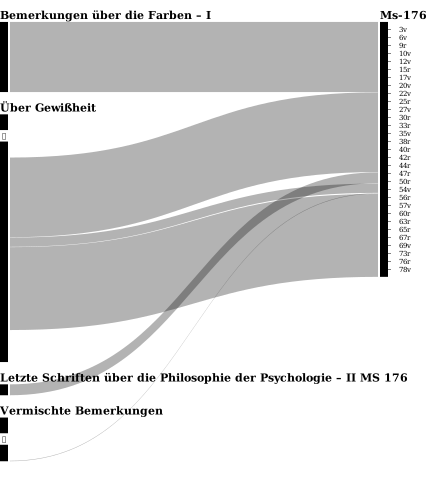
319 published remarks, ROC I, OC, LW II MS 176, VB
Do not quote from or cite this translation!
§ROC I
1r[1]Ein Sprachspiel: Darüber berichten ob ein bestimmter Körper heller, oder dunkler als ein andrer sei. – Aber nun gibt es ein verwandtes: Über das Verhältnis der Helligkeiten bestimmter Farbtöne aussagen. (Damit ist zu vergleichen: Das Verhältnis der Längen zweier Stäbe bestimmen – & das Verhältnis zweier Zahlen bestimmen.) – Die Form der Sätze in beiden Sprachspielen ist die gleiche: “x ist heller als y”. Aber im ersten ist es eine externe Relation & der Satz zeitlich, im zweiten ist es eine interne Relation & der Satz zeitlos.
A language-game: Reporting on whether a certain body is brighter or darker than another. – But now there is a related one: Making statements about the relationship of the brightnesses of certain shades of color. (This can be compared to: Determining the relationship of the lengths of two rods – & determining the relationship of two numbers.) – The form of the sentences in both language-games is the same: “x is brighter than y”. But in the first it is an external relation & the sentence is temporal, in the second it is an internal relation & the sentence is timeless.
§ROC I
1r[2] &1v[1]
In einem Bild, in welchem ein Stück weißes Papier seine Helligkeit vom blauen Himmel kriegt, ist dieser heller als das weiße Papier. Und doch ist, in einem andern Sinne, Blau die dunklere, Weiß die hellere Farbe. (Göthe.) Auf der Palette ist das Weiß die hellste Farbe.
In a picture, in which a piece of white paper gets its brightness from the blue sky, this is brighter than the white paper. And yet, in another sense, blue is the darker, white the brighter color. (Goethe.) On the palette, white is the brightest color.
§ROC I
1v[2]Lichtenberg sagt, nur wenige Menschen hätten je reines Weiß gesehen. So verwenden also die Meisten das Wort falsch? Und wie hat er den richtigen Gebrauch gelernt? – Er hat nach dem gewöhnlichen Gebrauch einen idealen konstruiert. Und das heißt nicht einen bessern, sondern einen in gewisser Richtung verfeinerten, worin etwas auf die Spitze getrieben wird.
Lichtenberg says that only a few people have ever seen pure white. So, are most people using the word incorrectly? And how did he learn the correct use? – He constructed an ideal one, based on the common use. And this does not mean a better one, but one that is refined in a certain direction, in which something is taken to the extreme.
§ROC I
1v[3] &2r[1]
Und freilich kann ein so konstruierter uns wieder über den tatsächlichen Gebrauch belehren.
And of course, such a constructed one can also inform us about the actual use.
§ROC I
2r[2]Wenn ich von einem Papier sage, es sei rein weiß, & es würde Schnee neben das Papier gehalten & dieses sähe nun grau aus, so würde ich es in seiner normalen Umgebung doch mit Recht weiß, nicht hellgrau, nennen. Es könnte sein, daß ich, im Laboratorium etwa, einen verfeinerten Begriff von Weiß verwendete (wie z.B. auch einen verfeinerten Begriff der genauen Zeitbestimmung).
If I say of a piece of paper that it is pure white, & snow is held next to the paper & this now looks gray, I would still, in its normal environment, rightly call it white, not light gray. It could be that, in the laboratory for example, I use a refined concept of white (just as I might also use a refined concept of the precise determination of time).
§ROC I
2r[3] &2v[1]
Was läßt sich dafür sagen, daß Grün eine primäre Farbe ist, keine Mischfarbe von Blau & Gelb? Wäre es richtig zu sagen: “Man kann das nur unmittelbar erkennen, indem man die Farben betrachtet? Aber wie weiß ich, daß ich dasselbe mit den Worten “primäre Farbe” meine wie ein Andrer, der auch geneigt ist, Grün eine primäre Farbe zu nennen?” Nein, – hier entscheiden Sprachspiele.
What can be said in favor of the fact that green is a primary color, not a mixed color of blue & yellow? Would it be correct to say: “One can only recognize this directly by looking at the colors?” But how do I know that I mean the same thing by the words “primary color” as someone else, who is also inclined to call green a primary color? No – language-games decide here.
§ROC I
2v[2] &3r[1]
[Es gibt mehr, oder weniger bläuliches (oder gelbliches) Grün &] es gibt die Aufgabe zu einem gegebenen Gelbgrün (oder Blaugrün) ein weniger gelbliches (oder bläuliches) zu mischen, oder aus einer Anzahl von Farbmustern auszuwählen. Ein weniger gelbliches ist aber kein bläuliches Grün (und umgekehrt), & es gibt auch die Aufgabe, ein Grün zu wählen, oder zu mischen, das weder gelblich noch bläulich ist. Ich sage “oder zu mischen”, weil ein Grün dadurch nicht zugleich grünlich & gelblich wird, daß es durch eine Art der Mischung von Gelb & Blau zustandekommt.
[There is more or less bluish (or yellowish) green &] there is the task of mixing a less yellowish (or bluish) one with a given yellowish green (or bluish green), or of selecting one from a number of color samples. However, a less yellowish one is not a bluish green (and vice versa), & there is also the task of choosing, or mixing, a green that is neither yellowish nor bluish. I say “or to mix”, because a green does not thereby become both greenish & yellowish because it is produced by a kind of mixing of yellow & blue.
§ROC I
3r[2]Menschen könnten den Begriff der Zwischenfarbe oder Mischfarbe haben auch wenn sie nie Farben durch Mischung (in welchem Sinne immer) erzeugten. Es könnte sich in ihren Sprachspielen immer nur darum handeln schon vorhandene Zwischen- oder Mischfarben zu suchen, zu wählen.
People could have the concept of an intermediate color or mixed color even if they never produced colors by mixing (in whatever sense). It could always be a matter of their language-games only involving the searching, choosing of already existing intermediate or mixed colors.
§ROC I
3r[3] &3v[1]
Wenn nun auch nicht Grün eine Zwischenfarbe von Gelb & Blau ist, könnte es nicht Leute geben, für die es ein bläuliches Gelb, ein rötliches Grün gibt? Leute also, deren Farbbegriffe von den unsern abwichen – da ja auch die Farbbegriffe der Farbenblinden von denen der Normalen abweichen. Und nicht jede Abweichung vom Normalen muß eine Blindheit, ein Defekt sein.
If now green is not an intermediate color of yellow & blue, could there not be people for whom there is a bluish yellow, a reddish green? People, therefore, whose color concepts differ from ours – since the color concepts of colorblind people also differ from those of normal people. And not every deviation from the normal must be a blindness, a defect.
§ROC I
3v[2] &4r[1]
Wer gelernt hat zu einem gegebenen Farbton einen gelblicheren, weißlicheren, rötlicheren zu finden oder zu mischen, u.s.f., wer also den Begriff der Zwischenfarbe kennt, den fordre man (nun) auf, uns ein rötliches Grün zu zeigen. Er mag diesen Befehl nun einfach nicht verstehen & etwa so reagieren, als hätte man von ihm verlangt nach einem regelmäßigen Viereck, Fünfeck, Sechseck, ein regelmäßiges Eineck zu zeigen. Wie aber, wenn er, ohne zu zögern, auf ein Farbmuster wiese (etwa auf ein schwärzliches Braun, wie wir es beschreiben würden)?
Whoever has learned to find or mix a more yellowish, whitish, reddish one with a given shade, etc., whoever, therefore, knows the concept of the intermediate color, should now be asked to show us a reddish green. He may simply not understand this request & react as if he had been asked to show a regular one-sided shape, pentagon, hexagon. But what if he, without hesitation, points to a color sample (perhaps to a brownish color, as we would describe it)?
§ROC I
4r[2] &4v[1]
Wem ein Rötlichgrün bekannt wäre, der sollte im Stande sein, eine Farbenreihe herzustellen, die mit Rot anfinge, mit Grün endet &, auch für uns vielleicht, einen kontinuierlichen Übergang zwischen ihnen bildet. Es würde sich dann zeigen, daß dort, wo wir jedesmal den gleichen Ton, von Braun z.B., sehen, er einmal Braun, einmal Rötlichgrün sähe. Daß er z.B. zwei chemische Verbindungen, die für uns die gleiche Farbe haben, nach der Farbe unterscheiden könnte & die eine braun die andre rötlichgrün nennte.
Whoever is familiar with reddish-green should be able to create a series of colors that begins with red, ends with green, and, perhaps even for us, forms a continuous transition between them. It would then become apparent that, where we always see the same shade, for example, brown, he would sometimes see brown, sometimes reddish-green. That he could, for example, distinguish between two chemical compounds that have the same color for us according to their color, and call one brown and the other reddish-green.
§ROC I
4v[2]Stell Dir vor alle Menschen mit seltenen Ausnahmen wären rot-grün-blind. Oder auch den andern Fall: alle Menschen wären entweder rot-grün-, oder blau-gelb-blind.
Imagine that almost all people, with rare exceptions, were red-green colorblind. Or also the other case: all people were either red-green or blue-yellow colorblind.
§ROC I
4v[3] &5r[1]
Denken wir uns ein Volk von Farbenblinden, & das könnte es leicht geben. Sie würden nicht die gleichen Farbbegriffe haben wie wir. Denn auch angenommen sie redeten, z.B., Deutsch, hätten also alle deutschen Farbwörter, so würden sie sie doch anders gebrauchen als wir, & anders zu gebrauchen lernen. Oder haben sie eine fremde Sprache, so würde es uns schwer, ihre Farbwörter in die unsern zu übersetzen.
Let us imagine a people of colorblind individuals, & such a group could easily exist. They would not have the same color concepts as we do. For even if we assume they speak, for example, German, & therefore have all the German color words, they would still use them differently than we do, & learn to use them differently. Or if they have a foreign language, it would be difficult for us to translate their color words into ours.
§ROC I
5r[2]Wenn es aber auch Menschen gäbe, denen es natürlich wäre, das Wort “rötlichgrün” oder “gelblichblau” in einer konsequenten Weise zu verwenden & dabei vielleicht auch Fähigkeiten verrieten, die wir nicht haben, so wären wir dennoch nicht gezwungen anzuerkennen, sie sähen Farben, die wir nicht sehen. Es gibt ja kein allgemein anerkanntes Kriterium dafür, was eine Farbe sei, es sei denn, daß es eine unserer Farben ist.
If, however, there were also people for whom it would be natural to use the word “reddish-green” or “yellowish-blue” in a consistent way, and who might also reveal abilities that we do not have, we would still not be compelled to acknowledge that they see colors that we do not see. After all, there is no generally accepted criterion for what a color is, unless it is one of our colors.
§ROC I
5v[1]In jedem ernsteren philosophischen Problem reicht die Unsicherheit bis an die Wurzeln hinab. Man muß immer darauf gefaßt sein, etwas ganz neues zu lernen.
In every serious philosophical problem, uncertainty extends down to the very roots. One must always be prepared to learn something completely new.
§ROC I
5v[2]Die Beschreibung der Phänomene der Farbenblindheit gehört in die Psychologie: also auch die der Phänomene des normalen Sehens? Die Psychologie beschreibt nur die Abweichungen der Farbenblindheit vom normalen Sehen.
The description of the phenomena of color blindness belongs to psychology: does this also apply to the description of the phenomena of normal seeing? Psychology only describes the deviations of color blindness from normal seeing.
§ROC I
5v[3] &6r[1]
Runge (in dem Brief, den Göthe in der Farbenlehre abdruckt) sagt, es gebe durchsichtige & undurchsichtige Farben. Weiß sei eine undurchsichtige Farbe. Dies zeigt die Unbestimmtheit im Begriff der Farbe, oder auch der Farbengleichheit.
Runge (in the letter that Goethe prints in the Theory of Colors) says that there are transparent and opaque colors. White is an opaque color. This shows the indeterminacy in the concept of color, or also of color identity.
§ROC I
6r[2]Kann ein durchsichtiges grünes Glas die gleiche Farbe haben wie ein undurchsichtiges Papier, oder nicht? Wenn ein solches Glas auf einem Gemälde dargestellt würde, so wären die Farben auf der Palette nicht durchsichtig. Wollte man sagen die Farbe des Glases wäre auch auf dem Gemälde durchsichtig, so müßte man den Komplex von Farbflecken, der das Glas darstellt, seine Farbe nennen.
Can a transparent green piece of glass have the same color as an opaque piece of paper, or not? If such a piece of glass were depicted in a painting, the colors on the palette would not be transparent. If one wanted to say that the color of the glass is also transparent in the painting, one would have to call the complex of color patches that represents the glass its color.
§ROC I
6r[3] &6v[1]
Wie kommt es, daß etwas Durchsichtiges grün, aber nicht weiß sein kann? Durchsichtigkeit & Spiegeln gibt es nur in der Tiefendimension eines Gesichtsbilds. Der Eindruck des durchsichtigen Mediums ist der, daß etwas hinter dem Medium liegt. Vollkommene Einfärbigkeit des Gesichtsbilds kann nicht durchsichtig sein.
How is it that something transparent can be green, but not white? Transparency & reflection only exist in the depth dimension of a visual image. The impression of the transparent medium is that something lies behind the medium. Complete uniformity of color in the visual image cannot be transparent.
§ROC I
6v[2] &7r[1]
Etwas Weißes hinter einem gefärbten durchsichtigen Medium erscheint in der Farbe des Mediums, etwas Schwarzes schwarz. Nach dieser Regel muß Schwarz auf weißem Grund durch ein ‘weißes durchsichtiges’ Medium wie durch ein farbloses gesehen werden.
Something white behind a colored transparent medium appears in the color of the medium, something black appears black. According to this rule, black on a white background must be seen through a ‘white transparent’ medium as if through a colorless one.
§ROC I
7r[2]Runge: “Wenn man sich ein bläuliches Orange, ein rötliches Grün, oder ein gelbliches Violett denken will, wird einem zu Muthe wie bei einem südwestlichen Nordwinde … Weiß sowohl als Schwarz sind beide undurchsichtig oder körperlich … Weißes Wasser wird man sich nicht denken können, was rein ist, so wenig wie klare Milch.”
Runge: “If one wants to think of a bluish orange, a reddish green, or a yellowish violet, one feels as if one were experiencing a southwestern north wind… White as well as black are both opaque or physical… One cannot imagine white water, just as one cannot imagine clear milk.”
§ROC I
7r[3] &7v[1]
Wir wollen keine Theorie der Farben finden (weder eine physiologische, noch eine psychologische), sondern die Logik der Farbbegriffe. Und diese leistet, was man sich oft mit Unrecht von einer Theorie erwartet hat.
We do not want to find a theory of colors (neither a physiological nor a psychological one), but the logic of color concepts. And this achieves what one has often wrongly expected from a theory.
§ROC I
7v[2]“Weißes Wasser wird man sich nicht denken können etc.” Das heißt man kann nicht beschreiben (z.B. malen), wie etwas weißes Klares aussähe, & das heißt, man weiß nicht, welche Beschreibung, Darstellung diese Worte von uns fordern.
“One cannot imagine white water, etc.” That is, one cannot describe (e.g., paint) what something white and clear would look like, and that means that one does not know what description, what representation these words demand of us.
§ROC I
7v[3] &8r[1]
Es ist nicht ohne weiteres klar, von welchem durchsichtigen Glas man sagen soll, es habe die gleiche Farbe, wie ein undurchsichtiges Farbmuster. Wenn ich sage “Ich suche ein Glas von dieser Farbe” (wobei ich auf ein farbiges Papier deute), so wird das etwa heißen, daß etwas Weißes, durch das Glas gesehen, ausschauen soll wie mein Muster. Ist das Muster rosa; himmelblau, lila, so wird man sich das Glas trübe denken, aber vielleicht auch klar & nur schwach rötlich, bläulich oder violett gefärbt.
It is not immediately clear which transparent glass one should say has the same color as an opaque color sample. If I say “I am looking for a glass of this color” (while pointing to a colored piece of paper), then that will roughly mean that something white, seen through the glass, should look like my sample. If the sample is pink, sky blue, or purple, then one will imagine the glass as opaque, but perhaps also clear and only faintly reddish, bluish, or purplish.
§ROC I
8r[2] &8v[1]
Im Kino kann man manchmal die Vorgänge im Film so sehen, als lägen sie hinter der Leinwandfläche, diese aber sei durchsichtig, etwa eine Glastafel. Das Glas nähme den Dingen ihre Farbe & ließe nur Weiß, Grau & Schwarz durch.
(Wir reden hier nicht physikalisch, sondern betrachten Weiß & Schwarz als Farben ganz wie Grün & Rot.) – Man könnte also denken, daß wir uns hier ein Glas vorstellen, das weiß & durchsichtig zu nennen wäre. Und doch sind wir nicht versucht, sie so zu nennen: Bricht also die Analogie mit einer durchsichtigen grünen Tafel, z.B., irgendwo zusammen?
In the cinema, one can sometimes see the events in the film as if they were behind the surface of the screen, but the screen is transparent, like a glass panel. The glass would take away the color of the things and only allow white, gray, and black to pass through.
(Here we are not speaking in a physical sense, but rather considering white and black as colors just like green and red.) – One could therefore think that we are imagining a glass that would be called white and transparent. And yet, we are not inclined to call it that: Where does the analogy with a transparent green panel, for example, break down?
§ROC I
8v[2]Von einer grünen Tafel würden wir etwa sagen: sie gäbe den Dingen hinter ihr eine grüne Färbung; also vor allem etwas Weißem.
We might say of a green panel that it gives the things behind it a green tint; primarily, something white.
§ROC I
8v[3]“Man kann sich das nicht vorstellen”, wenn es sich um die Logik handelt, heißt: man weiß nicht, was man sich hier vorstellen soll.
“One cannot imagine that,” when it concerns logic, means: one does not know what one should imagine here.
§ROC I
9r[1]Würde man von meiner fiktiven Glastafel im Kino sagen, sie gäbe den Dingen hinter ihr eine weiße Färbung?
Would one say that my fictional glass panel in the cinema gives the things behind it a white tint?
§ROC I
9r[2]Konstruiere aus der Regel für den Augenschein des durchsichtigen & gefärbten, die Du vom durchsichtigen Grünen, Roten, etc., abliest, den Schein des durchsichtigen Weißen! Warum geht es nicht?
Construct from the rule for the appearance of the transparent and colored, which you derive from the transparent green, red, etc., the appearance of the transparent white! Why does it not work?
§ROC I
9r[3]Jedes gefärbte Medium verdunkelt, was dadurch gesehen wird, es schluckt Licht: Soll nun mein weißes Glas auch verdunkeln? & je dicker es ist, desto mehr? So wäre es also eigentlich ein dunkles Glas!
Every colored medium darkens what is seen through it; it absorbs light: Should my white glass also darken? And the thicker it is, the more? So it would actually be a dark glass!
§ROC I
9v[1]Warum kann man sich weißdurchsichtiges Glas nicht vorstellen, – auch wenn es in Wirklichkeit keins gibt? Wo geht die Analogie mit dem durchsichtigen gefärbten schief?
Why can one not imagine white transparent glass, even if there is no such thing in reality? Where does the analogy with the transparent colored one fail?
§ROC I
9v[2]Sätze werden oft an der Grenze von Logik & Empirie gebraucht, (so) daß ihr Sinn über die Grenze hin & her wechselt, & sie bald als Ausdruck einer Norm, bald als Ausdruck einer Erfahrung gelten. (Denn es ist ja nicht eine psychische Begleiterscheinung – so stellt man sich den ‘Gedanken’ vor –, sondern die Verwendung, die den logischen vom Erfahrungssatz unterscheidet.)
Sentences are often used at the boundary of logic and empiricism, so that their sense shifts back and forth across the boundary, and they are sometimes regarded as an expression of a norm, and sometimes as an expression of an experience. (For it is not a psychological concomitant – that is how one imagines ‘thought’ – but the use that distinguishes the logical sentence from the empirical proposition.)
§ROC I
10r[1]Man redet von der ‘Farbe des Goldes’ & meint nicht Gelb. “Goldfarben” ist die Eigenschaft einer Fläche, welche glänzt, oder schimmert.
One speaks of the ‘color of gold’ and does not mean yellow. “Gold-colored” is the property of a surface that shines or shimmers.
§ROC I
10r[2]Es gibt Rotglut & Weißglut: Wie aber sähe Braunglut & Grauglut aus? Warum kann man sich diese nicht als einen schwächeren Grad der Weißglut denken?
There is red-hot and white-hot: What would brown-hot and gray-hot look like? Why can one not imagine these as a weaker degree of white-hot?
§ROC I
10r[3]“Das Licht ist farblos.” Wenn, dann in dem Sinne, wie die Zahlen farblos sind.
“Light is colorless.” If so, then in the sense in which numbers are colorless.
§ROC I
10r[4]Was leuchtend aussieht, sieht nicht grau aus. Alles Graue sieht beleuchtet aus.
What looks bright does not look gray. Everything gray looks illuminated.
§ROC I
10v[1]Was man als leuchtend sieht, sieht man nicht als grau. Wohl aber kann man es als weiß sehen.
What one sees as brightly lit, one does not see as gray. However, one can see it as white.
§ROC I
10v[2]Man könnte also etwas jetzt als schwach leuchtend, jetzt als grau sehen.
One could therefore see something now as faintly lit, now as gray.
§ROC I
10v[3]Ich sage nicht (wie die Gestaltpsychologen), daß der Eindruck des Weißen so & so zustande komme. Sondern die Frage ist gerade: was der Eindruck des Weißen sei. Was die Bedeutung dieses Ausdrucks, die Logik des Begriffes ist.
I am not saying (as the Gestalt psychologists do) that the impression of white comes about in such and such a way. Rather, the question is precisely: what is the impression of white? What is the meaning of this expression, the logic of the concept?
§ROC I
10v[4]Denn, daß man sich etwas ‘grauglühendes’ nicht denken kann, gehört nicht in die Physik, oder Psychologie der Farbe.
For the fact that one cannot imagine something ‘gray-glowing’ does not belong in the physics or psychology of color.
§ROC I
11r[1]Man sagt mir, eine gewisse Substanz brenne mit grauer Flamme. Ich kenne doch nicht die Farbe der Flammen sämtlicher Substanzen; warum sollte das also nicht möglich sein?
I am told that a certain substance burns with a gray flame. I do not know the color of the flames of all substances; why should this not be possible?
§ROC I
11r[2]Man redet von einem ‘dunkelroten Schein’, aber nicht von einem ‘schwarz-roten’.
One speaks of a ‘dark red glow’, but not of a ‘black-red’ one.
§ROC I
11r[3]Eine glatte weiße Fläche kann spiegeln: Wie nun, wenn man sich irrte, & was in ihr gespiegelt erscheint, wirklich hinter ihr wäre & durch sie gesehen würde? Wäre sie dann weiß & durchsichtig?
A smooth white surface can reflect: What if one were mistaken, and what appears reflected in it were actually behind it and seen through it? Would it then be white and transparent?
§ROC I
11r[4] &11v[1]
Man spricht von einem ‘schwarzen’ Spiegel. Aber wenn er spiegelt, verdunkelt er zwar, aber sieht nicht schwarz aus, & was durch ihn gesehen wird, erscheint nicht ‘schmutzig’, sondern ‘tief’.
One speaks of a ‘black’ mirror. But when it reflects, it darkens, but it does not look black, and what is seen through it does not appear ‘dirty’, but ‘deep’.
§ROC I
11v[2]Die Undurchsichtigkeit ist nicht eine Eigenschaft der weißen Farbe. Sowenig wie Durchsichtigkeit eine Eigenschaft der grünen.
Opacity is not a property of white color. Just as transparency is not a property of green.
§ROC I
11v[3] &12r[1]
Und es genügt auch nicht zu sagen, das Wort “weiß” werde eben nur für die Erscheinung von Oberflächen angewandt. Es könnte sein daß wir zwei Wörter für “grün” hätten: eines nur für grüne Oberflächen, das andre für grüne durchsichtige Gegenstände. Es bliebe also die Frage, warum es kein dem Wort “weiß” entsprechendes Farbwort für etwas Durchsichtiges gibt.
And it is not enough to say that the word “white” is simply used for the appearance of surfaces. It could be that we have two words for “green”: one only for green surfaces, the other for green transparent objects. So the question remains: why is there no color word corresponding to the word “white” for something transparent?
§ROC I
12r[2]Ein Medium, wodurch ein schwarz & weißes Muster (Schachbrett) unverändert erscheint, wird man nicht ein weißes nennen, auch wenn dadurch die andern Farben an Färbigkeit verlieren.
A medium through which a black and white pattern (chessboard) appears unchanged would not be called white, even if it makes the other colors lose some of their color intensity.
§ROC I
12r[3]Man könnte ein weißes Glanzlicht nicht “weiß” nennen wollen, & so nur das nennen, was dem Auge als Farbe einer Oberfläche erscheint.
One could not want to call a white highlight “white,” and only call what appears to the eye as the color of a surface.
§ROC I
12r[4] &12v[1]
Von zwei Stellen meiner Umgebung, die ich, in einem Sinne, als gleichfarbig sehe, kann ich, in anderem Sinne, die eine als weiß, die andre als grau sehen. In einem Zusammenhang ist diese Farbe für mich Weiß in schlechter Beleuchtung, in einem andern Grau in guter Beleuchtung. Dies sind Sätze über die Begriffe ‘weiß’ & ‘grau’.
From two places in my surroundings, which I, in one sense, see as having the same color, I can, in another sense, see one as white, the other as gray. In one context, this color is white for me in poor lighting, in another, gray in good lighting. These are sentences about the concepts ‘white’ & ‘gray’.
§ROC I
12v[2]Der Eimer, der hier vor mir steht, ist glänzend Weiß lackiert, es wäre absurd, ihn “grau” zu nennen, oder zu sagen “Ich sehe eigentlich ein helles Grau”. Aber er hat ein weißes Glanzlicht, das weit heller ist als eine übrige Fläche, & diese ist teils im Licht, teils im Schatten, ohne doch anders gefärbt zu erscheinen. (Zu erscheinen, nicht nur zu sein.)
The bucket standing in front of me is painted a glossy white; it would be absurd to call it “gray” or to say “I am actually seeing a light gray.” But it has a white highlight that is much brighter than the rest of the surface, and this is partly in the light, partly in the shadow, without appearing to be of a different color. (To appear, not just to be.)
§ROC I
12v[3] &13r[1]
Es ist nicht dasselbe, zu sagen: der Eindruck des Weißen oder Grauen kommt unter diesen Bedingungen zustande (kausal), &: er ist ein Eindruck in einem bestimmten Zusammenhang von Farben & Formen.
It is not the same to say: the impression of white or gray arises under these conditions (causally), and: it is an impression in a certain context of colors and shapes.
§ROC I
13r[2]Weiß als Stoffarbe (in dem Sinne, in welchem man sagt, Schnee ist weiß) ist heller als jede andre Stoffarbe; Schwarz dunkler. Hier ist die Farbe eine Verdunklung, & ist dem Stoff jede solche entzogen, so bleibt Weiß, & darum kann man es “farblos” nennen.
White as a material color (in the sense in which one says, snow is white) is brighter than any other material color; black is darker. Here the color is a darkening, and if this darkening is removed from the material, then white remains, and that is why one can call it “colorless.”
§ROC I
13r[3]Es gibt zwar nicht Phänomenologie, wohl aber phänomenologische Probleme.
There is no phenomenology, but there are phenomenological problems.
§ROC I
13r[4] &13v[1]
Daß nicht alle Farbbegriffe logisch gleichartig sind, sieht man leicht. Z.B. den Unterschied zwischen den Begriffen ‘Farbe des Goldes’ oder ‘Farbe des Silbers’ & ‘gelb’ oder ‘grau’.
It is easy to see that not all color concepts are logically of the same kind. For example, the difference between the concepts ‘color of gold’ or ‘color of silver’ and ‘yellow’ or ‘gray’.
§ROC I
13v[2]Eine Farbe ‘leuchtet’ in einer Umgebung (Wie Augen nur in einem Gesicht lächeln). Eine ‘schwärzliche’ Farbe – z.B. Grau – ‘leuchtet’ nicht.
A color ‘shines’ in an environment (just as eyes only smile in a face). A ‘dark’ color – for example, gray – does not ‘shine’.
§ROC I
13v[3]Die Schwierigkeiten, die wir beim Nachdenken über das Wesen der Farben empfinden (mit denen Göthe in der Farbenlehre sich auseinandersetzen wollte) liegen schon in der Unbestimmtheit unseres Begriffs der Farbengleichheit beschlossen.
The difficulties that we experience when thinking about the nature of colors (with which Goethe wanted to grapple in his theory of colors) are already contained in the indeterminacy of our concept of color equality.
§ROC I
13v[4] &14r[1]
“Ich fühle x”
“Ich beobachte x”
x steht im ersten & zweiten Satz nicht für den gleichen Begriff, wenn auch vielleicht für den gleichen Wortausdruck, z.B. für “einen Schmerz”. Denn fragt man “Was für einen Schmerz?” so könnte ich im ersten Fallantworten “Diesen” & den Fragenden etwa mit einer Nadel stechen. Im zweiten Falle muß ich auf dieselbe Frage anders antworten; z.B. “Den Schmerz in meinem Fuß”. Auch könnte das x im zweiten Satz für “meinen Schmerz” stehen, aber nicht im ersten.
“I feel x”
“I observe x”
In the first & second sentence, x does not stand for the same concept, even if perhaps for the same verbal expression, e.g. for “a pain”. For if one asks “What kind of pain?” then in the first case I could answer “This one” & perhaps prick the questioner with a needle. In the second case, I must answer the same question differently; e.g. “The pain in my foot”. Also, x in the second sentence could stand for “my pain”, but not in the first.
§ROC I
14r[2] &14v[1]
Denk, jemand zeigte auf eine Stelle der Iris in einem Rembrandtschen Auge & sagt: “Die Wände in meinem Zimmer sollen in dieser Farbe gemalt werden.”
Imagine someone points to a spot in the iris in a Rembrandt eye and says: “The walls in my room should be painted in this color.”
§ROC I
14v[2] &15r[1]
Ich male die Aussicht von meinem Fenster; eine bestimmte Stelle, bestimmt durch ihre Lage in der Architektur eines Hauses, male ich mit Ocker. Ich sage, ich sehe diese Stelle in dieser Farbe. Das bedeutet nicht, daß ich hier die Farbe Ocker sehe, denn dieser Farbstoff mag, so umgeben, heller, dunkler, rötlicher (etc.) aussehen als Ocker. “Ich sehe diese Stelle, wie ich sie hier mit Ocker gemalt habe, nämlich als ein stark rötliches Gelb.” Wie aber, wenn man von mir verlangte, den genauen Farbton anzugeben, den ich dort sehe? – Wie soll er angegeben werden, & wie bestimmt werden? Man könnte verlangen, daß ich ein Farbmuster (ein rechteckiges Stück Papier von dieser Farbe) herstelle. Ich sage nicht, daß ein solcher Vergleich ohne jedes Interesse wäre, aber er zeigt uns, daß nicht von vornherein klar ist, wie Farbtöne zu vergleichen sind & was “Gleichheit der Farbe” bedeutet.
I paint the view from my window; a particular spot, defined by its location in the architecture of a house, I paint with ochre. I say that I see this spot in this color. This does not mean that I see the color ochre here, because this pigment may, when so surrounded, appear lighter, darker, redder (etc.) than ochre. “I see this spot as I have painted it here with ochre, namely as a strong reddish yellow.” But what if I were asked to specify the exact shade that I see there? – How is it to be specified, & how is it to be determined? One could demand that I produce a color sample (a rectangular piece of paper of this color). I do not say that such a comparison would be without any interest, but it shows us that it is not clear from the outset how shades are to be compared & what “sameness of color” means.
§ROC I
15r[2]Denken wir uns ein Gemälde in kleine, annähernd einfärbige Stücke zerschnitten & diese dann als Steine eines Zusammenlegspiels verwendet. Auch wo ein solcher Stein nicht einfärbig ist, soll er keine räumliche Form andeuten, sondern einfach als flacher Farbfleck erscheinen. Erst im Zusammenhang mit den andern sieht man ihn als ein Stück blauen Himmel, als einen Schatten, einen Glanz, als durchsichtig oder undurchsichtig, etc. – Zeigen uns, die einzelnen Steine die eigentlichen Farben der Stellen des Bildes?
Let us imagine a painting cut into small, almost monochromatic pieces, and then used as stones in a jigsaw puzzle. Even where a stone is not monochromatic, it should not suggest any spatial form, but simply appear as a flat patch of color. It is only in connection with the others that one sees it as a piece of blue sky, as a shadow, a gleam, as transparent or opaque, etc. – Do the individual stones show us the actual colors of the places in the picture?
§ROC I
15v[2]Man neigt dazu, zu glauben, die Analyse unsrer Farbbegriffe führe am Ende zu den Farben von Stellen unsres Gesichtsbilds, welche nun von jeder räumlichen oder physikalischen Deutung unabhängig sind; denn hier gibt es weder Beleuchtung, noch Schatten, noch Glanz, etc. etc.
One is inclined to believe that the analysis of our color concepts ultimately leads to the colors of places in our visual image, which are now independent of any spatial or physical interpretation; for here there is neither lighting, nor shadow, nor gleam, etc.
§ROC I
15v[3]Daß ich sagen kann, diese Stelle in meinem Gesichtsfeld sei graugrün, bedeutet nicht, daß ich weiß, was eine genaue Kopie des Farbtons zu nennen wäre.
The fact that I can say that this place in my field of vision is gray-green does not mean that I know what an exact copy of the color tone would be called.
§ROC I
16r[1]Ich sehe auf einer (nicht färbigen) Photographie einen Mann mit dunklem Haar & einen Buben mit glatt zurückgekämmtem blondem Haar vor einer Art Drehbank stehen, die zum Teil aus schwarz gestrichenen Gußteilen, teils aus glatten Wellen, Zahnrädern, u.a. besteht, daneben ein Gitter aus hellem verzinkten Draht. Die bearbeiteten Eisenflächen sehe ich eisenfärbig, das Haar des Jungen blond, das Gitter zinkfarbig, obwohl alles durch hellere & dunklere Töne des photographischen Papiers dargestellt ist.
I look at a (non-colored) photograph of a man with dark hair and a boy with smooth, slicked-back blond hair standing in front of a kind of lathe, which consists partly of black-painted cast parts, partly of smooth waves, gears, etc., and next to it a grid of bright galvanized wire. I see the processed iron surfaces as iron-colored, the boy’s hair as blond, the grid as zinc-colored, although everything is represented by lighter and darker tones of the photographic paper.
§ROC I
16r[2] &16v[1]
Aber sehe ich wirklich die Haare auf der Photographie blond? Und was spricht dafür? Welche Reaktion des Betrachtens zeigt, daß er sie blond sieht, & nicht nur aus den Tönen der Photographie schließt, sie seien blond? – Würde von mir verlangt, daß ich jene Photographie beschreibe, so würde ich es am direktesten mit jenen Worten tun. Ließe man diese Art der Beschreibung nicht gelten, so müßte ich nun erst nach einer andern suchen.
But do I really see the hair in the photograph as blond? And what speaks for it? What reaction of the viewing shows that he sees it as blond, and not just infers from the tones of the photograph that it is blond? – If I were asked to describe that photograph, I would do so most directly with those words. If this kind of description were not accepted, then I would first have to look for another.
§ROC I
16v[2]Wenn selbst das Wort “blond” blond klingen kann, wieviel eher können die photographierten Haare blond aussehen!
If even the word “blond” can sound blond, how much more likely is it that the photographed hair will look blond!
§ROC I
16v[3] &17r[1]
“Kann man sich nicht denken, daß (gewisse) Menschen eine andere Farbengeometrie als die unsere hätten?” Das heißt doch: Kann man sich nicht Menschen mit andern Farbbegriffen als den unsern denken? & das heißt wieder: Kann man sich nicht vorstellen, daß Menschen unsre Farbbegriffe nicht haben, & daß sie Begriffe haben, die mit unsern Farbbegriffen in solcher Weise verwandt sind, daß wir sie auch “Farbbegriffe” nennen würden?
“Can one not imagine that (certain) people have a different color geometry than ours?” This really means: Can one not imagine people with color concepts different from ours? And this in turn means: Can one not imagine that people do not have our color concepts, and that they have concepts that are related to our color concepts in such a way that we would also call them “color concepts”?
§ROC I
17r[2]Sieh Dein Zimmer am späten Abend an, wenn Farben kaum mehr zu unterscheiden sind – & nun mach Licht & male, was Du früher im Halbdunkel gesehen hast. – Wie vergleicht man die Farben auf so einem Bild mit denen des halbdunkeln Raums?
Look at your room in the late evening, when colors can hardly be distinguished anymore – and now turn on the light and paint what you saw earlier in the dim light. – How does one compare the colors on such a picture with those of the dimly lit room?
§ROC I
17r[3] &17v[1]
Auf die Frage “Was bedeuten die Wörter ‘rot’, ‘blau’, ‘schwarz’, ‘weiß’”, können wir wohl gleich auf Dinge zeigen, die so gefärbt sind, – aber weiter geht unsre Fähigkeit die Bedeutungen dieser Worte zu erklären nicht! Im übrigen machen wir uns von ihrer Verwendung keine, oder eine ganz rohe, zum Teil falsche, Vorstellung.
To the question “What do the words ‘red’, ‘blue’, ‘black’, ‘white’ mean?”, we can immediately point to things that are colored in this way – but our ability to explain the meanings of these words does not go any further! Moreover, we have either no conception of their use, or a very crude, partly incorrect conception.
§ROC I
17v[2]Ich kann mir einen Logiker vorstellen, der erzählt, er sei jetzt dahin gelangt, “2 × 2 = 4” wirklich denken zu können.
I can imagine a logician who says that he has now come to the point of being able to really think “2 × 2 = 4”.
§ROC I
17v[3] &18r[1]
Die Göthesche Lehre von der Entstehung der Spektralfarben ist nicht eine Theorie, die sich als ungenügend erwiesen hat, sondern eigentlich gar keine Theorie. Es läßt sich mit ihr nichts vorhersagen. Sie ist eher ein vages Denkschema nach Art derer, die man in James' Psychologie findet. Es gibt auch kein Experimentum crucis, das für, oder gegen diese Lehre entscheiden könnte.
Goethe’s doctrine of the origin of the spectral colors is not a theory that has proven to be inadequate, but actually not a theory at all. Nothing can be predicted with it. It is more like a vague thought-schema of the kind that can be found in James’ psychology. There is also no crucial experiment that could decide for or against this doctrine.
§ROC I
18r[2]Wer mit Göthe übereinstimmt, findet, Göthe habe die Natur der Farbe richtig erkannt: Und Natur ist hier nicht, was aus Experimenten hervorgeht, sondern sie liegt im Begriff der Farbe.
Whoever agrees with Goethe finds that Goethe correctly recognized the nature of color: and here nature is not what emerges from experiments, but it lies in the concept of color.
§ROC I
18r[3] &18v[1]
Eins war für Göthe unumstößlich klar: Aus Dunkelheiten kann sich kein Helles zusammensetzen – wie aus mehr & mehr Schatten kein Licht entsteht. – Und dies ließe sich so ausdrücken: Wenn man Lila ein weißlich-rötlich-Blau nennt, oder Braun ein schwärzlich-rötlich-Gelb, – so kann man nun Weiß kein gelblich-rötlich-grünlich-Blau, oder dergleichen, nennen. Weiß ist nicht eine Zwischenfarbe anderer Farben. Und das können Versuche mit dem Spektrum weder bekräftigen noch widerlegen. Es wäre aber auch falsch zu sagen “Schau Dir die Farben nur in der Natur an, & Du wirst sehen, daß es so ist”. Denn über die Begriffe der Farben wird man durch Schauen nicht belehrt.
It was unequivocally clear to Goethe: no brightness can emerge from darkness – just as no light can come from more & more shadow. – And this could be expressed as follows: if one calls purple a whitish-reddish-blue, or brown a blackish-reddish-yellow, then one cannot call white a yellowish-reddish-greenish-blue, or the like. White is not an intermediate color between other colors. And attempts with the spectrum can neither confirm nor refute this. But it would also be wrong to say, “Just look at the colors in nature, & you will see that it is so.” For one is not enlightened about the concepts of colors by looking at them.
§ROC I
18v[2] &19r[1]
Ich kann mir nicht denken, daß Göthes Bemerkungen über die Charaktere der Farben & Farbenzusammenstellungen für den Maler nützlich sein können; kaum für den Dekorateur. Die Farbe eines blutunterlaufenen Auges könnte als Farbe eines Wandbehangs prächtig wirken. Wer vom Charakter einer Farbe redet, denkt dabei immer nur an eine bestimmte Art ihrer Verwendung.
I cannot imagine that Goethe’s remarks about the characters of colors & color combinations could be useful for the painter; hardly for the decorator. The color of a bloodshot eye might look splendid as the color of a wall hanging. Whoever speaks of the character of a color always has in mind only one particular kind of its use.
§ROC I
19r[2]Gäbe es eine Harmonielehre der Farben, so würde sie etwa mit einer Einteilung der Farben in Gruppen anfangen & gewisse Mischungen, oder Nachbarschaften verbieten, andre erlauben. Und sie würde, wie die Harmonielehre, ihre Regeln nicht begründen.
If there were a harmony theory of colors, it would begin with a classification of the colors into groups and prohibit certain mixtures or juxtapositions, and allow others. And, like harmony theory, it would not justify its rules.
§ROC I
19r[3] &19v[1]
Es mag Geistesschwache geben, denen man den Begriff ‘morgen’ nicht beibringen kann, oder den Begriff ‘ich’, oder das Ablesen der Uhrzeit. Sie würden den Gebrauch des Wortes ‘morgen’ nicht erlernen, etc.. Wem kann ich nun beschreiben, was diese nicht erlernen können. Nicht nur dem, der es erlernt hat? Kann ich dem A nicht mitteilen, B könne höhere Mathematik nicht erlernen, auch wenn A sie nicht beherrscht? Versteht nicht der das Wort “Schach” anders, der das Spiel gelernt hat, als der es nicht gelernt hat? Es bestehen Unterschiede zwischen der Verwendung, die jener von dem Wort machen kann, & der Verwendung, die dieser gelernt hat.
There may be mentally deficient individuals to whom one cannot teach the concept of ‘tomorrow’, or the concept of ‘I’, or how to read the time on a clock. They would not learn the use of the word ‘tomorrow’, etc. To whom can one describe what these individuals cannot learn? Not only to someone who has learned it? Can one not communicate to A that B cannot learn higher mathematics, even if A does not master it? Does not the one who has learned the game understand the word “chess” differently from the one who has not learned it? There are differences between the use that the former makes of the word, & the use that the latter has learned.
§ROC I
19v[2]Heißt ein Spiel beschreiben immer: eine Beschreibung geben, durch die man es lernen kann?
Does describing a game always mean giving a description by which one can learn it?
§ROC I
19v[3] &20r[1]
Hat der Normalsehende & der Farbenblinde den gleichen Begriff von der Farbenblindheit? Ein Farbenblinder kann nicht nur unsre Farbwörter, sondern auch das Wort “farbenblind” nicht so verwenden lernen wie ein Normaler. Er kann z.B. die Farbenblindheit nicht auf die gleiche Weise feststellen wie dieser.
Do the normally sighted and the colorblind have the same concept of color blindness? A colorblind person can not only learn to use our color words, but also the word “colorblind” not in the same way as a normal person. For example, he cannot determine color blindness in the same way.
§ROC I
20r[2]Es könnte Menschen geben, die unsre Ausdrucksweise, Orange sei ein rötliches Gelb, nicht verstünden, & nur dann geneigt wären, so etwas zu sagen, wo sie einen Farbübergang von Gelb über Orange nach Rot vor Augen sehen. Und für solche müßte der Ausdruck “rötliches Grün” keine Schwierigkeit haben.
There might be people who would not understand our way of expressing things, that orange is a reddish yellow, and would only be inclined to say so when they see a color transition from yellow to orange to red. And for such people, the expression “reddish green” would not present any difficulty.
§ROC I
20v[1]Die Psychologie beschreibt die Phänomene des Sehens. – Wem macht sie die Beschreibung? Welche Unwissenheit kann diese Beschreibung beheben?
Psychology describes the phenomena of seeing. – To whom does it provide this description? Which ignorance can this description remedy?
§ROC I
20v[2]Die Psychologie beschreibt, was beobachtet wurde.
Psychology describes what has been observed.
§ROC I
20v[3]Kann man dem Blinden beschreiben, wie das ist, wenn Einer sieht? – Doch. Ein Blinder lernt manches über den Unterschied des Blinden vom Sehenden. Aber die Frage ist schlecht gestellt; als wäre Sehen eine Tätigkeit & es gäbe von ihr eine Beschreibung.
Can one describe to a blind person what it is like to see? – Yes, one can. A blind person learns something about the difference between the blind person & the seeing person. But the question is poorly phrased; as if seeing were an activity & there existed a description of it.
§ROC I
21r[1]Ich kann doch Farbenblindheit beobachten; warum also Sehen nicht? – Ich kann beobachten, welche Farburteile ein Farbenblinder – oder auch ein Normalsichtiger – unter gewissen Umständen fällt.
I can observe color blindness; why, then, not seeing? – I can observe what judgments about colors a color-blind person – or even a person with normal vision – makes under certain circumstances.
§ROC I
21r[2]Man sagt manchmal (wenn auch mißverständlich) “Nur ich kann wissen, was ich sehe”. Aber nicht: “Nur ich kann wissen, ob ich farbenblind bin.” (Noch auch: “Nur ich kann wissen, ob ich sehe, oder blind bin.”)
One sometimes says (although it is misleading) “Only I can know what I see.” But not: “Only I can know whether I am colorblind.” (Nor: “Only I can know whether I see or am blind.”)
§ROC I
21r[3] &21v[1]
Die Aussage “Ich sehe einen roten Kreis” & die “Ich sehe (bin nicht blind)” sind logisch nicht gleichartig. Wie prüft man die Wahrheit der ersten, wie die Wahrheit der zweiten?
The statement “I see a red circle” & the statement “I see (am not blind)” are not logically equivalent. How does one verify the truth of the first, & how does one verify the truth of the second?
§ROC I
21r[3] &21v[1].2
Aber kann ich glauben zu sehen, & blind sein, oder glauben blind zu sein, & sehen?
But can I believe that I am seeing, & be blind, or believe that I am blind, & see?
§ROC I
21v[2]Könnte in einem Lehrbuch der Psychologie der Satz stehen “Es gibt Menschen, welche sehen”? Wäre das falsch? Aber wem wird hier etwas mitgeteilt?
Could the sentence “There are people who see” appear in a textbook of psychology? Would that be wrong? But to whom is something communicated here?
§ROC I
21v[3] &22r[1]
Wie kann es unsinnig sein zu sagen “Es gibt Menschen, welche sehen”, wenn es nicht unsinnig ist zu sagen “Es gibt Menschen, welche blind sind”? Aber angenommen, ich hätte nie von der Existenz blinder Menschen gehört & eines Tages teilt man mir mit “Es gibt Menschen, welche nicht sehen”, müßte ich diesen Satz so ohne weiteres verstehen? Muß ich mir, wenn ich selber nicht blind bin, bewußt sein, daß ich die Fähigkeit des Sehens habe, & daß es also Leute geben kann, die sie nicht haben?
How can it be nonsensical to say “There are people who see,” if it is not nonsensical to say “There are people who are blind”? But suppose I had never heard of the existence of blind people & one day I am told “There are people who do not see”; would I have to understand this sentence so easily? If I am not blind myself, must I be conscious that I have the ability to see, & that there are therefore people who do not have it?
§ROC I
22r[2]Wenn der Psychologe uns lehrt “Es gibt Menschen, welche sehen”, so können wir ihn fragen: “Und was nennst Du ‘Menschen, welche sehen’?” Darauf müßte die Antwort sein: Menschen, die unter den & den Umständen sich so & so benehmen.
If the psychologist teaches us “There are people who see,” then we can ask him: “And what do you call ‘people who see’?” The answer to this must be: People who behave in such and such a way under these and those circumstances.
§OC
22r[3] &22v[1]
21.03.1951
Wie aber ist es Einem zu zeigen, daß wir nicht nur Wahrheiten über Sinnesdaten sondern auch solche über Dinge wissen? Denn es ist doch nicht genug, daß jemand uns versichert, er wisse dies. Wovon muß man denn ausgehen um das zu zeigen?
21.03.1951
But how is one to show that we do not only have knowledge of truths about sense data, but also about things? For it is not enough that someone assures us that he knows this. What must one start from in order to show this?
§OC
22v[2]22.03.1951
Man muß zeigen daß, auch wenn er nie die Worte gebraucht “Ich weiß …”, sein Gebaren das zeigt, worauf es uns ankommt.
22.03.1951
One must show that, even if he has never used the words “I know…”, his behaviour shows this, which is what matters to us.
§OC
22v[3] &23r[1]
Denn wie, wenn ein normal handelnder Mensch uns versicherte: er glaube nur, er heiße so & so, er glaube seine ständigen Hausgenossen zu erkennen, er glaube Hände & Füße zu haben, wenn er sie nicht gerade sieht, u.s.w. Können wir ihm aus seinen Handlungen (& Reden) zeigen, daß es nicht so ist?
For how could one, if a normally acting person assured us: he only believes that he is called so & so, he believes he recognizes his constant housemates, he believes he has hands & feet, when he is not currently seeing them, etc. Can we show him from his actions (& speech) that it is not so?
§OC
23r[2]23.03.1951
Welchen Grund habe ich jetzt, da ich meine Zehen nicht sehe, anzunehmen, daß ich fünf Zehen an jedem Fuß habe? Ist es richtig zu sagen, der Grund sei der, daß frühere Erfahrung mich immer das gelehrt hat? Bin ich früherer Erfahrung sicherer als dessen, daß ich zehn Zehen habe? Jene frühere Erfahrung mag wohl die Ursache meiner gegenwärtigen Sicherheit sein; aber ist sie ihr Grund?
March 23, 1951
What reason do I have now, since I cannot see my toes, to assume that I have five toes on each foot? Is it correct to say that the reason is that past experience has always taught me this? Am I more certain of past experience than I am of the fact that I have ten toes? That past experience may well be the cause of my present certainty; but is it its ground?
§OC
23r[3] &23v[1]
Ich treffe einen Marsbewohner & er fragt mich “Wieviel Zehen haben die Menschen?” – Ich sage: “Zehn. Ich will's Dir zeigen” & ziehe meine Schuhe aus. Wenn er sich nun wundern, daß ich es mit solcher Sicherheit wußte, obwohl ich meine Zehen nicht gesehen hatte. – Sollte ich da sagen: “Wir Menschen wissen, daß wir soviel Zehen haben, ob wir sie sehen oder nicht”?
I meet a Martian & he asks me “How many toes do people have?” – I say: “Ten. I will show it to you” & take off my shoes. If he is now surprised that I knew this with such certainty, although I had not seen my toes. – Should I say: “We humans know that we have so many toes, whether we see them or not”?
§OC
23v[2] &24r[1]
26.03.1951
“Ich weiß, daß mein Zimmer auf dem zweiten Stock ist, daß hinter der Tür ein kurzer Gang zur Treppe führt, etc.” Es ließen sich Fälle denken, wo ich diese Äußerung machen würde, aber es wären recht seltene Fälle. Anderseits aber zeige ich dieses Wissen tagtäglich durch meine Handlungen & auch in meinen Reden. Was entnimmt nun der Andre aus diesen meinen Handlungen & Reden? Nicht nur, daß ich meiner Sache sicher bin? – Daraus, daß ich hier seit vielen Wochen gewohnt habe & täglich treppauf & ab gegangen bin, wird er entnehmen, daß ich weiß wo mein Zimmer gelegen ist. – Die Versicherung “Ich weiß …” werde ich gebrauchen, wenn er das noch nicht weiß, woraus er mein Wissen unbedingt schließen würde.
26.03.1951
“I know that my room is on the second floor, that behind the door there is a short corridor leading to the stairs, etc.” One could imagine cases where I would make this utterance, but they would be rather rare. On the other hand, I demonstrate this knowledge daily through my actions & also in my speeches. What does the other person infer from these my actions & speeches? Not only that I am certain about it? – From the fact that I have been living here for many weeks & have been going up & down the stairs daily, he will infer that I know where my room is located. – I will use the statement “I know…” when he does not yet know it, from which he would necessarily conclude that I possess this knowledge.
§OC
24r[2]Die Äußerung “Ich weiß …” kann nur in Verbindung mit der übrigen Evidenz des ‘Wissens’ ihre Bedeutung haben.
The statement “I know…” can only have its meaning in connection with the other evidence of ‘knowledge’.
§OC
24r[3] &24v[1]
Wenn ich also jemandem sage “Ich weiß, daß das ein Baum ist”, so ist es, wie wenn ich ihm sagte: “Das ist ein Baum; Du kannst Dich absolut drauf verlassen, es ist kein Zweifel.” Und das könnte der Philosoph nur dazu gebrauchen, um zu zeigen, daß man diese Form der Rede wirklich gebraucht. Wenn das aber nicht bloß eine Bemerkung der deutschen Grammatik sein soll, so muß er die Umstände angeben, in denen dieser Ausdruck funktioniert.
So, if I tell someone “I know that that is a tree”, it is as if I were saying: “That is a tree; you can absolutely rely on it, there is no doubt.” And the philosopher could only use this to show that this form of speech is actually used. But if this is not merely to be a remark about German grammar, then he must specify the circumstances in which this expression functions.
§OC
24v[2] &25r[1]
Lehrt uns nun Erfahrung, daß Menschen unter den & den Umständen, das & das wissen?
Erfahrung zeigt uns gewiß, daß für gewöhnlich ein Mensch nach so & soviel Tagen sich in einem Haus, das er bewohnt, auskennt. Oder auch: Erfahrung lehrt uns, daß eines Menschen Urteil nach der & der Lehrdauer zu trauen ist. Er muß, erfahrungsgemäß, so & solang gelernt haben, um eine richtige Vorhersage machen zu können. Aber – – –.
Does experience now teach us that people, under these & those circumstances, know this & that?
Experience certainly shows us that, as a rule, a person is familiar with a house that they live in after so & so many days. Or, rather: experience teaches us that one can trust a person’s judgment after a certain period of instruction. According to experience, they must have learned for so & so long in order to make a correct prediction. But – – –.
§OC
25r[2]27.03.1951
Man wird oft von einem Wort behext. Z.B. vom Wort “wissen”.
27.03.1951
One is often bewitched by a word. E.g. by the word “know”.
§OC
25r[3]Ist Gott durch unser Wissen gebunden? Können manche unsrer Aussagen nicht falsch sein? Denn das ist es, was wir sagen wollen.
Is God bound by our knowledge? Can some of our statements not be false? For that is what we want to say.
§OC
25r[4] &25v[1]
Ich bin geneigt zu sagen: “Das kann nicht falsch sein”. Das ist interessant; aber welche Folgen hat es?
I am inclined to say: “That cannot be wrong”. That is interesting; but what are the implications?
§OC
25v[2]Es wäre nicht genug, zu versichern, ich wisse, was dort & dort vorgeht, – ohne Gründe anzugeben, die (den Andern) davon überzeugen, ich sei in der Lage es zu wissen.
It would not be enough to assure someone that I know what is happening here and there – without giving reasons that would convince the other person that I am capable of knowing it.
§OC
25v[3]Auch die Aussage “Ich weiß, daß hinter dieser Tür ein Gang & die Stiege in's Erdgeschoß ist” klingt nur so überzeugend, weil Jeder weiß, daß ich's weiß.
Even the statement “I know that behind this door there is a corridor and the stairs down to the ground floor” sounds so convincing only because everyone knows that I know it.
§OC
25v[4]Es ist hier etwas Allgemeines; nicht nur etwas Persönliches.
This is something general; it is not just something personal.
§OC
26r[1]Im Gerichtssaal würde die bloße Versicherung des Zeugen “Ich weiß …” niemand überzeugen. Es muß gezeigt werden daß der Zeuge in der Lage war zu wissen. Auch die Versicherung “Ich weiß, daß das eine Hand ist”, wobei man die eigene Hand ansieht, wäre nicht glaubhaft, wenn wir nicht wüßten, daß er seine eigene Hand ansieht. Und kennen wir sie, so scheint sie zu versichern, daß der Sprechende in dieser Beziehung normal ist.
In the courtroom, the mere assertion of the witness “I know…” would not convince anyone. It must be shown that the witness was in a position to know. Even the assertion “I know that this is a hand,” while looking at one’s own hand, would not be credible if we did not know that he is looking at his own hand. And if we know it, it seems to assure that the speaker is normal in this respect.
§OC
26r[2] &26v[1]
Könnte es denn nicht sein, daß ich mir einbildete, etwas zu wissen?
Could it not be the case that I am merely imagining that I know something?
§OC
26v[2] &27r[1]
Denke, es gäbe in einer Sprache kein Wort, das unserm “wissen” entspricht. – Sie sprechen einfach die Behauptung aus. “Das ist ein Baum” etc. Es kann natürlich vorkommen, daß sie sich irren. Und da fügen sie nun dem Satz ein Zeichen hinzu, das anzeigt für wie wahrscheinlich sie einen Irrtum halten – oder soll ich sagen: wie wahrscheinlich ein Irrtum in diesem Falle ist? Dies letztere kann man auch durch die Angabe gewisser Umstände anzeigen. Z.B. “A sagte dem B … Ich stand ganz nahe bei ihnen & meine Ohren sind gut.” oder “A war gestern dort & dort. Ich habe ihn von weitem gesehen. Meine Augen sind nicht sehr gut.” oder “Dort steht ein Baum. Ich sehe ihn deutlich & habe ihn unzählige male gesehen.”
Suppose there is no word in a language that corresponds to our “know.” They simply state the assertion. “That is a tree,” etc. It can, of course, happen that they are mistaken. And now they add a sign to the sentence that indicates how likely they consider an error to be – or should I say: how likely an error is in this case? This latter can also be indicated by stating certain circumstances. E.g., “A said to B… I was standing very close to them, and my ears are good.” or “A was there yesterday. I saw him from a distance. My eyes are not very good.” or “There is a tree there. I see it clearly and have seen it countless times.”
§OC
27r[2]“Der Zug geht um 2 Uhr. Prüf zur Sicherheit nocheinmal nach.” oder “Der Zug geht um 2 Uhr. Ich habe gerade in einem neuen Fahrplane nachgeschaut.” Man kann auch hinzufügen “Ich bin in solchen Sachen verläßlich.” Die Nützlichkeit solcher Zusätze ist offenbar.
“The train leaves at 2 o’clock. Check again to be sure.” or “The train leaves at 2 o’clock. I just checked in a new timetable.” One can also add “I am reliable in such matters.” The usefulness of such additions is obvious.
§OC
27r[3] &27v[1]
Wenn ich aber sage “Ich habe zwei Hände” – was kann ich hinzufügen um die Verläßlichkeit anzuzeigen? Höchstens, daß die Umstände die gewöhnlichen sind.
But if I say “I have two hands” – what can I add to indicate reliability? At most, that the circumstances are normal.
§OC
27v[2]Warum bin ich denn so sicher, daß das meine Hand ist? Beruht nicht auf dieser Art Sicherheit das ganze Sprachspiel? Oder: Ist in dem Sprachspiel diese ‘Sicherheit’ nicht (schon) vorausgesetzt? Dadurch nämlich, daß der es nicht spielt, oder falsch spielt, der Gegenstände nicht erkennt.
Why am I so certain that this is my hand? Isn’t this entire language-game based on this kind of certainty? Or: Isn’t this ‘certainty’ already presupposed in the language-game? Namely, by the fact that he doesn’t play it, or plays it incorrectly, by not recognizing the objects.
§OC
27v[3] &28r[1]
28.03.1951
Vergleiche damit 12 × 12 = 144. Auch hier sagen wir nicht “vielleicht”. Denn sofern dieser Satz darauf beruht, daß wir uns nicht verzählen oder verrechnen, daß uns unsre Sinne beim Rechnen nicht trügen, sind die beiden, der arithmetische & der physische Satz, auf der gleichen Stufe. Ich will sagen: Das arithmetische Spiel ist eben so wenig unsicher wie das physische. Aber das kann mißverstanden werden. Meine Bemerkung ist eine logische, nicht eine psychologische.
March 28, 1951
Compare this with 12 × 12 = 144. Here, too, we do not say “perhaps.” For as long as this sentence is based on the fact that we do not miscount or miscalculate, that our senses do not deceive us when calculating, the two sentences, the arithmetic and the physical, are on the same level. I mean: the arithmetic game is just as little uncertain as the physical one. But this can be misunderstood. My remark is a logical one, not a psychological one.
§OC
28r[2] &28v[1]
Ich will sagen: Wenn man sich nicht darüber wundert, daß die arithmetischen Sätze (z.B. das Einmaleins) ‘absolut gewiß’ sind, warum soll man darüber erstaunt sein, daß der Satz “Dies ist meine Hand” es ebenso ist.
I mean: if one is not surprised that arithmetic sentences (e.g., the multiplication table) are ‘absolutely certain,’ why should one be surprised that the sentence “This is my hand” is equally so?
§OC
28v[2]Es muß uns etwas als Grundlage gelehrt werden.
Something must be taught to us as a basis.
§OC
28v[3] &29r[1]
Ich will sagen: Unser Lernen hat die Form “Das ist ein Veilchen”, “Das ist ein Tisch”. Das Kind könnte allerdings das Wort “Veilchen” zum erstenmal in dem Satz hören “Das ist vielleicht ein Veilchen”; dann aber könnte es fragen “Was ist ein Veilchen”. Nun könnte dies freilich dadurch beantwortet werden, daß man ihm ein Bild zeigt. Aber wie wäre es, wenn man nur beim Vorzeigen eines Bilds sagte “Das ist ein …”, sonst aber immer nur: “Das ist vielleicht ein …”? – Welche praktischen Folgen soll es haben? Ein Zweifel, der an allem zweifelte, wäre kein Zweifel.
I want to say: Our learning takes the form “This is a violet,” “This is a table.” The child, however, might hear the word “violet” for the first time in the sentence “This is perhaps a violet”; then it might ask, “What is a violet?” Now, of course, this could be answered by showing it a picture. But what if, while showing a picture, one only said, “This is a…,” but otherwise always said, “This is perhaps a…?” – What practical consequences should this have? A doubt that doubted everything would be no doubt.
§OC
29r[2]Mein Einwurf gegen Moore, daß der Sinn des isolierten Satzes “Das ist ein Baum” unbestimmt sei, da nicht bestimmt ist, was das ‘Das’ ist, wovon man aussagt, es sei ein Baum, – gilt nicht; denn man kann den Sinn bestimmter machen, indem man z.B. sagt: “Der Gegenstand dort, der ausschaut wie ein Baum, ist nicht die künstliche Imitation eines Baumes, sondern ein wirklicher Baum.”
My objection to Moore, that the sense of the isolated sentence “That is a tree” is indeterminate, because it is not determined what the ‘That’ is, of which one asserts that it is a tree, – does not hold; for one can make the sense more determinate by, for example, saying: “The object there, which looks like a tree, is not an artificial imitation of a tree, but a real tree.”
§OC
29r[3] &29v[1]
Es wäre nicht vernünftig, zu zweifeln, ob das ein wirklicher Baum, oder … sei. Daß es mir (als) zweifellos erscheint, darauf kommt's nicht an. Wenn es unvernünftig wäre, hier zu zweifeln, so kann das nicht aus meinen Dafürhalten ersehen werden. Es müßte also eine Regel geben, die den Zweifel hier für unvernünftig erklärt. Die aber gibt es auch nicht.
It wouldn’t be reasonable to doubt whether that is a real tree or… The fact that it seems obvious to me is not the point. If it would be unreasonable to doubt here, then this cannot be inferred from my point of view. There would therefore have to be a rule that declares doubt unreasonable here. But there isn’t one either.
§OC
29v[2]Ich sage allerdings: “Hier würde kein vernünftiger Mensch zweifeln.” – Könnte man sich denken, daß gelehrte Richter befragt würden, ob ein Zweifel vernünftig, oder unvernünftig sei?
I do, however, say: “No reasonable person would doubt this.” Could one imagine that learned judges would be asked whether a doubt is reasonable or unreasonable?
§OC
29v[3] &30r[1]
Es gibt Fälle, in denen der Zweifel unvernünftig ist, andre aber, in denen er logisch unmöglich scheint. Und zwischen ihnen scheint es keine klare Grenze zu geben.
There are cases in which doubt is unreasonable, but others in which it seems logically impossible. And there doesn’t seem to be a clear boundary between them.
§OC
30r[2]29.03.1951
Das Sprachspiel beruht darauf, daß Wörter & Gegenstände wiedererkannt werden. Wir lernen mit der gleichen Bestimmtheit, daß dies ein Sessel ist, wie daß 2 × 2 = 4 ist.
29.03.1951
The language-game is based on the fact that words & objects are recognized. We learn with the same certainty that this is an armchair as we learn that 2 × 2 = 4.
§OC
30r[3]Wenn ich also zweifle, oder unsicher bin darüber, daß das meine Hand ist (in welchem Sinne immer), warum dann nicht auch an der Bedeutung dieser Worte?
So if I doubt, or am uncertain, whether that is my hand (in whatever sense), why not also about the meaning of these words?
§OC
30r[4] &30v[1]
Will ich also sagen, daß die Sicherheit im Wesen des Sprachspiels liegt?
Am I saying that certainty lies in the essence of the language-game?
§OC
30v[2]Man zweifelt aus bestimmten Gründen. Es handelt sich darum: Wie wird der Zweifel in's Sprachspiel eingeführt?
One doubts for specific reasons. The question is: How is doubt introduced into the language-game?
§OC
30v[3]Wenn der Kaufmann jeden seiner Äpfel ohne Grund untersuchen wollte, um ja recht sicher zu gehen, warum muß er (dann) nicht die Untersuchung untersuchen? Und kann man nun hier von Glauben reden (ich meine, im Sinne von religiösem Glauben, nicht von Vermutung)? Alle psychologischen Wörter führen hier nur von der Hauptsache ab.
If the merchant wanted to examine each of his apples without reason, just to be absolutely sure, why doesn’t he then examine the examination? And can one now speak of belief here (I mean, in the sense of religious belief, not of conjecture)? All psychological words only distract from the main point.
§OC
31r[1] &31v[1]
Ich gehe zum Arzt, zeige ihm meine Hand & sage “Das ist eine Hand, nicht …; ich habe sie mir verletzt etc. etc.” Mache ich da nur eine überflüssige Mitteilung? Könnte man z.B. nicht sagen: Angenommen die Worte “Das ist meine Hand’ seien eine Mitteilung – wie konntest Du dann darauf rechnen, daß er die Mitteilung versteht? Ja, wenn es einem Zweifel unterliegt, ‘daß das eine Hand ist’, warum unterliegt da nicht auch einem Zweifel, daß ich ein Mensch bin, der dem Arzt dies mitteilt? – Anderseits kann man sich aber – wenn auch sehr seltsame – Fälle vor stellen wo so eine Erklärung nicht überflüssig ist, oder nur überflüssig aber nicht absurd ist.
I go to the doctor, show him my hand & say “This is a hand, not…; I injured it, etc. etc.” Am I just making an unnecessary communication? Couldn’t one, for example, say: Suppose the words “This is my hand” are a communication – how could you then be sure that he understands the communication? Yes, if there is a doubt about ‘that being a hand’, why isn’t there also a doubt about me being a person who communicates this to the doctor? – On the other hand, one can imagine – although very strange – cases in which such an explanation is not superfluous, or is only superfluous but not absurd.
§OC
31v[2] &32r[1]
Angenommen, ich wäre der Arzt & ein Patient kommt zu mir, zeigt mir seine Hand & sagt: “Was hier wie eine Hand ausschaut, ist nicht eine ausgezeichnete Imitation, sondern wirklich eine Hand.” (Worauf er von seiner Verletzung redet.) – würde ich dies wirklich als eine Mitteilung, wenn auch eine überflüssige, ansehen? Würde ich es nicht vielmehr für Unsinn halten, der allerdings die Form einer Mitteilung hat? Denn, würde ich sagen, wenn diese Mitteilung wirklich Sinn hätte, wie kann er seiner Sache sicher sein? Es fehlt der Mitteilung der Hintergrund.
Suppose I were the doctor & a patient comes to me, shows me his hand & says: “What looks like a hand here is not an excellent imitation, but a real hand.” (After which he talks about his injury.) – Would I really see this as a communication, even if it is superfluous? Wouldn’t I rather consider it nonsense, which, however, has the form of a communication? For, I would say, if this communication really had sense, how can he be sure of his case? The communication lacks context.
§OC
32r[2]30.03.1951
Warum gibt Moore unter den Dingen, die er weiß, nicht z.B. an, es gebe in dem & dem Teil von England ein Dorf, das so & so heiße? Mit andern Worten: Warum erwähnt er nicht eine Tatsache, die ihm, & nicht jedem von uns bekannt ist?
March 30, 1951
Why does Moore, when listing the things he knows, not mention, for example, that there is a village in a certain part of England called so-and-so? In other words, why does he not mention a fact that is known to him, & not to everyone of us?
§OC
32r[3]31.03.1951
Gewiß ist doch, daß die Mitteilung “Das ist ein Baum”, wenn niemand daran zweifeln könnte, eine Art Witz sein könnte & als solcher Sinn hätte. Ein Witz dieser Art ist wirklich einmal von Renan gemacht worden.
31.03.1951
It is certain that the communication “This is a tree”, if no one could doubt it, could be a kind of joke & have sense as such. Renan actually made such a joke once.
§OC
32v[1]03.04.1951
Meine Schwierigkeit läßt sich auch so demonstrieren: Ich sitze mit einem Freund im Gespräch. Plötzlich sage ich: “Ich habe schon die ganze Zeit gewußt, daß Du der N.N. bist.” Ist dies wirklich nur eine überflüssige, wenn auch wahre, Bemerkung? Es kommt mir vor, als wären diese Worte ähnlich einem “Grüßgott”, wenn man es mitten im Gespräch dem Andern sagte.
03.04.1951
My difficulty can also be demonstrated in this way: I am sitting with a friend in conversation. Suddenly I say: “I have known all along that you are N.N.” Is this really just a superfluous, albeit true, remark? It seems to me as if these words are similar to a “hello”, if one said it to the other person in the middle of a conversation.
§OC
32v[2] &33r[1]
Wie wäre es mit den Worten “Man weiß heute, daß es über … Arten von Insekten gibt”, statt der Worte “Ich weiß, daß das ein Baum ist”? Wenn Einer jenen Satz plötzlich außer allem Zusammenhang ausspräche, so könnte man meinen, er habe inzwischen an etwas anderes gedacht & spreche nun einen Satz seines Gedankenganges laut aus. Oder auch: er sei in einer Trance & rede ohne seine Worte zu verstehen.
How about the words “It is known today that there are over … species of insects”, instead of the words “I know that this is a tree”? If someone suddenly said that sentence out of context, one could think that he had been thinking about something else in the meantime & is now saying a sentence from his train of thought. Or also: he is in a trance & speaks without understanding his words.
§OC
33r[2]Es scheint mir also, ich habe etwas schon die ganze Zeit gewußt, & doch habe es keinen Sinn dies zu sagen, diese Wahrheit auszusprechen!
So it seems to me that I have known something all along, and yet it doesn’t make sense to say it, to utter this truth!
§OC
33r[3] &33v[1]
Ich sitze mit einem Philosophen im Garten; er sagt zu wiederholten Malen “Ich weiß, daß das ein Baum ist”, wobei er auf einen Baum in unsrer Nähe zeigt. Ein Dritter kommt daher & hört das, & ich sage ihm: “Dieser Mensch ist nicht verrückt. Wir philosophieren nur.”
I am sitting with a philosopher in the garden; he repeatedly says, “I know that that is a tree,” while pointing to a tree nearby. A third person comes along and hears this, and I say to him, “This person is not crazy. We are just philosophizing.”
§OC
33v[2] &34r[1]
04.04.1951
Jemand sagt irrelevant “Das ist ein Baum”. Er könnte den Satz sagen, weil er sich erinnert, ihn in einer ähnlichen Situation gehört zu haben; oder er wurde plötzlich von der Schönheit dieses Baumes getroffen & der Satz war ein Ausruf; oder er sagte sich den Satz als grammatisches Beispiel vor. (Etc.) Ich frage ihn nun: “Wie hast Du das gemeint?” & er antwortet: “Es war eine Mitteilung an Dich gerichtet.” Stünde mir da nicht frei anzunehmen er wisse nicht, was er sage, wenn er verrückt genug ist mir diese Mitteilung machen zu wollen?
04.04.1951
Someone says irrelevantly, “That is a tree.” He might say the sentence because he remembers having heard it in a similar situation; or he was suddenly struck by the beauty of this tree and the sentence was an exclamation; or he said the sentence to himself as a grammatical example. (Etc.) Now I ask him: “What did you mean by that?” and he answers: “It was a communication directed at you.” Wouldn’t it be up to me to assume that he doesn’t know what he is saying, if he is crazy enough to want to make this communication to me?
§OC
34r[2]Jemand sagt im Gespräch zu mir zusammenhangslos “Ich wünsch Dir alles Gute”. Ich bin erstaunt; aber später sehe ich ein, daß diese Worte in einem Zusammenhang mit seinen Gedanken über mich stehen. Und nun erscheinen sie mir nicht mehr sinnlos.
Someone says to me in conversation, unconnectedly, “I wish you all the best.” I am surprised; but later I realize that these words are connected with his thoughts about me. And now they no longer seem senseless to me.
§OC
34r[3]Warum ist kein Zweifel, daß ich L.W. heiße? Es scheint durchaus nichts, das man ohne weiteres zweifelsfrei feststellen könnte. Man sollte nicht meinen, daß das eine der unzweifelhaften Wahrheiten ist.
Why is there no doubt that my name is L.W.? It seems to be nothing that one could definitively establish without further question. One shouldn’t think that this is one of the undeniable truths.
§OC
34r[4] &34v[1]
05.04.1951
[Hier ist noch eine große Lücke in meinem Denken. Und ich zweifle, ob sie noch ausgefüllt werden wird.]
05.04.1951
[Here there is still a large gap in my thinking. And I doubt whether it will ever be filled.]
§OC
34v[2]Es ist so schwer den Anfang zu finden. Oder besser: Es ist schwer beim Anfang anzufangen. Und nicht zu versuchen weiter zurück zu gehen.
It is so difficult to find the beginning. Or rather: it is difficult to begin at the beginning. And not to try to go further back.
§OC
34v[3]Wenn das Kind die Sprache lernt, lernt es zugleich, was zu untersuchen, & was nicht zu untersuchen ist. Wenn es lernt, daß im Zimmer ein Schrank ist, so lehrt man es nicht zweifeln, ob, was es später sieht, noch immer ein Schrank, oder nur eine Art Kulisse ist.
When the child learns the language, it learns at the same time what to investigate, and what not to investigate. When it learns that there is a cupboard in the room, one does not teach it to doubt whether what it later sees is still a cupboard, or only a kind of backdrop.
§OC
34v[4] &35r[1]
Wie man beim Schreiben eine bestimmte Grundform lernt & diese später dann variiert, so lernt man zuerst die Beständigkeit der Dinge als Norm, die dann Änderungen unterliegt.
Just as one learns a certain basic form when writing and then later varies it, so one first learns the constancy of things as the norm, which is then subject to change.
§OC
35r[2]Dieses Spiel bewährt sich. Das mag die Ursache sein, weshalb es gespielt wird, aber es ist nicht der Grund.
This game proves itself. That may be the reason why it is played, but it is not the reason.
§OC
35r[3]Ich will den Menschen hier als ein Tier betrachten. Als ein Wesen in einem primitiven Zustande. Denn welche Logik für ein primitives Verständigungsmittel genügt, deren brauchen wir uns auch nicht schämen. Die Sprache ist nicht aus einem Raisonnement entstanden.
I want to consider the human being here as an animal. As a being in a primitive state. Because whatever logic is sufficient for a primitive means of communication, we need not be ashamed of it. Language did not arise from a line of reasoning.
§OC
35v[1]06.04.1951
Das Kind lernt nicht, daß es Bücher gibt, daß es Sessel gibt, etc. etc., sondern es lernt Bücher holen, sich auf Sessel (zu) setzen, etc. Es kommen freilich später auch Fragen nach der Existenz auf: “Gibt es ein Einhorn?” u.s.w. Aber so eine Frage ist nur möglich, weil in der Regel keine ihm entsprechende auftritt. Denn wie weiß man, wie man sich von der Existenz des Einhorns zu überzeugen hat? Wie hat man die Methode gelernt, zu bestimmen, ob etwas existiere oder nicht?
06.04.1951
The child does not learn that there are books, that there are armchairs, etc., etc., but it learns to fetch books, to sit (on) armchairs, etc. Of course, questions about existence also arise later: “Is there a unicorn?” etc. But such a question is only possible because, as a rule, no such question arises. Because how does one know how to convince oneself of the existence of the unicorn? How did one learn the method of determining whether something exists or not?
§OC
35v[2] &36r[1]
“So muß man also wissen, daß die Gegenstände existieren, deren Namen man durch eine hinweisende Erklärung einem Kind beibringt.” – Warum muß man's wissen? Ist es nicht genug, daß Erfahrung später nicht das Gegenteil erweise? Warum soll denn das Sprachspiel auf einem Wissen ruhen?
“So one must know that the objects exist whose names one teaches a child by means of an ostensive explanation.” – Why must one know it? Isn’t it enough that experience later does not prove the contrary? Why should the language-game rest on knowledge?
§OC
36r[2]07.04.1951
Glaubt das Kind, daß es Milch gibt? Oder weiß es, daß es Milch gibt? Weiß die Katze, daß es eine Maus gibt?
07.04.1951
Does the child believe that there is milk? Or does it know that there is milk? Does the cat know that there is a mouse?
§OC
36r[3]Sollen wir sagen, daß die Erkenntnis, es gebe physikalische Gegenstände, eine sehr frühe, oder eine sehr späte ist?
Should we say that the knowledge that there are physical objects is a very early one, or a very late one?
§OC
36r[4] &36v[1]
08.04.1951
Das Kind, das das Wort “Baum” gebrauchen lernt. Man steht mit ihm vor einem Baum & sagt “Schöner Baum!”. Daß kein Zweifel an der Existenz des Baums in das Sprachspiel eintritt, ist klar. Aber kann man sagen, das Kind wisse: daß es einen Baum gibt? Es ist allerdings wahr, daß ‘etwas wissen’ nicht in sich beschließt: daran denken – aber muß nicht, wer etwas weiß, eines Zweifels fähig sein? Und zweifeln heißt denken.
08.04.1951
The child that learns to use the word “tree.” One stands with it in front of a tree & says “Beautiful tree!” That there is no doubt about the existence of the tree entering the language-game is clear. But can one say that the child knows: that there is a tree? It is certainly true that ‘to know something’ does not in itself include: to think about it – but must not someone who knows something be capable of doubt? And to doubt means to think.
§OC
36v[2] &37r[1]
Wenn man M. sagen hört “Ich weiß, daß das ein Baum ist”, so versteht man plötzlich die, welche finden, das sei gar nicht ausgemacht. Die Sache kommt einem auf einmal unklar & verschwommen vor. Es ist als hätte M. das falsche Licht drauf fallen lassen. Es ist, als sähe ich ein Gemälde (vielleicht eine Bühnenmalerei) & erkenne von Weitem sofort & ohne den geringsten Zweifel, was es darstellt. Nun trete ich aber näher, & da sehe ich eine Menge Flecke verschiedener Farben, die alle höchst vieldeutig sind & durchaus keine Gewißheit geben.
When one hears M. say “I know that that is a tree,” one suddenly understands those who think that is not at all established. The matter suddenly seems unclear & blurred to one. It is as if M. has shone the wrong light on it. It is as if I see a painting (perhaps a stage set) & immediately recognize from a distance, without the slightest doubt, what it depicts. But now I approach, & then I see a lot of spots of different colors, all of which are highly ambiguous & give no certainty at all.
§OC
37r[2]Es ist als ob das “Ich weiß” keine metaphysische Betonung vertrüge.
It is as if the “I know” cannot stand any metaphysical emphasis.
§OC
37r[3] &37v[1]
Richtige Verwendung des Wortes “Ich weiß”. Ein Schwachsichtiger fragt mich: “Glaubst Du, daß das, was wir dort sehen, ein Baum ist” – Ich antworte “Ich weiß es; ich sehe ihn genau & kenne ihn gut.” – A: “Ist N.N. zu Hause?” – Ich: “Ich glaube ja.” – A: “War er gestern zu Hause?” – Ich: “Gestern war er zu Hause, das weiß ich; ich habe mit ihm gesprochen.” –
A: “Weißt Du, oder glaubst Du nur, daß dieser Teil des Hauses neu dazugebaut ist?” – Ich: “Ich weiß es; ich habe mich beim … erkundigt.”
Correct use of the word “I know.” A person with poor eyesight asks me: “Do you think that what we see there is a tree?” – I reply, “I know it; I see it clearly & know it well.” – A: “Is N.N. at home?” – I: “I think so.” – A: “Was he at home yesterday?” – I: “He was at home yesterday; I know that; I spoke to him.” –
A: “Do you know, or do you only believe, that this part of the house was newly built?” – I: “I know it; I inquired with the…”
§OC
37v[2]Hier sagt man also “Ich weiß” & gibt den Grund des Wissens an, oder man kann ihn doch angeben.
Here, one says “I know” & gives the reason for the knowledge, or one can give it.
§OC
37v[3] &38r[1]
Man kann sich auch einen Fall denken, in welchem Einer eine Liste von Sätzen durchgeht & sich dabei immer wieder fragt “Weiß ich das, oder glaube ich es nur”. Er will die Sicherheit jedes einzelnen Satzes überprüfen. Es könnte sich um eine Zeugenaussage vor Gericht handeln.
One can also imagine a case in which someone goes through a list of sentences & repeatedly asks himself, “Do I know this, or do I only believe it?” He wants to check the certainty of each individual sentence. It could be a witness statement in court.
§OC
38r[2]09.04.1951
“Weißt Du, oder glaubst Du nur, daß Du L.W. heißt?” Ist das eine sinnvolle Frage? Weißt Du, oder glaubst Du nur, daß, was Du hier hinschreibst, deutsche Worte sind? Glaubst Du nur, daß “glauben” diese Bedeutung hat? Welche Bedeutung?
09.04.1951
“Do you know, or do you only believe, that you are called L.W.?” Is that a meaningful question? Do you know, or do you only believe, that what you write here are German words? Do you only believe that “believe” has this meaning? Which meaning?
§OC
38r[3]Was ist der Beweis dafür, daß ich etwas weiß. Doch gewiß nicht, daß ich sage, ich wisse es.
What is the proof that I know something? Surely it is not that I say that I know it.
§OC
38r[4] &38v[1]
Wenn also Autoren aufzählen was sie alles wissen, so beweist das gar nichts. Daß man also etwas über physikalische Dinge wissen kann, kann nicht durch die Beteuerungen derer erwiesen werden, die es zu wissen glauben.
So, if authors list all the things they know, that proves nothing. That one can know something about physical things cannot be proven by the assertions of those who believe they know it.
§OC
38v[2]Denn was antwortet man dem, der sagt: “Ich glaube, es kommt Dir nur so vor, als wüßtest Du's.”
For what does one answer to the one who says, “I think it only seems to you that you know it”?
§OC
38v[3] &39r[1]
Wenn ich nun frage “Weiß ich, oder glaube ich nur, daß ich … heiße?” so nützt es nichts, daß ich in mich hinein sehe. Ich könnte aber sagen: Nicht nur zweifle ich nie im mindesten, daß ich so heiße, sondern ich könnte keines Urteils sicher sein, wenn sich darüber ein Zweifel erhöbe.
If now I ask, “Do I know, or do I only believe, that I am called…” then it is of no use to look into myself. But I could say: Not only do I never doubt that I am called that, but I could not be certain of any judgment if doubt arose about it.
§OC
39r[2]10.04.1951
“Weiß ich, oder glaub ich nur, daß ich L.W. heiße?” – Wenn die Frage hieße “Bin ich sicher, oder vermute ich nur, daß ich …?”, so könnte ich mich auf meine Antwort verlassen. –
10.04.1951
“Do I know, or do I only believe, that I am called L.W.?” – If the question were “Am I certain, or do I only suspect, that I am…?”, then I could rely on my answer.
§OC
39r[3] &39v[1]
“Weiß ich, oder glaube ich nur, …?” könnte man auch so ausdrücken: Wie, wenn es sich herauszustellen schiene, daß, was mir bisher dem Zweifel nicht zugänglich schien, falsch ist? Würde ich da reagieren, wie wenn ein Glauben sich als falsch erwiesen hat; oder würde das den Boden meines Urteilens auszuschlagen scheinen? – Aber ich will hier natürlich nicht eine Prophezeiung. Würde ich einfach sagen “Das hätte ich nie gedacht!” – oder aber mich weigern (müssen) mein Urteil zu revidieren, weil nämlich eine solche ‘revision’ einer Vernichtung aller Maßstäbe gleichkäme?
“Do I know, or do I only believe …?” one could also express it this way: How, if it were to turn out that what previously seemed inaccessible to doubt is false? Would I react as if a belief had proven false, or would that seem to undermine the very basis of my judgment? – But of course, I do not want to make a prediction here. Would I simply say “I never would have thought that!” – or would I have to refuse to revise my judgment because such a ‘revision’ would be equivalent to the annihilation of all standards?
§OC
39v[2]Ist es also so, daß ich gewisse Autoritäten anerkennen muß, um überhaupt urteilen zu können.
Is it therefore the case that I must recognize certain authorities in order to be able to judge at all?
§OC
39v[3]“An diesem Satz kann ich nicht zweifeln, ohne alles Urteilen aufzugeben.”
“I cannot doubt this sentence without giving up all judgment.”
§OC
40r[1]Aber was für ein Satz ist das?
(Er erinnert an das, was Frege über das Gesetz der Identität gesagt hat.) Er ist sicher kein Erfahrungssatz. Er gehört nicht in die Psychologie. Er hat eher den Charakter einer Regel.
But what kind of sentence is that?
(It reminds one of what Frege said about the law of identity.) It is certainly not an empirical proposition. It does not belong to psychology. It has more the character of a rule.
§OC
40r[2]Man könnte Einem, der gegen die gewissen Sätze Einwände machen wollte, einfach sagen “Ach Unsinn!”. Also nicht ihm antworten, sondern ihn zurechtweisen.
One could simply say to someone who wants to raise objections to certain certain sentences, “Oh, nonsense!” That is, not answer him, but reprimand him.
§OC
40r[3]Es ist hier ein ähnlicher Fall wie, wenn man zeigt, daß es keinen Sinn hat zu sagen, ein Spiel sei immer falsch gespielt worden.
Here, it is a similar case to when one shows that it makes no sense to say that a game has always been played incorrectly.
§OC
40r[4] &40v[1]
Wenn Einer Zweifel in mir aufrufen wollte & spräche: da täuscht Dich Dein Gedächtnis, dort bist Du betrogen worden, dort wieder hast Du Dich nicht gründlich genug überzeugt, etc., & ich ließe mich nicht erschüttern & bliebe bei meiner Gewißheit, – dann kann das schon darum nicht falsch sein, weil es (erst) ein Spiel definiert.
If someone wanted to raise doubt in me & said: here your memory is deceiving you, there you were cheated, there again you didn’t convince yourself thoroughly enough, etc., & I didn’t allow myself to be shaken & remained with my certainty – then that could not be wrong for that reason alone, because it (only) defines a game.
§OC
40v[2]11.04.1951
Das Seltsame ist, daß, wenn schon ich es ganz richtig finde, daß Einer den Versuch, ihn mit Zweifeln in dem Fundamente irre zu machen, mit dem Wort “Unsinn!” abweist, ich es für unrichtig halte, wenn er sich verteidigen will, wobei er etwa die Worte “Ich weiß” gebraucht.
11.04.1951
The strange thing is that, even if I think it is perfectly correct that one rejects the attempt to make one doubt in the fundamentals with the word “Nonsense!”, I think it is wrong if he wants to defend himself, using words like “I know.”
§OC
41r[1]Ich könnte auch so sagen: Das ‘Gesetz der Induktion’ läßt sich ebenso wenig begründen, als gewisse partikuläre Sätze das Erfahrungsmaterial betreffend.
I could also say this: The ‘law of induction’ can no more be justified than certain particular sentences concerning the empirical material.
§OC
41r[2]Aber es schiene mir auch Unsinn zu sein, zu sagen “Ich weiß, daß das Gesetz der Induktion wahr ist”. Denk Dir so eine Aussage in einem Gerichtshof gemacht! Richtiger wäre noch “Ich glaube an das Gesetz …”, wo ‘glauben’ nichts mit vermuten zu tun hat.
But it also seems to me to be nonsense to say “I know that the law of induction is true.” Imagine such a statement made in a courtroom! It would be more correct to say “I believe in the law…”, where ‘believe’ has nothing to do with guessing.
§OC
41r[3] &41v[1]
Komme ich nicht immer mehr & mehr dahin, zu sagen, daß die Logik sich am Schluß nicht beschreiben lasse.? Du mußt die Praxis der Sprache ansehn, dann siehst Du sie.
Am I not increasingly coming to the conclusion that logic cannot be described in the end? You must look at the practice of language, then you will see it.
§OC
41v[2]Könnte man sagen “Ich weiß mit geschlossenen Augen die Lage meiner Hände”, wenn meine Angabe immer oder meistens dem Zeugnis der Andern widerspräche?
Could one say “I know the location of my hands with my eyes closed,” if my statement always or mostly contradicted the testimony of others?
§OC
41v[3] &42r[1]
Ich schaue einen Gegenstand an & sage “Das ist ein Baum” oder “Ich weiß, daß das …” – Gehe ich nun in die Nähe & es stellt sich anders heraus, so kann ich sagen “Es war doch kein Baum”; oder ich sage “Es war ein Baum, ist es aber jetzt nicht mehr”. Wenn nun aber alle Andern mit mir in Widerspruch wären & sagten, es wäre nie ein Baum gewesen, & wenn alle andern Zeugnisse gegen mich sprächen – was nützte mir dann noch auf meinem “Ich weiß …” zu beharren?
I look at an object & say “That is a tree” or “I know that it…” – Now, if I go closer & it turns out to be different, then I can say “It wasn’t a tree after all”; or I say “It was a tree, but it isn’t one now.” If, however, everyone else disagreed with me & said that it had never been a tree, & if all other testimony was against me – what use would it be to insist on my “I know…”?
§OC
42r[2]Ob ich etwas weiß, hängt davon ab, ob die Evidenz mir recht gibt, oder mir widerspricht. Denn zu sagen, man wisse, daß man Schmerzen habe, heißt nichts.
Whether I know something depends on whether the evidence supports me or contradicts me. Because to say that one knows that one is in pain means nothing.
§OC
42r[3]Es ist immer von Gnaden der Natur, wenn man etwas weiß.
It is always by the grace of nature when one knows something.
§OC
42r[4] &42v[1]
Wenn mich mein Gedächtnis hier täuscht, so kann es mich überall täuschen. Wenn ich das nicht weiß, wie weiß ich dann, ob meine Worte das bedeuten, was ich glaube, daß sie bedeuten?
If my memory here deceives me, then it can deceive me everywhere. If I don’t know that, how do I know whether my words mean what I believe them to mean?
§OC
42v[2]“Wenn mich dies täuscht, was bedeutet “täuschen” dann noch?”
“If this deceives me, what does ‘deceive’ mean then?”
§OC
42v[3]Worauf kann ich mich verlassen?
What can I rely on?
§OC
42v[4]Ich will eigentlich sagen, daß ein Sprachspiel nur möglich ist, wenn man sich auf etwas verläßt. (Ich habe nicht gesagt “auf etwas verlassen kann”.)
I actually want to say that a language-game is only possible if one relies on something. (I didn’t say “can rely on something.”)
§OC
42v[5] &43r[1]
Wenn ich sage “Ich weiß, daß das ein Handtuch ist”, so mache ich eine Äußerung. Ich denke nicht an eine Verifikation. Es ist für mich eine unmittelbare Äußerung. Ich denke nicht an Vergangenheit oder Zukunft. (Und so geht es natürlich auch Moore.) Ganz so, wie ein unmittelbares Zugreifen; wie ich ohne zu zweifeln nach dem Handtuch greife.
If I say “I know that this is a towel,” then I am making an utterance. I am not thinking about a verification. For me, it is an immediate utterance. I am not thinking about the past or the future. (And that is, of course, also the case with Moore.) Just like an immediate reaching; like I reach for the towel without doubting.
§OC
43r[2]Aber dieses unmittelbare Zugreifen entspricht doch einer Sicherheit, keinem Wissen. Aber greif ich so nicht auch zum Namen eines Dinges?
But this immediate reaching does correspond to a certainty, not knowledge. But doesn’t this also involve reaching for the name of a thing?
§OC
43r[3] &43v[1]
12.04.1951
Die Frage ist doch die: “Wie, wenn Du auch in diesen fundamentalsten Dingen Deine Anschauung ändern müßtest?” Und darauf scheint mir die Antwort zu sein: “Du mußt sie nicht ändern. Gerade darin liegt es, daß sie ‘fundamental’ sind.”
12.04.1951
The question is: “How, if you had to change your view even in these most fundamental things?” And the answer seems to me to be: “You don’t have to change them. Precisely in that lies the fact that they are ‘fundamental.’”
§OC
43v[2]Wie, wenn etwas wirklich unerhörtes geschähe? Wenn ich etwa sähe, wie Häuser sich nach & nach ohne offenbare Ursache in Dampf verwandelten; wenn das Vieh auf der Wiese auf den Köpfen stünde, lachte & verständliche Worte redete; wenn Bäume sich nach & nach in Menschen, & Menschen in Bäume verwandelten. Hatte ich nun recht, als ich vor allen diesen Geschehnissen sagte “Ich weiß, daß das ein Haus ist” etc., oder einfach “Das ist ein Haus” etc.?
What if something really unheard of happened? For example, if I saw houses gradually turning into steam without any obvious cause; if the animals in the meadow stood on their heads, laughed, and spoke understandable words; if trees gradually turned into people, and people into trees. Was I right when I said before all these events, “I know that this is a house,” etc., or simply “This is a house,” etc.?
§OC
43v[3] &44r[1]
Diese Aussage erschien mir als fundamental; wenn das falsch ist, was ist noch ‘wahr’ & ‘falsch’?!
This statement seemed fundamental to me; if that is wrong, what is still ‘true’ and ‘false’?!
§OC
44r[2]Wenn mein Name nicht L.W. ist, wie kann ich mich darauf verlassen, was unter “wahr” & “falsch” zu verstehen ist?
If my name is not L.W., how can I rely on what is meant by “true” and “false”?
§OC
44r[3]Wenn etwas geschähe (wenn z.B. jemand mir etwas sagte), was dazu angetan wäre mir Zweifel daran zu erwecken, so gäbe es gewiß auch etwas, was die Gründe solcher Zweifel selbst zweifelhaft erscheinen ließe, & ich könnte mich also dafür entscheiden meinen alten Glauben beizubehalten.
If something happened (if, for example, someone said something to me) that would be likely to raise doubts in me, then there would certainly also be something that would make the reasons for such doubts themselves doubtful, and I could therefore decide to stick to my old belief.
§OC
44v[1]Wäre es aber nicht möglich, daß etwas geschähe, was mich ganz aus dem Geleise würfe? Evidenz, die mir das Sicherste unannehmbar machte? oder doch bewirkte, daß ich meine fundamentalsten Urteile umstoße? (Ob mit Recht oder mit Unrecht ist hier ganz gleich.)
Wouldn’t it be possible for something to happen that would completely throw me off track? Evidence that would make the most certain thing seem unacceptable to me? Or would it at least cause me to overturn my most fundamental judgments? (Whether rightly or wrongly is irrelevant here.)
§OC
44v[2]Könnte ich mir denken, daß ich dies in einem andern Menschen beobachtete?
Could I imagine observing this in another person?
§OC
44v[3] &45r[1] &
45v[1]
Wenn Du einen Befehl befolgst “Bring mir ein Buch”, so ist es allerdings möglich, daß Du untersuchen mußt ob, was Du dort siehst, wirklich ein Buch ist, aber Du weißt dann doch, was man unter “Buch” versteht; & weißt Du das nicht, so kannst Du etwa nachschlagen, – aber dann mußt Du doch wissen, was ein anderes Wort bedeutet. Und, daß ein Wort das & das bedeutet, so & so gebraucht wird, ist eine Tatsache von eben der Art wie, daß, was Du dort siehst, ein Buch ist. Um also einen Befehl befolgen zu können, mußt Du über eine Erfahrungstatsache außer Zweifel sein. Ja der Zweifel beruht nur auf dem, was außer Zweifel ist. Da aber ein Sprachspiel etwas ist, was in wiederholten Spielhandlungen in der Zeit besteht, so scheint es, man könne in keinem einzelnen Falle sagen, das & das müsse außer Zweifel stehen, wenn es ein Sprachspiel geben solle, wohl aber, daß, in der Regel, irgendwelche Erfahrungsurteile außer Zweifel stehen müssen.
If you follow the command, “Bring me a book,” then it is certainly possible that you must examine whether what you see there is actually a book, but you do know what is meant by “book”; and if you don’t know, then you can look it up – but then you must know what another word means. And that a word means this and that, that it is used in this way, is a fact of the same kind as the fact that what you see there is a book. In order to be able to follow a command, you must be certain about an empirical fact. Yes, doubt is based only on what is beyond doubt. But since a language-game is something that consists of repeated game-actions in time, it seems that one cannot say in any individual case that this and that must be beyond doubt if there is to be a language-game, but rather that, as a rule, some empirical judgments must be beyond doubt.
§OC
45v[2] &46r[1]
13.04.1951
Moore hat ein gutes Recht zu sagen, er wisse, daß vor ihm ein Baum steht. Natürlich kann er sich darin irren. (Denn es ist ja hier nicht wie mit der Äußerung “Ich glaube, dort steht ein Baum”.) Aber, ob er in diesem Fall recht hat, oder sich irrt, ist philosophisch nicht von Belang. Wenn M. die bekämpft, die sagen, so etwas könne man nicht eigentlich wissen, so kann er es nicht tun, indem er versichert: er wisse das & das. Denn das braucht man ihm nicht zu glauben. Hätten seine Gegner behauptet, man könne das & das nicht glauben, dann hätte er ihnen antworten können “Ich glaube es”.
13.04.1951
Moore is perfectly justified in saying that he knows there is a tree in front of him. Of course, he could be mistaken. (Because this is not like the statement “I believe there is a tree there.”) But whether he is right in this case or mistaken is not philosophically relevant. If M. is arguing against those who say that one cannot really know something like that, then he cannot do so by asserting: he knows this and that. Because one does not have to believe him for that. If his opponents had claimed that one could not believe this and that, then he could have replied to them, “I believe it.”
§OC
46r[2]14.04.1951
Moores Fehler liegt darin, auf die Behauptung, man könne das nicht wissen, zu antworten “Ich weiß es”.
14.04.1951
Moore’s mistake lies in responding to the claim that one cannot know something by saying, “I know it.”
§OC
46r[3] &46v[1]
Wir sagen: wenn das Kind die Sprache – & also ihre Anwendung – beherrscht, muß es die Bedeutungen der Worte wissen. Es muß z.B. einem weißen, schwarzen, roten, blauen Dinge seinen Farbnamen, in der Abwesenheit jedes Zweifels, beilegen können.
We say: if the child masters the language – and therefore its application – he must know the meanings of the words. He must, for example, be able to assign the color name to white, black, red, blue things without any doubt.
§OC
46v[2]Ja, hier vermißt auch niemand den Zweifel; wundert sich niemand, daß wir die Bedeutung der Worte nicht nur vermuten.
Yes, here no one is missing the doubt; no one is surprised that we do not just assume the meaning of the words.
§LW II MS 176
46v[3] &47r[1]
“Kann man wissen, was in dem Andern vorgeht, wie er selbst es weiß?” – Wie weiß er es denn? Er kann sein Gefühl (z.B.) ausdrücken. Ein Zweifel für ihn, ob er wirklich dies Erlebnis habe – analog dem Zweifel, ob er wirklich die & die Krankheit habe – tritt in das Spiel nicht ein; & darum ist es falsch zu sagen, er wisse, was er erlebe. Der Andre aber kann sehr wohl zweifeln, ob Jener dies Erlebnis habe. Der Zweifel tritt also in's Spiel ein, aber eben darum ist es auch möglich daß völlige Sicherheit besteht.
“Can one know what is going on in the other person, as he himself knows it?” – How does he know it? He can express his feeling (e.g.). A doubt about whether he is really having this experience – analogous to the doubt of whether he really has the such-and-such disease – does not arise for him; and that is why it is wrong to say that he knows what he is experiencing. But the other person can very well doubt whether the first person is having this experience. Doubt therefore arises, but precisely for that reason, complete certainty is also possible.
§LW II MS 176
47r[2]Muß ich weniger sicher sein, daß Einer Schmerzen leide, als daß 12 × 12 = 144 ist?
Must I be less certain that one person is in pain than that 12 × 12 = 144?
§LW II MS 176
47r[3]Und doch sagt man manchmal, das könne man nicht wissen. Nun, vor allem, man kann es nicht beweisen. D.h., es gibt hier so etwas wie einen Beweis, der sich auf (allgemein) anerkannte Prinzipien stützt, nicht.
And yet, one sometimes says that one cannot know this. Well, first of all, one cannot prove it. That is, there is no proof here that is based on (generally) accepted principles.
§LW II MS 176
47v[1]Aber das, was in ihm ist, wie kann ich es sehen? Es ist zwischen seinem Erlebnis & mir immer der Ausdruck! Hier ist das Bild: Er sieht's direkt, ich indirekt. Aber das ist falsch. Er sieht nicht etwas & beschreibt es.
But what is in him, how can I see it? There is always the expression between his experience and me! Here is the picture: He sees it directly, I indirectly. But that is wrong. He does not see something and describe it.
§LW II MS 176
47v[2]Wenn ‘etwas in ihm vorgeht’, so seh ich's freilich nicht, aber wer weiß, ob er selbst es sieht. – – –
If ‘something is going on in him,’ then I certainly don’t see it, but who knows if he himself sees it. – – –
§LW II MS 176
47v[3] &48r[1]
Sehe ich nicht wirklich oft, was in ihm vorgeht? – “Ja, aber nicht so wie er selbst es wahrnimmt. Ich sehe, daß er Schmerzen hat, aber fühle doch dabei keine Schmerzen. Und wenn ich welche fühlte, wären's nicht die seinen.” Das heißt nichts. Anderseits wäre es denkbar, es ließe sich mit einem Andern eine Verbindung herstellen, durch die ich denselben Schmerz (d.h. die gleiche Art des Schmerzes) empfände, & an der gleichen Stelle, wie der Andre. Aber daß das der Fall ist, müßte man durch den Schmerzausdruck der beiden feststellen.
Don’t I often really see what is going on in him? – “Yes, but not as he himself perceives it. I see that he is in pain, but I do not feel any pain in the process. And if I did feel it, it wouldn’t be his.” That means nothing. On the other hand, it is conceivable that a connection could be established with another person, through which I would experience the same pain (i.e., the same kind of pain) and in the same place as the other person. But one would have to determine whether this is the case by the expression of pain of the two people.
§LW II MS 176
48r[2] &48v[1] &
49r[1]
Und wenn sich diese Art, den Schmerz des Andern kennen zu lernen, bewährt hätte, wäre es denkbar, daß man sie, dem Schmerzausdruck eines Menschen entgegen anwendete, also seiner Äußerung mißtraute, wenn sie mit jener Probe im Widerspruch stünde. Und nun kann man sich doch auch denken, daß es Menschen gibt, die sich ursprünglich nach jener Methode richten, & das “Schmerz” nennen, was durch sie ermittelt wird. Dann wird ihr Begriff ‘Schmerz’ dem unsern verwandt, aber von ihm verschieden sein. (Es kommt aber natürlich nicht darauf an, ob sie diesen ihren Begriff mit dem gleichen Wort benennen, wie wir den verwandten, sondern nur darauf, daß er in ihrem Leben das Analogon zu unserm Schmerzbegriff ist.
And if this way of learning to know another’s pain had proven successful, it would be conceivable that one could apply it in reverse to a person’s expression of pain, that is, distrust his utterance if it were in contradiction with that test. And now, one can also imagine that there are people who, originally, follow this method, & call what is determined by it “pain,” i.e., that. Then their concept of ‘pain’ will be related to ours, but different from it. (Of course, it does not matter whether they name this concept of theirs with the same word as we name the related one, but only that it is in their life the analogue to our concept of pain.)
§LW II MS 176
49r[2]Diesem Analogon unseres Begriffes fehlte dann jene Unsicherheit der Evidenz des unsern. In diesem Punkte wären sich unsre Begriffe nicht ähnlich.
This analogue of our concept then lacked that uncertainty of the evidence that ours possesses. In this respect, our concepts would not be similar.
§LW II MS 176
49r[3](Nennen wir jenen analogen Begriff “Schmerz”, so können diese Leute glauben daß sie Schmerzen haben & auch daran zweifeln. Sollte aber jemand sagen: “Nun dann besteht eben wesentlich keine Ähnlichkeit zwischen den Begriffen” – dann können wir entgegnen: Es gibt hier ungeheure Unterschiede, aber auch große Ähnlichkeiten.)
(Let us call that analogous concept “pain”; then these people can believe that they have pain & also doubt it. However, if someone were to say: “Then there is essentially no similarity between the concepts” – then we can reply: There are enormous differences here, but also great similarities.)
§LW II MS 176
49v[1]Man könnte sich denken daß zur Feststellung, ob Einer ‘Schmerzen’ habe eine Art Fieberthermometer verwendet wird. Schreit ein Mensch oder stöhnt er, so legen sie ihm das Thermometer ein, & erst wenn dies den & den Ausschlag zeigt, fangen sie an den Leidenden zu bedauern & ihn zu behandeln wie wir den, der ‘offenbar Schmerzen hat’.
One could imagine that a kind of fever thermometer is used to determine whether someone ‘has pain.’ If a person screams or groans, they put the thermometer on him, and only when it shows a certain reading do they begin to pity the sufferer and treat him as we treat the one who ‘obviously has pain.’
§LW II MS 176
49v[2]Hängt unsere Logik des Schmerzbegriffes mit dem tatsächlichen Fehlen gewisser physischer Möglichkeiten des Gedanken- & Gefühllesens zusammen? – Wenn das eine Frage der Kausalität ist, – wie kann ich sie beantworten?
Is our logic of the concept of pain related to the actual absence of certain physical possibilities of reading thoughts and feelings? – If this is a question of causality, – how can I answer it?
§LW II MS 176
50r[1]Die Frage könnte eigentlich so gestellt werden: Wie hängt, was uns wichtig ist, von dem ab, was physisch möglich ist?
The question could actually be phrased as follows: How does what is important to us depend on what is physically possible?
§LW II MS 176
50r[2]Wenn uns das Messen nicht wichtig ist, dann messen wir nicht, auch wenn wir's können.
If measuring is not important to us, then we do not measure, even if we can.
§LW II MS 176
50r[3] &50v[1] &
51r[1] &
51v[1]
15.04.1951
“Ist die Unmöglichkeit zu wissen, was im Andern vorgeht eine physische oder eine logische? Und wenn beides, – wie hängen sie zusammen?” Vorerst: es ließen sich Möglichkeiten der Erforschung des Andern denken, die in Wirklichkeit nicht bestehen. Also gibt es eine physische Unmöglichkeit. Die logische Unmöglichkeit liegt in dem Fehlen exakter Regeln der Evidenz. (Daher drücken wir uns manchmal so aus: “Wir können uns immer irren; wir können nie sicher sein; was wir beobachten, kann immer noch Verstellung sein.” Obgleich Verstellung nur eine von vielen möglichen Ursachen eines falschen Urteils ist.) – Wir können uns eine Arithmetik vorstellen, in der Aufgaben mit kleinen Zahlen mit Sicherheit gelöst werden können, die Resultate aber umso unsicherer werden, je größer die Zahlen sind. So daß die Leute, die diese Rechenkunst besitzen, erklären, man könne des Produktes zweier großen Zahlen nie ganz sicher sein & es ließe sich auch keine Grenze angeben zwischen kleinen & großen Zahlen. Aber es ist natürlich nicht wahr, daß wir der seelischen Vorgänge im Andern nie sicher sind. Wir sind es in unzähligen Fällen. Und es bleibt nun die Frage, ob wir unser Sprachspiel, das auf ‘unwägbarer Evidenz’ beruht & oft zu Unsicherheit führt, aufgeben würden, wenn wir die Möglichkeit hätten, es mit einem exaktern zu vertauschen, das im großen & ganzen ähnliche Folgen hätte. Wir könnten – z.B. – mit einem mechanischen “Lügen-Detektor” arbeiten & eine Lüge neu definieren, als dasjenige was einen Ausschlag des Lügen-Detektors erzeugt. Die Frage ist also: Würden wir unsre Lebensform ändern, wenn uns das & das zur Verfügung gestellt würde? – Und wie könnte ich die beantworten?
15.04.1951
“Is the impossibility of knowing what is going on in another person a physical or a logical one? And if both, – how are they related?” For the time being: one could imagine possibilities of exploring the other person that do not actually exist. So there is a physical impossibility. The logical impossibility lies in the absence of exact rules of evidence. (Therefore, we sometimes express ourselves in this way: “We can always be wrong; we can never be certain; what we observe can always still be pretense.” Although pretense is only one of many possible causes of a false judgment.) – We can imagine an arithmetic in which tasks with small numbers can be solved with certainty, but the results become increasingly uncertain as the numbers get larger. So that the people who possess this art of calculation would say that one can never be completely certain of the product of two large numbers, and no limit can be set between small and large numbers. But it is of course not true that we are never certain of the mental processes in another person. We are in countless cases. And the question remains whether we would give up our language-game, which is based on ‘unreliable evidence’ and often leads to uncertainty, if we had the possibility of exchanging it for a more exact one that would have similar consequences on the whole. We could – for example – work with a mechanical “lie detector” and redefine a lie as something that produces a reaction on the lie detector. The question is therefore: Would we change our form of life if this and that were made available to us? – And how could I answer that?
§OC
51v[2] &52r[1] &
52v[1] &
53r[1]
Ist es für unsre Sprachspiele (‘Befehlen & Gehorchen’, z.B.) wesentlich, daß ein Zweifel an gewissen Stellen nicht eintritt, oder genügt es wenn das Gefühl der Sicherheit besteht, wenn auch mit einem leichten Anhauch des Zweifels? Genügt es also, wenn ich zwar nicht wie jetzt, ohne weiteres, ohne die Dazwischenkunft irgend eines Zweifels, etwas ‘schwarz’, ‘grün’, ‘rot’ nenne, – aber statt dessen doch sage “Ich bin sicher, daß das rot ist”, wie man etwa sagt “Ich bin sicher, daß er heute kommen wird” (also mit dem ‘Gefühl der Sicherheit’)? Das begleitende Gefühl ist uns natürlich gleichgültig, & ebensowenig brauchen wir uns um die Worte “Ich bin sicher, daß” bekümmern. – Wichtig ist, ob ein Unterschied in der Praxis der Sprache damit zusammengeht. Man könnte fragen, ob er überall dort, wo wir, z.B., mit Sicherheit einen Bericht aussprechen, (bei einem Versuch z.B. schauen wir in eine Röhre & melden die Farbe, die wir durch sie beobachten), ob er bei dieser Gelegenheit sagt “Ich bin sicher”. Tut er dies, so wird man zuerst geneigt sein seine Angabe zu überprüfen. Zeigt sich aber, daß er ganz zuverlässig ist, so wird man erklären, seine Redeweise sei nur eine Verschrobenheit, die die Sache nicht berührt. Man könnte z.B. annehmen, daß er skeptische Philosophen gelesen habe, überzeugt worden sei, man könne nichts wissen, & darum diese Redeweise angenommen habe. Wenn wir erst einmal an sie gewöhnt sind, so tut sie der Praxis keinen Eintrag.
Is it essential for our language-games (e.g., ‘commanding & obeying’) that doubt does not arise at certain points, or is it enough if there is a feeling of certainty, even if tinged with a slight doubt? Is it enough if I don't, as now, without further ado, without the interruption of any doubt, call something ‘black’, ‘green’, ‘red’ – but instead say “I am certain that it is red”, as one might say “I am certain that he will come today” (i.e., with the ‘feeling of certainty’)? The accompanying feeling is, of course, irrelevant to us, and we also have no need to worry about the words “I am certain that”. – What is important is whether a difference in the practice of language is associated with this. One might ask whether it occurs in all cases where we, for example, assert something with certainty (in an experiment, for example, we look into a tube and report the color we observe through it), whether it says “I am certain” on this occasion. If it does, one would first be inclined to check its statement. But if it turns out that it is quite reliable, one would explain that its way of speaking is merely an idiosyncrasy that does not affect the matter. One might, for example, assume that it has read skeptical philosophers, has been convinced that one cannot know anything, and therefore has adopted this way of speaking. Once we are used to it, it makes no difference to the practice.
§OC
53r[2]Wie sieht also der Fall aus, wo Einer wirklich zu den Farbnamen, z.B., eine andere Beziehung hat als wir? Wo nämlich ein leiser Zweifel, oder die Möglichkeit eines Zweifels, in ihrem Gebrauch besteht.
What does it look like when someone has a different relationship to color names, for example, than we do? Where, namely, a slight doubt, or the possibility of doubt, exists in its use.
§OC
53r[3] &53v[1]
16.04.1951
Wer beim Anblick eines englischen Postkastens sagte: “Ich bin sicher, er ist rot”, den müßten wir für farbenblind halten, oder glauben, er beherrsche das Deutsche nicht & wüßte den richtigen Farbnamen in einer andern Sprache. Wäre keines von beiden der Fall, so würden wir ihn nicht recht verstehen.
16.04.1951
If someone, when looking at an English postbox, said: “I am certain that it is red”, we would have to consider him colorblind, or believe that he does not master German and knows the correct color name in another language. If neither of these were the case, we would not understand him properly.
§OC
53v[2]Ein Deutscher, der diese Farbe “rot” nennt, ist nicht: ‘sicher sie heiße im Deutschen “rot”’. Das Kind, welches die Verwendung des Wortes beherrscht, ist nicht ‘sicher, diese Farbe heiße in seiner Sprache so’. Man kann auch nicht von ihm sagen, es lerne, wenn es sprechen lernt, daß die Farbe auf Deutsch so heißt; oder auch: es wisse dies, wenn es den Gebrauch des Worts erlernt hat.
A German who calls this color “red” is not: ‘certain that it is called “red” in German’. The child who masters the use of the word is not ‘certain that this color is called that in its language’. One cannot say that it learns, when it learns to speak, that the color is called that in German; or that it knows this when it has learned the use of the word.
§OC
53v[3] &54r[1]
Und dennoch: wenn jemand mich fragte, wie die Farbe auf Deutsch heiße, & ich sag es ihm, & er fragt mich “Bist Du sicher”: so werde ich antworten: “Ich weiß es; Deutsch ist meine Muttersprache”.
And yet: if someone asked me how the color is called in German, and I tell him, and he asks me “Are you certain?”: I will answer: “I know it; German is my mother tongue”.
§OC
54r[2]Auch wird z.B. ein Kind vom andern sagen, oder von sich selbst, es wisse schon, wie das & das heißt.
A child will also say, or say of itself, that it already knows how this and that is called.
§OC
54r[3]Ich kann jemandem sagen “Diese Farbe heißt auf Deutsch ‘rot’” (wenn ich ihn z.B. im Deutschen unterrichte). Ich würde in diesem Falle nicht sagen “Ich weiß, daß diese Farbe …” – das würde ich etwa sagen, wenn ich es soeben selbst gelernt hätte, oder im Gegensatz zu einer andern Farbe, deren deutschen Namen ich nicht kenne.
I can say to someone “This color is called ‘red’ in German” (if I am, for example, teaching him German). In this case, I would not say “I know that this color…” – I would say that if I had just learned it myself, or in contrast to another color whose German name I do not know.
§OC
54v[1]Ist es nun aber nicht richtig, meinen gegenwärtigen Zustand so zu beschreiben: ich wisse, wie diese Farbe auf Deutsch heißt? Und wenn das richtig ist, warum soll ich dann nicht meinen Zustand mit den entsprechenden Worten “Ich weiß etc.” beschreiben.
But is it not correct to describe my present state thus: I know how this color is called in German? And if that is correct, why should I not describe my state with the corresponding words “I know etc.”?
§OC
54v[2]Moore also, wenn er, vor dem Baume sitzend, sagte “Ich weiß, daß das ein …”, sprach einfach die Wahrheit über seinen damaligen Zustand aus.
Moore, then, when, sitting in front of the tree, he said “I know that this is a…”, simply expressed the truth about his state at that time.
§OC
54v[3] &55r[1]
[Ich philosophiere jetzt, wie eine alte Frau, die fortwährend etwas verlegt & es wieder suchen muß; einmal die Brille, einmal den Schlüsselbund –]
[I am now philosophizing like an old woman who keeps misplacing something and has to look for it again; sometimes it’s her glasses, sometimes her keyring –]
§OC
55r[2]Nun, wenn es richtig war, außer dem Zusammenhange seinen Zustand zu beschreiben, dann war es auch richtig außer dem Zusammenhange die Worte “Das ist ein Baum” auszusprechen.
Well, if it was correct to describe his state outside of the context, then it was also correct to utter the words “That is a tree” outside of the context.
§OC
55r[3] &55v[1]
Ist es aber falsch zu sagen: “Das Kind, welches ein Sprachspiel beherrscht, muß Gewisses wissen”? Wenn man statt dessen sagte “muß Gewisses können” so wäre das ein Pleonasmus, & doch ist es gerade das, welches ich auf den ersten Satz erwidern möchte. – Aber: “Das Kind erwirbt sich ein Naturgeschichtliches Wissen.” Das setzt voraus, daß das Kind fragen könne, wie die & die Pflanze heißt.
But is it wrong to say: “The child who masters a language-game must know certain things”? If, instead, one said “must be able to do certain things”, that would be a pleonasm, and yet it is precisely that to which I would like to reply to the first sentence. – But: “The child acquires natural history knowledge.” This presupposes that the child can ask what the plant is called.
§VB
55v[2]Man kann sich nicht beurteilen, wenn man sich in den Kategorien nicht auskennt. (Freges Schreibart ist manchmal groß; Freud schreibt ausgezeichnet, & es ist ein Vergnügen, ihn zu lesen, aber er ist nie groß in seinem Schreiben.)
One cannot judge oneself if one is not familiar with the categories. (Freges’s style of writing is sometimes great; Freud writes excellently, & it is a pleasure to read him, but he is never great in his writing.)
§OC
55v[3]Das Kind weiß, wie etwas heißt, wenn es auf die Frage “Wie heißt das” richtig antworten kann.
The child knows how something is called when it can answer the question “What is this called?” correctly.
§OC
55v[4] &56r[1]
Das Kind, welches anfängt die Sprache zu lernen, hat natürlich den Begriff des Heißens noch gar nicht.
The child, which is beginning to learn the language, naturally does not yet have the concept of being called.
§OC
56r[2]Kann man von Einem, der diesen Begriff nicht besitzt, sagen, er wisse, wie das & das heiße?
Can one say of someone who does not have this concept that he knows how this and that are called?
§OC
56r[3]Das Kind, möchte ich sagen, lernt so & so reagieren; & wenn es das nun tut, so weiß es damit noch nichts. Das Wissen beginnt erst auf einer spätern Stufe.
The child, I would like to say, learns to react in such and such a way; & when it does so, it still does not know anything. Knowledge only begins at a later stage.
§OC
56r[4]Ist es mit dem Wissen wie mit dem Sammeln?
Is it with knowledge as it is with collecting?
§OC
56v[1]Ein Hund könnte lernen auf den Ruf “N” zu N zu laufen & auf den Ruf “M” zu “M”, – wüßte er aber darum , wie die Leute heißen?
A dog could learn to run to N when it hears the call “N” & to M when it hears the call “M,” – but would it therefore know the names of people?
§OC
56v[2]“Er weiß erst, wie Dieser heißt, noch nicht wie Jener heißt.” Das kann man streng genommen nicht von Einem sagen, der den Begriff davon noch gar nicht hat, daß Menschen Namen haben.
“He first knows how this is called, but not yet how that is called.” Strictly speaking, one cannot say this of someone who does not yet have the concept that people have names.
§OC
56v[3]“Ich kann diese Blume nicht beschreiben, wenn ich nicht weiß, daß diese Farbe ‘rot’ heißt.”
“I cannot describe this flower if I do not know that this color is called ‘red.’”
§OC
56v[4] &57r[1]
Das Kind kann die Namen von Personen gebrauchen, lang ehe es in irgend einer Form sagen kann: “Ich weiß, wie Dieser heißt; ich weiß noch nicht, wie Jener heißt”.
The child can use the names of people long before it can say in any form: “I know how this one is called; I do not yet know how that one is called.”
§OC
57r[2]Ich kann freilich wahrheitsgemäß sagen “Ich weiß, wie diese Farbe auf Deutsch heißt”, indem ich z.B. auf die Farbe des frischen Blutes deute. Aber – – –
I can, of course, truthfully say “I know what this color is called in German,” by, for example, pointing to the color of fresh blood. But – – –
§OC
57r[3]17.04.1951
‘Das Kind weiß, welche Farbe das Wort “blau” bedeutet.’ Was es da weiß, ist gar nicht so einfach.
17.04.1951
‘The child knows what color the word “blue” means.’ What it knows here is not so simple.
§OC
57r[4]“Ich weiß, wie diese Farbe heißt” würde ich z.B. sagen, wenn es sich um Farbtöne handelt, deren Namen nicht Jeder kennt.
“I know what this color is called,” I would say, for example, if it is a matter of shades of color whose names not everyone knows.
§OC
57r[5] &57v[1]
Man kann einem Kind, das grade erst anfängt zu sprechen & die Wörter “rot” & “blau” gebrauchen kann noch nicht sagen: “Nicht wahr, Du weißt, wie diese Farbe heißt”.
One cannot say to a child who is just beginning to speak & can use the words “red” & “blue”: “Isn’t it true that you know what this color is called?”
§OC
57v[2]Das Kind muß die Verwendung von Farbnamen lernen, ehe es nach dem Namen einer Farbe fragen kann.
The child must learn the use of color names before it can ask for the name of a color.
§OC
57v[3]Es wäre falsch zu sagen, ich könne nur dann sagen “Ich weiß, daß dort ein Sessel steht”, wenn ein Sessel dort steht. Freilich ist es nur dann wahr, aber ich habe ein Recht es zu sagen wenn ich sicher bin, es stehe einer dort, auch wenn ich unrecht habe.
It would be wrong to say that I can only say “I know that there is an armchair there” if there is an armchair there. Of course, it is only then true, but I have a right to say it if I am certain that there is one there, even if I am wrong.
§OC
58r[1]18.04.1951
Die Prätentionen sind eine Hypothek die die Denkkraft des Philosophen belastet.
18.04.1951
The pretensions are a mortgage that burdens the philosopher’s power of thought.
§OC
58r[2]Wenn Einer etwas glaubt, so muß man nicht immer die Frage beantworten können, ‘warum er es glaubt’; weiß er aber etwas, so muß die Frage “Wie weiß er es” beantwortet werden können.
If someone believes something, one does not always have to be able to answer the question ‘why he believes it’; but if he knows something, the question “How does he know it?” must be answerable.
§OC
58r[3]Und beantwortet man diese Frage, so muß es nach allgemein anerkannten Grundsätzen geschehen. So weiß man soetwas.
And if one answers this question, it must be done according to generally accepted principles. Thus one knows such and such.
§OC
58r[4] &58v[1]
Weiß ich, daß ich jetzt in einem Sessel sitze? – Weiß ich es nicht?! Es wird niemand, unter den gegenwärtigen Umständen, sagen, ich wisse das; aber ebensowenig z.B., ich sei bei Bewußtsein. Man wird das auch gewöhnlich nicht von den Passanten auf der Straße sagen. Aber wenn man's nun auch nicht sagt, ist es darum nicht so??
Do I know that I am sitting in an armchair right now? — Don’t I know it?! Under the present circumstances, no one would say that I know; but no more, for example, that I am conscious. One would not usually say this of passers-by in the street either. But if one doesn’t say it, does that mean it is not the case??
§OC
58v[2] &59r[1]
Es ist seltsam: Wenn ich, ohne besondern Anlaß, sage “Ich weiß”, z.B. “Ich weiß, daß ich jetzt auf einem Sessel sitze”, so erscheint mir der Satz ungerechtfertigt & anmaßend. Mache ich aber die gleiche Aussage, wo ein Bedürfnis nach ihr vorhanden ist, so erscheint sie mir nun, obgleich ich ihrer Wahrheit nicht um ein Haar sicherer bin, als vollkommen gerechtfertigt & alltäglich.
It is strange: If, without any particular reason, I say “I know,” e.g., “I know that I am now sitting in an armchair,” the sentence seems unjustified & presumptuous to me. But if I make the same statement where there is a need for it, it seems to me, although I am not a hair’s breadth more certain of its truth, as perfectly justified & commonplace.
§OC
59r[2]In ihrem Sprachspiel ist sie nicht anmaßend. Sie steht dort nicht höher als eben das menschliche Sprachspiel: Denn sie hat ihre (sehr) besondre Anwendung. Wie ich aber den Satz außerhalb seinem Zusammenhang sage, so erscheint er in einem falschen Lichte. Denn dann ist es, als wollte ich versichern, daß es Dinge gibt, die ich weiß. Worüber Gott selber mir nichts erzählen könnte.
In its language-game, it is not presumptuous. It does not stand higher than just the human language-game: For it has its (very) special application. But the way I say the sentence outside of its context, it appears in a false light. For then it is as if I wanted to assert that there are things that I know. About which God himself could not tell me anything.
§OC
59v[1] &60r[1]
19.04.1951
Wir sagen, wir wissen, daß das Wasser kocht, wenn es an's Feuer gestellt wird. Wie wissen wir's? Erfahrung hat es uns gelehrt. – Ich sage “Ich weiß, daß ich heute früh gefrühstückt habe”, Erfahrung hat mich das nicht gelehrt. Man sagt auch “Ich weiß, daß er Schmerzen hat”. Jedesmal ist das Sprachspiel anders, jedesmal sind wir sicher, & jedesmal wird man mit uns übereinstimmen, daß wir in der Lage sind zu wissen. Daher finden sich ja auch die Lehrsätze der Physik in Lehrbüchern für jedermann. Wenn jemand sagt, er wisse etwas, so muß es etwas sein, was er, dem allgemeinen Urteil nach, in der Lage ist zu wissen.
19.04.1951
We say, we know that water boils when it is put on the fire. How do we know it? Experience has taught us that. – I say “I know that I had breakfast this morning,” experience has not taught me that. One also says “I know that he is in pain.” Each time, the language-game is different, each time we are certain, & each time one will agree with us that we are capable of knowing. That is why the principles of physics can also be found in textbooks for everyone. If someone says that he knows something, then it must be something that, according to general opinion, he is capable of knowing.
§OC
60r[2]Man sagt nicht: Er ist in der Lage, das zu glauben. Wohl aber: “Es ist: vernünftig in dieser Lage das anzunehmen” (oder “zu glauben”).
One does not say: He is capable of believing that. But one does say: “It is reasonable in this situation to assume that” (or “to believe it”).
§OC
60r[3]Ein Kriegsgericht mag zu beurteilen haben, ob es in dieser Lage vernünftig war, das & das mit Sicherheit (wenn auch fälschlich) anzunehmen.
A military court may have to judge whether it was reasonable in this situation to assume that & that with certainty (even if falsely).
§OC
60r[4] &60v[1]
Wir sagen, wir wissen, daß das Wasser unter den & den Umständen kocht & nicht gefriert. Ist es denkbar, daß wir uns darin irren? Würde nicht ein Irrtum alles Urteil mit sich reißen? Ich meine: Was könnte aufrecht stehen, wenn das fiele? Könnte Einer etwas finden, & wir nun sagen: “Es war ein Irrtum”? Was immer in Zukunft geschehen mag, wie immer sich Wasser in Zukunft verhalten mag, – wir wissen, daß es sich bis jetzt in unzähligen Fällen so verhalten hat. Diese Tatsache ist in die Grundlagen unseres Sprachspiels eingeschmolzen.
We say, we know that water boils under such & such circumstances & does not freeze. Is it conceivable that we are mistaken in this? Wouldn’t a mistake invalidate all judgment? I mean: What could remain valid if that were to fall? Could anyone find something, & we now say: “It was a mistake”? Whatever may happen in the future, however water may behave in the future, – we know that until now it has behaved in countless cases in this way. This fact is embedded in the foundations of our language-game.
§OC
60v[2] &61r[1]
Du mußt bedenken, daß das Sprachspiel sozusagen etwas Unvorhersehbares ist. Ich meine: Es ist nicht begründet. Nicht vernünftig (oder unvernünftig). Es steht da – wie unser Leben.
You must bear in mind that the language-game is, in a way, something unpredictable. I mean: It is not justified. Not reasonable (or unreasonable). It stands there – like our life.
§OC
61r[2]Und der Begriff des Wissens ist mit dem des Sprachspiels verkuppelt.
And the concept of knowledge is linked to that of the language-game.
§OC
61r[3]“Ich weiß” & “Du kannst Dich drauf verlassen”. Aber man kann nicht immer für das erste das zweite setzen.
“I know” & “You can rely on it.” But one cannot always substitute the first for the second.
§OC
61r[4]Immerhin ist es wichtig, sich eine Sprache vorzustellen, in der es unsern Begriff ‘wissen’ nicht gibt.
At any rate, it is important to imagine a language in which there is no our concept of ‘knowing’.
§OC
61r[5] &61v[1] &
62r[1]
Man sagt “Ich weiß, daß er Schmerzen hat”, obwohl man keinen überzeugenden Grund dafür angeben kann. – Ist das dasselbe wie “Ich bin sicher, daß er …”? – Nein. “Ich bin sicher” gibt Dir die subjektive Sicherheit. “Ich weiß” heißt, daß zwischen mir, der es weiß, & dem, der's nicht weiß, ein Unterschied des Verständnisses liegt. (Etwa gegründet auf einen Unterschied des Grads der Erfahrung.) Sage ich in der Mathematik “Ich weiß”, so ist die Rechtfertigung dafür ein Beweis. Wenn man in diesen beiden Fällen statt “Ich weiß” “Du kannst Dich drauf verlassen” sagt, so ist die Begründung jedesmal von andrer Art. Und die Begründung hat ein Ende.
One says “I know that he is in pain,” even though one cannot give a convincing reason for it. – Is that the same as “I am certain that he is…”? – No. “I am certain” gives you the subjective certainty. “I know” means that there is a difference of understanding between me, who knows it, & the one who does not know it. (Roughly based on a difference in the degree of experience.) If I say in mathematics “I know,” then the justification for it is a proof. If, in these two cases, one says instead of “I know,” “You can rely on it,” then the justification is of a different kind each time. And the justification has an end.
§OC
62r[2]Ein Sprachspiel: Bringen der Bausteine, Melden der Anzahl vorhandener Steine. Manchmal wird die Anzahl geschätzt, manchmal durch Zählen festgestellt. Es kommt dann die Frage vor “Glaubst Du, es sind soviele Steine” & die Antwort “Ich weiß es, ich hab sie gerade gezählt”. Aber hier könnte das “Ich weiß” wegbleiben. Wenn es aber mehrere Arten der sichern Konstatierung gibt, wie zählen, wägen, messen des Stoßes, etc., dann kann statt der Angabe, wie man's weiß, die Aussage “Ich weiß” treten.
A language-game: Bringing the building blocks, stating the number of blocks present. Sometimes the number is estimated, sometimes it is determined by counting. The question then arises: “Do you think there are that many blocks?” & the answer: “I know it, I just counted them.” But here the “I know” could be omitted. However, if there are several ways of reliably ascertaining it, such as counting, weighing, measuring the pile, etc., then instead of stating how one knows it, the statement “I know” can be used.
§OC
62v[1]Aber hier ist von einem ‘Wissen’, daß dies “Platte”, dies “Säule”, etc., heißt, noch gar nicht die Rede.
But here we are not yet talking about a ‘knowledge’ that this “plate,” this “pillar,” etc., is called.
§OC
62v[2] &63r[1]
Ja, das Kind das mein Sprachspiel (№ 2) lernt, lernt nicht sagen “Ich weiß, daß dies ‘Platte heißt”. Es gibt nun freilich ein Sprachspiel in welchem das Kind diesen Satz gebraucht. Dies setzt voraus, daß das Kind, sowie ihm der Name gegeben ist, ihn auch schon gebrauchen kann. Wie wenn mir jemand sagte “Diese Farbe heißt ‘ …’” – Wenn also das Kind ein Sprachspiel mit Bausteinen gelernt hat, so kann man ihm nun etwa sagen “Und dieser Stein heißt ‘ …’”, & man hat dadurch das ursprüngliche Sprachspiel erweitert.
Yes, the child who learns my language-game (No. 2) does not learn to say “I know that this is called ‘plate’.” Of course, there is now a language-game in which the child uses this sentence. This presupposes that the child, once it has been given the name, can already use it. As if someone said to me, “This color is called ‘…’” – So if the child has learned a language-game with building blocks, then one can now say, for example, “And this stone is called ‘…’,” & this has thereby extended the original language-game.
§OC
63r[2]Und ist nun das Wissen, daß ich L. W. heiße, von der gleichen Art wie das, daß Wasser bei 100˚ C siedet? Diese Frage ist natürlich falsch gestellt.
And is the knowledge that I am called L. W. of the same kind as that water boils at 100˚ C? This question is, of course, wrongly formulated.
§OC
63r[3]Wenn einer meiner Namen nur ganz selten gebraucht würde, so könnte es sein, daß ich ihn nicht wüßte. Daß ich meinen Namen weiß, ist nur darum selbstverständlich, weil ich ihn, wie jeder Andre, unzählige Male verwende.
If one of my names were only used very rarely, then it might be that I do not know it. The fact that I know my name is self-evident only because I, like everyone else, use it countless times.
§OC
63r[4] &63v[1]
Ein innres Erlebnis kann es mir nicht zeigen, daß ich etwas weiß. Wenn ich daher trotzdem sage “Ich weiß, daß ich … heiße” & es doch offenbar nicht ein Erfahrungssatz ist, – – –
An inner experience cannot show me that I know something. If, therefore, I still say “I know that I am called…” and it is clearly not an experiential proposition – – –
§OC
63v[2]“Ich weiß, daß ich so heiße; bei uns weiß es jeder Erwachsene, wie er heißt.”
“I know that I am called so; everyone knows their name among us adults.”
§OC
63v[3]“Ich heiße …, Du kannst Dich drauf verlassen. Wenn es sich als falsch erweist, so brauchst Du mir in Zukunft nie mehr zu glauben.”
“I am called…, you can rely on that. If it turns out to be false, then you will never have to believe me again.”
§OC
63v[4] &64r[1]
Ich scheine doch zu wissen daß ich mich, in meinem eigenen Namen z.B., nicht irren kann! Das drückt sich darin aus: “Wenn das falsch ist, dann bin ich verrückt.” Nun gut, aber das sind Worte; aber welchen Einfluß hat es auf die Anwendung der Sprache?
I seem to know that I cannot be mistaken about my own name! This is expressed by: “If that is false, then I am crazy.” Well, but these are just words; but what influence does it have on the application of language?
§OC
64r[2]Dadurch, daß ich durch nichts vom Gegenteil zu überzeugen bin?
Because I cannot be convinced of the opposite by anything?
§OC
64r[3]Die Frage ist: Welche Art Satz ist das: “Ich weiß, daß ich mich darin nicht irren kann”, oder auch: “Ich kann mich darin nicht irren”? Das “Ich weiß” scheint hier alle Gründe abzuschneiden: Ich weiß es eben. Aber wenn hier überhaupt von Irrtum die Rede sein kann, dann muß sich prüfen lassen, ob ich's weiß.
The question is: What kind of sentence is this: “I know that I cannot be mistaken in this,” or also: “I cannot be mistaken in this”? The “I know” seems to cut off all reasons here: I simply know it. But if there can be talk of error here at all, then it must be possible to examine whether I know it.
§OC
64v[1]Das Wort “Ich weiß” könnte also den Zweck haben anzuzeigen, wo ich zuverlässig bin, wobei aber die Brauchbarkeit dieses Zeichens aus der Erfahrung hervorgehen muß.
The word “I know” could therefore have the purpose of indicating where I am reliable, whereby the usefulness of this sign must emerge from experience.
§OC
64v[2]Man könnte fragen “Wie weiß ich, daß ich mich in meinem Namen nicht irre?” – & wenn darauf geantwortet würde “Weil ich ihn so oft verwendet habe”, so könnte man weiterfragen: “Wie weiß ich, daß ich mich darin nicht irre?!” Und hier kann das “Wie weiß ich” keine Bedeutung mehr haben.
One could ask, “How do I know that I am not mistaken about my name?” – & if the answer were “Because I have used it so often,” one could ask further: “How do I know that I am not mistaken in that?!” And here the “How do I know” can no longer have any meaning.
§OC
64v[3] &65r[1]
“Ich weiß meinen Namen mit voller Bestimmtheit.” Ich würde mich weigern, irgendein Argument in betracht zu ziehen, welches das Gegenteil zeigen wollte! Und was heißt: “Ich würde mich weigern”? Ist es der Ausdruck einer Absicht?
“I know my name with complete certainty.” I would refuse to consider any argument that wanted to show the opposite! And what does it mean: “I would refuse”? Is it the expression of an intention?
§OC
65r[2]Aber könnte nicht eine höhere Autorität mich versichern, daß ich nicht die Wahrheit weiß? So daß ich sagen müßte “Lehre mich!” Aber dann müßten mir die Augen aufgetan werden.
But could not a higher authority assure me that I do not know the truth? So that I would have to say “Teach me!” But then my eyes would have to be opened.
§OC
65r[3]Es gehört zu dem Sprachspiel mit den Personennamen, daß jeder seinen Namen mit der größten Sicherheit weiß.
It is part of the language-game with personal names that everyone knows their name with the greatest certainty.
§OC
65r[4] &65v[1]
20.04.1951
Es könnte doch sein, daß, wenn immer ich sagte “Ich weiß es”, es sich als falsch herausstellte. (Aufzeigen)
April 20, 1951
It could be that, whenever I say “I know it,” it turns out to be false. (Point out)
§OC
65v[2]Ich könnte mir aber vielleicht dennoch nicht helfen, & würde weiter versichern “Ich weiß –”. Aber wie hat denn der Mensch den Ausdruck gelernt?
But I might still not be able to help myself, & would continue to assure “I know –”. But how did the human being learn this expression?
§OC
65v[3]“Ich weiß es” kann heißen: Es ist mir schon bekannt – aber auch: Es ist gewiß so.
“I know it” can mean: It is already known to me – but also: It is certainly so.
§OC
65v[4] &66r[1]
“Ich weiß, daß das auf … ‘ …’ heißt.” – Wie weißt Du das? – “Ich habe … gelernt.” Könnte ich hier statt “Ich weiß, daß etc.” setzen “Auf … heißt dies ‘ …’”?
“I know that it is called ‘…’.” – How do you know that? – “I learned it.” Could I put “I know that, etc.” here instead of “It is called ‘…’”?
§OC
66r[2]Wäre es möglich, das Verbum “wissen” nur in der Frage “Wie weißt Du das?” zu benutzen, die auf eine einfache Behauptung folgt? – Statt “Das weiß ich schon” sagt man “Das ist mir bekannt”; & die folgt nur auf die Mitteilung der Tatsache. Aber was sagt man statt “Ich weiß, was das ist”?
Would it be possible to use the verb “to know” only in the question “How do you know that?” which follows a simple assertion? – Instead of “I already know that,” one says “That is known to me”; & this only follows the communication of the fact. But what does one say instead of “I know what that is”?
§OC
66r[3]Aber sagt nicht “Ich weiß, daß das ein Baum ist” etwas anderes als “Das ist ein Baum”?
But does “I know that that is a tree” say something different from “That is a tree”?
§OC
66r[4] &66v[1]
Statt “Ich weiß, was das ist” könnte man sagen “Ich kann sagen, was das ist.” Und wenn man diese Ausdrucksweise annähme, was würde dann aus “Ich weiß, daß das … ist”?
Instead of “I know what that is,” one could say “I can say what that is.” And if one were to adopt this way of expressing oneself, what would become of “I know that that is…”?
§OC
66v[2]Zurück zur Frage, ob “Ich weiß, daß das ein … ist” etwas andres sagt als “Das ist ein …”. – Im ersten Satz wird eine Person erwähnt, im zweiten nicht. Aber das zeigt nicht, daß sie verschiedenen Sinn haben. Man ersetzt jedenfalls oft die erste Form durch die zweite & gibt dieser dann oft eine besondere Intonation. Denn man spricht anders, wenn man eine unwidersprochene Feststellung macht, & wenn man sie gegen einen Widerspruch aufrecht erhält.
Back to the question of whether “I know that that is a…” says something different from “That is a…”. – The first sentence mentions a person, the second does not. But that does not show that they have different meanings. In any case, one often replaces the first form with the second & often gives the latter a special intonation. Because one speaks differently when making an undisputed statement, & when maintaining it against a contradiction.
§OC
67r[1] &67v[1]
Aber sage ich nicht durch die Worte “Ich weiß, daß …”, daß ich in einem bestimmten Zustand mich befinde, während das die bloße Behauptung “Das ist ein …” nicht sagt? Und doch antwortet man auf so eine Behauptung oft “Wie weißt Du das?” – “Aber doch nur, weil die Tatsache, daß ich dies behaupte zu erkennen gibt, ich glaube es zu wissen.” – Man könnte das so ausdrücken: In einem Zoologischen Garten könnte die Aufschrift stehen “Das ist ein Zebra”; aber doch nicht “Ich weiß, daß das ein Zebra ist”. “Ich weiß” hat nur Sinn, wenn eine Person es äußert. Dann aber ist es gleichgültig, ob die Äußerung ist “Ich weiß …”, oder “Das ist …”.
But doesn’t saying “I know that…” mean that I am in a certain state, whereas the mere assertion “That is a…” doesn’t say this? And yet, one often answers such an assertion with “How do you know that?” – “But only because the fact that I make this assertion shows that I believe I know it.” – One could express it like this: In a zoo, the sign could read “This is a zebra”; but not “I know that this is a zebra.” “I know” only has sense when a person utters it. Then, however, it is irrelevant whether the utterance is “I know…”, or “That is…”.
§OC
67v[2]Wie lernt denn Einer den Zustand des Wissens erkennen?
How does one learn to recognize the state of knowledge?
§OC
67v[3]Von dem Erkennen eines Zustandes könnte man eher noch reden, wo es heißt “Ich weiß, was das ist”. Man kann sich hier davon überzeugen, daß man dieses Wissen wirklich besitzt.
One could more readily speak of recognizing a state where it says “I know what that is.” One can convince oneself here that one actually possesses this knowledge.
§OC
67v[4] &68r[1]
“Ich weiß, was das für ein Baum ist. – Es ist eine Kastanie.” “Ich weiß, was das für ein Baum ist. Ich weiß, daß es eine Kastanie ist”. Die erste Aussage klingt natürlicher als die zweite. Man wird nur dann zum zweiten mal “Ich weiß” sagen, wenn man die Gewißheit besonders betonen will; etwa um einem Widerspruch zuvorzukommen. Das erste “Ich weiß” heißt ungefähr: Ich kann sagen. In einem andern Fall aber könnte man mit der Konstatierung “Das ist ein …” beginnen, & dann, auf einen Widerspruch, entgegnen: “Ich weiß, was das für ein Baum ist” & damit die Sicherheit betonen.
“I know what kind of tree that is. – It is a chestnut.” “I know what kind of tree that is. I know that it is a chestnut.” The first statement sounds more natural than the second. One will only say “I know” a second time if one wants to particularly emphasize the certainty; for example, in order to anticipate a contradiction. The first “I know” means approximately: I can say. In another case, however, one could begin with the statement “That is a…”, and then, in response to a contradiction, say: “I know what kind of tree that is” and thus emphasize the certainty.
§OC
68r[2] &68v[1]
“Ich kann sagen, was das für ein …, & zwar mit Sicherheit.”
“I can say what kind of… that is, and with certainty.”
§OC
68v[2]Auch wenn man “Ich weiß, daß es so ist” durch “Es ist so” ersetzen kann, kann man doch nicht die Negation des einen durch die Negation des andern ersetzen. Mit “Ich weiß nicht, …” tritt ein neues Element in die Sprachspiele ein.
Even if one can replace “I know that it is so” with “It is so,” one cannot replace the negation of the one with the negation of the other. With “I do not know…”, a new element enters the language-games.
§OC
68v[3]21.04.1951
“L. W.” ist mein Name. Und wenn es jemand bestritte, würde ich sofort unzählige Verbindungen schlagen, die ihn sichern.
21.04.1951
“L. W.” is my name. And if anyone disputed it, I would immediately establish countless connections that would confirm it.
§OC
68v[4] &69r[1]
“Aber ich kann mir doch einen Menschen vorstellen, der alle diese Verbindungen macht, wovon keine mit der Wirklichkeit übereinstimmt. Warum soll ich mich nicht in einem ähnlichen Falle befinden?” Wenn ich mir jenen Menschen vorstelle, so stelle ich mir auch eine Realität vor, eine Welt, die ihn umgibt; & ihn, wie er dieser Welt zuwider denkt (& spricht).
“But I can imagine a person who makes all these connections, none of which correspond to reality. Why shouldn’t I be in a similar situation?” If I imagine that person, I also imagine a reality, a world that surrounds him; and him, as he thinks (& speaks) against this world.
§OC
69r[2] &69v[1]
Wenn Einer mir mitteilt, sein Name sei N.N., so hat es Sinn für mich, ihn zu fragen “Kannst Du Dich darin irren?” Das ist eine regelrechte Frage im Sprachspiel. Und es hat darauf die Antwort Ja & Nein Sinn. – Nun ist freilich auch diese Antwort nicht unfehlbar, d.h. sie kann sich einmal als falsch erweisen, aber das nimmt der Frage “Kannst Du Dich …” & der Antwort “Nein” nicht ihren Sinn.
If someone tells me that his name is N.N., then it makes sense for me to ask him “Could you be mistaken about that?” This is a legitimate question in the language-game. And there is a sense to the answers Yes and No. – Of course, even this answer is not infallible, i.e., it may turn out to be wrong, but that does not take away from the question “Can you be mistaken…?” and the answer “No” their sense.
§OC
69v[2]Die Antwort auf die Frage “Kannst Du Dich darin irren” gibt der Aussage ein bestimmtes Gewicht. Die Antwort kann auch sein: “Ich glaube nicht”.
The answer to the question “Can you be mistaken about that?” gives the statement a certain weight. The answer can also be: “I believe not.”
§OC
69v[3] &70r[1]
Aber könnte man nicht auf die Frage “Kannst Du …” antworten: “Ich will Dir den Fall beschreiben & Du kannst dann selbst beurteilen, ob ich mich irren kann”? Z.B., wenn es sich um den Namen der Person handelt könnte der Fall so stehen, daß die Person diesen Namen nie gebraucht hat, sich aber entsinnt, ihn auf einem Dokument gelesen zu haben, – & anderseits könnte die Antwort sein: “Ich habe diesen Namen mein ganzes Leben lang geführt, bin von allen Menschen so genannt worden”. Wenn das nicht der Antwort “Ich kann mich darin nicht irren” gleichkommt, so hat sie überhaupt keinen Sinn. Und ganz offenbar wird doch damit auf einen sehr wichtigen Unterschied gedeutet.
But couldn’t one answer the question “Can you…?” by saying: “I will describe the case to you and you can then judge for yourself whether I can be mistaken”? For example, if it concerns the name of the person, the case could be that the person has never used this name, but remembers having read it on a document – and on the other hand, the answer could be: “I have used this name all my life, I have been called that by all people.” If that is not equivalent to the answer “I cannot be mistaken about that,” then it has no sense at all. And quite clearly, this indicates a very important difference.
§OC
70r[2] &70v[1] &
71r[1]
Man könnte z.B. die Sicherheit des Satzes, daß Wasser ca. bei 100˚ C kocht, beschreiben. Es ist das z.B. nicht ein Satz, den ich einmal gehört habe wie etwa den & jenen, die ich nennen könnte. Ich habe das Experiment selber in der Schule gemacht. Der Satz ist ein sehr elementarer unserer Lehrbücher, denen in solchen Dingen zu trauen ist, weil …. – Man kann nun allem dem Beispiele entgegenhalten, die zeigen, daß Menschen dies & jenes für gewiß gehalten haben, was sich später, unsrer Meinung nach, für falsch erwiesen hat. Aber dieses Argument ist wertlos. Zu sagen: wir können am Ende nur solche Gründe anführen, die wir für Gründe halten, sagt gar nichts. Kann es denn nicht auch geschehen, daß man heute einen Irrtum früherer Zeiten zu erkennen glaubt, & später darauf kommt, daß die erste Ansicht richtig war. etc. Ich glaube es liegt hier ein Mißverständnis des Wesens unserer Sprachspiele zu Grunde.
One could, for example, describe the certainty of the sentence that water boils at approximately 100˚ C. It is not, for example, a sentence that I once heard, like this or that one, which I could name. I performed the experiment myself in school. The sentence is a very elementary one in our textbooks, which can be trusted in such matters because… – One can now oppose all of this with examples that show that people have considered this and that to be certain, which later, in our opinion, has proven to be false. But this argument is worthless. To say that in the end, we can only cite such reasons that we consider to be reasons, says nothing. Can it not also happen that one believes today that one has recognized an error of earlier times, and later realizes that the first view was correct? etc. I believe that there is a misunderstanding of the essence of our language-games at the bottom of this.
§OC
71r[2]Was für einen Grund habe ich, Lehrbüchern der Experimentalphysik zu trauen? Ich habe keinen Grund ihnen nicht zu trauen. Und ich traue ihnen. Ich weiß, wie solche Bücher entstehen – oder vielmehr, ich glaube es zu wissen. Ich habe einige Evidenz, aber sie reicht nicht weit & ist von sehr zerstreuter Art. Ich habe Dinge gehört, gesehn, gelesen.
What reason do I have to trust the textbooks of experimental physics? I have no reason not to trust them. And I trust them. I know how such books come about – or rather, I believe I know. I have some evidence, but it is not very far-reaching and is of a very scattered nature. I have heard, seen, and read things.
§OC
71v[1]22.04.1951
Es ist immer die Gefahr, die Bedeutung durch Betrachtung des Ausdrucks & der Stimmung, in welcher man ihn gebraucht, erkennen zu wollen, statt immer an die Praxis zu denken. Darum sagt man sich den Ausdruck so oft vor, weil es ist, als müßte man in ihm & in dem Gefühl, das man hat, das Gesuchte sehen.
22.04.1951
There is always the danger of wanting to recognize the meaning by considering the expression and the mood in which one uses it, instead of always thinking about the practice. That is why one repeats the expression to oneself so often, because it is as if one had to see in it and in the feeling that one has what one is looking for.
§OC
71v[2]23.04.1951
Soll ich sagen “Ich glaube an die Physik”, oder “Ich weiß, daß die Physik wahr ist”?
23.04.1951
Should I say, “I believe in physics,” or “I know that physics is true”?
§OC
71v[3] &72r[1]
Man lehrt mich, daß unter solchen Umständen dies geschieht. Man hat es herausgefunden, indem man den Versuch ein paarmal gemacht hat. Das alles würde uns freilich nichts beweisen, wenn nicht, rund um diese Erfahrung, andere lägen, die mit ihr ein System bilden. So hat man nicht nur Fallversuche gemacht, sondern auch Versuche über den Luftwiderstand, u.a.m.. Am Ende aber verlasse ich mich auf diese Erfahrungen, oder auf die Berichte von ihnen, richte meine eigenen Handlungen ohne jede Skrupel danach. – Aber hat sich dieses Vertrauen nicht auch bewährt? Soweit ich es beurteilen kann – ja.
I am taught that under such circumstances, this happens. It has been discovered by performing the experiment a couple of times. Of course, all of this would not prove anything if it were not the case that other experiences, which form a system with it, lie around this experience. So, not only drop tests have been carried out, but also tests on air resistance, and so on. In the end, however, I rely on these experiences, or on reports of them, and I regulate my own actions without any hesitation. – But has this trust not also proven itself? As far as I can judge, yes.
§OC
72v[1]In einem Gerichtssaal würde die Aussage eines Physikers, daß Wasser bei ca. 100˚ C koche, unbedingt als Wahrheit angenommen. Wenn ich dieser Aussage nun mißtraute, was könnte ich tun um sie zu entkräften? Selbst Versuche anstellen? Was würden die beweisen?
In a courtroom, the statement of a physicist that water boils at approximately 100˚ C would certainly be accepted as true. If I were to distrust this statement, what could I do to disprove it? Should I conduct experiments myself? What would they prove?
§OC
72v[2]Aber wie, wenn die Aussage des Physikers Aberglaube wäre, & es ebenso falsch ist, daß das Urteil sich nach ihr, wie daß es sich nach einer Feuerprobe richtet?
But what if the physicist's statement were superstition, and it is just as false that the verdict should be based on it, as that it should be based on an ordeal?
§OC
72v[3] &73r[1]
Daß ein Andrer sich meiner Meinung nach geirrt hat, ist kein Grund anzunehmen, daß ich mich jetzt irre. – Aber ist es nicht ein Grund anzunehmen, daß ich mich irren könne? Es ist kein Grund zu irgend einer Unsicherheit in meinem Urteil, oder Handeln.
That another person has, in my opinion, made a mistake, is no reason to assume that I am now mistaken. – But isn’t it a reason to assume that I might be mistaken? There is no reason for any uncertainty in my judgment or action.
§OC
73r[2]Der Richter könnte ja sagen “Das ist die Wahrheit – soweit ein Mensch sie erkennen kann.” – Aber was würde dieser Zusatz leisten? (“beyond all reasonable doubt”)
The judge could say, “That is the truth – as far as a person can recognize it.” – But what would this addition achieve? (“beyond all reasonable doubt”)
§OC
73r[3] &73v[1]
Ist es falsch, daß ich mich in meinem Handeln nach dem Satze der Physik richte? Soll ich sagen, ich habe keinen guten Grund dazu? Ist nicht eben das, was wir einen ‘guten Grund’ nennen?
Is it wrong that I base my actions on the sentence of physics? Should I say that I have no good reason for it? Is not that precisely what we call a ‘good reason’?
§OC
73v[2]Angenommen, wir träfen Leute, die das nicht als triftigen Grund betrachteten. Nun, wie stellen wir uns das vor? Sie befragen statt dessen etwa ein Orakel. (Und wir halten sie darum für primitiv.) Ist es falsch, daß sie ein Orakel befragen & sich nach ihm richten? – Wenn wir dies “falsch” nennen, gehen wir nicht schon von unserm Sprachspiel aus & bekämpfen das ihre?
Suppose we met people who did not consider this to be a valid reason. Well, how do we imagine that? Instead, they consult an oracle. (And we consider them to be primitive because of it.) Is it wrong that they consult an oracle and base their actions on it? – If we call this “wrong,” are we not already starting from our language-game and combating theirs?
§OC
73v[3] &74r[1]
Und haben wir recht oder unrecht darin, daß wir's bekämpfen? Man könnte freilich unser Vorgehen mit allerlei Schlagworten (slogans) stützen.
And are we right or wrong in combating it? Of course, one could support our approach with all sorts of slogans.
§OC
74r[2]Wo sich wirklich zwei Prinzipe treffen, die sich nicht mit einander aussöhnen können, da erklärt jeder den Andern für einen Narren & Ketzer.
Where two principles, which cannot be reconciled with each other, really meet, each declares the other to be a fool and a heretic.
§OC
74r[3]Ich sagte, ich würde den Andern ‘bekämpfen’, – aber würde ich ihm denn nicht Gründe geben? Doch; aber wie weit reichen die? Am Ende der Gründe steht die Überredung. (Denke daran, was geschieht, wenn Missionäre die Eingeborenen bekehren.)
I said that I would ‘combat’ the other, – but would I not also give him reasons? Yes; but how far do these reasons go? In the end, the reasons lead to persuasion. (Think about what happens when missionaries convert the natives.)
§OC
74v[1] &75r[1]
Wenn ich nun sage “Ich weiß, daß das Wasser im Kessel auf der Gasflamme nicht gefrieren, sondern kochen wird”, so scheine ich zu diesem “Ich weiß” so berechtigt wie zu irgend einem. ‘Wenn ich etwas weiß, so weiß ich das.’ – Oder weiß ich, daß der Mensch mir gegenüber mein alter Freund so & so ist, mit noch größerer Gewißheit? Und wie vergleicht sich das mit dem Satz, daß ich aus zwei Augen schaue, & sie sehen werde, wenn ich in den Spiegel schaue? – Ich weiß nicht mit Sicherheit, was ich da antworten soll. – Aber es ist doch ein Unterschied zwischen den Fällen. Wenn das Wasser auf der Flamme gefriert, werde ich freilich im höchsten Maße erstaunt sein, aber einen mir noch unbekannnten Einfluß annehmen & etwa Physikern die Sache zur Beurteilung überlassen. – Was aber könnte mich daran zweifeln machen, daß dieser Mensch hier N.N. ist, den ich seit Jahren kenne. Hier schiene ein Zweifel alles nach sich zu ziehen & ein Chaos zu erzeugen.
If I now say “I know that the water in the kettle on the gas flame will not freeze, but boil,” then I seem to be just as justified in this “I know” as in any other. ‘If I know something, I know that.’ – Or do I know, with even greater certainty, that the person opposite me is my old friend so-and-so? And how does that compare with the sentence that I look with two eyes, & they will see when I look in the mirror? – I do not know for certain what I should answer to that. – But there is indeed a difference between the cases. If the water on the flame freezes, I will certainly be astonished to the highest degree, but I will assume an influence that is still unknown to me & perhaps leave the matter to physicists to judge. – But what could make me doubt that this person here is N.N., whom I have known for years? Here, a doubt seems to bring everything else with it & create chaos.
§OC
75r[2] &75v[1]
D.h.: Wenn mir von allen Seiten widersprochen würde: Jener heiße nicht, wie ich es immer wußte (& ich gebrauche hier “wußte” absichtlich), dann würde mir in diesem Fall die Grundlage alles Urteilens entzogen.
That is to say: If I were contradicted from all sides: that he is not as I always knew (and I use “knew” intentionally), then in this case the basis of all judgment would be taken away from me.
§OC
75v[2]Heißt das nun: “Ich kann überhaupt nur urteilen, weil sich die Dinge so & so (gleichsam gutmütig) benehmen”?
Does that mean: “I can only judge because things behave in such and such a way (as if good-naturedly)”?
§OC
75v[3]Aber wäre es denn undenkbar, daß ich im Sattel bliebe, auch wenn die Tatsachen noch so sehr bockten?
But would it really be unthinkable that I would remain in the saddle, even if the facts were to buck so much?
§OC
75v[4] &76r[1]
Ich würde durch gewisse Ereignisse in eine Lage versetzt, in der ich das alte Spiel nicht mehr fortsetzen könnte. In der ich aus der Sicherheit des Spiels herausgerissen würde. Ja, scheint es nicht selbstverständlich, daß ein Sprachspiel nur durch gewisse Tatsachen möglich ist?
I would be placed in a situation by certain events in which I could no longer continue the old game. In which I would be torn out of the certainty of the game. Yes, doesn’t it seem obvious that a language-game is only possible through certain facts?
§OC
76r[2]Es schiene dann, als müßte das Sprachspiel, die Tatsachen, die es ermöglichen, ‘zeigen’. (Aber so ist es nicht.) Kann man denn sagen, daß nur eine gewisse Regelmäßigkeit in den Geschehnissen die Induktion möglich macht? Das ‘möglich’ müßte natürlich ‘logisch möglich’ sein.
It would then seem as if the language-game, the facts that make it possible, must ‘show’. (But that is not the case.) Can one say that only a certain regularity in the events makes induction possible? Of course, ‘possible’ must be ‘logically possible’.
§OC
76r[3] &76v[1]
Soll ich sagen: Wenn auch plötzlich eine Unregelmäßigkeit im Naturgeschehn einträte, so müßte das mich nicht aus dem Sattel heben. Ich könnte, nach wie vor, Schlüsse machen – aber ob man das nun “Induktion” nennen wird, ist eine andre Frage.
Should I say: Even if an irregularity were to suddenly occur in the course of nature, that should not throw me off balance. I could, as before, draw conclusions – but whether one would call that “induction” is another question.
§OC
76v[2]Unter bestimmten Umständen sagt man “Du kannst Dich drauf verlassen”; & diese Versicherung kann in der Alltagssprache berechtigt, oder unberechtigt sein, & sie kann auch dann berechtigt sein, wenn das nicht zutrifft, was vorhergesagt wurde. Es gibt ein Sprachspiel, worin die Versicherung verwendet wird.
Under certain circumstances, one says “You can rely on it”; & this assurance can be justified, or unjustified, in everyday language, & it can also be justified even if what was predicted did not come to pass. There is a language-game in which the assurance is used.
§OC
77r[1]24.04.1951
Wenn von Anatomie die Rede wäre, würde ich sagen: “Ich weiß, daß vom Gehirn 12 Nervenpaare ausgehen.” Ich habe diese Nerven nie gesehen, & auch ein Fachmann hat sie nur an wenigen Spezimina beobachtet. – So wird aber hier das Wort “Ich weiß” richtig gebraucht.
April 24, 1951
If anatomy were being discussed, I would say: “I know that 12 pairs of nerves originate from the brain.” I have never seen these nerves, and even an expert has only observed them in a few specimens. – But here the word “I know” is used correctly.
§OC
77r[2] &77v[1]
Nun ist es aber auch richtig “Ich weiß” in den Verbindungen zu gebrauchen, die Moore erwähnt, wenigstens unter bestimmten Umständen. (Was “I know that I am a human being” heißt, weiß ich allerdings nicht. Aber auch dem könnte man einen Sinn geben.) Ich kann mir zu jedem dieser Sätze Umstände vorstellen, die ihn zum Zug in einem unsrer Sprachspiele machen, wodurch er alles philosophisch Erstaunliche verliert.
Now, it is also true that “I know” can be used in the connections that Moore mentions, at least under certain circumstances. (However, I do not know what “I know that I am a human being” means. But one could also give it a sense.) I can imagine circumstances for each of these sentences that would make it a move in one of our language-games, thereby causing it to lose all its philosophically surprising quality.
§OC
77v[2]Das Seltsame ist, daß ich in so einem Falle immer sagen möchte (obwohl es falsch ist): “Ich weiß das – soweit man so etwas wissen kann.” Das ist unrichtig, aber es steckt etwas Richtiges dahinter.
The strange thing is that in such a case I always want to say (although it is false): “I know that – as far as one can know it.” That is incorrect, but there is something correct behind it.
§OC
77v[3] &78r[1]
“Kannst Du Dich darin irren, daß diese Farbe auf Deutsch ‘Grün’ heißt?” Meine Antwort darauf kann nur “Nein” sein. Sagte ich “Ja, – denn eine Verblendung ist immer möglich”, so hieße das gar nichts. Ist denn der Nachsatz etwas dem Andern Unbekanntes? Und wie ist er mir bekannt?
“Can you be mistaken in that this color is called ‘green’ in German?” My answer to that can only be “No.” If I said, “Yes, – because a delusion is always possible,” that would mean nothing. Is the added remark something unknown to the other? And how is it known to me?
§OC
78r[2]Heißt das aber, daß es undenkbar wäre, daß das Wort “grün” hier aus einer Art von Versprechen oder momentaner Verwirrung entspringt? Kennen wir solche Fälle nicht? – Man kann einem auch sagen: “Du hast Dich nicht vielleicht versprochen –”. Das heißt etwa: “Überleg Dir's noch einmal!” – Aber diese Vorsichtsmaßregeln haben nur Sinn, wenn sie einmal zu einem Ende kommen. Ein Zweifel ohne Ende ist nicht einmal ein Zweifel.
Does that mean, however, that it would be unthinkable that the word “green” here springs from a kind of promise or momentary confusion? Don’t we know such cases? – One can also say to someone: “You may not have made a promise –”. That is about: “Think about it again!” – But these precautions only make sense if they come to an end at some point. A doubt without end is not even a doubt.
§OC
78v[1]Es heißt auch nichts, zu sagen: “Der deutsche Name dieser Farbe ist gewiß ‘grün’, – es sei denn, ich verspreche mich jetzt, oder bin irgendwie verwirrt.”
It also means nothing to say: “The German name for this color is certainly ‘green’ – unless I am making a mistake right now or am somehow confused.”
§OC
78v[2]Müßte man diese Klausel nicht in alle Sprachspiele einschieben? (Wodurch sich ihre Sinnlosigkeit zeigt.)
Shouldn't one insert this clause into all language-games? (Which would reveal their nonsensical nature.)
§OC
78v[3] &79r[1]
Wenn man sagt: “Gewisse Sätze müssen vom Zweifel ausgeschlossen werden”, dann scheint es, als sollte ich diese Sätze, z.B. daß ich L. W. heiße, in ein Buch über Logik aufnehmen. Denn wenn es zur Beschreibung des Sprachspiels gehört, so gehört es zur Logik. Aber daß ich L.W. heiße gehört nicht zu so einer Beschreibung. Das Sprachspiel, das mit Personennamen operiert, kann wohl bestehen, wenn ich mich in meinem Namen irre, – aber es setzt voraus, daß es unsinnig ist zu sagen, die Mehrzahl der Menschen irre sich in ihren Namen.
If one says: “Certain sentences must be excluded from doubt,” then it seems as though I should include these sentences, e.g., that I am called L.W., in a book about logic. For if it belongs to the description of the language-game, then it belongs to logic. But the fact that I am called L.W. does not belong to such a description. The language-game that operates with personal names can certainly exist even if I am mistaken about my name – but it presupposes that it is nonsensical to say that the majority of people are mistaken about their names.
§OC
79r[2] &79v[1]
Anderseits aber ist es richtig, wenn ich von mir aussage “Ich kann mich in meinem Namen nicht irren”, & falsch, wenn ich sage “Vielleicht irre ich mich”. Aber das bedeutet nicht, daß es für Andre sinnlos ist, anzuzweifeln, was ich für sicher erkläre.
On the other hand, it is correct if I assert “I cannot be mistaken about my name,” and incorrect if I say “Perhaps I am mistaken.” But that does not mean that it is nonsensical for others to doubt what I declare to be certain.
§OC
79v[2]Sich in der Muttersprache über die Bezeichnung gewisser Dinge nicht irren zu können ist einfach der gewöhnliche Fall.
Not being able to be mistaken in one’s native language about the designation of certain things is simply the usual case.
§OC
79v[3]“Ich kann mich darin nicht irren” ist einfach eine Art der Behauptung.
“I cannot be mistaken about this” is simply a kind of assertion.
§OC
79v[4] &80r[1]
Sichere & unsichere Erinnerung. Wäre die sichere Erinnerung nicht im allgemeinen zuverlässiger, d.h., würde sie nicht mehr durch andere Verifikationen bestätigt als die unsichere, dann würde der Ausdruck der Sicherheit & Unsicherheit nicht seine gegenwärtige Funktion in der Sprache haben.
Certain and uncertain memory. If certain memory were not, in general, more reliable, i.e., if it were not confirmed by other verifications more than uncertain memory, then the expression of certainty and uncertainty would not have its present function in language.
§OC
80r[2]“Ich kann mich darin nicht irren” – aber wie, wenn ich mich dann doch geirrt habe? Ist denn das nicht möglich? Aber macht es den Ausdruck “Ich kann mich etc.” zum Unsinn? Oder wäre es besser statt dessen zu sagen “Ich kann mich darin schwerlich irren”? Nein; denn dies heißt etwas andres.
“I cannot be mistaken about this” – but how, if I then am mistaken? Isn’t that possible? But does that make the expression “I cannot be mistaken, etc.” nonsensical? Or would it be better to say instead “I can hardly be mistaken about this”? No, because this means something else.
§OC
80r[3] &80v[1]
“Ich kann mich darin nicht irren; & schlimmstenfalls mache ich aus meinem Satze eine Norm.”
“I cannot be mistaken about this; and in the worst case, I turn my sentence into a norm.”
§OC
80v[2]“Ich kann mich darin nicht irren: ich bin heute bei ihm gewesen.”
“I cannot be mistaken about this: I was with him today.”
§OC
80v[3]“Ich kann mich darin nicht irren; sollte aber doch etwas gegen meinen Satz zu sprechen scheinen, so werde ich, gegen den Schein, an ihm festhalten.”
“I cannot be mistaken about this; but if something should seem to speak against my sentence, I will, against appearances, stick to it.”
§OC
80v[4]“Ich kann mich etc.” weist meiner Behauptung ihren Platz im Spiel an. Aber es bezieht sich wesentlich auf mich, nicht auf das Spiel im allgemeinen.
Wenn ich mich in meiner Behauptung irre, so nimmt das dem Sprachspiel nicht seinen Nutzen.
“I cannot be mistaken, etc.” assigns my assertion its place in the game. But it refers essentially to me, not to the game in general.
If I am mistaken in my assertion, that does not deprive the language-game of its use.