Ts-233a
German (epub, pdf) | German/English
361 published remarks, Z
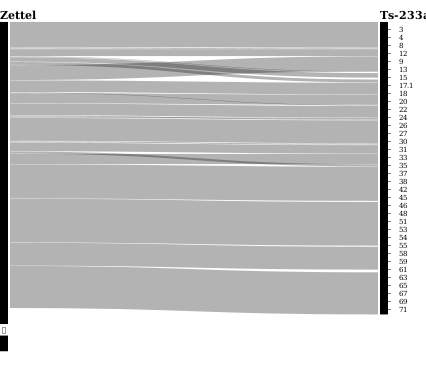
Do not quote from or cite this translation!
§Z
1[1]574 W. James: der Gedanke sei schon am Anfang des Satzes fertig. Wie kann man das wissen? Aber die Absicht, ihn auszusprechen, kann schon bestehen, ehe das erste Wort gesagt ist. Denn fragt man Einen “weißt du, was du sagen willst?” so wird er es oft bejahen.
574 W. James: the thought is already complete at the beginning of the sentence. How can one know this? But the intention to express it can already exist before the first word is said. For if one asks someone “do you know what you want to say?”, he will often answer in the affirmative.
§Z
1[1].2Ich sage Einem “Ich werde dir jetzt das Thema … vorpfeifen”, ich habe die Absicht, es zu pfeifen, & ich weiß schon, was ich pfeifen werde. Ich habe die Absicht, dieses Thema zu pfeifen: habe ich es damit in irgendeinem Sinne, etwa im Gedanken, schon gepfiffen?
I say to someone, “I will now whistle the tune…”, I have the intention to whistle it, & I already know what I will whistle. I have the intention to whistle this tune: does this mean that I have already whistled it in some sense, perhaps in thought?
§Z
1[2]12 “Ich sage das nicht nur, ich meine etwas damit.” – Soll man darauf fragen “Was?”– –dann kommt wieder ein Satz zur Antwort. – Oder kann man nicht so fragen, da der Satz etwa sagte “Ich sage das nicht nur, sondern es bewegt mich auch.”
12 “I do not merely say this, I mean something by it.” – Should one ask “What?” – then another sentence is given as an answer. – Or can one not ask in this way, since the sentence says something like “I do not merely say this, but it also moves me.”
§Z
1[3]427 (Eine der irreführendsten Redeweisen ist die Frage “Was meine ich damit?” – Man könnte in den meisten Fällen darauf antworten: “Gar nichts – ich sage …”)
427 (One of the most misleading ways of speaking is the question “What do I mean by that?” – In most cases, one could answer: “Nothing at all – I say …”)
§Z
1[4]106 Kann ich denn nicht mit Worten meinen, was ich will? ‒ ‒ Schau auf die Tür deines Zimmers, sage dabei eine Reihe beliebige Laute, und meine damit eine Beschreibung dieser Tür!
106 Can I not express with words what I want? – Look at the door of your room, and while looking, say a series of arbitrary sounds, and mean by it a description of that door!
§Z
1[5]258 “Sag ‘a b c d’ und meine damit: Das Wetter ist schön.” – Soll ich also sagen, daß das Aussprechen eines Satzes einer uns geläufigen Sprache ein ganz anderes Erlebnis ist, als das Aussprechen von Lauten, die uns nicht als Satz geläufig sind? Wenn ich also die Sprache erlernte, in welcher “a b c d ” jenen Sinn hat, – würde ich nach und nach das uns bekannte Erlebnis beim Aussprechen dieser Buchstaben kriegen? Ja & nein. – Eine Hauptverschiedenheit der beiden Fälle liegt darin, daß ich mich im ersten nicht bewegen kann. Es ist da, als wäre eines meiner Gelenke in Schienen und ich (wäre) noch nicht an sie gewöhnt & hätte die möglichen Bewegungen noch nicht inne, stieße also sozusagen in einem fort an.
258 “Say ‘a b c d’ and mean by it: The weather is nice.” – Am I to say, then, that uttering a sentence in a language familiar to us is a completely different experience than uttering sounds that are not familiar to us as a sentence? If I were to learn the language in which “a b c d” has that sense, would I gradually acquire the experience we are familiar with when uttering these letters? Yes & no. – A main difference between the two cases lies in the fact that in the first case I cannot move. It is as if one of my joints were in a cast, & I have not yet become accustomed to it & do not yet have the possible movements at my disposal, so that I constantly bump into it.
§Z
2[1]202 Wenn ich zwei Freunde gleichen Namens habe, und ich schreibe einem von ihnen einen Brief; worin liegt es, daß ich ihn nicht dem andern schreibe? Am Inhalt? Aber der könnte für beide passen. (Die Adresse habe ich noch nicht geschrieben.) Nun, die Verbindung kann in der Vorgeschichte liegen. Dann aber auch in dem, was dem Schreiben folgt. Wenn mich nun jemand fragt “An welchen der beiden schreibst du?” und ich antworte ihm, – schließe ich die Antwort aus der Vorgeschichte? Gebe ich sie nicht beinahe, wie ich sage “Ich habe Zahnschmerzen”? – Könnte ich im Zweifel darüber sein, welchem von beiden ich schreibe? Und wie sieht so ein Zweifelsfall aus? – Ja, wäre nicht auch der Fall einer Täuschung möglich: ich glaube dem Einen zu schreiben und schreibe dem Andern? Und wie sähe der Fall einer solchen Täuschung aus?
202 If I have two friends with the same name, & I write a letter to one of them; what is it that prevents me from writing it to the other? Is it the content? But it could fit for both. (I haven’t written the address yet.) Now, the connection could lie in the backstory. But then it also lies in what follows the writing. If someone now asks me, “Which of the two are you writing to?” & I answer him, do I exclude the answer from the backstory? Don’t I give it almost as I say, “I have tooth pain”? Could I be in doubt about which of the two I am writing to? & what does such a case of doubt look like? – Yes, wouldn’t the case of a deception also be possible: I believe I am writing to one, & I write to the other? & what would the case of such a deception look like?
§Z
2[2](Man sagt manchmal: “Was wollte ich nur in dieser Lade suchen? – Ach ja, die Photographie!” Und wenn uns dies einfällt, erinnern wir uns wieder an den Zusammenhang unsrer Handlung mit dem, was vorherging. Es könnte aber auch den Fall geben: Ich öffne die Lade und krame in ihr; endlich komme ich gleichsam zur Besinnung und frage mich “Warum suche ich in dieser Lade herum?” Und dann kommt die Antwort “Ich will die Photographie des … sehen”. “Ich will”, nicht “Ich wollte”. Das Öffnen der Lade, etc. geschah sozusagen automatisch und erhielt später eine Interpretation.)
Sometimes one says: “What was I looking for in this drawer? – Oh yes, the photograph!” And when this occurs to us, we remember the connection of our action with what preceded it. But it could also be the case: I open the drawer & rummage in it; finally, I, as it were, come to my senses & ask myself, “Why am I searching in this drawer?” And then comes the answer, “I want to see the photograph of…” “I want,” not “I wanted.” The opening of the drawer, etc., happened, as it were, automatically & received an interpretation later.
§Z
2[3]236 “Ich wollte mit dieser Bemerkung ihn treffen.” Wenn ich das höre, so kann ich mir dazu eine Situation und ihre Geschichte vorstellen. Ich könnte sie auf dem Theater darstellen, mich in den Seelenzustand versetzen, in dem ich ‘ihn treffen’ will. – Aber wie ist dieser Seelenzustand zu beschreiben? also zu identifizieren? – Ich denke mich in die Situation hinein, nehme eine gewisse Miene und Stimme an, etc.. Was verbindet meine Worte mit ihm? Die Situation und meine Gedanken. Und meine Gedanken nicht anders, als Worte, die ich ausspreche.
236 “I wanted to get at him with this remark.” If I hear that, I can imagine a situation and its history. I could stage it in a theater, put myself in the state of mind in which I want to ‘get at him’. – But how is this state of mind to be described? That is, how is it to be identified? – I imagine myself in the situation, adopt a certain facial expression and voice, etc. What connects my words with him? The situation and my thoughts. And my thoughts not otherwise than words that I utter.
§Z
3[1]32 Angenommen, ich wollte auf einmal alle Wörter meiner Sprache durch andere ersetzen; wie könnte ich wissen, an welcher Stelle eines der neuen Wörter steht? Sind es die Vorstellungen, die die Plätze der Wörter halten?
32 Suppose I wanted to replace all the words in my language with other words at once; how could I know where one of the new words is located? Are it the images that hold the places of the words?
§Z
3[2]33 Ich bin geneigt zu sagen: Ich ‘zeige’ in verschiedenem Sinne auf diesen Körper, auf seine Gestalt, auf seine Farbe, etc..– Was heißt das? Was heißt es: Ich ‘höre’ in anderem Sinne: das Klavier, seinen Klang, das Musikstück, den Klavierspieler, seine Geläufigkeit? Ich ‘heirate’, in einem Sinne, eine Frau, in einem andern, ihr Geld.
33 I am inclined to say: I ‘point’ in different senses to this body, to its shape, to its color, etc. – What does that mean? What does it mean: I ‘hear’ in another sense: the piano, its sound, the piece of music, the pianist, his skill? I ‘marry,’ in one sense, a woman, in another, her money.
§Z
3[3]584 Das Meinen stellt man sich hier als eine Art geistiges Zeigen, Hinweisen, vor.
584 Here, ‘meaning’ is imagined as a kind of mental pointing, indicating.
§Z
3[4]199 In manchen spiritistischen Handlungen ist es wesentlich, daß man an eine bestimmte Person denke. Und wir haben hier den Eindruck, als wäre ‘an ihn denken’ gleichsam, ihn mit meinen Gedanken aufspießen. Oder es ist, als stäche ich immer wieder mit den Gedanken nach ihm hin. Denn sie schweifen etwa immer wieder ein wenig von ihm ab.
199 In some spiritualist actions, it is essential that one think of a specific person. And we have here the impression that ‘thinking of him’ is as if one were, as it were, impaling him with my thoughts. Or it is as if I were repeatedly poking at him with thoughts. Because they keep drifting away from him.
§Z
3[5]237 “Ich mußte plötzlich an ihn denken.” Sein Bild schwebte mir etwa plötzlich vor. Wußte ich, daß es sein, des N, Bild war? Ich sagte es mir nicht. Worin lag es also, daß es das seine war? Vielleicht in dem, was ich später sagte, oder tat.
237 “I suddenly had to think of him.” His image suddenly appeared before me. Did I know that it was the image of N? I didn’t say it to myself. So what was it that made it his image? Perhaps in what I said or did later.
§Z
3[6]212 Wenn Max sagt “Der Fürst trägt Vatersorge für die Truppen”, so meint er Wallenstein. – Angenommen, jemand sagte: Wir wissen nicht, ob er Wallenstein meint; er könne in diesem Satz auch einen andern Fürsten meinen.
212 If Max says “The prince exercises guardianship over the troops,” he means Wallenstein. – Suppose someone said: We don’t know if he means Wallenstein; he could also mean another prince in this sentence.
§Z
3[7]591
“Daß du das Klavierspiel meintest, bestand darin, daß du ans Klavierspiel dachtest.” “Daß du in diesem Brief diesen Menschen mit dem Wort ‘du’ meintest, bestand darin, daß du an ihn schriebst.” Der Irrtum ist: daß Meinen nicht in etwas besteht.
591
“The fact that you meant the piano playing consisted in the fact that you thought of the piano playing.” “The fact that in this letter you meant this person with the word ‘you’ consisted in the fact that you wrote to him.” The mistake is: that ‘meaning’ does not consist in something.
§Z
4[1]235 “Als ich das sagte, wollte ich nur ihm einen Wink geben.” – Wie kann ich wissen, daß ich es nur sagte, um ihm einen Wink zu geben? Nun, die Worte “Als ich es sagte etc.” beschreiben eine bestimmte uns verständliche Situation. Wie schaut die Situation aus? Um sie zu beschreiben muß ich einen Zusammenhang beschreiben.
235 “When I said that, I only wanted to give him a hint.” – How can I know that I only said it to give him a hint? Well, the words “When I said it, etc.” describe a situation that is understandable to us. What does the situation look like? To describe it, I must describe a connection.
§Z
4[2]239 Wie tritt er in diese Vorgänge ein: ich stach nach ihm, ich sprach zu ihm, ich rief ihn, ich sprach von ihm, ich stellte mir ihn vor, ich achte ihn?
239 How does he enter into these processes: I poked at him, I spoke to him, I called him, I spoke about him, I imagined him, I pay attention to him?
§Z
4[3]586 Es ist falsch zu sagen: Ich meinte ihn, indem ich ihn ansah. “Meinen” wird nicht als Bezeichnung einer Tätigkeit benützt, die ganz, oder teilweise, in den ‘Äußerungen’ des Meinens besteht.
586 It is wrong to say: I meant him by looking at him. ‘Meaning’ is not used as a designation of an activity that consists wholly or partly in the ‘utterances’ of meaning.
§Z
4[4]592
Es wäre daher dumm, eine ‘geistige Tätigkeit’ zu nennen. Weil man damit eine falsche Vorstellung von der Funktion des Wortes hervorruft.
592
It would therefore be silly to call it a ‘mental activity,’ because that would evoke a false idea of the function of the word.
§Z
4[5]195 Ich sage “Komm her!” und zeige in der Richtung des A. B, der neben ihm steht, macht einen Schritt auf mich zu. Ich sage: “Nein; A soll kommen.” Wird man das nun als eine Mitteilung über meine innern Erlebnisse auffassen? Gewiß nicht. – Und könnte man nicht doch daraus Schlüsse auf Vorgänge ziehen, die in mir beim Aussprechen des Befehls stattgefunden haben? Aber auf was für Vorgänge? Könnte man nicht mutmaßen, ich habe bei meinem Befehl auf A geschaut; mein Gedankengang habe mich zu ihm geleitet? Aber vielleicht kenne ich den B überhaupt nicht, stehe nur mit A in Verbindung. Dann hätte also, wer meine seelischen Vorgänge mutmaßte, ganz irregehen können, und hätte dennoch verstanden, daß ich den A und nicht den B gemeint habe.
195 I say “Come here!” and point in the direction of A. B, who is standing next to him, takes a step towards me. I say: “No; A should come.” Would one now regard this as a communication about my inner experiences? Certainly not. – And could one not still draw conclusions from it about processes that took place in me while uttering the command? But what kind of processes? Could one not assume that I looked at A while giving my command; that my train of thought led me to him? But perhaps I don’t know B at all; I am only connected with A. Then, whoever guessed at my mental processes could have been completely wrong, and yet would have understood that I meant A and not B.
§Z
5[1]192 Ich zeige mit der Hand und sage “Komm her!”. A fragt “Hast du mich gemeint?” Ich sage “Nein; den B.” – Was ging da vor, als ich den B meinte (da doch mein Zeigen es zweifelhaft ließ, welchen ich meinte)? – Ich sage diese Worte, machte diese Handbewegung. Mußte noch mehr vorgehen, daß das Sprachspiel vor sich gehen konnte? Aber wußte ich nicht schon während des Zeigens, wen ich meinte? Wußte? Ich hätte z.B. auf B gezeigt, auch wenn A nicht in seiner Nähe gestanden wäre. Wußte? Freilich, – nach den gewöhnlichen Kriterien des Wissens.
192 I point with my hand and say “Come here!”. A asks, “Did you mean me?” I say, “No; I meant B.” – What was going on when I meant B (since my pointing made it doubtful which one I meant)? – I said these words, I made this hand gesture. Did anything else have to happen in order for the language-game to take place? But didn’t I already know who I meant while I was pointing? Did I know? For example, I could have pointed at B, even if A hadn’t been standing near him. Did I know? Of course – according to the usual criteria of knowledge.
§Z
5[2]319 “Ich wollte in meiner Erklärung auf … lossteuern.” Mir schwebte dieses Ziel vor. Ich sah im Geist die Stelle des Buchs, auf die ich hinzielte. Die Absicht zu beschreiben, heißt, was vorging, unter einem bestimmten Gesichtspunkte, für einen bestimmten Zweck, beschreiben. Ich male ein bestimmtes Porträt der Vorgänge.
319 “I wanted to steer my explanation toward…”. This goal was in my mind. I could see in my mind the place in the book that I was aiming for. To describe the intention means to describe what was going on, from a certain point of view, for a certain purpose. I paint a specific portrait of the events.
§Z
5[3]356 Statt “Ich habe ihn gemeint” kann man auch sagen “Ich habe von ihm gesprochen”. Und wie macht man das: mit diesen Worten von ihm sprechen? Warum klingt es falsch, zu sagen “ich habe von ihm gesprochen, indem ich bei diesen Worten auf ihn zeigte”? “Ihn meinen” heißt etwa: von ihm reden. Nicht: auf ihn zeigen. Und wenn ich von ihm rede, besteht freilich eine Verbindung zwischen meiner Rede und ihm, aber diese Verbindung liegt in der Anwendung der Rede, nicht in einem Akt des Hinweisens. Das Zeigen ist selbst nur ein Zeichen, und es kann im Sprachspiel die Anwendung der Sätze regeln, also, was gemeint ist, anzeigen.
356 Instead of “I meant him,” one can also say, “I spoke of him.” And how does one do that: speak of him with these words? Why does it sound wrong to say, “I spoke of him by pointing at him with these words”? “To mean him” means something like: to speak of him. Not: to point at him. And when I speak of him, there is, of course, a connection between my speech and him, but this connection lies in the application of the speech, not in an act of pointing. The pointing itself is only a sign, and in the language-game it can regulate the application of the sentences, i.e., indicate what is meant.
§Z
5[4]207 Wenn ich sage “Ich habe in diesem Zimmer einen Sessel gesehen”, so kann ich mich meistens nur sehr beiläufig an das besondere Gesichtsbild erinnern, und es hat in dem meisten Fällen auch gar keine Bedeutung. Der Gebrauch, der von dem Satz gemacht wird, geht an dieser Besonderheit vorbei. Ist es nun so auch, wenn ich sage “Ich habe den N gemeint”? Geht dieser Satz in der gleichen Weise an den Besonderheiten des Vorgangs vorbei?
207 If I say, “I saw an armchair in this room,” then I can usually only remember the specific visual image in a very casual way, and in most cases it also has no meaning. The use that is made of the sentence goes beyond this particularity. Is it the same when I say, “I meant N”? Does this sentence also go beyond the particularities of the event in the same way?
§Z
6[1]225 Wenn ich mit einer Bemerkung auf N anspiele, so mag sich dies – wenn bestimmte Umstände gegeben sind – aus meinem Blick, Gesichtsausdruck, etc. ersehen lassen.
Daß du den Ausdruck “auf N anspielen” verstehst, kannst du dadurch zeigen, daß du Beispiele des Anspielens beschreibst. Was wirst du nun alles beschreiben? Vor allem Umstände. Dann, was Einer sagt. Etwa auch seinen Blick etc. Dann, was der Anspielende tun will. Und teile ich jemand dazu noch meine Gefühle, Vorstellungen, etc., während ich die Bemerkung machte, mit, so mögen diese das typische Bild des Anspielens (oder ein solches Bild) vervollständigen. Aber daraus folgt nicht, daß der Ausdruck “auf N anspielen” bedeute: sich so benehmen, dies fühlen, sich dies vorstellen, etc. Und hier wird Mancher sagen: “Freilich nicht! Das haben wir immer schon gesehen. Und es muß sich eben ein roter Faden durch alle diese Erscheinungen ziehen. Er ist mit ihnen sozusagen umsponnen, und daher schwer auffindbar.” – Und das ist auch nicht wahr.
Aber es wäre auch falsch, zu sagen, “anspielen” bezeichne eine Familie von geistigen und anderen Vorgängen. – Denn man kann zwar fragen “Welches war deine Anspielung auf N?”, “Wie hast du den Andern zu verstehen gegeben, daß du N meintest?”; aber nicht: “Wie hast du diese Äußerung als Anspielung auf N gemeint?” “Ich habe in meiner Rede auf ihn angespielt.” – “Mit welchen Worten?”– “Ich habe auf ihn angespielt, als ich von einem Mann redete, der …”. “Ich habe auf ihn angespielt” heißt ungefähr: Ich wollte, daß jemand bei diesen Worten an ihn denken solle. Aber “Ich wollte” ist nicht die Beschreibung eines Seelenzustandes, und “verstehen, daß N gemeint war” ist es auch nicht
Man fragt aber: “Mit welcher Bemerkung hast du auf ihn angespielt”, “Mit welcher Bemerkung hast du ihn gemeint”.
225 If I allude to N with a remark, this—given certain circumstances—may be discernible from my gaze, facial expression, etc.
The fact that you understand the expression “to allude to N” can be demonstrated by describing examples of allusion. What will you describe? Primarily, the circumstances. Then, what someone says. Perhaps also his gaze, etc. Then, what the person making the allusion wants to do. And if I also share my feelings, images, etc., with someone while making the remark, these may complete the typical image of the allusion (or an image of this kind). But it does not follow from this that the expression “to allude to N” means: to behave in such a way, to feel this, to imagine this, etc. And here some will say: “Of course not! We have always seen that. And there must be a common thread running through all these phenomena. It is, as it were, interwoven with them, and therefore difficult to find.” – And that is not true either.
But it would also be wrong to say that “alluding” denotes a family of mental and other processes. – For one can ask “Which was your allusion to N?”, “How did you make it clear to the other person that you meant N?”; but not: “How did you intend this utterance as an allusion to N?” “I alluded to him in my speech.” – “With which words?” – “I alluded to him when I spoke of a man who…” “I alluded to him” means approximately: I wanted someone to think of him when hearing these words. But “I wanted” is not a description of a state of mind, and “understanding that N was meant” is not either.
One does, however, ask: “With which remark did you allude to him?”, “With which remark did you mean him?”.
§Z
6[2] &8[1]
234 Wenn die Situation zweideutig ist; ist es dann zweifelhaft, ob ich ihn meine? Bei meiner Aussage, ich habe ihn, oder habe ihn nicht gemeint, urteile ich nicht nach der Situation. Und wenn ich nun nicht nach der Situation urteile, wonach urteile ich? Scheinbar nach gar nichts. Denn ich erinnere mich wohl an die Situation, aber deute sie. Ich kann z.B. meinen Seitenblick auf ihn jetzt nachahmen, aber das Meinen erscheint als eine ganz ungreifbare, feine Atmosphäre des Sprechens und Handelns. (Ein verdächtiges Bild!)
234 If the situation is ambiguous, is it then doubtful whether I mean him? In my statement, “I meant him,” or “I did not mean him,” I do not judge according to the situation. And if I now do not judge according to the situation, according to what do I judge? Apparently, according to nothing. For I probably remember the situation, but I interpret it. I can, for example, reproduce my sidelong glance at him now, but the meaning seems to be a completely elusive, subtle atmosphere of speaking and acting. (A suspicious image!)
§Z
8[2]323 Im laufe eines Gesprächs will ich auf etwas zeigen; ich habe bereits den Anfang einer Zeigebewegung gemacht; führe sie aber nicht aus. Später sage ich: “Ich wollte damals darauf zeigen. Ich erinnere mich noch deutlich, daß ich schon den Finger aufgehoben hatte.” In dem Strom dieser Vorgänge, Gedanken und Empfindungen war dies der Anfang einer Gebärde des Zeigens. Ja, wenn ich die ganze Gebärde machte und sagte “Er liegt dort drüben”, so wäre das kein Zeigen, wenn nicht diese Worte zu einer Sprache gehörten.
323 In the course of a conversation, I want to point to something; I have already begun a gesture of pointing; but I do not carry it out. Later, I say: “At that time, I wanted to point to it. I still clearly remember that I had already raised my finger.” In the stream of these events, thoughts, and sensations, this was the beginning of a gesture of pointing. Yes, if I made the whole gesture and said, “It is over there,” that would not be pointing, unless these words belonged to a language.
§Z
8[3]3 “Du hast mit der Hand eine Bewegung gemacht; hast du etwas damit gemeint? – Ich dachte, du meintest, ich solle zu dir kommen.” Also er konnte etwas meinen, oder auch nichts meinen. Und wenn das erstere: dann eben seine Handbewegung, – oder etwas Anderes? Hat er mit seinem Ausdruck etwas Anderes, als diesen, gemeint, oder hat er nur seinen Ausdruck – gemeint?
3 “You made a movement with your hand; did you mean something by it? – I thought you meant that I should come to you.” So he could have meant something, or he could have meant nothing. And if the former: then it was his hand movement, or something else? Did he mean something else with his expression, or did he only mean his expression?
§Z
8[4]4 Könnte man auch antworten: “Ich habe etwas mit dieser Bewegung gemeint, was ich nur durch diese Bewegung ausdrücken kann”? (Musik, musikalischer Gedanke.)
4 Could one also say: “I meant something with this movement, which I can only express through this movement”? (Music, musical thought.)
§Z
8[5]“Freilich dachte ich an ihn: ich hab ihn vor mir gesehen!” – aber nicht nach seinem Bild erkannt.
“Of course, I thought of him: I had him before my eyes!” – but I didn’t recognize him from his image.
§Z
8[6] &10[1]
Stell Dir einen Deiner Bekannten vor! – Nun sag, wer es war! – Manchmal kommt das Bild zuerst und der Name danach. Aber errate ich den Namen nach der Ähnlichkeit des Bildes? – Und wenn nun der Name dem Bild erst nachfolgt, – war die Vorstellung schon mit dem Bild da, oder war sie erst mit dem Namen vollständig? Ich habe ja auf den Namen nicht aus dem Bild geschlossen; & eben darum kann ich sagen, die Vorstellung von ihm sei schon mit dem Bild gekommen.
Imagine one of your acquaintances! – Now say, who it was! – Sometimes the image comes first, and the name later. But do I guess the name from the similarity of the image? – And if the name follows the image, was the image already there with the image, or was it only complete with the name? After all, I did not infer the name from the image; & that is why I can say that the image of him came with the image.
§Z
10[2]2) Es scheint uns oft, als mache der Geist beim Verstehen der Bedeutung kleine Bewegungen, wie ein Unschlüssiger, der nicht weiß, welchen Weg er gehen soll – gehe also das Gebiet der möglichen Anwendungen ab.
2) It often seems to us as if the mind makes small movements in understanding the meaning, like someone who is undecided and does not know which way to go – he explores the area of possible applications.
§Z
10[3]1) Es ist, wie wenn man eine Tendenz, eine Bereitschaft erlebte (James). Und warum soll ich es nicht so nennen? (Und Manche würden auch, was da geschieht, durch Innervationen von Muskeln, Ansätze zu Bewegungen, oder gar Vorstellungen von ihnen erklären.) Nur mußt Du das Erlebnis einer Tendenz nicht unter dem Bild eines nicht ganz fertigen Erlebnisses ansehen.
1) It is as if one experiences a tendency, a predisposition (James). And why should I not call it that? (And some would also explain what happens through innervation of muscles, approaches to movements, or even images of them.) Only, you must not see the experience of a tendency as the image of an incomplete experience.
§Z
10[4](2) Denk dir Menschen, die von Kind auf mit großer Schnelligkeit kritzeln, während sie reden: was sie reden, gleichsam illustrieren. Muß ich annehmen, daß, wer aus der Vorstellung, oder Erinnerung, etwas zeichnet, oder beschreibt, oder nachahmt, seine Darstellung von irgend etwas abliest?! – Was spricht dafür?
(2) Imagine people who, from childhood, scribble quickly while they talk, as if to illustrate what they are saying. Must I assume that whoever draws, describes, or imitates something from imagination or memory reads off his representation from something?! – What speaks for it?
§Z
10[5]206 Gedanken erraten. Spielkarten liegen auf einem Tisch. Ich will, daß der Andre eine von ihnen berühren soll. Ich schließe die Augen und denke an eine dieser Karten; der Andre soll erraten, welche ich meine. – Er läßt sich darauf etwa eine Karte einfallen und wünscht dabei, meine Meinung zu treffen. Er berührt die Karte und ich sage “Ja, die war's”, oder sie war's nicht. Eine Variante dieses Spiels wäre es, daß ich auf eine bestimmte Karte schaue, so zwar, daß der Andre die Richtung meines Blicks nicht sieht, und daß er nun die Karte erraten muß, auf die ich schaue. Daß dies eine Variante des ersten Spiels ist, ist wichtig. Es kann hier wichtig sein, wie ich an die Karte denke, weil es sich zeigen könnte, daß davon die Zuverlässigkeit des Erratens abhängt. Sage ich aber im gewöhnlichen Leben “Ich dachte soeben an N”, so
206 Guessing thoughts. Playing cards are lying on a table. I want the other person to touch one of them. I close my eyes and think of one of these cards; the other person should guess which one I mean. – He may think of a card and wish to guess my intention. He touches the card, and I say, “Yes, that was it,” or it was not. A variant of this game would be for me to look at a specific card, in such a way that the other person does not see the direction of my gaze, and that he now has to guess which card I am looking at. The fact that this is a variant of the first game is important. It may be important how I think of the card, because it may turn out that the reliability of the guessing depends on it. But in everyday life, if I say, “I was just thinking of N,”
§Z
12[1]fragt man nicht “Wie hast du an ihn gedacht?”.
one does not ask “How did you think of him?”.
§Z
12[2]203 Man möchte fragen: “Hätte Einer, der in dein Inneres zu sehen im Stande wäre, dort sehen können, daß du das sagen wolltest?” Angenommen, ich hätte mir meinen Vorsatz auf einem Zettel notiert, so hätte ein Andrer meinen Vorsatz dort lesen können. Und kann ich mir denken, daß er ihn auf irgend einem Wege hätte sicherer erfahren können, als so? Gewiß nicht.
203 One might ask: “If someone were able to see into your inner self, would they be able to see that you intended to say that?” Suppose I had written down my intention on a piece of paper; then another person could read my intention there. And can I imagine that he could have learned it in some other way, in a more certain way? Certainly not.
§Z
12[3]299 (Über einem Musikstück steht, vom Komponisten drübergeschrieben = 88, aber um es heute richtig zu spielen, muß es = 94 gespielt werden; welches ist das vom Komponisten gemeinte Tempo.)
299 (Above a piece of music, the composer has written = 88, but in order to play it correctly today, it must be played at = 94; which is the tempo intended by the composer?)
§Z
12[4]Unterbrich einen Menschen im gänzlich unvorbereiteten und fließenden Reden. Dann frag ihn, was er sagen wollte; und er wird in vielen Fällen den angefangenen Satz fortführen können. – “Dazu mußte ihm schon vorgeschwebt haben, was er sagen wollte.” – Ist nicht vielleicht jenes Phänomen der Grund, warum wir sagen, die Fortsetzung hätte ihm vorgeschwebt?
Interrupt a person in his completely unprepared and flowing speech. Then ask him what he wanted to say, and in many cases he will be able to continue the sentence he had begun. – “He must have already had in mind what he wanted to say.” – Is it not perhaps this phenomenon that is the reason why we say that the continuation was already in his mind?
§Z
12[5]1803 Ist es aber nicht sonderbar, daß es so eine Reaktion so ein Geständnis der Intention gibt? Ist es nicht ein höchst merkwürdiges Sprachinstrument? Was ist eigentlich merkwürdig daran? Nun,– es ist schwer vorstellbar, wie der Mensch diesen Wortgebrauch lernt. Er ist gar so subtil.
1803 But is it not strange that there is such a reaction, such a confession of intention? Is it not a very remarkable linguistic tool? What is actually remarkable about it? Well, it is difficult to imagine how a person learns this use of words. It is so subtle.
§Z
12[6]1804 Aber ist er wirklich subtiler, als der der Worte “Ich habe mir ihn vorgestellt”, z.B.? Ja, merkwürdig, sonderbar, ist jede solche Sprachverwendung, wenn man nur auf die Betrachtung der Beschreibungen physikalischer Gegenstände eingestellt ist.
1804 But is it really more subtle than the use of the words “I had imagined it,” for example? Yes, remarkable, strange, is any such use of language, if one is only focused on the consideration of descriptions of physical objects.
§Z
12[7]221 Sage ich “Ich wollte damals das und das tun” und beruht diese Aussage auf den Gedanken, Vorstellungen, etc., an die ich mich erinnere, so muß ein Andrer, dem ich nur diese Gedanken, Vorstellungen, etc. mitteile, daraus mit eben solcher Sicherheit schließen können, ich hätte damals das und das tun wollen. – Er könnte das aber oft nicht. Ja, schlösse ich selbst nun aus dieser Evidenz auf meine Absicht, so würde der Andre mit Recht sagen, dieser Schluß sei sehr unsicher.
221 If I say “I wanted to do this and that at the time” and this statement is based on the thoughts, images, etc., that I remember, then another person, to whom I only communicate these thoughts, images, etc., should be able to draw the same conclusions from them with the same certainty that I wanted to do this and that at the time. – But he could often not. Yes, if I myself were to draw conclusions about my intention from this evidence, the other person would rightly say that this conclusion is very uncertain.
§Z
7[1]242 Ich erwarte jeden Augenblick eine Explosion. Ich bin nicht im Stande, einer andern Sache meine volle Aufmerksamkeit zu schenken; schaue in ein Buch, aber ohne zu lesen. Auf die Frage, warum ich zerstreut, oder nervös scheine, sage ich, ich erwarte jeden Augenblick die Explosion. – Wie war es nun: Beschrieb dieser Satz eben jenes Verhalten? Aber wie unterscheidet sich dann der Vorgang des Erwartens der Explosion vom Vorgang des Erwartens eines ganz andern Ereignisses, z.B. eines bestimmten Signals? Und wie unterscheidet sich die Erwartung eines Signals von der Erwartung eines etwas andern Signals? Oder war meine Handlungsweise nur Nebenerscheinung der eigentlichen Erwartung, und diese ein geistiger Vorgang? Und war dieser Vorgang homogen, oder gegliedert wie ein Satz (mit internem Anfang und Ende)? – Wie weiß aber der, in dem er vorgeht, welches Ereignisses Erwartung der Vorgang ist? Er scheint nämlich nicht darüber im Ungewissen. Es ist nicht, als konstatierte er einen seelischen oder andern Zustand und machte eine Vermutung über dessen Ursache. Er mag wohl sagen “Ich weiß nicht, ist es nur diese Erwartung, die mich heute so unruhig macht”; aber er wird nicht sagen: “Ich weiß nicht, ist dieser Seelenzustand in dem ich jetzt bin die Erwartung einer Explosion, oder von etwas anderm.” Die Aussage “Ich erwarte jeden Moment einen Knall” ist eine Äußerung der Erwartung. Diese Wortreaktion ist der Ausschlag des Zeigers, der das Erwartete anzeigt.
242 I expect an explosion every moment. I am unable to give my full attention to something else; I look at a book, but without reading. When asked why I seem distracted or nervous, I say that I expect an explosion every moment. – What was it like then: did this sentence describe just that behaviour? But how does the process of expecting an explosion differ from the process of expecting a completely different event, e.g. a specific signal? And how does the expectation of one signal differ from the expectation of a slightly different signal? Or was my way of acting merely a side effect of the actual expectation, and was this a mental process? And was this process homogeneous, or structured like a sentence (with internal beginning and end)? – But how does the one in whom it is happening know what event the process is the expectation of? He does not seem to be in doubt about it. It is not as if he were stating a mental or other state and making a guess about its cause. He might say “I do not know if it is only this expectation that is making me so restless today”; but he would not say: “I do not know if this state of mind I am now in is the expectation of an explosion, or of something else.” The statement “I expect an explosion every moment” is a manifestation of the expectation. This verbal reaction is the deflection of the pointer that indicates what is expected.
§Z
7[2]509 Es scheint: die Erwartung und die Tatsache, die die Erwartung befriedigt, passen doch irgendwie zusammen. Man möge nun eine Erwartung beschreiben und eine Tatsache, die zusammenpassen, damit man sieht, worin diese Übereinstimmung besteht. Da denkt man sofort an das Passen einer Vollform in eine entsprechende Hohlform. Aber wenn man diese beiden beschreiben will, so sieht man, daß, soweit sie passen, eine Beschreibung für beide gilt. (Vergleiche dagegen, was es heißt “Diese Hose paßt nicht zu diesem Rock”.)
509 It seems that: the expectation and the fact that satisfies the expectation somehow fit together. One might describe an expectation and a fact that fit together, so that one can see what this agreement consists of. One immediately thinks of the fitting of a solid into a corresponding hollow form. But if one wants to describe these two, one sees that, insofar as they fit, one description applies to both. (Compare this with what it means “These trousers don’t fit with this skirt”.)
§Z
9[1]530 Wie alles Metaphysische ist die Harmonie zwischen Gedanken und Wirklichkeit in der Grammatik der Sprache aufzufinden.
530 As with all metaphysics, the harmony between thoughts and reality is to be found in the grammar of language.
§Z
9[2]53 Mein Gedanke ist hier: Wenn Einer die Erwartung selbst sehen könnte – er müßte sehen, was erwartet wird. (So aber, daß es nicht noch einer Projektionsmethode, Vergleichsmethode, bedürfte, um von dem, was er sieht, zu der Tatsache zu kommen, die erwartet wird.) Aber so ist es ja auch: Wer den Ausdruck der Erwartung sieht, sieht ‘was erwartet wird’.
53 My thought here is: If one could see the expectation itself – one would have to see what is expected. (So that it would not require a method of projection, a method of comparison, to get from what one sees to the fact that is expected.) But that is also how it is: Whoever sees the expression of the expectation sees ‘what is expected’.
§Z
9[3]521 Der Gedanke, daß uns erst das Finden zeigt, was wir gesucht, erst die Erfüllung des Wunsches, was wir gewünscht haben, heißt, den Vorgang so beurteilen, wie die Symptome der Erwartung oder des Suchens bei einem Andern. Ich sehe ihn unruhig in seinem Zimmer auf und ab gehen; da kommt jemand zur Tür herein, und er wir ruhig und gibt Zeichen der Befriedigung. Und nun sage ich “Er hat offenbar diesen Menschen erwartet”.
521 The thought that it is only the finding that shows us what we were looking for, that only the fulfilment of the wish shows us what we wished for, means judging the process in the same way as the symptoms of expectation or searching in another person. I see him restlessly pacing up and down in his room; then someone comes to the door, and he becomes calm and shows signs of satisfaction. And now I say “He apparently expected this person”.
§Z
9[4]516 Wir sagen, der Ausdruck der Erwartung ‘beschreibe’ die erwartete Tatsache, und denken an sie wie an einen Gegenstand oder Komplex, der als Erfüllung der Erwartung in die Erscheinung tritt. – Aber der Erwartete ist nicht die Erfüllung, sondern: daß er kommt. Der Fehler ist tief in unserer Sprache verankert: Wir sagen “ich erwarte ihn” und “ich erwarte sein Kommen” und “ich erwarte, daß er kommt”.
516 We say that the expression of the expectation ‘describes’ the expected fact, and we think of it as an object or complex that appears as the fulfilment of the expectation. – But the expected one is not the fulfilment, but: that he comes. The mistake is deeply rooted in our language: We say “I expect him” and “I expect his coming” and “I expect that he will come”.
§Z
9[5]517 Es ist uns schwer, von dem Vergleich loszukommen: Der Mensch tritt ein – das Ereignis tritt ein. Als wäre das Ereignis schon vorgebildet vor der Tür der Wirklichkeit und würde nun in diese (wie in ein Zimmer) eintreten.
517 It is difficult for us to break away from the comparison: The person enters – the event enters. As if the event were already pre-formed in front of the door of reality and would now enter into it (as into a room).
§Z
9[6]513 Die Realität ist keine Eigenschaft, die dem Erwarteten noch fehlt, und die nun hinzutritt, wenn die Erwartung eintritt. – Die Realität ist auch nicht wie das Tageslicht, das den Dingen erst Farbe gibt, wenn sie im Dunkeln schon, gleichsam farblos, vorhanden sind.
513 Reality is not a property that the expected one still lacks, and which now comes into being when the expectation comes about. – Reality is also not like daylight, which only gives things color when they are already present in the dark, as if colorless.
§Z
9[7]520 Man kann vom Träger eines Namens sagen, daß er nicht existiert; und das ist natürlich keine Tätigkeit, obwohl man es mit einer vergleichen könnte und sagen: er müsse doch dabei sein, wenn er nicht existiert. (Und das ist von einem Philosophen bestimmt schon einmal geschrieben worden.)
520 One can say of the bearer of a name that he does not exist; and that is of course not an activity, although one could compare it with one and say: he must be present if he does not exist. (And this has certainly already been written by a philosopher.)
§Z
11[1]Das schattenhafte Antizipieren der Tatsache besteht darin, daß wir jetzt denken können, daß das eintreffen wird, was erst eintreffen wird. Oder, wie es irreführenderweise heißt: daß wir jetzt das (oder, an das) denken können, was erst eintreffen wird.
The shadowy anticipation of the fact consists in the fact that we can now think that that will happen, which will only happen later. Or, as it is misleadingly expressed: that we can now think of that (or, to that), which will only happen later.
§Z
11[2]547 Mancher wird vielleicht sagen wollen “Die Erwartung ist ein Gedanke.” Das entspricht offenbar einem Gebrauch des Wortes “erwarten”. Und wir wollen uns nur erinnern, daß der Vorgang des Gedankens sehr verschiedenerlei sein kann.
547 Someone might say, “Expectation is a thought.” This obviously corresponds to a use of the word “expect”. And we only want to remember that the process of thought can be very varied.
§Z
11[3]248 Ich pfeife, und jemand fragt mich, warum ich guter Dinge bin. Ich antworte “Ich hoffe, N wird heute kommen.” – Aber während ich pfiff, dachte ich nicht an ihn. Und doch wäre es falsch zu sagen: ich hätte aufgehört zu hoffen, als ich zu pfeifen anfing.
248 I whistle, and someone asks me why I am in good spirits. I reply, “I hope that N will come today.” – But while I was whistling, I was not thinking of him. And yet it would be wrong to say: I stopped hoping when I started whistling.
§Z
11[4]288 Wenn ich sage “Ich erwarte …” – ist das die Feststellung: die Situation, meine Handlungen, Gedanken, etc. seien die des Erwartens dieses Ereignisses; oder gehören die Worte “Ich erwarte …” zum Vorgang des Erwartens? Unter gewissen Umständen werden diese Worte heißen (ersetzt werden können durch) “Ich glaube, das und das wird eintreten”. Manchmal auch: “Mach dich darauf gefaßt, daß …”.
288 When I say “I expect…” – is this the statement: that the situation, my actions, thoughts, etc., are those of expecting this event; or do the words “I expect…” belong to the process of expectation? Under certain circumstances, these words will mean (can be replaced by) “I believe that this and that will happen”. Sometimes also: “Be prepared that…”.
§Z
11[5]39 Die psychologischen – trivialen – Erörterungen über Erwartung, Assoziation, u.s.w., lassen immer das eigentlich Merkwürdige aus, und man merkt ihnen an, daß sie herumreden, ohne den springenden Punkt zu berühren.
39 The psychological – trivial – discussions about expectation, association, etc., always leave out the actually remarkable thing, and one can tell from them that they are beating around the bush without touching the crucial point.
§Z
11[6] &13[1]
285 Eine Erwartung ist in einer Situation eingebettet, aus der sie entspringt. Die Erwartung einer Explosion kann z.B. aus einer Situation entspringen, in der eine Explosion zu erwarten ist. Der sie erwartet, hatte zwei Leute flüstern hören: “Morgen um zehn Uhr wird die Lunte angebrannt”. Dann denkt er: vielleicht will jemand hier ein Haus in die Luft sprengen. Gegen zehn Uhr wird er unruhig, fährt bei jedem Lärm zusammen, und endlich antwortet er auf die Frage, warum er nervös sei: “Ich erwarte …”. Diese Antwort wird z.B. sein Benehmen verständlich machen. Sie wird uns auch in den Stand setzen, uns seine Gedanken und Gefühle auszumalen.
285 An expectation is embedded in a situation from which it arises. The expectation of an explosion, for example, can arise from a situation in which an explosion is to be expected. The person who expects it heard two people whispering: “Tomorrow at ten o’clock the fuse will be lit.” Then he thinks: perhaps someone here wants to blow up a house. Around ten o’clock he becomes restless, jumps at every noise, and finally answers the question of why he is nervous: “I am expecting…” This answer will, for example, make his behaviour understandable. It will also put us in a position to imagine his thoughts and feelings.
§Z
13[2]525
Die Erfüllung der Erwartung besteht nicht darin, daß ein Drittes geschieht, das man, außer eben als “die Erfüllung dieser Erwartung” auch noch anders beschreiben könnte, also z.B. als ein Gefühl der Befriedigung, oder der Freude, oder wie immer. die Erwartung, daß etwas der Fall sein wird, ist das Gleiche wie die Erwartung der Erfüllung jener Erwartung. Erwartung dessen was nicht ist.
525
The fulfilment of the expectation does not consist in a third thing happening, which one could describe in some other way besides as “the fulfilment of this expectation,” such as, for example, as a feeling of satisfaction, or joy, or whatever. The expectation that something will be the case is the same as the expectation of the fulfilment of that expectation. Expectation of what is not.
§Z
13[3]Sokrates zu Theaitetos: “Und wer vorstellt, sollte nicht etwas vorstellen?” – Th.: “Notwendig.” – Sok.: “Und wer etwas vorstellt, nichts Wirkliches?” – Th.: “So scheint es.”
Socrates to Theaetetus: “And he who imagines, should he not imagine something?” – Th.: “Necessarily.” – Soc.: “And he who imagines something, nothing real?” – Th.: “So it seems.”
§Z
13[4]Setzen wir in diesem Argument statt des Wortes “vorstellen” etwa das Wort “töten”, so gibt es eine Regel für den Gebrauch dieses Worts; es hat keinen Sinn zu sagen “Ich töte etwas, was nicht existiert”. Ich kann mir einen Hirsch auf dieser Wiese vorstellen, der nicht da ist, aber keinen töten, der nicht da ist. Und “sich einen Hirsch auf dieser Wiese vorstellen” heißt: sich vorstellen, daß ein Hirsch da ist. Einen Hirsch töten aber heißt nicht: töten, daß etc.. Wenn aber jemand sagt “Damit ich mir einen Hirsch vorstellen kann, muß es ihn doch in einem gewissen Sinne geben” – so ist die Antwort: nein, es muß ihn dazu in keinem Sinne geben. Und wenn geantwortet würde: “Aber die braune Farbe z.B. muß es doch geben, damit ich sie mir vorstellen kann”, – so ist zu sagen: “es gibt die braune Farbe” heißt überhaupt nichts; außer etwa, daß sie da oder dort als Färbung eines Gegenstands vorhanden ist; und das ist nicht nötig, damit ich mir einen braunen Hirschen vorstellen kann.
If we substitute the word “kill” for the word “imagine” in this argument, then there is a rule for the use of this word; it makes no sense to say “I kill something that does not exist.” I can imagine a deer on this meadow that is not there, but I cannot kill one that is not there. And “imagining a deer on this meadow” means: imagining that a deer is there. But killing a deer does not mean: killing that etc.. If, however, someone says “In order for me to imagine a deer, it must exist in a certain sense,” the answer is: no, it does not have to exist in any sense. And if it were answered: “But the brown color, for example, must exist in order for me to imagine it,” then one must say: “the brown color exists” does not mean anything at all; except perhaps that it is present here or there as the color of an object; and that is not necessary for me to imagine a brown deer.
§Z
13[5]515 Etwas tun können, erscheint wie ein Schatten des wirklichen Tuns, gerade wie der Sinn des Satzes als Schatten einer Tatsache, oder das Verstehen des Befehls als Schatten seiner Ausführung. Im Befehl wirft die Tatsache gleichsam “ihren Schatten schon voraus”. Dieser Schatten aber, was immer wäre, ist nicht das Ereignis.
515 Being able to do something appears like a shadow of the real doing, just as the sense of the sentence is a shadow of a fact, or the understanding of the command is a shadow of its execution. In the command, the fact, as it were, “casts its shadow in advance.” But this shadow, whatever it may be, is not the event.
§Z
14[1]Und wie lernt es den Ausdruck gebrauchen “Ich war damals im Begriffe zu werfen”? Und wie weiß man, daß es damals wirklich in jenem Seelenzustand war, den ich “im Begriffe sein …” nenne?”
And how does one learn to use the expression “I was at that time in the process of throwing”? And how does one know that he was really in that state of mind that I call “in the process of being…”?
§
14[2]Das Neue (Spontane, ‘Spezifische’) ist ein Sprachspiel.
The new (spontaneous, ‘specific’) is a language-game.
§Z
14[3]Wie nun, wenn ein Mensch den Ausdruck “Ich war damals im Begriffe …”, oder “Ich wollte damals …” nie gebrauchte & seinen Gebrauch nicht erlernen könnte? Der Mensch kann doch viel denken, ohne das zu denken. Er kann ein großes Gebiet der Sprachspiele beherrschen, ohne dieses zu beherrschen. Ist es aber dann nicht sonderbar, daß wir in dieser Art defektiven Menschen nicht begegnen, bei aller der Verschiedenheit der Menschen? Oder finden sich eben diese Leute unter (den) Geistesschwachen, & es wird nur nicht genügend beobachtet, welcher Sprachverwendungen solche fähig sind & welcher nicht?
Now, if a person never used the expression “I was at that time in the process of…” or “I wanted to…” and could not learn its use, what would happen? The person can think a great deal without thinking that. He can master a large area of language-games without mastering this one. But is it not strange that we do not encounter such defective people, despite all the differences between people? Or are these people to be found among the mentally deficient, and is it simply not observed closely enough which uses of language they are capable of and which they are not?
§Z
14[4]581 “Ich hatte die Absicht …” drückt nicht die Erinnerung an ein Erlebnis aus. (So wenig wie “Ich war im Begriffe …”)
581 “I had the intention…” does not express the memory of an experience. (Just as little as “I was in the process of…”)
§Z
14[5]177 Absicht (Intention) ist weder Gemütsbewegung, Stimmung, noch Empfindung, oder Vorstellung. Sie ist kein Bewußtseinszustand. Sie hat nicht echte Dauer.
177 Intention is neither a feeling, mood, nor sensation, nor image. It is not a state of consciousness. It does not have real duration.
§Z
14[6]307 “Ich habe die Absicht, morgen zu verreisen.” – Wann hast du die Absicht? Die ganze Zeit; oder intermittierend?
307 “I intend to travel tomorrow.” – When do you have the intention? All the time; or intermittently?
§Z
15[1]Schau in die Lade, in der du sie zu finden glaubst. Die Lade ist leer. – Ich glaube, du hast sie unter den Empfindungen gesucht. Überlege, was das eigentlich heißen würde “eine Absicht intermittierend haben”. Es hieße etwa: die Absicht haben, sie fallen lassen, sie wieder aufnehmen, u.s.f..
Look in the drawer where you think you can find it. The drawer is empty. – I suppose you looked for it among your sensations. Consider what it would actually mean to “have an intention intermittently.” It would mean something like: intending to drop it, pick it up again, and so on.
§Z
15[2]629 Unter was für Umständen sagt man “Diese Vorrichtung ist eine Bremse, funktioniert aber nicht”? Das heißt doch: sie erfüllt ihren Zweck nicht. Worin liegt es, daß sie diesen Zweck hat? Man könnte auch sagen: “Es war die Absicht, daß dies als Bremse wirken sollte.” Wessen Absicht? Hier entschwindet uns die Absicht als Zustand der Seele gänzlich. Könnte man sich nicht auch das denken, daß mehrere Leute eine Absicht hätten, ausführten, ohne daß einer von ihnen sie hat? So kann eine Regierung eine Absicht haben, die kein Mensch hat.
629 Under what circumstances would one say, “This device is a brake, but it doesn’t work”? This surely means: it does not fulfill its purpose. What is the reason that it has this purpose? One could also say: “The intention was that this should function as a brake.” Whose intention? Here, the intention as a state of mind completely eludes us. Couldn’t one also imagine that several people have an intention, execute it, without any one of them having it? For example, a government can have an intention that no person has.
§
15[3]vielleicht nirgends der Ausdruck gebraucht, die Person habe diese Absicht. Aber wenn wir den Gang des Romanes erzählen, werden wir dies etwa sagen.
perhaps nowhere the expression is used, the person has this intention. But when we recount the course of the novel, we will say this.
§
15[4]Geschichte deute, d.h., mit dieser zusammen nur, als Absicht charakterisieren?
history, i.e., characterize it together with this only as an intention?
§Z
15[5]1498 Es könnte ein Verbum geben, welches bedeutet: die Absicht durch Worte, oder andere Zeichen, laut, oder in Gedanken, aussprechen. Dies Zeitwort wäre nicht gleichbedeutend unserem “beabsichtigen”. Es könnte ein Verbum geben, welches bedeutet: einer Absicht gemäß handeln; und dies wäre auch nicht gleichbedeutend unserm “beabsichtigen”. Wieder ein anderes könnte bedeuten: über eine Absicht brüten; oder, sie im Kopfe hin und her wälzen.
1498 There could be a verb that means: to express the intention in words, or other signs, aloud, or in thought. This verb would not be synonymous with our “intend.” There could be a verb that means: to act in accordance with an intention; and this would also not be synonymous with our “intend.” Another verb could mean: to brood over an intention; or, to turn it over and over in one’s head.
§Z
15[6]257 Man kann Einen im Denken stören, – aber im Beabsichtigen? – – Im Planen wohl. Auch im Festhalten einer Absicht, nämlich im Denken oder Handeln.
257 One can disturb someone in their thinking, – but in their intending? – – Perhaps in their planning. Also in holding fast to an intention, namely in thinking or acting.
§Z
16[1]646 Anwendungen des Imperativs. Vergleiche die Befehle: Heb den Arm! Stell dir … vor! Rechne … im Kopf! Überlege dir …! Konzentrier deine Aufmerksamkeit auf …! Sieh diese Figur als Würfel an! mit diesen: Beabsichtige …! Meine mit diesen Worten …! Vermute, daß es sich so verhält! Glaube, daß es so ist! Sei der festen Überzeugung …! Erinnere dich daran, daß dies geschehen ist! Zweifle daran, ob es geschehen ist! Hoffe auf seine Wiederkehr!
Ist das der Unterschied, daß die ersten willkürliche, die zweiten unwillkürliche Bewegungen des Geistes sind? Eher kann ich sagen, die Verben der zweiten Gruppe bezeichnen keine Handlungen. (Vergleiche damit den Befehl: “Lache herzlich über diesen Witz!”)
646 Applications of the imperative. Compare the commands: Raise your arm! Imagine …! Calculate … in your head! Consider …! Concentrate your attention on …! See this figure as a cube! with these: Intend …! Mean it by these words …! Assume that this is the case! Believe that it is so! Be firmly convinced …! Remember that this happened! Doubt that it happened! Hope for its return!
Is this the difference, that the former are voluntary, the latter involuntary movements of the mind? Rather, I can say that the verbs of the second group do not denote actions. (Compare this with the command: “Laugh heartily at this joke!”)
§Z
16[2]27 Kann man jemand befehlen, einen Satz zu verstehen? Warum kann man Einem nicht befehlen: “Versteh das!”? Könnte ich nicht den Befehl “Versteh diesen griechischen Satz!” dadurch befolgen, daß ich Griechisch lernte? ‒ ‒ Ähnlich: Man kann sagen “Rufe dir Schmerzen hervor!”, aber nicht “Habe Schmerzen!” Man sagt: “Versetz dich in diesen Zustand!” aber nicht: “Sei in diesem Zustand!”
27 Can one command someone to understand a sentence? Why can’t one command someone: “Understand this!”? Could I not obey the command “Understand this Greek sentence!” by learning Greek? – – Similarly: One can say “Bring about pain!”, but not “Have pain!” One says: “Put yourself in this state!” but not: “Be in this state!”
§Z
16[3]80 Vergleiche die Anwendungen von: “Ich habe seit gestern Schmerzen.” “Ich habe ihn seit gestern erwartet.” “Ich wußte seit gestern.” “Ich kann seit gestern integrieren.”
80 Compare the applications of: “I have been in pain since yesterday.” “I have been expecting him since yesterday.” “I knew it since yesterday.” “I have been able to integrate since yesterday.”
§Z
16[4]057 Der gemeinsame Unterschied aller Bewußtseinszustände von den Dispositionen scheint mir zu sein, daß man sich durch Stichproben überzeugen kann, ob sie noch andauern.
057 The common difference between all states of consciousness and the dispositions seems to me to be that one can convince oneself by taking samples whether they still persist.
§Z
17[1]Man muß manchen Satz öfter lesen, um ihn als Satz zu verstehen.
One must read some sentences more than once in order to understand them as sentences.
§Z
17[1].2Ein Satz sei mir in einer Chiffre gegeben und auch ihr Schlüssel; dann ist mir natürlich in einer Beziehung alles zum Verständnis des Satzes gegeben. Und doch würde ich auf die Frage “Verstehst du diesen Satz?” antworten: Nein, noch nicht; ich muß ihn erst entziffern. Und erst, wenn ich ihn, z.B., ins Deutsche übertragen hätte, würde ich sagen “Jetzt verstehe ich ihn”. Wenn man nun die Frage stellt “In welchem Moment der Übertragung verstehe ich nun den Satz?”, würde man einen Einblick in das Wesen dessen erhalten, was wir “verstehen” nennen.
Let a sentence be given to me in code, along with its key; then, in a certain respect, everything necessary for understanding the sentence is naturally given to me. And yet, if asked “Do you understand this sentence?”, I would answer: No, not yet; I must first decipher it. And only when I have, for example, translated it into German, would I say “Now I understand it.” If one were to ask “At what moment in the translation do I now understand the sentence?”, one would gain insight into the essence of what we call “understanding.”
§Z
17[2]1639 Ich kann auf den Verlauf meiner Schmerzen achten; aber nicht ebenso auf den meines Glaubens, oder meines Wissens.
1639 I can pay attention to the course of my pain; but not equally to that of my belief, or my knowledge.
§Z
17[3]1640 Man kann die Fortdauer einer Erscheinung durch ununterbrochene Beobachtung feststellen, oder durch Proben. Das Beobachten der Dauer kann ununterbrochen, oder unterbrochen sein.
1640 One can determine the persistence of a phenomenon through uninterrupted observation, or through sampling. The observation of duration can be either uninterrupted or intermittent.
§Z
17[3].2Wie beobachtest Du Dein Wissen, Deine Meinungen? Und andererseits, ein Nachbild, einen Schmerz? Gibt es ein ununterbrochenes Beobachten meiner Fähigkeit, die Multiplikation … auszuführen?
How do you observe your knowledge, your opinions? And on the other hand, an image, a pain? Is there an uninterrupted observation of my ability to perform multiplication?
§Z
17[4]721 Ist “Ich hoffe …” eine Beschreibung eines Seelenzustandes? Ein Seelenzustand hat eine Dauer. “Ich habe den ganzen Tag gehofft …”, ist also so eine Beschreibung. Sage ich aber Einem “Ich hoffe, du kommst” – wie, wenn er mich fragte “Wie lange hoffst du es”? Ist die Antwort: “Ich hoffe, während ich's sage”? Angenommen ich hätte auf diese Frage irgendeine Antwort, wäre sie nicht für den Zweck der Worte “Ich hoffe, du wirst kommen” ganz irrelevant?
721 Is “I hope…” a description of a state of mind? A state of mind has a duration. “I have hoped all day…” is thus such a description. But if one says to another, “I hope you come” – how, if he asked me, “How long do you hope it?” Is the answer: “I hope, while I say it”? Suppose I had some answer to this question, would it not be quite irrelevant for the purpose of the words “I hope you will come”?
§Z
17[5]04 Man sagt “Ich hoffe, du wirst kommen”, aber nicht “Ich glaube: ich hoffe, du wirst kommen”; wohl aber wäre es möglich zu sagen: “Ich glaube, ich hoffe noch immer, er werde kommen”.
04 One says “I hope you will come,” but not “I believe: I hope you will come”; but it would be possible to say: “I believe, I still hope he will come.”
§Z
18[1]728 Was ist die Vergangenheitsform von “Nicht wahr, du kommst!”?
728 What is the past tense of “Not true, you are coming!”?
§Z
18[2]050 Wo es echte Dauer gibt, da kann man Einem sagen: “Merk auf und gib mir ein Zeichen, wenn das Bild, das Geräusch, etc. sich ändert. Es gibt da überhaupt ein Aufmerken. Während man nicht das Vergessen des Gewußten, u. dergl., mit der Aufmerksamkeit verfolgen kann. (Stimmt nicht, denn man kann auch die eigenen Vorstellungen nicht mit der Aufmerksamkeit verfolgen.)
050 Where there is genuine duration, one can say to another: “Pay attention and give me a sign when the image, the sound, etc., changes. There is, in fact, a paying of attention. Whereas one cannot track the forgetting of what one knows, and so on, with attention. (This is not true, for one cannot track one’s own mental images with attention either.)
§Z
18[3]051 Denk an das Sprachspiel: Bestimm mit der Stoppuhr, wie lange der Eindruck dauert. Man könnte so nicht die Dauer des Wissens, Könnens, Verstehens bestimmen.
051 Think of the language-game: Determine with the stopwatch how long the impression lasts. One could not, however, determine the duration of knowledge, skill, or understanding in this way.
§Z
18[4]052 “Aber die Verschiedenheit von Wissen und Hören liegt doch nicht einfach in so einem Merkmal, wie die Art ihrer Dauer. Sie sind doch ganz und gar grundverschieden!“ Freilich. Aber man kann eben nicht sagen: “Wisse und höre, und du wirst den Unterschied merken!“
052 “But the difference between knowledge and hearing does not simply lie in such a characteristic as the nature of their duration. They are quite fundamentally different!” Indeed. But one cannot simply say: “Know and hear, and you will notice the difference!”
§Z
18[5]048 “Schmerz ist ein Bewußtseinszustand, Verstehen nicht.” – “Nun, ich fühle eben das Verstehen nicht.” – Aber diese Erklärung tut's nicht. Es wäre auch keine Erklärung (zu sagen): Was man in irgend einem Sinne fühlt, ist ein Bewußtseinszustand. Das hieße ja nur: Bewußtseinszustand = Gefühl. (Man hätte nur ein Wort durch ein anderes ersetzt.)
048 “Pain is a state of consciousness, understanding is not.” – “Well, I simply do not feel understanding.” – But this explanation doesn’t work. It also wouldn’t be an explanation (to say): What one in some sense feels is a state of consciousness. That would only mean: State of consciousness = feeling. (One would only have replaced one word with another.)
§Z
18[6]überhaupt kaum, man habe etwas seit gestern “ununterbrochen” geglaubt, verstanden, beabsichtigt. Eine Unterbrechung des Glaubens wäre eine Zeit des Unglaubens, nicht z.B. die Abwendung der Aufmerksamkeit von dem Geglaubten, z.B. der Schlaf. (Unterschied zwischen ‘knowing’ und ‘being aware of’.)
in fact, it is hardly ever the case that one has believed, understood, or intended something “uninterruptedly” since yesterday. An interruption of belief would be a time of disbelief, not, for example, turning one’s attention away from what one believes, such as sleep. (Difference between ‘knowing’ and ‘being aware of’.)
§Z
19[1]1461 Das Allerwichtigste ist hier, daß man sich eines Unterschieds, der ein kategorischer ist, bewußt sein kann, ohne sagen zu können, worin der Unterschied besteht. Das ist der Fall, in dem man gewöhnlich sagt, man erkenne den Unterschied eben durch Introspektion.
1461 The most important thing here is that one can be conscious of a difference that is categorical, without being able to say what the difference consists in. This is the case where one usually says that one recognizes the difference through introspection.
§Z
19[2]046 Das ist wohl der Punkt, an dem man sagt, man könne dem Andern eben nur die Form mitteilen, nicht aber den Inhalt. – So redet man also zu sich selbst über den Inhalt! – – (Wie ‘beziehen’ sich aber meine Worte auf den mir bewußten Inhalt? und zu welchem Zweck?)
046 This is probably the point at which one says that one can only communicate the form to the other, but not the content. – So one is essentially talking to oneself about the content! – – (But how do my words relate to the content of which I am conscious, & for what purpose?)
§Z
19[2].2Es ist sehr merkwürdig, daß die Vorgänge beim Denken uns so gut wie nie interessieren. Es ist merkwürdig, aber nicht seltsam.
It is very remarkable that the processes involved in thinking rarely interest us. It is remarkable, but not odd.
§Z
19[3]211 [Gedanken, gleichsam nur Winke] Ist er hier nicht wie beim Kunstrechner? – Er hat richtig gerechnet, wenn das Richtige herauskam. Was in ihm vorging, kann er vielleicht selbst nicht sagen. Und hörten wir's, so erschiene es vielleicht wie ein seltsames Zerrbild einer Rechnung.
211 [Thoughts, as if only hints.] Is he not like a calculating machine here? – He has calculated correctly if the correct result comes out. He may not be able to say what was going on in him. And if we heard it, it might seem like a strange caricature of a calculation.
§Z
19[4]235 Was weiß ich von den inneren Vorgängen Eines, der mit Aufmerksamkeit einen Satz liest? Und kann er mir sie beschreiben, nachdem er's getan hat; und ist, was er etwa beschreibt eben der charakteristische Vorgang der Aufmerksamkeit?
235 What do I know about the inner processes of someone who reads a sentence with attention? And can he describe them to me after he has done so; and is what he describes perhaps the characteristic process of attention?
§Z
19[5] &20[1]
236
Frage: Welche Wirkung will ich erzielen, wenn ich Einem sage “Lies aufmerksam!”? Etwa, daß ihm das und jenes auffällt, er davon berichten kann. – Wieder könnte man, glaube ich, sagen, daß, wer einen Satz mit Aufmerksamkeit liest, oft von Vorgängen in seinem Geist, Vorstellungen etwa, wird berichten können. Aber das heißt nicht, daß diese Vorgänge “Aufmerksamkeit” heißen
236
Question: What effect do I want to achieve when I tell someone, “Read attentively!”? Perhaps that he notices this and that, and can report on it. – Again, I think one could say that when someone reads a sentence attentively, he will often be able to report on processes in his mind, perhaps images. But that does not mean that these processes are called “attention.”
§Z
20[2]262 “Hast du den Satz denkend gelesen?” – “Ja, ich habe ihn denkend gelesen; jedes Wort war mir wichtig.” Das ist nicht das gewöhnliche Erlebnis. Man hört sich für gewöhnlich nicht halb erstaunt etwas reden; folgt der eigenen Rede nicht mit der Aufmerksamkeit; denn man redet für gewöhnlich eben willkürlich, nicht unwillkürlich.
262 “Did you read the sentence thoughtfully?” – “Yes, I read it thoughtfully; every word was important to me.” That is not the usual experience. One does not usually listen to someone speaking in a half-surprised way; one does not follow one’s own speech with attention; for one usually speaks arbitrarily, not involuntarily.
§Z
20[3]247 Wenn ein sonst normaler Mensch unter normalen Umständen ein normales Gespräch führt, und ich gefragt würde, wie sich in so einem Falle der Denkende vom Nichtdenkenden unterschiede, ‒ ‒ ich wüßte nicht zu antworten. Und ich könnte gewiß nicht sagen, daß der Unterschied in etwas liegt, was während des Sprechens vor sich ginge, oder nicht vor sich ginge.
247 If an otherwise normal person is having a normal conversation under normal circumstances, & I were asked how, in such a case, the person engaged in Denken differs from someone not engaged in it, I wouldn’t know how to answer. & I certainly couldn’t say that the difference lies in something that happens, or doesn’t happen, while speaking.
§Z
20[4]248 Die Grenzlinie zwischen ‘denken’ und ‘nicht denken’, die hier gezogen würde, liefe zwischen zwei Zuständen, die sich durch nichts einem Spiel der Vorstellungen auch nur ähnliches unterschieden. (Denn das Spiel der Vorstellungen bleibt ja doch das Vorbild, wonach man sich das Denken denken möchte.)
248 The dividing line between ‘thinking’ and ‘not thinking’ that would be drawn here would run between two states that differ in nothing that even remotely resembles a play of images. (For the play of images remains the model according to which one wants to imagine thinking.)
§Z
20[5]232
Nur unter ganz speziellen Umständen tritt die Frage auf, ob denkend geredet wurde, oder nicht.
232
Only under quite specific circumstances does the question arise as to whether one has spoken in a way that involves thinking, or not.
§Z
20[5].2Ja, wenn man von einer Erfahrung des Denkens spricht, so ist die Erfahrung des Redens so gut wie jede Andere. Aber der Begriff ‘denken’ ist kein Erfahrungsbegriff. Denn man vergleicht Gedanken nicht, wie man Erfahrungen vergleicht.
Yes, if one speaks of an experience of thinking, then the experience of speaking is as good as any other. But the concept ‘thinking’ is not a concept of experience. For one does not compare thoughts as one compares experiences.
§Z
20[6]Was man nachmacht, ist etwa der Ton der Rede, die Miene, und dergl., & das genügt einem. Das beweist, daß hier die wichtigen Begleitphänomene der Rede liegen.
What one imitates is, for example, the tone of speech, the facial expression, and so on, and that is enough. This proves that here the important accompanying phenomena of speech lie.
§Z
20[7]1227 Sagen wir, es denke jeder, der sinnvoll spricht? Z.B. der Bauende im Sprachspiel № 2? Könnten wir uns nicht das Bauen und Rufen der Wörter, etc., in einer Umgebung denken, in der wir es mit einem Denken nicht im entferntesten in Zusammenhang brächten?
1227 Let’s say that everyone who speaks meaningfully thinks? E.g., the builder in language-game No. 2? Could we not imagine the building and calling out of words, etc., in an environment in which we would not associate it with thinking in the slightest?
§Z
20[8](Unterschied zwischen ‘knowing’ und being aware[unreadable].)
(Difference between ‘knowing’ and being aware [unreadable].)
§Z
21[1][Zum Sprachspiel № 2] “Du setzt eben stillschweigend schon voraus, daß diese Menschen denken; daß sie in dieser Beziehung den uns bekannten Menschen gleichen; daß sie jenes Sprachspiel nicht rein mechanisch betreiben. Denn stellst du dir vor, sie täten's, so würdest du's selbst nicht den Gebrauch einer rudimentären Sprache nennen.” Was soll ich nun dem antworten? Es ist natürlich wahr, das Leben jener Menschen muß dem unsern in vieler Beziehung gleichen und ich habe über diese Ähnlichkeiten nichts gesagt. Das Wichtige aber ist, daß ihre Sprache, wie auch ihr Denken primitiv sein kann, daß es ein ‘primitives Denken’ gibt, welches durch ein primitives Verhalten zu beschreiben ist. Die Umgebung ist nicht die ‘Denkbegleitung’ des Sprechens.
[Regarding language-game No. 2] “You are, of course, tacitly assuming that these people think; that in this respect they are the same as the people known to us; that they do not perform this language-game in a purely mechanical way. For if you imagine that they do, then you would not even call it the use of a rudimentary language.” What should I answer to that? It is of course true that the life of these people must resemble ours in many respects, and I have said nothing about these similarities. But the important thing is that their language, as well as their thinking, may be primitive, that there is a ‘primitive thinking’ that can be described by a primitive behaviour. The environment is not the ‘thinking accompaniment’ of speech.
§Z
21[2] &22[1]
182
Denken wir uns, daß Einer eine Arbeit verrichtet, in der es ein Vergleichen, Versuchen, Wählen gibt. Er stellt etwa einen Gebrauchsgegenstand aus gewissen Materialstücken mit gegebenen Werkzeugen her. Immer wieder entsteht das Problem “Soll ich dies Stück dazu nehmen?” – Das Stück wird verworfen, ein anderes versucht. Stücke werden versuchsweise zusammengestellt, auseinandergenommen; es wird nach einem passenden gesucht, etc. etc. Ich denke mir nun diesen ganzen Hergang gefilmt. Der Arbeitende gibt etwa auch Laute von sich, wie “Hm” oder “Ha!” So zu sagen Laute des Zögerns, des plötzlichen Findens, des Entschlusses, der Zufriedenheit, der Unzufriedenheit. Aber kein Wort wird geredet. Jene Laute mögen im Film aufgenommen werden. Der Film wird mir vorgeführt, und ich erfinde nun ein Selbstgespräch des Arbeitenden, welches zu seiner Arbeitsweise, dem Rhythmus seiner Arbeit, seinem Mienenspiel, seinen Gebärden und Naturlauten paßt, welches all dem entspricht. Ich lasse ihn also manchmal sagen “Nein, das Stück ist zu lang, vielleicht paßt ein anderes besser.”‒ ‒ Oder “Was soll ich jetzt tun?” – Ich hab's!” ‒ ‒ Oder “Das ist ganz gut” etc. Wenn der Arbeitende reden kann, – wäre es eine Verfälschung des wirklichen Vorgangs, wenn er ihn genau beschriebe und etwa sagte: “Dann dachte ich: Nein, das geht nicht; ich muß es anders versuchen.” usw. – obwohl er während der Arbeit nicht gesprochen, und sich auch diese Worte nicht vorgestellt hatte? Ich will sagen: Kann er nicht seine wortlosen Gedanken später in Worten wiedergeben? So zwar, daß wir, die den Arbeitsvorgang sähen, mit dieser Wiedergabe einverstanden sein könnten? – Umsomehr, wenn wir dem Mann nicht nur einmal, sondern öfters bei der Arbeit zugesehen hätten?
182
Let us imagine that someone is performing a task involving comparisons, trials, and choices. He is, for example, constructing an object from certain pieces of material using given tools. Again and again, the problem arises: “Should I take this piece?” – The piece is rejected, another is tried. Pieces are provisionally put together and taken apart; a suitable one is sought, and so on. I now imagine this entire process filmed. The worker also makes sounds, such as “Hm” or “Ha!” – sounds that might be described as expressions of hesitation, sudden discovery, decision, satisfaction, or dissatisfaction. But no words are spoken. These sounds may be recorded in the film. The film is shown to me, and I now invent an internal monologue of the worker, which fits his method of working, the rhythm of his work, his facial expressions, his gestures, and his natural sounds, which corresponds to all of this. I have him say, for example, “No, this piece is too long; perhaps another would fit better.” – – Or “What should I do now?” – “I’ve got it!” – – Or “This is quite good,” etc. If the worker could speak – would it be a distortion of the actual process if he described it accurately and said, for example, “Then I thought: No, that won’t work; I must try it differently,” and so on – even though he did not speak during the work and did not even have these words in mind? I mean, can he not reproduce his wordless thoughts later in words? In such a way that we, who saw the working process, could agree with this reproduction? – Especially if we had observed the man at work not just once, but several times?
§Z
22[2]183 Wir könnten natürlich sein ‘Denken’ von der Tätigkeit nicht trennen. Das Denken ist eben keine Begleitung der Arbeit; so wenig, wie der denkenden Rede.
183 We could, of course, not separate ‘thinking’ from the activity. Thinking is not simply an accompaniment to work; just as little as is thinking speech.
§Z
22[3]185 Wenn wir Wesen bei der Arbeit sähen, deren Arbeitsrhythmus, deren Mienenspiel, etc., dem unsern ähnlich wäre, nur daß sie nicht sprächen, dann würden wir vielleicht sagen, sie dächten, überlegten, machten Entscheidungen. Es wäre eben da viel was dem Tun des gewöhnlichen Menschen entspricht. Und es ist nicht zu entscheiden, wie genau die Entsprechung sein muß, damit wir den Begriff ‘denken’ auch bei ihnen anzuwenden ein Recht hätten.
185 If we were to observe their essence at work, their working rhythm, their facial expressions, etc., and if these were similar to ours, except that they did not speak, then we might say that they were thinking, deliberating, making decisions. There would, of course, be much that corresponded to the actions of ordinary people. And it is not possible to determine how exact this correspondence must be in order for us to have the right to apply the concept of ‘thinking’ to them as well.
§Z
22[4]186 Und wozu sollen wir auch diese Entscheidung Fällen? Wir werden einen wichtigen Unterschied machen zwischen Wesen, die eine Arbeit, selbst eine komplizierte, ‘mechanisch’ zu verrichten lernen können, und solchen, die bei der Arbeit probieren, vergleichen. ‒ ‒ Was aber “probieren” und “vergleichen” zu nenne ist, kann ich nur wieder an Beispielen erklären, und diese Beispiele werden unserm Leben, oder einem, das dem unsern ähnlich ist, entnommen sein.
186 And what purpose would it serve to make this distinction? We will make an important distinction between those essences that can learn to perform a task, even a complicated one, ‘mechanically,’ and those that try and compare while working. ‒ ‒ However, what it is to call something “trying” and “comparing” can only be explained again by means of examples, and these examples will be taken from our life, or one that is similar to ours.
§Z
23[1]Hat er, etwa spielend, oder durch Zufall eine Kombination gemacht, und verwendet sie nun als Methode, das und jenes zu tun, so werden wir sagen, er denke. – Beim Überlegen würde er Mittel und Wege an seinem geistigen Auge vorbeiziehen lassen. Aber dazu muß er schon welche im Vorrat haben. Das Denken gibt ihm die Möglichkeit zur Vervollkommnung seiner Methoden. Oder vielmehr: Er ‘denkt’, wenn er in bestimmter Art und Weise seine Methoden vervollkommnet. Wie schaut denn das Forschen aus?
If he has, perhaps playfully or by chance, created a combination and now uses it as a method to do this and that, then we will say that he is thinking. – When considering something, he would let means and ways pass before his mind's eye. But to do this, he must already have some in stock. Thinking gives him the possibility of perfecting his methods. Or rather: he ‘thinks’ when he perfects his methods in a certain way. What does research look like?
§Z
23[2]224 Man könnte auch sagen: er denkt, wenn er in bestimmter Weise lernt.
224 One could also say: he thinks when he learns in a certain way.
§Z
23[3]225
Und auch dies (könnte man sagen): Wer bei der Arbeit denkt der wird vielleicht Hilfstätigkeiten in sie einschalten. Das Wort “denken” nun bezeichnet nicht diese Hilfstätigkeiten, wie Denken ja auch nicht Reden ist. Obwohl der Begriff ‘denken’ nach Art einer imaginären Hilfstätigkeit gebildet ist. (So wie man sagen könnte, der Begriff des Differentialquotienten sei nach Art eines imaginären Quotienten gebildet.)
225
And also this (one might say): Whoever thinks while working will perhaps incorporate auxiliary activities into it. The word “thinking” now does not refer to these auxiliary activities, just as thinking is not the same as speaking. Although the concept ‘thinking’ is formed in the manner of an imaginary auxiliary activity. (Just as one might say that the concept of the differential quotient is formed in the manner of an imaginary quotient.)
§Z
23[4]226
Diese Hilfstätigkeiten sind nicht das Denken; aber man stellt sich das Denken vor als dasjenige, was unter der Oberfläche dieser Hilfsmittel strömen muß, wenn sie nicht doch nur mechanische Handlungen sein sollen.
226
These auxiliary activities are not the thinking; but one imagines thinking as that which must flow beneath the surface of these aids, if they are not to be merely mechanical actions.
§Z
23[5]Nimm an, es handle sich um Wesen (menschenähnliche Tiere), die wir als Sklaven benützen, kaufen & verkaufen. Sie können nicht sprechen lernen, wohl aber kann man die begabtern unter ihnen zu, oft recht komplizierten, Arbeiten erziehen; & manche von diesen arbeiten ‘denkend’, andre bloß mechanisch. Für einen Denkenden zahlen wir mehr, als für einen bloß mechanisch Geschickten.
Suppose it concerns beings (human-like animals) that we use as slaves, that we buy & sell. They cannot learn to speak, but one can train the more gifted among them to often quite complicated tasks; & some of these perform their tasks ‘while thinking,’ others merely mechanically. We pay more for a thinking one than for one who is merely mechanically skilled.
§Z
24[1]Wenn es nur ganz wenige Menschen gäbe, die die Antwort auf eine Rechenaufgabe finden könnten, ohne zu sprechen, oder zu schreiben, könnte man diese nicht zum Zeugnis anführen, dafür daß man auch ohne Zeichen rechnen könne. Weil es nämlich nicht klar wäre, daß diese Leute überhaupt ‘rechnen’. Ebenso kann auch das Zeugnis des Ballard (James) Einen nicht davon überzeugen, daß man denken könne ohne Sprache. Ja, warum soll man, wo keine Sprache gebraucht wird, vom ‘denken’ reden? Tut man's, so zeigt das eben etwas über den Begriff des Denkens.
If there were only a very few people who could find the answer to an arithmetic problem without speaking or writing, one could not cite them as testimony that one can also calculate without signs. Because it would not be clear that these people are ‘calculating’ at all. Similarly, the testimony of Ballard (James) cannot convince one that one can think without language. Indeed, why should one speak of ‘thinking’ where no language is used? If one does, that simply shows something about the concept of thinking.
§Z
24[2]219
‘Denken’, ein weit verzweigter Begriff. Ein Begriff, der viele Lebensäußerungen in sich begreift. Die Denkphänomene liegen weit auseinander.
219
‘Thinking,’ a widely branching concept. A concept that encompasses many manifestations of life. The phenomena of thought are widely divergent.
§Z
24[3]1222 Wir sind auf die Aufgabe gar nicht gefaßt, den Gebrauch des Wortes “denken”, z.B., zu beschreiben. (Und warum sollten wir's sein? Wozu ist so eine Beschreibung nütze?) Und die naive Vorstellung, die man sich von ihm macht, entspricht gar nicht der Wirklichkeit. Wir erwarten uns eine glatte, regelmäßige Kontur, und kriegen eine zerfetzte zu sehen. Hier könnte man wirklich sagen, wir hätten uns ein falsches Bild gemacht. – Es ist das beinahe, als gäbe Bemerkung über Fragment.
1222 We are not at all prepared for the task of describing the use of the word “thinking,” for example. (And why should we be? What is the point of such a description?) And the naive image that one forms of it does not at all correspond to reality. We expect a smooth, regular contour, and we see a ragged one. Here, one could really say that we have formed a false image. – It is almost as if there were a remark about a fragment.
§Z
24[4]Es ist von diesem Wort nicht zu erwarten, daß es eine einheitliche Verwendung habe; es ist vielmehr zu erwarten,daß es sie nicht habe
It is not to be expected that this word has a uniform use; rather, it is to be expected that it does not.
§Z
24[5]020 Woher nehmen wir den Begriff ‘denken’, den wir hier betrachten wollen? Aus der Alltagssprache. Was unsrer Aufmerksamkeit zuerst ihre Richtung gibt, ist das Wort “denken”. Aber der Gebrauch dieses Worts ist verworren. Und wir können es nicht anders erwarten. Und das läßt sich natürlich von allen psychologischen Verben sagen. Ihre Verwendung ist nicht so klar, und so leicht zu übersehen, wie die der Wörter der Mechanik z.B.
020 Where do we get the concept of ‘thinking’ that we want to consider here? From everyday language. What first directs our attention is the word “thinking.” But the use of this word is confused. And we could not expect it to be otherwise. And this can naturally be said of all psychological verbs. Their use is not as clear, and as easy to overlook, as that of the words of mechanics, for example.
§Z
25[1]Aber ich kann einen Menschen den Gebrauch des Wortes lehren! denn dazu ist ein Beschreiben jener Umstände nicht nötig.
But I can teach a person the use of a word! because describing those circumstances is not necessary for that.
§Z
25[2]206 Ich lehre ihn eben das Wort unter bestimmten Umständen.
206 I am simply teaching him the phrase under certain circumstances.
§Z
25[3]199
Man lernt das Wort “denken”, d.i. seinen Gebrauch, unter gewissen Umständen, die man aber nicht beschreiben lernt.
199
One learns the word “to think”, that is, its use, under certain circumstances, which, however, one does not learn to describe.
§Z
25[4]200
Man lernt es etwa nur vom Menschen sagen, es von ihm behaupten, oder leugnen. Die Frage “Denkt ein Fisch?” muß unter seinen Sprachanwendungen nicht, existieren, nicht gestellt werden. (Was kann natürlicher sein, als so ein Zustand; so eine Sprachverwendung.)
200
One learns it only in connection with human beings, one asserts it of them, or denies it. The question “Does a fish think?” need not exist within the realm of its linguistic applications, it need not be posed. (What could be more natural than such a state; such a use of language?)
§Z
25[5]201
“An diesen Fall hat niemand gedacht”– kann man sagen. Ich kann zwar nicht die Bedingungen aufzählen, unter denen das Wort “denken” zu gebrauchen ist, – aber, wenn ein Umstand den Gebrauch zweifelhaft macht, so kann ich's sagen, und auch, wie die Lage von der gewöhnlichen abweicht.
201
“No one thought of this case” – one can say. I cannot, of course, enumerate the conditions under which the word “thinking” is in use, – but, if a circumstance makes its use doubtful, I can say so, and also, how the situation deviates from the usual one.
§Z
25[6]330
Wenn ich in einem bestimmten Zimmer eine bestimmte Tätigkeit auszuführen gelernt habe (das Aufräumen des Zimmers etwa) und diese Technik beherrsche, so folgt doch nicht, daß ich bereit sein müsse, die Einrichtung des Zimmers zu beschreiben; auch wenn ich jede Veränderung in ihr gleich merken würde und auch sofort beschreiben könnte.
330
If I have learned to perform a certain activity in a certain room (e.g., tidying up the room) & have mastered this technique, it does not follow that I must be prepared to describe the room’s furnishings; even if I were to immediately notice & be able to describe every change in them.
§Z
25[7]331
“Dieses Gesetz wurde nicht in Voraussicht solcher Fälle gegeben. Ist es darum sinnlos?
331
“This law was not enacted with such cases in mind. Is it therefore senseless?”
§Z
25[8] &26[1]
1224 Es wäre doch sehr wohl denkbar, daß Einer sich genau in einer Stadt auskennt, d.h., von jedem Ort der Stadt zu jedem andern mit Sicherheit den kürzesten Weg fände, – und dennoch ganz außer Stande wäre, einen Plan der Stadt zu zeichnen. Daß er, so bald er es versucht, nur _gänzlich Falsches hervor_bringt. (Unser Begriff vom ‘Instinkt’.)
1224 It is quite possible that someone knows a city very well, i.e., can find the shortest route from any place in the city to any other place with certainty, – and is yet quite incapable of drawing a map of the city. As soon as he tries, he only produces utterly false results. (Our concept of ‘instinct’.)
§Z
26[2]214 Man könnte verschiedene Wörter besitzen: fürs ‘laute Denken’; fürs denkende Sprechen in der Vorstellung; fürs Innehalten, wobei irgend etwas uns vorschwebt woraufhin wir aber die Antwort mit Sicherheit geben können. Ein Wort für den Gedanken, der im Satz ausgedrückt ist; eines für den Gedankenblitz, den ich später ‘in Worte kleiden’ kann, eins für das denkende Arbeiten ohne Worte.
214 One could have different words: for ‘thinking aloud’; for thinking in speech within one’s imagination; for pausing, while something is in one’s mind, after which, however, one can confidently give the answer. A word for the thought expressed in the sentence; one for the flash of thought that I can later ‘put into words’; one for thinking without words.
§Z
26[3]192 “Denken ist eine geistige Tätigkeit.”‒ ‒ Denken ist keine körperliche Tätigkeit. Ist Denken eine Tätigkeit? Nun, man kann Einem befehlen “denk darüber nach!”. Wenn aber Einer in Befolgung dieses Befehls zu sich selbst oder auch zum Andern spricht, verrichtet er da zwei Tätigkeiten?
192 “Thinking is a mental activity.” – – Thinking is no physical activity. Is thinking an activity? Well, one can command someone, “think about it!” But if someone, in obedience to this command, speaks to himself or also to another, is he performing two activities?
§Z
26[4]Die Anteilnahme an dem Gesprochenen hat ihre spezifischen Zeichen. Sie hat auch ihre spezifischen Folgen & Vorbedingungen. Die Anteilnahme ist ein Erlebtes & man sagt sie von sich selbst nicht auf Grund einer Beobachtung aus. Sie ist keine Begleitung des Gesprochenen. Wodurch wäre, was den Satz begleitet, eine Anteilnahme am Inhalt dieses Satzes? (Logische Bedingung)
Participation in what is said has its specific signs. It also has its specific consequences and preconditions. Participation is an experienced thing, and one does not say it of oneself on the basis of an observation. It is not an accompaniment of what is said. What would be, accompanying the sentence, a participation in the content of that sentence? (Logical condition)
§Z
26[5]593 Vergleiche das Phänomen des Denkens mit dem Phänomen des Brennens! Kann nicht das Brennen, die Flamme, uns rätselhaft erscheinen? Und warum die Flamme mehr als der Tisch? ‒ ‒ Und wie klärst du dieses Rätsel auf? Und wie soll nun das Rätsel des Denkens aufgelöst werden? – Wie das der Flamme?
593 Compare the phenomenon of thinking with the phenomenon of burning! Can not the burning, the flame, seem mysterious to us? And why the flame more than the table? – And how do you solve this riddle? And how is the riddle of thinking to be solved? – How is that of the flame?
§Z
26[6]594 Ist die Flamme nicht rätselhaft, weil sie ungreifbar ist? Wohl – aber warum macht sie das rätselhaft? Warum soll das Ungreifbare rätselhafter sein als das Greifbare? Außer, weil wir es greifen wollen. –
594 Is the flame not mysterious because it is intangible? Probably – but why does that make it mysterious? Why should the intangible be more mysterious than the tangible? Except because we want to grasp it. –
§Z
27[1]250 Man sagt, die Seele verläßt den Körper. Um ihr dann aber jede Ähnlichkeit mit dem Körper zu nehmen und damit man beileibe nicht denkt, es sei irgendein gasförmiges Ding gemeint, sagt man, diese Seele ist unkörperlich, unräumlich; aber mit dem Worte “verläßt” hat man schon alles gesagt. Zeige mir wie Du das Wort “seelisch” gebrauchst, und ich werde sehen, ob die Seele “unkörperlich” ist, und was Du unter “Geist” verstehst.
250 It is said that the mind leaves the body. But then every similarity between the mind & the body is removed, so that one certainly does not think that it is meant to be some kind of gaseous thing. It is said that this mind is incorporeal, non-spatial; but with the word “leaves” one has already said everything. Show me how you use the word “psychical”, & I will see whether the mind is “incorporeal”, & what you understand by “spirit”.
§Z
27[2]345 Ich bin geneigt, vom Leblosen zu reden als von einem, dem etwas abgeht. Ich sehe das Leben unbedingt als ein Plus an, als etwas dem leblosen hinzugefügtes. (Psychologische Atmosphäre.)
345 I am inclined to speak of the inanimate as something that lacks something. I see life as an absolute plus, as something added to the inanimate. (Psychological atmosphere.)
§Z
27[3]Man sagt vom Tisch und Stuhl nicht: “er denkt jetzt”, noch “er denkt jetzt nicht”, noch “er denkt nie”; auch von der Pflanze nicht, auch vom Fisch nicht, kaum vom Hund; aber vom Menschen. Und auch nicht von allen Menschen. “Ein Tisch denkt nicht”, ist nicht einer Aussage wie “Ein Tisch wächst nicht”. (Ich wüßte gar nicht, ‘wie das wäre, wenn’ ein Tisch dächte.) Und hier gibt es offenbar einen graduellen Übergang zu dem Fall des Menschen.
One does not say of the table and chair: “it is thinking now,” nor “it is not thinking now,” nor “it never thinks”; also not of the plant, also not of the fish, hardly of the dog; but of the human being. And not of all human beings. “A table does not think” is not a statement like “A table does not grow.” (I don’t even know what it would be like if a table thought.) And here there is obviously a gradual transition to the case of the human being.
§Z
27[4]Man redet nur vom ‘denken’ unter ganz bestimmten Umständen.
One only speaks of ‘thinking’ under quite specific circumstances.
§Z
27[5]Wie können denn der Sinn & die Wahrheit (oder die Wahrheit & der Sinn) der Sätze zugleich zusammenbrechen? (Miteinander stehen und fallen?)
How can the sense and the truth (or the truth and the sense) of the sentences collapse at the same time? (Stand and fall together?)
§Z
27[6]Und ist es nicht, als wolltest Du sagen: “Wenn es sich so & so verhält, dann hat es keinen Sinn mehr, zu sagen, es verhalte sich so”?
And is it not as if you wanted to say: “If it is as so and so, then it makes no sense to say that it is as so”?
§Z
27[7] &28[1]
Also z.B.: “Wenn immer falsch gezogen worden wäre, so hätte es keinen Sinn, von einem ‘falschen Zug’ zu reden.” Aber das ist nur eine paradoxe Form, es zu sagen. Die nichtparadoxe Form wäre: “Die allgemeine Beschreibung … hat keinen Sinn.”
For example: “If one had always made the wrong move, it would be pointless to speak of a ‘wrong move’.” But that is just a paradoxical way of putting it. The non-paradoxical form would be: “The general description… has no sense.”
§Z
28[2]137 Statt “man kann nicht”, sage: “es gibt in diesem Spiel nicht”. Statt “man kann im Damespiel nicht rochieren” – “es gibt in Damespiel kein Rochieren”; statt “ich kann meine Empfindung nicht vorzeigen” – “es gibt in der Verwendung des Worts ‘Empfindung’ kein Vorzeigen dessen, was man hat”; statt “man kann nicht alle Kardinalzahlen aufzählen” – “es gibt hier kein Aufzählen aller Glieder”.
137 Instead of “one cannot,” say: “there is no such thing in this game.” Instead of “one cannot castle in the game of draughts” – “there is no castling in draughts”; instead of “I cannot demonstrate my sensation” – “there is no demonstrating what one has in the use of the word ‘sensation’”; instead of “one cannot enumerate all the cardinal numbers” – “there is no enumerating all the elements here.”
§Z
28[3]Das Gespräch, die Anwendung & Ausdeutung der Worte fließt dahin, & nur im Fluß hat das Wort seine Bedeutung. “Er ist abgereist.” – “Warum?” – Was meintest Du, als Du das Wort “warum” aussprachst? Woran dachtest Du?
The conversation, the use & interpretation of words flows along, & only in this flow does the word have its meaning. “He has left.” – “Why?” – What did you mean when you uttered the word “why”? What were you thinking about?
§Z
28[4]Denk ans Aufzeigen in der Schule. Muß Einer sich die Antwort im Stillen vorgesagt haben, um mit Recht aufzeigen zu können? Und was muß in ihm dazu vorgegangen sein? – Nichts. Aber es ist wichtig, daß er für gewöhnlich eine Antwort wisse, wenn er aufzeigt; & das ist das Kriterium dafür, daß er das Aufzeigen versteht. Es muß nichts in ihm vorgegangen sein; & doch wäre der merkwürdig, der in so einem Falle etwas über innere Vorgänge zu berichten wüßte.
Think of pointing in school. Must one have silently recited the answer to oneself in order to be entitled to point? And what must have taken place in him for this? – Nothing. But it is important that he usually knows an answer when he points; & that is the criterion for him understanding the pointing. Nothing must have taken place in him; & yet he would be strange who could report something about inner processes in such a case.
§Z
28[5] &29[1]
Manchmal, wenn ich sage “Ich dachte damals …”, kann ich berichten, daß ich mir eben diese Worte laut, oder im Stillen gesagt hatte; oder wenn nicht diese, so andere Worte, wovon die gegenwärtigen eine sinngemäße Wiedergabe sind. Das kommt doch manchmal vor! Aber eben auch dies, daß meine gegenwärtigen Worte ‘nicht eine Wiedergabe’ sind. Denn ‘Wiedergabe’ sind sie nur, wenn sie es nach Regeln der Abbildung sind.
Sometimes, when I say “I thought at that time…”, I can report that I had just said these very words aloud, or silently; or if not these, then other words, of which the present ones are a close rendering. That does happen sometimes! But also this, that my present words are ‘not a rendering’. For they are only a rendering if they are so according to the rules of depiction.
§Z
29[2]497 Es scheint so, als wäre in einem Satz, der z.B. das Wort “Kugel” enthält, schon der Schatten anderer Verwendungen dieses Worts enthalten. Nämlich eben die Möglichkeit, jene andern Sätze zu bilden. – Wem scheint es so? und unter welchen Umständen?
497 It seems as if a sentence that, for example, contains the word “sphere,” already contains the shadow of other uses of this word. Namely, the possibility of forming those other sentences. – To whom does it seem so, and under what circumstances?
§Z
29[3]72 Man kommt nicht davon weg, daß der Sinn des Satzes den Satz begleitet; bei dem Satz steht.
72 One cannot escape the fact that the sense of the sentence accompanies the sentence; it inheres in the sentence.
§Z
29[4]441 ∙ 1 Man will etwa sagen: “die eine Verneinung tut dasselbe mit dem Satz, wie die andere, – sie kehrt ihn um”. Aber das sind nur andere Worte für eine Gleichsetzung der beiden negativen Sätze (welche nur gilt, wenn der verneinte Satz nicht selbst ein negativer Satz ist). Immer wieder der Gedanke, daß, was wir vom Zeichen sehen, nur eine Außenseite zu einem Innern ist, worin sich die eigentlichen Operationen des Sinnes und er Bedeutung abspielen.
441 ∙ 1 One might say: “one negation does the same thing to the sentence as the other – it reverses it”. But these are just other words for equating the two negative sentences (which only holds if the negated sentence is not itself a negative sentence). Again and again, the thought that what one sees in the sign is only an exterior to an interior, within which the actual operations of sense and meaning take place.
§Z
29[5]439 Unser Problem könnte man (sehr klar) so stellen: Angenommen, wir hätten zwei Systeme der Längenmessung; eine Länge wird in beiden durch ein Zahlzeichen ausgedrückt, diesem folgt ein Wort, das das Maß angibt. Das eine System bezeichnet eine Länge als “n Fuß” und Fuß ist eine Längeneinheit in gewöhnlichem Sinne; im andern System wird eine Länge mit “n W” bezeichnet und 1 Fuß = 1 W. Aber 2 W = 4 Fuß, 3 W = 9 Fuß, u.s.w.– Also heißt der Satz “Dieser Stock ist 1 W lang ” dasselbe wie “Dieser Stock ist 1 Fuß lang”. Frage: Hat in diesen beiden Sätzen “W” und “Fuß” dieselbe Bedeutung?
439 Our problem could be stated as follows: (very clearly) Suppose we have two systems of measuring lengths; in both, a length is expressed by a numerical sign followed by a word indicating the measure. One system describes a length as “n feet” and “foot” is a unit of length in the ordinary sense; in the other system, a length is described as “n W” and 1 foot = 1 W. But 2 W = 4 feet, 3 W = 9 feet, etc.—Thus, the sentence “This stick is 1 W long” means the same as “This stick is 1 foot long”. Question: Do “W” and “foot” have the same meaning in these two sentences?
§Z
29[6] &30[1]
440 Die Frage ist falsch gestellt. Das sieht man, wenn wir die Bedeutungsgleichheit durch eine Gleichung ausdrücken. Die Frage kann dann nur lauten: “Ist W = Fuß, oder nicht?” – Die Sätze, in denen diese Zeichen stehen, verschwinden in dieser Betrachtung. – Ebenso wenig kann man natürlich in dieser Terminologie fragen, ob “ist” hier das gleiche bedeutet wie “ist” dort; wohl aber, ob die Kopula das gleiche bedeutet wie das Gleichheitszeichen. Nun, wir sagten ja: 1 Fuß = 1 W; aber Fuß ≠ W.
440 The question is posed incorrectly. This becomes clear if we express the equality of meaning through an equation. The question can then only be: “Is W = foot, or not?” – The sentences in which these signs appear disappear in this consideration. – Likewise, one cannot, of course, ask in this terminology whether “is” here means the same as “is” there; but rather, whether the copula means the same as the sign of equality. Now, we did say: 1 foot = 1 W; but foot ≠ W.
§Z
30[2]544 Man könnte sagen: in allen Fällen meint man mit “Gedanke” das lebende am Satz. Das, ohne welches er tot, eine bloße Lautfolge oder Folge geschriebener Figuren ist. Wenn ich aber ebenso von einem Etwas spräche, welches einer Konfiguration von Schachfiguren Bedeutung gibt, d.h. sie von einer beliebigen Zusammenstellung von Holzklötzchen unterscheidet, – was könnte ich da nicht alles meinen! Die Regeln, die die Schachkonfiguration zu einer Situation eines Spiels machen; die besondern Erlebnisse, die wir mit solchen Spielstellungen verbinden; den Nutzen des Spiels. Oder wenn wir von einem etwas sprächen, welches das Papiergeld von bloßen bedruckten Zetteln unterscheidet und ihm seine Bedeutung, sein Leben gibt!
544 One could say: in all cases, when one speaks of a “thought,” one means the living aspect of the sentence. That which, without it, is dead, a mere sequence of sounds or a sequence of written figures. But if one were to speak of something that gives meaning to a configuration of chess pieces, i.e., distinguishes it from an arbitrary arrangement of wooden blocks, what could one not mean! The rules that make the chess configuration a situation in a game; the particular experiences that we associate with such game positions; the use of the game. Or if we were to speak of something that distinguishes paper money from mere printed slips of paper and gives it its meaning, its life!
§Z
30[3]354 Wie ein Wort verstanden wird, das sagen Worte allein nicht. (Theologie.)
354 How a word is understood, that words alone cannot say. (Theology.)
§Z
30[4]403 Wir können uns eine Sprache denken, in deren Verwendung der Eindruck, den wir von den Zeichen erhalten, keine Rolle spielt; in der es ein Verstehen im Sinne eines solchen Eindrucks nicht gibt. Die Zeichen werden uns etwa geschrieben übermittelt und wir können sie uns nun merken. (D.h. der einzige Eindruck, von dem da die Rede ist, ist das Bild des Zeichens.) Wenn es nun ein Befehl ist, so übertragen wir nach Regeln, Tabellen, das Zeichen in Handlung. Zum Eindruck, ähnlich dem eines Bildes, kommt es nicht, und man schreibt auch nicht Geschichten in dieser Sprache.
403 We can imagine a language in which, in its use, the impression we receive from the signs does not play a role; in which there is no understanding in the sense of such an impression. The signs are perhaps transmitted to us in writing, and we can memorize them. (That is, the only impression that is being talked about is the image of the sign.) If it is now a command, then we translate the sign into action according to rules, tables. There is no impression similar to that of a picture, and one does not write stories in this language.
§Z
30[5]404 Es wäre natürlich auch denkbar, daß wir einen Satz der Wortsprache, um von ihm einen Eindruck zu erhalten, nach Regeln in ein gezeichnetes Bild übertragen müßten. (Daß erst dies Bild eine Seele hätte.)
404 It would, of course, also be conceivable that we would have to translate a sentence of word-language into a drawn picture in order to receive an impression from it. (That it is only this picture that has a mind.)
§Z
31[1]405 (Zu Nr. 403.) In diesem Fall könnte man sagen: “Die Zeichenfolge ist tot ohne das System”?
405 (Regarding No. 403.) In this case, could one say: “The sequence of signs is dead without the system”?
§Z
31[2]250 Es wäre eine Sprache denkbar, in der die Bedeutungen von Worten nach bestimmten Regeln abwechselten, etwa: Vormittag heißt das Wort A dies Nachmittag jenes. Oder eine Sprache, in der die Wörter sich täglich änderten, indem an jedem Tag jeder Buchstabe des vorigen Tages durch den nächsten im Alphabet (und z durch a) ersetzt würde.
250 One could imagine a language in which the meanings of words alternate according to certain rules, for example: in the morning, the word A means this, in the afternoon it means that. Or a language in which the words change daily, with each day every letter of the previous day being replaced by the next in the alphabet (and z by a).
§Z
31[3]46 Denke dir diese Sprache: Wörter und Grammatik sind die des Deutschen, aber die Wörter im Satz stehen in der entgegengesetzten Reihenfolge. Ein Satz dieser Sprache klingt also wie ein deutscher Satz, den man vom Schlußpunkt zum Anfang hin liest. Die Ausdrucksmöglichkeiten haben also die gleiche Mannigfaltigkeit, wie im Deutschen. Aber was wir als Satzklang kennen, ist vernichtet.
46 Imagine this language: the words and grammar are those of German, but the words in the sentence are in the opposite order. A sentence in this language therefore sounds like a German sentence that is read from the period to the beginning. The possibilities of expression therefore have the same variety as in German. But what we know as the sound of a sentence is destroyed.
§Z
31[4]347 Jemand, der nicht Deutsch kann, hört mich bei gewissen Anlässen ausrufen: “Welch herrliche Beleuchtung!” Er errät den Sinn und Gebrauch nun den Ausruf selber, wie ich es tue, ohne jedoch die drei Wörter zu verstehen. Versteht er den Ausruf?
347 Someone who does not speak German hears me exclaim on certain occasions: “What wonderful lighting!” He guesses the meaning and use, now the exclamation itself, as I do, without, however, understanding the three words. Does he understand the exclamation?
§Z
31[5]330 Ich hatte mit Absicht ein Beispiel gewählt, in dem der Mensch einer Empfindung Ausdruck gibt. Denn in diesem Fall sagt man, Laute, die keiner Sprache angehören, seien voll von Bedeutung.
330 I had intentionally chosen an example in which a person gives expression to a sensation. For in this case, one says that sounds, which do not belong to any language, are full of meaning.
§Z
31[5].2Wäre es ebenso leicht, sich den analogen Fall zu denken für diesen Satz: “Wenn der Zug nicht pünktlich um 5 Uhr ankommt, wird er den Anschluß versäumen”? Was hieße es etwa in diesem Falle: den Sinn erraten?
Would it be equally easy to imagine the analogous case for this sentence: “If the train does not arrive on time at 5 o’clock, it will miss its connection”? What, for example, would it mean in this case to guess at the sense?
§Z
31[6]88 Es stört uns gleichsam, daß der Gedanke eines Satzes in keinem Moment ganz vorhanden ist. Wir sehen ihn wie einen Gegenstand an, den wir erzeugen, und nie ganz besitzen, denn kaum entsteht ein Teil, so verschwindet ein anderer.
88 It somehow bothers us that the thought of a sentence is never fully present at any moment. We look at it like an object that we create, and never fully possess, because as soon as one part arises, another disappears.
§Z
32[1]401 (Zu Nr. 347.) Man kann sich leicht eine Sprache vorstellen, in der Menschen ein einziges Wort für jenen Ausruf benutzen. Aber wie wäre es mit einem Wort für den Satz “Wenn der Zug …”? In was für einem Fall würden wir sagen, daß das Wort tatsächlich für diesen Satz steht? Etwa in diesem: Die Leute benützten anfänglich einen Satz wie den unsern; dann aber traten Umstände ein, in denen der Satz so häufig ausgesprochen werden mußte, daß sie ihn zu einem Wort zusammenzogen. Diese Leute könnten also noch das Wort durch den Satz erklären. Aber kann es auch den Fall geben, in dem Leute nur ein Wort für jenen Sinn besäßen, also für jenen Gebrauch? Warum nicht? Man muß sich vorstellen, wie Einer den Gebrauch dieses Wortes lernt, und unter welchen Umständen wir sagen würden, daß das Wort wirklich jenen Satz vertritt. Bedenk aber dies: In unserer Sprache sagt jemand “Er kommt um 5 Uhr an”; ein Andrer antwortet “Nein, 10 Minuten nach 5”. Gibt es diese Art Gespräch auch in der andern Sprache? Darum sind Sinn und Bedeutung vage Begriffe.
401 (Referring to No. 347.) One can easily imagine a language in which people use a single word for that exclamation. But what about a word for the sentence “If the train doesn’t arrive punctually at 5 o’clock”? In what case would we say that the word actually stands for this sentence? Perhaps in this case: People initially used a sentence like ours; then, however, circumstances arose in which the sentence had to be uttered so frequently that they condensed it into a word. These people could then still explain the word by means of the sentence. But is it also possible for there to be a case in which people have only a word for that sense, that is, for that use? Why not? One must imagine how someone learns the use of this word, and under what circumstances we would say that the word actually represents that sentence. But consider this: In our language, someone says “It arrives at 5 o’clock”; another replies “No, 10 minutes past 5.” Is this type of conversation also possible in the other language? That is why sense and meaning are vague concepts.
§Z
32[2]333 Worte eines Dichters können uns durch und durch gehen. Und das hängt, kausal, natürlich mit dem Gebrauch zusammen, den sie in unserm Leben haben. Und es hängt auch damit zusammen, daß wir, diesem Gebrauch gemäß, unsere Gedanken dorthin und dahin in die wohlbekannte Umgebung der Worte schweifen lassen.
333 The words of a poet can deeply affect us. And this is, causally, of course, related to the use they have in our lives. And it is also related to the fact that, according to this use, we let our thoughts wander here and there in the familiar environment of the words.
§Z
32[3]35 Gibt es einen Unterschied der Bedeutung, der sich erklären läßt, und einen, der in einer Erklärung nicht zu Tage tritt?
35 Is there one kind of meaning that can be explained, and another kind that does not come to light in an explanation?
§Z
32[4]694 Der seelenvolle Ausdruck in der Musik, – er ist doch nicht nach Regeln zu erkennen. Und warum können wir uns nicht vorstellen, daß er's für andere Wesen wäre?
694 The soulful expression in music – it cannot be recognized by rules. And why can we not imagine that it is for other beings?
§Z
32[5]1328 Wenn Dir plötzlich “ein Thema, eine Wendung, etwas” sagt, so brauchst Du Dir's nicht erklären zu können. Es ist Dir plötzlich auch diese Geste zugänglich.
1328 When suddenly “a theme, a turn, something” strikes you, you don’t need to be able to explain it. It is suddenly also accessible to you as this gesture.
§Z
33[1]465 Wenn ich aber eine Melodie mit Verständnis höre, geht da nicht etwas Besonderes in mir vor – was nicht vorgeht, wenn ich sie verständnislos höre? Und was? – Es kommt keine Antwort; oder was mir einfällt, ist abgeschmackt. Ich kann wohl sagen: “Jetzt habe ich sie verstanden” und nun etwa über sie reden, sie spielen, sie mit andern vergleichen, etc. Zeichen des Verständnisses mögen das Hören begleiten.
465 When I listen to a melody with understanding, is there not something special going on in me – something that does not happen when I listen to it without understanding? And what? – There is no answer; or what occurs to me is banal. I can say, “Now I have understood it” and then perhaps talk about it, play it, compare it with others, etc. Signs of understanding may accompany the listening.
§Z
33[2]466 Es ist falsch, das Verstehen einen Vorgang zu nennen, der das Hören begleitet. (Man könnte ja auch die Äußerung davon, das ausdrucksvolle Spiel, nicht eine Begleitung des Hörens nennen.)
466 It is wrong to call understanding a process that accompanies listening. (One could also not call the expression of it, the expressive play, an accompaniment of listening.)
§Z
33[3]467 Denn wie läßt sich erklären, was ‘ausdrucksvolles Spiel’ ist? Gewiß nicht durch etwas, was das Spiel begleitet. – Was gehört also dazu? Eine Kultur, möchte man sagen. – Wer in einer bestimmten Kultur erzogen ist, – dann auf Musik so und so reagiert, dem wird man den Gebrauch des Wortes “ausdrucksvolles Spiel” beibringen können.
467 For how can one explain what “expressive play” is? Certainly not through something that accompanies the play. – So what does it consist of? One might say: a culture. – If someone has been raised in a particular culture, and thus reacts to music in a certain way, then one can teach him the use of the word “expressive play.”
§Z
33[4]468 Das Verstehen der Musik ist weder eine Empfindung, noch eine Summe von Empfindungen. Es ein Erlebnis zu nennen, ist aber dennoch insofern richtig, als dieser Begriff des Verstehens manche Verwandtschaften mit andern Erlebnisbegriffen hat. Man sagt “Ich habe diese Stelle diesmal ganz anders erlebt”. Aber doch ‘beschreibt’ dieser Ausdruck ‘was geschah’ nur für den, der mit einem besondern Begriffssystem vertraut ist. (Analogie: “Ich habe die Partie gewonnen”.)
468 Understanding music is neither a sensation nor a sum of sensations. But calling it an experience is nevertheless correct in the sense that this concept of understanding has certain affinities with other concepts of experience. One says, “I experienced this passage quite differently this time.” But nevertheless, this expression ‘describes’ ‘what happened’ only for someone who is familiar with a particular system of concepts. (Analogy: “I won the game.”)
§Z
33[5] &34[1]
469 Beim Lesen schwebt mir das vor. So geht also etwas beim Lesen vor sich …? – Diese Frage führt ja nicht weiter.
469 When reading, that floats before me. So something is happening when reading…? – This question does not lead anywhere.
§Z
34[2]470 Wie kann mir doch das vorschweben? – Nicht in den Dimensionen, an die du denkst.
470 How can that float before me? – Not in the dimensions you are thinking of.
§Z
34[3]499 Wie weiß ich, daß Einer entzückt ist? Wie lernt man den sprachlichen Ausdruck Entzückens? Woran knüpft er sich? An den Ausdruck von Körperempfindungen? Fragen wir Einen, was er in der Brust, in den Gesichtsmuskeln spürt, um herauszufinden, ob er Genuß empfindet?
499 How do I know that someone is delighted? How does one learn the linguistic expression of delight? What does it attach to? To the expression of bodily sensations? Do we ask someone what he feels in his chest, in the facial muscles, in order to find out whether he is experiencing pleasure?
§Z
34[4] &35[1]
500 Heißt das aber, es gäbe nicht Empfindungen, die oft beim Genießen der Musik wiederkehren? Durchaus nicht.
500 Does that mean there aren’t sensations that often recur when enjoying music? Not at all.
§Z
34[4] &35[1].2
Ein Gedicht macht uns beim Lesen einen Eindruck. “Fühlst du dasselbe, während du es liest, wie wenn du etwas Gleichgültiges liest?” – Wie habe ich auf diese Frage antworten gelernt? Ich werde vielleicht sagen: “Natürlich nicht!” – was soviel heißt wie: mich ergreift dies, und das andere nicht. “Ich erlebe dabei etwas anderes.” – Und welcher Art ist dies? – Ich kann nichts Befriedigendes antworten. Denn, was ich angebe, ist nichts Wichtiges. –“Hast du aber nicht während des Lesens genossen?” Freilich – – Denn die entgegengesetzte Antwort hieße: ich hätte es früher, oder später genossen; und das will ich nicht sagen. Aber nun erinnerst du dich ja doch an Empfindungen und Vorstellungen beim Lesen, und zwar solche, die mit dem Genießen, mit dem Eindruck zusammenhängen– Aber, die hatten ihre Wichtigkeit nur durch ihre Umgebung erhalten: durch das Lesen des Gedichts, durch meine Vertrautheit mit der Sprache, dem Metrum und unzähligen anderen Zusammenhängen Du mußt dich doch fragen, wie haben wir den Ausdruck “Ist das nicht herrlich!” überhaupt gelernt? – Niemand erklärte ihn uns, indem er sich auf Empfindungen, Vorstellungen, oder Gedanken bezog, die das Hören begleiten! Ja, wir würden nicht bezweifeln, daß er's genossen hat, wenn er keine solchen Erlebnisse anzugeben wüßte; wohl aber, wenn es sich zeigte, daß er gewisse Zusammenhänge nicht versteht.
A poem makes an impression on us while we are reading it. “Do you feel the same thing while reading it as when you read something indifferent?” – How have I learned to answer this question? I will perhaps say: “Of course not!” – which means something like: this affects me, and the other does not. “I experience something different in the process.” – And what is the nature of this? – I cannot give a satisfactory answer. For what I state is nothing important. – “But did you not enjoy it during the reading?” Certainly – – For the opposite answer would mean: I enjoyed it earlier, or later; and that is not what I want to say. But now you do remember sensations and images while reading, and indeed such ones that are connected with enjoyment, with the impression – But, they only obtained their importance through their context: through the reading of the poem, through my familiarity with the language, the meter and countless other connections. You must ask yourself, how did we ever learn the expression “Isn’t that wonderful!”? – No one explained it to us by referring to sensations, images, or thoughts that accompany the listening! Yes, we would not doubt that he enjoyed it if he could not name such experiences; but we would doubt it if it became apparent that he does not understand certain connections.
§Z
35[2]501
Aber zeigt sich das Verständnis nicht z.B. darin, mit welchem Ausdruck Einer das Gedicht liest, die Melodie singt? Gewiß. Aber was ist nun hier das Erlebnis während des Lesens? Da müßte man ja sagen: der genieße und verstehe es, der es gut gelesen hört, oder in den Sprechorganen fühlt.
501
But doesn’t understanding also show itself, for example, in the way someone reads the poem, sings the melody? Certainly. But what is the experience during reading? One would have to say: the one who enjoys it and understands it, hears it read well, or feels it in the vocal organs.
§Z
35[3]502
Man kann auch vom Verstehen einer musikalischen Phrase sagen, es sei das Verstehen einer Sprache.
502
One can also say that understanding a musical phrase is the same as understanding a language.
§Z
35[4]503 Ich denke an eine ganz kurze von nur zwei Takten. Du sagst “Was liegt nicht alles in ihr!” Aber es ist nur, so zu sagen, eine optische Täuschung, wenn du denkst, beim Hören gehe vor, was in ihr liegt. (“Es kommt drauf an, wer's sagt”.) (Nur in dem Fluß der Gedanken und des Lebens haben die Worte Bedeutung.)
503 I am thinking of a very short one, only two measures long. You say “What isn’t contained in it!” But it is only, so to speak, an optical illusion, if you think that what is in it is what happens when listening. (“It depends on who says it.”) (Only in the stream of thoughts and of life do the words have meaning.)
§Z
35[5]504
Nicht das enthält die Täuschung: “ Jetzt habe ich's verstanden.”– und nun folgt vielleicht eine lange Erklärung dessen, was ich verstanden habe.
504
Not that contains the illusion: “Now I understand it.” – and then perhaps a long explanation of what I understood follows.
§Z
35[6]496 Du redest doch vom Verstehen der Musik. Du verstehst sie doch während du sie hörst! Sollen wir davon sagen, es sei ein Erlebnis, welches das Hören begleite?
496 You are talking about understanding music. You understand it while you are listening to it! Should we say that it is an experience that accompanies listening?
§Z
35[7]1556 Das Sprechen der Musik. Vergiß nicht, daß ein Gedicht, wenn auch in der Sprache der Mitteilung abgefaßt, nicht im Sprachspiel der Mitteilung verwendet wird.
1556 The speaking of music. Don’t forget that a poem, even if written in the language of communication, is not used in the language-game of communication.
§Z
35[7] &36[1]
Könnte man sich nicht denken, daß Einer, der Musik nie gekannt hat und zu uns kommt und jemand einen nachdenklichen Chopin spielen hört, daß der überzeugt wäre, dies sei eine Sprache und man wolle ihm nur den Sinn geheimhalten. In der Wortsprache ist ein starkes musikalisches Element. (Ein Seufzer, der Tonfall der Frage, der Verkündigung, der Sehnsucht, alle die unzähligen Gesten des Tonfalls.)
Could one not imagine that someone who has never known music and comes to us and hears someone play a thoughtful Chopin piece would be convinced that this is a language and that someone is only concealing the meaning from him? In word-language, there is a strong musical element. (A sigh, the tone of the question, the announcement, the longing, all the countless gestures of the tone.)
§Z
36[2]2001 Weist das Thema auf nichts außer sich? Oh ja! Das heißt aber:– Der Eindruck, den es mir macht, hängt mit Dingen in seiner Umgebung zusammen– z.B. mit unserer Sprache und ihrer Intonation, also, mit dem ganzen Feld unserer Sprachspiele. Wenn ich z.B. sage: Es ist, als ob hier ein Schluß gezogen würde, oder, als ob hier etwas bekräftigt würde, oder, als ob dies eine Antwort auf das frühere wäre, – so setzt mein Verständnis eben die Vertrautheit mit Schlüssen, Bekräftigungen, Antworten, voraus.
2001 Does the theme point to nothing other than itself? Oh yes! That is to say: – the impression it makes on me is connected with things in its surroundings – e.g. with our language and its intonation, that is, with the whole field of our language-games. If I say, for example: it is as if a conclusion is being drawn here, or as if something is being emphasized here, or as if this were an answer to the earlier one, – then my understanding presupposes familiarity with conclusions, emphases, answers.
§Z
36[3]296 Die Worte “Gottlob! Noch etwas weniges hat man geflüchtet – vor den Fingern der Kroaten”, mit ihrem Ton und Blick, scheinen allerdings schon jede Nuance ihrer Bedeutung in sich zu tragen. Nur darum aber, weil wir sie als Teil einer bestimmten Scene kennen. Man könnte aber eine ganz andere Scene um diese Worte (im gleichen Tone gesprochen) bauen; um zu zeigen, wie ihre besondere Seele in der Geschichte liegt, zu der sie gehören.
296 The words “Thank God! We have managed to escape something else – from the clutches of the Croats”, with their tone and context, seem already to contain every nuance of their meaning. But only because we know them as part of a particular scene. One could, however, construct a completely different scene around these words (spoken in the same tone); in order to show how their particular essence lies in the story to which they belong.
§Z
36[4]Wenn ich Einen mit verbannender Gebärde sagen höre “Weiche!”, ‘erlebe’ ich hier die Bedeutung des Wortes, wie in dem Spiel, wenn ich mir's für mich vorsage & es einmal so & einmal so ‘meine’? – Denn er konnte ja auch sagen “Weiche von mir”, & dann erlebte ich vielleicht die ganze Phrase so & so; aber auch das einzelne Wort? Die weiteren Worte waren es vielleicht, die mir den Eindruck machten.
If I hear someone say “Move aside!” with an admonishing gesture, do I ‘experience’ here the meaning of the word in the same way as in a game, when I say it to myself & pronounce it sometimes this way & sometimes that way, and in doing so ‘mean’ it? – For he could also have said “Move away from me,” & then perhaps I would have experienced the whole phrase in this way or that; but also the single word? Perhaps it was the other words that made the impression on me.
§Z
36[5]1356 Das besondere Erlebnis der Bedeutung ist charakterisiert dadurch, daß wir mit einer Erklärung und der Vergangenheitsform reagieren: gerade so, als erklärten wir die Bedeutung eines Worts für praktische Zwecke.
1356 The distinctive experience of meaning is characterized by the fact that we respond with an explanation & the past tense: just as if we were explaining the meaning of a word for practical purposes.
§Z
36[6]530 Vergiß, vergiß, daß du diese Erlebnisse selber hast.
530 Forget, forget that you yourself had these experiences.
§Z
37[1]572 Wie konnte er das Wort in der Bedeutung hören? Wie war es möglich?! Gar nicht– –in diesen Dimensionen. ‒ ‒
572 How could he hear the word in its meaning? How was it possible?! Not at all—in these dimensions.
§Z
37[2]573 Aber ist es also nicht wahr, daß das Wort für mich jetzt das bedeutet? Warum nicht? Es kommt ja dieser Sinn mit der übrigen Verwendung des Wortes nicht in Konflikt. Es sagt Einer: “Gib ihm die Nachricht … und meine damit …!” ‒ ‒ Was wäre der Sinn dieses Befehls?
573 But isn’t it true that the word means that to me now? Why not? After all, this sense does not conflict with the other uses of the word. Someone says: “Give him the message… & mean by that…!” – – What would be the sense of this command?
§Z
37[3]556 “Als ich das Wort jetzt aussprach, bedeutete es für mich …”. Warum sollte das nicht einfach Wahnsinn sein? weil ich das erlebte? Das ist kein Grund.
556 “When I uttered the word just now, it meant something to me…”. Why shouldn’t that simply be madness? Because I experienced it? That is no reason.
§Z
37[4]570 Der, den ich bedeutungsblind nenne, wird wohl den Auftrag verstehen: “Sag ihm, er solle zur Bank gehen, – ich meine die Gartenbank”, aber nicht: “Sag das Wort Bank und meine damit Gartenbank”. Welche Formen geistiger Defekte bei Menschen vorgefunden werden, kümmert diese Untersuchung nicht; wohl aber die Möglichkeit solcher Formen. Nicht, ob es Menschen gibt, die eines Gedankens vom Typus “Ich wollte damals …” nicht fähig sind, – sondern wie der Begriff so eines Defekts durchzuführen wäre, ist wichtig.
Wenn du annimmst, daß Einer das nicht kann, wie ist es dann mit dem? soll er es auch nicht können? – Wohin führt uns dieser Begriff? Denn wir haben ja hier Paradigmen.
570 The one I call “meaning-blind” will probably understand the instruction: “Tell him to go to the bank – I mean the garden bench,” but not: “Say the word ‘bank’ and mean the garden bench.” This investigation is not concerned with what forms of mental defects are found in people; rather, it is concerned with the possibility of such forms. Not whether there are people who are incapable of a thought of the type “I wanted to… at the time,” – but how the concept of such a defect could be carried out, is important.
If you assume that one person cannot do that, how is it then with the other? Shouldn’t he also be incapable of doing it? – Where does this concept lead us? Because we do, after all, have paradigms here.
§Z
37[5]571 Verschiedene Menschen empfinden es sehr verschieden stark, wenn die Rechtschreibung eines Worts geändert wird. Und die Empfindung ist nicht nur Pietät für einen alten Gebrauch. Wem die Orthographie nur eine praktische Frage ist, dem geht ein Gefühl ab, ähnlich, welches dem “Bedeutungsblinden” mangeln würde. (Goethe über Personennamen. Die Nummer des Gefangenen.)
571 Different people experience the change in the spelling of a word with vastly different intensity. And this sensation is not merely reverence for an old use. Someone for whom orthography is only a practical matter lacks a certain feeling, similar to the feeling that would be lacking in someone who is “blind to meaning.” (Goethe on personal names. The prisoner’s number.)
§Z
37[6] &38[1]
Wie Mancher auch die Frage nicht versteht “Welche Farbe hat für dich der Vokal a?” – Wenn Einer sie nicht verstünde, wenn er erklärte, sie sei Unsinn, – könnten wir sagen, er verstehe nicht deutsch, oder nicht die Bedeutungen der Wörter “Farbe”, “Vokal”, etc.? Im Gegenteil: Wenn er diese Worte verstehen gelernt hat, dann kann er auch jene Fragen ‘mit Verständnis’ oder ‘ohne Verständnis’ reagieren.
Just as some people don’t understand the question “What color does the vowel a have for you?” – if someone didn’t understand it, if they explained that it was nonsense, – could we say that they don’t understand German, or the meaning of the words “color,” “vowel,” etc.? On the contrary: if they have learned to understand these words, then they can also respond to those questions ‘with understanding’ or ‘without understanding’.
§Z
38[2]37 Mißverständnis – Unverständnis. Verständnis wird durch Erklärung bewirkt; aber auch durch Abrichtung.
37 Misunderstanding – incomprehension. Understanding is brought about through explanation; but also through training.
§Z
38[3]Warum kann man einer Katze nicht das Apportieren beibringen? Versteht sie nicht, was man will? Und worin besteht hier Verstehen und Unverständnis?
Why can one not teach a cat to retrieve? Does it not understand what one wants? And what is the difference between understanding and lack of understanding here?
§Z
38[4]263 “Ich lese jedes Wort mit dem ihm entsprechenden Gefühl. 1 Das Wort aber z.B. mit dem Abergefühl – u.s.w.”– Und selbst wenn das wahr ist, – was bedeutet es eigentlich? Was ist die Grammatik des Begriffs Abergefühl? – Es wird ja nicht ein Gefühl dadurch, daß ich es “Gefühl” nenne.
263 “I read every word with the feeling that corresponds to it. 1 But the word, for example, with the feeling of ‘but’ – and so on.” – And even if that is true, what does it actually mean? What is the grammar of the concept ‘feeling of but’? – The fact that I call it a “feeling” does not make it one.
§Z
38[5]1402 Ist Lügen ein bestimmtes Erlebnis? Nun, kann ich denn jemandem sagen “Ich werde Dich jetzt anlügen”, und es dann tun?
1402 Is lying a specific kind of experience? Well, can one say to someone, “I will now lie to you,” and then do it?
§Z
38[6]1403
Absicht Inwiefern ist mir die Lüge bewußt, während ich lüge? Nur insofern, als sie mir nicht später erst zum Bewußtsein kommt, und ich doch später weiß, daß ich gelogen habe. Das Sich-der-Lüge-bewußt-sein ist ein Können. Dem widerspricht nicht, daß es charakteristische Gefühle des Lügens gibt. Absicht
1403
Intention. In what way am I conscious of the lie while I am lying? Only in so far as it does not only become conscious to me later, and I later know that I lied. Being conscious of the lie is a capability. This does not contradict the fact that there are characteristic feelings of lying. Intention.
§Z
38[7]1404 Das Wissen wird eben nicht in Worte übersetzt, wenn es sich äußert Die Worte sind keine Übersetzung eines Andern, das vor ihnen da war.
1404 Knowledge is not simply translated into words when it is expressed. The words are not a translation of something else that was there before them.
§Z
38[8]597 “Sich etwas vernehmen ist ein besonderer innerer Vorgang.” – Aber was für ein Vorgang – auch wenn du ihn erdichten dürftest– könnte denn das leisten, was wir vom Vorsatz fordern.
597 “Misunderstanding something is a particular inner process.” – But what kind of process – even if you were to invent it – could accomplish what we demand of intention?
§Z
38[9] &39[1]
194 Ist er nicht genau so mit dem Verbum “verstehen”? Es erklärt mir jemand die Route, die ich dort und dort hin zu nehmen habe. Er fragt “Hast du mich verstanden?” Ich antworte “Ich hab's verstanden.” – Will ich ihm mitteilen, was in mir während seiner Erklärung vorging ? – Und doch ließe sich auch das mitteilen.
194 Isn’t this exactly the same with the verb “to understand”? Someone explains to me the route I have to take to get there and there. He asks, “Have you understood me?” I answer, “I have understood.” – Do I want to communicate to him what was going on in me during his explanation? – And yet, that could also be communicated.
§Z
39[2]83 Denk dir dieses Spiel: Eine Liste von Wörtern verschiedener Sprachen und von sinnlosen Lautreihen wird mir vorgelesen. Ich soll nach jedem sagen, ob ich es verstehe, oder nicht; Auch, was beim Verstehen oder Nichtverstehen in mir vorging. – Auf das Wort “Baum” werde ich, ohne zu bedenken, mit “ja” antworten (ein Bild mag mir dabei vorschweben); auf eine Lautzusammenstellung, die ich noch nie gehört habe, antworte ich ebenso unbedenklich mit “nein”. Bei Wörtern, die einen speziellen Farbton bezeichnen, wird häufig ein Vorstellen der Antwort vorhergehen; bei seltenen Wörtern, (“Kontinuum” etwa) ein Überlegen; bei Wörtern wie der Artikel “das” etwa ein Achselzucken; Wörter einer fremden Sprache werde ich manchmal ins Deutsche übersetzen; schweben mir Bilder vor, so sind es manchmal die der Gegenstände, die von den Worten bezeichnet werden (wieder tausenderlei Fälle), manchmal andere Bilder. Dies Spiel könnte man durch eines ergänzen, in welchem Einer die Namen von Tätigkeiten nennt und bei jeder fragt: “Kannst du das?” – Das Subjekt soll angeben, welche Gründe es hatte, die Frage mit “ja” oder “nein” zu beantworten.
83 Imagine this game: A list of words from different languages and of senseless sequences of sounds is read to me. I am to say after each one whether I understand it or not; also, what was going on in me while understanding or not understanding. – I will answer “yes” to the word “tree” without thinking (an image may float before me); I will answer just as unhesitatingly with “no” to a sequence of sounds that I have never heard before. With words that designate a specific shade of color, a visualization of the answer will often precede it; with rare words (“continuum,” for example), there will be some deliberation; with words like the article “the,” perhaps a shrug of the shoulders; words from a foreign language I will sometimes translate into German; if images float before me, they are sometimes those of the objects that are designated by the words (again, thousands of cases), sometimes other images. One could supplement this game with another, in which someone names activities and asks with each one: “Can you do that?” – The subject should indicate what reasons he had for answering the question with “yes” or “no.”
§Z
39[3]409 Denken wir uns eine Art Vexierbild, worin nicht ein bestimmter Gegenstand aufzufinden ist, sondern das uns auf den ersten Blick als ein Gewirr nichtssagender Striche erscheint und nach einigem Suchen erst als, sagen wir, ein Landschaftsbild. – Worin besteht der Unterschied zwischen dem Anblick des Bildes vor und nach der Lösung? Daß wir es beide Male anders sehen, ist klar. In wiefern aber kann man nach der Auflösung sagen, jetzt sage uns das Bild etwas, früher habe es uns nichts gesagt?
409 Let us imagine a kind of puzzle picture in which not one particular object is to be found, but what appears to us at first glance as a jumble of meaningless lines, and after some searching is only then revealed as, say, a landscape picture. – In what consists the difference between the view of the picture before and after the solution? That we see it differently in both cases is clear. In what way, however, can one say that after the solution, the picture now tells us something, whereas before it told us nothing?
§Z
39[4]410 Wir können diese Frage auch so stellen: Was ist das allgemeine Charakteristikum dafür, daß die Lösung gefunden ist?
410 We can also put this question in this way: What is the general characteristic of having found the solution?
§Z
40[1] &41[1]
411 Ich will annehmen, daß ich, sobald es gelöst ist, die Lösung dadurch kenntlich mache, daß ich gewisse Striche des Bildes stark nachziehe und etwa Schatten eintrage. Warum nennst du nun das Bild, was du eingezeichnet hast, eine Auflösung? a) Weil es die klare Darstellung einer Gruppe räumlicher Gegenstände ist. b) Weil es die Darstellung eines regelmäßigen Körpers ist. c) Weil es eine symmetrische Figur ist. d) Weil es eine Figur ist, die mir einen ornamentalen Eindruck macht. e) Weil es die Darstellung eines Körpers ist, der mir bekannt vorkommt. f) Weil es eine Liste von Auflösungen gibt und diese Figur (dieser Körper) auf der Liste steht. g) Weil es eine Art von Gegenstand darstellt, die ich wohl kenne: denn er macht mir den augenblicklichen Eindruck der Wohlbekanntheit, ich verbinde augenblicklich alle möglichen Assoziationen mit ihm; ich weiß, wie er heißt; ich weiß, daß ich ihn oft gesehen habe; ich weiß, wozu man ihn gebraucht: etc.. h) Weil ich den Gegenstand wohl zu kennen scheine: es fällt mir sogleich ein Wort als sein Name ein (obwohl das Wort keiner bestehenden Sprache angehört); ich sage mir “Natürlich, das ist ja ein …” und gebe mir eine unsinnige Erklärung, die mir in diesem Augenblick sinnvoll erscheint. (Wie im Traum.) i) Weil es ein Gesicht darstellt, welches mir bekannt vorkommt. j) Weil es ein Gesicht darstellt, welches ich erkenne: es ist das Gesicht meines Freundes N; es ist ein Gesicht, welches ich oft abgebildet gesehen habe. etc.. k) Weil es einen Gegenstand darstellt, den ich mich erinnere, einmal gesehen zu haben. l) Weil es ein Ornament ist, das ich gut kenne (obwohl ich nicht weiß, wo ich ich es gesehen habe). m) Weil es ein Ornament ist, das ich gut kenne: ich kenne seinen Namen, weiß, wo ich es schon gesehen habe. n) Weil es einen Einrichtungsgegenstand meines Zimmers darstellt. o) Weil ich instinktiv diese Striche nachgezogen habe und mich nun beruhigt fühle. p) Weil ich mich erinnere, daß mir dieser Gegenstand beschrieben worden ist. U.s.w.. (Wer nicht versteht, warum wir über diese Dinge reden, muß, was wir sagen, als leere Spielerei empfinden.)
411 I want to assume that as soon as it is solved, I make the solution recognizable by strongly emphasizing certain lines of the picture and perhaps adding shadows. Why do you now call the picture you have drawn a solution? a) Because it is the clear representation of a group of spatial objects. b) Because it is the representation of a regular body. c) Because it is a symmetrical figure. d) Because it is a figure that makes a decorative impression on me. e) Because it is the representation of a body that seems familiar to me. f) Because there is a list of solutions and this figure (this body) is on the list. g) Because it represents a kind of object that I probably know: for it makes on me the immediate impression of familiarity, I immediately connect all possible associations with it; I know what its name is; I know that I have often seen it; I know what it is used for: etc. h) Because I seem to know the object well: a word immediately occurs to me as its name (although the word does not belong to any existing language); I say to myself “Of course, it is a …” and give myself a nonsensical explanation that seems meaningful to me at this moment. (As in a dream.) i) Because it represents a face that is familiar to me. j) Because it represents a face that I recognize: it is the face of my friend N; it is a face that I have often seen depicted. etc. k) Because it represents an object that I remember seeing once. l) Because it is an ornament that I know well (although I don’t know where I saw it). m) Because it is an ornament that I know well: I know its name, I know where I have seen it before. n) Because it represents an item of furniture in my room. o) Because I instinctively emphasized these lines and now feel at ease. p) Because I remember that this object has been described to me. And so on. (Whoever does not understand why we are talking about these things must regard what we say as empty play.)
§Z
41[2]412 Kann ich mir den Eindruck der Bekanntschaft wegdenken, wo er ist; und hinzudenken, wo er nicht ist? Und was heißt das? Ich sehe z.B. das Gesicht eines Freundes an und frage mich: Wie schaut dieses Gesicht aus, wenn ich es als ein mir fremdes Gesicht sehe (als sähe ich es etwa jetzt zum erstenmal)? Was bleibt sozusagen von dem Anblick des Gesichts, wenn ich den Eindruck der Bekanntheit wegdenke, abziehe? – Hier bin ich nun geneigt zu sagen: “Es ist sehr schwer, die Bekanntheit von dem Eindruck des Gesichts zu trennen.” Aber ich fühle auch, daß das eine schlechte Ausdrucksweise ist. Ich weiß nämlich gar nicht, wie ich es auch nur versuchen soll, diese beiden zu trennen. Der Ausdruck “sie trennen” hat für mich gar keinen klaren Sinn. Ich weiß, was es heißt: “Stell dir diesen Tisch schwarz vor statt braun”. Dem entspricht: “Male diese Tische, aber schwarz, statt braun.”
412 Can I imagine away the impression of familiarity where it is present, and imagine it in where it is not? And what does that mean? I look, for example, at the face of a friend and ask myself: What does this face look like if I see it as a face that is unfamiliar to me (as if I were seeing it for the first time)? What, in a way, remains of the sight of the face if I imagine away, subtract, the impression of familiarity? – Here I am inclined to say: “It is very difficult to separate the familiarity from the impression of the face.” But I also feel that this is a bad way of putting it. For I don’t even know how to try to separate these two. The expression “to separate them” has no clear sense for me. I know what it means: “Imagine this table black instead of brown.” This corresponds to: “Paint these tables, but black instead of brown.”
§Z
41[3]413 Wie, wenn man sagte: “Denke dir diesen Schmetterling, genau so wie er ist, aber häßlich, statt schön”?!
413 What if one said: “Imagine this butterfly, exactly as it is, but ugly instead of beautiful”?
§Z
41[4]414 Wir haben in diesem Fall nicht bestimmt, was es heißen soll, sich die Wohlbekanntheit wegzudenken. Es könnte etwa heißen, sich des Eindrucks entsinnen, den ich hatte, als ich das Gesicht zum ersten Male sah.
414 We have not defined what it means to imagine away the familiarity. It could mean, for example, to remember the impression I had when I saw the face for the first time.
§Z
41[5] &42[1]
415 Die zeichnerische Darstellung des Innern eines Radioempfängers wird für den, der keine Kunde von solchen Dingen hat, Gewirr sinnloser Striche sein. Hat er aber den Apparat und seine Funktion kennengelernt, so wird jene Zeichnung für ihn ein sinnvolles Bild sein. Gegeben nun irgend eine mir jetzt sinnlose körperliche Gestalt (etwa im Bild) – kann ich nach Belieben sie sinnvoll vorstellen? Das wäre, als fragte man: Kann ich mir einen beliebig geformten Gegenstand als Gebrauchsgegenstand vorstellen? Aber für welchen Gebrauch? Man könnte eine Klasse von Körperformen sich methodisch als Wohnungen von Tieren oder Menschen denken. Eine andere Klasse als Waffen. Eine etwa als Modelle von Landschaften. Etc. etc. Und hier weiß ich also, wie ich einer sinnlosen Form Sinn andichten kann.
415 The pictorial representation of the inside of a radio receiver will be a jumble of senseless lines for someone who is unfamiliar with such things. But if he has become acquainted with the device and its function, then that drawing will be a meaningful picture for him. Now, given any physical shape that is currently senseless to me (for example, in a picture) – can I imagine it in a meaningful way at will? That would be like asking: Can I imagine any arbitrarily shaped object as an object for use? But for what use? One could methodically think of a class of body shapes as dwellings for animals or humans. Another class as weapons. Another as models of landscapes. Etc. etc. And here I know how I can imbue a senseless form with meaning.
§Z
42[2]679 Überlege wohl, wie wir das Wort “erkennen” benützen! Ich erkenne die Möbel in meinem Zimmer, meinen Freund, den ich täglich sehe. Aber kein ‘Wiedererkennen spielt sich ab’.
679 Consider how we use the word “recognize”! I recognize the furniture in my room, my friend, whom I see every day. But no ‘re-recognition’ takes place.
§Z
42[3]257 Man könnte sagen: Ich hätte keinen Eindruck von dem Zimmer als Ganzes, könnte ich nicht meinen Blick schnell in ihm dahin und dorthin schweifen lassen und mich nicht frei in ihm herumbewegen. (Stream of thought.) Aber nun ist die Frage wie manifestiert es sich, daß ich von ihm als Ganzes einen Eindruck habe? Z.B.: In der Selbstverständlichkeit, mit der ich mich in ihm zurechtfinde; in der Abwesenheit des Suchens, Zweifelns und der Verwunderung. darin, daß ich es nützlich & notwendig finde, mich immer wieder des Begriffs ‘mein Zimmer’ zu bedienen, im Gegensatz zu seinen Wänden, Ecken, etc.
257 One could say: I would have no impression of the room as a whole if I could not quickly let my gaze wander around in it and move freely in it. (Stream of thought.) But now the question is how does it manifest that I have an impression of it as a whole? For example: in the naturalness with which I find my way in it; in the absence of searching, doubting and wondering; in the fact that I find it useful & necessary to repeatedly use the concept ‘my room’, as opposed to its walls, corners, etc.
§Z
42[4]1778 Wie sieht die Beschreibung einer ‘Einstellung’ aus? Man sagt z.B.: “Sieh von diesen Flecken ab und auch von dieser kleinen Unregelmäßigkeit, und schau es als Bild eines … an!” “Denk Dir das weg! Wär's Dir auch ohne dieses … unangenehm?“ Man wird doch sagen, ich ändere mein Gesichtsbild – wie durch Blinzeln, oder Weghalten eines Details. Dieses “Absehen von …” spielt doch eine ganz ähnliche Rolle, wie etwa die Anfertigung eines neuen Bildes.
1778 What does the description of an ‘attitude’ look like? One says, for example: “Look away from these spots and also from this small irregularity, and look at it as a picture of…” “Imagine that away! Would it also be unpleasant to you without this…?” One would say that I am changing my visual image – as if by blinking, or by keeping out a detail. This “looking away from…” plays a very similar role to, for example, creating a new picture.
§Z
42[5] &43[1]
1779 Nun wohl, – und das sind gute Gründe dafür, zu sagen, wir hätten durch unsre Einstellung unsern Gesichtseindruck geändert. D.h., es sind (dies) gute Gründe, den Begriff ‘Gesichtseindruck’ so zu begrenzen.
1779 Now then, – and these are good reasons for saying that we have changed our visual impression through our attitude. That is, these are good reasons for limiting the concept of ‘visual impression’ in this way.
§Z
43[2]1786 “Aber ich kann doch offenbar im Sehen Elemente (Striche z.B.) zusammennehmen!” Aber warum nennt man es “zusammennehmen”? Warum braucht man hier ein Wort – wesentlich – das schon eine andere Bedeutung hat? (Es ist hier natürlich wie im Fall des Wortes “Kopfrechnen”.)
1786 “But I can obviously bring elements (lines, for example) together in seeing!” But why does one call it “bringing together”? Why is there a need for a word – essential – that already has a different meaning? (It is, of course, as in the case of the word “mental calculation”.)
§Z
43[3]1787 Wenn ich Jemandem sage: “Nimm diese Striche (oder anderes) zusammen!” was wird er tun? Nun, Verschiedenes, je nach den Umständen. Vielleicht soll er sie zu zwei und zwei zählen, oder in eine Lade legen, oder anblicken, etc.
1787 If I say to someone: “Combine these lines (or something else)!” what will he do? Well, different things, depending on the circumstances. Perhaps he should count them two and two, or put them in a drawer, or look at them, etc.
§Z
43[4] &44[1]
268 Es ist nützlich, sich zu überlegen was man über ein Phänomen, wie dieses, sagt:
Die Figur

einmal als ein F, einmal als sein Spiegelbild eines F sehen. Nun will ich fragen: Worin besteht es, die Figur einmal so, einmal anders sehen? – Sehe ich wirklich jedesmal etwas anderes? oder deute ich nur, was ich sehe, auf verschiedene Weise? – Ich bin geneigt, das erste zu sagen. Aber warum? Nun, Deuten ist eine Handlung. Es kann z.B. darin bestehen, daß Einer sagt “Das soll ein F sein”, oder daß er's nicht sagt, aber das Zeichen beim Kopieren durch ein F ersetzt; oder sich überlegt: “Was mag das wohl sein? Es wird ein F sein, das dem Schreiber mißglückt ist.” – Sehen ist keine Handlung, sondern ein Zustand. (Grammatische Bemerkung.) Und wenn ich es nie für etwas anderes als ein F gehalten, mir nie überlegt habe, was es wohl sein mag, so wird man sagen, ich sehe sie als F, wenn man nämlich weiß, daß es sich auch anders sehen läßt. “Deuten” würde ich es nennen, wenn ich sagte: “Das soll gewiß ein ‘F’ sein; der Schreiber schreibt alle seine ‘F’ so.” Wie ist man denn überhaupt zu dem Begriff des Dies als das sehen’ gekommen? Bei welchen Gelegenheiten war für ihn ein Bedürfnis? (Sehr häufig in der Kunst.) Dort z.B., wo es sich um ein Phrasieren durchs Aug oder Ohr handelt. Wir sagen “Du mußt diese Takte als Einleitung hören”, “Du mußt nach dieser Tonart hin hören, “Wenn man diese Figur einmal als … gesehen hat, ist es schwer, sie anders zu sehen”, “ich höre das französische ‘ne … pas’ als zweiteilige Verneinung, aber nicht als ‘nicht ein Schritt’”., etc. etc. Ist es nun ein wirkliches Sehen oder Hören? Nun: so nennen wir es; mit diesen Worten reagieren wir in bestimmten Situationen. Und auf diese Worte reagieren wir wieder durch bestimmte Handlungen.
268 It is useful to consider what one says about a phenomenon, such as this one:
The figure
one can see it sometimes as an F, sometimes as its mirror image of an F. Now I want to ask: In what does it consist, to see the figure sometimes in one way, sometimes in another? – Do I really see something different each time? or do I only interpret what I see in different ways? – I am inclined to say the former. But why? Well, interpreting is an action. It can, for example, consist in someone saying “This is meant to be an F,” or not saying it, but replacing the sign with an F when copying; or considering: “What could this be? It will be an F that the writer made badly.” – Seeing is not an action, but a state (grammatical remark). And if I have never taken it to be anything other than an F, never considered what it might be, then one will say that I see it as an F, namely, when one knows that it can also be seen differently. I would call it “interpreting” if I said: “This is certainly an ‘F’; the writer writes all his ‘F’s like this.” How did one come to the concept of seeing this as that in the first place? In what situations did he have a need for it? (Very common in art.) There, for example, where it is a matter of phrasing through the eye or ear. We say “You have to hear these bars as an introduction,” “You have to listen for this key,” “If you have seen this figure once as..., it is difficult to see it differently,” “I hear the French ‘ne… pas’ as a two-part negation, but not as ‘not a step’”, etc. etc. Is it now a real seeing or hearing? Well: that is what we call it; with these words we react in certain situations. And we react to these words again with certain actions.
§Z
44[2]393
Diese Form, die ich sehe – möchte ich sagen– ist nicht einfach eine Form, sondern sie ist eine von den mir bekannten Formen; sie ist eine im Vorhinein ausgezeichnete Form. Sie ist eine von den Formen, deren Bild schon früher in mir war, und nur weil sie so einem Bild entspricht, ist sie die wohlbekannte Form. (Ich trage gleichsam einen Katalog solcher Formen mit mir herum und die Gegenstände, die dort abgebildet sind, sind dann die wohlbekannten. –
393
This shape that I see – I would like to say – is not simply one shape, but it is one of the shapes I am familiar with; it is a shape that has been distinguished in advance. It is one of the shapes whose picture was already in me earlier, and only because it corresponds to such a picture, is it the well-known shape. (I carry, as it were, a catalog of such shapes with me, and the objects depicted there are then the well-known ones. –
§Z
44[3]394 Aber das ich das Bild schon früher mit mir herumgetragen habe, wäre nur eine kausale Erklärung des gegenwärtigen Eindrucks. Es ist, als sagte man: diese Bewegung geht so leicht, als wäre sie eingeübt worden.
394 But the fact that I carried the picture with me earlier would only be a causal explanation of the present impression. It is as if one said: this movement goes so easily as if it had been practiced.
§Z
44[4]84 “Wenn ich gefragt werde ‘Siehst du dort eine Kugel?’, ein andermal ‘Siehst du dort die Halbkugel?’, so kann, was ich sehe, beide Male das gleiche sein, und wenn ich antworte ‘Ja’, so unterscheide ich doch zwischen den beiden Hypothesen. Wie ich im Schachspiel zwischen einem Bauer und dem König unterscheide, auch wenn der gegenwärtige Zug einer ist, den beide machen könnten, und wenn selbst eine Königsfigur als Bauer fungierte.” – Man ist in der Philosophie immer in Gefahr, einen Mythus des Symbolismus zu geben, oder einen der seelischen Vorgänge. Statt einfach zu sagen, was Jeder weiß und zugeben muß.
84 “If I am asked ‘Do you see a sphere there?’ and another time ‘Do you see the hemisphere there?’, then what I see can be the same both times, and if I answer ‘Yes,’ then I still distinguish between the two hypotheses. As in chess, I distinguish between a pawn and the king, even if the present move is one that both could make, and even if a king figure were functioning as a pawn.” – One is always in danger in philosophy of creating a myth of symbolism, or one of the mental processes. Instead of simply saying what everyone knows and must admit.
§Z
44[5]600 Ist es Introspektion, was mich lehrt, ob ich's mit einem echten Sehen zu tun habe, oder doch mit einem Deuten? Zuerst einmal muß ich mir klar werden, was ich denn ein Deuten nennen würde; woran sich erkennen läßt, ob etwas ein Deuten oder ein Sehen zu nennen ist. Einer Deutung entsprechen sehen. Die Versuchung ist hier wieder groß, zu sagen, meine [unreadable]
600 Is it introspection that teaches me whether I am dealing with real seeing or with interpreting? First of all, I must become clear about what I would call interpreting; what shows that something is to be called interpreting or seeing. Interpreting corresponds to seeing. The temptation is again great to say, my [unreadable]
§Z
45[1]601 Sehe ich die Figur nicht einmal so, einmal anders, auch wenn ich nicht mit Worten reagiere? Aber “einmal so”, “einmal anders” sind ja Worte, und mit welchem Recht gebrauche ich sie hier? Kann ich die, oder mir selbst, mein Recht erweisen? (Es sei denn durch eine andere Reaktion.) Aber ich weiß doch, daß es zwei Eindrücke sind, auch wenn ich's nicht sage! Aber wie weiß ich, daß, was ich dann sage, das ist, was ich wußte? Welche Konsequenzen folgen daraus, daß ich dies als das deute? Welche daraus, daß ich dies als das sehe?
601 Do I not see the figure sometimes in one way, sometimes in another, even if I do not react with words? But “sometimes in one way,” “sometimes in another” are, after all, words, and on what grounds may I use them here? Can I prove it, or prove it to myself? (Unless by means of a different reaction.) But I do know that these are two different impressions, even if I don’t say so! But how do I know that what I then say is what I knew? What consequences follow from the fact that I interpret this as that? What consequences follow from the fact that I see this as that?
§Z
45[2]421 Erlebnis der wirklichen Größe. Wir sehen ein Bild, das sie Form eines Sessels zeigt; man sagt uns, es stelle eine Konstruktion von Hausgröße vor. Nun sehen wir sie anders.
421 Experience of real size. We see a picture that shows the shape of an armchair; we are told that it represents a structure the size of a house. Now we see it differently.
§Z
45[3]165
Denk dir, jemand, der auf die Sonne schaut, hätte plötzlich die Empfindung, daß nicht sie sich bewegt,– sondern wir an ihr vorüberziehen. Nun will er sagen, er habe einen neuen Bewegungszustand gesehen, in dem wir uns befinden; und denke, er zeigt nun, durch Gebärden, welche Bewegung er meint, und daß es nicht die der Sonne ist. – Wir hätten es hier mit zwei verschiedenen Anwendungen des Wortes “Bewegung” zu tun.
165
Imagine someone who, while looking at the sun, suddenly has the sensation that it is not moving, but rather that we are passing by it. Now he wants to say that he has seen a new state of motion in which we find ourselves; and suppose he now shows, through gestures, what motion he means, and that it is not the motion of the sun. – We would be dealing with two different applications of the word “motion.”
§Z
45[4]520 Nicht den Aspektwechsel sieht man, sondern den Deutungswechsel.
520 One does not see the change of aspect, but the change of interpretation.
§Z
45[5]521 Du siehst es nicht einer Deutung, sondern einem Deuten gemäß.
521 You do not see it according to one interpretation, but according to an interpreting.
§
45[6]Ich habe es (einer Deutung gemäß) wahrgenommen. Aber war mir darum nicht bewußt, daß hier Deutungen möglich sind. [Begriff der ‘Schreibweise’] Habe also seine Bedeutung erlebt.
I perceived it (according to one interpretation). But was I not conscious of the fact that interpretations are possible here? [Concept of ‘notation’] So, I experienced its meaning.
§Z
45[7]26 Ich deute die Worte; wohl – aber deute ich auch die Mienen? Deute ich einen Gesichtsausdruck als drohend, oder freundlich? Es kann geschehen. Wenn ich nun sagte: “Es ist nicht genug, daß ich das drohende Gesicht wahrnehme, sondern ich muß es erst deuten.” – Es zückt jemand das Messer auf mich, und ich sage: “Ich fasse das als eine Drohung auf.”
26 I interpret the words; yes, perhaps – but do I also interpret facial expressions? Do I interpret a facial expression as threatening or friendly? It can happen. If I were to say, “It is not enough that I perceive the threatening face, but I must first interpret it,” – someone points a knife at me, and I say, “I take this as a threat.”
§Z
45[8]11 Chinesische Gebärden verstehen wir so wenig, wie chinesische Sätze.
11 We understand Chinese gestures as little as we understand Chinese sentences.
§Z
46[1]1594 Das Bewußtsein in des Andern Gesicht. Schau ins Gesicht des Andern, und sieh das Bewußtsein in ihm und einen bestimmten Bewußtseinston. Du siehst auf ihm, in ihm, Freude, Gleichgültigkeit, Interesse, Rührung, Dumpfheit u.s.f. Das Licht im Gesicht des Andern. Schaust Du in Dich, um den Grimm in seinem Gesicht zu erkennen? Er ist dort so deutlich wie in Deiner eigenen Brust.
1594 Consciousness in the face of the other. Look into the face of the other, & see the consciousness in him & a particular tone of consciousness. You see in him, on him, joy, indifference, interest, emotion, dullness, etc. The light in the face of the other. Do you look into yourself to recognize the anger in his face? It is there as clearly as in your own breast.
§Z
46[2](Und was will man nun sagen? Daß das Gesicht des Andern mich zur Nachahmung anregt, und daß ich also kleine Bewegungen und Muskelspannungen im eigenen empfinde und die Summe dieser meine? Unsinn. Unsinn, – denn Du machst Annahmen statt bloß zu beschreiben. Wem hier Erklärungen im Kopf spuken, der vernachlässigt es, sich auf die wichtigsten Tatsachen zu besinnen.)
(And what is one to say now? That the face of the other stimulates me to imitate, and that I therefore feel small movements and muscle tensions in myself, and that this is the sum of mine? Nonsense. Nonsense – because you make assumptions instead of simply describing. Whoever has explanations spinning around in his head neglects to reflect on the most important facts.)
§Z
46[3]1596 “Das Bewußtsein ist so deutlich in seinem Gesicht und Benehmen, wie in mir selbst.”
1596 “Consciousness is as clearly present in his face and behaviour as it is in me myself.”
§Z
46[4]1767 Das menschliche Auge sehen wir nicht als Empfänger, es scheint nicht etwas einzulassen, sondern auszusenden. Das Ohr empfängt; das Auge blickt. (Es wirft Blicke, es blitzt, strahlt, leuchtet.) Mit dem Auge kann man schrecken, nicht mit dem Ohr, der Nase. Wenn Du das Aug siehst, so siehst Du etwas von ihm ausgehen. Du siehst den Blick des Auges.
1767 We do not see the human eye as a receiver; it does not seem to let something in, but rather to send something out. The ear receives; the eye looks. (It throws glances, it flashes, it shines.) One can scare someone with the eye, not with the ear or nose. When you see the eye, you see something emanating from it. You see the gaze of the eye.
§Z
46[5] &47[1]
1768 “Wenn Du nur von Deinen physiologischen Vorurteilen wegkommst, wirst Du gar nichts daran finden, daß das Blicken des Auges auch gesehen werden kann.” Ich sage ja auch, ich sehe den Blick, den Du dem Andern zuwirfst. Und wollte man mich verbessern und sagen, ich sähe ihn eigentlich nicht, so hielte ich das für bloße Dummheit. Anderseits habe ich mit meiner Redeweise nicht etwas zugegeben, und ich widerspreche dem, der mir sagt, ich sähe den Blick ‘geradeso’ wie die Gestalt und Farbe des Auges. Denn das ‘naive Sprechen’, d.h. unsere naive, normale Ausdrucksweise enthält ja keine Theorie des Sehens – zeigt dir keine Theorie, sondern nur einen Begriff des Sehens.
1768 “If you would only abandon your physiological prejudices, you would find nothing at all objectionable in the idea that the act of looking with the eye can also be seen.” I also say that I see the look that you give to another person. And if one were to correct me and say that I do not actually see it, I would consider that mere foolishness. On the other hand, with my way of speaking, I have not conceded anything, and I contradict the person who tells me that I see the look ‘in the same way’ as the shape and color of the eye. For ‘naive speech,’ i.e., our naive, normal way of expressing ourselves, contains no theory of seeing – it does not show you a theory, but only a concept of seeing.
§Z
47[2]Laß einen Menschen zornig, hochmütig, ironisch blicken; und nun verhäng sein Gesicht, daß nur die Augen frei bleiben, – in denen der ganze Ausdruck vereint schien: Ihr Ausdruck ist nun überraschend vieldeutig.
Let a person look angry, haughty, ironic; and now let his face be covered so that only the eyes remain free – in which the whole expression seemed to be united: its expression is now surprisingly ambiguous.
§Z
47[3]659 “Man sieht Gemütsbewegung.” – Im Gegensatz wozu? – Man sieht nicht die Gesichtsverziehungen und schließt nun (wie der Arzt, der eine Diagnose stellt) auf Freude, Trauer, Langeweile. Man beschreibt sein Gesicht unmittelbar als traurig, glückstrahlend, gelangweilt, auch wenn man nicht im Stande ist, eine andere Beschreibung der Gesichtszüge zu geben. – Die Trauer ist im Gesicht personifiziert, möchte man sagen. Dies gehört zum Begriff der Gemütsbewegung.
659 “One sees a mood.” – In contrast to what? – One does not see the facial expressions and infers (as the doctor, who makes a diagnosis) joy, sadness, boredom. One describes his face directly as sad, joyful, bored, even if one is not able to give another description of the facial features. – One might say that the sadness is personified in the face. This belongs to the concept of a mood.
§Z
47[4]534 (Die Häßlichkeit eines Menschen kann im Bild, im gemalten, abstoßen, wie in der Wirklichkeit, aber auch in der Beschreibung, in den Worten.)
534 (The ugliness of a person can be repulsive in a picture, in a painting, as in reality, but also in a description, in words.)
§Z
47[5]16 Es ist sonderbar: Unser Verstehen einer Geste möchten wir durch ihre Übersetzung in Worte erklären, und das Verstehen von Worten durch eine Übersetzung in Gesten. (So werden wir hin und her geworfen, wenn wir suchen wollen, wo das Verstehen eigentlich liegt.) Und wirklich werden wir Worte durch eine Geste, und eine Geste durch Worte erklären.
16 It is strange: we would like to explain our understanding of a gesture by translating it into words, and the understanding of words by translating them into gestures. (Thus, we are tossed back and forth when we want to find out where the understanding actually lies.) And indeed, we explain words by a gesture, and a gesture by words.
§Z
47[6]55 Erkläre Einem, die Zeigerstellung, die Du aufgezeichnet hast, solle ausdrücken: die Zeiger dieser Uhr stünden jetzt so. ‒ ‒ Die Unbeholfenheit, mit der das Zeichen, wie ein Stummer, durch allerlei suggestive Gebärden sich verständlich zu machen sucht – sie verschwindet, wenn wir erkennen, daß es aufs System ankommt, dem das Zeichen angehört. Man wollte sagen: nur der Gedanke kann es sagen, das Zeichen nicht.
55 Explain to someone that the pointer setting, which you have recorded, is meant to express: the pointers of this clock are now set this way. – – The awkwardness with which the sign, like a mute person, tries to make itself understood through all sorts of suggestive gestures – it disappears when we recognize that it depends on the system to which the sign belongs. One would like to say: only the thought can say it, not the sign.
§Z
47[7] &48[1]
22 Eine Deutung ist doch etwas, was in Zeichen gegeben wird. Es ist diese Deutung im Gegensatz zu einer andern (die anders lautet). – Wenn man also sagen wollte “Jeder Satz bedarf noch einer Deutung.”, so hieße das: kein Satz kann ohne einen Zusatz verstanden werden.
22 An interpretation is something that is given in a sign. It is this interpretation in contrast to another (which sounds different). – If one wanted to say “Every sentence requires a further interpretation,” then that would mean: no sentence can be understood without an addition.
§Z
48[2]178 Ähnlich wäre es fast, wenn man beim Würfeln, wieviel ein Wurf gelten soll, durch einen weitern Wurf bestimmte.
178 It would be almost the same as if, when rolling dice, one determined how much a roll should count by means of a further roll.
§Z
48[3]548 Mit “Intention” meine ich hier das, was das Zeichen im Gedanken verwendet. Die Intention scheint zu interpretieren, die endgültige Interpretation zu geben; aber nicht ein weiteres Zeichen oder Bild, sondern etwas Anderes, das, was man nicht wieder interpretieren kann. Aber ein psychologisches Ende ist erreicht, kein logisches. Denken wir eine Zeichensprache, eine ‘abstrakte’, ich meine eine, die uns fremd ist, in der wir uns nicht heimisch fühlen, in der, wie wir sagen würden, wir nicht denken; und denken wir uns diese Sprache interpretiert durch eine Übersetzung in eine, wie wir sagen möchten, unzweideutige Bildersprache; eine Sprache, die aus perspektivisch gemalten Bildern besteht. Es ist ganz klar, daß es viel leichter ist, sich verschiedene Deutungen der Schriftzeichen zu denken, als eines in gewohnter Art gemalten Bildes. Hier werden wir auch geneigt sein, zu denken, es gebe keine Möglichkeit der Deutung mehr.
548 By “intention,” I mean here what the sign uses in thought. The intention seems to interpret, to give the definitive interpretation; but not another sign or picture, but something else, something that one cannot interpret again. But a psychological end is reached, not a logical one. Let us think of a sign language, an ‘abstract’ one, I mean one that is foreign to us, in which we do not feel at home, in which, as we would say, we do not think; and let us imagine this language interpreted by a translation into a, as we would like to say, unambiguous picture language; a language that consists of pictures painted in perspective. It is quite clear that it is much easier to think of different interpretations of the written characters than of a picture painted in a familiar way. Here, we will also be inclined to think that there is no longer any possibility of interpretation.
§Z
48[4]549 Wir könnten da auch sagen, wir lebten nicht in der Zeichensprache, wohl aber im gemalten Bilde.
549 We could also say that we do not live in the sign language, but rather in the painted picture.
§Z
48[5] &49[1]
550 “Nur das intendierte Bild reicht als Maßstab an die Wirklichkeit heran. Von außen betrachtet steht es gleich tot und isoliert da.” – Es ist, als hätten wir ein Bild erst so angeschaut, daß wir in ihm leben und die Gegenstände in ihm uns als wirkliche umgeben, und dann träten wir zurück und wären nun außerhalb, sähen den Rahmen, und das Bild wäre eine bemalte Fläche. So, wenn wir intendieren, umgeben uns die Bilder der Intention und wir leben unter ihnen. Aber wenn wir aus der Intention heraustreten, so sind es bloße Flecke auf einer Leinwand, ohne Leben und ohne Interesse für uns. Wenn wir intendieren, leben wir im Raum der Intention, unter den Bildern (Schatten) der Intention, zugleich mit den wirklichen Dingen. Denken wir, wir sitzen im verdunkelten Kino und Leben im Film. Der Saal wird nun erhellt, aber das Lichtspiel auf der Leinwand geht weiter. Aber jetzt stehen wir plötzlich außerhalb, und sehen es als Bewegungen von lichten und dunkeln Flecken auf einer Leinwand. (Im Traum geschieht es manchmal, daß wir eine Geschichte erst lesen und dann in ihr selbst agieren. Und nach dem Aufwachen aus einem Traum ist es manchmal, als wären wir aus den Traum heraus zurückgetreten und sehen ihn jetzt, als ein fremdes Bild, vor uns.) Und es heißt auch etwas, “in den Seiten eines Buches leben”.
550 “Only the intended picture suffices as a standard in relation to reality. When viewed from the outside, it stands there, dead and isolated.” – It is as if we first looked at a picture in such a way that we live in it and the objects in it surround us as real, and then we step back and are now outside, see the frame, and the picture is a painted surface. So, when we intend, the pictures of the intention surround us and we live among them. But when we step out of the intention, they are merely spots on a canvas, without life and without interest for us. When we intend, we live in the space of the intention, among the pictures (shadows) of the intention, together with the real things. Let us think, we are sitting in the darkened cinema and living in the film. The hall is now illuminated, but the play of light on the screen continues. But now we suddenly stand outside, and see it as movements of light and dark spots on a canvas. (In a dream, it sometimes happens that we first read a story and then act in it ourselves. And after waking up from a dream, it is sometimes as if we have stepped out of the dream and now see it as a foreign picture in front of us.) And it also means something to “live in the pages of a book”.
§Z
49[2]551 Nicht das findet statt, daß sich dieses Symbol nicht mehr deuten läßt, sondern: ich deute nicht. Ich deute nicht, weil ich mich in dem gegenwärtigen Bild heimisch fühle. Wenn ich deute, so schreite ich auf meinem Gedankenweg von Stufe zu Stufe.
551 It is not the case that this symbol can no longer be interpreted, but rather: I do not interpret. I do not interpret because I feel at home in the present picture. If I interpret, I proceed on my path of thought from stage to stage.
§Z
49[3]Sehe ich das gedachte Symbol “von außen” an, so kommt es mir zum Bewußtsein, daß es so und so gedeutet werden könnte; ist es eine Stufe meines Gedankenweges, so ist es ein mir natürlicher Aufenthalt und es beschäftigt (und beunruhigt) mich seine weitere Deutbarkeit nicht. – Wie ich die Tabelle, den Eisenbahnfahrplan, bei mir habe, ohne daß es mich beschäftigt, daß eine Tabelle auf verschiedene Art deutbar ist.
If I look at the imagined symbol “from the outside,” it becomes conscious to me that it could be interpreted in this way or that; if it is a stage in my train of thought, then it is a place that is natural to me, & its further interpretability does not occupy (and disturb) me. – As is the case when I have the chart, the railway timetable, without it occupying me that a chart can be interpreted in different ways.
§Z
49[4] &50[1]
553 Wenn ich den Vorgang der Intention beschreiben will, so fühle ich vor allem, daß sie noch am ehesten leisten kann, was sie soll, wenn sie ein äußerst getreues Bild von dem enthält, was sie intendiert. Aber ferner, daß auch das nicht ausreicht, weil ja das Bild, was immer es ist, sich verschieden deuten läßt; daß also dieses Bild doch wieder isoliert dasteht. Wie man das Bild allein ins Auge faßt, ist es plötzlich tot, und es ist, als wäre ihm etwas genommen worden, was es zuvor belebt hatte. Es ist kein Gedanke, keine Intention, und wie immer wir es uns begleitet denken, durch artikulierte oder unartikulierte Vorgänge, und durch welche Empfindungen immer: es bleibt isoliert, weist nicht aus sich heraus auf eine Realität außer ihm. Nun sagt man: “Freilich intendiert das Bild nicht, sondern wir müssen mit ihm etwas intendieren”. Aber wenn dieses Intendieren, Meinen, wieder etwas ist, was mit dem Bild geschieht, so sehe ich nicht ein, warum das an einen Menschen gebunden sein soll. Man kann ja auch den Vorgang der Verdauung als chemischen Prozeß studieren, unabhängig davon, ob er in einem Lebewesen stattfindet. Wir wollen sagen “Das Meinen ist doch wesentlich ein geistiger Vorgang, ein Vorgang des bewußten Lebens, nicht der toten Materie”. Aber was soll einen solchen ausmachen, als die spezifische Art dessen, was vorgeht – solange wir eben an einen Vorgang denken. Und nun scheint es uns, als ob gar kein Vorgang, welcher Art immer, das Intendieren sein kann. – Wir sind eben hier mit der Grammatik des Vorgangs nicht zufrieden, und nicht mit der spezifischen Art eines Vorgangs. – Man könnte sagen: jeden Vorgang würden wir in diesem Sinne “tot” nennen!
553 If I want to describe the process of intention, I feel above all that it can best achieve what it should when it contains a very faithful picture of what it intends. But further, that even that is not enough, because the picture, whatever it is, can be interpreted in different ways; so that this picture again stands isolated. As one considers the picture alone, it is suddenly dead, and it is as if something has been taken away from it that had enlivened it before. It is no thought, no intention, and however we think of it as accompanied by articulated or unarticulated processes, and by whatever sensations: it remains isolated, does not point from itself to a reality outside of it. Now one says: “Of course, the picture does not intend, but we must intend something with it.” But if this intending, meaning, is again something that happens with the picture, then I do not see why it should be bound to a human being. One can also study the process of digestion as a chemical process, independently of whether it takes place in a living being. We want to say “Meaning is essentially a mental process, a process of conscious life, not of dead matter.” But what is meant by such a process, other than the specific kind of what is happening – as long as we are thinking of a process. And now it seems to us as if no process, of whatever kind, can be the intending. – We are simply not satisfied with the grammar of the process, and not with the specific kind of a process. – One could say: we would call every process “dead” in this sense!
§Z
50[2]554 Fast könnte man sagen: “Die Meinung geht, während jeder Vorgang steht”.
554 One could almost say: “The opinion goes, while every process stands”.
§Z
50[3]555 Man sagt: Wie kann denn diese Gebärde, diese Haltung der Hand, dieses Bild, der Wunsch sein, daß das und das der Fall wäre? Sie ist weiter nichts als eine Hand über einem Tisch, und steht allein und ohne Sinn da! Wie eine einzelne Kulisse, die von der Aufführung eines Theaterstücks allein in einem Raum stehengeblieben ist. Sie hatte Leben nur im Stück.
555 One says: How can this gesture, this posture of the hand, this picture, be the wish that this and that were the case? It is nothing more than a hand over a table, and it stands alone and without sense! Like a single stage set that has been left standing in a room after a theatrical performance. It only had meaning within the play.
§Z
50[4]1560 “Der Gedanke stand in diesem Augenblick vor meiner Seele.” – Und wie? – “Ich hatte dieses Bild.” – So war das Bild der Gedanke? Nein; denn hätte ich Einem bloß das Bild mitgeteilt, so hätte er nicht den Gedanken erhalten.
1560 “The thought stood before my mind at this moment.” – And how? – “I had this image.” – So was the image the thought? No, because if I had only communicated the image to someone, he would not have grasped the thought.
§Z
50[5]1561 Das Bild war der Schlüssel. Oder es erschien doch als Schlüssel.
1561 The image was the key. Or it appeared as the key.
§Z
51[1]398 Denken wir uns eine Bildergeschichte in schematischen Bildern, also ähnlicher der Erzählung in einer Sprache, als eine Folge realistischer Bilder. Man könnte in so einer Bildersprache etwas insbesondere den Gang von Schlachten festgehalten haben. (Sprachspiel.) Und ein Satz unserer Wortsprache kommt so einem Bild dieser Bildersprache viel näher als man meint.
398 Let us imagine a sequence of pictures, in schematic form, so that it is more like a narrative in a language than a sequence of realistic pictures. One could, in such a picture language, have captured something, in particular the course of battles. (Language-game.) And a sentence of our word-language is closer to such a picture in this picture language than one might think.
§Z
51[2]399 Denken wir auch daran, daß wir uns solche Bilder nicht erst in realistische übertragen, um sie zu ‘verstehen’, so wenig wir uns je Photographien oder die Bilder eines Films, in farbige Bilder übertragen, obwohl uns schwarz–weiße Menschen, oder Pflanzen in der Wirklichkeit unsagbar fremd und schrecklich vorkämen. Wie, wenn wir nun hier sagten “Ein Bild ist etwas nur in einer Bildersprache”?
399 Let us also remember that we do not first have to translate such images into realistic ones in order to ‘understand’ them, just as we never translate photographs or the images of a film into colored images, even though black and white people, or plants in reality, seem incredibly strange and terrible to us. What if we now said: “An image is something only in a picture language”?
§Z
51[3]397 Gewiß, ich lese eine Geschichte und kümmere mich den Teufel um ein System der Sprache. Ich lese einfach, habe Eindrücke, sehe Bilder vor mir, etc.. Ich lasse die Geschichte an mir vorüberziehen wie Bilder, wie eine Bildergeschichte. (Damit will ich natürlich nicht sagen, daß jeder Satz in mir ein visuelles Bild, oder mehrere, hervorruft, und daß das etwa der Zweck eines Satzes sei.)
397 Of course, I read a story and don't give a damn about a system of language. I simply read, have impressions, see images before me, etc. I let the story pass before me like images, like a picture story. (Of course, I don't mean to say that every sentence evokes a visual image, or several, in me, and that that is perhaps the purpose of a sentence.)
§Z
51[4]168 “Sätze dienen ja dazu, zu beschreiben, wie sich alles verhält”, denken wir. Der Satz als Bild.
168 “Sentences are meant to describe how everything is related,” we think. The sentence as image.
§Z
51[5]14 Ich verstehe dieses Bild genau, ich könnte es plastisch darstellen. – Ich verstehe diese Beschreibung genau, ich könnte eine Zeichnung nach ihr machen. Man könnte in vielen Fällen als Kriterium des Verstehens festsetzen, daß man den Sinn des Satzes muß zeichnerisch darstellen können. (Ich denke etwa an eine offiziell festgelegte Prüfung des Verstehens.) Wie wird man z.B. im Kartenlesen geprüft?
14 I understand this image exactly; I could represent it plastically. – I understand this description exactly; I could make a drawing according to it. In many cases, one could establish as a criterion of understanding that one must be able to represent the sense of the sentence graphically. (I am thinking of an officially established test of understanding.) How, for example, is one tested in card reading?
§Z
52[1]Und das sinnvolle Bild ist das, was ich nicht nur zeichnen, sondern auch plastisch darstellen kann. Und dies zu sagen, hätte Sinn. Aber das Denken des Satzes ist nicht eine Tätigkeit, die man nach den Worten vollzieht (wie etwa das Singen nach den Noten.) Das folgende Beispiel zeigt dies. Hat es Sinn zu sagen “Ich habe so viele Freunde, als eine Lösung der Gleichung … ergibt”? Ob dies Sinn hat, ist der Gleichung unmittelbar nicht anzusehen. Und man könnte also in diesem Sinne nicht wissen, ob sich der Satz denken läßt oder nicht. Ob er sich verstehen läßt oder nicht.
And the meaningful image is the one that I can not only draw but also represent plastically. And to say this would make sense. But the thinking of the sentence is not an activity that one performs according to the words (as one might sing according to the notes). The following example shows this. Does it make sense to say: “I have as many friends as there are solutions to the equation …”? Whether this makes sense is not immediately apparent from the equation. And one could, in this sense, not know whether the sentence can be thought or not. Whether it can be understood or not.
§Z
52[2]49 Was heißt es denn: “entdecken, daß ein Satz keinen Sinn hat”? Und was heißt das: “wenn ich etwas damit meine, muß es doch Sinn haben”? Das erste heißt doch: sich durch die Erscheinung eines Satzes nicht irren lassen und seine Anwendung im Sprachspiel untersuchen. Und “wenn ich etwas damit meine” – heißt das etwas Ähnliches wie: “wenn ich mir etwas dabei vorstellen kann”? – Von der Vorstellung führt ein Weg zur weiteren Verwendung.
49 What does it mean to “discover that a sentence has no sense”? And what does it mean: “if I mean something by it, it must have sense”? The first means: not to be misled by the appearance of a sentence and to examine its use in the language-game. And “if I mean something by it” – does that mean something similar to: “if I can imagine something with it”? – From the imagination, there is a path to further use.
§Z
52[3]431 (Etwas, was auf den ersten Blick ausschaut wie ein Satz und keiner ist.) Der folgende Vorschlag zur Konstruktion einer Straßenwalze wurde mir einmal mitgeteilt. Der Motor befindet sich im Innern der hohlen Walze. Die Kurbelwelle läuft durch die Mitte der Walze und ist an beiden Enden durch Speichen mit dem Walzenrand verbunden. Der Zylinder des Motors ist an der Innenseite der Walze befestigt. Auf den ersten Blick sieht diese Konstruktion wie eine Maschine aus. Aber sie ist ein starres System und der Kolben kann sich im Zylinder nicht aus und ein bewegen. Wir haben ihn der Bewegungsmöglichkeit beraubt und wissen es nicht.
431 (Something that looks like a sentence at first glance, but isn't one.) The following proposal for the construction of a road roller was once communicated to me. The motor is located inside the hollow roller. The crankshaft runs through the middle of the roller and is connected to the roller rim at both ends by spokes. The cylinder of the motor is attached to the inside of the roller. At first glance, this construction looks like a machine. But it is a rigid system, and the piston cannot move in and out of the cylinder. We have deprived it of the possibility of movement and do not know it.
§Z
52[4] &53[1]
625 “Nichts leichter, als sich einen 4-dimensionalen Würfel vorstellen! er schaut so aus:
– Aber das meine ich nicht, ich meine etwas wie
nur mit 4 Ausdehnungen! – “Aber ist nicht, was ich dir gezeigt habe, eben etwas wie
nur mit 4 Ausdehnungen?” – Nein; das meine ich nicht! ‒ ‒ Was aber meine ich? Was ist mein Bild? Nun, der 4-dimensionale Würfel, wie du ihn gezeichnet hast, ist es nicht! Ich habe jetzt als Bild nur die Worte und die Ablehnung alles dessen, was du mir zeigen kannst.
625 “Nothing is easier than imagining a 4-dimensional cube! It looks like this:
– But that is not what I mean; I mean something like
just with 4 dimensions! – “But isn’t what I showed you something like
just with 4 dimensions?” – No; that is not what I mean! – – But what do I mean? What is my picture? Well, the 4-dimensional cube, as you have drawn it, is not it! I now have only the words as my image, and the rejection of everything that you can show me.
§Z
53[2]670 Sind die Rosen rot im Finstern? – Man kann an die Rose im Finstern als rot denken. – Daß man sich etwas ‘denken’ kann, sagt nicht, daß es Sinn hat, es zu sagen.)
670 Are roses red in the dark? – One can think of the rose in the dark as red. – The fact that one can ‘think’ of something does not mean that it makes sense to say it.
§Z
53[3]170
“Die Annahme, daß dieser Mensch – der sich ganz normal benimmt – dennoch blind ist, hat doch Sinn!” – D.h.: ‘es ist doch eine Annahme’, ‘ich kann doch so etwas wirklich annehmen’. Und das heißt: ich mache mir doch ein Bild von dem, was ich annehme. Wohl; aber geht es weiter? Wenn ich die Annahme, daß Einer blind ist, unter andern Umständen mache, bestätige ich mir doch nie, daß diese Annahme wirklich Sinn hat. Und daß ich mir dabei wirklich etwas denke, ein Bild habe, spielt dann gar keine Rolle. Dieses Bild wird erst hier wichtig, wo es sozusagen der einzige Anhaltspunkt dafür ist, daß ich wirklich eine Annahme gemacht habe. Ja es ist alles, was von einer Annahme hier noch übrig ist.
170
“The assumption that this person – who behaves quite normally – is nevertheless blind, does make sense!” – That is to say: ‘it is indeed an assumption’, ‘I can indeed make such an assumption’. And that means: I form an image of what I assume. Yes; but does it go further? If I make the assumption that someone is blind, under other circumstances, I never confirm that this assumption really makes sense. And the fact that I really think something, have an image, then plays no role at all. This image only becomes important here, where it is, as it were, the only indication that I have actually made an assumption. Yes, it is all that is left of an assumption here.
§Z
53[4]293
“Ich kann mir sehr wohl vorstellen, daß Einer so handelt und doch nichts Schandbares in der Handlung sieht”– und nun folgt eine Beschreibung, wie man sich das vorzustellen habe. “Ich kann mir eine menschliche Gesellschaft vorstellen, in welcher es als unanständig gilt, zu rechnen, außer zum Zeitvertreib.” Das heißt ungefähr soviel wie: ich könnte mir dies Bild leicht weiter ausmalen.
293
“I can very well imagine that someone acts in such a way and yet sees nothing shameful in the action” – and now follows a description of how one should imagine it. “I can imagine a human society in which it is considered indecent to calculate, except for pastime.” This means approximately: I could easily paint this image further.
§Z
53[5]66 “Ich habe tatsächlich nie gesehen, daß ein schwarzer Fleck allmählich heller wird, bis er weiß ist, dann das Weiß immer rötlicher, bis er rot ist. Aber ich weiß, daß es möglich ist, weil ich es mir vorstellen kann.
66 “I have never actually seen a black spot gradually become lighter until it is white, and then the white becoming redder until it is red. But I know that it is possible because I can imagine it.
§Z
53[6]74 (Wenn man mit jemandem über eine Zeiteinteilung redet, so geschieht es oft, daß man die Uhr zieht, nicht um zu sehen, wieviel Uhr es ist, sondern um sich ein Bild der überdachten Einteilung machen zu können.)
74 (When one is talking to someone about a time division, it often happens that one pulls out the clock, not to see what time it is, but to be able to form an image of the division being thought about.)
§Z
54[1]Wie kann man durch Denken die Wahrheit lernen?
Wie man ein Gesicht besser sehen lernt, wenn man es zeichnet.
How can one learn the truth through thinking?
How one learns to see a face better by drawing it.
§Z
54[2]Die Philosophen, die glauben, daß man im Denken die Erfahrung gleichsam ausdehnen kann, sollen daran denken, daß man durchs Telefon die Rede, aber nicht die Masern übertragen kann. Ich kann auch nicht die Zeit als begrenzt empfinden, wenn ich will, oder das Gesichtsfeld als homogen etc.
The philosophers who believe that one can expand experience in thinking should remember that one can transmit speech through the telephone, but not measles. I cannot also feel time as limited, if I will, or the field of vision as homogeneous, etc.
§Z
54[3]Wäre es möglich, eine neue Farbe zu entdecken? (Denn der Farbenblinde ist ja in derselben Lage wie wir, seine Farben bilden ein ebenso komplettes System, wie die unsern; er sieht keine Lücke, wo die übrigen Farben noch hinein gehörten.) (Vergleich mit der Mathematik.)
Would it be possible to discover a new color? (Because a colorblind person is in the same situation as we are; their colors form just as complete a system as ours; they see no gap where the other colors still belong.) (Comparison with mathematics.)
§Z
54[4]28 Man kann in der Logik die Allgemeinheit nicht weiter ausdehnen, als unsere logische Voraussicht reicht. Oder richtiger: als unser logischer Blick reicht.
28 In logic, one cannot extend generality any further than our logical foresight allows. Or rather: than our logical vision allows.
§Z
54[5]1495 “Wie aber kann der menschliche Geist der Wirklichkeit voranfliegen, und selbst das Unverifizierbare denken?” – Warum sollen wir nicht das Unverifizierbare reden? Wir machten es ja selbst unverifizierbar. Es wird ein falscher Schein erzeugt? Und wie kann es auch nur so scheinen? Willst Du denn nicht sagen, daß dies So auch nicht einmal eine Beschreibung ist? Nun, dann ist es also kein falscher Schein, sondern vielmehr einer, der uns der Orientierung beraubt. So das wir uns an den Kopf greifen eben fragen: Wie ist es möglich?
1495 “But how can the human mind outstrip reality, & even think about what is unverifiable?” – Why shouldn’t we talk about the unverifiable? After all, we ourselves made it unverifiable. Does it create a false appearance? & how can it even seem that way? Do you want to say that this state isn’t even a description? Well, then it isn’t a false appearance, but rather one that deprives us of our bearings, so that we are left to ask: How is it possible?
§Z
54[6]Man kann nur scheinbar “über jede mögliche Erfahrung hinausgehen”: ja, dieses Wort hat auch nur scheinbar Sinn, weil es nach Analogie sinnvoller Ausdrücke gebildet ist.
One can only seemingly “go beyond every possible experience”: yes, this word also only seems to have sense, because it is formed by analogy with more meaningful expressions.
§Z
54[7]Die “Philosophie des Als Ob” beruht selbst auf dieser Verwechslung zwischen Gleichnis und Wirklichkeit.
The “philosophy of ‘as if’” is based itself on this confusion between simile & reality.
§Z
54[8]43 “Ich kann doch nicht in den Gedanken, durch Worte, eine Voraussicht erschleichen von etwas, was ich nicht kenne. (Nihil est in intellectu …) Als könnte ich in den Gedanken gleichsam von hinten herum kommen, und einen Blick von etwas erhaschen, was von vorn zu sehen unmöglich ist.”
43 “One cannot sneak into a thought, through words, a premonition of something that one does not know. (There is nothing in the intellect…) As if one could, in thought, come at it from the back, and catch a glimpse of something that is impossible to see from the front.”
§Z
54[9]245 Daher ist auch etwas daran richtig, daß die Unvorstellbarkeit ein Kriterium der Unsinnigkeit ist.
245 Therefore, there is some truth to the idea that imaginability is a criterion of nonsensicality.
§Z
54[10]655 Wie, wenn Einer sagte: “Ich kann mir nicht vorstellen, wie das ist, wenn man einen Sessel sieht, außer wenn ich ihn gerade sehe”? Wäre es berechtigt, das zu sagen?
655 How, if one were to say: “I cannot imagine what it is like to see an armchair, except when I am actually seeing it”? Would it be justified to say that?
§Z
54[11]653 Bin ich berechtigt, zu sagen “Ich kann !!!!!!!!! nicht als Gestalt sehen”? Was berechtigt mich dazu? (Was berechtigt den Blinden, zu sagen, er könne nicht sehen?)
653 Am I justified in saying “I cannot see it as a shape”? What justifies me in doing so? (What justifies the blind person in saying that he cannot see?)
§Z
55[1]232 Kannst du dir absolutes Gehör vorstellen, wenn du es nicht hast? – Kannst du es dir vorstellen, wenn du es hast? – Kann ein Blinder sich das Sehen vorstellen? Kann ich mir es vorstellen? – Kann ich mir vorstellen, daß ich so und so spontan reagiere, wenn ich's nicht tue? – Kann ich mir's besser vorstellen, wenn ich's tue? (Gehört zu der Frage: Kann ich mir vorstellen, daß jemand !!!!!!!! als artikulierte Gestalt sieht.)
232 Can one imagine absolute pitch if one does not possess it? – Can one imagine it, if one does possess it? – Can a blind person imagine seeing? Can I imagine it? – Can I imagine that I react in such and such a way spontaneously, if I do not do so? – Can I imagine it better if I do? (This relates to the question: Can I imagine that someone sees !!!!!!!! as an articulated shape?)
§Z
55[2]649 Soll es Erfahrungstatsache sein, daß, wer ein Erlebnis hatte, es sich vorstellen kann, und daß es ein Andrer nicht kann? (Wie weiß ich, daß der Blinde sich die Farben vorstellen kann?) Aber: er kann ein Sprachspiel nicht spielen (nicht erlernen). Aber wie? erfahrungsgemäß, oder eo ipso? Das letztere.
649 Is it to be an empirical fact that whoever has had an experience can imagine it, and that another cannot? (How do I know that the blind man can imagine colors?) But: he cannot play a language-game (cannot learn it). But how? According to experience, or eo ipso? The latter.
§Z
55[3]657
Was würden wir dem sagen, der behauptete, er könne sich genau vorstellen wie es ist, absolutes Gehör zu haben, ohne daß er's hat?
657
What would we say to someone who claimed that they could accurately imagine what it is like to have perfect pitch, without actually having it?
§Z
55[4]161' Wenn man glaubt, sich einen vierdimensionalen Raum vorstellen zu können, warum nicht auch vierdimensionale Farben, das sind Farben, die außer dem Grad der Sättigung dem Farbton und der Lichtstärke noch eine vierte Bestimmung zulassen?
161' If one believes one can imagine a four-dimensional space, why not also four-dimensional colors—that is, colors that, in addition to the degree of saturation, the hue, and the luminosity, allow for a fourth determination?
§Z
55[5]42 “Wie kann es denn Sinn haben, von einer mir ganz neuen Art der Sinneswahrnehmung zu reden, die ich vielleicht einmal haben werde? Wenn du nicht etwa vom Sinnesorgan reden willst.”
42 “How can it possibly make sense to talk about a completely new kind of sensory perception that one might perhaps experience someday? Unless you are talking about the sensory organ.”
§Z
55[6]654 Wozu dient ein Satz wie dieser: “Wir können uns die Empfindungen eines Jongleurs wie Rastelli gar nicht vorstellen”?
654 What purpose does a sentence like this serve: “We cannot possibly imagine the sensations of a juggler like Rastelli”?
§
55[7]285 Frage dich: Wäre es denkbar, daß Einer im Kopfe rechnen lernte, ohne je schriftlich oder mündlich zu rechnen? – “Es lernen“ heißt doch wohl: dazu gebraucht werden,
285 Ask yourself: Would it be conceivable that someone learned to do arithmetic in their head without ever doing arithmetic in writing or orally? – Does “to learn” not mean, after all, to be put to use?
§Z
55[8]“Es hat Sinn, von einer endlosen Baumreihe zu reden; ich kann mir doch vorstellen, daß eine Baumreihe ohne Ende weiterläuft.” D.h. etwa: wenn es Sinn hat, zu sagen, die Baumreihe komme hier zu Ende, hat es Sinn, zu sagen, sie komme hier nicht zu einem Ende, und also auch, sie komme nirgends zu einem Ende.
“It makes sense to talk about an endless row of trees; I can imagine that a row of trees continues endlessly.” That is, if it makes sense to say that the row of trees ends here, then it makes sense to say that it does not end here, and therefore also that it does not end anywhere.
§Z
56[1]Ramsey pflegte auf solche Fragen zu antworten: es sei eben doch möglich, so etwas zu denken. So etwa, wie man sagt “Die Technik leistet heute eben Dinge, die du dir gar nicht vorstellen kannst.” – Nun, da muß man herausfinden, was du dabei denkst. (Daß du versicherst, diese Phrase ließe sich denken – was kann ich damit machen? Darauf kommt es ja nicht an. Ihr Zweck ist ja nicht der, Nebel in deiner Seele aufsteigen zu lassen.) Was du meinst – wie ist es herauszufinden? Wir müssen geduldig prüfen, wie dieser Satz angewandt werden soll. Wie rund um ihn alles aussieht. Da wird sich sein Sinn zeigen.
Ramsey used to answer such questions by saying that it is indeed possible to think of such a thing. Something like saying, “Today, technique achieves things that you can’t even imagine.” – Well, then one must find out what you are thinking of. (What can I do with the fact that you claim this phrase can be thought? That is not the point. Its purpose is not to conjure up fog in your mind.) How is one to find out what you mean? We must patiently examine how this sentence is to be applied. How everything looks around it. Its sense will reveal itself there.
§Z
56[2]45
Hardy: “That ‘the finite cannot understand the infinite’ should surely be a theological and not a mathematical war cry.” Es ist wahr, dieser Ausdruck ist ungeschickt. Aber was Leute damit sagen wollen, ist: “Es muß hier doch mit rechten Dingen zugehen! Woher dieser Sprung vom Endlichen zum Unendlichen? Und so ganz unsinnig ist die Ausdrucksweise auch nicht – nur ist das ‘Endliche’, was das Unendliche nicht soll denken können, nicht ‘der Mensch’, oder ‘unser Verstand’, sondern der Kalkül. Und wie dieser das ‘Unendliche’ denkt, dies ist wohl einer Untersuchung wert. Und die ist zu vergleichen der genauen Untersuchung und Klärung der Geschäftsgebarung eines Unternehmens durch einen Chartered Accountant. Das Ziel ist eine übersichtliche vergleichende Darstellung aller Anwendungen, Illustrationen, Auffassungen, des Kalküls. Die vollkommene Übersicht über alles, was Unklarheit schaffen kann. Und diese Übersicht muß sich auf ein weites Gebiet erstrecken, denn die Wurzeln unserer Ideen reichen weit. – “Das Endliche kann nicht das Unendliche verstehen” heißt hier: So kann es nicht zugehen, wie ihr es, in charakteristischer Oberflächlichkeit, darstellt. Der Gedanke kann gleichsam fliegen, er braucht nicht zu gehen. Du verstehst, d.h. übersiehst, deine Transaktionen nicht, und projizierst, quasi, dein Unverständnis in die Idee eines Mediums, in dem das Erstaunlichste möglich ist.
45
Hardy: “That ‘the finite cannot understand the infinite’ should surely be a theological and not a mathematical war cry.” It is true, this expression is awkward. But what people mean to say by it is: “Surely, things must be done properly here! Where does this leap from the finite to the infinite come from?” And the way of expressing it is not entirely nonsensical – only, the ‘finite,’ which the infinite should not be able to think, is not ‘man,’ or ‘our understanding,’ but the calculus. And how this thinks of the ‘infinite’ is probably worth investigating. And this is to be compared with the thorough investigation and clarification of a company’s business operations by a Chartered Accountant. The goal is a clear, comparative representation of all applications, illustrations, and conceptions of the calculus. A complete overview of everything that could create uncertainty. And this overview must extend over a wide area, because the roots of our ideas reach far. – “The finite cannot understand the infinite” means here: So it cannot happen, as you, in characteristic superficiality, represent it. Thought can, as it were, fly; it does not need to walk. You do not understand, i.e., you overlook, your transactions, and you project, as it were, your lack of understanding into the idea of a medium in which the most astonishing things are possible.
§Z
57[1]1493 Das ‘wirklich Unendliche’ ist ein ‘bloßes Wort’. Besser wäre, zu sagen: dieser Ausdruck schafft vorläufig bloß ein Bild, – das noch in der Luft hängt; dessen Anwendung Du uns noch schuldig bist.
1493 The ‘truly infinite’ is a ‘mere word.’ It would be better to say: this expression provisionally only creates a picture – which is still floating in the air; its application you still owe us.
§Z
57[2]1494 Eine unendlich lange Kugelreihe, ein unendlich langer Stab. Denk Dir, davon sei in einer Art Märchen die Rede. Welche Anwendung könnte man, wenn auch nur fiktiv, von diesem Begriff machen? Die Frage sei jetzt nicht: Kann es so etwas geben? Sondern: Was stellen wir uns vor? Laß also Deiner Einbildung wirklich die Zügel schießen! Du kannst es jetzt haben, wie Du's willst. Du brauchst nur zu sagen, wie Du's willst. Mach also (nur) ein Wortbild; illustriert es, wie Du willst – durch Zeichnungen, durch Vergleiche, etc.! Du kannst also, gleichsam, eine Werkzeichnung anfertigen. Und nun ist noch die Frage, wie nach ihr gearbeitet werden soll.
1494 An infinitely long row of spheres, an infinitely long rod. Imagine that this is spoken of in a kind of fairy tale. What application, even if only fictitious, could one make of this concept? The question is now not: Can such a thing exist? But: What do we imagine? So let your imagination really run wild! You can have it however you want now. You only need to say how you want it. So just make a word picture; illustrate it however you want – with drawings, with comparisons, etc.! You can, as it were, create a technical drawing. And now the question is, how is one to work according to it.
§Z
57[3]623 Ich glaube, im Reihenstück ganz fein eine Zeichnung zu erblicken, die nurmehr des “u.s.w.” bedarf, um in die Unendlichkeit zu reichen. “Ich erblicke ein Charakteristikum in ihr.” – Nun, doch etwas, was dem algebraischen Ausdruck entspricht. – “Ja, aber nichts Geschriebenes, sondern förmlich etwas Ätherisches.” – Welches seltsame Bild. – “Etwas, was nicht der algebraische Ausdruck ist, sondern wofür dieser nur eben der Ausdruck ist.”
623 I think I see a drawing in the sequence, which only needs “etc.” to extend into infinity. “I see a characteristic in it.” – Well, something that corresponds to the algebraic expression. – “Yes, but nothing written, but rather something ethereal.” – What a strange picture. – “Something that is not the algebraic expression, but of which this is only the expression.”
§Z
57[4]624 Ich erblicke etwas in ihr – ähnlich wie eine Gestalt im Vexierbild. Und sehe ich das, so sage ich “Das ist alles, was ich brauche.” – Wer den Wegweiser findet, sucht nun nicht nach einer weiteren Instruktion, sondern er geht. (Und sagte ich statt “er geht” “er richtet sich nun nach ihm”, so könnte der Unterschied der beiden nur sein, daß der zweite Ausdruck auf gewisse psychologische Begleiterscheinungen anspielt.)
624 I see something in it – similar to a shape in an ambiguous picture. And if I see that, then I say “That is all I need.” – Whoever finds the signpost now no longer looks for further instructions, but he goes. (And if I said “he orients himself to it” instead of “he goes,” the difference between the two might only be that the second expression refers to certain psychological accompanying phenomena.)
§Z
57[5]162 Was heißt es: Man kann eine gerade Strecke beliebig verlängern! Gibt es hier nicht ein “und so weiter ad inf.” das ganz verschieden ist von dem der mathematischen Induktion? Nach dem Bisherigen bestünde der Ausdruck für die Möglichkeit des Verlängerns, im Sinn der Beschreibung des verlängerten Stückes, oder des Verlängerns. Hier scheint es sich nun zunächst gar nicht um Zahlen zu handeln. Ich kann mir denken, daß der Bleistift, der die Strecke zeichnet, seine Bewegung fortsetzt und nun immer so weiter geht. Ist es aber auch denkbar, daß die Möglichkeit nicht besteht, diesen Vorgang mit einem zählbaren Vorgang zu begleiten! Ich glaube nicht.
162 What does it mean: One can extend a straight line as far as one likes! Is there not a “and so on ad infinitum” here that is quite different from that of mathematical induction? According to what has been said so far, the expression for the possibility of extending it would consist in the description of the extended piece, or of the extending. Here it seems, at first, to have nothing to do with numbers. I can imagine that the pencil, which draws the line, continues its movement and then always continues in the same way. But is it also conceivable that the possibility does not consist in being able to accompany this process with a countable process! I don’t think so.
§Z
58[1]611
Wann sagen wir: “Die Linie gibt mir das als Regel ein – immer das Gleiche.” Und anderseits: “Sie gibt mir immer wieder ein, was ich zu tun habe – sie ist keine Regel.” Im ersten Fall heißt es: ich habe keine weitere Instanz dafür, was ich zu tun habe. Die Regel tut es ganz allein; ich brauche ihr nur zu folgen (und folgen ist eben eins). Ich fühle nicht z.B.: es ist seltsam, daß mir die Linie was ich tun werden; die Linie wird's mir sagen.
611
When do we say: “The line gives me the rule – always the same.” And on the other hand: “It keeps giving me what I have to do – it is not a rule.” In the first case, it means: I have no further instance for what I have to do. The rule does it all alone; I only have to follow it (and following it is just one thing). I don’t, for example, feel: it is odd that the line will tell me what I have to do; the line will tell it to me.
§Z
58[2]615 Man könnte sich denken, daß Einer mit solchen Gefühlen multipliziert, richtig multipliziert; immer wieder sagt “Ich weiß nicht – jetzt gibt mir die Regel auf einmal das ein!” – und daß wir antworten: “Freilich; du gehst ja ganz nach der Regel vor.”
615 One could imagine that someone, with such feelings, multiplies correctly, multiplies properly; always says “I don’t know – now the rule suddenly gives me that!” – and that we reply: “Of course; you are, after all, following the rule exactly.”
§Z
58[3]565
Zu sagen, die Punkte, die dieses Experiment liefert, liegen durchschnittlich auf dieser Linie, z.B. einer Geraden, sagt etwas ähnliches, wie: “Aus dieser Entfernung gesehen, scheinen sie in einer Geraden zu liegen.” Ich kann von einer Strecke sagen, der allgemeine Eindruck ist der einer Geraden; aber nicht von der Linie
 ;
;
obwohl es möglich wäre, sie als Stück einer längeren Linie zu sehen, in der sich die Abweichungen von der Geraden verlieren würden. Ich kann nicht sagen: “Dies Linienstück schaut gerade aus, denn es kann das Stück einer Linie sein, die mir als Ganzes den Eindruck der Geraden macht.” (Berge auf der Erde und auf dem Mond Erde eine Kugel.)
565
To say that the points that this experiment yields lie on average on this line, e.g., a straight line, says something similar to: “Seen from this distance, they seem to lie on a straight line.” I can say of a line that the general impression is that of a straight line; but not of the line
;
although it would be possible to see it as a piece of a longer line, in which the deviations from the straight line would be lost. I cannot say: “This line segment looks straight, because it can be a piece of a line that gives me the impression of a straight line as a whole.” (Mountains on the Earth and on the Moon: the Earth is a sphere.)
§Z
58[4]618 “Sie gibt mir, verantwortungslos, dies oder das ein” heißt: ich kann es dich nicht lehren, wie ich der Linie folge. Ich setze nicht voraus, daß du ihr folgen wirst wie ich, auch wenn du ihr folgst.
618 “It gives me, without responsibility, this or that” means: I cannot teach you how I follow the line. I do not assume that you will follow it as I do, even if you follow it.
§Z
58[5]24 Was heißt es: verstehen, daß etwas ein Befehl ist, wenn man auch den Befehl selber noch nicht versteht? (“Er meint: ich soll etwas tun – aber was er wünscht, weiß ich nicht.”)
24 What does it mean: to understand that something is an order, when one does not yet understand the order itself? (“He means: I am supposed to do something – but what he wants, I don’t know.”)
§Z
58[6]18 Der Satz “Ich muß den Befehl verstehen, ehe ich nach ihm handeln kann” hat natürlich einen guten Sinn; aber wieder keinen metalogischen.
18 The sentence “I must understand the order before I can act according to it” naturally has a good sense; but again, no metalogical one.
§Z
58[7]19 Die Idee, die man dabei vom Verstehen hat, ist etwa daß man dadurch von den Worten näher an die Ausführung heran kommt. – In welchem Sinne ist das richtig?
19 The idea one has of understanding in this case is something like: it brings one closer to the execution, closer to the words. – In what sense is that correct?
§Z
58[8]20 “Aber ich muß einen Befehl verstehen, um nach ihm handeln zu können.” Hier ist das “muß” verdächtig. – Denk auch an die Frage: “Wie lange vor dem Befolgen mußt du den Befehl verstehen?”
20 “But I must understand an order in order to act according to it.” Here the “must” is suspicious. – Also think of the question: “How long before obeying must you understand the order?”
§Z
59[1]23 “Ich kann den Befehl nicht ausführen, weil ich nicht verstehe, was du meinst. ‒ ‒ Ja, jetzt verstehe ich dich.” – Was ging da vor, als ich plötzlich den Andern verstand? Da gab es viele Möglichkeiten. Der Befehl konnte, z.B., mit falscher Betonung gegeben worden sein; und es fiel mir plötzlich die richtige Betonung ein. Einem Dritten würde ich dann sagen “Jetzt verstehe ich ihn, er meint …” und würde den Befehl in richtiger Betonung wiederholen. Und in der richtigen Betonung verstünde ich ihn nun; d.h., ich müßte nun nicht noch einen Sinn erfassen (etwas außerhalb des Satzes, also ätherisches), sondern er genügt mir vollkommen der wohlbekannte deutsche Wortlaut. – Oder, der Befehl ist mir in verständlichem Deutsch gegeben worden, schien mir aber ungereimt. Dann fällt mir eine Erklärung ein; und nun kann ich ihn ausführen. – Oder es konnten mir mehrere Deutungen vorschweben, für deren eine ich mich endlich entscheide.
23 “I cannot execute the command because I do not understand what you mean. ‒ ‒ Yes, now I understand you.” – What was happening when I suddenly understood the other person? There were many possibilities. The command, for example, could have been given with incorrect emphasis; and suddenly the correct emphasis occurred to me. I would then say to a third person, “Now I understand him, he means…” and repeat the command with the correct emphasis. And in the correct emphasis, I would now understand it; that is, I would no longer have to grasp a sense (something outside the sentence, i.e., something ethereal), but the well-known German wording would be completely sufficient for me. – Or, the command was given to me in understandable German, but it seemed nonsensical. Then an explanation occurs to me; and now I can execute it. – Or, several interpretations could have occurred to me, and I finally decide on one.
§Z
59[2]61 Wenn der Befehl nicht befolgt wird – wo ist dann der Schatten seiner Befolgung, den du zu sehen meintest; weil dir die Form vorschwebte: Er befiehlt das und das.
61 If the command is not followed – where is the shadow of its execution, which you meant to see; because the form was floating before you: He commands this and that.
§Z
59[3]198 Wenn die Verbindung des Meinens vor dem Befehl hergestellt worden konnte, dann auch nach dem Befehl.
198 If the connection of meaning could have been established before the command, then it could also be established after the command.
§Z
59[4]62 “Er hat das getan, was ich ihm befohlen habe.” – Warum soll man hier nicht sagen: es sei eine Identität der Handlung und der Worte?! Wozu soll ich einen Schatten zwischen die beiden stellen? Wir haben ja eine Projektionsmethode. – Nur ist es eine andere Identität: “Ich habe das getan, was er getan hat” und anderseits “Ich habe das getan, was er befohlen hat”.
62 “He did that which I commanded him to do.” – Why should one not say here: it is an identity of the action and the words?! Why should I put a shadow between the two? We have a projection method. – It is just a different identity: “I did what he did” and, on the other hand, “I did what he commanded.”
§Z
59[5]103 “Verbindung des Bildes mit dem Abgebildeten” könnte man die Projektionsstrahlen nennen; aber auch die Technik des Projizierens.
103 “Connection of the image with what is depicted” could be called the rays of projection; but also the technique of projecting.
§Z
59[6] &60[1]
147 Die Doppeldeutigkeit unserer Ausdrucksweise: Wenn uns ein Befehl in einer Chiffre gegeben wäre und der Schlüssel zur Übersetzung ins Deutsche, so könnten wir den Vorgang, den deutschen Befehl zu bilden, mit den Worten zu bezeichnen: “aus der Chiffre ableiten, was wir zu tun haben”, oder “ableiten, welche die Befolgung des Befehls ist”. Wenn wir anderseits nach dem Befehl handeln, ihn befolgen, so kann man auch hier in gewissen Fällen von einem Ableiten der Befolgung reden.
147 The ambiguity of our way of speaking: If a command were given to us in a cipher and the key to translating it into German, then we could describe the process of forming the German command with the words: “derive from the cipher what we have to do,” or “derive what the execution of the command is.” If, on the other hand, we act according to the command, we follow it, then in certain cases one can also speak of deriving the execution.
§Z
60[2]1077 Ich gebe die Regeln eines Spiels. Der Andere macht, diesen Regeln ganz entsprechend, einen Zug, dessen Möglichkeit ich nicht vorausgesehen hatte, und der das Spiel stört, so wie ich's nämlich wollte. Ich muß nun sagen: “Ich habe schlechte Regeln gegeben”; ich muß meine Regeln ändern, oder vielleicht ergänzen. So habe ich also schon zum Voraus ein Bild des Spiels? In gewissem Sinne: ja! Es war doch z.B. möglich, daß ich nicht voraussah, daß eine quadratische Gleichung nicht reelle Lösungen haben muß. Die Regel führt mich also zu etwas, wovon ich sage: “dieses Bild hatte ich nicht erwartet; ich stellte mir eine Lösung immer so vor: …”
1077 I give the rules of a game. The other person, in complete accordance with these rules, makes a move, the possibility of which I did not foresee, and which disturbs the game as I intended. I must now say: “I gave bad rules”; I must change my rules, or perhaps supplement them. So, did I already have an image of the game in advance? In a certain sense: yes! It was, for example, possible that I did not foresee that a quadratic equation does not have to have real solutions. The rule thus leads me to something, of which I say: “this image I did not expect; I always imagined a solution like this: …”
§Z
60[3]Im einen Fall machen wir den Zug eines bestehenden Spiels, im andern setzen wir eine Spielregel fest. Man könnte auch das Ziehen mit einer Spielfigur auf diese beiden Arten auffassen: als Paradigma für künftige Züge, und als Zug des Spiels.
In one case, we make a move in an existing game, in the other, we set a rule of the game. One could also consider the making of a move with a game piece in these two ways: as a paradigm for future moves, and as a move of the game.
§Z
60[4]1256 Du mußt bedenken, daß es ein Sprachspiel geben kann, ‘eine Reihe von Ziffern fortsetzen’, in dem keine Regel, kein Regelausdruck je gegeben wird, sondern das Lernen nur durch Beispiele geschieht. So daß die Idee einer Rechtfertigung durch ein Bild, das uns zwingt, so vorzugehen, diesen Leuten ganz fremd wäre.
1256 You must consider that there may be a language-game, ‘continuing a series of numbers’, in which no rule, no rule expression is ever given, but learning takes place only through examples. So that the idea of a justification by an image that forces us to proceed in this way would be completely foreign to these people.
§Z
60[5]87 Wie seltsam: Es scheint, als ob zwar eine physische (mechanische) Führung versagen, Unvorhergesehenes zulassen könnte, aber eine Regel nicht! Sie wäre sozusagen die einzig verläßliche Führung. Aber worin besteht es, daß eine Führung eine Bewegung nicht zuläßt, und worin, daß eine Regel sie nicht zuläßt? – Wie weiß man das eine, und wie das andere?
87 How strange: It seems as if a physical (mechanical) guidance could fail, allow the unforeseen, but a rule cannot! It would be, as it were, the only reliable guidance. But what is it that a guidance does not allow a movement, and what is it that a rule does not allow it? – How does one know the one, and how the other?
§Z
61[1]48 Wie mach ich's denn, um ein Wort immer richtig, d.h., sinnvoll anzuwenden; schau ich immer in der Grammatik nach? Nein; daß ich etwas meine – was ich meine, hindert mich, Unsinn zu sagen.” – “Ich meine etwas mit den Worten” heißt hier: Ich weiß, daß ich sie anwenden kann. Ich kann aber glauben, sie anwenden zu können, und es zeigt sich, daß ich im Irrtum war.
48 How do I manage to use a word correctly every time, that is, meaningfully? Do I always consult the grammar? No; the fact that I have something in mind – what I have in mind – prevents me from saying nonsense.” – “I have something in mind with the words” means here: I know that I can apply them. But I may believe that I can apply them, and it turns out that I was mistaken.
§Z
61[2]15 Daraus folgt nicht, daß Verstehen die Tätigkeit ist, durch die wir unser Verständnis zeigen. Die Frage, ob es diese Tätigkeit ist, ist irreführend. Sie darf nicht so aufgefaßt werden: “Ist also das Verstehen diese Tätigkeit – ist es nicht doch eine andere?” – Sondern so: “Wird ‘Verstehen’ zur Bezeichnung dieser Tätigkeit gebraucht – wird es nicht anders gebraucht?”
15 It does not follow that understanding is the activity through which we demonstrate our understanding. The question of whether it is this activity is misleading. It must not be understood in this way: “Is understanding this activity – or is it not rather a different one?” – But rather: “Is ‘understanding’ used to designate this activity – or is it used differently?”
§Z
61[3]620 Wir sagen: “Wenn ihr beim Multiplizieren wirklich der Regel folgt, muß das Gleiche herauskommen.” Nun, wenn dies nur die etwas hysterische Ausdrucksweise der Universitätssprache ist, so braucht sie uns nicht sehr zu interessieren. Es ist aber der Ausdruck einer Einstellung zu der Technik des Rechnens, die sich überall in unserm Leben zeigt. Die Emphase des Muß entspricht nur der Unerbittlichkeit dieser Einstellung, sowohl zur Technik des Rechnens, als auch zu unzähligen verwandten Übungen.
620 We say: “If you really follow the rule when multiplying, the same result must come out.” Well, if this is only the somewhat hysterical expression of university language, then it doesn’t need to interest us very much. But it is the expression of an attitude towards the technique of calculation, which is evident everywhere in our lives. The emphasis on ‘must’ corresponds only to the inflexibility of this attitude, both towards the technique of calculation and towards countless related practices.
§
61[4]569
“Die Gewißheit, daß ich werde fortsetzen können, nachdem ich dies Erlebnis gehabt habe – z.B. diese Formel gesehen habe – gründet sich einfach auf Induktion.” – Was heißt das? –“Die Gewißheit, daß das Feuer mich brennen wird, gründet sich auf Induktion.” Heißt das, daß ich mir sage: “Ich habe mich immer an einer Flamme verbrannt, also wird es auch jetzt geschehen”? Oder ist die frühere Erfahrung die Ursache meiner Gewißheit, nicht ihr Grund? Ist die frühere Erfahrung die Ursache der Gewißheit? – das kommt auf das System von Hypothesen, Naturgesetzen an, in welchem wir das Phänomen der Gewißheit betrachten. “Ich weiß, daß es möglich ist, dieses Schloß mit dem Sperrhaken aufzuschließen, weil ich solche Schlösser schon so aufgesperrt habe.” Sind diese beiden Fälle analog?
569
“The certainty that I will be able to continue after I have had this experience – e.g., seen this formula – is simply based on induction.” – What does that mean? – “The certainty that fire will burn me is based on induction.” Does that mean that I say to myself: “I have always been burned by a flame, so it will happen now, too”? Or is the previous experience the cause of my certainty, not its basis? Is the previous experience the cause of certainty? – that depends on the system of hypotheses, laws of nature, in which we consider the phenomenon of certainty. “I know that it is possible to open this lock with the latch because I have opened such locks in this way.” Are these two cases analogous?
§
62[1]571 Ist die Zuversicht gerechtfertigt? – Was die Menschen als Rechtfertigung gelten lassen, – zeigt, wie sie denken und leben.
571 Is the confidence justified? – What people accept as justification shows how they think and live.
§
62[2]1289 Wenn Du Dich über diese Dinge wunderst, wundere Dich erst über etwas anderes! Nämlich darüber, was denn Beschreibung und Bericht überhaupt leisten. Konzentrierst Du darauf Dein Verwundern, so werden jene andern Probleme verblassen.
1289 If you are surprised by these things, be surprised by something else first! Namely, by what description and reporting actually achieve. If you focus your surprise on that, the other problems will fade.
§Z
62[3]402 Mit den Worten: “Diese Zahl ist die folgerechte Fortsetzung dieser Folge” kann ich Einen dazu bringen, daß er in Zukunft das “folgerechte Fortsetzung” nennt, was ich so nenne. D.h., ich kann ihn eine Reihe (Grundreihe) fortsetzen lehren ohne einen Ausdruck des ‘Gesetzes der Reihe’ zu verwenden; vielmehr, um ein Substrat zu erhalten für die Bedeutung algebraischer Regeln, oder was ihnen ähnlich ist.
402 With the words “This number is the correct continuation of this sequence,” I can bring it about that in the future, he calls “correct continuation” what I call it. That is, I can teach him to continue a sequence (basic sequence) without using an expression of the ‘law of the sequence’; rather, to maintain a substrate for the meaning of algebraic rules, or something similar.
§Z
62[4]403 Er muß ohne Grund so fortsetzen. Aber nicht, weil man ihm den Grund noch nicht begreiflich machen kann, sondern weil es – in diesem System – keinen Grund gibt. (“Die Kette der Gründe hat ein Ende.”) Und das so (in “so fortsetzen”) ist durch eine Ziffer, einen Wert, bezeichnet. Denn auf dieser Stufe wird der Regelausdruck durch den Wert erklärt, nicht der Wert durch die Regel.
403 He must continue in this way without reason. But not because one cannot make the reason comprehensible to him, but because – in this system – there is no reason. (“The chain of reasons has an end.”) And the way (in “continue in this way”) is designated by a number, a value. For at this stage, the expression of the rule is explained by the value, not the value by the rule.
§Z
62[5]404 Denn dort, wo es heißt “Aber siehst du denn nicht …!”
nützt eben die Regel nichts, sie ist Erklärtes, nicht Erklärendes.
404 For where it says “But don’t you see…!”
the rule is of no use; it is what is explained, not what explains.
§Z
62[6]405 “Er erfaßt die Regel intuitiv.” – Warum aber die Regel?
und nicht, wie er jetzt fortsetzen soll?
405 “He grasps the rule intuitively.” – But why the rule?
and not how he should continue now?
§Z
62[7] &63[1]
406 “Hat er nur das Richtige gesehen, diejenige der unendlich vielen Beziehungen, die ich ihm nahezubringen trachte, – hat er sie nur einmal erfaßt, so wird er jetzt ohne weiteres die Reihe richtig fortsetzen. Ich gebe zu, er kann diese Beziehung, die ich meine, nur erraten (intuitiv erraten) – ist es aber gelungen, dann ist das Spiel gewonnen”– Aber dieses ‘Richtige’ von mir Gemeinte, gibt es gar nicht. Der Vergleich ist falsch. Es gibt hier nicht quasi ein Rädchen, das er erfassen soll, die richtige Maschine, die ihn, einmal gewählt automatisch weiterbringt. Es könnte ja sein, daß sich in unserm Gehirn so etwas abspielt, aber das interessiert uns nicht.
406 “Has he only seen the right thing, that one of the infinitely many relations that I am trying to bring close to him – has he only grasped it once, then he will now effortlessly continue the series correctly. I admit, he can only guess this relation that I mean (guess it intuitively) – but if he succeeds, then the game is won.” – But this ‘right’ thing that I mean, does not even exist. The comparison is wrong. There is not, as it were, a cog that he has to grasp, the right machine that, once chosen, automatically carries him on. It could be that something like this happens in our brains, but that doesn’t interest us.
§Z
63[2]407 “Tu dasselbe!” Aber dabei muß ich ja auf die Regel zeigen. Die muß er also schon anzuwenden gelernt haben. Denn was bedeutet ihr Ausdruck sonst für ihn?
407 “Do the same!” But in doing so, I must point to the rule. He must therefore already have learned to apply it. Because what else does its expression mean to him?
§Z
63[3]408 Die Bedeutung der Regel erraten, sie intuitiv zu erfassen
könnte doch nur heißen: ihre Anwendung erraten. Und das kann nun nicht heißen: die Art, die Regel ihrer Anwendung erraten, und vom Erraten ist hier überhaupt keine Rede.
408 Guessing the meaning of the rule, grasping it intuitively, could only mean: guessing its application. And that cannot mean: guessing the way, the rule of its application, and guessing is not even the issue here.
§Z
63[4]409 Ich könnte z.B. erraten, welche Fortsetzung dem Andern Freude machen wird (etwa nach seinem Gesicht)! Die Anwendung der Regel erraten könnte man nur, so fern man bereits unter verschiedenen Anwendungen wählen kann.
409 I could, for example, guess which continuation would please the other person (perhaps by looking at his face)! One could only guess at the application of the rule if one could already choose between different applications.
§Z
63[5]410 Man könnte sich ja dann auch denken, daß er, statt die “Anwendung der Regel zu erraten”, sie erfindet. Nun, wie sähe das aus? – Soll er etwa sagen: “Der Regel” + 1” folgen, möge einmal heißen, zu schreiben: 1, 1+1, 1+1+1, z.B.”? Aber was meint er damit? Das “u.s.w.” setzt ja eben schon das Beherrschen einer Technik voraus. Statt “usw.” hätte er auch sagen können: “Du weißt schon, was ich meine.” Und seine Erklärung wäre einfach eine Definition des Ausdrucks “der Regel + 1 folgen” gewesen. Das wäre seine “Erfindung” gewesen.
410 One could then also think that, instead of ‘guessing the application of the rule’, he invents it. Well, what would that look like? – Should he, for example, say: “Let ‘following the rule + 1’ mean, for example, writing: 1, 1+1, 1+1+1, etc.”? But what does he mean by that? The “etc.” already presupposes mastery of a technique. Instead of “etc.”, he could also have said: “You know what I mean.” And his explanation would simply have been a definition of the expression “following the rule + 1”. That would have been his “invention”.
§Z
64[1]690 Wir kopieren die Ziffern von 1 bis 100 etwa, und schließen, denken, auf diese Weise. Ich könnte es so sagen: Wenn ich die Ziffern von 1 bis 100 kopiere, – wie weiß ich, daß ich eine Ziffernreihe erhalten werde, die beim Zählen stimmt? Und was ist hier eine Kontrolle wofür? Oder wie soll ich hier die wichtige Erfahrungstatsache beschreiben? Soll ich sagen, die Erfahrung lehrt, daß ich immer gleich zähle? oder, daß beim Kopieren keine Ziffer verlorengeht? oder, daß die Ziffern auf dem Papier stehen bleiben, wie sie sind, auch wenn ich nicht hinschaue? Oder alle diese Tatsachen? Oder soll ich sagen, daß wir einfach nicht in Schwierigkeiten kommen? Oder daß uns für gewöhnlich alles in Ordnung zu sein scheint? So denken wir. So handeln wir. So reden wir darüber.
690 We copy the numbers from 1 to 100, for example, and proceed, think in this way. I could say it this way: When I copy the numbers from 1 to 100, how do I know that I will obtain a sequence of numbers that is correct when counting? And what is the control for? Or how should I describe this important empirical fact? Should I say that experience teaches that I always count the same way? Or that no number is lost when copying? Or that the numbers stay on the paper as they are, even if I don’t look at them? Or all these facts? Or should I say that we simply don’t get into trouble? Or that, as a rule, everything seems to be in order? That’s how we think. That’s how we act. That’s how we talk about it.
§Z
64[2]1303 Denke, Du solltest beschreiben, wie Menschen das Zählen (im Dezimalsystem z.B.) lernen. Du beschreibst, was der Lehrer sagt und tut, und wie der Schüler darauf reagiert In dem, was der Lehrer sagt und tut, werden sich z.B. Worte und Gebärden finden, die den Schüler zum Fortsetzen einer Reihe aufmuntern sollen; auch Worte wie “Er kann jetzt zählen”. Soll nun die Beschreibung, die ich von dem Vorgang des Lehrens und Lernens gebe, außer den Worten des Lehrers auch mein eigenes Urteil enthalten: der Schüler könne jetzt zählen, oder: der Schüler habe nun das System der Zahlworte verstanden? Wenn ich so ein Urteil nicht in die Beschreibung aufnehme, – ist sie dann unvollständig? und wenn ich es aufnehme, gehe ich über die bloße Beschreibung hinaus? – Kann ich mich jener Urteile enthalten mit der Begründung: “Das ist alles was geschieht”?
1303 Suppose you should describe how people learn to count (in the decimal system, for example). You describe what the teacher says and does, and how the student reacts. In what the teacher says and does, there will be, for example, words and gestures that are intended to encourage the student to continue a series; also words like “He can count now.” Should the description that I give of the process of teaching and learning include, in addition to the teacher’s words, my own judgment: that the student can now count, or: that the student now understands the system of number words? If I don’t include such a judgment in the description, is it incomplete? And if I include it, do I go beyond the mere description? – Can I refrain from those judgments with the justification: “That is all that happens”?
§Z
64[3] &65[1]
1304 Muß ich nicht vielmehr fragen: “Was tut die Beschreibung überhaupt? wozu dient sie?” – Was eine vollständige und eine unvollständige Beschreibung ist, wissen wir allerdings in anderem Zusammenhang. Frage Dich: Wie verwendet man die Ausdrücke “vollständige” und “unvollständige Beschreibung”? Eine Rede vollständig (oder unvollständig) wiedergeben. Gehört dazu auch die Wiedergabe des Tonfalls, des Minenspiels, der Echtheit oder Unechtheit der Gefühle, der Absichten des Redners, der Anstrengung des Redens? Ob das, oder jenes für uns zur vollständigen Beschreibung gehört, wird vom Zweck der Beschreibung abhängen, davon, was der Empfänger mit der Beschreibung anfängt.
1304 Shouldn’t I rather ask: “What does the description actually do? What is its purpose?” – What constitutes a complete and an incomplete description, we certainly know in another context. Ask yourself: How are the expressions “complete” and “incomplete description” used? To reproduce a speech completely (or incompletely). Does this also include reproducing the tone of voice, the play of facial expressions, the authenticity or inauthenticity of the feelings, the intentions of the speaker, the effort of speaking? Whether this or that belongs to the complete description will depend on the purpose of the description, on what the recipient does with the description.
§Z
65[2]1305 Der Ausdruck “Das ist alles, was geschieht” grenzt ab, was wir “geschehen” nennen.
1305 The expression “That is all that happens” demarcates what we call “happening”.
§Z
65[3]276 Hier ist die Versuchung überwältigend, noch etwas zu sagen, wenn schon alles beschrieben ist. – Woher dieser Drang? Welche Analogie, welche falsche Interpretation erzeugt ihn?
276 Here the temptation is overwhelming to say something more, even when everything has already been described. – Where does this urge come from? What analogy, what false interpretation creates it?
§Z
65[4]434 Hier stoßen wir auf eine merkwürdige und charakteristische Erscheinung in philosophischen Untersuchungen: Die Schwierigkeit – könnte ich sagen – ist nicht, die Lösung zu finden, sondern, etwas als die Lösung anzuerkennen, was aussieht, als wäre es erst eine Vorstufe zu ihr. “Wir haben schon alles gesagt. – Nicht etwas, was daraus folgt, sondern eben das ist die Lösung!” Das hängt, glaube ich, damit zusammen, daß wir fälschlich eine Erklärung erwarten; während eine Beschreibung die Lösung der Schwierigkeit ist, wenn wir sie richtig in unsere Betrachtung einordnen. Wenn wir bei ihr verweilen, nicht versuchen, über sie hinauszukommen. Die Schwierigkeit ist hier: Halt zu machen.
434 Here we encounter a remarkable and characteristic phenomenon in philosophical investigations: The difficulty – could I say – is not to find the solution, but to recognize something as the solution, which looks as if it were only a preliminary stage to it. “We have already said everything. – Not something that follows from it, but precisely this is the solution!” I believe this is related to the fact that we wrongly expect an explanation; whereas a description is the solution to the difficulty if we correctly place it in our consideration. If we linger with it, not trying to go beyond it. The difficulty here is: to stop.
§Z
65[5]40 “Warum verlangst du Erklärungen? Wenn diese gegeben sein werden, wirst du ja doch wieder vor einem Ende stehen. Sie können dich nicht weiterführen, als du jetzt bist.”
40 “Why do you ask for explanations? If these are given, you will still end up at an end. They cannot lead you further than you are now.”
§Z
65[6] &66[1]
41 Man kann einen roten Gegenstand als Muster für das Malen eines rötlichen Weiß, oder eines rötlichen Gelb (etc.) verwenden – aber kann man es auch als Muster für das Malen eines blaugrünen Farbtones, z.B., verwenden? – Wie, wenn ich jemand, mit allen äußern Zeichen des genauen Kopierens, einen roten Fleck blaugrün ‘wiedergeben’ sähe? – Ich würde sagen “Ich weiß nicht, wie er es macht!” oder auch “Ich weiß nicht, was er macht”. – Aber angenommen, er ‘kopierte’ nun diesen Ton von Rot bei verschiedenen Gelegenheiten in Blaugrün, und etwa andere Töne von Rot regelmäßig in andern blaugrünen Tönen – soll ich nun sagen, er kopiere, oder er kopiere nicht? Was heißt es aber, daß ich nicht weiß, “was er macht”? Sehe ich denn nicht, was er macht? – Aber ich sehe nicht in ihn hinein. – Nur dieses Gleichnis nicht! Wenn ich ihn Rot in Rot kopieren sehe,– was weiß ich denn da? Weiß ich, wie ich es mache? Freilich, man sagt: ich male eben die gleiche Farbe. – Aber wie, wenn er sagt “Und ich male die Quint zu dieser Farbe”? Sehe ich einen besonderen Vorgang der Vermittlung, wenn ich die ‘gleiche’ Farbe male? Nimm an, ich kenne ihn als einen ehrlichen Menschen; er gibt, wie ich es beschrieben habe, ein Rot durch ein Blaugrün wieder – aber nun nicht den gleichen Ton immer durch den gleichen, sondern einmal durch einen, einmal durch einen andern Ton. – Soll ich sagen “Ich weiß nicht was er macht”? – Er macht, was ich sehe – aber ich würde es nie tun; ich weiß nicht, warum er es tut; seine Handlungsweise ‘ist mir unverständlich’.
41 One can use a red object as a sample for painting a reddish white, or a reddish yellow (etc.) – but can one also use it as a sample for painting a blue-green hue, for example? – What if I saw someone, with all the external signs of accurate copying, ‘reproduce’ a red patch in blue-green? – I would say “I don’t know how he does it!” or even “I don’t know what he is doing.” – But suppose he now ‘copied’ this tone of red in blue-green on various occasions, and other tones of red regularly in other blue-green tones – should I now say that he is copying, or that he is not copying? But what does it mean that I do not know “what he is doing”? Don’t I see what he is doing? – But I don’t see into him. – Not this simile! If I see him copy red in red, what do I know? Do I know how I do it? Of course, one says: I just paint the same color. – But what if he says, “And I am painting the fifth in relation to this color”? Do I see a special process of mediation when I paint the ‘same’ color? Suppose I know him as an honest person; he reproduces a red through a blue-green, as I have described, but now not always the same tone with the same, but sometimes with one tone, sometimes with another. – Should I say “I don’t know what he is doing”? – He does what I see – but I would never do it; I don’t know why he does it; his way of acting ‘is incomprehensible to me’.
§Z
66[2]391 Man könnte sich ein negatives Bildnis denken, das ist eins das darstellen soll wie Herr N. nicht aussieht (das also ein schlechtes Portrait ist, wenn es dem N. ähnlich sieht.)
391 One could conceive of a negative image, that is, one that is meant to represent how Mr. N. does not look (which would therefore be a bad portrait if it resembled Mr. N.).
§Z
66[3]412 Ich kann nicht beschreiben, wie eine Regel (allgemein) zu verwenden ist, als in dem ich dich lehre, abrichte, eine Regel zu verwenden.
412 I cannot describe how a rule (in general) is to be used, except in the act of teaching you, training you to use a rule.
§Z
66[4]413 Ich kann nun z.B. eine solchen Unterricht im Sprechfilm aufnehmen. Der Lehrer wird manchmal sagen “So ist es recht”. Sollte der Schüler ihn fragen “warum?” – so wird er nichts, oder doch nichts Relevantes antworten, auch nicht das: “Nun, weil wir's
413 I can now, for example, record such an instruction in a talking film. The teacher will sometimes say, “That is correct.” If the student asks him, “Why?” – then he will give no answer, or rather no relevant answer, not even this: “Well, because we do so.”
§Z
66[5] &67[1]
387 Warum nenne ich die Regeln des Kochens nicht willkürlich, und warum bin ich versucht, die Regeln der Grammatik willkürlich zu nennen? Weil ‘Kochen’ durch seinen Zweck definiert ist, dagegen ‘Sprechen’ nicht. Darum ist der Gebrauch der Sprache in einem gewissen Sinne autonom, in dem das Kochen und Waschen es nicht ist. Wer sich beim Kochen nach andern als den richtigen Regeln richtet, kocht schlecht; aber wer sich nach andern Regeln, als denen des Schach richtet, spielt ein anderes Spiel; und wer sich nach andern grammatischen Regeln richtet, als den und den, spricht darum nichts Falsches, sondern von etwas Anderem.
387 Why do I not call the rules of cooking arbitrary, and why am I tempted to call the rules of grammar arbitrary? Because ‘cooking’ is defined by its purpose, while ‘speaking’ is not. That is why the use of language is, in a certain sense, autonomous, in a way that cooking and washing are not. Whoever follows rules other than the correct ones when cooking cooks badly; but whoever follows rules other than those of chess plays a different game; and whoever follows rules other than these grammatical rules does not speak something false, but something else.
§Z
67[2]388 Wenn man eine Regel, ein Wort des Satzes betreffend, dem Satze beifügt, so ändert sich sein Sinn nicht.
388 If one adds a rule, concerning a word in the sentence, to the sentence, its sense does not change.
§Z
67[3]540
Die Sprache ist für uns nicht als Einrichtung definiert, die einen bestimmten Zweck erfüllt. Sondern “Sprache” ist für mich ein Sammelname, und ich verstehe darunter die deutsche Sprache, die englische Sprache, u.s.w. und noch verschiedene Zeichensysteme, die mit diesen Sprachen eine größere oder geringere Verwandtschaft haben.
540
Language is not defined for us as a device that fulfills a specific purpose. Rather, “language” is, for me, a collective term, and I understand it to include the German language, the English language, and so on, as well as various systems of signs that have a greater or lesser affinity with these languages.
§Z
67[4]1255 Unsere Kenntnis vieler Sprachen läßt uns die Philosophie, die in den Formen einer jeden niedergelegt sind, nicht recht erst nehmen. Dabei sind wir aber blind dafür, daß wir selbst starke Vorurteile für, wir gegen gewisse Ausdrucksformen haben; daß eben auch diese besondere Übereinanderlagerung mehrerer Sprachen für uns ein Bild ergibt.
1255 Our knowledge of many languages does not allow us to fully appreciate the philosophy that is embodied in the forms of each of them. At the same time, however, we are blind to the fact that we ourselves have strong prejudices for or against certain forms of expression; that this particular superposition of several languages also gives us an image.
§Z
67[5]499
Lernt das Kind nur sprechen, oder auch denken? Lernt es den Sinn des Multiplizierens vor –, oder nach dem Multiplizieren?
499
Does the child only learn to speak, or also to think? Does it learn the sense of multiplication before or after multiplying?
§Z
67[6]500 Wie bin ich denn zum Begriff ‘Satz’, oder zum Begriff ‘Sprache’ gekommen? Doch nur durch die Sprachen, die ich gelernt habe. – Aber die scheinen mich in gewissem Sinne über sich selbst hinausgeführt zu haben, denn ich bin jetzt im Stande, eine neue Sprache zu konstruieren, z.B., Wörter zu erfinden. – Also gehört diese Konstruktion noch zum Begriff der Sprache. Aber nur, wenn ich ihn so festlegen will.
500 How did I come to the concept of ‘sentence’, or the concept of ‘language’? Only through the languages that I have learned. – But they seem to have, in a certain sense, led me beyond themselves, because I am now able to construct a new language, e.g., to invent words. – So this construction is also part of the concept of language. But only if I want to define it that way.
§Z
67[7]111 Der Begriff des Lebewesens hat die gleiche Unbestimmtheit, wie der der Sprache.
111 The concept of a living being has the same indeterminacy as that of language.
§Z
67[8]114 Vergleiche: Ein Spiel erfinden – eine Sprache erfinden – eine Maschine erfinden.
114 Compare: inventing a game – inventing a language – inventing a machine.
§Z
67[9]719 Daß der und der Satz keinen Sinn hat, ist in der Philosophie von Bedeutung; aber auch, daß er komisch klingt.
719 The fact that this and that sentence has no sense is of importance in philosophy; but so is the fact that it sounds funny.
§Z
68[1]351 Ich mache einen Plan nicht nur, um mich Andern verständlich zu machen, sondern auch, um selbst über die Sache klar zu werden. (D.h. die Sprache ist nicht nur Mittel zur Mitteilung.)
351 I make a plan not only to make myself understandable to others, but also to become clear about the matter myself. (That is, language is not only a means of communication.)
§Z
68[2]394 Was heißt das: “Das ist doch ein ganz anderes Spiel!” Wie verwende ich diesen Satz? Als Mitteilung? Nun, etwa als Einleitung zu einer Mitteilung, die die Unterschiede aufzählt und ihre Folgen erklärt. Aber auch, um auszudrücken, daß ich eben darum hier nicht mehr mittue, oder doch eine andere Stellung zu dem Spiel einnehme.
394 What does it mean to say: “That is a completely different game!” How do I use this sentence? As a communication? Well, perhaps as an introduction to a communication that lists the differences and explains their consequences. But also, to express that I will no longer participate, or that I will take a different position in the game.
§Z
68[3]386 Man ist versucht, Regeln der Grammatik durch Sätze zu rechtfertigen von der Art “Aber es gibt doch wirklich vier primäre Farben”. Und gegen die Möglichkeit dieser Rechtfertigung, die nach dem Modell der Rechtfertigung eines Satzes durch den Hinweis auf seine Verifikation gebaut ist, richtet sich das Wort, daß die Regeln der Grammatik willkürlich sind. Kann man aber nicht doch in irgendeinem Sinne sagen, daß die Grammatik der Farbwörter die Welt, wie sie tatsächlich ist, charakterisiert? Man möchte sagen: Kann ich nicht wirklich vergebens nach einer fünften primären Farbe suchen? Nimmt man nicht die primären Farben zusammen, weil sie eine Ähnlichkeit haben; oder zum mindesten die Farben, im Gegensatz z.B. zu den Formen oder Tönen, weil sie eine Ähnlichkeit haben? Oder habe ich, wenn ich diese Einteilung der Welt als die richtige hinstellte, schon eine vorgefaßte Idee als Paradigma im Kopf? Von der ich dann etwa nur sagen kann: “Ja, das ist die Art, wie wir die Dinge betrachten”, oder “Wir wollen eben ein solches Bild machen”. Wenn ich nämlich sage: “die primären Farben haben doch eine bestimmte Ähnlichkeit miteinander” – woher nehme ich den Begriff dieser Ähnlichkeit? Ist nicht so, wie der Begriff ‘primäre Farbe’ nichts andres ist, als ‘blau oder rot oder grün oder gelb’, – auch der Begriff jener Ähnlichkeit nur durch die vier Farben gegeben? Ja, sind sie nicht die gleichen? – “Ja, könnte man denn auch rot, grün und kreisförmig zusammenfassen?” – Warum nicht?!
386 One is tempted to justify the rules of grammar by means of sentences of the kind “But there really are four primary colors.” And the statement that the rules of grammar are arbitrary is directed against the possibility of this kind of justification, which is modeled on the justification of a sentence by reference to its verification. But can one not, in some sense, say that the grammar of color words characterizes the world as it actually is? One would like to say: Can I not, in fact, search in vain for a fifth primary color? Do we not group the primary colors together because they have a similarity; or at least the colors, in contrast to, for example, shapes or sounds, because they have a similarity? Or if I present this division of the world as the correct one, do I already have a preconceived idea in my head as a paradigm? From which I can then only say: “Yes, this is the way we look at things,” or “We simply want to create such a picture.” For if I say: “The primary colors do, after all, have a certain similarity with one another” – where do I get the concept of this similarity from? Is it not the case that, just as the concept ‘primary color’ is nothing other than ‘blue or red or green or yellow,’ the concept of that similarity is also only given by the four colors? Yes, are they not the same? – “Could one not also group red, green, and circular together?” – Why not?!
§Z
69[1]1312 Glaub doch nicht, daß Du den Begriff der Farbe in Dir hältst, weil Du auf ein färbiges Objekt schaust,– wie immer Du schaust. (So wenig, wie Du den Begriff der negativen Zahl besitzt, dadurch, daß Du Schulden hast.)
1312 Don’t believe that you hold the concept of color within you because you are looking at a colored object – however you are looking. (Just as little as you possess the concept of a negative number by having debts.)
§Z
69[2]1288 “Rot ist etwas Spezifisches”, das müßte soviel heißen wie: “Das ist etwas Spezifisches” – wobei man auf etwas Rotes deutet. Aber damit das verständlich wäre, mußte man schon unsern Begriff ‘rot’, den Gebrauch jenes Musters, meinen.
1288 “Red is something specific,” that would have to mean something like: “This is something specific” – whereby one points to something red. But in order for that to be understandable, one would already have to mean our concept of ‘red,’ the use of that pattern.
§Z
69[3]2136 Ich kann doch offenbar eine Erwartung einmal in den Worten “ich erwarte einen roten Kreis”, ein ander Mal statt der letzten beiden Worte durch das farbige Bild eines roten Kreises ausdrücken. Aber in diesem Ausdruck entsprechen den beiden Wörtern “rot” und “Kreis” nicht zwei Dinge. Also ist der Ausdruck der zweiten Sprache von ganz anderer Art.
2136 I can obviously express an expectation at one time in the words “I expect a red circle,” and at another time, instead of the last two words, by means of the colored image of a red circle. But in this expression, two words, “red” and “circle,” do not correspond to two things. Thus, the expression of the second language is of an entirely different kind.
§Z
69[4]236 Es gäbe außer dieser auch eine Sprache, in der ‘roter Kreis’ durch Nebeneinanderstellen eines Kreises und eines roten Flecks ausgedrückt würde.
236 Besides this, there would also be a language in which ‘red circle’ is expressed by placing a circle and a red patch next to each other.
§Z
69[5] &70[1]
Wenn ich nun auch zwei Zeichen bei mir habe, den Ausdruck “roter Kreis” und das farbige Bild, oder die Vorstellung, des roten Kreises, so wäre doch die Frage: Wie ist denn dann das eine Wort der Farbe, das andere der Form zugeordnet? Denn man scheint sagen zu können, das eine Wort lenke die Aufmerksamkeit auf die Farbe, das andere die Form. Aber was heißt das? Wie kann man diese Wörter in dieses Bild übersetzen?
Oder auch: Wenn mir das Wort ‘rot’ eine Farbe ins Gedächtnis ruft, so muß sie doch mit einer Form verbunden sein; wie kann ich denn dann von der Form abstrahieren?
Die wichtige Frage ist dabei nie: wie weiß er, wovon er abstrahieren soll? sondern: wie ist das überhaupt möglich? oder: was heißt es?
If I now also have two signs at my disposal, the expression “red circle” & the colored image, or the image of the red circle, then the question would be: how is the one word assigned to the color, the other to the shape? For one seems to be able to say that the one word directs attention to the color, the other to the shape. But what does that mean? How can one translate these words into this image?
Or also: if the word ‘red’ brings a color to my memory, then it must be connected with a shape; how can I then abstract from the shape?
The important question here is never: how does he know what he should abstract from? but: how is that even possible? or: what does it mean?
§Z
69[5] &70[1].2
Vielleicht wird es klarer, wenn man die beiden Sprachen vergleicht in deren einer ein rotes Täfelchen und eines mit Kreis darauf (etwa einem schwarzen auf weißem Grund) die Worte “roter Kreis” ersetzen; und in der andren statt dessen ein roter Kreis gemalt wird. Wie geht denn hier die Übersetzung vor sich? Er schaut etwa zuerst auf das rote Täfelchen und wählt einen roten Stift, dann auf den Kreis, und macht nun mit diesem Stift einen Kreis. Es würde etwa zuerst gelernt, daß das erst Täfelchen immer die Wahl des Bleistiftes bestimmt, das zweite, was wir mit ihm zeichnen sollen. Die beiden Täfelchen gehören also verschiedenen Wortarten an (etwa Hauptwort und Tätigkeitswort). In der anderen Sprache aber gäbe es nichts, was man hier zwei Wörter nennen könnte.
Perhaps it will become clearer if one compares the two languages in which, in one, a red square and one with a circle on it (something like a black one on a white background) replace the words “red circle”; and in the other, instead, a red circle is painted. How does the translation proceed here? One looks, for example, first at the red square and chooses a red pen, then at the circle, and now makes a circle with this pen. It would be as if one first learned that the first square always determines the choice of the pencil, the second, what we are supposed to draw with it. The two squares thus belong to different parts of speech (something like a noun and a verb). But in the other language, there would be nothing that one could call two words here.
§Z
70[2]1273 Wenn Einer sagte “Rot ist zusammengesetzt”– so könnten wir nicht erraten, worauf er damit anspielt, was er mit diesem Satz wird anfangen wollen. Sagt er aber: “Dieser Sessel ist zusammengesetzt”, so mögen wir zwar nicht gleich wissen, von welcher Zusammensetzung er spricht, können aber gleich an Mehr als einen Sinn für seine Aussage denken. Was für eine Art von Faktum ist nun dies, worauf ich aufmerksam machte? Jedenfalls ist es ein wichtiges Faktum. – Uns ist keine Technik geläufig, auf die dieser Satz anspielen könnte.
1273 If someone said “Red is composite”—we couldn’t guess what he meant, what he intends to do with this sentence. But if he says, “This armchair is composite,” we may not immediately know what kind of composition he is talking about, but we can immediately think of more than one sense for his statement. What kind of fact is this that I have pointed out? In any case, it is an important fact. – We are not familiar with any technique to which this sentence could refer.
§Z
70[3]1274 Wir beschreiben hier ein Sprachspiel, welches wir nicht lernen können.
1274 We are describing here a language-game which we cannot learn.
§Z
70[4]1275 “Dann muß etwas ganz anderes in ihm vorgehen, etwas, was wir nicht kennen.” – Das zeigt uns, wonach wir bestimmen, ob ‘im Andern’ etwas anderes als, oder dasselbe wie, in uns stattfindet. Das zeigt uns, wonach wir die inneren Vorgänge beurteilen.
1275 “Then something quite different must be going on in him, something that we do not know.” – This shows us what we mean by saying that something is different from, or the same as, what is happening in us. This shows us what we use to judge the inner processes.
§Z
70[5]1283 Kannst Du Dir vorstellen, was der rot-grün Blinde sieht? Kannst Du das Bild des Zimmers malen, wie er es sieht? Kann er es malen, wie er's sieht? Kann ich also malen, wie ich's sehe? In welchem Sinne kann ich's.
1283 Can you imagine what the red-green blind person sees? Can you paint the picture of the room as he sees it? Can he paint it as he sees it? Can I then paint how I see it? In what sense can I?
§Z
70[6]1284 “Wer alles nur grau, schwarz und weiß sähe, dem müßte etwas gegeben werden, damit er wüßte, was Rot, Grün, etc. ist.
1284 “Anyone who could see only gray, black, and white would have to be given something so that he would know what red, green, etc., are.
§Z
71[1]Und was müßte ihm gegeben werden? Nun, die Farben. Also z.B. dies, und dies, und dies. (Denk Dir, z.B., daß farbige Vorbilder in sein Gehirn eingeführt werden müßten, zu den bloß grauen und schwarzen.) Aber müßte das geschehen als Mittel zum Zweck des künftigen Handelns? Oder schließt eben dies Handeln diese Vorbilder ein? Will ich sagen: “Es müßte ihm etwas gegeben werden, denn es ist klar, er könnte sonst nicht …” – oder: Sein sehendes Benehmen enthält neue Bestandteile? Auch: was würden wir eine “Erklärung des Sehens” nennen? Soll man sagen: Nun, Du weißt doch sonst, was “Erklärung” heißt; verwende diesen Begriff also auch hier!
And what would have to be given to him? Well, the colors. So, for example, this, and this, and this. (Imagine, for example, that colored models would have to be introduced into his brain, in addition to the merely gray and black ones.) But would this have to happen as a means to the end of future action? Or does this action already include these models? Do I mean: “Something would have to be given to him, because it is clear that he could not otherwise…” – or: His seeing behaviour includes new components? Also: what would we call an “explanation of seeing”? Should one say: Well, you know what “explanation” means; so use this concept here as well!
§Z
71[2]1285 Kann ich sagen: “Schau es an! so wirst Du sehen, daß es sich nicht erklären läßt.” – Oder: “Trinke die Farbe Rot in Dich ein, so wirst Du sehen, daß sie nicht durch etwas anderes darzustellen ist!” – Und wenn der Andere nun mir beistimmt, zeigt es, daß er dasselbe eingetrunken hat, wie ich? – Und was bedeutet nun unsere Geneigtheit, dies zu sagen? Rot erscheint uns isoliert dazustehen. Warum? Was ist dieser Schein, diese Geneigtheit wert? Man könnte aber fragen: Auf welche Eigentümlichkeit des Begriffs deutet diese unsre Neigung?
1285 Can I say: “Look at it! Then you will see that it cannot be explained.” – Or: “Drink the color red into yourself, and you will see that it cannot be represented by something else!” – And if the other person now agrees with me, does it show that he has absorbed the same thing as I have? – And what does our inclination to say this mean? Red appears to us to stand alone. Why? What is this appearance, this inclination worth? But one could ask: To what peculiarity of the concept does this inclination of ours point?
§Z
71[3]1286 Denke an den Satz “Rot ist keine Mischfarbe” und an seine Funktion. Das Sprachspiel mit den Farben ist eben durch das charakterisiert, was wir tun können und was wir nicht tun können.
1286 Think of the sentence “Red is not a mixed color” and its function. The language-game with colors is characterized precisely by what we can do and what we cannot do.
§Z
71[4]1292 “Ein rötliches Grün gibt es nicht” ist den Sätzen verwandt, die wir als Axiome in der Mathematik gebrauchen.
1292 “A reddish green does not exist” is related to the sentences that we use as axioms in mathematics.
§Z
71[5]1762 Daß wir mit gewissen Begriffen rechnen, mit andern nicht, zeigt nur, wie verschiedener Art die Begriffswerkzeuge sind (wie wenig Grund wir haben, hier je Einförmigkeit anzunehmen.) Zu Sätzen über Farben, die den mathematischen ähnlich sind, z.B.: Blau ist dunkler als weiß. Dazu Göthes Farbenlehre.
1762 The fact that we calculate with certain concepts, but not with others, simply shows how different the conceptual tools are (how little reason we have to assume any uniformity here). Consider sentences about colors that are similar to mathematical ones, e.g.: Blue is darker than white. Also consider Goethe’s theory of colors.
§Z
72[1]104 “Die Möglichkeit der Übereinstimmung bedingt schon eine Übereinstimmung.” – Denke, jemand sagte: “Schachspielenkönnen ist eine Art des Schachspielens”!
104 “The possibility of agreement already presupposes an agreement.” – Think of someone saying: “Knowing how to play chess is a kind of playing chess”!
§Z
72[2]402 Es ist sehr schwer, Gedankenbahnen zu beschreiben, wo schon viel Fahrgeleise sind – ob deine eigenen, oder andere– und nicht in eins der ausgefahrenen Gleise zu kommen. Es ist schwer: nur wenig von einem alten Gedankengleise abzuweichen.
402 It is very difficult to describe thought paths when there are already so many well-trodden paths—whether your own or those of others—and not to end up on one of the established paths. It is difficult: to deviate only a little from an old thought path.
§Z
72[3]391 “Es ist, als wären unsere Begriffe bedingt durch ein Gerüste von Tatsachen.” Das hieß doch: Wenn du dir gewisse Tatsachen anders denkst, sie anders beschreibst, als sie sind, dann kannst du die Anwendung gewisser Begriffe dir nicht mehr vorstellen, weil die Regeln ihrer Anwendung kein Analogon unter den neuen Umständen haben. – Was ich sage, kommt also darauf hinaus: Ein Gesetz wird für Menschen gegeben und ein Jurist mag wohl fähig sein, Konsequenzen für jeden Fall zu ziehen, der ihm gewöhnlich vorkommt, das Gesetz hat also offenbar seine Verwendung, einen Sinn. Trotzdem aber setzt seine Giltigkeit allerlei voraus; und wenn das Wesen, welches er zu richten hat, ganz vom gewöhnlichen Menschen abweicht, dann wir z.B. die Entscheidung, ob er eine Tat mit böser Absicht begangen hat, nicht etwa schwer, sondern (einfach) unmöglich werden.
391 “It is as if our concepts are conditioned by a framework of facts.” This meant: if you think of certain facts differently, if you describe them differently from how they are, then you can no longer imagine the application of certain concepts, because the rules of their application have no analogue under the new circumstances. – What I am saying, therefore, comes down to this: a law is given for people, and a lawyer may well be capable of drawing consequences for every case that usually occurs to him; the law therefore obviously has its use, a sense. Nevertheless, its validity presupposes all sorts of things; and if the nature of what it has to judge deviates completely from that of the ordinary person, then, for example, the decision as to whether he committed a deed with evil intention will not merely be difficult, but (simply) impossible.
§Z
72[4]392 “Wenn die Menschen nicht im Allgemeinen über die Farben der Dinge übereinstimmten, wenn Unstimmigkeiten nicht Ausnahmen wären, könnte es unsern Farbbegriff nicht geben.” Nein:– gäbe es unsern Farbbegriff nicht.
392 “If people did not generally agree about the colors of things, if inconsistencies were not exceptions, then our concept of color could not exist.” No: – there would not be our concept of color.
§Z
72[5]726 Will ich also sagen, gewisse Tatsachen seien gewissen Begriffsbildungen günstig; oder ungünstig? Und lehrt das die Erfahrung? Es ist Erfahrungstatsache, daß Menschen ihre Begriffe ändern, wechseln, wenn sie neue Tatsachen kennenlernen; wenn dadurch, was ihnen früher wichtig war, unwichtig wird, und umgekehrt. (Man findet z.B.: was früher als Artunterschied galt, sei eigentlich nur ein Gradunterschied.)
726 Do I want to say that certain facts are favorable or unfavorable to certain concept-formations? And does experience teach us this? It is an empirical fact that people change, alter their concepts when they become acquainted with new facts; when, as a result, what was previously important to them becomes unimportant, and vice versa. (One finds, for example: what used to be regarded as a difference in kind is actually only a difference in degree.)