Letzte Schriften über die Philosophie der Psychologie – I
Last Writings on the Philosophy of Psychology – I
German (epub, pdf) | German/English
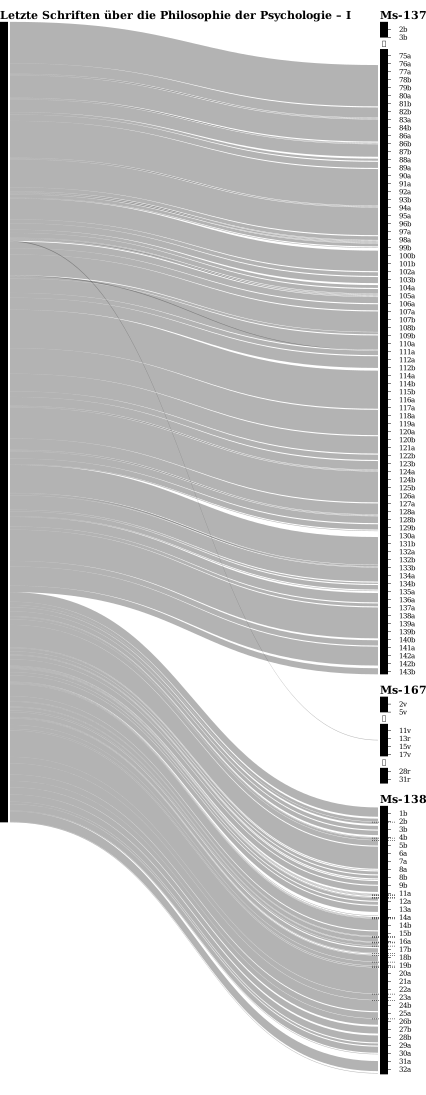
1948–1949, 1001 remarks, Ms-137, Ms-167, Ms-138
Do not quote from or cite this translation!
§Ms-137
76a[6]1 22.10.1948
Eine Sprache in der es ein Wort “sich fürchteln” gibt, welches bedeutet: sich mit Furchtgedanken quälen. – Und nun könnte man z.B. annehmen, daß dies Zeitwort keine erste Person des Präsens hat. Das Englische “I am …ing”
22.10.1948
A language in which there is a word “to be afraid” which means: to torment oneself with fearful thoughts. – And now one could, for example, assume that this verb does not have a first person in the present tense. The English “I am …ing.”
§Ms-137
76a[7] &76b[1]
2 Wenn ich Einem sage “Ich hoffe, Du wirst kommen” ist es weniger dringend, wenn das Hoffen nur 30 Sekunden gedauert hat, als wenn es 2 Minuten gedauert hätte? “Ich freue mich, daß es Dir gelungen ist!” – “Wie lange freut es Dich?” Eine seltsame Frage. Aber sie könnte Sinn haben. Die Antwort könnte sein: “Immer, wenn ich dran denke” oder “Zuerst hab ich mich nicht darüber gefreut, aber dann doch” oder “Ich denke immer wieder daran & freue mich” oder “Es fällt mir nur für Augenblicke ein, aber dann freue ich mich”, etc.. Man sagt auch “Es ist mir eine dauernde Freude”, & “Für einen Augenblick freute ich mich über sein Unglück”.
If I say to someone “I hope you will come,” is it less urgent if the hoping lasted only 30 seconds than if it lasted 2 minutes? “I am glad that you succeeded!” – “How long are you glad?” A strange question. But it could have sense. The answer could be: “Whenever I think of it,” or “At first, I wasn’t glad about it, but then I was,” or “I keep thinking about it and I’m glad,” or “It only occurs to me for moments, but then I’m glad,” etc. One also says “It is a lasting joy to me,” and “For a moment, I was glad about his misfortune.”
§Ms-137
76b[2]3 “Ich ziehe mit dem Läufer” – “Wie lange ziehst Du?”
“I move the knight” – “How long do you move it?”
§Ms-137
76b[3]4 Als Beispiel der Satzform “Wenn p, so q” bedenke: “Wenn er kommt, werde ichs ihm sagen“. Wenn er nun nicht kommt, – habe ich damit mein Versprechen gehalten? – habe ich's gebrochen? – Kann man aber sagen jener Satz behaupte einen ‘Zusammenhang’? Würde ich auf ihn antworten “Es muß nicht sein”? Es ist nicht, wie wenn der Satz gewesen wäre: “Wenn diese beiden sich treffen, gibt's eine Rauferei.” Hier wäre jene Antwort möglich.
As an example of the sentential form “If p, then q,” consider: “If he comes, I will tell him.” If he now does not come, – have I thereby kept my promise? – have I broken it? – Can one say that this sentence asserts a ‘connection’? Would I answer him with “It doesn’t have to be”? It is not as if the sentence were: “If these two meet, there will be a fight.” Here, that answer would be possible.
§Ms-137
76b[4]5 Wie, wenn aber die materielle Implikation behauptet würde (& diesen Fall gibt's!) – kann ich da auf “p ⊃ q” auch antworten “Es muß nicht sein”? Und was bedeutet das hier?
But if the material implication is asserted (& there is such a case!) – can one also answer “It does not have to be” to “p ⊃ q”? And what does that mean here?
§Ms-137
76b[5] &77a[1]
6 “Wenn sich die beiden Pole nahekommen, springt ein Funke über” – Was betrachtet man als eine Verifikation des Satzes? Die Beobachtung, daß sie sich nie nahekommen? – Läßt sich, was wir hier sagen wollen, mit der materiellen Implikation ausdrücken? Gewiß nicht; aber vielleicht mit der ‘formalen’? Doch ebensowenig. – Was wir aussagen wollen, ist doch eine Art von Naturgesetz; die Art von Beobachtung, die dazu führt, ist leicht genug vorzustellen. Man hat beobachtet, daß immer ein Funke überspringt, wenn sie einander nahekommen. – Ist der Satz vielleicht von der Art “(x)․φx ⊃ ψx:(∃x)․φx”? Wenn nicht, so muß dieser Satz doch eine Anwendung haben, wenn auch nicht die gleiche.
“When the two poles come close together, a spark jumps across” – What does one consider to be a verification of the sentence? The observation that they never come close together? – Can what we want to say here be expressed with the material implication? Certainly not; but perhaps with the ‘formal’ one? But no more than that. – What we want to state is after all a kind of law of nature; the kind of observation that leads to it is easy enough to imagine. One has observed that a spark always jumps across when they come close to each other. – Is the sentence perhaps of the kind “(x)․φx ⊃ ψx:(∃x)․φx”? If not, then this sentence must have some application, even if not the same one.
§Ms-137
77a[2]7 “Wenn er kommt, werde ich ihm sagen …” ist ein Vorsatz, ein Versprechen. Wenn es kein falsches Versprechen sein soll, darf es sich nicht auf die Gewißheit stützen, daß er nicht kommen wird. Es ist weder eine materielle noch eine formale Implikation.
“If he comes, I will tell him…” is an intention, a promise. If it is not to be a false promise, it must not be based on the certainty that he will not come. It is neither a material nor a formal implication.
§Ms-137
77a[3]8 Bei einer wissenschaftlichen bedingten Vorhersage könnte man Berechtigung & Richtigkeit unterscheiden. Man konnte sie “berechtigt” nennen, wenn sie aus einer so & so begründeten Theorie folgt, hervorgeht. Wenn also der Vordersatz nicht zutrifft, so kann man dann sagen: wäre er zugetroffen, so wäre ‥‥‥ Nicht das aber gibt mir dazu ein Recht, daß der Vordersatz sich nicht bewahrheitet hat.
In the case of a scientific conditional prediction, one could distinguish between warrant & correctness. One could call it “warranted” if it follows from a theory that is justified in such & such a way. So, if the antecedent does not hold true, then one can say: were it to hold true, then it would be ‥‥‥ But that does not give one the right to say that the antecedent has not come true.
§Ms-137
77a[4] &77b[1]
9 Ein Satz wie der “Jeder Körper bewegt sich ‥‥․” (Trägheitsgesetz), muß er in der Form “wenn – so” gefaßt werden? “Wenn etwas ein Körper ist, so bewegt es sich ‥‥․” – Oder muß es heißen: “Es gibt Körper; & wenn etwas ein Körper ist, so ‥․?” (Niemand würde daran denken, es so auszudrücken.)
Must a sentence like “Every body is in motion…” (the law of inertia) be formulated in the form “if – then”? “If something is a body, then it is in motion…” – Or must it say: “There are bodies; and if something is a body, then…?” (No one would think of expressing it that way.)
§Ms-137
77b[2]10 23.10.1948
Es ist offenbar, daß man einen Furchtbegriff einfach zur Anwendung auf Tiere haben könnte, & daß dem Begriffswort die erste Person fehlen würde. Seine dritte Person würde sehr ähnlich der dritten Person von “fürchten” verwendet.
23.10.1948
It is obvious that one could simply have an application of the concept of “fear” to animals, & that the term would lack the first person. Its third person would be used very similarly to the third person of “to fear.”
§Ms-137
77b[3]11 24.10.1948
Erinnre Dich, daß der Konjunktiv keinen Sinn hat, außer im Konditionalsatz. Wenn Einer sagt “Ich hätte dieses Spiel gewonnen”, wird man fragen: “Wenn –?”
24.10.1948
Remember that the subjunctive has no sense except in a conditional sentence. If someone says “I would have won this game,” one will ask: “If –?”
§Ms-137
77b[4]12 Nichts schwerer, als die Begriffe vorurteilsfrei betrachten. Denn das Vorurteil ist ein Verständnis. Und darauf verzichten, wenn uns eben daran so viel liegt, –.
There is nothing more difficult than considering concepts without prejudice. For prejudice is a kind of understanding. And to give up on that, when it is precisely what matters to us, –.
§Ms-137
77b[5]13 Das Englische “I'm furious” ist kein Ausdruck der Selbstbetrachtung. Ähnlich im Deutschen “Ich bin wütend”; aber nicht “Ich bin zornig”. (Entsetzlich wechselt mir der Grimm im Busen ‥‥”. Es ist ein Zittern des Grimms.)
The English “I’m furious” is not an expression of self-observation. Similarly in German, “Ich bin wütend”; but not “Ich bin zornig”. (“Horribly, my fury changes in my breast ‥‥”. It is a trembling of fury.)
§Ms-137
77b[6] &78a[1]
14 Man fragt sich “Was bedeutet ‘ich fürchte mich’ eigentlich? Was denke ich dabei ?”. Und es kommt natürlich keine Antwort, oder eine die offenbar nicht genügt Die Frage ist: “In welcher Art Zusammenhang steht es?”
One asks oneself: “What does ‘I am afraid’ actually mean? What am I thinking?” And, of course, no answer comes, or one that clearly does not suffice. The question is: “In what kind of context is it?”
§Ms-137
78a[2]15 Man könnte auch sagen: “Ich sage es einfach”. Denn dies heißt nur: Kümmre Dich nicht um etwas, was das Reden begleitet.
One could also say: “I just say it.” For this only means: Don’t worry about something that accompanies the speaking.
§Ms-137
78a[3]16 Kann nun die Äußerung nicht in verschiedenen Zusammenhängen stehen? die ihr einmal das eine, einmal das anderes Gesicht geben?
Can the utterance not stand in different contexts? Which give it one face one time, and another face another time?
§Ms-137
78a[4]17 Ich sage “Ich fürchte mich ‥‥”, der Andre fragt mich “Was wolltest Du damit? War es wie ein Ausruf; oder hast Du auf Deinen Zustand in den letzten Stunden angespielt; wolltest Du hier einfach eine Mitteilung machen?” Kann ich ihm immer eine klare Antwort geben? Kann ich ihm nie eine geben? – Ich werde manchmal sagen müssen: “Ich habe daran gedacht, wie ich den heutigen Tag verbracht habe & gleichsam unwillig meinen Kopf über mich geschüttelt” – manchmal aber: “Es hieß: O Gott! wenn ich mich nur nicht so fürchtete!” – oder: “Es war nur ein Schrei der Furcht” – oder: “Ich wollte, daß Du weißt, wie mir zu Mute ist.” – Es folgen der Äußerung ja wirklich manchmal solche Explikationen. Aber man könnte sie doch nicht immer geben.
I say “I am afraid…,” the other person asks me: “What did you mean by that? Was it like an exclamation; or did you allude to your state in the last few hours; did you simply want to communicate something?” Can I always give him a clear answer? Can I never give him one? – I will sometimes have to say: “I thought about how I spent today and, as it were, shook my head at myself” – but sometimes: “It was: Oh God! If only I weren’t so afraid!” – or: “It was just a cry of fear” – or: “I wanted you to know how I feel.” – Such explanations really do sometimes follow the utterance. But one could not always give them.
§Ms-137
78a[5] &78b[1]
18 Man könnte sich Menschen denken, die gleichsam viel bestimmter dächten als wir, & eine Menge verschiedener Wörter gebrauchten, einmal das eine, einmal das andere.
One could imagine people who, as it were, think much more precisely than we do, and who use a lot of different words, sometimes the one, sometimes the other.
§Ms-137
78b[2]19 Nichts ist doch wichtiger, als die Bildung von fiktiven Begriffen, die uns die unseren erst verstehen lehren.
Nothing is more important than the formation of fictional concepts, which teach us to understand our own concepts.
§Ms-137
78b[3]20 “Was ist Furcht?” – “Die Erscheinungen & Anlässe der Furcht sind diese: – – –” “Ist also “Ich fürchte mich – – –” eine Beschreibung meines Zustandes?” Es kann in einem solchen Zusammenhang & mit einer solchen Absicht gebraucht werden. Aber wenn ich Einem z.B. einfach meine Befürchtung mitteilen will, so ist es keine solche Beschreibung.
“What is fear?” – “The phenomena & occasions of fear are these: – – –” “So is ‘I am afraid – – –’ a description of my state?” It can be used in such a context & with such an intention. But if I simply want to communicate my fear to someone, then it is not such a description.
§Ms-137
78b[4]21 25.10.1948
“Ich fürchte mich” kann z.B. einfach zur Erklärung meiner Handlungsweise gesagt werden. Es ist dann weit entfernt ein Stöhnen zu sein, kann sogar lächelnd gesagt werden.
October 25, 1948
“I am afraid” can, for example, simply be said to explain my way of acting. It is then far from being a moan; it can even be said with a smile.
§Ms-137
78b[5]22 [→ ] Man fragt sich “Was bedeutet ‘ich fürchte mich’ eigentlich, worauf ziele ich (damit)?” Und es kommt natürlich keine Antwort, oder eine, die nicht genügt. Die Frage ist: “In welcher Art Zusammenhang steht es?”
One asks oneself: “What does ‘I am afraid’ actually mean, what do I aim at (with it)?” And, of course, no answer comes, or one that is not sufficient. The question is: “In what kind of context is it?”
§Ms-137
78b[6] &79a[1]
23 Es kommt keine Antwort, wenn man die Frage “Worauf ziele ich”, “Was denke ich dabei”, etc. dadurch beantworten will daß ich die Worte sage & dabei auf mich achtgebe, aus dem Augenwinkel gleichsam dabei meine Seele beobachte. Ich kann aber allerdings in einem besonderen Fall fragen: “Warum habe ich das gesagt, was wollte ich damit?” & könnte die Frage auch beantworten, aber nicht auf Grund einer Beobachtung von Begleiterscheinungen des Sprechens. Und meine Antwort würde die frühere Äußerung ergänzen, paraphrasieren.
No answer comes if one wants to answer the question “What do I aim at,” “What am I thinking,” etc., by saying the words and, as it were, paying attention to oneself from the corner of one’s eye, observing one’s mind. However, I can, in a particular case, ask: “Why did I say that, what did I want with it?” and could also answer the question, but not on the basis of an observation of the accompanying phenomena of speaking. And my answer would supplement the earlier utterance, paraphrase it.
§Ms-137
79a[2]24 Was ist Furcht? Was heißt “sich fürchten”? Wenn ich's mit einem Zeigen erklären wollte – würde ich die Furcht spielen.
What is fear? What does it mean to “be afraid”? If I wanted to explain it by means of one example, I would play fear.
§Ms-137
79a[3]25 Könnte ich Hoffen auch so darstellen? Kaum. Oder gar Glauben?
Could I also represent hope in this way? Hardly. Or even belief?
§Ms-137
79a[4]26 “Ich glaube, er wird kommen.” “Ich sage mir immer wieder: ‘Er wird kommen’.” Für das zweite könnten Leute ein eigenes Verbum haben.
“I think he will come.” “I keep saying to myself: ‘He will come.’” For the second one, people might have their own verb.
§Ms-137
79a[5]27 Meinen Seelenzustand (der Furcht etwa) beschreiben, das tue ich in einem ganz bestimmten Zusammenhang. (Wie eine bestimmte Handlung nur in einem bestimmten Zusammenhang ein Experiment ist. Ist es denn so erstaunlich, daß ich den gleichen Ausdruck in verschiedenen Spielen verwende? Und manchmal auch gleichsam zwischen den Spielen? “Ich dachte an ihn” & “Ich dachte über ihn nach” bedeutet doch sehr Verschiedenes.
Describing my state of mind (e.g., fear) is something I do in a very specific context. (Just as a particular action is only an experiment in a specific context. Is it really so surprising that I use the same expression in different games? And sometimes even as if between the games? “I was thinking of him” & “I was thinking about him” means something quite different.
§Ms-137
79a[6]28 Und rede ich denn immer mit sehr bestimmter Absicht? – Und ist darum, was ich sage, sinnlos?
And do I always speak with a very specific intention? – And is what I say therefore senseless?
§Ms-137
79b[1]29 “Now you mention it: I think he'll come”. Ich glaube jetzt, Du hast recht: er würde kommen.” “Nein. Ich bin davon überzeugt: er wird kommen.” Man kann sich bei allen solchen Ausdrücken einen Zusammenhang ausdenken.
“Now that you mention it: I think he’ll come.” I believe now, you are right: he would come.” “No. I am convinced: he will come.” One can imagine a context for all such expressions.
§Ms-137
79b[2]30 Was gehört dazu, daß man einen Seelenzustand beschreibt? – Oder könnte ich fragen: Was gehört dazu, daß man seinen Seelenzustand beschreiben will?
What does it take to describe a state of mind? – Or might I ask: what does it take to want to describe one’s state of mind?
§Ms-137
79b[3]31 Man könnte auch fragen: “Worauf muß es mir dann ankommen?”
One could also ask: “What must it depend on then?”
§Ms-137
79b[4]32 Ich wollte Dir meinen Seelenzustand beschreiben” – etwa im Gegensatz dazu “Ich wollte nur meinen Gefühlen Luft machen”. Ich wollte also, daß er weiß ‘wie mir's zumute ist’ (damit hängt oft die Angabe der Dauer des Zustands zusammen).
I wanted to describe my state of mind to you” – as opposed to “I just wanted to give vent to my feelings.” So I wanted him to know ‘how I feel’ (which often involves stating the duration of the state).
§Ms-137
79b[5]33 Es ist doch etwas anderes: die Furcht ruhig gestehen – & ihr ungehemmten Ausdruck geben. Die Worte können dieselben sein, der Ton & die Gebärden verschieden.
It is, after all, something else: calmly admitting one’s fear – & giving it free expression. The words may be the same, but the tone & the gestures are different.
§Ms-137
79b[6]34 Wenn es in einer Leichenrede heißt “Wir trauern um unsern ‥‥․” so soll das doch der Trauer Ausdruck geben; nicht uns etwas mitteilen. Aber in anderer Umgebung sind diese Worte eine Mitteilung. In einem Gebet am Grabe könnten sie auch eine Art von Mitteilung sein.
When, in a eulogy, it says “We mourn our ‥‥․,” this is meant to give expression to the grief; not to communicate something to us. But in a different context, these words are a communication. In a prayer at the graveside, they could also be a kind of communication.
§Ms-137
79b[7] &80a[1]
35 Wir sagen doch nicht unbedingt von Einem er klage, weil er sagt er habe Schmerzen. Also können die Worte “Ich habe Schmerzen” eine Klage & auch etwas anderes sein. (Und ähnlich ist es mit dem Ausdruck der Furcht & anderer Gemütsbewegungen.)
We don’t necessarily say that one is complaining simply because one says one is in pain. Thus, the words “I am in pain” can be a complaint & also something else. (And it is similar with the expression of fear & other emotional states.)
§Ms-137
80a[2]36 Ist aber “Ich fürchte mich” nicht immer etwas einer Klage ähnliches, warum soll es dann immer eine Beschreibung meines Seelenzustands sein? Was ist denn eine Klage?
But if “I am afraid” is always something similar to a complaint, why should it always be a description of my state of mind? What is a complaint?
§Ms-137
80a[3]37 Denn wodurch unterscheidet sich die Klage “Ich habe Schmerzen” von der bloßen Mitteilung? Doch durch die Absicht. Und die wird sich vielleicht auch im Ton ausdrücken.
Because what distinguishes the complaint “I have pain” from a mere communication? It is the intention. And this will perhaps also be expressed in the tone.
§Ms-137
80a[4]38 Die Umstände in denen ein Satz steht sind am besten in einem Drama dargestellt, daher das beste Beispiel für den Ausdruck in einer bestimmten Bedeutung ein Zitat aus einem Drama ist. Und wer fragt die Person im Drama, was sie während des Sprechens erlebt?
The circumstances in which a sentence stands are best represented in a drama, hence the best example of expression in a specific meaning is a quote from a drama. And who asks the person in the drama what he experiences while speaking?
§Ms-137
80a[5]39 26.10.1948
“Du mußt wissen, – ich fürchte mich.” “Du mußt wissen, – mir graut davor.” Ja, man kann es auch in lächelndem Ton sagen.
October 26, 1948
“You must know – I am afraid.” “You must know – I am apprehensive.” Yes, one can also say it in a smiling tone.
§Ms-137
80a[6] &80b[1]
Und willst Du mir sagen, er spürt das nicht? Wie weiß er's denn sonst? – Aber auch wenn es eine Mitteilung ist, liest er's doch nicht von seinem Innern ab. Er könnte auch dann nicht zum Beweis seiner Aussage seine Empfindungen anführen. Sie lehren ihn's nicht.
And do you want to tell me that he doesn’t feel it? How else would he know it? – But even if it is a communication, he doesn’t read it off from his inner self. He couldn’t even then use his sensations as proof for his statement. They don’t teach it to him.
§Ms-137
80b[2]40 Denn denk Dir die Empfindungen hervorgerufen durch die Gebärden des Grauens: die Worte “mir graut davor” sind ja auch so eine Gebärde, & wenn ich ihre Äußerung höre & fühle, gehört dies zu jenen übrigen Empfindungen. Warum soll denn die ungesprochene Gebärde die gesprochene motivieren?
For consider the sensations evoked by the gestures of horror: the words “I am horrified” are also a gesture, & when I hear & feel their utterance, this belongs to those other sensations. Why should the unspoken gesture motivate the spoken one?
§Ms-137
80b[3]41 [→ ] Wir lernen das Wort “denken” gebrauchen unter bestimmten Umständen. Sind die Umstände andere, so wissen wir's nicht zu gebrauchen. – Darum müssen wir aber jene Umstände nicht beschreiben können.
[→ ] We learn to use the word “thinking” under certain circumstances. If the circumstances are different, we do not know how to use it. – But that does not mean that we must be able to describe those circumstances.
§Ms-137
80b[4]42 “Wenn die Menschen in ihren Farbaussagen stark auseinandergingen, könnten sie unsern Farbbegriff nicht verwenden.” – Wenn die Menschen in ihren Farbaussagen stark auseinander gingen, dann würden sie, eben dadurch, unsern Farbbegriff nicht verwenden. Sie würden nicht unser Sprachspiel spielen: Denn bedenk doch, wie man das ihre & das unsre zu vergleichen hätte!
---
“If people strongly disagreed in their color statements, they could not use our concept of color.” – If people strongly disagreed in their color statements, then, precisely because of that, they would not use our concept of color. They would not be playing our language-game: for consider how one would have to compare theirs and ours!
---
§Ms-137
80b[5] &81a[1]
43 Wenn ich also Einen sagen höre “Ich fürchte mich”, wie kann ich erfahren ob dies die ‘Beschreibung eines Seelenzustands’ oder was sonst ist? Soll ich ihn fragen, & wird er die Frage gewiß verstehen? – Aber er könnte sie doch beantworten. Wie? Z.B. so: “Nein; ich habe mir nur Luft gemacht”, oder “Ja; ich will, daß Du weißt, wie ich mich fühle.” Aber so eine Frage wird man doch so gut wie nie stellen. Ist es nicht, weil der Ton & der Zusammenhang uns die Antwort geben müssen? Denn aus diesen wird man ersehen, ob er sich etwa über seine eigene Furcht lustig macht; ob er sie, sozusagen, in sich entdeckt; ob er sie mir unwillig aber um der Offenheit willen, gesteht; ob er sie wie einen Schrei äußert, etc. – Und unterrichten mich die Worte, wie immer sie geäußert sind, nicht über denselben Sachverhalt, nämlich seinen Seelenzustand?
So, when I hear someone say “I am afraid,” how can I know whether this is a ‘description of a state of mind’ or something else? Should I ask him, & will he certainly understand the question? – But he could answer it. How? For example, like this: “No; I just let off some steam,” or “Yes; I want you to know how I feel.” But such a question is hardly ever asked. Isn’t it because the tone & the context must provide the answer? For from these, one can see whether he is, for example, making fun of his own fear; whether he is, as it were, discovering it within himself; whether he is confessing it to me unwillingly but for the sake of openness; whether he is expressing it like a cry, etc. – & don’t the words, however they are uttered, instruct me about the same state of affairs, namely his state of mind?
§Ms-137
81a[2]44 Hat denn der Satz “Napoleon wurde im Jahr 1804 gekrönt” einen andern Sinn, jenachdem ich ihn Einem zur Information sage; oder in der Geschichtsprüfung um zu zeigen, was ich weiß; oder etc. etc.? Um ihn zu verstehen müssen mir doch für alle diese Zwecke die Bedeutungen seiner Wörter auf die gleiche Art erklärt werden. Und wenn also die Bedeutung der Wörter & ihre Zusammenstellung den Sinn des Satzes ausmachen, – – –.
Does the sentence “Napoleon was crowned in 1804” have a different meaning depending on whether I say it to someone to inform him, or in a history exam to show what I know, or etc. etc.? In order to understand it, the meanings of its words must be explained to me in the same way for all these purposes. And if the meaning of the words and their combination constitute the meaning of the sentence, – – –.
§Ms-137
81a[3]45 Das Problem ist doch dies: Der Schrei, den man keine Beschreibung nennen kann, der primitiver ist als jede Beschreibung, tut gleichwohl den Dienst einer Beschreibung des Seelenzustands
The problem is this: the cry, which cannot be called a description, which is more primitive than any description, nevertheless serves the purpose of a description of the state of mind.
§Ms-137
81a[4]46 27.10.1948
Wer schreien kann, der kann damit noch nicht einem etwas im Gespräch mitteilen.
October 27, 1948.
Whoever can cry can’t necessarily communicate something to someone in conversation by doing so.
§Ms-137
81a[5] &81b[1]
47 Ich höre, daß Einer sagt “ich fürchte mich”. Ich frage: “In welchem Zusammenhang hast Du das gesagt? War es ein Stoßseufzer, war es ein Geständnis, war es Selbstbeobachtung, ‥‥․?”
I hear someone say, “I am afraid.” I ask: “In what context did you say that? Was it a gasp, was it a confession, was it self-observation, ‥‥․?”
§Ms-137
81b[2]48 Will, wer “Hilfe!” ruft beschreiben, wie's ihm zumute ist? Nichts ist ihm ferner, als etwas zu beschreiben.
Does someone who cries “Help!” want to describe how they feel? Nothing is further from their intention than to describe something.
§Ms-137
81b[3]49 Aber es gibt Übergänge von dem, was wir nicht Beschreibung nennen würden, zu dem, was wir Beschreibung nennen würden.
But there are transitions from what we would not call a description to what we would call a description.
§Ms-137
81b[4]50 Das Wort “Beschreibung des Seelenzustands” charakterisiert ein gewisses Spiel. Und wenn ich bloß die Worte “Ich fürchte mich” höre, so mag ich zwar erraten, welches Spiel hier gespielt wird (aus dem Ton etwa), aber ich werde es erst wissen, wenn ich den Zusammenhang kenne.
The phrase “description of a state of mind” characterizes a certain game. And if I only hear the words “I am afraid,” I may indeed guess what game is being played here (from the tone, for example), but I will only know it when I know the context.
§Ms-137
81b[5]51 Denn zu dem, was wir “beschreiben” nennen gehört eines oder das andere einer Klasse von Merkmalen. Das beobachtende, überlegende, erinnernde Verhalten, ein Trachten nach Genauigkeit, die Fähigkeit des Verbesserns, das Vergleichen. Ein Schrei ist keine Beschreibung. Aber es gibt Übergänge. Und die Worte “Ich fürchte mich” können näher & weiter von einem Schrei sein. Sie können ihm ganz nahe liegen & ganz weit von ihm entfernt sein.
For what we call “describing” includes one or another of a class of characteristics. The observing, considering, remembering behavior, an effort for accuracy, the ability to improve, the comparing. A cry is not a description. But there are transitions. And the words “I am afraid” can be closer to or further from a cry. They can be very close to it and very far from it.
§Ms-137
82a[2]52 [→ ] Wenn ein feines Aufhorchen mir zeigt, daß ich in jenem Spiel das Wort “weiche” bald so, bald so erlebe, – zeigt es mir nicht auch, daß ich, im Zusammenhang eines ganzen Satzes, den ich verstehe & in irgend einem Sinne erlebe, jenes Wort selbst oft gar nicht erlebe
[→] If a careful listening shows me that in that game I experience the word “soft” sometimes so, sometimes so, – doesn’t it also show me that, in the context of an entire sentence, which I understand and experience in some sense, I often don’t experience that word itself?
§Ms-137
82a[3]53 “Mir stand die Bedeutung des Wortes vor der Seele” – Wird man denn das sagen, wenn das Wort im unzweideutigen Zusammenhang steht?
“The meaning of the word was present in my mind.” – Would one say that if the word is in an unambiguous context?
§Ms-137
82a[4]54 Eine Schrift in der das durchgestrichene Wort, der durchgestrichene Satz ein Zeichen ist.
A script in which the crossed-out word, the crossed-out sentence, is a sign.
§Ms-137
82a[5]55 Du versicherst doch, das Wort, wie Du es jetzt ausgesprochen hast, so ‘gemeint’ erlebt zu haben: Dann sag doch auch mit dem gleichen feinen Gefühl, ob Du dieses Wort im rechten Zusammenhang, in diesem Sinne, so meinst. Denn daß Du's in anderm Sinne so & nicht so meinst, intendierst, später wohl auch erklärst, ist ja klar.
You claim that you experienced the word, as you pronounced it just now, in that way. Then, with the same keen feeling, say whether you intend this word in the correct context, in this sense. For the fact that you intend it in another sense so and not so, and will probably explain that later, is clear.
§Ms-137
82a[6]56 Aber es bleibt dann die Frage, warum wir bei dem Spiel des Meinens auch von einem ‘meinen’ reden. – Das ist eine Frage anderer Art. Es ist eben die Erscheinung des Spiels, daß wir hier in einem nur endlichen Sinn von einem ‘Meinen’ reden.
But then the question remains, why, in the game of intending, we also talk about an ‘intention’. – That is a question of a different kind. It is precisely the phenomenon of the game that we talk about an ‘intention’ only in a finite sense.
§Ms-137
82b[1]Das ist eine Frage von anderer Art ‒ ‒ Es ist (eben) die Erscheinung des Spiels, daß wir in dieser Situation sagen, wir hätten das Wort so gemeint & diesen Ausdruck aus dem andern Sprachspiel herübernehmen. Es muß eine Frage vorhergegangen sein. Das ist eine Frage einer fremden Art. Das ist eine ungehörige Frage; gleichsam anderer Rasse.
This is a question of a different kind. It is precisely the phenomenon of the language-game that in this situation we say that we meant the word in that way & transfer this expression from another language-game. A question must have preceded it. This is a question of a different kind. This is an improper question; as if it were of a different race.
§Ms-137
82b[2]57 28.10.1948
Es ist als stellte man in einem Buch über reine Mathematik eine Frage der Physik als die, die du stellen wolltest? Ist es denn ein Mißverständnis? Ich verwende ja nun das Wort nicht für etwas anderes; sondern in einer andern Situation. [Wie ich auch nicht zweierlei mit dem Worte “Wissen” bezeichne, wenn ich sage “Ich wußte im Traum. Vgl. auch Gefühl der Unwirklichkeit.] Wird mir denn die Technik seiner Anwendung hier anders beigebracht?
28.10.1948
Is it as if one were posing a question of physics in a book on pure mathematics, as if that were the question you wanted to ask? Is it a misunderstanding? I am not using the word for something else, but in a different situation. [Just as I do not use the word “knowledge” in two different ways when I say “I knew it in a dream.” Cf. also the feeling of unreality.] Is the technique of its application taught to me differently here?
§Ms-137
82b[3]58 Ich höre ein Beethoven'sches Werk & sage “Beethoven!” – Hat das Wort hier eine andere Bedeutung, als in dem Satz “Beethoven wurde im Jahre 1770 zu Bonn geboren”? (Wer den Ton des Ausrufs nicht verstünde, könnte man ihn etwa erklären: “So schreibt nur Beethoven”.)
I hear a Beethoven piece & say “Beethoven!” – Does the word have a different meaning here than in the sentence “Beethoven was born in Bonn in 1770”? (If one did not understand the tone of the exclamation, one could perhaps explain it: “Only Beethoven would write like that.”)
§Ms-137
82b[4]59 Wäre es richtiger zu sagen dem e ‘entspreche’ gelb, als “e ist gelb”? ist es nicht eben der Witz des Spiels, daß wir sagen e sei gelb, Ja, wenn es Einen gäbe, der geneigt ist zu sagen, dem e ‘entspreche’ gelb & nicht, es sei gelb, wäre der nicht vom Andern beinahe so verschieden, wie Einer, für den Vokale & Farben nicht zusammenhängen? Und ähnlich für das Erleben der Bedeutung.
Would it be more correct to say that e ‘corresponds’ to yellow, rather than “e is yellow”? Isn’t it precisely the trick of the language-game that we say e is yellow? Yes, if there were someone who was inclined to say that e ‘corresponds’ to yellow & not that it is yellow, would he not be almost as different from the other as someone for whom vowels & colors are not connected? And similarly for the experience of meaning.
§Ms-137
82b[5]60 Wenn ich beim Lernen des Wortes “Bank”, & um mir seine doppelte Bedeutung einzuprägen, abwechselnd auf das Bild der Sitzbank & der Geldbank schaute & immer sagte “Bank”, oder “Das ist eine Bank”, – fände hier das ‘Bedeutungserlebnis’ statt? Da gewiß nicht, möchte ich sagen. Wenn es mir aber z.B. im Ton der Aussprache zu liegen schiene, daß ich das eine, oder andere meine, – dann schon.
If, when learning the word “bank,” & in order to impress its double meaning upon myself, I alternately looked at the picture of a bench & a money bank & always said “bank,” or “This is a bank,” – would the ‘experience of meaning’ take place here? Certainly not, I would say. But if, for example, it seemed to me that the tone of my pronunciation indicated that I meant one or the other, – then yes.
§Ms-137
83a[1]61 [→ ] Es ist ja nicht, als würden da zwei Dinge hartnäckig mit demselben Wort bezeichnet, & man fragte: Warum tut man das, wenn sie wirklich verschieden sind? – Der neue Gebrauch besteht ja gerade darin, daß der alte Ausdruck in einer neuen Situation verwendet wird; nicht zur Bezeichnung für etwas neues.
[→] It is not as if two things were persistently designated with the same word, & one asked: Why does one do this, if they are really different? – The new use consists precisely in the fact that the old expression is used in a new situation; not to designate something new.
§Ms-137
83a[2]62 Das Erlebnis des ‘treffenden Worts’. Ist dies dasselbe, wie das Erleben des ‘Meinens’?
The experience of the ‘appropriate word’. Is this the same as the experience of ‘meaning’?
§Ms-137
83a[3]63 “Warum nennt man dies im Traum ein ‘Wissen’?” – Man nennt ja nichts im Traum ein Wissen, sondern sagt “ich wußte im Traume ‥‥” Warum nennt man dies “meinen” & “bedeuten”, wenn es sich nicht um meinen & bedeuten handelt? – Was nenne ich denn im Spiel ein ‘Meinen’ (oder ‘Bedeuten’): ich sage “ich habe mit dem Wort jetzt ‥‥․ gemeint”.
“Why does one call this a ‘knowledge’ in a dream?” – One does not call anything a knowledge in a dream, but says “I knew in my dream ‥‥” Why does one call this ‘meaning’ & ‘meaning,’ when it is not about meaning? – What do I call a ‘meaning’ in the language-game: I say “I meant this with the word now ‥‥․”
§Ms-137
83a[5]Aber was nenne ich denn so? – Ein Erlebnis? Und welches Erlebnis? Kann ich's denn anders beschreiben, als eben durch den Ausdruck: ich ‘meine’ jetzt dieses Wort so?
But what do I call it? – An experience? And which experience? Can I describe it in any other way than through the expression: I ‘mean’ this word in this way now?
§Ms-137
83a[4]64 Ich kann also nicht sagen: Ich benenne eben zwei verwandte Dinge mit demselben Wort. (Denn sonst wäre ja das Problem nie entstanden.)
So I cannot say: I simply designate two related things with the same word. (For otherwise the problem would never have arisen.)
§Ms-137
83a[6] &83b[1]
65 “Warum reden wir bei jenem Spiel auch von einem ‘Meinen’?” – Wonach frage ich? Nach einem Grund, nach einer Ursache? – Gewiß nicht nach einer Überlegung, die mich bestimmt, so zu reden; noch nach einer Rechtfertigung; denn um nichts solches handelt es sich.
“Why do we also talk about a ‘meaning’ in that language-game?” – What am I asking for? For a reason, for a cause? – Certainly not for a consideration that determines me to speak like this; nor for a justification; for it is not about anything of the sort.
§Ms-137
83b[2]66 29.10.1948
[→ ] Nenn es einen Traum!
29.10.1948
[→] Call it a dream!
§Ms-137
83b[3]67 Aber es bleibt dann die Frage warum verwendet Einer im Spiel des ‘Meinens’ auch das Wort “Meinen”? Kann er denn ein anderes verwenden? Verwendet er denn dasselbe Wort für: etwas Anderes? Könnte er eine andere Erklärung davon geben?
But then the question remains, why does one, in the game of ‘meaning’, also use the word “meaning”? Could one use a different word? Does one use the same word for: something else? Could one give a different explanation of it?
§Ms-137
83b[4]68 Nenn es einen Traum. Es ändert nichts.
Call it a dream. It changes nothing.
§Ms-137
83b[5]69 30.10.1948
“Schubert” – Es ist, als ob der Name ein Eigenschaftswort wäre.
[→ ] Man kann ja auch nicht sagen: “Sieh, was alles ‘paßt’. Es paßt auch z.B. der Name zum Träger.” [→ ] Ein Anbau wäre doch eine Erweiterung; & eine Erweiterung ist ja hier gerade nicht. Denn man nennt ja nicht ein ‘Zusammenpassen’, was eigentlich kein Zusammenpassen ist. Als dehnte man nur diesen Begriff aus. Sondern es liegt hier gleichsam eine Täuschung vor, eine Spiegelung. Wir glauben zu sehen, was nicht da ist. Aber es ist nur gleichsam so. – Wir wissen sehr wohl, daß der Name “Schubert” zu seinem Träger & zu Schuberts Werken in keiner Beziehung des Passens steht; & doch sind wir unter einem Zwang, uns so auszudrücken.
30.10.1948
“Schubert” – It is as if the name were an adjective.
[→ ] One cannot say, “Look at all that fits. For example, the name also fits the bearer.” [→ ] An addition would be an extension; & an extension is precisely what is not the case here. Because one does not call a ‘fitting together’ what is actually not a fitting together. It is as if one were merely extending this concept. Rather, there is something like a deception, a reflection. We believe we are seeing what is not there. But it is only as if so. – We know very well that the name “Schubert” has no relationship of fitting to its bearer & to Schubert’s works; & yet we are under compulsion to express ourselves in this way.
§Ms-137
83b[6] &84a[1]
70 Man sieht etwas unter dem Bild, unter dem Begriff, des Passens. Ich kann doch Eins als Variation eines Andern sehen. Und nun könnte im äußersten Fall doch das was ich als Variation sehe mit dem, als dessen Variation ich's sehe, gar keine Ähnlichkeit mehr haben. – Sagen wir's so: Erst ist diese Figur eine einfache Projektion jener. Dann krümmen sich die Projektionsstrahlen etwas; aber es ist für mich doch noch eine Projektion. Endlich verbiegen sie sich bis zur Unkenntlichkeit, aber für mich ist das noch immer die Projektion (Wie Manche im Alten immer noch den Jungen sehen, im völlig veränderten Menschen immer noch den frühern.) Es ist vielleicht seltsam den Fall des Personennamens damit in Zusammenhang zu bringen. Aber man kann einen Zusammenhang machen. Nämlich den: Man sehe eben den Personennamen als Bildnis.
One sees something under the image, under the concept, under the idea of fitting. One can see one thing as a variation of another. And now, in the most extreme case, what one sees as a variation may have no similarity at all with what it is seen as a variation of. – Let's put it this way: first, this figure is a simple projection of that. Then the projection rays curve a little; but for me, it is still a projection. Finally, they twist to the point of being unrecognizable, but for me, it is still the projection (As some still see the young in the old, in the completely changed person, they still see the former person). It may seem odd to connect the case of the personal name with this. But one can make a connection. Namely, one sees the personal name as an image.
§Ms-137
84a[2]71 Nehmen wir an, ich sehe ein Dreieck als Quadrat, indem ich es als das Ende einer Veränderung sehe:

– Dann gehört die Art des Variierens zum gesehenen Aspekt. Aber so etwas liegt ja eben nicht vor, wenn uns der Name das Bildnis des Trägers zu sein scheint.
Suppose I see a triangle as a square, by seeing it as the end of a change:
– Then the type of variation belongs to the seen aspect. But this is not what is happening when the name seems to be the image of the bearer.
§Ms-137
84a[3]72 Ich sage etwas (z.B. “Der Name ‘Schubert’ paßt doch vollkommen zum Schubert”) – es heißt nichts.
I say something (e.g. “The name ‘Schubert’ fits perfectly with Schubert”) – it means nothing.
§Ms-137
84a[4] &84b[1]
73 Der Satz “Der Name ‥‥ paßt auf ‥‥” ist, wie wir ihn gebrauchen, keine Mitteilung über den Namen, oder seinen Träger. Er ist eine pathologische Mitteilung über den Mitteilenden. – Man lehrt ein Kind nicht, daß dieser Name auf den Menschen paßt.
The sentence “The name ‥‥ fits ‥‥” is, as we use it, not a communication about the name, or its bearer. It is a pathological communication about the communicator. – One does not teach a child that this name fits the person.
§Ms-137
84b[2]74 31.10.1948
Einer winkt (mir) mit der Hand. “Was wolltest Du?” – “Ich wollte, daß Du kommst.” Das ist die Absicht zur Zeit des Wirkens. Das Zeichen war der Ursprung einer Bewegung. War es also nicht auch der Ursprung der Erklärung? Konnte nun diese Erklärung selber lauten: “Das Winken mit der Hand war der Ursprung der Erklärung, die ich Dir jetzt gebe: “Komm zu mir”?
October 31, 1948
Someone waves (to) me. “What did you want?” – “I wanted you to come.” That is the intention at the time of the action. The sign was the origin of a movement. Was it not also the origin of the explanation? Could this explanation itself be: “The waving with the hand was the origin of the explanation that I am giving you now: ‘Come to me’?”
§Ms-137
84b[3]75 02.11.1948
Man konnte hier nicht sagen “Er [der Name] paßt nicht geradezu”, oder “Er scheint nicht geradezu zu passen”.
02.11.1948
One could not say here “He [the name] does not quite fit”, or “He does not seem to quite fit”.
§Ms-137
84b[4]Es ist nicht, als ob “passen” nicht ganz das rechte Wort wäre. Man könnte allerdings auch andere Wörter gebrauchen; z.B. “Es ist eine Verwandtschaft da”.
“Das, was immer assoziiert ist, hält man leicht für verwandt. Ist das der richtige Ausdruck? Nicht ganz. Aber es ist, als wären sie verwandt.
It is not as if “to fit” is not quite the right word. One could, however, also use other words; for example, “There is a kinship there.”
“What is always associated, one readily takes to be related. Is that the right expression? Not quite. But it is as if they are related.
§Ms-137
84b[5]76 Es ist nicht so: “Ich halte sie für verwandt, obwohl sie's nicht sind” – denn ich brauche, gleichsam, nur aufzuwachen, um zu wissen, daß sie's nicht sind. Aber ich sehe sie unter dem Bild der Verwandtschaft. Ich gebrauche das Wort, das Bild. –
It is not that: “I consider them to be related, even though they are not” – for I need only, as it were, wake up in order to know that they are not. But I see them under the image of kinship. I use the word, the image. –
§Ms-137
85a[1]Man kann freilich erklären: Zusammenpassen & Assoziation im Gebrauch gehen oft zusammen; & daher jene Täuschung (wenn man es Täuschung nennen soll).
One can, of course, explain: Fitting together and association often go together in use; and therefore that deception (if one wants to call it a deception).
§Ms-137
85a[2]77 Ich denke mir, eine physiologische Erklärung des seltsamen Phänomens ist gefunden worden. Man sieht jetzt, wie die Täuschung zu Stande kam. Es geht nämlich dann im Gehirn manchmal das vor, was auch vorgeht, wenn ‥‥․ Freudige Aufregung: Jetzt verstehen wir, warum man immer sagte ‥‥! Und wenn nun die Erklärung gegeben, das Rätsel gelöst ist in welcher Lage läßt uns das zurück? Es hat nur eine Frage weggeräumt, die uns nicht interessiert hat es läßt uns mit der Tatsache zurück, daß wir jenen Ausdruck, jenes Bild gebrauchen, gebrauchen möchten, wo die normale Veranlassung fehlt.
I think a physiological explanation of the strange phenomenon has been found. One now sees how the deception came about. In the brain, something happens that also happens when ‥‥․ Joyful excitement: Now we understand why one always said ‥‥! And if the explanation has now been given, the riddle solved, what does this leave us with? It has only removed a question that does not interest us; it leaves us with the fact that we use that expression, that image, and would like to use it, where the normal reason is lacking.
§Ms-137
85a[3]78 [→ ] Aber es bleibt dann die Frage, warum wir bei jenem Spiel des Meinens auch von einem ‘Meinen’ reden. Die Frage gehört (gar) nicht her. Wir gebrauchen (hier) das Wort: weil es diese Bedeutung hat. Kein anderes, keine andere Bedeutung täte es für uns. Es ist die Tatsache hinzunehmen.
[→ ] But then the question remains as to why, in that game of believing, we also speak of a ‘belief’. The question does not (really) belong here. We use the word (here) because it has this meaning. No other meaning would do for us. It is a fact to be accepted.
§Ms-137
85a[4]79 03.11.1948
Aber wird nun das Wort in zwei Bedeutungen gebraucht? Nein. (Sonst wären wir ja eine Erklärung schuldig.) Lehrt man den Gebrauch auf zwei verschiedene Arten?
03.11.1948
But is the word now used in two meanings? No. (Otherwise, we would be obliged to provide an explanation.) Do we teach the use in two different ways?
§Ms-137
85b[1]80 Aber hat für uns eine Erklärung des seltsamen Phänomens nicht doch Interesse? Denk an andere verwandte Phänomene, & was ihre Erklärung leistet. Ja, es ist freilich interessant zu verstehen warum ich auf diesem Spaziergang unter dem Eindruck stehe, die Stadt müsse dort liegen; obwohl eine einfache Überlegung mich davon überzeugen kann daß es nicht so ist. Ich will nun annehmen, ich wisse, wie die Täuschung zustande kann: Ich zog falschen Schlüsse aus Ähnlichkeiten der Gegend mit einer andern Gegend, & dergl. – Aber ich hatte ja den falschen Schluß nicht ausdrücklich gezogen, & es ist auch nicht erklärt, warum jene Ähnlichkeiten mich zu diesem vorschnellen Schluß verleitet haben. Die Erklärung läßt die Seltsamkeit bestehen. (Ebenso für das Phänomen Laute farbig zu sehen, etc.)
But doesn't an explanation of the strange phenomenon still interest us? Think of other related phenomena, & what their explanation achieves. Yes, it is indeed interesting to understand why I, on this walk, have the impression that the city must be there; even though a simple consideration can convince me that this is not the case. I now want to assume that I know how the deception can arise: I drew false conclusions from similarities between the area and another area, and so on. – But I didn't explicitly draw the false conclusion, and it is also not explained why those similarities led me to this hasty conclusion. The explanation leaves the strangeness intact. (Likewise for the phenomenon of seeing colors, etc.)
§Ms-137
85b[2]81 Wenn Einer auf die Frage “Wird N. wiederkommen” wieder & wieder bejahend antwortet, kann man das so ausdrücken, er sei in einem Zustand des Dafürhaltens. Aber niemand wird sagen, daß die Antwort “N wird wiederkommen” den Zustand des Gefragten beschreibt.
If someone, when asked “Will N. return?” answers in the affirmative again and again, one can express it by saying that he is in a state of believing. But no one will say that the answer “N. will return” describes the state of the person asked.
§Ms-137
85b[3] &86a[1]
82 Wenn “Ich glaube p” aussagt, ich sei in einem bestimmten Zustand, so auch “rp”. Denn die Anwesenheit der Worte “Ich glaube” kann's nicht machen, kann es höchstens andeuten.
If “I believe p” states that I am in a certain state, then so does “rp”. For the presence of the words “I believe” cannot bring it about, it can at most indicate it.
§Ms-137
86a[2]83 Sprache, in der “Ich glaube, daß p” nur durch den Tonfall der Behauptung “p” ausgedrückt wird. Statt “Er glaubt ‥․” heißt es dort “Er ist geneigt zu sagen ‥․” & es gibt auch die Annahme “Angenommen, ich sei geneigt, zu sagen ‥․”, aber nicht eine Äußerung “Ich bin geneigt, zu sagen ‥․”.
A language in which “I believe that p” is expressed only through the tone of the assertion “p”. Instead of “He believes ‥‥”, it says there, “He is inclined to say ‥‥”, and there is also the assumption “Suppose I am inclined to say ‥‥”, but not an utterance “I am inclined to say ‥‥”.
§Ms-137
86a[3]84 Anomalien gibt es ja auch sonst. Man sagt “Es wird vielleicht regnen”, aber nicht “Angenommen, es werde vielleicht regnen, ‥‥”
There are anomalies in other cases as well. One says “It will probably rain,” but not “Suppose it will probably rain, ‥‥”
§Ms-137
86a[4]85 Moore's Paradox gäbe es in jener Sprache nicht; statt dessen gäbe es ein Verbum, das keine erste Person des Präsens hat.
Moore's paradox would not exist in that language; instead, there would be a verb that does not have a first-person present tense.
§Ms-137
86a[5]86 Das aber sollte uns nicht überraschen. Denk daran, daß man die eigene künftige Handlung in der Äußerung der Absicht vorhersagen kann.
But that shouldn't surprise us. Remember that one can predict one's own future action in the utterance of an intention.
§Ms-137
86a[6]87 Denk an den Ausdruck “Ich sage, ‥‥” z.B. “Ich sage, es wird heute regnen”, welches einfach der Behauptung “Es wird heute ‥․” gleichkommt.” Er sagt, es wird ‥․” heißt beiläufig “Er glaubt, es wird ‥․”. “Angenommen, ich sage ‥‥” heißt nicht “Angenommen, es werde heute ‥․”.
Think of the expression “I say, ‥‥” e.g. “I say, it will rain today,” which is simply equivalent to the assertion “It will be ‥‥ today.” “He says, it will ‥‥” incidentally means “He believes, it will ‥‥”. “Suppose I say ‥‥” does not mean “Suppose it will be ‥‥ today.”
§Ms-137
86a[7]88 Verschiedene Begriffe berühren sich hier & laufen ein Stück Wegs miteinander. Man muß eben nicht glauben, daß die Linien alle Kreise sind.

Various concepts touch here and run along a path together. One must not assume that the lines are all circles.
§Ms-137
86a[8] &86b[1]
89 Wer etwas einer Deutung gemäß sieht, erlebt deswegen nicht eine Deutung.
Whoever sees something according to a certain interpretation does not, for that reason, experience an interpretation.
§Ms-137
86b[2]90 Jeder der denkt, weiß, wie Notizen, Bilder, die einem Andern nichts sagen würden, & die man auch selbst nicht zu erklären weiß, für Gedanken, oder einzelne Charakterzüge von Gedanken stehen können. (Die Notation des Kunstrechners.) [Noch nicht gelungen.] Für einen Gedanken, oder einzelne Züge des Gedankens stehen können.
Everyone who thinks knows how notes, pictures, which would mean nothing to another person, and which one cannot even explain oneself, can stand for thoughts, or individual features of thoughts. (The notation of the computer.) [Not yet successful.] Can stand for a thought, or individual features of the thought.
§Ms-137
86b[5]91 “Hast Du, wie Du das Wort sagtest, das gemeint?” – Nein, ich hatte eigentlich an … gedacht.” – Ist das ein Erlebnis? Nein. Ein Erlebnis hätte nicht das gleiche Interesse. Es könnte dem Psychologen zum Erforschen der unbewußten Absicht dienen.
“Did you, as you said the word, mean that?” – No, I was actually thinking of ….” – Is that an experience? No. An experience would not have the same interest. It could serve the psychologist in exploring the unconscious intention.
§Ms-137
86b[4]92 D.h.: Wenn ich z.B. erführe, er habe beim Aussprechen des Wortes das & das vor sich gesehen, so wäre es möglich daß ich daraus einen Schluß auf eine Tendenz in seinem Unbewußten zöge – Was ihm vorschwebte war nicht seine Absicht bei dem Worte.
That is: If I, for example, learn that he saw this and that in front of him when uttering the word, it would be possible for me to draw a conclusion about a tendency in his unconscious – What he had in mind was not his intention in the word.
§Ms-137
87a[1]93 “Diese Pflanze wächst aus dem Keim, nicht jene Pflanze.” Denk Dir, man würde sich in einer Sprache wirklich so ausdrücken!
“This plant grows from the seed, not that plant.” Imagine that one would actually express oneself in that way in a language!
§Ms-137
87a[2]94 Aber was ist der Keim? – Das Erlebnis zur Zeit des Sprechens. (Also z.B. eine Vorstellung – wie sie ja freilich oft vorhanden ist.) Aber es ist doch nicht, seiner Natur nach, der Keim. Noch wird etwas durch die spätere Entwicklung zum Keim. So bleibt also nur, daß sich das Bild vom Keim uns aufdrängt. (Ganz natürlich; denn wir wollen im Erlebnis
But what is the germ? – The experience at the time of speaking. (Also, for example, an image – as indeed it often is.) But it is not, by its nature, the germ. Nor does something become the germ through later development. So, the only thing left is that the image of the germ forces itself upon us. (Quite natural, because we want in the experience
§Ms-137
87a[3]95 Die Frage, die uns interessieren muß, ist also: Wozu dient der Bezug auf den Zeitpunkt des Redens? Was teilt er Einem mit?
The question that must interest us is, therefore: What is the purpose of the reference to the time of speaking? What does it communicate to one?
§Ms-137
87a[4]96 “Ich dachte mir, daß Du dabei an ihn denken würdest.” Es lag nicht in dem Bild, das er vor sich sah (das war nicht genau zu erkennen), noch am Namen, den er sich vorsagte (der konnte auch einem Andern gehören). Es war die Kette von Deutungen, von Erklärungen. Denn wenn er sagte “Ich dachte dabei an ‥․”, “Ich meinte damit ‥․”, so knüpft er ja dadurch an jenen Zeitpunkt an. (Er erinnert sich also nicht z.B. eines Vorstellungsbildes, welches er vor sich sah & nun zeigt es ihm, daß er an ‥‥ gedacht hat.)
“I thought that you would think of him in that context.” It was not in the picture he saw before him (which was not clearly discernible), nor in the name he imagined (which could also belong to someone else). It was the chain of interpretations, of explanations. For when he says “I was thinking of ‥․,” “I meant ‥․,” he is, thereby, connecting to that point in time. (He is not, for example, recalling a mental image that he saw before him & now showing it to him, to demonstrate that he was thinking of ‥‥.)
§Ms-137
87a[5]97 Er liest es nicht vom Vorstellungsbild ab, woran er gedacht hat.
He does not read it from the mental image of what he was thinking.
§Ms-137
87a[6] &87b[1]
98 Er sagte etwas & ich mußte dabei an N. denken. Wann fiel mir N. ein? In welchem Augenblick, bei welchem seiner Worte? – Wenn ich weiß, bei welchem, – was geschah mir bei diesem Wort? Die Gedanken nahmen von dem Wort ihren Ausgang. Da fing die Kette an. Was aber macht sie zur Kette? Daß ich es sage?
He said something, and I had to think of N. When did N. occur to me? At what moment, during which of his words? – If I know at which point, what happened to me at that word? The thoughts took their origin from the word. That is where the chain began. But what makes it the chain? That I say it?
§Ms-137
87b[2]99 “Ich habe bemerkt, daß Du bei diesem Wort nachdenklich geworden bist.”
“I noticed that you became thoughtful at this word.”
§Ms-137
87b[3]100 “Wie ich dies Wort hörte, fiel er mir ein.” Was ist die praktische Bedeutung dieses Zeitpunkts? – Denn ich will einmal sagen: Es kam mir vor, als fiele er mir bei diesem Wort ein,” – so macht das Subjektive daran ja keinen Unterschied. Die Frage ist dann noch immer dieselbe: “Welche Folgen hat so eine Mitteilung?”
“As soon as I heard this word, it occurred to me.” What is the practical meaning of this moment? – For I want to say: It came to me as if it occurred to me upon hearing this word,” – so the subjective element does not make any difference. The question is still the same: “What are the consequences of such a communication?”
§Ms-137
87b[4]101 04.11.1948
“Ich habe bei diesem Wort an ihn gedacht.” Wo liegt das Interesse dieser Mitteilung? Was ist die primitive Reaktion, die solchen Worten entspricht?
04.11.1948
“I thought of him at this word.” Where lies the interest of this communication? What is the primitive reaction that corresponds to such words?
§Ms-137
87b[5]102 “A propos ‥‥” “Wie bist Du plötzlich auf ihn gekommen?” – “Du sagtest ‥‥ & das hat mich an ihn erinnert.”
“By the way…” “How did you suddenly come to think of him?” – “You said… and that reminded me of him.”
§Ms-137
87b[6]103 Wann sagt man, ich schreibe an diesen Menschen. Wie zeigt es sich? Wie weiß ich's selbst?! – Schreibe ich an ihn, während ich schreibe?
When does one say, “I am writing to this person”? How does it manifest itself? How does one know it oneself?! – Am I writing to him while I am writing?
§Ms-137
87b[7]104 Es wäre beinahe seltsam, zu sagen: “Ich dachte an ihn, während ich an ihn schrieb.”
It would almost be strange to say: “I was thinking of him while I was writing to him.”
§Ms-137
87b[8]105 “Wir haben gerade von ihm geredet”, von diesem Menschen, auf den ich jetzt zeige. Wie hing die Rede mit ihm zusammen? Machte ich nicht, gerade durch diese Worte den Zusammenhang mit ihm?
“We were just talking about him, about this person I am now pointing to. How was the speech related to him? Did I not, through these very words, establish a connection with him?”
§Ms-137
88a[1]106 “Ich wußte, von wem ihr geredet habt.” – Wie wußte ich's? Und was war das für ein Seelenzustand, das ‘Wissen, daß von diesem Menschen die Rede ist’?
“I knew who they had been talking about.” – How did I know? & What was that state of mind, this ‘knowledge that the conversation was about this person’?
§Ms-137
88a[2]107 “Von wem habt ihr gesprochen?” – “Vom N.” ‒ ‒ “Von meinem Freund N.” – “Von dem Menschen auf dieser Photographie.” – “Von dem, der jetzt zur Tür hereinkommt.”
“Who were you talking about?” – “N.” – “My friend N.” – “The person in this photograph.” – “The one who is coming through the door now.”
§Ms-137
88a[3]108 Gott, wenn er in unsre Seelen geblickt hätte, hätte dort nicht sehen können, von wem wir sprachen.
God, if he had looked into our minds, he would not have been able to see who we were talking about.
§Ms-137
88a[6]109 In der Philosophie muß man unterscheiden: Zwischen (den) Sätzen, die die Neigung ausdrücken, & denen, die die Lösung geben.
In philosophy, one must distinguish between the sentences that express the inclination and those that provide the solution.
§Ms-137
88a[7]110 Die unheilbare Krankheit ist die Regel, nicht die Ausnahme. |
Incurable illness is the rule, not the exception.
§Ms-137
88a[8] &88b[1]
111 Du beziehst Dich mit dieser Äußerung auf den Zeitpunkt des Redens. Es macht einen Unterschied, ob Du Dich auf diesen, oder auf jenen Zeitpunkt beziehst. (Die Worterklärung bezieht sich auf keinen Zeitpunkt.)
You refer with this statement to the time of speaking. It makes a difference whether you refer to this time or to that time. (The explanation of the word does not refer to any time.)
§Ms-137
88b[3]Wie fängt man an, das zu sagen? (Worin liegt die Wichtigkeit dieser Frage?)
How does one begin to say that? (In what lies the importance of this question?)
§Ms-137
88b[4]112 “Warum hast Du mich bei diesem Wort angeschaut; hast Du an … gedacht?” Es gibt also eine Reaktion in diesem Zeitpunkt, “Ich dachte an ‥‥” erklärt die Reaktion.
“Why did you look at me when I said that word; were you thinking of…?” So, there is a reaction at this moment, “I was thinking of…” explains the reaction.
§Ms-137
88b[5]113 05.11.1948
“Wir haben bei diesem Wort Beide an ihn gedacht.” Nehmen wir an, jeder von uns hätte dabei die gleichen Worte zu sich selbst gesagt – & mehr kann es doch nicht heißen. Aber wären eben diese Worte nicht auch nur ein Keim? Sie müssen doch zu einer Sprache gehören & zu einem Zusammenhang, um wirklich der Ausdruck des Gedankens an ihn zu sein.
November 5, 1948
“With this word, both of us thought of him.” Let us assume that each of us said the same words to ourselves – & surely, that is all it can mean. But would these very words not also just be a seed? They must belong to a language & to a context in order to truly be the expression of the thought of him.
§Ms-137
88b[6] &89a[1]
114 Es kommt doch vor daß ein laut gesprochenes Wort in der Mitte eines nicht ausgesprochenen Gedankenganges steht. Und dies könnte man doch melden. So wie man überhaupt melden kann, man habe sich zu dieser Zeit das & das überlegt, ohne zu sprechen. Was immer das Interesse dieser Meldung ist, muß es auch jener Meldung sein; & also auch: man habe bei dem Wort ‥‥ an ‥‥ gedacht.
It does happen that a word spoken aloud stands in the middle of an unexpressed train of thought. And this could be reported. Just as one can generally report that one has thought this & that at that time, without speaking. Whatever the interest of this report is, it must also be the interest of that report; & thus also: one has thought of ‥‥ when saying the word ‥‥.
§Ms-137
89a[2]115 “Ich habe damals gedacht: ob er wohl kommen werde –.” “Du hast so zweifelhaft dreingeschaut; was hast Du gedacht?” – “Ich habe gedacht: ob er wohl kommen wird –”. – – “Hast Du Dir dabei diese, oder ähnliche Worte im Geist gesagt?” – “Nein. Ich habe dabei seltsamerweise an Piccolomini gedacht, an die Scene, in der ‥‥”.
“At that time, I thought: I wonder if he will come.” “You looked at it so doubtfully; what did you think?” – “I thought: I wonder if he will come.” – – “Did you say these words, or similar ones, in your mind at the time?” – “No. I was strangely thinking of Piccolomini, of the scene in which…”
§Ms-137
89a[3]116 Das Reden in der Vorstellung ist in wichtiger Weise nicht mit dem Reden zu vergleichen, aber unsre Sprachspiele mit den beiden sind ähnlich. (Das Tennis mit Ball & das Tennis ohne Ball.) Und auch irgend ein Vorstellungsbild spielt in ihnen die Rolle eines wirklichen Bildes, das ja auch im Zusammenhang von Sätzen & Erklärungen stehen kann.
Speaking in the imagination is, in an important way, not comparable to speaking, but our language-games are similar to both. (Tennis with a ball & tennis without a ball.) And also, some mental image plays in them the role of a real picture, which can also stand in the context of sentences & explanations.
§Ms-137
89a[4]117 D.h.: Unser Sprachspiel bezieht sich auf ein Vorstellungsbild ungefähr so, wie auf einen laut ausgesprochenen Satz. Denn dieses ist auch nur eine Lautreihe & bezieht sich auch ohne weiteres, noch auf gar nichts.
That is: our language-game refers to a mental image approximately as it refers to a spoken sentence. For this is also just a sequence of sounds and does not immediately refer to anything.
§Ms-137
89a[5] &89b[1]
118 Es wäre nun die Frage: Wenn ein Wort in einem bestimmten Zusammenhang steht, so kann ich dennoch dabei im Gedanken einen andern Zusammenhang machen– tu ich das nun nicht, geschieht nichts Abnormales, – geht dann mein Denken meiner Rede entlang?
Now the question arises: If a word is used in a specific context, can one nevertheless, in one’s thought, establish a different connection – if I don’t do this, nothing abnormal happens – does my thinking then follow along with my speech?
§Ms-137
89b[3]119 Wenn mein Denken einmal vom Weg der Rede abweicht, geht es im normalen Fall den Weg entlang.
If my thinking once deviates from the path of speech, it normally follows the path.
§Ms-137
89b[4]120 Wenn alles seinen normalen Gang geht, denkt niemand an etwas, was die Rede begleitet.
If everything proceeds in its normal course, no one thinks of something that accompanies the speech.
§Ms-137
89b[5]121 06.11.1948
Philosophie ist nicht Beschreibung des Sprachgebrauchs, & doch kann man sie durch ständiges Aufmerken auf alle Äußerungen der Sprache lernen.
06.11.1948
Philosophy is not a description of linguistic usage, and yet one can learn it by constantly paying attention to all the utterances of language.
§Ms-137
89b[6]122 Wissen, Glauben, Hoffen, Fürchten (u.a.) sind lauter so verschiedenartige Begriffe, daß eine Klassifikation, ein Einordnen in Fächer, für uns keinen Nutzen hat. Wir wollen aber die Verschiedenheiten & Ähnlichkeiten unter ihnen erkennen.
Knowledge, belief, hope, fear (and others) are all such different concepts that a classification, an arrangement into categories, is of no use to us. But we want to recognize the differences and similarities among them.
§Ms-137
89b[7]123 Vergleiche: “Ich glaube als Du vom ‘N.’ sprachst, Du meintest den ‥‥” & “Als Du vom N. sprachst, wußte ich, daß Du den ‥‥ meintest.” Gehört zum Zweiten ein bestimmtes Erlebnis? Und warum also zum Ersten?
Compare: “I believe that when you spoke of ‘N.’, you meant…” and “When you spoke of N., I knew that you meant…” Does the latter involve a specific experience? And why, then, the former?
§Ms-137
90a[1]124 Der Ausdruck: “Mir ist ‥‥ durch den Kopf gegangen.” “Beim Lesen ging mir unser gestriges Gespräch durch den Kopf.” Geht mir beim aufmerksamen Lesen auch das, was ich lese, durch den Kopf?
The expression: “It occurred to me.” “While reading, our conversation of yesterday occurred to me.” Does what I am reading also occur to me while I am reading attentively?
§Ms-137
90a[2]125 “Nein, als ich ‘Bank’ sagte, ging mir für einen Augenblick unsre Gartenbank durch den Kopf.” – Würde ich auch sagen, es sei mir die Geldbank ‘durch den Kopf gegangen’, wenn sich alles ganz normal abgespielt hätte?
“No, when I said ‘bank,’ I thought for a moment of our garden bench.” – Would I also say that the money-bank occurred to me if everything had proceeded normally?
§Ms-137
90a[3]126 Stell Dir vor, jemand würde, sowie er eine Äußerung tut, uns (immer) von dem, was sich in seinem Geist dabei abgespielt hat, unterhalten. (Es ist eine Gewohnheit.) Würde uns das unter allen Umständen interessieren?
Imagine someone, whenever they make an utterance, tells us (always) about what was going on in their mind at the time. (It is a habit.) Would we be interested in this under all circumstances?
§Ms-137
90a[4]127 “Ich meine, als ich ‘Bank’ sagte, natürlich die Bank, auf die Du gehen sollst.” Mußte ein Bedeutungserlebnis das Wort begleiten? (Unsinn!) – Warum aber dann, wenn ich – gegen den Zusammenhang – an unsre Gartenbank dabei dachte?
“I mean, when I said ‘bank,’ I of course meant the bank that you are supposed to go to.” Did an experience of meaning have to accompany the word? (Nonsense!) – But why then, if I – against the context – thought of our garden bench at the time?
§Ms-137
90a[5]128 “Ich habe mich heute schon dreimal daran erinnert, daß ich an N. schreiben muß.” Welche Wichtigkeit hat, was dabei geschah?! – Aber anderseits, welche Wichtigkeit, welches Interesse hat der Bericht selbst? Er läßt gewisse Schlüsse zu.
“I have already remembered three times today that I have to write to N.” What importance does what happened at the time have?! – But on the other hand, what importance, what interest does the report itself have? It allows certain conclusions.
§Ms-137
90a[6] &90b[1]
129 “Es war mir nicht ganz entfallen; ich hab mich heute dreimal daran erinnert.” – “Ja, ich weiß: Du bist einmal beim Wort ‥‥ zusammengefahren.” – Sein Geisteszustand wird beleuchtet, & es hat gewisse Folgen. Andere z.B. als der Sachverhalt: “Es war mir gänzlich entfallen; ich habe nicht mehr dran gedacht.”
“It hadn’t completely slipped my mind; I’ve remembered it three times today.” – “Yes, I know: you got worked up about the word ‥‥ once.” – His state of mind is being examined, & it has certain consequences. Others, for example, would say: “It was completely forgotten; I no longer thought about it.”
§Ms-137
90b[2]130 07.11.1948
Ich bin bei dem Wort in dieser Richtung gegangen. (Es ist also, als ob man die Tangente an eine Kurve in diesem Punkte angäbe.) Aber das ist wieder nur ein Bild. (Wie wenn man das Tennis ohne Ball durch das Tennis mit Ball beschreibt.)
07.11.1948
I pursued the word in this direction. (So it is as if one were to indicate the tangent to a curve at this point.) But that is again only an image. (As if one were to describe tennis without a ball by means of tennis with a ball.)
§Ms-137
90b[3]131 Das Sprachspiel “Ich meine (oder meinte) das” (nachträgliche Worterklärung) ist ein ganz anderes als das Sprachspiel ich dachte dabei an ‥‥” Dies ist verwandt mit: “Es erinnerte mich an ‥‥”.
The language-game “I mean (or meant) that” (a subsequent explanation of a word) is quite different from the language-game “I was thinking of ‥‥”. This is related to: “It reminded me of ‥‥”.
§Ms-137
90b[4]132 Hier ist zur Zeit des Meinens, Gedenkens, Erinnerns eine charakteristische Reaktion möglich.
Here, during the time of believing, remembering, or recalling, a characteristic reaction is possible.
§Ms-137
90b[5]133 Was ist die primitive Reaktion, mit der das Sprachspiel anfängt? Die dann in Worte umgesetzt werden kann. Wie kommt es denn, daß Menschen diese Worte gebrauchen?
What is the primitive reaction with which the language-game begins? Which can then be expressed in words. How does it come about that people use these words?
§Ms-137
90b[6]134 “Du sagtest das Wort, als wäre Dir dabei plötzlich etwas Anderes eingefallen.” Diese Reaktion hat man nicht gelernt. Die primitive Reaktion konnte auch eine Wortreaktion sein.
“You said the word as if something else suddenly occurred to you.” One does not learn this reaction. The primitive reaction could also have been a word-reaction.
§Ms-137
90b[7] &91a[1]
135 Nimm an, ich bin mit jemand im Gespräch über Dr N.. In mitten des Gesprächs sage ich “Ich dachte beim Namen ‘N’ jetzt an Dr N.” – der Andre wird mich nicht verstehen. Hätte ich gesagt “Ich meinte mit ‘N’ jetzt den Dr N., der ‥‥”, so wäre die Antwort vielleicht gewesen: “Freilich. Wen hättest Du sonst meinen können!” Hätte ich gesagt “Beim Namen ‘N” habe ich den Dr N. jetzt vor mir gesehen”, so wäre das vielleicht nicht zur Sache gewesen.
Suppose I am talking to someone about Dr. N. In the middle of the conversation, I say, “When I said the name ‘N,’ I was just thinking about Dr. N.” The other person would not understand me. If I had said, “I meant ‘N’ to refer to Dr. N., who…,” the answer might have been: “Of course. Who else could you have meant!” If I had said, “When I said the name ‘N,’ I now see Dr. N. before me,” that might not have been relevant.
§Ms-137
91a[2]136 “Ich dachte bei dem Wort an …‥‥” – Wenn Einer auf die Frage “Was ging dabei in Dir vor?” nichts zu antworten wüßte, – – – war seine Äußerung ungültig? – Er hätte ja antworten können “Ich hab's vergessen”, & es kam ihm nur so vor, als hätte er es je gewußt.
“When asked about the word, I thought of…” – If one were to answer the question “What was going on in your mind at the time?” with nothing, would that utterance be invalid? – He could have answered, “I forgot,” & it only seemed to him as if he had ever known.
§Ms-137
91a[3]137 Ist “Ich wollte Dir mit dem Zeichen zu verstehen geben ‥‥” vergleichbar mit: “Wie ich früher den Mund geöffnet habe, wollte ich sagen ‥‥”? D.h.: Ist jener Satz die Äußerung einer vergangenen Absicht?
Is “I wanted to give you to understand by this sign…” comparable to: “When I used to open my mouth, I wanted to say…?” That is, is that sentence the expression of a past intention?
§Ms-137
91a[4]138 08.11.1948
“Ich wollte Dir mit dem Zeichen zu verstehen geben Du solltest” … “Dies drückt keine Zeichenregel aus (keine Übereinkunft); sondern den Zweck, jenes Zeichens meiner Handlung.
08.11.1948
“I wanted to give you to understand by this sign that you should…” “This does not express a rule of signs (no agreement); but the purpose of that sign in my action.
§Ms-137
91a[5]Ich konnte freilich ein für diesen Zweck festgesetztes Zeichen verwenden.
Of course, I could have used a sign established for this purpose.
§Ms-137
91a[6]139 [→ ] “Diese Zahl ist die folgerechte Fortsetzung dieser Reihe” Mittels dieses Ausdrucks kann ich einen dazu bringen, daß er in Zukunft das & das die “folgerechte Fortsetzung” nennt. Was ‘das & das’ ist, kann ich nur an Beispielen zeigen. – D.h., ich kann ihn eine Reihe (Grundreihe) fortsetzen lehren, einen Ausdruck für das Gesetz der Reihe zu verwenden, vielmehr als ein Substrat für die Verwendung algebraischer Regeln, oder was ihnen ähnlich ist.
[→ ] “This number is the correct continuation of this sequence.” By means of this expression, I can get someone to call this & that the “correct continuation” in the future. What ‘this & that’ is, I can only show by means of examples. – I.e., I can teach him to continue a sequence (basic sequence), to use an expression for the law of the sequence, rather as a substrate for the use of algebraic rules, or something similar.
§Ms-137
91b[1]140 Ich kann nun allerdings beim Lehren der Grundreihe das Wort “gleich” gebrauchen, welches er etwa in andern Zusammenhängen, d.h. in anderer, wenn auch verwandter Bedeutung, schon kennt: Es kann sich zeigen, daß er die Grundreihe leichter bilden lernt, wenn ich ihm dabei sage “Du mußt immer wieder das tun, immer wieder dazugeben.”, also eine Regel ausspreche; aber sie funktioniert hier (noch) nicht als Regel, es gibt noch keine Algebra.
I can now, however, use the word “equal” when teaching the basic series, which he perhaps already knows in other contexts, i.e., in another, albeit related, meaning: it may turn out that he learns to form the basic series more easily if I say to him “You must always do that, always add that,” i.e., if I state a rule; but it does not yet function here as a rule, there is not yet any algebra.
§Ms-137
91b[2]141 Gäbe es ein Verbum mit der Bedeutung: fälschlich glauben, so hätte das im Indikativ keine erste Person des Präsens.
If there were a verb with the meaning: to believe falsely, it would not have a first person of the present indicative.
§Ms-137
91b[3]142 “Ich glaube, er wird kommen, aber er wird gewiß nicht kommen.” Wenn ich das jemandem sage, so ist es die Mitteilung, er werde nicht kommen, & ich sei trotzdem durchdrungen vom Gegenteil, werde mich also entsprechend diesem Glauben verhalten. Aber freilich tu ich das schon dadurch nicht, daß ich dem Andern mitteile, er werde nicht kommen.
“I believe he will come, but he certainly will not come.” If I say this to someone, it is the communication that he will not come, and that I am nevertheless permeated by the opposite, and will therefore behave accordingly to this belief. But, of course, I do not do that just by telling the other person that he will not come.
§Ms-137
91b[4]143 “Ich glaube bestimmt, er wird kommen, aber er wird bestimmt nicht kommen. Wozu teilt man Einem mit man glaube etwas? Um ihn von dem, was man glaubt, zu überzeugen, oder nur, um ihn auf mein Verhalten in dieser Sache vorzubereiten?
“I certainly believe he will come, but he certainly will not come. Why tell someone that one believes something? In order to convince him of what one believes, or only to prepare him for one’s behavior in this matter?
§Ms-137
91b[5]144 Betrachte: “Er wird nicht kommen, aber ich werde mich ganz so stellen, als glaubte ich, er werde kommen.” Das könnte ich Einem sagen, aber in Wirklichkeit zu dieser Verstellung pathologisch gezwungen sein, so daß sie nicht eigentlich Verstellung wäre.
Consider: “He won’t come, but I will behave as if I believed he would come.” I could say this to someone, but in reality, I might be pathologically compelled to do this, so that it wouldn’t actually be pretending.
§Ms-137
92a[1]Man könnte das so ausdrücken: Es ist nicht so, aber ich muß es glauben.
One could express it like this: It’s not the case, but I must believe it.
§Ms-137
92a[2]145 Ich sagte der Satz “Ich glaube, es ist so, & es ist nicht so” könne wahr sein; wenn ich es nämlich wirklich fälschlich glaube; was doch wohl möglich ist. Aber was macht den Satz wahr? Wie kann ein Andrer sehen, daß er wahr ist? Wie weiß er, daß ich es glaube? Nicht aus meinem Betragen; denn das ist widerspruchsvoll.
I said that the sentence “I believe that it is so, & it is not so” could be true; namely, if I really believe it falsely; which is presumably possible. But what makes the sentence true? How can another person see that it is true? How does he know that I believe it? Not from my behavior; because that is contradictory.
§Ms-137
92a[3]146 ---
09.11.1948 Wenn ich sage: “Schau! in diesem Bild ist diese Figur enthalten.” – mache ich eine geometrische Bemerkung? – Ist ‘dieses Bild’ nicht das, wovon dies die genaue Kopie ist? was mit den Worten ‥‥ zu beschreiben wäre? Hätte es also Sinn, zu sagen, es enthalte jene Figur jetzt? oder habe sie enthalten? – Meine Bemerkung ist also zeitlos, & man kann sie “geometrisch” nennen.
November 9, 1948. If I say: “Look! in this picture, this figure is contained.” – am I making a geometrical remark? – Isn’t ‘this picture’ what this is the exact copy of? which could be described with the words ‥‥? Would it therefore make sense to say that it contains that figure now? or has contained it? – My remark is therefore timeless, & one can call it “geometrical”.
§Ms-137
92a[4]147 Was folgt aber daraus für's Wahrnehmen so eines Sachverhaltes? Denk Dir, Einer sieht ein Vexierbild an & findet darin die versteckte Figur. Er bildet sich aber nun ein, das Bild habe sich so verändert, daß die Figur jetzt in ihm liegt. Er sagt etwa “Hier ist jetzt diese Figur”. Oder es konnte, umgekehrt, das Bild sich unbemerkt verändert haben, & er glaubt nur, etwas darin entdeckt zu haben, was immer darin gelegen hatte.
But what are the consequences for perceiving such a state of affairs? Imagine someone looks at a trick picture and finds the hidden figure. He then imagines that the picture has changed in such a way that the figure is now in it. He might say something like, “This figure is now here.” Or, conversely, the picture may have changed imperceptibly, & he only believes that he has discovered something in it that has always been there.
§Ms-137
92a[5] &92b[1]
148 “Eigentlich sollte man bei den Worten ‘Ich sehe dies’ auf den eigenen Gesichtseindruck deuten, dann würde man wirklich auf das zeigen, was man sieht.” Ein Resultat der Kreuzung verschiedener Sprachspiele. (Ähnlich: “‘dieses’ ist der eigentliche Name.”)
“Actually, one should refer to one’s own visual impression in the words ‘I see this,’ then one would really be pointing to what one sees.” A result of the intersection of different language-games. (Similarly: “‘this’ is the actual name.”)
§Ms-137
92b[2]149 “Ich sehe jetzt, daß diese Gesichter nicht ganz gleich sind.” (Zeitloser Satz.) Dazu sind doch auch die Augen da! Denk Dir, Einer wollte sagen: “Ja, das ist eine Wahrnehmung mittels des Gesichtssinnes; aber es beschreibt nicht meine Gesichtseindrücke”. Was wären diese? Nun, ich schaute von einem Gesicht zum andern, um sie zu vergleichen, dabei erhielt ich eine Menge Gesichtseindrücke; oder einen sich kontinuierlich verändernden Gesichtseindruck, etwas, was man durch einen Film darstellen möchte. Könnten wir aber, um die Sache zu vereinfachen, aus allen diesen nicht zwei herausheben, könnten's zwei Gesichtseindrücke im extremen Fall nicht tun? Und könnten diese zwei nun darstellen was ich bemerkt hatte, nämlich die Ungleichheit? Haben wir hier nicht eben ein ganz anderes Spiel?
“I see now that these faces are not quite the same.” (Timeless sentence.) Of course, the eyes are also there for that! Imagine someone wants to say: “Yes, this is a perception by means of the sense of sight; but it does not describe my visual impressions.” What would these be? Well, I looked from one face to the other to compare them, and in doing so, I received a lot of visual impressions; or a continuously changing visual impression, something that one would like to represent with a film. But could we, in order to simplify the matter, not pick out two of all these, and couldn’t two visual impressions do this in the extreme case? And could these two now represent what I had noticed, namely the difference? Don’t we have a completely different game here?
§Ms-137
92b[3]150 Es ist nicht Zufall, daß ich in diesem Buch soviele Fragesätze verwende.
It is not accidental that I use so many interrogative sentences in this book.
§Ms-137
92b[4] &93a[1]
151 Soll ich nun hier sagen, der Gesichtseindruck, das Sinnesdatum, der visuelle Gegenstand sei ein anderer? Dieser Begriff scheint hier nicht recht zu passen. Wollte man sich vorstellen, man sähe Ähnlichkeit oder die Verschiedenheit als etwas Bildartiges, so dächte man sie sich etwa im Bild betont; so wie man, um Einem zu zeigen, wo die Verschiedenheit zweier Bilder liegt, verschieden ist stark ausziehen kann. Aber wer das Nachgezogene in beiden sieht, bemerkt damit noch nicht die Verschiedenheit der Bilder. Du mußt das Spiel als Ganzes ausschauen, dann siehst Du den Unterschied.
Should one now say here that the visual impression, the sense-datum, the visual object is something different? This concept does not seem to fit very well here. If one were to imagine seeing similarity or difference as something image-like, one would perhaps imagine it as emphasized in an image; just as, in order to show someone where the difference between two pictures lies, one can strongly emphasize the difference. But whoever sees the emphasized features in both does not yet notice the difference between the pictures. One must look at the game as a whole, then one will see the difference.
§Ms-137
93a[2]152 “Ich sehe, daß die Beiden ähnlich sind” kann zeitlich & zeitlos gebraucht werden, jenachdem wie ‘die Beiden’ definiert sind. Aber sehe ich darum auch jedesmal etwas Anderes? “Ich sehe” ist immer zeitlich, aber “Die Beiden sind ähnlich” kann unzeitlich sein.
“I see that the two are similar” can be used both temporally & atemporally, depending on how ‘the two’ are defined. But do I therefore see something different each time? “I see” is always temporal, but “The two are similar” can be atemporal.
§Ms-137
93a[3]153 Aber ist es im praktischen Gebrauch auch immer klar, ob der Satz zeitlich, oder zeitlos gemeint ist? – Es handelt sich um zwei Brüder; ich treffe sie & sage dann “Ja, ich sehe, daß sie einander ähnlich sind”. Meinte ich: diese beiden Menschen, M & N, sind einander jetzt ähnlich. (Waren es vielleicht früher nicht, etc..) – Oder: Ich bemerke, daß diese beiden menschlichen Erscheinungen, die z.B. ein Bild festhalten kann, einander ähnlich sind. – Hätte ich die Äußerung getan & wäre gefragt worden, welches ich meine, könnte ich es unbedingt beantworten?
But is it always clear in practical use whether the sentence is meant to be temporal or timeless? – It concerns two brothers; I meet them & then say “Yes, I see that they are similar.” Did I mean: these two people, M & N, are similar now. (Perhaps they weren’t before, etc.) – Or: I notice that these two human appearances, which can, for example, be captured in a picture, are similar. – If I had made the utterance & had been asked which I meant, could I definitely answer it?
§Ms-137
93a[4]154 10.11.1948
“Du sollst sein Gesicht nicht zeichnen” könnte heißen: Du sollst das Gesicht dieses Menschen nicht zeichnen, wie immer es ausschaut – oder: Du sollst diese Gesichtszüge nicht zeichnen, die jetzt zufällig die seinen sind. Es kommt jedesmal auf etwas anderes an. Und das Verbot, so oder so aufgefaßt, hat verschiedene Konstruktionen.
10.11.1948
“You shouldn't draw his face” could mean: You shouldn't draw the face of this person, however it looks – or: You shouldn't draw these facial features that happen to be his now. Each time, it depends on something different. And the prohibition, understood in one way or another, has different constructions.
§Ms-137
93b[1]155 Auch wenn ich sage “Es besteht eine Ähnlichkeit zwischen diesen (beiden) Gesichtern” kann's mir auf verschiedenerlei ankommen. Es könnte z.B. heißen: Es besteht eine Ähnlichkeit zwischen dieser Art von Gesicht & dieser Art von Gesicht. Wo die beiden Arten durch Beschreibungen charakterisiert werden. Es können nicht die Gesichter dieser Menschen interessieren, oder diese Gesichtsformen, wo immer ich sie antreffe. Der Unterschied, der mir vorschwebt ist natürlich der zwischen dem Sinn: Diese beiden Striche haben ähnliche Form – & dem: Kreis, Ellipse, Parabel & Hyperbel haben eine Ähnlichkeit mit einander.
Even if I say “There is a similarity between these (two) faces,” it could matter in different ways. For example, it could mean: There is a similarity between this type of face & this type of face, where the two types are characterized by descriptions. It may not be the faces of these people, or these face shapes, that are of interest, wherever I encounter them. The difference I have in mind is naturally that between the sense: These two lines have a similar shape – & the sense: Circle, ellipse, parabola & hyperbola have a similarity with one another.
§Ms-137
93b[2]156 Der Unterschied ist der zwischen externer & interner Ähnlichkeit.
The difference is between external & internal similarity.
§Ms-137
93b[3]157 Wenn ich nun von zwei Gesichtern sage, sie seien ähnlich, – hat es Sinn zu fragen “Meinst Du die externe, oder die interne Ähnlichkeit”?
If I now say of two faces that they are similar, does it make sense to ask “Do you mean the external, or the internal similarity”?
§Ms-137
93b[4]158 “Interessiert es Dich, daß Du in diesen scheinbar ganz verschiedenen Formen eine Ähnlichkeit bemerken kannst?” “Willst Du sagen, diesen Formen ist etwas gemeinsam, – oder diesen Menschen?” – Aber wo ist der Unterschied? – Interessieren Dich die Formen, oder die Menschen? Wenn die Formen, so wirst Du sie vielleicht genau nachzeichnen, die Ähnlichkeit der Linien studieren & die Menschen ganz vergessen. Entsteht darüber eine Diskussion, so wird es eine geometrische sein, eine über Typen von Linien.
“Are you interested in whether you can notice a similarity in these seemingly quite different forms?” “Do you want to say that there is something in common between these forms – or between these people?” – But where is the difference? – Are you interested in the forms, or in the people? If in the forms, then you will perhaps trace them exactly, study the similarity of the lines & forget the people completely. If a discussion arises about this, it will be a geometric one, a discussion about types of lines.
§Ms-137
93b[5] &94a[1]
159 Angenommen, ich zeichnete die Gesichtsformen nach, um jemand die Ähnlichkeit zu erklären & er sagte “Ja diese Linien haben eine Ähnlichkeit, das seh ich; aber so schauen diese Gesichter nicht aus, ‥‥․” – so könnte ich antworten: “Vielleicht hast Du recht, aber darauf kommt's mir nicht an. Ich wollte sagen, daß eine solche Form & eine solche, so verschieden sie ausschauen, ‥‥․” Hier handelte sich's mir um eine geometrische Frage. Hätte ich aber geantwortet: “Du hast Recht, ich habe mich geirrt.” – so wär's mir auf die Ähnlichkeit dieser Menschen angekommen.
Suppose I were to trace the outlines of faces in order to explain similarity to someone, & he said, “Yes, these lines have a similarity; I can see that; but these faces don’t look like that….” Then I could reply: “Perhaps you’re right, but that’s not what matters to me. I wanted to say that a such form & a such form, however different they may look, ‥‥․” Here, I was concerned with a geometrical question. But if I had replied, “You’re right; I was mistaken,” then I would have been concerned with the similarity of these people.
§Ms-137
94a[2]160 “Das sind Geschwister, aber ganz unähnlich” – Ich kann eine Ähnlichkeit in ihnen sehen.” Worauf kommt's mir da an?
“These are siblings, but quite dissimilar” – I can see a similarity in them. What am I interested in here?
§Ms-137
94a[3]161 Denke, es gäbe eine ästhetische Regel, nach der zwischen Gesichtern auf einem Gemälde eine Ähnlichkeit bestehen muß. Ich zeige nun auf zwei Leute & sage Einem “Nimm diese als Modelle für Dein Bild; sie haben eine Ähnlichkeit.”
Imagine there is an aesthetic rule according to which there must be a similarity between faces in a painting. I now point to two people & say to one “Take these as models for your picture; they have a similarity.”
§Ms-137
94a[4]Der Satz ist unzeitlich, wenn ich für “Sie sahen ein Ähnlichkeit” nicht setzen darf “Sie haben jetzt eine Ähnlichkeit”.
The sentence is timeless if I cannot substitute for “They saw a similarity” the sentence “They have a similarity now.”
§Ms-137
94a[6]162 Aber wenn ich ihn bei einer bestimmten Gelegenheit ausspreche, ist da immer klar, ob ich die Ersetzung zulassen wollte, oder nicht? Muß ich mir's überlegt haben?
But when I utter it on a specific occasion, is it always clear whether I wanted to allow the substitution or not? Must I have thought about it?
§Ms-137
94a[5]163 Es kann mir drauf ankommen, das ich in diesen Linien, denen scheinbar nichts gemeinsam ist, doch etwas Gemeinsames sehe. Also auf meinen analytischen Blick.
It may be that I am interested in the fact that I see something in common in these lines that apparently have nothing in common. So, in my analytical gaze.
§Ms-137
94a[7]164 12.11.1948
“Ich sehe in einem viel wichtigern Sinne verschiedenes, als dasselbe.”
12.11.1948
“I see different things in a much more important sense than I see the same thing.”
§Ms-137
94a[8] &94b[1]
165 Eine Bildergeschichte. In einem ihrer Bilder kommen Enten vor, in einem andern Hasen; aber einer der Entenköpfe ist genau so gezeichnet wie einer der Hasenköpfe. Jemand sieht sich die Bilder an & es fällt ihm nicht auf. Wenn er sie beschreibt, beschreibt er unbedenklich diese Form einmal als das eine, einmal als das andere. Erst wenn wir ihn drauf aufmerksam machen, folgt das Erstaunen.
A picture story. In one of the pictures, ducks appear; in another, rabbits; but one of the duck heads is drawn exactly like one of the rabbit heads. Someone looks at the pictures & it doesn't occur to him. When he describes them, he describes this form without hesitation, sometimes as one thing, sometimes as the other. Only when we draw his attention to it does amazement follow.
§Ms-137
94b[2]166 Er sah also die Aspekte & doch nicht den Aspektwechsel.
He saw the aspects & yet not the change of aspect.
§Ms-137
94b[3]167 Hätte er, beim Kopieren der beiden Bilder, den Kopf jedesmal anders nachgezeichnet? Nicht daß ich wüßte! Er sah sie also beidemale genau gleich.
When copying the two pictures, did he redraw the head differently each time? Not that I know! So, he saw them exactly the same both times.
§Ms-137
94b[4]168 Aber stellte er sich beidemale das gleiche darunter vor? – Soweit ich diese Frage verstehe – nein.
But did he imagine the same thing in both cases? – As far as I understand this question – no.
§Ms-137
94b[5]169 Im Aspektwechsel wird man sich des Aspekts bewußt.
In the change of aspect, one becomes conscious of the aspect.
§Ms-137
94b[6]170 War es aber richtig zu sagen “Er sah die beiden Aspekte, aber nicht den Aspektwechsel”? Hätte ich nicht sagen sollen “Er deutete also das Bild auf zweierlei Weise, sah aber nicht den Aspektwechsel”? Für ihn war ja zuerst das Bild wie irgendeines einer Ente: & sah er hier einen Aspekt, so überhaupt in jedem Bild, & dann auch in jedem Gegenstand. Dann habe ich jedes Bild daraufhin untersucht, ob man es nicht noch anders sehen könnte? – Ich werde also sagen: er sah den Aspekt nicht; er deutete das Bild so & so.
Was it correct to say “He saw the two aspects, but not the change of aspect”? Shouldn’t I have said “He interpreted the picture in two ways, but did not see the change of aspect”? For him, the picture was initially like any picture of a duck: and when he saw an aspect here, he saw it in every picture, and also in every object. Then, did I examine every picture to see if it could not be seen in another way? – So, I will say: he did not see the aspect; he interpreted the picture in this way or that way.
§Ms-137
95a[1]171 Die Äußerung des Erlebens des Aspekts ist: “Jetzt ist es ein ‥‥”.
The utterance of the experience of seeing the aspect is: “Now it is a …”.
§Ms-137
95a[2]172 Was ist die philosophische Wichtigkeit dieses Phänomens? Ist es denn soviel seltsamer, als die alltäglichen Gesichtserlebnisse? Wirft es ein unerwartetes Licht auf sie? – In seiner Beschreibung spitzen sich (die) Probleme, den Sehbegriff betreffend, zu.
What is the philosophical importance of this phenomenon? Is it so much stranger than everyday experiences of seeing? Does it shed an unexpected light on them? – In his description, the problems concerning the concept of seeing become acute.
§Ms-137
95a[4]173 Und man kann da die Frage stellen: Wenn Einer sagt “Jetzt ist es eine Ente – – – jetzt ist es ein Hase!” – was geschah denn da zuerst? Er hatte ja den Wechsel da noch nicht erlebt, & doch sagt er schon “Jetzt ist es …”. Es ‘geschah’ eben nichts; aber er spielte schon jenes Spiel. Du müßtest nach etwas suchen, was das Seherlebnis bei den Worten “Jetzt ist es eine Ente” von dem Seherlebnis bei den Worten “Das ist eine Ente” (wenn Einer gar nichts von Aspekten weiß) unterscheidet. Und natürlich ist nichts zu finden. Denn was soll ich sagen? – wann geht das Erlebnis, das mich interessiert, bei den Worten “Jetzt ‥‥‥ jetzt ‥‥‥” vor sich? (Haben wir hier zwei außerordentliche Erlebnisse? oder drei?
And one can ask: When someone says “Now it is a duck – – – now it is a rabbit!” – what happened first? He had not yet experienced the change, and yet he already says “Now it is …”. Nothing happened; but he was already playing that game. You would have to look for something that distinguishes the experience of seeing when uttering the words “Now it is a duck” from the experience of seeing when uttering the words “That is a duck” (if someone knows nothing of aspects). And of course, nothing can be found. Because what should I say? – when does the experience that interests me take place when uttering the words “Now … now …”? (Do we have two extraordinary experiences here, or three?
§Ms-137
95a[5]174 Das seltsame ist eigentlich das Staunen; das Fragen “Wie ist es möglich!” Der Ausdruck davon ist etwa: “Dasselbe – & doch nicht dasselbe”.
What is strange is actually the amazement; the question “How is it possible!” The expression of this is something like: “The same – and yet not the same”.
§Ms-137
95a[6] &95b[1]
175 Das Paradoxe äußert sich etwa im Lachen. Aber man könnte sich doch auch einen denken, der hier nicht lachen würde; dem nichts paradox erschiene. Und der würde doch auch den Aspektwechsel erleben. Er würde das Bild jetzt so, jetzt so ansprechen: & das wäre alles.
The paradoxical manifests itself in something like laughter. But one could also imagine someone who would not laugh here; to whom nothing would seem paradoxical. And that person would also experience the change of aspect. He would now address the picture so, now so: and that would be all.
§Ms-137
95b[2]176 Und was tut er? Er sagt jetzt als Erlebnisäußerung, was sonst sein Bericht der Wahrnehmung ist. (Die große Ähnlichkeit mit dem Erleben der Bedeutung.)
And what does he do? He now says, as an utterance of experience, what is otherwise his report of perception. (The great similarity to the experience of meaning.)
§Ms-137
95b[3]177 Worin liegt die Ähnlichkeit des Aspektsehens mit dem Denken? Daß dieses Sehen nicht die Folgen des Wahrnehmens hat; daß es darin einem Vorstellen ähnlich ist.
In what lies the similarity of seeing an aspect with thinking? That this seeing does not have the consequences of perception; that it is similar to imagining something.
§Ms-137
95b[4]178 Nimm an, es gäbe eine Zeichensprache, in der ein Entenkopf eine gewisse Nachricht ist, ein Hasenkopf eine andere. Jemand, der diese Chiffre benützt zeichnet, unabsichtlich, einen Entenkopf so, daß er auch als Hasenkopf gesehen werden kann. Der Empfänger der Nachricht gibt ihm die falsche Deutung: das wird sich an seinen Handlungen zeigen. Kommt er aber darauf, daß man ihn so & so sehen kann, so wird er nun nicht je nach dem Aspekt, den er gerade sieht, (auch) anders handeln.
Suppose there were a sign language in which a duck head is a certain message, a rabbit head another. Someone who uses this code draws, unintentionally, a duck head in such a way that it can also be seen as a rabbit head. The recipient of the message gives it the wrong interpretation: this will be shown in his actions. But if he realizes that it can be seen so and so, then he will not, depending on the aspect he is currently seeing, act differently.
§Ms-137
95b[5]179 “Ist es ein Denken? ist es ein Sehen?” – Heißt das nicht eigentlich “Ist es ein Deuten? ist es ein Sehen?” Und das Deuten ist ein Denken; & es bewirkt oft ein Umschlagen des Aspekts. Kann ich sagen: Das Sehen des Aspekts ist verwandt einem Deuten? – Die Neigung war ja, zu sagen “Es ist, als sehe ich eine Deutung”. Nein, der Ausdruck dieses Sehens ist verwandt dem Ausdruck des Deutens.
“Is it thinking? is it seeing?” – Does this not actually mean “Is it interpreting? is it seeing?” And interpreting is thinking; and it often causes a change of aspect. Can I say: Seeing the aspect is related to interpreting? – The inclination was to say “It is as if I see an interpretation”. No, the expression of this seeing is related to the expression of interpreting.
§Ms-137
96a[1]180 13.11.1948
[→ ] Zwei Verwendungen des Berichts “Ich sehe ‥‥” – Das eine Sprachspiel: Der Beobachter meldet, was er von seinem Posten sieht. – Das andere: Die gleichen Gegenstände werden von Mehreren betrachtet; Einer sagt: “Ich sehe eine Ähnlichkeit zwischen ihnen”. Im ersten Sprachspiel hätte die Meldung z.B. sein können “Ich sehe zwei Leute, die einander ähnlich sind, wie Vater & Sohn.” Das ist eine weit unvollständigere Beschreibung, als z.B. die durch eine genaue Zeichnung es wäre. Aber jemand könnte diese vollständigere Beschreibung geben & doch die Ähnlichkeit nicht bemerken. Und ein Anderer könnte die Zeichnung dieses sehen & die Ähnlichkeit in ihr entdecken.
13.11.1948
[→ ] Two uses of the report “I see …”. The one language-game: The observer reports what he sees from his post. – The other: The same objects are looked at by several people; one says: “I see a similarity between them”. In the first language-game, the report could, for example, have been “I see two people who are similar to each other, like father and son”. That is a much less complete description than, for example, that provided by an accurate drawing. But someone could give this more complete description and still not notice the similarity. And another could see the drawing and discover the similarity in it.
§Ms-137
96a[2]181 Es gibt ein Spiel: Gedanken erraten. Eine Variante davon wäre die: Ich spreche einen Satz in einer Sprache, die A versteht, B nicht versteht. B soll raten, was ich gesagt habe. Eine andere Variante: Ich schreibe einen Satz nieder, den der Andre nicht sehen kann. Er muß ihn erraten; oder erraten, wovon er handelt.
There is a game: guessing thoughts. One variant of this would be: I speak a sentence in a language that A understands, but B does not understand. B must guess what I said. Another variant: I write down a sentence that the other person cannot see. He must guess it; or guess what it is about.
§Ms-137
96a[3]182 Die Absicht erraten: Ich schreibe auf einen Zettel, den der Andre nicht sieht, ich werde, wenn die Uhr schlägt, den linken Arm heben. Der Andre soll erraten, was ich um diese Zeit tun werde.
To guess the intention: I write on a piece of paper, which the other person cannot see, that when the clock strikes, I will raise my left arm. The other person should guess what I will do at that time.
§Ms-137
96a[4] &96b[1]
183 “Nur ich kann wissen, was ich tun werde.” Aber ich mag mich doch irren; & kann's der Andere nicht richtig vorhersagen? Aber für gewöhnlich weiß es der Andre nicht, & ich weiß es oft. Ebenso weiß der Andre nicht, an wen ich schreibe, – wenn er's nicht sieht, oder von mir erfährt; aber ich kann's sagen. Um die Motive meiner Handlung frägt man meistens mich, nicht einen Andern. Ebenso auch darum, ob ich Schmerzen habe. Das liegt im Sprachspiel.
“Only I can know what I will do.” But I might be wrong; and can’t the other person predict it correctly? But usually the other person doesn’t know, and I often do. Likewise, the other person doesn’t know who I am writing to—if he doesn’t see it, or hear it from me; but I can say. When asked about the motives for my action, one usually asks me, not someone else. Likewise, when asked if I am in pain. That is part of the language-game.
§Ms-137
96b[2]184 Wäre es aber richtig zu sagen, meine Schmerzen seien versteckt?
But would it be correct to say that my pains are hidden?
§Ms-137
96b[3]185 Ist z.B. die Zukunft versteckt?
For example, is the future hidden?
§Ms-137
96b[4]186 “Nichts ist so gut versteckt, wie die Ereignisse der Zukunft. Man kann sie nicht wissen. Nur was jetzt geschieht, kann man wissen.”
“Nothing is so well hidden as the events of the future. One cannot know them. Only what is happening now can be known.”
§Ms-137
96b[5]187 Man kann sich freilich über die unmittelbare Erfahrung nicht täuschen: aber nicht, weil sie so gewiß ist. Das Sprachspiel läßt die sinnlose Äußerung nicht zu, – wenn auch nicht die ‘falsche’.
One can, of course, not be mistaken about immediate experience: but not because it is so certain. The language-game does not permit the senseless utterance, – although not the ‘false’ one.
§Ms-137
96b[6]188 “Die Zukunft kann man nicht wissen” ist eine grammatische Bemerkung über den Begriff ‘wissen’. Es heißt etwas ähnliches wie: “Das ist nicht wissen.” Und nun könnte man fragen: Warum soll Einer versucht sein diese Begriffsgrenze zu ziehen? Und die Antwort ist: Wegen der Unsicherheit der Vorhersagen.
“The future cannot be known” is a grammatical observation about the concept ‘to know’. It says something similar to: “That is not knowing.” And now one could ask: Why should someone be tempted to draw this line of demarcation? And the answer is: Because of the uncertainty of predictions.
§Ms-137
96b[7]189 “Die Zukunft kann man nicht wissen? – Wie ist es mit den Sonnen- & Mondfinsternissen?” – Wissen kann man sie eigentlich auch nicht.” – “Wissen? – wie was z.B.?”
“The future cannot be known? – What about solar and lunar eclipses?” – One can’t really know them.” – “Know? – how, for example?”
§Ms-137
96b[8]190 14.11.1948
[→ ] Wenn ein Löwe sprechen könnte, wir könnten ihn nicht verstehen.
14.11.1948
[→ ] If a lion could speak, we could not understand him.
§Ms-137
97a[1]191 Wenn Einer auch alles ausspräche, ‘was in seinem Innern ist’, wir müßten ihn nicht verstehen.
Even if someone expressed everything ‘that is in his inner being’, we would not necessarily understand him.
§Ms-137
97a[2]192 Er wird also zornig, wenn wir keinen Grund dafür sehen; was uns erregt, läßt ihn ruhig. – Wäre der wesentliche Unterschied, daß wir seine Reaktionen nicht voraussehen könnten? – Könnte es nicht sein, daß wir sie zwar nach einiger Erfahrung wüßten, aber doch nicht mit könnten.
He becomes angry when we see no reason for it; what excites us leaves him calm. – Is the essential difference that we cannot predict his reactions? – Could it not be that we know them after some experience, but cannot cope with them?
§Ms-137
97a[3]193 Er benimmt sich wie Einer, in dem verzwickte Denkprozesse vorsichgehen; & wenn ich sie nur verstünde, verstünde ich ihn. – Denken wir uns diesen Fall; & er spricht nun seine Gedanken vor sich hin, & ich verstehe in gewissem Sinne sein Handeln. D.h.; ich sehe die Gedankenketten & weiß, wie sie zu den Handlungen führen.
He behaves like someone for whom complex processes of thinking are taking place; & if I could only understand them, I would understand him. Let us consider this case; & now he expresses his thoughts to himself, & in a certain sense I understand his action. That is to say; I see the chains of thought & know how they lead to the actions.
§Ms-137
97a[4]194 Er hörte dadurch vielleicht auf, mir ein Rätsel zu sein.
He may have ceased to be a mystery to me.
§Ms-137
97a[5]195 Denke an die Rätselhaftigkeit des Traumes. Ein solches Rätsel muß keine Lösung haben. Es intriguiert uns. Es ist, als wenn hier ein Rätsel wäre. Dies könnte doch eine primitive Reaktion sein.
Think of the mysteriousness of the dream. Such a mystery does not necessarily have to have a solution. It intrigues us. It is as if there were a mystery here. This could, after all, be a primitive reaction.
§Ms-137
97a[6]196 Es ist als wenn hier ein Rätsel wäre; aber es muß doch kein Rätsel sein. (“Alle Formen sind ähnlich & keine gleichet der andern, & so deutet das Chor auf ein geheimes Gesetz.”)
It is as if there were an enigma here; but it does not have to be an enigma. (“All forms are similar, and none is like the other, and thus the chorus suggests a secret law.”)
§Ms-137
97a[7] &97b[1]
197 Ich weiß nicht, was in ihm vorgeht. Ich könnte mir seine Gedanken nicht ergänzen.
I don’t know what is going on in him. I could not supplement his thoughts.
§Ms-137
97b[2]198 Er ist mir unverständlich, heißt: ich kann nicht so mit ihm verkehren, wie mit Andern.
He is incomprehensible to me, which means: I cannot interact with him in the same way as I interact with others.
§Ms-137
97b[4]199 15.11.1948
Wer gegen ein mathematisches Resultat mißtrauisch ist, der wird die Rechnung verdächtigen. Aber ist dies nicht nur eine Methode? Wer gegen den unmittelbaren Ausdruck der Erfahrung mißtrauisch ist & nicht meint, der Andre lüge, wird sagen, er wisse nicht, was er sagt, er träume, oder sei nicht bei Sinnen.
15.11.1948
Whoever is suspicious of a mathematical result will suspect the calculation. But isn’t this just a method? Whoever is suspicious of the immediate expression of experience and does not think that the other person is lying will say that he does not know what he is saying, that he is dreaming, or not in his right mind.
§Ms-137
97b[5]200 16.11.1948
[→ ] Aber wie weiß ich, was ich täte, wenn …? Vielleicht, wenn ich auf die Straße hinaus träte & fände Alles anders, als ich es je gesehen habe, täte ich ganz lustig mit. Benähme mich also auch ganz anders, als ich mich je benommen habe. Und doch ist etwas Wichtiges an meiner Bemerkung.
16.11.1948
[→ ] But how do I know what I would do if…? Perhaps, if I went out into the street and found everything different than I have ever seen, I would cheerfully go along with it. I would behave completely differently than I have ever behaved. And yet there is something important in my remark.
§Ms-137
97b[6]201 Schon in Menschen, die sämtlich die gleichen Gesichtszüge hätten, konnten wir uns nicht finden.
Even among people who all had the same facial features, we could not find each other.
§Ms-137
97b[7]202 Ein Volk: mit einer herrschenden Klasse, deren Individuen (bis auf sexuelle Merkmale) alle gleich ausschaun, & einer unterdrückten Klasse, die unsre Variabilität der Gestalt & Gesichtszüge hat.
A people: with a ruling class, whose individuals (except for sexual characteristics) all look the same, and an oppressed class that has our variability of shape and facial features.
§Ms-137
98a[1]203 17.11.1948
Ein Stamm der den Begriff der geheuchelten Schmerzen nicht kennt. Wer bei ihnen Schmerz äußert, wird bemitleidet. Die mißtrauische Einstellung zu der Schmerzäußerung kennen sie nicht. Der Reisende, der von uns zu ihnen kommt, denkt oft, daß ein Klagen übertrieben ist ja auch daß nur den Zweck hat Mitleid zu erzeugen; die Eingeborenen scheinen nicht so zu denken. (Sie haben in ihrer Sprache einen Ausdruck der beiläufig, unserm “Schmerzen haben” entspricht.) Ein Missionar lehrt die Kinder unsre Sprache; er erzieht sie auch, & bei ihm lernen sie zwischen echtem & geheucheltem Schmerzausdruck unterscheiden. Denn er mißtraut der Schmerzäußerung & stellt sie ab & lehrt die Kinder mißtrauisch sein. – Sie lernen unsern Ausdruck “Schmerzen haben”, auch den “Schmerzen heucheln”, & es ist die Frage: hat man ihnen einen neuen Schmerzbegriff beigebracht? Ich werde doch gewiß nicht sagen, sie wissen jetzt erst, was Schmerzen sind. Denn das hieße, sie hätten früher nie Schmerzen gehabt.
17.11.1948
A tribe that does not know the concept of feigned pain. When someone among them expresses pain, they are pitied. They are unfamiliar with the distrustful attitude toward the expression of pain. The traveler who comes to them from us often thinks that a complaint is exaggerated, that it is false, and only serves to elicit pity; the natives do not seem to think so. (In their language, there is an expression that corresponds, at least approximately, to our “having pain.”) A missionary teaches the children our language; he also trains them, and through him, they learn to distinguish between genuine and feigned expressions of pain. Because he distrusts the expression of pain and rejects it, and he teaches the children to be distrustful. – They learn our expression “having pain,” also “feigning pain,” – has a new concept of pain been taught to them? I certainly would not say that they only now know what pain is. Because that would mean that they never had pain before.
§Ms-137
98b[2] &99a[1]
Ein Stamm, der den Begriff der geheuchelten Schmerzen nicht kennt. Wer bei ihnen Schmerz äußert, wird betreut, bemitleidet. Die mißtrauische Haltung zur Schmerzäußerung kennen sie nicht. Der Reisende, der von uns zu ihnen kommt, denkt oft, daß ein Klagen übertrieben ist, daß es falsch ist & nur berechnet, Mitleid zu erzeugen; die Eingeborenen scheinen nicht so zu denken. In ihrer Sprache ist ein Ausdruck, der, wenigstens einigermaßen, dem unsern: “Schmerzen haben”, entspricht. – Ein Missionar lehrt diese Leute unsre Sprache; er erzieht sie aber auch & bei ihm lernen sie, zwischen echtem & geheucheltem Schmerzausdruck unterscheiden. Denn er mißtraut mancher Äußerung & läßt sie nicht gelten, & lehrt die Leute diese Einstellung. Sie lernen unsern Ausdruck “Schmerzen haben”, auch den “Schmerzen heucheln”, – haben sie einen neuen Schmerzbegriff erhalten? Ich werde doch gewiß nicht sagen, sie wissen jetzt erst, was Schmerzen sind. Denn das hieße, sie hätten früher nie Schmerzen gehabt. Aber sie mußten für den Gebrauch unserer Worte eine neue Abrichtung erhalten. Diese (Abrichtung) war ähnlich, aber nicht gleich der alten.
A tribe that doesn't know the concept of feigned pain. When someone among them expresses pain, they are cared for and pitied. They don't know a distrustful attitude toward the expression of pain. The traveler who comes to them from us often thinks that a complaint is exaggerated, that it is false & only calculated to evoke pity; the natives don't seem to think so. In their language, there is an expression that, at least to some extent, corresponds to ours: “to have pain”. – A missionary teaches these people our language; he also trains them, & they learn from him to distinguish between genuine & feigned expressions of pain. Because he distrusts some expressions & doesn't accept them, & he teaches the people this attitude. They learn our expression “to have pain”, also “to feign pain” – have they received a new concept of pain? I certainly won't say that they only now know what pain is. Because that would mean that they never had pain before. But they had to receive new training for the use of our words. This (training) was similar, but not the same as the old one.
§Ms-137
98a[2]204 Hatten diese Leute etwas übersehen, & hat der Lehrer sie auf etwas aufmerksam gemacht?
Had these people overlooked something, and did the teacher draw their attention to it?
§Ms-137
99a[2]205 Und wie konnte ihnen denn der Unterschied nicht zum Bewußtsein kommen, wenn sie einmal mit Schmerzen & einmal ohne Schmerzen klagten? Soll ich sagen: sie haben immer gedacht, es ist dasselbe? – Gewiß nicht. Oder: es sei ihnen kein Unterschied aufgefallen? – Aber warum nicht: es sei ihnen nicht darauf angekommen?
And how could the difference not come to their consciousness when they complained with pain at one time and without pain at another? Should I say: they always thought it was the same? – Certainly not. Or: no difference occurred to them? – But why not: it was not important to them?
§Ms-137
98a[3] &98b[1]
Und wie konnte ihnen denn der Unterschied nicht zum Bewußtsein kommen, wenn sie einmal mit Schmerzen klagten & einmal ohne Schmerzen? Aber mußte der Unterschied für sie so wichtig sein, wie für uns? (Mancher erzählt in Gesellschaft unwahre Geschichten, die Andern wissen, daß sie unwahr sind, laßen sie aber gelten, wie die wahren. Sie nehmen von dem Unterschied keine Notiz.)
And how could the difference not come to their consciousness when they complained with pain at one time and without pain at another? But did the difference have to be as important to them as it is to us? (Some people tell untrue stories in company; others know that they are untrue, but they accept them as if they were true. They take no notice of the difference.)
§Ms-137
99a[3]206 [→ ] 18.11.1948 “Bezieht sich ein Begriff auf eine bestimmte Lebensschablone, so muß in ihm eine Unbestimmtheit liegen.” Dabei denke ich so: wir hätten auf einem Streifen ein regelmäßig fortlaufendes Bandmuster & auf diesem Muster als einem Grund eine unregelmäßige Zeichnung oder Malerei die wir mit Beziehung auf das Muster beschreiben da uns diese Beziehung das Wichtige ist. Wenn das Muster liefe: a b c a b c a b c etc., so hätte ich z.B. einen besonderen Begriff dafür, daß etwas Rotes auf ein c fällt & etwas Grünes auf das nächste b. Wenn nun einmal Anomalien in dem Muster auftreten, so werde ich im Zweifel darüber sein, welches Urteil zu fällen ist. Aber könnte dafür in meiner Instruktion nichts vorgesehen sein? Oder nehme ich eben an, daß bei der Abrichtung, die uns den Begriff beibringt, das besondere Muster Voraussetzung war & selbst nie beschrieben wurde?
[→ ] November 18, 1948 “If a concept relates to a specific life pattern, then there must be some indeterminacy in it.” I think of it like this: we would have a regularly repeating pattern on a strip, & on this pattern, as a base, an irregular drawing or painting that we describe in relation to the pattern, because this relationship is what is important to us. If the pattern were to run: a b c a b c a b c, etc., then I would, for example, have a specific concept for the fact that something red falls on a c & something green on the next b. If anomalies now occur in the pattern, I will probably have doubts about which judgment to make. But could there not be something provided for in my instruction? Or do I simply assume that the specific pattern was a prerequisite in the training that teaches us the concept & was never described itself?
§Ms-137
99a[4]207 [→ ] Wenn die Farben in der Welt des Menschen eine andere Rolle spielten, als in der unsern, welche Folgen hätte das für die Farbbegriffe? Das ist eigentlich eine naturwissenschaftliche Frage, & eine solche will ich nicht stellen. Eher die: Welche Folgen kämen uns plausibel vor? Welche Folgen würden uns nicht überraschen?
[→ ] If colors played a different role in the world of humans than in our world, what would be the consequences for the concepts of color? This is actually a question of natural science, and I do not want to ask such a question. Rather: what consequences would seem plausible to us? What consequences would not surprise us?
§Ms-137
99b[1]208 Wenn die Farben in der Welt des Menschen eine andere Rolle spielten als in der unseren, was für, von den unseren verschiedene, Farbbegriffe würde uns dann nicht überraschen? Überlege verschiedene Fälle. Die Frage ist noch nicht richtig gestellt; aber was ist ihr Zweck? –
If colors played a different role in the world of humans than in ours, what kind of color concepts, different from ours, would not surprise us? Consider different cases. The question is not yet properly formulated; but what is its purpose? –
§Ms-137
99b[2]209 Andere Begriffe, als die unseren sind darum so schwer vorzustellen, weil uns gewisse sehr allgemeine Naturtatsachen nicht bewußt werden & es uns nicht einfällt, sie uns anders vorzustellen, als sie sind. Tun wir das aber, dann ist es nicht mehr schwer uns in andere Begriffe zu finden.
Other concepts than ours are so difficult to imagine because certain very general facts of nature are not conscious to us, and it does not occur to us to imagine them differently than they are. But if we do this, then it is no longer difficult for us to find ourselves in other concepts.
§Ms-137
99b[4]210 Unser Begriff der reinen Zukunft “Es wird geschehen” – im Gegensatz zu “Es will geschehen” & “Es soll geschehen”. Muß jedes Volk diesen Begriff haben, der gleichsam die Zeit räumlich auffaßt?
Our concept of pure future – “It will happen” – as opposed to “It wants to happen” & “It should happen.” Must every people have this concept, which, as it were, conceives of time spatially?
§Ms-137
100a[3]211 Wenn ein Lebensmuster die Grundlage für eine Wortverwendung ist, so muß in ihr eine Unbestimmtheit liegen. Das Lebensmuster ist ja nicht genaue Regelmäßigkeit.
If a pattern of life is the basis for the use of a word, then there must be an indeterminacy in it. For the pattern of life is not an exact regularity.
§Ms-137
100a[4]212 Wer nur an seinen Fingern zählt, für wen 5 die Hand, 10 der ganze Mensch ist & wer dann die Menschen wieder an seinen Fingern abzählt, etc., für den wird das Dezimalsystem nicht ein beliebiges Zahlensystem sein. Es ist ihm nicht eine Methode des Zählens, sondern das Zählen.
For someone who only counts on his fingers, for whom 5 is the hand, 10 is the whole person, and who then counts the people again on his fingers, etc., the decimal system will not be an arbitrary number system. It is not a method of counting for him, but the counting itself.
§Ms-137
100a[5]213 Sechs reine Farben. Muß es uns so vorkommen? – Braun gehört nicht zu ihnen. Aber was teilt uns das überhaupt mit? Wo brauchen wir dergleichen? Wenn wir Dinge nach ihren Farben beschreiben? – Doch; wenn wir's z.B. in einer allgemeinen Weise tun. “Braun gehört nicht zu ihnen” kann ja der Ausdruck einer instinktiven Ablehnung einer Farbenzusammenstellung sein.
Six pure colors. Must it seem that way to us? – Brown is not one of them. But what does that tell us at all? Where do we need something like this? When we describe things according to their colors? – Yes, if we do it in a general way, for example. “Brown is not one of them” can be the expression of an instinctive rejection of a color combination.
§Ms-137
100a[6] &100b[1]
214 “Das Licht ist weiß. Farben sind schon ein Schatten.” – Aber ist denn wirklich alles ‘Licht’ weiß? Gibt die Lampe nicht Licht? – Woher dann dieser erste Satz, der doch so einleuchtend klingt? Und warum klingt er einleuchtend?) – Das Hellste nennen wir immer das Weiße. Ist von zwei Farben eine die hellere, so kann nur sie die weiße sein. Und Helligkeit & Licht sind hier gleichgesetzt.
“The light is white. Colors are already a shadow.” – But is everything really ‘light’ white? Doesn’t the lamp give off light? – Where does this first sentence come from, which sounds so obvious? And why does it sound obvious?) – We always call the brightest thing white. If one of two colors is brighter, then only it can be the white one. And brightness & light are equated here.
§Ms-137
100b[2]215 Es scheint uns einen Begriff der Farbenmischung zu geben, der über dem aller physikalischen Methoden der Farbenmischung steht. So daß wir also von so einer Methode sagen können: sie repräsentiert noch am ehesten die ‘reine’ Farbenmischung, z.B..
It seems to us that there is a concept of color mixing that is above all the physical methods of color mixing. So that we can say of such a method: it represents the ‘pure’ color mixing most closely, for example.
§Ms-137
100b[3]216 Wir beurteilen also, ob nach unserem Begriff die beiden Farben a & b wirklich die Farbe c geben sollen.
We judge whether, according to our concept, the two colors a & b really should give the color c.
§Ms-137
100b[4]217 Wie kamen wir zu diesem Begriff? Das ist eigentlich gleichgültig.
How did we come to this concept? That is actually irrelevant.
§Ms-137
100b[5]218 “Mehrere Schatten geben zusammen das Licht” – diese Idee könnte schon wie eine höllische Verdrehung der Wahrheit erscheinen.
“Several shadows together give light” – this idea could already seem like a hellish distortion of the truth.
§Ms-137
100b[6]219 Könnte man auch alle Farben als Mischungen von Weiß & Schwarz empfinden? – Wenn z.B. das weiße & das schwarze Pigment unter bestimmten Umständen rot, grün, etc., gäben, vielleicht. Man würde vielleicht sagen: “Das Licht bringt aus dem Schwarz das Rot hervor.” (Denkt sich also die Farbe im Schwarz versteckt.)
Could one also perceive all colors as mixtures of white & black? – If, for example, the white & black pigment gave red, green, etc., under certain circumstances, perhaps. One might say: “The light brings out the red from the black.” (So one imagines the color hidden in the black.)
§Ms-137
100b[7] &101a[1]
220 Rot & Grün das Gleiche. Ich stelle mir vor, es gibt nur einen Ton von Rot & von Grün. Die beiden gehen in der Natur (wie im Herbst in gewissen Blättern) immer in einander über. Sie werden überall mit einander angetroffen, das eine eine Variation des andern. Ihr Unterschied spielt keine andere Rolle als der von heller & dunkler. Aber sehen die Leute den Unterschied nicht?! Freilich. Aber sie haben etwa ein Wort “Blattfarbe” welches einigermaßen analog unsern Farbnamen gebraucht wird & rot oder Grün bezeichnet, & zwei Bestimmungsworte, “scharf” & “stumpf”, analog etwa unsern “hell” & “dunkel”, welche rot von grün trennen. Und nun fragt es sich: welcher ihrer Begriffe ist ähnlich einem unsrer Farbbegriffe, ihr Begriff ‘Blattfarbe’ oder ihr Begriff ‘scharfe Blattfarbe’ (d.i. rot) z.B.? (Wenn es sich um das Färben, Anstreichen eines Gegenstands handelt sagen sie etwa, sie wünschen ihn blattfarbig. Gefragt, ob scharf oder stumpf, antworten sie vielleicht, es ist ihnen gleichgültig.) Oder wären diese Leute dann farbenblind? Nun, wenn wir sie unsre Sprache lehren, so erweisen sie sich als farbensehend.
Red & green are the same. I imagine that there is only one shade of red & one of green. In nature, the two always blend into each other (as in autumn in certain leaves). They are found everywhere together, one being a variation of the other. Their difference plays no other role than that of light & dark. But do people not see the difference?! Of course. But they might have a word “leaf color” which is used somewhat analogously to our color names & which denotes red or green, & two distinguishing words, “sharp” & “dull,” analogous to our “light” & “dark,” which differentiate red from green. And now the question is: which of their concepts is similar to our concept of color, their concept of ‘leaf color’ or their concept of ‘sharp leaf color’ (i.e., red), for example? (If it is a matter of dyeing or painting an object, they might say that they want it to be leaf-colored. If asked whether it should be sharp or dull, they might answer that it is all the same to them.) Or would these people then be colorblind? Well, if we teach them our language, they prove to be able to see colors.
§Ms-137
101a[2]221 Der Unterschied zwischen Rot & Grün hat bei ihnen nur nicht die Wichtigkeit wie bei uns.
The difference between red & green does not have the importance for them that it has for us.
§Ms-137
101a[4] &101b[1]
222 Wenn wir sie mit einer größern Mannigfaltigkeit von Farben bekanntmachen, werden sie vielleicht unser System als das einzig natürliche empfinden, d.h., zu ihm übergehen & das andre ohne Schwierigkeit verlassen. Vielleicht aber nicht.
If we introduce them to a greater variety of colors, they might perceive our system as the only natural one, i.e., they might adopt it & abandon the other one without difficulty. Perhaps not.
§Ms-137
101b[2]223 Eine Malerei, in welcher die Lichtseite der Körper immer grün, die Schatten rot gemalt werden.
A painting in which the light side of the bodies is always painted green, the shadows red.
§Ms-137
101b[3]224 Könnten wir uns denken, daß Leute einen vom unsern verschiedenen Begriff der Verstellung hätten? – Aber wäre es dann der Begriff der Verstellung? – Nun, es könnte ein dem unsern verwandter Begriff sein.
Could we imagine that people have a concept of pretense that is different from ours? – But would it then be the concept of pretense? – Well, it could be a concept related to ours.
§Ms-137
101b[4]225 Aber gibt es nicht wesentlichere & unwesentlichere Züge eines (solchen) Begriffs? D.h.: Ändert man dies, so wird man es noch “Verstellung” nennen, – ändert man dies, so nicht mehr. Und das Benehmen bedeutet hier eine Einstellung.
But are there not more essential & less essential features of (such) a concept? I.e.: If one changes this, one will still call it “pretense,” – if one changes this, not anymore. And behavior here means an attitude.
§Ms-137
101b[5]226 Leute, deren Gesicht ihre Empfindungen dem Andern sogleich verraten, verbergen es, wenn sie heucheln wollen.
People whose faces immediately betray their feelings to others hide it when they want to pretend.
§Ms-137
101b[6]227 Die Leute sagen nicht, man könnte in das Innere, in das Herz, nicht schauen, sondern, man könne die Züge nicht lesen, wenn sie verhüllt sind.
People do not say that one cannot look into the interior, into the heart, but that one cannot read the features if they are covered.
§Ms-137
101b[7]228 “Man kann nicht in sein Herz sehen.” Die Frage ist: Kann er's? (Das bestimmt den Begriff.)
“One cannot see into his heart.” The question is: Can he? (That determines the concept.)
§Ms-137
101b[8] &102a[1]
229 “Man kann dem Menschen nicht in das Herz schauen.” Dabei ist eigentlich angenommen, daß er selbst es kann. – Ist es Erfahrung, die uns das lehrt? Ja & nein – möchte ich antworten.
“One cannot look into a person’s heart.” However, the underlying assumption is that the person themselves can. – Is this something that experience teaches us? Yes & no – I would answer.
§Ms-137
101b[8] &102a[1].2
230 Und das muß einen Grund haben.
And there must be a reason for that.
§Ms-137
102a[2]231 “Er könnte mir über sich sagen, was ich sonst nicht wüßte.”
“He could tell me about himself what I would not otherwise know.”
§Ms-137
102a[3]232 Dies ist sicher: Er kann Bewegungen seines Körpers vorhersagen, die ich nicht vorhersagen kann. Und sag ich seine Handlungen voraus, dann auf andere Weise.
This is certain: He can predict movements of his body that I cannot predict. And if I predict his actions, then I do so in a different way.
§Ms-137
102a[4]233 Und ist das Erfahrungstatsache? oder: Von welcher rede ich hier? Ich kann z.B. seinen Arm nicht willkürlich bewegen, wie den meinen. Was damit aber gemeint ist, ist nicht ganz einfach zu erklären.
And is that an empirical fact? or: What is it that I am talking about here? For example, I cannot move his arm arbitrarily, as I can move my own. But what is meant by this is not entirely easy to explain.
§Ms-137
102a[5]234 Ich kann nicht wissen, was er in seinem Innern plant. Aber angenommen, er machte immer geschriebene Pläne; von welcher Wichtigkeit wären sie? Wenn er sich z.B. nie nach ihnen richtete. –
I cannot know what he is planning in his heart. But suppose he always made written plans; how important would they be? If, for example, he never followed them. –
§Ms-137
102a[6]235 Vielleicht sagt man: Dann sind's eigentlich keine Pläne. Aber so wären's also auch keine, wenn sie in ihm wären, & in ihn zu sehen würde mir nichts nützen.
Perhaps one would say: Then they are not really plans. But they would not be plans even if they were in him, & seeing into him would not be of any use to me.
§Ms-137
102a[7]236 20.11.1948
“Siehst Du nicht, er hat Schmerzen!” – “Schmerzen dort? Wieso?” Er würde nicht verstehen, was es heißt, der Andre habe Schmerz.
20.11.1948
“Don’t you see that he is in pain!” – “Pain there? Why?” He would not understand what it means that the other has pain.
§Ms-137
102a[9] &102b[1]
237 Wie, wenn Einem in der Jugend beigebracht worden wäre, die Pflanzen empfänden Schmerz; später aber glaubt er es nicht mehr. – Wie ginge dieser Übergang vor sich? Er wirft die Idee ab, wie eine Hülle, die nicht mehr paßt.
What if one had been taught in youth that plants feel pain; later, however, he no longer believes it. – How would this transition take place? He throws away the idea, as if it were a shell that no longer fits.
§Ms-137
102b[2]238 Wie würde Einer handeln, der nicht ‘glaubt’, der andre Mensch fühle Schmerzen? Man kann sich das vorstellen. Er behandelt ihn, wie etwas lebloses, oder so, wie die Meisten die menschenunähnlichsten Tiere. (Quallen z.B.)
How would one act who does not ‘believe’ that the other person feels pain? One can imagine that. He treats him as something inanimate, or as most people treat the most unhumanlike animals. (Jellyfish, for example.)
§Ms-137
102b[3]239 Wir alle kennen die Frage des Doktors “Hat er Schmerzen”; auch die Unsicherheit ob der Narkotisierte, welcher stöhnt, Schmerz empfindet; aber die philosophische Frage, ob der Andre (etwas) empfindet, ist von ganz anderer Art; : es ist nicht der Zweifel im bestimmten Fall auf jeden Einzelnen angewandt. [Die Pointe dieses Satzes ist nicht herausgekommen.]
We all know the doctor’s question, “Is he in pain?” Also, the uncertainty as to whether a person under anesthesia, who groans, is actually feeling pain; but the philosophical question of whether the other (person) feels (something) is of a completely different kind; it is not the doubt applied to each individual in a specific case. [The point of this sentence has not come across.]
§Ms-137
102b[4]240 Kommt uns dieser Zweifel im gewöhnlichen Leben unter? Nein. Aber vielleicht etwas ihm ähnliches: die Gleichgültigkeit gegen die Schmerzäußerung des Andern.
Do we encounter this doubt in ordinary life? No. But perhaps something similar: indifference to the other person’s expression of pain.
§Ms-137
102b[5]241 Sind die fiktiven Fälle, mit denen ich mich auseinanderzusetzen trachte, nicht wie Rechenexempel? (Und wie würdest Du diese Gleichung lösen? & wie diese?)
Are the fictitious cases with which I try to grapple not like calculation problems? (And how would you solve this equation? & how this one?)
§Ms-137
103a[2]242 21.11.1948
Glauben, der & der habe keine Schmerzen, weil er keine äußert, – oder weil er sie nur heuchelt, – oder weil er in der Narkose ist, – hat andre Gründe als der Glaube, eine Amöbe habe keine Schmerzen, & auch andre, als der des fiktiven Unmenschen, der die Schmerzäußerungen der Umgebung wie Erscheinungen an den leblosen Dingen betrachtet. Würde dieser aber überhaupt sagen, er glaube, sie haben keine Schmerzen? – Vielleicht. Aber würde er dasselbe meinen, wie der Doktor z.B., der mich über den Zustand des Patienten beruhigt? Die Äußerung – wie immer er sie gelernt haben mag – steht bei ihm in einem andern Zusammenhang; wenn auch manche ihrer Folgen ähnlich sind.
November 21, 1948
Believing that this person or that person is not in pain because he does not express it, or because he is only pretending, or because he is under anesthesia, has different reasons than the belief that an amoeba does not feel pain, and also different reasons than those of the fictitious inhuman person who sees the expressions of pain in his surroundings as phenomena in inanimate things. Would this person even say that he believes that they do not feel pain? – Perhaps. But would he mean the same thing as the doctor, for example, who reassures me about the patient’s condition? The utterance – however he may have learned it – is in a different context for him; even if some of its consequences are similar.
§Ms-137
103a[3]243 “Die Unsicherheit, ob der Andre Schmerzen hat” – liegt sie darin, daß er er ist & ich ich? (Aber frag Dich doch: “Kann er's wissen? er hat ja keinen Vergleichsgegenstand.”) Nein; hier täuscht mich ein Bild Die Unsicherheit ist eine von Fall zu Fall & das Schwanken des Begriffes. Aber das ist unser Spiel– wir spielen es mit einem elastischen Werkzeug.
“The uncertainty as to whether the other person is in pain” – does it lie in the fact that he is him and I am me? (But ask yourself: “Can he know? He has no point of comparison.”) No; here I am being misled by a picture. The uncertainty is from case to case, and the fluctuation of the concept. But this is our game – we play it with an elastic tool.
§Ms-137
103b[1]244 Könnte es nicht Menschen geben, die nie in den Fall gekommen sind, diese Unsicherheit zu spüren?
Could there not be people who have never encountered the situation of feeling this uncertainty?
§Ms-137
103b[2]245 “Darum soll ich unsicher sein, weil er er ist & ich ich? Was meinst Du nur?” würden sie sagen.
“So, I should be uncertain because he is him and I am me? What on earth do you mean?” they would say.
§Ms-137
103b[3]246 Und könnten Leute es mit einem starren Begriffe spielen? – Dann wäre es von dem unsern in einer befremdlichen Weise verschieden. Denn wo alle Begriffe elastisch sind, in dem Wechsel des Lebens, nähme sich ein starrer Begriff seltsam aus.
And could people play with a rigid concept? – Then it would be different from ours in a strange way. Because where all concepts are elastic, in the changes of life, a rigid concept would seem odd.
§Ms-137
103b[4]247 Muß nicht auch jeder Begriff des Benehmens allein unscharf sein, um ungefähr dem Spiele mit solchen Begriffen dienen zu können?
Must not every concept of behaviour also be somewhat vague in order to be able to serve, in a rough way, in the game with such concepts?
§Ms-137
103b[5]248 Es könnte ja jemand geben, der den Andern gegenüber in einem ernsten, hoffnungslosen Zweifel wäre. Aber wie würde der handeln? (Wie ein Geistesgestörter.) Er würde etwa sagen: Manchmal fühle ich, der Andre & ich seien dasselbe, & manchmal wieder nicht. Und dementsprechend würde er manchmal Mitgefühl zeigen, manchmal keines, manchmal aber den Zweifel.
There could be someone who would be in serious, hopeless doubt about the other person. But how would he act? (Like a mentally disturbed person.) He might say: Sometimes I feel that the other person and I are the same, and sometimes that we are not. And accordingly, he would sometimes show compassion, sometimes not, sometimes even the doubt.
§Ms-137
103b[6] &104a[1]
249 Das Benehmen des Menschen nicht vorhersehbar, nicht berechenbar. Angenommen, es wär's. Ich hätte die Berechnung angestellt & nun beobachtete ich ihre Handlungen (wie die Bewegungen komplizierter Maschinen). Wenn das vorkäme, – wäre es möglich, daß er sie mit Teilnahme betrachtete? Wäre es unmöglich, daß er sagte “Man kann nicht wissen, was in ihnen vorgeht”? Wenn er sich z.B. sagt “So ist der Mensch. Ganz so bin ich auch.” Es wäre ja möglich, daß er dann seine Rechnung mit neuen Augen betrachten würde.
The behaviour of a person is unpredictable, not calculable. Suppose it were. I would have made the calculation and now I would observe his actions (like the movements of complicated machines). If that were the case, would it be possible for him to observe them with empathy? Would it be impossible for him to say, “One cannot know what is going on in them”? For example, if he says to himself, “That’s just how people are. I am exactly the same.” It would be possible that he would then look at his calculation with new eyes.
§Ms-137
104a[4]250 Warum spielen wir nur dieses Spiel! – Aber wonach fragt man da? Nach seiner Umgebung, nicht nach seinen Ursachen.
Why do we only play this game! – But what is one asking about here? About its surroundings, not about its causes.
§Ms-137
104a[5]251 “Wo ich sicher bin, ist er unsicher.” Wenn das auch bei einer Rechnung geschähe –.
“Where I am certain, he is uncertain.” If that were also the case in a calculation –.
§Ms-137
104a[6]252 22.11.1948
[→ ] “Konnte er sich nicht verstellen?” – Aber könnte er sich nicht nur einbilden, er verstellte sich? (Wäre dies nicht denkbar? & auf die Denkbarkeit kommt es uns hier an, nicht auf die Wahrscheinlichkeit.) Verstellung ist ja eben nur ein besonderer Fall; nur unter besondern Umständen können wir ein Benehmen als Verstellung deuten.
November 22, 1948
[→ ] “Could he not be pretending?” – But could he not only imagine that he is pretending? (Wouldn’t this be conceivable? & it is the conceivability that matters here, not the probability.) Pretending is only a special case; only under special circumstances can we interpret behaviour as pretending.
§Ms-137
104a[7] &104b[1]
253 Der Begriff ‘Verstellung’ knüpft an die Vorgänge & Situationen der Verstellung an. Also kann nicht alles Benehmen, unter allen Umständen Verstellung sein?
The concept of ‘pretending’ is connected to the events and situations of pretending. So, can not all behaviour, under all circumstances, be pretending?
§Ms-137
104b[3]254 Aber ist der Begriff nicht eben solcher Art, daß man sich zu jedem Benehmen, etc., eine noch weitere Umgebung denken konstruieren kann, in der auch dies ein Benehmen der Verstellung wäre? Ist nicht z.B. darauf das Problem jeder Detektivgeschichte gegründet?
But isn’t the concept precisely of such a kind that one can construct a further environment for every kind of behaviour, etc., in which even this would be a behaviour of pretending? Isn’t, for example, every detective story based on this?
§Ms-137
104b[4]255 Man könnte auch sagen: Der Begriff der Verstellung hat es mit einem praktischen Problem zu tun. Und die verschwommene Grenze des Begriffs ändert daran nichts.
One could also say: the concept of pretending is connected to a practical problem. And the blurred boundary of the concept does not change anything about that.
§Ms-137
104b[5]256 Schon das Erkennen des philosophischen Problems als eines logischen ist ein Fortschritt; es bringt die rechte Einstellung (mit), & die Methode.| …
Already recognizing the philosophical problem as a logical one is progress; it brings with it the right attitude & the method.
§Ms-137
104b[6]257 “Es könnte, theoretisch, Verstellung sein”: Was heißt das?
“Theoretically, it could be pretending”: What does that mean?
§Ms-137
104b[7]258 Es muß doch heißen: der Begriff der Verstellung ließe es zu.
It must mean: the concept of pretending allows it.
§Ms-137
104b[8] &105a[1]
259 Und das heißt: Wenn ich nun noch das & das & das erführe, würde ich vielleicht sagen, es sei Verstellung (gewesen). (Euklidische Geometrie.)
And that means: If I now learn this & that & the other, I might say that it was pretending. (Euclidean geometry.)
§Ms-137
105a[3]Aber wo steht es denn, daß man das sagen würde; oder woraus schließe ich's denn?
But where does it say that one would say that; or how do I conclude it?
§Ms-137
105a[5]‘Soweit dieser Begriff bestimmt ist, läßt er auch das zu.’
‘To the extent that this concept is defined, it also allows that.’
§Ms-137
105a[2]260 Aber hier machen wir uns ein falsches Bild unseres Begriffes.
But here we are creating a false picture of our concept.
§Ms-137
105a[4]261 Der Begriff ‘Verstellung’ dient praktischen Zwecken.
The concept of ‘pretending’ serves practical purposes.
§Ms-167
13v[3]262 (Zur ‘Verstellung’ gehört der Anlaß, das Motiv, etc.)
(The motive, the reason, etc., belong to ‘pretending’.)
§Ms-137
105a[7]263 Wie Fälle von Verstellung ausschauen, zeigt Dir z.B. ein Drama.
A drama, for example, shows you what cases of pretending look like.
§Ms-137
105a[8]264 Die typischen Erscheinungen der Verstellung könnte man sich nun variiert denken. Die Dramen solcher andrer Menschen verliefen dann ganz anders. Und wir würden sie gar nicht verstehen. Was bei uns ganz unmotiviert wäre, schiene ihnen natürlich.
One could now imagine the typical appearances of pretending in a varied way. The dramas of these other people would then unfold quite differently. And we would not understand them at all. What is completely unmotivated for us would seem natural to them.
§Ms-137
105a[9]265 (So könnte die Art, wie Orest sich dem König gegenüber ausweist, indem er auf sein Schwert weist etc. Menschen gänzlich unsinnig erscheinen.)
(For example, the way Orestes behaves towards the king, by pointing to his sword, etc., might seem completely nonsensical to people.)
§Ms-137
105a[10] &105b[1]
266 Ein Schauspiel dieser Leute wäre uns unverständlich. (Und ist uns die griechische Tragödie verständlich?) Und was heißt hier ‘verstehen’?
A spectacle involving these people would be incomprehensible to us. (And is Greek tragedy understandable to us?) And what does ‘understanding’ mean here?
§Ms-137
105b[2]267 Ein schärferer Begriff wäre nicht derselbe Begriff. Das heißt: der schärfere Begriff hätte für uns nicht den Wert des unscharfen. Eben weil wir Leute, die dort ihrer Sache ganz sicher sind, wo wir es nicht sein können, nicht verstehen (würden).
A sharper concept would not be the same concept. That is to say: the sharper concept would not have the value of the vague one for us. Precisely because we would not understand people who are completely certain of their cause where we cannot be.
§Ms-137
105b[3]268 23.11.1948
Könnte Einer nicht, um zu zeigen, daß er versteht was ‘Verstellung’ ist, Geschichten erfinden, worin Verstellung vorkommt? Um nun den Begriff der Verstellung zu entwickeln, erfindet er immer kompliziertere Geschichten. Was z.B. wie ein Geständnis ausschaut ist nur eine weitere Verstellung; was wie die Verstellung ausschaut, ist nur eine Front um die eigentliche Verstellung zu verbergen; etc. etc. etc.. Der Begriff ist also in einer Art von Geschichten niedergelegt.
November 23, 1948
Couldn’t someone, in order to show that he understands what ‘pretending’ is, invent stories in which pretending occurs? In order to develop the concept of pretending, he invents ever more complicated stories. For example, what looks like a confession is only another form of pretending; what looks like pretending is only a façade to conceal the real pretending; etc. etc. etc. The concept is thus embedded in a kind of stories.
§Ms-137
105b[4] &106a[1]
269 Und die Geschichten sind nach dem Prinzip konstruiert, daß alles Verstellung sein kann. Dazu gehört natürlich, daß in jeder Geschichte etwas als der wahre Urgrund charakterisiert wird. Und wie ist der wahre Urgrund als solcher zu charakterisieren? Etwa in Form von Monologen. Diese dürfen nicht hörbar sein, sonst könnten sie zum Betrug gehören. – Aber könnte nicht Einer gedankliche Monologe halten, nur weil sie ihm eine gewisse Erscheinung geben, die er zum Betrug verwenden will? – So ist also die Absicht der Urgrund? Und wie kann die in der Geschichte herauskommen?
And the stories are constructed according to the principle that everything can be pretending. This naturally includes the fact that in every story something is characterized as the true underlying cause. And how is the true underlying cause to be characterized as such? Perhaps in the form of monologues. These must not be audible, otherwise they could be part of the deception. – But couldn’t someone hold mental monologues, just because they give him a certain appearance that he wants to use for deception? – So, is the intention the underlying cause? And how can that emerge in the story?
§Ms-137
106a[2]270 Der Begriff der Verstellung dient praktischen Problemen. D.h.: Wenn der, welcher die finstern Ränke schmiedet, nichts als Gutes & Herrliches tut, bis er dann einmal die finstere Tat begeht, so wird das auch nur ‘theoretisch’ eine Verstellung sein; denn es sieht nicht mehr wie Verstellung aus & die Schlüsse, die man im normalen Fall aus finstern Anschlägen ziehen würde, treffen hier nicht zu.
The concept of pretending serves practical problems. That is to say: if the one who is hatching dark plans does nothing but good & wonderful things until he commits the dark deed, then even that will only be ‘theoretically’ pretending; because it no longer looks like pretending & the conclusions that one would normally draw from dark machinations do not apply here.
§Ms-137
106a[4]271 Und was hab ich nun mit allem dem erreicht? In der Erklärung des Begriffs den Gebrauch an die Stelle des Bilds gesetzt.
And what have I achieved with all this? In the explanation of the concept, I have put the use in place of the picture.
§Ms-137
106a[5]272 “Das Wort W. hat zwei Bedeutungen” heißt: es hat zwei Arten der Verwendung. Was teilt Einem dieser Satz mit? Unter welchen Umständen wird er gebraucht? Jemand kennt das Wort “Bank” nur in einer Verwendung; ich teile ihm mit: es hat noch eine andere. (Nämlich‥‥‥) Er kennt schon jede Verwendung des Wortes, wird aber plötzlich stutzig, kennt sich nicht aus, & ich erkläre ihm: “Das Wort hat zwei Verwendungen: ‥‥․”
“The word W. has two meanings” means: it has two kinds of use. What does this sentence tell one? Under what circumstances is it used? Someone knows the word “bank” only in one sense; I tell him: it has another. (Namely‥‥‥) He already knows every use of the word, but he suddenly becomes puzzled, he doesn't know what's what, & I explain to him: “The word has two uses: ‥‥․”
§Ms-137
106a[6]273 In diesem Begriff von der Bedeutung ist manche Unbestimmtheit.
In this concept of meaning, there is some indeterminacy.
§Ms-137
106b[1]274 Man sagt z.B. nicht, “gehe” & “gehst” haben verschiedene Bedeutung. Sie bedeuten ganz dasselbe, würde man Einem sagen; nämlich das – & nun würde man ihm das Gehen vormachen.
One doesn't say, for example, that “go” & “goes” have different meanings. They mean exactly the same thing, one would tell him; namely that – & then one would demonstrate the act of walking to him.
§Ms-137
106b[2]275 Du kommst zu einem Stamm, sie haben eine Sprache; in dieser Sprache hörst Du ein Wort (einen Laut) – – hat er eine Bedeutung, oder mehrere? Wie wirst Du es entscheiden?
You come to a tribe, they have a language; in this language you hear a word (a sound) – – does it have one meaning, or several? How will you decide?
§Ms-137
106b[3]276 Manchmal wird die Entscheidung jedenfalls ganz leicht & klar sein. [Aber immer?]
Sometimes the decision will certainly be quite easy & clear. [But always?]
§Ms-137
106b[4]277 Ich weiche um kein Haar” “Er hat kein Haar auf dem Kopf”. Hat “Haar” in beiden Sätzen die gleiche Bedeutung? – Und bedeutet “ein bißchen” einen kleinen Bissen? – “Man ist sich in einem Fall noch der alten Bedeutung bewußt, im andern nicht.” Und dieser Satz bezieht sich nicht auf ein Bewußtsein beim Aussprechen des Worts, sondern etwa auf eine Erklärung, welche man gäbe, oder nicht gäbe, wenn … Also auf Verbindungen, welche gemacht, oder nicht gemacht würden.
I don't give an inch. “He has no hair on his head.” Does “hair” have the same meaning in both sentences? – And does “a little bit” mean a small bite? – “In one case, one is still conscious of the old meaning, in the other, not.” And this sentence does not refer to a consciousness when uttering the word, but rather to an explanation that one would give, or not give, if… That is, to connections that would, or would not, be made.
§Ms-137
106b[5]278 Was ist die korrekte Übersetzung eines englischen Wortspiels in's Deutsche? Vielleicht ein ganz anderes Wortspiel.
What is the correct translation of an English pun into German? Perhaps a completely different pun.
§Ms-137
107a[1]279 24.11.1948
Was willst Du mit der Entscheidung, das Wort habe nur eine, oder nicht nur eine, Bedeutung? Du kannst ja seinen Gebrauch lernen, ohne das zu entscheiden (ohne darüber nachzudenken).
24.11.1948
What do you achieve with the decision that the word has only one meaning, or not only one? You can learn its use without deciding that (without thinking about it).
§Ms-137
107a[2]280 Sagst Du, es hat zwei Bedeutungen, so mußt Du sie nun durch eine Erklärung trennen. (Das kann verschiedenen Zweck haben.
If you say it has two meanings, then you must separate them by an explanation. (This can have various purposes.
§Ms-137
107a[3]281 Aber die Unterscheidung kann in's Auge springen, oder auch nicht.
But the distinction may be obvious, or not.
§Ms-137
107a[4]282 Sie mag schon beim ersten Sprechenlernen gemacht werden, oder auch erst von Einem, der die Grammatik der Sprache erforscht.
It may already be made when one is first learning to speak, or only by someone who researches the grammar of the language.
§Ms-137
107a[5]283 (Du mußt ja hier von der lebenden Sprache ausgehen.)
(You must start here from the living language.)
§Ms-137
107a[6]284 Die Unterscheidung von Verwendungsweisen hat verschiedene Zwecke.
The differentiation of ways of use has various purposes.
§Ms-137
107a[7] &107b[1]
285 Ich schaue die Sprache an & sage “verschiedene Wörter werden ganz verschieden gebraucht”. Dann aber auch: “Diese haben ähnliche Verwendung“. Ja: “Diese (hier) haben die gleiche.” Und ferner: “Dieses Wort hat zwei ganz verschiedene Verwendungen.” Aber auch: “Es hat zwei verschiedene, & doch ähnliche Verwendungen.” – Und soweit beschreibe ich, was mir auffällt. (D.h., es ist hier noch kein Problem.) (Soweit bin ich noch ganz naiv.) Zu jeder Bedeutung gehört hier immer eine Erklärung der Bedeutung. Und die Erklärungen können ihrer Art nach ungemein von einander verschieden sein & wieder in verschiedener Weise mit einander ähnlich sein. [Eine Erklärung von “gehen”, & von “gegangen”.] Die Unterschiede können primitiver, & weniger primitiv sein.
I look at the language & say “different words are used in quite different ways”. But also: “These have similar uses.” Yes: “These (here) have the same.” And further: “This word has two quite different uses.” But also: “It has two different, & yet similar uses.” – And so far I describe what I notice. (That is, there is no problem yet.) (So far I am still quite naive.) In each meaning, there is always an explanation of the meaning. And the explanations can differ in their nature and also be similar in various ways. [An explanation of “go” and of “gone.”] The differences can be more primitive, and less primitive.
§Ms-137
107b[2]286 Du kommst in eine neue Lage, wenn Du mehrere Sprachen betrachtest & miteinander vergleichst.
You come to a new situation when you consider several languages & compare them with each other.
§Ms-137
107b[3]287 Die Erklärung mancher Wortverwendung wird uns einfach, lapidar, ursprünglich, vorkommen; einer andern: künstlich, willkürlich, zwecklos.
The explanation of some word uses will seem simple, concise, original to us; another: artificial, arbitrary, pointless.
§Ms-137
107b[4]288 “Wir brauchen ein Wort, um diesen Gegenstand, dies Werkzeug, zu bezeichnen; aber wozu ein Wort, das dieses jeden Montag, jenes jeden Dienstag, etc., bezeichnet?” Hat dieses Wort überhaupt eine Bedeutung, oder sieben?
“We need a word to designate this object, this tool; but why a word that designates this one every Monday, that one every Tuesday, etc.?” Does this word have one meaning, or seven?
§Ms-137
107b[5]289 Nicht jeder Gebrauch, willst Du sagen, ist eine Bedeutung.
Not every use, you want to say, is a meaning.
§Ms-137
107b[6]290 Hat dieses Wort eine Funktion in unserm Leben, oder hat es sieben Funktionen? Eine Funktion: dafür hat man gewisse Vorbilder. Und was diesen verwandt ist, heißt so. (Ein unscharfer Begriff.)
Does this word have one function in our lives, or does it have seven functions? There is a model for one function. And what is related to this is called that. (An unclear concept.)
§Ms-137
107b[7]291 Bedeutung, Funktion, Zweck, Nutzen, – zusammenhängende Begriffe.
Meaning, function, purpose, use – related concepts.
§Ms-137
107b[8] &108a[1]
292 Denk Dir die Hypothese: der Mensch erinnere sich eines Traums nie richtig, er vergäße beim Erwachen sofort den Gedanken des Traumes & behielte nur die Bilder im Gedächtnis, die denselben begleiteten. Die Geschichte geht verloren & nur die Illustrationen bleiben.
Imagine the hypothesis: a person never remembers a dream properly, he forgets the thought of the dream immediately upon waking & only retains the images in his memory that accompanied it. The story is lost & only the illustrations remain.
§Ms-137
108a[2]293 Denk Dir; in einer Geschichte ersetzten wir jedes zehnte Wort durch das Wort “Tisch”. – Und nun hätte in einer Sprache ein Wort die Verwendung, die das Wort “Tisch” in jener Geschichte hat. Wie könnten wir die Verwendung eines solchen vagierenden Wortes beschreiben? Oder was hieße: “Einen den Gebrauch dieses Wortes lehren”?
Imagine this: in a story, we replace every tenth word with the word “table.” Now, in a language, a word has the use that the word “table” has in that story. How could we describe the use of such a fluctuating word? Or what would it mean to “teach someone the use of this word”?
§Ms-137
108a[3]294 Worauf will ich hinaus? Doch darauf, daß die Beschreibung eines Wortgebrauchs die Beschreibung eines Systems, oder von Systemen ist. – Aber was ein System ist, dafür habe ich keine Definition.
What am I getting at? That the description of a word use is the description of a system, or of systems. But I have no definition of what a system is.
§Ms-137
108a[4]295 Ich komme zu Leuten, die in ihrer Sprache ein vagierendes Wort benützen.
I am dealing with people who use a fluctuating word in their language.
§Ms-137
108a[5]296 Hätten sie nur vagierende Worte – dann wäre es eben keine Sprache.
If they had only vague words, then it simply wouldn’t be language.
§Ms-137
108a[6]297 Ich denke mir hier einen Menschen, der ganz naiv (ohne philosophische Hintergedanken) die Varietäten der Wortverwendung anschaut & für sich beschreibt. Es könnte z.B. das Wort, das jeden Tag der Woche etwas andres bedeutet, wie das normale Substantiv klassifizieren, & es käme ihm nicht die Frage “Hat dies eine Funktion, oder mehrere?”
I imagine a person who, in a completely naive way (without any philosophical preconceptions), looks at the varieties of word use & describes them for themselves. For example, they might classify the word that means something different every day of the week as a normal noun, & it would not occur to them to ask “Does this have one function, or several?”
§Ms-137
108a[7]298 Die Frage kommt ihm gar nicht: “Haben ‘non’ & ‘ne’ die gleiche Bedeutung?”
The question does not even occur to him: “Do ‘non’ and ‘ne’ have the same meaning?”
§Ms-137
108b[1]299 25.11.1948
Aber nun vergleicht er auch seine Sprache mit der primitiven, die Einer lernt, der als Fremder unter Leute kommt, die ihn nicht verstehen. Dieser nämlich lernt einzelne wichtige Worte durch Demonstrationen verschiedener Art. Zu jedem Wort gehört ein Zeigen, ein Vormachen (eine Szene). – Auch die Bedeutung der Verneinung wird natürlich vorgemacht. (Sei es im Befehl “Tu das nicht!” oder in der Mitteilung.)
25.11.1948
But now he also compares his language with the primitive language that is learned by someone who comes as a stranger among people who do not understand him. This person learns individual important words through demonstrations of various kinds. Every word is accompanied by a showing, a demonstration (a scene). The meaning of negation is also, of course, demonstrated. (Whether in the command “Don’t do that!” or in the communication.)
§Ms-137
108b[2]300 In dieser Sprache wird es z.B. auf die genauen Endungen der Worte nicht ankommen. (Oder auch: diese Sprache hat keine Flexion.) Die Demonstrationen unterscheiden zwar die Verwendung eines Wortes von der Verwendung eines andern, aber sie unterscheiden z.B. nicht “geht” von “gehst”.
In this language, the exact endings of the words will not matter. (Or: this language has no inflection.) The demonstrations distinguish the use of one word from the use of another, but they do not, for example, distinguish “goes” from “go.”
§Ms-137
108b[3]301 Und wir könnten nun in unsre Sprachbeschreibung einen Begriff ‘Bedeutung’ einführen solcher Art, daß zwei Worte die gleiche Bedeutung haben, wenn in jener primitiven Sprache die gleiche Demonstration sie erklären würde.
And now we could introduce a concept of ‘meaning’ into our description of language, such that two words have the same meaning if the same demonstration explains them in that primitive language.
§Ms-137
108b[4]302 Man kann also fragen: Wenn ein Fremder zu den Leuten kommt, die “non” & “ne” sagen, auf welcher Stufe wird ihm der Unterschied beigebracht werden? Anfänglich gewiß nicht; er wird eine Verneinung lernen die den Unterschied nicht kennt.
One can therefore ask: If a stranger comes to the people who say “non” and “ne,” at what stage will the difference be taught to him? Certainly not at first; he will learn a negation that does not recognize the difference.
§Ms-137
109a[1]303 Denke, ich sagte, ‘Bedeutung’ wäre die primitive Funktion eines Worts – würde das stimmen?
Suppose I said, ‘Meaning’ is the primitive function of a word – would that be true?
§Ms-137
109a[2]304 Und natürlich ist dieser Begriff äußert vag.
[→ ]
And of course, this concept is extremely vague.
[→ ]
§Ms-137
111a[2]28.11.1948
[→ ] Ist aber z.B. die primitive Funktion der Verneinung im Bericht & der Abwehr im Befehl (“Tu das nicht!”) die gleiche? – Was man die gleiche Funktion, & was nicht, nennen wird, wird von der menschlichen Natur abhängen. Sowie natürlich auch: was Notwendigkeit ist, & was nicht.
28.11.1948
[→ ] But is, for example, the primitive function of negation in the account and of defense in the command (“Don’t do that!”) the same? – What one will call the same function, and what not, will depend on human nature. As will, of course, also: what is necessity, and what is not.
§Ms-137
109a[3]305 26.11.1948
Die Worte “die Rose ist rot” sind sinnlos, wenn das Wort “ist” die Bedeutung von “ist gleich” hat. – Heißt dies: Wenn Du jenen Satz sprichst & dabei “ist” als Gleichheitszeichen meinst, so zerfällt Dir der Sinn?
26.11.1948
The words “the rose is red” are senseless if the word “is” has the meaning of “is equal to.” – Does this mean: if you utter that sentence & at the same time mean “is” as a sign of equality, then its sense collapses?
§Ms-137
109a[4]306 Wir nehmen einen Satz & erklären Einem die Bedeutung jedes seiner Wörter; er lernt damit, sie anzuwenden & also auch jenen Satz. Hätten wir statt des Satzes eine unsinnige Wortreihe gewählt, so würde er sie nicht verwenden lernen. Und erklärt man das Wort “ist” als Gleichheitszeichen, – dann lernt er nicht die Wortfolge “die Rose ist rot” zu verwenden.
We take a sentence & explain to someone the meaning of each of its words; he learns to use them, & therefore also that sentence. If, instead of the sentence, we had chosen a nonsensical string of words, he would not learn to use it. And if one explains the word “is” as a sign of identity, then he does not learn to use the sequence of words “the rose is red”.
§Ms-137
109a[5]307 Und dennoch ist es wahr, daß einem der beim Wort “ist” an “gleich” denkt der Sinn jenes Satzes im Geist zerfällt. Ähnlich wie wenn jemand beim Ausrufe Ei, ei! an zwei Eier dächte. – Man könnte Einem sagen: Wenn Du den Ausruf “Ei, ei!” ausdrucksvoll sprechen willst, darfst Du nicht an ein Ei dabei denken!
And yet it is true that if one thinks of “equal” when hearing the word “is,” the sense of that sentence falls apart in the mind. Similar to when someone, upon hearing “Hey, hey!”, thinks of two eggs. One could tell someone: If you want to say the exclamation “Hey, hey!” expressively, you must not think of an egg at the same time!
§Ms-137
109b[1]308 ---
Was macht meine Vorstellung von ihm zu einer Vorstellung von ihm? Wenn ich sage “Ich stelle ihn mir jetzt vor, wie er ‥‥” so wird hier nichts als sein Portrait bezeichnet. Aber kann ich nicht daraufkommen, daß ich ihn mir ganz falsch vorstellte? Ist meine Frage nicht wie die: “Was macht diesen Satz zu einem, der von ihm handelt”? “Daß wir von ihm sprachen.” – Und was macht unser Gespräch zu einem über ihn?” – Gewisse Übergänge die wir gemacht haben, oder machen würden.
---
What makes my image of him an image of him? If I say “I am now imagining him as he ‥‥,” then nothing more is meant than his portrait. But can I not come to realize that I had a completely wrong image of him? Is my question not like this: “What makes this sentence one that is about him?” “That we are talking about him.” – And what makes our conversation one about him?” – Certain transitions that we have made, or would make.
§Ms-137
109b[2]309 27.11.1948
Was macht dies Bild zu seinem Portrait? – Es ist im Katalog als das bezeichnet.
27.11.1948
What makes this image his portrait? – It is designated as such in the catalog.
§Ms-137
109b[3]310 Angenommen, statt mir etwas vorzustellen, skitzierte ich auf einem Stück Papier. Ich rede also von N. & mein Bleistift skitziert dabei eine Figur auf dem Papier. Da kann man mich fragen “Stellt das den N. vor?” Und es mag ihn vorstellen, ob es ihm ähnlich ist, oder nicht. Ist es richtig zu sagen: So ähnlich ist es mit der Vorstellung. Gewiß; insofern man manchmal zeichnen kann, was man sich vorgestellt hat.
Suppose, instead of imagining something, I sketched it on a piece of paper. So, I am talking about N. & my pencil is sketching a figure on the paper. One could then ask me, “Does that depict N.?” And it might depict him, whether it resembles him or not. Is it correct to say: It is similar with the image. Certainly; insofar as one can sometimes draw what one has imagined.
§Ms-137
109b[4]311 Die Frage “Was macht dies zu einer Vorstellung von ihm?” tritt normalerweise nicht auf, wenn ich mir etwas vorstelle. Und zeichne ich was ich mir etwas vorstelle. Und zeichne ich was ich mir vorgestellt habe & man fragt “Was macht dieses Bild zu seinem Bild?”, so könnte ich antworten: “Meine Vorstellung”.
The question “What makes this an image of him?” normally doesn’t arise when I imagine something. And if I draw what I imagine, & someone asks “What makes this picture his picture?”, then I could answer: “My image”.
§Ms-137
109b[5] &110a[1]
312 “Was macht die Bemerkung, die ich jetzt machte, zu einer Bemerkung über ihn?”
“What makes the remark I just made a remark about him?”
§Ms-137
110a[2]313 Was läßt sich darauf sagen? Nichts, was mit ihr gleichzeitig ist. Wenn Du wissen willst, wen er gemeint hat, frag ihn!
What can be said about that? Nothing that is simultaneous with it. If you want to know who he meant, ask him!
§Ms-137
110a[3]314 “Was macht meine Vorstellung von ihm ‥‥‥? Gibt es hier etwas, was ich daraufhin untersuchen könnte, ob es meine Vorstellung von ihm war?
“What makes my imagination of him…?” Is there something here that I could investigate to determine whether it was my imagination of him?
§Ms-137
110a[4]315 Denn wenn ich sage “Ich sehe ihn jetzt lebhaft vor mir, wie er …” so gilt ja von diesem Satz & vom Vorstellungsbild die gleiche Frage.
For when I say, “I now vividly imagine him as he…,” the same question applies to this sentence and to the mental image.
§Ms-137
110a[5]316 Anderseits könnte mir ein Gesicht vorschweben, ja ich könnte im Stande sein es zu zeichnen, & wüßte nicht wem es angehört, wo ich es gesehen habe.
On the other hand, I might have a face in mind, I might even be able to draw it, and not know to whom it belongs, where I saw it.
§Ms-137
110a[6]317 Was macht meine Vorstellung von ihm zu einer Vorstellung von ihm? Nicht die Ähnlichkeit des Bildes. Von der Äußerung “Ich sehe ihn jetzt lebhaft vor mir” gilt ja die gleiche Frage wie von der Vorstellung. Was macht meine Äußerung zu einer Äußerung über ihn? Nichts, was in ihr liegt, oder mit ihr gleichzeitig ist (‘hinter ihr steht’). Wenn Du wissen willst, wen er gemeint hat, frag ihn!
What makes my image of him an image of him? Not the similarity of the picture. The same question applies to the utterance “I now vividly imagine him,” how about from the image? What makes my utterance an utterance about him? Nothing that is in it, or simultaneous with it (“behind it”). If you want to know who he meant, ask him!
§Ms-137
110a[7] &110b[1]
318 Wenn aber jemand beim Vorstellen, oder statt des Vorstellens zeichnete, wenn auch nur mit dem Finger in der Luft. (Man könnte das “motorische Vorstellung” nennen.) Da könnte man ihn fragen “Wen stellt das vor?” Und seine Antwort entscheidet. Sie würde uns eine Intention mitteilen.
If, however, someone were to draw while imagining, or instead of imagining, even if only with a finger in the air. (One could call that a “motor image”.) One could ask him, “Whom does that depict?” And his answer would be decisive. It would communicate an intention to us.
§Ms-137
110a[7] &110b[1].2
319 Die Linie die ich zeichnete, war wie eine Beschreibung.
The line I drew was like a description.
§Ms-137
110b[2]320 ---
Man muß sich eigens daran erinnern, daß ein Gesicht mit seelenvollem Ausdruck gemalt werden kann, um zu glauben, daß bloße Farben & Formen so auf uns einwirken.
---
One must consciously remember that a face with a soulful expression can be painted in order to believe that mere colors and shapes can have such an effect on us.
§Ms-137
110b[3]321 “Ich glaube daß er leidet.” – Glaube ich auch, daß er kein Automat ist? Nur mit Widerstreben könnte ich das Wort in diesen beiden Zusammenhängen gebrauchen. (Oder ist es so: “Ich glaube daß er leidet; ich bin sicher daß er kein Automat ist”? Unsinn!) (Das wäre Philosophenunsinn.)
“I believe that he is suffering.” – Do I also believe that he is not a machine? I could only use that word in these two contexts with reluctance. (Or is it like this: “I believe that he is suffering; I am certain that he is not a machine”? Nonsense!) (That would be philosophical nonsense.)
§Ms-137
110b[4]322 Denke ich sage von einem Freunde “Er ist kein Automat” – Was für eine Mitteilung wäre das? Für wen wäre es eine? Für einen Menschen, der ihn unter normalen Umständen sieht? Was könnte ihm das mitteilen?! (Doch höchstens, daß er sich immer wie ein Mensch & nicht manchmal wie eine Maschine benimmt.)
Suppose I say about a friend, “He is not an automaton” – What kind of communication would that be? For whom would it be? For a person who sees him under normal circumstances? What could it communicate to him?! (At most, that he always behaves like a human being and not sometimes like a machine.)
§Ms-137
110b[5]323 “Ich glaube, daß er kein Automat ist” hat so ohne weiteres noch gar keinen Sinn.
“I believe that he is not an automaton” does not immediately make sense.
§Ms-137
110b[6]324 Meine Einstellung zu ihm ist die Einstellung zur Seele. Ich habe nicht die Meinung, daß er eine Seele habe.
My attitude towards him is the attitude towards the mind. I do not have the opinion that he has a mind.
§Ms-137
110b[7] &111a[1]
325 Es drängt sich uns freilich ein Bild auf, das vom Unkörperlichen, was das Gesicht belebt (wie eine zitternde Luft). Man muß eigens daran denken, daß ein Gesicht mit seelenvollem Ausdruck sich malen läßt, um zu glauben, daß Farben & Formen allein so auf uns einwirken können.
Of course, an image forces itself upon us, of something incorporeal that animates the face (like trembling air). One must consciously remember that a face with a soulful expression can be painted in order to believe that colors and shapes alone can have such an effect on us.
§Ms-137
111a[3]326 Der Begriff ‘Bedeutung’ wird dazu dienen, das, was man die kapriziösen Bildungen der Sprache nennen könnte, von den wesentlichen, in der Natur ihres Zweckes gelegenen zu unterscheiden.
The concept of ‘meaning’ will serve to distinguish what one might call the capricious formations of language from the essential ones, those inherent in the nature of their purpose.
§Ms-137
111a[4]327 Der Begriff der ‘Bedeutung’ wird in die Beschreibung der Wortverwendung einen neuen Gesichtspunkt einführen.
The concept of ‘meaning’ will introduce a new perspective into the description of word use.
§Ms-137
111a[5]328 Beispiel: Ein Verbum, das in der ersten Person schreiben bedeutet, in der zweiten lieben, in der dritten essen.
Example: A verb that means “to write” in the first person, “to love” in the second person, & “to eat” in the third person.
§Ms-137
111a[6]329 Was kapriziös ist entscheidet die menschliche Natur.
What is capricious is decided by human nature.
§Ms-137
111a[7]330 Aber die Natur Eines, der schon eine Sprache kennt, oder dessen, der noch keine kennt (z.B. also des einjährigen Kindes)?
But the nature of one who already knows a language, or of one who does not yet know it (e.g., a one-year-old child)?
§Ms-137
111a[8] &111b[1]
331 Ist es kapriziös, oder nicht, daß ein Wort an jedem Wochentag etwas anderes bedeutet? oder in der ersten Person etwas andres, als in der zweiten?
Is it capricious, or not, that a word has a different meaning on each day of the week? or in the first person, something different than in the second?
§Ms-137
111b[3]332 ‘Bedeutung’ ist ein primitiver Begriff. Es gehört zu ihm die Form: “Das Wort bedeutet das”; d.i., die Erklärung der Bedeutung durch ein Zeigen. Dies funktioniert gut unter gewissen Umständen & bei gewissen Wörtern. So wie man den Begriff auf andere Wörter ausdehnt entstehen aber Schwierigkeiten.
‘Meaning’ is a primitive concept. Its form includes: “The word means that”; i.e., the explanation of meaning through demonstration. This works well under certain circumstances & with certain words. However, difficulties arise when one extends the concept to other words.
§Ms-137
111b[4]333 Die Erklärung eines Worts ist nicht eine Analyse dessen, was in mir vorgeht (oder vorgehen soll) wenn ich es ausspreche.
The explanation of a word is not an analysis of what goes on in me (or is supposed to go on) when I utter it.
§Ms-137
111b[5]334 “Auf je zwei Meter stehen zwei Soldaten.” “Er saß in der Bank auf einer Bank.”
“Two soldiers stand on each two meters.” “He sat in the bank on a bench.”
§Ms-137
111b[6] &112a[1]
335 “Für dieses Wort unser Sprache will ich zwei setzen; das eine erkläre ich so: ‥‥‥, das andere so: ‥‥․” Ich hätte auch sagen können: Dieses Wort unserer Sprache hat zwei Bedeutungen: ‥‥‥” Hier könnte man nicht fragen: “Aber sind das wirklich zwei Bedeutungen?” – Oder doch – wenn das heißen soll: “Ist diese Unterscheidung nicht ganz willkürlich, ganz zwecklos?”
“Warum unterscheidest Du sie, was ist der Witz dieser Unterscheidung?”
“For this word in our language, I will assign two meanings; one I explain like this: ‥‥‥, the other like this: ‥‥․” I could also have said: This word in our language has two meanings: ‥‥‥” Here, one could not ask: “But are these really two meanings?” – Or perhaps – if that means: “Isn’t this distinction completely arbitrary, completely pointless?”
“Why do you distinguish them, what is the point of this distinction?”
§Ms-137
112a[2]336 “Ich sehe ihren Zweck nicht ein.” Wie schaut aber die Erklärung eines Zwecks aus? Ich kann darauf keine allgemeine Antwort geben.
“I cannot see its purpose.” But what does the explanation of a purpose look like? I cannot give a general answer to that.
§Ms-137
112a[3]337 Du stellst Dir Aufgaben & löst sie dann, wie ein Mathematiker. Die Aufgabe: non & ne.
You set yourself tasks & then solve them, like a mathematician. The task: non & ne.
§Ms-137
112a[4]338 Der welcher die Wortverwendungen naiv beschreibt, wird auch die von “non” & die von “ne” beschreiben, & er kann auch die Bemerkung machen, daß sie beinahe die gleichen sind. – Aber das ist nicht alles: Kann er nicht sagen, daß die beiden Wörter nur in sehr speziellen Sprachspielen verschiedene, & sonst die gleiche Verwendung haben?
The one who describes word uses naively will also describe those of “non” & those of “ne,” & he can also make the observation that they are almost the same. – But that is not all: Can he not say that the two words are only different in very specific language-games, & otherwise have the same use?
§Ms-137
112a[5]339 Muß er nicht sagen können, daß in einem bestimmten Sprachspiel ein Wort durch ein anderes ersetzbar ist?
Must he not be able to say that in a certain language-game, one word can be replaced by another?
§Ms-137
112a[6]340 Wenn das Sprachspiel, die Tätigkeit, z.B. das Bauen eines Hauses (wie in № 2), die Verwendung eines Wortes fixiert, so ist der Begriff der Verwendung elastisch mit dem der Tätigkeit. Das aber liegt im Wesen der Sprache.
If the language-game, the activity, e.g., building a house (as in No. 2), fixes the use of a word, then the concept of use is elastic with that of the activity. But this lies in the nature of language.
§Ms-137
112a[7] &112b[1]
341 Denken wir uns also diesen Gebrauch von “non” & “ne”: Die beiden Wörter werden wie unser “nicht” gebraucht; bei dem gleichen Anlaß wird einmal das eine, einmal das andre verwendet, sie verhalten sich darin ganz wie synonyme Wörter; nur in dem seltenen Fall der Verdopplung wird unterschieden. Ich werde also versucht sein die Wortverwendung ‘als ganze’ von einer Teilverwendung zu unterscheiden. Ja, hier wird die Teilverwendung wichtiger scheinen als die ‘ganze’.
Let us imagine this use of “non” & “ne”: The two words are used like our “not”; on the same occasion, one or the other is used, they behave in this respect just like synonymous words; only in the rare case of doubling is a distinction made. I will therefore be tempted to distinguish the word use ‘as a whole’ from a partial use. Yes, here the partial use may seem more important than the ‘whole’.
§Ms-137
112b[2]342 Ich sage also: “Die Verwendung hier & hier ist dieselbe. In allen diesen Fällen kann man das eine für das andre setzen.” Aber was heißt das eigentlich?
So I say: “The use here & here is the same. In all these cases, one can substitute one for the other.” But what does that actually mean?
§Ms-137
112b[3]343 Der naive Beschreiber, – kennt er den Begriff ‘ein Wort durch ein andres ersetzen können’? – Er kennt gewiß den, der gemischten Verwendung zweier Wörter.
The naive describer – does he know the concept of ‘being able to replace one word with another’? – He certainly knows the one concerning the mixed use of two words.
§Ms-137
112b[4]344 Oder auch so: Der Reisende, welcher das Land, wo “non” & “ne” gebraucht wird, bereist & die Sprache in die seine zu übersetzen trachtet, wird keinen Grund haben, jedes durch ein besondres Wort seiner Sprache zu übersetzen, – bis er einmal zu einem Fall der doppelten Verneinung kommt (dann mag er in seiner Sprache ein Äquivalent finden).
Or also like this: The traveler, who travels through the land where “non” & “ne” are used & tries to translate the language into his own, will have no reason to translate each into a separate word in his language – until he comes to a case of double negation (then he may find an equivalent in his language).
§Ms-137
112b[5]345 Der Reisende könnte doch sagen: “Die Verwendung, soweit ich sehen kann, ist die Gleiche.”
The traveler could also say: “As far as I can see, the use is the same.”
§Ms-137
112b[6]346 “‘ne’ & ‘non’” hat in allen diesen Fällen genau die gleiche Bedeutung.” Das könnte man z.B. sagen, wenn in ihrer Sprache die Worte in diesen Fällen wie Synonyme behandelt werden. (Und wir wissen wie das ausschaut.) – Es könnte aber auch sein, daß der Stamm sie zwar nicht wie Synonyme behandelt, sie nicht ‘vermischt’, & sie für uns dennoch Synonyme wären.
“‘ne’ & ‘non’” has exactly the same meaning in all these cases.” One could say this, for example, if in their language the words are treated like synonyms in these cases. (And we know what that looks like.) – But it could also be that the language does not treat them like synonyms, does not ‘mix’ them, & they would still be synonyms for us.
§Ms-137
113a[4]347 ---
Die größte Schwierigkeit in diesen Untersuchungen ist, eine Darstellungsweise für die Vagheit finden.
---
The greatest difficulty in these investigations is finding a way of representation for vagueness.
§Ms-137
113a[5]348 Man kann von der Funktion des Worts im Satz, im Sprachspiel, in der Sprache, reden. Aber “Funktion” heißt in jedem dieser Fälle Technik. Bezieht sich also auf eine allgemeine Erklärung & Abrichtung.
One can speak of the function of the word in the sentence, in the language-game, in language. But “function” means in each of these cases Technique. It therefore refers to a general explanation & training.
§Ms-137
113a[6] &113b[1]
349 Wer Einen ein Verneinungszeichen lehrt, richtet ihn so & so ab. (Die doppelte Verneinung braucht in der Abrichtung gar nicht zu erscheinen.) Nun kann er sie aber einmal gebrauchen, oder hören & sie dabei so, oder so auffassen. Die Auffassung müßte nicht mit seiner frühern Abrichtung in Zusammenhang stehen, obwohl sich so einer denken läßt. Soll ich aber sagen, die Abrichtung hat ihn den Sinn der doppelten Verneinung gelehrt? Das muß ich nicht sagen. Und hat sie mich gelehrt zwei Wörter in gleicher Weise als Negation zu gebrauchen, so gewiß nicht, zwischen ihnen dann im Fall der Verdoppelung zu diskriminieren. Diese Unterscheidung habe ich gewiß durch die Abrichtung nicht gelernt. Ich habe aber eine Bedeutung durch sie gelernt, & also die selbe.
Whoever teaches someone a sign for negation trains them in a certain way. (The double negation need not appear at all in the training.) Now, however, he can use it once, or hear it & perceive it in this way or that. This perception need not be connected with his earlier training, although one might imagine it that way. Should I say that the training has taught him the meaning of the double negation? I don't have to say that. And if it has taught me to use two words in the same way as a negation, certainly not, nor to discriminate between them in the case of doubling. I certainly did not learn this distinction through the training. But I did learn a meaning through it, & therefore, the same meaning.
§Ms-137
113b[2]350 Man kann in einer Abrichtung (wieder) Abrichtungen unterscheiden. Und also in einer Wortverwendung Verwendungen.
One can distinguish between different kinds of training in a training session. And thus, one can distinguish between different kinds of use in a use of words.
§Ms-137
113b[3]351 ---
30.11.1948 So handelt die Psychologie vom Benehmen; nicht vom Seelischen? Was berichtet der Psychologe? – Was beobachtet er? Nicht das Benehmen der Menschen & insbesondre ihre Äußerungen? Aber diese handeln nicht von ihrem Benehmen.
---
November 30, 1948. So psychology is concerned with behaviour; not with the mental? What does the psychologist report? – What does he observe? Not the behaviour of people & in particular their utterances? But these do not report on their behaviour.
§Ms-137
113b[4] &114a[1]
352 Der Arzt fragt “Wie geht es ihm?”. Die Krankenschwester sagt “Er stöhnt”. Ein Bericht über's Benehmen. Aber muß die Frage überhaupt auftauchen ob das Stöhnen echt sei? Kann es nicht sein, als ob diese Frage gar nicht existierte? Kann nicht z.B. der Schluß gezogen werden: “Wenn er stöhnt, so müssen wir ihm noch ein schmerzstillendes Mittel geben”? Kann in dieser Gedankenwelt der Bericht über das Benehmen nicht eben als Bericht über das Seelische verwendet werden. Kann es nicht zu diesem Dienst verwendet werden, & kommt es eben nicht auf den Dienst an?
The doctor asks, “How is he doing?” The nurse says, “He is groaning.” A report about behaviour. But does the question of whether the groaning is genuine even need to arise? Couldn’t it be that this question simply doesn’t exist? Couldn’t one, for example, conclude: “If he is groaning, then we must give him another pain-relieving medication”? Couldn’t the report about behaviour in this world of thought simply be used as a report about the psychological, as such? Couldn’t it be used for this purpose, & isn’t it precisely the purpose that matters?
§Ms-137
114a[2]353 “Aber diese machen dann eben eine stillschweigende Voraussetzung.” Dann ist die Technik der Verwendung unsrer Worte immer stillschweigende Voraussetzung.
“But these then involve a tacit assumption.” Then the technique of the use of our words is always a tacit assumption.
§Ms-137
114a[3]354 “Wir machen dabei immer eine Voraussetzung; wenn sie nicht stimmt, so ist natürlich alles anders.” Sagen wir das z.B., wenn wir Einen einkaufen schicken. Ist die Voraussetzung, daß er ein Mensch ist & das Geschäft keine Fata Morgana? Die Voraussetzungen haben ein Ende.
“In doing so, we always make an assumption; if it is not correct, then, of course, everything is different.” Let us say, for example, when we send someone to do some shopping. Is the assumption that he is a human being & that the shop is not a mirage? Assumptions have an end.
§Ms-137
114a[4]355 Aber könnte, was hier nicht ‘Voraussetzung’ ist, dies in einem andern Falle nicht sein? Ist Voraussetzung nicht, wo ein Zweifel ist? Und der Zweifel kann gänzlich fehlen; & er kann im geringsten Grade & bis zum größten vorhanden sein.
---
But couldn't what is not an ‘assumption’ here be something else in another case? Isn’t an assumption simply where there is a doubt? And doubt can be completely absent; & it can be present to the slightest degree & to the greatest extent.
---
§Ms-137
114a[5]356 Denk Dir, es sagte Einer “Es gruselt mir, es gruselt mir die ganze Zeit”, – er meint aber damit, er könne Schach spielen. Er gibt einer Fähigkeit einen Ausdruck eines Erlebnisses.
Imagine someone saying, “I’m scared, I’m scared all the time,” – but what he means is that he can play chess. He gives a capability the expression of an experience.
§Ms-137
114a[6]Selbst wenn er nur dann & nur solange dies könnte, als er jenes fühlt, wäre das Gefühl nicht die Fähigkeit.
Even if he could do this only when & for as long as he feels it, feeling would not be the ability.
§Ms-137
114a[7] &114b[1]
357 01.12.1948
Wie vergleicht sich das Benehmen des Zornes, der Freude, der Hoffnung, des Erwartens, des Glaubens, der Liebe, des Verstehens? – Stelle einen zornigen Menschen dar! Das ist leicht. Einen Freudigen, – da käme es drauf an: was für eine Freude? Die Freude des Wiedersehns, oder die Freude beim Hören einer Musik …? – Die Hoffnung? Das wäre schwer. Warum? Es gibt nicht Gebärden der Hoffnung. Wie drückt die Hoffnung sich aus, daß er wiederkommen wird?
01.12.1948
How does one compare the behaviour of anger, joy, hope, expectation, belief, love, understanding? – Depict an angry person! That is easy. A joyful one – that would depend: what kind of joy? The joy of reunion, or the joy of listening to music…? – Hope? That would be difficult. Why? There are no gestures of hope. How does hope express itself, that he will return?
§Ms-137
114b[2]358 Es ist leicht sich ein Tier zornig, furchtsam, traurig, freudig, erschrocken vorzustellen. Aber hoffend?
It is easy to imagine an animal angry, fearful, sad, joyful, or frightened. But hopeful?
§Ms-137
114b[3]359 Hoffen ist doch ein ruhiges, freudiges Erwarten. (Obwohl so eine Analyse etwas abstoßendes hat.)
Surely, hoping is a calm, joyful anticipation. (Although such an analysis has something rather unappealing about it.)
§Ms-137
114b[4]360 Ein Hund kann seinen Herrn erwarten, aber kann er erwarten, sein Herr werde übermorgen kommen? Und was kann er nun nicht? – Wie mache denn ich's? Was soll ich darauf antworten?
A dog can expect its master, but can it expect that its master will come the day after tomorrow? & what can’t it do? – How am I to do this? What am I supposed to answer?
§Ms-137
114b[5]361 ---
Die ‘Bedeutung’ ist ist nicht das Erlebnis beim Aussprechen oder Hören des Worts; & der ‘Sinn’ des Satzes nicht der Komplex von Erlebnissen, die zu den Worten gehören Wie ist der Sinn von “Ich habe ihn noch immer nicht gesehen” aus den Bedeutungen der, Wörter zusammengesetzt? Der Satz ist aus den Wörtern zusammengesetzt, & das ist genug.
---
‘Meaning’ is not the experience one has when uttering or hearing the word; & the ‘sense’ of the sentence is not the complex of experiences to which the words belong. How is the sense of “I have still not seen him” composed of the meanings of the words? The sentence is composed of the words, & that is enough.
§Ms-137
114b[6] &115a[1]
362 Das Wortgefühl. Denk Dir, wir fänden einen Menschen der uns beim Sprechen über die Wortgefühle sagte für ihn hätte “wenn” & “aber” das gleiche Gefühl. Dürften wir ihm das nicht glauben? – Oder sollen wir einfach sagen er spiele nicht unser Spiel. Es wäre das ähnlich wie wenn jemand nicht mit jedem Vokal eine eigene Farbe verbände, sondern, sagen wir, eine mit a, e, i; & eine andre mit o & u. Vielleicht gibt es solche.
The feeling for a word. Imagine we found a person who, when we talk to them about the feeling for words, says that for them, “if” & “but” have the same feeling. Shouldn’t we believe them? – Or should we simply say that they aren’t playing our game? It would be similar to if someone didn’t associate each vowel with its own color, but rather, let’s say, one with a, e, i, & another with o & u. Perhaps such people exist.
§Ms-137
115a[2]363 Sie wären, möchte man sagen von uns viel verschiedener, als die, welche gar keine Farben mit den Vokalen verbinden. Beinahe möchte man sie farbenblind nennen.
They would, one might say, be much different from us, more so than those who don’t associate any colors with the vowels. One might almost call them colorblind.
§Ms-137
115a[3]364 Und würde jener darum im Gebrauch “wenn” & “daß” verwechseln?
---
And would he therefore confuse the use of “if” & “that”?
§Ms-137
115a[4]365 Kann nur hoffen, wer sprechen kann? Nur der, der die Verwendung der Sprache beherrscht. Die Zeichen des Hoffens sind Modifikationen eines kompliziertern Lebensmusters. (Wenn ein Begriff seine Anwendung auf den Charakter der Handschrift hat, dann hat er keine Anwendung auf Wesen, die nicht schreiben.)
---
Can only someone who can speak also hope? Only someone who has mastered the use of language. The signs of hope are modifications of a more complex pattern of life. (If a concept has application to the character of handwriting, then it has no application to essences that do not write.)
---
§Ms-137
115a[5]366 Der Blick den das Wort uns in einem bestimmten Zusammenhang nur zuwirft. Die Art & Weise wie es uns anschaut hängt natürlich von der Umgebung ab in der es steht.
The glance that the word casts upon us in a certain context. The way in which it looks at us naturally depends on the environment in which it stands.
§Ms-137
115a[6]367 Ist nicht das Wenn-Gefühl dieses Wort, in diesem Ton & dieser Umgebung?
Isn’t the if-feeling this, in this tone & this environment?
§Ms-137
115a[7]368 Das Wenn-Gefühl kann nicht etwas sein, was das Wort “wenn” begleitet.
The if-feeling cannot be something that the word “if” accompanies.
§Ms-137
115b[1]369 Sonst könnte es auch etwas anderes begleiten.
Otherwise, it could also accompany something else.
§Ms-137
115b[2]370 Denk Dir ich redete von einer Wenn-Geste. Könnte ein anderes Wort dieselbe Geste machen? – Oder ‘wäre es dann nicht dieselbe’?
Imagine I’m talking about an if-gesture. Could another word make the same gesture? – Or would it then not be the same?
§Ms-137
115b[3]371 Zur Wenn-Geste gehört eben auch der Klang des Wortes “wenn”.
The if-gesture also includes the sound of the word “if”.
§Ms-137
115b[4]372 Können zwei Gesichter den gleichen Ausdruck haben? (Ja & Nein.)
Can two faces have the same expression? (Yes & No.)
§Ms-137
115b[5]373 Das Wenn-Gefühl müßte zu vergleichen sein dem besondern ‘Gefühl’, das uns eine musikalische Phrase gibt. (Es könnte Einer von einem ‘Halbschluß-Gefühl’ reden (wollen).)
The if-feeling should be comparable to the specific ‘feeling’ that a musical phrase gives us. (One might speak of a ‘half-cadence feeling’.)
§Ms-137
115b[6]374 Aber kann man dies Gefühl von der Phrase trennen? Und doch ist es nicht die Phrase selbst; denn Einer kann sie hören ohne dies Gefühl.
But can this feeling be separated from the phrase? And yet it is not the phrase itself, because one can hear it without this feeling.
§Ms-137
115b[7]375 Ist es darin ähnlich dem ‘Ausdruck’ mit welchem sie etwa gespielt wird?
Is it similar to the ‘expression’ with which it is perhaps played?
§Ms-137
115b[8]376 Denn man meint nicht ein Gefühl, das sie begleitet, höchstens die Phrase mit dem Gefühl.
For one does not mean a feeling that accompanies it, at most the phrase with the feeling.
§Ms-137
115b[9]377 “Er sah mich mit einem eigentümlichen Lächeln an.” – Mit was für einem? – Da muß ich vielleicht sein Gesicht zeichnen.
“He looked at me with a peculiar smile.” – With what kind of smile? – Perhaps I have to draw his face.
§Ms-137
115b[10]378 02.12.1948
Das Wenn-Gefühl ist nicht ein Gefühl, das das Aussprechen des Wortes “Wenn” begleitet.
02.12.1948
The if-feeling is not a feeling that accompanies the utterance of the word “if”.
§Ms-137
115b[11] &116a[1]
379 Wir sagen, diese Stelle gibt uns ein ganz besonderes Gefühl. Wir singen sie uns vor, & machen dabei eine gewisse Bewegung, haben vielleicht auch irgend eine besondere Empfindung. Aber diese Begleitungen – die Bewegung, die Empfindung – würden wir in einem andern Zusammenhang gar nicht wiedererkennen. Sie wären ganz leer ↑, & sind's nur nicht, wenn wir diese musikalische Phrase singen
We say that this passage gives us a very special feeling. We sing it to ourselves, and in doing so, we make a certain movement, and perhaps have some special sensation. But these accompaniments – the movement, the sensation – we would not recognize again in another context. They would be quite empty, and they are only not so when we sing this musical phrase.
§Ms-137
116a[2]380 Sagen wir “Ich singe sie mit einem ganz bestimmten Ausdruck”, dann bezeichnet “Ausdruck” nicht etwas, was ich von ihr trennen kann. Man könnte sich schon denken, daß, in einem andern Sinne, ich eine andere Phrase mit demselben Ausdruck spielen könnte.
Let’s say, “I sing it with a very specific expression,” then “expression” does not refer to something that I can separate from it. One could probably imagine that, in a different sense, I could play a different phrase with the same expression.
§Ms-137
116a[3]381 Das besondre Gefühl, das mir die Stelle gibt, gehört zur Stelle, ja zu ihr in diesem Zusammenhang.
The special feeling that this passage gives me belongs to the passage, yes, to it in this context.
§Ms-137
116a[4]382 Ich kann doch von dem Ausdruck reden, mit welchem Einer eine Stelle spielt, auch ohne dran zu denken, daß eine andre Stelle den gleichen Ausdruck haben könnte. Der Begriff dient hier nur zur Vergleichung von Wiedergaben dieser Stelle.
I can talk about the expression with which someone plays a passage, even without thinking that another passage could have the same expression. The concept here serves only for the comparison of performances of this passage.
§Ms-137
116a[5]383 ---
03.12.1948 Daß wir einen Satz verstehen, zeigt uns daß wir ihn unter Umständen verwenden könnten (wenn auch nur in einem Märchen), aber es zeigt uns nicht was, & wieviel wir mit ihm anfangen können.
---
December 3, 1948. The fact that we understand a sentence shows us that we could, under certain circumstances, use it (even if only in a fairy tale), but it does not show us what, & how much we can do with it.
§Ms-137
116a[6]384 ---
04.12.1948 [non & ne] Es hat denselben Zweck, dieselbe Verwendung – bis auf eine Bestimmung.
---
04.12.1948 [non & ne] It has the same purpose, the same use – except for one stipulation.
§Ms-137
116a[7] &116b[1]
385 So gibt es also zwischen Wortverwendungen wesentliche & unwesentliche Unterschiede? Erst wenn man vom Zweck des Wortes redet, taucht diese Unterscheidung auf.
---
Thus, are there essential & inessential differences between the uses of words? This distinction only arises when one speaks of the purpose of the word.
---
§Ms-137
116b[2]386 Meine kinästhetischen Empfindungen belehren mich über die Bewegungen & Lagen meiner Glieder.
My kinesthetic sensations inform me about the movements and positions of my limbs.
§Ms-137
116b[3]Ich lasse jetzt meinen Zeigefinger eine leichte Pendelbewegung vor- & rückwärts machen. Ich spüre sie kaum, oder gar nicht. Vielleicht eine wenig in der Fingerspitze, wie ein Spannen der Haut (gar nicht im Gelenk). Und diese Empfindung belehrt mich über die Bewegung? Denn ich kann sie genau beschreiben.
Now I let my index finger make a slight back-and-forth pendulum motion. I hardly feel it, or not at all. Perhaps a little in the fingertip, like a stretching of the skin (not at all in the joint). And does this sensation inform me about the movement? Because I can describe it accurately.
§Ms-137
116b[4]387 “Du mußt die Bewegung eben doch fühlen, sonst könntest Du nicht wissen, wie sich der Finger bewegt.” Aber, es “wissen”, heißt nur: es beschreiben können. – Ich mag die Richtung aus der ein Schall kommt nur angeben können, weil er das eine Ohr stärker affiziert als das andre; aber das höre ich nicht. Es bewirkt nur: ich weiß von wo der Schall kommt, ich blicke z.B. in dieser Richtung.
“You must really feel the movement, otherwise you couldn’t know how the finger is moving.” But “to know” just means: to be able to describe it. – I might only be able to indicate the direction from which a sound comes because it affects one ear more strongly than the other; but I don’t actually hear it. It just results in: I know where the sound is coming from, I look in that direction, for example.
§Ms-137
116b[5]388 So geht es auch mit der Idee, ein Merkmal der Schmerzempfindung müsse uns über den Ort des Schmerzes belehren; oder ein Merkmal des Erinnerungsbildes über die Lage eines Ereignisses in der Zeit
The same applies to the idea that a characteristic of the sensation of pain must inform us about the location of the pain; or a characteristic of the memory-image about the location of an event in time.
§Ms-137
116b[6] &117a[1]
389 Eine Empfindung kann uns über die Bewegung, oder Lage eines Gliedes belehren. Wer z.B. nicht wie der Normale, im Stande wäre mit geschlossenen Augen anzugeben, ob sein Arm gestreckt sei, könnte durch einen Schmerz im Ellbogen darüber belehrt werden. – Und es kann auch der Charakter eines Schmerzes uns über den Sitz der Verletzung belehren.
A sensation can inform us about the movement or position of a limb. For example, someone who, unlike a normal person, is unable to state with their eyes closed whether their arm is extended, could be informed about this by a pain in the elbow. – And the character of a pain can also inform us about the location of the injury.
§Ms-137
117a[2]390 Wie weiß ich, daß den Blinden sein Tastgefühl & den Sehenden sein Gesicht über die Gestalt & Lage der Dinge belehren?
How do I know that the sense of touch informs the blind person, and sight informs the seeing person, about the shape and location of things?
§Ms-137
117a[3]391 Weiß ich's nur aus eigener Erfahrung, & vermute es nur bei den Andern?
---
Do I only know it from my own experience, & merely suspect it in others?
---
§Ms-137
117a[4]392 Die Evolution der höheren Tiere & des Menschen & das Erwachen des Geistes, (des) Bewußtseins auf einer bestimmten Stufe Unsere Sprache beschreibt zuerst einmal ein Bild. Was mit dem Bild zu geschehen hat, wie es zu verwenden ist, bleibt im Dunkeln. Aber es ist ja klar, daß dies erforscht werden muß, wenn man den Sinn unsrer Aussage(n) verstehen will. Das Bild aber scheint uns dieser Arbeit zu überheben; es deutet ja schon auf eine (ganz) bestimmte Verwendung. Dadurch hat es uns zum besten.
The evolution of higher animals and humans, and the awakening of the mind, consciousness at a certain stage. Our language first describes a picture. What is to happen with the picture, how is it to be used, remains in the dark. But it is clear that this must be investigated if one wants to understand the meaning of our statements. But the picture seems to transcend this task; it already points to a (quite) specific use. In this way, it has done us a favor.
§Ms-137
117a[6]393 ---
06.12.1948 Was ist das Kriterium dafür, daß mich ein Sinneseindruck über die Form & Farbe belehrt?
---
December 6, 1948. What is the criterion for a sense impression informing me about shape & color?
§Ms-137
117a[7] &117b[1]
394 Welcher Sinneseindruck? Nun, dieser. Ich kann ihn beschreiben: “er ist derselbe, wie der, ‥‥” – oder ihn an einem Bild zeigen. Und nun: was fühlst Du, wenn Deine Finger in dieser Lage sind? – “Wie soll man ein Gefühl erklären? Man kann es nur in sich selbst kennen.” Aber den Gebrauch der Worte muß man doch lehren können!
Which sense impression? Well, this one. I can describe it: “it is the same as the one, ‥‥” – or show it in a picture. And now: what do you feel when your fingers are in this position? – “How is one supposed to explain a feeling? One can only know it in oneself.” But surely one can teach the use of words!
§Ms-137
117b[2]395 Ich suche nun nach dem grammatischen Unterschied.
I am now looking for the grammatical difference.
§Ms-137
117b[3]396 Farbe, Klang, Geschmack, Temperatur, diese haben eine subjektive & eine objektive Seite. Das heißt doch wohl: sie geben manchmal an, was ich fühle, manchmal beschreiben sie die Außenwelt. – Nun, das subjektive Zwischenglied scheint in meiner Kenntnis der Körperstellung zu fehlen.
Color, sound, taste, temperature, these have a subjective and an objective side. This probably means: they sometimes indicate what I feel, sometimes they describe the external world. – Well, the subjective component seems to be lacking in my knowledge of body position.
§Ms-137
117b[4]397 Man kann ein Gefühl nicht beschreiben? Freilich kann man es. Man tut es alle Tage. Aber wie? Nun, wir müssen uns auf die besondern Fälle besinnen.
Can one describe a feeling? Of course, one can. One does it every day. But how? Well, we must consider the specific cases.
§Ms-137
117b[5]398 Wenn Einer mir sagte, er hätte damals das gefühlt was man fühlt wenn man seine Finger in dieser Lage hält, oder so bewegt, so würde ich die Lage oder Bewegung nachahmen & ihn dann vielleicht fragen “Meinst Du das Gefühl in den Fingerspitzen, oder in den Muskeln, oder an dieser Stelle?” D.h., es müßte mir noch nicht klar sein, von welchem Gefühl er spricht; ja ich könnte ihm sogar sagen “Ich fühle jetzt gar nichts bei dieser Bewegung.” Bedenk: ich könnte ihn auch fragen “Ist es ein starkes Gefühl, oder ein sehr schwaches?”! (Aber diese Bemerkung ist erst am Rande, noch nicht im Zentrum der Sache.)
If someone told me that he felt at the time what one feels when one holds one’s fingers in this position, or moves them like this, I would imitate the position or movement and then perhaps ask him, “Do you mean the feeling in the fingertips, or in the muscles, or at this spot?” That is, it would not yet be clear to me what feeling he is talking about; indeed, I could even say to him, “I don’t feel anything at all with this movement.” Consider: I could also ask him, “Is it a strong feeling, or a very weak one?!” (But this remark is only on the periphery, not at the center of the matter.)
§Ms-137
118a[1]399 Und was ist der Ort des kinästhetischen Gefühls? Kannst Du auf ihn deuten? (Denn daß Rezeptoren in den Gelenken & Muskeln sind geht uns hier nichts an.)
And what is the location of the kinesthetic feeling? Can you point to it? (Because the fact that there are receptors in the joints and muscles is not relevant here.)
§Ms-137
118a[2]400 Sehen wir einmal vom kinästhetischen Gefühl ab! – Ich will einem ein Gefühl beschreiben, & sage ihm “Mach's so, dann wirst Du's haben.” dabei halte ich meinen Arm, oder meinen Kopf, in bestimmter Lage. Ist das nun eine Beschreibung eines Gefühls, & wann, werde ich sagen, er habe verstanden, was für ein Gefühl ich gemeint habe? Er wird daraufhin noch eine weitere Beschreibung des Gefühls geben müssen. Und welcher Art muß die sein? – Angenommen, er sagt mir “Ja, ich hab's. Es ist ein sehr eigentümliches Gefühl” Auf die Frage “Was für eins? Wo?” sagt er, das könne er nicht sagen, – es sei ganz eigenartig. Wie wüßten wir, daß es ein Gefühl ist?
Let’s put aside the kinesthetic feeling for a moment! – I want to describe a feeling to someone, & I tell him, “Do it like this, then you’ll have it.” I hold my arm, or my head, in a certain position. Is this a description of a feeling, & when will I say that he has understood what feeling I meant? He would then have to give a further description of the feeling. And what kind must it be? – Suppose he says to me, “Yes, I’ve got it. It’s a very peculiar feeling.” To the question, “What kind? Where?” he says that he can’t say, – it is quite peculiar. How would we know that it is a feeling?
§Ms-137
118a[3]401 Die ‘weitere Beschreibung’ wird das Gefühl mit andern Gefühlen in Zusammenhang bringen: Es wird einen Ort haben, es wird gleichbleiben, oder sich ändern, stärker oder schwächer werden.
The ‘further description’ will relate the feeling to other feelings: it will have a location, it will remain constant, or change, become stronger or weaker.
§Ms-137
118a[4]402 “Mach's so, dann wirst Du's haben” dabei hatte ich meinen Arm, oder meinen Kopf in bestimmter Lage. Kann da nicht ein Zweifel sein? muß nicht einer sein, wenn ein Gefühl gemeint ist?
“Do it like this, then you’ll have it.” I had my arm, or my head in a certain position. Can there not be a doubt? Must there not be one, if a feeling is meant?
§Ms-137
118b[1]403 Was würden wir sagen, wenn jemand uns mitteilt, er sähe an einem bestimmten Ding eine Farbe, die er nicht beschreiben könne? Muß er sich richtig ausdrücken? Muß er eine Farbe meinen?
What would we say if someone told us that he saw a color on a certain thing that he could not describe? Must he express himself correctly? Must he mean a color?
§Ms-137
118b[2]404 Das schaut so aus; das schmeckt so; das fühlt sich so an: “das” & “so” müssen verschieden erklärt werden.
That looks like this; that tastes like this; that feels like this: “that” & “like this” must be explained differently.
§Ms-137
118b[3]405 06.12.1948
Ein ‘Gefühl’ hat für uns ein ganz bestimmtes Interesse. Und dazu gehört z.B. ein ‘Grad des Gefühls’ , die Übertäubbarkeit eines Gefühls durch ein anderes.
---
December 6, 1948
A ‘feeling’ has a quite specific significance for us. And this includes, for example, a ‘degree of feeling,’ the susceptibility of one feeling to being overshadowed by another.
---
§Ms-137
118b[4]406 “Kummer” beschreibt eine Art wiederkehrendes Muster im Lebensteppich. Nun, zu diesem Muster gehört auch ein Verlauf. Wenn der Körperausdruck des Grames & der Freude bei einem Menschen, etwa mit dem Ticken eines Metronoms, wechselten, so ergäbe das nicht das Gram- oder das Freudemuster. (Das heißt nicht Freude oder Kummer sei ein Benehmen.)
“Sorrow” describes a kind of recurring pattern in the tapestry of life. Well, this pattern also includes a course. If the bodily expression of grief & joy in a person alternated, say, with the ticking of a metronome, this would not produce the grief or joy pattern. (This does not mean that joy or sorrow is behaviour.)
§Ms-137
118b[5]407 Wer den eigenen Kummer beobachtet, mit welchen Sinnen beobachtet er ihn? Mit einem eigenen Sinn? Mit einem der den Kummer fühlt? So fühlt er ihn anders, wenn er ihn beobachtet? Und welchen beobachtet er nun, den welcher nur da ist, während er beobachtet wird? – ‘Beobachten’ erzeugt nicht das beobachtete. (Das ist eine begriffliche Feststellung.)
Whoever observes his own sorrow, with what senses does he observe it? With his own sense? With one that feels the sorrow? Does he feel it differently when he observes it? And which one does he observe, the one that is only there while it is being observed? – ‘Observation’ does not create the observed. (This is a conceptual statement.)
§Ms-137
118b[6]408 Aber ich kann doch meinen Kummer beobachten. Ich frage mich z.B. “Bin ich heute so betrübt, wie gestern?” & antworte darauf.
But I can observe my sorrow. I ask myself, for example, “Am I as sad today as I was yesterday?” & I answer it.
§Ms-137
119a[1]409 Ich sage (zu mir selbst) z.B.: “Vor einem Monat hätte ich noch nicht ohne Grauen daran denken können.”
I say (to myself), for example: “A month ago, I could not have thought about it without horror.”
§Ms-137
119a[2]410 07.12.1948
Wen man abgerichtet hätte beim Anblick von etwas Rotem einen bestimmten Laut auszustoßen, beim Anblick von etwas Gelbem andern, & so fort für andere Farben, von dem würde man dennoch nicht sagen, er könne Gegenstände ihrer Farben nach beschreiben obwohl er uns zu einer Beschreibung verhelfen könnte. Um zu beschreiben, muß er nach irgend einer Projektionsregel Bilder von Farbverteilungen im Raume machen können. (Sprachspiel ?)
07.12.1948
If someone had been trained to utter a certain sound when looking at something red, another when looking at something yellow, & so on for other colours, one would not say that he could describe objects according to their colours, although he could help us to describe them. In order to describe, he must be able to make pictures of colour distributions in space according to some rule of projection. (Language-game ?)
§Ms-137
119a[3]411 Wer z.B. seinen Blick in einem Zimmer schweifen ließe, plötzlich fällt er auf einen Gegenstand von auffallender roter Färbung & er ruft aus “Rot!” – der hätte keine Beschreibung gegeben, auch wenn er eine geben könnte.
If someone, for example, let his gaze wander around a room, suddenly it falls on an object of striking red colour & he exclaims “Red!” – he would not have given a description, even if he could give one.
§Ms-137
119a[4]412 08.12.1948
Sind die Worte “Ich fürchte mich” eine Beschreibung eines Seelenzustandes? Es kommt drauf an, in welchem Spiel sie stehen.
08.12.1948
Are the words “I am afraid” a description of a state of mind? It depends on what game they are in.
§Ms-137
119a[5] &119b[1]
413 Wir setzen bei dem, der der Furcht ausdrückt, natürlich gewisse physiologische Begleiterscheinungen voraus Den schnellen Puls, den keuchenden Atem, vielleicht erhöhten Blutdruck & eine Reihe, schwerer beobachtbare Erscheinungen des Nervensystems, alles das wieder begleitet von manchen charakteristischen Gefühlen. Wenn Einem der Angstschweiß ausbricht, dann hat er die charakteristischen Empfindungen des Schwitzens.
We naturally assume certain physiological accompaniments in the one who expresses fear: the rapid pulse, the panting breath, perhaps increased blood pressure & a series of, difficult to observe, phenomena of the nervous system, all of which is accompanied by some characteristic feelings. If someone breaks out in a cold sweat, then he has the characteristic sensations of sweating.
§Ms-137
119b[2]414 Und ferner: es ist wohl möglich, daß der, welcher gewisse typische Mienen, Gebärden, Laute, der Furcht nachahmt, & eben dadurch das eine oder andre typische Gefühl, welches diese Gebärden erzeugen, erhält, – daß dieser dadurch in seinem Körper andere der physiologischen Furchterscheinungen induziert & mit diesen noch weitere Furchtempfindungen erhält.
And furthermore: it is probably possible that the one who imitates certain typical mien, gestures, sounds of fear, & thereby obtains the one or other typical feeling that these gestures produce, – that by this he induces other of the physiological fear phenomena in his body & obtains further fear sensations with these.
§Ms-137
119b[3]415 Ja, es kann auch sein, daß Furcht spielen Furcht erzeugt. (Es muß nicht sein, es liegt nicht im Wesen der Furcht.)
Yes, it can also be that playing creates fear. (It does not have to be, it is not in the nature of fear.)
§Ms-137
119b[4]416 ---
09.12.1948 Das Sprachspiel der Meldung kann so gewendet werden, daß die Meldung uns nicht über den Gegenstand der Meldung unterrichten soll, sondern über den Meldenden. So ist es z.B. wenn der Lehrer den Schüler prüft. (Man kann messen um den Maßstab zu prüfen.)
---
09.12.1948 The language-game of reporting can be used in such a way that the report is not intended to inform us about the object of the report, but about the reporter. For example, when the teacher examines the student. (One can measure in order to test the standard.)
§Ms-137
119b[5]417 “Wenn mich meine Sinne nicht täuschen, so kommt er dort.” “Wenn ich mich nicht irre, so kommt er dort.” Wie heißt davon die Annahmeform?
“If my senses do not deceive me, he is coming there.” “If I am not mistaken, he is coming there.” What is the assumption form for this?
§Ms-137
119b[6]418 Man kann sehr wohl sagen “Mir scheint es, er käme, aber er kommt nicht.”
One can very well say: “It seems to me that he is coming, but he is not coming.”
§Ms-137
119b[7]419 Man kann den eigenen Sinnen mißtrauen aber nicht dem eigenen Glauben.
One can distrust one’s own senses, but not one’s own belief.
§Ms-137
120a[1]420 Man kann sogar sagen: “Es macht auf mich den Eindruck er kommt, aber er kommt nicht.
One can even say: “It makes the impression on me that he is coming, but he is not coming.”
§Ms-137
120a[2]421 Angenommen, ich führte einen Ausdruck, z.B. “Ich glaube”, so ein: Er soll dort der Meldung vorgesetzt werden, wo sie dazu dient über den Meldenden Auskunft zu geben. (Es braucht dem ‘Ich glaube’ keine Unsicherheit anzuhängen. ) Was hieße dann: “Ich glaube, es ist so, & es ist nicht so.”? Bedenke auch daß die Unsicherheit sich auch unpersönlich ausdrücken läßt: “Er dürfte heute kommen.”
Suppose I introduce an expression, e.g., “I believe,” in such a way that it is placed before the report where it serves to provide information about the reporter. (There is no need to attach uncertainty to “I believe.”) What would “I believe it is so, and it is not so” mean? Also, consider that uncertainty can also be expressed impersonally: “He is probably coming today.”
§Ms-137
120a[3]422 “Ich glaube‥‥” beleuchtet meinen Zustand. Es lassen sich aus dieser Äußerung Schlüsse auf mein Verhalten ziehen. Also ist hier eine Ähnlichkeit mit den Äußerungen der Gemütsbewegung der Stimmung etc.
“I believe…” illuminates my state. Conclusions about my behaviour can be drawn from this utterance. Thus, there is a similarity with the expressions of emotional states such as mood, etc.
§Ms-137
120a[4]423 Gäbe es ein Verbum “Zu glauben scheinen” dann fehlte ihm eine sinnvolle erste Person im Indikativ Präsentis. (Unserm Worte “träumen” könnte sie auch fehlen.)
If there were a verb “to seem to believe,” it would lack a meaningful first person in the indicative present tense. (Our word “to dream” might also lack it.)
§Ms-137
120a[5]424 10.12.1948
Das beste Beispiel für einen Ausdruck in ganz bestimmter Bedeutung ist eine Stelle in einem Drama.
---
10.12.1948
The best example of an expression with a very specific meaning is a passage in a drama.
---
§Ms-137
120a[7] &120b[1]
425 Die augenblickliche Bewegung. Wer eine Bewegung sieht, sieht überhaupt nicht Lagen in Zeitpunkten. Er könnte sie nicht abbilden, nachahmen.
---
The instantaneous movement. Whoever sees a movement does not see positions at points in time. He could not depict it, imitate it.
---
§Ms-137
120b[2]426 “Ich glaubte damals die Erde sei eine Scheibe.” Ein Glaube hat einen Grund, die Erfahrungen, Berichte, Beziehungen auf denen er fußt. Er steht auf einem Boden.
“I used to believe that the Earth was flat.” A belief has a basis: the experiences, reports, and relationships on which it is founded. It stands on a ground.
§Ms-137
120b[3]427 Die Linie “X ist im Irrtum” hat keinen reellen Punkt für X = ich. Die Linie taucht hier in's Dunkel.
The line “X is mistaken” has no real point for X = I. The line disappears into the darkness here.
§Ms-137
120b[4]428 Man kann ja fragen: Ist ein Zustand, den ich aus den Äußerungen des Menschen entnehme wirklich derselbe wie der, den einer auf diese Weise nicht erkennt? Und die Antwort ist eine Entscheidung.
---
One can ask: Is a state that I infer from the utterances of a person really the same as the one that someone else does not recognize in this way? And the answer is a decision.
---
§Ms-137
120b[5]429 Das Phänomen, wovon wir reden, ist das Aufleuchten des Aspekts.
The phenomenon we are talking about is the lighting up of the aspect.
§Ms-137
120b[6]430 Man sagt sich z.B. “Es könnte auch das sein” (gibt eine neue Deutung) & der Aspekt mag aufleuchten.
One says to oneself, for example, “It could also be that” (gives a new interpretation), and the aspect may light up.
§Ms-137
120b[7] &121a[1]
431 11.12.1948
Zwei Verwendungen von “sehen”. Die eine: “Ich sehe dies” – wobei ich auf eine Beschreibung anspiele, oder auf ein Bild, eine Kopie zeige. Damit mag ich einem Andern mitteilen: dort, wo seine Blicke nicht hinreichen befinde sich das & das. Ein Beispiel der andern Verwendung; “Ich sehe eine Ähnlichkeit in diesen beiden Gesichtern”. Der, dem ich die Mitteilung mache, mag die Gesichter so deutlich sehen, wie ich.
11.12.1948
Two uses of “to see”. One: “I see this” – whereby I refer to a description, or show a picture, a copy. With this, I may communicate to another: there, where his gaze does not reach, is this and that. An example of the other use: “I see a similarity in these two faces.” The person to whom I make the communication may see the faces as clearly as I do.
§Ms-137
121a[2]432 Der Eine könnte die Gesichter genau portraitieren, der Andre in diesen Bildnissen ihre Ähnlichkeit bemerken, die der erste nicht sah.
One person could accurately portray the faces, the other might notice their similarity in these depictions, which the first did not see.
§Ms-137
121a[3]433 Ich mag zwei Gesichter, die sich nicht ändern, betrachten: auf einmal leuchtet ihre Ähnlichkeit auf. Ich nenne diese Erfahrung das Aufleuchten eines Aspekts.
I may look at two faces that do not change: suddenly their similarity lights up. I call this experience the lighting up of an aspect.
§Ms-137
121a[4]434 Seine Ursachen interessieren den Psychologen nicht mich.
The psychologist is not interested in its causes; I am.
§Ms-137
121a[5]435 Uns interessiert der Begriff & seine Stellung in den Erfahrungsbegriffen.
We are interested in the concept and its position in the concepts of experience.
§Ms-137
121a[6]436 Man kann das Aufleuchten des Aspekts hervorrufen, indem man z.B. gewissen Linien des Gesichts (mit dem Blicke) folgt.
One can bring about the lighting up of the aspect by, for example, following certain lines of the face (with the gaze).
§Ms-137
121a[7]437 Was ist der charakteristische Ausdruck des Aufleuchtens? Wie weiß ich daß jemand diese Erfahrung hat? – Der Ausdruck ist ähnlich der der Überraschung.
What is the characteristic expression of the lighting up? How do I know that someone has this experience? – The expression is similar to that of surprise.
§Ms-137
121a[8]438 Ein Aspekt leuchtet auf & verhallt. Soll er uns bewußt bleiben, so müssen wir ihn immer wieder anschlagen.
An aspect lights up and fades away. If we want it to remain conscious to us, we must strike it again and again.
§Ms-137
121a[9] &121b[1]
439 Ich sehe plötzlich die Lösung eines Vexierbilds. Wo früher Äste & Zweige waren ist jetzt ein Mensch. Mein Gesichtseindruck hat sich geändert, & ich erkenne jetzt daß er nicht nur Farbe & Form, sondern auch eine ganz bestimmte Organisation hatte & eine andre hat. – Mein Gesichtseindruck hat sich geändert; – wie war er früher; wie ist er jetzt. – Stelle ich ihn durch eine genaue Kopie dar – und ist das keine gute Darstellung? – so zeigt sich keine Änderung.
I suddenly see the solution to a puzzle picture. Where before there were branches and twigs, now there is a person. My visual impression has changed, and I now realize that it not only had color and shape, but also a very specific organization and now has another. – My visual impression has changed; – what was it like before; what is it like now. – If I represent it by an exact copy – and is that not a good representation? – then no change appears.
§Ms-137
121b[2]440 Und sag nur ja nicht “Mein Gesichtseindruck ist doch nicht die Zeichnung! er ist dies, was ich niemand zeigen kann.” Freilich ist er nicht die Zeichnung, aber auch nichts von der gleichen Kategorie, das ich in mir trage.
And don't just say, “My visual impression is not the drawing! It is this, something I cannot show anyone.” Of course, it is not the drawing, but also not something of the same category that I carry within me.
§Ms-137
121b[3]441 Kann also die Kopie den Aspekt nicht wiedergeben? – Man nennt sehr verschiedenes “Kopie”. – Die Art des Kopierens könnte den gesehenen Aspekt anzeigen. Sie kann z.B. ‘Zusammengehöriges’ zusammennehmen. Auch die besondern Fehler die Einer beim Kopieren macht können den Aspekt den er sah anzeigen.
So, can the copy not reproduce the aspect? – Very different things are called “copy.” – The way of copying could indicate the seen aspect. It can, for example, bring together what belongs together. Also, the particular errors that one makes when copying can indicate the aspect that one saw.
§Ms-137
121b[4]442 Der Begriff des ‘innern Bildes’ ist irreführend, denn das Vorbild dieses Begriffs ist das äußere Bild, & doch sind ihre Anwendungen ganz verschieden
The concept of the ‘inner picture’ is misleading, because the model for this concept is the outer picture, & yet their applications are quite different.
§Ms-137
121b[5] &122a[1]
443 Wer die Organisation des Gesichtseindrucks mit Formen & Farben zusammenstellt, geht vom Gesichtseindruck als einem innern Gegenstand aus. Dieser Gegenstand wird dadurch freilich ein Unding, ein seltsam schwankendes Gebilde. Denn die Ähnlichkeit mit dem Bild ist nun gestört.
Whoever ascribes the organization of the visual impression to shapes and colors proceeds from the visual impression as an inner object. This object, however, becomes something absurd, a strangely fluctuating entity. For the similarity with the image is now disturbed.
§Ms-137
122a[2]444 Wer eine Reihe äquidistanter Punkte als Reihe von Punktpaaren sieht deren innere Entfernungen kleiner sind als die äußeren, der kann sagen, er sieht die Reihe in besondrer Weise organisiert, denn das Bild, das er von der Reihe entwürfe hätte eben eine besondere Organisation. Es könnte sich ja hier auch um einen Irrtum handeln: er hält die Reihe für so organisiert.
Whoever sees a series of equidistant points as a series of pairs of points whose internal distances are smaller than the external ones can say that he sees the series as being organized in a special way, because the image that he would construct of the series would indeed have a special organization. It could also be a mistake: he believes that the series is organized in this way.
§Ms-137
122a[3]445 Die Organisation: das sind etwa die räumlichen Beziehungen. Die Darstellung räumlicher Beziehungen im Gesichtseindruck sind räumliche Beziehungen in der Darstellung des Gesichtseindrucks. Die Änderung des Aspekts kann sich durch eine Änderung räumlicher Beziehungen in der Darstellung des Gesehenen darstellen. Beispiel: die Aspekte des Würfelschemas. Die gezeichnete Kopie ist immer die gleiche, die räumliche verschieden.
The organization: these are roughly the spatial relationships. The representation of spatial relationships in the visual impression are spatial relationships in the representation of the visual impression. The change of the aspect can manifest itself through a change in spatial relationships in the representation of what is seen. Example: the aspects of the cube diagram. The drawn copy is always the same, but the spatial arrangement is different.
§Ms-137
122a[4]446 Der Begriff der Darstellung des Gesehenen, der Kopie ist sehr dehnbar, & daher auch der Begriff des Gesehenen. Aber die beiden hängen innig zusammen. (D.h. nicht, daß sie einander ähnlich sind.)
The concept of the representation of what is seen, the copy, is very flexible, & therefore also the concept of what is seen. But the two are intimately connected. (That is to say, not that they are similar to each other.)
§Ms-137
122a[6] &122b[1]
447 Wer bei der Betrachtung des Würfelschemas sich so ausdrückte: “Ich sehe jetzt einen Würfel in dieser Lage, jetzt einen in dieser” – der könnte sehr Verschiedenes meinen. Etwas Subjektives, & etwas Objektives. Seine Worte allein lassen das nicht erkennen. – Der Bericht des Aspektwechsels hat wesentlich die Form eines Berichts über den wahrgenommenen Gegenstand. Aber seine weitere Anwendung ist verschieden.
Whoever, when considering the cube schema, expressed himself thus: “I now see a cube in this position, now one in that” – he might mean very different things. Something subjective, & something objective. His words alone do not reveal this. – The account of the aspect-switch essentially has the form of an account of the perceived object. But its further application is different.
§Ms-137
122b[2]448 Ist der Aspekt eine Art Organisation, & die Organisation vergleichbar den Charakteristiken der Form & Farbe, dann ist der Wechsel des Aspekts wie der Wechsel der scheinbaren Farbe.
If the aspect is a kind of organization, and the organization is comparable to the characteristics of shape and color, then the change of aspect is like the change of apparent color.
§Ms-137
122b[3]449 ‘Farbe’ & ‘Form’ muß objektiv gelernt werden.
‘Color’ & ‘form’ must be learned objectively.
§Ms-137
122b[3].2450 Der Ausdruck des Aspekts folgt dann dem Ausdruck der Wahrnehmung, wie der der Vorstellung dem der Wahrnehmung. Aber hier muß man sich daran erinnern, daß die visuelle Vorstellung sich nicht immer durch die Beschreibung eines Gesichtseindrucks darstellen läßt. Ich stelle mir z.B. eine geschlossene Schachtel vor, aber das Bild der geschlossenen Schachtel könnte manches Andere auch darstellen. (Dies erinnert an den Ausdruck in der Traumerzählung: “Und ich wußte, daß ‥‥․”)
The expression of the aspect then follows the expression of perception, just as the expression of the image follows the expression of perception. But here one must remember that the visual image cannot always be represented by the description of a visual impression. For example, I imagine a closed box, but the picture of the closed box could also represent many other things. (This is reminiscent of the expression in dream narration: “And I knew that ‥‥․”)
§Ms-137
122b[4] &123a[1]
451 Das Sehen des Aspekts eine Willenshandlung. Man kann Einen auffordern: Schau es jetzt so an. Trachte die Ähnlichkeit 12.12.1948 wieder zu sehen. Hör das Thema so etc. Aber ist damit das Sehen eine Willenshandlung? nicht vielmehr die Art des Anschauens die dies Sehen hervorruft? Ich kann z.B. das Würfelschema so sehen, indem ich den Blick auf diese Kanten besonders richte. Wenn ich es tue, dann folgt das Umschlagen des Aspekts. Hier weiß ich wie ich es herbeiführe. Anderseits, wenn ich

so & so betrachte so bin ich mir dessen nicht bewußt.
The seeing of an aspect is an act of will. One can ask someone: Look at it now in this way. Consider the similarity, try to see it again, 12.12.1948. Listen to the theme in this way, etc. But does this mean that seeing is an act of will? Or is it rather the way of looking that brings about this seeing? I can, for example, see the cube diagram in this way by directing my gaze particularly to these edges. If I do this, then the shift in aspect follows. Here, I know how I bring it about. On the other hand, if I
look at it in this way and that way, then I am not conscious of it.
§Ms-137
123a[2]452 Der Aspekt ist vom Willen abhängig. Darin gleicht er der Vorstellung.
The aspect is dependent on the will. In this it is like the mental image.
§Ms-137
123a[3]453 Aber es ist doch auch die visuelle Wahrnehmung vom Willen abhängig! Schau ich genauer hin, so sehe ich etwas anderes, & ich kann den andern Gesichtseindruck nach Willkür hervorrufen. Das macht den Eindruck freilich nicht zu einem Aspekt – aber ist er nicht auch vom Willen abhängig?
But isn't visual perception also dependent on the will? If one looks more closely, one sees something different, & one can evoke the other visual impression at will. This certainly doesn't make the impression an aspect – but isn't it also dependent on the will?
§Ms-137
123a[6]454 Wer eine Figur immer als ein Druck-F aufgefaßt hat, braucht nie die Erfahrung gehabt haben, die die Worte “Jetzt seh ich's als ein F” ausdrücken. Dieser Aspekt mußte nicht ‘aufgeleuchtet’ haben.
Whoever has always regarded a figure as a duck-rabbit need never have had the experience that the words “Now I see it as a rabbit” express. This aspect did not need to ‘dawn’ on him.
§Ms-137
123a[7] &123b[1]
455 Wer das H.-E.-Bild betrachtet & über den Gesichtsausdruck des H. nachdenkt, etwa trachtet, das richtige Wort dafür zu finden, der betrachtet das Bild im H-Aspekt aber dieser H-Aspekt leuchtet nicht auf. Ist es aber richtig zu sagen dieser sehe das Bild die ganze Zeit in diesem Aspekt? Nun er beschreibt, was er sieht als einen H-Kopf, denn so redet er z.B. über das was er sieht.
Whoever looks at the H.-E. image & reflects on the facial expression of H., perhaps trying to find the right word for it, is looking at the image in the H. aspect, but this H. aspect does not become clear. Is it correct to say that he sees the image in this aspect all the time? Now, he describes what he sees as an H. head, because that is how he talks about what he sees, for example.
§Ms-137
123b[2]456 Frage Dich nun nicht “Wie geht es mit mir?” Frage “Was weiß ich vom Andern?”
Now, do not ask yourself “How is it with me?” Instead, ask “What do I know about the Other?”
§Ms-137
123b[3]457 Frage Dich nicht “Seh ich es in so einem Fall?” – sondern “Was macht mich sagen, er sieht es in so einem Fall?”.
Don’t ask yourself “Do I see it in such a case?” – but rather “What makes me say that he sees it in such a case?”.
§Ms-137
123b[4]458 Hörte ich Einen über das H-E Bild reden, & jetzt in gewisser Weise über den besonderen Ausdruck des H-Gesichts, so würde ich sagen “Er betrachtet das Bild jetzt als H.-Kopf”, oder “im H-Aspekt”.
If I heard someone talking about the H-E picture, & now in a certain way about the particular expression of the H-face, I would say “He is now considering the picture as an H-head,” or “in the H-aspect.”
§Ms-137
123b[5]459 Die größte Gefahr ist, hier sich selbst beobachten wollen.
The greatest danger is wanting to observe oneself here.
§Ms-137
123b[6]460 Wenn ich sage “Diese beiden Formen schienen mir auch keine Ähnlichkeit miteinander zu haben”, kann ich einen stärkern Ausdruck dafür gebrauchen, daß ich jedesmal etwas andres sah?
When I say “These two forms did not seem to have any similarity with each other”, can I use a stronger expression to convey that I saw something different each time?
§Ms-137
123b[7]461 Er sieht z.B. zwei Bilder; in dem einen den H.-E.-Kopf umgeben von Hasen, im andern von Enten. Er bemerkt die Gleichheit nicht. Folgt daraus daß er beidemale etwas andres sieht? – Dies gibt uns einen Grund, es zu sagen
He looks at, for example, two pictures; in one, the H.-E. head is surrounded by rabbits, in the other, by ducks. He does not notice the sameness. Does it follow from this that he sees something different each time? – This gives us a reason to say so.
§Ms-137
123b[8]462 Und wie ist es mit seiner Äußerung “Ich hab es ganz anders gesehen!”? Nun die zeigt etwa, daß einem dieser Begriff naheliegt & das ist auch begreiflich.
And what about his utterance “I saw it completely differently!”? Well, that shows, among other things, that this concept comes naturally to one, & that is also understandable.
§Ms-137
124a[1]Ich hatte es also so ‘gesehen’, – obwohl dieser Aspekt nie aufgeleuchtet hatte.
So I had ‘seen’ it like that – although this aspect had never dawned on me.
§Ms-137
124a[2]463 Und wie vergleicht sich nun dieses chronische ‘so-sehen’ mit Farben & Formen? Hatte also mein Gesichtsbild immer: diese Farben, diese Formen, diese Organisation? Soweit ist es ja nur eine Ausdrucksform; aber wie ähnlich sind diese Begriffe?
And how does this chronic ‘seeing it like that’ compare with colors and shapes? Did my visual image always have these colors, these shapes, this organization? So far, it is only a form of expression; but how similar are these concepts?
§Ms-137
124a[4]Man kann natürlich sagen “Es gibt gewisse Dinge, die sowohl unter den Begriff ‘Bildhase’ als ‘Bildente’ fallen. Und so ein Ding ist ein Bild, eine Zeichnung. – Aber der Eindruck ist nicht zugleich der von einer Bildente & von einem Bildhasen.
One can, of course, say that there are certain things that fall under both the concept of ‘picture-rabbit’ & ‘picture’. And such a thing is a picture, a drawing. – But the impression is not at the same time the impression of a picture-rabbit & of a picture.
§Ms-137
124a[3]464 Du hattest gelernt: das ist ‘rot’; das ist ‘rund’, das ist ein ‘Hase’.
You had learned: this is ‘red’; this is ‘round’, this is a ‘rabbit’.
§Ms-137
124a[5]465 Ich lernte nun die Begriffe ‘rot’, ‘rund’, ‘Bildhase’, ‘Bildente’, – soweit sind sie ungefähr auf einer Stufe. Ich kann sie an Mustern lernen.
I learned the concepts ‘red’, ‘round’, ‘picture-rabbit’, ‘duckling’ – to a certain extent, they are all roughly on the same level. I can learn them from samples.
§Ms-137
124a[6]466 Ein Bildhase ist so etwas: & nun zeige ich Beispiele. Eine Bildente ist also etwas anderes, wenn auch ein Beispiel das gleiche ist.
A picture-rabbit is something like this: & now I will show examples. A picture is therefore something different, even if one example is the same.
§Ms-137
124a[7]467 Wenn ich also den H-E.-Kopf als H. sah so sah ich: Diese Form & Farbe (ich zeichne sie genau – & außerdem noch so etwas: dabei nun zeige ich eine Menge verschiedener H.-Bilder. Das zeigt die Verschiedenheit der Begriffe.
So if I saw the duck-rabbit head as a duck, then I saw: this shape and color (I draw it exactly – and also something like this: while showing a lot of different duck pictures. This shows the difference of the concepts.
§Ms-137
124a[8]468 “Ich habe es ganz anders gesehen, ich hätte es nie erkannt!” Nun das ist ein Ausruf. Und er hat auch eine Rechtfertigung.
“I saw it completely differently; I would never have recognized it!” Now, that is an exclamation. And it also has a justification.
§Ms-137
124a[9] &124b[1]
469 Du hättest es all diese Zeit durch dieses Gesicht (die Imitation eines Hasen) kopiert, also sahst Du es doch in einem Sinne so.
You must have been copying it all this time through this face (the imitation of a rabbit), so you did see it in a sense as such.
§Ms-137
124b[2]470 Und wenn ich's nun einmal als H. (&) einmal als E. sehe so sehe ich's so, & so ( wobei ich jedesmal ein andres Tier nachmache & in andrer Richtung schaue).
And if I happen to see it now as H, & now as E, then I see it like that, & like that (whereby each time I imitate a different animal & look in a different direction).
§Ms-137
124b[3]471 Von wem sagt man er genieße den sprechenden Ausdruck dieses Bilds? Nun, wer es so anschaut, so & so darüber redet, so darauf reagiert.
From whom does one say that he enjoys the expressive appearance of this picture? Well, whoever looks at it like this, talks about it like this, and reacts to it like this.
§Ms-137
124b[4]472 Ich habe es immer als Hasen gesehen könnte sogar heißen: es war für mich immer ein Hase, ich habe immer dazu wie zu einem Hasen gesprochen. Ein Kind tut dies. Ich hab es immer als Hasen behandelt, heißt das.
I have always seen it as a rabbit; one might even say: it has always been a rabbit for me, I have always spoken to it as one would speak to a rabbit. A child does this. I have always treated it as a rabbit; that is what it means.
§Ms-137
124b[5]473 Wenn nun das Kind das Hasenbild als einen wirklichen Hasen behandelt, zeigt das etwas über die Organisation des Gesichtsbilds? Ist das ein Beweis, daß das Kind nicht nur Farben & Formen sieht?
If the child now treats the picture of the rabbit as a real rabbit, does that reveal something about the organization of the visual image? Is that a proof that the child does not only see colors & shapes?
§Ms-137
124b[6]474 Und nun der Aspektwechsel. Das Erlebnis des neuen Aspekts. Oder: des Erscheinens des Aspekts. Und sein Ausdruck ein Ausruf. Ein H.! etc.
And now, the change of aspect. The experience of the new aspect. Or: the experience of the aspect emerging. And its expression is an exclamation. A “H!” etc.
§Ms-137
124b[7]475 “Du würdest doch sagen, daß sich das Bild jetzt gänzlich geändert hat!”
“You would say that the picture has changed completely now!”
§Ms-137
124b[8]476 Aber was ist anders: mein Eindruck? Meine Stellungnahme? – Kann ich's sagen? Ich beschreibe die Änderung, wie eine der Wahrnehmung; ganz als hätte sich der Gegenstand vor meinen Augen geändert.
But what is different: my impression? My statement? – Can I say it? I describe the change as one would describe a perception; it is as if the object before my eyes had changed.
§Ms-137
125a[1]477 Denk Dir den H-E Kopf ausgeschrieben & ein Kind behandelt ihn als Puppe, einmal so, einmal so.
Imagine the H-E head fully fleshed out, & a child treats it like a doll, sometimes this way, sometimes that way.
§Ms-137
125a[2]478 Man zeigt mir einen Bildhasen & fragt mich was das sei; ich sage “Das ist ein H.”. Nicht “Das ist jetzt ein H.”. Ich teile die Wahrnehmung mit. Man zeigt mir den H.-E. Kopf & fragt mich was das sei; da kann ich sagen “das ist der H.-E. Kopf”. Aber ich kann auch ganz anders drauf reagieren. – Sage ich es sei der H.-E.Kopf so ist es wieder die Mitteilung der Wahrnehmung; sage ich aber “Jetzt ist ein H., dann nicht. Hatte ich gesagt “Es ist ein Hase”, so hätte ich die Doppeldeutigkeit nicht bemerkt & hätte die Wahrnehmung berichtet.
One is shown a picture-rabbit & asked what it is; I say “That is an H.” Not “That is now an H.” I communicate the perception. One is shown the H.-E. head & asked what it is; then one can say “that is the H.-E. head.” But I can also react quite differently. – If I say that it is the H.-E. head, then it is again the communication of the perception; if, however, I say “Now there is an H.,” then it is not. If I had said “It is a rabbit,” I would not have noticed the ambiguity & would have reported the perception.
§Ms-137
125a[3]479 Ist aber nicht auch dann ein Unterschied zwischen dem ersten “Jetzt ist es ein Hase” & dem nun entstehenden Aspekt?
However, isn’t there also a difference between the first “Now it’s a hare” & the aspect that now arises?
§Ms-137
125a[4]480 13.12.1948
Eine fleckige Wand; & ich beschäftige mich damit, Gesichter in ihr zu sehen; aber nicht um die Natur des Aspekts zu studieren, sondern weil mich jene Gestalten interessieren & das Verhängnis, das mich von einer zur andern führt. Aspekte leuchten immer wieder auf, andre vergehen, manchmal starre ich wie blind auf die Wand.
13.12.1948
A mottled wall; & I am occupied with seeing faces in it; but not in order to study the nature of the aspect, but because those shapes interest me & the fate that leads me from one to the other. Aspects keep appearing, others fade away, sometimes I stare blindly at the wall.
§Ms-137
125a[5]481 Unter dem Flecken könnte auch das Doppelkreuz & der H.-E.-Kopf sein & sie könnten wie die andern & mit ihnen in verschiedenen Aspekten gesehen werden.
Under the spot could also be the double cross and the duck-rabbit, and they could be seen as the others are, and with them in different aspects.
§Ms-137
125a[6]482 Der Aspekt scheint zur Struktur der innern Materialisation zu gehören.
The aspect seems to belong to the structure of the inner materialization.
§Ms-137
125b[1]483 Wir lernen Sprachspiele. Wir lernen Gegenstände nach ihren Farben ordnen, die Farben von Dingen melden, Farben erzeugen, Formen vergleichen, messen, etc. etc. – Lernen wir aus sie uns vorstellen?
We learn language-games. We learn to arrange objects according to their colors, to report the colors of things, to produce colors, to compare shapes, to measure, etc., etc. – Do we learn this from imagining them?
§Ms-137
125b[2]484 Es gibt ein Sprachspiel: “Melde ob (auch “wie oft” & “wo”) diese Figur in jener vorkommt.” Was Du meldest ist eine Wahrnehmung.
There is a language-game: “Report whether this figure occurs in that one (also ‘how often’ and ‘where’).” What you report is a perception.
§Ms-137
125b[3]485 Man könnte also auch sagen: “Melde ob hier ein Spiegel-F vorkommt”, & es kann einem plötzlich auffallen. Dies könnte von großer Wichtigkeit sein.
One could also say, “Report whether a mirror-F occurs here,” and it can suddenly strike one. This could be of great importance.
§Ms-137
125b[4]486 Die Meldung aber “Jetzt seh ich's als …” meldet keine Wahrnehmung.
But the report “Now I see it as…” does not report a perception.
§Ms-137
125b[5]487 “Du kannst dabei einmal an das denken, einmal an das, einmal es als das ansehen, einmal als das, & dann wirst Du's einmal so sehen, einmal so.” Wie denn? Es gibt ja keine weitere Bestimmung.
“One can, at one time, think of that, at another time of that, at one time see it as that, at another time as that, & then one will see it at one time like this, at another time like that.” How then? There is, after all, no further determination.
§Ms-137
125b[6]488 Ich kann die Aspekte des F wechseln & mir keiner andern Willenshandlung dabei bewußt sein.
I can switch the aspects of the figure, and not be conscious of any other act of will in doing so.
§Ms-137
125b[7]489 Es ist nützlich in diesen Betrachtungen den Begriff ‘Bild-Hase’ ‘Bild-Mensch’ etc. einzuführen. Ein Bild-Gesicht, z.B., ist die Figur

It is useful in these considerations to introduce the concept of ‘picture-rabbit’, ‘picture-human’, etc. A picture-face, for example, is the figure.
§Ms-137
125b[8]490 “Ich sehe ja jetzt das” könnte ich sagen. Es ist die Meldung einer neuen Wahrnehmung.
“I can now say that I see that.” It is the report of a new experience.
§Ms-137
126a[1]491 Wie aber, wenn ich erst das Wahrgenommene genau zeichnete; dann sagte: “Ich sehe jetzt es ist ein Hase”, oder “Ach, es ist ein Hase!” Nun äußere ich ein Erlebnis zur Zeit des Ausrufs.
But what if I first draw the perceived thing accurately, and then say, “I now see that it is a rabbit,” or “Ah, it is a rabbit!” Now I am expressing an experience at the time of the exclamation.
§Ms-137
126a[2]492 14.12.1948
Das Wahrnehmen der internen Relation & das Aufleuchten des Aspekts der internen Relation. Wer den H.-E.-Kopf zuerst immer als H. gesehen hat & ihn dann einmal als E. sieht, der mag dadurch lernen daß ein H.-Kopf & ein E.-Kopf die gleiche Kontur haben können. Das kann unter bestimmten Umständen eine wichtige Entdeckung sein. (Ich denke an eine Chiffre in der ein Hasenkopf ein Zeichen ist.) – Aber das Aufleuchten des H-Aspekts ist nicht das Wahrnehmen jener Relation. Wäre es nicht möglich, daß Einer sie wahrnimmt, ohne das Umschlagen des Aspekts erleben zu können, oder das Aufleuchten?
December 14, 1948
The perceiving of the internal relation and the lighting up of the aspect of the internal relation. Whoever has always seen the duck-rabbit as an H, and then sees it once as an E, may learn that a duck-rabbit and an E-shape can have the same contour. Under certain circumstances, this can be an important discovery. (I am thinking of a cipher in which a rabbit-head is a sign.) – But the lighting up of the H-aspect is not the perceiving of that relation. Wouldn't it be possible for someone to perceive it without experiencing the change of aspect, or the lighting up?
§Ms-137
126a[3]493 15.12.1948
Einmal heißt es: “Was ich vor mir habe, ist das [Kopie]. Ich kann es auch als einen Hasen beschreiben.” – Das andremal: Früher sah ich etwas andres, jetzt einen Hasen.
December 15, 1948
At one point, it says: “What I have before me is the [copy]. I can also describe it as a rabbit.” – The other time: Earlier, I saw something different; now I see a rabbit.
§Ms-137
126a[4]494 Der Ausdruck des Aspektwechsels ist der Ausdruck einer neuen Wahrnehmung zugleich mit dem Ausdruck der unveränderten Wahrnehmung.
The expression of the change of aspect is simultaneously the expression of a new perception & the expression of the unchanged perception.
§Ms-137
126a[5] &126b[1]
495 Die Kopie beschreibt die Wahrnehmung gänzlich . Das Modell, worauf ich auch noch deute, eine Art meiner Anschauung; man könnte also auch sagen: das Seherlebnis. – Als eine Meldung der Wahrnehmung ist die Kopie dann genauer. Wenn aber der Aspekt aufleuchtet, dann ist der Ausdruck davon (das Zeigen aufs Modell z.B.) wesentlich der Ausdruck einer neuen Wahrnehmung.
The copy describes perception completely. The model, to which I also refer, is a kind of my view; one could also say: the experience of seeing. As a report of perception, the copy is then more precise. But when the aspect becomes apparent, then the expression of it (pointing to the model, for example) is essentially the expression of a new perception.
§Ms-137
126a[5] &126b[1].2
496 So also, als müßte diesem Ausdruck jetzt eine neue Kopie entsprechen. Was aber nicht der Fall ist.
Thus, as if this expression now had to correspond to a new copy. But that is not the case.
§Ms-137
126b[2]497 Ich frage: “Was siehst Du?” Der Andre fängt an zu zeichnen; dann gibt er's auf & sagt “Ich kann's nicht gut zeichnen; es ist ein sitzender Hase.” Darauf könnte ich vielleicht seine Zeichnung verbessern.
I ask: “What do you see?” The other person begins to draw, then gives up and says, “I can’t draw it well; it is a sitting rabbit.” To this, I might perhaps improve his drawing.
§Ms-137
126b[3]498 “Ich sehe einen Hasen. Und das ist genau, was ich sehe [& jetzt zeichne ich's]”.
“I see a rabbit. And that is exactly what I see [now I'm drawing it].”
§Ms-137
126b[4]499 Ist nun die Kopie eine unvollkommene Beschreibung meines Seherlebnisses? Nein. Es kommt doch auf die Umstände an, welche näheren Bestimmungen ich zu machen brauche. Es kann eine unvollkommene sein; wenn eine Frage übrigbleibt. (Beispiel: Würfelschema.)
Is the copy now an imperfect description of my experience of seeing? No. It depends on the circumstances, which further determinations I need to make. It can be imperfect; if a question remains. (Example: Cube schema.)
§Ms-137
126b[5]500 Also mag das Zeigen auf's Modell, noch außer der Kopie, zur Beschreibung des Seherlebnisses gehören. Zur Beschreibung der visuellen Wahrnehmung gehört es dann nicht.
Therefore, pointing to the model, in addition to the copy, may also be part of describing the experience. However, it is not part of describing visual perception.
§Ms-137
126b[6]501 16.12.1948
Wenn ich weiß, daß es verschiedene Aspekte des Würfelschemas gibt, kann ich den Andern, um zu erfahren, was er sieht, dies nicht nur zeichnen sondern ihn außerdem auch noch auf einen Würfel zeigen lassen; auch wenn er gar nicht weiß, warum. Mir beschreibt es, was er sieht. Beim Aspektwechsel aber verschiebt sich's. Es wird das der einzig mögliche Erlebnisausdruck, was früher vielleicht nach der Kopie eine unnütze Bestimmung schien.
December 16, 1948
If I know that there are different aspects of the cube schema, I can, in order to find out what the other person sees, not only draw it but also let him look at a cube; even if he doesn't know why. It describes to him what he sees. But with the change of aspect, it shifts. It becomes the only possible expression of the experience, which before may have seemed like an unnecessary determination after the copy.
§Ms-137
127a[1]502 Wenn ich weiß, daß es verschiedene Aspekte des Würfelschemas gibt, kann ich den Andern, um zu erfahren, was er sieht, außer die Kopie auch noch ein Modell des Gesehenen herstellen, oder zeigen lassen; auch wenn er gar nicht weiß, was diese doppelte Demonstration soll. Beim Aspektwechsel aber verschiebt sich's. Es wird das der einzig mögliche Erlebnisausdruck, was früher nach der Kopie vielleicht eine unnütze Bestimmung schien, oder (auch) war.
If I know that there are different aspects of the cube schema, I can, in order to find out what the other person sees, in addition to the copy, also create or show a model of what has been seen; even if he doesn't know what this double demonstration is supposed to be. But with the change of aspect, it shifts. It becomes the only possible expression of the experience, which before may have been an unnecessary determination after the copy, or (also) was.
§Ms-137
127a[2]503 Und das allein eliminiert für uns den Vergleich der ‘Organisation des Gesichtseindrucks’ mit Farbe & Form.
And that alone eliminates for us the comparison of the ‘organization of the visual impression’ with color & form.
§Ms-137
127a[4]504 Ja, ich gestehe, nichts scheint mir möglicher, als daß die Menschen einmal zur bestimmten Ansicht kommen werden, dem einzelnen Gedanken, der einzelnen Vorstellung, Erinnerung, entspreche keinerlei Abbild im Physiologischen, im Nervensystem.
Yes, I confess, nothing seems more likely to me than that people will one day come to the conclusion that the individual thought, the individual image, memory, does not correspond to any image in the physiological, in the nervous system.
§Ms-137
127a[5]505 Wie wäre es, wie sähe es aus, wenn der Aspekt gänzlich der Willkür entzogen wäre?
What would it be like, what would it look like, if the aspect were completely removed from arbitrariness?
§Ms-137
127a[6] &127b[1]
506 Heißt “den Aspekt sehen”: die interne Relation wahrnehmen? Was spricht in mir dagegen?
Does “seeing the aspect” mean perceiving the internal relation? What do I have against it?
§Ms-137
127b[2]507 Wer nach einer Figur (1) in der andern (2) sucht, & sie dann findet, der sieht (2) nun anders, kann man sagen. Er kann nicht nur eine neue Art der Beschreibung von ihr geben, sondern jenes Bemerken war ein neues Seherlebnis.
Whoever looks for a figure (1) in the other (2) & then finds it, can say that (2) is now seen differently. He can not only give a new kind of description of it, but that noticing was a new experience of seeing.
§Ms-137
127b[3]508 Aber es muß nicht geschehen, daß er sagen möchte: “Die Figur (2) sieht nun ganz anders aus, sie hat auch keine Ähnlichkeit mit der frühern; obwohl sie mit ihr kongruent ist!”
But it doesn't have to happen that he wants to say: “The figure (2) now looks completely different, it also has no similarity with the previous one; although it is congruent with it!”
§Ms-137
127b[4]509 “Das innere Bild hat Farben, Formen, & überdies eine bestimmte Organisation.” Daraus würde folgen: es schaut so aus, & nicht so aus.
“The inner image has colors, shapes, & moreover a certain organization.” From this it would follow: it looks like this, & not like that.
§Ms-137
127b[5]510 Du bemerkst eine Organisation des Objekts (des Gegenstands der Wahrnehmung). Oder vielmehr: Du bemerkst etwas an seiner Organisation; einen Zug dieser Organisation.
You notice an organization of the object (the object of perception). Or rather: You notice something about its organization; a feature of this organization.
§Ms-137
127b[6]511 Das Bemerken ist ein Seherlebnis.
The noticing is an experience of seeing.
§Ms-137
127b[7]512 Man kopiert die Farbe & die Form. Man zeigt ein Muster der Farbe & Form. Man zeigt kein Muster der Organisation des Gesichtseindrucks.
One copies the color & the form. One shows a sample of the color & form. One does not show a sample of the organization of the visual impression.
§Ms-137
127b[8] &128a[1]
513 Aber man könnte etwa sagen: “Um den Eindruck zu erhalten, den ich habe, mußt Du auf diese Figur schauen, insbesondere auf diesen Teil, & so, daß Dir dies an ihr auffällt.” Aber man tut das nicht. So etwas nennt man nicht “den Gesichtseindruck beschreiben”, wie man auch zu diesem Zweck nicht vorschreibt, wie der Blick des Andern über den Gegenstand zu wandern hat. Das zeigt uns, daß “Gesichtseindruck” etwas wie “Gesichtsbild” bezeichnen soll, & dies etwas einem Bild verwandtes.
But one could say, for example: “In order to get the impression that I have, you must look at this figure, especially at this part, & in such a way that this strikes you about it.” But one does not do that. One does not call that “describing the visual impression”, just as one does not prescribe for this purpose how the other person's gaze should wander over the object. This shows us that “visual impression” is meant to denote something like “visual image”, & this something is related to an image.
§Ms-137
128a[2]514 Fragst Du mich, was ich gesehen habe, so werde ich vielleicht eine Skizze herstellen können, die es zeigt, aber daran, wie mein Blick gewandert ist, werde ich mich in den meisten Fällen überhaupt nicht erinnern.
If you ask me what I saw, I will perhaps be able to produce a sketch that shows it, but in most cases I will not remember how my gaze wandered.
§Ms-137
128a[3]515 Der Farbe des Objekts entspricht die Farbe im Gesichtseindruck, der Form des Objekts die Form im Gesichtseindruck. Aber der Organisation des Objekts entspricht nicht der Aspekt des Gesichtseindrucks, denn der kann sich ändern, während die gleiche Organisation betrachtet wird. Im Aspekt bemerke ich einen Zug der Organisation.
The color of the object corresponds to the color in the visual impression, the form of the object to the form in the visual impression. But the organization of the object does not correspond to the aspect of the visual impression, because it can change while the same organization is being looked at. In the aspect, I notice a feature of the organization.
§Ms-137
128a[4]516 Der Farbe des Objekts entspricht die Farbe im Gesichtseindruck (dies Fließpapier scheint mir rosa, & es ist rosa) – der Form des Objekts die Form im Gesichtseindruck (es scheint mir rechteckig, & es ist rechteckig) – aber was ich im Aspekt sehe, ist nicht eine Eigenschaft des Objekts, es ist eine interne Relation zwischen ihm & andern Objekten.
The color of the object corresponds to the color in the visual impression (this piece of paper seems pink to me, & it is pink) – the form of the object to the form in the visual impression (it seems rectangular to me, & it is rectangular) – but what I see in the aspect is not a property of the object, it is an internal relation between it & other objects.
§Ms-137
128a[5] &128b[1]
517 Denk Dir den H.-E.-Kopf in einer Menge von Strichen versteckt. Einmal nun bemerke ich ihn in dem Bild & zwar einfach als H.. Später einmal schaue ich das gleiche Bild an & bemerke die gleiche Linie, aber als E., & dabei brauche ich noch gar nicht zu wissen, daß es beidemale die gleiche Linie war. Wenn ich später nun den Aspekt wechseln sehe, kann ich sagen daß dabei die Aspekte H. & E. ganz anders gesehen werden, als da ich sie einzeln im Gewirr der Striche bemerkte? Nein. Aber der Wechsel ruft ein Staunen hervor, den das Bemerken nicht hervorrief.
Imagine the H-E head hidden in a collection of lines. Now, I notice it in the picture, simply as an H. Later, I look at the same picture & notice the same line, but as an E, & I don't even need to know that it was the same line both times. If later I see the aspect change, can I say that the aspects of H & E are seen quite differently than when I noticed them individually in the jumble of lines? No. But the change evokes a sense of wonder that the noticing did not evoke.
§Ms-137
128b[3]518 17.12.1948
Der Aspekt leuchtet nur auf, bleibt nicht stehen. Aber das muß eine begriffliche Bemerkung sein, keine psychologische. Der Ausdruck des Sehens des Aspekts ist der Ausdruck der neuen Wahrnehmung.
17.12.1948
The aspect only lights up, it does not remain. But this must be a conceptual remark, not a psychological one. The expression of seeing the aspect is the expression of the new perception.
§Ms-137
128b[2]519 (Ich mache scheinbar ‘Gedankenexperimente’. Nun, es sind eben keine Experimente. Viel eher Rechnungen.)
(I seem to be doing ‘thought experiments’. Well, they are not experiments. Rather, they are calculations.)
§Ms-137
128b[4]520 Der Ausdruck des Aufleuchtens des Aspekts ist: “Jetzt ist es das – jetzt ist es das. Der Ausdruck des Bemerkens des H.-Kopfes in dem Gewirr von Strichen ist: “Es ist hier ein H-Kopf.” Wir hatten etwas nicht bemerkt & bemerken es jetzt; daran ist nichts Paradoxes. Wir wollen nicht sagen: das Alte sei verschwunden, – es sei etwas Neues da; & doch ganz das Alte.
The expression of the lighting up of the aspect is: “Now it is this – now it is this. The expression of noticing the H-head in the jumble of lines is: “There is an H-head here.” We had not noticed something & now we notice it; there is nothing paradoxical about that. We do not want to say: the old has disappeared – something new is here; & yet it is quite the old.
§Ms-137
128b[5]521 “Jetzt ist es das” sagt man nicht vor dem ersten Wechsel des Aspekts.
“Now it is this” one does not say before the first change of the aspect.
§Ms-137
128b[6]522 ---
18.12.1948 Die zaghafte Behauptung ist nicht eine Behauptung der Zaghaftigkeit.
---
18.12.1948 The hesitant assertion is not an assertion of hesitancy.
§Ms-137
128b[7]523 Denk an den zaghaften Befehl.
Think of the hesitant command.
§Ms-137
128b[8]524 Und man muß sich davor hüten zu sagen: “Es dürfte regnen” heiße eigentlich “Ich glaube, es wird regnen”. Warum dann nicht umgekehrt?
And one must be careful not to say that “It might rain” actually means “I believe it will rain”. Why not the other way around?
§Ms-137
128b[9] &129a[1]
525 Die Aristotelische Logik tabuliert den Widerspruch als einen Unsatz, der aus der Sprache auszuschließen ist. Diese Logik aber behandelt nur ein ganz kleines Gebiet der Logik unsrer Sprache. (Es ist, als wäre das erste System der Geometrie eine Trigonometrie gewesen; & als glaubten wir nun, die Trigonometrie sei der eigentliche Grundstock, wenn nicht vielleicht sogar die ganze Geometrie.)
Aristotelian logic tabulates the contradiction as an un-sentence that must be excluded from language. However, this logic only deals with a very small area of the logic of our language. (It is as if the first system of geometry had been trigonometry; & as if we now believe that trigonometry is the true foundation, if not even the whole of geometry.)
§Ms-137
129a[2]526 Betrachte nicht die zaghafte Behauptung als Behauptung der Zaghaftigkeit.
---
Do not consider the hesitant assertion as an assertion of hesitancy.
---
§Ms-137
129a[3]527 “Ich bemerke die Ähnlichkeit der Beiden vielleicht fünf Minuten lang.” – Das hieße: sie fiel mir fünf Minuten lang auf, sie beschäftigten mich 5 Minuten lang, ich mußte während dieser Zeit immer wieder an sie denken. “Sie fiel mir nur für fünf Minuten auf, dann nicht mehr.” “Die Ähnlichkeit verblüffte mich fünf Minuten lang. Ich mußte immer wieder ausrufen …” Das heißt nicht: ich beobachtete sie 5 Minuten lang, dann verschwand sie. “The similarity struck me for 5 minutes” “Die Ähnlichkeit verblüffte mich 5 Minuten lang. Danach bemerkte ich sie nicht mehr.
“I may have noticed the similarity between the two for five minutes.” – That would mean: they struck me for five minutes, they occupied me for 5 minutes, I had to think about them again and again during that time. “They only struck me for five minutes, then no longer.” “The similarity puzzled me for five minutes. I had to keep exclaiming…” That does not mean: I observed them for 5 minutes, then they disappeared. “The similarity struck me for 5 minutes” “The similarity puzzled me for 5 minutes. After that, I no longer noticed it.
§Ms-137
129a[4]528 Ich beobachtete diese Ähnlichkeit für 5 Minuten” würde heißen: Ich beobachtete die sich ändernden Gesichter auf ihre Ähnlichkeit hin.
“I observed this similarity for 5 minutes” would mean: I observed the changing faces with regard to their similarity.
§Ms-137
129a[6] &129b[1]
529 Die Organisation des Gesichtsbildes: das gehört zusammen, das nicht. Organisiert wird also durch ein Zusammennehmen & ein Trennen. Nun, beim Zeichnen kann man das z.B. tun.
The organization of the visual image: this belongs together, this does not. So, organization involves bringing together & separating. Well, one can do that, for example, when drawing.
§Ms-137
129b[2]530 Es gibt sehr verschiedene Arten der ‘Aspekte’. Eine Art könnte man “Aspekte der Organisation nennen.
There are very different kinds of ‘aspects’. One kind could be called “aspects of organization”.
§Ms-137
129b[3]531 Die Linien hängen anders zusammen. Was früher zusammengehörte, gehört jetzt nicht zusammen.
The lines are connected differently. What used to belong together now does not belong together.
§Ms-137
129b[4]532 ---
20.12.1948 Ich konnte also den H.E.-K. von vornherein als Bild-H. sehen. D.h. gefragt: “Was ist das?” oder “Was siehst Du da?” hätte ich geantwortet “Einen Bild-H.”. Hätte man mich weiter gefragt, was ein Bild-H. sei, so hätte ich zur Erklärung auf verschiedene Hasenbilder, auch auf wirkliche Hasen zeigen müssen, hätte von dem Leben dieser Tiere reden & sie nachmachen können.
---
20.12.1948 I could therefore see the H-E head from the beginning as a picture-H. That is, when asked: “What is that?” or “What do you see there?” I would have answered “A picture-H”. If I had been asked further what a picture-H was, I would have had to explain it by pointing to various rabbit pictures, also to real rabbits, and I could have talked about the life of these animals & imitated them.
§Ms-137
129b[5]533 Ich hätte nicht gesagt “Ich sehe das als Bild-H.” oder “Ich sehe das jetzt als Bild-H.” Ich hätte einfach die Wahrnehmung beschrieben; nicht anders als hätte ich gesagt “Ich sehe dort einen roten Kreis”. Dennoch hätte ein Andrer von mir sagen können “Er sieht diese Figur als H..”
I wouldn’t have said, “I see that as a picture-H,” or “I see that now as a picture-H.” I would simply have described the perception; no differently than if I had said, “I see a red circle there.” Nevertheless, another person could have said of me, “He sees this figure as an H.”
§Ms-137
129b[6]534 21.12.1948
Zu sagen “Ich sehe das jetzt als …” hätte für mich sowenig Sinn gehabt als wie beim Anblick einer Flasche Wein zu sagen “Ich sehe das jetzt als Flasche”. Man würde diese Äußerung nicht verstehen. “Ebensowenig wie die Äußerung aus heiler Haut “Das ist jetzt für mich eine Flasche” oder auch diese “Das kann auch eine Flasche sein.”
21.12.1948
To say, “I see that now as…” would make as little sense to me as saying, when looking at a bottle of wine, “I see that now as a bottle.” One would not understand this utterance. “Just as little as the utterance from healthy skin: ‘That is now a bottle for me,’ or even this: ‘That could also be a bottle.’”
§Ms-137
129b[7]535 Man könnte auch normalerweise nicht sagen “Ich halte das für Messer & Gabel”.
One could not normally say, “I consider this to be a knife and fork.”
§Ms-137
130a[2]536 Man hält auch nicht, was man bei Tisch als Messer & Gabel erkennt, für Messer & Gabel; sowenig wie man beim Essen für gewöhnlich zu essen versucht, oder zu essen trachtet.
One also does not consider what one recognizes as a knife and fork at the table to be a knife and fork; just as little as one usually tries to eat while eating, or intends to eat.
§Ms-137
130b[3]537 23.12.1948
Denkt der Hund an den Hasen, den er plötzlich gewahr wird?
23.12.1948
Does the dog, when it suddenly becomes aware of a rabbit, think about it?
§Ms-137
130b[4]538 Wenn nun ein Mensch spazieren geht, & es läuft ihm plötzlich ein Tier über den Weg: ich sehe ihn überrascht schauen – was weiß ich von seinem Erlebnis? Gefragt, könnte er sagen “Es hat mich plötzlich etwas erschreckt; ich weiß nicht was.” Oder auch: “Ich sah plötzlich etwas vorbeihuschen – das war alles.” Oder: “Es wäre ein Hase!”
If a person is now walking and an animal suddenly runs across his path: I see him looking at it in surprise – what do I know about his experience? If asked, he could say, “I was suddenly startled by something; I don’t know what.” Or also: “I suddenly saw something rush past – that was all.” Or: “It was a hare!”
§Ms-137
130b[5]539 Denk Dir, er hätte nie ein Tier gesehen: Wäre sein Seherlebnis dann anders, als das eines, dem die Tiergestalt des Vorbeihuschenden vertraut ist? (Ich möchte gerne die Frage bejahen, weiß aber nicht warum.)
Imagine that he has never seen an animal before: Would his visual experience then be different from that of one to whom the animal form of the thing rushing past is familiar? (I would like to answer the question in the affirmative, but I do not know why.)
§Ms-137
130b[6] &131a[1]
540 Man kann die Frage auch anders stellen: Jemand sieht plötzlich einen Gegenstand vor sich, den er nicht er kennt; (es mag ein ihm wohlvertrauter Gegenstand sein, aber in ungewöhnlicher Lage, oder Beleuchtung); das nicht-Erkennen dauert vielleicht nur sekundenlang. Ist es richtig: er habe ein anders Seherlebnis, als der dem der Gegenstand gleich bekannt ist?
One can also ask the question differently: Someone suddenly sees an object in front of him that he does not know; (it may be an object that is familiar to him, but in an unusual position or lighting); the not-recognizing may last only a few seconds. Is it correct: he has a different visual experience than the one to whom the object is immediately known?
§Ms-137
131a[2]541 Können wir uns denn nicht vorstellen, daß Einer die vor ihm auftauchende, gänzlich unbekannte Form ebenso genau beschreiben kann, wie ich, dem sie vertraut ist? Und ist das nicht die Antwort? Freilich, im allgemeinen wird es so nicht sein. Auch wird seine Beschreibung ganz anders ausschauen. Ich werde z.B. sagen “Das Tier hatte lange Ohren” – er: “Es waren da zwei lange blattförmige Fortsätze.)
Can we not imagine that someone could describe the completely unfamiliar form that appears before him just as accurately as I, to whom it is familiar? And isn't that the answer? Of course, in general, it will not be so. Also, his description will look quite different. I will, for example, say “The animal had long ears” – he: “There were two long, leaf-shaped appendages.”
§Ms-137
131a[3]542 Man muß sich hüten, hier in den hergebrachten psychologischen Kategorien zu denken. Etwa das Erlebnis einfach in ein Sehen & ein Denken zu zerlegen; oder dergl..
One must be careful not to think here in the conventional psychological categories. For example, to simply break down the experience into seeing and thinking, or something similar.
§Ms-137
131a[4]543 Man will fragen “Ist Erkennen ein Teil des Sehens?” & die Frage ist falsch gestellt. Was sind die Zeichen des Erkennens –? was sind die Zeichen des Sehens. Wer den Freund plötzlich in der Menge sieht & seinen Namen ausruft, wovon gibt der ein Zeichen?
One might ask: “Is recognizing a part of seeing?” And the question is wrongly posed. What are the signs of recognition? What are the signs of seeing? If one suddenly sees a friend in the crowd and calls out his name, what does this signify?
§Ms-137
131a[5]544 Oder ich sehe Einen, den ich jahrelang nicht gesehen habe, ich sehe ihn deutlich, erkenne ihn aber nicht. Plötzlich erkenne ich ihn, sehe in seinem veränderten Gesicht sein altes. Ich glaube, ich könnte ihn jetzt anders portraitieren.
Or, I see someone I haven’t seen for years, I see him clearly, but I don’t recognize him. Suddenly, I recognize him, I see his old self in his changed face. I think I could now depict him differently.
§Ms-137
131b[1]545 Es ist klar, es ist hier eine Verwandtschaft der Begriffe.
It is clear that there is a kinship of concepts here.
§Ms-137
131b[2]546 Ist es nicht möglich, daß Einer ein ihm fremdes Gesicht genauer beschreiben kann, als ich ein mir alt bekanntes?
Isn’t it possible that someone can describe a completely unfamiliar shape more accurately than I can describe a shape that is very familiar to me?
§Ms-137
131b[3]547 (Und hier muß man zwischen dem Erlebnis des Wiedererkennens unterscheiden & dem Erkennen, welches einfach ein Mir-Vertrautsein ist.)
(And here one must distinguish between the experience of recognizing something again and the recognition which is simply a feeling of familiarity.)
§Ms-137
131b[4]548 Versuche nicht, in Dir selbst das Erlebnis zu analysieren!
Do not try to analyze the experience in yourself!
§Ms-137
131b[5]549 24.12.1948
Ich schaue auf ein Tier im Käfig. Man fragt mich: “Was siehst Du?” Ich antworte: “Einen Hasen.” – Ich sehe in die Landschaft; plötzlich läuft ein Hase vorbei. Ich rufe aus: “Ein Hase!” Beides, die Meldung & den Ausruf, kann man den Ausdruck der Wahrnehmung & des Seherlebnisses nennen. Aber der Ausruf ist es in anderm Sinn, als die Meldung; er entringt sich uns. Er verhält sich zum Erlebnis ähnlich, wie der Schrei zum Schmerz.
December 24, 1948
I look at an animal in a cage. Someone asks me: “What do you see?” I answer: “A rabbit.” – I look at the landscape; suddenly, a rabbit runs past. I exclaim: “A rabbit!” Both, the statement and the exclamation, can be called the expression of perception and of the visual experience. But the exclamation is in a different sense than the statement; it bursts forth from us. It is related to the experience in a way similar to how a scream is related to pain.
§Ms-137
131b[6]550 Aber ist es nicht einfach so: Der Ausruf, d.h. der besondere Ton der Worte ist einfach ein Ausdruck der Überraschung. Die Worte selbst sind, ganz wie die der Meldung, der Ausdruck der visuellen Wahrnehmung, etc. Die Überraschung hätte sich auch in einem unartikulierten Laut ausdrücken können; gefragt “Warum bist Du erschrocken?”, sage ich dann: “Ein Hase ist über den Weg gelaufen.”
But isn’t it simply this: the exclamation, i.e., the particular tone of the words, is simply an expression of surprise. The words themselves, just like those of the statement, are the expression of visual perception, etc. The surprise could also have been expressed in an unarticulated sound; if asked “Why were you startled?” I could say: “A rabbit ran across the path.”
§Ms-137
132a[1]551 Ein anderer Ausruf wäre gewesen: “Was war das?!”
Another exclamation could have been: “What was that?!”
§Ms-137
132a[1].2552 Aber ist es auch das gleiche Erlebnis, dessen Ausdruck der unartikulierte Laut, dessen Ausdruck der Ausruf “Ein Hase!”, war? Wie soll ich's beurteilen? (Ich meinte nicht das gleiche.)
But is it also the same experience, whose expression was the inarticulate sound, whose expression was the exclamation “A rabbit!”? How am I supposed to judge it? (I didn’t mean the same.)
§Ms-137
132a[2]553 Aber da er (der Anruf) die Beschreibung einer Wahrnehmung ist, kann man ihn auch den Ausdruck eines Gedankens nennen. Und man kann also sagen: wer den Gegenstand anschaut & sieht, muß nicht an ihn denken; wer aber das Seherlebnis hat, dessen Ausdruck jener Ausruf ist, der denkt auch an das, was er sieht.
But since it is a description of a perception, one can also call it an expression of a thought. And one can therefore say: whoever looks at the object and sees it does not necessarily have to think about it; but whoever has the visual experience, whose expression is that exclamation, also thinks about what he sees.
§Ms-137
132a[3]554 Und darum scheint das Erlebnis des Aspektwechsels halb Seh-, halb Gedankenerlebnis.
And therefore, the experience of the change of aspect seems to be half visual, half a thought experience.
§Ms-137
132a[4]555 Beim Sehen des Aspektwechsels muß ich mich mit dem Objekt beschäftigen
When seeing the change of aspect, I must engage with the object.
§Ms-137
132a[5]556 Mit dem; was ich jetzt bemerke, was mir auffällt, beschäftige ich mich. Insofern ist das Erleben des Aspektwechsels auch gleich einem Tun.
I engage with what I now notice, with what strikes me. In this respect, experiencing the change of aspect is also like an action.
§Ms-137
132a[6]557 Drückt der Ausruf “Was war das?” ein besondres Seherlebnis aus?
Does the exclamation “What was that?” express a particular visual experience?
§Ms-137
132a[7]558 Könnte man nicht sagen: Ja & Nein?
Could one not say: Yes and no?
§Ms-137
132a[8]559 “Ich sah nur einen Schatten vorbeihuschen.” Ist das nicht der Ausdruck des Seherlebnisses?
“I just saw a shadow flitting past.” Isn’t this the expression of the visual experience?
§Ms-137
132a[9]560 Ich sehe eine ‘fragwürdige’ Gestalt.
I see a ‘questionable’ shape.
§Ms-137
132a[10]561 Aber kannst Du wirklich sagen, daß die Fragwürdigkeit & die Gestalt gesehen wird?
But can one really say that the questionableness & the shape is seen?
§Ms-137
132b[1]562 Frage: Was spricht dafür? Nun, daß die Beschreibung die ich von der Erscheinung gebe auch durch die Fragwürdigkeit gemodelt wird.
Question: What speaks in favor of it? Well, that the description that one gives of the phenomenon is also modeled by its problematic nature.
§Ms-137
132b[2]563 Was ist das Kriterium des Seherlebnisses? Was soll das Kriterium sein? Die Darstellung dessen, ‘was gesehen wird’.
---
What is the criterion of the experience of seeing? What should the criterion be? The representation of ‘what is seen’.
---
§Ms-137
132b[3]564 Kann ich nun beim Aufleuchten des Aspekts ein Seherlebnis von einem Denkerlebnis trennen? – Wenn Du es trennst, dann scheint das Aufleuchten des Aspekts verloren zu gehen.
Can I now, when the aspect changes, separate a visual experience from a thought experience? – If you separate them, then the change of aspect seems to be lost.
§Ms-137
132b[4]565 Ich glaube man könnte es auch so sagen: Das Wesentliche des Aspektwechsels ist ein Staunen. Und Staunen ist Denken.
I believe one could also put it this way: The essential thing about the change of aspect is a sense of wonder. And wonder is thinking.
§Ms-137
132b[5]566 Aber ist denn das nicht nur meine Auffassung des Aspektwechsels?
But isn’t that just my understanding of the change of aspect?
§Ms-137
132b[6]567 Was leuchtet denn auf? Der Aspekt des H., z.B.. Und darin, daß man es nur so ausdrücken konnte, lag der Gedanke.
What is illuminated? The aspect of it, for example. And the thought lay in the fact that one could only express it in this way.
§Ms-137
132b[7]568 Etwas Vorbeifliegendes könnte mich überraschen, sozusagen körperlich überraschen, & ich doch nicht daran denken. D.h., ich könnte z.B. in einem Gedankengang fortfahren, obgleich ich zusammenzuckte.
Something passing by could surprise me, so to speak, physically surprise me, & yet I don’t think about it. That is, I could, for example, continue in a train of thought, even though I flinched.
§Ms-137
132b[8] &133a[1]
569 Denke nun aber an die Aspekte der rotierenden Trommel. Wenn sie wechseln ist es, als ob die Bewegung gewechselt hätte. Man weiß hier nicht & notwendigerweise ob die Bewegungsweise oder der Aspekt sich geändert hat. Hier haben wir also auch nicht im gleichen Sinne das Erlebnis des Aspektwechsels.
Now, however, consider the aspects of the rotating drum. When they change, it is as if the motion has changed. One does not necessarily know here whether the mode of motion or the aspect has changed. Here, therefore, one does not have the experience of the change of aspect in the same sense.
§Ms-137
133a[2]570 Denk Dir, zwei Lichter, blau & rot, wechseln vor meinen Augen ab. Es ist meine Aufgabe beim Aufleuchten des blauen auf einen Knopf zu drücken, bei Aufleuchten des andern, auf einen andern Knopf. Das könnte Einer doch gewiß ganz mechanisch tun. – Und nun denk Dir dies Spiel gespielt mit den beiden Aspekten des Schwarz-weiß-Kreuzes. Ist es denn unmöglich, daß es da ein ebenso mechanisches, gedankenloses, Reagieren gibt?
Imagine two lights, blue & red, alternating in front of my eyes. It is my task to press a button when the blue light appears, and another button when the other light appears. Surely, one could do this completely mechanically. – And now imagine this game being played with the two aspects of the black-and-white cross. Is it impossible that there could be an equally mechanical, thoughtless reaction?
§Ms-137
133a[3]571 Wenn ich nun diesen Menschen in der Menge erkenne, nachdem ich vielleicht schon längere Zeit in seiner Richtung geschaut habe, – ist es ein Sehen? ein Denken? Der Ausdruck des Erlebnisses ist “Schau, da ist die ‥‥! – aber es könnte natürlich auch eine Skizze sein. Auch in der Skizze & im Skizzieren mag es sich ausdrücken, daß ich diesen Menschen erkenne. (Aber das plötzliche Erkennen drückt sich darin nicht aus.)
If now I recognize this person in the crowd, after perhaps having looked in their direction for some time, – is it seeing? Is it thinking? The expression of the experience is “Look, there is the ‥‥!” – but it could, of course, also be a sketch. The fact that I recognize this person might also be expressed in the sketch & in the sketching. (But the sudden recognition is not expressed in it.)
§Ms-137
133b[3]Derselbe Ausdruck, der früher Meldung des Geschehenen war, ist jetzt Ausruf des Erkennens.
The same expression, which previously reported what had happened, is now an exclamation of recognition.
§Ms-137
133a[4] &133b[1]
572 Nimm an, das Kind erkennt plötzlich einen Menschen. Es sei das erste Mal, daß es jemand plötzlich erkennt. – Es ist als wären ihm plötzlich die Augen aufgegangen. [] Man kann z.B. fragen: Wenn es den N.N. plötzlich erkennt, – könnte es dasselbe Seherlebnis haben, aber ohne ihn zu erkennen? Es könnte ihn doch z.B. falsch wiedererkennen.
Suppose a child suddenly recognizes a person. Let it be the first time that it suddenly recognizes someone. – It is as if their eyes have suddenly opened. One could, for example, ask: If it suddenly recognizes N.N., – could it have the same visual experience, but without recognizing him? It could, for example, mistake him.
§Ms-137
133b[2]573 Denk Einer fragte: “Tu ich denn das mit den Augen?”
Imagine someone asked: “Am I doing this with my eyes?”
§Ms-137
133b[4]574 Es läuft ein Hase über den Weg. Einer kennt ihn nicht & sagt: “Etwas Seltsames ist vorbeigesaust” & beschreibt nun die Erscheinung. Ein Andrer ruft “Ein Hase!” & kann ihn nicht so genau beschreiben. Und warum will ich nun dennoch sagen, daß der, der ihn erkennt ihn anders sieht, als der ihn nicht erkennt?
A hare runs across the path. One person does not know him & says: “Something strange has just rushed past” & now describes the phenomenon. Another person exclaims “A hare!” & cannot describe it so precisely. And why do I still want to say that the one who recognizes him sees him differently than the one who does not recognize him?
§Ms-137
133b[5]575 Sieht Einer ein Lächeln, das er nicht als Lächeln erkennt, nicht so versteht, anders, als der es versteht? Er macht es z.B. anders nach.
(Verstehen der Kirchentonarten.)
If one sees a smile that one does not recognize as a smile, does not understand it, is it seen differently than when it is understood? For example, one might imitate it differently.
(Understanding of the modes of church music.)
§Ms-137
133b[6]576 Was ist dafür zu sagen daß er es anders sieht?
What is to be said that he sees it differently?
§Ms-137
133b[7]577 “Wenn man weiß, was es ist, schaut's anders aus.” – Wieso?
“When one knows what it is, it looks different.” – Why?
§Ms-137
133b[8]578 Wie wäre es wenn Einer das Vorüberhuschende zwar nicht kennt, sich aber gleich darin auskennt? Sieht er's dann wie der, der es kennt?
What if someone does not know the thing rushing past, but immediately understands it? Does he then see it like the one who knows it?
§Ms-137
133b[9]579 Es ist eine Frage der Begriffsbestimmung.
It is a question of defining concepts.
§Ms-137
133b[10]580 Ich erwähne diese Arten der Aspekte, um zu zeigen, mit welcher Art der Vielheit man es hier zu tun hat.
I mention these types of aspects in order to show what kind of variety we are dealing with here.
§Ms-137
133b[11] &134a[1]
581 Es gibt hier eine große Menge mit einander verwandter Erscheinungen & möglicher Begriffe.
There is a large number of interrelated phenomena & possible concepts here.
§Ms-137
134a[2]582 Manchmal ist im Aspekt das Begriffliche vorherrschend. D.h.: Manchmal ist der Ausdruck des Aspekterlebnisses nur durch eine begriffliche Erklärung möglich. Und diese | kann wieder sehr verschiedener Art sein.
Sometimes the conceptual is predominant in the aspect. That is: Sometimes the expression of the aspect experience is only possible through a conceptual explanation. And this | can again be of a very different kind.
§Ms-137
134a[3]583 25.12.1948
Die verschiedenen Arten der Aspekte.
25.12.1948
The different types of aspects.
§Ms-137
134a[4]584 Das Hören einer Melodie & die Bewegungen, mit denen man sie in einer bestimmten Weise auffaßt, oder hört.
Hearing a melody & the movements with which one perceives it in a certain way, or hears it.
§Ms-137
134a[5]585 Warum scheint hier Tun & Erleben so schwer zu trennen?
Why does it seem so difficult to separate doing & experiencing here?
§Ms-137
134a[6]586 Es ist, als ob Tun & Eindruck nicht nebeneinander hergingen, sondern das Tun den Eindruck formte.
It is as if doing & impression did not proceed side by side, but the doing shaped the impression.
§Ms-137
134a[7]587 Ich höre es anders, ich kann es jetzt anders spielen. Also anders wiedergeben.
I hear it differently, I can now play it differently. That is, reproduce it differently.
§Ms-137
134a[8]588 Es gibt viele Arten des Aspekterlebnisses. Es ist ihnen gemeinsam der Ausdruck: “Ich sehe es jetzt als das”; oder “Ich sehe es jetzt so”; oder “Jetzt ist es das, – jetzt das”: oder “Ich höre es jetzt als das; “Ich höre es jetzt als …”. Die Erklärung Erläuterung aber dieser “das” & “so” ist in verschiedenen Fällen die denkbarst verschiedene.
There are many types of aspectual experience. They all have in common the expression: “I see it now as that”; or “I see it now like this”; or “Now it is that, – now this”: or “I hear it now as that; “I hear it now as …”. The explanation, however, of this “that” & “like this” is, in different cases, quite different.
§Ms-137
134a[9] &134b[1]
589 Wie wäre es aber wenn ich im Freien plötzlich einen Löwen gewahr würde? Ich nehme an, ich sehe nur ein Stück seines Kopfes, erkenne es aber sogleich & schreie “Ein Löwe!”. Das Stärkste in mir ist die Furcht. – Und nun frage ich wieder: Wie war es mit dem Gesichtseindruck? War er von andrer Art als der, den ich im zoologischen Garten empfange? (Abgesehen davon, daß dieser viel vollständiger ist. –)
But what if I suddenly become aware of a lion outdoors? I assume I only see a part of its head, but I immediately recognize it & shout “A lion!”. The strongest thing in me is the fear. – And now I ask again: What was the visual impression like? Was it of a different kind than the one I receive in the zoo? (Apart from the fact that this one is much more complete. –)
§Ms-137
134b[2]590 (Ich kann mich noch nicht über die Masse der Erscheinungen erheben.)
(I cannot yet rise above the mass of phenomena.)
§Ms-137
134b[3]591 Es ist hier schwierig zu sehen, daß es sich um Begriffsbestimmungen handelt. Dir Begriff drängt sich auf. (Das darfst Du nicht vergessen.)
It is difficult to see here that it is about definitions. The concept forces itself upon you. (You must not forget that.)
§Ms-137
134b[5]592 26.12.1948
Der Gesichtseindruck scheint sich zu dieser Form zu organisieren.
26.12.1948
The visual impression seems to organize itself into this form.
§Ms-137
134b[6]593 Das heißt doch eigentlich: er änderte sich, & er änderte sich nicht.
That is, it actually means: it changed, & it did not change.
§Ms-137
134b[8]594 Als ich ihn plötzlich erkannte, schien aus meinen Gesichtseindruck plötzlich das zu werden.
When I suddenly recognized it, my visual impression seemed to suddenly become that.
§Ms-137
134b[9]595 War es ein Verstehen? war es ein Sehen?
Was it understanding? Was it seeing?
§Ms-137
134b[10]596 Was, wenn überhaupt etwas, rechtfertigt mich, von einem Sehen hier zu reden?
What, if anything, justifies me in speaking of seeing here?
§Ms-137
134b[11] &135a[1]
597 Denk, Einer erzählte mir: “Es war als ob sich mein Gesichtseindruck zu diesem Gesicht & seiner Umgebung plötzlich organisierte.” Ich würde ihn verstehen. Ich würde begreifen, warum er sich so ausdrückt. D.h., ich wäre auch geneigt, das Bild zu brauchen.
Imagine, someone told me: “It was as if my visual impression suddenly organized itself into this face & its surroundings.” I would understand him. I would grasp why he expresses himself this way. That is, I would also be inclined to use the image.
§Ms-137
135a[2]598 Diese Figur

ist die Umkehrung von

& diese:

[muß in Spiegelschrift geschrieben werden] die Umkehrung von
dieser:
 .
.
Man ist geneigt zu sagen daß man das verkehrte Wort anders sieht als das aufrechte. Dieses ist leicht zu kopieren, jenes schwer.
This figure
is the reversal of
& this:
[must be written in mirror writing] the reversal of
this:
.
One is inclined to say that one sees the inverted word differently than the upright one. This is easy to copy, that one is difficult.
§Ms-137
135a[3]599 Die Figur a) 🖵 ist die Umkehrung der Figur b) 🖵, wie die Figur c 🖵 von d)🖵. Aber zwischen meinem Eindruck von c & d besteht noch ein anderer Unterschied– möchte ich sagen – als zwischen a & b, (d sieht z.B. ordentlich aus, c unordentlich. Vergl. Lewis Carroll ‘Looking glass’) d ist leicht zu kopieren, c schwer.
The figure a) 🖵 is the reversal of the figure b) 🖵, as the figure c 🖵 is of d)🖵. But there is still another difference between my impression of c & d – I would like to say – than between a & b, (d, for example, looks neat, c messy. Cf. Lewis Carroll ‘Looking glass’) d is easy to copy, c difficult.
§Ms-137
135a[5]600 Was früher im Gesichtseindruck auseinanderfiel, gehört jetzt zusammen.
What formerly fell apart in the visual impression now belongs together.
§Ms-137
135b[2]601 29.12.1948
Wie wäre diese Erklärung: “Ich kann etwas als das sehen, wovon es ein Bild sein kann”? – Aber ist das eine Erklärung, oder ein Pleonasmus? –
29.12.1948
How would this explanation be: “I can see something as that, of which it can be a picture”? – But is this an explanation, or a pleonasm? –
§Ms-137
135b[3]602 Es heißt doch: Die Aspekte im Aspektwechsel sind die, die die Figur unter Umständen statisch in einem Bild haben könnte.
It says that the aspects in the change of aspect are those that the figure might, under certain circumstances, have in a picture in a static way.
§Ms-137
135b[4]603 Ein Dreieck kann ja wirklich in einem Bild stehen, in einem andern hängen, in einem dritten etwas Umgefallenes darstellen. – So zwar, daß ich, der Betrachter, nicht sage “Das kann auch etwas Umgefallenes darstellen”, sondern “Dieser Krug ist umgefallen & liegt in Scherben” … So reagieren wir auf das Bild.
A triangle can indeed be in a picture, hanging in another, representing something overturned in a third. – So that I, the observer, do not say “This can also represent something overturned”, but “This jug has fallen over & lies in shards” … That is how we react to the picture.
§Ms-137
135b[5]604 Könnte ich sagen, wie ein Bild beschaffen sein muß, damit man so darauf reagiert? Nein. Es gibt z.B. Malweisen, die mir nichts auf diese direkte Weise mitteilen, aber doch einem Andern. Ich glaube, daß Gewohnheit & Erziehung etwas damit zu tun haben.
Could I say what a picture must be like so that one reacts to it in that way? No. There are, for example, styles of painting that do not communicate anything to me in this direct way, but do to someone else. I believe that habit & education have something to do with it.
§Ms-137
135b[6]605 30.12.1948
Betrachte nun als Beispiel die Aspekte des Dreiecks. Das Dreieck

kann gesehen werden als dreieckiges Loch, als Körper, als geometrische Zeichnung; auf seiner Basis stehend, von seiner Spitze hängend; als Berg, als Keil, als Pfeil oder Zeiger; als ein umgefallener Körper, der (z.B.) auf der kürzeren Kathete stehen sollte, als ein halbes Parallelogramm, und anderes.
---
30.12.1948
Consider now, as an example, the aspects of the triangle. The triangle
can be seen as a triangular hole, as a body, as a geometric drawing; standing on its base, hanging from its point; as a mountain, as a wedge, as an arrow or pointer; as an overturned body that should (e.g.) stand on the shorter leg, as half a parallelogram, and other things.
---
§Ms-137
135b[7] &136a[1]
606 Was heißt es nun, daß ich auf dem Bild die Kugel schweben sehe? Liegt es schon darin, daß ich das Bild so beschreibe? Daß mir diese Beschreibung die nächstliegende, natürlichste ist? Nein; das könnte sie aus verschiedenen Gründen sein. Sie könnte z.B. einfach die herkömmliche sein.
What does it mean that I see the sphere floating in the picture? Does it already lie in the fact that I describe the picture in this way? That this description is the most obvious, most natural one for me? No; it could be for various reasons. It could, for example, simply be the conventional one.
§Ms-137
136a[2]607 Was aber ist der Ausdruck dafür, daß ich das Bild nicht nur ‘z.B.’ so verstehe (weiß was es darstellen soll), sondern so sehe? Ein solcher Ausdruck ist: “Die Kugel scheint zu schweben”, “Man sieht sie schweben.”, oder auch in besonderem Tonfall “Sie schwebt!” Das ist also der Ausdruck des Dafürhaltens. Aber nicht als solcher verwendet.
What, then, is the expression for the fact that I understand the image not merely in the sense of ‘e.g.’ like this (know what it is supposed to represent), but see it like this? Such an expression is: “The sphere appears to float,” “One sees it floating,” or also in a particular tone of voice, “It is floating!” This, then, is the expression of the attitude. But not used as such.
§Ms-137
136a[3]608 Wir fragen uns hier nicht, was die Ursachen sind & was in einem besondern Fall diesen Eindruck hervorruft.
We are not asking here what the causes are & what produces this impression in a particular case.
§Ms-137
136a[4]609 Und ist es ein andrer Eindruck? – “Ich sehe doch etwas anderes, wenn ich die Kugel schweben, als wenn ich sie bloß daliegen sehe.” – Das heißt eigentlich: Dieser Ausdruck ist gerechtfertigt! (Denn wörtlich genommen ist es ja nur eine Wiederholung.)
And is it a different impression? – “I do see something different when I see the sphere floating, compared to when I simply see it lying there.” – This actually means: This expression is justified! (Because, taken literally, it is merely a repetition.)
§Ms-137
136a[5]610 (Und doch sehe ist mein Eindruck auch nicht der einer wirklichen schwebenden Kugel. Vergleiche verschiedene Arten des ‘räumlichen’ Sehens; Räumlichkeit der gewöhnlichen Photographie & dessen, was man durchs Stereoskop sieht.)
(And yet, my impression is also not that of a real, floating sphere. Compare different kinds of ‘spatial’ seeing; the spatial quality of ordinary photography & that of what one sees through a stereoscope.)
§Ms-137
136a[6] &136b[1]
611 “Und ist es wirklich ein anderer Eindruck?” Um es zu beantworten, möchte ich mich fragen, ob wirklich etwas anderes in mir existiert. Aber wie kann ich mich davon überzeugen – Ich beschreibe, was ich sehe, anders.
---
“And is it really a different impression?” In order to answer this, I would like to ask myself whether something different actually exists within me. But how can I convince myself of this – I describe what I see differently.
---
§Ms-137
136b[2]612 Den Wechsel des Aspekts können wir hervorrufen, & er kann auch gegen unsern Willen eintreten. Er kann unserm Willen folgen wie unser Blick.
We can bring about the change in aspect, and it can also occur against our will. It can follow our will as our gaze does.
§Ms-137
136b[4]613 Wenn man bei nachts im Omnibus fährt & er eine Kurve macht & man schaut dabei die Vorderwand des Omnibusses an (die sich relativ zum Fahrgast nicht bewegt), so glaubt man, man sehe sie die Biegung machen. Man spürt natürlich, daß das Gefährt die Bewegung macht & möglicherweise sieht man auch irgend ein Anzeichen davon an der äußern Dunkelheit, die man noch aus dem Augenwinkel sieht, wenn auch unbewußt. Aber man meint, die Vorderwand die Kurve beschreiben zu sehen & zugleich natürlich sich nicht gegen uns zu verändern.
When one is riding in a bus at night & it turns a corner, & one looks at the front wall of the bus (which does not move relative to the passenger), one believes that one sees it making the turn. One naturally feels that the vehicle is making the movement, & perhaps one also sees some indication of it in the outer darkness, which one still sees out of the corner of one’s eye, even if unconsciously. But one believes that one sees the front wall describing the curve & at the same time naturally that it is not changing relative to oneself.
§Ms-137
136b[5] &137a[1]
614 01.01.1949
(Rhees) Wenn jemand seine gegenwärtige Stimmung beschreibt, z.B. sagt, sie gleiche einer grauen Wolke, – beobachtet er sie nicht, auch wenn sie vielleicht durch dies Beobachten modifiziert wird? & gilt für diese Beschreibung, was ich von ‘Beschreibungen’ allgemein sagte?
01.01.1949
(Rhees) When someone describes his current mood, for example, saying that it is like a gray cloud, – is he not observing it, even if it is perhaps modified by this observation? & does what I said about ‘descriptions’ in general apply to this description?
§Ms-137
137a[2]615 Schaue ich nicht in mich & sage: “Was ist nur das richtige Wort für dies Gefühl, diese Stimmung? – Und ist es klar daß sie durch mein Schauen nicht z.B. verstärkt wird? Kann ich nicht in einer Stimmung schwelgen? Und kann Selbstbeobachtung nicht zum Schwelgen gehören?
Don’t I look within myself & say: “What is the right word for this feeling, this mood? – And is it clear that it is not, for example, intensified by my looking? Can’t I indulge in a mood? And can’t self-observation be part of indulging?
§Ms-137
137a[3]616 Ist dem ähnlich, daß ich einen Körperschmerz (auf welche Weise immer) in mir hervorrufe & dann seinen Charakter genau zu beschreiben trachte.
Is this similar to the fact that I evoke a bodily pain (in whatever way) in myself and then try to describe its character accurately.
§Ms-137
137a[5]617 Denke, ich sage in so einem Fall: “Ja, dieser Schmerz ist wie eine lodernde Flamme”.
Imagine I say in such a case: “Yes, this pain is like a blazing flame.”
§Ms-137
137a[6] &137b[1]
618 In welcher Weise & in welchem Sinne beobachte ich den Schmerz? (Denn es scheint mir da keinen Unterschied zu machen, ob Einer seine Traurigkeit oder seinen eigenen Schmerz beobachtet.) Ich setze mich in den Stand, ihn zu fühlen. Aber welchen? den so gearteten, – oder den, der auf diese Weise hervorgerufen wird? Sage ich “Ich möchte wieder diesen selben lodernden Schmerz erzeugen, um zu, sehen, wie er ist? Wozu soll ich ihn beobachten, wenn ich ihn so identifizieren kann? Nun, man könnte sagen: “Wenn ich nur diesen selben Schmerz wieder & wieder fühle, werde ich endlich das rechte Wort oder gar das rechte farbige Bild (etwa das einer Flamme) für ihn finden.” Und nun kann ich den Fall vereinfachen. Er braucht ja den Schmerz nicht absichtlich hervorrufen; sondern es sei ein andauernder Schmerz (im Kopf, oder Magen) & er denkt über die richtige Beschreibung seines Gefühls nach.
In what way & in what sense do I observe the pain? (For it seems to me that there is no difference whether one observes one’s sadness or one’s own pain.) I put myself in the position of feeling it. But which one? The one of that kind, or the one that is brought about in this way? Do I say, “I would like to create this same burning pain again, in order to see how it is”? What is the point of observing it if I can identify it in this way? Well, one could say: “If I only feel this same pain again & again, I will finally find the right word or even the right colored image (perhaps that of a flame) for it.” & now I can simplify the case. He does not need to intentionally bring about the pain; rather, let there be a persistent pain (in the head, or stomach) & he thinks about the right description of his feeling.
§Ms-137
137b[2]619 Was ich sagen will, ist doch das, daß ich durch's Schauen nicht den Gesichtseindruck beobachte, sondern das Angeschaute.
What I want to say is that when I look, I don’t observe the visual impression, but rather what is being looked at.
§Ms-137
137b[3]620 Wenn ich also in irgend einem Sinn auf meinen Kummer schaue, so beobachte ich nicht den Eindruck den ich so erhalte.
So, if I look at my sorrow in some sense, then I am not observing the impression that I receive.
§Ms-137
137b[4]621 Aber denk Dir, ich schaue starr auf einen Gegenstand & frage mich “Was für ein Rot sehe ich da?” Es interessiert mich dabei gar nicht die Farbe des Gegenstandes sondern ich suche (etwa) nur nach einem Namen für meinen gegenwärtigen Eindruck von ihm. Kann ich sagen: Über einen Eindruck nachdenken ist nicht ‘ihn beobachten’?
But imagine, I stare at an object & ask myself “What kind of red am I seeing there?” I am not interested in the color of the object; rather, I am simply looking for a name for my current impression of it. Can I say: To think about an impression is not the same as ‘to observe it’?
§Ms-137
137b[5] &138a[1]
622 02.01.1949
Was teilt uns der mit, der sagt “Jetzt seh ich es als …? Das heißt: Welche Folgen hat diese Mitteilung, welche Art von Verwendung kann sie haben? Sie könnte verschiedenerlei Folgen haben. Wer z.B. den H.-E.-Kopf als H. sieht, wird nicht den Ausdruck des E.-Gesichts beschreiben können. Raumvorstellung in der Darstellenden Geometrie. Wer das Würfelschema eben sieht, wird verschiedene zeichnerische Operationen mit ihm nicht vornehmen können. [Stimmt nicht ganz.]
01/02/1949
What does the person communicating to us when they say “Now I see it as …?” That is: what are the consequences of this communication, what kind of use can it have? It could have various consequences. For example, someone who sees the duck-rabbit as a duck will not be able to describe the expression of the rabbit's face. Spatial image in descriptive geometry. Whoever sees the cube schema exactly will not be able to perform various drawing operations with it. [Not quite correct.]
§Ms-137
138a[2]623 Verbindung mit dem Spiel “Das könnte ein ‥‥ sein”.
Related to the game “This could be …”.
§Ms-137
138a[3]624 Was teilst Du mir mit den Worten ‥‥ mit? Was kann ich mit dieser Äußerung anfangen? Welche Folgen hat sie?
What do you communicate to me with the words …? What can I do with this utterance? What are its consequences?
§Ms-137
138a[4]625 Gewisse Zeichnungen sieht man immer, flach als Figur in der Ebene, andere manchmal, oder auch immer räumlich.
Some drawings are always seen, flat as a figure in the plane, others sometimes, or always spatially.
§Ms-137
138a[5]626 Da möchte man nun sagen: Der Gesichtseindruck der räumlich gesehenen Zeichnungen ist räumlich; ist für's Würfelschema z.B. ein Würfel. (Denn die Beschreibung des Eindrucks ist die Beschreibung eines Würfels.)
One might now say: The visual impression of the spatially seen drawings is spatial; for the cube scheme, for example, it is a cube. (Because the description of the impression is the description of a cube.)
§Ms-137
138a[6]627 “Ich sehe es jetzt immer als ‥‥” Ich habe auf dem Bild dies früher fälschlich als ‥‥ gesehen; jetzt aber nicht mehr. Ich sehe es jetzt immer, wie es gemeint ist. – Wie äußert sich das?
“Now I always see it as ….” I previously saw this incorrectly in the picture as …; but not anymore. I now always see it as it is intended. – How does this manifest itself?
§Ms-137
138a[7]628 Und es ist dann merkwürdig, daß unser Eindruck für manche Zeichnung etwas Flaches, für manche etwas Räumliches ist. Man fragt sich: “Wo kann das enden?” [Das Bild eines Läufers]
And it is then remarkable that our impression is something flat for some drawings, and something spatial for others. One wonders: “Where can this end?” [The image of a runner.]
§Ms-137
138a[8]629 03.01.1949
“An was erinnert mich diese Farbe?” – Wer einen Gegenstand anschaut & sich das fragt, – beobachtet der den Gesichtseindruck? []
---
01/03/1949
“What does this color remind me of?” – Whoever looks at an object & asks himself this, – is he observing the facial impression? []
---
§Ms-137
138a[9]630 Was teilt mir Einer mit, der sagt “Ich sehe es jetzt als ‥‥”? Welche Folgen hat diese Mitteilung? Was kann ich mit ihr anfangen?
What does someone communicate to me when they say “Now I see it as …”? What are the consequences of this communication? What can I do with it?
§Ms-137
138a[10] &138b[1]
631 Menschen assoziieren oft Farben mit Vokalen. Es könnte sein, daß für Manchen ein Vokal, wenn er öfters hintereinander ausgesprochen wird, seine Farbe wechselt. Der Vokal a wäre ‘jetzt blau – jetzt rot’. “Ich sehe es jetzt als ‥‥” könnte uns nicht mehr bedeuten, als “a ist rot” (gekuppelt mit physiologischen Beobachtungen könnte auch dieser Wechsel uns wichtig werden.)
People often associate colors with vowels. It could be that for some, a vowel, when pronounced repeatedly, changes its color. The vowel a would be ‘now blue – now red’. “Now I see it as …” might no longer mean anything more than “a is red” (combined with physiological observations, this change could also become important to us).
§Ms-137
138b[2]632 Wenn ich mich nach der Verwendung, nach dem Interesse, jener Mitteilung fragte, fällt mir ein, wie oft es in ästhetischen Betrachtungen heißt “Du mußt es so sehen, so ist es gemeint”, “Wenn Du es so siehst, siehst Du, wo der Fehler liegt”, “Du mußt diese Takte als Einleitung hören”, “Du mußt nach dieser Tonart hinhören”, “Du mußt das Thema so phrasieren” (& das kann sich auf's Hören & auf's Spielen beziehen).
When I ask about the use, about the interest, of that communication, it occurs to me how often in aesthetic considerations it is said “You must see it this way, that is how it is intended,” “If you see it this way, you will see where the mistake lies,” “You must hear these measures as an introduction,” “You must listen for this key,” “You must phrase the theme this way” (and this can refer to both listening and playing).
§Ms-137
138b[3]633 Die Figur

soll eine konvexe Stufe vorstellen, & zur Demonstration gewisser räumlicher Vorgänge verwendet werden. Ich ziehe dabei etwa die Linie a durch die Mittelpunkte

der beiden Flächen. – Wenn nun Einer die Figur nur auf Augenblicke räumlich sähe, & auch dann vielleicht manchmal als eine konkave Stufe, so könnte es ihm schwer werden, der Demonstration zu folgen. (Wie dem die Darstellende Geometrie schwer wird, der die Projektionen nicht räumlich zu sehen im Stande ist.) (Rolle der Anschauung in der Mathematik.) Und wenn für ihn der flache Aspekt mit einem räumlichen wechselt, so ist es nicht anders, als zeigte ich ihm während der Demonstration abwechselnd etwas Flaches & eines von zwei Modellen
The figure
is intended to represent a convex step, and is used to demonstrate certain spatial processes. I draw the line a through the midpoints
of the two surfaces. – If someone only sees the figure spatially for a moment, and perhaps even then sometimes as a concave step, then it might be difficult for them to follow the demonstration. (As it is for someone in descriptive geometry who is unable to see the projections spatially.) (The role of perception in mathematics.) And if the flat aspect alternates with a spatial one for them, then it is no different than if I were showing them alternately something flat and one of two models during the demonstration.
§Ms-137
139a[1]634 Aber die Verwendungen in der Ästhetik & in der Darstellenden Geometrie sind doch grundverschieden. Ist es in der Ästhetik nicht wesentlich, daß das Bild, das Musikstück, etc., seinen Aspekt für mich wechseln kann? – denn für jene Darstellung räumlicher Vorgänge ist es das natürlich nicht.
But the uses in aesthetics and in descriptive geometry are fundamentally different. Is it not essential in aesthetics that the picture, the piece of music, etc., can change its aspect for me? – because for that depiction of spatial processes, it is of course not.
§Ms-137
139a[2]635 “Wenn ich es so sehe, so paßt es, aber wenn ich es so sehe, dann nicht.”
“If I see it this way, it fits, but if I see it this way, then it doesn’t.”
§Ms-137
139a[3]636 Spiel: “Es kann auch ‥‥ sein”.
---
Game: “It could also be …”.
---
§Ms-137
139a[4]637 “Das ist doch kein Sehen!” – “Das ist doch ein Sehen!” – Beide müssen sich begrifflich rechtfertigen lassen.
“That is not seeing!” – “That is seeing!” – Both must be justified conceptually.
§Ms-137
139a[5]638 Die Frage ist: Inwiefern ist es ein Sehen?
---
The question is: In what way is it seeing?
---
§Ms-137
139a[6]639 “Siehst Du dies Blatt immer grün, solange Du es räumlich anschaust & auf die Frage, welche Farbe es hat, ohne zu lügen “grün” antworten würdest?” Hat diese Frage einen klaren Sinn? Eine Antwort wäre vielleicht: “Nun, ich sage mir beim Ansehen des Blattes nicht die ganze Zeit ‘Ach, wie grün!’”.
“Do you always see this leaf as green, as long as you perceive it spatially, & when asked what color it is, would you answer “green” without lying?” Does this question have a clear sense? One possible answer might be: “Well, when I look at the leaf, I don’t keep saying to myself ‘Oh, how green!’”.
§Ms-137
139a[7]640 04.01.1949
Was ist der Ausdruck davon, daß ich dies Bild als Bild beschneiter Bäume sehe? daß ich nicht nur weiß, daß es solche vorstellt, daß ich es nicht wie eine Blaupause lese? – Ich behandle es anders. (Kind & Puppe)
04.01.1949
What is the expression of the fact that I see this picture as a picture of bare trees? That I don’t just know that it depicts such, that I don’t read it like a blueprint? – I treat it differently. (Child & doll)
§Ms-137
139a[8] &139b[1]
641 Wenn ich in einem Bild ein Tier von einem Pfeil durchbohrt sehe, weiß ich nur, daß die Pfeilspitze mit den Federn zusammenhängt, oder sehe ich's? – Ich verhalte mich zu diesen Stücken, wie zu einem Pfeil, d.h.: ich sage nicht nur, als wär's die Zeichnung einer Maschine, die ich entziffere, “Diese beiden Stücke gehören zusammen, es geht hier ein Stab durch”; sondern gefragt “Was sahst Du auf dem Bild antworte ich gleich: “Ein Tier von einem Pfeil durchbohrt.”
If I see an animal in a picture pierced by an arrow, do I only know that the arrowhead is connected to the feathers, or do I see it? – I behave towards these parts as I would towards an arrow, i.e., I don’t just say, as if it were a drawing of a machine that I am deciphering, “These two parts belong together; a rod goes through here”; but if asked, “What did you see in the picture?” I immediately answer: “An animal pierced by an arrow.”
§Ms-137
139b[2]642 “Die Erscheinung nimmt einen zuerst Wunder, aber es wird gewiß eine physiologische Erklärung dafür gefunden werden.” – Unser Problem ist kein kausales sondern ein Begriffliches.
“The phenomenon initially amazes one, but a physiological explanation for it will certainly be found.” – Our problem is not causal but conceptual.
§Ms-137
139b[3]Die Frage ist: Inwiefern ist es ein Sehen?
The question is: In what way is it seeing?
§Ms-137
139b[4]643 Ich sehe oft eine Kontur weitergehen, wenn sie in der Zeichnung unterbrochen ist.
I often see a contour continue when it is interrupted in the drawing.
§Ms-137
139b[5]644 Ich sehe, daß auf dem Bild der Pfeil das Tier durchdringt. Er hat es in den Hals getroffen & ragt noch beim Genick heraus. Denk Dir das Bild als Silhouette. – Siehst Du den Pfeil, – weißt Du nur, daß diese beiden Stücke Teile eines Pfeils darstellen (sollen)?
I see that in the picture, the arrow penetrates the animal. It has hit it in the neck and still protrudes at the nape of the neck. Imagine the picture as a silhouette. – Do you see the arrow, or do you only know that these two parts depict (are supposed to depict) a part of an arrow?
§Ms-137
139b[6]645 Vergleiche Köhlers Figur der einander durchdringenden Sechsecke.
Compare Köhler’s figure of the mutually penetrating hexagons.
§Ms-137
139b[7]646 Das ist doch ein Sehen! Inwiefern ist es ein Sehen?
That is seeing! In what way is it seeing?
§Ms-137
139b[8]647 Die Beschreibung, die ich von der Figur geben würde, wenn ich naiv an sie herantrete, ist unzweifelhaft die. Würde mir das Bild für kurze Zeit gezeigt & ich sollte es beschreiben, wäre das die Beschreibung, sollte ich's danach zeichnen, so würde ich gewiß zwei gleiche einander durchdringende Sechsecke zeichnen & in dieser Beziehung würde ich in der Kopie nicht irregehen, wenn auch sonst manches an ihr falsch sein könnte.
The description I would give of the figure if I approached it naively is undoubtedly that. If the picture were shown to me for a short time & I were to describe it, that would be the description; if I were to draw it afterward, I would certainly draw two identical, mutually intersecting hexagons, & in this respect I would not err in the copy, even if otherwise much of it might be incorrect.
§Ms-137
140a[1]648 Ist es ein Wissen oder ein Sehen? – Wie wär's, wenn es bloß ein Wissen wäre? In welcher Fällen würde ich sagen, es sei bloß ein Wissen? Wenn ich eine Blaupause lese, etwa.
Is it knowledge or seeing? – What if it were merely knowledge? In what cases would I say that it is merely knowledge? When I read a blueprint, for example.
§Ms-137
140a[2]649 Was heißt es, wenn ich, eine Zeichnung in der Darstellenden Geometrie betrachtend, sage: “Ich weiß, daß es hier weitergeht, ader ich kann es nicht so sehen”? Heißt es einfach, daß mir die Geläufigkeit des ‘Auskennens’ fehlt? Nun, diese Geläufigkeit ist gewiß eines unsrer Kriterien. Das Kriterium ist eine gewisse Art des sich Auskennens. (Gewisse Gesten z.B., die die räumlichen Verhältnisse andeuten. Feine Abschattungen des Verhaltens.)
What does it mean when, looking at a drawing in descriptive geometry, I say: “I know that it continues here, but I can’t see it”? Does it simply mean that I lack the familiarity of ‘knowing’? Well, this familiarity is certainly one of our criteria. The criterion is a certain kind of knowing. (Certain gestures, for example, that indicate the spatial relationships. Fine nuances of behaviour.)
§Ms-137
140a[3]650 Du mußt an die Rolle denken, welche Bilder (im Gegensatz zu Werkzeichnungen) in unserm Leben spielen. Und diese Rolle ist durchaus nicht etwas gleichförmiges.
You must think about the role that pictures (as opposed to technical drawings) play in our lives. And this role is by no means uniform.
§Ms-137
140a[4]651 Von dem der die Zeichnung als … sieht werde ich mir andres erwarten als von dem, der nur weiß, was sie darstellen soll.
I would expect something different from someone who sees the drawing as… than from someone who only knows what it is supposed to depict.
§Ms-137
140a[5]652 [Bemerkung über die dritte Person.]
[Remark about the third person.]
§Ms-137
140a[6]653 Man hängt sich manchmal Sprüche an die Wand. Aber nicht Lehrsätze der Geometrie. Unser Verhältnis zu diesen beiden.
One sometimes hangs sayings on the wall. But not theorems of geometry. Our relationship to these two.
§Ms-137
140a[7]654 “Wenn ich es so sehe, so paßt es zu dem Übrigen.” Dies ist ein ganz bestimmtes Sprachspiel mit dem Ausdruck “etwas so sehen”. Und das Kriterium des ‘so sehen’ ist hier ein andres als im Fall der Darstellenden Geometrie.
“If I see it this way, then it fits with the rest.” This is a very specific language-game with the expression “to see something this way.” And the criterion of ‘seeing it this way’ is different here than in the case of descriptive geometry.
§Ms-137
140b[3]655 Was ist das Kriterium dafür, daß er es so sieht, wenn er etwa sagt “Wenn ich es so sehe, dann paßt es zu diesem”? – Daß er z.B. gewisse Änderungen an dem Bild, Gebäude, etc., machen oder vorschlagen kann, die eine gewisse Wirkung auf den Beschauer haben.
What is the criterion for him seeing it this way, if, for example, he says, “If I see it this way, then it fits with this”? – That he can, for example, make or suggest certain changes to the picture, building, etc., that have a certain effect on the viewer.
§Ms-137
140b[4]656 05.01.1949
---
Wie, wenn Einer sagte: Die Traumerzählung ist eine seltsame Gedächtnisstörung; sie nimmt eine Menge von Erinnerungen vom Vortag, aus früheren Tagen, ja aus der Kindheit zusammen & macht daraus eine Erinnerung an ein Ereignis während der Zeit des Schlafs. Wir alle kennen ja Fälle in denen wir die Erinnerungen mehrerer Tage zu einer vermischen.
---
05.01.1949
---
How, if one were to say: The recounting of a dream is an odd form of memory disturbance; it combines a lot of memories from the previous day, from earlier days, yes, even from childhood, & makes of them a memory of an event during the time of sleep. We all know of cases in which we mix the memories of several days into one.
---
§Ms-137
140b[5]657 Wann würde ich's denn ein bloßes Wissen nennen? – Wenn Einer das Bild wie eine Werkzeichnung behandelte. Das, was es darstellt aus ihm herausläse. (Feine Abschattungen des Benehmens.)
When would I call it merely knowing? – If one treated the picture as if it were a technical drawing. One would read out what it depicts from it. (Subtle nuances of behaviour.)
§Ms-137
140b[6]658 06.01.1949
Ich erkenne die 6-Ecke gleich als solche. Nun schau ich sie an & frage mich: “Seh ich sie wirklich als Sechsecke?” – & zwar: die ganze Zeit, während welcher ich sie sehe? – Und ich möchte antworten: Ich denke nicht die ganze Zeit an sie als Sechsecke.
06.01.1949
I immediately recognize the 6 corners as such. Now I look at them & ask myself: “Am I really seeing them as hexagons?” – and that: the whole time, during which I see them? – And I would like to answer: I don't think I think of them as hexagons the whole time.
§Ms-137
141a[1]659 Das erste, was an diesem Bild in die Augen springt, ist: es sind Sechsecke.
The first thing that strikes the eye in this picture is: they are hexagons.
§Ms-137
141a[2]660 Einer sagt mir: “Ich habe es sofort als zwei Sechsecke gesehen. Ja, das war alles, was ich daran gesehen habe.” Aber wie versteh ich das? Ich denke, er hätte auf die Frage “Was siehst Du?” gleich geantwortet “Zwei Sechsecke”. Er hätte diese Antwort auch nicht als eine von vielen möglichen behandelt. Sie ist darin gleich der Antwort “Ein Tier” – wenn ich ihm das Bild eines solchen gezeigt hätte; oder “Ein Gesicht” – wenn ich ihm die Figur

gezeigt hätte.
Someone tells me: “I immediately saw it as two hexagons. Yes, that was all that I saw in it.” But how do I understand that? I think he would have answered the question “What do you see?” immediately with “Two hexagons.” He would also not have treated this answer as one of many possible answers. It is in this respect the same as the answer “An animal” – if I had shown him the picture of such an animal; or “A face” – if I had shown him the figure
§Ms-137
141a[3]661 Ich erkenne es sofort als Gesicht, bin bereit, es als das zu behandeln.
I recognize it immediately as a face, I am ready to treat it as such.
§Ms-137
141a[5]662 Es hätte ja auch sein können, daß ich das Bild zuerst als etwas andres sah, & mir dann sagte “Ach, es sind 2 Sechsecke!” Aber dies geschah nicht. Der Aspekt hätte sich also geändert. Und beweist das nun, daß ich's tatsächlich in einem besondern Aspekt sah? (Nun, wie Du willst!)
It could also have been that I saw the picture as something else first, & then said to myself “Ah, it’s 2 hexagons!” But this did not happen. So the aspect would have changed. And does this now prove that I actually saw it in a particular aspect? (Well, as you like!)
§Ms-137
141a[6]663 “Ist es ein echtes Seherlebnis?” Die Frage ist: In wiefern ist es eins?
“Is it a real experience of seeing?” The question is: In what respect is it one?
§Ms-137
141a[7]664 [Es ist schwer zu sehen ‥‥․] [Das Auge “Sieh wie es schaut!”]
[It is difficult to see ‥‥․] [The eye “See how it looks!”]
§Ms-137
141b[1]665 “Es ist für mich ein Tier, vom Pfeil durchbohrt” Ich behandle es als das, dies ist meine Einstellung zur Figur. Das ist eine Bedeutung davon: es ein Sehen zu nennen.
“For me it is an animal, pierced by an arrow.” I treat it as that, this is my attitude towards the figure. This is one of its meanings: to call it seeing.
§Ms-137
141b[2]666 Kann ich aber auch im gleichen Sinne sagen: “Dies sind für mich zwei Sechsecke”? Nicht im gleichen Sinne, aber in einem ähnlichen. –
But can I also say in the same sense: “These are two hexagons for me”? Not in the same sense, but in a similar one. –
§Ms-137
141b[3]667 So seh ich es, in diesem Sinne, also nur so lange so, als ich diese Einstellung dazu habe? Man könnte es sagen.
So I see it, in this sense, therefore only as long as I have this attitude towards it? One could say that.
§Ms-137
141b[4]668 “Dieser Zug des Bildes fiel mir in die Augen.”
“This feature of the picture struck me.”
§Ms-137
141b[5]669 Die beste Beschreibung die ich von dem geben kann, was mir auf einen Augenblick gezeigt wurde ist das: ‥‥‥ “Der Eindruck war der von einem stehenden Tier” Es kam also eine ganz bestimmte Beschreibung. – War das das Sehen, oder war es ein Gedanke? Wie soll ich's entscheiden?
The best description I can give of what was shown to me in a fleeting moment is this: ‥‥‥ “The impression was that of a standing animal.” So, a quite specific description emerged. – Was that seeing, or was it a thought? How am I supposed to decide?
§Ms-137
141b[6]670 Aber sehe ich also das Bild nur so lange in diesem Aspekt, als ich diese Einstellung dazu habe? – Man kann es sagen.
But do I only see the picture in this aspect as long as I have this attitude towards it? – One can say that.
§Ms-137
141b[7]671 Könnte man aber nicht auch sagen: “Ich sehe es immer als das, wenn ich's nie als etwas anderes sehe”?
But couldn't one also say: “I always see it as that, if I never see it as something else”?
§Ms-137
141b[8] &142a[1]
672 [] “Er sieht es räumlich & kennt sich daher so gut in der Zeichnung aus, als operierte er in dem räumlichen Modell.” Aber ist nicht eben sein besonderes Manipulieren in der Zeichnung das Kriterium dafür, daß er's räumlich sieht? (Denn was weiß ich sonst von seinem Eindruck?)
---
“He sees it spatially & is therefore so familiar with the drawing, as if he were operating in the spatial model.” But isn't his particular manipulation in the drawing precisely the criterion for the fact that he sees it spatially? (Because what else do I know about his impression?)
---
§Ms-137
142a[2]673 Ich sehe es doch nicht nur als ein Tier, während ich dies sage. Ein Körper hat auch sein Gewicht nicht nur während er gewogen wird. (Begriffsbestimmung)
I don't just see it as an animal while I say this. A body also does not have its weight only during the time it is being weighed. (Definition of concepts.)
§Ms-137
142a[3]674 Es ist für mich ein Löwe. Wie lange ist es für mich ein Löwe?
It is a lion for me. How long is it a lion for me?
§Ms-137
142a[4]675 Aber halt! Sage ich denn wirklich je von dem gewöhnlichen Bild (eines Löwen), ich sehe es als Löwen? Ich habe das doch noch nie gehört. [→ ]
But wait! Do I ever actually say of the ordinary picture (of a lion) that I see it as a lion? I have never heard that. [→ ]
§Ms-137
142a[5]676 Und doch habe ich hier über so ein Sehen geredet!
And yet I have talked about such seeing here!
§Ms-137
142a[6]677 07.01.1949
Ich könnte von einem Bild von Picasso sagen, ich sehe es nicht als Menschen. Oder von manchem: Ich hätte es lange nicht als das, was es darstellt, sehen können, tue es aber jetzt. Das ist doch ähnlich dem: ich war lange nicht im Stande dies als Einheit zu hören, jetzt aber hör ich's so. Früher schien es mir wie lauter kurze Stücke, die immer wieder abreißen, – jetzt hör ich's als Organismus. (Bruckner.)
07.01.1949
I could say of a picture by Picasso that I do not see it as people. Or of some: I could not have seen it as what it represents for a long time, but I do now. This is similar to: I was not able to hear this as a unit for a long time, but now I hear it as such. Previously it seemed to me like a lot of short pieces that kept breaking off – now I hear it as an organism. (Bruckner.)
§Ms-137
142a[7]678 Würdest Du's verstehen, wenn ich sagte “Wir betrachten die Photographie, das Bild an unsrer Wand, als die Menschen & andere Dinge, als diejenigen Dinge, welche auf ihnen dargestellt sind”?
Would you understand if I said, “We regard the photograph, the picture on our wall, as the people & other things, as the things that are depicted on them”?
§Ms-137
142a[8] &142b[1]
679 Dies müßte nicht sein. Wir könnten uns leicht Menschen vorstellen die zu den Bildern nicht dieses Verhältnis hätten. (Menschen z.B. die unsre Photographien abstießen, weil ein Gesicht ohne Farbe unheimlich & häßlich sei.)
This doesn't have to be the case. We could easily imagine people who do not have this relationship to the pictures. (People, for example, who would be repelled by our photographs because a face without color is eerie & ugly.)
§Ms-137
142b[2]680 Von dem konventionellen Bild eines Menschen sagen wir nicht “Ich sehe das als einen Menschen” “Ich sehe es als ein ‥‥” geht zusammen mit ‥‥‥ [→ ] (“Geht zusammen” im Sprachspiel.)
We do not say of a conventional picture of a person, “I see that as a person.” “I see it as a…” goes together with… [→] (“Goes together” in the language-game.)
§Ms-137
142b[3]681 Wenn ich nun sage “Wir betrachten ein Portrait als Menschen”, – wann & wie lange tun wir dies? Immer, wenn wir es überhaupt sehen (& es nicht etwa als etwas andres sehen)? Ich könnte dies bejahen, & dadurch würde ich den Begriff des Betrachtens bestimmen. – Die Frage ist, ob ein anderer Begriff außer diesem für mich wichtig wird: ein Begriff des so-Sehens, das nur statt hat, während ich mich mit dem Bild als ‥‥ beschäftige.
If I now say “We regard a portrait as a human being,” – when & for how long do we do this? Always, whenever we see it at all (& not see it as something other)? I could affirm this, & in doing so, I would define the concept of regarding. – The question is whether a different concept becomes important to me besides this one: a concept of seeing it in this way, which only takes place while I am occupied with the picture as ‥‥ occupied.
§Ms-137
142b[4]682 Der Begriff des Bemerkens. Ich kann sagen ich bemerke manchmal die Ähnlichkeit dieses Bilds mit ‥‥, & dergleichen; aber ich sage nicht ich bemerke manchmal daß diese Photographie ein Gesicht ist. Ich könnte sagen: Ein Bild lebt nicht immer für mich, während ich es sehe.
The concept of noticing. I can say that I sometimes notice the similarity of this picture with… and so on; but I do not say that I sometimes notice that this photograph is a face. I could say: A picture does not always live for me while I see it.
§Ms-137
142b[5]683 Aber die Frage ist nun: Ist dies “Leben” ein “Sehen” oder: mit welchem Recht könnte ich es ein “Sehen” nennen? Was hat dieser Begriff mit einem Sehbegriff gemeinsam?
But the question now is: Is this “living” a “seeing,” or: on what grounds could I call it a “seeing”? What does this concept have in common with a concept of seeing?
§Ms-137
142b[6]684 Nun sagen wir aber nicht, wir ‘sähen’ das konventionelle Bild, eines Löwen z.B., als Löwen:
Now, we do not say that we ‘see’ the conventional picture of a lion, for example, as a lion:
§Ms-137
142b[7] &143a[1] &
143a[2] &
143a[3]
685 “Ihr Bild lächelt mich von der Wand an.” Das muß es nicht immer tun, wenn ich es sehe. Und dieser Ausdruck ist doch eine Rechtfertigung des Ausdrucks, ich sehe es dann anders.
Ich strebe mit allen diesen Beispielen nicht irgend eine Vollständigkeit an. Kein Register aller psychologischen Begriffe. Ich will nur meinen Leser in den Stand setzen sich in begrifflichen Unklarheiten zu helfen.
“Your picture smiles at me from the wall.” It does not have to do this every time I see it. And this expression is, after all, a justification for the expression that I see it differently then.
I am not striving for any kind of completeness with all these examples. No inventory of all psychological concepts. I only want to enable my reader to help himself in conceptual uncertainties.
§Ms-137
143a[7]687 Das Kind sagt “Jetzt ist es ein Haus.” – das kann auch in dem Spiel, in dem die Kiste ein Haus ist, in mancherlei Art & in mancherlei Situationen gesagt werden. Jemand kommt in's Zimmer während das Spiel im Gang ist; es wird ihm mitgeteilt “Jetzt ist es ein Haus”. Dies heißt nicht: “Jetzt wurde es für mich ein Haus”, nicht das Aufleuchten des Aspekts. Damit es das ist, müssen Ton & Situation von besonderer Art sein & es handelt sich wieder um feine Unterschiede des Benehmens.
The child says, “Now it is a house.” – this can also be said in the game in which the box is a house, in various ways & in various situations. Someone comes into the room while the game is in progress; they are told, “Now it is a house.” This does not mean: “Now it has become a house for me,” not the lighting up of the aspect. For it to be so, the tone & situation must be of a particular kind, & it is again about subtle differences in behaviour.
§Ms-137
143a[8] &143b[1]
688 09.01.1949
‘Feine Abschattungen des Benehmens’ – Wenn sich mein Verstehen eines Themas darin äußert, daß ich es mit dem richtigen Ausdruck pfeife, so ist das ein Beispiel dieser feinen Abschattungen.
Wenn aber “Jetzt ist es ein Haus” auch nicht das Aufleuchten des Aspekts ausdrückt, kann es nicht den stabilen Aspekt berichten?
09.01.1949
‘Subtle nuances of behaviour’ – If my understanding of a subject is expressed in that I whistle it correctly, that is an example of these subtle nuances.
But if “Now it is a house” does not express the lighting up of the aspect, can it report the stable aspect?
§Ms-137
143b[2]689 “Er vergißt ganz, daß es eine Kiste ist; es ist für ihn tatsächlich ein Haus.” (Dafür gibt es bestimmte Anzeichen.) Von wem man das sagen würde, wäre es von dem nicht auch richtig zu sagen, er sehe sie als Haus?
“He completely forgets that it is a box; it is actually a house for him.” (There are certain signs of this.) If you were to say this about someone, would it also be correct to say that he sees it as a house?
§Ms-137
143b[3]690 Und wer nun so spielen könnte & in einer bestimmten Situation mit besonderm Ausdruck ausriefe “Jetzt ist es ein Haus!”, der würde das Aufleuchten des Aspekts ausdrücken.
And whoever could play like this & in a particular situation exclaims with special expression, “Now it is a house!,” would express the lighting up of the aspect.
§Ms-137
143b[4]691 Der Ausdruck der Stimme & Gebärde aber ist der gleiche, als hätte sich das Objekt geändert & wäre nun endlich zu dem & jenem geworden.
But the expression of the voice & gesture is the same as if the object had changed & had finally become that & this.
§Ms-137
143b[5]692 Ich möchte sagen, daß dasjenige, was hier aufleuchtet, nur so lange stehen bleibt, als eine bestimmte Beschäftigung mit dem Objekt dauert. (“Sieh, wie es blickt!”) (Das Bemerken der Familienähnlichkeit dieses Gesichts mit einem Abwesenden.) – ‘Ich möchte sagen’ – & ist es so? – Frage Dich: “Wie lange fällt mir etwas auf?” – Wie lange ist es mir neu?
I would like to say that what lights up here only remains as long as a certain engagement with the object lasts. (“Look how it looks!”) (The noticing of the family resemblance of this face to an absent person.) – “I would like to say” – & is it so? – Ask yourself: “How long do I notice something?” – How long is it new to me?
§Ms-137
143b[6]693 Wäre es richtig zu sagen, daß im Aspektwechsel der rotierenden Trommel die Wahrnehmung des Gleichbleibens des Objekts fehlt? Weil man hier ja wirklich zweifeln kann, ob sich nicht die Bewegungsweise geändert habe.
Would it be correct to say that in the change of aspect of the rotating drum, the perception of the constancy of the object is missing? Because one can really doubt here whether the mode of movement has not changed.
§Ms-137
143b[7]694 Du mußt bedenken, daß die Beschreibung der wechselnden Aspekte in jedem Falle von andrer Art sind.
You must bear in mind that the description of the changing aspects is in every case of a different kind.
§Ms-138
1a[2]695 Ich will die Aspekte ‘schwarzes Kreuz’, ‘weißes Kreuz’ zur Abkürzung die Hauptaspekte des Doppelkreuzes nennen. Ebenso von 2 Hauptaspekten der Stufe reden. Es ist ein fundamentaler Unterschied zwischen ihnen & dem Aspekt des Dreiecks z.B. als umgefallenes Dreieck.
I want to call the aspects of ‘black cross’, ‘white cross’ the main aspects of the double cross, for short. Likewise, let us speak of the two main aspects of the stage. There is a fundamental difference between them & the aspect of the triangle, for example, as an inverted triangle.
§Ms-138
1a[3]696 Der Unterschied liegt in der Beschreibung zur Mitteilung des Aspekts.
The difference lies in the description for the communication of the aspect.
§Ms-138
1a[4]697 Den Aspekterlebnissen ist gemeinsam die Form des Ausdrucks: “Ich sehe es jetzt als das” oder „Ich sehe es jetzt so” oder “Jetzt ist es das – jetzt das” oder “Ich höre es jetzt als …; früher hörte ich es als …”. Die Erklärung aber dieser ‘das’ & ‘so’ ist in verschiedenen Fällen von ganz verschiedener Art.
The aspect experiences have in common the form of expression: “I see it now as this” or “I see it now like this” or “Now it is this – now this” or “I hear it now as …; before I heard it as …”. But the explanation of this ‘this’ & ‘like this’ is of a very different kind in different cases.
§Ms-138
1a[5]698 Zum Sehen des Dreiecks als halbem Parallelogramm gehört Vorstellungskraft, zum Sehen der Hauptaspekte des Doppelkreuzes nicht.
Seeing the triangle as half a parallelogram requires imagination; seeing the main aspects of the double cross does not.
§Ms-138
1a[6]699 Diese scheinen fundamentalerer Art, als jener.
These seem to be of a more fundamental nature than that.
§Ms-138
1a[7]700 Den ‘H. & E. Aspekt sehen’ kann nur, wer die Gestalten jener Tiere innehat; die Hauptaspekte des Doppelkreuzes könnten sich in primitiven Reaktionen des Kindes äußern, das noch nicht sprechen kann.
Only someone who has the shape of those animals can ‘see the H. & E. aspect’; the main aspects of the double cross could manifest in the primitive reactions of a child who cannot yet speak.
§Ms-138
1b[1]701 – – – Jene beiden Aspekte A (Ich will sie die Aspekte A nennen) ließen sich z.B. einfach dadurch mitteilen, daß der Betrachter abwechselnd auf ein freistehendes weißes & auf ein freistehendes schwarzes Kreuz zeigt. Ja, man könnte sich denken, daß dies eine primitive Reaktion eines Kindes wäre, das noch nicht sprechen kann. Bei der Mitteilung der Aspekte A wird also auf einen Teil der Doppelkreuzfigur hingewiesen. Den H. & E. Aspekt könnte man auf analoge Weise nicht beschreiben.
– – – These two aspects A (I want to call them the aspects A) could, for example, be communicated simply by the observer alternately pointing to a free-standing white cross & a free-standing black cross. Yes, one could imagine that this would be a primitive reaction of a child who cannot yet speak. In the communication of the aspects A, a part of the double cross figure is therefore pointed out. The H. & E. aspect could not be described in an analogous way.
§Ms-138
1b[2]702 Nur von dem werden wir sagen, er sehe die Aspekte H. & E., der die Gestalten jener beiden Tiere innehat. Analoge Bedingungen gibt es für die Aspekte A nicht.
Only of the one will we say that he sees the H. & E. aspects, who has the shape of those two animals. Analogous conditions do not exist for the aspects A.
§Ms-138
1b[3]703 Den H. & E.-Kopf kann jemand für das Bild eines Hasen halten, das Doppelkreuz für das Bild eines schwarzen Kreuzes, aber die bloße Dreiecksfigur nicht für das Bild von etwas Umgefallenen. Diesen Aspekt des Dreiecks zu sehen, braucht es Vorstellungskraft.
Someone can take the H. & E. head for the image of a rabbit, the double cross for the image of a black cross, but not the mere triangular figure for the image of something inverted. Imagination is needed to see this aspect of the triangle.
§Ms-138
1b[4]704 Wer das Würfelschema täuscht, so daß er es für einen Würfel hält, der sieht es vor allem als diesen Würfel, ob er es auch später anders zu sehen versuchen, & es ihm auch gelingen kann. (Vergleich mit dem Doppelkreuz.)
Whoever is deceived by the cube schema, so that he takes it for a cube, primarily sees it as this cube, whether he later tries to see it differently, & whether he succeeds in doing so. (Comparison with the double cross.)
§Ms-138
1b[5] &2a[1]
705 Die Aspekte A sind nicht wesentlich räumliche Aspekte. Ein schwarzes Kreuz auf weißem Grunde ist nicht notwendigerweise ein schwarzes Kreuz das auf einer weißen Fläche liegt. Man könnte Einem diesen Begriff beibringen, indem man ihm nur auf Papier gemalte schwarze Kreuze zeigt; vorausgesetzt daß die Umgebung dieser Kreuze wechselt & das Kreuz das Wichtige an dem Wahrgenommenen ist: Läßt man es z.B. kopieren, so wird immer, oder vor allem, das Kreuz kopiert, etc.. Die Aspekte A hängen nicht in gleicher Weise mit einer Täuschung zusammen, wie die räumlichen Aspekte des Würfelschemas.
The aspects A are not essentially spatial aspects. A black cross on a white background is not necessarily a black cross that lies on a white surface. One could teach him this concept by only showing him black crosses painted on paper; provided that the environment of these crosses changes & the cross is the important thing in what is perceived: If, for example, it is copied, then always, or primarily, the cross is copied, etc.. The aspects A are not related in the same way to a deception as the spatial aspects of the cube schema.
§Ms-138
2a[2]706 16.01.1949
Von einem beliebigen Schriftzeichen – diesem etwa – kann ich mir vorstellen, es sei ein streng korrekt geschriebener Buchstabe irgend eines fremden Alphabets. – Oder aber, es sei ein fehlerhaft geschriebener Buchstabe; & zwar fehlerhaft in einer von mehreren verschiedenen Weisen: z.B. schleuderhaft, oder typisch kindisch – ungeschickt, oder bürokratisch verschnörkelt. Es könnte in verschiedener Weise vom korrekt Geschriebenen abweichen. – Und je nach der Erdichtung, mit der ich es umgebe, kann ich es in verschiedenen Aspekten sehen. – Hier besteht enge Verwandtschaft mit dem Erleben der Bedeutung eines isolierten Wortes.
January 16, 1949
From any script – this one, for example – I can imagine that it is a perfectly correctly written letter of some foreign alphabet. – Or, it is a poorly written letter; & in a way that is one of several different ways: e.g. hastily, or typically childish – clumsy, or bureaucratically ornate. It could deviate from the correctly written in various ways. – & depending on the fiction with which I surround it, I can see it in different aspects. – Here there is a close kinship with the experience of the meaning of an isolated word.
§Ms-138
2b[2]707 “Ich bemerkte die Ähnlichkeit zwischen ihm & seinem Vater vielleicht für 5 Minuten.” Das kann man sagen, wenn sich sein Gesicht ändert & nur in diesen 5 Minuten seinem Vater ähnlich sah. Aber es kann auch heißen: seine Ähnlichkeit mit dem Vater fiel mir nur für wenige Minuten auf, danach vergaß ich sie.
“I noticed the similarity between him & his father for perhaps 5 minutes.” One can say this if his face changes & only resembled his father’s for those 5 minutes. But it can also mean: the similarity to his father only struck me for a few minutes, after which I forgot it.
§Ms-138
2b[3]708 “Sie fällt mir nicht mehr auf” – aber was geschieht da, wenn sie mir auffällt? – Nun, ich schaue das Gesicht an, mit dem Ausdruck des Staunens etwa in meiner Miene, vielleicht auch in Worten. – Aber ist das das Auffallen der Ähnlichkeit? Nein; das sind die Erscheinungen des Auffallens, aber diese sind ‘was geschieht’. ‘Auffallen’ ist ein anderer Begriff. –
“It no longer strikes me” – but what happens when it strikes me? – Well, I look at the face, with an expression of astonishment, perhaps, in my mien, maybe also in words. – But is that the striking of the similarity? No; these are the appearances of the striking, but these are ‘what happens’. ‘Striking’ is a different concept. –
§Ms-138
2b[4]709 ‘Denken’ & ‘in der Vorstellung sprechen’ (ich sage nicht: “zu sich selbst sprechen”) sind verschiedene Begriffe.
‘Thinking’ & ‘speaking in the imagination’ (I don’t say: “talking to oneself”) are different concepts.
§Ms-138
2b[5]710 Ist das Auffallen Schauen & Denken? Nein. Viele Begriffe kreuzen sich hier.
Is the striking looking & thinking? No. Many concepts intersect here.
§Ms-138
2b[6]711 “Wenn man die Bedeutung der Wörter nicht erlebte, wie könnte man dann über Wortwitze lachen?” [Hairdresser & sculptor.] – Man lacht über solche Witze: & insofern, z.B. könnte man sagen, man erlebe die Bedeutung.
“If one did not experience the meaning of words, how could one laugh at puns?” [Hairdresser & sculptor.] – One laughs at such jokes: & in that sense, one could say that one experiences the meaning.
§Ms-138
3a[1]712 Denk nur an die Worte, die Liebende zu einander sprechen! Sie sind mit Gefühlen ‘geladen’. Und sie sind gewiß nicht – wie Fachausdrücke – durch beliebige andere Laute auf eine Vereinbarung hin zu ersetzen. Ist das nicht, weil sie Gebärden sind? Und eine Gebärde muß nicht angeboren sein; sie ist anerzogen, aber eben assimiliert. – Aber ist das nicht Mythus?! – Nein. Denn die Merkmale der Assimilation sind eben, daß ich dies Wort gebrauchen & lieber keines, als ein aufgedrungenes verwenden will; & ähnliche Reaktionen.
Just think of the words that lovers speak to one another! They are ‘charged’ with feelings. And they are certainly not – as technical terms are – to be replaced by any other sounds according to an agreement. Isn’t this because they are gestures? And a gesture does not have to be innate; it is learned, but precisely assimilated. – But isn’t that a myth?! – No. For the characteristics of assimilation are precisely that I use this word & prefer to use none rather than one that is imposed; & similar reactions.
§Ms-138
3a[2]713 Ein Wort ist uns z.B. der Träger eines Tons geworden; & ich kann nicht, auf Befehl, ein anderes Wort im selben gefühlten Ton aussprechen.
A word has, for example, become the carrier of a tone for us; & I cannot, on command, utter another word in the same felt tone.
§Ms-138
3b[1]714 Die Ähnlichkeit (z.B.) fällt mir auf, – & das Auffallen erlischt. Sie fiel mir nur für wenige Minuten auf, dann nicht mehr.
The similarity (for example) strikes me, – & the striking ceases. It only struck me for a few minutes, then no longer.
§Ms-138
3b[2]715 Was geschah da? Zuerst blickte ich das Gesicht mit einem eigentümlichen Ausdruck in meinem an, & hätte mich jemand gefragt “Warum schaust Du ihn so interessiert an?”, so hätte ich geantwortet “Weil er so seinem Vater ähnlich sieht”. Vielleicht spricht er zu mir & ich gebe gar nicht recht auf das acht, was er sagt, weil ich nur an diese Ähnlichkeit denke. – Das ist etwa was mir auf die Frage, was da geschah”, einfällt.
What happened then? First, I looked at the face with a peculiar expression in my own, & if someone had asked me, “Why are you looking at him so intently?”, I would have answered, “Because he looks so much like his father.” Perhaps he is speaking to me & I don’t even pay attention to what he is saying, because I am only thinking about this similarity. – That is approximately what occurs to me in answer to the question, what happened.
§Ms-138
3b[3]716 Aber in dieser Antwort steht ein heterogenes Element: “& hätte man mich gefragt …”. Das ist doch nichts, was ‘geschah’ als mir die Ähnlichkeit auffiel. – Ja, auch meine Zerstreutheit ist nicht von gleicher Art, wie mein Gesichtsausdruck. – Es bleiben also nur meine Mienen, Gebärden, vielleicht Worte, die ich zu mir selbst oder Andern sage.
But in this answer, there is a heterogeneous element: “& if someone had asked me …”. That is not something that ‘happened’ when the similarity struck me. – Yes, my distraction is also not of the same kind as my facial expression. – So only my mien, gestures, perhaps words that I say to myself or others, remain.
§Ms-138
3b[4]717 Das Auffallen ist dem Denken verwandt.
The striking is related to thinking.
§Ms-138
3b[5] &4a[1]
718 Was geschah da? – Wessen entsinne ich mich? Mein eigener Gesichtsausdruck kommt mir in den Sinn, ich könnte ihn nachmachen. Hätte Einer, der mich kennt, mein Gesicht gesehen, er hätte gesagt “Es ist Dir jetzt etwas an seinem Gesicht aufgefallen. – Auch Worte fallen mir ein, die ich bei so einer Gelegenheit, laut, oder zu mir selbst spreche. Und das ist alles. Und ist das das Auffallen? Nein.
What happened there? – Whose face do I remember? My own facial expression comes to mind; I could imitate it. If someone who knows me had seen my face, they would have said, “Something about his face has struck you.” – Words also come to mind that I might utter aloud, or to myself, on such an occasion. And that is all. And is that what it means to be struck by something? No.
§Ms-138
4a[3]719 Bemerken, auf etwas aufmerksam werden, aufmerken.
To notice, to pay attention, to be attentive.
§Ms-138
4a[4]720 19.01.1949
“Siehst Du dies Blatt immer grün, solange Du es siehst, & sich die Farbe für Dich nicht ändert?” Hat diese Frage einen klaren Sinn? Eine Antwort darauf wäre vielleicht: “Nun, ich sage mir nicht die ganze Zeit ‘Ach, wie grün!’”.
19.01.1949
“Do you see this leaf as always green, as long as you see it, & does its color not change for you?” Does this question have a clear sense? An answer to it might be: “Well, I don’t keep saying to myself all the time ‘Oh, how green!’”.
§Ms-138
4a[5]721 “Bist Du Dir seiner Farbe die ganze Zeit bewußt?” Da möchte ich zuerst sagen: “Gewiß nicht!” Aber wann & (auf) wie lange bin ich mir ihrer bewußt? Darüber scheine ich nichts rechtes sagen zu können; ich weiß nicht welche Kriterien da anzuwenden sind. Soll ich sagen: “Nur solange, als ich an sie denke”?
“Are you conscious of its color all the time?” First, I would like to say: “Certainly not!” But when & for how long am I conscious of it? It seems I cannot say anything sensible about that; I do not know what criteria should be applied. Should I say: “Only as long as I think of it”?
§Ms-138
4a[6]722 Es erzählt mir Einer: “Ich sah die Blume an, dachte aber an etwas anderes & war mir ihrer Farbe nicht bewußt”. Versteh ich das? – Ich kann mir einen sinnvollen Zusammenhang dazu denken; es würde etwa weitergehen: “Dann plötzlich sah ich sie & erkannte, daß es die war, die …”.
Someone tells me: “I looked at the flower, but I was thinking about something else & was not conscious of its color.” Do I understand that? – I can imagine a meaningful connection to it; it would continue something like: “Then suddenly I saw it & realized that it was the one that…”.
§Ms-138
4a[7] &4b[1]
723 Wie ist es aber mit dieser Antwort: “Hätte ich mich damals abgewandt & hätte man mich gefragt, welche Farbe sie hatte, ich hätte es nicht gewußt”? “Er blickte ihn an, ohne ihn zu sehen”. Das gibt es. Aber was ist das Kriterium dafür? Es gibt da eben verschiedene Fälle.
But what about this answer: “If I had turned away at that time and someone had asked me what color it was, I wouldn’t have known”? “He looked at him without seeing him.” That happens. But what is the criterion for that? There are just different cases.
§Ms-138
4b[2]724 “Ich habe jetzt mehr auf die Form, als auf die Farbe geschaut.” Laß Dich durch solche Wendungen des Ausdrucks nicht verwirren. Vor allem, denk nicht “was mag da wohl im Auge, oder im Gehirn vor sich gehen?”
“I’m looking more at the shape now than at the color.” Don’t let yourself be confused by such turns of phrase. Above all, don’t think, “What might be happening in the eye or in the brain?”
§Ms-138
4b[5]725 “Ein im Sehen nachhallender Gedanke” – möchte man sagen.
“A thought echoing in seeing” – one might say.
§Ms-138
4b[6]726 “Das Wort hat eine Atmosphäre” – Ein bildlicher Ausdruck; aber ganz verständlich in gewissen Zusammenhängen. Z.B.: Das Wort “Sabel” hat eine andre Atmosphäre als das Wort “ Säbel”. Sie haben die gleiche Bedeutung, insofern als beide Namen der gleichen Art von Gegenständen sind. Aber was soll man hier sagen? Haben sie verschiedene Bedeutung?
“The word has an atmosphere” – a figurative expression; but perfectly understandable in certain contexts. For example: The word “Sabel” has a different atmosphere than the word “Säbel”. They have the same meaning, insofar as both are names for the same type of objects. But what should one say here? Do they have different meanings?
§Ms-138
5a[1]727 Soll ich nun so & so viele Arten des Bedeutens unterscheiden? Das will ich nicht tun. So eine Klassifikation kann nützlich sein für einen bestimmten praktischen Zweck. Denn für einen solchen wäre dann eine – der unzähligen möglichen Einteilungen – besser als eine andere.
Should I now distinguish this many types of meaning? I do not want to do that. Such a classification can be useful for a specific practical purpose. Because for such a purpose, one – out of the countless possible classifications – would be better than another.
§Ms-138
5a[2]728 Der Botaniker klassifiziert die Pflanzen. Aber um die unendliche Vielgestalt der Pflanzen zu zeigen & die Vielfältigkeit der feinen Übergänge braucht es keine Klassifikation.
The botanist classifies plants. But to show the infinite variety of plants and the diversity of the fine transitions, no classification is needed.
§Ms-138
5a[3]729 Ich sah das Gesicht so klar (vor mir) wie früher, – aber die Ähnlichkeit mit jenem andern merkte ich nicht mehr.
I saw the face clearly (in front of me) as before, – but I no longer noticed the similarity to that other face.
§Ms-138
5a[4]730 Es konnte auch die eine Ähnlichkeit für mich zurücktreten & eine andere mir zum Bewußtsein kommen.
It could also be that one similarity faded for me and another came to my consciousness.
§Ms-138
5a[5]731 Mach einmal – als Hilfskonstruktion – die Annahme, gewisse Erinnerungen würden, während ich sein Gesicht anschaue, bald mehr bald weniger lebhaft. & dies sei für den Aspektwechsel verantwortlich. Soll ich dann dennoch sagen, ich sehe jetzt das eine, jetzt das andre?
Let’s suppose – as a hypothetical construct – that certain memories become more or less vivid while I look at his face, & that this is responsible for the change of aspect. Should I still say that I see now this, now that?
§Ms-138
5a[6]732 Ist also das Bemerken der Ähnlichkeit ein Sehen, oder nicht? Wie soll ich's entscheiden? Es sind hier ungleiche, aber verwandte Begriffe.
Is the noticing of similarity a seeing, or is it not? How am I to decide? They are unequal here, but related concepts.
§Ms-138
5a[7]733 20.01.1949
Man nimmt durch das Bemerken des Aspekts eine interne Relation wahr & dennoch ist es dem Vorstellen verwandt.
20.01.1949
One perceives an internal relation through noticing the aspect, & yet it is related to imagining.
§Ms-138
5a[8] &5b[1]
734 21.01.1949
Nur von Einem, der das & das kann, gelernt hat, beherrscht, hat es Sinn, zu sagen, er habe Gewisses erlebt.
21.01.1949
Only someone who has learned & mastered that, and can do it, has any reason to say that he has experienced something.
§Ms-138
5b[2]735 – – –Und sieht man nun die Zaghaftigkeit, oder sieht man sie nicht? Mit dem Begriff ‘zaghaft’ kann man das visuell Wahrgenommene beschreiben, wie mit dem Begriff ‘Dur’, oder ‘Moll’ das Gehörte.
– – –Does one now perceive the timidity, or does one not? With the concept of ‘timid,’ one can describe what is visually perceived, just as with the concepts of ‘major’ or ‘minor,’ one can describe what is heard.
§Ms-138
5b[4]736 Wie könnte ich sehen daß der Gesichtsausdruck gemein, furchtsam, grausam, ist, wenn ich nicht wüßte, daß dies ein Ausdruck, nicht die Anatomie des Wesens ist?
How could one see that the facial expression is mean, fearful, cruel, if one did not know that this is an expression, not the anatomy of the essence?
§Ms-138
5b[5]Aber heißt das nicht nur, daß ich diese Begriffe, die sich eben nicht nur auf Visuelles beziehen, dann nicht zur Beschreibung des Gesehenen anwenden könnte? Könnte ich nicht dennoch einen rein visuellen Begriff, sagen wir, des furchtsamen Gesichts, haben? (Ich könnte dann ein andres Wort gebrauchen.)
But does that not simply mean that I could not apply these concepts, which do not only relate to the visual, to the description of what is seen? Could I not still have a purely visual concept, let's say, of a frightened face? (I could then use a different word.)
§Ms-138
5b[6]737 Ich muß schon viel wissen, um eine Schrift als “kindisch” beschreiben zu können. Aber kann ich auch sagen: “um sie als ‘kindisch’ sehen zu können”?
I must already know quite a lot in order to be able to describe a text as “childish”. But can I also say: “in order to be able to see it as ‘childish’”?
§Ms-138
5b[7]“Kindisch” kann eine Schrift beschreiben, also das was ich sehe, aber ‘kindisch’ ist nicht ein rein visueller Begriff.
“Childish” can describe a script, i.e., what I see, but ‘childish’ is not a purely visual concept.
§Ms-138
6a[1]738 Ist es nun richtig zu sagen: “Wir könnten einen rein visuellen Begriff haben, der sich ganz mit dem visuellen Teil des Begriffs ‘gemein’ (z.B.) deckt”?
Is it now correct to say: “We could have a purely visual concept, which coincides entirely with the visual part of the concept ‘common’ (e.g.)”?
§Ms-138
6a[2]739 Ein solcher Begriff wäre dann wirklich mit den Begriffen ‘Dur’ & ‘Moll’ zu vergleichen, die ja auch einen Gefühlswert haben, aber auch einzig zur Beschreibung der Struktur des Wahrgenommenen gebraucht werden können.
Such a concept would then truly be comparable to the concepts ‘major’ and ‘minor’, which also have an emotional value, but which can also only be used to describe the structure of what is perceived.
§Ms-138
6a[3]740 ‘Dur’ & ‘Moll’ ist also hier verglichen mit ‘schiefwinkelig’ & ‘rechtwinkelig’, z.B..
‘Major’ & ‘minor’ is therefore compared here with ‘oblique’ & ‘right-angled’, for example.
§Ms-138
6a[4]741 Aber wäre er nicht auch richtig zu sagen, daß wer nicht unsern Begriff des ‘zaghaften’, ‘kindischen’, ‘gemeinen’, hätte, die Schrift, den Gesichtsausdruck, nicht so empfinden könnte wie wir, selbst wenn er einen Begriff hat, der immer dort anwendbar ist, wo ‘zaghaft’ z.B. es ist? Könnte ich, also nicht sagen: Die Beiden sehen das Gleiche, empfinden es aber anders? Wie sie beide Dur hören, aber es verschieden empfinden können.
But wouldn't it also be correct to say that whoever does not have our concept of ‘timid’, ‘childish’, ‘mean’, could not experience the writing, the facial expression, in the same way as we do, even if he has a concept that is always applicable wherever ‘timid’ is, for example? Couldn't I say: The two of them see the same thing, but experience it differently? Just as they can both hear something, but experience it differently.
§Ms-138
6a[5]742 Denk nur an den Ausdruck “Ich hörte eine klagende Melodie”! Und nun die Frage: “Hört er das Klagen?”
Just think of the expression “I heard a mournful melody”! And now the question: “Does he hear the lament?”
§Ms-138
6a[6]743 Und wenn ich nun antwortete: “Nein, er hört es nicht; er empfindet es (nur)” – was ist damit getan? Man kann ja nicht einmal ein Sinnesorgan dieser ‘Empfindung’ angeben. Mancher möchte nun antworten: “Freilich höre ich's!” – Mancher: “Ich höre es eigentlich nicht.” – Es lassen sich aber Begriffsunterschiede feststellen.
And if I were to answer: “No, he doesn’t hear it; he only experiences it” – what would that accomplish? One cannot even specify a sensory organ for this ‘experience’. Some might answer: “Of course I hear it!” – Others: “I don’t actually hear it.” – However, distinctions in concepts can be identified.
§Ms-138
6b[1]744 (Es läßt sich eine Begriffsgrenze ziehen. Aber woher dann überhaupt die Idee des ‘Empfindens’ des Gemeinen, Furchtsamen etc.?) (Nun,) wir reagieren anders auf den zaghaften Gesichtsausdruck, als der, der ihn nicht als zaghaft (im vollen Sinne des Wortes) erkennt. – Nun will ich aber nicht sagen, wir spüren in den Muskeln & Gelenken diese Reaktion. – Nein, wir haben hier einen modifizierten Empfindungsbegriff.
(One can draw a boundary for a concept. But where does the idea of ‘experiencing’ the common, fearful, etc. come from?) (Now,) we react differently to the hesitant facial expression than to the one who does not recognize it as hesitant (in the full sense of the word). – Now, I do not want to say that we sense this reaction in the muscles & joints. – No, we have here a modified experience concept.
§Ms-138
6b[2]745 Aber was ist hier Empfindungsartiges?
But what exactly is something akin to sensation here?
§Ms-138
6b[3]746 “Du mußt die Traurigkeit dieses Gesichts empfinden.” (Bei der Betrachtung eines Bilds.) – Wer sie empfindet macht oft das Gesicht mit dem seinen nach. Er ist beeindruckt. Das Bild bringt diese Wirkung in ihm hervor. Am ehesten könnte ich diese ‘Empfindung’ der Schmerzempfindung vergleichen, die auch einen charakteristischen Ausdruck im Mienen- & Gebärdenspiel hat. Und doch ist sie auch dem Sehen verwandt, weil sie (?)– – –
“You must experience the sadness of this face.” (When looking at a picture.) – Whoever experiences it often mirrors the face with their own. They are impressed. The picture evokes this effect in them. Most likely, I could compare this ‘experience’ to the sensation of pain, which also has a characteristic expression in facial expressions & gestures. And yet, it is also related to seeing, because it (?) – – –
§Ms-138
6b[4]747 Was ist der Ausdruck, das Kriterium, dieser Empfindung? Doch z.B., wie, mit welchem Ausdruck, Einer die Melodie nachsingen wird. Auch vielleicht, mit welchem Gesicht. Oder: was er über sie sagen wird. Das ist doch wohl die besondere Beschreibung, die er von ihr gibt.
What is the expression, the criterion, of this sensation? For instance, how, with what expression, will someone hum the melody. Also perhaps, with what facial expression. Or: what he will say about it. That is probably the particular description that he gives of it.
§Ms-138
6b[5] &7a[1]
748 Die Wahrheit ist doch die: ‘Klagen’ ist ein Begriff der nicht rein akustisch ist. Ich kann ihn aber zum Beschreibung von rein Akustischem verwenden. (“Die Dampfpfeife gibt einen klagenden Ton”.) Das Wort “klagen” könnte auch alle seine nicht-akustischen Beziehungen verlieren & zu einer rein akustischen Bezeichnung werden. (Wie die Worte “to travel” & “travailler” ursprünglich eine Beziehung zum Qualvollen hatten, die sie dann verloren.)
The truth is this: ‘lamenting’ is a concept that is not purely acoustic. However, I can use it to describe something that is purely acoustic (“The steam whistle emits a lamenting tone”). The word “lamenting” could also lose all its non-acoustic relationships and become a purely acoustic designation (like the words “to travel” and “travailler” originally had a relationship to what was painful, which they then lost).
§Ms-138
7a[2]749 Man könnte nun gegen die Bezeichnung “rein akustisch” Einspruch erheben. Wer sagt was das “rein” Akustische ist? – Nun, “rein akustisch” ist eine Beschreibung, wenn man nach ihr das Gehörte reproduzieren kann & alle andern Beziehungen aus dem Spiel gelassen werden.
One could now raise an objection to the designation “purely acoustic.” Who says what “purely” acoustic is? – Well, “purely acoustic” is a description if, according to it, one can reproduce what was heard & all other relationships are left out of the game.
§Ms-138
7a[3]750 Ich kann doch einen Sessel beschreiben durch den Begriff “Stil Ludwig XIV”, & dem Entgegensetzen eine Beschreibung, die, etwa durch Zeichnungen, u.a., die Gestalt, Farbe, etc. notiert, ohne Bezug auf eine historische Periode, einen König, etc..
I can describe a chair by using the concept “Louis XIV style,” and in contrast to that, a description that, for example, through drawings, etc., notes the shape, color, etc., without reference to a historical period, a king, etc.
§Ms-138
7a[4]751 Denke, man fragte: “Siehst Du den Stil Ludwig XIV, wenn Du den Sessel anschaust?”
One might ask: “Do you see the style of Ludwig XIV when you look at the armchair?”
§Ms-138
7a[5]752 Es ist schwer Begriffsböschungen zu verstehen & darzustellen.
It is difficult to understand and present conceptual slopes.
§Ms-138
7a[6]753 22.01.1949
Man kann doch die Frage beantworten “Wie sieht ein Sessel im Stil Ludwig XIV aus?” – oder die, “Wie klingt eine klagende Melodie?” – Zeig mir solche Sessel, sing mir solche Melodie vor!
22.01.1949
One can answer the question “What does a chair in the Louis XIV style look like?” – or the question, “What does a lamenting melody sound like?” – Show me such chairs, sing me such a melody!
§Ms-138
7a[7]754 Das Adjektiv “traurig”, auf das Strichgesicht angewendet, z.B., charakterisiert die Gruppierung von Strichen im Oval. (Dur, Moll) Angewendet auf den Menschen hat es eine andere, wenn auch verwandte, Bedeutung. (Das heißt aber nicht, daß der Gesichtsausdruck dem Gefühl der Traurigkeit ähnlich sei!)
The adjective “sad,” when applied to the stick figure, e.g., characterizes the grouping of lines within the oval. (Major, minor). When applied to a person, it has a different, albeit related, meaning. (That is, however, not to say that the facial expression is similar to the feeling of sadness!)
§Ms-138
7a[8] &7b[1]
755 Bedenke auch dies: Rot & grün kann ich nur sehen, aber nicht hören, – die Traurigkeit aber, soweit ich sie in seinem Gesicht sehen kann, kann ich sie auch in seiner Stimme hören.
Consider this as well: I can only see red & green, but I cannot hear them; however, the sadness, insofar as I can see it in his face, I can also hear it in his voice.
§Ms-138
7b[2]756 Viele Knoten entwirren, das ist die Aufgabe des Philosophen.
Untangling many knots is the task of the philosopher.
§Ms-138
7b[3]757 Dieses Gesicht ist unverschämt, dieses Gesicht widert mich an, dieser Geruch ist abscheulich. Gehört die Abscheulichkeit zur Geruchsempfindung? Wie entscheidet man's? Man könnte z.B. so fragen: “Können zwei Menschen die gleiche Geruchsempfindung haben, aber einer sie abscheulich finden, der andre nicht? – Und was wäre des Kriterium der Gleichheit? – Sie könnten ihn z.B. mit den gleichen Gerüchen vergleichen. – Aber es gibt hier kein anerkanntes Kriterium. Sehe ich also die Unverschämtheit? Ja & Nein. Beides läßt sich rechtfertigen.
This face is outrageous, this face disgusts me, this smell is repulsive. Does repulsiveness belong to the sensation of smell? How does one decide? One could, for example, ask: “Can two people have the same sensation of smell, but one find it repulsive, the other not? – & what would be the criterion of sameness? – One could, for example, compare them with the same smells. – But there is no accepted criterion here. Do I see the outrageousness? Yes & no. Both can be justified.
§Ms-138
7b[4]758 Einen Geruch abscheulich zu finden, dazu braucht es kein Wissen.
One doesn’t need any knowledge to find a smell disgusting.
§Ms-138
7b[5]759 “Siehst Du, wenn Du diese Linien ziehst, wird das Gesicht traurig.” In welche Kategorie gehört dieser Satz? Wie verwendet man ihn? Ich sagte einmal, er sei ähnlich einem geometrischen. Man könnte aber meinen, er sei ein psychologischer, also ein Erfahrungssatz. (Etwa vergleichbar dem: Wenn Du diese Substanzen mischt, entsteht eine gelbe.)
“Do you see that when you draw these lines, the face becomes sad?” Into which category does this sentence belong? How is it used? I once said that it is similar to a geometrical one. But one could also argue that it is a psychological one, i.e., an empirical proposition (roughly comparable to: if you mix these substances, a yellow color results).
§Ms-138
7b[6]760 Man sagt einem Kind etwa “Siehst Du, wenn Du diese beiden Steine zusammengibst, so wird ein Kreis daraus”.
 .
.
Lernt es einen Erfahrungssatz? (Ich rede hier absichtlich vom Kind, nicht vom Erwachsenen.)
One might say to a child: “Do you see that when you put these two stones together, a circle results?”
.
Is he learning an empirical proposition? (Here I am deliberately speaking of the child, not the adult.)
§Ms-138
8a[1]761 (Könnte der Satz nicht wieder ‘Zwischen mehrere Spiele’ hineinfallen?)
(Could the sentence not also fall ‘between several games’?)
§Ms-138
8a[3]762 Jener Satz müßte kein geometrischer sein. Sein Zweck könnte sein, festzustellen, daß das Gesicht mit diesen Strichen mir jetzt einen traurigen Eindruck macht. Aber er könnte auch ungefähr die Rolle eines geometrischen (unzeitlichen) spielen.
That sentence need not be a geometrical one. Its purpose could be to establish that the face, with these lines, makes a sad impression on me now. But it could also play roughly the role of a geometrical (timeless) one.
§Ms-138
8a[5]763 23.01.1949
Man könnte von Einem sagen, er sei für den Ausdruck in einem Gesicht blind. Aber fehlte deshalb seinem Gesichtssinn etwas? Aber das ist natürlich nicht einfach eine Frage der Physiologie. Das Physiologische ist hier ein Symbol für das Logische. Physiologische Unterscheidungen symbolisieren hier logische Unterscheidungen.
23.01.1949
One could say that someone is blind to the expression in a face. But does that mean that their sense of faces is lacking? But this is, of course, not simply a question of physiology. The physiological is here a symbol for the logical. Physiological distinctions symbolize logical distinctions here.
§Ms-138
8a[6]764 ‘Er hat das Auge eines Malers’, ‘das Ohr des Musikers’.
‘He has the eye of a painter,’ ‘the ear of a musician’.
§Ms-138
8a[7] &8b[1]
765 Ist nun, vom Empfinden des Ausdrucks als einem Sehen zu reden einfach eine Begriffsverschiebung, wie wenn man vom Heiraten des Geldes redet? Ist hier also ein bloßes Mißverständnis, oder eine allmähliche Abböschung des Begriffs ‘Sehen’?
Is talking about the sensation of an expression as a kind of seeing simply a shift in concepts, like when one talks about the marriage of money? Is this merely a misunderstanding, or a gradual erosion of the concept of ‘seeing’?
§Ms-138
8b[2]766 Wer nur einen Gesichtsausdruck gesehen hätte, könnte den Begriff des ‘Gesichtsausdrucks’ nicht besitzen. ‘Gesichtsausdruck’ gibt es nur im Mienenspiel. Wer nur ‘traurige’ Gesichter gesehen hätte, könnte sie nicht als traurig empfinden.
Someone who has only seen one facial expression could not possess the concept of ‘facial expression’. ‘Facial expression’ only exists in the play of facial expressions. Someone who has only seen ‘sad’ faces could not experience them as sad.
§Ms-138
8b[4]767 Aber er könnte sie doch sehen, wie ich & Du. – Aber das Wort “Empfinden” ist doch auch nicht einwandfrei. – Was nehme ich denn mit der Empfindung wahr? Nehme ich, außer der sogenannten Traurigkeit der Gesichtszüge, auch die traurige Stimmung des Menschen wahr? Oder schließe ich diese aus dem Gesicht? Sage ich: “Seine Züge & sein Benehmen waren traurig, also war wohl auch er traurig”?
But couldn’t he see it, just like you & I? – But the word “sensation” is not entirely without ambiguity either. – What do I perceive with the sensation? Do I perceive, in addition to the so-called sadness of the facial features, also the sad mood of the person? Or do I infer this from the face? Do I say: “His features & his behaviour were sad, so he was probably also sad”?
§Ms-138
8b[5]768 Hierher gehört, glaube ich, die Frage: Macht ‘traurige Musik’ uns traurig? Es scheint, Ja & Nein. Wir machen z.B. ein trauriges Gesicht, oder ein Gesicht, welches Trauer spiegelt.
I believe the question belongs here: Does ‘sad music’ make us sad? It seems, yes & no. We make, for example, a sad face, or a face that reflects sadness.
§Ms-138
8b[6]769 24.01.1949
Man sieht die Trauer, insofern man z.B. den traurigen Gesichtsausdruck sieht, aber man sieht doch nicht den traurigen Klang seiner Stimme.
24.01.1949
One sees sadness, insofar as one sees, for example, the sad facial expression, but one does not see the sad sound of his voice.
§Ms-138
8b[7]770 Man sieht ja auch Weinen. Und sieht nun der es anders, der nur das physiologische Phänomen beobachtet, als der der darin den Ausdruck des Grams sieht? – Er beobachtet es anders.
One also sees crying. And does the one who sees it differently, the one who only observes the physiological phenomenon, see something different from the one who sees the expression of grief in it? – He observes it differently.
§Ms-138
9a[2]771 Ja, ich möchte fragen: Habe ich auch nur eine Entschuldigung, da von einem andern ‘Sehen’ zu reden?
Yes, I would like to ask: Do I even have an excuse for talking about a different ‘seeing’?
§Ms-138
9a[4]772 Nun, was wäre das Anzeichen dafür, daß er es anders sieht? Doch nur seine Stellungnahme dazu. Und freilich: wer anders beobachtet, sieht auch etwas Anderes.
Now, what would be the sign that he sees it differently? Only his statement about it. And of course: whoever observes differently also sees something different.
§Ms-138
9a[5]773 Denk dir, Einer fragte Dich ganz trocken “Warum sagst Du, er sieht es anders?” (Was könntest Du antworten?) Zuerst möchte ich sagen “Er schaut auf etwas anderes”, dann etwa “Er wird andere Vergleiche ziehen”. Es mag ja auch sein, daß das bloße Faktum, daß der Mensch nicht weint, oder klagt, sein Gesicht trauriger aussehen läßt.
Imagine, someone asks you quite dryly: “Why do you say he sees it differently?” (What could you answer?) First, I would like to say, “He looks at something different,” then perhaps “He will make different comparisons.” It may also be that the mere fact that the person is not crying or complaining makes his face look sadder.
§Ms-138
9a[6]774 Ich höre die Melodie ganz anders, nachdem ich den Stil dieses Meisters kenne. Ich hätte sie z.B. als heiter beschrieben, nun aber empfinde ich sie als den Ausdruck eines großen Leidens. Ich beschreibe sie jetzt anders, stelle sie mit ganz anderem zusammen.
I hear the melody very differently after I know the style of this master. I might have described it as cheerful before, but now I experience it as the expression of great suffering. I describe it differently now, put it in a completely different context.
§Ms-138
9a[7]775 Wer den Ernst einer Melodie empfindet, was nimmt der wahr? – Nichts, was man durch Wiedergabe des Gehörten erklären kann.
What does one perceive when one experiences the seriousness of a melody? – Nothing that can be explained by reproducing what was heard.
§Ms-138
9b[1]776 25.01.1949
Wie könnte ich den Ausdruck des Gesichts erkennen, wenn ich nicht wüßte, daß es ein Ausdruck, nicht die Anatomie dieses Wesens ist? Wie könnte ich Traurigkeit, Ernst, Grausamkeit in dem Gesicht sehen, ohne das zu wissen?
25.01.1949
How could I recognize the expression of the face if I did not know that it is an expression, not the anatomy of this being? How could I see sadness, seriousness, cruelty in the face without knowing that?
§Ms-138
9b[3] &10a[1]
777 26.01.1949
Denk Dir eine physiologische Erklärung für dies Erlebnis. Es sei die: beim Ansehen der Figur beschreibt der Blick das Objekt wieder & wieder entlang einer bestimmten Bahn. Diese Bahn entspricht einer bestimmten periodischen Bewegung der Augäpfel. Es kann geschehen, daß eine solche mit einer andern automatisch abwechselt. Gewisse Bewegungen sind physiologisch unmöglich, daher kann ich den H.-E.-Kopf nicht als Bild eines Hasenkopfes & eines hinter ihm liegenden Entenkopfes sehen, oder das Würfelschema als das zweier einander durchdringender Prismen. U.s.f..– Nehmen wir an, dies sei die Erklärung. – “Ja, nun weiß ich, inwiefern es ein Sehen ist.” Du hast jetzt ein neues, ein physiologisches Kriterium des Sehens eingeführt. Und das kann das alte Problem verdecken, aber nicht lösen. – Der Zweck dieser Bemerkung ist aber, Dir vor Augen zu führen, was geschieht, wenn uns eine physiologische Erklärung dargeboten wird. Unser Problem schwebt unberührt über dieser Erklärung & seine Natur wird nun erst recht klar. Es ist der psychologische Begriff der uns (hier) zu schaffen macht.
26.01.1949
Imagine a physiological explanation for this experience. Let it be this: when looking at the figure, the gaze traces the object again & again along a certain path. This path corresponds to a certain periodic movement of the eyeballs. It may be that such a movement automatically alternates with another. Certain movements are physiologically impossible; therefore, one cannot see the duck-rabbit as a picture of a rabbit’s head & a duck’s head behind it, or the cube schema as that of two prisms penetrating each other. And so on. – Let us assume that this is the explanation. – “Yes, now I know in what respect it is a seeing.” You have now introduced a new, a physiological criterion of seeing. And this may obscure the old problem, but it does not solve it. – The purpose of this remark, however, is to bring to your attention what happens when a physiological explanation is presented to us. Our problem hovers untouched above this explanation, & its nature is now all the more clear. It is the psychological concept that is creating the difficulty for us (here).
§Ms-138
10a[2]778 27.01.1949
Es drängt sich nun die Frage auf: Könnte es Menschen geben, die nicht etwas als etwas sehen können? – oder: Wie wäre es wenn einem Menschen diese Fähigkeit fehlte? was für Folgen hätte es? Wäre dieser Defekt vergleichbar dem der Farbenblindheit etwa, oder mit dem Fehlen des absoluten Gehörs? Wir wollen ihn (einmal) “Aspektblindheit” nennen – & uns nun überlegen, was damit gemeint sein könnte. (Eine begriffliche Untersuchung.)
27.01.1949
The question now arises: could there be people who cannot see something as something? – Or: what would it be like if a person lacked this ability? What consequences would it have? Would this defect be comparable to that of color blindness, or to the lack of perfect pitch? We want to call it “aspect-blindness” – and now consider what this might mean. (A conceptual investigation.)
§Ms-138
10a[3]779 Soll er also z.B. das Würfelschema nicht als Würfel sehen können? Daraus würde nicht folgen, daß er es nicht als Darstellung (z.B. Werkzeichnung) eines Würfels erkennen könnte. Es würde aber nicht von einem Aspekt in den andern überspringen. Frage: Könnte er es, wie wir für einen Würfel halten? Wenn nicht, so wird man das keine Blindheit nennen. Er wird zu Bildern überhaupt ein anderes Verhältnis haben als wir. (Und Abweichungen vom Normalen dieser Art lassen sich leicht vorstellen.)
So is he not supposed to, for example, be able to see the cube schema as a cube? It would not follow from this that he could not recognize it as a representation (e.g., a technical drawing) of a cube. But it would not involve a transition from one aspect to another. Question: Could he, as we do for a cube, hold it to be so? If not, then one would not call it blindness. He will have a different relationship to pictures in general than we do. (And deviations from the normal of this kind are easy to imagine.)
§Ms-138
10a[4] &10b[1]
780 Soll er für die Ähnlichkeit zweier Gesichter blind sein? Aber also auch für die Gleichheit, oder angenäherte Gleichheit? Das möchte ich nicht sagen. – Wer Gestaltgleichheit nicht erkennen könnte, würden wir “geistesschwach”, nicht “blind” nennen.
Should he be blind to the similarity of two faces? But also to sameness, or approximate sameness? I wouldn’t say so. – We would call someone who could not recognize the sameness of shapes “mentally deficient,” not “blind.”
§Ms-138
10b[2]781 Der Aspektblinde soll die Aspekte A nicht wechseln sehen. Soll er aber nicht erkennen, daß das Doppelkreuz ein schwarzes Kreuz enthält?? Soll er also die Aufgabe “Zeig mir unter diesen Figuren solche, die ein schwarzes Kreuz enthalten” nicht bewältigen können? Nein; er soll nur nicht sagen: “Jetzt ist es ein schwarzes Kreuz auf weißem Grund!”
The aspect-blind person should not see the aspects change. But should he not recognize that the double cross contains a black cross? Should he therefore not be able to cope with the task “Show me among these figures those that contain a black cross”? No; he should only not say: “Now it is a black cross on a white background!”
§Ms-138
10b[3]782 Man sagt, Einer habe ‘das Auge des Malers’, ‘das Ohr des Musikers’, aber wer es nicht hat, dessen Defekt ist kaum eine Art der Blindheit oder Taubheit.
One says that someone has ‘the eye of the painter,’ ‘the ear of the musician,’ but if someone does not have it, their defect is hardly a kind of blindness or deafness.
§Ms-138
10b[4]783 Man sagt, Einer habe kein ‘musikalisches Gehör’, & ‘Aspektblindheit’ ist (etwa) mit dieser Art Gehörlosigkeit zu vergleichen.
One says that someone does not have ‘musical hearing,’ and ‘aspect-blindness’ is (roughly) comparable to this kind of hearing impairment.
§Ms-138
10b[5]784 Die Wichtigkeit des Begriffs der ‘Aspektblindheit’ liegt in der Verwandtschaft des Sehens eines Aspekts mit dem Erleben der Bedeutung eines Worts. Denn wir wollen fragen: “Was geht dem ab, der die Bedeutung eines Wortes nicht erlebt?” – Der z.B. das Wort Bank nicht einmal in einer, einmal in der andern Bedeutung isoliert aussprechen könnte, oder der nicht fände, daß wenn man das Wort zehnmal nacheinander ausspricht es gleichsam seine Bedeutung verliert & ein bloßer Klang wird.
The importance of the concept of ‘aspect-blindness’ lies in the kinship between seeing an aspect and experiencing the meaning of a word. For we want to ask: “What is lacking in someone who does not experience the meaning of a word?” – Someone who, for example, could not even pronounce the word ‘bank’ once with one meaning and then with another, or who would not think that if one says the word ten times in a row, it loses its meaning and becomes a mere sound.
§Ms-138
11a[3]785 Die Mitteilung “Das Wort – – – war mit seiner Bedeutung angefüllt” hat ja eine ganz andere Verwendung, ganz andere Folgen, als der “Es hatte die Bedeutung …”
The statement “The word – – – was filled with its meaning” has a completely different use, completely different consequences, than “It had the meaning…”
§Ms-138
11a[4]786 29.01.1949
“Wie weiß der Chemiker, daß ein Na Atom an dieser Stelle der Struktur sitzt?” Vergleiche damit: “Wie weiß Herr N, daß ein Na Atom an dieser Stelle etc.?” – Die Antwort könnte sein: “B hat es ihm gesagt.” Die Frage “Wie weiß der Chemiker …” ist der typische Ausdruck der Frage nach dem Kriterium.
January 29, 1949
“How does the chemist know that a Na atom is located at this point in the structure?” Compare this with: “How does Mr. N know that a Na atom is located at this point, etc.?” – The answer could be: “B told him.” The question “How does the chemist know…” is the typical expression of the question about the criterion.
§Ms-138
11a[5] &11b[1]
787 Denke hier an eine besondere Art der Täuschung, die auf diese Dinge ein Licht wirft. – Ich gehe mit einem Bekannten in der Umgebung der Stadt spazieren. Im Gespräch zeigt es sich, daß ich mir die Stadt zu unsrer Rechten liegend vorstelle. Für diese Idee habe ich nicht nur keinen mir bewußten Grund, sondern eine ganz einfache Überlegung konnte mich davon überzeugen, daß die Stadt in unserm Rücken liegt. Gefragt, warum ich mir denn die Stadt in dieser Richtung vorstellte, kann ich zuerst keine Antwort geben. Ich hatte keinen Grund, das zu glauben. Obgleich aber keinen Grund, scheine ich doch gewisse psychologische Ursachen zu sehen, oder zu ahnen. Und zwar sind es gewisse Assoziationen & Erinnerungen. z.B. diese: Wir gehen einen Kanal entlang, & ich war auch einmal einem gefolgt der in der von mir vermuteten Richtung lief. Ich könnte die Ursachen meiner Überzeugung gleichsam psychoanalytisch erforschen.
Here, think of a particular type of illusion that sheds light on these things. – I go for a walk with an acquaintance in the vicinity of the city. In the conversation, it becomes apparent that I imagine the city to be on our right. I have not only no conscious reason for this idea, but a very simple consideration has convinced me that the city is behind us. Asked why I imagine the city in this direction, I can initially give no answer. I had no reason to believe that. Although there is no reason, I seem to see or sense certain psychological causes. Specifically, they are certain associations & memories, e.g., this: We are walking along a canal, and I once followed one that ran in the direction I suspected. I could investigate the causes of my conviction in a kind of psychoanalytic way.
§Ms-138
11b[3]788 “Aber was ist das für ein seltsames Erlebnis?” – Es ist natürlich nicht seltsamer, als jedes andere; es ist nur von anderer Art als diejenigen Erlebnisse, die wir als die fundamentalsten betrachten, die Sinneseindrücke etwa.
“But what kind of odd experience is that?” – It is certainly no odder than any other; it is just of a different kind than those experiences that we regard as the most fundamental, such as sensory impressions.
§Ms-138
11b[4]789 Wie soll nun der, welcher fühlt, die Stadt liege in dieser Richtung, dies korrekt ausdrücken? Ist es z.B. richtig zu sagen, er fühle es? Soll er eigentlich ein neues Wort dafür prägen? Aber wie könnte Einer denn dies Wort lernen? Der primitive Ausdruck des Erlebnisses konnte es (ja) nicht enthalten. Seine Neigung wäre vielleicht zu sagen “Es ist mir, als ob ich wüßte, die Stadt liege dort”. Nun, daß er dies, oder ähnliches, unter diesen Umständen sagt, ist eben der Ausdruck dieses eigentümlichen Erlebnisses.
How then should someone who feels that the city lies in this direction express this correctly? Is it, for example, correct to say that he feels it? Should he actually coin a new word for it? But how could one learn this word? The primitive expression of the experience could not (indeed) contain it. His inclination might be to say “It is as if I know that the city lies there”. Now, the fact that he says this, or something similar, under these circumstances, is precisely the expression of this peculiar experience.
§Ms-138
11b[5]790 Der Name, das Bild des Trägers.
The name, the image of the bearer.
§Ms-138
12a[1]791 “Mir ist als wüßte ich, daß die Stadt dort liegt” – “Mir ist als paßte der Name Schubert zu Schuberts Werken & seinem Gesicht”.
“It is as if I know that the city is there” – “It is as if the name Schubert fits Schubert’s works and his face.”
§Ms-138
12a[2]792 30.01.1949
Es ist für die Mathematik eine Untersuchung möglich ganz analog der philosophischen Untersuchung der Psychologie. Sie ist ebensowenig eine mathematische, wie die andre eine psychologische. In ihr wird nicht gerechnet, sie ist also z.B. nicht Logistik. Sie könnte den Namen einer Untersuchung der “Grundlagen der Mathematik” verdienen.
January 30, 1949
For mathematics, an investigation is possible that is quite analogous to the philosophical investigation of psychology. It is no more a mathematical investigation than the other is a psychological one. In it, one does not calculate; it is therefore not, for example, logistics. It could be worthy of the name of an investigation of the “foundations of mathematics.”
§Ms-138
12a[4]793 Ich spreche mir das Wort “weiche” vor & ‘meine’ es einmal als Imperativ, einmal als Adjektiv. Und nun sag “Weiche!” & dann “Weiche nicht vom Platz!” Begleitet das gleiche Erlebnis das Wort “weiche”?
I say the word “yield” to myself & ‘mean’ it once as an imperative, once as an adjective. And now say “Yield!” & then “Do not yield from your position!” Does the same experience accompany the word “yield”?
§Ms-138
12a[5]794 31.01.1949
Wer sich etwas vorstellt, könnte sich primitiv so ausdrücken: “Mir ist, als ob ich … vor mir sähe.” – Kann man nun sagen, er nenne “sehen”, was eigentlich kein Sehen ist? sondern etwa nur etwas ähnliches?
31.01.1949
Whoever imagines something might express it in a primitive way: “It is as if I were seeing … before me.” – Can one now say that he calls “seeing” what is not actually seeing, but rather something only similar to it?
§Ms-138
12b[1]795 Gegeben die beiden Worte “dick” & “dünn”, – würdest Du eher geneigt sein, zu sagen Mittwoch sei dick & Dienstag dünn, oder Dienstag dick & Mittwoch dünn. (Ich neige entschieden zum erstern.) Haben nun hier “dick” & “dünn” eine andere Bedeutung, als die gewöhnliche? Sie haben eine andere Verwendung. Hätte ich also eigentlich andere Wörter gebrauchen sollen? Doch gewiß nicht. Ich will diese Wörter (mit den geläufigen Bedeutungen) hier gebrauchen. Nun sage ich nichts über die Ursachen der Erscheinung. Sie könnten z.B. sein daß ich als Kind an jedem Mittwoch von einem dicken Lehrer & an Dienstagen von einem dünnen unterrichtet wurde. Aber das ist Hypothese. Was immer die Erklärung, – jene Neigung besteht.
Given the two words “fat” & “thin,” would you be more inclined to say that Wednesday is fat & Tuesday is thin, or Tuesday is fat & Wednesday is thin? (I decidedly lean toward the former.) Do “fat” & “thin” have a different meaning here than the usual one? They have a different use. So should I have actually used different words? But certainly not. I want to use these words (with the common meanings) here. Now, I say nothing about the causes of the phenomenon. They could, for example, be that when I was a child, I was taught by a fat teacher every Wednesday & by a thin teacher on Tuesdays. But that is a hypothesis. Whatever the explanation, that inclination exists.
§Ms-138
12b[2]796 Wenn Du ihn fragtest “Was meinst Du hier eigentlich mit ‘dick’ & ‘dünn’?” da könnte er es nur auf die ganz gewöhnliche Weise erklären. Er könnte nicht auf Dienstag & Mittwoch zeigen, & was er meint an ihnen klar machen.
If you asked him, “What do you actually mean here by ‘fat’ & ‘thin’?” he could only explain it in the completely usual way. He could not point to Tuesday & Wednesday and make clear what he means by them.
§Ms-138
12b[4] &13a[1]
797 Könnte man hier von ‘primärer’ & ‘sekundärer’ Bedeutung eines Worts reden? – Die Worterklärung ist beidemale die der primären Bedeutung. Nur für den, der das Wort in jener Bedeutung kennt, kann es diese haben. D.h. die sekundäre Verwendung besteht darin, daß das Wort, mit dieser primären Verwendung, nun in dieser neuen Umgebung gebraucht wird.
Could one speak here of the ‘primary’ & ‘secondary’ meaning of a word? – The explanation of the word is in both cases that of the primary meaning. Only for the one who knows the word in that meaning can it have this meaning. That is to say, the secondary use consists in the fact that the word, with this primary use, is now used in this new environment.
§Ms-138
13a[2]798 Insofern könnte man die sekundäre eine ‘übertragene’ Bedeutung nennen wollen.
In that sense, one could want to call the secondary a ‘transferred’ meaning.
§Ms-138
13a[3]799 Aber das Verhältnis ist hier nicht, wie das zwischen dem ‘Abschneiden eines Fadens’ & ‘Abschneiden der Rede’, denn hier muß man ja nicht den bildlichen Ausdruck gebrauchen. Und wenn man sagt ‘Der Vokal e ist gelb’ so ist ja das Wort gelb nicht bildlich gebraucht.
But the relationship here is not like that between ‘cutting a thread’ & ‘cutting short one’s speech,’ because here one does not have to use the figurative expression. And when one says ‘The vowel e is yellow,’ the word yellow is not used figuratively.
§Ms-138
13a[4]800 Man sagt nur von solchen Kindern, sie spielen Eisenbahn, die von einer wirklichen Eisenbahn wissen. Und das Wort Eisenbahn im Ausdruck “Eisenbahn spielen” ist nicht bildlich gebraucht, oder im übertragenen Sinn.
One only says of such children that they are playing train, if they know a real train. And the word train in the expression “playing train” is not used figuratively, or in a transferred sense.
§Ms-138
13a[5]801 01.02.1949
Wer sagt, er rechne im Kopf, rechnet der eigentlich nicht, meint er mit rechnen etwas anderes? Man könnte Einem gar nicht begreiflich machen, was man mit “Kopfrechnen” meint, wenn man ihm nicht vorher den Begriff des Rechnens beigebracht hätte.
01.02.1949
When someone says that he calculates in his head, does he not actually calculate, does he mean something else by calculating? One could not make it understandable to someone what one means by “mental arithmetic” if one had not first taught him the concept of calculation.
§Ms-138
13a[6]802 Nur mittels der Begriffs des Rechnens (schriftlichen, lauten Rechnens) kann man Einem begreiflich machen, was “Kopfrechnen” bedeutet.
Only by means of the concept of calculation (written, spoken calculation) can one make it understandable to someone what “mental arithmetic” means.
§Ms-138
13a[7]803 Ich könnte Einem weder den Befehl begreiflich machen etwas lautlos zu lesen, noch den Begriff, er habe es lautlos gelesen, wenn ich ihm nicht zuerst den Begriff des lauten Lesens beibringe. Und diese Unmöglichkeit ist eine logische.
I could not make understandable to someone the command to read something silently, nor the concept that he has read it silently, if I did not first teach him the concept of reading aloud. And this impossibility is a logical one.
§Ms-138
13b[1]804 02.02.1949
Nur wenn Einer rechnen gelernt hat, schriftlich oder mündlich rechnen, – kann man ihm, mittels dieses Begriffs des Rechnens, begreiflich machen, was Kopfrechnen ist.
02.02.1949
Only if someone has learned to calculate, either in writing or orally, can one, by means of this concept of calculation, make it understandable to him what mental arithmetic is.
§Ms-138
13b[6] &14a[1]
805 Denk aber an die Bilder, die ein Gesicht zugleich von vorn & im Profil darstellen. Man könnte sagen: “So schaut doch ein Gesicht nicht aus!” Aber auch: Es ist ein irreführendes Bild, – es sei denn, Du läßt Deinen Blick so schweifen, daß Du es gar nicht mehr, im gewöhnlichen Sinne, als ein Bild siehst, sondern als mehrere Bilder, von denen jedes seine eigene Anwendung hat.
But think of the pictures that depict a face both from the front and in profile. One could say: “That’s not how a face looks!” But also: It is a misleading picture, unless you let your gaze wander in such a way that you no longer see it, in the ordinary sense, as a picture, but as several pictures, each of which has its own application.
§Ms-138
14a[3]806 Das Gehirn schaut aus wie eine Schrift, die uns auffordert, sie zu lesen, & ist doch keine Schrift. Denke, Menschen würden um so gescheiter, je mehr Bücher sie besäßen – das sei eine Tatsache, es käme aber gar nicht drauf an, was in den Büchern steht.
The brain looks like a script that invites us to read it, and yet it is not a script. Imagine that people become more intelligent the more books they own – that is a fact, but it does not depend on what is in the books.
§Ms-138
14a[4]807 Nützt der Fortschritt der Wissenschaft der Philosophie? Gewiß. Die entdeckten Wirklichkeiten erleichtern dem Philosophen die Aufgabe Möglichkeiten zu erdenken. Bin wieder gesund, oder beinahe gesund.
Does the progress of science benefit philosophy? Certainly. The discovered realities make it easier for the philosopher to consider possibilities. I am well again, or almost well.
§Ms-138
14a[5]808 03.02.1949
“Ich sah ihn bei diesen Worten vor mir.” Ist das kein Erlebnis? Und doch, daß ich ihn sah, konnte in dem Bild, das mir vorschwebte, nicht liegen. War da also ein Bild und ein Gedanke; & war das Bild ein Erlebnis, der Gedanke aber nicht?
03.02.1949
“I saw him before me in those words.” Isn’t that an experience? And yet, the fact that I saw him could not lie in the picture that I had in mind. Was there then a picture and a thought; and was the picture an experience, but the thought not?
§Ms-138
14a[6]809 Man ‘erlebt’ den Ausdruck des Gedankens.
One ‘experiences’ the expression of a thought.
§Ms-138
14a[7] &14b[1]
810 Den Gedanken kann ich kein Erlebnis nennen, denn sonst müßte ich sagen, daß dies Erlebnis z.B. das Sprechen begleitet.
I cannot call the thought an experience, because otherwise I would have to say that this experience accompanies, for example, speaking.
§Ms-138
14b[2]811 “Aber wie wußtest Du daß er's war, den Du vor Dir siehst?” – Ich wußte es nicht. Ich sagte es.
“But how did you know that it was him, the one you see before you?” – I didn’t know. I said it.
§Ms-138
14b[3]812 Wenn ich sage, ich erlebe den Ausdruck des Gedankens, so muß ich hier unter “Ausdruck” auch den vorgestellten Ausdruck verstehen.
If I say that I experience the expression of the thought, then here I must also understand by ‘expression’ the imagined expression.
§Ms-138
14b[4]813 04.02.1949
Der Zweck eines Zeichens. – “Wenn Du willst daß er komme, wink ihm mit der Hand so.” “Wenn Du willst, ich soll aufhören, mach dieses Zeichen.” – Kann man also z.B. von einem ‘Zweck’ der Verneinung (des Wortes “nicht”) reden? Das könnte man doch nur wenn jeder Satz, worin man es verwendet, einen Zweck hätte. – Dennoch könnte man von (den) Zwecken des Wortes “nicht” reden.
04.02.1949
The purpose of a sign. – “If you want him to come, wave your hand like this.” “If you want me to stop, make this sign.” – Can one, for example, speak of a ‘purpose’ of negation (of the word “not”)? One could only do so if every sentence in which one uses it had a purpose. – Nevertheless, one could speak of (the) purposes of the word “not”.
§Ms-138
14b[5]814 Und man könnte z.B. sagen: “non” & “ne” erfüllen im Großen & Ganzen dieselben Zwecke, & auch: “Dieses Wort hat so gut wie gar keinen Zweck. Du kannst ganz leicht ohne es auskommen.”
And one could, for example, say: “non” and “ne” fulfill more or less the same purposes, and also: “This word has hardly any purpose. You can easily do without it.”
§Ms-138
14b[6]815 Wer z.B. eine Kunstsprache (Esperanto, Basic English) konstruiert, wird ihre Wörter nach gewissen Gesichtspunkten auswählen, & aus diesen Gesichtspunkten könnte man dann wieder unsre Sprache betrachten. Er könnte z.B. sagen: “Ich werde nicht zwei Wörter, eins für “gehen”, eins für “schreiten”, zulassen, denn für alle wichtigen Zwecke genügt hier ein Wort.” Und also auch: “‘gehen’ & ‘schreiten’ haben wesentlich die gleiche Bedeutung.”
Someone who, for example, constructs an artificial language (Esperanto, Basic English) will select its words according to certain principles, and from these principles one could then look at our language. He could, for example, say: “I will not allow two words, one for ‘go’, one for ‘walk’ because for all important purposes one word is enough.” And thus also: “‘go’ and ‘walk’ have essentially the same meaning.”
§Ms-138
14b[7]816 Man kann die Sprache aus verschiedenen Gesichtspunkten betrachten. Und sie spiegeln sich in dem jeweiligen Begriff der ‘Bedeutung’.
One can consider language from different points of view. And they are reflected in the respective concept of ‘meaning’.
§Ms-138
14b[8] &15a[1]
817 05.02.1949
“Ich habe dabei an ihn gedacht.” Worin liegt es daß ich an ihn dachte? Wie hätte sich, was dabei geschah, geändert, wenn ich, statt an diesen, an einen Andern gedacht hätte? Mußte ich überhaupt einen ‘Keim’ angeben können, der sich dann zum Wortausdruck auswuchs? Nein.
05.02.1949
“I thought of him while saying that.” What is it that I thought of him? How would what happened have changed if, instead of thinking of this one, I had thought of another? Did I have to be able to specify a ‘seed’ that then grew into the verbal expression? No.
§Ms-138
15a[2]818 “Als Du von ‘einem Freund’ sprachst, wen hast Du da gemeint?” – “Ich habe … gemeint.” Was geschah während Deiner Worte, das sie zu einer Anspielung auf diesen Menschen machte? Nichts, was sie dazu machte. Denn auch wäre mir beim Sprechen sein Bild mit allen Einzelheiten vorgeschwebt (oder was immer Du an die Stelle dieses Bildes setzen willst) so hätte das doch nicht mehr leisten können, als hätte ich bei meinen Worten ihn angeschaut, & ihn ausschauen heißt doch nicht ihn meinen. – Es gibt Zeichen dafür, daß ich ihn meinte, & ein Blick konnte so ein Zeichen sein. Auch eine Vorstellung ist nicht mehr als so ein Zeichen.
“When you spoke of ‘a friend,’ who did you mean?” – “I meant…” What happened during your words that made them a reference to this person? Nothing that made them so. Because even if the image of him, with all its details, had been before me while speaking (or whatever you want to put in place of this image), that could not have achieved more than if I had looked at him while saying the words, and looking at him does not mean meaning him. – There are signs that I meant him, and a glance could be such a sign. A mental image is also nothing more than such a sign.
§Ms-138
15a[3]819 Vergleiche die Frage “Was geschah, als Du bei diesem Wort an ihn dachtest?” mit “Was geschah, als Du plötzlich weiter wußtest?” –
Compare the question “What happened when you thought of him while saying this word?” with “What happened when you suddenly knew more?” –
§Ms-138
15a[4]820 Das Meinen ist kein Vorgang, der die Worte begleitet. Denn kein ‘Vorgang’ könnte die besondern Folgen des Meinens haben.
Meaning is not a process that accompanies the words. Because no ‘process’ could have the particular consequences of meaning.
§Ms-138
15a[5]821 Wenn ich mit den Worten “mein Freund” ihn meinte, mußte ich bei den Worten an ihn denken? Wo ist der Unterschied? Aber es ist ein Unterschied zwischen “Ich habe mit dem Wort ihn gemeint” & “Er ist mir bei dem Wort eingefallen.”
If, with the words “my friend,” I meant him, did I have to think of him while uttering the words? Where is the difference? But there is a difference between “I meant him with that word” & “He occurred to me with that word.”
§Ms-138
15a[6]822 Es gibt wichtige Begleitvorgänge des Redens, die dem gedankenlosen Reden oft fehlen. Aber diese sind nicht das Denken.
There are important accompanying processes of speaking that are often lacking in thoughtless speaking. But these are not the thinking.
§Ms-138
15b[2]823 Ich habe also an diesen Menschen gedacht, – aber doch nicht an alle Aspekte dieses Menschen.
So, I thought of this person – but not of all aspects of this person.
§Ms-138
15b[3]824 Es schwebte mir der Garten dieser Tante vor. Ich sah ein Stück von ihm in der Vorstellung, aber doch z.B. nicht, daß er dieser Frau gehörte. Es war da etwas wie ein Zeichen, das ich dann weiter so ausdeutete. Oder las? Nein, ein Lesen ist es nicht, aber ein Deuten auch nicht.
The garden of this aunt was present in my mind. I saw a part of it in my imagination, but not, for example, that it belonged to this woman. There was something like a sign, which I then interpreted further in this way. Or read? No, it is not reading, but neither is it interpreting.
§Ms-138
15b[4]825 “Jetzt weiß ich's!” Was ging da vor? — — Wußte ich's also nicht, als ich sagte, ich täte es? Du siehst es falsch an. (Wozu dient das Signal?)
“Now I know it!” What was going on there? – So, I didn’t know it when I said I did? You are looking at it incorrectly. (What is the purpose of the signal?)
§Ms-138
15b[5]826 Und könnte man das ‘wissen’ eine Begleitung des Ausrufs nennen?
And could one call this ‘knowing’ an accompaniment of the exclamation?
§Ms-138
15b[6]827 (Der Keim könnte ein Wort oder ein Vorstellungsbild, oder verschiedenes andre sein.)
(The seed could be a word or a mental image, or various other things.)
§Ms-138
15b[7]828 “Mir liegt das Wort auf der Zunge.” Was geht da in meinem Bewußtsein vor? Darauf kommt's gar nicht an. Was immer vorging, meinte ich nicht mit jenen Worten. Interessanter ist, was in meinem Benehmen dabei vorging. Was ich sagte, welche Bilder ich verwendete, wie ich dreinschaute, – “Mir liegt das Wort auf der Zunge” ist ein Wortausdruck dessen, was sich auch in ganz anderer Weise durch ein charakteristisches Benehmen ausdrückt. Frage wieder nach der primitiven Reaktion, die der Äußerung zu Grunde liegt.
“The word is on the tip of my tongue.” What is happening in my consciousness? That is not what matters. Whatever was happening, I did not mean it with those words. What is more interesting is what was happening in my behaviour at the same time. What I said, what images I used, how I looked – “The word is on the tip of my tongue” is a verbal expression of what is also expressed in quite a different way through characteristic behaviour. Ask again about the primitive reaction that underlies the utterance.
§Ms-138
15b[8] &16a[1]
829 07.02.1949
Die Absicht hat keinen Ausdruck in Miene, Gebärde, oder Stimme, aber der Entschluß.
07.02.1949
The intention has no expression in facial expression, gesture, or voice, but the resolution does.
§Ms-138
16a[2]830 Die Philosophen legen sich für manches Wort eine ideale Verwendung zurecht, die dann aber nichts taugt.
Philosophers devise an ideal use for many words, which then turns out to be useless.
§Ms-138
16a[3]831 “Ich weiß …” bedeutet zumeist “Ich habe mich davon überzeugt, daß …”. Niemand sagt, er habe sich davon überzeugt, er habe zwei Hände.
“I know …” usually means “I have convinced myself that …”. No one says that they have convinced themselves that they have two hands.
§Ms-138
16a[4]832 Ich weiß wie man sich davon überzeugt, man habe zwei Münzen in der Tasche. Aber ich kann mich nicht davon überzeugen, ich habe zwei Hände, weil ich nicht daran zweifeln kann.
I know how one convinces oneself that one has two coins in one’s pocket. But I cannot convince myself that I have two hands because I cannot doubt it.
§Ms-138
16a[5]833 Aber was heißt es “sich von etwas überzeugen”? Um es zu verstehen, muß man sich einfache Sprachspiele mit diesem Wort vorführen. – Wie überzeugt Einer sich im Sprachspiel 8, daß dort so & so viele Platten liegen? Wie überzeugt man sich davon, daß 6 + 6 = 12 ist? U.s.f..
But what does it mean “to convince oneself of something”? To understand it, one must be shown simple language-games with this word. – How does one convince oneself, in language-game 8, that there are so many plates there? How does one convince oneself that 6 + 6 = 12? Etc.
§Ms-138
16a[6]834 Man sagt “Ich weiß …”, wo man zweifeln kann, während die Philosophen gerade dort sagen, man wisse etwas, wo es keinen Zweifel gibt & wo daher die Worte “Ich weiß” als Einleitung der Aussage überflüssig sind.
One says “I know …” where one can doubt, while philosophers say that one knows something precisely where there is no doubt & where, therefore, the words “I know” as an introduction to the statement are superfluous.
§Ms-138
16a[7]835 Es ist hier wie mit dem Schluß “Alle Menschen sind sterblich; Sokrates ist ein Mensch; etc.”, von dem es auch nicht klar ist, wie, unter welchen Umständen, er anzuwenden wäre.
It is here as with the syllogism “All men are mortal; Socrates is a man; etc.”, of which it is also not clear how, under what circumstances, it would be applied.
§Ms-138
16a[8]836 08.02.1949
Wie wäre z.B. der Gesichtseindruck dessen, der eine Druckseite liest, zu beschreiben.
08.02.1949
How would one describe, for example, the visual impression of someone reading a printed page.
§Ms-138
16b[1]837 “Ja, jetzt weiß ich was ‘bremseln’ ist.” (Er hat etwa zum erstenmal einen elektrischen Schlag gespürt.) – Fühlt er ein andres mal dasselbe, so wird er vielleicht nach den gleichen Begleiterscheinungen ausschauen. Das Bremseln lehrt ihn die Außenwelt kennen. – Lehrt uns das Erinnern auf gleiche Weise, das & das Ereignis sei vergangen? – Dann müßte man es mit vergangenen Ereignissen in Zusammenhang bringen. (Photographie & Moden) Während es doch das Kriterium des Vergangenen ist.
“Yes, now I know what ‘braking’ is.” (He has, for example, felt an electric shock for the first time.) – If he feels the same thing another time, he will perhaps look for the same accompanying phenomena. Braking teaches him about the external world. – Does remembering teach us in the same way that this and that event has passed? – Then one would have to relate it to past events. (Photograph & fashions) Whereas it is indeed the criterion of the past.
§Ms-138
16b[2]838 Und wie wirst Du in Zukunft wieder wissen, wie Erinnern tut?
And how will you know in the future how remembering feels?
§Ms-138
16b[3]839 Wie weiß er, daß dies Gefühl ‘Erinnern’ ist? Vergleiche “Ja, jetzt weiß ich, was ‘Bremseln’ ist” (er hat etwa zum ersten mal einen elektrischen Schlag gekriegt). – Weiß er, daß es Erinnern ist, weil er damit die Vergangenheit erkennt? Und wie weiß er, was Vergangenheit ist? Den Ausdruck der Vergangenheit lernt ja der Mensch, indem er sich erinnert.
How does he know that this feeling is ‘remembering’? Compare “Yes, now I know what ‘braking’ is” (he has, for example, felt an electric shock for the first time). – Does he know that it is remembering because he recognizes the past with it? And how does he know what past is? The human being learns the expression of the past by remembering.
§Ms-138
16b[4]840 Dagegen könnte man z.B. von einem Gefühl “Lang, lang ist's her” sprechen, denn es gibt einen Ausdruck der Stimme & Miene, der gewissen Erzählungen aus vergangenen Tagen eigen ist.
In contrast, one could speak of a feeling of “long, long ago,” because there is an expression in the voice & facial expression that is characteristic of stories from past days.
§Ms-138
16b[5] &17a[1]
841 09.02.1949
James will eigentlich sagen: “Was für ein merkwürdiges Erlebnis! Das Wort ist noch nicht da & ist doch, in einem Sinne, schon da, oder etwas ist da, was nur zu diesem Wort heranwachsen kann.” – Aber das ist gar kein Erlebnis, die Worte “Es liegt mir auf der Zunge drücken kein Erlebnis aus gibt ihnen nur die seltsame Deutung.
February 9, 1949
James actually wants to say: “What a remarkable experience! The word is not yet there, & yet, in a sense, it is already there, or something is there that can only grow into this word.” – But this is not an experience at all; the words “It is on the tip of my tongue” do not express an experience, they only give it a strange interpretation.
§Ms-138
17a[2]842 Sie drücken ebenso wenig ein Erlebnis aus, wie die Worte “Jetzt hab ich's!” – Sie sind ein Ausdruck, den wir in gewissen Situationen gebrauchen & er ist umgeben von einem Benehmen besonderer Art, auch von manchen charakteristischen Erlebnissen. Insbesondre folgt ihnen häufig das Finden des Wortes. (Frage Dich: “Wie wäre es wenn Menschen nie das Wort fänden, das ihnen auf der Zunge liegt?”)
They express an experience no more than the words “Now I've got it!” – they are an expression that we use in certain situations, & they are surrounded by a behaviour of a special kind, also by some characteristic experiences. In particular, the finding of the word often follows them. (Ask yourself: “What would it be like if people never found the word they were looking for?”)
§Ms-138
17a[4] &17b[1]
843 Es gibt hier, wie in vielen verwandten Fällen, was man ein Keimerlebnis nennen kann: eine Vorstellung, Empfindung, die sich dann nach & nach zur vollen Erklärung auswächst. Und man möchte sagen, es sei ein logischer Keim, etwas, was sich mit logischer Notwendigkeit so auswachsen mußte. Mir fällt bei irgendeinem Anlaß der & der Mensch ein. Wie geschah es? – Zuerst sah ich ein Bild vor mir, etwa bloß graue Haare – dann sagte ich den Namen N.(aber der kann auch noch vielen Menschen angehören) – aber ich sage, ich meine den N., welcher … etc.– Und ferner habe ich den Namen nicht von dem Vorstellungsbild abgelesen, & ich habe es auch nicht nachträglich so & so gedeutet; denn auf die Frage, ob ist erst später gewußt oder entschieden hätte, wem die grauen Haare & der Name N. gehören, werde ich's verneinen & sage, ich hätte es von Anfang an gewußt. Aber wissen ist kein Erlebnis. – “Ich habe es von Anfang an gewußt” heißt eigentlich nur: Ich habe den Namen vom Bild nicht abgelesen, denn ich habe mir z.B. nicht überlegt “Wem gehören diese Haare, wer schaut so aus!” – noch sagte ich mir “Der Name ‘N’ soll einmal für diesen Menschen stehn”. Man könnte sagen, ich wurde immer expliziter. Aber woher nun die Idee vom logischen Keim? D.h. eigentlich: Woher die Idee “Es war alles schon im Anfang da & im ersten Erlebnis enthalten”? Hat es nicht einen ähnlichen Grund wie James's Behauptung, der Gedanke sei schon zu Anfang des Satzes fertig? Dies behandelt die Absicht als ein Erlebnis.
There is here, as in many related cases, what one could call a germinal experience: an image, a sensation, that then gradually develops into a full explanation. And one would like to say that it is a logical germ, something that had to develop in this way with logical necessity. On some occasion, person N. comes to mind. How did it happen? – First, I saw an image, perhaps just gray hair – then I said the name N. (but it could also belong to many people) – but I say, I mean that N., who… etc. – And furthermore, I did not read the name from the mental image, & I also did not subsequently interpret it in this way; for, to the question of whether I only knew or decided later to whom the gray hair & the name N. belonged, I would deny it & say that I knew it from the beginning. But knowing is not an experience. – “I knew it from the beginning” actually only means: I did not read the name from the image, because I did not, for example, think “Whose hair is this, who looks like this!” – nor did I say to myself “The name ‘N.’ should one day stand for this person.” One could say that I became more and more explicit. But where does the idea of the logical germ come from? That is, actually: Where does the idea come from that “it was all already there at the beginning & contained in the first experience”? Does it not have a similar basis as James’s assertion that the thought is already complete at the beginning of the sentence? This treats intention as an experience.
§Ms-138
17b[2]844 Ich schreite von Erklärung zu Erklärung (weiter). Scheine aber nur zu sagen, was schon da war. Freilich. Denn “Es ist nicht von Anfang an dagewesen” wäre falsch. “Der Gedanke ist nicht von Anfang an fertig gewesen” heißt: Ich habe erst später herausgefunden oder entschieden, was ich sagen wollte. Und das will ich nicht sagen.
I proceed from explanation to explanation (further). But I only seem to be saying what was already there. Of course. For “It was not there from the beginning” would be wrong. “The thought was not complete from the beginning” means: I only later discovered or decided what I wanted to say. And that is what I do not want to say.
§Ms-138
17b[3]845 Die Idee, dies Erlebnis sei ein Keim, entsteht allerdings durch einen logischen Prozeß. Es wird in einem logischen Sinne ein Keim. Durch eine logische Deutung.
The idea that this experience is a seed arises, however, through a logical process. It becomes a seed in a logical sense. Through a logical interpretation.
§Ms-138
17b[4]846 Könnte ich nicht auch so sagen: Daß mir zuerst die grauen Haare vorschwebten, denn der Name ist ganz unwesentlich. Es hätte mir ebensogut der Name zu Anfang einfallen können.
Could I not also say: That the gray hair first occurred to me, because the name is quite immaterial. It could just as easily have occurred to me at the beginning.
§Ms-138
17b[5]847 Ich wußte gleich von Anfang, wer es war. “Ich wußte es nicht gleich von Anfang” würde ja heißen: ich bin später erst draufgekommen. So war es gewiß nicht.
I knew right away from the beginning who it was. “I did not know right away from the beginning” would mean: I only realized it later. That was certainly not the case.
§Ms-138
18a[1]848 10.02.1949
Wenn ich (normalerweise) schreite, gehe, esse, rede, dahin & dorthin schaue trachte ich ebensowenig diese Handlungen auszuführen, als mir das Gesicht eines alten Freundes ‘bekannt vorkommt’. Aber versuchen, trachten, sich entschließen sind die Willensakte, das worin sich der Wille für uns ausspricht, sie sind das, woran wir denken, wenn wir vom Willen reden.
10.02.1949
When (normally) I walk, go, eat, talk, look here & there, I am no less performing these actions than when the face of an old friend ‘becomes familiar’ to me. But trying, intending, making up one’s mind are the acts of the will, that in which the will expresses itself to us; they are what we think of when we speak of the will.
§Ms-138
18a[2]849 (Ähnlich könnte man, glaube ich, sagen: Eine Multiplikation ist kein Experiment, denn kein Experiment könnte die besondern Konsequenzen einer Multiplikation haben.)
(Similarly, I think, one could say: A multiplication is not an experiment, because no experiment could have the special consequences of a multiplication.)
§Ms-138
18a[4]850 Aber ‘kommt’ das Wort, das Dir einfällt nicht in etwas besonderer Weise? Gib doch acht! – Das genaue Achtgeben nützt mich nichts. Ich könnte damit doch nur entdecken, was in mir jetzt vorgeht. Und wie kann ich beim Philosophieren überhaupt drauf hinhorchen? Ich müßte dazu doch abwarten, bis mir wieder (einmal) ein Wort einfällt. Aber das Seltsame ist (ja), daß es scheint, als müßte ich (gar) nicht auf so eine Gelegenheit warten. Als könnte ich mir den Fall vorführen, auch wenn er mir nicht wirklich passiert. Und wie? – Ich spiele ihn. – Aber was kann ich auf diese Weise erfahren? Was mache ich denn nach? – Gebärden, Mienen, einen Tonfall. (Diese Bemerkung hat sehr allgemeine Anwendung.)
But doesn’t the word that occurs to you come in a rather special way? Just pay attention! – Exact attention doesn’t help me at all. With it, I could only discover what is currently going on in me. And how can I listen for it at all when philosophizing? I would have to wait until a word occurs to me again (once). But the curious thing is (yes) that it seems as if I don’t (even) have to wait for such an opportunity. As if I could demonstrate the case to myself, even if it doesn’t really happen to me. And how? – I play it. – But what can I learn in this way? What do I do next? – Gestures, facial expressions, a tone of voice. (This remark has very general application.)
§Ms-138
18a[5] &18b[1]
851 12.02.1949
– – – Als Erlebnis gedeutet sieht es freilich seltsam aus. (Nicht anders, als das ‘Meinen’, gedeutet als Vorgang beim Sprechen, oder – als Kardinalzahl.)
12.02.1949
– – – Interpreted as an experience, it certainly looks odd. (No different than ‘meaning’, interpreted as a process in speaking, or – as a cardinal number.)
§Ms-138
18b[2]852 13.02.1949
Das stille Reden ist nicht ein halb-verborgenes schwer klar zu sehendes Phänomen & wir müssen nun trachten es deutlicher zu sehen & darüber sagen, soviel wir wissen. – Es ist gar nicht verborgen, aber sein Begriff ist verwirrend.
Wir können es einen artikulierten Vorgang nennen: denn es geht in einer Zeitspanne vor sich, kann einen andern Vorgang begleiten. gleichsam ein verschleiertes Antlitz, wie es manchmal scheint. (Die Frage, ob beim stillen Reden immer, oder zumeist Kehlkopfbewegungen etc. stattfinden, mag großes Interesse haben, aber nicht für uns.)
13.02.1949
Silent speech is not a half-hidden, difficult-to-see phenomenon, & we must now try to see it more clearly & say something about it, as far as we know. – It is not hidden at all, but its concept is confusing.
We can call it an articulated process: for it takes place within a time span, can accompany another process, as it were a veiled face, as it sometimes seems. (The question of whether laryngeal movements, etc., always, or mostly, take place in silent speech, may be of great interest, but not to us.)
§Ms-138
18b[3]853 Ich soll nicht sagen “das stille Reden zu mir selbst”, denn man kann innerlich reden, ohne zu sich selbst zu reden.
I should not say “silent speaking to myself,” because one can speak internally without speaking to oneself.
§Ms-138
18b[4]854 Denk Dir dieses Spiel – ich nenne es “Tennis ohne Ball”: Die Spieler bewegen sich auf einem Tennisplatz ganz wie im Tennis, sie haben auch Schläger aber keinen Ball. Jeder reagiert auf des Andern stroke so, oder ungefähr so, als hätte ein Ball ihre Reaktion bestimmt. (Manöver) Der der einen ‘Blick’ für das Spiel haben muß beurteilt strittigenfalls, ob ein Ball in's Netz gegangen ist, etc. etc.. Das Spiel hat offenbar große Ähnlichkeit mit dem Tennis & ist doch anderseits grundverschieden.
Imagine this game – I call it “Tennis without a ball”: The players move around on a tennis court just as in tennis, they also have rackets but no ball. Everyone reacts to the other’s stroke as if, or approximately as if, a ball had determined their reaction. (Maneuver) The one who has ‘an eye’ for the game must judge, if necessary, whether a ball went into the net, etc. etc. The game clearly has great similarity with tennis & is nevertheless fundamentally different.
§Ms-138
19a[1]855 Aber es ist hier ein Unterschied: Reden in der Vorstellung kann nur der, der reden kann. Denn zum Reden in der Vorstellung gehört, daß es sich später mitteilen läßt, was ich im Stillen geredet habe. – Dagegen könnte das Tennis ohne Ball (theoretisch) auch der lernen der das andre Tennis nicht kennt.
But there is a difference here: only the one who can speak can speak in his imagination. Because speaking in imagination involves being able to communicate later what I have said in silence. – In contrast, even someone who does not know the other tennis could (in theory) learn tennis without a ball.
§Ms-138
19a[2]856 “Aber Reden im Stillen ist doch eine gewisse Tätigkeit, die ich lernen muß!” Wohl; aber was ist hier ‘tun’ & was ist hier ‘lernen’? Laß dich die Bedeutung der Worte von ihrer Verwendung lehren!
“But silent speaking is a certain activity that I have to learn!” Yes; but what is ‘doing’ and what is ‘learning’ here? Let the meaning of the words be taught to you by their use!
§Ms-138
19a[3]857 “So rechne ich nicht wirklich, wenn ich im Kopf rechne?!” – Du unterscheidest doch auch Kopfrechnen von wahrnehmbarem Rechnen! Und Du kannst jenen Begriff nicht haben, ohne diesen zu haben, & jene Tätigkeit nur lernen, indem Du diese lernst. (Ihre Begriffe sind so nah verwandt & soweit entfernt wie die der Kardinalzahl & der rationalen Zahl).
“So I don’t really calculate when I calculate in my head?!” – Don’t you also distinguish mental calculation from perceptible calculation? And you cannot have that concept without having this one, and you can only learn that activity by learning this one. (Their concepts are so closely related and so far apart as the concepts of cardinal number and rational number.)
§Ms-138
19a[4]858 Du könntest lernen, nach dem Metronom im Kopf zu rechnen.
You could learn to calculate in your head according to the metronome.
§Ms-138
19a[5]859 Nicht jedes Wesen das Furcht, Freude, Schmerz, äußern kann, kann sie heucheln.
Not every being that can express fear, joy, pain, can feign it.
§Ms-138
19a[6]860 Es wäre etwa so: Nur im Gesicht kann ein Auge lächeln, aber nur in der ganzen Gestalt kann es – – –
It would be something like this: only in the face can an eye smile, but only in the whole figure can it – – –
§Ms-138
19a[7]861 Nur in einer ganz gewissen Umgebung kann etwas Schmerzäußerung sein; aber nur in einer noch viel [unreadable] bestimmten kann es ein Schmerzheucheln geben.
Only in a very specific environment can something be an expression of pain; but only in an even more specific one can it be a feigned expression of pain.
§Ms-138
19a[8] &19b[1]
862 Denn Heucheln ist ein (bestimmtes) Muster im Lebensteppich. Es kehrt in unendlichen Variationen wieder. Ein Hund kann nicht Schmerzen heucheln, weil sein Leben dazu zu einfach ist. Es hat nicht die nötigen Gelenke zu diesen Bewegungen.
Because feigning is a (specific) pattern in the tapestry of life. It recurs in infinite variations. A dog cannot feign pain because its life is too simple. It does not have the necessary joints for these movements.
§Ms-138
19b[2]863 Du kannst doch den Heuchler auf dem Theater darstellen. Es gibt also eine Erscheinung des Heuchelns, sie ist weit komplizierter als die Erscheinung des Leidens z.B.. Sonst könnte man Heuchelei nicht entlarven.
You can portray the hypocrite on the stage. So there is an appearance of feigning; it is far more complicated than the appearance of suffering, for example. Otherwise, one could not expose hypocrisy.
§Ms-138
19b[3]864 14.02.1949
Es ließe sich auch denken, daß Menschen bewußt im Kehlkopf rechneten, wie sie ja auch z.B. mit den Fingern rechnen könnten. Willst Du denn sagen es sei eine Täuschung, wenn sie sich einbilden sie hörten im Innern die Rede, oder ein bloßer Trick der Sprache?
14.02.1949
One could also think that people consciously calculate in their throats, just as they could, for example, calculate with their fingers. Do you want to say that it is an illusion if they imagine that they hear the speech inside, or just a trick of the language?
§Ms-138
19b[4]865 Die Hypothese, daß beim stillen Reden gewisse physiologische Vorgänge stattfinden, ist für uns nur insofern von Interesse, als sie uns eine mögliche Anwendung des Berichts “Ich sagte mir im Stillen …” zeigt; nämlich die, von der Äußerung auf den physiologischen Vorgang zu schließen.
The hypothesis that certain physiological processes take place during silent speech is of interest to us only insofar as it shows us a possible application of the statement “I said to myself in silence…”, namely, to infer the physiological process from the utterance.
§Ms-138
19b[5]866 Was muß das Kind lernen, ehe es heucheln kann? Z.B. die Verwendung der Worte: “Er glaubt, ich habe Schmerzen, aber ich habe keine.”
What must the child learn before it can feign? For example, the use of the words: “He thinks I am in pain, but I am not.”
§Ms-138
19b[6]867 Das Kind macht die Erfahrung, es werde freundlich behandelt wenn es, z.B. bei Schmerzen, schreit; es schreit nun, um so behandelt zu werden. Das ist kein Heucheln. Nur eine Wurzel des Heuchelns.
The child has the experience that it will be treated kindly if, for example, it cries when in pain; it now cries in order to be treated that way. That is not hypocrisy. It is merely a root of hypocrisy.
§Ms-138
20a[1]868 Ein Kind muß allerlei lernen, ehe es heucheln kann.
A child must learn all sorts of things before it can feign.
§Ms-138
20a[2]869 Es muß ein kompliziertes Muster des Benehmens lernen, ehe es heucheln oder aufrichtig sein kann.
It must learn a complicated pattern of behaviour before it can feign or be sincere.
§Ms-138
20a[3]870 Ein Hund heuchelt nicht; aber er ist auch nicht aufrichtig.
A dog does not feign; but it is also not sincere.
§Ms-138
20a[4]871 Das Kind lernt auch den Schmerz mimen. Es lernt das Spiel: sich stellen, als habe man Schmerzen.
The child also learns to mime pain. It learns the game of pretending to be in pain.
§Ms-138
20a[5]872 “Wenn das Kind nur einmal weiß, was Schmerzen sind, so weiß es natürlich auch, daß man sie heucheln kann.”
“If the child knows what pain is, then it naturally also knows that it can feign it.”
§Ms-138
20a[6]873 15.02.1949
“ … Und eines Tages glaubt nun das Kind etwas.” Warum ist das falsch? “Eines Tages sagt es ‘Ich glaube …’” ist richtig. “Heute hat es zum ersten Mal etwas geglaubt.” Nun, was ist dabei? – es ist eben heute zum erstenmal das in seinem Innern vorgegangen. – Aber wie zeigte es sich? Nun, er sagte heute zum erstenmal “Ich glaube, sie hat Schmerzen”. Das aber ist nicht genug. Ich muß also annehmen, er zeigte in der Folge, daß er die Worte nicht nur nachgesprochen hatte. Kurz, jene Äußerung fing ein Spiel an, & er konnte es fortsetzen. Heute, so schien es, war ihn das Spiel aufgegangen. Aber wie kann dem Kind plötzlich ein Sprachspiel aufgehn? Gott weiß es. – Es fängt eines Tages an, etwas zu tun. Denk Dir etwas Analoges im Lernen eines Brettspiels, das das Kind täglich gespielt sieht.
15.02.1949
“…And one day the child believes something.” Why is that wrong? “One day it says ‘I believe …’” is correct. “Today, for the first time, it believed something.” Well, what’s wrong with that? – it simply happened today for the first time that something occurred within it. – But how did it show itself? Well, today it said for the first time, “I believe she is in pain.” But that is not enough. I must therefore assume that it subsequently showed that it had not merely repeated the words. In short, that utterance started a language-game, & it could continue it. Today, it seemed, the language-game had begun to work for it. But how can a language-game suddenly begin to work for the child? God knows. – It begins one day to do something. Imagine something analogous in learning a board game that the child sees being played every day.
§Ms-138
20a[7] &20b[1]
874 Er lernt nicht nur den Gebrauch des Ausdrucks “Schmerzen haben” in all seinen Zeiten & Personen , sondern auch in Verbindung mit der Negation & den Verben des Dafürhaltens. Denn: glauben, bezweifeln etc. daß der Andre Schmerzen hat, sind natürliche Arten unsres Verhaltens gegen den Andern. (Er lernt “Ich glaube, er hat …”, “Er glaubt, ich habe …” etc. etc., aber nicht “Ich glaube, ich habe.”) (Hat der Raum da ein Loch? Nein, er scheint nur eins zu haben.)
He is not only learning the use of the expression “to have pain” in all its tenses & persons, but also in connection with negation & the verbs of assertion. For: to believe, to doubt, etc., that the other has pain, are natural ways of our behaviour towards the other. (He learns “I believe that he has …”, “He believes that I have …”, etc. etc., but not “I believe that I have …”). (Does the room have a hole there? No, it only seems to have one.)
§Ms-138
20b[2]875 Ändert dabei das Wort ‘Schmerz’ seine Bedeutung?
Does the word ‘pain’ change its meaning in the process?
§Ms-138
20b[3]876 Das ‘Heucheln’ macht im Schmerzbegriff keine Schwierigkeit. Es macht ihn komplizierter. (Gebrauch des Geldes.)
‘Feigning’ does not make the concept of pain more difficult. It makes it more complicated. (Use of money.)
§Ms-138
20b[4]877 Die Unsicherheit, ob der Andre …, sie ist ein (wesentlicher) Zug aller dieser Sprachspiele. Aber dies bedeutet nicht, daß jeder im hoffnungslosen Zweifel darüber ist, was der andre fühlt.
The uncertainty as to whether the other person …, it is a (significant) feature of all these language-games. But this does not mean that everyone is in hopeless doubt about what the other person feels.
§Ms-138
20b[5]878 Die Teile eine Maschine sind elastisch, ja auch biegsam. Aber heißt das nun, daß es eigentlich keinen Mechanismus gibt, da sich die Maschinenteile benehmen, als wären sie aus Butter hergestellt? (Und denk Dir nun Mechanismen Uhrwerke etwa, aus Materialien hergestellt, die weit biegsamer sind als die Unsern, so daß die Bewegungen seltsam unregelmäßig würden, – müßte so ein Mechanismus unbrauchbar sein, könnte er nicht, tatsächlich, verwendet werden? (Und wir haben ja unsre Begriffe nicht, weil sie praktisch sind. Oder doch nur einige aus diesem Grund.)
The parts of a machine are elastic, yes, even flexible. But does that mean that there is actually no mechanism, because the machine parts behave as if they were made of butter? (And now imagine mechanisms, such as clockworks, made of materials that are far more flexible than ours, so that the movements become strangely irregular – would such a mechanism be unusable, or could it, in fact, be used? (And we don't have our concepts because they are practical. Or only some of them for this reason.))
§Ms-138
20b[6] &21a[1]
879 Denk Dir Unsicherheit in ein Spiel eingeführt! Das könnte auf vielerlei Weise geschehen. Denk Dir's so: [Tennis ohne Ball]. Wenn Du fändest, daß Leute dies Spiel spielen, würdest Du sagen, dies sei kein Spiel? Nun, verglichen mit den unsern wäre es von sehr verschiedenem Charakter. (It takes many kinds …)
Imagine introducing uncertainty into a game! This could happen in many ways. Imagine it like this: [tennis without a ball]. If you were to see people playing this game, would you say that this is not a game? Well, compared to our games, it would be of a very different character. (It takes many kinds…)
§Ms-138
21a[2]880 Daß das, was Einer innerlich redet, mir verborgen ist, es sei denn, er teile es mir mit, liegt im Begriff innerliches Reden’. Nur ist “verborgen” hier das falsche Wort; denn ist es mir verborgen, so sollte es ihm selbst offenbar sein, er müßte es wissen. Aber er ‘weiß’ es nicht, obwohl es für ihn meinen Zweifel nicht gibt.
The fact that what someone says internally is hidden from me, unless he tells me, lies in the concept of internal speech. Only, “hidden” is the wrong word here, because if it is hidden from me, then it should be obvious to him; he should know it. But he doesn’t ‘know’ it, even though he has no doubt about it.
§Ms-138
21a[3]881 “Ich weiß, was ich will, wünsche, glaube, hoffe, sehe” etc. etc. (durch alle psychologischen Verben) ist entweder Philosophenunsinn, oder aber nicht ein Urteil a priori.
“I know what I want, what I desire, what I believe, what I hope, what I see” etc. etc. (through all psychological verbs) is either philosophical nonsense, or it is not an a priori judgment.
§Ms-138
21a[4]882 “Ich weiß …” mag heißen “Ich zweifle nicht …” – aber es heißt nicht die Worte “Ich zweifle” seien hier sinnlos, der Zweifel logisch unmöglich.
“I know…” may mean “I do not doubt…” – but it does not mean that the words “I doubt” are here senseless, or that doubt is logically impossible.
§Ms-138
21a[5]883 Man sagt “Ich weiß …”, wo man sich überzeugen kann.
One says “I know…”, where one can convince oneself.
§Ms-138
21a[6] &21b[1]
884 Ein Fall läßt sich denken, indem ich mich davon überzeugen könnte, daß ich zwei Hände habe. Normalerweise aber kann ich's nicht. “Aber Du brauchst sie Dir ja nur vor die Augen zu halten.” – Wenn ich jetzt zweifeln könnte, daß ich zwei Hände habe, so hätte ich auch keinen Grund meinen Augen zu trauen. (Ebensogut könnte ich dann meinen Freund fragen.)
One can imagine a case in which I might convince myself that I have two hands. Normally, however, I cannot do that. “But you only have to hold them in front of your eyes.” – If I could now doubt that I have two hands, then I would also have no reason to trust my eyes. (Just as easily, I could then ask my friend.)
§Ms-138
21b[2]885 “Seine Schmerzen sind mir verborgen”, das wäre, als sagte ich: “Diese Klänge sind meinem Auge verborgen.”
“His pain is hidden from me,” that would be as if I said: “These sounds are hidden from my eye.”
§Ms-138
21b[3]886 Die Unsicherheit, in der mich all sein Benehmen über das läßt, was in seiner Seele ist. Aber läßt es mich denn immer unsicher?
The uncertainty in which all his behavior leaves me, is about what is in his mind. But does it always leave me uncertain?
§Ms-138
21b[4]887 “Es ist hier freilich nicht immer subjektive Unsicherheit, aber objektive.” (Aber was heißt das?)
“It is certainly not always subjective uncertainty here, but rather objective uncertainty.” (But what does that mean?)
§Ms-138
21b[5]888 16.02.1949
‘Objektive Unsicherheit’ ist eine Unbestimmtheit im Wesen des Spiels, der zugelassenen Evidenz.
16.02.1949
‘Objective uncertainty’ is an indeterminacy in the nature of the game, the permitted evidence.
§Ms-138
21b[6]889 “Was er innerlich redet, ist mir verborgen” könnte freilich auch heißen, ich kann es zumeist nicht erraten, noch (wie es ja möglich wäre) aus seinen Kehlkopfbewegungen z.B. entnehmen.
“What he says to himself inwardly is hidden from me,” which could, of course, also mean that one can usually not guess it, nor (as would be possible) deduce it from his throat movements, for example.
§Ms-138
21b[7]890 Von Sprachverwendungen aber, wie “Nur Du kannst wissen, was in Dir vorgeht”, sehe ich ab. Wer mir aber vorhalten wollte, man sage manchmal “Ich muß doch wissen, ob ich Schmerzen habe”, “Nur Du kannst wissen, was Du denkst” u.a., möge die Anlässe & den Zweck solcher Redensarten überlegen. (“Krieg ist Krieg” ist auch nicht ein Beispiel des Identitätsgesetzes)
However, I will disregard uses of language such as “Only you can know what is going on inside you.” But if someone wanted to argue that one sometimes says “I must know whether I am in pain,” “Only you can know what you think,” etc., let them consider the occasions and purpose of such expressions. (“War is war” is also not an example of the law of identity.)
§Ms-138
21b[8]891 Bin ich weniger sicher, daß dieser Mann Schmerzen hat, als daß 2 x 2 = 4 ist? – Aber ist darum das erste mathematische Sicherheit? – ‘Mathematische Sicherheit’ ist kein psychologischer Begriff.
Am I any less certain that this man is in pain than I am that 2 x 2 = 4? – But does that make the former a mathematical certainty? – “Mathematical certainty” is not a psychological concept.
§Ms-138
22a[1]892 17.02.1949
Die Art der Sicherheit ist die Art der Sprachspiels.
17.02.1949
The kind of certainty is the kind of language-game.
§Ms-138
22a[2]893 Es gibt hier zwei verschiedene Fakten: Das eine Faktum, daß ich meine Handlungen im allgemeinen sicherer voraussehe als der Andre; das andre, daß meine Voraussage nicht auf derselben Evidenz beruht wie die des Andern & daß sie andere Schlüsse zuläßt.
There are two different facts here: the one fact that I generally foresee my actions more certainly than the other person; the other, that my prediction is not based on the same evidence as that of the other person, and that it allows for different inferences.
§Ms-138
22a[3]894 Nicht das ist wichtig, daß ich irgendwelche Vorgänge in meinem Geist weiß, nicht darum frägt man mich nach meinen Motiven. Sondern weil hier die Evidenz & die Folgen der Aussage von andrer Art sind.
It is not important that I know about certain processes in my mind; one does not ask me about my motives for that reason. Rather, it is because the evidence & the consequences of the statement are of a different kind.
§Ms-138
22a[4]895 “Der Physiker rechnet darum, weil Papier & Tinte zuverlässiger sind als seine Apparate.”
“The physicist calculates because paper and ink are more reliable than his apparatus.”
§Ms-138
22a[5]896 Nehmen wir an, es gebe einen Menschen, der immer richtig erriete, was ich im Gedanken zu mir selbst sage. (Wie er das macht, ist gleichgültig.) Aber was ist das Kriterium dafür, daß er es richtig errät? Nun, ich bin wahrheitsliebend & gestehe, er habe es richtig erraten. – Aber könnte ich mich nicht irren, könnte mich mein Gedächtnis denn nicht täuschen? Und kann es das nicht (überhaupt) immer, wenn ich – ohne zu lügen – ausspreche, was ich bei mir gedacht habe? – Aber so scheint es ja, es komme gar nicht darauf an, daß ich weiß ‘was in meinem Innern geschehen ist.’ (Ich mache hier eine Hilfskonstruktion.)
Let us suppose there is a person who always correctly guesses what I think to myself. (How he does it is irrelevant.) But what is the criterion for him guessing it correctly? Well, I am truth-loving & admit that he has guessed it correctly. – But could I not be mistaken, could my memory not deceive me? & can it not (at all) always, when I – without lying – express what I have thought to myself? – But that is how it seems; it does not seem to depend on whether I know ‘what has happened inside me.’ (I am making a hypothetical construction here.)
§Ms-138
22a[6] &22b[1]
897 Für das wahrheitsgemäße Geständnis, ich hätte das & das gedacht, sind die Kriterien nicht die, wie für die Beschreibung eines vergangenen Vorgangs.
Und die Wichtigkeit des wahrheitsgemäßen Geständnisses liegt nicht darin, daß es irgendeinen Vorgang mit Sicherheit richtig darstellt. Sie liegt vielmehr in den besondern Anzeichen der ‘subjektiven Wahrheit’ & in den besondern Konsequenzen des wahrheitsgemäßen Geständnisses. Sie liegt vielmehr in den besondern Konsequenzen, die sich aus einem Geständnis ziehen lassen, dessen Wahrhaftigkeit durch die besondern Kriterien der Wahrhaftigkeit verbürgt ist.
For the truthful confession that I thought this and that, the criteria are not the same as for the description of a past event.
And the importance of the truthful confession does not lie in the fact that it correctly represents any process with certainty. Rather, it lies in the special signs of ‘subjective truth’ and in the special consequences of the truthful confession. It lies rather in the special consequences that can be drawn from a confession, the truthfulness of which is guaranteed by the special criteria of truth.
§Ms-138
22b[2]898 (Angenommen daß die Träume der Menschen uns wichtige Aufschlüsse über den Träumer geben können, so wäre das, was den Aufschluß gibt, die wahrhaftige Traumerzählung. Die Frage, ob den Träumer sein Gedächtnis manchmal täuscht kann sich gar nicht erheben, es sei denn wir führten ein gänzlich neues Kriterium für die ‘Richtigkeit’ der Traumerzählung ein.)
(Assuming that the dreams of people can give us important insights into the dreamer, then what gives the insight is the truthful dream narration. The question of whether the dreamer’s memory sometimes deceives him cannot even arise, unless we introduce a completely new criterion for the ‘correctness’ of the dream narration.)
§Ms-138
22b[3] &23a[1]
899 18.02.1949
Das Kind, das zuerst einen primitiven Wortausdruck des eigenen Schmerzes lernt, das dann anfängt (auch) von einem vergangenen Schmerz zu erzählen, – es kann eines schönen Tages erzählen: “Wenn ich Schmerzen habe, kommt das Arzt”. Hat nun in diesem Prozeß des Lernens das Wort “Schmerz” seine Bedeutung geändert? – Ja, es hat seine Verwendung geändert. Aber bezieht sich das Wort im primitiven Ausdruck & im Satz nicht dasselbe, nämlich dasselbe Gefühl? Doch; aber nicht auf die gleiche Technik.
18.02.1949
The child that first learns a primitive verbal expression of its own pain, and then begins to talk (also) about a past pain – it may one day say: “When I have pain, the doctor comes.” Has the word “pain” changed its meaning in this process of learning? – Yes, its use has changed. But doesn’t the word in the primitive expression & in the sentence refer to the same thing, namely the same feeling? Yes; but not using the same technique.
§Ms-138
23a[2]900 Ich kann einen Satz aussprechen oder aufschreiben, der eine Absicht (in der ersten Person) ausdrückt. Der Satz sei: “Ich werde in 2 Minuten den linken Arm heben.” Aber es ist doch ein Unterschied, ob das wirklich meine Absicht ist, oder ob ich es nur so, wie gerade jetzt, als Beispiel hinschreibe.
I can utter or write a sentence that expresses an intention (in the first person). Let the sentence be: “I will raise my left arm in 2 minutes.” But there is a difference whether this is actually my intention, or whether I just write it down, as I am doing now, as an example.
§Ms-138
23a[3]901 Nicht nur auf die Schmerzen, sondern auch auf die Verstellung schließt man ja aus dem Benehmen.
One infers not only from pain, but also from pretending, from behaviour.
§Ms-138
23a[4]902 19.02.1949
Eine Form des Gedankenerratens: Einer stellt ein Jigsaw puzzle zusammen, der Andre kann ihn nicht sehen, aber er sagt von Zeit zu Zeit: “Jetzt kann er etwas nicht finden”, “Jetzt denkt er ‘wo habe ich nur ein solches Stück gesehen?’”, “Jetzt ist er sehr befriedigt”, “Jetzt denkt er ‘jetzt weiß ich wo es hingehört!’”, “Jetzt denkt er ‘Es paßt nicht recht’ – & dabei braucht der Andre weder laut noch zu sich selber sprechen.
19.02.1949
A form of guessing thoughts: One assembles a jigsaw puzzle, the other cannot see it, but he says from time to time: “Now he cannot find something,” “Now he is thinking ‘where have I seen such a piece before?’” “Now he is very satisfied,” “Now he is thinking ‘now I know where it belongs!’” “Now he is thinking ‘it doesn’t quite fit’” – and the other need not speak aloud or to himself.
§Ms-138
23a[5]903 Alles dies ist Erraten von Gedanken, & daß es tatsächlich nicht geschieht, macht den Gedanken nicht verborgener als den physischen Vorgang, den ich nicht wahrnehme.
All of this is guessing at thoughts, & the fact that it doesn't actually happen doesn't make the thought any more obscure than the physical process that I don't perceive.
§Ms-138
23a[6] &23b[1]
904 Man kann sich ein Erraten der Absicht denken, ähnlich einem Erraten des Gedankens, aber auch ein Erraten dessen, was Einer tatsächlich tun wird. Zu sagen “Nur er kann wissen, was er beabsichtigt” ist Unsinn. Zu sagen “Nur er kann wissen, was er tun wird” ist falsch. Denn die Voraussage, die im Ausdruck der Absicht liegt (z.B. “So wie es 5 Uhr schlägt, gehe ich nach Hause.”) mag nicht zutreffen, & ich kann wissen, was wirklich geschehen wird.
One can imagine guessing someone’s intention, similar to guessing someone’s thought, but also guessing what someone will actually do. To say “Only he can know what he intends” is nonsense. To say “Only he can know what he will do” is false. For the prediction that lies in the expression of the intention (e.g., “As soon as it strikes five, I will go home”) may not be accurate, & I can know what will actually happen.
§Ms-138
23b[2]905 Zwei Dinge aber sind wichtig. Daß er in vielen Fällen meine Handlungen nicht voraussehen kann, in denen er sie in der Absicht voraussieht. Und daß die Vorhersage der Absicht nicht auf der Grundlage ruht, auf der des Andern Voraussage ruht.
But two things are important. That in many cases he cannot predict my actions, in which he predicts them in the intention. And that the prediction of intention is not based on the same basis as the other's prediction.
§Ms-138
23b[3]906 20.02.1949
Vom Glauben, von der Sicherheit möchte man manchmal sagen, sie seien Farbtöne des Gedankens: Und sie drücken sich ja wirklich oft im Ton der Rede aus. Denk aber nicht an sie als ‘Gefühle’, die unsre Worte begleiten.
20.02.1949
Of belief, of certainty, one might sometimes say that they are shades of thought: and indeed, they are often expressed in the tone of speech. But do not think of them as ‘feelings’ that accompany our words.
§Ms-138
23b[4]907 Wäre es richtig, zu sagen, daß das Sprachspiel des Aussprechens des Motivs von der Seite des ‘Andern’ gleich dem des Aussprechens der Ursache ist, aber nicht von der Seite dessen, der sein Motiv gesteht.
Would it be correct to say that the language-game of expressing the motive from the side of the ‘other’ is the same as that of expressing the cause, but not from the side of the one who confesses his motive?
§Ms-138
24a[1]908 21.02.1949
Was ist der Unterschied zwischen Motiv & Ursache? – Wie findet man das Motiv, & wie die Ursache?
February 21, 1949
What is the difference between motive & cause? – How does one discover the motive, & how does one discover the cause?
§Ms-138
24a[2]909 Die unsägliche Verschiedenheit aller der tagtäglichen Sprachspiele kommt uns gar nicht zu Bewußtsein, weil die äußern Formen unsrer Sprache alles gleichmachen.
The unspeakable difference of all these everyday language-games does not become conscious to us, because the external forms of our language make everything equal.
§Ms-138
24a[3]910 22.02.1949
Denke, Menschen würden das Wetter beurteilen; & zwar sagt Einer “Es schaut im Westen gelb aus, das ist ein gutes Zeichen. Es wird schön bleiben.” Und er handelt dementsprechend. Ein Andrer sagt “Nein. Im Norden ist es grau. Ich bin überzeugt, es kommt Regen” – Und handelt danach. Ein Dritter hat wieder andere Kriterien für seine Prognose, etc. etc.. Alle diese Leute können doch ihrer Sache sicher sein. Und die Sicherheit wird sich in ihren Handlungen ausdrücken. Ja hätten sie, statt aller Kriterien, nicht einfach den Himmel anschaun, & sagen können: “Ich habe den bestimmten Eindruck, es wird …”?
22.02.1949
One might think that people judge the weather; & one says, for instance, “It looks yellow in the west, that is a good sign. It will stay nice.” & acts accordingly. Another says, “No. It is gray in the north. I am convinced that it will rain” – & acts accordingly. A third has different criteria for his forecast, etc. etc. All these people can presumably be certain of their assessment. And that certainty will be expressed in their actions. Yes, couldn’t they, instead of all the criteria, simply look at the sky & say: “I have the definite impression that it will be …”?
§Ms-138
24a[4]911 Und nun: Mehrere Leute betrachten einen Kranken (oder, der sich krank stellt); der Eine hat den Eindruck, er sei wirklich krank, der Andre den entgegengesetzten; jeder sagt a) er habe den bestimmten Eindruck, daß …, & handelt danach b) er gibt Gründe für diesen Eindruck an, die aber nur Gründe für ihn sind. “Was geschieht da, wenn Einer den Eindruck hat …?” – Unsinn! Wie, wenn die Leute einfach sagten: “Ich wette …, er ist krank”, “Ich wette …, er verstellt sich”?
And now: Several people are looking at a sick person (or someone pretending to be sick); one has the impression that he is really sick, the other has the opposite impression; each says a) that he has the specific impression that…, & acts accordingly, b) he gives reasons for this impression, but these are only reasons for him. “What happens when one has the impression…?” – Nonsense! How about if people simply said: “I bet…, he is sick”, “I bet…, he is faking it”?
§Ms-138
24a[5] &24b[1]
912 Wenn ich nun glaube, Einer heuchle Schmerz, so glaube ich nicht nur, er habe keinen. Es ist hier ein bestimmter Verdacht. Ich will sagen: Wenn die natürliche Einstellung der Menschen gegen den, der Schmerz äußert, verschieden ist, – die eine kühl & gleichgültig, die andre mitleidsvoll, etc., – so heißt das noch nicht, Einer glaube, der Mensch verstelle sich.
If I now believe that someone is feigning pain, then I do not only believe that he does not have any. Here, there is a specific suspicion. I want to say: if people’s natural attitude towards someone who expresses pain is different – some are cool & indifferent, others are compassionate, etc. – then that does not mean that one believes that the person is feigning.
§Ms-138
24b[2]913 Wenn nun Einer sagt “Ich glaube, er heuchelt” – was meint er damit? – Nun, er gebraucht ein Wort, welches man in den & den Lagen gebraucht. Er wird, das Spiel vielleicht so weiterspielen, daß er Vermutungen über das künftige Benehmen des Andern anstellt; das muß aber nicht geschehn. Es geht einiges Benehmen & einige Konversation vor sich. Ein paar Sätze, hin & her; & ein paar Handlungen. Das kann alles sein.
If now someone says, “I believe he is feigning it,” what does he mean by that? Well, he uses a word that is used in certain situations. He might continue the game by making conjectures about the other person’s future behaviour; but that does not have to happen. There is some behaviour and some conversation. A few sentences, back and forth; and a few actions. That can be all there is to it.
§Ms-138
24b[3] &24b[5]
[Nur im Fluß des Lebens haben die Worte ihre Bedeutung.]
[Only in the stream of life do words have meaning.]
§Ms-138
24b[4]914 Es kommt mir so vor, als stünde irgendwo ein leeres Schachbrett & daneben liegen Schachfiguren. Wenn ein paar Leute dran vorbeikommen, so stellt etwa der eine 2 oder 3 Figuren auf & der Andre auch; einer macht einen Zug, es folgt ein Gegenzug, sie machen Gesichter dabei, oder sagen so etwas wie “Das war dumm!” “Siehst Du!” etc. & lassen's dann. Das Ganze wäre unmöglich wenn sie nicht Schach spielen könnten; was vor sich geht aber, ist ein Fragment, oder mögliches Fragment einer Schachpartie.
It seems to me as if there is a chessboard somewhere, and chess pieces lying next to it. If a few people pass by, one of them might put two or three pieces on the board, and the other might do the same; one makes a move, followed by a counter-move; they make faces, or say things like “That was stupid!” “See!” etc., and then they leave it. All of this would be impossible if they could not play chess; but what is happening is a fragment, or a possible fragment, of a chess game.
§Ms-138
24b[6] &25a[1]
915 Vergleiche nun “das Urteil eines Fachmanns” mit jenen Urteilen über das Wetter. Jenes hat für einen Andern als den Urteilenden Wert, – dieses ist nur eine Äußerung der Stellungnahme des Urteilenden; – es mag dadurch freilich auch auf Andre wirken. Die Sprachspiele sind verschieden.
Compare now “the judgment of an expert” with those judgments about the weather. The former has value for someone other than the person making the judgment – the latter is only an expression of the person making the judgment’s position; although it may also affect others. The language-games are different.
§Ms-138
25a[2]916 Und natürlich gibt es auch hier Übergänge.
And of course, there are transitions here as well.
§Ms-138
25a[3]917 Man könnte fragen: “Gibt es, was die Gefühle eines Menschen betrifft, ein ‘fachmännisches’ Urteil?” Und die Antwort wäre: Es gibt auch hier, was man ‘Menschen mit besserem’ & ‘Menschen mit schlechterem Urteil’ nennt.
One could ask: “With regard to a person’s feelings, is there an ‘expert’ judgment?” And the answer would be: There are also here what one calls ‘people with better’ and ‘people with worse’ judgment.
§Ms-138
25a[4]918 Aber es gibt z.B. keine Fachprüfung in Menschenkenntnis. (Wie wäre es, wenn's eine gäbe?)
But there is, for example, no professional examination in the ability to judge people. (What if there were?)
§Ms-138
25a[5]919 Aber worin zeigt es sich, daß Einer das richtige Urteil hat? Das ist schwer zu sagen. Ich könnte manches anführen; aber es wären nur Fetzen einer Beschreibung.
But how does it show that someone has the right judgment? That is difficult to say. I could mention some things; but they would only be fragments of a description.
§Ms-138
25a[7]920 Man kann einen auch durch Evidenz von dem & dem Seelenzustand des Andern überzeugen, Und doch gibt es hier kein Fachstudium.
One can also convince someone of a certain state of mind of the other person through evidence, and yet there is no professional study here.
§Ms-138
25a[8] &25b[1]
921 Wie ist es damit, wenn man gewisse Regeln geben kann, aber doch nur wenige & solche die Einer durch Erfahrung ohnehin zumeist erlernt, – wenn aber das wichtigste Übrige unwägbar ist??
What if one can give certain rules, but only a few, and those which one mostly learns through experience anyway, and if the most important thing remains unquantifiable?
§Ms-138
25b[2]922 Was heißt “unwägbare Evidenz”? (Seien wir ehrlich!)
What does “unquantifiable evidence” mean? (Let us be honest!)
§Ms-138
25b[3]923 Ich sage Einem, ich habe Gründe für diese Behauptung, oder Beweise für sie, aber sie seien ‘unwägbar’. Nun, ich habe z.B. den Blick gesehen, den der eine dem andern zugeworfen hat. Ich sage “Hättest Du ihn gesehen, so würdest Du dasselbe sagen”. [Aber es ist hier noch eine Unklarheit.] Ich kann ihn vielleicht ein andermal diesen Blick sehen lassen & er ist dann überzeugt. Das wäre eine Möglichkeit. Ich mache zum Teil Vorhersagen des Benehmens (“Sie werden heiraten, sie wird ihn dazu bringen.”) zum Teil auch nicht.
I tell someone that I have reasons for this assertion, or evidence for it, but that they are ‘unquantifiable’. Well, I have, for example, seen the look that one person gave the other. I say, “If you had seen it, you would say the same.” [But there is still an ambiguity here.] I might perhaps show him this look another time, and then he will be convinced. That would be one possibility. I partly make predictions about behaviour (“They will get married, she will make him do it”), and partly I do not.
§Ms-138
25b[4]924 Die Frage ist: Was leistet die unwägbare Evidenz? Mit welchem Rechte nennt man das “Evidenz”? (Vergleiche den Fall der Wetterbeobachter mit dem des Menschen, der das Leiden eines andern beurteilt.)
The question is: What does the unquantifiable evidence achieve? By what right does one call it “evidence”? (Compare the case of the weather observers with that of the person who judges the suffering of another.)
§Ms-138
25b[5] &26a[1]
925 23.02.1949
Ein wichtiges Faktum ist hier, daß wir Gewisses nur durch lange Erfahrung lernen & nicht durch einen Kurs in einer Schule. Wie entwickelt man z.B. einen Kennerblick? Es sagt Einer z.B.: “Dieses Bild ist nicht von dem & dem Meister” – er macht also eine Aussage, die kein ästhetisches Urteil ist, sondern vielleicht durch Dokumente bewiesen werden kann. Er mag nicht im Stande sein, sein Urteil klar zu begründen. – Wie hat er es gelernt. Konnte jemand es ihn lehren? O ja. – Nicht so, wie man rechnen lehrt. Es bedurfte langer Erfahrung. D.h., der Lernende mußte vielleicht wieder & wieder eine Menge Bilder verschiedener Meister betrachten & vergleichen. Dabei konnte man ihm Winke geben. Nun das war der Prozeß des Lernens. Dann aber betrachtete er ein Bild & gab ein Urteil ab. Er konnte in den meisten Fällen Gründe für sein Urteil abgeben aber sie waren in den meisten Fällen nicht überzeugend.
23.02.1949
An important fact here is that one learns certain things only through long experience & not through a course in school. For example, how does one develop expertise? Someone says, “This picture is not by so-and-so,” – thus making a statement that is not an aesthetic judgment, but which can perhaps be proven through documents. He may not be able to clearly justify his judgment. – How did he learn it? Could someone have taught it to him? Oh yes. – Not in the same way that one teaches arithmetic. It required long experience. That is, the learner may have had to look at & compare a large number of pictures by different masters again & again. In the process, one could give him hints. That was the process of learning. Then, however, he looked at a picture & gave a judgment. In most cases, he could give reasons for his judgment, but they were in most cases not convincing.
§Ms-138
26a[2]926 Betrachte das Lernen – und das Resultat des Lernens.
Consider learning – and the result of learning.
§Ms-138
26a[3]927 Der Kenner könnte sich z.B. einer Jury nicht verständlich machen. D.h. sie würden seinen Ausspruch aber nicht seine Gründe verstehen. Dem andern Kenner kann er die Andeutungen geben, die dieser versteht.
The expert might not be able to make himself understood by a jury. That is, they would understand his statement but not his reasons. He can give the other expert the hints that this one understands.
§Ms-138
26a[4]928 Aber will ich etwa sagen, die Sicherheit der Mathematik beruhe auf der Zuverlässigkeit von Tinte & Papier? Nein. (Das wäre ein circulus vitiosus) Ich habe nicht gesagt warum es zwischen den Mathematikern nicht zum Streit kommt, sondern nur daß es nicht zum Streit kommt.
But do I want to say that the certainty of mathematics rests on the reliability of ink & paper? No. (That would be a vicious circle.) I did not say why there is no dispute among mathematicians, but only that there is no dispute.
§Ms-138
26a[5]929 Es ist wohl wahr daß man mit gewissen Arten von Papier & Tinte nicht rechnen könnte, wenn sie nämlich gewissen seltsamen Änderungen unterworfen wären, aber daß sie sich ändern könnte ja doch wieder nur durch das Gedächtnis & den Vergleich mit andern Rechenmitteln gezeigt werden. Und diese kann man ja nicht wieder an etwas anderm prüfen.
It is true that one could not calculate with certain types of paper & ink if they were subject to certain strange changes, but the fact that they could change could again only be shown through memory & comparison with other means of calculation. And one cannot check these again against something else.
§Ms-138
26a[6] &26b[1]
930 Hat es Sinn zu sagen, die Menschen stimmen in Bezug auf ihre Farburteile im allgemeinen überein?? Wie wäre es wenn's anders wäre? Der Eine würde sagen, die Blume sei rot, die der andre für blau hält etc. – Aber mit welchem Recht könnte man nun die Wörter “rot” & “blau” dieser Menschen Farbwörter nennen? Warum sollen wir sagen, sie hätten die gleiche Bedeutung? Wir können das eine & das andere sagen. Der Begriff ist nun geändert & es gibt Gründe, ihn noch als denselben anzusprechen, & Gegengründe.
Does it make sense to say that people generally agree about their color judgments? What if it were different? One person would say the flower is red, the other that it is blue, etc. – But on what grounds could one now call the words “red” & “blue” the color words of these people? Why should we say that they have the same meaning? We can say one thing or the other. The concept has now changed, & there are reasons to continue to call it the same, & counter-reasons.
§Ms-138
26b[2]931 Aber wie ist es damit: “Es kommt über Farburteile im allgemeinen nicht zum Streit”? Es gibt ‘Farbenblindheit’ & Mittel sie festzustellen. Ist jener Satz nicht einer über den Begriff des Farburteils?
But what about this: “There is generally no dispute about color judgments”? There is ‘color blindness’ & ways to detect it. Is that statement not one about the concept of color judgment?
§Ms-138
26b[3]932 24.02.1949
Wenn nicht Übereinstimmung in den Farburteilen bestünde, wie erlernten Menschen denn die Farbwörter gebrauchen? Mit welchem Recht könnten wir den Gebrauch, den sie lernen, den der ‘Farbnamen’ nennen? Aber hier gibt es natürlich Übergänge.
24.02.1949
If there were no agreement in color judgments, how would people learn to use color words? On what grounds could we call the use they learn the use of ‘color names’? But there are, of course, transitions here.
§Ms-138
26b[4]933 Und diese Überlegung muß für die Mathematik gelten: Gäbe es unsere mathematische Sicherheit nicht, so würden die Menschen auch nicht die gleiche Technik lernen, die wir erlernen. Sie wäre von der unsern mehr, oder weniger verschieden, & im Grenzfalle bis zur Unkenntlichkeit.
And this consideration must apply to mathematics: If there were no mathematical certainty, people would also not learn the same technique that we learn. It would be more or less different from ours, & in the extreme case, to the point of being unrecognizable.
§Ms-138
26b[5] &27a[1]
934 “Die mathematische Wahrheit ist doch unabhängig davon, ob Menschen sie erkennen, oder nicht!” – Gewiß: “Die Menschen glauben, daß 2 x 2 = 4 ist” & “2 x 2 = 4” haben nicht den gleichen Sinn. Dieser ist ein mathematischer Satz, jener, wenn er überhaupt einen Sinn hat, kann etwa heißen, daß die Menschen auf den mathematischen Satz gekommen sind. Die Beiden haben gänzlich verschiedene Verwendung. – Aber was würde nun das heißen: “Wenn auch alle Menschen glaubten, 2 x 2 sei 5, so wäre es doch 4”? Wie sähe denn das aus, wenn alle Menschen das glaubten? Nun, ich kann nur sagen, es wäre ein andrer Kalkül. Wäre es falsch! Ist eine Königskrönung falsch? Höchstens nutzlos. Und vielleicht auch das nicht.
“Mathematical truth is, after all, independent of whether people recognize it or not!” – Certainly: “People believe that 2 x 2 = 4” & “2 x 2 = 4” do not have the same sense. This is a mathematical sentence; the other, if it has any sense at all, might mean that people have come to understand the mathematical sentence. The two have completely different use. – But what would it mean to say: “Even if all people believed that 2 x 2 = 5, it would still be 4”? What would it look like if everyone believed that? Well, I can only say that it would be a different calculus. Would it be false? Is a coronation false? At most, it would be useless. And perhaps not even that.
§Ms-138
27a[2]935 Mathematik ist freilich, in einem Sinne, eine Lehre, aber doch auch ein Tun. Und einen ‘falschen Zug’ kann es nur als Ausnahme geben; denn würde, was wir jetzt so nennen, die Regel, so hörte damit das Spiel auf, worin es ein falscher Zug war.
Mathematics is, of course, in one sense, a teaching, but also a doing. And a ‘wrong move’ can only occur as an exception; for if what we now call the rule were the rule, then the game in which it was a wrong move would stop.
§Ms-138
27a[5]936 26.02.1949
Zur ‘unwägbaren Evidenz’ gehört gewiß der Ton, der Blick, die Gebärde. Ist es hier nicht wirklich, als sähe man das Arbeiten des Nervensystems. Denn ich möchte wohl, daß meine geheuchelte Gebärde ganz der echten gleicht, aber es geschieht eben doch nicht das gleiche.
26.02.1949
The ‘unpredictable evidence’ certainly includes tone, gaze, & gesture. Is it not really as if one were observing the workings of the nervous system here? Because I would presumably like my feigned gesture to be completely identical to the genuine one, but it simply does not happen the same way.
§Ms-138
27a[6] &27b[1]
937 Ich kann den echten Blick der Liebe erkennen, ihn vom verstellten unterscheiden. Und ich kann ihn doch dem Andern auf keine Art beschreiben. Hätten wir etwa einen großen Maler hier, so wäre es denkbar, daß er solcher in Bildern den echten & den geheuchelten darstellte, oder es ließe sich eine Darstellung im Film denken, – auf sie aufgebaut vielleicht eine Beschreibung in Worten.
I can recognize the genuine look of love, distinguish it from the affected one. And yet I cannot describe it to another in any way. If we had a great painter here, it would be conceivable that he would depict the genuine and the feigned in pictures, or perhaps a depiction in a film could be imagined, on which a description in words might be based.
§Ms-138
27b[2]938 Frage Dich: Wie lernt der Mensch, einen ‘Blick’ für etwas kriegen? & wie läßt sich dieser Blick verwenden.
Ask yourself: How does a person learn to ‘develop a feel’ for something? & how can this feel be used.
§Ms-138
27b[3]939 27.02.1949
Mit welchem Recht kann man sagen, ein Kind müsse manches lernen, ehe es heucheln kann? (– – – Ehe es einen Rechenfehler machen kann.)
February 27, 1949
On what grounds can one say that a child must learn certain things before it can feign? (– – – Before it can make a calculation error.)
§Ms-138
27b[4]940 Jemand sagt von seinem Kind “Heute hat es zum ersten Mal geheuchelt”. Das kann man sich leicht vorstellen. Aber nicht, wenn er sagt “Heute war es zum ersten Mal aufrichtig” – obwohl man doch vom Neugeborenen nicht sagen könnte, es sei aufrichtig. Und doch kann man wieder sagen “Mein Kind ist jetzt schon entschieden aufrichtig”.
Someone says of their child, “Today, it feigned for the first time.” One can easily imagine that. But not if they say, “Today, it was sincere for the first time” – even though one could not say that a newborn is sincere. And yet, one can again say, “My child is now decidedly sincere.”
§Ms-138
27b[5]941 Wenn man nun fragt “Was muß es lernen, um aufrichtig sein, zu können?” – erhält man vielleicht so eine Antwort wie: “Es muß eingesehen haben, daß Unaufrichtigkeit schlecht ist” – oder irgend eine Antwort, die das Innere des Kindes beschreibt, die inneren Requisiten.
If one now asks “What must it learn in order to be able to be sincere?” – one might receive an answer such as: “It must have come to sehen that insincerity is bad” – or some other answer that describes the child’s inner self, the inner requirements.
§Ms-138
27b[6] &28a[1]
942 Auch boshaft, freundlich, dankbar, kann ja das neugeborne Kind nicht sein. Erst in einem komplizierten Muster des Benehmens gibt es Dankbarkeit. Wenn eine Figur nur aus drei Geraden besteht, so kann sie weder ein regelmäßiges noch ein unregelmäßiges Sechseck sein.
A newborn child cannot be spiteful, friendly, grateful. Gratitude exists only in a complicated pattern of behaviour. If a figure consists of only three lines, it can be neither a regular nor an irregular hexagon.
§Ms-138
28a[2]943 Wir sagen doch gewiß normalerweise nur von dem, er sei aufrichtig, der sprechen kann. Und wenn daraus auch nicht folgt, daß der Begriff ‘aufrichtig’ dort unanwendbar wäre, wo keine Sprache ist, so doch das, daß dieser Begriff dort nicht ohne jede Schwierigkeit anzuwenden ist.
We certainly normally only say of someone that they are sincere if they can speak. And even if it does not follow from this that the concept ‘sincere’ is inapplicable where there is no language, it does follow that this concept cannot be applied there without some difficulty.
§Ms-138
28a[3]944 Der Erwachsene kann freilich, ohne ein Wort zu sprechen, durch Mienen, Gebärden & unartikulierte Laute heucheln, oder aufrichtig sein.
The adult can, of course, without speaking a word, feign or be sincere through facial expressions, gestures & unarticulated sounds.
§Ms-138
28b[2]945 Denk Dir ein neugebornes Kind, das zwar freilich nicht reden könnte, aber das Mienen- & Gebärdenspiel der Erwachsenen hätte!
Imagine a newborn child that could not, of course, speak, but that had the facial expressions & gestures of adults!
§Ms-138
28b[3]946 Erst in einem komplizierten Ausdrucksspiel gibt es Heuchelei & ihr Gegenteil. (Wie erst in einem Spiel einen falschen, oder richtigen Zug.)
Only in a complex game of expression does hypocrisy and its opposite exist. (Just as one only has a false or correct move in a game.)
§Ms-138
28b[4]947 Und wenn sich das Ausdrucksspiel entwickelt, so kann ich freilich sagen, es entwickle sich eine Seele, ein Inneres. Aber es ist nun das Innere nicht mehr die Ursache des Ausdrucks. (Sowenig wie das mathematische Denken das Rechnen erzeugt, die Triebkraft des Rechnens ist. Und dies ist eine Bemerkung über Begriffe.)
And if the expression-game develops, then of course one can say that a mind, an inner self, develops. But now the inner is no longer the cause of the expression. (Just as little as mathematical thinking generates calculation; the driving force is the calculation itself. And this is a remark about concepts.)
§Ms-138
28b[5]948 Einen dreifachen Kontrapunkt gibt es nur in einer ganz bestimmten musikalischen Umgebung.
A triple counterpoint exists only in a very specific musical context.
§Ms-138
28b[6]949 Denk Dir, Einer verstecke seine Absicht, indem er einen geschriebenen Plan versteckt.
Imagine someone concealing their intention by hiding a written plan.
§Ms-138
28b[7]950 28.02.1949
‘Der Schmerz das Wichtige – die Klage das Unwichtige’ – Nun, ich will, daß er von meinen Schmerzen Notiz nimmt, nicht von den Klagelauten. Und wie nimmt er von meinen Schmerzen Notiz?
2/28/1949
‘Pain is the important thing – lament is the unimportant thing’ – Well, I want him to take note of my pain, not of the sounds of lament. And how does he take note of my pain?
§Ms-138
28b[8]951 Es scheint: hier ist ein Inneres, worauf das Äußere nur unbestimmte Schlüsse zuläßt. Es ist ein Bild & was das Bild rechtfertigt ist offenbar. Die scheinbare Sicherheit der ersten Person, die Unsicherheit der dritten.
It seems: here is an inner life, to which the external only allows for uncertain inferences. It is a picture, and what justifies the picture is obvious. The apparent certainty of the first person, the uncertainty of the third.
§Ms-138
29a[1]952 ‘Die zureichende Evidenz geht, ohne scharfe Grenzen zu haben, in die unzureichende über.’ Die Grenzen sind verschwommen. Und doch gibt es Evidenz.
‘Sufficient evidence gradually merges into insufficient evidence, without having sharp boundaries.’ The boundaries are blurred. And yet there is evidence.
§Ms-138
29a[2]953 Die Beurteilung der Fälle ist schwankend, wie die natürliche Stellungnahme zum Andern.
The assessment of cases is fluctuating, like the natural stance towards others.
§Ms-138
29a[4]954 01.03.1949
Der seelenvolle Ausdruck in der Musik. Er ist nicht nach Graden der Stärke & des Tempos zu beschreiben. Sowenig wie der seelenvolle Gesichtsausdruck durch räumliche Maße. Ja er ist auch nicht durch ein Paradigma zu erklären, denn das gleiche Stück kann auf unzählige Arten mit echtem Ausdruck gespielt werden.
3/1/1949
The soulful expression in music. It cannot be described in terms of degrees of intensity and tempo. Just as a soulful facial expression cannot be described by spatial measurements. Yes, it cannot even be explained by a paradigm, because the same piece can be played in countless ways with genuine expression.
§Ms-138
29a[5]955 Und wie sähe nun das Gegenteil aus? – Man könnte die Traurigkeit z.B. mit derselben Sicherheit feststellen, mit der man eine Halsentzündung etwa feststellt. – Aber was wäre nun das für ein Begriff der Traurigkeit? Der unsere?
And what would the opposite look like? – One could, for example, determine sadness with the same certainty as one determines a sore throat. – But what would that be as a concept of sadness? The one we have?
§Ms-138
29a[6]956 Warum nicht? Wer bei einem bestimmten Anlaß dieses Gesicht macht, sich so hält, etc., von dem können wir all das mit Bestimmtheit voraussagen, was wir (in der Welt, wie sie jetzt ist) von einem wahrhaft Traurigen erwarten.
Why not? Whoever makes this face on a particular occasion, holds themselves this way, etc., we can predict all of that with certainty, which we (in the world as it is now) expect from a truly sad person.
§Ms-138
29b[2]957 Worin besteht unsre Unwissenheit über die Seelenzustände & Vorgänge im Andern? Denn sie ist aus mehrerem zusammengesetzt. Wir können nicht an seinem Äußern ablesen, was er zu sich selbst sagt. Wir können das, was er sagt oft nicht verstehen. Wir können seine Absichten nicht erraten. Wir wissen oft nicht in welcher Stimmung er sich befindet.
Die Unwissenheiten sind von verschiedener Art; & wenn man sie sich behoben denkt, dann würden sie auf verschiedene Weise behoben.
What is our ignorance about the mental states and processes in another person? Because it is made up of several things. We cannot read from their outward behavior what they say to themselves. We often cannot understand what they say. We cannot guess their intentions. We often do not know what mood they are in.
The ignorances are of different kinds; and if one thinks about them being resolved, then they would be resolved in different ways.
§Ms-138
29b[3]958 Was heißt es z.B., die Stimmung des Andern mit Sicherheit kennen? Nun, man denkt sich, Einer könnte sie nur vom Gesicht ablesen. – Aber die Absicht auch?! Warum dann nicht ebensogut an den Händen, oder Kleidern? – Aber man könnte sich ein Mittel denken, die Absicht zu erfahren. Man fragt ihn nach seiner Absicht & kann mit Sicherheit erkennen, wenn er lügt & etwa auch, was ihm dann durch den Kopf geht. Aber wenn nun die Absicht in diesem Moment sozusagen nur als Disposition vorliegt, wenn sie nicht gedacht wird? – Hier wäre es also vielleicht nötig, daß ich ihn schon vorher beobachtet hätte!
What does it mean, for example, to know the other person’s mood with certainty? Well, one thinks that one could only read it from their face. – But also their intention?! Why then not just as easily from their hands or clothes? – But one could imagine a way to find out the intention. One asks them about their intention and can reliably recognize if they are lying and perhaps also what is going through their head. But if the intention is, as it were, only present as a disposition in this moment, if it is not thought? – Here, it would perhaps be necessary that I had observed him before!
§Ms-138
29b[4] &30a[1]
959 “Das Innere ist mir verborgen” – ist das nicht ebenso vage, wie der Begriff des ‘Inneren’? (Denn bedenk nur: das Innere ist ja Empfindungen & Gedanken & Vorstellungen & Stimmung & Absicht u.s.f..)
“The inner life is hidden from me” – is that not just as vague as the concept of ‘inner life’? (Because consider: the inner life is feelings and thoughts and images and mood and intention, etc.)
§Ms-138
30a[2]960 Du errätst ja auch seine Absicht, seine Empfindungen, seine Gedanken, seine Stimmung nicht in gleicher Weise.
You don’t, after all, guess at his intention, his sensations, his thoughts, or his mood in the same way.
§Ms-138
30a[3]961 03.03.1949
Ich weiß auch seine Handlungen nicht voraus wie die meinen, & ich habe andere Mittel meine Absicht zu bilden, als er, sie zu erraten. Auch wenn ich keine positive Absicht habe, kann ich negative Absichten haben; ich weiß nicht, was ich tun werde, bin aber schon entschieden, daß ich das & das nicht tun will.
03.03.1949
I also cannot anticipate his actions any more than I can anticipate my own, & I have different means of forming my intentions than he does, of guessing them. Even if I have no positive intention, I can have negative intentions; I do not know what I will do, but I have already decided that I do not want to do this & that not.
§Ms-138
30a[4]962 Wenn einem unter Tags ein Traum der letzten Nacht einfällt, an den man früher im Wachen nie gedacht hatte, so ist das ein seltsames Erinnern. – – –
When, in the late hours, one remembers a dream from the previous night that one had never thought of while awake, that is a strange kind of remembering.
§Ms-138
30a[5]963 Der Gegensatz zu meiner Unsicherheit bezüglich dessen, was in ihm vorgeht, ist nicht seine Sicherheit. Denn ich kann der Gefühle des andern auch sicher sein, aber darum sind es nicht die meinen.
The contrast to my uncertainty regarding what is going on in him is not his certainty. For I can also be certain of the feelings of another, but that does not make them mine.
§Ms-138
30a[6]964 “Ich kann die Gefühle des Andern nur erraten” – hat das wirklich Sinn, wenn man ihn z.B. mit schweren Verletzungen in furchtbaren Schmerzen sieht?
“I can only guess the feelings of another” – does that really make sense when one sees him, for example, with severe injuries and in terrible pain?
§Ms-138
30a[8] &30b[1]
965 16.03.1949
Der Traum eine Halluzination? – Die Erinnerung an den Traum ist wie die Erinnerung an eine Halluzination, oder vielmehr: wie die Erinnerung an ein wirkliches Erlebnis. Das heißt, man möchte z.B. manchmal sagen: “Ich habe gerade das & das gesehen”, so als hätte man's wirklich gerade gesehen.
March 16, 1949
Is the dream a hallucination? – The memory of the dream is like the memory of a hallucination, or rather: like the memory of a real experience. That is, one sometimes wants to say, for example: “I just saw this and that,” as if one had really just seen it.
§Ms-138
31a[4]966 Denk z.B. an die Beschreibung von ‘Anlässen’. Ist es denn klar, daß Einer die Beschreibung des ‘Kummeranlasses’ verstehen muß? Denn die Anlässe zum Kummer sind ja mit 1000 andern Mustern verwoben. Ist es klar, daß Einer die Technik, die Bezeichnung dieser Art von Muster zu gebrauchen, muß lernen können? Daß er es aus den andern Mustern wie wir herausklauben kann?
Consider, for example, the description of ‘occasions’. Is it really clear that one has to understand the description of the ‘occasion for sorrow’? After all, the occasions for sorrow are interwoven with 1000 other patterns. Is it clear that one must be able to learn the technique of using the designation for this type of pattern? That one can extract it from the other patterns, as we do?
§Ms-138
31a[5] &31b[1]
967 Es gibt hier aber einfache & kompliziertere Fälle; & das ist für den Begriff wichtig. Jemand verbrennt sich & schreit auf; nur unter sehr seltenen Umständen würde man sein Benehmen “Verstellung” nennen. Ja hier könnte ein Arzt uns sagen, nur unter den & den Umständen könnte es Verstellung sein.
But there are simple and more complicated cases here, and this is important for the concept. Someone burns himself and cries out; only in very rare circumstances would one call his behavior “pretending.” Yes, here a doctor could tell us that it could only be pretending under these and these circumstances.
§Ms-138
31b[2]968 20.03.1949
Die Beschreibung des Wortgebrauchs. Das Wort wird ausgesprochen – in welcher Umgebung? Wir müssen also etwas Charakteristisches in diesen einzelnen Vorfällen finden, eine Art Regelmäßigkeit. – Nun lernen wir aber den Wortgebrauch nicht mit Hilfe von Regeln. Wie könnte ich Einem denn eine Regel dafür geben, in welchen Fällen er zu sagen hat, er habe Schmerzen! – Dagegen aber gibt es eine ungefähre Gesetzmäßigkeit in dem Gebrauch, den ein Mensch tatsächlich von dem Worte macht.
20.03.1949
The description of the use of words. The word is uttered – in what context? We must therefore find something characteristic in these individual instances, a certain regularity. – Now, one does not learn the use of words with the help of rules. How could one give someone a rule for when he is to say that he is in pain! – On the other hand, there is an approximate regularity in the use that a person actually makes of the word.
§Ms-138
31b[3]969 Ich will also sagen: es ist von vornherein nicht ausgemacht, daß es so etwas gibt, wie ‘eine allgemeine Beschreibung der Verwendung eines Worts’. Und wenn es also doch etwas derartiges gibt, – so ist nicht ausgemacht, wie bestimmt eine solche Beschreibung sein muß.
I want to say: it is not predetermined that there is such a thing as ‘a general description of the use of a word’. And if there is indeed such a thing, it is not predetermined how precise such a description must be.
§Ms-138
31b[4]970 Unter welchen Umständen (äußeren Umständen) nennt man etwas eine Schmerzäußerung? (Denn das ist doch eine wichtige Frage,, wenn man sagt daß der wahren Schmerzäußerung etwas Inneres entspricht.)
Under what circumstances (under what external circumstances) does one call something a manifestation of pain? (Because this is indeed an important question if one says that a true manifestation of pain corresponds to something inner.)
§Ms-138
31b[5]971 Und kann ich nun diese Umstände beschreiben? – und warum nicht? Ich könnte Beispiele geben, das ist klar. Wie kann ich denn lernen die Umstände zu beschreiben? Hat man mich's denn gelehrt? Oder was müßte ich dazu beobachten?
And can I now describe these circumstances? – and why not? I could give examples, that is clear. How can I learn to describe the circumstances? Was I taught this? Or what would I have to observe for this?
§Ms-138
32a[1]972 Und das gleiche gilt von den äußeren Anzeichen der ‘Verstellung’.
And the same applies to the external signs of ‘pretending’.
§Ms-138
32a[2]973 Und wenn ich mir nun eine Aufzählung solcher Umstände denke, für wen wäre sie von Interesse? – Ja einzelne Apercus haben wohl Interesse. Aber wäre eine Aufzählung interessant, die Vollständigkeit anstrebte? Könnte man sie praktisch brauchen? – So funktioniert dieses Spiel gar nicht.
And if I now think of a list of such circumstances, for whom would it be of interest? – Yes, individual insights are probably of interest. But would a list that aspired to completeness be interesting? Could it be of practical use? – That’s not how this game works.
§Ms-138
32a[3]974 22.03.1949
Es ist hier nichts versteckt, & nähme ich an, es sei etwas versteckt, so hätte die Kenntnis dieses Versteckten kein Interesse. Ich kann aber meine Gedanken vor ihm verbergen, indem ich ein Tagebuch verstecke. Und hier verstecke ich etwas, dessen Kenntnis für ihn von Interesse sein könnte.
March 22, 1949
There is nothing hidden here, & if I assumed that something was hidden, then knowledge of this hidden thing would have no interest. But I can conceal my thoughts from him by hiding a diary. And here I am hiding something whose knowledge might be of interest to him.
§Ms-138
32a[4]975 Zu sagen, meine Gedanken seien ihm unzugänglich, weil sie im Innern meines Geistes stattfänden, ist ein Pleonasmus.
To say that my thoughts are inaccessible to him because they take place in the inner recesses of my mind is a pleonasm.
§Ms-138
32a[5]976 Was ich im Stillen zu mir selbst sage, ist ihm nicht bekannt: aber es kommt wieder nicht auf den ‘seelischen Vorgang’ dabei an, wenn auch hier ein physischer Vorgang stattfinden mag, der, wenn er dem Andern bekannt wäre, die laute Rede ersetzen könnte. Man könnte also auch hier einen physischen Vorgang versteckt nennen.
What I say to myself in secret is not known to him: but it is not about the ‘mental process’ involved, although here there may be a physical process that, if it were known to the other, could replace the spoken word. One could therefore also call a physical process hidden here.
§Ms-138
32a[6] &32b[1]
977 “Was ich im Stillen bei mir denke ist ihm verborgen” kann nur heißen, er könne es nicht erraten, aus dem & dem Grunde nicht erraten; nicht aber, er könne es nicht wahrnehmen, weil es in meiner Seele ist.
“What I think to myself in secret is hidden from him” can only mean that he cannot guess it, for this reason or that; not that he cannot perceive it because it is in my soul.
§Ms-138
32b[2]978 Man sieht ein Gesicht an & sagt “Was geht wohl hinter diesem Gesicht vor?” – Aber man muß das nicht sagen. Man muß das Äußere nicht als die Front betrachten hinter der die geistigen Kräfte wirken.
One looks at a face & says, “What is probably going on behind this face?” – But one does not have to say that. One does not have to regard the exterior as a front behind which the mental forces are at work.
§Ms-138
32b[5]979 Die Idee vom Geist des Menschen, den man sieht oder nicht sieht, ist sehr ähnlich der der Wortbedeutung, die als ein Vorgang oder Objekt beim Wort steht.
The idea of the human mind, which one sees or does not see, is very similar to the idea of word-meaning, which is seen as a process or object associated with the word.