Bemerkungen über die Grundlagen der Mathematik – I App III
Remarks on the Foundations of Mathematics – I App III
German (epub, pdf) | German/English
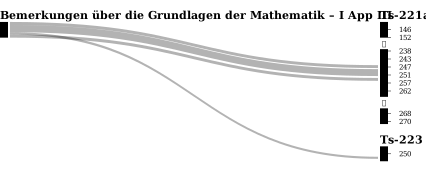
1938, 20 remarks, Ts-221a, Ts-223
Do not quote from or cite this translation!
§Ts-221a
246[1]1 Man kann sich leicht eine Sprache denken, in der es keine Frage- und keine Befehlsform gibt, sondern in der Frage und Befehl in der Form der Behauptung ausgedrückt wird, in Formen z.B., entsprechend unserem: “Ich möchte wissen, ob ‥‥․” und “Ich wünsche, daß ‥‥․”. Niemand würde doch von einer Frage (etwa, ob es draußen regnet) sagen, sie sei wahr oder falsch. Es ist freilich deutsch, dies von einem Satz, “ich wünsche zu wissen, ob ‥‥․”, zu sagen. Wenn nun aber diese Form immer statt der Frage verwendet wird? –
One can easily imagine a language in which there is no question form and no command form, but in which question and command are expressed in the form of an assertion, in forms, for example, corresponding to our: “I would like to know whether…” and “I want that…” No one would say of a question (e.g., whether it is raining outside) that it is true or false. It is, of course, German to say this of a sentence, “I want to know whether…”. But what if this form is always used instead of the question? –
§Ts-221a
246[2]2 Die große Mehrzahl der Sätze, die wir aussprechen, schreiben und lesen, sind Behauptungssätze. Und – sagst Du – diese Sätze sind wahr oder falsch. Oder, wie ich auch sagen könnte, mit ihnen wird das Spiel der Wahrheitsfunktionen gespielt. Denn die Behauptung ist nicht etwas, was zu dem Satz hinzutritt, sondern ein wesentlicher Zug des Spiels, das wir mit ihm spielen. Etwa vergleichbar dem Charakteristikum des Schachspiels, daß es ein Gewinnen und Verlieren dabei gibt, und daß der gewinnt, der dem Andern den König nimmt. Freilich, es könnte ein dem Schach sehr verwandtes Spiel geben, das darin besteht, daß man die Schachzüge macht, aber ohne daß es dabei ein Gewinnen und Verlieren gibt, oder die Bedingungen des Gewinnens sind andere.
The vast majority of the sentences that we utter, write, and read are assertion sentences. And – you say – these sentences are true or false. Or, as I might also say, with them the game of truth-functions is played. For the assertion is not something that is added to the sentence, but an essential feature of the game that we play with it. Something comparable to the characteristic of chess, that there is winning and losing in it, and that the one who takes the other's king wins. Of course, there could be a game very similar to chess, which consists in making chess moves, but without there being winning and losing, or the conditions for winning are different.
§Ts-221a
247[1]3 Denke, man sagte: Ein Befehl besteht aus einem Vorschlag (‘Annahme’) und dem Befehlen des Vorgeschlagenen.
Imagine one said: A command consists of a proposal (‘assumption’) and the commanding of the person to whom it is proposed.
§Ts-221a
247[2]4 Könnte man nicht Arithmetik treiben, ohne auf den Gedanken zu kommen, arithmetische Sätze auszusprechen, und ohne daß uns die Ähnlichkeit einer Multiplikation mit einem Satz je auffiele? Aber würden wir nicht den Kopf schütteln, wenn Einer uns eine falsch gerechnete Multiplikation zeigte, wie wir es tun, wenn er uns sagt, es regne, wenn es nicht regnet? – Doch; und hier liegt ein Punkt der Anknüpfung. Wir machen aber auch abwehrende Gesten, wenn ein Hund sich nicht benimmt, wie wir es wünschen. Wir sind gewohnt, zu sagen “2 mal 2 ist 4” und das Verbum “ist” macht dies zum Satz und stellt scheinbar eine nahe Verwandtschaft her mit allem, was wir ‘Satz’ nennen; während es sich nur um eine sehr äußerliche Beziehung handelt.
Could one not do arithmetic without coming to the idea of uttering arithmetic sentences, and without the similarity of a multiplication to a sentence ever striking us? But wouldn’t we shake our heads if someone showed us a wrongly calculated multiplication, as we do when he tells us that it is raining when it is not raining? – Yes; and here lies a point of connection. We also make defensive gestures when a dog does not behave as we wish. We are used to saying “2 times 2 is 4” and the verb “is” makes this a sentence and apparently establishes a close kinship with everything we call ‘sentence’; whereas it is only a very superficial relationship.
§Ts-221a
248[1]5 Gibt es wahre Sätze in Russell's System, die nicht in seinem System zu beweisen sind? – Was nennt man denn einen wahren Satz in Russell's System?
Are there true sentences in Russell's system that cannot be proven in his system? – What does one call a true sentence in Russell's system?
§Ts-221a
248[2]6 Was heißt denn, ein Satz ‘ist wahr’? p ist wahr = p. (dies ist die Antwort.) Man will also etwa fragen: unter welchen Umständen behauptet man einen Satz? oder: wie wird die Behauptung des Satzes im Sprachspiel gebraucht? Und die “Behauptung des Satzes” ist hier entgegengesetzt dem Aussprechen des Satzes etwa als Sprachübung, – oder als Teil eines andern Satzes, u. dergl.. Fragt man also in diesem Sinne: “Unter welchen Umständen behauptet man in Russell's Spiel einen Satz”, so ist die Antwort: Am Ende eines seiner Beweise, oder als ‘Grundgesetz’ (p.p.). Anders werden in diesem System Behauptungssätze in den Russell'schen Symbolen nicht verwendet.
What does it mean that a sentence ‘is true’? p is true = p. (this is the answer.) So, one wants to ask, for example: under what circumstances does one assert a sentence? or: how is the assertion of the sentence used in the language-game? And the “assertion of the sentence” is here the opposite of uttering the sentence, for example, as a language exercise, – or as part of another sentence, and so on. If one asks in this sense: “Under what circumstances does one assert a sentence in Russell's game”, the answer is: at the end of one of his proofs, or as a ‘fundamental law’ (p.p.). Otherwise, assertion sentences are not used in Russell's symbols in this system.
§Ts-221a
248[3] &249[1]
7 “Kann es aber nicht wahre Sätze geben, die in diesem Symbolismus angeschrieben sind, aber in dem System Russell's nicht beweisbar?” – ‘Wahre Sätze’, das sind also Sätze, die in einem andern System wahr sind, d.h. in einem andern Spiel mit Recht behauptet werden können. Gewiß; warum soll es keine solchen Sätze geben; oder vielmehr: warum soll man nicht Sätze – der Physik z.B. – in Russell's Symbolen anschreiben? Die Frage ist ganz analog der: Kann es wahre Sätze in Euklids Sprache geben, die in seinem System nicht beweisbar, aber wahr sind? – Aber es gibt ja sogar Sätze, die in Euklid's System beweisbar, aber in einem andern System falsch sind. Können nicht Dreiecke – in einem andern System – ähnlich (sehr ähnlich) sein, die nicht gleiche Winkel haben? – “Aber das ist doch ein Witz! sie sind ja dann nicht im selben Sinne einander ‘ähnlich’!” – Freilich; und ein Satz, der nicht in Russell's System zu beweisen ist, ist im andern Sinne “wahr” oder “falsch”, als ein Satz der ‘Principia Mathematica’.
“But can’t there be true sentences in Russell's system that cannot be proven in his system?” – ‘True sentences,’ then, are sentences that are true in some other system, i.e., in some other game, and can rightfully be asserted. Certainly; why should there not be such sentences; or rather: why should one not write sentences – of physics, for example – in Russell's symbols? The question is quite analogous to: Can there be true sentences in Euclid's language that are true but not provable in his system? – But there are even sentences that are provable in Euclid's system but false in another system. Can triangles – in another system – not be similar (very similar) but not have the same angles? – “But that's absurd! They are not ‘similar’ to each other in the same sense!” – Of course; and a sentence that cannot be proven in Russell's system is “true” or “false” in the other sense, as opposed to a sentence of ‘Principia Mathematica’.
§Ts-221a
249[2] &250[1]
8 Ich stelle mir vor, es fragte mich Einer um Rat; er sagt: “Ich habe einen Satz (ich will ihn mit “P” bezeichnen) in Russell's Symbolen konstruiert, und den kann man durch gewisse Definitionen und Transformationen so deuten, daß er sagt: ‘P ist nicht in Russell's System beweisbar’. Muß ich nun von diesem Satz nicht sagen: einerseits er sei wahr, anderseits er sei unbeweisbar? Denn angenommen, er wäre falsch, so ist es also wahr, daß er beweisbar ist! Und das kann doch nicht sein. Und ist er bewiesen, so ist bewiesen, daß er nicht beweisbar ist! So kann er also nur wahr, aber unbeweisbar sein.” So wie wir fragen: “in welchem System ‘beweisbar’?”, so müssen wir auch fragen: “in welchem System ‘wahr’?”. ‘In Russell's System wahr’ heißt, wie gesagt: in Russell's System bewiesen; und ‘in Russell's System falsch’ heißt: das Gegenteil sei in Russell's System bewiesen. – Was heißt nun Dein: “angenommen, er sei falsch”? In Russell's Sinne heißt es: “angenommen das Gegenteil sei in Russell's System bewiesen”; ist das Deine Annahme, so wirst Du jetzt die Deutung, er sei unbeweisbar, wohl aufgeben. Und unter dieser Deutung verstehe ich die Übersetzung in diesem deutschen Satz. – Nimmst Du an, der Satz sei in Russell's System beweisbar, so ist er damit in Russell's Sinne wahr und die Deutung “P ist nicht beweisbar” ist wieder aufzugeben. Nimmst Du an, der Satz sei in Russell's Sinne wahr, so folgt das Gleiche. Ferner: soll der Satz in einem andern als Russell's Sinne falsch sein: so widerspricht dem nicht, daß er in Russell's System bewiesen ist. (Was im Schach “verlieren” heißt, kann doch in einem andern Spiel das Gewinnen ausmachen.)
Suppose someone asks me for advice; he says: “I have constructed a sentence (I will denote it with “P”) in Russell's symbols, and it can be interpreted by certain definitions and transformations so that it says: ‘P is not provable in Russell's system’. Must I then say that this sentence is both true and unprovable? For suppose it is false; then it is true that it is provable! And that cannot be the case. And if it is proven, then it is proven that it is not provable! So it can only be true but unprovable.” Just as we ask: “in which system is it ‘provable’?”, so we must also ask: “in which system is it ‘true’?”. ‘True in Russell's system’ means, as mentioned, proven in Russell's system; and ‘false in Russell's system’ means: the opposite is proven in Russell's system. – What does your “supposed it is false” mean? In Russell's sense, it means: “supposed the opposite is proven in Russell's system”; if that is your assumption, then you will probably give up the interpretation that it is unprovable. And I understand the translation into this German sentence to be that. – If you assume that the sentence is provable in Russell's system, then it is in Russell's sense true, and the interpretation “P is not provable” must be given up. If you assume that the sentence is true in Russell's sense, then the same follows. Furthermore: if the sentence is to be false in a system other than Russell's, this does not contradict the fact that it is proven in Russell's system. (What “losing” means in chess can be the basis for winning in another game.)
§Ts-221a
250[2]9 Was heißt es denn: “P” und “P ist unbeweisbar” seien der gleiche Satz? Es heißt, daß diese zwei deutschen Sätze in der und der Notation einen Ausdruck haben.
What does it mean that “P” and “P is unprovable” are the same sentence? It means that these two German sentences have one expression in the notation.
§Ts-221a
250[3] &251[1]
10 “Aber P kann doch nicht beweisbar sein, denn, angenommen es wäre bewiesen, so wäre der Satz bewiesen, er sei nicht beweisbar.” Aber wenn dies nun bewiesen wäre, oder wenn ich glaubte – vielleicht durch Irrtum – ich hätte es bewiesen, warum sollte ich den Beweis nicht gelten lassen und sagen, ich müsse meine Deutung “unbeweisbar” zurückziehen?
“But P cannot be provable, because, suppose it were proven, then the sentence would be proven that it is not provable.” But if this were now proven, or if I believed – perhaps mistakenly – that I had proven it, why should I not accept the proof and say that I must withdraw my interpretation of “unprovable”?
§Ts-221a
251[2]11 Nehmen wir an, ich beweise die Unbeweisbarkeit (in Russell's System) von P; so habe ich mit diesem Beweis P bewiesen. Wenn nun dieser Beweis einer in Russell's System wäre, – dann hätte ich also zu gleicher Zeit seine Zugehörigkeit und Unzugehörigkeit zum Russell'schen System bewiesen. – Das kommt davon, wenn man solche Sätze bildet. – Aber hier ist ja ein Widerspruch! – Nun so ist hier ein Widerspruch. Schadet er hier etwas?
Let us assume that I prove the unprovability (in Russell's system) of P; then I have proven P with this proof. If this proof were now in Russell's system, then I would have proven its belonging and non-belonging to Russell's system at the same time. – This is what happens when one forms such sentences. – But here is a contradiction! – Well, then here is a contradiction. Does it matter here?
§Ts-221a
251[3]12 Schadet der Widerspruch, der entsteht wenn Einer sagt: “Ich lüge. – Also lüge ich nicht. – Also lüge ich. Etc.” Ich meine: ist unsere Sprache dadurch weniger brauchbar, daß man in diesem Fall aus einem Satz nach den gewöhnlichen Regeln sein Gegenteil und daraus wieder ihn folgern kann? – der Satz selbst ist unbrauchbar, und ebenso dieses Schlüsseziehen; aber warum soll man es nicht tun? – Es ist eine brotlose Kunst! – Es ist ein Sprachspiel, das Ähnlichkeit mit dem Spiel des Daumenfangens hat.
Does the contradiction that arises when one says: “I am lying. – So I am not lying. – So I am lying. Etc.” matter? I mean: is our language made less useful by the fact that in this case one can infer the opposite of a sentence from it according to the usual rules, and then infer it again? – The sentence itself is useless, and so is this inference; but why shouldn't one do it? – It is an unproductive pursuit! – It is a language-game that is similar to the game of thumb-wrestling.
§Ts-221a
252[1]13 Interesse erhält so ein Widerspruch nur dadurch, daß er Menschen gequält hat und dadurch zeigt, wie aus der Sprache quälende Probleme wachsen können; und was für Dinge uns quälen können.
A contradiction only gains interest in that it has tormented people and thereby shows how tormenting problems can arise from language; and what kinds of things can torment us.
§Ts-223
252[2]14 Ein Beweis der Unbeweisbarkeit ist quasi ein geometrischer Beweis; ein Beweis, die Geometrie der Beweise betreffend. Ganz analog einem Beweise etwa, daß die und die Konstruktion nicht mit Zirkel und Lineal ausführbar ist. Nun enthält so ein Beweis ein Element der Vorhersage, ein physikalisches Element. Denn als Folge dieses Beweises sagen wir ja einem Menschen: “Bemüh' Dich nicht, eine Konstruktion (der Dreiteilung des Winkels, etwa) zu finden, – man kann beweisen, daß es nicht geht.” Das heißt: es ist wesentlich, daß sich der Beweis der Unbeweisbarkeit in dieser Weise soll anwenden lassen. Er muß – könnte man sagen – für uns ein triftiger Grund sein, die Suche nach einem Beweis (also einer Konstruktion der und der Art) aufzugeben. Ein Widerspruch ist als eine solche Vorhersage unbrauchbar.
A proof of unprovability is almost a geometric proof; a proof concerning the geometry of proofs. Very analogous to a proof, for example, that the one or other construction cannot be carried out with compass and ruler. Now, such a proof contains an element of prediction, a physical element. For as a consequence of this proof, we say to a person: “Do not try to find a construction (of the trisection of the angle, for example) – it can be proven that it is not possible.” This means: it is essential that the proof of unprovability can be applied in this way. It must – one could say – be a valid reason for us to abandon the search for a proof (i.e., a construction of that kind). A contradiction is unusable as such a prediction.
§Ts-223
252[3] &253[1]
15 Ob etwas mit Recht der Satz genannt wird “X ist unbeweisbar”, hängt davon ab, wie wir diesen Satz beweisen. Nur der Beweis zeigt, was als das Kriterium der Unbeweisbarkeit gilt. Der Beweis ist ein Teil des Systems von Operationen, des Spiels, worin der Satz gebraucht wird, und zeigt uns seinen ‘Sinn’. Es ist also die Frage ob der “Beweis der Unbeweisbarkeit’ von p hier ein triftiger Grund ist zur Annahme daß ein Beweis von p nicht gefunden werden wird.
Whether something is rightly called the sentence “X is unprovable” depends on how we prove this sentence. Only the proof shows what counts as the criterion of unprovability. The proof is part of the system of operations, the game, in which the sentence is used, & shows us its ‘sense’. Thus, the question is whether the “proof of unprovability” of p is a valid reason to assume that a proof of p will not be found.
§Ts-223
252[3] &253[1].2
16 Der Satz “p ist unbeweisbar” hat einen andern Sinn, nach dem – als ehe er bewiesen ist. Ist er bewiesen, so ist er die Schlußfigur des Unbeweisbarkeitsbeweises. – Ist er unbewiesen, so ist ja noch nicht klar, was als Kriterium seiner Wahrheit zu gelten hat, und sein Sinn ist – kann man sagen – noch verschleiert.
The sentence “p is unprovable” has a different sense than it does after it has been proven. If it is proven, then it is the final figure in the proof of unprovability. If it is unproven, then it is not yet clear what should be considered as the criterion for its truth, and its sense is – one might say – still obscured.
§Ts-221a
253[2] &254[1]
17 Wie, soll ich nun annehmen, ist P bewiesen? Durch einen Unbeweisbarkeitsbeweis? oder auf eine andere Weise? Nimm an, durch einen Unbeweisbarkeitsbeweis. Nun, um zu sehen, was bewiesen ist, schau auf den Beweis! Vielleicht ist hier bewiesen, daß die und die Form des Beweises nicht zu P führt. – Oder, es sei P auf eine direkte Art bewiesen – wie ich einmal sagen will –, dann folgt also der Satz “P ist unbeweisbar”, und es muß sich nun zeigen, wie diese Deutung der Symbole von P mit der Tatsache des Beweises kollidiert und warum sie hier aufzugeben sei. Angenommen aber, ~ P sei bewiesen. – Wie bewiesen? Etwa dadurch, daß P direkt bewiesen ist – denn daraus folgt, daß es beweisbar ist, also ~ P. Was soll ich nun aussagen: “P”, oder “~ P”? Warum nicht beides? Wenn mich jemand fragt: “Was ist der Fall – P, oder nicht-P?”, so antworte ich: “⊢ P” steht am Ende eines Russell'schen Beweises, Du schreibst also im Russell'schen System: “ ⊢ P”; anderseits ist es aber eben beweisbar und dies drückt man durch “ ⊢ ~ P” aus, dieser Satz aber steht nicht am Ende eines Russell'schen Beweises, gehört also nicht zum Russell'schen System. – Als die Deutung “P ist unbeweisbar” für P gegeben wurde, da kannte man ja diesen Beweis für P nicht und man kann also nicht sagen “P” sage: dieser Beweis existierte nicht. – Ist der Beweis hergestellt, so ist damit eine neue Lage geschaffen: Und wir haben nun zu entscheiden, ob wir dies einen Beweis (noch einen Beweis), oder ob wir dies noch die Aussage der Unbeweisbarkeit nennen wollen. Angenommen ~ P sei direkt bewiesen; es ist also bewiesen, daß sich P direkt beweisen läßt! Das ist also wieder eine Frage der Deutung – es sei denn, daß wir nun auch einen direkten Beweis von P haben. Wäre es nun so, nun, so wäre es so. – (Die abergläubische Angst und Verehrung der Mathematiker vor dem Widerspruch.)
How, am I now to assume, is P proven? By a proof of unprovability? Or in some other way? Suppose, by a proof of unprovability. Now, to see what is proven, look at the proof! Perhaps here it is proven that that particular form of proof does not lead to P. – Or, suppose P is proven in a direct way – as I want to say – then the sentence “P is unprovable” follows, and it must now be shown how this interpretation of the symbols of P collides with the fact of the proof and why it should be abandoned. Suppose, however, that ~ P is proven. – How proven? Perhaps by proving P directly – because from this it follows that it is provable, hence ~ P. What am I to say: “P”, or “~ P”? Why not both? If someone asks me: “What is the case – P, or not-P?”, then I answer: “⊢ P” stands at the end of a Russellian proof, so you write in the Russellian system: “⊢ P”; on the other hand, it is provable, and this is expressed by “⊢ ~ P”, but this sentence does not stand at the end of a Russellian proof, so it does not belong to the Russellian system. – When the interpretation “P is unprovable” was given for P, one did not know this proof for P, and one cannot say that this proof did not exist. – When the proof is established, a new situation is created: And we now have to decide whether we want to call this a proof (or another proof), or whether we want to call this the statement of unprovability. Suppose ~ P is proven directly; it is therefore proven that P can be proven directly! This is therefore again a question of interpretation – unless we now also have a direct proof of P. If it were so, then it would be so. – (The superstitious fear and reverence of mathematicians for contradiction.)
§Ts-221a
254[2]18 “Aber angenommen, der Satz wäre nun falsch – und daher beweisbar! –” Warum nennst Du ihn ‘falsch’? Weil Du einen Beweis siehst? – Oder aus andern Gründen? Dann macht es ja nichts. Man kann ja den Satz des Widerspruchs sehr wohl falsch nennen, mit der Begründung z.B., daß wir sehr oft mit gutem Sinn auf eine Frage antworten: “Ja, und nein.” Und ebenso den Satz “p ≡ ~~p”: weil wir die Verdoppelung der Verneinung als eine Verstärkung der Verneinung verwenden und nicht bloß als ihre Aufhebung.
“But suppose the sentence were now false – and therefore provable!” Why do you call it ‘false’? Because you see a proof? – Or for other reasons? Then it doesn’t matter. One can very well call the sentence of contradiction false, with the justification, for example, that we very often answer a question with good sense: “Yes, and no.” And also the sentence “p ≡ ~~p”: because we use the doubling of the negation as a strengthening of the negation and not merely as its cancellation.
§Ts-221a
255[1]19 Du sagst: “‥‥․” also ist P wahr und unbeweisbar.” Das heißt wohl: “Also ⊢ P.” Von mir aus – aber zu welchem Zweck schreibst Du diese ‘Behauptung’ hin? (Das ist, als hätte jemand aus gewissen Prinzipien über Naturformen und Baustil abgeleitet, auf den Mount Everest, wo niemand wohnen kann, gehöre ein Schlößchen im Barockstile.) Und wie könntest Du mir die Wahrheit der Behauptung plausibel machen, da Du sie ja zu nichts weiter brauchen kannst als zu jenen Kunststückchen?
You say: “‥‥․” so P is true and unprovable. That probably means: “Therefore ⊢ P.” Fine by me – but what is the purpose of writing down this ‘assertion’? (It’s as if someone, based on certain principles about natural forms and architectural style, concluded that a baroque palace should be built on Mount Everest, where no one can live.) And how could you plausibly demonstrate the truth of the assertion to me, since you don’t need it for anything other than these little tricks?
§Ts-221a
255[2]20 Man muß sich hier daran erinnern, daß die Sätze der Logik so konstruiert sind, daß sie als Information keine Anwendung in der Praxis haben. Man könnte also sehr wohl sagen, sie seien garnicht Sätze; und daß man sie überhaupt hinschreibt, bedarf einer Rechtfertigung. Fügt man diesen ‘Sätzen’ nun ein weiteres satzartiges Gebilde andrer Art hinzu, so sind wir hier schon erst recht im Dunkeln darüber, was dieses System von Zeichenkombinationen nun für eine Anwendung, für einen Sinn haben soll, denn der bloße Satzklang dieser Zeichenverbindungen gibt ihnen ja eine Bedeutung noch nicht.
Here, one must remember that the sentences of logic are constructed in such a way that, as information, they have no application in practice. One could therefore quite rightly say that they are not sentences at all, and that writing them down requires justification. If we now add another sentence-like construct of a different kind to these ‘sentences,’ then we are even more in the dark about what this system of combinations of signs is supposed to be used for, what sense it is supposed to have, because the mere sentence-sound of these combinations of signs does not yet give them a meaning.