Bemerkungen über die Grundlagen der Mathematik – III
Remarks on the Foundations of Mathematics – III
German (epub, pdf) | German/English
1939–1940, 357 remarks, Ms-122, Ms-117
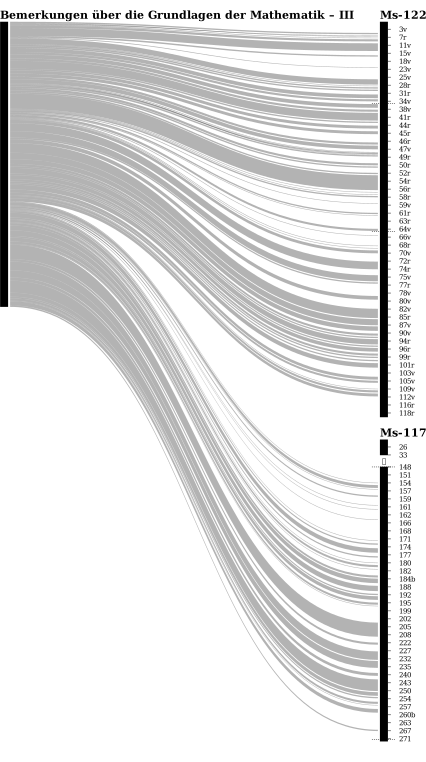
Do not quote from or cite this translation!
§Ms-122
5r[2] &5v[1]
1 25.10.1939
‘Ein Mathematischer Beweis muß übersichtlich sein.’ “Beweis” nennen wir nur eine Struktur, deren Reproduktion eine leicht lösbare Aufgabe ist. Es muß sich mit Sicherheit entscheiden lassen, ob wir hier wirklich zweimal den gleichen Beweis vor uns haben, oder nicht. Der Beweis muß ein Bild sein, welches sich mit Sicherheit genau reproduzieren läßt. Oder auch: was dem Beweise wesentlich ist muß sich mit Sicherheit genau reproduzieren lassen. Er kann z.B. in zwei verschiedenen Handschriften oder Farben niedergeschrieben sein. Zur Reproduktion eines Beweises soll nichts gehören was von der Art einer genauen Reproduktion eines Farbtones oder einer Handschrift ist.
25.10.1939
‘A mathematical proof must be surveyable.’ We call only a structure a “proof”, the reproduction of which is an easily solvable problem. It must be possible to decide with certainty whether we really have the same proof in front of us twice, or not. The proof must be a picture which can be exactly reproduced with certainty. Or also: what is essential to the proof must be able to be exactly reproduced with certainty. It can, for example, be written down in two different handwritings or colors. Nothing that belongs to the reproduction of a proof should be of the kind of an exact reproduction of a color tone or a handwriting.
§Ms-122
5v[2] &6r[1] &
6v[1]
Es muß leicht sein genau diesen Beweis wieder anzuschreiben. Hierin liegt der Vorteil des Geschriebenen im Vergleich zum gezeichneten Beweis. Dieser ist oft seinem Wesen nach mißverstanden worden. Die Zeichnung eines Euklidischen Beweises kann ungenau sein, in dem Sinne, daß die Geraden nicht gerade sind die Kreisbögen nicht genau kreisförmig etc. etc. & dabei ist die Zeichnung doch ein exakter Beweis & dies zeigt daß diese Zeichnung nicht – z.B. – demonstriert daß eine solche Konstruktion ein Vieleck mit 5 gleichlangen Seiten ergibt, daß sie einen Satz der Geometrie, nicht einen über die Eigenschaften von Papier, Zirkel, Lineal & Bleistift beweist.
It must be easy to write down exactly this proof again. This is where the advantage of the written lies in comparison to the drawn proof. The latter has often been misunderstood in its essence. The drawing of a Euclidean proof can be inaccurate in the sense that the lines are not straight, the circular arcs are not exactly circular, etc. etc. & yet the drawing is an exact proof & this shows that this drawing does not – for example – demonstrate that such a construction results in a polygon with 5 sides of equal length, that it proves a theorem of geometry, not one about the properties of paper, compass, ruler & pencil.
§Ms-122
7r[2]Denken wir uns nun einen Russellschen Beweis für einen Additionssatz der Art a + b = c der aus ein paar tausend Zeichen bestünde. Du wirst sagen: Zu sehen, ob dieser Beweis stimmt, oder nicht, ist eine rein äußerliche Schwierigkeit, die von keinem mathematischen Interesse ist. (“Ein Mensch übersieht leicht, was ein anderer schwer oder garnicht übersieht”– etc. etc.)
Let us now imagine a Russellian proof for an addition theorem of the kind a + b = c, which consists of a few thousand characters. You will say: To see whether this proof is correct or not is a purely external difficulty, which is of no mathematical interest. (“One person easily overlooks what another person overlooks with difficulty or not at all”– etc. etc.)
§Ms-122
6v[3] &7r[1]
2 27.10.1939
Ich will sagen: Wenn man eine nicht übersichtliche Beweisfigur durch Veränderung der Notation übersehbar macht, dann schafft man erst einen Beweis, wo früher keiner war.
27.10.1939
I want to say: If one makes a non-surveyable proof figure surveyable by changing the notation, then one creates a proof where there was none before.
§Ms-122
7v[2]Die Annahme ist, daß die Definitionen nur zur Abkürzung des Ausdrucks dienen, zur Bequemlichkeit des Rechnenden; während sie doch ein Teil der Rechnung sind.
Mit ihrer Hilfe werden Ausdrücke erzeugt, die ohne ihre Hilfe nicht erzeugt werden könnten.
The assumption is that the definitions only serve to shorten the expression, for the convenience of the calculator; while they are in fact part of the calculation.
With their help, expressions are created that could not be created without their help.
§Ms-122
8r[2] &8v[1]
3 Wie ist es aber damit: “Man kann zwar im R'schen Kalkül nicht 234 mit 537 multiplizieren – im gewöhnlichen Sinn – aber es gibt eine R'sche Rechnung die dieser Multiplikation entspricht”? – Welcher Art ist diese Entsprechung? Es könnte so sein:
Man kann auch im R'schen Kalkül diese Multiplikation ausführen nur in einem andern Symbolismus – wie wir ja auch sagen würden wir könnten sie auch in einem andern Zahlensystem ausführen. Wir könnten dann also z.B. die praktischen Aufgaben, zu deren Lösung man jene Multiplikation benützt auch durch die Rechnung im R'schen Kalkül lösen, nur umständlicher.
But what about this: “One can’t multiply 234 by 537 in the Russellian calculus – in the ordinary sense – but there is a Russellian calculation that corresponds to this multiplication”? – What kind of correspondence is this? It could be this:
One can also perform this multiplication in the Russellian calculus, only in a different symbolism – just as we would also say that we could perform it in a different number system. We could then, for example, solve the practical problems for which that multiplication is used, also by means of the calculation in the Russellian calculus, only in a more cumbersome way.
§Ms-122
8v[2] &9r[1]
Denken wir uns nun die Kardinalzahlen erklärt als 1, 1 + 1, (1 + 1) + 1, ((1 + 1) + 1) + 1, u.s.f.. Du sagst, die Definitionen welche die Ziffern des Dezimalsystems einführen dienen bloß zur Bequemlichkeit; man könnte die Rechnung 703000 × 40000101 auch in jener langwierigen Schreibweise ausführen. Aber stimmt das? – “Freilich stimmt es! Ich kann doch eine Rechnung in jener Notation anschreiben, konstruieren, die der Rechnung in der Dezimalnotation entspricht.” – Aber wie weiß ich, daß sie ihr entspricht? – Nun, weil ich sie nach einer gewissen Methode aus der andern abgeleitet habe. – Aber wenn ich sie nun nach einer halben Stunde wieder anschaue, kann sie sich da nicht verändert haben? Sie ist ja nicht übersehbar.
Let us now imagine the cardinal numbers defined as 1, 1 + 1, (1 + 1) + 1, ((1 + 1) + 1) + 1, and so on. You say that the definitions that introduce the digits of the decimal system serve only for convenience; one could also perform the calculation 703000 × 40000101 in that lengthy notation. But is that true? – “Of course it is true! I can write down, construct, a calculation in that notation that corresponds to the calculation in decimal notation.” – But how do I know that it corresponds to it? – Well, because I have derived it from the other one according to a certain method. – But if I look at it again after half an hour, couldn’t it have changed? It is not something that can be grasped at a glance.
§Ms-122
9r[2]Ich frage nun: könnten wir uns von der Wahrheit des Satzes 7034174 + 6594321 = 13628495 auch durch einen Beweis überzeugen, der in der ersten Notation geführt wäre? – Gibt es so einen Beweis dieses Satzes? – Die Antwort ist: nein.
Now I ask: could we also be convinced of the truth of the sentence 7034174 + 6594321 = 13628495 by a proof that is carried out in the first notation? – Is there such a proof of this sentence? – The answer is: no.
§Ms-122
11r[2]4 Aber lehrt uns Russell nicht doch eine Art des Addierens?
But doesn’t Russell teach us one kind of adding?
§Ms-122
11r[3] &11v[1]
30.10.1939
Angenommen wir bewiesen auf R's Methode daß (∃a‥‥․g) ‥‥ (∃a‥‥․i) ⊃ (∃a‥‥․s) eine Tautologie ist; könnten wir nun unser Resultat dahin ausdrücken, g + i sei s? Das setzt doch voraus, daß ich die drei Stücke des Alphabets als Repräsentanten des Beweises nehmen kann. Aber zeigt denn das R's Beweis? Den R'schen Beweis hätte ich doch offenbar auch mit solchen Gruppen von Zeichen in den Klammern führen können, deren Reihenfolgen für mich nichts Charakteristisches gehabt hätten, so daß es nicht möglich gewesen wäre die Zeichengruppe in einer Klammer durch ihr letztes Glied zu repräsentieren.
October 30, 1939
Suppose we prove, using Russell's method, that (∃a‥‥․g) ‥‥ (∃a‥‥․i) ⊃ (∃a‥‥․s) is a tautology; could we now express our result by saying that g + i = s? This does, however, presuppose that I can take the three groups of letters as representatives of the proof. But does Russell's proof show this? Surely, I could also have carried out Russell's proof using such groups of signs in parentheses, whose sequences have no characteristic feature for me, so that it would not be possible to represent the group of signs in a parenthesis by its last member.
§Ms-122
11v[2] &12r[1]
Angenommen sogar, der R'sche Beweis werde mit einer Notation der Art als in der Dezimalnotation geführt, & es seien 100 Glieder in der ersten 300 Glieder in der zweiten & 400 Glieder in der dritten Klammer, zeigt der Beweis selbst dann, daß 100 + 300 = 400 ist? – Wie wenn dieser Beweis einmal zu diesem einmal zu einem andern Resultat führte z.B. 100 + 300 = 420? Was bedarf es, um zu sehen daß das Resultat des Beweises, wenn er richtig geführt ist, immer nur von den letzten Ziffern der ersten zwei Klammern abhängt?
Suppose, indeed, that Russell's proof is carried out using a notation of the kind , as in decimal notation, and there are 100 members in the first, 300 members in the second, and 400 members in the third parenthesis; does the proof itself then show that 100 + 300 = 400? – As if this proof were to lead once to this result and once to another result, e.g. 100 + 300 = 420? What is required to see that the result of the proof, if it is carried out correctly, always only depends on the last digits of the first two parentheses?
§Ms-122
12r[2] &12v[1]
Aber für kleine Zahlen lehrt uns doch Russell addieren; denn dann übersehen wir eben die Zeichengruppen in den Klammern & können sie als Zahlzeichen nehmen; z.B. ‘xy’, ‘xyz’, ‘xyzuv’.
Russell lehrt uns also einen anderen Kalkül, um von 2 und 3 zu 5 zu gelangen; & das stimmt auch dann, wenn wir sagen der logische Kalkül sei nur – ‘frills’, die dem arithmetischen Kalkül angehängt seien.
But Russell does teach us to add for small numbers; for then we simply overlook the groups of signs in the parentheses and can take them as number signs; e.g. 'xy', 'xyz', 'xyzuv'.
Russell, therefore, teaches us a different calculus to get from 2 and 3 to 5; and this is also true when we say that the logical calculus is only – ‘frills’ that are attached to the arithmetic calculus.
§Ms-122
12v[2] &13r[1]
Die Anwendung der Rechnung muß für sich selber sorgen. Und das ist, was am ‘Formalismus’ richtig ist. Die Zurückführung der Arithmetik auf symbolische Logik soll die Applikation der Arithmetik zeigen; gleichsam den Ansatz, mittels welchem sie auf ihrer Anwendung sitzt. So als zeigte man Einem erst eine Trompete ohne das Mundstück – & nun das Mundstück, welches uns zeigt, wie eine Trompete verwendet, geblasen, wird. Das Ansatzstück aber, das uns Russell gibt, ist einerseits zu eng anderseits zu weit; zu allgemein und zu speziell. Die Rechnung sorgt für ihre eigene Anwendung.
The application of calculation must take care of itself. And this is what is right about ‘formalism’. The reduction of arithmetic to symbolic logic is supposed to show the application of arithmetic; as if it were the approach by means of which it rests on its application. It is as if one were first shown a trumpet without the mouthpiece – and then the mouthpiece, which shows us how a trumpet is used, how it is played. But the approach that Russell gives us is, on the one hand, too narrow, and on the other hand, too wide; too general and too specific. Calculation takes care of its own application.
§Ms-122
13r[2] &13v[1]
Wir dehnen unsre Ideen von den Rechnungen mit kleinen Zahlen auf die mit großen Zahlen aus, ähnlich wie wir uns vorstellen, daß wenn die Distanz von hier zur Sonne mit dem Zollstock gemessen werden könnte dann eben das herauskäme was wir heute auf ganz andere Art herausbringen. Das heißt, wir sind geneigt die Längenmessung mit dem Zollstab zum Modell zu nehmen auch für die Messung des Abstandes zweier Sterne. Und man sagt, etwa in der Schule: “Wenn wir uns Zollstäbe von hier bis zur Sonne gelegt denken, …” & scheint damit zu erklären, was wir unter dem Abstand zwischen Sonne und Erde verstehen. Und der Gebrauch eines solchen Bildes ist ganz in Ordnung, so lange es uns klar ist daß wir den Abstand von uns zur Sonne messen können & daß wir ihn nicht mit Zollstäben messen können.
We extend our ideas from calculations with small numbers to those with large numbers, much as we imagine that if the distance from here to the sun could be measured with a folding ruler, the result would be exactly what we arrive at today in a completely different way. That is, we are inclined to take the measurement of length with a folding ruler as a model even for measuring the distance between two stars. And people say, for example in school: “If we imagine laying out rulers from here to the Sun, …” & seem to provide an explanation for what we understand by the distance between the Sun and Earth. And the use of such an image is perfectly fine, as long as we realize that we can measure the distance from us to the Sun & that we cannot measure it with rulers.
§Ms-122
13v[2] &14r[1]
5 31.10.1939
Wie, wenn jemand sagen würde: “der eigentliche Beweis von 1000 + 1000 = 2000 ist doch erst der Russellsche, der zeigt, daß der Ausdruck … eine Tautologie ist”? Kann ich denn nicht beweisen, daß eine Tautologie herauskommt, wenn ich in den beiden ersten Klammern je 1000 Glieder & in der dritten 2000 habe? Und wenn ich das beweisen kann, so kann ich das als Beweis des arithmetischen Satzes ansehen.
October 31, 1939
What if someone were to say: “The actual proof of 1000 + 1000 = 2000 is only Russell's, which shows that the expression … is a tautology”? Can I not prove that a tautology results if I have 1000 members in each of the first two parentheses and 2000 in the third? And if I can prove that, then I can see it as a proof of the arithmetic sentence.
§Ms-122
14r[2]In der Philosophie ist es immer gut, statt einer Beantwortung einer Frage eine Frage zu setzen. Denn eine Beantwortung der philosophischen Frage könnte ungerecht sein; ihre Erledigung mittels einer andern Frage ist es nicht.
In philosophy, it is always good to put a question in place of an answer to a question. For an answer to the philosophical question might be unfair; its resolution by means of another question is not.
§Ms-122
14r[3]Soll ich also z.B. hier eine Frage setzen statt der Antwort, man könne jenen arithm. Satz mit R's Methode nicht beweisen?
Should I, therefore, put a question here instead of the answer, that one cannot prove that arithmetic sentence with Russell's method?
§Ms-122
14v[1] &15r[1]
6 01.11.1939
Der Beweis, daß
eine Tautologie ist, besteht darin, daß man immer ein Glied der 3ten Klammer für ein Glied von 1 oder 2 abstreicht. Und es gibt ja viele Methoden dieses Kollationierens. Oder man könnte auch sagen: es gibt viele Arten & Weisen, das Gelingen der 1 → 1 Zuordnung festzustellen. Eine Art wäre z.B. sternförmige Muster eins für die linke eins für die rechte Seite der Implikation zu konstruieren & diese wieder dadurch zu vergleichen daß man ein Ornament aus beiden bildet. Man könnte also die Regel geben: “Wenn Du wissen willst, ob die Zahlen A & B zusammen wirklich C ergeben, schreib einen Ausdruck der Form … an & ordne die Variablen in den Klammern einander zu indem Du den Beweis dafür anschreibst (oder anzuschreiben trachtest) daß der Ausdruck eine Tautologie ist.” Mein Einwand dagegen ist nun nicht, daß es willkürlich ist, gerade diese Art des Kollationierens vorzuschreiben, sondern, daß man auf diese Weise nicht feststellen kann, daß 1000 + 1000 = 2000 ist.
01.11.1939
The proof that is a tautology consists in the fact that one always eliminates one element of the 3rd parenthesis for one element of 1 or 2. And there are indeed many methods for this collation. Or one could also say: there are many kinds & ways of establishing the success of the 1 → 1 assignment. One way would be, for example, to construct star-shaped patterns, one for the left, one for the right side of the implication, & to compare them again by forming an ornament from both. One could, therefore, give the rule: “If you want to know whether the numbers A & B really add up to C, write an expression of the form … & assign the variables in the parentheses to each other by writing down (or trying to write down) the proof that the expression is a tautology.” My objection to this is now not that it is arbitrary to prescribe precisely this kind of collation, but that in this way one cannot establish that 1000 + 1000 = 2000.
§Ms-122
16r[4] &16v[1]
7 03.11.1939
Denke, Du hättest eine meilenlange ‘Formel’ angeschrieben, & zeigtest durch Transformation, daß sie tautologisch ist (‘wenn sie sich inzwischen nicht verändert hat’, müßte man sagen). Nun zählen wir die Glieder in den Klammern oder teilen sie ab & machen den Ausdruck übersichtlich & es zeigt sich, daß in der ersten Klammer 7566 in der zweiten 2434 in der dritten 10000 Glieder stehen. Habe ich nun bewiesen, daß 2434 + 7566 = 10000 ist? – Das kommt drauf an – könnte man sagen – ob Du sicher bist, daß das Zählen wirklich die Zahlen der Glieder ergeben hat, die während des Beweises in den Klammern standen.
03.11.1939
Suppose you have written a mile-long ‘formula,’ & show by transformation that it is tautological (‘if it has not changed in the meantime,’ one would have to say). Now let us count the elements in the parentheses or divide them & make the expression surveyable & it turns out that there are 7566 elements in the first parenthesis, 2434 in the second, & 10000 in the third. Have I now proven that 2434 + 7566 = 10000? – That depends – one could say – on whether you are sure that the counting really gives the numbers of the elements that were in the parentheses during the proof.
§Ms-122
16v[2] &17r[1]
Könnte man so sagen: “R. lehrt uns in die 3te Klammer so viele Zeichen schreiben als in den beiden ersten zusammen stehen”? Aber eigentlich: er lehrt uns für je eine Variable in (1) & in (2) eine Variable in (3) schreiben. Aber lernen wir dadurch welche Zahl die Summe zweier gegebener Zahlen ist? Vielleicht sagt man: “Freilich, denn in der 3ten Klammer steht nun das Paradigma, Urbild, der neuen Zahl.” Aber inwiefern ist ∣∣∣∣∣∣∣∣∣∣∣∣∣∣∣∣ das Paradigma einer Zahl? Bedenke, wie man es als solches verwenden kann.
Could one say: “R. teaches us to write as many signs in the 3rd parenthesis as there are in the two first together”? But actually: he teaches us to write one variable in (3) for each variable in (1) & in (2). But do we learn from this what number is the sum of two given numbers? Perhaps one says: “Indeed, because in the 3rd parenthesis there is now the paradigm, the archetype, of the new number.” But in what sense is ∣∣∣∣∣∣∣∣∣∣∣∣∣∣∣∣ the paradigm of a number? Consider how one can use it as such.
§Ms-122
21v[3] &22r[1]
8 09.11.1939
Die R'sche Tautologie, die dem Satz a + b = c entspricht, zeigt uns vor allem nicht in welcher Notation die Zahl c zu schreiben ist & es ist kein Grund warum sie nicht in der Form a + b geschrieben werden soll. –Denn R. lehrt uns ja nicht die Technik des Addierens, etwa, im Dezimalsystem. – Aber könnten wir sie vielleicht aus seiner Technik ableiten? Fragen wir einmal so: Kann man die Technik des Dezimalsystems aus der des Systems 1, 1 + 1, (1 + 1) + 1, etc. ableiten? Könnte man diese Frage nicht auch so stellen: Wenn man eine Rechentechnik in dem einen System & eine im andern System hat, – wie zeigt man, daß die beiden äquivalent sind?
09.11.1939
The R-style tautology, corresponding to the sentence a + b = c, primarily doesn’t show us in what notation the number c should be written, and there is no reason why it shouldn’t be written in the form a + b. – Because R. doesn’t teach us the technique of addition, for example, in the decimal system. – But could we perhaps derive it from his technique? Let’s ask this: Can the technique of the decimal system be derived from that of the system 1, 1 + 1, (1 + 1) + 1, etc.? Couldn’t we also phrase this question as follows: If one has a calculation technique in one system and one in the other system, how does one show that the two are equivalent?
§Ms-122
26v[2]9 “Ein Beweis soll nicht nur zeigen, daß es so ist, sondern daß es so sein muß.”
“A proof should not only show that it is so, but that it must be so.”
§Ms-122
26v[3]Unter welchen Umständen zeigt dies das Zählen?
Under what circumstances does counting show this?
§Ms-122
26v[4] &27r[1]
17.11.1939
{ Man möchte sagen: wenn die Ziffern & das Gezählte ein einprägsames Bild ergeben. Wenn dieses Bild nun statt jedes neuen Zählens dieser Menge gebraucht wird. – Aber hier scheinen wir nur von räumlichen Bilden zu reden: wenn wir aber eine Reihe von Wörtern auswendig wissen & nun zwei solche Reihen einander eins zu eins zuordnen indem wir z.B. sagen
“der erste – Montag; der zweite – Dienstag; der dritte – Mittwoch; etc.” – können wir so nicht beweisen daß vom Montag zum Donnerstag vier Tage sind? Es fragt sich eben: Was nennen wir ein “einprägsames Bild”. Was ist das Kriterium davon, daß wir es uns eingeprägt haben? Oder ist die Antwort hierauf: “Daß wir es als Paradigma der Identität benützen!”?
17.11.1939
One might say: if the numerals and the things counted form a memorable image. If this image is then used instead of every new counting of this quantity. – But here it seems we are only talking about spatial images: but if we know a series of words by heart and now assign two such series to each other one to one by saying, for example,
“the first – Monday; the second – Tuesday; the third – Wednesday; etc.” – can we not prove that four days lie between Monday and Thursday? The question is: What do we call a “memorable image”? What is the criterion for us having memorized it? Or is the answer here: “That we use it as a paradigm of identity!”?
§Ms-122
27r[2]10 Wir machen nicht Versuche, an einem Satz, oder Beweis, um seine Eigenschaften festzustellen.
We do not conduct experiments on a proposition or proof in order to determine its properties.
§Ms-122
27r[3] &27v[1]
Wie reproduzieren wir, kopieren wir einen Beweis? – Nicht, z.B., indem wir Messungen an ihm anstellen.
How do we reproduce, copy a proof? – Not, for example, by taking measurements on it.
§Ms-122
27v[2] &28r[1]
Wie wenn ein Beweis so ungeheuer lang wäre, daß man ihn unmöglich übersehen könnte – oder sehen wir einen anderen Fall an: Man habe als Paradigma der Zahl die wir 1000 nennen eine lange Reihe von Strichen in einen harten Fels gegraben. Diese Reihe nennen wir die Ur-Tausend & um zu erfahren, ob tausend Menschen auf einem Platz sind ziehen wir Striche, oder spannen Schnüre (1 → 1 Zuordnung). Hier hat nun das Zahlzeichen für 1000 nicht die Identität einer Gestalt sondern eines physikalischen Gegenstandes. Wir können uns ähnlich eine Ur-Hundert etc. denken & einen Beweis daß 10 × 100 = 1000 ist, den wir nicht übersehen könnten.
What if a proof were so incredibly long that one could not possibly overlook it – or let us look at another case: Suppose one has a long row of strokes carved into a hard rock as a paradigm of the number we call 1000. We call this row the prime thousand, and in order to find out whether a thousand people are on a square, we draw strokes or span strings (1 → 1 assignment). Here, the numerical sign for 1000 does not have the identity of a shape but of a physical object. We can similarly imagine a prime hundred, etc., and a proof that 10 × 100 = 1000, which we could not overlook.
§Ms-122
28r[2]Die Ziffer für 1000 im 1 + 1 + 1 + 1… System kann nicht durch ihre Gestalt erkannt werden.
The numeral for 1000 in the 1 + 1 + 1 + 1… system cannot be recognized by its shape.
§Ms-122
28r[4] &28v[1]
11
Ist diese Figur ein Beweis für 27 + 16 = 43: weil man zu “27” kommt, wenn man die Striche der linken Seite zählt, zu “16” auf der rechten Seite, & zu “43” wenn man die ganze Reihe zählt?
Worin liegt hier das Seltsame – wenn man die Figur den Beweis dieses Satzes nennt? Doch darin, wie dieser Beweis zu reproduzieren ist, oder wiederzuerkennen ist, darin, daß er keine charakteristische visuelle Gestalt hat. –
Is this figure a proof for 27 + 16 = 43: because one arrives at “27” by counting the strokes on the left side, at “16” on the right side, & at “43” when counting the entire row?
What is strange here – if one calls this figure the proof of this sentence? But it lies in how this proof can be reproduced or recognized, in the fact that it has no characteristic visual shape. –
§Ms-122
28v[3] &29r[1]
Wenn nun jener Beweis auch keine visuelle Gestalt hat, so kann ich ihn dennoch genau kopieren(, reproduzieren) – ist die Figur also nicht doch der Beweis? Ich könnte ihn etwa in ein Stahlstück einritzen & von Hand zu Hand gehen lassen. Ich würde also Einem sagen: “Hier hast Du den Beweis, daß 27 + 16 = 43 ist.” – – Nun, kann man nicht doch sagen: er beweise den Satz mit Hilfe der Figur? Doch; aber die Figur ist nicht der Beweis.
Now, even if that proof has no visual form, I can still copy it exactly (reproduce it)—so isn’t the figure the proof after all? I could, for example, engrave it on a piece of steel and pass it from hand to hand. I would thus say to someone: “Here you have the proof that 27 + 16 = 43.” – – Well, can’t one still say: he proves the theorem with the help of the figure? Yes; but the figure is not the proof.
§Ms-122
29r[2] &29v[1]
Das aber würde man doch einen Beweis von 250 + 3220 = 3470 nennen: man zählt über 250 hinaus & fängt zugleich auch bei 1 zu zählen an & ordnet die beiden Zählungen einander zu: 251 … 1 252 … 2 253 … 3 etc. 3470 …3220 Man könnte das einen Beweis nennen, der durch 3220 Stufen fortschreitet. Das ist doch ein Beweis – & kann man ihn übersichtlich nennen??
But one would certainly call this a proof of 250 + 3220 = 3470: one counts beyond 250 & at the same time starts counting from 1 & assigns the two counts to each other: 251 … 1 252 … 2 253 … 3 etc. 3470 … 3220. One could call this a proof that progresses through 3220 steps. This is a proof – & can one call it surveyable?
§Ms-122
30r[2] &30v[1]
12 Wie kannst Du sagen, daß Russell den Satz “250 + 3220 = 3470” nicht beweisen kann?! Denk Dir einfach, daß man die Definitionen 1 + 1 = 2, 2 + 1 = 3, etc. nicht darum auswendig weiß, weil sie einem System folgen – man weiß sie eben auswendig. Was ist die Erfindung des Dezimalsystems eigentlich? Die Erfindung eines Systems von Kürzungen – – aber was ist das System der Kürzungen ? ist es bloß das System der neuen Zeichen, oder auch ein System ihrer Anwendungen als Abkürzung? Und ist es das letztere, dann ist es ja eine neue Anschauungsart des alten Zeichensystems.
How can you say that Russell cannot provide a proof for the statement “250 + 3220 = 3470”?! Just think that one does not know the definitions 1 + 1 = 2, 2 + 1 = 3, etc., by heart simply because they follow a system—one just knows them by heart. What is the invention of the decimal system, actually? The invention of a system of abbreviations—but what is the system of abbreviations? Is it merely the system of new symbols, or also a system of their applications as abbreviations? And if it is the latter, then it is indeed a new way of viewing the old system of symbols.
§Ms-122
30v[2]Können wir vom 1 + 1 + 1… System kommend, durch bloße Abkürzungen der Schreibweise im Dezimalsystem rechnen lernen?
Can we, starting from the 1 + 1 + 1… system, learn to do arithmetic in the decimal system simply by means of abbreviations of notation?
§Ms-122
31v[2] &32r[1]
13 Angenommen ich habe nach Russell einen Satz der Form (∃xyz…) (∃uvw…) ⊃ (∃abc…) bewiesen – & nun ‘mache ich ihn übersichtlich’, indem ich über die Variablen Zeichen schreibe – soll ich nun sagen, ich habe nach Russell einen arithmetischen Satz im Dezimalsystem bewiesen?
Suppose I have proven a sentence of the form (∃xyz…) (∃uvw…) ⊃ (∃abc…) in Russell’s system – & now I ‘make it surveyable’ by writing over the variables – am I now to say that I have proven an arithmetic sentence in the decimal system in Russell’s system?
§Ms-122
32r[2]22.11.1939
Aber jedem Beweis in Dezimalsystem entspricht doch einer im Russellschen System! – Woher wissen wir, daß es so ist? Lassen wir die Intuition beiseite. – Aber man kann es beweisen. –
22.11.1939
But every proof in the decimal system corresponds to one in Russell’s system! – How do we know that this is so? Let us put intuition aside. – But one can prove it. –
§Ms-122
32r[3]Wenn man eine Zahl im Dezimalsystem aus 1, 2, 3 ‥․ 9, 0 definiert & die Zeichen 0,1…9 aus 1, 1 + 1, (1 + 1) + 1, ‥․, kann man dann durch die rekursive Erklärung des Dezimalsystems hindurch von irgendeiner Zahl zu einem Zeichen der Form 1 + 1 + 1… gelangen?
If one defines a number in the decimal system from 1, 2, 3 ‥․ 9, 0 & the signs 0, 1…9 from 1, 1 + 1, (1 + 1) + 1, ‥․, can one, through the recursive explanation of the decimal system, get from any number to a sign of the form 1 + 1 + 1…?
§Ms-122
32v[1]Wie, wenn Einer sagte: Die R.sche Arithmetik stimmt mit der gewöhnlichen bis zu Zahlen unter 1010 überein; dann aber weicht sie von ihr ab. Und nun führt er uns einen R-Beweis dafür vor daß 1010 + 1 = 1010 ist. Warum soll ich nun einem solchen Beweis nicht trauen? Wie wird man mich davon überzeugen, daß ich mich im R-Beweis verrechnet haben muß? Brauche ich denn aber einen Beweis aus einem anderen System, um mich zu überzeugen, ob ich mich in dem ersten Beweis verrechnet habe? Genügt es nicht, daß ich diesen Beweis übersehbar anschreibe?
How, if one said: Russell’s arithmetic agrees with the usual one up to numbers less than 1010; then, however, it deviates from it. And now he presents us with an R-proof that 1010 + 1 = 1010. Why should I not trust such a proof? How will one convince me that I must have made a mistake in the R-proof? Do I need a proof from another system in order to convince myself whether I made a mistake in the first proof? Is it not enough that I write this proof in a way that makes it surveyable?
§Ms-122
32v[2] &33r[1]
14 23.11.1939
Liegt denn nicht meine ganze Schwierigkeit darin, einzusehen, wie man, ohne aus R's logischem Kalkül herauszutreten zum Begriff der Menge von Variablen im Ausdruck “(∃ x,y,z etc.)” kommen kann, dort wo dieses Zeichen nicht übersehbar ist? – Nun kann man ihn aber doch übersehbar machen indem man schreibt:
(). Und dennoch verstehe ich etwas nicht: man hat doch nun das Kriterium für die Identität so eines Ausdrucks geändert! Ich sehe jetzt auf andere Weise, daß die Menge der Zeichen in zwei solchen Ausdrücken die selbe ist.
23.11.1939
Isn’t my whole difficulty in seeing how one, without leaving Russell’s logical calculus, can arrive at the concept of the set of variables in the expression “(∃ x,y,z etc.)”, where this sign is not surveyable? – Now, however, one can make it surveyable by writing:
(). And yet I don’t understand something: one has now changed the criterion for the identity of such an expression! I now see in a different way that the set of signs in two such expressions is the same.
§Ms-122
33v[2]Ich bin eben versucht zu sagen: R's Beweis kann wohl Stufe für Stufe weitergehen, aber am Schluß wisse man nicht recht was man bewiesen habe – wenigstens nicht nach den alten Kriterien; indem ich den R-schen Beweis übersichtlich mache, beweise ich etwas über diesen Beweis.
I am just trying to say: R's proof can presumably proceed step by step, but in the end, one does not really know what one has proven – at least not according to the old criteria; by making the R-proof surveyable, I prove something about this proof.
§Ms-122
33v[3] &34r[1] &
34v[1]
Ich will sagen: man brauche die R'sche Rechentechnik gar nicht anzuerkennen, & könne mit einer andern (Rechentechnik) beweisen, daß es einen R'schen Beweis des Satzes geben müsse. Dann aber ruht der Satz freilich nicht mehr auf dem R-Beweis. Oder: Daß man sich zu jedem bewiesenen Satz der Form m + n = l einen R'schen Beweis vorstellen kann, zeigt nicht daß der Satz auf diesem Beweis ruht. Denn der Fall ist denkbar, daß man den R-Beweis eines Satzes vom R-Beweis eines andern Satzes gar nicht unterscheiden kann & nur darum sagt sie seien verschieden, weil sie die Übersetzungen zweier erkennbar verschiedener Beweise sind.
What I want to say is: one need not accept R’s computational technique at all, and could use another (computational technique) to prove that there must be an R-proof of the theorem. But then, of course, the theorem no longer rests on the R-proof. Or: The fact that one can conceive of an R-proof for every proven theorem of the form m + n = l does not show that the theorem rests on this proof. For it is conceivable that one cannot distinguish the R-proof of one theorem from the R-proof of another theorem at all, and says they are different only because they are the translations of two recognizably different proofs.
§Ms-122
34v[2]Oder: Etwas hört auf Beweis zu sein, wenn es aufhört Paradigma zu sein, z.B. R.'s logischer Kalkül; & anderseits ist jeder andere Kalkül annehmbar, der uns als Paradigma dient.
Or: Something ceases to be a proof when it ceases to be a paradigm, e.g., R.'s logical calculus; and conversely, any other calculus is acceptable if it serves us as a paradigm.
§Ms-122
36v[2]15 25.11.1939
Es ist eine Tatsache, daß verschiedene Methoden der Zählung so gut wie immer übereinstimmen.
25.11.1939
It is a fact that different methods of counting almost always agree.
§Ms-122
36v[3] &37r[1]
Wenn ich die Felder eines Schachbretts zähle, komme ich so gut wie immer zu ‘64’.
If I count the squares of a chessboard, I almost always arrive at ‘64’.
§Ms-122
37r[2]Wenn ich zwei Reihen von Wörtern auswendig weiß, z.B., Zahlwörter & das Alphabet & ich ordne sie nun einander 1 → 1 zu a 1 b 2 c 3 etc.
so komme ich bei ‘z’ so gut wie immer zu ‘26’.
If I know two series of words by heart, e.g., number words and the alphabet, and I now assign them to each other 1 → 1 a 1 b 2 c 3 etc.
then I almost always arrive at ‘26’ at ‘z’.
§Ms-122
37r[3] &37v[1] &
38r[1]
Es gibt (so) etwas wie: eine Reihe von Wörtern auswendig können. Wann sagt man ich wisse das Gedicht … auswendig? Die Kriterien sind ziemlich kompliziert. Übereinstimmung mit dem gedruckten Texte ist eines. Was müßte geschehen, das mich zweifeln machte, daß ich wirklich das ABC auswendig weiß? Es ist schwer vorzustellen. Aber ich verwende nun das Aufsagen, oder Anschreiben aus dem Gedächtnis, einer Wortfolge als Kriterium der Zahlengleichheit, Mengengleichheit. [I'm much too slick & all I produce is pretty slick. Es hat nicht genug Falten im Gesicht sondern ist oberflächlich & von glatter Stirn. Zugleich macht es fälschlich den Eindruck der Tiefe, denn es ist von Einem geschrieben der sich so gern tief wüßte. Das Gesicht ist zu faltenlos; aber Falten kommen vom Kummer, nicht von der Bequemlichkeit. Wer auf dem Kummer schwimmen will, um ja nie unterzutauchen, wie sollte der Tiefe kennen. Mein ganzes Leben (inneres & äußeres) ist darauf angelegt, auf sicherem Boot auf dem Meere, auf der Oberfläche, zu schwimmen. Ich will doch gar nicht zahlen; wie sollte ich erhalten?]
There is something like: being able to recite a series of words from memory. When does one say that I know the poem… by heart? The criteria are quite complicated. Agreement with the printed text is one of them. What would have to happen to make me doubt that I really know the ABC by heart? It’s hard to imagine. But I now use reciting, or writing down from memory, a sequence of words as a criterion for the equality of numbers, the equality of sets. [I'm much too slick & all I produce is pretty slick. It doesn't have enough wrinkles on its face but is superficial & with a smooth forehead. At the same time, it falsely gives the impression of depth, because it is written by someone who would like to know so much. The face is too wrinkle-free; but wrinkles come from sorrow, not from comfort. How could someone who wants to float on sorrow, in order to never sink, know depth. My whole life (inner & outer) is designed to float on a safe boat on the sea, on the surface. I don't even want to count; how could I maintain it?]
§Ms-122
38r[2]Soll ich nun sagen: Das macht ja alles nichts – die Logik bleibt doch der Grundkalkül nur wird freilich, ob ich zweimal dieselbe Formel vor mir habe, von Fall zu Fall verschieden festgestellt.
Should I now say: That doesn't matter at all – logic still remains the basic calculus, but of course, whether I have the same formula in front of me twice, is determined differently from case to case.
§Ms-122
38v[3]16 Es ist nicht die Logik, die mich zwingt – möchte ich sagen – einen Satz von der Form (∃) (∃) ⊃ (∃) anzuerkennen, wenn in den ersten beiden Klammern je eine Million Variable ist & in der dritten zwei Millionen. Ich will sagen: die Logik zwänge mich in diesem Falle gar nicht irgend einen Satz anzuerkennen. Etwas anderes zwingt mich so einen Satz als der Logik gemäß anzuerkennen.
It is not logic that forces me – I would like to say – to accept a sentence of the form (∃) (∃) ⊃ (∃) if there is one million variables in each of the first two parentheses & two million in the third. I want to say: logic does not force me to accept any sentence in this case. Something else forces me to accept such a sentence as being in accordance with logic.
§Ms-122
38v[4] &39r[1]
27.11.1939
Die Logik zwingt mich nur, sofern mich der logische Kalkül zwingt.
27.11.1939
Logic only forces me insofar as the logical calculus forces me.
§Ms-122
39r[2] &39v[1]
Aber es ist doch dem Kalkül mit 1000000 wesentlich, daß sich diese Zahl muß in eine Summe 1 + 1 + 1… auflösen lassen! Und um sicher zu sein, daß wir die richtige Anzahl von Einsern vor uns haben, können wir ja die Einser numerieren. Diese Notation wäre ähnlich der: ‘100,000.000,000’, die ja auch das Zahlzeichen übersehbar macht. Und ich kann mir doch denken, jemand hätte große Summen Geldes in Pfennigen in ein Buch eingetragen wo sie etwa als 100-stellige Zahlen erschienen, mit denen ich nun zu rechnen hätte. Ich finge nun damit an, sie mir in eine übersehbare Notation zu übersetzen, würde sie aber doch ‘Zahlzeichen’ nennen, sie als Dokumente von Zahlen behandeln. Ja ich würde es sogar als Dokument einer Zahl ansehen, wenn mir einer sagte N hat soviele Schillinge, als Erbsen in dieses Faß gehen. Anders wieder: “Er hat soviele Schillinge als das Hohelied Buchstaben hat”.
But it is essential for the calculus with 1,000,000 that this number must be resolvable into a sum of 1 + 1 + 1…. And to be sure that we have the correct number of ones in front of us, we can number the ones. This notation would be similar to: ‘100,000,000,000’, which also makes the number sign overlookable. And I can imagine that someone has entered large sums of money in pennies in a book where they appear as 100-digit numbers, with which I now have to calculate. I would now start by translating them into an easily readable notation, but I would still call them ‘number signs’, treat them as documents of numbers. Yes, I would even consider it a document of a number if someone said that N has as many schillings as there are peas in this barrel. In other ways: “He has as many schillings as the Song of Songs has letters”.
§Ms-122
39v[3]17 29.11.1939
Die Notation ‘’ macht den Ausdruck ‘(∃…)’ zur Gestalt & damit die R-bewiesene Tautologie.
29.11.1939
The notation ‘’ makes the expression ‘(∃…)’ into a shape, and thus the R-proven tautology.
§Ms-122
39v[4] &40r[1]
Laß mich so fragen: Ist es nicht möglich, daß die 1 → 1 Zuordnung im R.schen Beweis nicht verläßlich vollzogen werden kann, daß, z.B., wenn wir sie zum Addieren benützen wollen, regelmäßig sich ein dem gewöhnlichen Resultat widersprechendes ergibt, & daß wir das auf eine Ermüdung schieben, die , ohne daß wir's wissen uns gewisse Schritte überspringen läßt? Und könnten wir dann nicht sagen: – wenn wir nur nicht ermüdeten, würde sich dieses Resultat ergeben –? Darum, weil es die Logik fordert? Fordert sie es denn? Kontrollieren wir (hier) nicht die Logik mit einem anderen Kalkül?
Let me ask this: isn't it possible that the 1 → 1 correspondence in the R-proof cannot be reliably carried out, that, e.g., if we want to use it for adding, a result contradicting the usual result regularly emerges, & that we attribute that to fatigue, which, without us knowing it, causes us to skip certain steps? And couldn't we then say: – if we were not tired, this result would emerge –? Because the logic demands it? Does it demand it? Aren't we (here) controlling the logic with another calculus?
§Ms-122
40v[1]Nehmen wir an wir nähmen immer 100 Schritte des logischen Kalküls zusammen & erhielten nun verläßliche Resultate, während wir sie nicht erhalten, wenn wir alle Schritte auszuführen versuchen – – man möchte sagen: die Rechnung basiert ja doch auf Einerschritten, da ein Hunderterschritt durch Einerschritte definiert ist. – Die Definition sagt doch: einen Hunderterschritt machen sei dasselbe wie …, – & doch machen wir den Hunderterschritt & nicht die hundert Einerschritte. Beim abgekürzten Rechnen folge ich doch einer Regel – – & wie wurde diese Regel abgeleitet? – Wie, wenn der gekürzte & der ungekürzte Beweis verschiedene Resultate ergeben?
Suppose we always take 100 steps of the logical calculus together & now obtain reliable results, while we do not obtain them if we try to carry out all the steps – – one would like to say: the calculation is based on single steps after all, since a hundred-step is defined by single steps. – The definition does say: making a hundred-step is the same as …, – & yet we make the hundred-step & not the hundred single steps. In the abbreviated calculation, I follow a rule – – & how was this rule derived? – How, if the shortened & the unshortened proof yield different results?
§Ms-122
41r[1]18 30.11.1939
Was ich sage kommt doch darauf hinaus: daß ich, z.B., ‘10’ als ‘1 + 1 + 1 + 1…’ definieren kann & ‘100 × 2’ als ‘2 + 2 + 2…’, aber darum nicht notwendig ‘100 × 10’ als ‘10 + 10 + 10…’ oder gar als ‘1 + 1 + 1 + 1…’.
30.11.1939
What I say boils down to this: that I can, for example, define ‘10’ as ‘1 + 1 + 1 + 1…’ & ‘100 × 2’ as ‘2 + 2 + 2…’, but that does not necessarily mean that ‘100 × 10’ is ‘10 + 10 + 10…’ or even ‘1 + 1 + 1 + 1…’.
§Ms-122
41r[2]Ich kann mich davon, daß 100 × 100 = 10000 ist durch ein ‘abgekürztes’ Verfahren überzeugen. Warum soll ich dann nicht dieses als das ursprüngliche Beweisverfahren betrachten?
I can convince myself that 100 × 100 = 10000 by means of an ‘abbreviated’ procedure. Why should I not then regard this as the original method of proof?
§Ms-122
41r[3]Ein abgekürztes Verfahren lehrt mich, was bei dem unabgekürzten herauskommen soll. (Statt daß es umgekehrt wäre.)
An abbreviated procedure teaches me what the result of the unabbreviated one should be. (Instead of the other way around.)
§Ms-122
41v[1]19 01.12.1939
“Die Rechnung basiert ja doch auf den Einerschritten …” Ja; aber auf andre Weise. Der Beweisvorgang ist eben ein anderer.
01.12.1939
“The calculation is based on the single steps after all…” Yes; but in a different way. The proof process is simply different.
§Ms-122
41v[2]Ich könnte z.B. sagen:
10 = 1 + 1 + 1 + 1 + 1 + 1 + 1 + 1 + 1 + 1 und gleichermaßen 100 = 10 + 10 + 10 + 10 + 10 + 10 + 10 + 10 + 10 + 10. Habe ich nicht die Erklärung von 100 auf die sukzessive Addition von 1 basiert? Aber in der selben Weise, als hätte ich 100 Einser addiert? Braucht es in meiner Notation überhaupt ein Zeichen der Form – ‘1 + 1 + 1…’ mit 100 Summanden geben?
I could, for example, say:
10 = 1 + 1 + 1 + 1 + 1 + 1 + 1 + 1 + 1 + 1 and equally 100 = 10 + 10 + 10 + 10 + 10 + 10 + 10 + 10 + 10 + 10. Haven't I based the explanation of 100 on the successive addition of 1? But in the same way as if I had added 100 ones? Does my notation even need a sign of the form – ‘1 + 1 + 1…’ with 100 summands?
§Ms-122
41v[3] &42r[1]
Die Gefahr scheint hier zu sein, das gekürzte Verfahren als einen blassen Schatten des ungekürzten anzusehen. Die Regel des Zählens ist nicht das Zählen.
The danger here seems to be to see the shortened procedure as a pale shadow of the unshortened one. The rule of counting is not the counting.
§Ms-122
42r[2]20 02.12.1939
Worin besteht es 100 Schritte des Kalküls ‘zusammenzunehmen’? Doch darin, daß man nicht die Einerschritte sondern einen andern Schritt als maßgebend ansieht.
02.12.1939
What does it consist of to ‘sum up’ 100 steps of the calculus? Doesn't it consist in this, that one does not regard the single steps but another step as decisive?
§Ms-122
42v[2] &43r[1]
Beim gewöhnlichen Addieren von Zahlen im Dezimalsystem machen wir Einerschritte, Zehnerschritte, etc.. Kann man sagen, das Verfahren basiere auf dem, nur Einerschritte zu machen? Und man könnte es so begründen: Das Resultat der Addition schaut allerdings so aus – ‘7583’, aber die Erklärung dieses Zeichens, seine Bedeutung, die endlich auch in seiner Anwendung zum Ausdruck kommen muß ist doch der Art: 1 + 1 + 1 + 1 + 1 u.s.f.. Aber ist dem so? Muß das Zahlzeichen so erklärt werden oder diese Erklärung implicite in seiner Anwendung zum Ausdruck kommen? Ich glaube, wenn wir nachdenken zeigt sich's, es ist nicht der Fall.
When ordinarily adding numbers in the decimal system, we make steps of one, steps of ten, etc. Can one say that the procedure is based on making only steps of one? And one could justify it thus: the result of the addition certainly looks like this – ‘7583’, but the explanation of this sign, its meaning, which must ultimately also come to expression in its application, is of this sort: 1 + 1 + 1 + 1 + 1, etc. But is this the case? Must the number sign be explained in this way, or must this explanation come to expression implicitly in its application? I believe that, if we think about it, it turns out that this is not the case.
§Ms-122
43r[2]Das Rechnen mit Kurven oder mit dem Rechenschieber. Freilich wenn wir die eine Art des Rechnens mit der anderen kontrollieren, kommt normalerweise dasselbe heraus. Wenn es nun aber mehrere Arten gibt – wer sagt, wenn sie nicht übereinstimmen, welches die eigentliche, d.h. aus dem Wesen der Zahl stammende, Rechnungsweise ist?
Calculating with curves or with a slide rule. Of course, if we check one kind of calculation against the other, the same result usually comes out. But if there are several kinds – who says that, if they do not agree, which is the correct one, i.e. the one that stems from the essence of the number?
§Ms-122
44r[2]21 04.12.1939
Wo ein Zweifel darüber auftauchen kann, ob dies wirklich das Bild dieses Beweises ist, wo wir bereit sind die Identität eines Beweises anzuzweifeln, dort hat die Ableitung ihre Beweiskraft verloren. Denn der Beweis dient uns ja als Maß.
04.12.1939
Where doubt can arise as to whether this is really the image of this proof, where we are ready to doubt the identity of a proof, there the derivation has lost its probative force. For the proof serves us as a measure.
§Ms-122
44r[3]Könnte man sagen: Zu einem Beweise gehört ein von uns anerkanntes Kriterium der richtigen Reproduktion des Beweises?
Could one say: Does a proof include a criterion, accepted by us, for the correct reproduction of the proof?
§Ms-122
44r[4] &44v[1]
D.h., (auf den gewöhnlichen Fall angewandt), es muß uns als sicher feststehen, daß wir beim Beweisen (z.B.) kein Zeichen übersehen haben. Daß uns kein Teufelchen betrogen haben kann, indem es Zeichen ohne unserm Wissen verschwinden ließ, hinzusetzte, etc.
That is, (applied to the ordinary case), it must be firmly established for us that we have not overlooked any sign in the proving (e.g.). That no little devil has deceived us by making signs disappear without our knowledge, adding them, etc.
§Ms-122
44v[3]Man könnte sagen: Wenn man sagen kann: “auch wenn uns ein Dämon betrogen hätte, so wäre doch alles in Ordnung”, dort hat der Schabernack, den er uns antun wollte, eben seinen Zweck verfehlt.
One could say: If one can say: “even if a demon had deceived us, everything would still be in order”, then the trick he wanted to play on us has failed.
§Ms-122
45r[2]22 05.12.1939
Der Beweis, könnte man sagen, zeigt nicht bloß, daß es so ist, sondern: wie es so ist. Er zeigt, wie 13 + 14 27 ergeben.
05.12.1939
The proof, one could say, does not merely show that it is so, but: how it is so. It shows how 13 + 14 gives 27.
§Ms-122
45r[3]“Der Beweis muß übersehbar sein” – heißt: wir müssen bereit sein, ihn als Richtschnur unseres [(nicht-mathematischen)] Urteilens zu gebrauchen.
“The proof must be surveyable” – means: we must be prepared to use it as a guide for our [(non-mathematical)] judgment.
§Ms-122
45r[4]Wenn ich sage “der Beweis ist ein Bild” – so kann man sich ihn auch als kinematographisches Bild denken.
If I say “the proof is an image”, then one can also think of it as a cinematographic image.
§Ms-122
45v[1]Den Beweis macht man ein für alle Mal.
One makes the proof once and for all.
§Ms-122
46v[2]Der Beweis muß natürlich vorbildlich sein.
The proof must, of course, be exemplary.
§Ms-122
46v[3]08.12.1939
Der Beweis(, (das Beweisbild)) zeigt uns das Resultat eines Vorgangs (der Konstruktion); & wir sind überzeugt, daß ein so geregeltes Vorgehen (immer) zu diesem Bild führe.
December 8, 1939
The proof (the proof image) shows us the result of a process (the construction); and we are convinced that such a systematic procedure (always) leads to this image.
§Ms-122
47r[1](Der Beweis führt uns ein synthetisches Faktum vor.)
(The proof presents us with a synthetic fact.)
§Ms-122
47r[3]23 09.12.1939
Mit dem Satz, der Beweis sei ein Vorbild, – dürfen wir natürlich nichts neues sagen.
09.12.1939
With the statement that the proof is a model, we are, of course, not saying anything new.
§Ms-122
47r[4]Der Beweis muß ein Vorgang sein, von dem ich sage: Ja, so muß es sein; das muß herauskommen, wenn ich mich nach dieser Regel richte.
The proof must be a process of which I say: Yes, it must be like this; this must be the result if I follow this rule.
§Ms-122
47r[5] &47v[1]
Der Beweis, könnte man sagen, muß ursprünglich eine Art Experiment sein – wird aber dann einfach als Bild genommen.
One could say that the proof must originally be a kind of experiment – but then it is simply taken as an image.
§Ms-122
47v[2]Wenn ich 200 Äpfel & 200 Äpfel zusammenschütte & zähle, & es es kommt 400 heraus, so ist das kein Beweis für 200 + 200 = 400. D.h., wir würden dieses Faktum nicht als Paradigma zur Beurteilung aller ähnlichen Situationen verwenden wollen.
If I put 200 apples and 200 apples together and count them, and the result is 400, that is not a proof of 200 + 200 = 400. That is, we would not want to use this fact as a paradigm for assessing all similar situations.
§Ms-122
47v[3]Zu sagen: “diese 200 Äpfel & diese 200 Äpfel geben 400”– sagt: Wenn man sie zusammenschüttet, kommt keiner weg, noch dazu, sie verhalten sich normal.
To say: “these 200 apples & these 200 apples make 400”—means: When you put them together, none of them disappear, and moreover, they behave normally.
§Ms-122
48r[3]24 11.12.1939
‘Das ist das Vorbild der Addition von 200 & 200’– nicht: ‘ Das ist das Vorbild davon, daß 200 & 200 addiert 400 ergeben’. Der Vorgang des Addierens ergab allerdings 400, aber dies Resultat nehmen wir nun zum Kriterium der richtigen Addition – oder einfach: der Addition – dieser Zahlen.
11.12.1939
‘This is the model of the addition of 200 & 200’ – not: ‘This is the model of the fact that 200 & 200 added together yield 400’. The process of adding, however, yielded 400, but we now take this result as the criterion for correct addition – or simply: addition – of these numbers.
§Ms-122
48v[2]← Der Beweis muß unser Vorbild, unser Bild, davon sein, wie diese Operationen ein Ergebnis haben.
← The proof must be our model, our illustration, of how these operations yield a result.
§Ms-122
48r[4]Der ‘bewiesene Satz’ drückt aus, was aus dem Beweisbild abzulesen ist.
The ‘proven sentence’ expresses what can be read from the proof image.
§Ms-122
48v[1]Der Beweis ist uns ein Paradigma des richtigen Zusammenzählens von 200 Äpfeln & 200 Äpfeln: D.h., er bestimmt einen neuen Begriff: ‘das Zusammenzählen von 200 & 200 Gegenständen’. Oder man könnte auch sagen: “ein neues Kriterium dafür, daß nichts weggekommen, oder dazugekommen ist”.
The proof is for us a paradigm of the correct counting of 200 apples and 200 apples: that is, it defines a new concept: ‘the counting together of 200 and 200 objects’. Or one could also say: ‘a new criterion for the fact that nothing has disappeared or been added’.
§Ms-122
48v[3]Der Beweis definiert das ‘richtige Zusammenzählen’.
The proof defines the ‘correct addition’.
§Ms-122
48v[4] &49r[1]
Der Beweis ist unser Vorbild eines bestimmten Ergebens,– welches als Vergleichsobjekt (Maßstab) für wirkliche Veränderungen dient.
The proof is our model of a specific outcome—which serves as an object of comparison (standard) for real changes.
§Ms-122
50r[2]25 Der Beweis überzeugt uns von etwas – – aber nicht der Gemütszustand der Überzeugung interessiert uns jetzt, sondern die Handlungen die diese Überzeugung belegen.
The proof convinces us of something – but it is not the state of mind of conviction that interests us now, but the actions that prove this conviction.
§Ms-122
50r[3]Daher läßt uns die Aussage, der Beweis überzeuge uns von der Wahrheit dieses Satzes, kalt, da dieser Ausdruck der verschiedensten Auslegungen fähig ist.
Therefore, the statement that the proof convinces us of the truth of this sentence leaves us cold, since this expression is capable of the most diverse interpretations.
§Ms-122
50r[4] &50v[1]
Wenn ich sage: “der Beweis überzeugt mich von etwas”, so muß aber der Satz, der dieser Überzeugung Ausdruck gibt nicht im Beweise konstruiert werden. Wie wir z.B. multiplizieren, aber nicht notwendigerweise das Ergebnis in Form des Satzes … × … = … hinschreiben. Man wird also wohl sagen, die Multiplikation gebe uns diese Überzeugung, ohne daß der Satz der sie ausdrückt je ausgesprochen wird.
When I say: “the proof convinces me of something,” the sentence that expresses this conviction must not be constructed in the proof. For example, we multiply, but we don’t necessarily write the result in the form of the sentence … × … = …. One would probably say that the multiplication gives us this conviction, without the sentence that expresses it ever being uttered.
§Ms-122
51r[2]Ein psychologischer Nachteil der Beweise, die Sätze konstruieren, ist, daß sie uns leichter vergessen lassen, daß der Sinn des Resultats nicht aus diesem allein abzulesen (ist), sondern aus dem Beweis. In dieser Hinsicht hat das Eindringen des Russellschen Symbolismus in die Beweise viel Schaden gemacht.
A psychological disadvantage of proofs that construct sentences is that they more easily make us forget that the sense of the result cannot be read from it alone, but from the proof. In this respect, the penetration of Russellian symbolism into proofs has done much harm.
§Ms-122
51r[3] &51v[1]
Die Russellschen Zeichen hüllen die wichtigen Formen des Beweises, gleichsam, bis zur Unkenntlichkeit ein, wie wenn eine menschliche Gestalt in (viele) Tücher gewickelt ist.
The Russellian signs, as it were, conceal the important forms of the proof to the point of being unrecognizable, as if a human figure were wrapped in (many) cloths.
§Ms-122
52r[4] &52v[1]
26 18.12.1939
Bedenken wir, wir werden in der Mathematik von grammatischen Sätzen überzeugt; der Ausdruck, das Ergebnis, dieser Überzeugtheit ist also, daß wir eine Regel annehmen.
18.12.1939 Let us consider that in mathematics, we are convinced by grammatical sentences; the expression, the result of this conviction, is therefore that we accept a rule.
§Ms-122
52v[2]Nichts ist wahrscheinlicher, als daß der Wortausdruck des Resultats eines mathem. Beweises dazu angetan ist, uns einen Mythus vorzumachen. Wie sollte es nicht so sein, da jeder Ausdruck in diesen Sätzen in einer sehr speziellen, & dabei, gewissermaßen, übertragenen Bedeutung gebraucht wird.
Nothing is more likely than that the verbal expression of the result of a mathematical proof is designed to deceive us into believing a myth. How could it be otherwise, since every expression in these sentences is used in a very specific, and moreover, in a sense, figurative meaning.
§Ms-122
53r[1]27 Ich will etwa sagen: Wenn auch der bewiesene mathematische Satz hinaus auf eine Realität außerhalb (seiner selbst) zu deuten scheint, (so) ist er doch nur (der) Ausdruck der Anerkennung eines neuen Maßes (der Realität).
I want to say, for example: Even if the proven mathematical sentence seems to point to a reality outside (itself), it is only the expression of the recognition of a new measure of (reality).
§Ms-122
53r[2]Wir nehmen also (aus diesen Grundlagen, auf diese Weise) die Konstruierbarkeit (Beweisbarkeit) dieses Symbols (nämlich des math. Satzes) zum Zeichen dafür, daß wir Symbole so & so transformieren sollen – – –
Thus, we take (from these foundations, in this way) the constructibility (provability) of this symbol (namely, the mathematical sentence) as a sign that we should transform symbols in this way—
§Ms-122
53r[3] &53v[1]
Wir haben uns im Beweis zu einer Erkenntnis durchgerungen? Und der letzte Satz spricht diese Erkenntnis aus? Ist diese Erkenntnis nun frei vom Beweise (ist die Nabelschnur abgeschnitten)? – Nun, der Satz wird jetzt allein & ohne das Anhängsel des Beweises verwendet.
Have we arrived at an insight in the proof? And does the last sentence express this insight? Is this insight now free from the proof (is the umbilical cord cut)? — Well, the sentence is now used alone and without the appendage of the proof.
§Ms-122
53v[2]Warum soll ich nicht sagen: ich habe mich, im Beweis, zu einer Entscheidung durchgerungen?
Why shouldn’t I say: I arrived at a decision in the proof?
§Ms-122
53v[3]Der Beweis stellt diese Entscheidung in ein System von Entscheidungen.
The proof places this decision in a system of decisions.
§Ms-122
53v[4](Ich könnte natürlich auch sagen: “der Beweis überzeugt mich von der Zweckmäßigkeit dieser Regel”. Aber das zu sagen könnte leicht irreführen.)
(I could, of course, also say: “the proof convinces me of the expediency of this rule.” But saying that could easily be misleading.)
§Ms-122
53v[5]28 20.12.1939
Der durch den Beweis bewiesene Satz dient als Regel, also als Paradigma. Denn nach der Regel richten wir uns.
20.12.1939 The sentence proven by the proof serves as a rule, and therefore as a paradigm. For we orient ourselves according to the rule.
§Ms-122
54r[1]Aber bringt uns der Beweis nur dazu, daß wir uns nach dieser Regel richten (sie anerkennen), oder zeigt er uns auch, wie wir uns nach ihr richten sollen?
But does the proof only lead us to the point that we orient ourselves according to this rule (accept it), or does it also show us how we should orient ourselves according to it?
§Ms-122
54r[2]Der math. Satz soll uns ja zeigen, was zu sagen Sinn hat.
The mathematical sentence is supposed to show us what it makes sense to say.
§Ms-122
54r[3] &54v[1]
Der Beweis konstruiert einen Satz; aber es kommt eben drauf an wie er ihn konstruiert. Manchmal z.B. konstruiert er zuerst eine Zahl & dann folgt der Satz, daß es eine solche Zahl gibt. Wenn wir sagen, die Konstruktion müsse uns von dem Satz überzeugen, so heißt das, daß sie uns dazu bringen muß, diesen Satz so & so anzuwenden. Daß sie uns bestimmen muß, das als Sinn, das nicht als Sinn anzuerkennen.
The proof constructs a sentence; but it depends on how it constructs it. Sometimes, for example, it first constructs a number and then the sentence follows, stating that there is such a number. If we say that the construction must convince us of the sentence, this means that it must bring us to apply this sentence in such and such a way. That it must determine us to recognize this as sense and that as non-sense.
§Ms-122
54v[2]29 21.12.1939
Was hat der Zweck einer Euklidischen Konstruktion, etwa der Halbierung der Strecke, mit dem Zweck der Ableitung einer Regel aus Regeln mittels logischer Schlüsse gemein?
21.12.1939 What does the purpose of a Euclidean construction, such as bisecting a line, have in common with the purpose of deriving a rule from rules by means of logical inferences?
§Ms-122
54v[3]Das Gemeinsame scheint zu sein, daß ich durch die Konstruktion eines Zeichens die Anerkennung eines Zeichens erzwinge.
The common element seems to be that by constructing a sign, I force the acceptance of a sign.
§Ms-122
54v[4] &55r[1]
Könnte man sagen: “Die Mathematik schafft neue Ausdrücke, nicht neue Sätze”?? Insofern nämlich, als die mathematischen Sätze ein für allemal in die Sprache aufgenommene Instrumente sind – & ihr Beweis die Stelle zeigt, an der sie stehen.
Could one say: “Mathematics creates new expressions, not new propositions”? Insofar as mathematical propositions are instruments incorporated into language once and for all—and their proof indicates the place where they stand.
§Ms-122
55r[2]Inwiefern sind aber z.B. Russells Tautologien ‘Instrumente der Sprache’? Russell hätte sie jedenfalls nicht für solche gehalten. Sein Irrtum, wenn ein solcher vorlag, konnte aber nur darin bestehen, daß er auf ihre Anwendung nicht acht hatte.
In what sense are, for example, Russell’s tautologies ‘instruments of language’? Russell would certainly not have considered them as such. His mistake, if there was one, could only have been that he did not pay attention to their application.
§Ms-122
55r[3] &55v[1]
Der Beweis läßt ein Gebilde aus einem anderen entstehen. Er führt uns die Entstehung von einem aus anderen vor. Das ist alles recht gut – aber er leistet doch damit in verschiedenen Fällen ganz Verschiedenes! Was ist das Interesse dieser Überleitung?!
The proof allows one structure to emerge from another. It presents us with the emergence of one from others. That’s all well and good – but it achieves something quite different in different cases! What is the interest of this transformation?!
§Ms-122
55v[2]Wenn ich auch den Beweis in einem Archiv der Sprache niedergelegt denke, wer sagt, wie dies Instrument zu verwenden ist, wozu es dient!
If I think of the proof as being deposited in an archive of language, who says how this instrument is to be used, what is it for!
§Ms-122
55v[3] &56r[1]
30 22.12.1939
Der Beweis bringt mich dazu zu sagen, das müsse sich so verhalten. ‒ ‒ Nun, das versteh ich im Fall eines Euklidischen Beweises oder eines Beweises von “25 × 25 = 625”, aber ist es auch so im Fall eines R.schen Beweises etwa von “⊢ p⊃q ∙ p․⊃․q”? Was heißt hier ‘es müsse sich so verhalten’, im Gegensatz zu ‘es verhält sich so’? Soll ich sagen: “nun ich nehme diesen Ausdruck als Paradigma für alle nichtssagenden Sätze dieser Form an”?
22.12.1939 The proof leads me to say that this must behave in such a way. — Well, I understand this in the case of a Euclidean proof or a proof of “25 × 25 = 625”, but is it also the case in the case of a Russellian proof, such as “⊢ p⊃q ∙ p․⊃․q”? What does ‘it must behave in such a way’ mean here, as opposed to ‘it behaves in such a way’? Should I say: “Now I adopt this expression as a paradigm for all nonsensical sentences of this form”?
§Ms-122
56r[2]Ich gehe den Beweis durch & sage: “Ja, so muß es sein; ich muß den Gebrauch der Sprache so festlegen”. Ich schlage gleichsam einen Bolzen ein, & schließe damit gewisse Bewegungen aus.
I go through the proof and say: “Yes, it must be so; I must establish the use of language in this way”. I am, as it were, driving a stake into the ground, and thereby excluding certain movements.
§Ms-122
56r[3]Ich will sagen, daß das Muß einem Gleise entspricht, das ich in der Sprache lege.
I want to say that the must corresponds to a track that I lay in the language.
§Ms-122
56v[3] &57r[1]
31 24.12.1939
Wenn ich sagte, ein Beweis führe einen neuen Begriff ein so meinte ich so etwas wie: der Beweis setze ein neues Paradigma zu den Paradigmen der Sprache; etwa wie wenn man ein besonderes rötlich-blau mischte die besondere Farbmischung irgendwie festlegte, & ihr einen Namen gäbe. Aber wenn wir auch geneigt sind, einen Beweis ein solches neues Paradigma zu nennen – was ist die genaue Ähnlichkeit eines Beweises zu so einem Paradigma? Man möchte sagen: der Beweis ändert die Grammatik unserer Sprache, ändert unsere Begriffe. Er macht neue Zusammenhänge & er schafft den Begriff dieser Zusammenhänge. (Er stellt nicht fest, daß sie da sind, sondern sie bestehen nicht, ehe er sie nicht macht.)
24.12.1939 If I said that a proof introduces a new concept, then I meant something like this: the proof adds a new paradigm to the paradigms of language; for example, as if one mixed a special reddish-blue color, thereby fixing the particular color mixture in some way, and giving it a name. But if we are also inclined to call a proof such a new paradigm – what is the precise similarity between a proof and such a paradigm? One would like to say: the proof changes the grammar of our language, changes our concepts. It creates new connections and it creates the concept of these connections. (It does not state that they are there, but they did not exist until it created them.)
§Ms-122
57v[2]32 Welchen Begriff schafft ‘p⊃p’? Und doch ist es mir als könnte man sagen “p⊃p” diene uns als Begriffszeichen. “p⊃p” ist eine Formel. Legt eine Formel einen Begriff fest? Man kann sagen: “daraus folgt nach der Formel … das & das”. Oder auch: “daraus folgt auf die Art (& Weise) … das & das”. Aber ist das ein Satz, wie ich ihn wünsche? Wie ist es aber damit “Zieh' daraus die Konsequenz auf die Art …”?
What concept does ‘p⊃p’ create? And yet, it seems to me as if one could say that “p⊃p” serves us as a concept-sign. “p⊃p” is a formula. Does a formula establish a concept? One can say: “from this follows, according to the formula, that and that”. Or also: “from this follows, in the manner (& way), that and that”. But is this a sentence, as I want it? How is it, then, with “Draw the consequence in the manner…”?
§Ms-122
58r[2]33 Wenn ich vom Beweis sage, er sei ein Vorbild(, ein Bild,) so muß ich es auch von einer R.schen primitive proposition sagen (als der Eizelle eines Beweises).
If I say that the proof is a model (a picture), then I must say the same of an R-proposition (as the egg cell of a proof).
§Ms-122
58r[3] &58v[1]
Man kann fragen: Wie ist man darauf gekommen den Satz “p⊃p” als eine wahre Behauptung auszusprechen? Nun, man hat ihn nicht im praktischen Sprachverkehr gebraucht, – aber dennoch war man geneigt ihn unter besondern Umständen (wenn man z.B. Logik betrieb) mit Überzeugung auszusprechen.
One might ask: How did one come to express the sentence “p⊃p” as a true assertion? Well, one did not use it in practical language use—yet one was nevertheless inclined to express it with conviction under special circumstances (e.g., when engaging in logic).
§Ms-122
59r[5] &59v[1]
Wie ist es aber mit ‘p⊃p’? Ich sehe in ihm einen degenerierten Satz, der auf der Seite der Wahrheit ist. Ich lege ihn als wichtigen Schnittpunkt von Sätzen fest. Ein Angelpunkt der Darstellung.
But what about ‘p⊃p’? I see in it a degenerate sentence that is on the side of truth. I establish it as an important intersection of sentences. An anchor point of the representation.
§Ms-122
61r[3] &61v[1]
34 28.12.1939
Die Konstruktion des Beweises beginnt mit irgend welchen Zeichen, & unter diesen müssen einige, die ‘Konstanten’ in der Sprache schon Bedeutung haben. So ist es wesentlich daß “ ⌵ ” & “~” schon eine uns geläufige Anwendung besitzen & die Konstruktion eines Beweises in den Principia Mathematica nimmt ihre Wichtigkeit, ihren Sinn, daher. Die Zeichen aber des Beweises lassen ihre Bedeutung nicht erkennen.
December 28, 1939
The construction of the proof begins with certain symbols, and among these there must be some—the ‘constants’—that already have meaning in the language. Thus, it is essential that “⌵” and “~” already have an application that is familiar to us, and the construction of a proof in the Principia Mathematica derives its importance and its sense from this. The symbols of the proof, however, do not reveal their meaning.
§Ms-122
61v[2]Die ‘Verwendung’ des Beweises hat natürlich mit jener Verwendung seiner Zeichen zu tun.
The ‘use’ of the proof is, of course, related to that use of its signs.
§Ms-122
61v[4] &62r[1]
35 Wie gesagt, ich bin ja auch schon von den primitive propositions Russell's in gewissem Sinne überzeugt. Die Überzeugung also, die der Beweis hervorbringt kann nicht nur von der Beweiskonstruktion herrühren.
As I said, I am already convinced, in a certain sense, of Russell's primitive propositions. Thus, the conviction that the proof brings about cannot be solely derived from the construction of the proof.
§Ms-122
64v[2]36 Wenn ich das Urmeter in Paris sähe, aber die Institution des Messens & ihren Zusammenhang mit dem ‘Urmeter’ nicht kennte – könnte ich sagen, ich kenne den Begriff des Urmeters?
If I were to see the standard metre in Paris, but did not know the institution of measurement and its connection with the ‘standard metre’ – could I say that I know the concept of the standard metre?
§Ms-122
64v[3]Ist nicht auch so die Beweiskonstruktion ein Teil einer Institution?
Is the construction of a proof not also part of an institution?
§Ms-122
64v[4] &65r[1]
Der Beweis ist ein Instrument – aber warum sage ich: “ein Instrument der Sprache“? Ist denn die Rechnung notwendigerweise ein Instrument der Sprache?
The proof is an instrument – but why do I say: “an instrument of language”? Is calculation necessarily an instrument of language?
§Ms-122
66r[2]37 Was ich immer tue, scheint zu sein, zwischen Sinnbestimmung & Sinnverwendung einen Unterschied hervorzuheben.
What I always do seems to be to emphasize a difference between the determination of sense and the use of sense.
§Ms-122
68r[4] &68v[1]
38 Den Beweis anerkennen: Man kann ihn anerkennen als Paradigma der Figur, die entsteht, wenn diese Regeln richtig auf gewisse Figuren angewandt wurden. Man kann ihn anerkennen als die richtige Ableitung einer Schlußregel. Oder als eine richtige Ableitung aus einem richtigen Erfahrungssatz; oder als die richtige Ableitung aus einem falschen Erfahrungssatz; oder einfach als die richtige Ableitung aus einem Erfahrungssatz, von dem wir nicht wissen ob er wahr oder falsch ist.
To recognize the proof: One can recognize it as a paradigm of the figure that arises when these rules are correctly applied to certain figures. One can recognize it as the correct derivation of a rule of inference. Or as a correct derivation from a correct empirical proposition; or as a correct derivation from a false empirical proposition; or simply as a correct derivation from an empirical proposition, of which we do not know whether it is true or false.
§Ms-122
69r[2] &69v[1]
Kann ich nun aber sagen, daß die Auffassung des Beweises als ‘Beweises der Konstruierbarkeit’ des bewiesenen Satzes in irgend einem Sinn(e) eine einfachere, primärere, als jede andre Auffassung ist? Kann ich also sagen: “Ein jeder Beweis beweist vor allem, daß diese Zeichenform herauskommen muß wenn ich diese Regeln auf diese Zeichenformen anwende”?
Oder: “Der Beweis beweist vor allem, daß diese Zeichenform entstehen kann, wenn man nach diesen Transformationsregeln mit diesen Zeichen operiert. – Das würde auf eine geometrische Anwendung deuten. Denn der Satz dessen Wahrheit, wie ich sage, hier bewiesen ist, ist ein geometrischer Satz, ein Satz Grammatik die Transformierungen von Zeichen betreffend. Man könnte z.B. sagen: es sei bewiesen, daß es Sinn habe zu sagen, jemand habe das Zeichen … nach diesen Regeln aus … & … erhalten, aber keinen Sinn etc. etc..
Can I now say that the conception of the proof as a ‘proof of the constructibility’ of the proven proposition is in some sense(s) a simpler, more primary conception than any other conception? Can I say: ‘Every proof proves above all that this sign form must come out if I apply these rules to these sign forms’?
Or: ‘The proof proves above all that this sign form can arise if one operates with these signs according to these transformation rules. – This would point to a geometric application. For the proposition whose truth, as I say, is proven here, is a geometric proposition, a proposition concerning the grammar of the transformations of signs. One could, for example, say: it has been proven that it makes sense to say that someone obtained the sign … from … & … according to these rules, but that it makes no sense, etc. etc.’
§Ms-122
70r[3]Oder: Wenn man die Mathematik jedes Inhalts entkleide, so bleibe, daß gewisse Zeichen aus andern nach gewissen Regeln sich konstruieren lassen. –
Or: If one were to strip mathematics of all content, then what remains is that certain signs can be constructed from others according to certain rules. –
§Ms-122
70r[4]Das Mindeste, was wir anerkennen (müssen) sei: daß dies Zeichen etc. etc. – & diese Anerkennung liege jeder anderen zu Grunde. –
The least that we (must) acknowledge is: that these signs, etc., etc. – and this acknowledgement underlies everything else. –
§Ms-122
70v[1]Ich möchte nun sagen: Die Zeichenfolge des Beweises zieht nicht notwendigerweise irgendein Anerkennen nach sich. Wenn wir aber einmal mit dem Anerkennen anfangen, dann braucht es nicht das ‘geometrische’ zu sein.
I would like to say: the sequence of signs in the proof does not necessarily entail any acknowledgement. But if we once begin with acknowledgement, then it does not necessarily have to be ‘geometric’.
§Ms-122
70v[2]Ein Beweis könnte doch aus bloß zwei Stufen bestehen: etwa einem Satz ‘(x).f(x)’ & einem ‘f(a)’ – spielt hier das richtige Übergehen nach einer Regel eine wichtige Rolle?
A proof could consist of only two steps: for example, a sentence ‘(x).f(x)’ and a ‘f(a)’ – does the correct transition according to a rule play an important role here?
§Ms-122
72r[3]39 01.01.1940
Was ist unerschütterlich gewiß am Bewiesenen?
January 1, 1940
What is unshakably certain about what has been proven?
§Ms-122
72r[4] &72v[1]
Einen Satz als unerschütterlich gewiß anzunehmen – will ich sagen – heißt, ihn als grammatische Regel zu verwenden: dadurch entzieht man ihn der Ungewißheit.
To accept a sentence as unshakably certain – I want to say – means to use it as a grammatical rule: thereby one removes it from uncertainty.
§Ms-122
72v[2]“Der Beweis muß übersehbar sein” heißt eigentlich nichts andres als: der Beweis ist kein Experiment. Was sich in ihm ergibt nehmen wir nicht deshalb an weil es sich einmal ergibt, oder weil es sich oft ergibt. Sondern wir sehen im Beweis den Grund dafür, zu sagen, daß es sich ergeben muß.
“The proof must be transparent” actually means nothing other than: the proof is not an experiment. We do not accept what follows from it simply because it follows once, or because it follows often. Rather, we see in the proof the reason for saying that it must follow.
§Ms-122
72v[3] &73r[1]
Nicht, daß das Zuordnen zu diesem Resultat führt beweist– sondern daß wir überredet werden, diese Erscheinungen (Bilder) als Vorbilder zu nehmen dafür, wie es ausschaut, wenn ….
It is not that the assignment leads to this result that provides a proof—but that we are persuaded to take these phenomena (images) as models of what it looks like when ….
§Ms-122
73r[2]Der Beweis ist unser neues Vorbild dafür wie es ausschaut, wenn nichts weg- & nichts dazukommt, wenn wir richtig zählen, etc..
The proof is our new model for how it looks when nothing is lost and nothing is added, when we count correctly, etc.
§Ms-122
73r[3] &73v[1]
Ich will sagen: mit der Logik der Principia Mathematica könnte man eine Arithmetik begründen in der 1000 + 1 = 1000 ist; & alles was dazu nötig ist, wäre die sinnliche Richtigkeit der Rechnungen anzuzweifeln. Wenn wir sie aber nicht anzweifeln, so hat daran nicht unsre Überzeugtheit von der Wahrheit der Logik die Schuld.
I want to say: with the logic of Principia Mathematica, one could ground an arithmetic in which 1000 + 1 = 1000; and all that would be needed is to doubt the sensory correctness of the calculations. But if we do not doubt them, then it is not our conviction of the truth of logic that is to blame.
§Ms-122
73v[2]Wenn wir beim Beweis sagen: “Das muß herauskommen” – so nicht aus Gründen, die wir nicht sehen.
When we say in a proof, “This must be the result”—we do not say it for reasons we cannot see.
§Ms-122
73v[3]Nicht, daß wir dieses Resultat erhalten, sondern, daß es das Ende dieses Weges ist, läßt es uns annehmen.
Not that we obtain this result, but that it is the end of this path, is what makes us accept it.
§Ms-122
73v[4] &74r[1]
Das ist der Beweis, was uns überzeugt: Das Bild, was uns nicht überzeugt, ist der Beweis auch dann nicht, wenn von ihm gezeigt werden kann, daß es einen Satz exemplifiziert.
That is the proof that convinces us: the picture that does not convince us is not the proof, even if it can be shown that it exemplifies a proposition.
§Ms-122
74r[2]02.01.1940
Das heißt: es darf keine physikalische Untersuchung des Beweisbildes nötig sein um uns zu zeigen, was bewiesen ist.
02.01.1940
That is: no physical investigation of the proof image is necessary to show us what has been proven.
§Ms-122
75r[3] &75v[1]
40 Wir sagen von zwei Menschen auf einem Bild nicht vor allem: der eine erscheine kleiner als der andre, & erst dann, er erscheine weiter weg zu sein. Es ist, kann man sagen, wohl möglich daß uns das kürzer sein gar nicht auffällt sondern bloß das Hintenliegen. (Dies scheint mir mit der Frage der ‘geometrischen’ Auffassung des Beweises zusammen zu hängen.)
When_ _looking at two people in a picture, we do not first say: one appears smaller than the other, and only then that he appears to be farther away. It is, one might say, quite possible that we do not notice the smaller size at all, but merely that he is in the background. (This seems to me to be connected with the question of the ‘geometric’ conception of proof.)
§Ms-122
75v[2]41 03.01.1940
‘Er ist das Vorbild für das, was man so & so nennt.’
03.01.1940
‘It is the model for what one calls so-and-so.’
§Ms-122
75v[3]Von was soll aber der Übergang von “(x) ∙ φx” auf “φa” ein Vorbild sein? Höchstens davon, wie von Zeichen der Art “(x) ∙ φx” geschlossen werden kann. Das Vorbild dachte ich mir als eine Rechtfertigung, hier aber ist es keine Rechtfertigung. Das Bild (x) ∙ φx :. φa rechtfertigt den Schluß nicht. Wenn wir von einer Rechtfertigung des Schlusses reden wollen, so liegt sie außerhalb dieses Zeichenschemas.
But what is the transition from “(x) ∙ φx” to “φa” supposed to be a model of? At most, of how one can infer from signs of the kind “(x) ∙ φx”. I had imagined the model as a justification, but here it is not a justification. The diagram (x) ∙ φx :. φa does not justify the inference. If we want to speak of a justification for the inference, it lies outside this symbolic scheme.
§Ms-122
76r[1]Und doch ist etwas daran, daß der math. Beweis einen neuen Begriff schafft. – Jeder Beweis ist gleichsam ein Bekenntnis zu einer bestimmten Zeichenverwendung.
And yet, there is something to the idea that the mathematical proof creates a new concept. – Every proof is, as it were, a commitment to a certain use of signs.
§Ms-122
76r[2]Aber wozu ist er ein Bekenntnis? Nur zu dieser Verwendung der Übergangsregeln von Zeichen zu Zeichen? Oder (ist er) auch ein Bekenntnis zur Verwendung der primitive propositions in der & der Weise?
But what is it a commitment to? Only to this use of the rules of transition from sign to sign? Or is it also a commitment to the use of the primitive propositions in this or that way?
§Ms-122
76r[3]Könnte ich sagen: ich bekenne mich zu p ⊃ p als einer Tautologie?
Could I say: I am committed to p ⊃ p as a tautology?
§Ms-122
76v[1]Ich nehme p⊃p als Maxime an, etwa des Schließens.
I take p⊃p as a maxim, for example, for inference.
§Ms-122
76v[2]Die Idee, der Beweis schaffe einen neuen Begriff könnte man (auch) ungefähr so ausdrücken: Der Beweis ist nicht: seine Grundlagen plus den Schlußregeln; sondern ein neues Haus – obgleich ein Beispiel dieses & dieses Stils. Der Beweis ist ein neues Paradigma.
The idea that the proof creates a new concept could also be expressed approximately as follows: The proof is not: its foundations plus the rules of inference; but a new house – although an example of this and this style. The proof is a new paradigm.
§Ms-122
76v[4] &77r[1]
Der Begriff, den der Beweis schafft, kann z.B. ein neuer Schlußbegriff sein, ein neuer Begriff des richtigen Schließens. Warum ich aber das als richtiges Schließen anerkenne, hat seinen Grund außerhalb des Beweises.
The concept created by the proof can, for example, be a new concept of inference, a new concept of correct inference. But the reason why I recognize this as correct inference lies outside the proof.
§Ms-122
77r[2]Der Beweis schafft einen neuen Begriff – indem er ein neues Zeichen schafft, oder ist. Oder – indem er dem Satz, der sein Ergebnis ist, einen neuen Platz gibt. (Denn der Beweis ist nicht eine Bewegung, sondern ein Weg.)
The proof creates a new concept – by creating a new sign, or by being one. Or – by giving the sentence, which is its result, a new place. (For the proof is not a movement, but a way.)
§Ms-122
79v[2]42 Es darf nicht vorstellbar sein, daß diese Substitution in diesem Ausdruck etwas anderes ergibt. Oder: ich muß es für nicht vorstellbar erklären. (Das Ergebnis eines Experiments aber kann man sich so & so vorstellen.)
It must not be imaginable that this substitution yields anything else in this expression. Or: I must provide an explanation for its inconceivability. (The result of an experiment, however, can be conceived of in one way or another.)
§Ms-122
79v[3] &80r[1]
Man könnte sich doch aber den Fall vorstellen, daß der Beweis sich dem Ansehen nach ändert – er ist in einen Fels gegraben & man sagt es sei der gleiche, was immer der Anschein sagt.
But one could imagine the case where the proof changes when viewed – it is carved into a rock, and one says it is the same, whatever the appearance may be.
§Ms-122
80r[2]Sagst Du eigentlich etwas anderes als: der Beweis wird als Beweis genommen?
Are you actually saying something other than: the proof is accepted as a proof?
§Ms-122
80r[3]Der Beweis muß ein anschaulicher Vorgang sein. Oder auch: der Beweis ist der anschauliche Vorgang.
The proof must be a visual process. Or also: the proof is the visual process.
§Ms-122
80r[4]Nicht etwas hinter dem Beweise, sondern der Beweis beweist.
Not something behind the proof, but the proof itself proves.
§Ms-122
82v[3]43 07.01.1940
Wenn ich sage: “es muß vor allem offenbar sein, daß diese Substitution wirklich diesen Ausdruck ergibt” – so könnte ich auch sagen: “ich muß es als unzweifelhaft annehmen” – aber dann müssen dafür gute Gründe vorliegen: Z.B., daß die gleiche Substitution so gut wie immer das gleiche Resultat ergibt etc. Und besteht darin nicht eben die Übersehbarkeit?
07.01.1940
If I say: “it must primarily be obvious that this substitution actually yields this expression,” then I could also say: “I must assume it as beyond doubt” – but then there must be good reasons for it: e.g., that the same substitution almost always yields the same result, etc. And isn't the comprehensibility precisely based on this?
§Ms-122
83r[1]Ich möchte sagen, daß, wo die Übersehbarkeit nicht vorhanden ist, wo also für einen Zweifel Raum ist, ob (hier) wirklich das Resultat dieser Substitution vorliegt, der Beweis zerstört ist. Und nicht – in einer dummen & unwichtigen Weise, die mit dem Wesen des Beweises nichts zu tun hat.
I would like to say that, where comprehensibility is not present, where there is therefore room for doubt as to whether (here) the result of this substitution is actually present, the proof is destroyed. And not – in a silly & unimportant way, which has nothing to do with the essence of the proof.
§Ms-122
83r[2]Oder: Die Logik als Grundlage aller Mathematik tut's schon darum nicht, weil die Beweiskraft der logischen Beweise mit ihrer geometrischen Beweiskraft steht & fällt.
Or: Logic, as the basis of all mathematics, fails for this very reason, because the probative force of logical proofs rises and falls with their geometric probative force.
§Ms-122
83r[3] &83v[1]
D.h.: der logische Beweis, etwa von der Russellschen Art, ist beweiskräftig nur solange, als er auch geometrische Überzeugungskraft besitzt. Und eine ‘Abkürzung’ eines solchen logischen Beweises kann diese Überzeugungskraft haben & durch sie ein Beweis sein, wenn die (voll) ausgeführte Konstruktion nach R-scher Art es nicht ist.
That is: the logical proof, of the Russellian type, for example, is only probative as long as it also possesses geometric persuasive power. And an ‘abbreviation’ of such a logical proof can have this persuasive power & through it be a proof, when the (fully) carried-out construction in the Russellian style is not.
§Ms-122
83v[2]84r[1]Wir neigen dazu, zu glauben, daß der logische Beweis eine eigene, absolute Beweiskraft habe, welche von der unbedingten Sicherheit der logischen Grund- & Schlußgesetze herrührt. Während doch die so bewiesenen Sätze nicht sicherer sein können, als es die Richtigkeit der Anwendung jener Schlußgesetze ist.
We tend to believe that the logical proof has its own, absolute probative force, which derives from the unconditional certainty of the logical basic & inference rules. Whereas the sentences thus proven cannot be more certain than the correctness of the application of those inference rules.
§Ms-122
84r[2]08.01.1940
Die logische Gewißheit der Beweise – will ich sagen – reicht nicht weiter, als ihre geometrische Gewißheit.
08.01.1940
The logical certainty of proofs – I want to say – does not extend beyond their geometric certainty.
§Ms-122
84r[4]44 Wenn nun der Beweis ein Vorbild ist, so muß es darauf ankommen, was als eine richtige Reproduktion des Beweises zu gelten hat.
If now the proof is a model, then it must depend on what is to be regarded as a correct reproduction of the proof.
§Ms-122
84r[5] &84v[1]
Käme z.B. im Beweis das Zeichen “∣∣∣∣∣∣∣∣∣∣” vor, so ist es nicht klar, ob als Reproduktion davon nur ‘die gleiche Anzahl’ von Strichen (oder etwa Kreuzchen) gelten soll, oder ebensowohl auch eine andere, wenn nicht gar zu kleine Anzahl. Etc.
For example, if the sign “∣∣∣∣∣∣∣∣∣∣” appears in the proof, it is not clear whether only ‘the same number’ of lines (or, for example, crosses) should be regarded as a reproduction of it, or also another, if not even a smaller number. Etc.
§Ms-122
84v[2]Es ist doch die Frage, was als Kriterium der Reproduktion des Beweises zu gelten hat, – der Gleichheit von Beweisen. Wie sind sie zu vergleichen, um die Gleichheit festzustellen? Sind sie gleich, wenn sie gleich ausschauen?
The question is what should be regarded as the criterion for the reproduction of the proof – the equality of proofs. How are they to be compared in order to establish equality? Are they equal if they look the same?
§Ms-122
84v[3]Ich möchte, sozusagen, zeigen, daß wir den logischen Beweisen in der Mathematik davonlaufen können.
I would like, as it were, to show that we can outrun the logical proofs in mathematics.
§Ms-122
85r[1] &85v[1]
45 “Durch entsprechende Definitionen können wir “25 × 25 = 625” in der R.schen Logik beweisen.” – Und kann ich die gewöhnliche Beweistechnik durch die R.sche erklären? Aber wie kann man eine Beweistechnik durch eine andere erklären? Wie kann eine das Wesen einer andern erklären? Denn ist die eine eine ‘Abkürzung’ der anderen, so muß sie doch eine systematische Abkürzung sein. Es bedarf doch eines Beweises, daß ich die langen Beweise systematisch abkürzen kann & also wieder ein System von Beweisen erhalte. Die langen Beweise gehen nun (zuerst) immer mit den kurzen einher & geben ihnen gleichsam ihre Sanktion. Aber endlich können sie den kurzen nicht mehr folgen & diese zeigen ihre Selbständigkeit.
“Through definitions that correspond to the original definition, we can provide a proof for ‘25 × 25 = 625’ in R.sch logic.” – And can I give an explanation of the ordinary method of proof through R.sch’s? But how can one method of proof be explained by another? How can one explain the nature of another? For if one is an ‘abbreviation’ of the other, it must surely be a systematic abbreviation. After all, proof is required that I can systematically abbreviate the long proofs & thus obtain a system of proofs once again. The long proofs now (at first) always accompany the short ones &, as it were, sanction them. But eventually they can no longer follow the short ones, & these demonstrate their independence.
§Ms-122
85v[2]Das Betrachten der langen unübersehbaren logischen Beweise ist nur ein Mittel um zu zeigen, wie diese Technik zusammenbricht & neue Techniken notwendig werden.
Looking at the long, sprawling logical proofs is merely a means of showing how this technique breaks down & new techniques become necessary.
§Ms-122
86r[2]46 Ich will sagen: Die Mathematik ist ein buntes Gemisch von Beweistechniken. – – Und darauf beruht ihre mannigfache Anwendbarkeit & ihre Wichtigkeit.
I want to say: mathematics is a motley mixture of techniques of proof. – – And this is the basis for its manifold applicability & its importance.
§Ms-122
86r[3]Und das kommt doch auf das Gleiche hinaus, wie zu sagen: Wer ein System, wie das R.sche, besäße & aus diesem ‘durch entsprechende Definitionen’ Systeme, wie den Differentialkalkül, erzeugte, der erfände ein neues Stück Mathematik. (Wie ich schon früher gesagt habe.)
And this ultimately amounts to the same thing as saying: If one possessed a system, such as Russell’s, & generated systems such as differential calculus from it ‘by means of corresponding definitions’, one would invent a new piece of mathematics. (As I said earlier.)
§Ms-122
86r[4] &86v[1]
Nun, man könnte doch einfach sagen: Wenn ein Mensch das Rechnen im Dezimalsystem erfunden hätte – der hätte doch eine mathematische Erfindung gemacht! – Auch wenn ihm Russell's Principia Mathematica bereits vorgelegen wären. –
Well, one could simply say: If a person had invented calculation in the decimal system—he would have made a mathematical invention!—even if Russell’s Principia Mathematica had already been available to him. –
§Ms-122
86v[2] &87r[1]
Wie ist es, wenn man ein Beweissystem einem anderen koordiniert? Es gibt dann eine Übersetzungsregel mittels derer man die in bewiesenen Sätze in die in bewiesenen übersetzen kann. Man kann sich doch aber denken, daß einige – oder alle – Beweissysteme der heutigen Mathematik auf solche Weise einem System, etwa dem R.schen zugeordnet wären. So daß alle Beweise, wenn auch umständlich, in diesem System ausgeführt werden könnten. So gäbe es dann nur das eine System – & nicht mehr die vielen Systeme? – Aber es muß sich doch also von dem einen zeigen lassen, daß es sich in den vielen darstellen läßt. – Ein Teil des Systems wird die Eigentümlichkeiten der Trigonometrie besitzen, ein anderer die der Algebra, u.s.w.. Man kann also sagen, daß in diesen Teilen verschiedene Techniken verwendet werden.
What if one coordinates one system of proof to another? Then there is a rule of translation by means of which one can translate the sentences proven in into those proven in . One can imagine that some – or all – of the systems of proof of modern mathematics would be coordinated to a system in this way, for example, Russell’s. So that all proofs, even if cumbersome, could be carried out in this system. Thus, there would then only be the one system – and no longer the many systems? – But it must be possible to demonstrate from the one that it can be represented in the many. – One part of the system will have the peculiarities of trigonometry, another that of algebra, etc. One can say that different techniques are used in these parts.
§Ms-122
87r[2]Ich sagte: der, welcher das Rechnen in der Dezimalnotation erfunden hat, habe doch eine mathematische Entdeckung gemacht. Aber hätte er diese Entdeckung nicht in lauter Russellschen Symbolen machen können. Er hätte, sozusagen (wie ich mich seinerzeit ausdrückte) einen neuen Aspekt entdeckt.
I said: the person who invented calculation in decimal notation made a mathematical discovery. But could he not have made this discovery in a series of Russellian symbols? He would, as it were (as I expressed myself at the time), have discovered a new aspect.
§Ms-122
87v[1]‘Aber die Wahrheit der wahren math. Sätze kann dann doch aus jenen allgemeinen Grundlagen bewiesen werden.’ – Mir scheint, hier ist ein Haken. Wann sagen wir, ein math. Satz sei wahr? –
‘But the truth of true mathematical sentences can then be proven from those general foundations.’ – It seems to me that there is a catch here. When do we say that a mathematical sentence is true? –
§Ms-122
87v[2]Mir scheint, als führten wir, ohne es zu wissen, neue Begriffe in die R.sche Logik ein. ‒ ‒ Z.B., indem wir festsetzen, was für Zeichen der Form (∃x,y,z…) als einander äquivalent & welche nicht als äquivalent gelten sollen. Ist es selbstverständlich, daß “(∃x,y,z)” nicht das gleiche Zeichen ist wie “(∃x,y,z,u)”?
It seems to me that we are, without knowing it, introducing new concepts into Russell’s logic. – – E.g., by establishing what signs of the form (∃x,y,z…) are to be regarded as equivalent to each other & which are not to be regarded as equivalent. Is it self-evident that “(∃x,y,z)” is not the same sign as “(∃x,y,z,u)”?
§Ms-122
87v[3] &88r[1]
Aber wie ist es – : Wenn ich zuerst ‘p⌵q’ & ‘~p’ einführe & einige Tautologien mit ihnen konstruiere – & dann zeige ich (etwa) die Reihe ~p, ~ ~p, ~ ~ ~p, etc. vor & führe eine Notation ein wie , . Ich möchte sagen: wir hatten vielleicht an die Möglichkeit so einer Reihenordnung ursprünglich gar nicht gedacht & wir haben nun einen neuen Begriff in unsre Rechnung eingeführt. Hier ist ein ‘neuer Aspekt’.
But what if – : If I first introduce ‘p⌵q’ & ‘~p’ & construct some tautologies with them – & then I show (e.g.) the series ~p, ~ ~p, ~ ~ ~p, etc. & introduce a notation like , . I would like to say: we may not have originally thought about the possibility of such a sequence, & we have now introduced a new concept into our calculation. Here is a ‘new aspect’.
§Ms-122
88v[2]Es ist ja klar, daß ich den Zahlbegriff, wenn auch in sehr primitiver & unzureichender Weise hätte so einführen können – aber dieses Beispiel zeigt mir alles was ich brauche.
It is clear that I could have introduced the concept of number, even if in a very primitive & inadequate way – but this example shows me everything I need.
§Ms-122
89r[1]In wiefern kann es richtig sein, zu sagen, man hätte mit der Reihe ~p, ~~p, ~~~p, etc. einen neuen Begriff in die Logik eingeführt? – Nun, vor allem könnte man sagen, man habe es mit dem ‘etc.’ getan. Denn dieses ‘etc.’ steht für ein mir neues Gesetz der Zeichenbildung. Dafür charakteristisch, die Tatsache, daß eine rekursive Definition zur Erklärung der Dezimalnotation benötigt wird.
In what sense can it be correct to say that one introduced a new concept into logic with the sequence ~p, ~~p, ~~~p, etc.? – Well, first one could say that one did it with the ‘etc.’. For this ‘etc.’ stands for a new law of symbol formation. This is characterized by the fact that a recursive definition is needed to explain decimal notation.
§Ms-122
89r[2]Eine neue Technik wird eingeführt.
A new technique is introduced.
§Ms-122
89r[3] &89v[1]
Man kann es auch so sagen: Wer den Begriff der R.'schen Beweis- & Satzbildung hat, hat damit nicht den Begriff jeder Reihe
One could also put it this way: Whoever has grasped R.'s concept of proof and proposition formation does not thereby have a grasp of every series
§Ms-122
89v[2]Ich möchte sagen: R.'s Begründung der Mathematik schiebt die Einführung neuer Techniken hinaus, – bis man endlich glaubt, sie sei (gar) nicht mehr nötig.
I would like to say: Russell’s justification of mathematics postpones the introduction of new techniques – until one finally believes that they are (no longer) necessary.
§Ms-122
89v[3](Es wäre vielleicht so, als philosophierte ich über den Begriff der Längenmessung so lange, bis man vergäße, daß zur Längenmessung die tatsächliche Festsetzung einer Längeneinheit nötig ist.)
(It would be perhaps as if I philosophized about the concept of length measurement for so long that one forgets that the actual fixing of a unit of length is necessary for length measurement.)
§Ms-122
90v[2] &91r[1]
47 11.01.1940
Kann man nun, was ich sagen will so ausdrücken: “Wenn wir von Anfang an gelernt hätten alle Mathematik in R's System zu schreiben, so wäre natürlich mit dem R'schen Kalkül die Differentialrechnung, z.B., noch nicht erfunden. Wer also diese Rechnungsart im R'schen Kalkül entdeckte – – –.”
11.01.1940
Can one now express what I want to say in this way: “If we had learned from the beginning to write all mathematics in Russell’s system, then, of course, the Russellian calculus would not yet have invented differential calculus. Whoever discovered this type of calculation in the Russellian calculus – – –.”
§Ms-122
91r[2]Angenommen, ich hätte R'sche Beweise der Sätze
vor mir & fände nun einen abgekürzten Weg, den Satz ‘’
zu beweisen. Es ist als habe ich eine neue Rechnungsart innerhalb des alten Kalküls gefunden. Worin besteht es, daß sie gefunden wurde?
Suppose I had Russellian proofs of the sentences
before me & now found a shortened way to prove the sentence ‘’. It is as if I have discovered a new type of calculation within the old calculus. In what does it consist that it has been discovered?
§Ms-122
91r[3] &91v[1]
Sage mir: Habe ich eine neue Rechnungsart eingeführt, wenn ich multiplizieren gelernt hätte & mir nun Multiplikationen mit lauter gleichen Faktoren als ein besonderer Zweig dieser Rechnungen auffallen & ich daher die Notation einführe ‘an = …’ ?
Tell me: have I introduced a new type of calculation if I had learned to multiply & now multiplications with all the same factors strike me as a special branch of these calculations & I therefore introduce the notation ‘an = …’?
§Ms-122
91v[3] &92r[1]
12.01.1940
Offenbar die bloße ‘abgekürzte’, oder andere, Schreibweise – ‘162’ statt ‘16 × 16’ – macht's nicht. Wichtig ist, daß wir jetzt die Faktoren bloß zählen. Ist 1615 das gleiche wie
16 × 16 × 16 × 16 × 16 × 16 × 16 × 16 × 16 × 16 × 16 × 16 × 16 × 16 × 16.? Der Beweis, daß 1615 = ‥‥ ist, besteht nicht einfach darin, daß ich 16 15-mal mit sich selbst multipliziere & daß dabei dies heraus kommt – sondern es muß im Beweis gezeigt sein, daß ich die Zahl 15-mal zum Faktor setze.
12.01.1940
Apparently, the mere ‘abbreviated’, or different, way of writing – ‘162’ instead of ‘16 × 16’ – doesn’t make the difference. What is important is that we now simply count the factors. Is 1615 the same as
16 × 16 × 16 × 16 × 16 × 16 × 16 × 16 × 16 × 16 × 16 × 16 × 16 × 16 × 16.? The proof that 1615 = ‥‥ does not simply consist in the fact that I multiply 16 by itself 15 times & that this results – but it must be shown in the proof that I set the number 15 times as a factor.
§Ms-122
92r[2] &92v[1] &
93r[1]
Wenn ich frage: “Was ist das neue an der ‘neuen Rechnungsart’ des Potenzierens” – so ist das schwer zu sagen. Das Wort ‘neuer Aspekt’ ist vag. Es heißt, wir sehen die Sache jetzt anders an – aber die Frage ist: was ist die wesentliche, die wichtige, Äußerung dieses ‘andersAnsehens’? Zuerst will ich sagen: “Es hätte einem nie auffallen brauchen, daß in gewissen Produkten alle Faktoren gleich sind” – oder: “‘Produkt lauter gleicher Faktoren’ ist ein neuer Begriff” – oder: “Das Neue besteht darin, daß wir die Rechnungen anders zusammenfassen”. Beim Potenzieren ist es offenbar das Wesentliche, daß wir auf die Zahl der Faktoren sehen. Es ist doch nicht gesagt, daß wir auf die Zahl der Faktoren je geachtet haben. Es mag uns zum ersten mal auffallen daß es Produkte mit 2, 3, 4 etc. Faktoren gibt, obwohl wir schon lange solche Produkte ausgerechnet haben. Ein neuer Aspekt – aber wieder: Was ist seine wichtige Seite? Wozu benütze ich diesen neuen Aspekt? – Nun vor allem lege ich ihn vielleicht in einer Notation nieder. Ich schreibe also, z.B. statt ‘a × a’ ‘’. Dadurch beziehe ich mich auf die Zahlenreihe (spiele auf sie an), was früher nicht geschehen war. Ich stelle also doch eine neue Verbindung her! – Eine Verbindung – zwischen welchen Dingen? Zwischen der Technik des Zählens von Faktoren & der Technik des Multiplizierens.
When I ask, “What is new about the ‘new method of calculation’ of exponentiation?”—it is hard to say. The term ‘new aspect’ is vague. It means we now see the matter differently—but the question is: what is the essential, the important, expression of this ‘different view’? First, I want to say: “It would never have been necessary to notice that in certain products all factors are the same”—or: “‘product of identical factors’ is a new concept”—or: “The novelty lies in the fact that we summarize the calculations differently.” In exponentiation, it is apparently essential that we see the number of factors. It is not a given that we have ever paid attention to the number of factors. It may strike us for the first time that there are products with 2, 3, 4, etc., factors, even though we have been calculating such products for a long time. A new aspect—but again: What is its important side? What do I use this new aspect for?—Well, first of all, I might perhaps record it in a notation. So I write, for example, ‘’ instead of ‘a × a’. In doing so, I refer to the sequence of numbers (allude to it), which had not happened before. So I am indeed establishing a new connection! – A connection – between which things? Between the technique of counting factors & the technique of multiplying.
§Ms-122
93v[2]Aber so macht ja jeder Beweis, jede einzelne Rechnung neue Verbindungen!
But in this way, every proof, every single calculation, creates new connections!
§Ms-122
93v[3] &94r[1]
Aber der gleiche Beweis, der zeigt, daß a × a × a × a… = b ist beweist doch auch, daß ist; nur, daß wir den Übergang nach der Definition von ‘an’ machen müssen. Aber dieser Übergang ist gerade das Neue. Aber wenn er nur ein Übergang zu dem alten Beweis ist, wie kann er dann wichtig sein?
But the same proof that shows that a × a × a × a… = b also proves that ; only that we must make the transition according to the definition of ‘an’. But this transition is precisely what is new. But if it is merely a transition to the old proof, how can it be important?
§Ms-122
94r[2]‘Es ist nur ein andere Schreibweise.’ Wo hört es auf – bloß eine andre Schreibweise zu sein?
‘It is only a different way of writing.’ Where does it stop – being just another way of writing?
§Ms-122
94r[3]Nicht dort: wo nur die eine Schreibweise, & nicht die andre, so & so verwendet werden kann?
Not where only one way of writing, and not the other, can be used in this way?
§Ms-122
94r[4] &94v[1]
Man könnte es “einen neuen Aspekt finden” nennen wenn Einer statt f(a) schreibt a(f); man könnte sagen: ‘Er sieht die Funktion als Argument ihres Arguments an’. Oder wenn Einer statt ‘a × a’ schriebe ‘x(a)’ könnte man sagen: ‘Was man früher als Spezialfall einer Funktion mit zwei Argumentstellen ansah, sieht er als Funktion mit einer Argumentstelle an.’ Wer das tut, hat gewiß in einem Sinn den Aspekt verändert, er hat z.B. diesen Ausdruck mit anderen zusammengestellt, verglichen, mit denen er früher nicht verglichen wurde. – Aber ist das nun eine wichtige Aspektänderung? Nicht, solange sie nicht gewisse Konsequenzen hat.
One could call it “finding a new aspect” if one writes a(f) instead of f(a); one could say: ‘He sees the function as the argument of its argument.’ Or if one were to write ‘x(a)’ instead of ‘a × a,’ one could say: ‘What was previously seen as a special case of a function with two argument positions, he sees as a function with a single argument position.’ Anyone who does this has certainly changed the aspect in a sense; for example, they have combined this expression with others, conducted a comparison with things it was not previously compared to. – But is this now a significant change in aspect? Not as long as it has no specific consequences.
§Ms-122
94v[2] &95r[1]
Es ist schon wahr, daß ich durch das Hineinbringen des Begriffs der Zahl der Negationen von p den Aspekt der logischen Rechnung geändert habe: ‘So hab ich es noch nicht angeschaut’– könnte man sagen. Aber wichtig wird diese Änderung erst dadurch, daß sie die Anwendung des Zeichens ändert.
It is true that by introducing the concept of the number of negations of p, I have changed the aspect of the logical calculation: ‘I haven’t looked at it that way yet’—one might say. But this change only becomes significant insofar as it alters the application of the sign.
§Ms-122
95r[2]13.01.1940
Einen Fuß als 12 Zoll auffassen, hieße allerdings den Aspekt des Fußes ändern, aber wichtig würde diese Änderung erst, wenn man nun auch Längen in Zoll mäße.
January 13, 1940
To conceive of a foot as 12 inches would, however, mean changing the aspect of the foot, but this change would only become important if one were now also measuring lengths in inches.
§Ms-122
95r[4] &95v[1]
Wer das Zählen der Negationszeichen einführt, führt eine neue Art der Reproduktion der Zeichen ein.
Whoever introduces the counting of negation signs introduces a new type of reproduction of the signs.
§Ms-122
95v[2]Es ist zwar für die Arithmetik, die (doch) von der Gleichheit von Anzahlen spricht, ganz gleichgültig, wie Anzahlengleichheit zweier Klassen festgestellt wird – aber es ist für ihre Schlüsse nicht gleichgültig, wie ihre Zeichen mit einander verglichen werden, nach welcher Methode also, z.B., festgestellt wird, ob die Anzahl der Ziffern zweier Zahlzeichen die gleiche ist.
It is true that for arithmetic, which (after all) speaks of the equality of numbers, it is quite irrelevant how the equality of numbers of two classes is established – but it is not irrelevant for its inferences how its signs are compared with each other, according to what method, for example, it is determined whether the number of digits of two number signs is the same.
§Ms-122
96r[2]Nicht die Einführung der Zahlzeichen als Abkürzungen ist wichtig, sondern der Methode des Zählens.
It is not the introduction of numerical symbols as abbreviations that is important, but the method of counting.
§Ms-122
96r[3] &96v[1]
48 Ich will die Buntheit der Mathematik erklären.
I want to explain the colorfulness of mathematics.
§Ms-122
96v[2] &97r[1]
49 ‘Ich kann auch in Russell's System den Beweis führen, daß 127 : 18 = 7˙055 ist.’ Warum nicht. – Aber muß beim R.schen Beweis dasselbe herauskommen, wie bei der gewöhnlichen Division? Die beiden sind freilich durch eine Rechnung (durch Übersetzungsregeln etwa) mit einander verbunden; aber ist es nicht doch gewagt die Division in der ‘sekundären’ Technik zu rechnen?
‘I can also provide a proof in Russell’s system that 127 : 18 = 7.055.’ Why not? – But must the result of Russell’s proof be the same as that of ordinary division? The two are, of course, connected by a calculation (through translation rules, for example); but is it not still risky to perform the division using the ‘secondary’ technique?
§Ms-122
97r[2]Aber wenn nun Einer sagte: “Unsinn – solche Bedenken spielen gar keine Rolle!” –
But if someone now said: “Nonsense – such concerns play no role at all!” –
§Ms-122
97r[3] &97v[1]
14.01.1940
– Aber nicht um die Unsicherheit handelt sich's, denn wir sind (ja) unsrer Schlüsse sicher, sondern darum, ob wir noch (Russellsche) Logik betreiben, wenn wir z.B. dividieren. Wie weiß ich, wie ich einen R.schen Beweis als Division anwenden kann? Ich sehe z.B. nach, wie oft eine Länge in einer andern enthalten ist: wie zeigt mir ein R-scher Beweis diese Anwendung? – Z.B., in R.schen Beweisen braucht kein Zählen vorkommen. Aber kann ich nicht doch einen Satz wie ‘127 : 18 = 7˙05’ in R.sche Notation übertragen? – Ja, wenn ich eine gewisse Übertragung annehme. Aber ist es denn nicht einfach eine Übertragung nach einer Definition? ‒ ‒
January 14, 1940
– But it is not a matter of uncertainty, for we are (indeed) certain of our conclusions, but rather of whether we are still applying (Russellian) logic when, for example, we divide. How do I know how to apply a Russellian proof as a division? For example, I see how many times one length is contained in another: how does a Russellian proof show me this application? – For example, counting need not occur in Russellian proofs. But can I not still translate a statement like ‘127 : 18 = 7.05’ into Russellian notation? – Yes, if I assume a certain translation. But isn’t that simply a translation according to a definition? ‒ ‒
§Ms-122
98v[1]50 Die Trigonometrie hat ihre Wichtigkeit ursprünglich in ihrer Verbindung mit Längen- & Winkelmessungen: sie ist ein Stück Mathematik, das zur Anwendung auf Längen- & Winkelmessungen eingerichtet ist. Man könnte die Anwendbarkeit auf dieses Gebiet auch einen ‘Aspekt’ der Trigonometrie nennen.
Trigonometry originally has its importance in its connection with measurements of lengths & angles: it is a piece of mathematics that is set up for application to measurements of lengths & angles. One could also call the applicability to this field an ‘aspect’ of trigonometry.
§Ms-122
98v[2]Wenn ich einen Kreis in 7 gleiche Teile teile & den Kosinus eines dieser Teile durch Messung bestimme – ist das eine Rechnung oder ein Experiment? Wenn eine Rechnung – ist sie denn übersehbar?
If I divide a circle into 7 equal parts & determine the cosine of one of these parts by measurement – is this a calculation or an experiment? If it is a calculation – is it surveyable?
§Ms-122
99r[1]Ist das Rechnen mit dem Rechenschieber übersehbar?
Is calculating with a slide rule surveyable?
§Ms-122
99r[3]Wenn man den Cosinus eines Winkels durch Messung bestimmen muß, ist dann ein Satz der Form cos α = n ein mathematischer Satz? Was ist das Kriterium dieser Entscheidung? Sagt der Satz etwas Äußeres über unsre Lineale, u. dergl., aus; oder etwas Internes über unsre Begriffe? – Wie ist das zu entscheiden?
If one has to determine the cosine of an angle by measurement, is a sentence of the form cos α = n a mathematical sentence? What is the criterion for this decision? Does the sentence say something external about our rulers, etc., or something internal about our concepts? – How is this to be decided?
§Ms-122
99r[4] &99v[1]
Gehören die Figuren (Illustrationen) in der Trigonometrie zur reinen Mathematik, oder sind sie nur Beispiele einer möglichen Anwendung?
Do the figures (illustrations) in trigonometry belong to pure mathematics, or are they only examples of a possible application?
§Ms-122
99v[4]51 16.01.1940
Wenn an dem, was ich sagen will, irgend etwas Wahres ist, so muß, z.B., das Rechnen in der Dezimalnotation sein eigenes Leben haben. – Man kann natürlich jede Dezimalzahl darstellen in der Form:

& daher die vier Rechnungsarten in dieser Notation ausführen. Aber das Leben der Dezimalnotation müßte unabhängig sein von dem der Strichnotation.
16.01.1940
If there is anything true in what I want to say, then, e.g., calculating in decimal notation must have its own life. – One can, of course, represent every decimal number in the form:
& therefore perform the four arithmetic operations in this notation. But the life of decimal notation must be independent of that of stroke notation.
§Ms-122
100r[1]52 In diesem Zusammenhang fällt mir immer wieder dies ein: Daß man in R.'s Logik zwar einen Satz a : b = c beweisen kann, daß sie uns aber einen richtigen Satz dieser Form nicht konstruieren lehrt, d.h. daß sie uns nicht Dividieren lehrt. Der Vorgang des Dividierens entspräche z.B. dem eines systematischen Probierens R'scher Beweise zu dem Zwecke etwa den Beweis eines Satzes von der Form 37 × 15 = x zu erhalten. ‘Aber die Technik eines solchen systematischen Probierens gründet sich doch wieder auf Logik. Man kann doch wieder logisch beweisen, daß diese Technik zum Ziel führen muß.’ Es ist also ähnlich, wie wenn wir im Euklid beweisen, daß sich das & das so & so konstruieren läßt.
In this context, this thought keeps coming to mind: that although one can provide a proof for the proposition a : b = c in R.’s logic, it does not teach us how to construct a correct proposition of this form, i.e., it does not teach us how to divide. The process of division would correspond, for example, to that of systematically testing R.'s proofs for the purpose of obtaining, say, a proof of a theorem of the form 37 × 15 = x. ‘But the technique of such systematic trial and error is, after all, based on logic. One can, after all, provide a logical proof that this technique must lead to the desired result.’ It is thus similar to when we provide a logical proof in Euclid that & can be constructed in such and such a way.
§Ms-122
100v[3] &101r[1]
53 17.01.1940
Was will Einer zeigen, der zeigen will, daß Mathematik nicht Logik ist? Er will doch etwas sagen wie: – Wenn man Tische, Stühle, Schränke etc. in genug Papier wickelt, werden sie endlich gewiß alle kugelförmig ausschauen.
17.01.1940
What does one want to show, if one wants to show that mathematics is not logic? One wants to say something like: – If one wraps enough tables, chairs, cupboards, etc. in paper, they will eventually all look spherical.
§Ms-122
101r[2]Er will nicht zeigen, daß es unmöglich ist, zu jedem math. Beweis einen R'schen zu konstruieren, der ihm (irgendwie) ‘entspricht’; sondern, daß das Annehmen so einer Entsprechung sich nicht auf Logik stützt.
One does not want to show that it is impossible to construct a Russellian proof for every mathematical proof that (somehow) ‘corresponds’ to it; but that the assumption of such a correspondence is not based on logic.
§Ms-122
101r[3] &101v[1]
18.01.1940
“Aber wir können doch immer auf die primitive logische Methode zurückgehen!” Nun, angenommen, daß wir es können – wie kommt es, daß wir es nicht tun müssen? Oder sind wir vorschnell, unvorsichtig, wenn wir es nicht tun? Aber wie gehen wir denn zurück zum primitiven Ausdruck? Gehen wir, z.B., den Weg durch den sekundären Beweis & von seinem Ende aus zurück in's primäre System & sehen zu, wo wir so hingelangen; oder gehen wir in beiden Systemen vor & machen dann die Verbindung der Endpunkte? Und wie wissen wir, daß wir im primären System in beiden Fällen zum gleichen Resultat gelangen? Führt das Vorgehen im sekundären System nicht Überzeugungskraft mit sich?
18.01.1940
“But we can always go back to the primitive logical method!” Well, assuming that we can – how is it that we don’t have to? Or are we hasty, careless, when we don’t do it? But how do we go back to the primitive expression? Do we, for example, go through the secondary proof & from its end back into the primary system & see where we end up; or do we proceed in both systems & then make the connection of the endpoints? And how do we know that in the primary system we arrive at the same result in both cases? Doesn’t the procedure in the secondary system carry conviction with it?
§Ms-122
101v[2] &102r[1]
“Aber wir können uns doch bei jedem Schritt im sekundären System denken, daß er auch im primären gemacht werden könnte!” – Das ist es eben: wir können uns denken, daß er gemacht werden könnte – ohne, daß wir ihn machen.
“But we can, at every step in the secondary system, think that it could also be done in the primary system!” – That is precisely it: we can think that it could be done – without actually doing it.
§Ms-122
102r[2]Und warum nehmen wir den einen an Stelle des andern an? Aus logischen Gründen?
And why do we take one instead of the other? For logical reasons?
§Ms-122
102r[3]“Aber kann man nicht logisch beweisen, daß beide Umwandlungen zum gleichen Resultat gelangen müssen?” – Aber es handelt sich doch hier um Umwandlungen von Zeichen – wie soll denn die Logik hier ein Urteil sprechen?
“But can’t one logically prove that both transformations must lead to the same result?” – But here we are dealing with transformations of signs – how is logic supposed to make a judgment here?
§Ms-122
104v[2]54 Wie kann der Beweis im Strichsystem beweisen, daß der Beweis im Dezimalsystem ein Beweis ist?
How can the proof in the stroke system prove that the proof in the decimal system is a proof?
§Ms-122
104v[3]Nun, – ist es hier mit dem Beweis im Dezimalsystem nicht so, wie mit einer Konstruktion bei Euklid, von der bewiesen wird, daß sie wirklich eine Konstruktion dieses & dieses Gebildes ist?
Well, – isn’t the proof in the decimal system here like a construction in Euclid, which is proven to be a genuine construction of this and that figure?
§Ms-122
104v[4] &105r[1]
Darf ich es so sagen: “Die Übertragung des Strichsystems ins Dezimalsystem setzt eine rekursive Definition voraus. Diese Definition führt aber nicht die Abkürzung eines Ausdrucks durch einen andern ein. Der Induktive Beweis im Dezimalsystem aber enthält natürlich nicht die Menge jener Zeichen die durch die rekursive Definition in Strichzeichen zu übertragen wären. Dieser allgemeine Beweis kann daher durch die rekursive Definition nicht in einen Beweis des Strichsystems übertragen werden.”?
May I put it this way: “The translation of the line system into the decimal system presupposes a recursive definition. However, this definition does not introduce the abbreviation of one expression by another. The inductive proof in the decimal system, however, naturally does not contain the set of those symbols that would have to be transferred into line symbols by the recursive definition. This general proof cannot therefore be transferred into a proof of the line system by means of the recursive definition.”?
§Ms-122
105r[2] &105v[1]
Der rekursive Beweis führt eine neue Zeichentechnik ein. – Er muß also den Übergang in eine neue ‘Geometrie’ machen. (Können wir sagen): wir erhalten eine neue Methode ein Zeichen wiederzuerkennen?
The recursive proof introduces a new technique for signs. – It must therefore make the transition into a new ‘geometry’. (Can we say): we obtain a new method for recognizing a sign?
§Ms-122
105v[3] &106r[1] &
106v[1]
55 22.01.1940
Der Beweis zeigt uns, was herauskommen soll. – Und da jede Reproduktion des Beweises das nämliche demonstrieren muß, so muß sie einerseits das Resultat automatisch reproduzieren, anderseits aber auch den Zwang es zu erhalten.
D.h.: wir reproduzieren nicht nur die Bedingungen, unter welchen sich dies Resultat einmal ergab (wie beim Experiment), sondern das Resultat selbst. Und doch ist der Beweis kein abgekartetes Spiel, insofern er uns immer wieder muß führen können.
January 22, 1940
The proof shows us what is supposed to result. – And since every reproduction of the proof must demonstrate the same thing, it must, on the one hand, automatically reproduce the result, but on the other hand, also the necessity of obtaining it.
That is to say: we reproduce not only the conditions under which this result once arose (as in an experiment), but the result itself. And yet the proof is not a rigged game, insofar as it must always be able to lead us there again.
§Ms-122
106v[2]Wir müssen einerseits den Beweis automatisch ganz reproduzieren können, & anderseits muß diese Reproduktion wieder der Beweis des Resultats sein.
On the one hand, we must be able to reproduce the proof in its entirety automatically, and on the other hand, this reproduction must itself be the proof of the result.
§Ms-122
106v[3] &107r[1]
“Der Beweis muß übersehbar sein” will unsre Aufmerksamkeit eigentlich auf den Unterschied der Begriffe richten: ‘einen Beweis wiederholen’, ‘ein Experiment wiederholen’. Einen Beweis wiederholen heißt nicht: die Bedingungen reproduzieren unter denen einmal ein bestimmtes Resultat erhalten wurde, sondern es heißt, jede Stufe & das Resultat wiederholen. Und obwohl so der Beweis also etwas ist, was sich ganz – automatisch muß reproduzieren lassen, so muß doch jede solche Reproduktion den Beweiszwang enthalten das Resultat anzuerkennen.
“The proof must be transparent” actually wants to direct our attention to the difference between the concepts: ‘repeating a proof,’ ‘repeating an experiment.’ Repeating a proof does not mean reproducing the conditions under which a certain result was once obtained, but rather repeating every step and the result. And although the proof is thus something that must be capable of being reproduced entirely—automatically—every such reproduction must nevertheless contain the compelling evidence to accept the result.
§Ms-122
109v[2]56 Wann sagen wir: ein Kalkül ‘entspräche’ einem andern, sei nur die abgekürzte Form des ersten? – ‘Nun, wenn man die Resultate dieses, durch entsprechende Definitionen in die Resultate jenes überführen kann.’ Aber ist schon gesagt, wie man mit diesen Definitionen zu rechnen hat? Was macht uns diese Übertragung anerkennen? Ist sie am Ende ein abgekartetes Spiel? Das ist sie, wenn wir entschlossen sind nur die Übertragung anzuerkennen, die zu dem uns gewohnten Resultat führt.
When do we say that one calculus ‘corresponds’ to another, except that it is only the abbreviated form of the first? – ‘Well, if one can transform the results of this into the results of that by means of corresponding definitions.’ But has it already been said how one is to calculate with these definitions? What makes us accept this transformation? Is it ultimately a foregone conclusion? It is, if we are determined to accept only the transformation that leads to the result we are used to.
§Ms-122
110r[2] &110v[1]
Warum nennen wir einen Teil des R'schen Kalküls den der Differentialrechnung entsprechenden? – Weil in ihm alle Sätze der Differentialrechnung bewiesen werden. – Aber doch nicht am Ende post hoc. – Aber ist das nicht gleichgültig? Genug, daß man Beweise dieser Sätze im R.schen System finden kann! Aber sind es Beweise dieser Sätze nicht nur dann, wenn ihre Resultate sich nur in diese Sätze übersetzen lassen? Aber stimmt das sogar im Fall des Multiplizierens im Strichsystem mit numerierten Strichen?
Why do we call part of Russell's calculus the one corresponding to differential calculus? – Because in it all the sentences of differential calculus are proven. – But not, perhaps, only post hoc. – But is that not irrelevant? Enough that one can find proofs of these sentences in the Russellian system! But are these proofs of these sentences only then, if their results can only be translated into these sentences? But is that even true in the case of multiplication in the stroke system with numbered strokes?
§Ms-122
110v[2] &111r[1]
57 26.01.1940
Nun muß klar gesagt werden, daß die Rechnungen in der Strichnotation normalerweise immer mit denen in der Dezimalnotation übereinstimmen werden. Vielleicht werden wir, um sichere Übereinstimmung zu erzielen, an einem Punkt dazu greifen müssen, die Rechnung mit Strichen von mehreren Leuten nachrechnen zu lassen. Und das Gleiche werden wir bei Rechnungen mit noch höheren Zahlen im Dezimalsystem vornehmen. Aber das zeigt freilich schon: daß nicht die Beweise im Strichsystem die Beweise im Dezimalsystem zwingend machen.
26.01.1940
Now, it must be clearly stated that the calculations in the stroke notation will normally always agree with those in the decimal notation. Perhaps, in order to achieve certain agreement, we will have to resort to having the calculations with strokes checked by several people. And the same will be done with calculations with even higher numbers in the decimal system. But this already shows that the proofs in the stroke system do not necessarily entail the proofs in the decimal system.
§Ms-122
111r[2] &111v[1]
“Hätte man aber nun diese nicht, so könnte man jene gebrauchen, um das Gleiche zu beweisen.” – Das Gleiche? Was ist das Gleiche? – Also, der Strichbeweis wird mich vom Gleichen, wenn auch nicht auf die gleiche Weise, überzeugen. – Wie, wenn ich sagte: “Der Platz an den uns ein Beweis führt, kann nicht unabhängig von diesem Beweis bestimmt werden”. – Bin ich durch einen Beweis im Strichsystem davon überzeugt worden, daß der bewiesene Satz die Anwendbarkeit besitzt, die der Beweis im Dezimalsystem ihm gibt – ist, z.B., im Strichsystem gezeigt worden, daß der Satz auch im Dezimalsystem beweisbar ist?
“But if one did not have these, then one could use those to prove the same.” – The same? What is the same? – So, the stroke proof will convince me of the same, even if not in the same way. – How, if I said: “The place to which a proof leads cannot be determined independently of this proof.” – Have I been convinced by a proof in the stroke system that the proven sentence has the applicability that the proof in the decimal system gives it – is it, for example, shown in the stroke system that the sentence can also be proven in the decimal system?
§Ms-122
111v[3] &112r[1]
58 28.01.1940
Es wäre natürlich Unsinn zu sagen, daß ein Satz nicht mehrere Beweise haben kann – denn so sagen wir eben. Aber kann man nicht sagen: Dieser Beweis zeigt daß … herauskommt, wenn man das tut; der andre Beweis zeigt, daß dieser Ausdruck herauskommt, wenn man etwas andres tut. Ist denn z.B. das mathematische Faktum, daß 129 durch 3 teilbar ist, unabhängig davon, daß dies Resultat bei dieser Rechnung herauskommt? Ich meine: ist das Faktum dieser Teilbarkeit unabhängig von dem Kalkül vorhanden, in dem es sich ergibt; oder ist es ein Faktum dieses Kalküls?
28.01.1940
It would, of course, be nonsense to say that one sentence cannot have several proofs – because that is precisely what we say. But can one not say: This proof shows that … results when one does that; the other proof shows that this expression results when one does something else. For example, is the mathematical fact that 129 is divisible by 3 independent of the fact that this result is obtained in this calculation? I mean: is the fact of this divisibility independent of the calculus in which it arises; or is it a fact of this calculus?
§Ms-122
112v[1]Denke man sagte: “Durch das Rechnen lernen wir die Eigenschaften der Zahlen kennen.” Aber bestehen die Eigenschaften der Zahlen außerhalb des Rechnens?
Suppose one said: “Through calculation we learn the properties of numbers.” But do the properties of numbers exist outside of calculation?
§Ms-122
112v[2]‘Zwei Beweise beweisen dasselbe, wenn sie mich von dem gleichen überzeugen.’ – Und wann überzeugen sie mich von dem Gleichen? Wie weiß ich, daß sie mich vom Gleichen überzeugen? Natürlich nicht durch Introspektion.
‘Two proofs prove the same if they convince me of the same thing.’ – And when do they convince me of the same thing? How do I know that they convince me of the same thing? Certainly not through introspection.
§Ms-122
112v[3]Man kann mich auf verschiedenen Wegen dazu bringen, diese Regel anzunehmen.
One can bring me to accept this rule in different ways.
§Ms-117
154[1]59 “Jeder Beweis zeigt nicht nur den bewiesenen Satz, sondern auch, daß er sich so beweisen läßt.” – Aber dies letztere läßt sich ja auch anders beweisen. – “Ja aber der Beweis beweist es auf eine bestimmte Weise & beweist, daher, daß es sich auf diese Weise demonstrieren läßt.” – Aber auch das ließ sich durch einen andern Beweis zeigen. – “Ja aber eben nicht auf diese Weise.” – Das heißt doch etwa: Dieser Beweis ist ein mathematisches Wesen, das sich durch kein andres Wesen ersetzen läßt; man kann sagen, er könne uns von etwas überzeugen wovon uns nichts anderes überzeugen kann, & man kann ihm daher einen Satz zuordnen, den man keinem andern Beweis zuordnet.
“Every proof shows not only the proven theorem, but also that it can be proven in this way.” – But the latter can also be proven in other ways. – “Yes, but the proof proves it in a certain way & therefore proves that it can be demonstrated in this way.” – But that, too, could be shown by another proof. – “Yes, but not in this way.” – That means, in effect: This proof is a mathematical entity that cannot be replaced by any other entity; one can say that it can convince us of something that nothing else can convince us of, & one can therefore assign to it a theorem that one does not assign to any other proof.
§Ms-117
155[2]60 Aber mache ich nicht einen groben Fehler? Den Sätzen der Arithmetik & den Sätzen der R.schen Logik ist es ja geradezu wesentlich, daß verschiedene Beweise zu ihnen führen. Ja sogar, daß unendlich viele Beweise zu einem jeden von ihnen führen.
But am I not making a gross mistake? The sentences of arithmetic and the sentences of Russell's logic are, in fact, essentially characterized by the fact that different proofs lead to them. Yes, even that infinitely many proofs lead to each of them.
§Ms-117
155[3]Ist es richtig, zu sagen, daß jeder Beweis uns von etwas überzeugt, wovon kein anderer uns überzeugt? Wäre dann nicht – sozusagen – der bewiesene Satz überflüssig, & der Beweis selbst auch das Bewiesene?
Is it correct to say that every proof convinces us of something that no other proof convinces us of? Would it not then be – as it were – the proven sentence superfluous, and the proof itself also the proven thing?
§Ms-117
155[4]Überzeugt mich der Beweis nur vom bewiesenen Satz?
Does the proof only convince me of the proven sentence?
§Ms-117
155[5] &156[1]
05.02.1940
Was heißt: “ein Beweis ist ein mathematisches Wesen, das sich durch kein anderes ersetzen läßt”? Es heißt doch, daß jeder besondere Beweis einen Nutzen hat, den kein anderer hat. Man könnte sagen: “– daß jeder Beweis, auch eines schon bewiesenen Satzes, eine Kontribution zur Mathematik ist”. Warum aber ist er eine Kontribution, wenn es bloß darauf ankam, den Satz zu beweisen? Nun, man kann sagen: “der neue Beweis zeigt (oder macht) einen neuen Zusammenhang”. (Aber gibt es dann nicht einen mathematischen Satz, welcher sagt daß dieser Zusammenhang besteht?)
February 5, 1940
What does it mean: “A proof is a mathematical entity that cannot be replaced by any other”? It means, after all, that every particular proof has a utility that no other has. One could say: “– that every proof, even of a theorem that has already been proven, is a contribution to mathematics.” But why is it a contribution if the only thing that mattered was proving the theorem? Well, one can say: “the new proof shows (or establishes) a new connection.” (But isn’t there then a mathematical theorem that states that this connection exists?)
§Ms-117
156[3]Was lernen wir, wenn wir den neuen Beweis sehen, außer den Satz, den wir ohnehin schon kennen? Lernen wir etwas, was sich nicht in einem mathematischen Satz ausdrückt?
What do we learn when we see the new proof, apart from the proposition we already know? Do we learn something that cannot be expressed in a mathematical proposition?
§Ms-117
158[3]61 Inwiefern hängt die Anwendung eines math. Satzes davon ab, was man als seinen Beweis gelten läßt & was nicht?
In what way does the application of a mathematical sentence depend on what one accepts as its proof and what one does not?
§Ms-117
158[4] &159[1]
Ich kann doch sagen: Wenn der Satz 137 × 373 = 46792 im gewöhnlichen Sinne wahr ist, dann muß es eine Multiplikationsfigur geben, an deren Enden die Seiten dieser Gleichung stehen. Und eine Multiplikationsfigur ist ein Muster, das gewissen Regeln genügt. Ich will sagen: Erkennte ich die Multiplikationsfigur nicht als einen Beweis des Satzes an, so fiele damit auch die Anwendung des Satzes auf Multiplikationsfiguren fort.
I can say: If the proposition 137 × 373 = 46792 is true in the ordinary sense, then there must be a multiplication figure at whose ends the sides of this equation stand. And a multiplication figure is a pattern that satisfies certain rules. What I want to say is: If I did not accept the multiplication figure as a proof of the theorem, then the application of the theorem to multiplication figures would also cease.
§Ms-117
161[4]62 11.02.1940
Bedenken wir, daß es nicht genug ist, daß sich zwei Beweise im selben Satzzeichen treffen! Denn wie wissen wir, daß dies Zeichen beidemale dasselbe sagt? Dies muß aus anderen Zusammenhängen hervorgehen.
February 11, 1940
Let us consider that it is not enough for two proofs to meet within the same punctuation mark! For how do we know that this mark says the same thing in both cases? This must be evident from other contexts.
§Ms-117
160[7]63 Die genaue Entsprechung eines richtigen (überzeugenden) Übergangs in der Musik & in der Mathematik.
The exact correspondence of a correct (convincing) transition in music & in mathematics.
§Ms-117
164[3]64 Denke, ich gäbe jemand die Aufgabe: ‘Finde einen Beweis des Satzes …’ – die Antwort ist doch, daß er mir gewisse Zeichen vorlegt. Nun gut: welcher Bedingung müssen diese Zeichen genügen? Sie müssen ein Beweis jenes Satzes sein – aber ist das etwa eine geometrische Bedingung? Oder eine psychologische? Manchmal könnte man es eine geometrische Bedingung nennen; dort, wo die Beweismittel schon vorgeschrieben sind & nur noch eine bestimmte Zusammenstellung gesucht wird.
Suppose I gave someone the task: ‘Find a proof of the theorem …’—the answer is, after all, that they present me with certain symbols. All right: what condition must these symbols satisfy? They must be a proof of that theorem—but is that a geometric condition? Or a psychological one? Sometimes one could call it a geometric condition; where the proof elements are already prescribed & only a specific arrangement is sought.
§Ms-117
172[2]65 20.02.1940
Sind die Sätze der Mathematik anthropologische Sätze, die sagen wie wir Menschen schließen & kalkulieren? – Ist ein Gesetzbuch ein Werk über Anthropologie das uns sagt wie die Leute dieses Volkes einen Dieb etc. behandeln? ‒ ‒ Könnte man sagen: “Der Richter schlägt in einem Buch über Anthropologie nach & verurteilt hierauf den Dieb zu einer Gefängnisstrafe.” Nun der Richter gebraucht das Gesetzbuch nicht als Handbuch der Anthropologie. (Gespräch mit Sraffa.)
20.02.1940
Are the sentences of mathematics anthropological sentences that say how we humans infer & calculate? – Is a law book a work on anthropology that tells us how the people of this culture treat a thief, etc.? – – Could one say: “The judge looks up in a book on anthropology & then sentences the thief to a prison term.” Now, the judge does not use the law book as a manual of anthropology. (Conversation with Sraffa.)
§Ms-117
173[2]66 Die Prophezeiung lautet nicht, daß der Mensch, wenn er bei der Transformation dieser Regel folgt das herausbringen wird– sondern, daß er, wenn wir sagen, er folge der Regel, das herausbringen werde.
The prediction is not that the person, when he follows the transformation of this rule, will bring that forth – but that, when we say that he follows the rule, he will bring it forth.
§Ms-117
173[3] &174[1]
Wie, wenn wir sagten, daß mathematische Sätze, in diesem Sinne, Prophezeiungen sind; indem sie voraussagen, was Glieder einer Gesellschaft, die diese Technik gelernt haben, in Übereinstimmung mit den übrigen Gliedern der Gesellschaft herausbringen werden. “25 × 25 = 625” hieße also, daß Menschen wenn sie unsrer Meinung nach die Regeln des Multiplizierens befolgen, bei der Multiplikation 25 × 25 zum Resultat 625 kommen werden. – Daß dies eine richtige Vorhersage ist, ist zweifellos; & auch, daß das Wesen des Rechnens auf solche Vorhersagen gegründet ist. D.h., daß wir etwas nicht ‘rechnen’ nennen würden, wenn wir so eine Prophezeiung nicht mit Sicherheit machen könnten. Das heißt eigentlich: das Rechnen ist eine Technik. Und was wir gesagt haben, gehört zum Wesen der Technik.
How about if we said that mathematical sentences, in this sense, are predictions; in that they predict what members of a society, who have learned this technique, will bring forth in accordance with the other members of the society. “25 × 25 = 625” would therefore mean that people, when they follow the rules of multiplication in our view, will arrive at the result 625 when multiplying 25 × 25. – That this is a correct prediction is undoubtedly true; & also, that the essence of calculation is based on such predictions. That is, we would not call something ‘calculation’ if we could not make such a prediction with certainty. This actually means: calculation is a technique. And what we have said belongs to the essence of technique.
§Ms-117
175[3]67 Zum Rechnen gehört, wesentlich, dieser Konsensus, das ist sicher. D.h.: zum Phänomen unseres Rechnens gehört dieser Konsensus.
This consensus is, essentially, part of calculation; that is certain. That is: this consensus is part of the phenomenon of our calculation.
§Ms-117
175[4]In einer Rechentechnik müssen Prophezeiungen möglich sein. Und das macht die Rechentechnik der Technik eines Spiels, wie des Schachs, ähnlich.
In a calculational technique, predictions must be possible. And that makes the calculational technique similar to the technique of a game, such as chess.
§Ms-117
176[1]Aber wie ist das mit dem Konsensus – heißt das nicht, daß ein Mensch allein nicht rechnen könnte? Nun, ein Mensch könnte jedenfalls nicht nur einmal in seinem Leben rechnen.
But what about the consensus – does this not mean that one person alone could not calculate? Well, one person could certainly not calculate only once in his life.
§Ms-117
176[2]Man könnte sagen: alle möglichen Spielstellungen im Schach können als Sätze aufgefaßt werden, die sagen, sie (selbst) seien mögliche Spielstellungen; oder auch als Prophezeiungen: die Menschen werden diese Stellungen durch Züge erreichen können welche sie übereinstimmend für den Regeln gemäß erklären. Eine so erhaltene Spielstellung ist dann ein bewiesener Satz dieser Art.
One could say: all possible game positions in chess can be regarded as sentences that say that they (themselves) are possible game positions; or also as predictions: that people will be able to reach these positions through moves, which they consistently declare to be in accordance with the rules. A game position thus obtained is then a proven sentence of this kind.
§Ms-117
176[3]“Eine Rechnung ist ein Experiment.” – – Eine Rechnung kann ein Experiment sein. Der Lehrer läßt den Schüler eine Rechnung machen, um zu sehen ob er rechnen kann; das ist ein Experiment.
“A calculation is an experiment.” – – A calculation can be an experiment. The teacher has the student do a calculation in order to see whether he can calculate; that is an experiment.
§Ms-117
177[1]Wenn in der Früh im Ofen Feuer gemacht wird, ist das ein Experiment? Aber es könnte eins sein. Und so sind auch Schachzüge nicht Beweise & Schachstellungen nicht Sätze. Und mathematische Sätze nicht Spielstellungen. Und so sind sie auch nicht Prophezeiungen.
When a fire is lit in the stove in the morning, is that an experiment? But it could be one. And so, too, chess moves are not proofs, and chess positions are not propositions. And mathematical propositions are not game positions. And so, they are not prophecies either.
§Ms-117
178[3]68 Wenn eine Rechnung ein Experiment ist; was ist dann ein Fehler in der Rechnung? Ein Fehler im Experiment? Nicht doch; ein Fehler im Experiment wäre es gewesen, wenn ich die Bedingungen des Experiments nicht eingehalten hätte, wenn ich also jemand etwa bei furchtbarem Lärm hätte rechnen lassen.
If a calculation is an experiment, what then is an error in the calculation? An error in the experiment? No; it would have been an error in the experiment if I had not adhered to the conditions of the experiment—if, for example, I had had someone perform the calculation amid terrible noise.
§Ms-117
178[4]Aber warum soll ich nicht sagen: Ein Rechenfehler ist zwar kein Fehler im Experiment aber ein – manchmal erklärliches manchmal nicht erklärliches – Fehlgehen des Experiments?
But why shouldn’t I say: A calculation error is not an error in the experiment, but a—sometimes explainable, sometimes unexplainable—failure of the experiment?
§Ms-117
180[3]69 “Eine Rechnung, z.B. eine Multiplikation, ist ein Experiment: wir wissen nicht, was herauskommen wird, & erfahren es nun, wenn die Multiplikation fertig ist.” – Gewiß; wir wissen auch nicht, wenn wir spazierengehen, an welchem Punkt wir uns in 5 Minuten befinden werden – aber ist Spazierengehen deshalb ein Experiment? – Ja; aber in der Rechnung wollte ich doch, von vornherein, wissen, was herauskommen werde; das war es doch, was mich interessierte. Ich bin doch neugierig auf das Resultat. Aber nicht als auf das, was ich sagen werde, sondern, was ich sagen soll.
“A calculation, e.g., a multiplication, is an experiment: we do not know what the result will be, & find out only when the multiplication is finished.” – Certainly; when we go for a walk, we also do not know at which point we will be in 5 minutes – but is going for a walk therefore an experiment? – Yes; but in the calculation, I wanted to know from the outset what the result would be; that was what interested me. I am curious about the result. But not as to what I will say, but rather what I ought to say.
§Ms-117
181[3]Aber interessiert Dich nicht eben an dieser Multiplikation, wie die Allgemeinheit der Menschen rechnen wird? Nein – wenigstens für gewöhnlich nicht – wenn ich auch zu einem gemeinsamen Treffpunkt mit eile. Aber die Rechnung zeigt mir doch eben, experimentell, welches dieser Treffpunkt ist. Ich lasse mich, gleichsam, ablaufen, & sehe wo ich hingelange. Und die richtige Multiplikation ist das Bild davon, wie wir alle ablaufen, wenn wir so aufgezogen werden.
But aren’t you interested precisely in this multiplication—in how the general public will calculate? No—at least not usually—even though I too am hurrying toward a common meeting point. But the calculation does show me, experimentally, which of these meeting points it is. I let myself, as it were, run my course, & see where I end up. And the correct multiplication is the image of how we all run our course when we are raised in this way.
§Ms-117
181[4]Die Erfahrung lehrt, daß wir Alle diese Rechnung richtig finden.
Experience teaches us that we all find this calculation correct.
§Ms-117
181[5] &182[1]
Wir lassen uns ablaufen & erhalten das Resultat der Rechnung. Aber nun – will ich sagen – interessiert uns nicht, daß wir etwa unter diesen & diesen Bedingungen – dies Resultat erzeugt haben; uns interessiert das Bild des Ablaufs, aber nicht als das Resultat eines Experiments, sondern als ein Weg.
We let the process run its course & obtain the result of the calculation. But now—I want to say—we are not interested in the fact that we produced this result under these & those conditions; we are interested in the picture of the process, but not as the result of an experiment, but as a path.
§Ms-117
182[4]Wir sagen nicht: “also so gehen wir!”, sondern: “also so geht es!”
We do not say: “So this is how we go!”, but rather: “So this is how it goes!”
§Ms-117
184a[2]70 Unsre Zustimmung läuft gleich ab, – aber wir bedienen uns dieser Gleichheit des Ablaufs nicht bloß, um Zustimmungsabläufe vorauszusagen. Wie wir uns des Satzes “dies Heft ist rot” nicht nur dazu bedienen um vorherzusagen, daß die meisten Menschen es ‘rot’ nennen werden.
Our agreement proceeds in the same way—but we do not make use of this similarity in the course of events merely to predict the course of agreement. Just as we do not make use of the sentence “this notebook is red” merely to predict that most people will call it ‘red.’
§Ms-117
184a[3] &184b[1]
23.02.1940
“Und das nennen wir doch ‘dasselbe’”. Bestünde keine Übereinstimmung in dem, was wir ‘rot’ nennen, etc., etc., so würde die Sprache aufhören. Wie ist es aber bezüglich der Übereinstimmung in dem, was wir “Übereinstimmung” nennen? Wir können das Phänomen einer Sprachverwirrung beschreiben; – aber welches sind für uns die Anzeichen einer Sprachverwirrung? Nicht notwendigerweise Tumult & Verwirrung im Handeln. Dann also, daß ich mich, wenn die Leute sprechen, nicht auskenne; nicht übereinstimmend mit ihnen reagieren kann.
February 23, 1940
“And that is what we call ‘the same thing’.” If there were no agreement on what we call ‘red,’ etc., etc., language would cease to exist. But what about the agreement in what we call “agreement”? We can describe the phenomenon of linguistic confusion;—but what are the signs of linguistic confusion for us? Not necessarily turmoil and confusion in action. Then, therefore, that when people speak, I am at a loss; I cannot react in agreement with them.
§Ms-117
184b[2]‘Das ist für mich kein Sprachspiel.’ Ich könnte dann aber auch sagen: Sie begleiten zwar ihre Handlungen mit Sprechlauten & ihre Handlungen kann ich nicht ‘verwirrt’ nennen, aber doch haben sie keine Sprache. – Vielleicht aber würden ihre Handlungen verwirrt, wenn man sie daran hinderte jene Laute von sich zu geben.
‘That is not a language-game for me.’ But I could also say: Although they accompany their actions with vocal sounds—and I cannot call their actions ‘confused’—they nevertheless have no language. – Perhaps, however, their actions would become confused if one prevented them from uttering those sounds.
§Ms-117
184b[4]71 Man könnte sagen: ein Beweis dient der Verständigung. Ein Experiment setzt sie voraus. Oder auch: Ein math. Beweis formt unsere Sprache.
One could say: a proof serves understanding. An experiment presupposes it. Or also: A mathematical proof shapes our language.
§Ms-117
185[1]Aber es bleibt doch bestehen, daß man mittels eines math. Beweises wissenschaftliche Voraussagen über das Beweisen anderer Menschen machen kann. – Wenn mich Einer fragt: “Was für eine Farbe hat dieses Buch?” & ich antworte: “Es ist grün.” – hätte ich ebensowohl die Antwort geben können: “Die Allgemeinheit der Deutschsprechenden nennt das ‘grün’”? Könnte er darauf nicht fragen: “Und wie nennst Du es”? Denn er wollte meine Reaktion hören.
But the fact remains that, by means of a mathematical proof, one can make scientific predictions about the proofs of other people. – If someone asks me: “What color is this book?” & I answer: “It is green.” – I could just as well have given the answer: “The general public of German speakers calls it ‘green’”? Couldn’t he then ask: “And what do you call it?” Because he wanted to hear my reaction.
§Ms-117
185[2]‘Die Grenzen des Empirismus’
‘The Limits of Empiricism’
§Ms-117
185[3] &186[1]
72 Wenn ich die Multiplikation rechne, – ist das Resultat: daß die Menschen allgemein damit übereinstimmen werden? Es gibt doch eine Wissenschaft von den konditionierten Rechenreflexen; ist das die Mathematik? Jene Wissenschaft wird sich auf Experimente stützen: & diese Experimente werden Rechnungen sein. Aber wie, wenn diese Wissenschaft recht exakt, & am Ende gar eine ‘mathematische’ Wissenschaft würde? Ist das Resultat dieser Experimente nun, daß (die) Menschen in ihren Rechnungen übereinstimmen, oder, daß sie darin übereinstimmen, was sie “übereinstimmen” nennen? Und das geht so weiter.
When I calculate the multiplication, – is the result that people will generally agree with it? There is, after all, a science of conditioned computational reflexes; is that mathematics? That science will be based on experiments: & these experiments will be calculations. But what if this science were to become quite exact, & ultimately even a ‘mathematical’ science? Is the result of these experiments now that people agree in their calculations, or that they agree in what they call “agreeing”? And so it goes on.
§Ms-117
186[2]Man könnte sagen: jene Wissenschaft würde nicht funktionieren, wenn wir in Bezug auf die Idee der Übereinstimmung nicht übereinstimmten.
One could say: this science would not work if we did not agree with regard to the idea of agreement.
§Ms-117
186[3]Es ist doch klar, daß wir ein mathematisches Werk zum Studium der Anthropologie verwenden können. Aber eines ist dann nicht klar: – ob wir sagen sollen: “diese Schrift zeigt uns wie bei diesem Volk mit Zeichen operiert wurde”, oder ob wir sagen sollen: “diese Schrift zeigt uns, welche Teile der Mathematik dieses Volk beherrscht hat”.
It is clear that we can use a mathematical work to study anthropology. But it is not clear whether we should say: “this writing shows us how this people operated with signs,” or whether we should say: “this writing shows us what parts of mathematics this people mastered.”
§Ms-117
187[4] &188[1]
73 Kann ich, am Ende einer Multiplikation angelangt, sagen: “Also damit stimm' ich überein! –”? – Aber kann ich es bei einem Schritt der Multiplikation sagen? Etwa bei dem Schritt “2 × 3 = 6”? Nicht ebensowenig, wie ich, auf dies Papier sehend, sagen kann: “Also das nenne ich ‘weiß’!”?
Can I, having reached the end of a multiplication, say: “So I agree with that!”? – But can I say it at a step in the multiplication? For example, at the step “2 × 3 = 6”? No more than I can, seeing this paper, say: “So that’s what I call ‘white’!”?
§Ms-117
188[2]Ähnlich scheint mir der Fall zu sein, wenn jemand sagte: “Wenn ich mir ins Gedächtnis rufe, was ich heute getan habe, mache ich ein Experiment (ich lasse mich ablaufen) & die Erinnerung, die dann kommt, dient dazu mir zu zeigen, was Andere, die mich gesehen haben, auf die Frage, was ich getan habe, antworten werden.”
The case seems similar to when someone says: “When I recall what I did today, I perform an experiment (I let myself run along) & the memory that then comes serves to show me what others, who have seen me, will answer to the question of what I have done.”
§Ms-117
188[3] &189[1]
Was geschähe, wenn es uns öfter so ginge, daß wir eine Rechnung machen & sie als richtig finden; dann rechnen wir sie nach & finden sie stimmt nicht: wir glauben, wir hätten früher etwas übersehen – wenn wir sie wieder nachrechnen scheint uns unsre zweite Rechnung nicht zu stimmen, usf. Sollte ich das nun ein Rechnen nennen, oder nicht? – Er kann jedenfalls nicht die Voraussage auf seine Rechnung bauen, daß er das nächste mal wieder dort landen wird. – Könnte ich aber sagen, er habe diesmal falsch gerechnet, weil er das nächste mal nicht wieder so gerechnet hat? Ich könnte sagen: wo diese Unsicherheit bestünde gäbe es kein Rechnen.
What would happen if we often found ourselves in a situation where we make a calculation and find it correct; then we check it and find it is wrong: we believe we must have overlooked something earlier—when we check it again, our second calculation seems incorrect to us, and so on. Should I call this calculating, or not? – In any case, he cannot base his prediction on his calculation that he will end up there again next time. – But could I say that he calculated incorrectly this time, because he did not calculate that way again the next time? I could say: where this uncertainty exists, there would be no calculation.
§Ms-117
189[2]Aber ich sage doch anderseits wieder: ‘wie man rechnet– so ist es richtig.’ Es kann kein Rechenfehler in 12 × 12 = 144 bestehen. Warum? Dieser Satz ist unter die Regeln aufgenommen. Ist aber ‘12 × 12 = 144’ die Aussage, es sei allen Menschen natürlich 12 × 12 so zu rechnen, daß 144 herauskommt?
But on the other hand, I say again: ‘however one calculates—that is correct.’ There can be no calculation error in 12 × 12 = 144. Why? This statement is included in the rules. But is ‘12 × 12 = 144’ the statement that it is natural for all people to calculate 12 × 12 in such a way that 144 comes out?
§Ms-117
189[3] &190[1]
74 24.02.1940
Wenn ich eine Rechnung mehrmals nachrechne, um sicher zu sein, daß ich richtig gerechnet habe, & wenn ich sie dann als richtig anerkenne, – habe ich da nicht ein Experiment wiederholt um sicher zu sein, daß ich das nächste mal wieder gleich ablaufen werde? – Aber warum soll mich dreimaliges Nachrechnen davon überzeugen, daß ich das vierte Mal ebenso ablaufen werde. – Ich würde sagen: ich habe nachgerechnet um sicher zu sein, ‘daß ich nichts übersehen habe’. Die Gefahr ist hier, glaube ich, eine Rechtfertigung unsres Vorgehens zu geben, wo es eine Rechtfertigung nicht gibt & wir einfach sagen sollten: so machen wir's.
February 24, 1940
If I check a calculation several times to be sure that I have calculated correctly, and if I then accept it as correct—have I not repeated an experiment to be sure that I will proceed in the same way the next time?—But why should checking it three times convince me that I will proceed in the same way the fourth time? – I would say: I checked to be sure ‘that I hadn’t overlooked anything.’ The danger here, I think, is to provide a justification for our approach where there is no justification, and we should simply say: this is how we do it.
§Ms-117
190[2]Wenn Einer wiederholt ein Experiment anstellt, ‘immer wieder mit dem gleichen Resultat’, hat er dann zugleich ein Experiment gemacht, das ihn lehrt, was er ‘das gleiche Resultat’ nennen wird, wie er also das Wort “gleich” gebraucht? Mißt der, der den Tisch mit dem Zollstock mißt, auch den Zollstock? Mißt er dabei den Zollstock, so kann er den Tisch nicht messen.
If someone repeats an experiment, ‘again and again with the same result,’ has he at the same time conducted an experiment that teaches him what he will call ‘the same result,’ that is, how he uses the word “same”? Does the person who measures the table with a ruler also measure the ruler? If he measures the ruler in doing so, he cannot measure the table.
§Ms-117
190[3] &191[1]
Wie, wenn ich sagte: “Wenn Einer den Tisch mit dem Zollstock mißt, so macht er dabei ein Experiment, welches ihn lehrt, was bei der Messung dieses Tisches mit andern Zollstaben herauskäme”? Es ist doch gar kein Zweifel, daß man aus der Messung mit einem Zollstab voraussagen kann, was die Messung mit andern Zollstäben ergeben wird. Und ferner– könnte man es nicht tun – daß dann unser ganzes System des Messens zusammenfiele. Kein Zollstab, könnte man sagen, wäre richtig, wenn sie nicht alle übereinstimmten. – Aber wenn ich das sage, so meine ich nicht, daß sie dann alle falsch wären.
It is as if I were to say: “When someone measures the table with a ruler, is he thereby conducting an experiment that teaches him what the measurement of this table with other rulers would yield”? There is, after all, no doubt that one can predict from a measurement with one ruler what the measurement with other rulers will yield. And furthermore—if one could not do so—our entire system of measurement would collapse. No ruler, one might say, would be correct if they did not all agree. – But when I say that, I do not mean that they would all be wrong.
§Ms-117
192[2]75 Das Rechnen verlöre seinen Sinn, wenn Verwirrung einträte. Wie der Gebrauch der Worte “grün” & “blau” seinen Witz verlöre. Und doch scheint es Unsinn zu sein, zu sagen, – daß ein Rechensatz sage, es werde keine Verwirrung eintreten. – Ist die Lösung einfach die, daß der Rechensatz nicht falsch werde, sondern nutzlos, wenn Verwirrung einträte? Sowie der Satz dies Zimmer ist 16 Fuß lang dadurch nicht falsch würde, daß Verwirrung in den Maßstäben & im Messen einträte. Sein Sinn, nicht seine Wahrheit basiert auf dem ordnungsgemäßen Ablauf der Messungen. (Sei aber hier nicht dogmatisch. Es gibt Übergänge, die die Betrachtung erschweren.)
Calculation would lose its sense if confusion were to arise. Just as the use of the words “green” and “blue” would lose its point. And yet it seems nonsensical to say—that a mathematical proposition states that no confusion will arise. – Is the solution simply that the mathematical proposition does not become false, but useless, if confusion were to arise? Just as the proposition “this room is 16 feet long” would not become false if confusion were to arise in the standards and in the measuring. Its sense, not its truth, is based on the proper conduct of the measurements. (But do not be dogmatic here. There are transitions that complicate the analysis.)
§Ms-117
192[3] &193[1]
Wie, wenn ich sagte: der Rechensatz drückt die Zuversicht aus, es werde keine Verwirrung eintreten. – Dann drückt der Gebrauch aller Worte die Zuversicht aus, es werde keine Verwirrung eintreten.
What if I said: the calculation sentence expresses the confidence that no confusion will arise. – Then the use of all words expresses the confidence that no confusion will arise.
§Ms-117
193[3]Man kann aber dennoch nicht sagen, der Gebrauch des Wortes ‘grün’ besage, es werde keine Verwirrung eintreten, – weil dann der Gebrauch des Wortes “Verwirrung” wieder eben dasselbe über dieses Wort aussagen müßte.
But one cannot nevertheless say that the use of the word ‘green’ implies that no confusion will arise—because then the use of the word “confusion” would again have to make the same statement about this word.
§Ms-117
193[4] &194[1]
Wenn “25 × 25 = 625” die Zuversicht ausdrückt, wir werden uns immer wieder leicht dahin einigen können, daß der Weg, der mit diesem Satz endet, zu nehmen sei – wie drückt dann dieser Satz nicht die andere Zuversicht aus, wir würden uns immer wieder über seinen Gebrauch einigen können.
If “25 × 25 = 625” expresses the confidence that we will always be able to agree easily that the path ending with this sentence is the one to take—how then does this sentence not express the other confidence, that we would always be able to agree on its use?
§Ms-117
194[2]Wir spielen mit den beiden Sätzen nicht das gleiche Sprachspiel.
We are not playing the same language-game with these two sentences.
§Ms-117
194[3]Oder kann man sowohl zuversichtlich sein, man werde dort die gleiche Farbe sehen wie hier – & auch, man werde die Farbe, wenn sie gleich ist, gleich zu benennen geneigt sein?
Or can one be confident both that one will see the same color there as here – & also that one will be inclined to call the color the same if it is the same?
§Ms-117
194[4]Ich will doch sagen: Die Mathematik ist als solche immer Maß & nicht Gemessenes.
I want to say: mathematics, as such, is always the measure & not the measured.
§Ms-117
195[3]76 25.02.1940
Der Begriff des Rechnens schließt Verwirrung aus. – Wie, wenn Einer beim Rechnen einer Multiplikation zu verschiedenen Zeiten Verschiedenes herausbrächte & dies sähe, aber in der Ordnung fände? – Aber dann könnte er doch die Multiplikation nicht zu den Zwecken verwenden, wie wir es tun! – Warum nicht? Und es ist auch nicht gesagt, daß er dabei immer übel führe.
25.02.1940
The concept of calculation excludes confusion. – How, if someone, when calculating a multiplication, brings out different results at different times & sees this, but finds order in it? – But then couldn’t he use the multiplication for the purposes for which we use it! – Why not? & it is not said that he will always do badly in the process.
§Ms-117
196[1]Die Auffassung der Rechnung als Experiment kommt uns leicht als die einzig realistische vor.
The conception of calculation as an experiment easily seems to us to be the only realistic one.
§Ms-117
196[2]Alles andere – meinen wir – sei Gefasel. Im Experiment haben wir etwas Greifbares. Es ist beinahe, als sagte man: “Ein Dichter, wenn er dichtet, stellt ein psychologisches Experiment an; nur so ist es zu erklären, daß ein Gedicht Wert haben kann.” Man verkennt das Wesen des ‘Experiments’, – indem man glaubt, jeder Vorgang, auf dessen Ende wir gespannt sind, sei was wir “Experiment” nennen.
Everything else – we think – is nonsense. In the experiment, we have something tangible. It is almost as if one said: “A poet, when he writes poetry, conducts a psychological experiment; only in this way can it be explained that a poem can have value.” One misinterprets the essence of ‘experiment’, – by believing that every process whose end we eagerly await is what we call “experiment”.
§Ms-117
197[1]Es scheint wie Obskurantismus, wenn man sagt, eine Rechnung sei kein Experiment. In gleicher Weise wie auch die Feststellung, die Mathematik handle nicht von Zeichen oder Schmerz sei nicht eine Form des Benehmens. Aber nur weil die Leute glauben, man behaupte damit die Existenz eines ungreifbaren, d.i. schattenhaften, Gegenstands neben dem uns Allen greifbaren. Während wir nur auf verschiedene Verwendungsweisen der Worte hinweisen. Es ist beinahe als sagte man: ‘blau’ müsse einen blauen Gegenstand bezeichnen – – der Zweck des Wortes wäre sonst nicht einzusehen.
It seems like obscurantism to say that a calculation is not an experiment. In the same way as the assertion that mathematics does not deal with signs, or that pain is not a form of behaviour. But only because people believe that one is thereby asserting the existence of an intangible—that is, shadowy—object alongside the tangible one known to us all. Whereas we are merely pointing out different ways of using the words. It is almost as if one were to say: ‘blue’ must be used to designate a blue object—otherwise the purpose of the word would be unclear.
§Ms-117
204[1]77 Ich habe ein Spiel erfunden– komme drauf, daß, wer anfängt immer gewinnen muß: Es ist also kein Spiel. Ich ändere es ab; nun ist es in Ordnung.
I invented a game—and realized that whoever starts must always win: so it is not a game. I change it; now it is okay.
§Ms-117
204[2]Habe ich ein Experiment gemacht, & war das Ergebnis, daß, wer anfängt immer gewinnt? oder: daß wir so zu spielen geneigt sind, daß dies geschieht? Nein. – Aber das Resultat hattest Du Dir doch nicht erwartet! Freilich nicht; aber das macht das Spiel nicht zum Experiment.
Did I conduct an experiment, and was the result that whoever starts always wins? or: that we are inclined to play in such a way that this happens? No. – But you didn’t expect that result! Of course not; but that doesn’t make the game an experiment.
§Ms-117
204[3] &205[1]
Was heißt es aber: Nicht wissen, woran es liegt, daß es immer so ausgehen muß? Nun, es liegt an den Regeln. – Ich will wissen, wie ich die Regeln abändern muß um zu einem richtigen Spiel zu gelangen. – Aber Du kannst sie ja z.B. ganz abändern –also statt Deinem, ein gänzlich anderes Spiel angeben. – Aber das will ich nicht. Ich will die Regeln im großen ganzen beibehalten & nur einen Fehler ausmerzen. – Aber das ist vag. Es ist nun einfach nicht klar, was als dieser Fehler zu betrachten ist.
But what does it mean: not to know why it always has to turn out that way? Well, it is because of the rules. – I want to know how I have to change the rules in order to arrive at a proper game. – But you can, for example, completely change them—that is, instead of your game, specify a completely different game. – But I don’t want that. I want to keep the rules basically the same and only eliminate one mistake. – But that is vague. It is simply not clear what should be regarded as this mistake.
§Ms-117
205[2]Es ist beinahe, wie wenn man sagt: Was ist der Fehler in diesem Musikstück? es klingt nicht gut in den Instrumenten. – Nun, den Fehler muß man nicht in der Instrumentation suchen; man könnte ihn in den Themen suchen.
It’s almost like saying: What’s the mistake in this piece of music? It doesn’t sound right in the instruments. – Well, you don’t have to look for the mistake in the instrumentation; you could look for it in the themes.
§Ms-117
205[3]Nehmen wir aber an, das Spiel sei so, daß, wer anfängt immer durch einen bestimmten, einfachen, Trick gewinnen kann. Darauf aber sei man nicht gekommen; – es ist also ein Spiel. Nun macht uns jemand darauf aufmerksam; und es hört auf ein Spiel zu sein.
But let us assume that the game is such that whoever starts can always win through a certain, simple trick. But one didn’t realize this; – so it is a game. Now someone points this out to us, and it ceases to be a game.
§Ms-117
205[4]Wie kann ich dies wenden, daß es mir klar wird? – Ich will nämlich sagen: “& es hört auf ein Spiel zu sein”– nicht: “& wir sehen nun, daß es kein Spiel war.”
How can I use this so that it becomes clear to me? – I want to say: “and it ceases to be a game”—not: “and we now see that it was not a game.”
§Ms-117
205[5] &206[1]
Das heißt doch, ich will sagen, man kann es auch so auffassen: daß der Andre uns nicht auf etwas aufmerksam gemacht hat; sondern daß er uns statt unseres, ein andres Spiel gelehrt hat. – Aber wie konnte durch das neue das alte obsolet werden? – Wir sehen nun etwas anderes, & können nicht mehr naiv weiterspielen. Das Spiel bestand einerseits in unsern Handlungen (Spielhandlungen) auf dem Brett; und diese Spielhandlungen könnte ich jetzt so gut ausführen, als früher. Aber anderseits war dem Spiel doch wesentlich, daß ich blind versuchte zu gewinnen; & das kann ich jetzt nicht mehr.
That is, I want to say that one can also interpret it in such a way that the other person did not point something out to us; rather, he taught us a different game instead of our game. – But how could the new game make the old one obsolete? – We now see something different, and we can no longer play naively. The game consisted on the one hand in our actions (moves in the game) on the board; and I could now perform these moves just as well as before. But on the other hand, the game essentially involved that I tried to win blindly; and I can no longer do that.
§Ms-117
206[2]78 Nehmen wir an: die Menschen haben ursprünglich die 4 species in gewöhnlicher Weise gepflogen. Dann fingen sie an mit Klammerausdrücken zu rechnen, & auch mit solchen von der Form (a ‒ a). Sie bemerkten nun, daß, z.B., Multiplikationen vieldeutig wurden. Mußte sie das in Verwirrung stürzen? Mußten sie sagen: “Nun scheint der Grund der Arithmetik zu wanken”?
Let us assume that people originally treated the 4 species in the usual way. Then they began to calculate with bracket expressions, and also with those of the form (a ‒ a). They now noticed that, for example, multiplications became ambiguous. Did this have to plunge them into confusion? Did they have to say: “Now the basis of arithmetic seems to be tottering”?
§Ms-117
206[3] &207[1]
Und wenn sie nun einen Beweis der Widerspruchsfreiheit fordern, weil sie sonst bei jedem Schritt in Gefahr wären in den Sumpf zu fallen – was fordern sie da? Nun, sie fordern eine Ordnung. Aber war früher keine Ordnung? – Nun, sie fordern eine Ordnung, die sie jetzt beruhigt. – Aber sind sie also wie (kleine) Kinder & sollen nur eingelullt werden?
And if they now demand a proof of consistency, because otherwise they would be in danger of falling into the swamp at every step—what are they demanding? Well, they are demanding order. But was there no order before?—Well, they are demanding an order that now reassures them.—But are they then like (little) children & do they just need to be lulled to sleep?
§Ms-117
207[2]Nun, die Multiplikation würde doch durch ihre Vieldeutigkeit praktisch unbrauchbar – d.h.: für die früheren normalen Zwecke. Voraussagen, die wir auf Multiplikationen basiert hätten, träfen nicht mehr ein. (Wenn ich voraussagen wollte, wie lang eine Reihe von Soldaten ist, die aus einem Carré von 50 × 50 gebildet werden kann, käme ich immer wieder zu falschen Resultaten.) Also ist diese Rechnungsart falsch? – Nun, sie ist für diese Zwecke unbrauchbar. (Vielleicht für andre brauchbar.) Ist es nicht, wie wenn ich einmal statt zu multiplizieren dividierte? (Wie dies wirklich vorkommen kann.)
Well, multiplication would become practically unusable because of its ambiguity—that is, for the earlier, normal purposes. Predictions that we based on multiplications would no longer be correct. (If I wanted to predict how long a line of soldiers would be that could be formed from a square of 50 × 50, I would always arrive at false results.) So is this type of calculation wrong? – Well, it is unusable for these purposes. (Perhaps usable for others.) Isn’t it as if I once divided instead of multiplying? (As this can actually happen.)
§Ms-117
207[3]Was heißt das: “Du mußt hier multiplizieren, nicht dividieren!” –
What does it mean: “You must multiply here, not divide!” –
§Ms-117
207[4] &208[1]
Ist nun die gewöhnliche Multiplikation ein rechtes Spiel; ist es unmöglich auszugleiten? Und ist die Rechnung mit (a ‒ a) kein rechtes Spiel – ist es unmöglich nicht auszugleiten?
Is ordinary multiplication a proper game; is it impossible to slip out of it? And is the calculation with (a ‒ a) not a proper game—is it impossible not to slip out of it?
§Ms-117
208[2](Beschreiben, nicht Erklären, ist, was wir wollen!)
(Describing, not giving an explanation, is what we want!)
§Ms-117
208[3]Nun, wie ist das, wenn wir uns in unserm Kalkül nicht auskennen?
Well, what is it like when we are not familiar with our calculus?
§Ms-117
208[4]Wir gingen schlafwandelnd den rechten Weg. – Aber wenn wir auch jetzt sagen: “jetzt sind wir wach”, – können wir sicher sein, daß wir nicht eines Tages aufwachen werden? (Und dann sagen: wir hatten also wieder geschlafen. –)
We were sleepwalking along the right path. – But even if we now say: “now we are awake,” – can we be sure that we will not wake up one day? (And then say: so we were sleeping again.)
§Ms-117
208[5]Können wir sicher sein, daß es nicht jetzt Abgründe gibt, die wir nicht sehen? Wie aber, wenn ich sagte: Die Abgründe, in einem Kalkül, sind nicht da, wenn ich sie nicht sehe!
Can we be sure that there are not abysses right now that we cannot see? But what if I were to say: The abysses, in a calculus, are not there if I do not see them!
§Ms-117
208[6]Irrt uns jetzt kein Teufelchen? Nun wenn es uns irrt, so macht's nichts. Was ich nicht weiß, macht mich nicht heiß.
Is some little devil misleading us now? Well, if it is misleading us, it doesn’t matter. What I don’t know doesn’t bother me.
§Ms-117
209[1]Nehmen wir an: Früher teilte ich manchmal so durch 3:

manchmal so:

und merkte es nicht. – Dann macht mich jemand darauf aufmerksam. Auf einen Fehler? Ist es unbedingt ein Fehler? Und unter welchen Umständen nennen wir es so?
Let's assume: earlier, I sometimes divided like this:
sometimes like this:
and didn't notice it. – Then someone points it out to me. Is it a mistake? Is it necessarily a mistake? And under what circumstances do we call it that?
§Ms-117
222[2]79
Die Sätze “Φ(Φ)” & “~Φ(Φ)” scheinen uns einmal das Gleiche & einmal Entgegengesetztes zu sagen. (Jenachdem wir ihn ansehen scheint der Satz “Φ(Φ)” einmal zu sagen, ~ Φ(Φ), einmal das Gegenteil davon. Und zwar sehen wir ihn einmal an als das Substitutionsprodukt
ein andermal als:
The sentences “Φ(Φ)” & “~Φ(Φ)” seem to say the same thing & something different to us. (Depending on how we look at it, the sentence “Φ(Φ)” seems to say ~Φ(Φ) sometimes, & the opposite of that at other times. Namely, we look at it once as the product of substitution
& at other times as:
§Ms-117
222[3] &223[1]
Wir möchten sagen: ‘heteronom ist nicht heteronom; also kann man es, nach der Definition, “heteronom” nennen.’ Und klingt ganz richtig, geht [English?] ganz glatt, & es braucht uns der Widerspruch gar nicht auffallen. Werden wir auf den Widerspruch aufmerksam, so möchten wir zuerst sagen, daß wir mit der Aussage, ξ ist heteronom, in den beiden Fällen nicht dasselbe meinen. Einmal sei es die unabgekürzte Aussage das andremal die nach der Definition abgekürzte. Wir möchten uns dann aus der Sache ziehen, indem wir sagen: . ← Aber warum sollen wir uns so belügen? Es führen hier wirklich zwei entgegengesetzte Wege – zu dem Gleichen. Oder auch: – es ist ebenso natürlich, in diesem Falle ‘~Φ(Φ)’ zu sagen, wie ‘Φ(Φ)’. Es ist, der Regel gemäß, ein ebenso natürlicher Ausdruck, zu sagen C liege vom Punkte A rechts, wie, es liege links.

Dieser Regel gemäß – welche sagt, ein Ort liege in der Richtung des Pfeils, wenn die Straße, die in dieser Richtung beginnt, zu ihm führt.
We would like to say: ‘heteronomous is not heteronomous; therefore, according to the definition, one can call it “heteronomous”.’ & It sounds perfectly correct, goes [English?] smoothly, & we don't even have to notice the contradiction. If we become aware of the contradiction, we would first like to say that in the two cases, we do not mean the same thing by the statement that ξ is heteronomous. In one case, it is the unabbreviated statement, in the other, the abbreviated statement according to the definition. We would then like to get out of the situation by saying: . ← But why should we lie to ourselves like that? Here, two opposing paths really lead – to the same thing. Or also: – it is just as natural to say ‘~Φ(Φ)’ in this case as to say ‘Φ(Φ)’. According to the rule, it is just as natural to say that C lies to the right of point A as it is to say that it lies to the left.
According to this rule – which says that a place lies in the direction of the arrow if the road that begins in this direction leads to it.
§Ms-117
223[2]Sehen wir's vom Standpunkt der Sprachspiele an. – Wir haben ursprünglich das Spiel nur mit geraden Straßen gespielt. – – –
Let's look at it from the point of view of language-games. – Originally, we only played the game with straight roads. – – –
§Ms-117
227[2] &228[1]
80 03.03.1940
Könnte man sich etwa denken, daß, wo ich blau sehe, das bedeutet, daß der Gegenstand, den ich sehe, nicht blau ist – daß die Farbe die mir erscheint immer als die gilt, die ausgeschlossen ist. Ich könnte z.B. glauben, daß Gott mir immer eine Farbe zeigt, um zu sagen: Die nicht. Oder geht es so: Die Farbe, die ich sehe, sage mir bloß, daß diese Farbe in der Beschreibung des Gegenstands eine Rolle spielt. Sie entspricht nicht einem Satz, sondern nur dem Wort “blau”. Und die Beschreibung des Gegenstands kann also ebensogut heißen: “er ist blau”, als auch “er ist nicht blau”. Man sagt dann: das Auge zeigt mir nur Bläue, aber nicht die Rolle dieser Bläue. – Wir vergleichen das Sehen der Farbe mit dem Hören des Wortes “blau”, wenn wir das Übrige des Satzes nicht gehört haben.
March 3, 1940
One might imagine, for example, that where I see blue, this has the meaning that the object I see is not blue—that the color that appears to me is always taken to be the one that is excluded. I might, for example, believe that God always shows me a color to say: Not that one. Or is it like this: The color I see merely tells me that this color plays a role in the description of the object. It does not correspond to a sentence, but only to the word “blue.” And the description of the object can therefore just as well be: “it is blue,” as well as “it is not blue.” One then says: the eye shows me only blueness, but not the role of this blueness. – We make a comparison between seeing the color and hearing the word “blue” when we have not heard the rest of the sentence.
§Ms-117
228[2]Ich möchte zeigen, daß man dahin geführt werden könnte, daß etwas blau ist, mit den Worten zu beschreiben, es sei blau & auch, es sei nicht blau. Daß wir also, unter der Hand, die Projektionsmethode so verschieben könnten, daß “p” & “~p” den gleichen Sinn erhalten. Wodurch sie ihn verlieren, wenn ich nicht etwas neues als Negation einführe.
I want to show that one could be led to describe something as blue with the words that it is blue & also that it is not blue. That we, as it were, shift the projection method so that “p” & “~p” have the same sense. Which makes them lose it, if I don’t introduce something new as negation.
§Ms-117
228[3] &229[1]
Ein Sprachspiel kann nun durch einen Widerspruch seinen Sinn verlieren, den Charakter des Sprachspiels. Und hier ist es wichtig zu sagen, daß dieser Charakter nicht dadurch beschrieben ist, daß man sagt, die Laute müssen eine gewisse Wirkung haben. Denn das Sprachspiel (1) würde den Charakter des Sprachspiels verlieren, wenn statt der 5 Befehle immer wieder andere Laute vom Bauenden ausgestoßen würden; auch wenn etwa physiologisch gezeigt werden könnte, daß immer wieder diese Laute es seien, die den Helfer dazu bewegen die Bausteine zu bringen, die er bringt.
A language-game can now lose its sense, its character as a language-game, through a contradiction. And here it is important to say that this character is not described by saying that the sounds must have a certain effect. For the language-game (1) would lose the character of a language-game if, instead of the 5 commands, the builder kept uttering different sounds; even if, for example, it could be physiologically demonstrated that it is always these sounds that motivate the helper to bring the building blocks that he brings.
§Ms-117
229[2]Auch hier könnte man sagen, daß freilich die Betrachtung der Sprachspiele ihre Wichtigkeit darin hat, daß Sprachspiele (tatsächlich) (immer wieder) funktionieren. Daß also ihre Wichtigkeit darin liegt, daß die Menschen sich zu einer solchen Reaktion auf Laute abrichten lassen.
Here too, one could say that, of course, the consideration of language-games has its importance in the fact that language-games (actually) (repeatedly) function. That their importance lies in the fact that people allow themselves to be conditioned to such a reaction to sounds.
§Ms-117
229[3]Damit hängt, scheint mir, die Frage zusammen, ob eine Rechnung ein Experiment ist zum Zweck Rechnungsabläufe vorauszusagen. Denn wie, wenn man eine Rechnung ausführte & – richtig – voraussagte, man werde das nächste mal anders rechnen, da ja die Umstände sich das nächste Mal schon dadurch geändert haben, daß man die Rechnung nun schon so & so oft mal gemacht hat.
This seems to be connected with the question of whether a calculation is an experiment for the purpose of predicting the course of calculations. For how if one carried out a calculation & – correctly – predicted that one would calculate differently next time, since the circumstances have already changed next time simply by the fact that the calculation has now been done this way and that often.
§Ms-117
229[4] &230[1]
Das Rechnen ist ein Phänomen, das wir vom Rechnen her kennen. Wie die Sprache ein Phänomen, das wir von unserer Sprache her kennen.
Calculation is a phenomenon that we know from calculation itself. As language is a phenomenon that we know from our language.
§Ms-117
230[2] &231[1]
Kann man sagen: ‘Der Widerspruch ist unschädlich, wenn er abgekapselt werden kann’? Was aber hindert uns, ihn abzukapseln? Daß wir uns im Kalkül nicht auskennen. Das also ist der Schaden. Und das ist es, was man meint, wenn man sagt: der Widerspruch zeige an, daß etwas in unserm Kalkül nicht in Ordnung sei. Er sei bloß das Symptom einer Krankheit des ganzen Körpers. Aber der Körper ist nur krank, wenn wir uns nicht auskennen. Der Kalkül hat eine heimliche Krankheit, heißt: was wir vor uns haben, ist, wie es ist, kein Kalkül, & wir kennen uns nicht aus – d.h., wir können keinen Kalkül angeben, der diesem Kalkül-Ähnlichen ‘im Wesentlichen’ entspricht & nur das Falsche in ihm ausschließt.
Can one say: ‘The contradiction is harmless if it can be isolated’? But what prevents us from isolating it? That we are not familiar with the calculus. That is the harm. And that is what one means when one says that the contradiction indicates that something is not in order in our calculus. It is merely the symptom of an illness of the whole body. But the body is only ill if we are not familiar with it. The calculus has a hidden illness, namely: what we have before us is, as it is, not a calculus, & we are not familiar with it – i.e., we cannot give a calculus that corresponds ‘essentially’ to this calculus-like thing and only excludes the false in it.
§Ms-117
231[2]Aber wie ist es möglich, sich in einem Kalkül nicht auszukennen, liegt er denn nicht offen vor uns?! Denken wir uns den Fregeschen Kalkül mitsamt dem Widerspruch in ihm gelehrt. Nicht aber, indem man den Widerspruch als etwas Krankhaftes betrachtet. Er ist vielmehr ein anerkannter Teil des Kalküls, es wird mit ihm gerechnet. (Die Rechnungen dienen nicht dem gewöhnlichen Zweck logischer Rechnungen.) – Nun wird die Aufgabe gestellt, diesen Kalkül, von dem der Widerspruch ein durchaus wohlanständiger Teil ist, in einen andern umzuwandeln, in dem es diesen Widerspruch nicht geben soll, da man den Kalkül nun zu Zwecken verwenden will, die einen Widerspruch unerwünscht machen. – Was ist das für eine Aufgabe? Und was ist das für ein Unvermögen, wenn wir sagen: ‘wir haben einen Kalkül, der dieser Bedingung entspricht, noch nicht gefunden’?
But how is it possible not to be familiar with a calculus, does it not lie open before us?! Let us imagine the Frege calculus, including the contradiction in it, taught. But not by considering the contradiction as something pathological. It is rather an accepted part of the calculus, it is calculated with. (The calculations do not serve the usual purpose of logical calculations.) – Now the task is set to transform this calculus, of which the contradiction is a perfectly respectable part, into another one, in which this contradiction is not supposed to exist, since the calculus is now to be used for purposes that make a contradiction undesirable. – What is this task? And what is this inability, when we say: ‘we have not yet found a calculus that corresponds to this condition’?
§Ms-117
231[3] &232[1]
Mit: “ich kenne mich in dem Kalkül nicht aus” – meine ich nicht einen seelischen Zustand, sondern ein Unvermögen etwas zu tun.
By: “I am not familiar with the calculus” – I do not mean a mental state, but an inability to do something.
§Ms-117
232[2]Es ist oft zur Klärung eines philosophischen Problems sehr nützlich, sich die historische Entwicklung, in der Mathematik z.B., ganz anders vorzustellen, als sie tatsächlich war. Wäre sie anders gewesen, so käme oft niemand auf die Idee, zu sagen, was man tatsächlich sagt.
It is often very useful for clarifying a philosophical problem to imagine the historical development in mathematics, for example, quite differently from how it actually was. If it had been different, then often no one would have the idea of saying what one actually says.
§Ms-117
232[3]Ich möchte etwas fragen, wie: “Gehst Du bei Deinem Kalkül auf Nützlichkeit aus? – dann erhältst Du auch keinen Widerspruch. Und wenn Du nicht auf Nützlichkeit ausgehst – dann macht es schließlich nichts wenn Du einen erhältst.”
I would like to ask something like: “Are you aiming for utility in your calculus? – then you will not get a contradiction. And if you are not aiming for utility – then it doesn’t matter if you get one.”
§Ms-117
233[1]81 05.03.1940
Unsre Aufgabe ist es nicht, Kalküle zu finden, sondern den gegenwärtigen Zustand zu beschreiben.
05.03.1940
Our task is not to find calculi, but to describe the present state.
§Ms-117
233[2]Die Idee des Prädikats, das von sich selber gilt, etc., stützte sich freilich auf Beispiele – aber diese Beispiele waren ja Dummheiten, sie waren ja gar nicht ausgedacht. Aber das sagt nicht, daß solche Prädikate nicht verwendet werden könnten & daß dann nicht der Widerspruch seine Verwendung hätte! Ich meine, wenn man sein Augenmerk wirklich auf die Verwendung richtet, so kommt man gar nicht auf die Idee ‘f(f)’ zu schreiben. Anderseits kann man, wenn man die Zeichen im Kalkül, sozusagen, voraussetzungslos gebraucht, auch ‘f(f)’ schreiben, & muß dann die Konsequenzen ziehen & darf nicht vergessen, daß man von einer eventuellen praktischen Verwendung dieses Kalküls noch keine Ahnung hat.
The idea of a predicate that applies to itself, etc., certainly relied on examples – but these examples were nonsense; they weren’t even invented. But that doesn’t mean that such predicates couldn’t be used & that the contradiction wouldn’t then have its use! I mean, if one really directs one’s attention to the use, one doesn’t even get the idea of writing ‘f(f)’. On the other hand, if one uses the signs in the calculus, so to speak, without any preconditions, one can also write ‘f(f)’ and must then draw the consequences and must not forget that one has no idea yet of any possible practical use of this calculus.
§Ms-117
233[3] &234[1]
Ist die Frage die: “Wo haben wir das Gebiet der Brauchbarkeit verlassen?”? –
Is the question: “Where have we left the area of applicability?”? –
§Ms-117
234[2]Wäre es denn nicht möglich, daß wir einen Widerspruch hervorbringen wollten? Daß wir – mit dem Stolz auf eine mathematische Entdeckung – sagten: “Sieh, so erzeugen wir einen Widerspruch”. Wäre es nicht möglich, daß, z.B., viele Leute versucht hätten, einen Widerspruch im Gebiet der Logik zu erzeugen, & daß es dann endlich einem gelungen wäre? Aber warum hätten Leute das versuchen sollen? Nun, ich kann vielleicht jetzt nicht den plausibelsten Zweck angeben. Aber warum nicht z.B., um zu zeigen, daß alles auf dieser Welt ungewiß sei?
Wouldn’t it be possible that we want to produce a contradiction? That we – with pride in a mathematical discovery – say: “Look, this is how we create a contradiction.” Wouldn’t it be possible that, for example, many people tried to create a contradiction in the area of logic, and that finally one succeeded? But why would people have tried that? Well, I may not be able to give the most plausible reason right now. But why not, for example, to show that everything in this world is uncertain?
§Ms-117
234[3]Diese Leute würden dann Ausdrücke von der Form f(f) zwar nie wirklich verwenden, wären aber doch froh, daß sie in der Nachbarschaft eines Widerspruches lebten.
These people would never really use expressions of the form f(f), but they would still be glad that they live in the vicinity of a contradiction.
§Ms-117
234[4] &235[1]
“Sehe ich eine Ordnung, die mich verhindert, unversehens zu einem Widerspruch zu kommen?” Das ist so, wie wenn ich sage: Zeige mir eine Ordnung in meiner Technik, die mich überzeugt, daß ich auf diese Weise nicht einmal zu einer Zahl kommen kann, die kleiner als jene Zahl ist. Ich zeige ihm dann etwa einen Rekursionsbeweis.
“Do I see an order that prevents me from inadvertently arriving at a contradiction?” That’s like saying: Show me an order in your technique that convinces me that I cannot even arrive at a number that is smaller than that number. I then show him, for example, a recursive proof.
§Ms-117
235[2]Ist es aber falsch, zu sagen: “Nun, ich gehe meinen Weg weiter. Sehe ich einen Widerspruch, so ist es Zeit, etwas zu machen.” – Heißt das: nicht wirklich rechnen? Warum soll das nicht Kalkulieren sein?! Ich gehe ruhig diesen Weg weiter; sollte ich zu einem Abgrund kommen, so werde ich versuchen, umzukehren. Ist das nicht ‘gegangen’?
But is it wrong to say: “Well, I’ll continue on my way. If I see a contradiction, then it’s time to do something.” – Does that mean: not really calculating? Why shouldn_’t_ that be calculating?! I’ll calmly continue down this path; should I come to an abyss, I’ll try to turn back. Isn’t that ‘gone’?
§Ms-117
235[3] &236[1]
Denken wir uns folgenden Fall: Die Leute eines gewissen Stammes können nur mündlich rechnen. Sie kennen die Schrift noch nicht. Sie lehren ihre Kinder im Dezimalsystem zählen. Es kommen bei ihnen sehr häufig Fehler im Zählen vor, Ziffern werden wiederholt, oder ausgelassen, ohne daß sie es merken. Ein Reisender aber nimmt ihr Zählen phonographisch auf. Er lehrt sie die Schrift & schriftliches Rechnen, & zeigt ihnen dann wie oft sie sich beim bloß mündlichen Rechnen verrechnen. – Müssen diese Leute nun zugeben, sie hätten früher eigentlich nicht gerechnet? Sie wären nur herumgetappt, während sie jetzt gehen? Könnten sie nicht vielleicht sogar sagen: früher seien ihre Sachen besser gegangen, ihre Intuition sei nicht durch tote Mittel gehindert gewesen. Man könne den Geist nicht mit Maschinen fassen. Sie sagen etwa: “Wenn wir damals, wie Deine Maschine behauptet, eine Ziffer wiederholt haben, so wird es schon so recht gewesen sein.”
Let’s imagine the following case: The people of a certain tribe can only calculate orally. They do not yet know writing. They teach their children to count in the decimal system. They often make mistakes in counting, repeating or omitting digits, without noticing it. But a traveler records their counting phonographically. He teaches them writing and written calculation, and then shows them how often they make mistakes when calculating only orally. – Must these people now admit that they didn’t really calculate before? That they were only stumbling around, while now they are walking? Couldn’t they perhaps even say that things used to be better, that their intuition was not hindered by dead means. One cannot grasp the mind with machines. They might say: “If we repeated a digit back then, as your machine claims, then it must have been right.”
§Ms-117
236[2] &237[1]
Wir vertrauen, etwa, ‘mechanischen’ Mitteln des Rechnens oder Zählens mehr als unserm Gedächtnisse. Warum? – Muß das so sein? Ich mag mich verzählt haben, die Maschine, von uns einmal so & so konstruiert, kann sich nicht verzählt haben. Muß ich diesen Standpunkt einnehmen? – “Nun, Erfahrung hat uns (eben) gelehrt, daß das Rechnen mit der Maschine verläßlicher ist, als das mit dem Gedächtnisse. Sie hat uns gelehrt, daß unser Leben glatter geht, wenn wir mit Maschinen rechnen.” Aber muß das Glatte unbedingt unser Ideal sein (muß es unser Ideal sein daß alles in Cellophan gewickelt sei)? Könnte ich nicht auch dem Gedächtnis trauen & der Maschine nicht trauen? Und könnte ich nicht der Erfahrung mißtrauen, die mir ‘vorspiegelt’, die Maschine sei verläßlicher?
We trust, for example, ‘mechanical’ means of calculation or counting more than our memory. Why? – Does that have to be the case? I may have miscounted, but the machine, once constructed in this way, cannot miscount. Must I take that position? – “Well, experience has (just) taught us that calculating with the machine is more reliable than calculating with memory. It has taught us that our lives go more smoothly if we calculate with machines.” But must smoothness necessarily be our ideal (must our ideal be that everything is wrapped in cellophane)? Couldn’t I also trust my memory and not trust the machine? And couldn’t I distrust the experience that ‘suggests’ to me that the machine is more reliable?
§Ms-117
239[3] &240[1]
82 Mein Ziel ist mir unklar: Das Ziel dieser Bemerkungen (ist mir unklar). Denn ich kann mich doch nach dem Beweis der Widerspruchsfreiheit dort auskennen, wo ich mich vor dem Beweis nicht ausgekannt habe. So wie ich vor dem Beweis der zeigt, daß nur diese regelmäßigen n-Ecke mit Lineal & Zirkel konstruierbar sind, aufs Geratewohl solche Vielecke zu konstruieren versuchte, & es danach aufgab. Vorher war ich nicht sicher, daß unter den Arten des Multiplizierens, die dieser Beschreibung entsprechen, keine ist, die ein anderes Resultat, als das anerkannte, liefert. Nehmen wir aber an, meine Unsicherheit sei eine solche, die erst in einer gewissen Entfernung von den normalen Arten des Rechnens anfing; & nehmen wir an, wir sagten: Da schadet sie nichts, denn rechne ich auf sehr abnormale Weise, so muß ich mir eben alles noch einmal überlegen. Wäre das nicht ganz in Ordnung?
My goal is unclear to me: The goal of these remarks (is unclear to me). For I can, after all, notice the proof of consistency where I did not notice it before the proof. Just as, before the proof showing that only these regular n-gons can be constructed with a ruler and compass, I tried to construct such polygons at random, and gave it up afterward. Before that, I was not sure that among the types of multiplication that correspond to this description, there is none that yields a result other than the accepted one. But let us assume that my uncertainty is one that began only at a certain distance from the normal methods of calculation; and let us assume we said: Since it does no harm, for if I calculate in a very abnormal way, I simply have to reconsider everything. Would that not be quite all right?
§Ms-117
240[2]Ich will doch fragen: Muß ein Beweis der Widerspruchsfreiheit (oder Eindeutigkeit) mir (unbedingt eine) größere Sicherheit geben, als ich ohne ihn habe? Und, wenn ich wirklich auf Abenteuer ausgehe, kann ich dann nicht auch auf solche ausgehen, in denen dieser Beweis mir keine Sicherheit mehr bietet?
I want to ask: Must a proof of consistency (or unambiguity) necessarily give me greater certainty than I have without it? And, if I really set out on adventures, can I not also embark on those in which this proof no longer offers me any certainty?
§Ms-117
240[3] &241[1]
Mein Ziel ist, die Einstellung zum Widerspruch & zum Beweis der Widerspruchsfreiheit zu ändern. (Nicht, zu zeigen, daß dieser Beweis nur (etwas) Unwichtiges zeigt. Wie könnte das auch so sein!)
My goal is to change the attitude toward contradiction and toward the proof of consistency. (Not to show that this proof demonstrates only something unimportant. How could that even be the case!)
§Ms-117
241[2]08.03.1940
Wäre es mir, z.B., daran gelegen, Widersprüche, etwa zu ästhetischen Zwecken zu erzeugen, so würde ich nun den Induktionsbeweis (der Widerspruchsfreiheit) unbedenklich annehmen & sagen: es ist hoffnungslos, in diesem Kalkül einen Widerspruch erzeugen zu wollen; der Beweis zeigt Dir, daß es nicht geht. (Beweis in der Harmonielehre.) – – –
08.03.1940
If I, for example, were interested in creating contradictions, perhaps for aesthetic purposes, then I would now unreservedly accept the inductive proof of consistency and say: it is hopeless to want to create a contradiction in this calculus; the proof shows you that it is not possible. (Proof in the theory of harmony.) – – –
§Ms-117
242[5] &243[1]
83 Es ist ein guter Ausdruck, zu sagen: “dieser Kalkül kennt diese Ordnung (diese Methode) nicht, dieser Kalkül kennt sie.” Wie, wenn man sagte: “ein Kalkül, der diese Ordnung nicht kennt, ist eigentlich kein Kalkül”? (Ein Kanzleibetrieb, der diese Ordnung nicht kennt, ist eigentlich kein Kanzleibetrieb.)
It is a good expression to say: “this calculus does not know this order (this method), this calculus knows it.” How, when one says: “a calculus that does not know this order is actually not a calculus”? (A law firm that does not know this order is actually not a law firm.)
§Ms-117
243[2]Die Unordnung – möchte ich sagen – wird zu praktischen, nicht zu theoretischen Zwecken vermieden.
The disorder – I would like to say – is avoided for practical, not theoretical purposes.
§Ms-117
243[3]Eine Ordnung wird eingeführt, weil man ohne sie üble Erfahrungen gemacht hat – oder auch, sie wird eingeführt wie die Stromlinienform bei Kinderwagen & Lampen weil sie sich etwa irgendwo anders bewährt hat, & so der Stil oder, die Mode geworden ist.
An order is introduced because one has had bad experiences without it – or also, it is introduced like the streamlined shape in strollers & lamps because it has proven itself somewhere else, & thus has become a style or fashion.
§Ms-117
243[4]Der Mißbrauch der Idee der mechanischen Sicherung gegen den Widerspruch. Wie aber, wenn die Teile des Mechanismus mit einander verschmelzen, brechen oder sich biegen?
The misuse of the idea of mechanical protection against contradiction. But what if the parts of the mechanism merge with each other, break or bend?
§Ms-117
243[5]84 09.03.1940
‘Der Beweis der Widerspruchsfreiheit erst zeigt mir, daß ich mich dem Kalkül anvertrauen kann.’
09.03.1940
‘The proof of consistency only shows me that I can trust the calculus.’
§Ms-117
244[1]Was ist das für ein Satz: du kannst Dich dem Kalkül erst dann anvertrauen? Wenn Du Dich ihm aber nun doch anvertraust! – Welche Art von Fehler hast Du begangen?
What is this sentence: you can only trust the calculus then? But if you do trust it! – What kind of mistake have you made?
§Ms-117
244[2] &245[1]
Ich mache Ordnung; ich sage: ‘es sind nur diese Möglichkeiten: …’. Es ist so, wie wenn ich die Zahl der möglichen Permutationen der Elemente A, B, C bestimme: ehe die Ordnung da war, hatte ich etwa nur einen ganz nebelhaften Begriff von der Menge der Möglichkeiten. Die Ordnung ist ein Mittel, keine Permutation zu übersehen, keine zu wiederholen. Es ist nun ganz sicher, daß ich nichts übersehen habe. – Aber so sicher, daß ich die ewige Seligkeit des Kalküls an diese Sicherheit hängen könnte? Ist nun sicher, daß Leute nie werden anders rechnen wollen? Daß Leute unsern Kalkül nie so ansehen werden, wie wir das Zählen der Eingeborenen, deren Zahlen (nur) bis fünf reichen? – daß wir die Wirklichkeit nie anders werden betrachten wollen? [Lessingisch] Aber das ist gar nicht die Sicherheit, die uns diese Ordnung geben soll. Nicht die ewige Richtigkeit des Kalküls soll gesichert werden.
I create order; I say: ‘there are only these possibilities: …’. It is like when I determine the number of possible permutations of the elements A, B, C: before the order was there, I had only a very vague idea of the set of possibilities. The order is a means of not overlooking any permutation, not repeating any. It is now quite certain that I have not overlooked anything. – But so certain that I could hang the eternal bliss of the calculus on this certainty? Is it now certain that people will never want to calculate differently? That people will never look at our calculus the way we look at the counting of natives whose numbers (only) reach five? – that we will never want to look at reality differently? [Lessingian] But that is not the certainty that this order is supposed to give us. It is not the eternal correctness of the calculus that is to be secured.
§Ms-117
245[2]‘Diese Möglichkeiten meinst Du doch! – oder meinst Du andre?’
‘These possibilities are what you mean! – or do you mean others?’
§Ms-117
246[1]Die Ordnung überzeugt mich, daß ich mit diesen 8 Möglichkeiten keine übersehen habe. Aber überzeugt sie mich auch davon, daß nichts meine gegenwärtige Auffassung solcher Möglichkeiten wird umstoßen können?
The order convinces me that I have not overlooked any of these 8 possibilities. But does it also convince me that nothing will upset my current view of such possibilities?
§Ms-117
246[2]85 10.03.1940
Könnte ich mir denken, daß man sich von einer Möglichkeit der 7-Ecks-Konstruktion ebenso fürchtete, wie vor der Konstruktion eines Widerspruchs, & daß der Beweis daß die 7-Ecks-Konstruktion unmöglich ist eine beruhigende Wirkung hätte, wie der Beweis der Widerspruchsfreiheit?
10.03.1940
Could one imagine that one would be just as afraid of a possibility of the 7-sided construction as of the construction of a contradiction, & that the proof that the 7-sided construction is impossible would have a reassuring effect, like the proof of consistency?
§Ms-117
246[3] &247[1]
Wie kommt es denn, daß wir überhaupt versucht sind (oder doch in der Nähe davon) in (3 ‒ 3) ∙ 2 = (3 ‒ 3) ∙ 5 durch (3 ‒ 3) zu kürzen? Wie kommt es, daß dieser Schritt nach den Regeln plausibel erscheint, & wie kommt es, daß er dann dennoch unbrauchbar ist? Wenn man diese Situation beschreiben will, ist es ungeheuer leicht, in der Beschreibung einen Fehler zu machen. (Sie ist also sehr schwer zu beschreiben.) Die Beschreibungen, die uns sogleich in den Mund kommen sind (alle) irreleitend – so ist unsre Sprache eingerichtet.
How does it come about that we are at all tempted (or are close to it) to shorten (3 ‒ 3) ∙ 2 = (3 ‒ 3) ∙ 5 by (3 ‒ 3)? How does it come about that this step seems plausible according to the rules, & how does it come about that it is nevertheless unusable? When one wants to describe this situation, it is extremely easy to make a mistake in the description. (It is therefore very difficult to describe.) The descriptions that immediately come to our lips are (all) misleading – that is how our language is structured.
§Ms-117
247[2]Man wird dabei auch immer vom Beschreiben in's Erklären fallen.
One always falls from describing into explaining.
§Ms-117
247[3] &248[1] &
249[1]
Es war, oder scheint ungefähr so: Wir haben einen Kalkül, sagen wir, mit Kugeln einer Rechenmaschine; ersetzen den durch einen Kalkül mit Schriftzeichen; dieser Kalkül legt uns eine Ausdehnung der Rechnungsweise nahe, die der erste Kalkül uns nicht nahegelegt hat – oder vielleicht besser: der zweite Kalkül verwischt einen Unterschied, der im ersten nicht zu übersehen war. Wenn es nun die Pointe des ersten Kalküls ist, daß dieser Unterschied gemacht werde & er im zweiten nicht gemacht wird so hat dieser damit seine Brauchbarkeit als Ersatz des ersten verloren. Und nun könnte das Problem entstehen – so scheint es –: wo haben wir uns von dem ursprünglichen Kalkül entfernt, welche Grenzen in dem neuen entsprechen den natürlichen Grenzen des alten? Ich habe ein System von Regeln eines Kalküls, die beiläufig nach einem andern Kalkül gemodelt waren. Ich habe mir ihn zum Vorbild genommen. Bin aber über ihn hinausgegangen. Dies war sogar ein Vorzug; aber nun wurde der neue Kalkül an gewissen Stellen (zum mindesten für die alten Zwecke) unbrauchbar. Ich suche ihn daher abzuändern: d.h., durch einen einigermaßen anderen zu ersetzen. Und zwar durch einen, der die Vorteile des neuen ohne die Nachteile hat. Aber ist das eine klar bestimmte Aufgabe? Gibt es – könnte man auch fragen – den richtigen logischen Kalkül, nur ohne die Widersprüche? Könnte man z.B. sagen, daß R's Theory of Types zwar den Widerspruch vermeidet, daß aber R's Kalkül doch nicht der allgemeine logische Kalkül ist, sondern etwa ein künstlich eingeschränkter, verstümmelter? Könnte man sagen, daß der reine, allgemeine logische Kalkül erst gefunden werden muß??
It was, or seems to be, something like this: We have a calculus, let us say, with the balls of a calculating machine; we replace this with a calculus using written symbols; this calculus suggests to us an extension of the method of calculation that the first calculus did not suggest—or perhaps better: the second calculus blurs a distinction that was impossible to overlook in the first. If the point of the first calculus is that this distinction is made—and it is not made in the second—then the second has thereby lost its usefulness as a substitute for the first. And now the problem might arise—so it seems—: where have we departed from the original calculus, and which boundaries in the new one correspond to the natural boundaries of the old? I have a system of rules for a calculus that was incidentally modeled after another calculus. I took it as my model. But I have gone beyond it. This was indeed an advantage; but now the new calculus has become unusable in certain respects (at least for the old purposes). I therefore seek to modify it: that is, to replace it with a somewhat different one. Namely, one that has the advantages of the new one without its disadvantages. But is this a clearly defined task? Is there—one might also ask—the correct logical calculus, only without the contradictions? Could one say, for example, that while R’s Theory of Types avoids contradiction, R’s calculus is not the general logical calculus, but rather an artificially restricted, mutilated one? Could one say that the pure, general logical calculus has yet to be found??
§Ms-117
249[2] &250[1]
Ich spielte ein Spiel & richtete mich dabei nach gewissen Regeln: aber wie ich mich nach ihnen richtete das hing von ⋎ Umständen ab & diese Abhängigkeit war nicht schwarz auf weiß niedergelegt. (Dies ist eine einigermaßen irreführende Darstellung.) Nun wollte ich dies Spiel so spielen, daß ich mich, ‘mechanisch’, nach Regeln richtete & ich ‘formalisierte’ das Spiel. Dabei aber kam ich an Stellen, wo das Spiel jeden Witz verlor; diese wollte ich daher ‘mechanisch’ vermeiden. – Die Formalisierung der Logik war nicht zur Zufriedenheit gelungen. Aber wozu hatte man sie überhaupt versucht? (Wozu war sie nütze?) Entsprang diese Idee nicht einer irrigen Auffassung?
I played a game & followed certain rules in doing so: but how I followed them depended on ⋎ circumstances & this dependence was not laid down in black and white. (This is a somewhat misleading account.) Now I wanted to play this game in such a way that I followed the rules ‘mechanically’ & I ‘formalized’ the game. In doing so, however, I came to points where the game lost all its charm; I therefore wanted to ‘mechanically’ avoid these. – The formalization of logic had not been successfully achieved. But why had it been attempted in the first place? (What was its purpose?) Did this idea not spring from a mistaken conception?
§Ms-117
250[2] &251[1]
Die Frage “Wozu war sie nütze?” war eine durchaus wesentliche Frage. Denn der Kalkül war nicht für einen praktischen Zweck erfunden worden, sondern dazu, ‘die Arithmetik zu begründen’. Aber wer sagt, daß die Arithmetik Logik ist; oder was man mit der Logik tun muß, um sie, in irgend einem Sinne, zum Unterbau der Arithmetik zu machen? Wenn wir etwa von ästhetischen Überlegungen dazu geführt worden wären, dies zu versuchen, wer sagt, daß es uns gelingen kann? (Wer sagt, daß sich dieses englische Gedicht zu unsrer Zufriedenheit ins Deutsche übersetzen läßt?!) (Wenn es auch klar ist; daß es zu jedem englischen Satz, in einem Sinne, eine Übersetzung ins Deutsche gibt.)
The question “What was it good for?” was a thoroughly essential question. For calculus had not been invented for a practical purpose, but rather to ‘establish the foundations of arithmetic.’ But who says that arithmetic is logic; or what one must do with logic to make it, in any sense, the foundation of arithmetic? If, for example, aesthetic considerations had led us to attempt this, who says that we could succeed? (Who says that this English poem can be translated into German to our satisfaction?!) (Even though it is clear that, in a sense, there is a German translation for every English sentence.)
§Ms-117
251[3]Die Philosophische Unbefriedigung verschwindet dadurch, daß wir mehr sehen.
Philosophical dissatisfaction disappears as we see more.
§Ms-117
251[4]Dadurch, daß ich das Kürzen durch (3 ‒ 3) gestatte, verliert das Rechnen seinen Witz. Aber wie, wenn ich z.B. ein neues Gleichheitszeichen einführte, das ausdrücken sollte: ‘gleich, nach dieser Operation’? Hätte es aber einen Sinn zu sagen: “Gewonnen in dem Sinne”, wenn in diesem Sinne jedes Spiel von mir gewonnen wäre?
By allowing the reduction through (3 ‒ 3), arithmetic loses its charm. But what if, for example, I introduced a new equal sign to express: ‘equal, after this operation’? Would it make sense to say, “Won in that sense,” if in that sense every game were won by me?
§Ms-117
251[5] &252[1]
Der Kalkül verleitete mich an gewissen Stellen zur Aufhebung seiner selbst. Ich will nun einen Kalkül, der dies nicht tut, & schließe diese Stellen aus. – Heißt das nun aber, daß jeder Kalkül, in dem eine solche Ausschließung nicht erfolgt ist, ein unsicherer ist? ‘Nun, die Entdeckung dieser Stellen war mir eine Warnung’. – Aber hast Du diese ‘Warnung’ nicht mißverstanden?!
The calculus led me in certain places to negate itself. I now want a calculus that does not do this, and I exclude these places. – But does that mean that every calculus in which such an exclusion has not taken place is an uncertain one? ‘Well, the discovery of these points served as a warning to me.’ – But haven’t you had a misunderstanding regarding this ‘warning’?!
§Ms-117
252[2]86 11.03.1940
Kann man beweisen, daß man nichts übersehen hat? – Gewiß. Und muß man nicht vielleicht später zugeben: “Ja, ich habe etwas übersehen; aber nicht in dem Feld, wofür mein Beweis gegolten hat”?
March 11, 1940
Can one prove that one has overlooked nothing? – Certainly. And must one not perhaps later admit: “Yes, I have overlooked something; but not in the field to which my proof applied”?
§Ms-117
252[3] &253[1]
Der Beweis der Widerspruchsfreiheit muß uns Grund für eine Voraussagung geben; & das ist sein praktischer Zweck. Das heißt nicht, daß dieser Beweis ein Beweis aus der Physik unsrer Rechentechnik ist – also ein Beweis der angewandten Mathematik – aber daß die uns nächstliegende Anwendung, & die, um derentwillen uns an diesem Beweis liegt, jene Voraussagung ist. Die Voraussagung ist nicht: “auf diese Weise wird keine Unordnung entstehen” (denn das ist keine Voraussagung, sondern das ist der mathem. Satz) sondern: “es wird keine Unordnung entstehen”.
The proof of consistency must give us grounds for a prediction; & that is its practical purpose. This does not mean that this proof is a proof from the physics of our computational technique—that is, a proof of applied mathematics—but that the closest application, & the one for which we care about this proof, is that prediction. The prediction is not: “in this way, no disorder will arise” (for that is not a prediction, but rather the mathematical theorem) but rather: “no disorder will arise.”
§Ms-117
253[3]Ich wollte sagen: Der Beweis der Widerspruchsfreiheit kann uns nur dann beruhigen, wenn er ein triftiger Grund für jene Voraussage ist.
I wanted to say: The proof of consistency can only reassure us if it is a valid reason for that prediction.
§Ms-117
253[4]87 12.03.1940
Wo es mir genügt, daß bewiesen wird, daß ein Widerspruch, oder eine Dreiteilung des Winkels auf diese Weise nicht konstruiert werden kann, dort leistet der induktive Beweis, was man von ihm verlangt. Wenn ich mich aber fürchten müßte, daß irgend etwas, irgendwie, einmal als Konstruktion eines Widerspruchs gedeutet werden könnte, so kann kein Beweis mir diese unbestimmte Furcht nehmen.
12.03.1940
Where it is enough for me that it is proven that a contradiction, or a trisection of the angle, cannot be constructed in this way, the inductive proof does what is expected of it. But if I had to fear that something, somehow, might one day be interpreted as a construction of a contradiction, then no proof can take away this indefinite fear.
§Ms-117
255[4]Der Zaun den ich um den Widerspruch ziehe ist kein Über-Zaun.
The fence I draw around the contradiction is not a super-fence.
§Ms-117
255[5] &256[1]
Wie konnte der Kalkül durch einen Beweis prinzipiell in Ordnung kommen? Wie konnte es kein rechter Kalkül sein, solange man diesen Beweis nicht gefunden hatte?
How could the calculus, through a proof, come into order in principle? How could it not have been a proper calculus, as long as one had not found this proof?
§Ms-117
256[2]‘Dieser Kalkül ist rein mechanisch; eine Maschine könnte ihn ausführen.’ Was für eine Maschine? Eine die aus gewöhnlichen Materialien hergestellt ist– oder eine Über-Maschine? Verwechselst Du nicht die Härte einer Regel mit der Härte eines Materials?
‘This calculus is purely mechanical; a machine could perform it.’ What kind of machine? One made of ordinary materials—or a super-machine? Are you confusing the hardness of a rule with the hardness of a material?
§Ms-117
256[4]Wir werden den Widerspruch in einem ganz andern Lichte sehen, wenn wir sein Auftreten & seine Folgen, gleichsam, anthropologisch betrachten – als wenn wir ihn mit der Entrüstung des Mathematikers anblicken. D.h., wir werden ihn anders sehen, wenn wir nur zu beschreiben versuchen, wie der Widerspruch Sprachspiele beeinflußt; als wenn wir ihn vom Standpunkt eines mathematischen Gesetzgebers ansehen.
We will see the contradiction in a completely different light if we consider its appearance & its consequences, as it were, anthropologically—as if we were looking at it with the mathematician’s indignation. That is, we will see it differently if we only try to describe how the contradiction influences language-games, as opposed to looking at it from the point of view of a mathematical legislator.
§Ms-117
258[2]88 Aber halt! ist es nicht klar, daß niemand zu einem Widerspruch gelangen will? Daß also der, dem Du die Möglichkeit eines Widerspruchs vor Augen stellst, alles tun wird, um einen solchen unmöglich zu machen? (Daß also, wer das nicht tut, eine Schlafmütze ist.)
But hold on! Is it not clear that no one wants to arrive at a contradiction? That therefore, the person to whom you present the possibility of a contradiction will do everything to make such a contradiction impossible? (That therefore, whoever does not do so is a sleepyhead.)
§Ms-117
258[3]Wie aber, wenn er antwortete: “Ich kann mir einen Widerspruch in meinem Kalkül nicht vorstellen. – Du hast mir zwar einen Widerspruch in einem andern gezeigt, aber nicht in diesem. In diesem ist keiner & ich sehe auch nicht die Möglichkeit.”
But what if he replied: “I cannot imagine a contradiction in my calculus. – You have indeed shown me a contradiction in another, but not in this one. In this one there is none, and I do not see the possibility either.”
§Ms-117
258[4]“Sollte sich einmal meine Auffassung von dem Kalkül ändern; sollte, durch eine Umgebung, die ich jetzt nicht sehe, sich sein Aspekt ändern– dann wollen wir weiter reden.”
“If my conception of the calculus should ever change; if, through an environment that I do not see now, its aspect changes – then we will talk further.”
§Ms-117
260a[1]“Ich sehe die Möglichkeit eines Widerspruches nicht. So wenig, wie Du – scheint es – die Möglichkeit, daß in Deinem Beweis der Widerspruchsfreiheit einer ist.”
“I do not see the possibility of a contradiction. Just as little, it seems, as you see the possibility that there is one in your proof of consistency.”
§Ms-117
260a[2]Weiß ich denn, ob, wenn ich je einen Widerspruch dort sehen sollte, wo ich jetzt nicht die Möglichkeit eines Widerspruchs sehe, er mir dann gefährlich erscheinen wird?
Do I know whether, if I ever see a contradiction where I now do not see the possibility of one, it will then seem dangerous to me?
§Ms-117
267[2]89 19.03.1940
‘Was lehrt mich ein Beweis, abgesehen von seinem Resultat?’ – Was lehrt mich eine neue Melodie? Bin ich nicht in Versuchung zu sagen, sie lehre mich etwas? –
March 19, 1940
‘What does a proof teach me, apart from its result?’ – What does a new melody teach me? Am I not tempted to say that it teaches me something? –
§Ms-117
267[3]90 Die Rolle des Verrechnens habe ich noch nicht klar gemacht. Die Rolle des Satzes: “Ich muß mich verrechnet haben”. Sie ist eigentlich der Schlüssel zum Verständnis der ‘Grundlagen’ der Mathematik.
I have not yet clarified the role of calculation. The role of the sentence: “I must have made a mistake in my calculation.” It is actually the key to understanding the ‘foundations’ of mathematics.