Bemerkungen über die Grundlagen der Mathematik – IV
Remarks on the Foundations of Mathematics – IV
German (epub, pdf) | German/English
1938–1944, 183 remarks, Ms-125, Ms-127, Ms-126, Ms-121
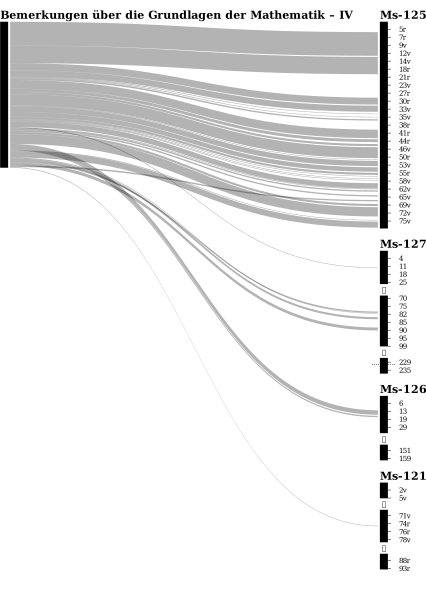
Do not quote from or cite this translation!
§Ms-125
5v[4]1 “Die Axiome eines mathematischen Axiomsystems sollen einleuchtend sein.” Wie leuchten sie denn ein?
“The axioms of a mathematical axiom system should be self-evident.” How are they self-evident?
§Ms-125
6r[1]Wie wenn ich sagte: so kann ich mir's am leichtesten vorstellen. Und hier ist Vorstellen nicht ein bestimmter seelischer Vorgang bei dem man zumeist die Augen schließt, oder mit den Händen bedeckt.
As when I say: this is the easiest way for me to imagine it. And here, imagining is not a specific mental process in which one mostly closes one's eyes or covers one's face with one's hands.
§Ms-125
6r[2] &6v[1]
2 Was sagen wir, wenn uns so ein Axiom dargeboten wird, z.B. das Parallelenaxiom? Hat Erfahrung uns gezeigt, daß es sich so verhält?
Nun vielleicht; aber welche Erfahrung? Ich meine: Erfahrung spielt eine Rolle; aber nicht die, die man unmittelbar erwarten würde. Denn man hat ja doch nicht Versuche gemacht & gefunden, daß wirklich nur eine Gerade die andre Gerade nicht durch den Punkt schneidet. Und doch leuchtet der Satz ein. – Wenn ich nun sagte: es ist ganz gleichgültig, warum er einleuchtet. Genug: wir nehmen ihn an. Wichtig ist nur, wie wir ihn gebrauchen.
What do we say when such an axiom is presented to us, e.g., the parallel axiom? Has experience shown us that it is the case?
Well, perhaps; but which experience? I mean: experience plays a role; but not the one one might immediately expect. Because, after all, one has not conducted experiments and found that in reality only one straight line does not intersect the other straight line at the point. And yet the sentence is clear. – If now I said: it is completely irrelevant why it is clear. Enough: we accept it. What is important is only how we use it.
§Ms-125
6v[2]Der Satz beschreibt ein Bild. Nämlich dieses:

The sentence describes a picture, namely this:
§Ms-125
7r[1]Dies Bild ist uns annehmbar. Wie es uns annehmbar ist, die ungenaue Kenntnis einer Zahl durch Abrunden auf ein Vielfaches von 10 anzudeuten.
This picture is acceptable to us. How it is acceptable to us is the same as how we indicate an imprecise knowledge of a number by rounding it to a multiple of 10.
§Ms-125
7r[2]‘Wir nehmen diesen Satz an.’ Aber als was nehmen wir ihn an?
‘We accept this sentence.’ But as what do we accept it?
§Ms-125
7r[3] &7v[1]
3 Ich will sagen: Wenn der Wortlaut des Parallelen-Axioms, z.B., gegeben ist (& wir die Sprache verstehen) so ist die Art der Verwendung dieses Satzes, & also sein Sinn, noch gar nicht bestimmt. Und wenn wir sagen, er leuchtet uns ein, so haben wir damit, ohne es zu wissen, schon eine bestimmte Art der Verwendung des Satzes gewählt. Der Satz ist kein mathematisches Axiom, wenn wir ihn nicht gerade dazu verwenden.
I want to say: if the wording of the parallel axiom, for example, is given (& we understand the language), then the type of use of this sentence, and thus its sense, is not yet determined. And if we say that it is clear to us, then we have already chosen a certain type of use of the sentence, without knowing it. The sentence is not a mathematical axiom if we do not use it for that.
§Ms-125
7v[2] &8r[1]
Daß wir nämlich hier nicht Versuche machen, sondern das Einleuchten gelten lassen legt schon die Verwendung fest. Denn wir sind ja nicht so naiv, das Einleuchten statt des Versuchs gelten zu lassen.
The fact that we do not conduct experiments here, but let the clarity count, already determines the use. Because we are not so naive as to let the clarity count instead of the experiment.
§Ms-125
8r[2]Nicht, daß er uns als wahr einleuchtet, sondern daß wir das Einleuchten gelten lassen, macht ihn zum mathem. Satz.
Not that it appears true to us, but that we let the clarity count makes it a mathematical sentence.
§Ms-125
8r[3] &8v[1]
4 Lehrt uns die Erfahrung daß zwischen je 2 Punkten eine Gerade möglich ist? Oder, daß zwei verschiedene Farben nicht an einem Orte sein können? Man könnte sagen: die Vorstellung lehrt es uns. Und darin liegt die Wahrheit; man muß es nur recht verstehen.
Does experience teach us that a straight line is possible between any two points? Or that two different colors cannot be at one place? One could say: imagination teaches us this. And therein lies the truth; one must just understand it correctly.
§Ms-125
8v[2]Vor dem Satz ist der Begriff noch geschmeidig.
Before the sentence, the concept is still flexible.
§Ms-125
8v[3]Aber könnten nicht Erfahrungen uns bestimmen das Axiom zu verwerfen?!
Ja. Und dennoch spielt es nicht die Rolle des Erfahrungssatzes.
But could not experiences determine us to reject the axiom?!
Yes. And yet it does not play the role of the empirical proposition.
§Ms-125
8v[4] &9r[1]
Warum sind die Newtonschen Gesetze keine Axiome der Mathematik? Weil man sich sehr wohl vorstellen könnte, daß es sich anders verhielte. Aber – will ich sagen – dies schreibt jenen Sätzen nur eine gewisse Rolle im Gegensatz zu einer andern zu. D.h.: von einem Satz zu sagen: ‘man könnte sich das auch anders vorstellen’ oder ‘man kann sich auch das Gegenteil davon vorstellen’, schreibt ihm die Rolle des Erfahrungssatzes zu.
Why are Newton's laws not axioms of mathematics? Because one could very well imagine that things could be different. But – I want to say – this only assigns a certain role to those sentences in contrast to another. That is: to say of a sentence: ‘one could also imagine it differently’ or ‘one can also imagine the opposite of it’, assigns it the role of the empirical proposition.
§Ms-125
9r[2] &9v[1]
Der Satz den man sich nicht anders als wahr soll vorstellen können hat eine andere Funktion als der für den es sich nicht so verhält.
The sentence that one is not supposed to be able to imagine anything other than true has a different function than the one for which this is not the case.
§Ms-125
9v[2]5 Die mathem. Axiome funktionieren dergestalt, daß, wenn Erfahrung uns dazu bewegte, ein Axiom aufzugeben, sein Gegenteil damit nicht zum Axiom würde. ‘2 × 2 ≠ 5’ heißt nicht, ‘2 × 2 = 5’ habe sich nicht bewährt.
The mathematical axioms function in such a way that, if experience were to move us to give up an axiom, its opposite would not thereby become an axiom. ‘2 × 2 ≠ 5’ does not mean that ‘2 × 2 = 5’ has not proven itself.
§Ms-125
9v[3]Man könnte den Axiomen, sozusagen, ein spezielles Behauptungszeichen vorsetzen.
One could, as it were, put a special assertion mark in front of the axioms.
§Ms-125
9v[4] &10r[1]
Axiom ist etwas nicht dadurch, daß wir es als äußerst wahrscheinlich, ja als gewiß, anerkennen, sondern dadurch, daß wir ihm eine bestimmte Funktion zuerkennen & eine, die der des Erfahrungssatzes widerstreitet.
An axiom is not something because we recognize it as highly probable, indeed as certain, but because we assign it a certain function and one that is contrary to that of the empirical proposition.
§Ms-125
10r[2]Wir geben dem Axiom eine andere Art der Anerkennung als dem Erfahrungssatz. Und damit meine ich nicht daß der ‘seelische Akt des Anerkennens’ ein andrer ist.
We give the axiom a different kind of recognition than the empirical proposition. And I do not mean by this that the ‘psychic act of recognition’ is different.
§Ms-125
10v[1]Das Axiom ist, möchte ich sagen, ein andrer Redeteil.
The axiom is, I would say, a different part of speech.
§Ms-125
10v[2]6 Man nimmt, wenn man das math. Axiom, das & das sei möglich, hört, ohne weiters an, man wisse, was hier ‘möglich sein’ bedeutet; weil die Satzform uns natürlich geläufig ist.
One assumes, when one hears that the mathematical axiom, this and that, is possible, without further ado, that one knows what ‘being possible’ means here; because the sentence form is naturally familiar to us.
§Ms-125
10v[3] &11r[1]
Man wird nicht gewahr, wie verschiedenerlei die Verwendung der Aussage, etwas sei möglich, ist & kommt nicht auf den Gedanken, nach der besondern Verwendung in diesem Fall, zu fragen.
One does not realize how different the use of the statement, something is possible, is, and does not think to ask about the special use in this case.
§Ms-125
11r[2]Ohne die Verwendung im geringsten zu übersehen, können wir hier gar nicht zweifeln, daß wir den Satz verstehen.
Without overlooking the use in the slightest, we cannot doubt that we understand the sentence.
§Ms-125
11r[3] &11v[1]
Ist der Satz, daß es keine Wirkung in die Ferne gibt von dem Geschlecht der math. Sätze? Man möchte da auch sagen: der Satz ist nicht dazu bestimmt eine Erfahrung auszudrücken, sondern daß man sich etwas nicht anders vorstellen könne.
Is the sentence that there is no effect in the distance of the type of mathematical sentences? One would also like to say: the sentence is not intended to express an experience, but that one cannot imagine anything else.
§Ms-125
11v[2] &12r[1]
Zu sagen zwischen zwei Punkten sei – geometrisch – immer eine Gerade möglich, heißt: Von mehr als zwei Punkten zu sagen, sie lägen auf einer Geraden ist eine Aussage; es von zweien zu sagen ist keine.
To say that a straight line is always possible – geometrically – between two points means: to say that more than two points lie on a straight line is a statement; to say it of two is not.
§Ms-125
12r[2]So wie man sich auch nicht fragt, was ein Satz der Form “Es gibt kein …” (z.B. “Es gibt keinen Beweis dieses Satzes”) im besonderen Fall bedeutet. Auf die Frage was er bedeutet antwortet man dem Anderen & sich selbst mit einem Beispiel des Nicht-existierens.
Just as one does not ask what a sentence of the form “There is no…” (e.g., “There is no proof of this sentence”) means in a particular case. In answer to the question of what it means, one answers the other person and oneself with an example of non-existence.
§Ms-125
12r[3] &12v[1]
7 Der math. Satz steht auf vier Füßen, nicht auf dreien; er ist überbestimmt.
The mathematical sentence stands on four legs, not three; it is overdetermined.
§Ms-125
12v[2]8 Wenn wir das Tun eines Menschen, z.B., durch eine Regel beschreiben, so wollen wir, daß der, dem wir die Beschreibung geben, durch Anwendung der Regel wisse, was im besonderen Fall geschieht. Gebe ich ihm nun durch die Regel eine indirekte Beschreibung?
If we describe a person’s action, e.g., by means of a rule, we want the person to whom we give the description to know, by applying the rule, what happens in the particular case. Does giving him the rule provide an indirect description?
§Ms-125
12v[3] &13r[1]
Es gibt natürlich einen Satz, der sagt: wenn Einer die Zahlen … nach den & den Regeln zu multiplizieren trachtet so erhält er ‥‥․.
There is, of course, a sentence that says: if someone tries to multiply the numbers … according to the rules, then he obtains ….
§Ms-125
13r[2]Eine Anwendung des math. Satzes muß immer das Rechnen selber sein. Das bestimmt das Verhältnis der Rechentätigkeit zum Sinn der math. Sätze.
An application of the mathematical sentence must always be the calculation itself. This determines the relationship of the calculating activity to the sense of the mathematical sentences.
§Ms-125
13r[3]Wir beurteilen Gleichheit & Übereinstimmung nach den Resultaten unseres Rechnens, darum können wir nicht das Rechnen mit Hilfe der Übereinstimmung erklären.
We judge sameness and agreement according to the results of our calculations; therefore, we cannot explain calculation with the help of agreement.
§Ms-125
13v[2]Wir beschreiben mit Hilfe der Regel: Wozu? Warum das ist eine andre Frage.
We describe with the help of the rule: for what purpose? Why? That is another question.
§Ms-125
13v[3] &14r[1]
‘Die Regel, auf diese Zahlen angewandt, gibt jene’ könnte heißen: der Regelausdruck auf den Menschen angewendet läßt ihn aus diesen Zahlen jene erzeugen.
‘The rule, when applied to these numbers, gives those’ could mean: the rule, when applied to a person, makes him generate those numbers from these numbers.
§Ms-125
14r[2]Man fühlt ganz richtig daß dies kein math. Satz wäre.
One rightly feels that this would not be a mathematical sentence.
§Ms-125
14r[3]Der math. Satz setzt einen gewissen Weg fest.
The mathematical sentence establishes a certain path.
§Ms-125
14r[4] &14v[1]
Es ist kein Widerspruch daß er eine Regel ist und nicht einfach festgesetzt, sondern nach Regeln erzeugt wird.
It is not a contradiction that it is a rule and not simply stipulated, but is generated according to rules.
§Ms-125
14v[2]Wer mit einer Regel beschreibt, weiß selbst auch nicht mehr als er sagt. D.h., er sieht auch nicht die Anwendung voraus, die er im besondern Fall von der Regel machen wird. Wer “u.s.w.” sagt, weiß selbst auch nicht mehr als “u.s.w.”.
Whoever describes with a rule does not know more than he says. That is, he does not foresee the application that he will make of the rule in the particular case. Whoever says “etc.” does not know more than “etc.”.
§Ms-125
14v[3] &15r[1]
9 Wie könnte man Einem erklären, was der zu tun hat, der einer Regel folgen soll?
How could one explain to someone what he has to do who is supposed to follow a rule?
§Ms-125
15r[2] &15v[1]
Man ist versucht zu erklären: vor allem tu das Einfachste (wenn die Regel z.B. ist immer das gleiche zu wiederholen). Und daran ist natürlich etwas. Es ist von Bedeutung, daß wir sagen können, es sei einfacher eine Zahlenreihe anzuschreiben, in der jede Zahl gleich der vorhergehenden ist, als eine Reihe, in der jede Zahl um 1 größer ist als die vorhergehende. Und wieder, daß dies ein einfacheres Gesetz ist als das, abwechselnd 1 und 2 zu addieren.
One is tempted to explain: first of all, do the simplest thing (if the rule is, for example, always to repeat the same thing). And there is, of course, something to that. It is important that we can say that it is simpler to write down a series of numbers in which each number is equal to the previous one than a series in which each number is 1 greater than the previous one. And again, that this is a simpler law than the one that alternates between adding 1 and 2.
§Ms-125
15v[2] &16r[1]
10 Ist es denn nicht übereilt, einen Satz, den man an Stäbchen & Bohnen erprobt hat, auf Wellenlängen des Lichts anzuwenden? Ich meine: daß 2 × 5000 = 10000 ist. Rechnet man wirklich damit, daß, was sich in so viel Fällen bewahrheitet hat, auch für diese stimmen muß? Oder ist es nicht vielmehr, daß wir uns mit der arithmetischen Annahme noch gar nicht binden?
Isn’t it premature to apply a sentence that one has tested on sticks and beans to the wavelengths of light? I mean: that 2 × 5000 = 10000. Does one really assume that what has proven true in so many cases must also be true for these? Or is it not rather that we are not yet at all committed to the arithmetic assumption?
§Ms-125
16r[2]11 Die Arithm. als die Naturgeschichte (Mineralogie) der Zahlen. Wer spricht aber so von ihr? Unser ganzes Denken ist von dieser Idee durchsetzt.
Arithmetic as the natural history (mineralogy) of numbers. Who speaks of it in this way? Our entire thinking is permeated by this idea.
§Ms-125
16r[3] &16v[1] &
17r[1]
Die Zahlen sind Gestalten (ich meine nicht die Zahlzeichen) & die Arithm. teilt uns die Eigenschaften dieser Gestalten mit. Aber die Schwierigkeit ist da, daß die Eigenschaften der Gestalten Möglichkeiten sind; nicht die gestaltlichen Eigenschaften der Dinge, die die Gestalt haben. Und diese Möglichkeiten wieder entpuppen sich als physikalische, oder psychologische, Möglichkeiten (der Zerlegung, Zusammensetzung, etc.). Die Gestalten aber spielen (nur) die Rolle der Bilder, die man so & so verwendet. Nicht Eigenschaften von Gestalten ist es, was wir geben, sondern Transformationen von Gestalten, als irgendwelche Paradigmen aufgestellt.
The numbers are shapes (I do not mean the number signs), and arithmetic tells us about the properties of these shapes. But the difficulty is that the properties of the shapes are possibilities; not the shape-like properties of things that have the shape. And these possibilities turn out to be physical or psychological possibilities (of decomposition, composition, etc.). The shapes, however, play (only) the role of images that are used in such and such a way. It is not properties of shapes that we give, but transformations of shapes, presented as paradigms.
§Ms-125
17r[2] &17r[3]
12 Wir beurteilen nicht die Bilder, sondern mittels der Bilder. Wir erforschen sie nicht sondern mittels ihrer etwas anderes.
We do not judge the images, but by means of the images. We do not investigate them but investigate something else by means of them.
§Ms-125
17r[4] &17v[1]
Du bringst ihn zu der Entscheidung dies Bild aufzunehmen. Und zwar durch Beweis, d.i., durch Vorführung einer Bilderreihe, oder einfach dadurch, daß Du ihm das Bild zeigst. Was zu dieser Entscheidung bewegt ist hier gleichgültig. Die Hauptsache ist, daß es sich um das Annehmen eines Bildes handelt.
You lead him to the decision to adopt this image. And that is done through proof, i.e., by presenting a series of images, or simply by showing him the image. What moves him to this decision is irrelevant here. The main thing is that it is about adopting an image.
§Ms-125
17v[2]Das Bild des Zusammensetzens ist kein Zusammensetzen; das Bild einer Zerlegung keine Zerlegung; das Bild des Passens kein Passen. Aber diese Bilder sind von der größten Bedeutung. So sieht es aus, wenn zusammengesetzt wird; wenn zerlegt wird; usw.
The image of composition is not composition; the image of decomposition is not decomposition; the image of fitting is not fitting. But these images are of the utmost meaning. This is what it looks like when something is composed; when something is decomposed; and so on.
§Ms-125
18r[1]13 Wie wäre es, wenn Tiere oder Kristalle so schöne Eigenschaften hätten wie die Zahlen? Es gäbe also z.B. eine Reihe von Gestalten, eine immer um eine Einheit größer als die andere.
What if animals or crystals had such beautiful properties as numbers? There would be, for example, a series of shapes, each one larger than the other by one unit.
§Ms-125
18r[2] &18v[1]
Ich möchte darstellen können, wie es kommt, daß die Math. jetzt uns als Naturgeschichte des Zahlenreiches, jetzt wieder als eine Sammlung von Regeln erscheint.
I would like to be able to show how it is that mathematics now appears to us as a natural history of the realm of numbers, and now again as a collection of rules.
§Ms-125
18v[2]Könnte man aber nicht Transformationen von Tiergestalten (z.B.) studieren? Aber wie ‘studieren’? Ich meine: könnte es nicht nützlich sein, sich Transformationen von Tiergestalten vorzuführen? Und doch wäre dies kein Zweig der Zoologie. –
But could one not study transformations of animal shapes (for example)? But how ‘study’? I mean: could it not be useful to demonstrate transformations of animal shapes? And yet this would not be a branch of zoology.
§Ms-125
18v[3] &19r[1]
Ein math. Satz wäre es dann (z.B.), daß diese Transformation diese Gestalt in diese überleitet. (Die Gestalten & die Transformation wiedererkennbar.)
A mathematical proposition would then be (e.g.), that this transformation maps this figure onto that one. (The figures and the transformation are recognizable.)
§Ms-125
19r[2] &19v[1]
14 Wir müssen uns aber dessen erinnern, daß der math. Beweis durch seine Umformungen nicht nur zeichengeometrische Sätze, sondern Sätze des verschiedenartigsten Inhalts beweist.
We must, however, remember that the mathematical proof, through its transformations, proves not only propositions of symbolic geometry, but propositions of the most varied content.
§Ms-125
19r[3]So beweist die Umformung eines Russellschen Beweises, daß dieser logische Satz mit Hilfe dieser Regeln sich aus den Grundgesetzen bilden lasse. Aber der Beweis wird als Beweis der Wahrheit des Schlußsatzes angesehen, oder als Beweis dafür, daß der Schlußsatz nichts sagt. Das ist nun nur durch eine Beziehung des Satzes nach außen möglich; d.h. durch seine Beziehung zu andern Sätzen, z.B., & deren Anwendung.
Thus, the transformation of a Russellian proof demonstrates that this logical proposition can be derived from the fundamental laws using these rules. But the proof is regarded as a proof of the truth of the conclusion, or as a proof that the conclusion says nothing. This is possible only through a relationship of the proposition to the outside world; that is, through its relationship to other propositions, e.g., and their application.
§Ms-125
19v[2] &20r[1]
‘Die Tautologie (‘p ⌵ ~p’, z.B.) sagt nichts’ ist ein Satz der sich auf das Sprachspiel bezieht, worin der Satz p angewendet wird. (Z.B.: “Es regnet, oder regnet nicht” ist keine Mitteilung über das Wetter.)
‘The tautology (“p ∨ ~p”, for example) says nothing’ is a sentence that refers to the language-game in which the sentence p is used. (E.g.: “It is raining, or it is not raining” is not a communication about the weather.)
§Ms-125
20r[2]Die R.sche Logik sagt nichts darüber, welcher Art & Verwendung Sätze, ich meine nicht logische Sätze, sind: Und doch erhält die Logik ihren ganzen Sinn (nur) von der supponierten Anwendung auf die Sätze.
R.‘s logic says nothing about the nature and use of sentences—I mean, not logical sentences: And yet logic derives its entire sense (only) from the supposed application to sentences.
§Ms-125
28v[1] &29r[1]
15 Man kann sich denken daß Leute eine angewandte Mathematik haben ohne eine reine Mathematik. Sie können z.B. – nehmen wir an – die Bahn berechnen, welche gewisse sich bewegende Körper beschreiben & deren Ort zu einer gegebenen Zeit vorhersagen. Dazu benüutzen sie ein Koordinatensystem, die Gleichung von Kurven (eine Form der Beschreibung wirklicher Bewegung) & die Technik des Rechnens im Dezimalsystem.
Die Idee eines Satzes der reinen Mathematik kann ihnen ganz fremd sein. Diese Leute haben also Regeln denen gemäß sie die betreffenden Zeichen insbesondere z.B. Zahlzeichen transformieren zum Zweck der Voraussage des Eintreffens gewisser Ereignisse.
One can imagine that people have applied mathematics without pure mathematics. They can, for example—let us assume—calculate the trajectory described by certain moving bodies and predict their location at a given time. To do this, they use a coordinate system, the equations of curves (a form of describing reality), and the technique of calculation in the decimal system.
The idea of a theorem in pure mathematics may be completely foreign to them. These people therefore have rules according to which they transform the relevant symbols—in particular, for example, numerical symbols—for the purpose of predicting the occurrence of certain events.
§Ms-125
29r[2] &29v[1]
Aber wenn sie nun z.B. multiplizieren, werden sie da nicht einen Satz gewinnen, der sagt, daß das Resultat der Multiplikation das gleiche ist, wie immer man die Faktoren vertauscht? Das wird keine primäre Zeichenregel sein, aber auch kein Satz ihrer Physik. Nun, sie brauchen so einen Satz nicht zu erhalten – selbst wenn sie das Vertauschen der Faktoren erlauben.
But if they now multiply, for example, will they not arrive at a theorem stating that the result of the multiplication is the same no matter how the factors are swapped? This will not be a primary symbolic rule, nor will it be a theorem of their physics. Well, they do not need to arrive at such a theorem—even if they allow the factors to be swapped.
§Ms-125
29v[2] &30r[1]
Ich denke mir die Sache so, daß diese Mathematik ganz in Form von Geboten betrieben wird. “Du mußt das & das tun” – um nämlich die Antwort darauf zu erhalten, ‘wo wird sich dieser Körper zu der & der Zeit befinden’. (Wie diese Menschen zu dieser Methode der Vorhersagung gekommen sind, ist ganz gleichgültig).
I imagine the matter in such a way that this mathematics is conducted entirely in the form of commands. “You must do this and that”—namely, in order to obtain the answer to the question, ‘where will this body be at such-and-such a time’. (How these people arrived at this method of prediction is entirely irrelevant).
§Ms-125
30r[2]Der Schwerpunkt der Mathem. liegt für diese Menschen ganz im Tun.
For these people, the focus of mathematics lies entirely in action.
§Ms-125
30r[3]16 Ist das aber möglich? Ist es möglich, daß sie das kommutative Gesetz (z.B.) nicht als Satz ansprechen?
But is that possible? Is it possible that they do not address the commutative law (for example) as a proposition?
§Ms-125
30r[4] &30v[1]
Ich will doch sagen: Diese Leute sollen nicht zu der Auffassung kommen, daß sie mathem. Entdeckungen machen – sondern nur physikalische Entdeckungen. [Wie sehr ich doch bei meinem Denken von Spengler beeinflußt bin!]
I want to say: These people should not come to the conclusion that they are making mathematical discoveries—but only physical discoveries. [How greatly I am influenced by Spengler in my thinking!]
§Ms-125
30v[2] &31r[1]
Frage: Müssen sie mathem. Entdeckungen als Entdeckungen machen? Was geht ihnen ab wenn sie keine machen? Könnten sie (z.B.) den Beweis des kommutativen Gesetzes gebrauchen, aber ohne die Auffassung, er gipfle in einem Satz, er habe also ein Resultat das ihren physikalischen Sätzen irgendwie vergleichbar sei?
Question: Must they make mathematical discoveries as discoveries? What are they missing if they do not make them? Could they (e.g.) use the proof of the commutative law, but without the notion that it culminates in a theorem, that it thus has a result somehow comparable to their physical theorems?
§Ms-125
31r[2] &31v[1]
17 Das bloße Bild

einmal als 4 Reihen zu 5 Punkten, einmal als 5 Kolumnen zu 4 Punkten betrachtet könnte jemand vom kommutativen Gesetz überzeugen. Und er könnte daraufhin Multiplikationen einmal in der einen, einmal in der andern Richtung ausführen.
The mere picture
considered once as 4 rows of 5 points, once as 5 columns of 4 points, could convince someone of the commutative law. And he could then carry out multiplications in one direction in one case, and in the other direction in the other case.
§Ms-125
31v[2]06.04.1942
Ein Blick auf die Vorlage & die Steine überzeugt ihn, daß er mit ihnen die Figur wird legen können, d.h., er unternimmt darauf, sie zu legen.
April 6, 1942
A glance at the template and the stones convinces him that he will be able to lay out the figure with them; that is, he sets about laying them out.
§Ms-125
31v[4] &32r[1] &
32r[2] &
32v[1]
‘Ja, aber nur, wenn die Steine sich nicht ändern? – Wenn sie sich nicht ändern & wenn wir keinen unbegreiflichen Fehler machen, oder Steine unbemerkt verschwinden oder dazukommen. ‘Aber es ist doch wesentlich, daß sich die Figur tatsächlich allemal aus den Steinen legen läßt! Was geschähe wenn sie sich nicht legen ließe?’ – Vielleicht würden wir uns dann für geistesgestört halten. Aber – was weiter? – Vielleicht würden wir die Sache auch hinnehmen, wie sie ist. Und dann würde Frege sagen: “Hier haben wir eine neue Art der Verrücktheit”.
‘Yes, but only if the stones do not change? – If they do not change and if we do not make an incomprehensible mistake, or stones disappear unnoticed or are added.’ But it is essential that the figure can always be laid out with the stones! What would happen if it could not be laid out?’ – Perhaps we would then consider ourselves insane. But – what then? – Perhaps we would also accept the matter as it is. And then Frege would say: “Here we have a new kind of madness.”
§Ms-125
32v[2]18 Es ist klar, daß die Mathematik als Technik des Umwandelns von Zeichen zum Zweck des Vorhersagens mit (der) Grammatik nichts zu tun hat.
It is clear that mathematics as a technique of transforming signs for the purpose of prediction has nothing to do with grammar.
§Ms-125
32v[3] &33r[1]
19 (Jene) Leute, deren Mathematik nur eine solche Technik ist, sollen nun auch Beweise anerkennen, die sie von der Brauchbarkeit einer Zeichentechnik überzeugen.
Those people whose mathematics is only such a technique should also recognize proofs that convince them of the usability of a sign technique.
§Ms-125
33r[2] &33v[1]
20 Wenn uns das Rechnen als maschinelle Tätigkeit erscheint, so ist der Mensch, der die Rechnung ausführt, die Maschine.
If calculation appears to us as a mechanical activity, then the person performing the calculation is the machine.
§Ms-125
33v[2]Die Rechnung wäre dann gleichsam ein Diagramm, das ein Teil der Maschine hinschreibt.
The calculation would then be like a diagram that the machine writes down.
§Ms-125
33v[3]21 Und das bringt mich darauf daß ein Bild uns sehr wohl davon überzeugen kann daß ein bestimmter Teil eines Mechanismus sich so & so bewegen werde wenn man den Mechanismus in Gang setzt.
And that brings me to the fact that a picture can very well convince us that a certain part of a mechanism will move in a certain way when the mechanism is set in motion.
§Ms-125
34r[1]So ein Bild (oder eine Bilderreihe) wirkt wie ein Beweis. So könnte ich z.B. konstruieren, wie der Punkt x des Mechanismus

sich bewegen werde.
Such an image (or a series of images) acts as proof. For example, I could illustrate how point x of the mechanism
will move.
§Ms-125
34r[2]Ist es nicht seltsam, daß es nicht augenblicklich klar ist, wie uns das Bild der Periode im Dividieren von der Wiederkehr der Ziffernreihe überzeugt?
Isn’t it strange that it is not immediately clear how the image of the period in division convinces us of the recurrence of the sequence of numbers?
§Ms-125
34v[3](Es ist so schwer für mich, die innere Beziehung von der äußeren zu scheiden – das Bild von der Vorhersage.)
(It is so difficult for me to separate the inner relationship from the outer one – the image from the prediction.)
§Ms-125
35v[2]Der Doppelcharakter des math. Satzes – als Gesetz & als Regel.
The dual nature of the mathematical proposition—as a law and as a rule.
§Ms-125
36r[3] &36v[1]
22 Wie, wenn man statt “Intuition” sagen würde “richtiges Erraten”? Das würde den Wert einer Intuition in einem ganz andern Lichte zeigen. Denn das Phänomen des Ratens ist ein psychologisches, aber nicht das des richtig Ratens.
What if, instead of “intuition,” one said “correct guessing”? That would show the value of an intuition in a completely different light. Because the phenomenon of guessing is a psychological one, but not that of correct guessing.
§Ms-125
36v[2]23 Daß wir die Technik gelernt haben, macht, daß wir sie nun, auf den Anblick dieses Bildes hin, so & so abändern.
The fact that we have learned the technique means that we now, upon seeing this image, modify it in such and such a way.
§Ms-125
39v[3]‘Wir entschließen uns zu einem neuen Sprachspiel.’ ‘Wir entschließen uns spontan (möchte ich sagen) zu einem neuen Sprachspiel.’
‘We decide on a new language-game.’ ‘We decide spontaneously (I would say) on a new language-game.’
§Ms-125
39v[4] &40r[1]
24 Ja – es scheint: wenn unser Gedächtnis anders funktionierte, daß wir dann nicht so, wie wir's tun, rechnen könnten. Könnten wir aber dann Definitionen geben, wie wir es tun; so reden & schreiben, wie wir es tun? Wie aber können wir die Grundlage unsrer Sprache durch Erfahrungssätze ausdrücken?!
Yes – it seems: if our memory functioned differently, then we could not calculate as we do. But could we then give definitions as we do; speak and write as we do? How, however, can we express the foundation of our language through sentences of experience?
§Ms-125
40r[2] &40v[1]
25 Angenommen, eine Division wenn wir sie ganz ausführen würde nicht zu demselben Resultat führen wie das Kopieren der Periode. Das könnte z.B. daher kommen, daß wir die Rechengesetzchen ohne uns dessen bewußt zu sein veränderten. (Es könnte aber auch daher kommen, daß wir anders kopieren.)
Suppose that a division, if carried out completely, would not lead to the same result as copying the period. This could be due, for example, to the fact that we alter the rules of calculation without being conscious of it. (But it could also be due to the fact that we copy differently.)
§Ms-125
40v[2] &41r[1]
26 Was ist der Unterschied zwischen nicht rechnen & falsch rechnen. – Oder: ist eine scharfe Grenze zwischen dem, die Zeit nicht zu messen & sie falsch messen? Keine Zeitmessung zu kennen & eine falsche?
What is the difference between not calculating and calculating incorrectly? – Or: is there a clear distinction between not measuring time and measuring it incorrectly? Between not knowing how to measure time and doing so incorrectly?
§Ms-125
41r[2]27 Gib auf das Geschwätz acht, wodurch wir jemand von der Wahrheit eines math. Satzes überzeugen. Es gibt einen Aufschluß über die Funktion dieser Überzeugung. Ich meine das Geschwätz womit die Intuition wachgerufen wird. Womit also die Maschine einer Technik in Gang gesetzt wird.
Pay attention to the chatter by which we convince someone of the truth of a mathematical sentence. It provides an insight into the function of this conviction. I mean the chatter that evokes intuition. With which, therefore, the machine of a technique is set in motion.
§Ms-125
41v[1]28 Kann man sagen, daß, wer eine Technik lernt, sich dadurch von der Gleichförmigkeit der Resultate überzeugt??
Can one say that someone who learns a technique thereby becomes convinced of the uniformity of the results?
§Ms-125
41v[2]29 Die Grenze der Empirie – ist die Begriffsbildung.
The limit of empiricism is conceptualization.
§Ms-125
41v[3] &42r[1]
Welchen Übergang mache ich von “es wird so sein” zu “es muß so sein”? Ich bilde einen andern Begriff. Einen, in dem inbegriffen ist was es früher nicht war. Wenn ich sage: “Wenn diese Ableitungen gleich sind, dann muß …”, Bilde also meinen Begriff der Gleichheit um.
What transition do I make from “it will be so” to “it must be so”? I form a different concept. One that includes what was not there before. When I say: “If these derivations are equal, then …”, I thus reformulate my concept of equality.
§Ms-125
42r[2] &42v[1]
Wie aber, wenn Einer nun sagt: “Ich bin mir nicht dieser zwei Vorgänge bewußt, ich bin mir nur der Empirie bewußt, nicht einer von ihr unabhängigen Begriffsbildung & Begriffsumbildung; alles scheint mir im Dienste der Empirie zu stehen.”? Mit andern Worten: wir scheinen nicht bald mehr, bald weniger rational zu werden, oder die Form unseres Denkens zu verändern, so daß damit sich das ändert, was wir “Denken” nennen. Wir scheinen es nur immer der Erfahrung anzupassen.
But what if someone now says: “I am not conscious of these two processes; I am only conscious of empiricism, not of concept formation and concept transformation independent of it; everything seems to me to be in the service of empiricism.”? In other words: we do not seem to become more or less rational, or to change the form of our thinking, so that what we call “thinking” changes as a result. We seem only to adapt it constantly to experience.
§Ms-125
42v[2] &43r[1]
Das ist klar: daß, wenn Einer sagt: “Wenn Du der Regel folgst so muß es so sein”, (daß) er keinen klaren Begriff von Erfahrungen hat die dem Gegenteil entsprächen.
It is clear that when someone says, “If you follow the rule, then it must be so,” they have no clear concept of experiences that would correspond to the opposite.
§Ms-125
43r[2]Oder auch so: Er hat keinen klaren Begriff davon, wie es aussähe, wenn es anders wäre. Und das ist sehr wichtig.
Or also: He has no clear concept of what it would look like if it were different. And that is very important.
§Ms-125
43v[2] &44r[1]
30 Was zwingt uns den Begriff der Gleichheit so zu formen, daß wir etwa sagen: “wenn Du beidemale wirklich das Gleiche tust, muß auch dasselbe herauskommen”? – Was zwingt uns, nach einer Regel vorzugehen, etwas als Regel aufzufassen? Was zwingt uns mit uns selbst in den Formen der von uns gelernten Sprache zu reden
What compels us to shape the concept of equality in such a way that we say, for example: “if you really do the same thing both times, the same result must follow”? – What compels us to proceed according to a rule, to regard something as a rule? What compels us to speak to ourselves in the forms of the language we have learned?
§Ms-125
44r[2]Denn das Wort “muß” drückt doch aus, daß wir von diesem Begriff nicht abgehen können. (Oder soll ich sagen “wollen”?)
For the word “must” expresses, after all, that we cannot depart from this concept. (Or should I say “want”?)
§Ms-125
44r[3] &44v[1]
Ja, auch wenn ich von einer Begriffsbildung zu einer andern übergegangen bin, so bleibt der alte Begriff noch (immer) im Hintergrund.
Yes, even if I have moved from one concept formation to another, the old concept still remains in the background.
§Ms-125
44v[2]Kann ich sagen: “Ein Beweis bringt uns zu einer gewissen Entscheidung, & zwar zu der, eine bestimmte Begriffsbildung anzunehmen”??
Can I say: “A proof brings us to a certain decision, namely to accept a certain concept formation”?
§Ms-125
45r[2]Sieh den Beweis nicht als einen Vorgang an der Dich zwingt, sondern der Dich führt. – Und zwar führt er Deine Auffassung eines (gewissen) Sachverhalts.
Do not see the proof as a process that compels you, but rather one that guides you. – Specifically, it guides your understanding of a (certain) state of affairs.
§Ms-125
45v[1]Aber wie kommt es, daß er jeden von uns so führt, daß wir übereinstimmend von ihm beeinflußt werden? Nun, wie kommt es daß wir übereinstimmend zählen? ‘Wir sind eben so abgerichtet’, kann man sagen, ‘und die Übereinstimmung die so erzeugt wird setzt sich durch die Beweise fort’.
But how is it that he guides each of us in such a way that we are uniformly influenced by him? Well, how is it that we count in unison? ‘We are simply trained that way,’ one might say, ‘and the uniformity thus produced is perpetuated by the proofs.’
§Ms-125
45v[2] &46r[1]
Während dieses Beweises haben wir eine Anschauungsweise von der 3-Teilung des Winkels gebildet, die eine Konstruktion mit Lineal & Zirkel ausschließt.
During this proof, we have formed a conception of the trisection of the angle that excludes a construction with a ruler and compass.
§Ms-125
46r[3] &46v[1]
Dadurch, daß wir einen Satz als selbstverständlich anerkennen, sprechen wir ihn auch von jeder Verantwortung gegenüber der Erfahrung frei.
By recognizing a sentence as self-evident, we also free it from all responsibility towards experience.
§Ms-125
46v[2]Während des Beweises wird unsere Anschauung geändert – & daß das mit Erfahrungen zusammenhängt tut dem keinen Eintrag.
During the proof, our view is changed – and the fact that this is connected with experiences does not matter.
§Ms-125
46v[3]Unsre Anschauung wird umgemodelt.
Our view is remodeled.
§Ms-125
46v[4] &47r[1]
31 Es muß so sein, heißt nicht, es wird so sein. Im Gegenteil: ‘Es wird so sein, wählt zwischen einer & einer andern Möglichkeit. ‘Es muß so sein’ sieht nur eine Möglichkeit.
"It must be so" does not mean "it will be so." On the contrary: "It will be so" chooses between one possibility and another. "It must be so" sees only one possibility.
§Ms-125
47r[2]Der Beweis leitet unsere Erfahrungen sozusagen in bestimmte Kanäle. Wer das & das immer wieder versucht hat gibt den Versuch Beweis auf.
The proof, as it were, channels our experiences in certain ways. Whoever has tried this again and again gives up the attempt after seeing the proof.
§Ms-125
47r[3] &47v[1]
Es versucht Einer ein gewisses Bild aus Steinen zusammenzulegen. Er sieht nun eine Vorlage in welcher ein Teil jenes Bilds aus allen seinen Steinen zusammengelegt erscheint, & gibt nun seinen Versuch auf. Die Vorlage war der Beweis dafür, daß sein Vorhaben unmöglich ist.
Someone attempts to assemble a certain picture out of stones. He now sees a model in which a part of that picture appears to have been assembled from all his stones, and he gives up his attempt. The model was the proof that his undertaking is impossible.
§Ms-125
47v[2] &48r[1]
Auch die Vorlage, sowie die, die ihm zeigt daß er wird ein Bild aus diesen Steinen zusammensetzen können, ändert seinen Begriff. Denn er hat, könnte man sagen, das Zusammensetzen dieses Bildes aus diesen Steinen noch nie so angesehen.
Even the model, as well as the one that shows him that he will be able to assemble a picture from these stones, changes his conception. For, one might say, he has never before viewed the assembly of this picture from these stones in this way.
§Ms-125
48r[2] &48v[1]
Ist es gesagt, daß Einer, der sieht, daß man mit diesen Steinen einen Teil des Bildes legen kann, einsieht, daß man also auf keine Weise das ganze Bild aus ihnen wird legen können? Ist es nicht möglich, daß er versucht & versucht, ob nicht doch eine Stellung der Steine dies Ziel erreicht?
Is it said that if one person sees that one can arrange a part of the picture with these stones, he realizes that one will therefore in no way be able to put the whole picture together from them? Is it not possible that he tries and tries again to see if perhaps a position of the stones will achieve this goal?
§Ms-125
48v[2]Muß man hier nicht zwischen (dem) Denken & dem praktischen Erfolg des Denkens unterscheiden?
Must one not distinguish here between thought and the practical success of thought?
§Ms-125
48v[3] &49r[1]
32 “… die nicht, wie wir, gewisse Wahrheiten unmittelbar einsehen, sondern vielleicht auf den langwierigen Weg der Induktion angewiesen sind”, so sagt Frege. Aber was mich interessiert ist das unmittelbare Einsehen, ob es nun das einer Wahrheit ist, oder einer Falschheit. Ich frage: was ist das charakteristische Benehmen von Menschen, die etwas ‘unmittelbar einsehen’ – was immer der praktische Erfolg dieses Einsehens ist?
“… those who do not, like us, immediately grasp certain truths, but perhaps rely on the lengthy path of induction,” says Frege. But what interests me is the immediate grasping, whether it is of a truth or of a falsehood. I ask: what is the characteristic behaviour of people who ‘immediately grasp’ something – whatever the practical success of this grasping may be?
§Ms-125
49v[1]Mich interessiert nicht das unmittelbare Einsehen einer Wahrheit, sondern das Phänomen des unmittelbaren Einsehens. Nicht (zwar) als einer besondern seelischen Erscheinung sondern als einer Erscheinung im Handeln der Menschen.
I am not interested in the immediate grasping of a truth, but in the phenomenon of immediate grasping. Not (exactly) as a particular mental phenomenon, but as a phenomenon in the actions of people.
§Ms-125
49v[2] &50r[1]
33 Ja; es ist, als ob die Begriffsbildung unsre Erfahrung in bestimmte Kanäle leitete so daß man nun die eine Erfahrung mit der andern auf neue Weise zusammensieht. (Wie ein optisches Instrument Licht von verschiedenen Quellen auf bestimmte Art in einem Bild zusammenkommen läßt.)
Yes; it is as if the formation of concepts guided our experience in certain channels so that one now sees one experience with the other in a new way. (As an optical instrument lets light from different sources come together in a picture in a certain way.)
§Ms-125
50r[2]Denke Dir, der Beweis wäre eine Dichtung ja ein Theaterstück. Kann mich das Ansehen eines solchen zu nichts bringen?
Imagine that the proof were a poem, or a play. Can seeing such a thing not bring me anything?
§Ms-125
50r[3] &50v[1]
Ich wußte nicht wie es gehen werde, – aber ich sah ein Bild, & nun wurde ich überzeugt, daß es so gehen werde, wie im Bilde. Das Bild verhalf mir zur Vorhersage. Nicht als ein Experiment – – es war nur der Geburtshelfer der Vorhersage.
I did not know how it would turn out, but I saw a picture, and now I was convinced that it would turn out as in the picture. The picture helped me to make a prediction. Not as an experiment – it was only the midwife of the prediction.
§Ms-125
50v[3] &50r[1]
Denn, was immer meine Erfahrungen sind, oder waren, ich muß doch noch die Vorhersage machen. (Die Erfahrungen machen sie nicht für mich.)
For whatever my experiences are, or were, I must still make the prediction. (The experiences do not make it for me.)
§Ms-125
51v[1]Dann ist es ja kein so großes Wunder, daß der Beweis uns zur Vorhersage hilft. Ohne dieses Bild hätte ich nicht sagen können, wie es werden wird, aber wenn ich es sehe so ergreife ich es zur Vorhersage.
Then it is not such a great wonder that the proof helps us to make a prediction. Without this picture, I could not have said how it would turn out, but when I see it, I use it to make a prediction.
§Ms-125
51v[2] &52r[1] &
52v[1]
Welche Farbe eine chemische Verbindung haben wird kann ich nicht mit Hilfe eines Bildes vorhersagen, das mir die Substanzen in der Proberöhre & ihre Reaktion veranschaulicht. Zeigt das Bild ein Aufschäumen & am Ende rote Kristalle, so könnte ich nicht sagen: “Ja, so muß es sein”, oder “Nein, so kann es nicht sein”. Anders aber ist es wenn ich das Bild eines Mechanismus in Bewegung setze; dieses kann mich lehren wie ein Teil sich wirklich bewegen wird. Stellte aber das Bild einen Mechanismus dar dessen Teile aus einem sehr weichen Material (etwa Teig) bestünde & sich daher im Bild auf verschiedenste Art verbögen, so würde mir das Bild vielleicht wieder nicht zu einer Vorhersage verhelfen.
I cannot predict what color a chemical compound will have with the help of a picture that illustrates the substances in the test tube and their reaction. If the picture shows foaming and, in the end, red crystals, I could not say: “Yes, that must be it,” or “No, that cannot be it.” It is different, however, when I set the image of a mechanism in motion; this can teach me how a part will actually move. But if the image depicted a mechanism whose parts were made of a very soft material (such as dough) and therefore bent in various ways in the image, then the image might not help me make a prediction after all.
§Ms-125
52v[2] &53r[1]
Kann man sagen: ein Begriff wird so gebildet daß er einer gewissen Vorhersage angepaßt ist, d.h., sie in den einfachsten Termini ermöglicht –?
Can one say: a concept is formed in such a way that it is adapted to a certain prediction, i.e., makes it possible in the simplest terms?
§Ms-125
53r[2]34 Das philosophische Problem ist: wie können wir die Wahrheit sagen, & dabei diese starken Vorurteile beruhigen?
The philosophical problem is: how can we speak the truth while allaying these strong prejudices?
§Ms-125
53r[3] &53v[1]
Es ist ein Unterschied: ob ich etwas als eine Täuschung meiner Sinne oder als ein äußeres Ereignis deute, ob ich diesen Gegenstand zum Maß jenes nehme, oder umgekehrt, ob ich mich entschließe, zwei Kriterien entscheiden zu lassen, oder nur eins.
There is a difference: whether I interpret something as an illusion of my senses or as an external event, whether I take this object as the measure of that one, or vice versa, whether I decide to let two criteria decide, or only one.
§Ms-125
53v[2]35 Wenn richtig gerechnet wurde, so muß das herauskommen. Muß es dann immer so herauskommen? Natürlich.
If the calculation was done correctly, that is what must result. Must it always turn out that way? Of course.
§Ms-125
53v[3]Indem wir zu einer Technik erzogen sind, sind wir auch zu einer Betrachtungsweise abgerichtet, die ebenso fest sitzt als jene Technik.
By being trained in a technique, we are also conditioned to a way of looking at things that is just as firmly established as that technique.
§Ms-125
54r[1]Der math. Satz scheint weder von den Zeichen, noch von den Menschen zu handeln, & er tut es daher auch nicht.
The mathematical proposition seems to deal neither with signs nor with people, & therefore it does not.
§Ms-125
54r[2]Er zeigt die Verbindungen die wir als starr betrachten. Wir schauen aber sozusagen, von diesen Verbindungen weg & auf etwas anderes. Wir drehen ihnen sozusagen den Rücken. Oder: wir lehnen uns an sie oder fußen auf ihnen.
It reveals the connections we regard as rigid. But we look, so to speak, away from these connections and toward something else. We turn our backs on them, so to speak. Or: we lean on them or stand upon them.
§Ms-125
54r[3] &54v[1]
Nochmals: wir sehen den math. Satz nicht als einen Satz, der von Zeichen handelt an, & er ist es daher auch nicht.
Once again: we do not see the mathematical proposition as a proposition dealing with signs, & therefore it is not one.
§Ms-125
54v[2]Wir erkennen ihn an, indem wir ihn den Rücken drehen.
We acknowledge it by turning our backs on it.
§Ms-125
54v[3]Wie ist es, z.B., mit den Grundgesetzen der Mechanik? Wer sie versteht, muß wissen, auf welche Erfahrungen sie sich stützen. Anders verhält es sich mit den Sätzen der reinen Mathematik.
How is it, for example, with the fundamental laws of mechanics? Whoever understands them must know what experiences they are based on. The sentences of pure mathematics are different.
§Ms-125
54v[4] &55r[1]
36 Ein Satz kann ein Bild beschreiben & dieses Bild mannigfach in unserer Betrachtungsweise der Dinge, also in unserer Lebens- & Handlungsweise verankert sein.
A sentence can describe a picture, and this picture can be embedded in many ways in our way of looking at things, i.e., in our way of life and acting.
§Ms-125
55r[3] &55v[1]
Ist nicht der Beweis ein flimsy Grund die Suche nach einer Konstruktion der Dreiteilung ganz aufzugeben? Du bist nur ein oder zweimal diese Zeichenreihe durchgegangen & daraufhin willst Du Dich entschließen? Nur weil Du diese eine Transformation gesehen hast willst Du die Suche aufgeben?
Is the proof not a flimsy reason to give up the search for a construction of the trisection altogether? You have only gone through this sequence of signs once or twice, and then you want to decide? Just because you have seen this one transformation do you want to give up the search?
§Ms-125
55v[2]Der Effekt des Beweises sei, daß sich in die neue Regel hineinstürzt.
The effect of the proof is that one plunges into the new rule.
§Ms-125
56r[1] &56v[1]
Er hatte bisher nach der & der Regel gerechnet; nun zeigt ihm Einer den Beweis, man könne auch anders rechnen, & er schaltet nun (auf die andre Technik) um – nicht weil er sich sagt, es werde so auch gehen, sondern weil er die neue Technik mit der alten als identisch empfindet, weil er ihr denselben Sinn geben muß weil er sie als gleich anerkennt wie er diese Farbe als grün anerkennt. D.h.: das Einsehen der math. Relationen spielt eine ähnliche Rolle wie das Einsehen der Identität. Man könnte beinahe sagen, es ist eine kompliziertere Art der Identität.
He has so far calculated according to this and that rule; now someone shows him the proof that one can also calculate differently, and he switches (to the other technique) – not because he says to himself that it will also work, but because he regards the new technique as identical with the old, because he must give it the same sense, because he recognizes it as the same as he recognizes this color as green. That is: the comprehension of the mathematical relations plays a similar role to the comprehension of identity. One could almost say that it is a more complicated kind of identity.
§Ms-125
57r[2]Man könnte sagen: Die Gründe warum er nun auf eine andere Technik umschaltet, sind von gleicher Art wie die, die ihn eine neue Multiplikation so ausführen lassen, wie er sie ausführt; indem er die Technik als die gleiche anerkennt, wie die, die er bei andern Multiplikationen angewandt hatte.
One might say: The reasons why he now switches to a different technique are of the same kind as those that cause him to perform a new multiplication in the way he does; by recognizing the technique as the same as the one he had applied in other multiplications.
§Ms-125
57v[2] &58r[1]
37 18.05.1942
Ein Mensch ist in einem Zimmer gefangen, wenn die Türe unversperrt ist, sich nach innen öffnet; er aber nicht auf die Idee kommt zu ziehen, statt gegen sie zu drücken.
May 18, 1942
A person is trapped in a room if the door is unlocked and opens inward, but he does not think to pull it instead of pushing against it.
§Ms-125
58r[3] &58v[1]
38 Wenn Weiß zu Schwarz wird, sagen manche Menschen “Es ist im wesentlichen noch immer dasselbe”. Und andere, wenn die Farbe um einen Grad dunkler wird, sagen “Es hat sich ganz verändert”.
When white turns to black, some people say, “It is essentially still the same.” And others, when the color becomes one shade darker, say, “It has changed completely.”
§Ms-125
59v[2] &60r[1]
39 Die Sätze “a = a”, “p ⊃ p”, “Das Wort ‘Bismarck’ hat 8 Buchstaben”, “Es gibt kein rötlichgrün”, sind alle einleuchtend & Sätze über das Wesen: was haben sie gemeinsam? Sie sind offenbar jeder von andrer Art & anderem Gebrauch. Der vorletzte ist einem Erfahrungssatz am ähnlichsten. Und es ist verständlich daß man ihn einen synthetischen Satz a priori nennen kann. Man kann sagen: wenn einer die Zahlenreihe mit der Buchstabenreihe nicht zusammenhält, kann er nicht wissen, wieviel Buchstaben das Wort hat.
The sentences “a = a”, “p ⊃ p”, “The word ‘Bismarck’ has 8 letters”, “There is no reddish-green”, are all self-evident & sentences about the essence: what do they have in common? They are obviously each of a different kind & of different use. The penultimate one is most similar to an empirical sentence. And it is understandable that one can call it an a priori synthetic sentence. One can say: if one does not keep the number series together with the letter series, one cannot know how many letters the word has.
§Ms-125
60v[2]40 15.09.1942
Eine Figur aus der andern nach einer Regel abgeleitet. (Etwa die Umkehrung vom Thema.)
September 15, 1942
A figure derived from another according to a rule. (Approximately the reversal of the theme.)
§Ms-125
60v[3]Dann das Resultat als Äquivalent der Operation gesetzt.
Then the result is set as equivalent to the operation.
§Ms-125
60v[4]41 Wenn ich schrieb “der Beweis muß übersichtlich sein” so hieß das: Kausalität spielt im Beweis keine Rolle. Oder auch: der Beweis muß sich durch bloßes Kopieren reproduzieren lassen.
When I wrote “the proof must be surveyable,” this meant: causality plays no role in the proof. Or also: the proof must be reproducible by mere copying.
§Ms-125
61r[1]42 Daß bei der Fortsetzung der Division von 1 ÷ 3 immer wieder 3 herauskommen muß wird ebenso wenig durch Intuition erkannt, wie, daß die Multiplikation 25 × 25 wenn man sie wiederholt immer wieder dasselbe Produkt liefert.
That in the continued division of 1 ÷ 3, 3 must always result, is recognized no more by intuition than that the multiplication 25 × 25, when repeated, always yields the same product.
§Ms-125
61r[2] &61v[1]
43 Man könnte vielleicht sagen daß der synthetische Charakter der Sätze der Math. sich am klarsten in der unregelmäßigen Verteilung der Primzahlen zeigt.
One might perhaps say that the synthetic character of the sentences of mathematics is most clearly shown in the irregular distribution of prime numbers.
§Ms-125
61v[2] &62r[1]
Aber weil sie synthetisch sind (in diesem Sinne), sind sie drum nicht weniger a priori. Man könnte sagen, will ich sagen, daß sie nicht aus den Begriffen durch einen Vorgang der Analyse abgeleitet werden können dennoch aber einen Begriff nach der Hand bestimmen.
But because they are synthetic (in this sense), they are no less a priori. One could say, that is, that they cannot be derived from the concepts by a process of analysis, but nevertheless determine a concept.
§Ms-127
13[2]Die Verteilung der Primzahlen wäre ein ideales Beispiel für das was man synthetisch a priori nennen könnte, denn man kann sagen, daß sie jedenfalls durch eine Analyse des Begriffs der Primzahl nicht zu finden ist.
The distribution of prime numbers would be an ideal example of what one might call synthetic a priori, because one can say that it can in any case not be found through an analysis of the concept of prime number.
§Ms-125
62v[1] &63r[1] &
63v[1]
44 Könnte man nicht wirklich von Intuition in der Math. reden? Nicht so aber, daß eine mathem. Wahrheit intuitiv erfaßt würde wohl aber eine physikalische, oder psychologische. So weiß ich mit großer Sicherheit, daß ich jedesmal 625 errechnen werde, wenn ich zehnmal 25 mit 25 multipliziere. D.h. ich weiß die psychologische Tatsache, daß mir immer wieder diese Rechnung als richtig erscheinen wird; so wie ich weiß, wenn ich die Zahlenreihe von 1 bis 20 zehnmal nacheinander aus dem Gedächtnis aufschreibe, die Aufschreibungen sich beim Kollationieren als gleich erweisen werden. – Ist das nun eine Erfahrungstatsache? Freilich – und doch wäre es schwer Experimente anzugeben die mich von ihr überzeugen würden. Man könnte so etwas eine intuitiv erkannte Erfahrungstatsache nennen.
Could one not speak of intuition in mathematics? Not in the sense that a mathem. truth is intuitively grasped, but rather a physical or psychological one. For example, I know with great certainty that I will always calculate 625 when I multiply ten times 25 by 25. That is, I know the psychological fact that this calculation will always appear correct to me; just as I know that if I write down the number sequence from 1 to 20 ten times in a row from memory, the written sequences will prove to be identical when compared. – Is this now an empirical fact? Indeed – and yet it would be difficult to specify experiments that would convince me of it. One could call such a thing an intuitively recognized Erfahrungs fact.
§Ms-125
63v[3]45 Du willst sagen, daß jeder Beweis in einer oder der anderen Weise den Begriff des Beweises ändert.
You want to say that every proof changes the concept of proof in one way or another.
§Ms-125
63v[4]Aber nach welchem Prinzip wird denn etwas als neuer Beweis anerkannt? Oder vielmehr gibt es da gewiß kein ‘Prinzip’.
But according to what principle is something recognized as a new proof? Or rather, there is certainly no ‘principle’ there.
§Ms-125
65r[2] &65v[1]
46 Soll ich nun sagen: “wir sind überzeugt, daß immer wieder dasselbe Resultat herauskommen wird”? Nein, das ist nicht genug. Wir sind überzeugt, daß immer dieselbe Rechnung herauskommen, gerechnet werden, wird. Ist das nun eine mathematische Überzeugung? Nein – denn würde nicht immer dasselbe gerechnet so könnten wir nicht folgern, daß die Rechnung einmal ein Resultat das andre mal, ein anderes ergiebt.
Should I now say: “We are convinced that the same result will always emerge”? No, that is not enough. We are convinced that the same calculation will always emerge, will be carried out. Is that now a mathematical conviction? No – for if the same calculation were always carried out, we could not infer that the calculation yields one result one time and a different result another time.
§Ms-125
65v[2]Wir sind freilich auch überzeugt, daß wir beim wiederholten Rechnen das Bild der Rechnung reproduzieren werden. –
We are, of course, also convinced that when repeatedly calculating, we will reproduce the image of the calculation. –
§Ms-125
69r[2] &69v[1]
47 Könnte ich nicht sagen: wer die Multiplikation macht findet jedenfalls nicht das math. Faktum, aber den math. Satz? Denn, was er findet ist das nicht-math. Faktum, & so den math. Satz. Denn der math. Satz ist eine Begriffsbestimmung die auf eine Entdeckung folgt.
Could I not say: whoever does the multiplication certainly does not find the mathematical fact, but the mathematical sentence? For what he finds is the non-mathematical fact, and thus the mathematical sentence. For the mathematical sentence is a definition of a concept that follows an discovery.
§Ms-125
69v[2]
Du findest eine neue Physiognomie. Du kannst Dir sie z.B. jetzt merken oder sie kopieren.
You find a new physiognomy. You can, for example, memorize it now or copy it.
§Ms-125
69v[3] &70r[1]
Es ist eine neue Form gefunden, konstruiert worden. Aber sie wird dazu benützt mit der alten einen neuen Begriff zu geben:
Man ändert den Begriff so, daß das hat herauskommen müssen.
A new form has been found, constructed. But it is used to give a new concept together with the old one:
One changes the concept so that this must come out.
§Ms-125
70r[3] &70v[1]
Ich finde nicht das Resultat; sondern ich finde, daß ich dahin gelange.
I do not find the result; rather, I find that I arrive at it.
§Ms-125
70v[2]Und nicht das ist eine Erfahrungstatsache, daß dieser Weg da anfängt & da endet; sondern, daß ich diesen Weg, oder einen Weg zu diesem Ende, gegangen bin.
And it is not an empirical fact that this path begins and ends there; rather, that I have gone this path, or a path to this end.
§Ms-125
70v[3]48 Aber könnte man nicht sagen, daß die Regeln diesen Weg führen, auch wenn niemand ihn gienge?
But could one not say that the rules lead this way, even if no one goes it?
§Ms-125
71r[1] &71v[1]
Denn das ist es ja, was man sagen möchte – und hier ist die Vorstellung von einem math. Mechanismus, einem, der nicht den Gesetzen der Physik, sondern nur denen der Math. gehorcht.
For that is what one wants to say – and here is the idea of a mathematical mechanism, one that obeys not the laws of physics, but only those of mathematics.
§Ms-125
71v[2] &72r[1]
Ich will sagen: das Arbeiten der math. Maschine ist nur das Bild des Arbeitens einer Maschine.
I want to say: the working of the mathematical machine is only the image of the working of a machine.
§Ms-125
72r[2]Die Regel arbeitet nicht, denn, was immer der Regel nach geschieht, ist eine Interpretation der Regel.
The rule does not “work,” because whatever happens according to the rule is an interpretation of the rule.
§Ms-125
72r[3] &72v[1]
49 Nehmen wir an, ich habe die Stadien der Bewegung von

im Bilde vor mir, so verhilft mir das zu einem Satz, den ich von diesem Bild gleichsam ablese. Der Satz enthält das Wort “ungefähr” & ist ein Satz der Geometrie.
Suppose I have the stages of the movement from
in the image before me; this helps me arrive at a proposition that I, as it were, read from this image. The proposition contains the word “approximately” and is a proposition of geometry.
§Ms-125
72v[2]Es ist seltsam, daß ich einen Satz von einem Bild soll ablesen können.
It is strange that I am supposed to be able to read a proposition from an image.
§Ms-125
72v[3]Der Satz aber handelt nicht von dem Bild das ich sehe. Er sagt nicht, daß auf diesem Bild das & das zu sehen ist. Er sagt aber auch nicht, was der wirkliche Mechanismus tun wird, obwohl er dies andeutet.
But the sentence is not about the image I see. It does not say that this and that can be seen in this image. Nor does it say what the reality of the mechanism will be, although it implies this.
§Ms-125
73r[1]Aber könnte ich von der Bewegung des Mechanismus wenn ihre Teile sich nicht ändern, auch andere Zeichnungen anfertigen? D.h., bin ich nicht gezwungen eben dies als Bild der Bewegung, unter diesen Bedingungen, anzunehmen.
But could I also produce other drawings of the movement of the mechanism if its parts do not change? That is to say, am I not compelled to accept precisely this as a picture of the movement, under these conditions?
§Ms-125
73r[2] &73v[1]
Denken wir uns die Konstruktion der Stadien des Mechanismus mit Strichen von wechselnder Farbe ausgeführt. Die Striche seien zum Teil schwarz auf weißem Grund, zum Teil weiß auf schwarzem Grund. Denke Dir die Konstruktionen im Euklid so ausgeführt; sie werden allen Augenschein verlieren.
Let us imagine that the construction of the stages of the mechanism is carried out with strokes of alternating colors. Some of the strokes are black on a white background, some white on a black background. Imagine the constructions in Euclid carried out in this way; they will lose all appearance.
§Ms-125
73v[2]50 Das umgekehrte Wort hat ein neues Gesicht.
The reversed word has a new face.
§Ms-126
12[2]Wie, wenn man sagte: Wer die Folge 1 2 3 umgekehrt hat, lernt über sie, daß sie umgekehrt 3 2 1 ergibt? Und zwar ist, was er lernt, nicht eine Eigenschaft dieser Tintenstriche, sondern der Folge von Formen. Er lernt eine formale Eigenschaft von Formen. Der Satz, welcher diese formale Eigenschaft aussagt, wird durch die Erfahrung bewiesen, die ihm die Entstehung der einen Form, in dieser Weise, aus der andern zeigt.
What if one said: Whoever reverses the sequence 1 2 3, learns about it, that when reversed, it yields 3 2 1? And moreover, what he learns is not a property of these ink strokes, but of the sequence of forms. He learns a formal property of forms. The sentence that states this formal property is proven by the experience that shows him the emergence of one form, in this way, from the other.
§Ms-126
13[1]Hat nun, wer das lernt, zwei Eindrücke? Einen davon daß die Reihenfolge umgekehrt wird, den andern davon daß 3 2 1 entsteht? Und könnte er die Erfahrung, den Eindruck, daß 1 2 3 umgekehrt wird nicht haben und doch nicht den daß 3 2 1 entsteht? Vielleicht wird man sagen: “nur durch eine seltsame Täuschung”. –
Now, does the person who learns this have two impressions? One of them is that the sequence is reversed, the other is that 3 2 1 emerges? And could he not have the experience, the impression, that 1 2 3 is reversed, and yet still not have the impression that 3 2 1 emerges? Perhaps one would say: “only through some strange illusion.” –
§Ms-126
13[2] &14[1]
Warum man eigentlich nicht sagen kann, daß man jenen formalen Satz aus der Erfahrung lernt – weil man es erst dann diese Erfahrung nennt, wenn dieser Prozeß zu diesem Resultat führt. Die Erfahrung, die man meint, besteht schon aus diesem Prozeß mit diesem Resultat.
Why can't one say that one learns that formal sentence from experience – because one only calls it experience when this process leads to this result. The experience that one has in mind already consists of this process with this result.
§Ms-126
14[2]Darum ist sie mehr wie die Erfahrung: ein Bild zu sehen.
Therefore, it is more like the experience: seeing a picture.
§Ms-126
14[3] &15[1] &
16[1]
Kann eine Buchstabenreihe zwei Umkehrungen haben? Etwa eine akustische & eine andere optische Umkehrung. Angenommen ich erkläre jemandem was die Umkehrung eines Wortes auf dem Papier ist, was man so nennt. Und nun stellt sich heraus daß er eine akustische Umkehrung des Wortes hat, d.h., etwas was er so nennen möchte was aber nicht ganz mit der geschriebenen Buchstabenreihe übereinstimmt. So daß man sagen kann: er hört das als Umkehrung des Wortes. Gleichsam als verzerrte sich ihm das Wort beim Umkehren. Und dies könnte etwa eintreten wenn er das Wort & die Umkehrung fließend ausspricht im Gegensatz zu dem Fall wenn er es buchstabiert. Oder die Umkehrung könnte anders scheinen, wenn er das Wort in einem Zuge vor- & rückwärts spricht.
Can a sequence of letters have two reversals? For example, one acoustic and one optical reversal. Suppose I explain to someone what the reversal of a word on paper is, what is called. And now it turns out that he has an acoustic reversal of the word, i.e., something that he would like to call, but that does not quite correspond to the written sequence of letters. So that one can say: he hears that as the reversal of the word. As if the word were distorted when reversed. And this could happen, for example, if he pronounces the word and its reversal fluently, as opposed to the case when he spells it out. Or the reversal might seem different if he pronounces the word in one go, both forward and backward.
§Ms-126
16[2]Es wäre möglich, daß man das genaue Spiegelbild eines Profils sogleich nach diesem gesehen nie für das gleiche & nur in die andere Richtung gedrehte erklärte, sondern daß, um den Eindruck der genauen Umkehrung zu machen, das Profil in den Maßen etwas geändert werden müßte.
It would be possible that one does not immediately recognize the exact mirror image of a profile after seeing it as being the same and only rotated in the other direction, but that, in order to create the impression of the exact reversal, the profile would have to be somewhat altered in its dimensions.
§Ms-126
17[1]Ich will doch sagen, man könne nicht sagen: wir mögen zwar über die korrekte Umkehrung, eines langen Wortes z.B., im Zweifel sein, aber wir wissen, daß das Wort nur eine Umkehrung hat.
I want to say that one cannot say: we may doubt the correct reversal of a long word, for example, but we know that the word has only one reversal.
§Ms-126
17[2]‘Ja, aber wenn es eine Umkehrung in diesem Sinne sein soll, dann kann es nur eine geben!’ Heißt hier ‘in diesem Sinne’: nach diesen Regeln, oder: mit dieser Physiognomie. Im ersten Falle wäre der Satz tautologisch, im zweiten muß er nicht wahr sein.
‘Yes, but if it is to be a reversal in this sense, then there can only be one!’ Does ‘in this sense’ here mean: according to these rules, or: with this physiognomy? In the first case, the sentence would be tautological; in the second case, it does not have to be true.
§Ms-125
75r[2]51 Denk Dir eine Maschine, die ‘so konstruiert ist’, daß sie eine Buchstabenreihe umkehrt. Und nun den Satz, daß das Resultat im Falle
ABER
REBA ist. –
Imagine a machine that is ‘constructed’ to reverse a sequence of letters. And now the statement that the result in the case of
ABER
is REBA. –
§Ms-125
76r[2] &76v[1]
Die Regel, wie sie wirklich gemeint ist, scheint eine treibende Kraft zu sein, die eine ideale Reihe so umkehrt, – was immer ein Mensch mit einer wirklichen Reihe tun mag. Dieser ist also der Mechanismus, der für den wirklichen als Maßstab, als Ideal zu gelten hat.
The rule, as it is truly intended, seems to be a driving force that reverses an ideal series—whatever a person might do with a real series. This, then, is the mechanism that must serve as the standard, as the ideal, for reality.
§Ms-125
76v[2] &77r[1]
Und das ist verständlich. Denn wird das Resultat der Umkehrung zum Kriterium dafür daß die Reihe wirklich umgekehrt wurde, & drücken wir dies so aus, daß wir es einer idealen Maschine nachtun, so muß diese Maschine unfehlbar dies Resultat erzeugen.
And that is understandable. For if the result of the reversal becomes the criterion for whether the series was really reversed, & we express this in such a way that we imitate it with an ideal machine, then this machine must infallibly produce this result.
§Ms-125
77r[2]52 Kann man nun sagen: daß die Begriffe, die die Math. schafft, eine Bequemlichkeit sind, daß es, wesentlich auch, ohne sie ginge?
Can one say that the concepts which mathematics creates are a convenience, that it would essentially be possible without them?
§Ms-125
77r[3]Zuvörderst drückt die Annahme dieser Begriffe die sichere Erwartung gewisser Erfahrungen aus.
First of all, the assumption of these concepts expresses the certain expectation of certain experiences.
§Ms-125
77v[1]Wir nehmen es z.B. nicht hin, daß eine Multiplikation nicht jedesmal das gleiche Resultat ergibt.
We do not, for example, accept that a multiplication does not yield the same result every time.
§Ms-125
77v[2]Und was wir mit Sicherheit erwarten, ist für unser ganzes Leben wesentlich.
And what we expect with certainty is essential for our whole life.
§Ms-125
77v[3] &78r[1]
53 Warum soll ich aber dann nicht sagen, daß die math. Sätze eben jene bestimmten Erwartungen, d.h. also Erfahrungen ausdrücken? Nur weil sie es eben nicht tun. Die Annahme eines Begriffes ist eine Maßregel die ich vielleicht nicht ergreifen würde, wenn ich nicht das Eintreten gewisser Tatsachen mit Bestimmtheit erwartete; aber darum ist die Festsetzung dieses Maßes nicht äquivalent mit dem Aussprechen der Erwartungen.
Why then shouldn’t I say that mathematical sentences express precisely those specific expectations, i.e., those experiences? Just because they don’t. The assumption of a concept is a measure I might not take if I didn’t expect certain facts to occur with certainty; but that doesn’t mean that establishing this measure is equivalent to expressing the expectations.
§Ms-125
78r[2] &78v[1] &
79r[1]
54 Es ist schwer den Tatsachenkörper auf die richtige Fläche zu stellen: das Gegebene als gegeben zu betrachten. Es ist schwer den Körper anders aufzustellen als man gewohnt ist, ihn zu sehen. Ein Tisch in einer Rumpelkammer mag immer auf der Tischplatte liegen, aus Gründen der Raumersparnis, etwa So habe ich den Tatsachenkörper immer so aufgestellt gesehen, aus mancherlei Gründen; & nun soll ich etwas anderes als seinen Anfang & etwas anderes als sein Ende ansehen. Das ist schwer. Er will gleichsam nicht so stehen, es sei denn daß man ihn in dieser Lage durch andere Vorrichtungen unterstützt.

It is difficult to place the body of facts on the correct plane: to consider the given as given. It is difficult to arrange the body differently than one is accustomed to seeing it. A table in a cluttered room may always lie on its tabletop, for reasons of saving space, for example. I have always seen the body of facts arranged this way, for various reasons; and now I am supposed to look at something other than its beginning and something other than its end. That is difficult. It, as it were, does not want to stand like that, unless one supports it in this position with other devices.
§Ms-127
81[3]55 Es ist eines eine mathem. Technik zu gebrauchen, die darin besteht, den Widerspruch zu vermeiden, & ein anderes gegen den Widerspruch in der Mathematik überhaupt zu philosophieren.
It is one thing to use a mathematical technique that consists in avoiding contradiction, and quite another to philosophize against contradiction in mathematics in general.
§Ms-127
83[2]56 Der Widerspruch. Warum grad dieses eine Gespenst? Das ist doch sehr verdächtig.
The contradiction. Why precisely this one ghost? That is very suspicious.
§Ms-127
83[3]Warum sollte eine Rechnung zu einem praktischen Zweck angestellt die einen Widerspruch ergibt mir nicht sagen: “Tu wie Dir's beliebt, ich die Rechnung entscheide darüber nicht.”?
Why should a calculation carried out for a practical purpose, which yields a contradiction, not say to me: “Do as you please; the calculation does not decide that.”?
§Ms-127
83[4]Der Widerspruch könnte als Wink der Götter aufgefaßt werden, daß ich handeln soll & nicht überlegen.
The contradiction could be understood as a hint from the gods that I should act & not deliberate.
§Ms-127
80[3] &81[1]
57 04.03.1944
“Warum soll es in der Mathematik keinen Widerspruch geben dürfen?” – Nun, warum darf es in unsern einfachen Sprachspielen keinen geben? (Da besteht doch gewiß ein Zusammenhang.) Ist das also ein Grundgesetz, das alle denkbaren Sprachspiele beherrscht?
04.03.1944
“Why shouldn't there be a contradiction in mathematics?” – Well, why shouldn't there be one in our simple language-games? (Surely there is a connection.) Is this then a fundamental law that governs all conceivable language-games?
§Ms-127
81[2]Angenommen ein Widerspruch in einem Befehl z.B. bewirkt Staunen & Unentschlossenheit – & nun sagen wir: das eben ist der Zweck des Widerspruchs in diesem Sprachspiel.
Suppose a contradiction in an order, for example, causes amazement & indecision – and now we say: that is precisely the purpose of the contradiction in this language-game.
§Ms-127
88[2] &89[1]
58 Einer kommt zu Leuten & sagt: “Ich lüge immer”. Sie antworten: “Nun, dann können wir dir trauen!”. – Aber konnte er meinen, was er sagte? Und warum nicht? Gibt es nicht ein Gefühl, man sei unfähig etwas wirklich Wahres zu sagen; sei es was immer. –
Someone comes to people & says: “I always lie.” They reply: “Well, then we can trust you!”. – But could he have meant what he said? And why not? Is there not a feeling that one is incapable of saying anything truly true; whatever it may be. –
§Ms-127
89[2]“Ich lüge immer!” – Nun, & wie war's mit diesem Satz? – “Der war auch gelogen!” – Aber dann lügst du also nicht immer! – “Doch, alles ist gelogen!” Wir würden vielleicht von diesem Menschen sagen, er meint mit “wahr” & mit “lügen” nicht dasselbe was wir meinen. Er meine etwa, alles, was er sage, flimmere; oder nichts komme wirklich vom Herzen.
“I always lie!” – Well, what about this sentence? – “That one was a lie too!” – But then you don’t always lie! – “Yes, everything is a lie!” We might say that this person doesn’t mean the same thing by “true” and “lying” as we do. He might mean that everything he says flickers, or that nothing really comes from the heart.
§Ms-127
89[3] &90[1]
Man könnte auch sagen: sein “ich lüge immer” war eigentlich keine Behauptung. Eher war es ein Ausruf.
One could also say: his “I always lie” wasn’t actually an assertion. Rather, it was an exclamation.
§Ms-127
90[2]Man kann also sagen: “Wenn er jenen Satz nicht ohne Gedanken aussprach, – so mußte er die Worte so & so meinen, er konnte sie nicht auf die gewöhnliche Weise meinen”? aussprechen”?
So one can say: “If he did not utter that sentence without thinking, – then he must have meant the words in such and such a way; he could not have meant them in the usual way”? utter”?
§Ms-125
67r[2] &67v[1]
59 Warum sollte man den Russellschen Widerspruch nicht als etwas Überpropositionales auffassen, etwas das über den Sätzen thront & nach beiden Seiten (wie ein Januskopf) schaut. N.B.: der Satz F(F) – in welchem F(ξ) = ~ξ(ξ) – enthält keine Variablen & könnte also als etwas Überlogisches, als etwas Unangreifbares, dessen Verneinung nur wieder es selber aussagt, gelten. Ja könnte man nicht sogar die Logik mit diesem Widerspruch anfangen? Und von ihm gleichsam zu den Sätzen niedersteigen.
Why should one not regard the Russellian contradiction as something super-propositional, something that towers above the sentences and looks at both sides (like a Janus head). N.B.: the sentence F(F) – in which F(ξ) = ~ξ(ξ) – contains no variables and could therefore be regarded as something super-logical, as something untouchable, whose negation simply asserts itself again. Yes, could one not even begin logic with this contradiction? And, as it were, descend from it to the sentences.
§Ms-125
68r[1]Der sich selbst widersprechende Satz stünde wie ein Denkmal (mit einem Januskopf) über den Sätzen der Logik.
The self-contradictory sentence would stand like a monument (with a Janus head) above the sentences of logic.
§Ms-121
74v[2] &75r[1]
60 Nicht das ist ein Unglück, einen Widerspruch zu erzeugen in der Region, in der weder der widerspruchsfreie noch der widerspruchsvolle Satz eine Arbeit zu leisten hat; wohl aber das, nicht zu wissen, wo man in diese Region eingetreten ist wo der Widerspruch nicht mehr schadet.
It is not a misfortune to create a contradiction in the region where neither the non-contradictory nor the contradictory sentence has anything to do; but it is a misfortune not to know when one has entered this region where the contradiction no longer harms.